
Life, 1916-05-18 · page 27 of 48
Life — May 18, 1916 — page 27: what you’re looking at
What you’re looking at
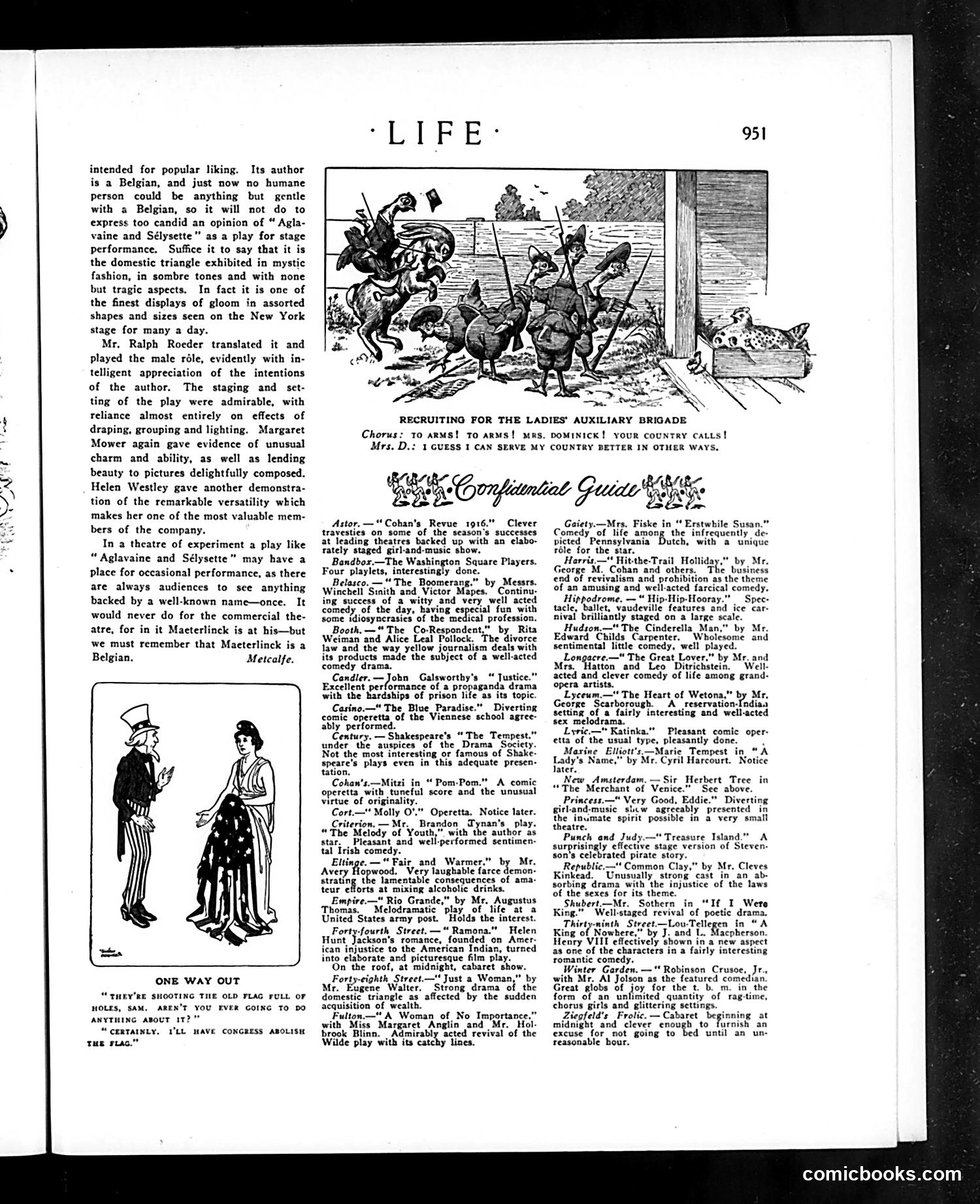
This page combines theater reviews with two cartoons satirizing WWI-era American attitudes. **"One Way Out"** (top left): A man complains that the American flag is being "shot full of holes," asking his companion Sam what he'll do about it. Sam's absurd solution—"I'll have Congress abolish the flag"—mocks defeatist or isolationist attitudes toward war damage, suggesting that avoiding the problem entirely is cowardly. **"Recruiting for the Ladies' Auxiliary Brigade"** (center): A woman is asked to join military service, responding she can "serve my country better in other ways." This satirizes women reluctant to support the war effort, implying their domestic role is insufficient patriotic contribution during wartime. Both cartoons use humor to pressure American civilian support for WWI, which the U.S. officially entered in 1917. The page's theater reviews appear standard contemporary entertainment coverage.
📄 Transcribed text from this page (OCR, searchable)
Machine-transcribed from the original scan — historical spelling and the odd misread are preserved.
intended for popular liking. Its author is a Belgian, and just now no humane person could be anything but gentle with a Belgian, so it will not do to express too candid an opinion of “ Agla- vaine and Sélysette” as a play for stage performance, Suffice it to say that it is the domestic triangle exhibited in mystic fashion, in sombre tones and with none but tragic aspects. In fact it is one of the finest displays of gloom in assorted shapes and sizes seen on the New York stage for many a day. Mr. Ralph Roeder translated it and played the male réle, evidently with in- telligent appreciation of the intentions of the author. The staging and set- ting of the play were admirable, with reliance almost entirely on effects of draping, grouping and lighting. Margaret Mower again gave evidence of unusual charm and ability, as well as lending beauty to pictures delightfully composed. Helen Westley gave another demonstra- tion of the remarkable versatility which makes her one of the most valuable mem- bers of the company. In a theatre of experiment a play like “ Aglavaine and Sélysette” may have a place for occasional performance, as there are always audiences to see anything backed by a well-known name—once. It would never do for the commercial the- atre, for in it Maeterlinck is at his—but we must remember that Maeterlinck is a Metcalfe. ONE WAY OUT “THEY'RE SHOOTING THE OLD FLAG FULL OF HOLES, SAM. AREN'T YOU EVER GoING To DO ANYTHING ABOUT IT?" “CERTAINLY, I'LL MAVE CONGRESS ABOLISIE TMB FLac.” RECRUITING FOR THE LADIES’ AUXILIARY BRIGADE Chorus: 10 arms! To arMS! MRS. DOMINICK! YouR CouNTRY CALLS! Mrs. D.: 1 GUESS I CAN SERVE MY COUNTRY BETTER IN OTHER WAYS. i Corpintiat Gut YN. Astor, —“Cohan's Revue 1916." Clever travesties on some of the season's successes at leading theatres backed up with an elabo- rately staged girl-and-music show. Bandbox.—The Washington Square Players. Four playlets, interestingly done. Belasco. —" The Boomerang.” by Messrs. Winchell Sinith and Victor Mapes. ing success of a witty and comedy of the day, having some idiosyncrasies of the m Booth. —“ The Co-Respondent,” by Rita Weiman and Alice Leal Pollock. The divorce law and the way yeliow journalism deals with its products made the subject of a well-acted comedy drama. Candler. —John Galsworthy’s _“ Justice. Excellent performance of a propaganda drama with the hardships of prison life as its topic. Casino. —" The Blue Paradise.” Diverting comic operetta of the Viennese school agree- ably performed. Century. — Shakespeare's “The Tempest. under the auspices of the Drama Society Not the most interesting or famous of Shaki speare's plays even in this adequate presen- Mitzi in “ Pom-Pom." A comic operetta with tuneful score and the unusual virtue of originality. * Operetta. Notice later. jon Tynan’s play, the author as star. Pleasant and well-performed sentimen- tal irish comedy. Eltinge, —" Fair_and Warmer." by Mr. Avery Hopwood. Very laughable farce demon: strating the lamentable consequences of ama. teur eflorts at mixing alcoholic drinks. Empire.— Rio Grande,” by Mr. Augustus Thomas. Melodramatic ‘play of ‘life at a United States army post. Holds the interest. Forty-fourth Street. —“ Ramona.” Helen Jackson's romance, founded on Amer- ican injustice to the American Indian, turned into elaborate and picturesque film play. On the roof, at midnight, cabaret show. Forty-cighth Street.— Just a Woman," by Mr. Eugene Walter. Strong drama of the domestic triangle as affected by the sudden acquisition of wealth. ulton.—"A Woman of No Importance, with Miss Margaret Anglin and Mr. Hol- brook Blinn. Admirably acted revival of the Wilde play with its catchy lines. Gaiety.—Mrs. Fiske in “ Erstwhile Susan.” Comedy of life among the infrequently de- picted Pennsylvania, Dutch, ‘with a unique réle for the star. Harris.—"' Hitthe-Trail Holliday.” by Mr. George M, Cohan and others, The bi end of revivalism and prohibition as the theme of an amusing and well-acted farcical comedy. Hippodrome. —“ Hip-Hip-Hooray.” Spec- tacle, ballet, vaudeville features and ice car- nival brilliantly staged on a large scale. The Cinderella Man,” by Mr. ‘lds Carpenter. Wholesome and sentimental little comedy, well played. Longacre.—" The Great Lover.” by Mr. and Mrs. Hatton and Leo Ditrichstein. Well- acted and clever comedy of life among grand- opera artists. Lyceum —" The Heart of Wetona.” by Mfr. George Scarborough. reservation-[ndiaa setting of a fairly interesting and well-acted sex melodrama, Lyric.—" Katinka.” Pleasant comic oper- etta of the usual type, pleasantly done. Marine Elliott's —Marie Tempest in “A Lady's Name," by Mr. Cyril Harcourt, Notice ater. New Amsterdam. —Sir Herbert Tree in “The Merchant of Venice.” See above. Princess.—" Very Good, Eddie.” Diverting girland-music slcw agreeably presented in the inumate spirit possible in a very small theat: 1y.—" Treasure Island.” A surprisingly effective stage version of Steven- son's celebrated pirate story. Republic.—* Common Clay,” by Mr. Cleves Kinkead. “Unusually strong’ cast in an. ab- sorbing drama with the injustice of the laws of the sexes for its theme. ert—Mr. Sothern in “If I Were Weil-staged revival of poetic drama. Thirty: gt sLouTellegen in" A King o by J. and L. Macpherson. Henry VIII effectively shown in a new aspect as one of the characters in a fairly interesting romantic comedy. Winter Garden. —"* Robinson Crusoe, Jr, with Mr. Al Jolson as the featured comedian. Great globs of joy for the t. b. m. in the form of an unlimited quantity of ragtime, chorus girls and glittering settings. Ziegfeld's Frolic. —Cabaret beginning at midnight and clever enough to furnish an excuse for not going to bed until an un- reasonable hour. comicbooks.com