
Life, 1916-05-18 · page 30 of 48
Life — May 18, 1916 — page 30: what you’re looking at
What you’re looking at
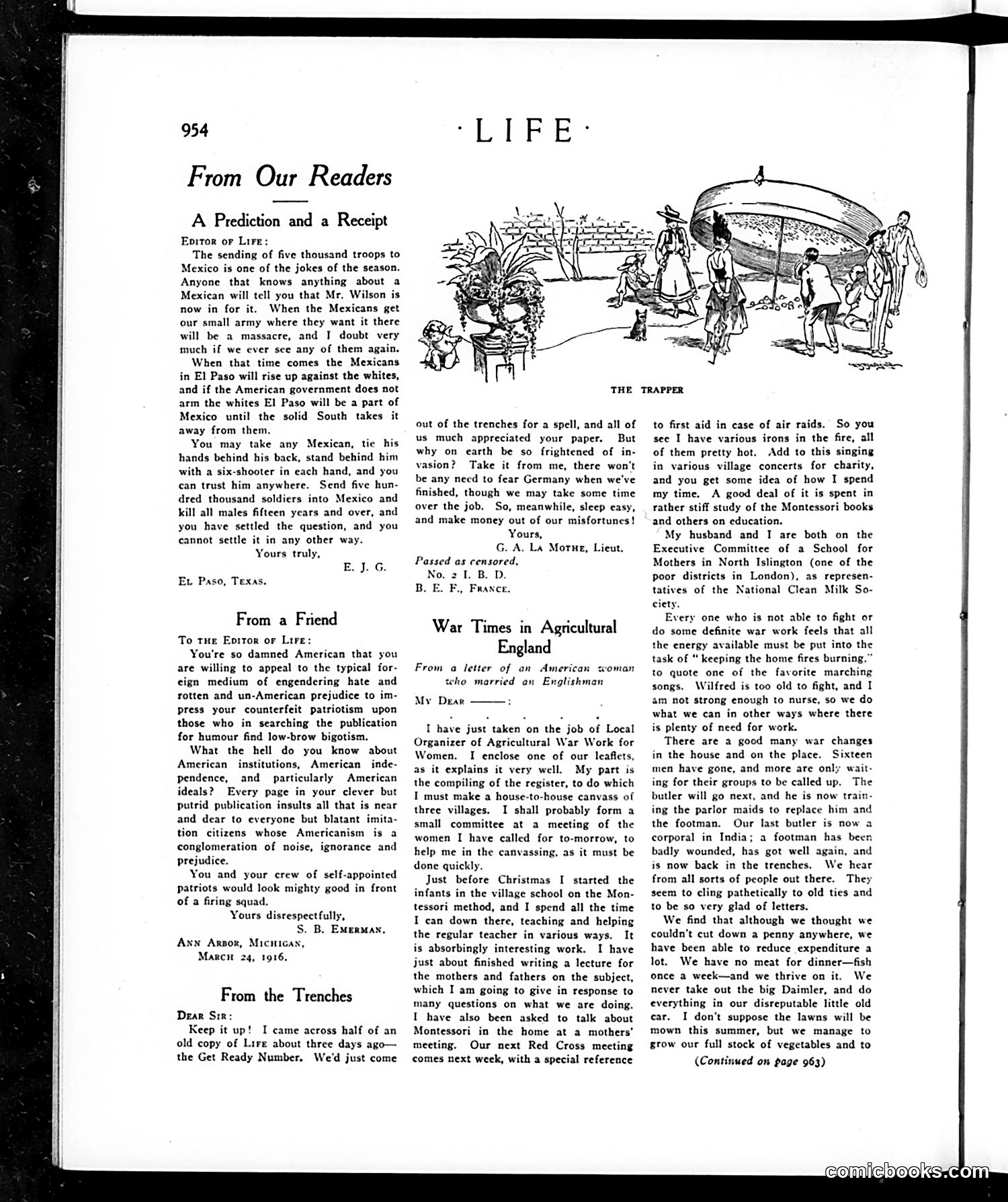
This page contains reader letters responding to Life's editorial content, primarily about U.S.-Mexico relations and World War I. **"A Prediction and a Receipt"** presents an inflammatory letter from El Paso predicting disaster if American troops are sent to Mexico—advocating instead for mass killing of Mexican males. Life published this extremist view alongside a rebuke from "A Friend," who attacks Life itself for promoting "hate and rotten and un-American prejudice" through bigoted content. **"From the Trenches"** features a British officer reassuring Americans not to fear German invasion, urging them to profit from the war instead—likely satirizing American profiteering from WWI. **"War Times in Agricultural England"** is a correspondent's account of wartime domestic work, describing village agricultural organization and Montessori education efforts—illustrating civilian contribution to the war effort. The cartoon **"The Trapper"** (illustration) remains unclear without additional context. The page reflects 1916 tensions: Mexican-American conflict, American neutrality debates, and WWI's widening impact.
📄 Transcribed text from this page (OCR, searchable)
Machine-transcribed from the original scan — historical spelling and the odd misread are preserved.
954 From Our Readers A Prediction and a Receipt Epitor or Lire: The sending of five thousand troops to Mexico is one of the jokes of the season. Anyone that knows anything about a Mexican will tell you that Mr. Wilson is now in for it. When the Mexicans get our small army where they want it there will be a massacre, and J doubt very much if we ever sce any of them again. When that time comes the Mexicans in El Paso will rise up against the whites, and if the American government does not arm the whites El Paso will be a part of Mexico until the solid South takes it away from them. You may take any Mexican, tie his hands behind his back, stand behind him with a six-shooter in each hand, and you can trust him anywhere. Send five hun- dred thousand soldiers into Mexico and kill all males fifteen years and over, and you have settled the question, and you cannot settle it in any other way. Yours truly, E. J. G. Et Paso, Texas. From a Friend To tue Epitor of Lire: You're so damned American that you are willing to appeal to the typical for- eign medium of engendering hate and rotten and un-American prejudice to im- press your counterfeit patriotism upon those who in searching the publication for humour find low-brow bigotism. What the hell do you know about American institutions, American inde- pendence, and particularly American ideals? Every page in your clever but putrid publication insults all that is near and dear to everyone but blatant imita- tion citizens whose Americanism is a conglomeration of noise, ignorance and Prejudice. You and your crew of self-appointed Patriots would look mighty good in front of a firing squad. Yours disrespectfully, S. B. EMErman. Ann Arpor, Miciicay, Marcit 24, 1916, From the Trenches Dear Siz: Keep it up! I came across half of an old copy of Lire about three days ago— the Get Ready Number. We'd just come THE TRAPPER out of the trenches for a spell, and all of us much appreciated your paper. But why on earth be so frightened of in- vasion? Take it from me, there won't be any need to fear Germany when we've finished, though we may take some time over the job. So, meanwhile, sleep easy, and make money out of our misfortunes! Yours, G. A, La Morne, Lieut. Passed as censored, No. 2 I. B. D. B. » France. War Times in Agricultural England From a letter of an American woman sho married an Englishman My Dear I have just taken on the job of Local Organizer of Agricultural War Work for Women. I enclose one of our leaflets, as it explains it very My part is the compiling of the register, to do which IT must make a house-to-house canvass of three villages. I shall probably form a small committee at a meeting of the women I have called for to-morrow, to help me in the canvassing, as it must be done quickly. Just before Christmas I started the infants in the village school on the Mon- tessori method, and I spend all the time I can down there, teaching and helping the regular teacher in various ways. It is absorbingly interesting work. I have just about finished writing a lecture for the mothers and fathers on the subject, which I am going to give in response to many questions on what we are doing. I have also been asked to talk about Montessori in the home at a mothers’ meeting. Our next Red Cross meeting comes next week, with a special reference to first aid in case of air raids. So you see I have various irons in the fire, all of them pretty hot. Add to this singing in various village concerts for charity, and you get some idea of how I spend my time. A good deal of it is spent in rather stiff study of the Montessori books and others on education. My husband and I are both on the Executive Committee of a School for Mothers in North Islington (one of the poor districts in London), as represen- tatives of the National Clean Milk So- ciety. Every one who is not able to fight or do some definite war work feels that all the energy available must be put into the task of “ keeping the home fires burning,” to quote one of the favorite marching songs. Wilfred is too old to fight, and I am not strong enough to nurse, so we do what we can in other ways where there is plenty of need for work. There are a good many war changes in the house and on the place. Sixteen men have gone, and more are only wait- ing for their groups to be called up. The butler will go next, and he is now train- ing the parlor maids to replace him and the footman. Our last butler is now a corporal in India; a footman has been badly wounded, has got well again, and is now back in the trenches. We hear from all sorts of people out there. They seem to cling pathetically to old ties and to be so very glad of letters. We find that although we thought we couldn't cut down a penny anywhere, we have been able to reduce expenditure a lot. We have no meat for dinner—fish once a week—and we thrive on it. We never take out the big Daimler, and do everything in our disreputable little old car. I don’t suppose the lawns will be mown this summer, but we manage to grow our full stock of vegetables and to (Continued on page 963)