
Life, 1916-05-18 · page 23 of 48
Life — May 18, 1916 — page 23: what you’re looking at
What you’re looking at
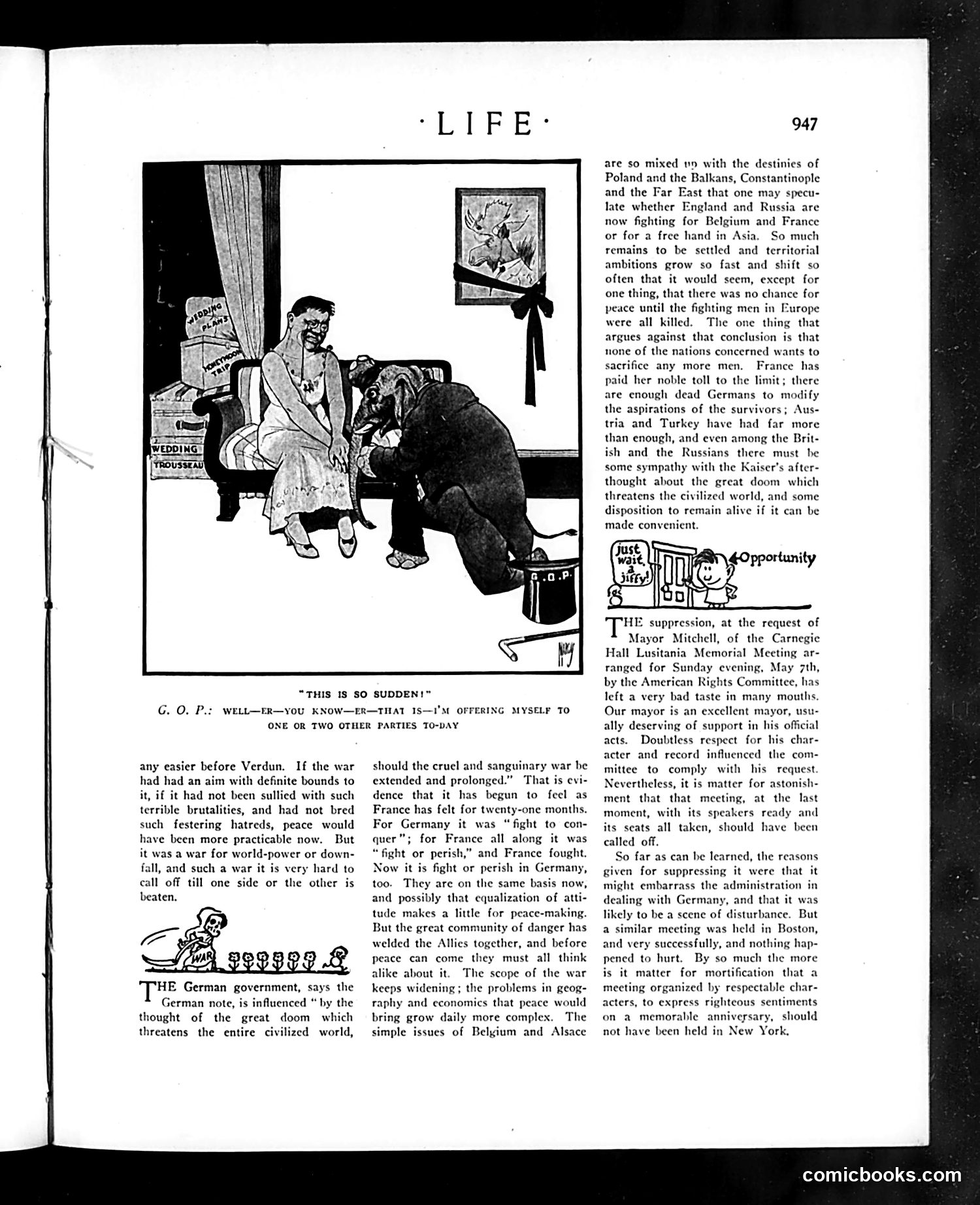
The main cartoon depicts the Republican Party (labeled "G.O.P.") as a woman in a wedding dress, awkwardly proposing to other political parties. The figure sits holding a "Wedding Trousseau" bag, offering herself to "one or two other parties to-day." This satirizes Republican political desperation during what appears to be WWI-era American politics. The cartoonist mocks the GOP's apparent willingness to align with competing parties, suggesting internal weakness or loss of political principle. The bride imagery emphasizes the absurdity and shamelessness of the proposal. The surrounding text discusses broader WWI peace negotiations and Mayor Mitchell's controversial suppression of a Lusitania Memorial Meeting at Carnegie Hall—an event meant to commemorate the 1915 ship sinking. The mayor's censorship is criticized as cowardly and unworthy of New York, suggesting the suppression was politically motivated rather than justified.
📄 Transcribed text from this page (OCR, searchable)
Machine-transcribed from the original scan — historical spelling and the odd misread are preserved.
“THIS 1S SO SUDDEN!” G. O. P.: WELL—ER—YOU KNOW—ER—THAT IS—I'M OFFERING MYSELF TO ONE OR TWO OTHER PARTIES TO-DAY any easier before Verdun. If the war had had an aim with definite bounds to it, if it had not been sullied with such terrible brutalities, and had not bred such festering hatreds, peace would have been more practicable now. But it was a war for world-power or down- Il, and such a war it is very hard to call off till one side or the other is beaten, Ape Ae 'HE German government, says the German note, is influenced “ by the thought of the great doom which threatens the entire civilized world, should the cruel and sanguinary war be extended and prolonged.” That is evi- dence that it has begun to feel as France has felt for twenty-one month For Germany it was “fight to con- quer”; for France all along it was “fight or perish,” and France fought. Now it is fight or perish in Germany, too. They are on the same basis now, and possibly that equalization of atti- tude makes a little for peace-making. But the great community of danger has welded the Allies together, and before peace can come they must all think alike about it. The scope of the war keeps widening; the problems in geog- raphy and economics that peace would bring grow daily more complex. The simple issues of Belgium and Alsace 947 are so mixed un with the destinies of Poland and the Balkans, Constantinople and the Far East that one may specu- late whether England and Russia are now fighting for Belgium and France or for a free hand in Asia, So much remains to be settled and territorial ambitions grow so fast and shift so often that it would seem, except for one thing, that there was no chance for peace until the fighting men in Europe were all killed. The one thing that argues against that conclusion is that none of the nations concerned wants to sacrifice any more men. France has paid her noble toll to the limit; there are enough dead Germans to modify the aspirations of the survivors; Aus- tria and Turkey have had far more than enough, and even among the Brit- ish and the Russians there must be some sympathy with the Kaiser's after- thought about the great doom which threatens the civilized world, and some disposition to remain alive if it can be made convenient. HE suppression, at the request of Mayor Mitchell, of the Carnegie Hall Lusitania Memorial Meeting ar- ranged for Sunday evening, May 7th, by the American Rights Committee, has left a very bad taste in many mouths. Our mayor is an excellent mayor, usu- ally deserving of support in his official acts. Doubtless respect for his ¢l acter and record influenced the com- mittee to comply with his request Nevertheless, it is matter for astonish- ment that that meeting, at the last moment, with its speakers ready and its seats all taken, should have been called off. So far as can be learned, the reasons given for suppressing it were that it might embarrass the administration in dealing with Germany, and that it was likely to be a scene of disturbance. But a similar meeting was held in Boston, and very successfully, and nothing hap- pened to hurt. By so much the more is it matter for mortification that a meeting organized by respectable char- acters, to express righteous sentiments on a memorable anniversary, should not have been held in New York, comicbooks.com