
Life, 1916-05-18 · page 31 of 48
Life — May 18, 1916 — page 31: what you’re looking at
What you’re looking at
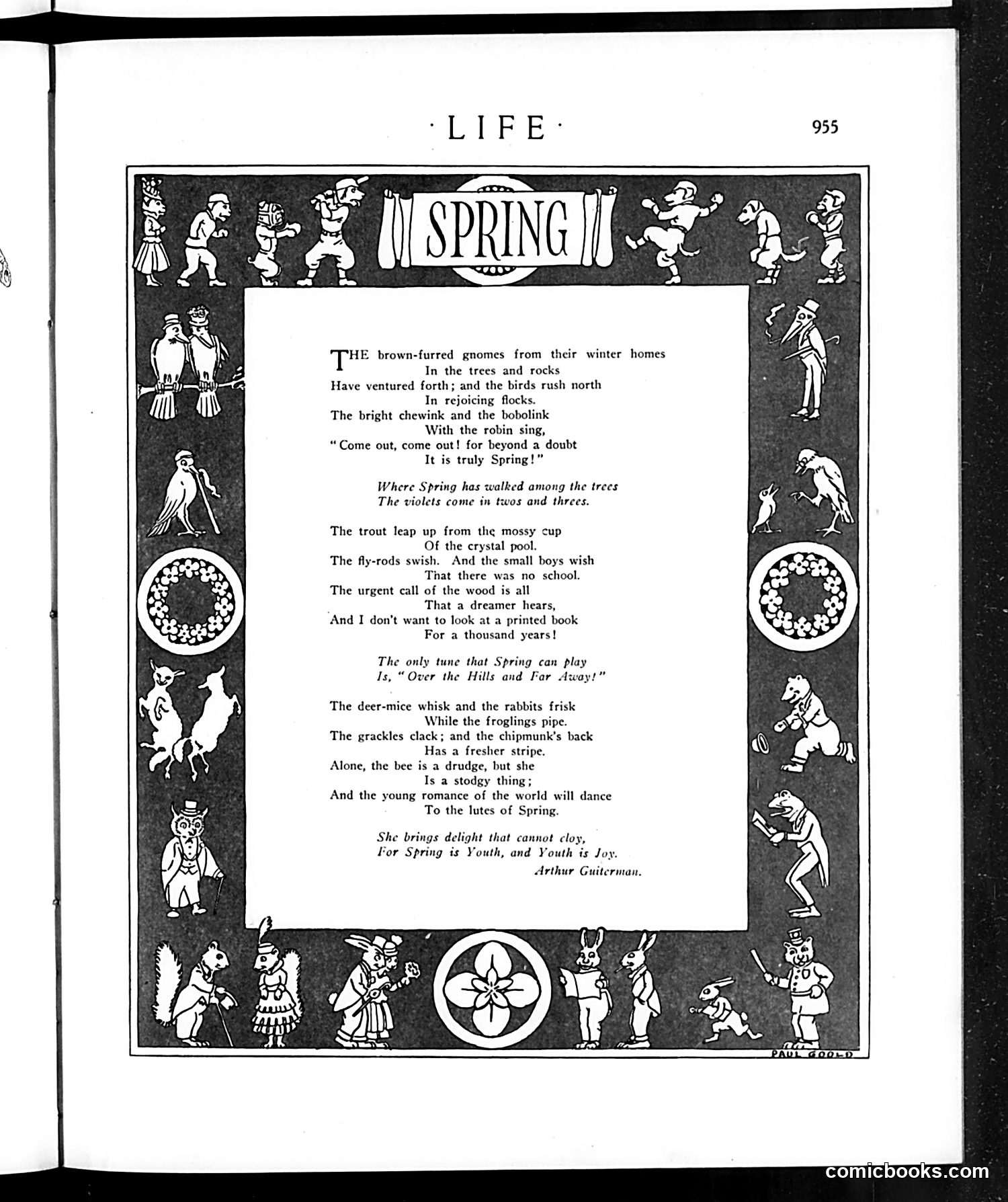
This is a decorative poem celebrating springtime, surrounded by an ornamental border of whimsical illustrations. The page contains no political satire or social commentary—it's purely celebratory verse. The poem romanticizes spring's arrival: animals emerge, birds return north, and nature awakens. A key theme is spring's irresistible call to abandon indoor life ("I don't want to look at a printed book / For a thousand years!") and schoolwork ("the small boys wish / That there was no school"). The border illustrations depict playful figures—children, animals, mythological creatures—reinforcing the season's association with youthful joy and renewal. The final lines equate Spring with Youth and Youth with Joy, making this an idealized, sentimental tribute to the season's transformative power rather than commentary on contemporary issues.
📄 Transcribed text from this page (OCR, searchable)
Machine-transcribed from the original scan — historical spelling and the odd misread are preserved.
a 'HE brown-furred gnomes from their winter homes In the trees and rocks Have ventured forth; and the birds rush north In rejoicing flocks. The bright chewink and the bobolink With the robin sing, “Come out, come out! for beyond a doubt It is truly Spring!” Where Spring has walked among the trees The violets come in twos and threes. The trout leap up from the mossy cup Of the crystal pool. The fly-rods swish. And the small boys wish That there was no school. The urgent call of the wood is all That a dreamer hears, And I don’t want to look at a printed book For a thousand years! The only tune that Spring can play Is, “Over the Hills and Far Away!” The deer-mice whisk and the rabbits frisk While the froglings pipe. The grackles clack; and the chipmunk’s back Has a fresher stripe. Alone, the bee is a drudge, but she Is a stodgy thing; And the young romance of the world will dance To the lutes of Spring. She brings delight that cannot cloy, For Spring is Youth, and Youth is Joy. Arthur Guiterman, comicbooks.com