
Life, 1916-05-18 · page 14 of 48
Life — May 18, 1916 — page 14: what you’re looking at
What you’re looking at
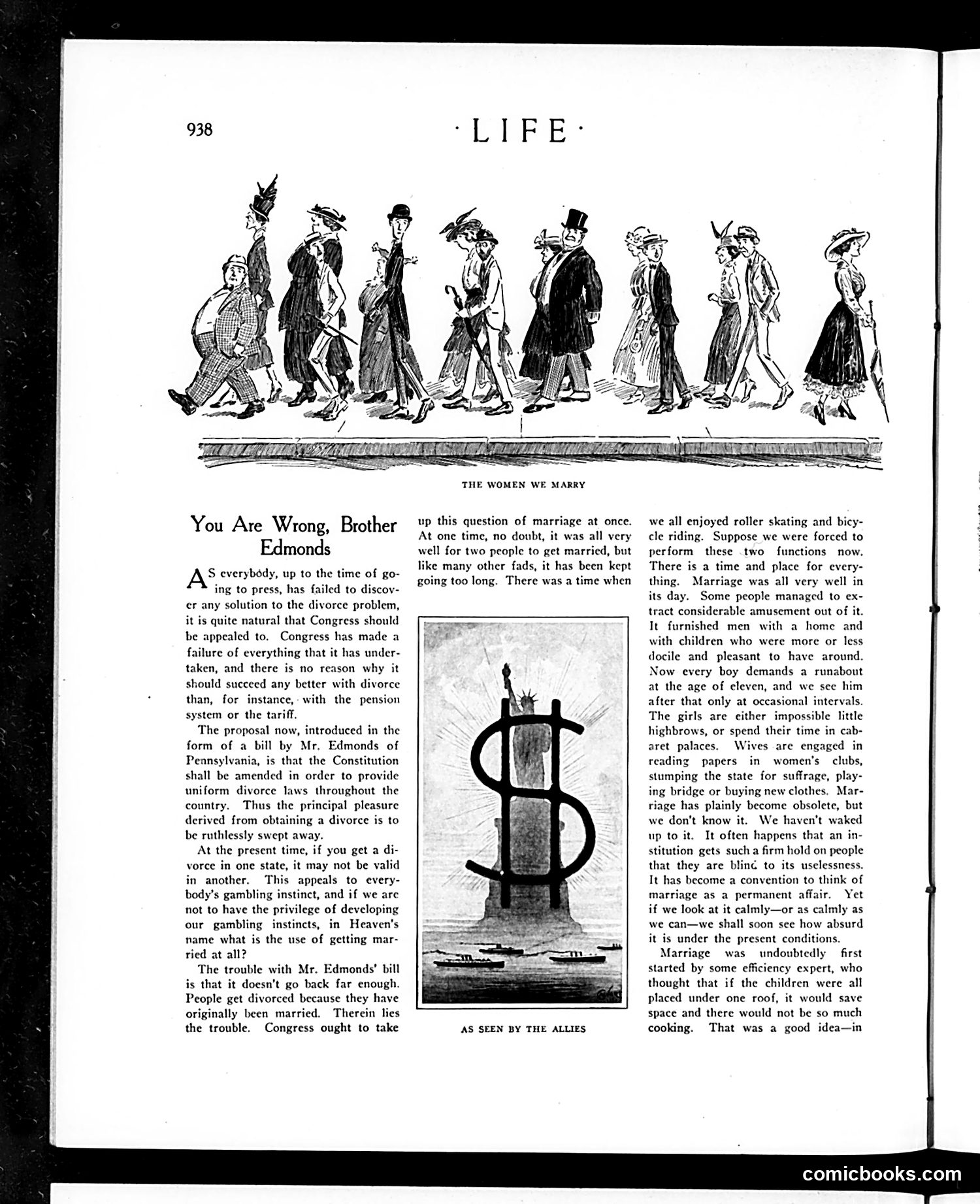
This page from *Life* magazine satirizes marriage and divorce reform. The main article, "You Are Wrong, Brother Edmonds," argues against a proposed bill by Mr. Edmonds of Pennsylvania that would standardize divorce laws nationwide. The cartoon at top, titled "The Women We Marry," depicts a line of women in various states of fashionable dress and demeanor—likely satirizing the diversity of modern women and changing gender roles. The central illustration, "As Seen by the Allies," shows a dollar sign with what appears to be a classical monument, likely criticizing how marriage has become commercialized or how financial considerations dominate matrimonial decisions. The text mocks the notion that marriage is "obsolete" and argues marriage reform should address why people marry in the first place, rather than simply making divorce easier.
📄 Transcribed text from this page (OCR, searchable)
Machine-transcribed from the original scan — historical spelling and the odd misread are preserved.
You Are Wrong, Brother Edmonds S everybédy, up to the time of go- ing to press, has failed to discov- er any solution to the divorce problem, it is quite natural that Congress should be appealed to. Congress has made a failure of everything that it has under- taken, and there is no reason why it should succeed any better with divorce than, for instance, with the pension system or the tariff. The proposal now, introduced in the form of a bill by Mr. Edmonds of Pennsylvania, is that the Constitution shall be amended in order to provide uniform divorce laws throughout the country. Thus the principal pleasure derived from obtaining a divorce is to be ruthlessly swept away. At the present time, if you get a di- vorce in one state, it may not be valid in another. This appeals to every- body’s gambling instinct, and if we arc not to have the privilege of developing our gambling instincts, in Heaven's name what is the use of getting mar- ried at all? The trouble with Mr. Edmonds’ bill is that it doesn’t go back far enough. People get divorced because they have originally been married. Therein lies the trouble. Congress ought to take THE WOMEN WE MARRY up this question of marriage at once. At one time, no doubt, it was all very well for two people to get married, but like many other fads, it has been kept going too long. There was a time when —— AS SEEN BY THE ALLIES we all enjoyed roller skating and bicy- cle riding. Suppose we were forced to perform these two functions now. There is a time and place for every- thing. Marriage was all very well in its day. Some people managed to e: tract considerable amusement out of it. It furnished men with a home and with children who were more or less docile and pleasant to have around. Now every boy demands a runabout at the age of eleven, and we see him after that only at occasional intervals. The girls are cither impossible little highbrows, or spend their time in cab- aret palaces. Wives are engaged in reading papers in women’s clubs, stumping the state for suffrage, play- ing bridge or buying new clothes. Mar- riage has plainly become obsolete, but we don’t know it. We haven't waked up to it. It often happens that an in- stitution gets such a firm hold on people that they are bliné to its uselessness. It has become a convention to think of marriage as a permanent affair. Yet if we look at it calmly—or as calmly as we can—we shall soon see how absurd it is under the present conditions. Marriage was undoubtedly first started by some efficiency expert, who thought that if the children were all placed under one roof, it would save space and there would not be so much cooking. That was a good idea—in comicbooks.com