
Life, 1916-05-18 · page 4 of 48
Life — May 18, 1916 — page 4: what you’re looking at
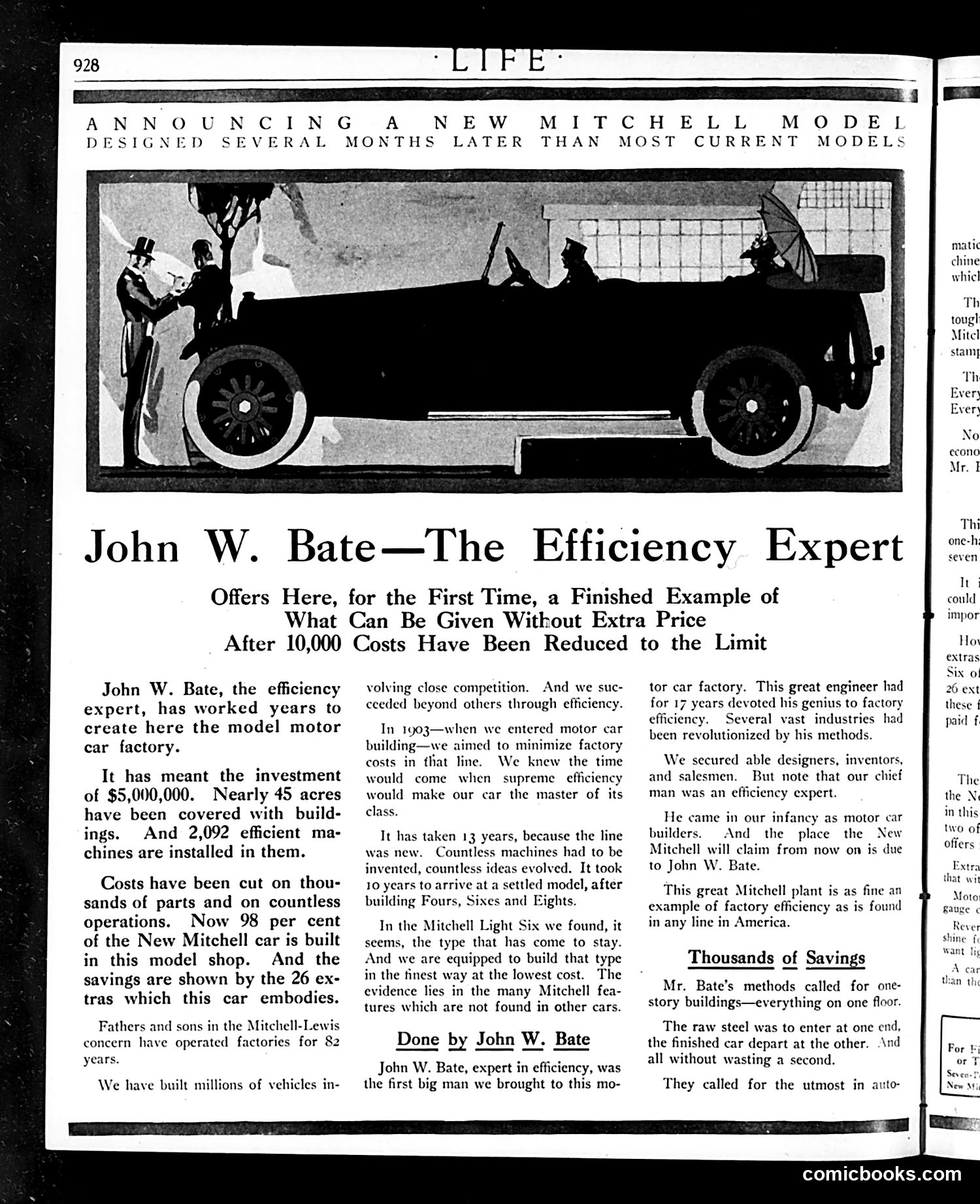
What you’re looking at
This is not satire—it's a straightforward **advertisement** for Mitchell automobiles, specifically announcing a new model designed by efficiency expert John W. Bate. The silhouette illustration shows a luxury touring car with well-dressed passengers, emphasizing elegance and status. The text promotes Bate's credentials: he reduced manufacturing costs through efficiency innovations at Mitchell's factory (reportedly saving thousands through streamlined production methods and a one-story building layout). The "satire" framing comes from Life magazine's editorial context—the publication often ran advertisements alongside humorous content. However, this particular page is promotional, celebrating American industrial efficiency and manufacturing innovation as competitive advantages during the early automotive era (circa 1916).
📄 Transcribed text from this page (OCR, searchable)
Machine-transcribed from the original scan — historical spelling and the odd misread are preserved.
UN CING SEVERAL ANN O DESIGNED MONTHS E W LATER THAN MITCHELL MOST MODEI CURRENT MODELS John W. Bate—The Efficiency Expert Offers Here, for the First Time, a Finished Example of What Can Be Given Without Extra Price After 10,000 Costs Have Been Reduced to the Limit John W. Bate, the efficiency expert, has worked years to create here the model motor car factory. It has meant the investment of $5,000,000. Nearly 45 acres have been covered with build- ings. And 2,092 efficient ma- chines are installed in them. Costs have been cut on thou- sands of parts and on countless operations. Now 98 per cent of the New Mitchell car is built in this model shop. And the savings are shown by the 26 ex- tras which this car embodies. Fathers and sons in the Mitchell-Lewis concern have operated factories for 82 years. We have built millions of vehicles in- volving close competition. And we suc- eceded beyond others through efficiency. In 1903—when we entered motor car building—we aimed to minimize factory costs in that line. We knew the time would come when supreme efficiency would make our car the master of its class. It has taken 13 years, because the line was new. Countless machines had to be invented, countless ideas evolved. It took 10 years to arrive at a settled model, after building Fours, Sixes and Eights. In the Mitchell Light Six we found, it seems, the type that has come to stay. And we are equipped to build that type in the finest way at the lowest cost. The evidence lies in the many Mitchell fea- tures which are not found in other cars. Done by John W. Bate John W. Bate, expert in efficiency, was the first big man we brought to this mo- tor car factory. This great engineer had for 17 years devoted his genius to factory efficiency. Several vast industries had been revolutionized by his methods. We secured able designers, inventors, and salesmen. But note that our chief man was an efficiency expert. He came in our infancy as motor car builders. And the place the New Mitchell will claim from now on is due to John W. Bate. This great Mitchell plant is as fine an example of factory efficiency as is found in any line in America. Thousands of Savings Mr. Bate’s methods called for one- story buildings—everything on one floor. The raw steel was to enter at one end, the finished car depart at the other. \nd all without wasting a second. They called for the utmost in auto- matic chine whiel Th tougl Mitel stamy econo Mr. I Thi one-h. seven Tt could impor Hoy extras Six of 26 ext these f paid f The the N, in this two of offers comicbooks.com