
Life, 1916-05-18 · page 26 of 48
Life — May 18, 1916 — page 26: what you’re looking at
What you’re looking at
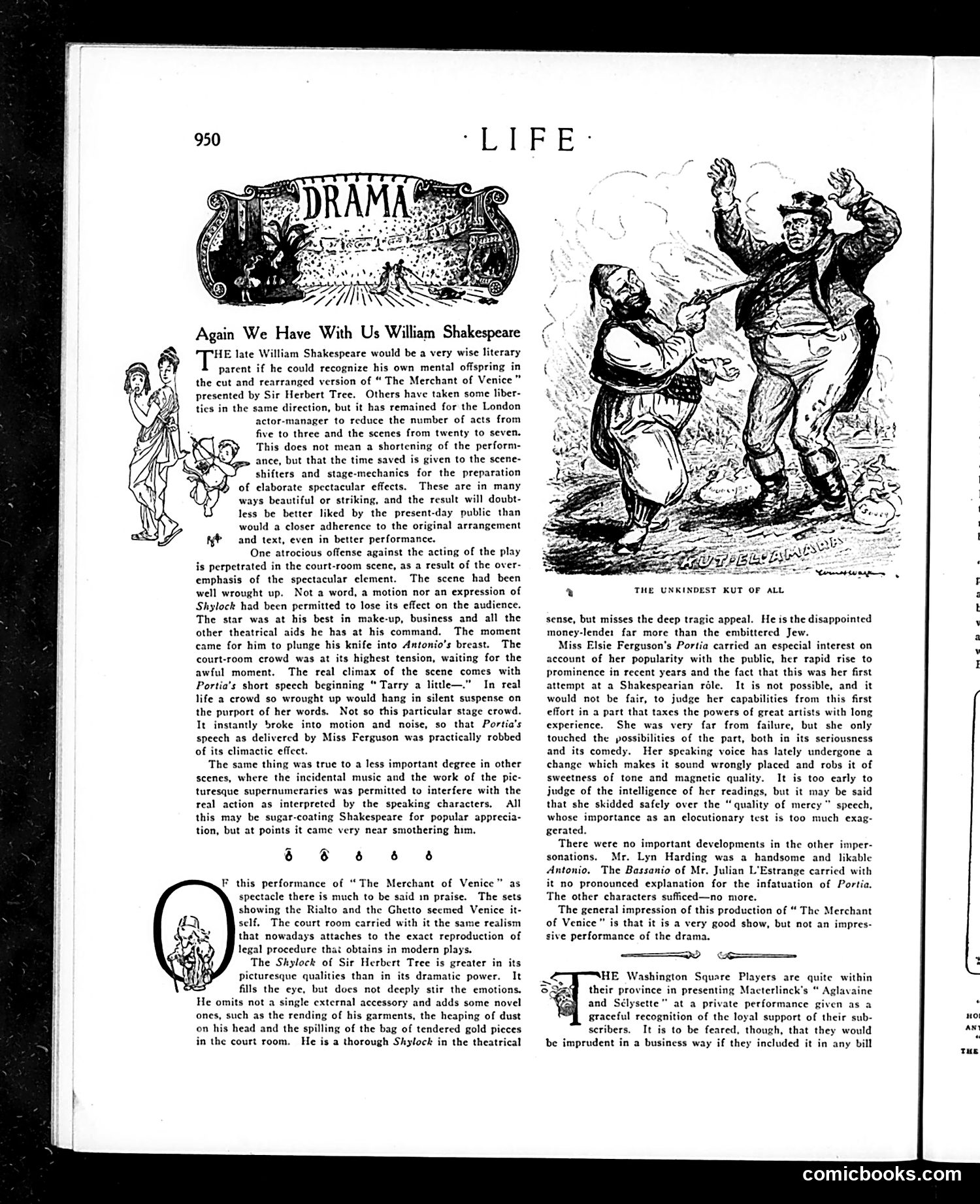
This is a theater review critiquing Sir Herbert Tree's production of Shakespeare's *The Merchant of Venice*. The cartoon titled "The Unkindest Kut of All" (visible on the right) depicts a figure being stabbed, likely referencing Shylock's knife attack on Antonio—the play's climactic moment. The review's satire targets Tree's directorial choices: he reduced the five-act play to three acts and twenty scenes to seven, not to shorten performance time, but to allow more time for elaborate scenic effects and stage machinery. The critic argues this "sugar-coats Shakespeare for popular appreciation" and actually undermines the drama. The review particularly criticizes Tree's performance as Shylock for emphasizing theatrical spectacle and external details (costume business, stage effects) over genuine emotional depth and tragic power. It also notes Miss Elsie Ferguson's capable but somewhat limited debut as Portia. The central complaint: prioritizing visual grandeur and mechanical effects drowns out the actors and Shakespeare's actual dramatic impact.
📄 Transcribed text from this page (OCR, searchable)
Machine-transcribed from the original scan — historical spelling and the odd misread are preserved.
Again We Have With Us William Shakespeare ‘HE late William Shakespeare would be a very wise literary parent if he could recognize his own mental offspring in the cut and rearranged version of “ The Merchant of Venice” presented by Sir Herbert Tree. Others have taken some liber- tics in the same direction, but it has remained for the London actor-manager to reduce the number of acts from five to three and the scenes from twenty to seven. This does not mean a shortening of the perform- ance, but that the time saved is given to the scene- shifters and stage-mechanics for the preparation of elaborate spectacular effects. These are in many ways beautiful or striking, and the result will doubt- less be better liked by the present-day public than would a closer adherence to the original arrangement and text, even in better performance. One atrocious offense against the acting of the play is perpetrated in the court-room scene, as a result of the over- emphasis of the spectacular element. The scene had been well wrought up. Not a word, a motion nor an expression of Shylock had been permitted to lose its effect on the audience. The star was at his best in make-up, business and all the other theatrical aids he has at his command, The moment came for him to plunge his knife into Antonio’s breast. The court-room crowd was at its highest tension, waiting for the awful moment. The real climax of the scene comes with Portia’s short speech beginning “ Tarry a little—.” In real life a crowd so wrought up would hang in silent suspense on the purport of her words. Not so this particular stage crowd. It instantly broke into motion and noise, so that Portia’s speech as delivered by Miss Ferguson was practically robbed of its climactic effect. The same thing was true to a less important degree in other scenes, where the incidental music and the work of the pic- turesque supernumeraries was permitted to interfere with the real action as interpreted by the speaking characters, All this may be sugar-coating Shakespeare for popular apprecia- tion, but at points it came very near smothering him. 6 6 86 6 8 this performance of “‘The Merchant of Venice” as spectacle there is much to be said in praise. The sets showing the Rialto and the Ghetto seemed Venice it- self, The court room carried with it the same realism that nowadays attaches to the exact reproduction of legal procedure thai obtains in modern plays. The Shylock of Sir Herbert Tree is greater in its picturesque qualities than in its dramatic power. It fills the eye, but docs not deeply stir the emotions. He omits not a single external accessory and adds some novel ones, such as the rending of his garments, the heaping of dust on his head and the spilling of the bag of tendered gold pieces in the court room. He is a thorough Shylock in the theatrical THE UNKINDEST KUT OF ALL sense, but misses the deep tragic appeal. He is the disappointed money-lendet far more than the embittered Jew. Miss Elsie Ferguson's Portia carried an especial interest on account of her popularity with the public, her rapid rise to Prominence in recent years and the fact that this was her first attempt at a Shakespearian role. It is not possible, and it would not be fair, to judge her capabilities from this first effort in a part that taxes the powers of great artists with long experience. She was very far from failure, but she only touched the possibilities of the part, both in its seriousness and its comedy. Her speaking voice has lately undergone a change which makes it sound wrongly placed and robs it of sweetness of tone and magnetic quality. It is too early to judge of the intelligence of her readings, but it may be said that she skidded safely over the “quality of mercy” speech, whose importance as an elocutionary test is too much exag- gerated, There were no important developments in the other imper- sonations. Mr. Lyn Harding was a handsome and likable Antonio, The Bassanio of Mr. Julian ‘strange carried with it no pronounced explanation for the infatuation of Portia. The other characters sufficed—no more. The general impression of this production of “ The Merchant of Venice” is that it is a very good show, but not an impres- sive performance of the drama. —— Wd HE Washington Square Players are quite within their province in presenting Macterlinck’s glavaine and Sélysette" at a private performance given as a graceful recognition of the loyal support of their sub- scribers. It is to be feared, though, that they would be imprudent in a business way if they included it in any bill comicbooks.com