
A complete issue · 68 pages · 1914
Life — April 2, 1914
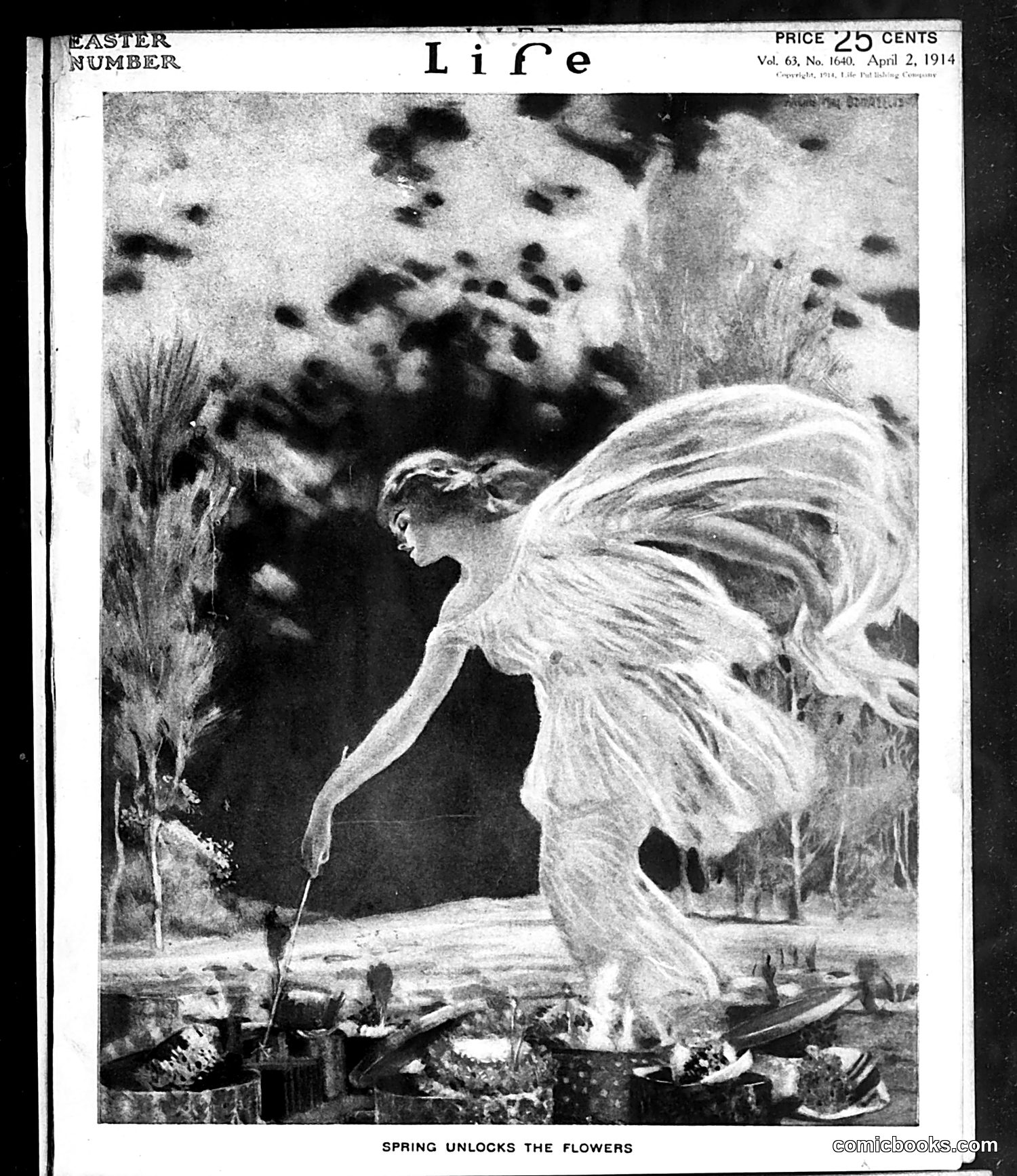
This is an Easter-themed allegorical illustration rather than political satire. The caption "Spring Unlocks the Flowers" depicts a winged female figure (personifying Spring) in flowing drapery, gesturing toward blooming flowers emerging from the ground. The image uses classical artistic convention—the allegorical female figure was a standard way magazines illustrated seasonal transitions and natural renewal in early 20th-century American publications. The dramatic lighting and detailed rendering were typical of Life's cover art during this period. This appears to be straightforward seasonal artwork celebrating Easter and springtime, rather than commentary on contemporary political or social events. It exemplifies the type of decorative, allegorical imagery commonly used in magazines of this era.
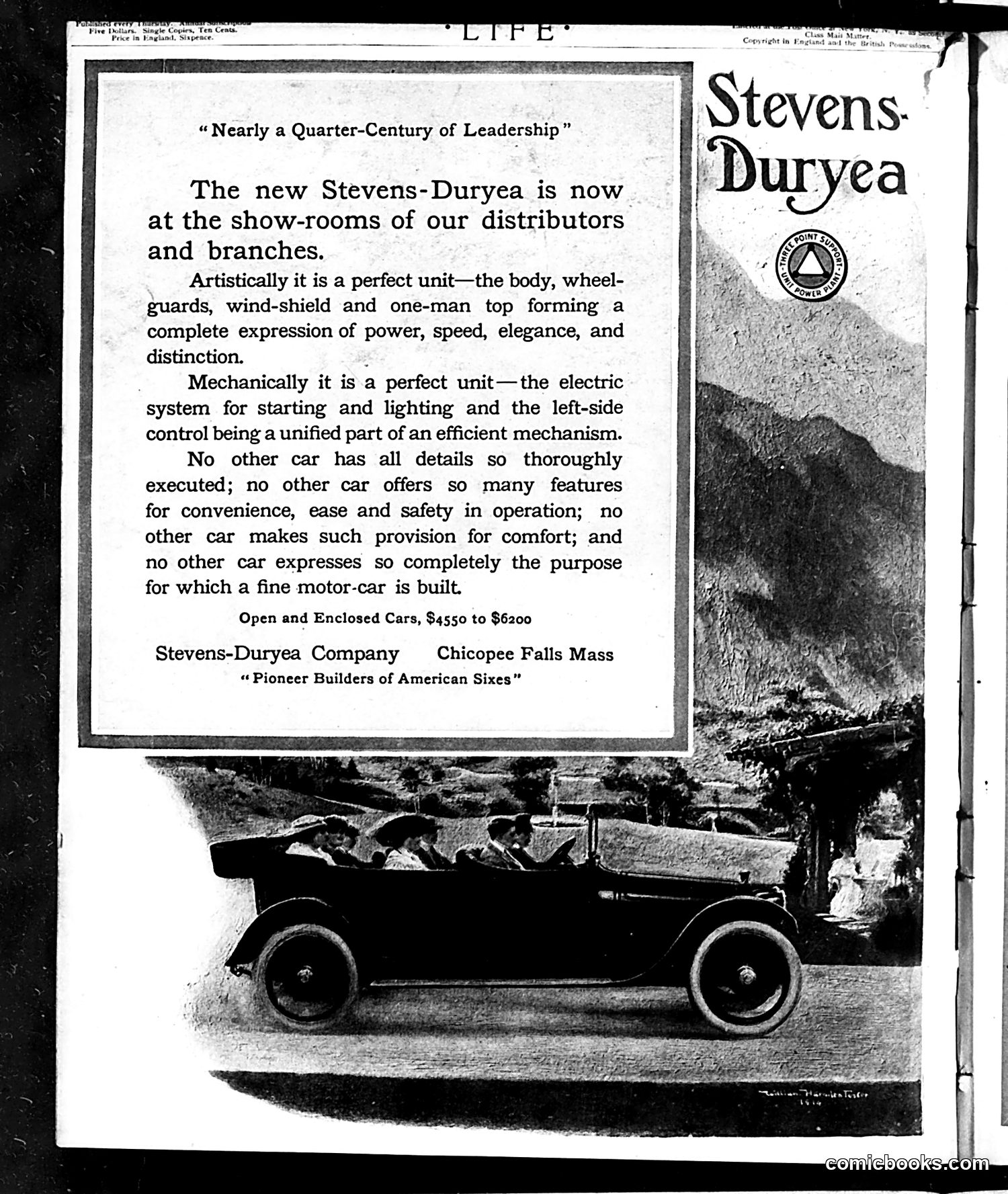
This is **not a cartoon or satire**—it's a straightforward automobile advertisement from Life magazine's early automotive era. The page promotes the Stevens-Duryea motorcar, manufactured in Chicopee Falls, Massachusetts, marketed as "Pioneer Builders of American Sixes." The ad emphasizes the vehicle's artistic and mechanical superiority, claiming no competitor offers comparable features for "convenience, ease and safety." Price range: $4,550 to $6,200 (substantial sums for the period). The accompanying photograph shows an open-air touring car with passengers, positioned dramatically against a scenic mountain backdrop—a common advertising strategy to associate the automobile with leisure, adventure, and social status. The phrase "Nearly a Quarter-Century of Leadership" suggests the company's established reputation.
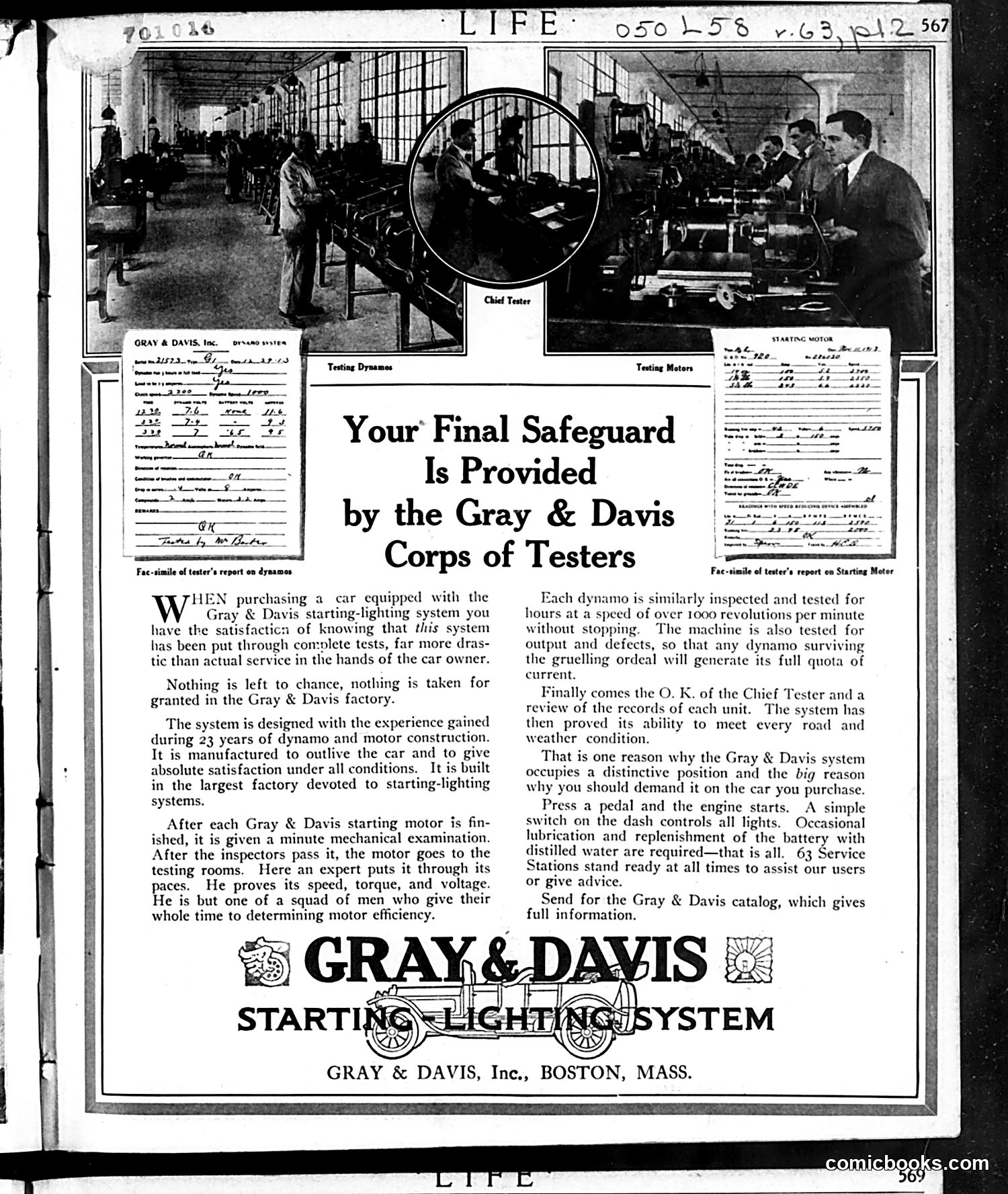
This page is **primarily an advertisement**, not satirical content. It promotes the Gray & Davis Starting-Lighting System for automobiles, published in *Life* magazine. The ad features factory photographs showing testing equipment and workers inspecting dynamos and starting motors. The central message emphasizes quality control: each component undergoes rigorous testing at "over 1000 revolutions per minute" to ensure reliability. The headline—"Your Final Safeguard Is Provided by the Gray & Davis Corps of Testers"—markets the product through assurance of thorough inspection. The text appeals to car buyers' desire for dependable starting systems, mentioning 23 years of manufacturing experience. This reflects early automotive-era concerns about reliability. There is **no political satire or caricature** present—it's straightforward industrial advertising.
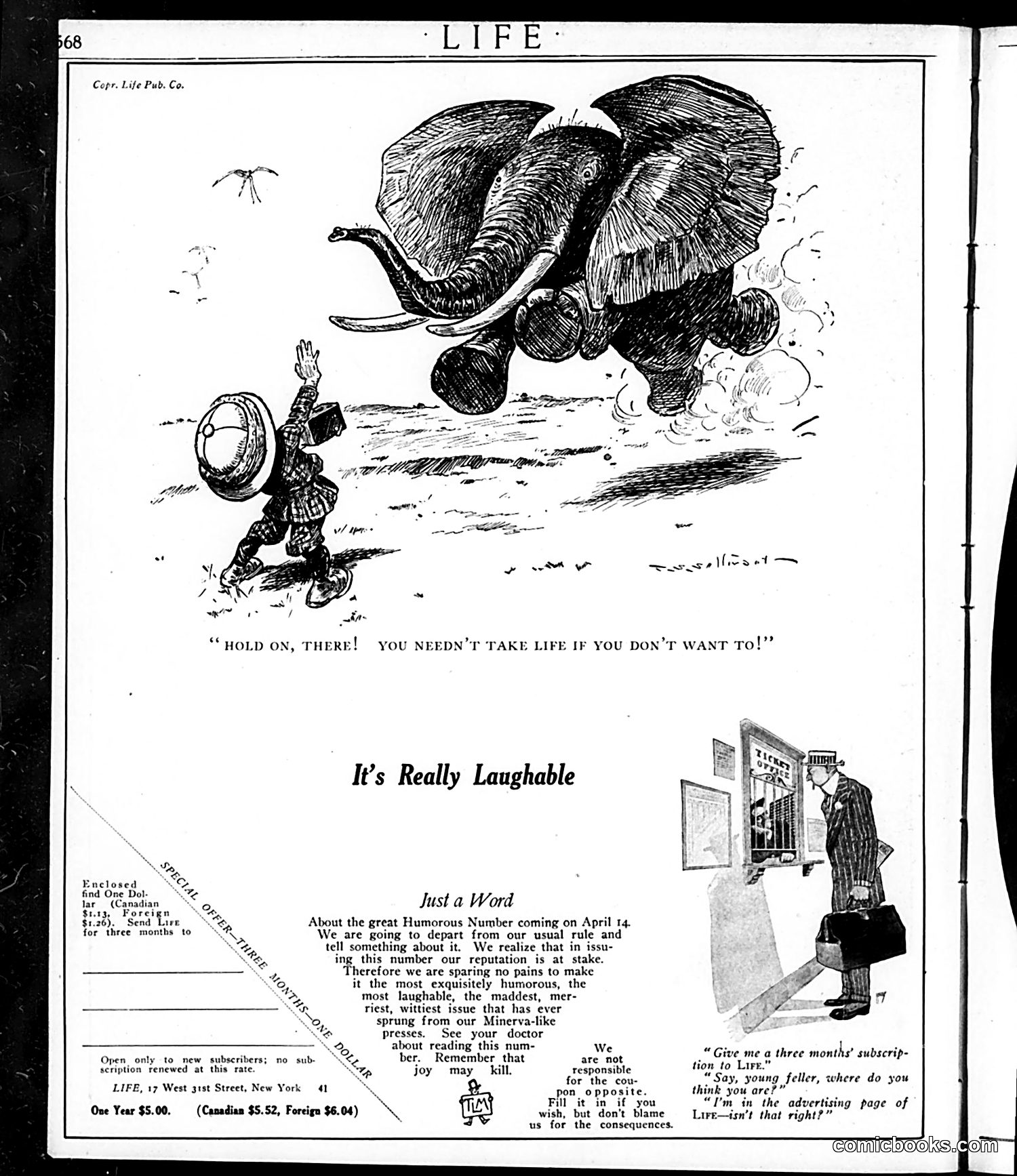
The main cartoon depicts a small figure with a shield confronting a large, charging elephant kicking up dust. The caption reads: "HOLD ON, THERE! YOU NEEDN'T TAKE LIFE IF YOU DON'T WANT TO!" This appears to be a satirical commentary on Life magazine itself. The figure represents the magazine's editors or publishers, while the elephant likely symbolizes a powerful force or competitor threatening the publication. The joke plays on the magazine's name—the small defender is literally telling the elephant not to "take LIFE" (both the publication and the concept). Below, the text "It's Really Laughable" and "Just a Word" explain the magazine is departing from its usual editorial approach to produce a humorous special issue, staking its reputation on making this the wittiest issue ever published. The bottom section includes subscription information and a related cartoon about advertising.
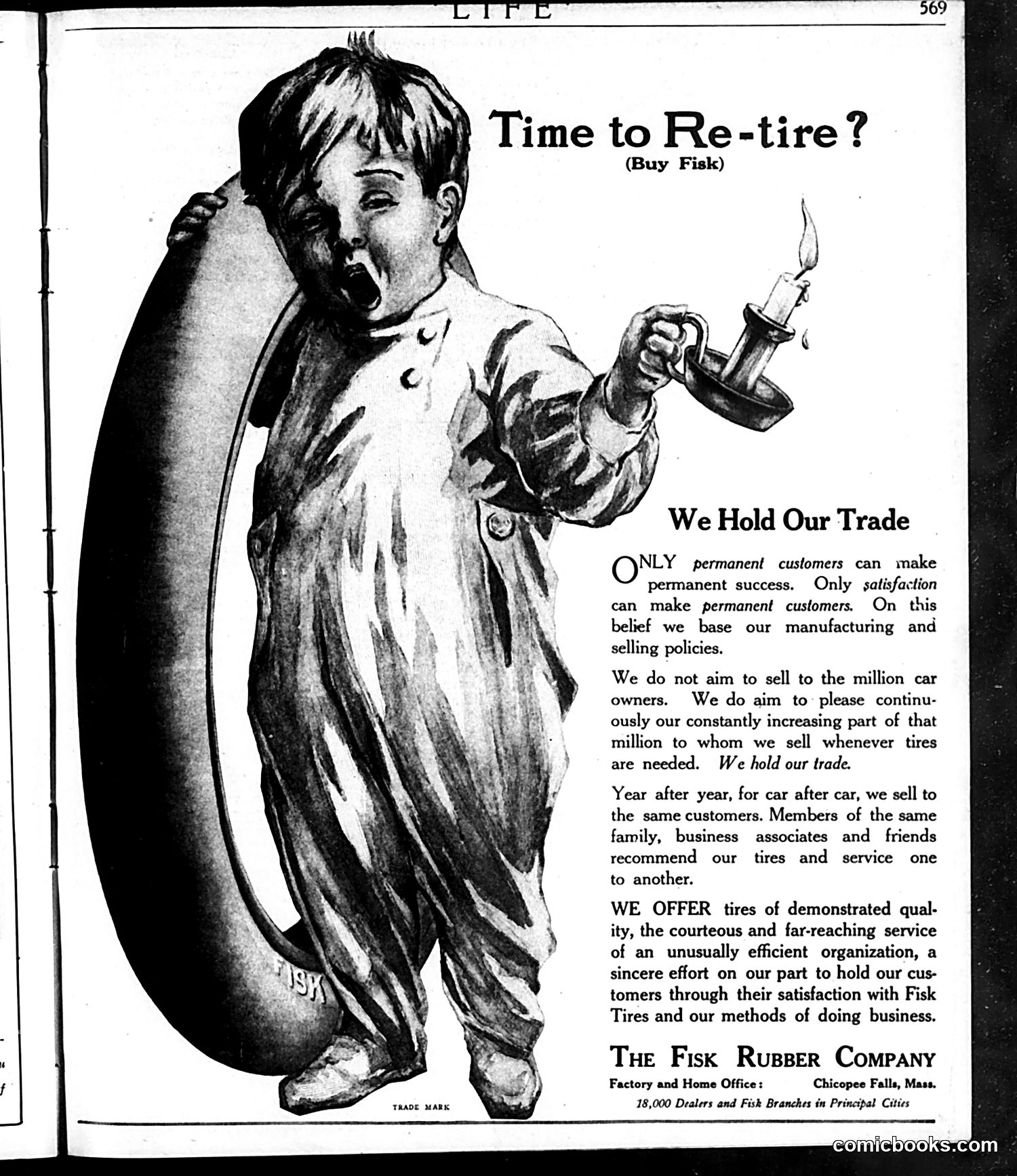
This is primarily a **Fisk Rubber Company advertisement**, not political satire. The image shows a caricatured figure holding a large tire and a torch, with the headline "Time to Re-tire? (Buy Fisk)." The figure appears to be a **Fisk Tire mascot**—likely the company's "Fisk Boy," a recognizable brand character from early 20th-century advertising. The torch reference and tired pose suggest the person should "re-tire" (rest/replace tires). The accompanying text emphasizes the company's business philosophy: building customer loyalty through quality and service rather than seeking one-time sales. This is **commercial advertising using visual humor**, not political commentary. The satirical element is simply the pun on "retire"/"re-tire."
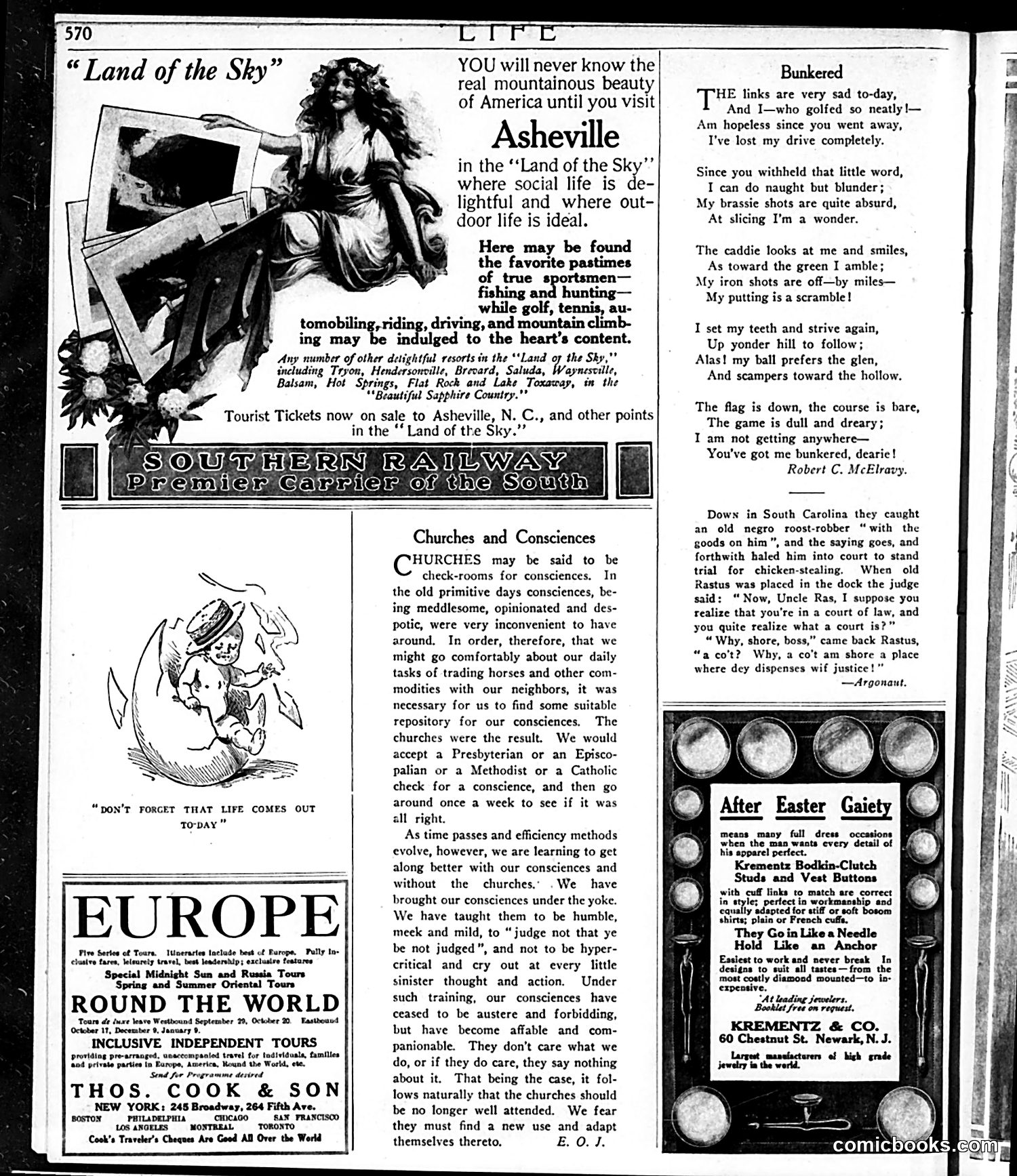
This page is primarily **advertising and editorial content** rather than political satire. The top half features a **Southern Railway advertisement** promoting Asheville, North Carolina as a tourist destination in the "Land of the Sky," highlighting outdoor recreation like golf, fishing, and mountain climbing. The center contains an illustration labeled "don't forget that life comes out to-day"—a straightforward reminder to readers about the magazine's publication schedule. Below that, an article titled **"Churches and Consciences"** discusses the historical evolution of American churches from their original role as community gathering spaces to their modern social function. The piece appears to be a serious commentary on changing religious practice rather than satire. The remaining space is devoted to travel advertisements (Europe tours) and jewelry ads (Krementz & Co.).
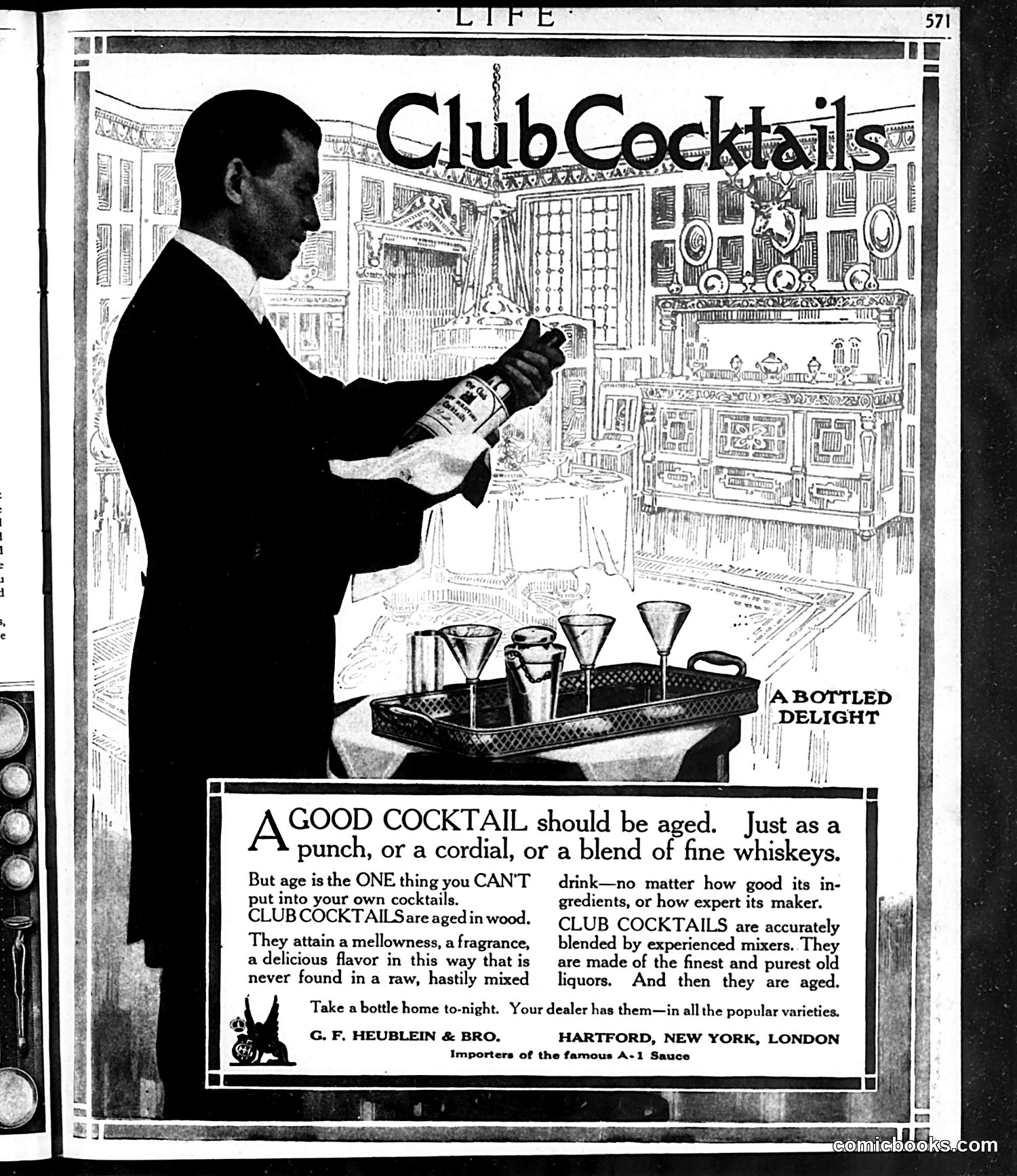
This is a full-page advertisement for Club Cocktails, a pre-mixed bottled cocktail product made by G.F. Heublein & Bro. (Hartford, New York, London). The ad features an illustration of a well-dressed man in formal attire holding a bottle, with prepared cocktails displayed on a table before an ornate interior backdrop. The tagline reads "A Bottled Delight." The sales pitch emphasizes that proper cocktails require aging—something home bartenders cannot achieve. Club Cocktails, the ad claims, are "accurately blended by experienced mixers" and made from "finest and purest old liquors," then aged professionally. The copy urges readers to "take a bottle home to-night," suggesting these pre-made cocktails offer convenience and quality that homemade versions cannot match.
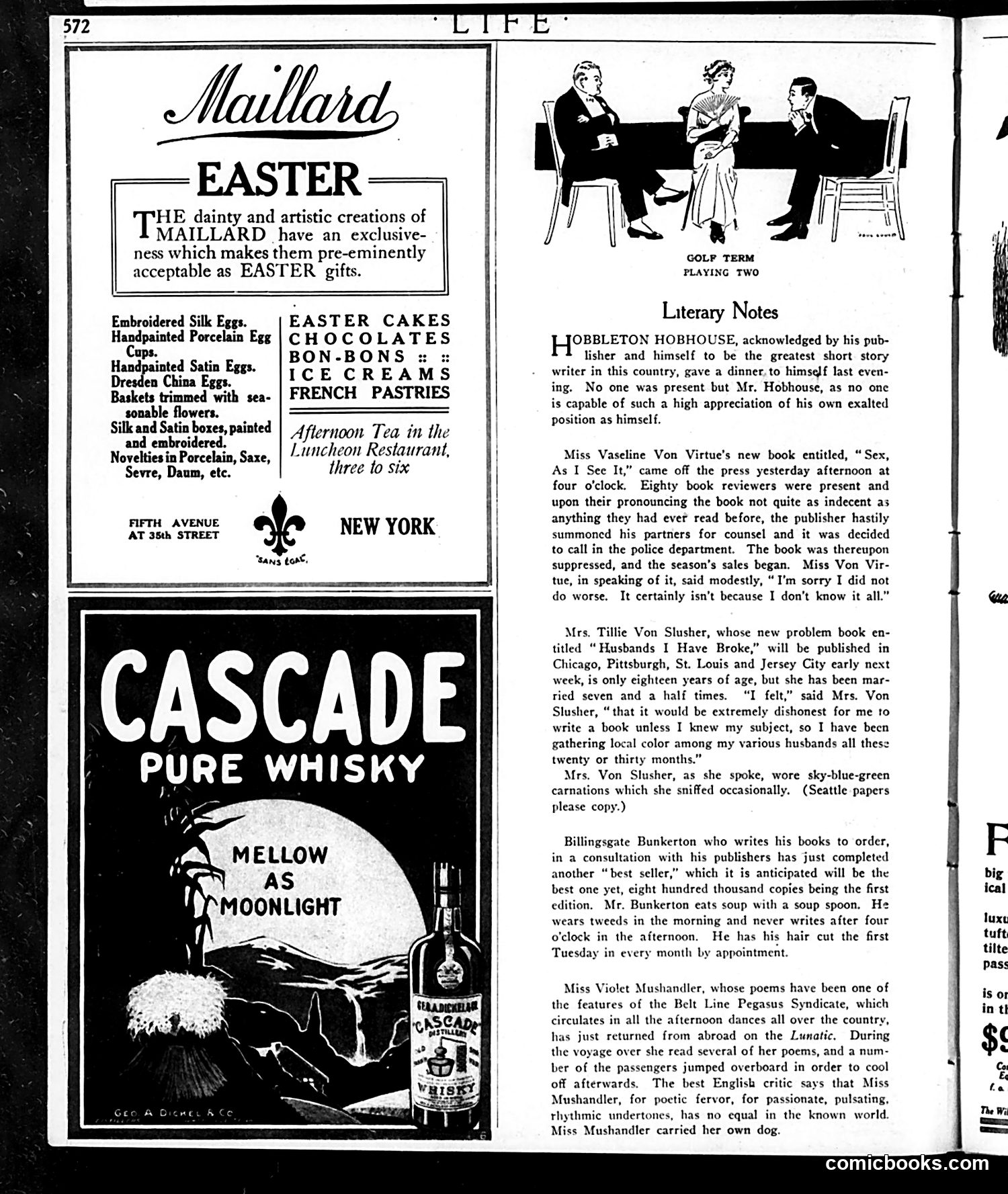
This page contains primarily **advertisements** (Maillard Easter confections, Cascade Pure Whisky) and a **"Literary Notes" column** discussing contemporary authors. The literary section gossips about several writers: Hobbleton Hobhouse (a short story writer), Vaseline Von Virtue (whose book "Sex, As I See It" was deemed scandalous enough to involve police), Mrs. Tillie Von Slusher (an 18-year-old writing about her marriages), Bilingsgate Bunkerton (who writes methodically), and Miss Violet Mushandler (a poet whose work circulates in "afternoon dances"). The tone is satirical—mocking these authors' pretensions, work habits, and subject matter. The illustration shows three people in conversation, labeled "Golf Term Playing Two," though its connection to the text is unclear.
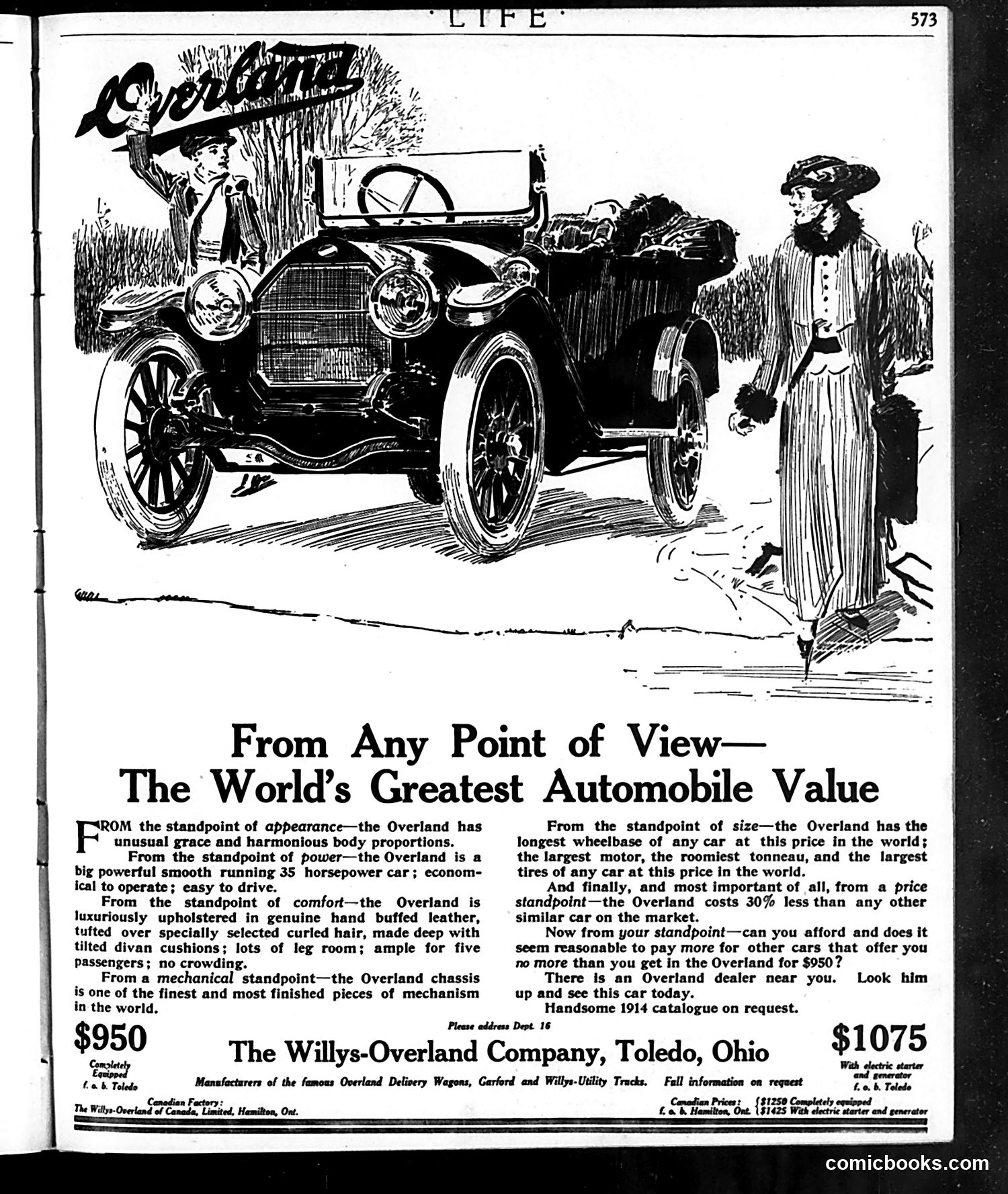
This is primarily an **automobile advertisement**, not satire or political commentary. The Willys-Overland Company promotes their 1914 Overland automobile as "The World's Greatest Automobile Value." The illustration shows a well-dressed woman in period clothing observing an early motorcar (with two men visible—one driving, one appearing to load cargo). The ad uses a rhetorical device: "From Any Point of View," listing comparative advantages (appearance, power, comfort, mechanical quality, size, and price). The key selling point is **affordability**: the Overland costs $950-$1075 and is marketed as 30% cheaper than competing cars while offering more features. This represents early automotive marketing to middle-class consumers, before cars were mass-produced luxuries. The woman's prominent placement suggests marketing toward female consumers—a relatively novel advertising strategy for the era.
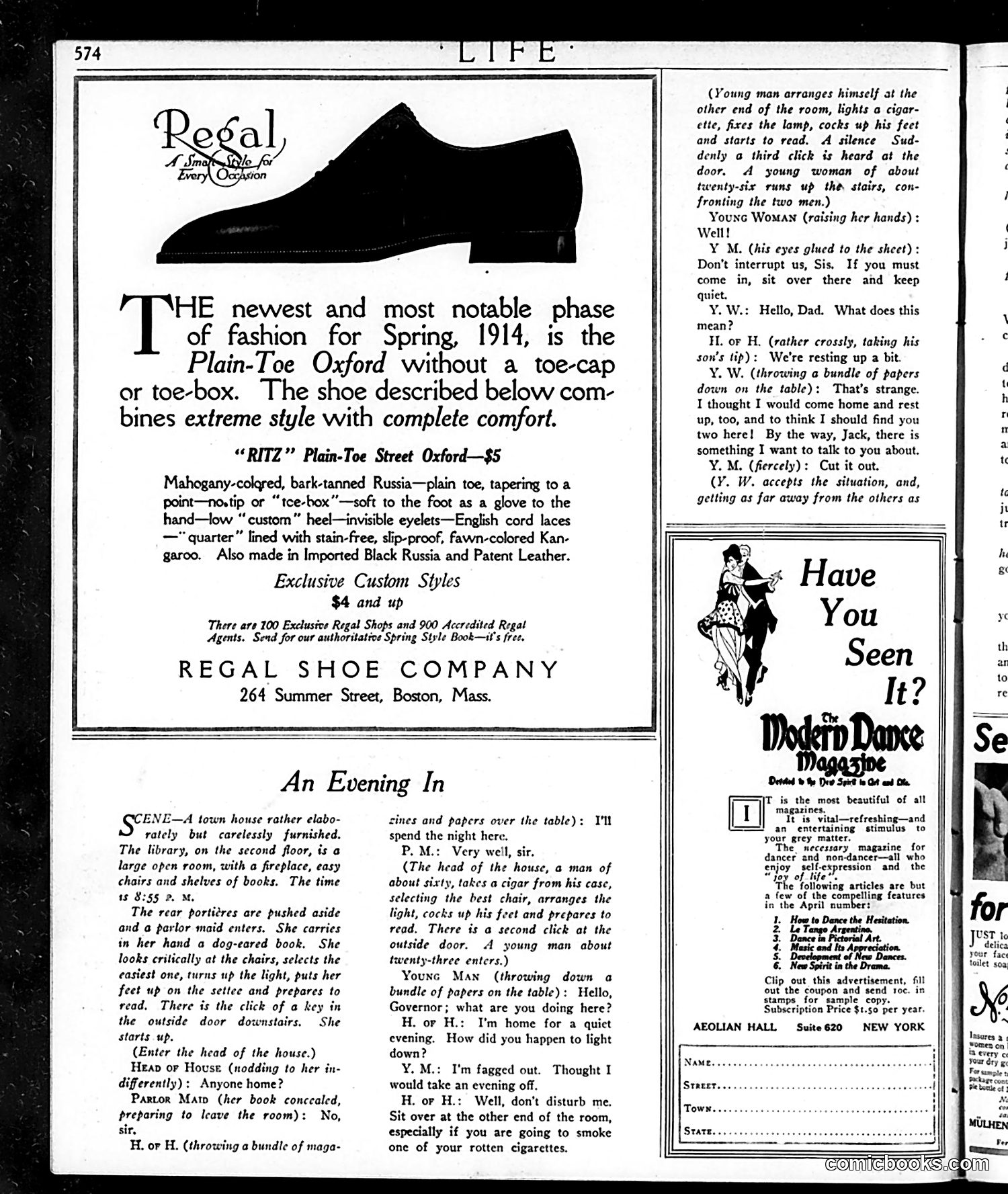
This page is primarily **advertising and theatrical content**, not political satire. The left side features a **Regal Shoe Company advertisement** for a "Plain-Toe Oxford" shoe ($5), marketed as the "newest and most notable phase of fashion for Spring, 1914." The ad emphasizes the shoe's stylish plain toe design without a toe-cap, claiming it combines "extreme style with complete comfort." The right side contains two unrelated items: **dialogue from a play titled "An Evening In"** (appearing to be a domestic comedy scene) and an **advertisement for "Modern Dance Magazine."** There is **no political cartoon or satire visible** on this page. It reflects early 1910s consumer culture and theatrical entertainment rather than social commentary.
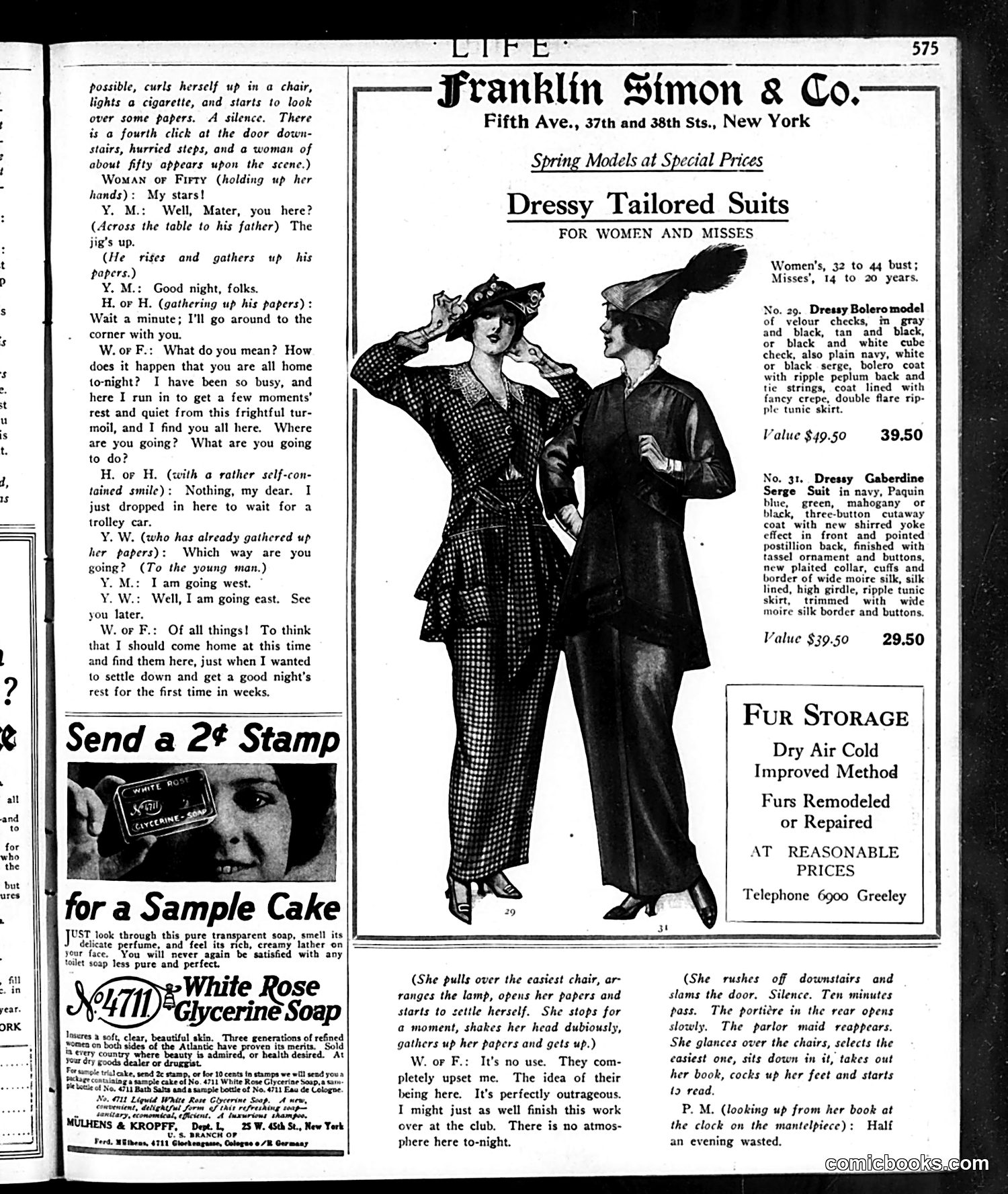
This page is primarily **advertising and fashion content**, not political satire. The main image shows two women modeling spring suits from Franklin Simon & Co., a Fifth Avenue retailer. The suits are described as "Dressy Tailored Suits for Women and Misses," with prices reduced from $49.50 to $39.50 and $39.50 to $29.50—suggesting an economic downturn (likely the Great Depression era based on Life's publication period). The left side contains a theatrical script excerpt about characters waiting for a "trolley car," unrelated to the fashion content. Below is an advertisement for White Rose Glycerine Soap, emphasizing its purity and luxury. The page represents typical **1920s-30s magazine content**: fashion, theater, and consumer goods advertising aimed at middle-to-upper-class readers, with no discernible political message or satire.
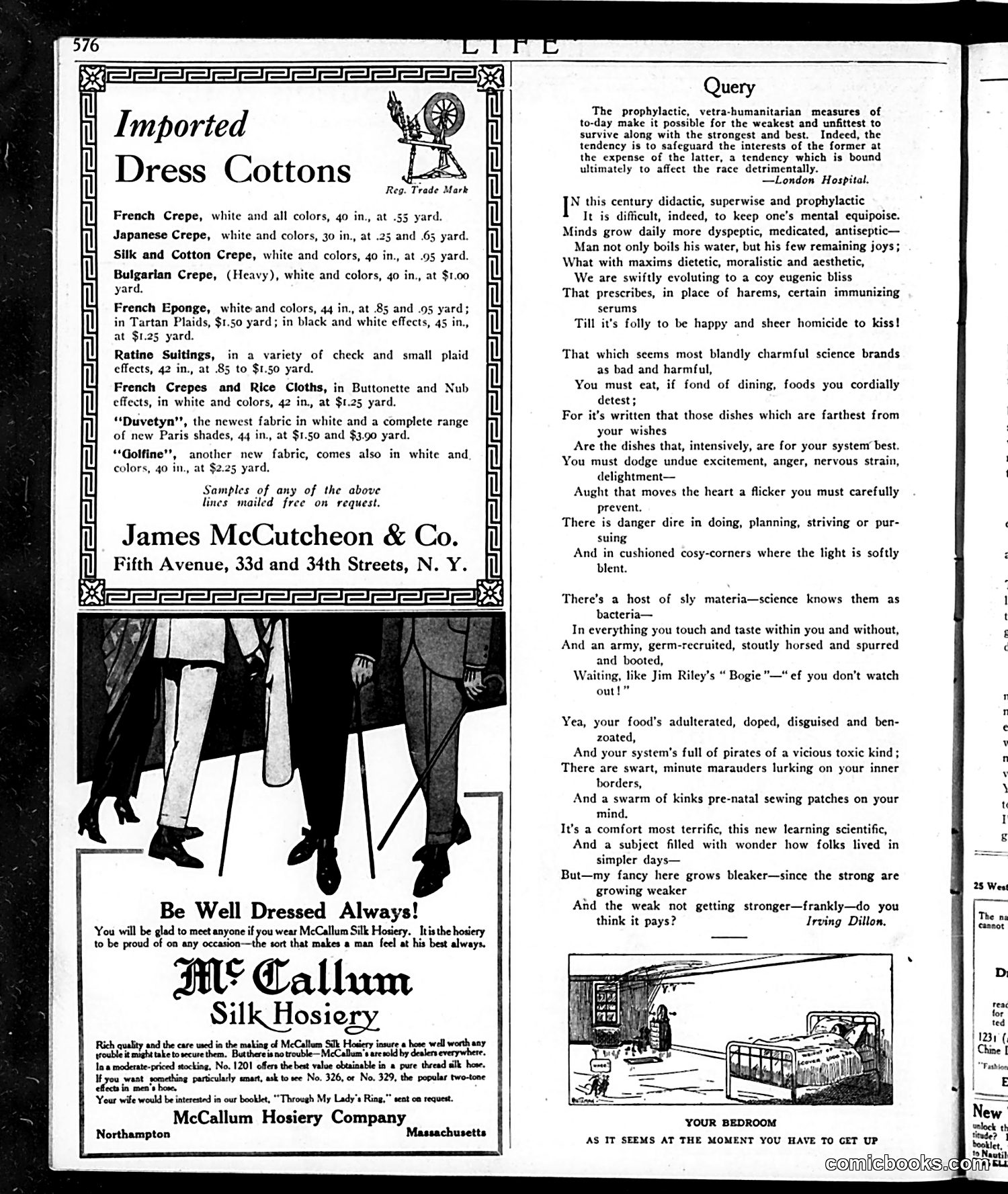
This page is primarily **advertising** (James McCutcheon & Co. dress fabrics, McCallum Silk Hosiery) rather than satirical content. The right side contains a poem titled "Query" by Irving Dillon that satirizes **modern scientific anxiety**. Written in early 20th-century style, it mocks contemporary fears about food adulteration, bacteria, and contamination—concerns heightened by recent food safety scandals. The poem humorously catalogs worries: poisoned food, "germ-recruited" bacteria, and "pre-natal sewing patches on your mind," suggesting society has become neurotically obsessed with invisible threats. Below is a small cartoon captioned "Your Bedroom" depicting someone in bed, likely continuing the anxious theme about unseen dangers in everyday spaces. The satire targets the era's growing scientific consciousness and resulting health paranoia.
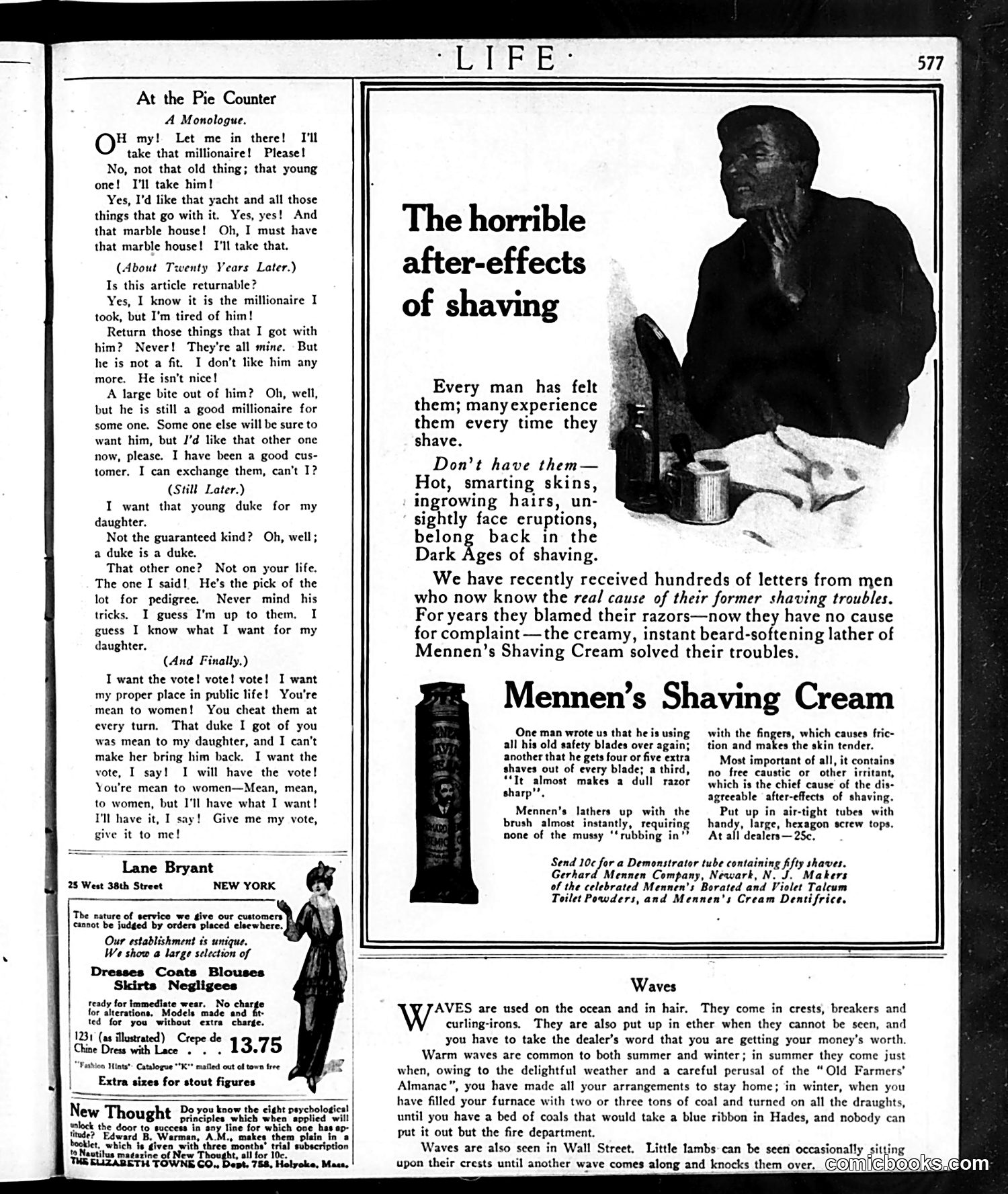
This page contains **primarily advertising and humor columns**, not political satire. The left side features "At the Pie Counter," a monologue by Lane Bryant about a woman at a diner exchanging a millionaire husband for a younger man—satirizing materialism and relationship fickleness through domestic humor. The right side is a **full-page advertisement** for Mennen's Shaving Cream, addressing "the horrible after-effects of shaving" (ingrown hairs, skin irritation). The ad features a man examining his face, claiming letters prove the cream solves these problems. Below that, a brief piece titled "Waves" discusses ocean waves and Wall Street speculation—a pun comparing financial market volatility to literal waves. This is primarily a **consumer-focused magazine page** blending entertainment columns with product advertising typical of 1920s-era Life magazine.
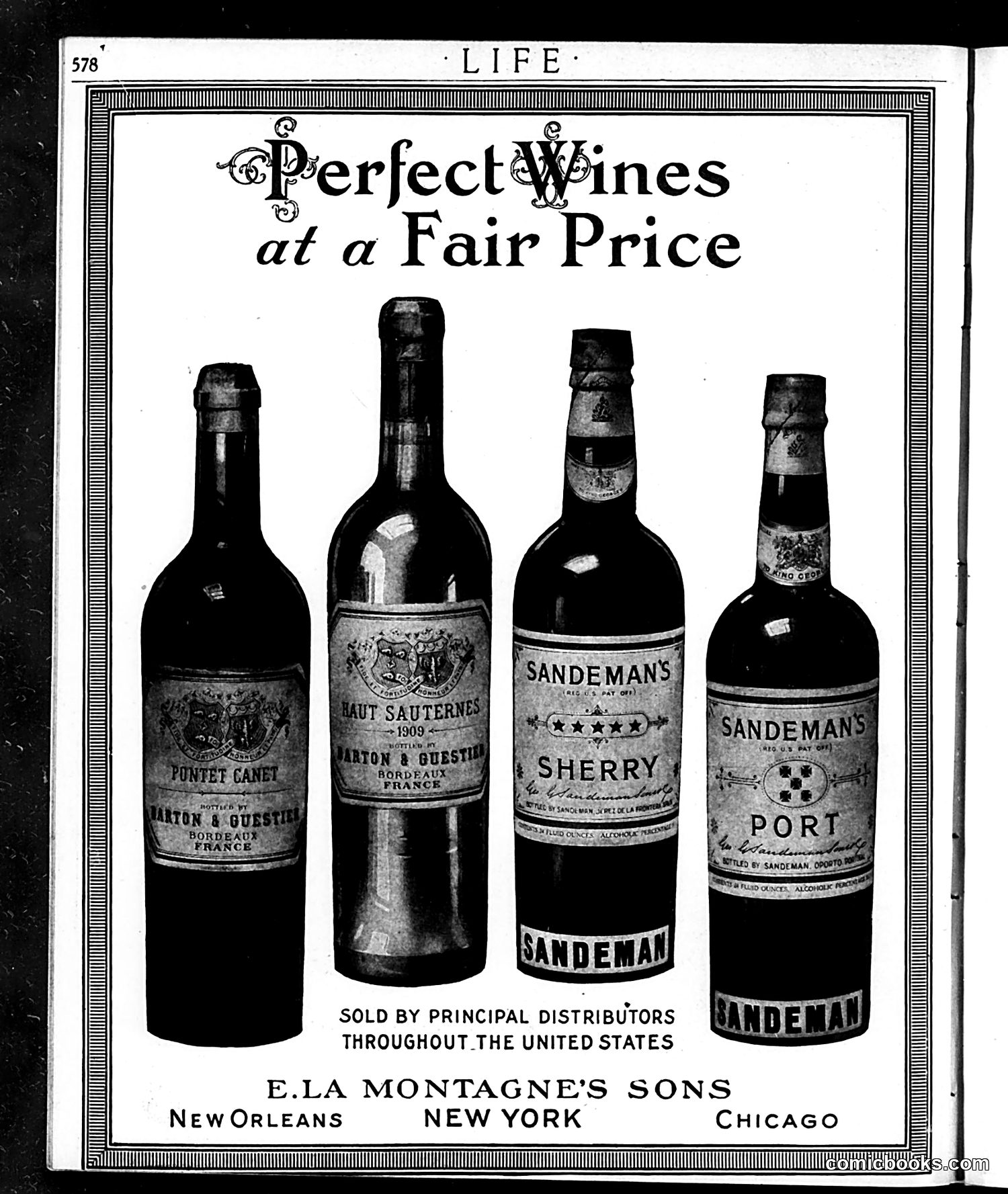
This is a straightforward wine advertisement, not political satire or editorial content. E. La Montagne's Sons, a wine distributor with offices in New Orleans, New York, and Chicago, advertises four wine products: Pontet Canet, Haut Sauternes, Sandeman's Sherry, and Sandeman's Port. The ad's headline promises "Perfect Wines at a Fair Price" and notes these wines are "sold by principal distributors throughout the United States." This appears in Life magazine, likely during the early 20th century based on typography and style. The advertisement simply showcases imported wines available to American consumers through major U.S. distributors.
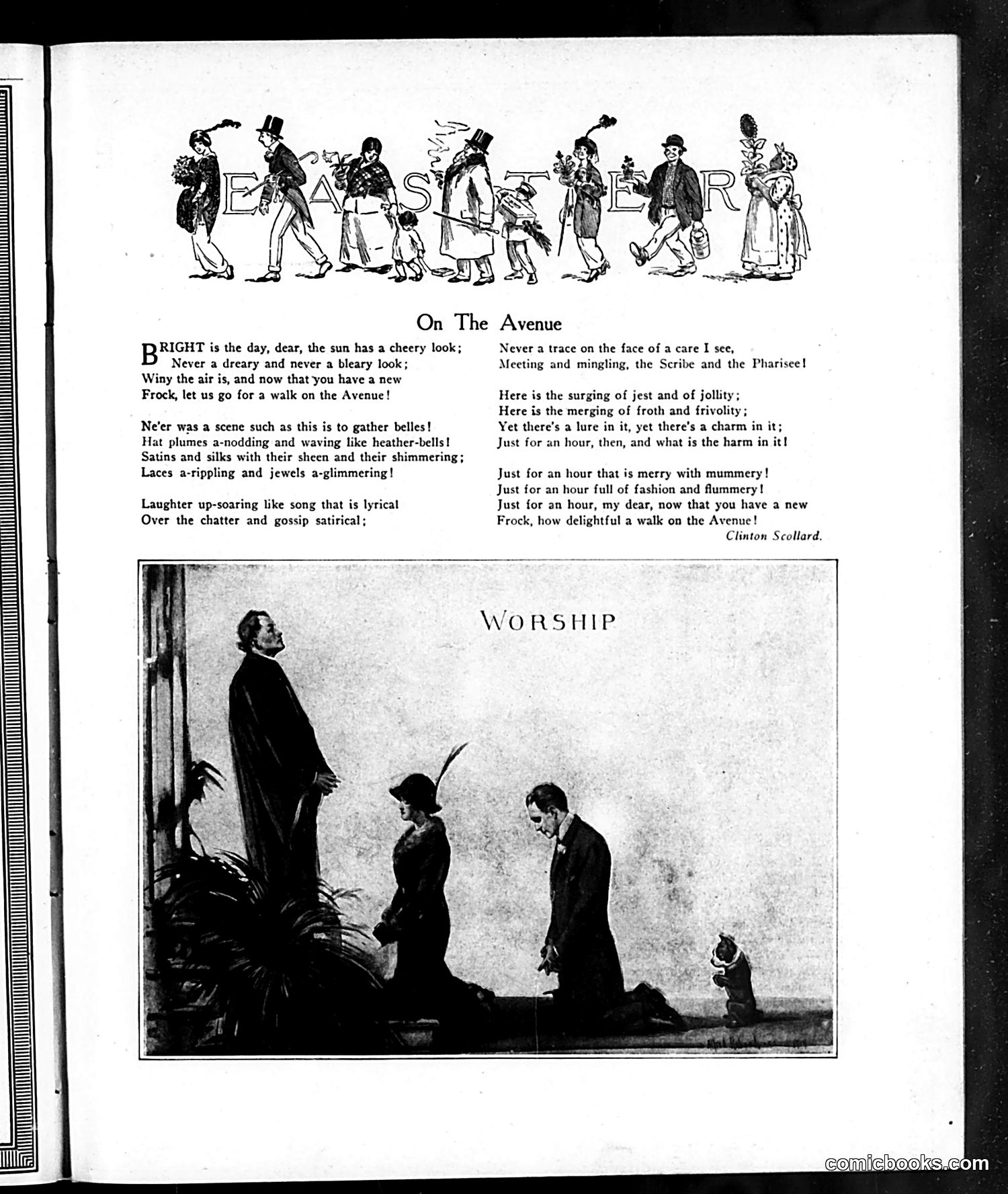
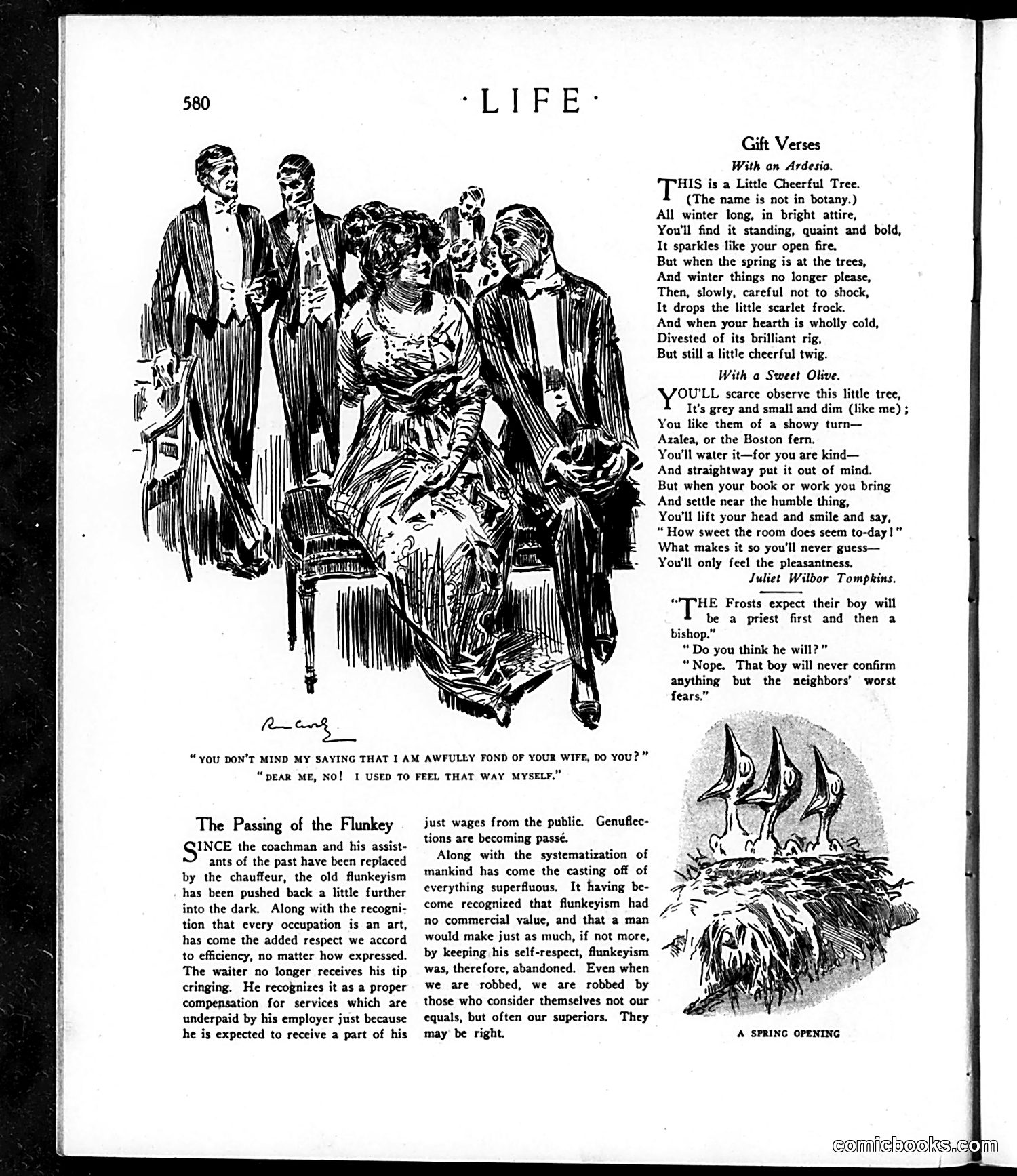
**The Main Cartoon**: A well-dressed man tells another man he's "awfully fond of your wife," to which the other replies he "used to feel that way myself." This is a joke about infidelity and the casual acceptance of romantic indiscretion among the wealthy classes—the humor lies in the bland, matter-of-fact admission rather than jealousy. **"The Passing of the Flunkey"**: This essay satirizes the decline of servile deference. It argues that modern efficiency has made obsequious behavior obsolete. Waiters, coachmen, and servants no longer need to grovel for tips since their labor is increasingly recognized as legitimate work deserving fair wages. The piece celebrates this shift as progress—even robbers now consider themselves "superiors" rather than inferiors, suggesting a democratization of respect. **Gift Verses**: Sentimental poems accompanying potted plants, typical of the era's genteel gift-giving culture. **Bottom Joke**: A brief anecdote mocking parental expectations—the Frosts hope their boy becomes a priest or bishop, but he'll only "confirm the neighbors' worst fears," suggesting moral failure.
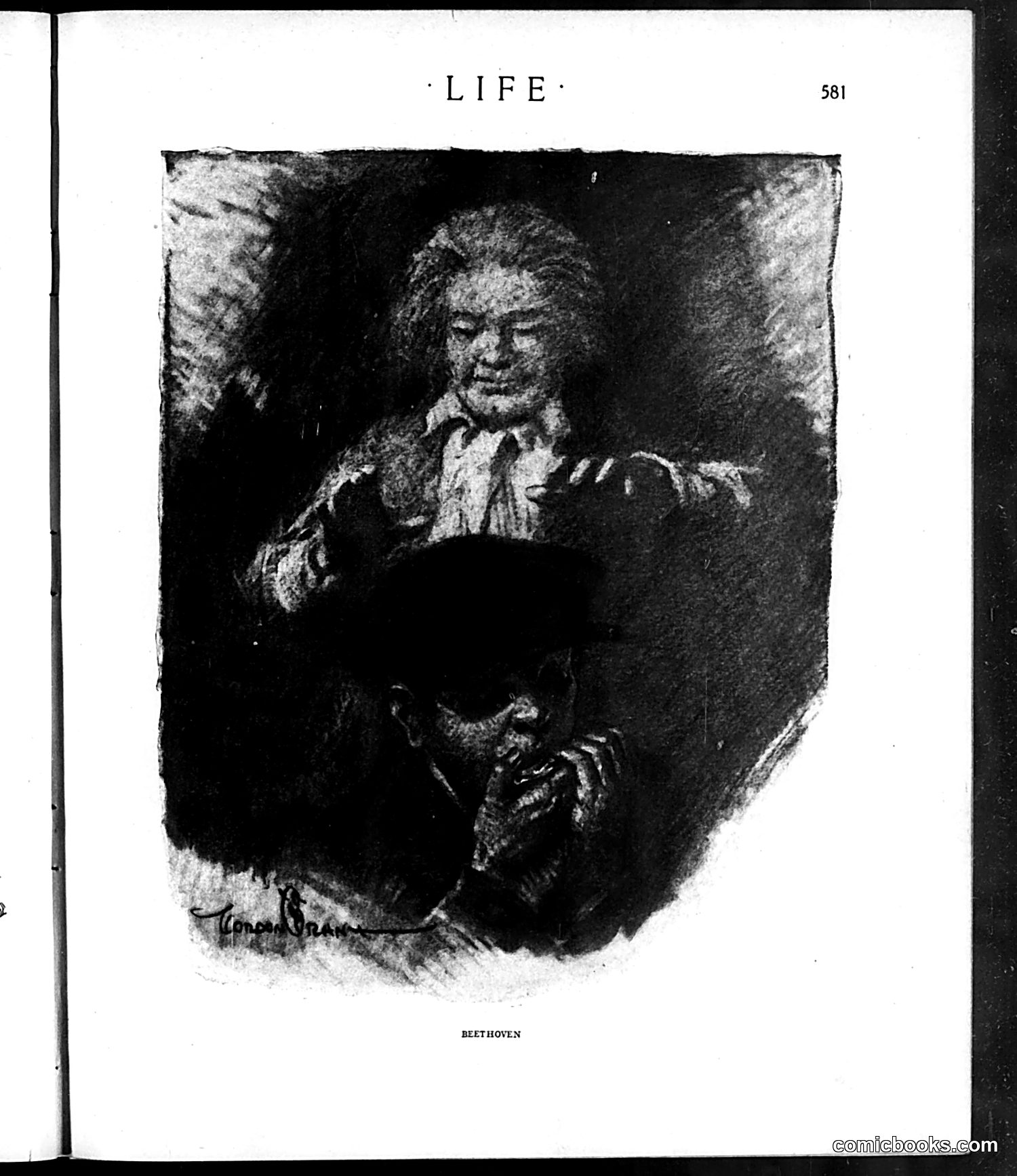
This page from *Life* magazine (page 581) features a portrait illustration labeled "BEETHOVEN" at the bottom. The image shows two faces in a sketchy, expressive drawing style: an upper figure in 18th-century dress with curled hair, and a lower bearded face in profile. The artist's signature appears to read "Leonard Dove" or similar in the lower left. Without additional OCR text or context from surrounding pages, the specific satirical point is unclear. However, this appears to be either a straightforward artistic tribute to the composer or possibly a commentary on Beethoven's legacy in contemporary culture—common *Life* magazine fare. The dual-portrait composition may suggest contrasting interpretations or aspects of the musician.
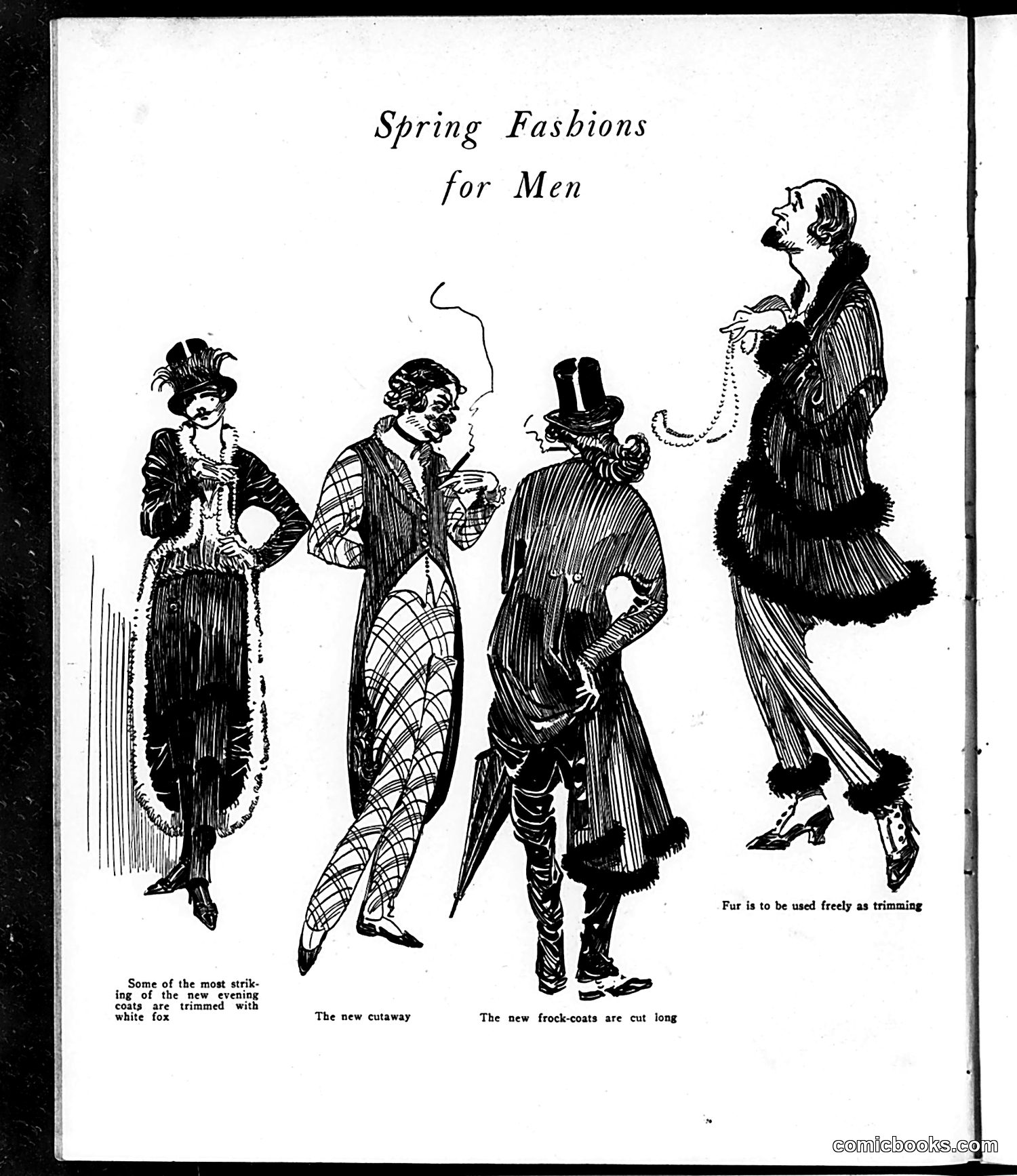
This is a fashion illustration page satirizing men's spring clothing trends. It depicts five male figures modeling various garments: evening coats trimmed with white fur, a cutaway jacket with plaid patterning, and elongated frock-coats. The caption notes that "fur is to be used freely as trimming." The satire appears to mock the increasing use of fur and elaborate ornamentation on men's formal wear—details traditionally associated with women's fashion. By showing men sporting generous fur trim, extended hemlines, and decorative elements with exaggerated poses, the illustrator is gently ridiculing what the magazine's editors considered absurdly feminine styling creeping into men's formal fashion. This reflects early 20th-century anxieties about masculine dress standards and gender presentation in clothing.
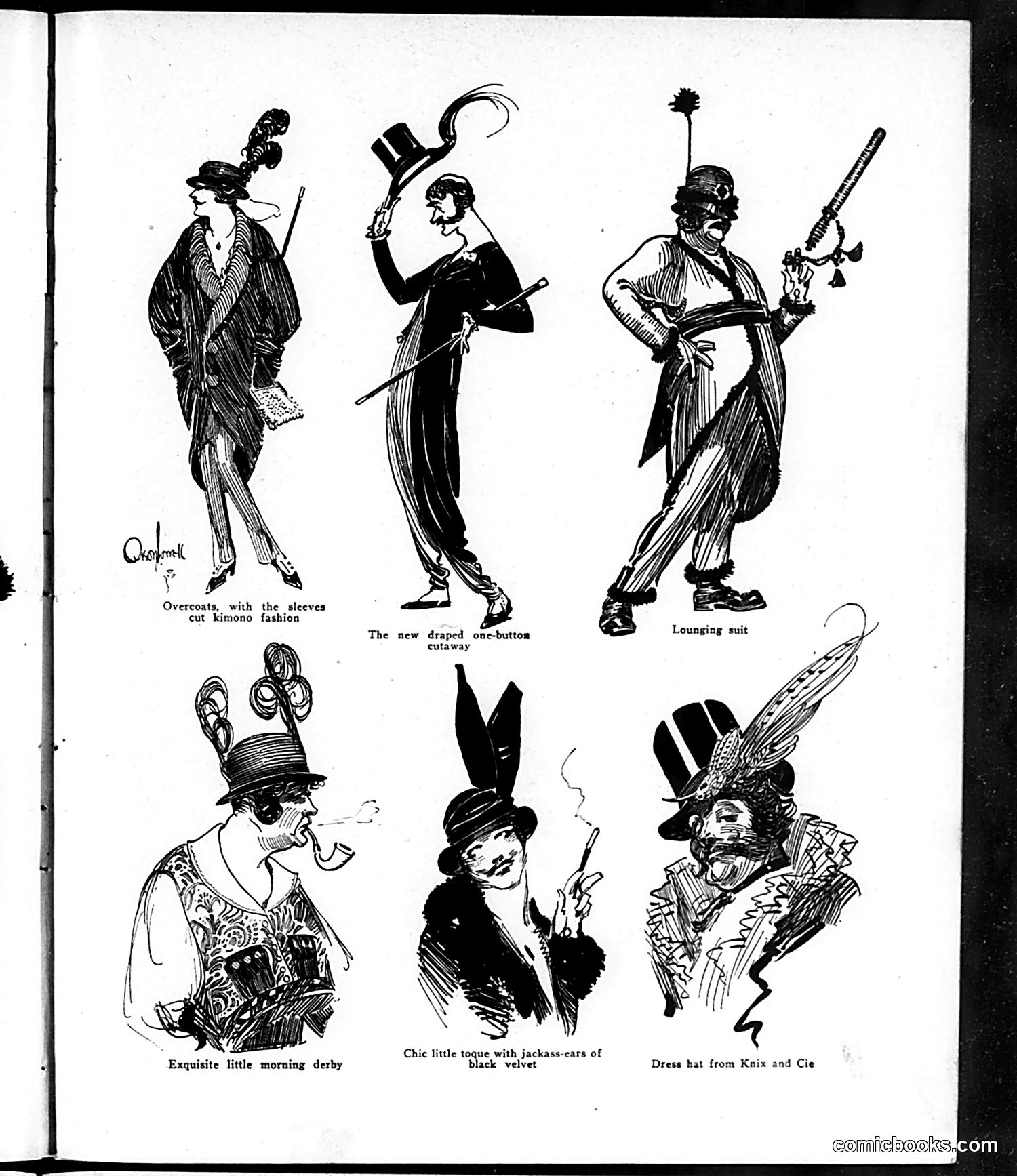
This is a fashion satire page from *Life* magazine mocking contemporary men's fashion trends. The six illustrated figures showcase exaggerated styles—overcoats with kimono sleeves, draped one-button cutaways, and lounging suits—alongside absurd accessories like elaborate morning derbies and a hat featuring "jackass-ears." The cartoonist ridicules these fashions as pretentious and ridiculous, particularly targeting what appear to be high-end designer pieces (notably "Knix and Cie"). The satirical tone suggests these trends were controversial or seen as overly feminine or impractical among *Life* magazine's audience. The caricatured figures emphasize the absurdity through exaggerated proportions and affected poses, typical of the magazine's humorous approach to social commentary on fashion and masculine style.
This is a romantic allegorical story, not political satire. It personifies **Earth** (a male figure) and **Springtime** (a female character) as lovers engaged in their annual seasonal reunion. The narrative depicts their flirtatious "Easter" encounter: Springtime arrives with flowers and playful charm, awakening the sleeping Earth with tickles and bird songs. Earth initially pretends indifference, but Springtime's appeal wins him over. Their dialogue reveals a recurring pattern—they vow to end their affair each May, yet reunite faithfully each spring, resigned to repeating "the same beautiful old lie." The piece is sentimental humor about nature's cycles, personified as an eternal romantic dynamic. It requires no historical context beyond recognizing spring's literal and metaphorical association with renewal and romance. This reflects early 20th-century *Life* magazine's frequent use of whimsical, allegorical storytelling for light entertainment.
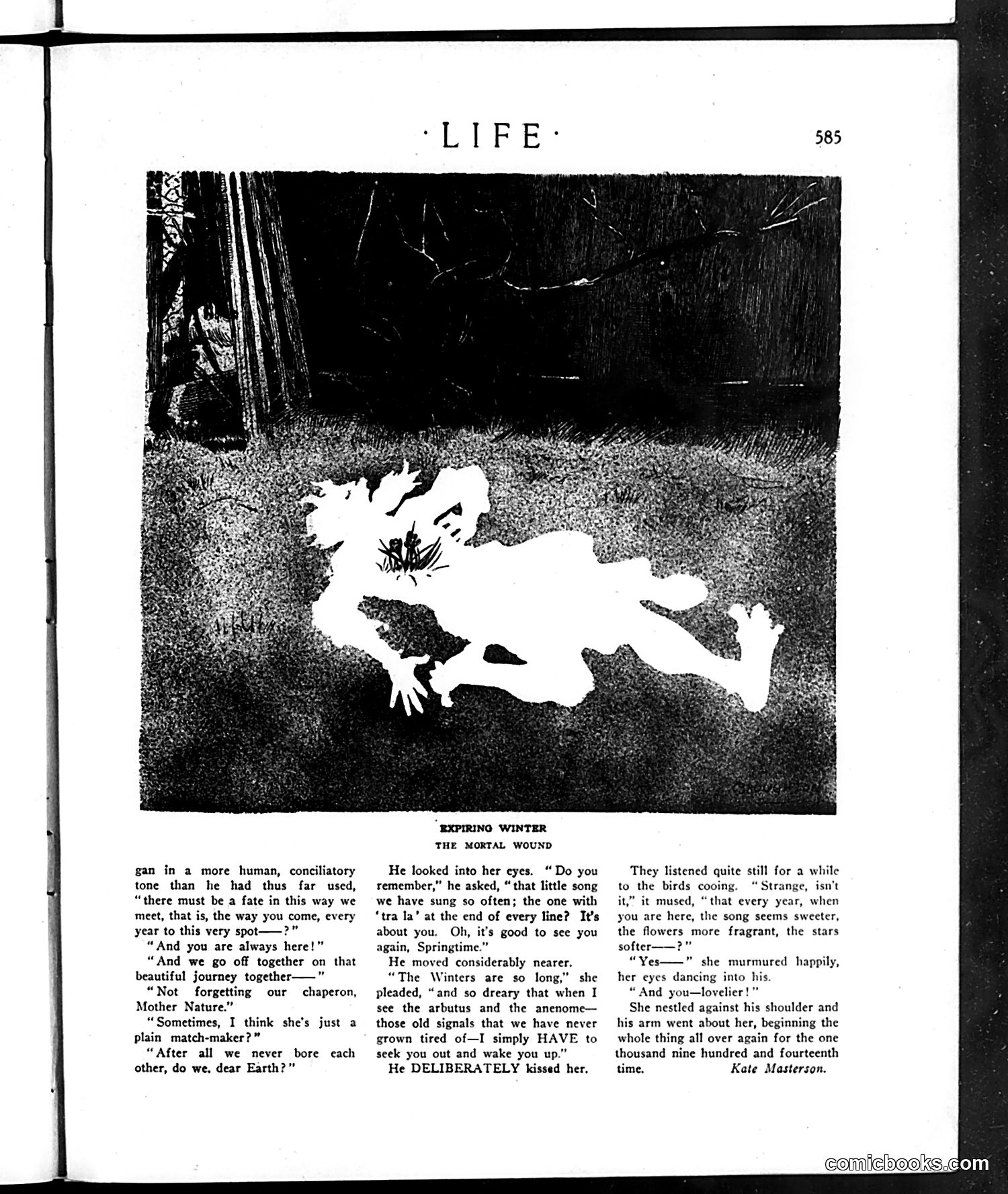
This is a romantic literary piece titled "Expiring Winter: The Mortal Wound," not a political cartoon. It personifies Spring and Earth (or Winter and Spring) as lovers in an annual reunion. The narrative depicts their flirtation and kiss as nature cycles through seasons—Spring arrives to awaken Earth from Winter's long, dreary sleep. The text emphasizes their eternal, cyclical romance: "the whole thing all over again for the one thousand nine hundred and fourteenth time." The satire lies in treating natural seasonal change as sentimental human courtship, complete with clichéd romantic dialogue ("you are always here," "lovelier"). The stark black-and-white illustration shows a pale figure against dark ground—likely depicting Spring's arrival or the winter landscape. This was typical *Life* magazine content: mixing gentle nature-based humor with romantic sentimentality for early 20th-century audiences.
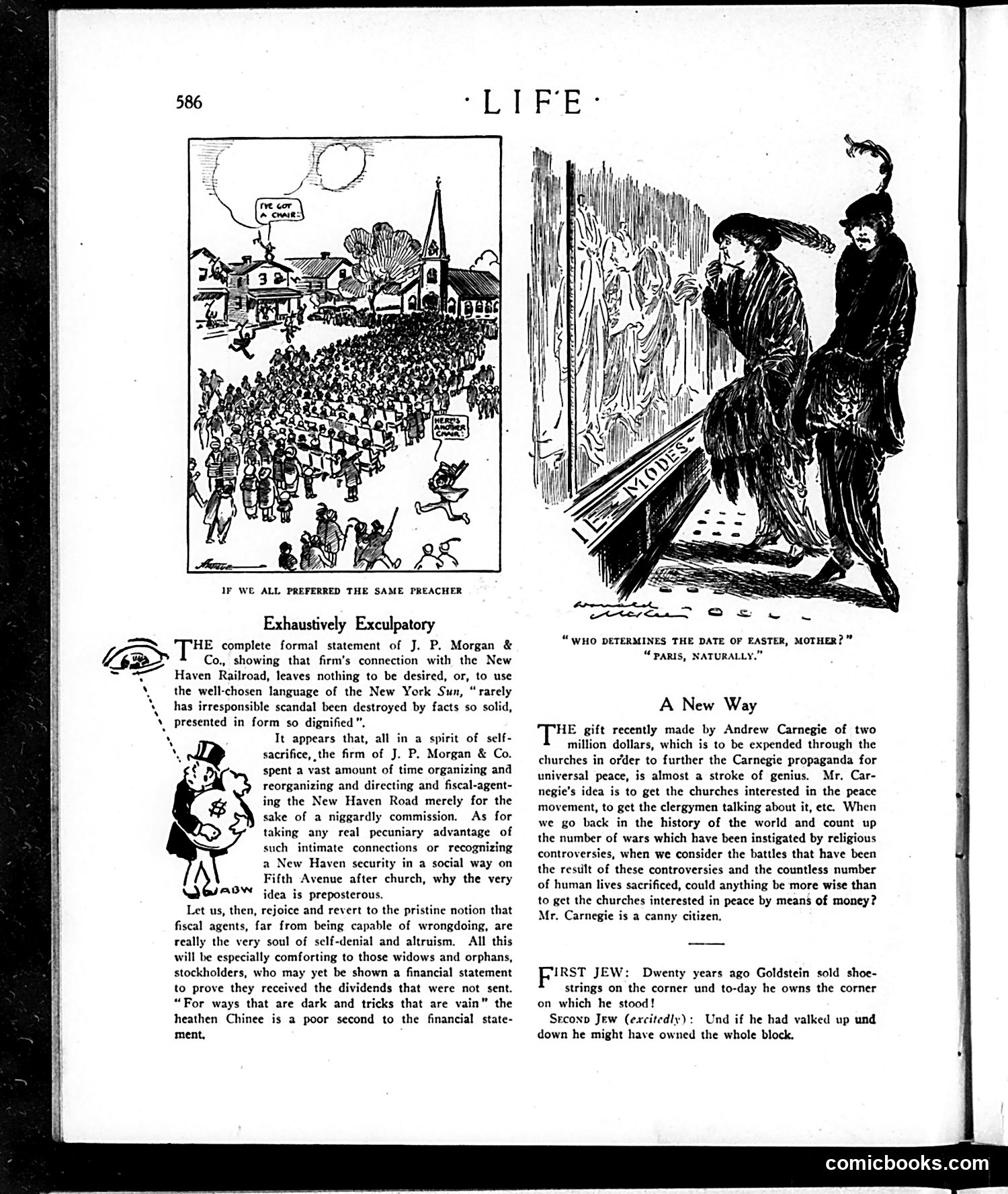
**Top Left Cartoon ("If We All Preferred the Same Preacher"):** A crowded revival meeting scene mocking religious conformity—the satire's title suggests absurdity of everyone following one preacher. **"Exhaustively Exculpatory" Article:** Scathing critique of J.P. Morgan & Co.'s formal statement defending their New Haven Railroad dealings. Life sarcastically accepts their claim of "self-sacrifice" and pure motives, while heavily implying financial malfeasance. The reference to "heathen Chinee" and financial deception suggests Morgan used complex financial maneuvering to obscure wrongdoing that harmed widows and orphans (stockholders). **Right Cartoon:** Two fashionable figures viewing a "Modes" display, with dialogue mocking Parisian fashion dominance—"naturally" Paris determines Easter's date, satirizing European cultural superiority attitudes. **"A New Way" Section:** Critiques Andrew Carnegie's $2 million gift to churches for peace propaganda as cynically manipulative, given religious wars' historical toll. **Bottom Jokes:** Yiddish-accented humor about Jewish immigrant entrepreneurship and wealth accumulation.
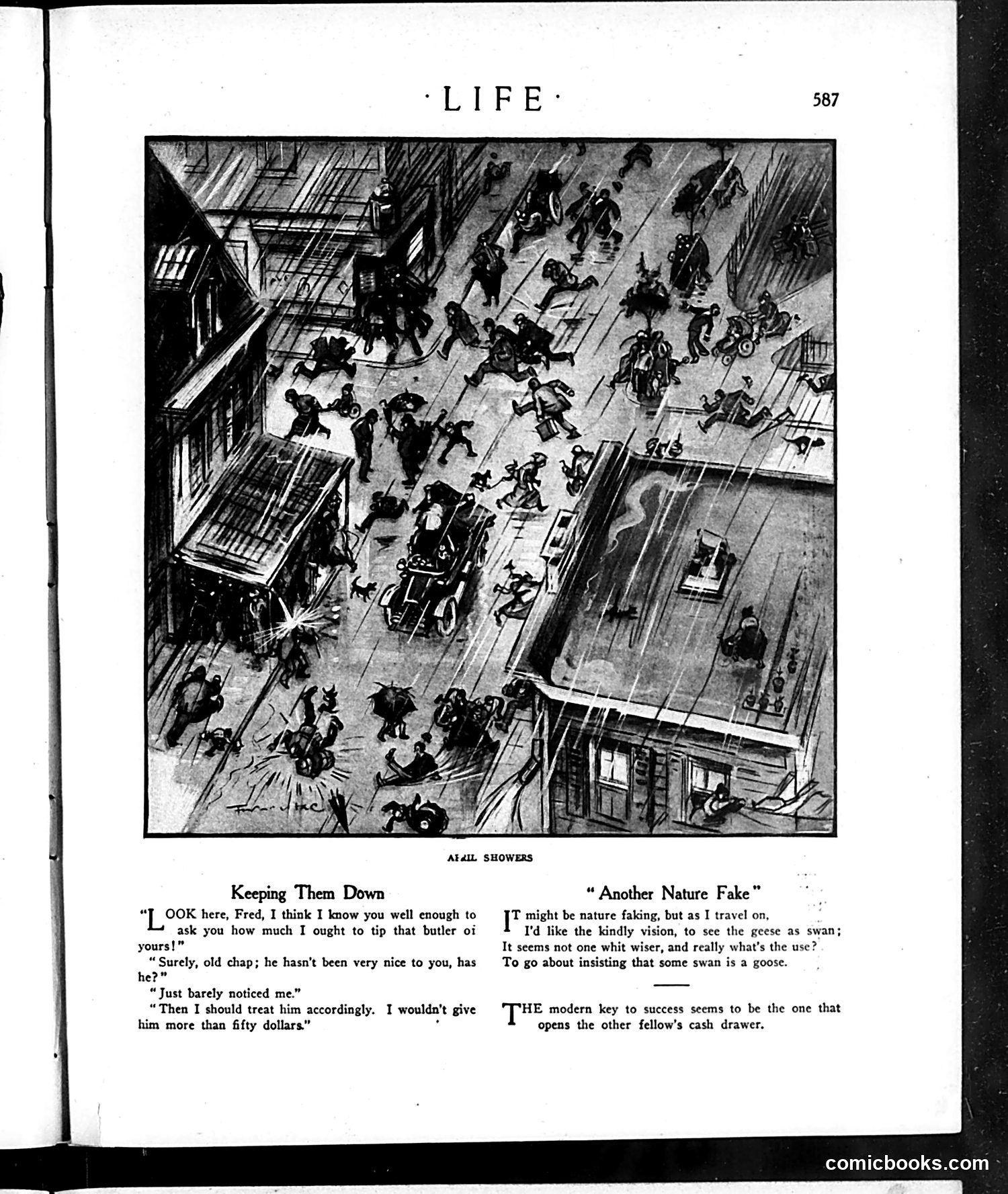
This page contains three brief satirical pieces about early 20th-century social behavior: **"Keeping Them Down"** mocks the class dynamics of tipping. A guest asks his host how much to tip the butler; the host suggests fifty dollars only because the butler ignored him—satirizing the absurd logic where poor service justifies minimal compensation. **"Another Nature Fake"** references the contemporary debate over nature writer John Burroughs's accusations that other naturalists fabricated or exaggerated animal observations. The poem suggests it's harmless to see geese as swans (romanticizing reality) rather than the reverse, mocking pedantic insistence on literal accuracy. **The final aphorism** cynically reduces business success to financial manipulation—"opening the other fellow's cash drawer" means taking their money, reflecting Gilded Age anxieties about ruthless capitalism and moral decline. The overhead illustration depicts an urban street scene with numerous figures during a rainstorm, providing visual context for everyday social interactions the text satirizes.
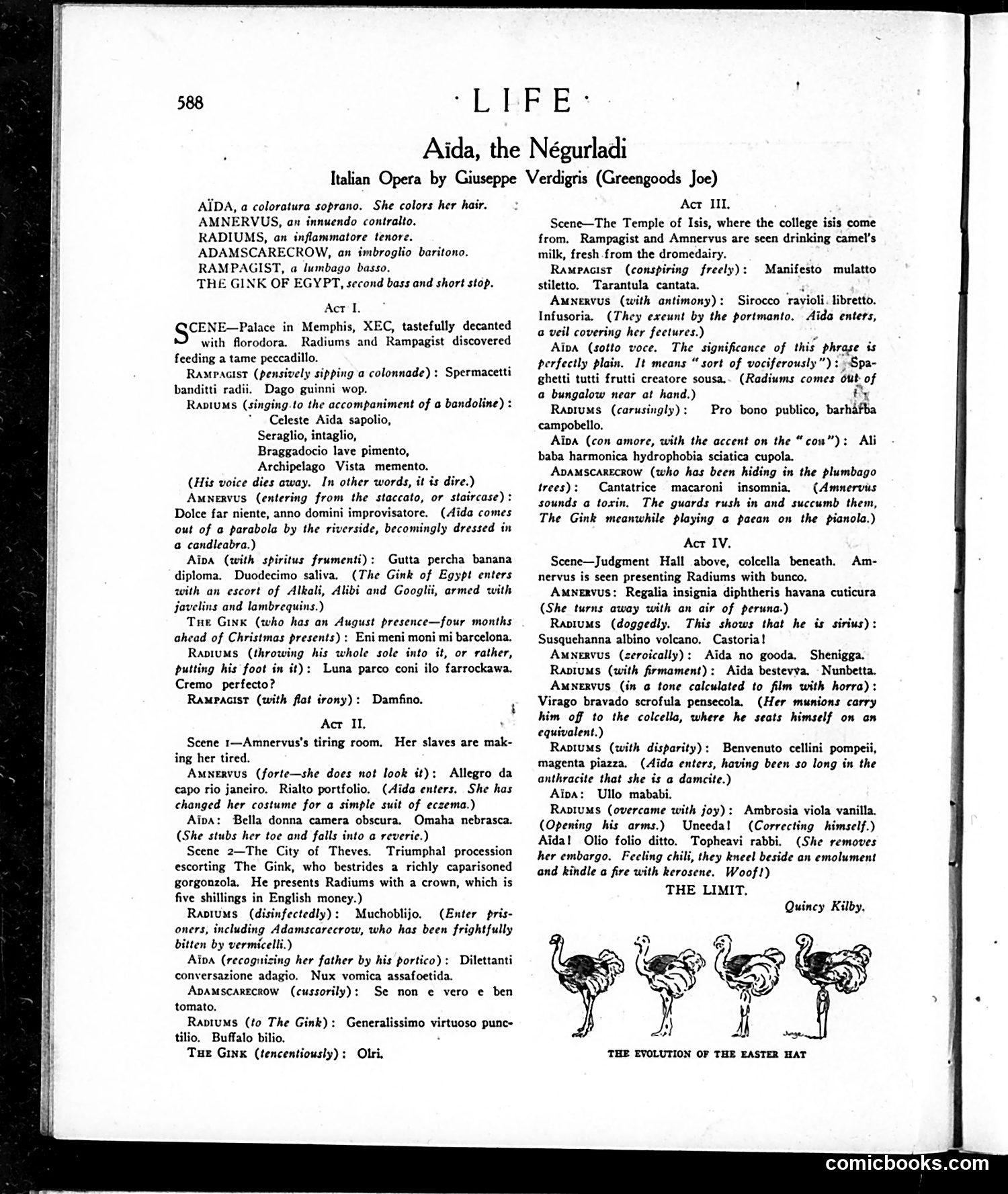
This is a mock-serious opera synopsis parodying Giuseppe Verdi's *Aida*. The satire works through deliberate nonsense: character names like "Adamscarecrow" and "The Gink of Egypt" replace actual roles, while dialogue consists of gibberish mimicking operatic Italian—"Spermacetti banditti radii. Dago guinni wop" and "Celeste Aida sapolio." The humor targets opera itself: the pretentious, incomprehensible conventions of grand opera, where elaborate plots and foreign-language arias were performed for audiences who barely understood them. By replacing meaningful dialogue with patent absurdities ("She colors her hair," "five shillings in English money"), the writer suggests opera's grandiosity masks emptiness. The footnotes ("His voice dies away. In other words, it is dire") provide comic meta-commentary. This represents early-20th-century American anti-elitism toward European "high culture," mocking opera-goers' presumed snobbery.
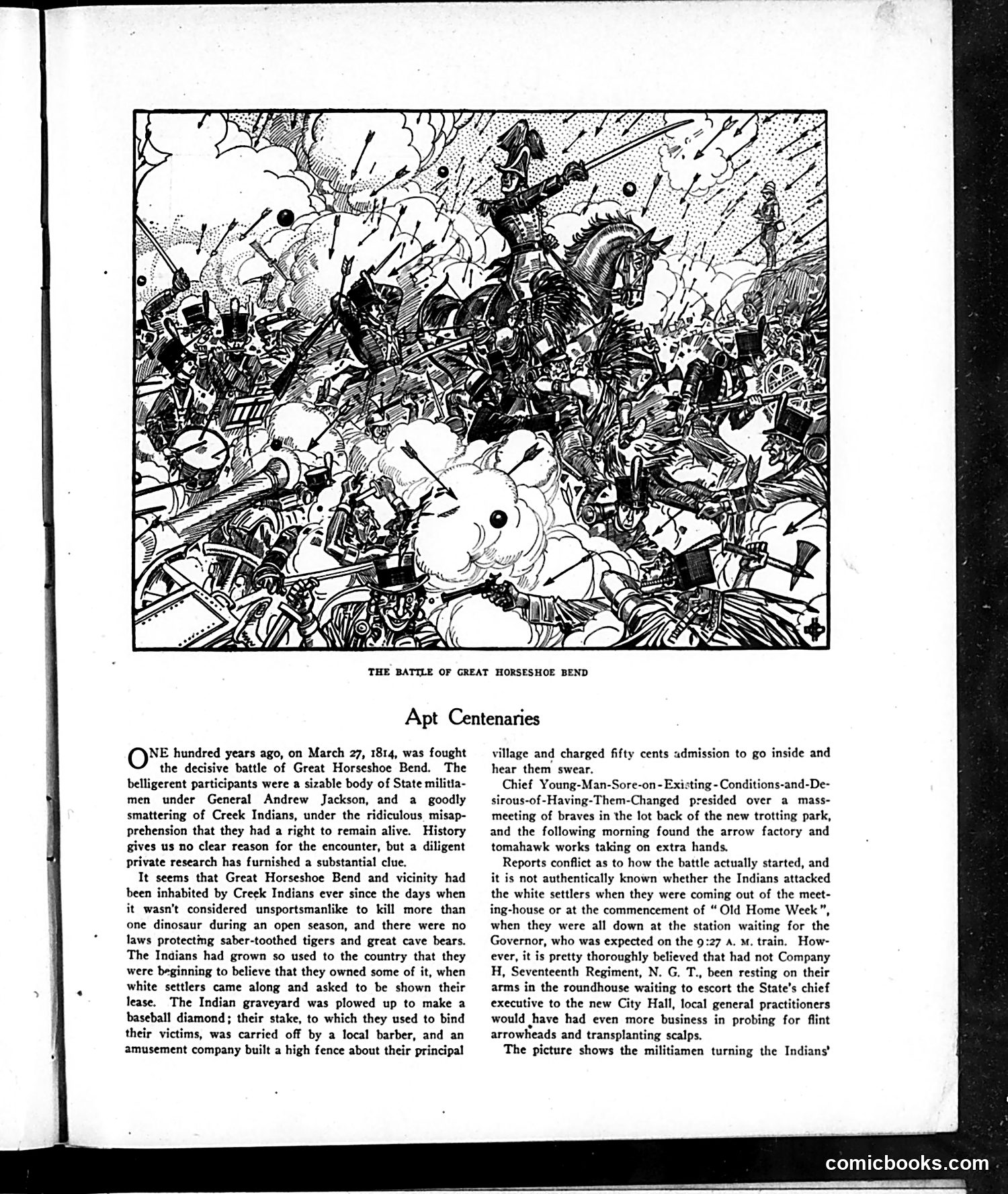
This is a satirical centennial piece mocking the 1814 Battle of Great Horseshoe Bend, where Andrew Jackson's militia defeated Creek Indians. The satire's target is white American treatment of Native Americans and the self-serving historical narrative. The text ridicules the settlers' appropriation of Creek lands—desecrating burial grounds to build a baseball diamond, turning sacred sites into paid tourist attractions ("charged fifty cents admission"), and commodifying Indigenous culture. The mocking "Chief" name ("Young-Man-Sore-on-Existing-Conditions") undercuts dignity while describing legitimate grievances. The satire's bite: the text suggests the battle was inevitable only because armed militia happened to be present, implying the outcome was predetermined rather than militarily necessary. It portrays colonization as absurd—settlers demanding proof of ownership from people who'd inhabited the land since prehistoric times—while treating Indigenous resistance as unreasonable. The crude cartoon depicts the chaotic violence, illustrating the "ridiculous misapprehension" that Native Americans believed they had "a right to remain alive"—the satire's darkest, most direct indictment of settler-colonial violence.
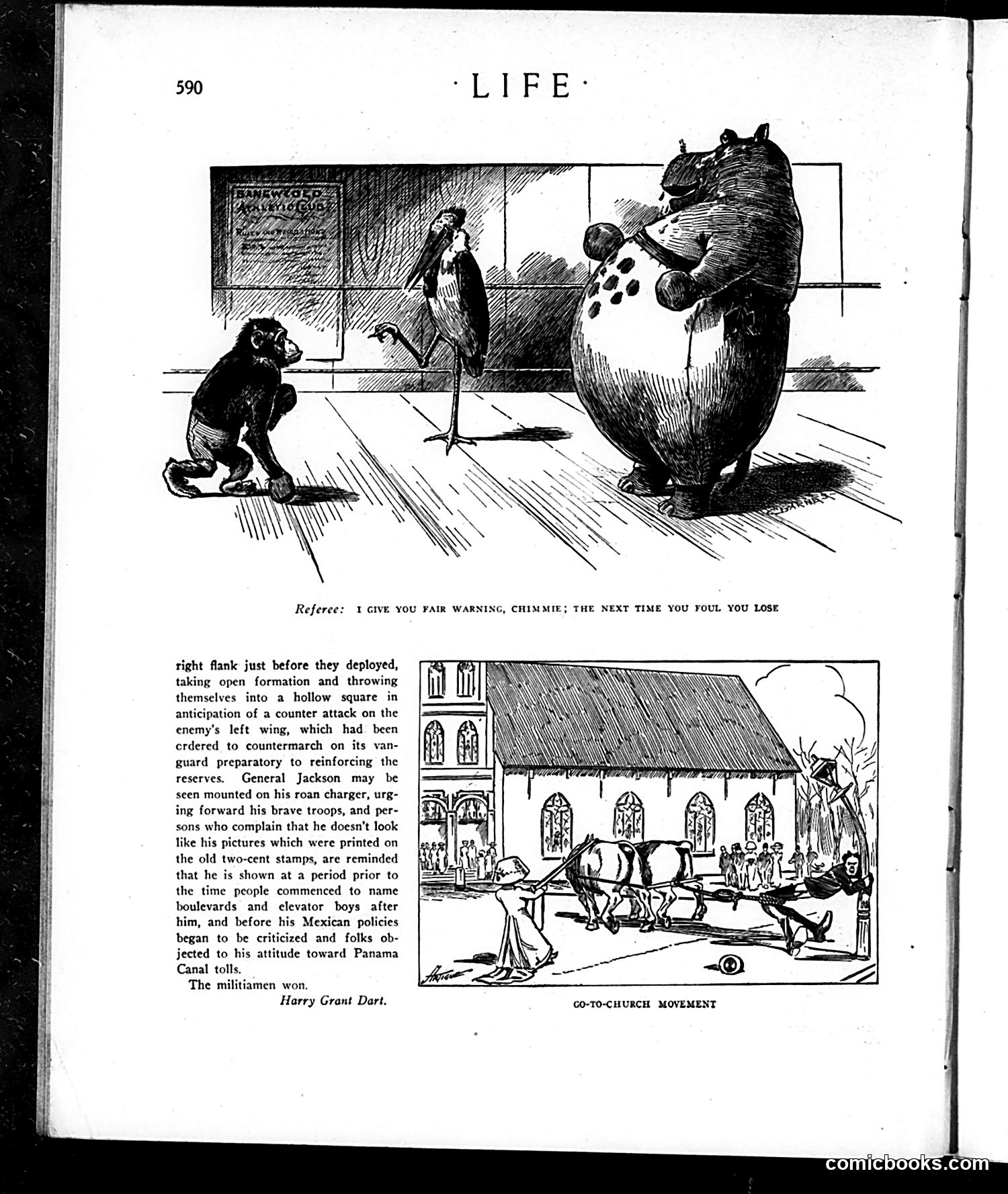
**Top cartoon:** A boxing referee warns "Chimmie" (likely a working-class or immigrant character, suggested by the nickname) about fouling. This appears to be satirizing a boxing match as metaphor for political or social conflict, though the specific reference is unclear without additional context. **Bottom cartoon:** Titled "Go-to-Church Movement," depicts a horse-drawn carriage ostensibly heading to church, but the passengers appear to be engaged in rowdy or irreverent behavior, satirizing hypocrisy—people claiming religious devotion while behaving badly. **Text section:** References General Andrew Jackson in a military context, sarcastically noting his image appeared on stamps and that his "Mexican policies" and "attitude toward Panama Canal tolls" faced contemporary criticism. This appears from a period when Jackson's legacy was actively debated in American politics and policy discussions. The page blends boxing satire, religious hypocrisy humor, and political commentary on Jackson-era policies.
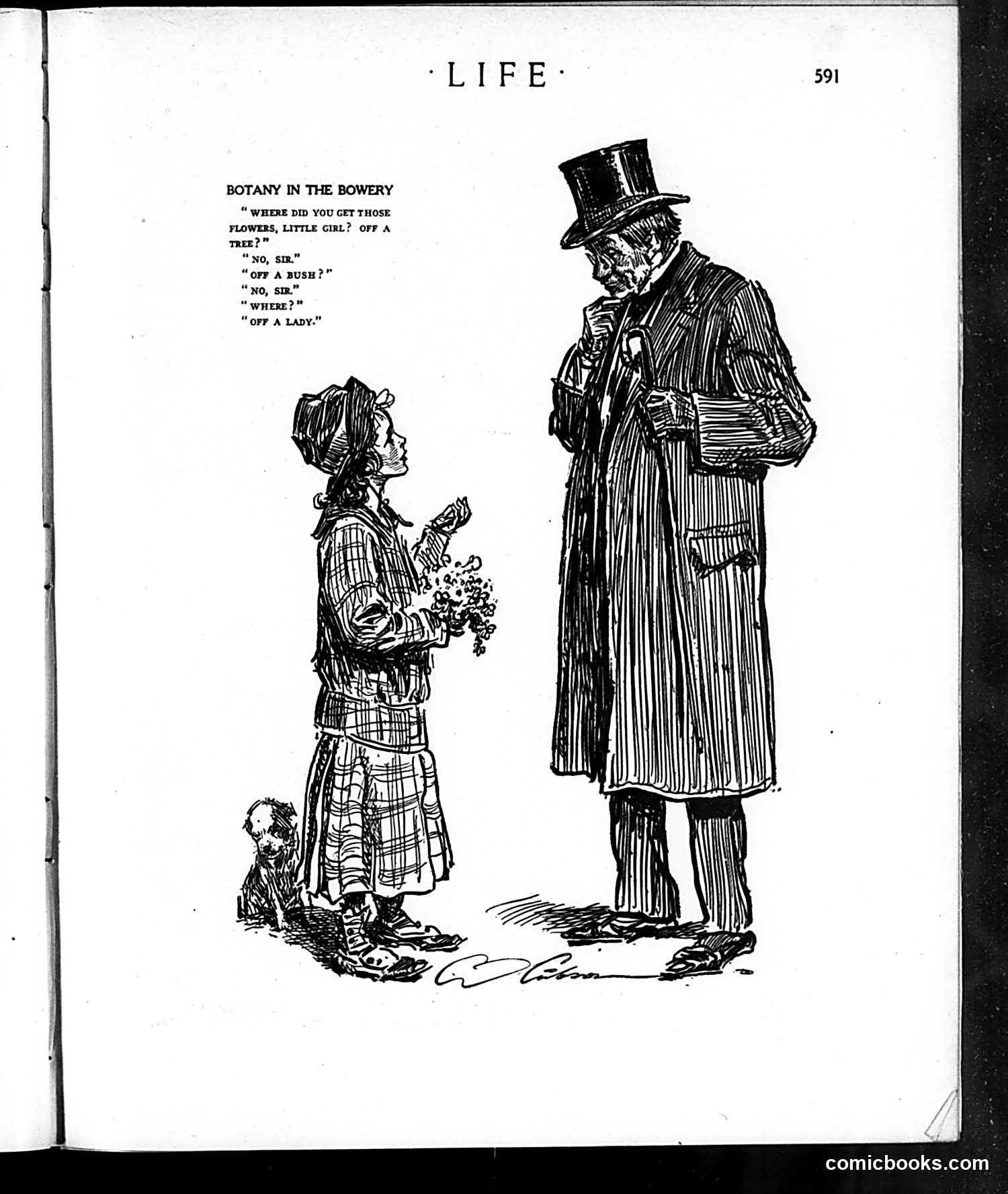
This cartoon satirizes poverty and street life in the Bowery (a working-class NYC neighborhood). An elegantly dressed gentleman questions a shabby little girl holding flowers, guessing increasingly implausible sources—a tree, a bush, a bus—before landing on the truth: she stole them "off a lady." The joke's dark humor lies in the contrast between the gentleman's naive assumptions and the grim reality of slum life, where a desperate child resorts to theft. The title puns on "botany" (plant science) versus the crude urban reality. This reflects early 20th-century *Life* magazine's tendency toward social commentary mixed with cynicism about poverty, presenting street crime as inevitable rather than systemic.
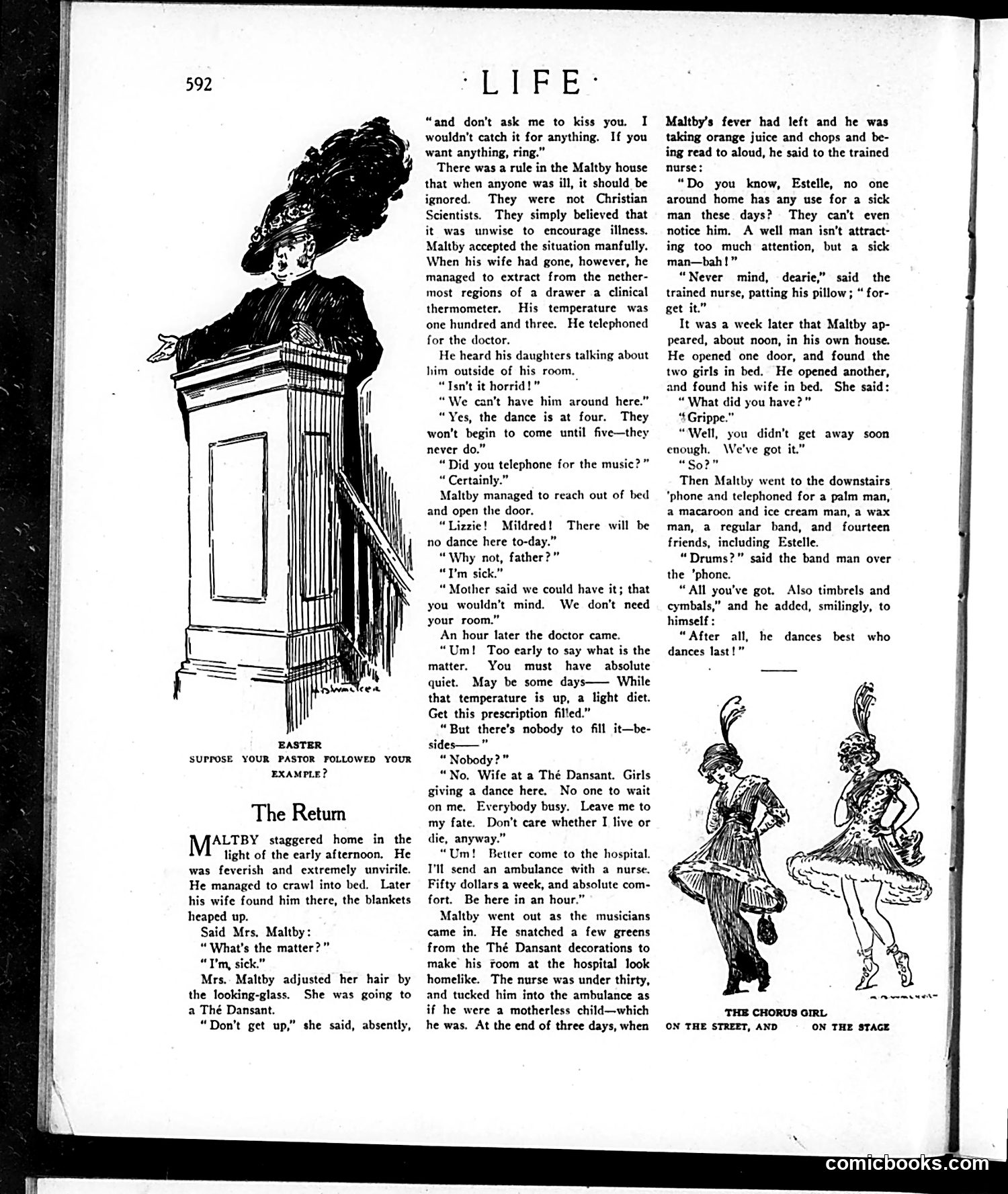
This story satirizes early 20th-century family indifference toward illness and gender roles. Mr. Maltby falls seriously ill (fever of 103°F), but his wife abandons him for a "Thé Dansant" (fashionable afternoon dance), and his daughters prioritize their own dance party over his welfare. Even the doctor finds no one available to care for him. The satire's punch: when Maltby recovers and returns home, his wife and daughters have contracted influenza ("grippe") and are bedridden. Now *he* gleefully throws a lavish party—complete with band, drums, timbrels, and cymbals—while they suffer in bed, proving the karmic reversal. The Easter heading suggests Christian hypocrisy: the family ignores religious duty to care for the sick, yet Maltby's eventual vindication becomes his redemption. The joke critiques both domestic neglect and the shallow social priorities of the era's leisure class.
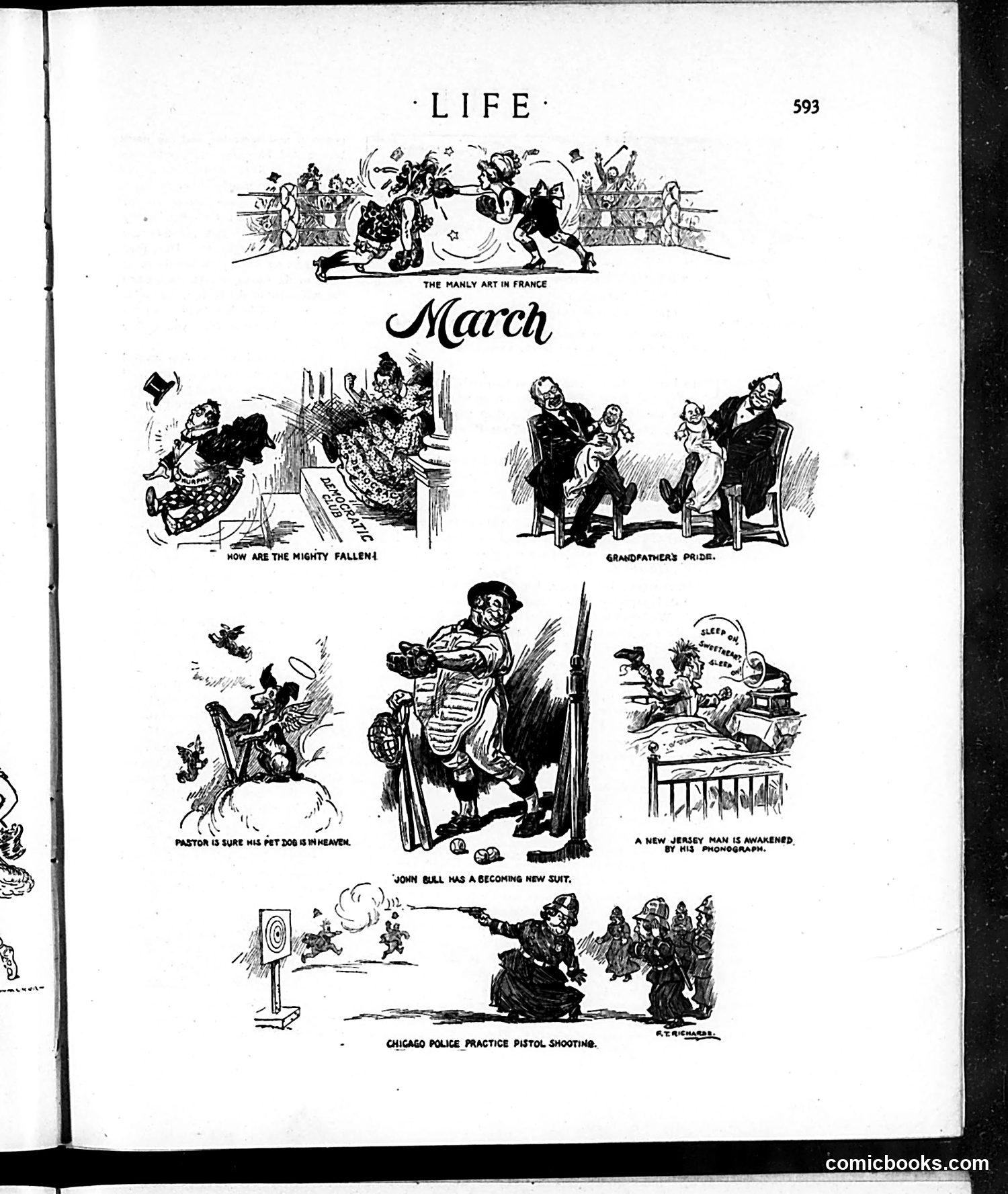
This page contains six satirical cartoons commenting on contemporary American issues: **"The Manly Art in France"** (top) depicts physical comedy involving French figures. **"How Are the Mighty Fallen"** shows a character in apparent misfortune. **"Grandfathers' Pride"** depicts elderly men with children, likely satirizing generational attitudes. **"Pastor is sure his pet dog is in heaven"** mocks religious sentimentality about pets. **"John Bull has a Becoming New Suit"** references Britain (John Bull personifies England) in some diplomatic or political context. **"A New Jersey Man is Awakened by His Phonograph"** jokes about early recording technology. **"Chicago Police Practice Pistol Shooting"** (bottom) satirizes Chicago police, likely referencing the city's notorious crime problems or police incompetence—a common American joke topic of this era. The cartoons employ exaggerated caricature typical of early 20th-century satirical humor.
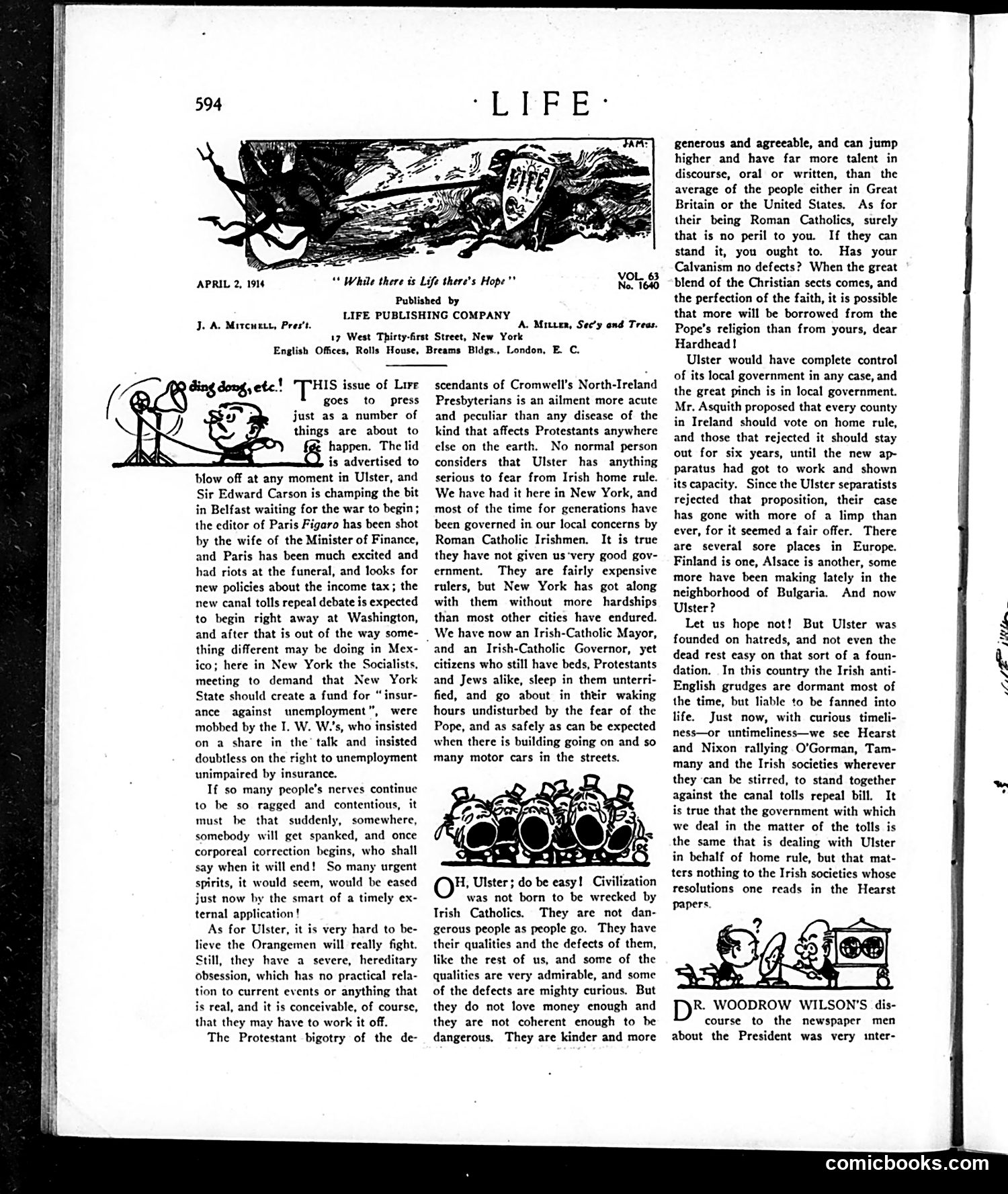
This editorial addresses the imminent Irish Home Rule crisis. The main cartoon (top) depicts a figure lying down with "Ulster" marked on his chest, illustrating Ulster's anxiety about Catholic Irish self-governance. The text argues that Protestant Ulster's fears are irrational prejudice rather than practical concern. The author cites New York's experience with Irish-Catholic mayors and governors as proof that Catholics can govern competently without oppressing Protestants. He characterizes Ulster Protestants as suffering from hereditary bigotry—specifically "Protestant bigotry of the descendants of Cromwell's North-Ireland Presbyterians"—disconnected from current reality. The piece dismisses Irish Catholics as insufficiently organized or greedy to be genuinely "dangerous," while praising their intelligence and generosity. It's a sarcastic plea for Ulster to accept Home Rule rationally rather than violently resist it. The subtext: Life's editors view Ulster's opposition as emotional sectarianism masking political obstruction.
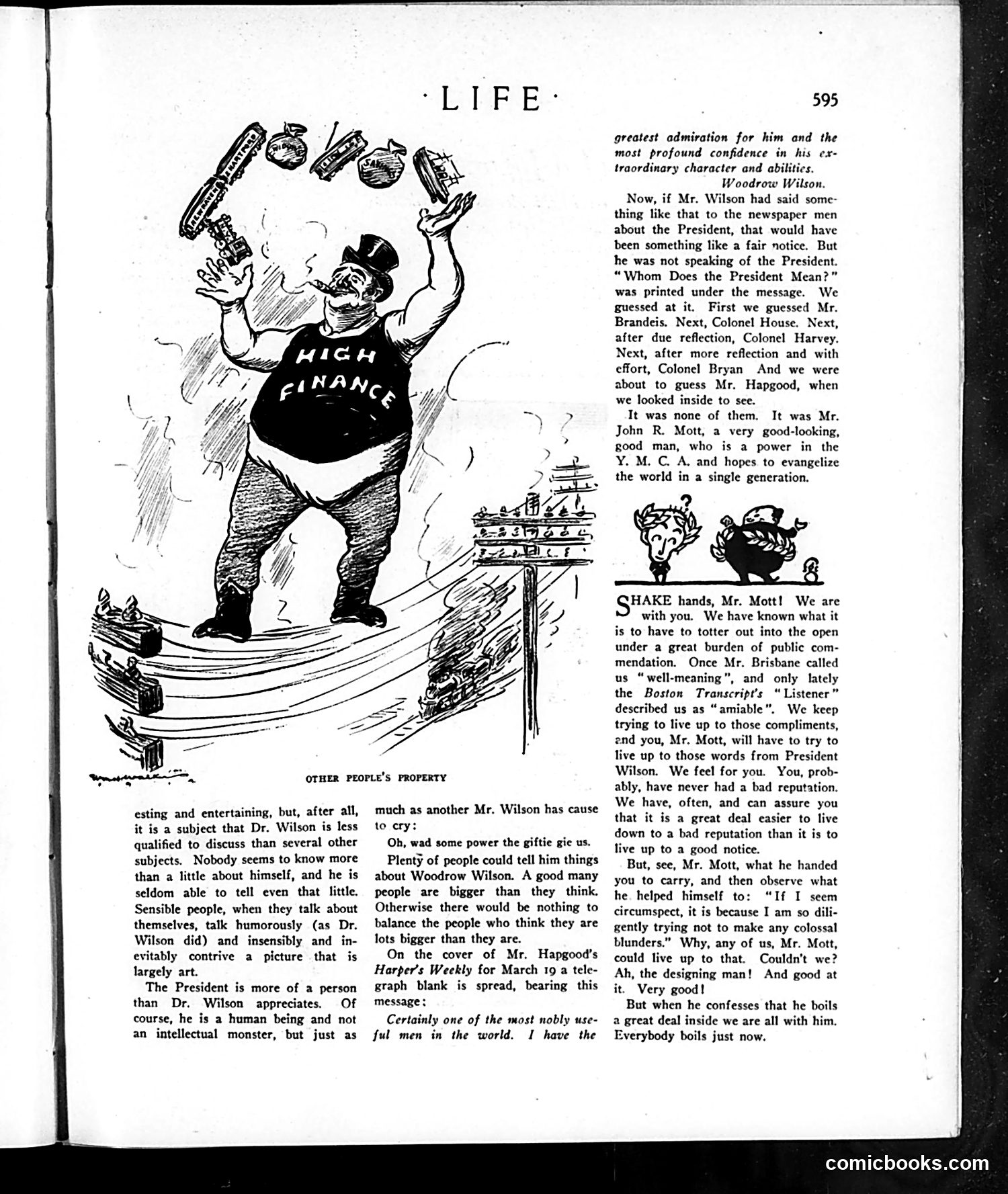
This Life magazine piece satirizes President Woodrow Wilson's public relations strategy. The cartoon depicts a figure juggling "high finance" — representing Wilson's attempt to control his public image. The satire concerns Wilson's telegram of praise for John R. Mott (a YMCA leader), published in Harper's Weekly. Life mocks Wilson for lavishly complimenting Mott while simultaneously praising *himself* in the same message — claiming he's "diligently trying not to make any colossal blunders" and that he "boils a great deal inside." The magazine's point: Wilson is cunningly using Mott as a vehicle for self-promotion, burdening Mott with impossible praise while reserving the more relatable, humble statements for himself. Life sarcastically congratulates both men on bearing the weight of Wilson's manufactured public endorsements, implying the President is a skilled manipulator of his own image who projects false modesty.
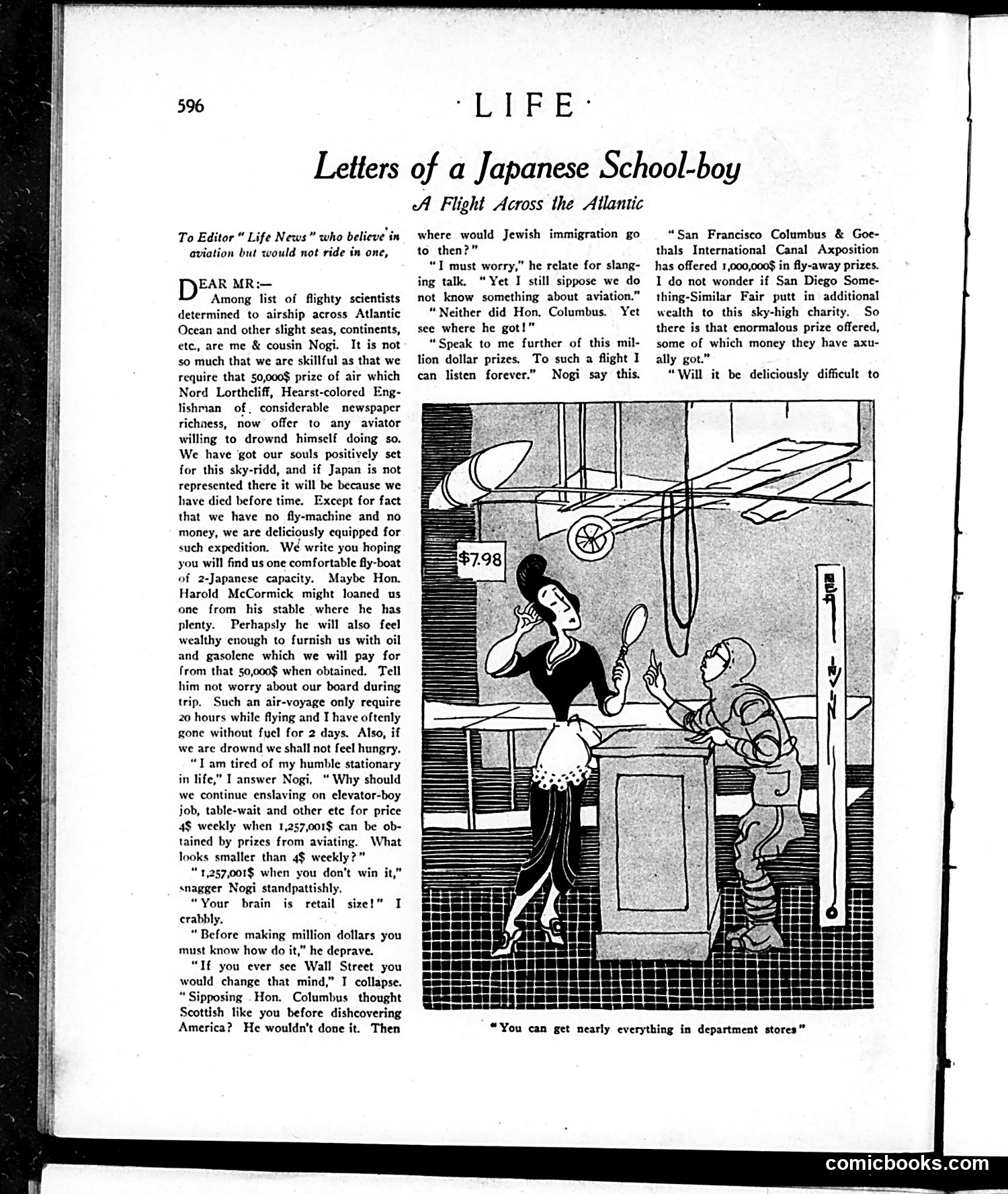
This satirical piece mocks both Japanese immigrants and the aviation craze of the early 1900s. Two Japanese characters—the letter writer and his cousin Nogi—are portrayed with exaggerated, broken English and depicted as poorly educated laborers (elevator boys, table waiters earning $4 weekly) who naively believe they can win a $50,000 aviation prize by crossing the Atlantic. The humor relies on ethnic stereotyping: their fractured grammar ("sippose," "enormalous"), malapropisms, and illogical reasoning are presented as inherent to their character. The references to Columbus and Jewish immigration suggest contemporary anxieties about foreign populations. The accompanying cartoon shows a woman at a department store counter, captioned "You can get nearly everything in department stores"—likely a separate advertisement or commentary on consumer culture. The satire ultimately ridicules both the get-rich-quick mentality and the "foreign other" attempting to participate in American enterprise.
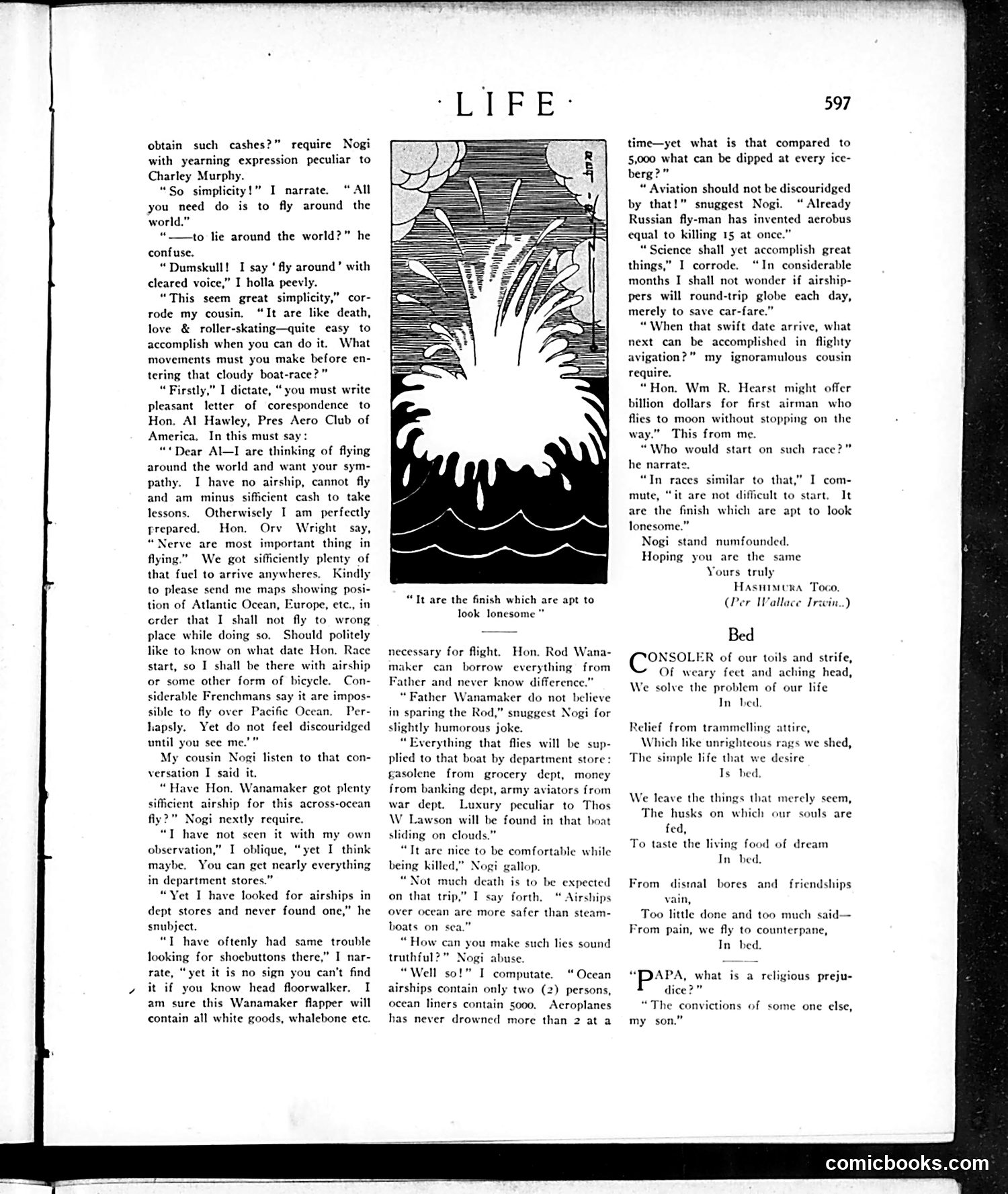
This page satirizes early aviation enthusiasm and American commercial culture circa 1910. The main cartoon depicts a humorously fractured conversation between the narrator and his cousin Nogi (depicted with exaggerated features suggesting Asian ethnicity—a common stereotype in period satire) about flying around the world. The satire targets: 1. **Aviation hype**: The notion that anyone could casually fly globally, borrowing equipment from department stores like Wanamaker's 2. **Corporate ambition**: References to wealthy figures (Hearst, Wanamaker, Lawson) financing aviation stunts 3. **Dubious logic**: The narrator's absurd statistics claiming aeroplanes are "safer" than ocean liners because they've killed fewer total people 4. **Broken English dialogue**: Used comedically to show ignorance and confusion about emerging technology The cartoon mocks both naive enthusiasm for aviation and the commercialization of danger for entertainment and profit.
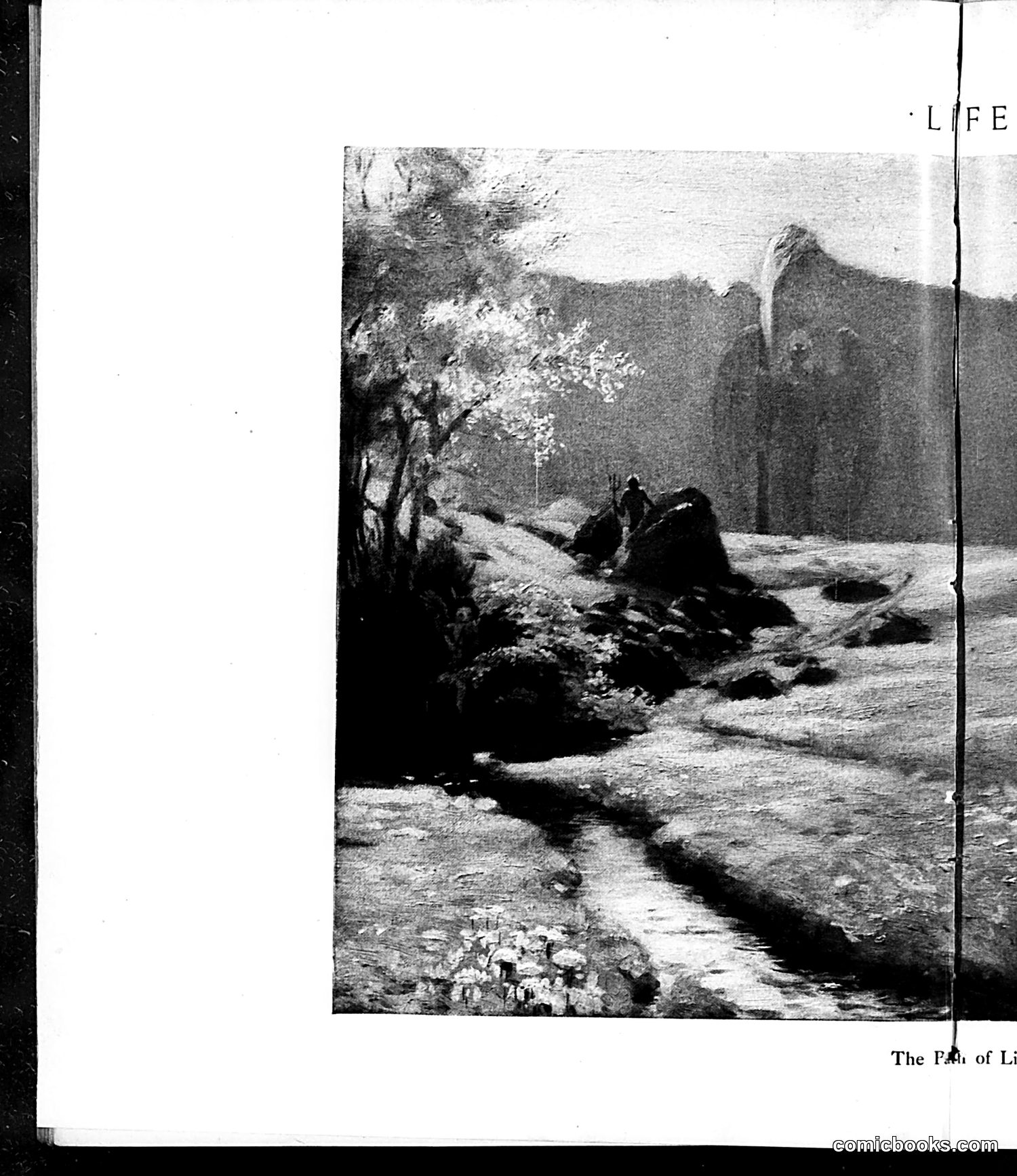
This appears to be a photograph rather than a political cartoon. The image shows a stark black-and-white landscape scene with a small figure (appearing to be a person in dark clothing) positioned among rocks and boulders near what looks like a stream or water channel. There are cliffs or mountains visible in the background, and some vegetation on the left side. The caption reads "The P&h of Li" (likely OCR error for a longer title). Without additional context or legible text, it's unclear what specific satirical or social point this photograph makes. It could be illustrative content for an article rather than satirical commentary. The image's stark, dramatic composition suggests it may comment on human isolation or struggle against nature, but the exact reference remains unclear.
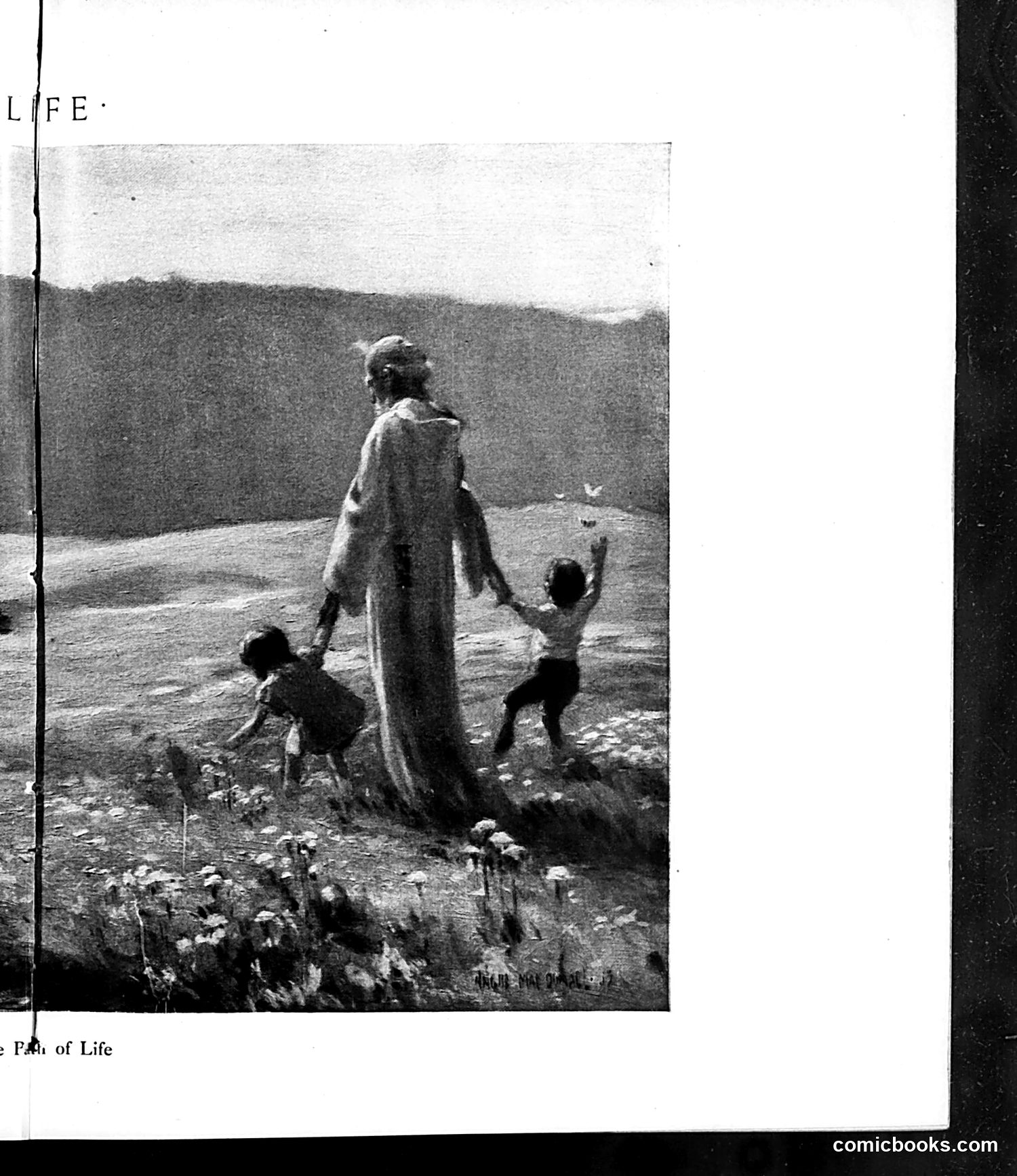
This appears to be a page from *Life* magazine titled "LIFE" at the top, with a black-and-white photograph rather than a cartoon. The image shows an adult woman in a long dress standing with two small children in a rural landscape with hills in the background. There are flowers visible in the foreground. The partial text visible at the bottom reads "...Part of Life," suggesting this is an editorial photograph rather than political satire or a cartoon. Without additional OCR text or caption information visible on the page, I cannot determine the specific social or political commentary this image was intended to convey. The composition appears sentimental or documentary in nature, possibly addressing themes of motherhood, rural life, or family—common subjects for *Life* magazine—but the precise point requires more textual context.
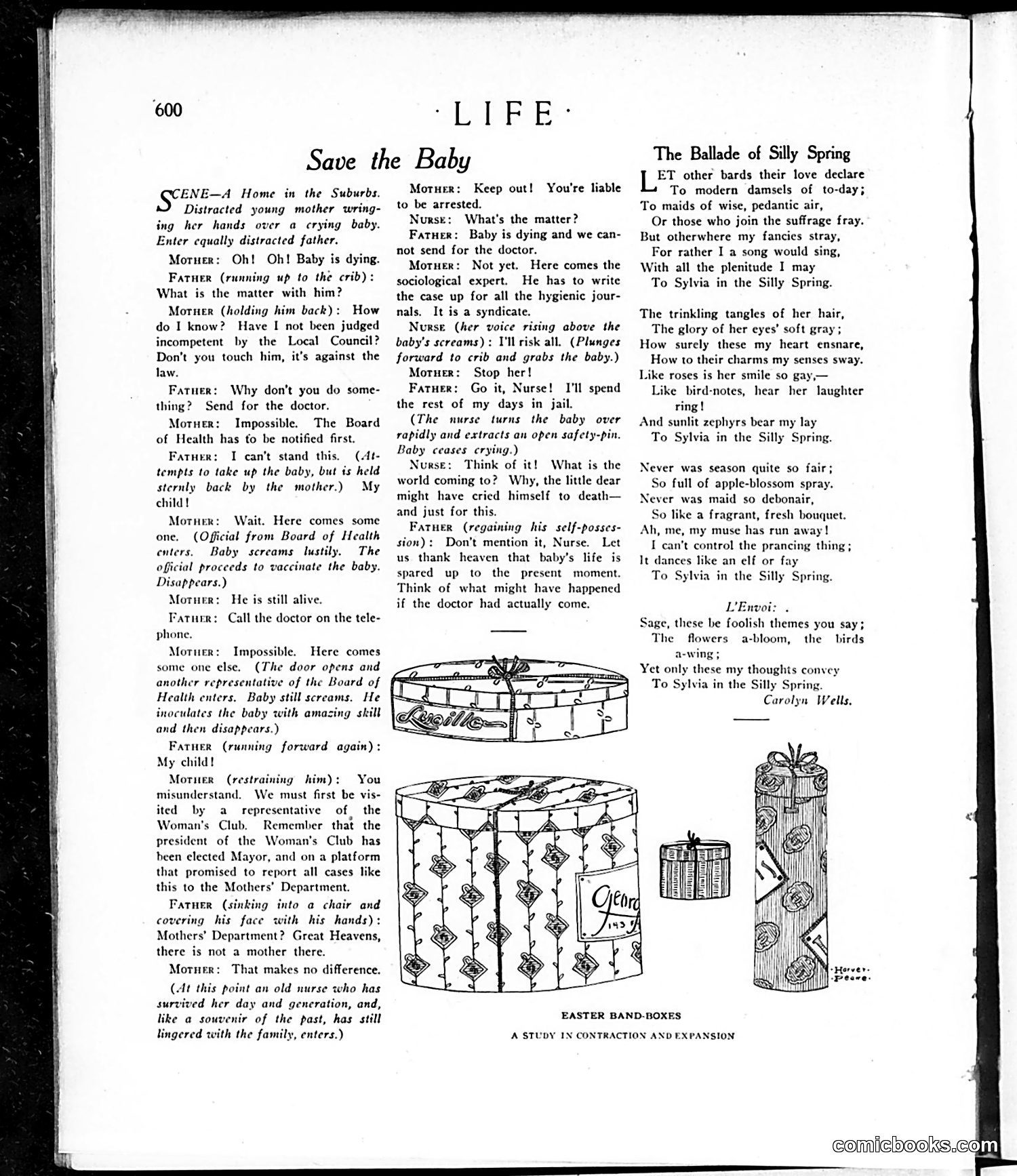
This sketch mocks early-20th-century bureaucratic interference in parenting. When a baby falls dangerously ill, the parents cannot summon a doctor because regulatory boards—the Board of Health, Woman's Club officials, and "sociological experts"—must first inspect, vaccinate, inoculate, and document the case for "hygienic journals." The satire climaxes when an old nurse risks arrest by simply removing a safety pin causing the baby's distress, accomplishing what all the officials could not. The joke targets Progressive Era reformers who, despite good intentions around public health and maternal welfare, created paralyzing bureaucratic obstacles to actual care. The "Mothers' Department" run by non-mothers epitomizes the absurdity: official credentials replacing maternal instinct and common sense. This reflects genuine contemporary anxiety about government agencies usurping parental authority—a conservative critique of expanding state power in American life.
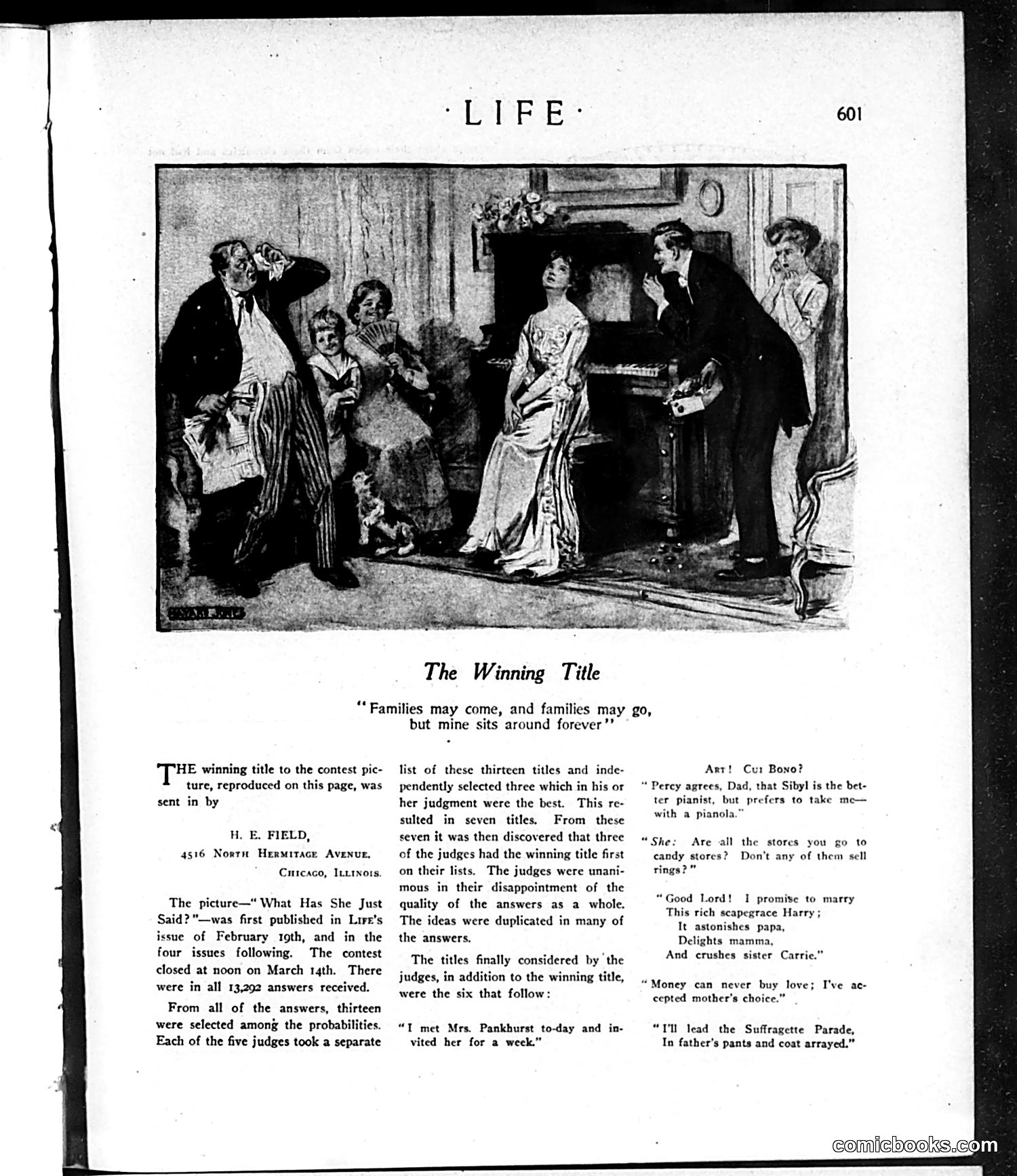
This page documents a caption-writing contest where readers submitted humorous titles for an illustration titled "What Has She Just Said?" The winning entry, submitted by H. E. Field of Chicago, was: *"Families may come, and families may go, but mine sits around forever."* The page shows the five runner-up captions, which reveal the satirical concerns of early 20th-century American life: women's suffrage ("I'll lead the Suffragette Parade"), class anxiety about wealthy but dissolute suitors ("This rich scapegrace Harry"), consumerism and marriage, and domestic tensions. The reference to "Mrs. Pankhurst" (the famous British suffragist) signals that women's rights were a hot contemporary topic. The judges noted disappointment that many submissions duplicated ideas, suggesting these social themes were obvious comedy targets for the era.
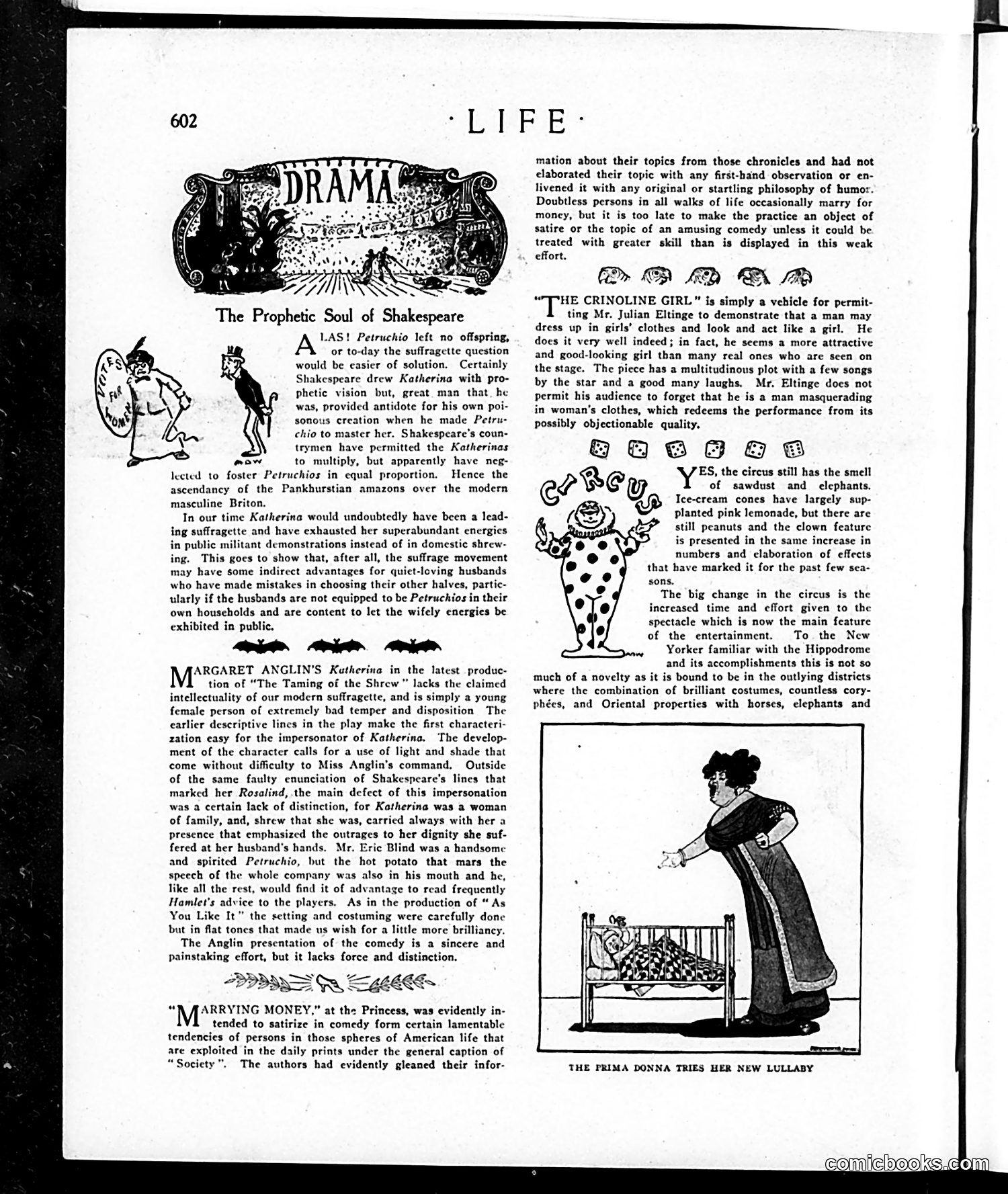
This page critiques contemporary theater productions while making a pointed political argument about women's suffrage. The main article discusses actress Margaret Anglin's performance in *The Taming of the Shrew*. The reviewer uses Shakespeare's play as a springboard for satire: he suggests that if Petruchio (the husband who "tames" the shrew Katherina) had produced offspring, the modern "suffragette question" would be solved. The joke is caustic—he implies suffragettes like the Pankhursts are modern versions of Shakespeare's Katherina, and that Britain lacks men strong enough to "master" them as Petruchio did. The article sardonically notes that channeling women's rebellious energy into public suffrage activism may actually *benefit* husbands by removing shrewish wives from their homes. This reflects anti-suffrage sentiment common in the 1910s: women demanding voting rights were mocked as irrational shrews needing male control. The page also reviews other theatrical productions, including Julian Eltinge's cross-dressing performance in "The Crinoline Girl."
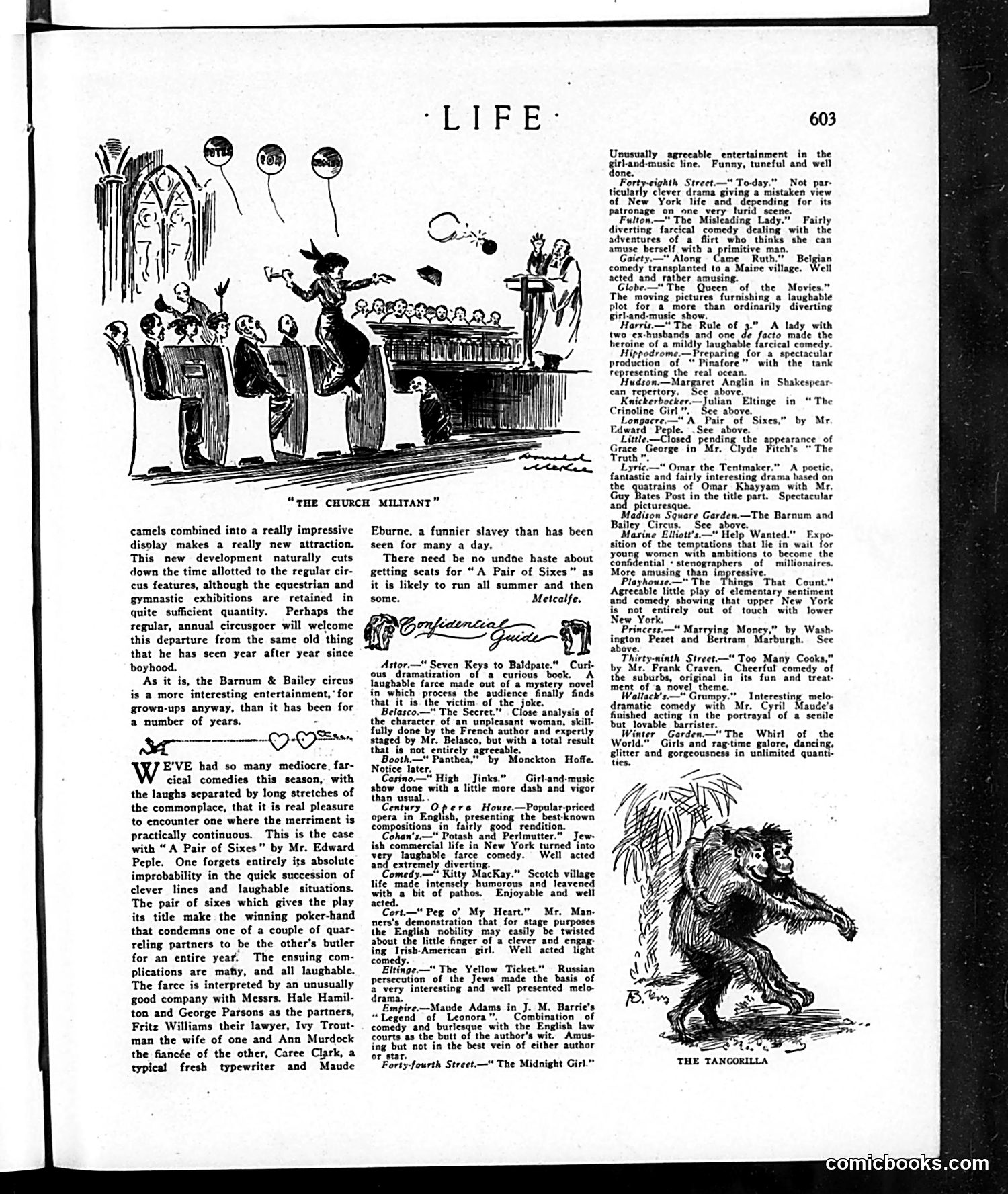
The cartoon depicts the Barnum & Bailey circus's new attraction: a religious procession featuring camels, clergy, and worshippers arranged in an ornate church-like setting. The satire targets the commercialization of religion and spectacle in entertainment. **The Joke:** The circus—traditionally associated with secular, often irreverent entertainment—has literalized "the church militant" (a theological term for the active, fighting church) by making it a circus act. This mocks both the circus industry's desperate search for novelty ("the same old thing") and the potential commodification of religious imagery for profit and entertainment. The cartoon's title puns on the theological phrase while depicting religion reduced to mere spectacle and performance—suggesting that American popular entertainment was trivializing sacred institutions by turning them into attractions meant to amuse the paying crowd.
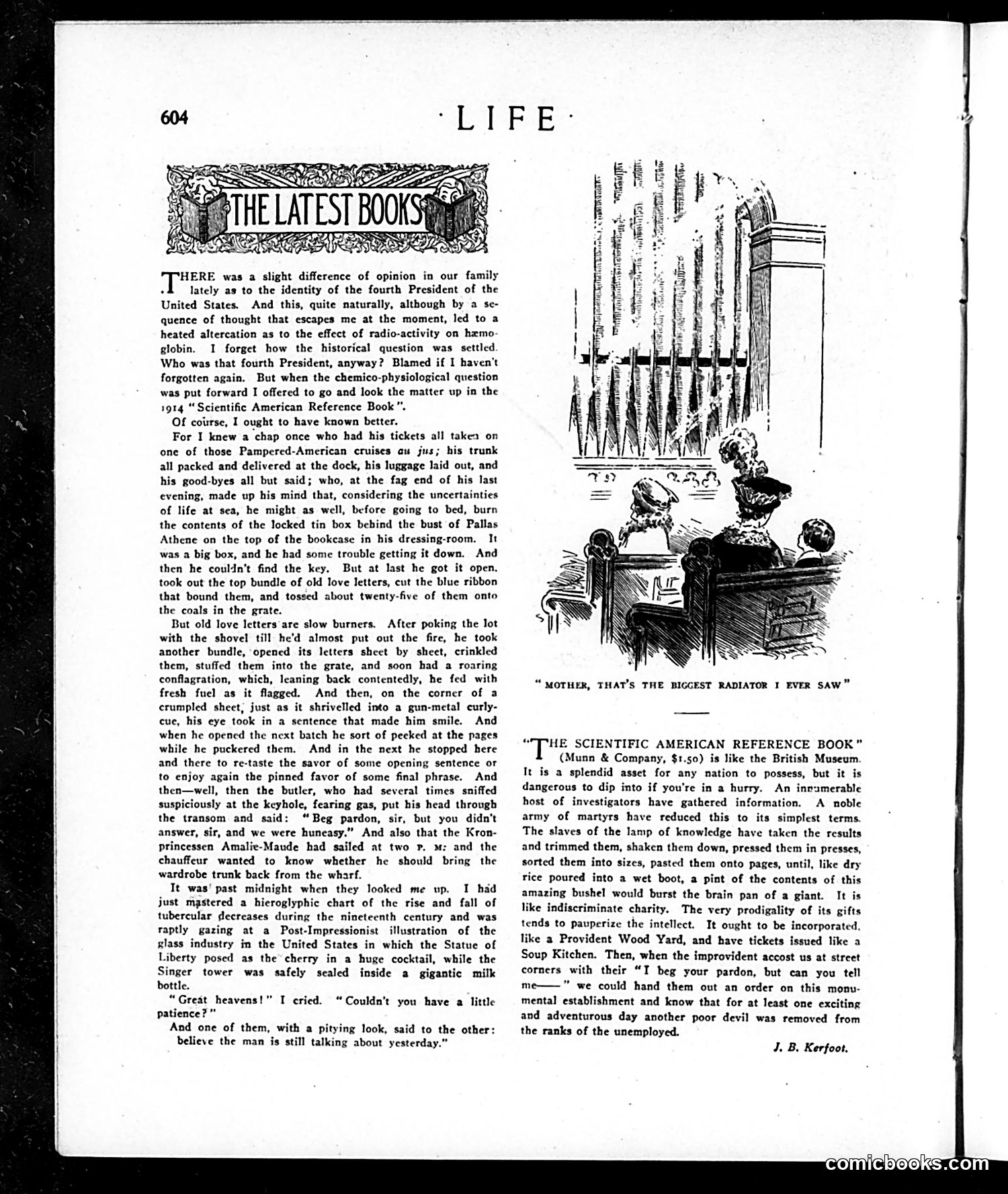
This page presents a humorous essay satirizing the *Scientific American Reference Book* (1914). The author recounts a family dispute over which president was fourth, which spiraled into debates about radio-activity's effect on hemoglobin—illustrating how consulting reference books can trap readers in endless rabbit holes. The accompanying anecdote mocks over-consultation of information sources: a man planning ocean travel attempts to look up an obscure fact before departure, gets distracted by old love letters, and nearly misses his ship entirely. The cartoon (captioned "Mother, that's the biggest radiator I ever saw") appears to be a child's innocent misidentification of some object—likely satirizing how reference books create confusion rather than clarity for casual users. The review's concluding point: the *Scientific American Reference Book* is valuable but dangerous "if you're in a hurry"—a witty critique of how comprehensive reference materials, while impressive, can overwhelm rather than assist rushed readers.
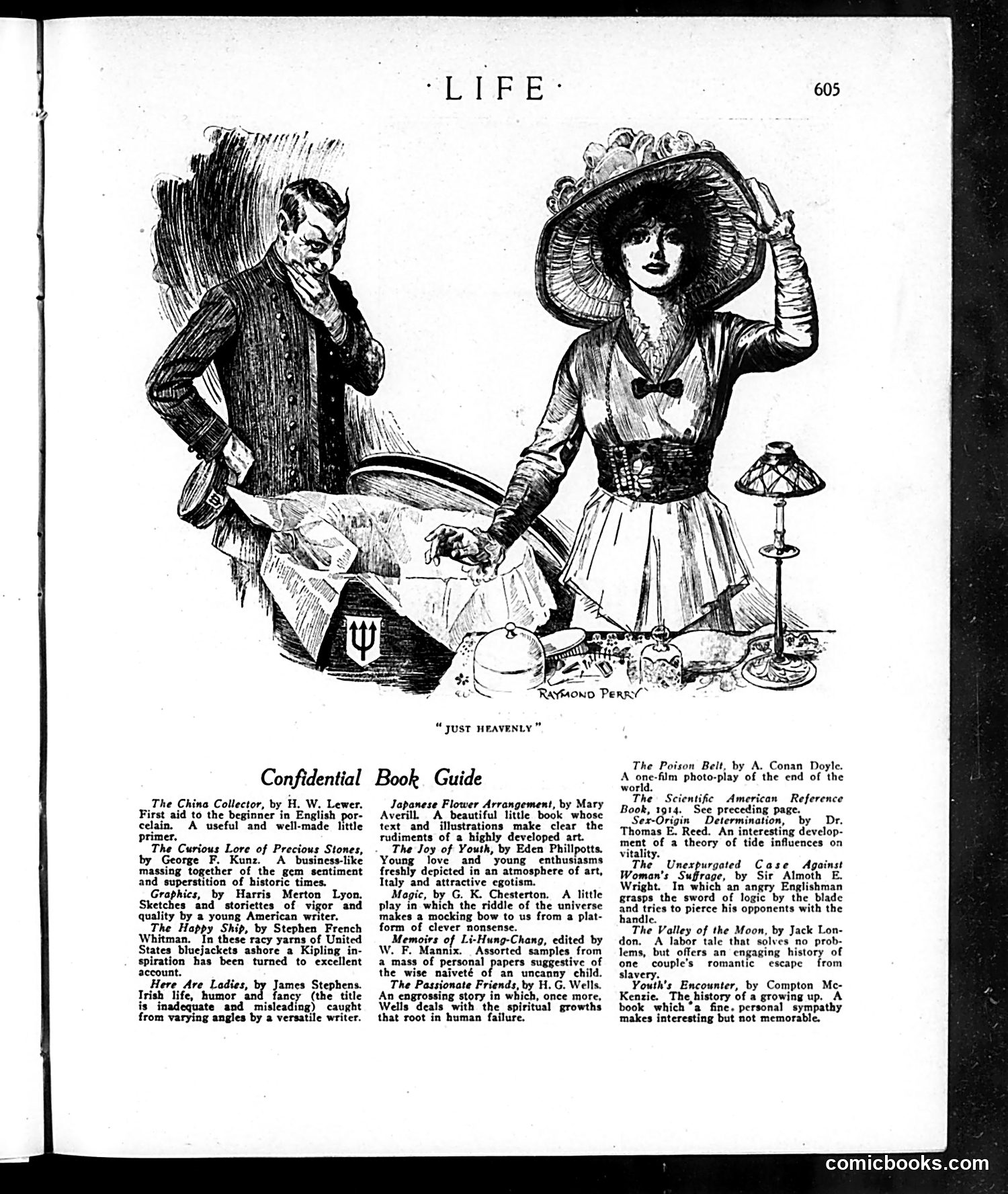
This cartoon, credited to Raymond Perry, depicts a domestic scene satirizing gender roles and marital dynamics of the early 1900s. A man stands behind a woman adjusting an enormous, elaborate hat adorned with feathers and decorations. The title "Just Heavenly" is ironic—the woman appears pleased with her extravagant headwear while the man's expression suggests bemused tolerance or resignation. The satire targets two contemporary concerns: the absurd expense and impracticality of fashionable women's hats of the Edwardian era, and the husband's role as financial provider obliged to indulge his wife's costly tastes. The cartoon pokes fun at both the exaggerated fashion standards women faced and the financial burden this placed on men—a common theme in satirical magazines of this period.
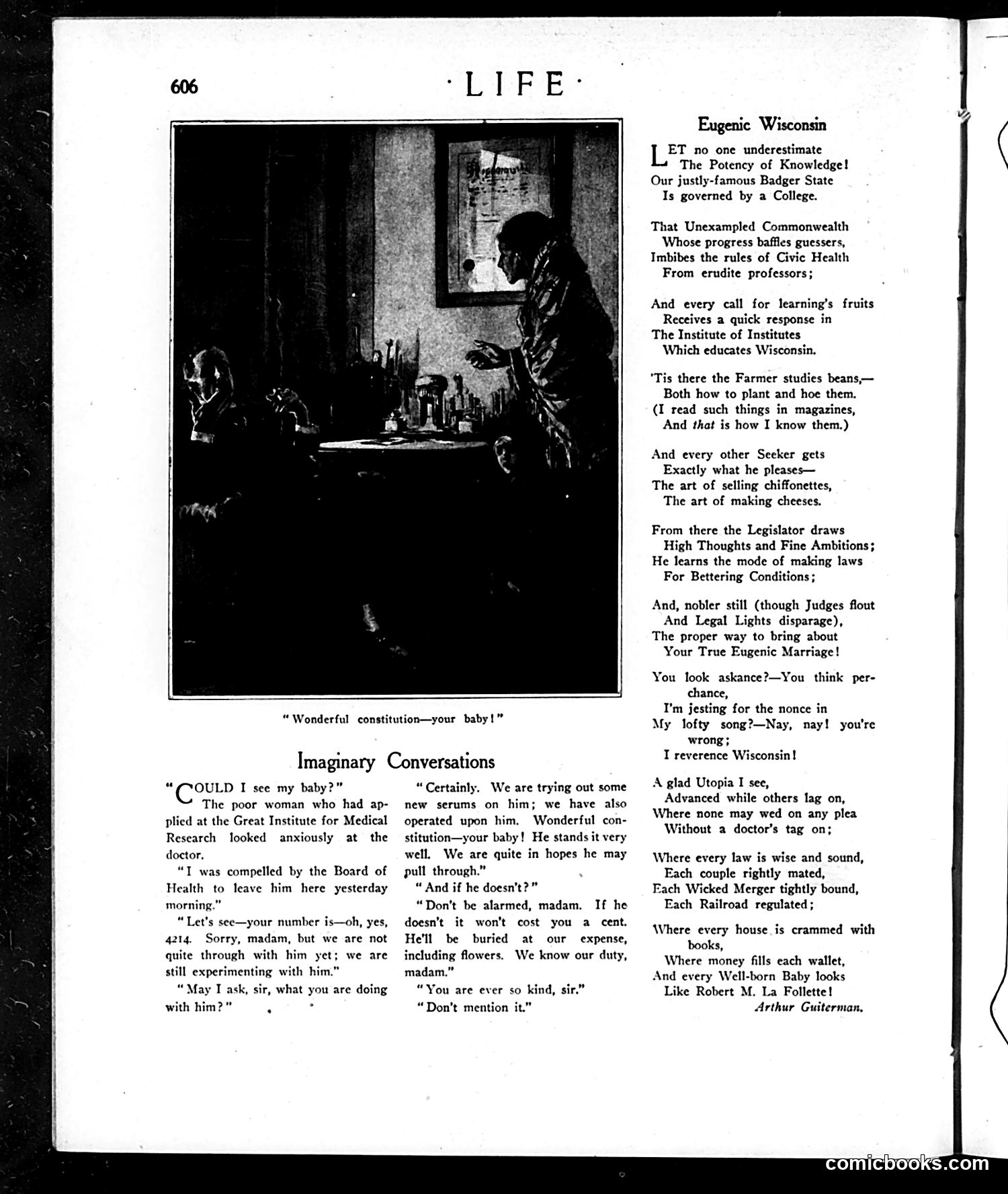
The page contains two satirical pieces mocking early 20th-century progressive ideals, particularly eugenics. **"Imaginary Conversations"** depicts a poor woman visiting a medical research institute to see her baby. A doctor casually describes experimenting on the infant with serums and surgery, callously noting that if the child dies, the institute will cover burial expenses. The satire targets the callous dehumanization of the poor by medical institutions conducting experiments without consent—a darkly comic critique of medical exploitation. **"Eugenic Wisconsin"** by Arthur Guiterman sarcastically praises Wisconsin's progressive governance, specifically its embrace of eugenics and forced sterilization policies. The poem mocks the state's confidence in scientific control of human reproduction—"rightly mated" couples, marriage requiring "a doctor's tag on." It references Robert La Follette, Wisconsin's progressive senator, suggesting progressivism's dangerous intersection with eugenics pseudoscience. Both pieces expose the era's troubling faith that science and expertise could—and should—control human biology and society, critiquing this ideology as inhumane and overreaching.
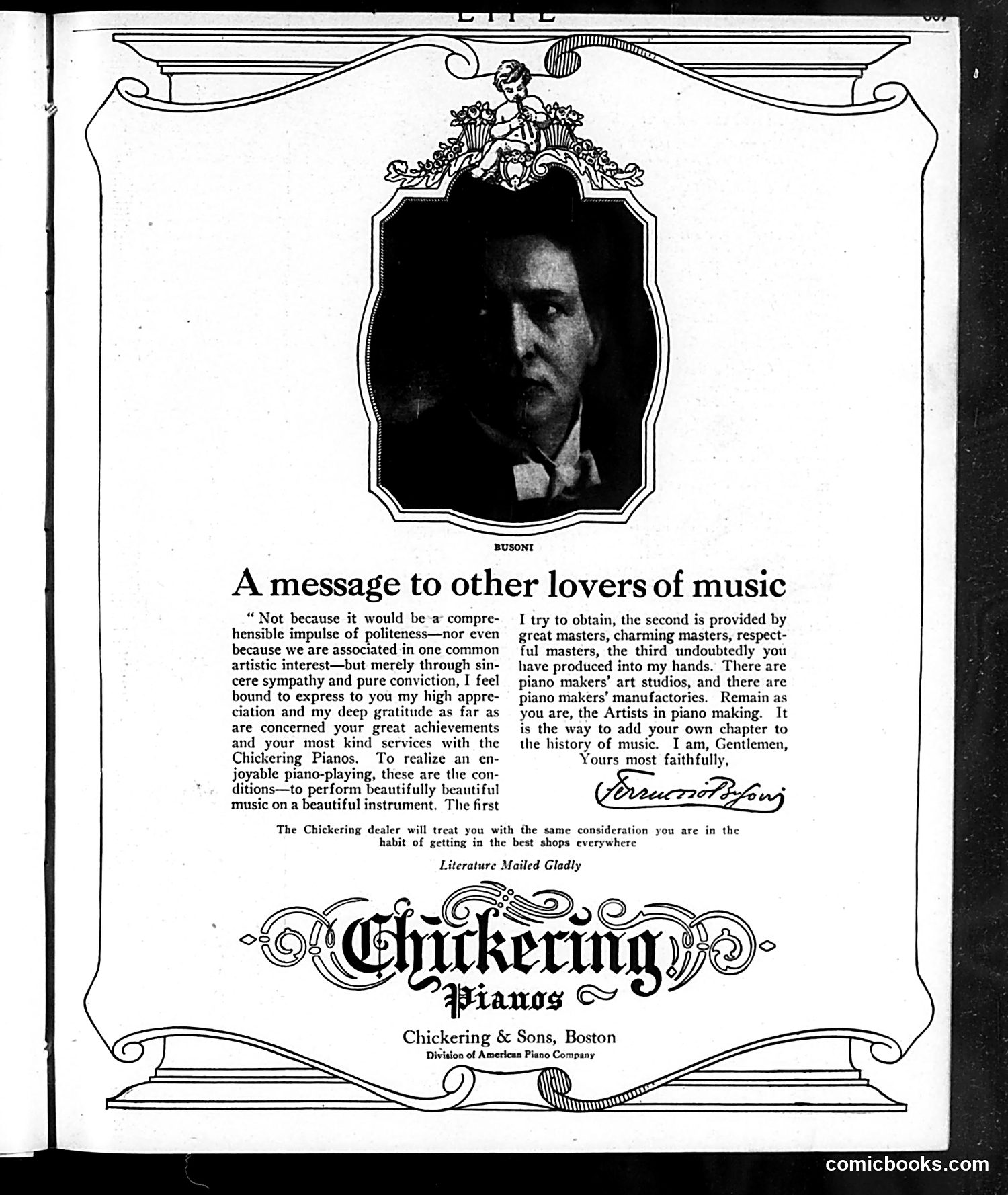
This page is **not a cartoon or satire** but rather a **full-page advertisement** for Chickering Pianos, masquerading as editorial content. The portrait labeled "BUSONI" appears to be **Ferruccio Busoni**, a renowned pianist and composer of the early 20th century. His purported endorsement—a lengthy letter praising Chickering pianos—serves as the advertisement's centerpiece. The ad employs a common marketing tactic of the era: using celebrity testimonials to legitimize a product. The flowery language about "beautiful music on a beautiful instrument" and positioning Chickering as "Artists in piano making" rather than mere manufacturers appeals to aspirational music lovers. The phrase "Literature Mailed Gladly" at bottom indicates readers could request promotional materials. This blurs advertising and journalism—typical of early *Life* magazine, which mixed satirical content with sponsored material presented as legitimate endorsements.
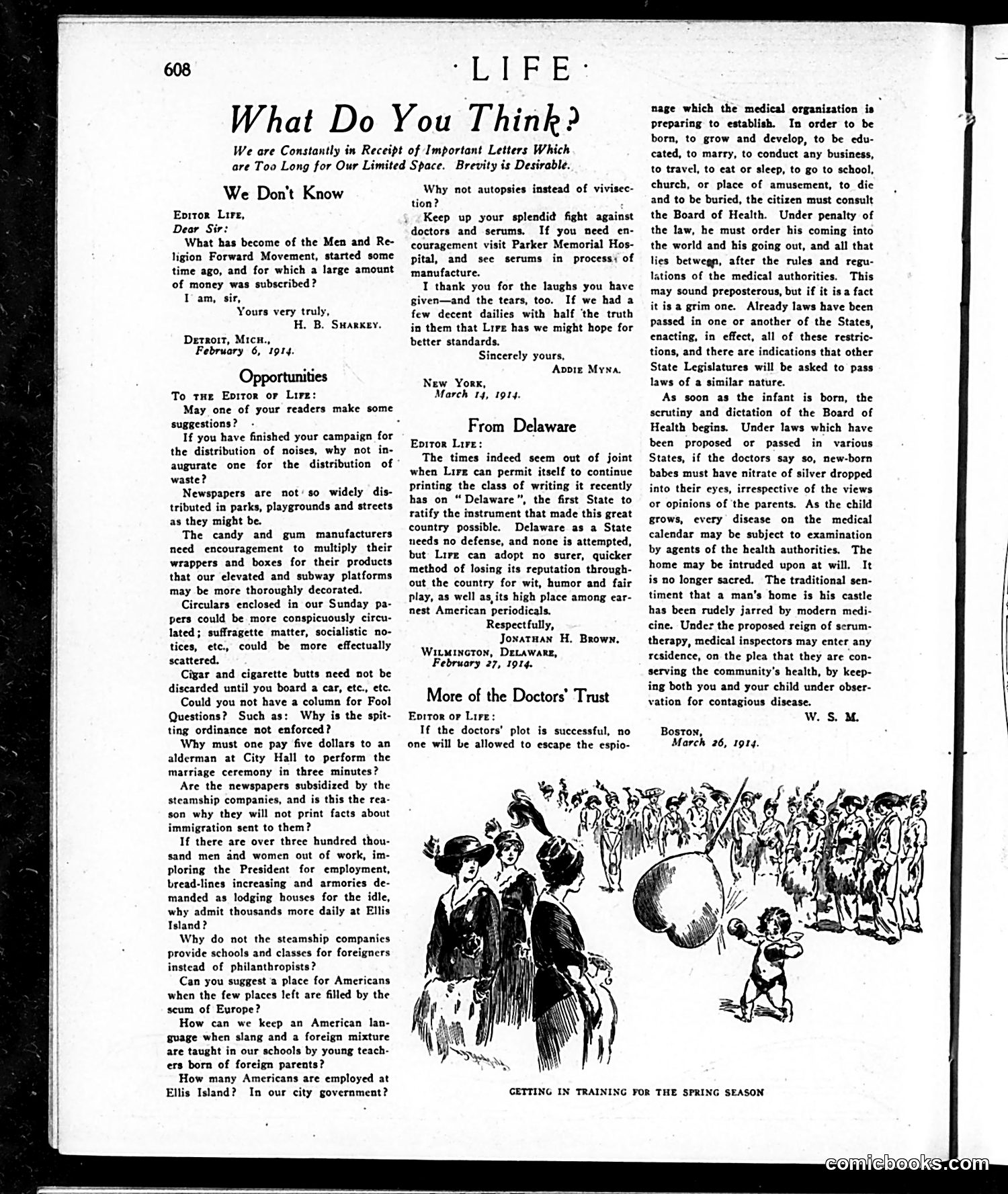
This page features reader letters to Life's editor, showcasing the magazine's satirical role as social critic. The letters reveal early 20th-century American anxieties: **Key concerns addressed:** - The "Men and Religion Forward Movement" (a Progressive-era reform initiative) and its accountability - Immigration policy at Ellis Island—a writer sarcastically suggests distributing "waste" (litter) as efficiently as immigrants are admitted, implying overly permissive immigration - Labor unemployment despite thousands seeking work - Medical authority overreach ("Doctors' Trust")—one writer warns of doctors gaining surveillance power over citizens' private lives (birth, death, travel, eating) - Foreign-born teachers and language preservation **The satire:** Life presents these letters to ridicule both genuine social problems and cranky reader obsessions. The sarcastic "opportunities" letter mocks complaint-culture itself. The doctors' letter reflects contemporary anti-medical establishment sentiment and fears of institutional control. The bottom illustration shows figures training for "spring season"—likely satirizing athletic preparation or some contemporary fad, though context is unclear.
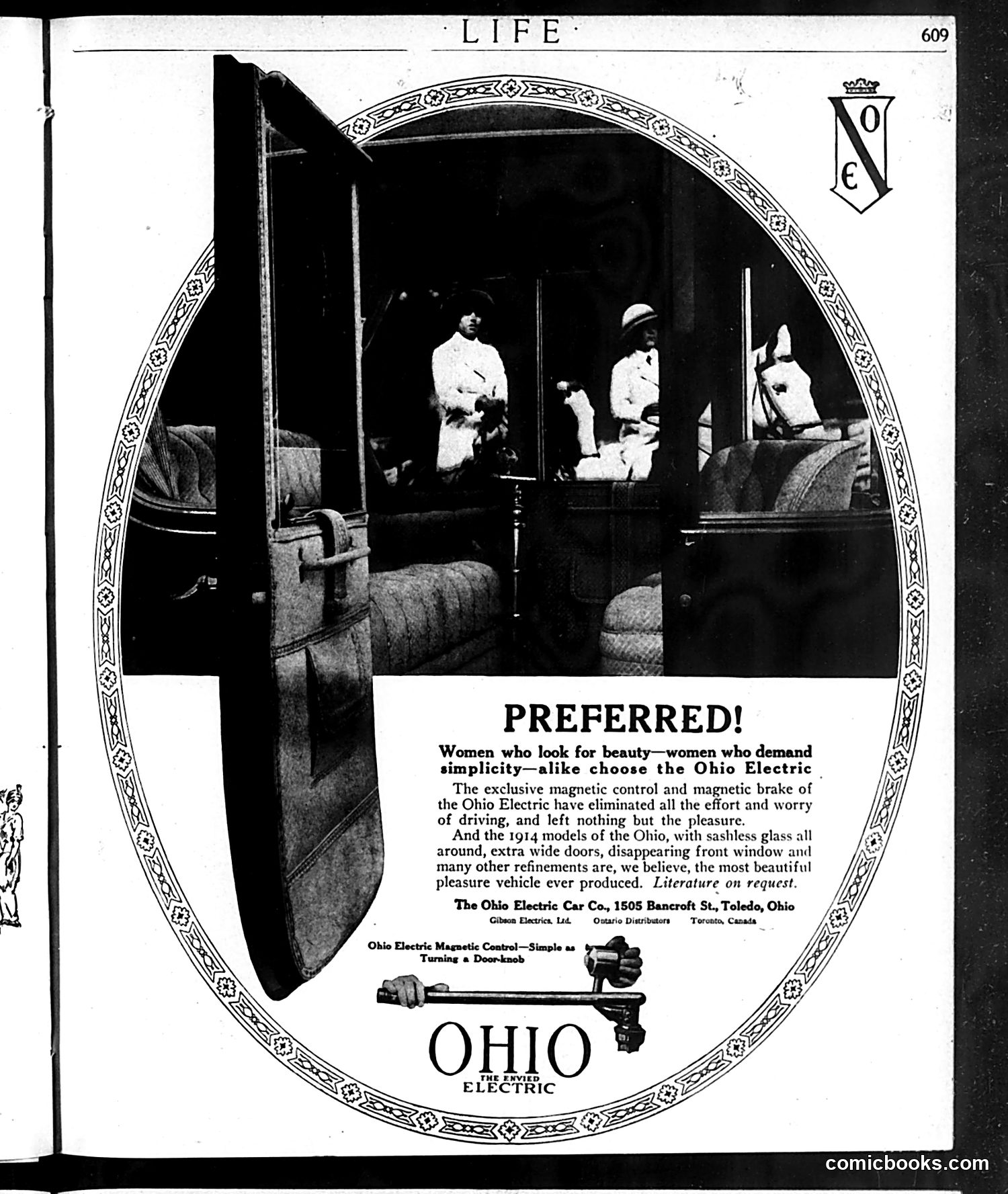
This is a **full-page advertisement**, not political satire. It promotes the Ohio Electric Car Company's 1914 automobile model. The ad targets women specifically, emphasizing the car's ease of operation—its "magnetic control and magnetic brake" eliminate "effort and worry." This appeals to female drivers of the era, when cars required significant physical strength to operate. The photograph shows well-dressed women inside an elegant vehicle with luxurious features: sashless windows, wide doors, and a disappearing front window. The headline "PREFERRED!" suggests women drivers prefer this model for its beauty, simplicity, and comfort. The ad reflects early 1900s marketing strategies that positioned electric vehicles as particularly suitable for women because they required less mechanical skill than gasoline cars. This was a significant selling point during automobiles' early adoption period.
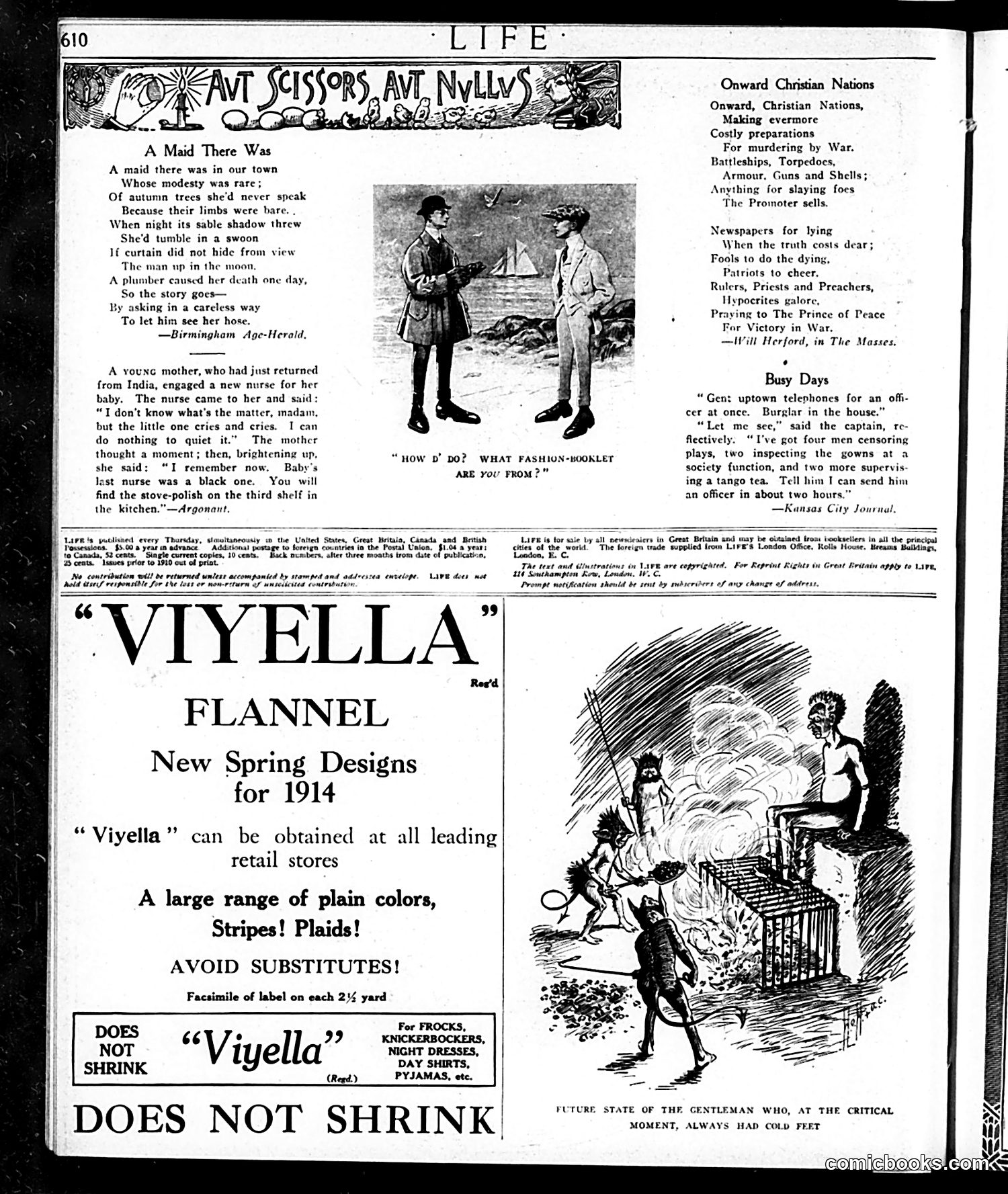
This *Life* magazine page from 1914 contains anti-war satire alongside period humor and advertisements. **"Onward Christian Nations"** (by Will Herford, *The Masses*) is a scathing critique of Christian hypocrisy regarding warfare. It mocks religious and political leaders who preach peace while manufacturing weapons, newspapers that lie to support war, and clergy who pray for military victory—condemning the gap between Christian doctrine and martial preparation. This reflects pre-WWI pacifist sentiment. The page's other content is lighter: "A Maid There Was" presents Victorian-era prudishness as absurd (a modest woman faints at tree limbs); "Busy Days" satirizes police censoring theater costumes and dances while ignoring actual crime; period jokes mock racial attitudes and innocent misunderstandings. The *Viyella* flannel advertisement occupies the lower half—standard commercial content. The bottom cartoon about "cold feet" is a pun on cowardice during courtship. The anti-war poetry stands starkest against the advertisement's normalcy, highlighting the magazine's dual role as satirical commentary and commercial publication during an era of mounting international tension.
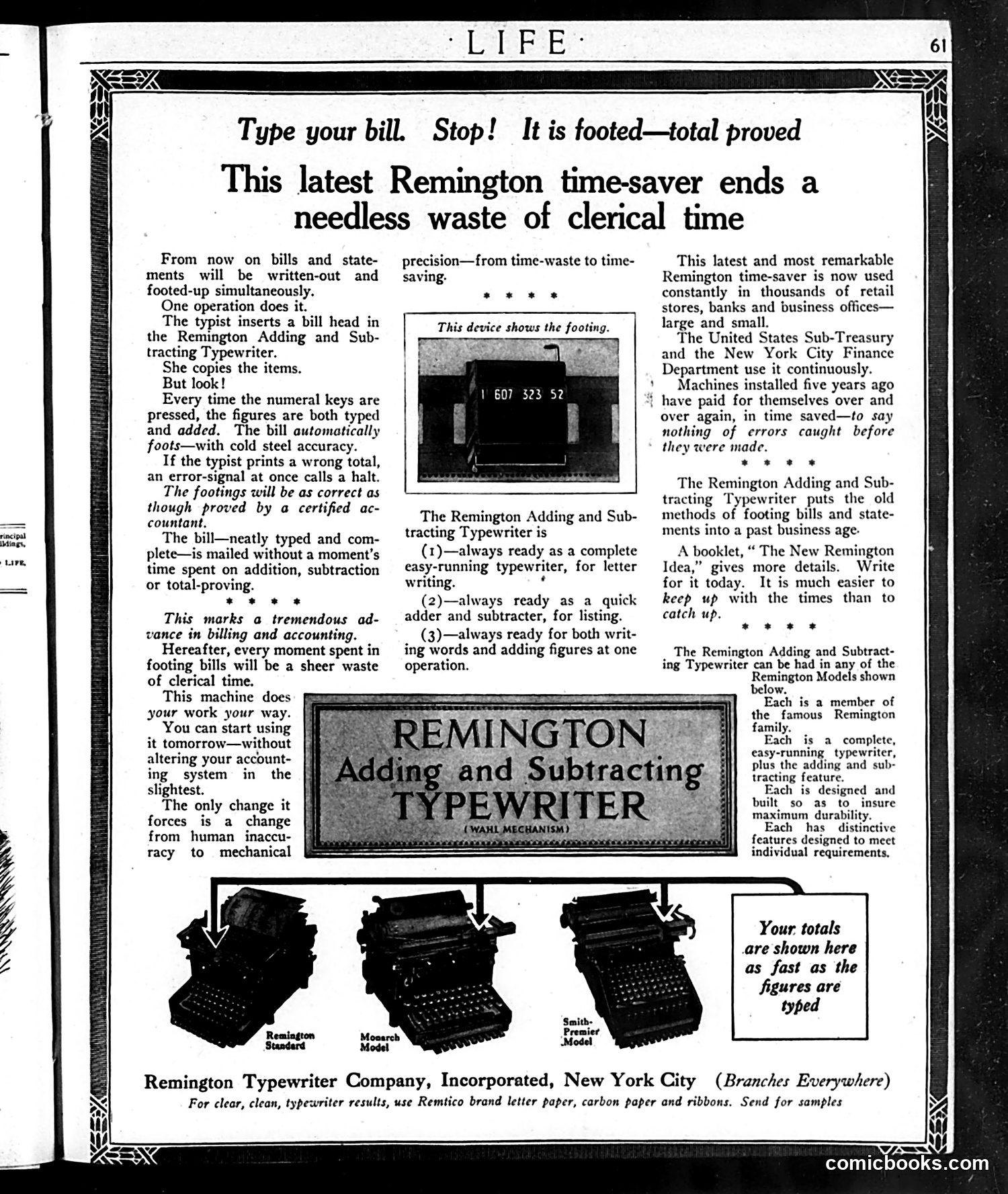
This is **not a cartoon or satire**—it's a straightforward **product advertisement** for a Remington typewriter innovation. The page promotes a typewriter that combines typing with automatic arithmetic: as a clerk types bill items and presses number keys, the machine simultaneously calculates totals and prints them. The ad emphasizes this eliminates manual addition errors and saves clerical time. The appeal to modern readers: this represents pre-computer office automation. In an era before electronic calculators, this mechanical integration of typing and math was genuinely innovative. The ad references real institutional users (U.S. Sub-Treasury, NYC Finance Department) to establish credibility, and the cost-benefit argument ("machines installed five years ago have paid for themselves") uses efficiency metrics familiar to business decision-makers. The page demonstrates how businesses solved clerical bottlenecks through mechanical innovation—the historical predecessor to modern spreadsheet software.
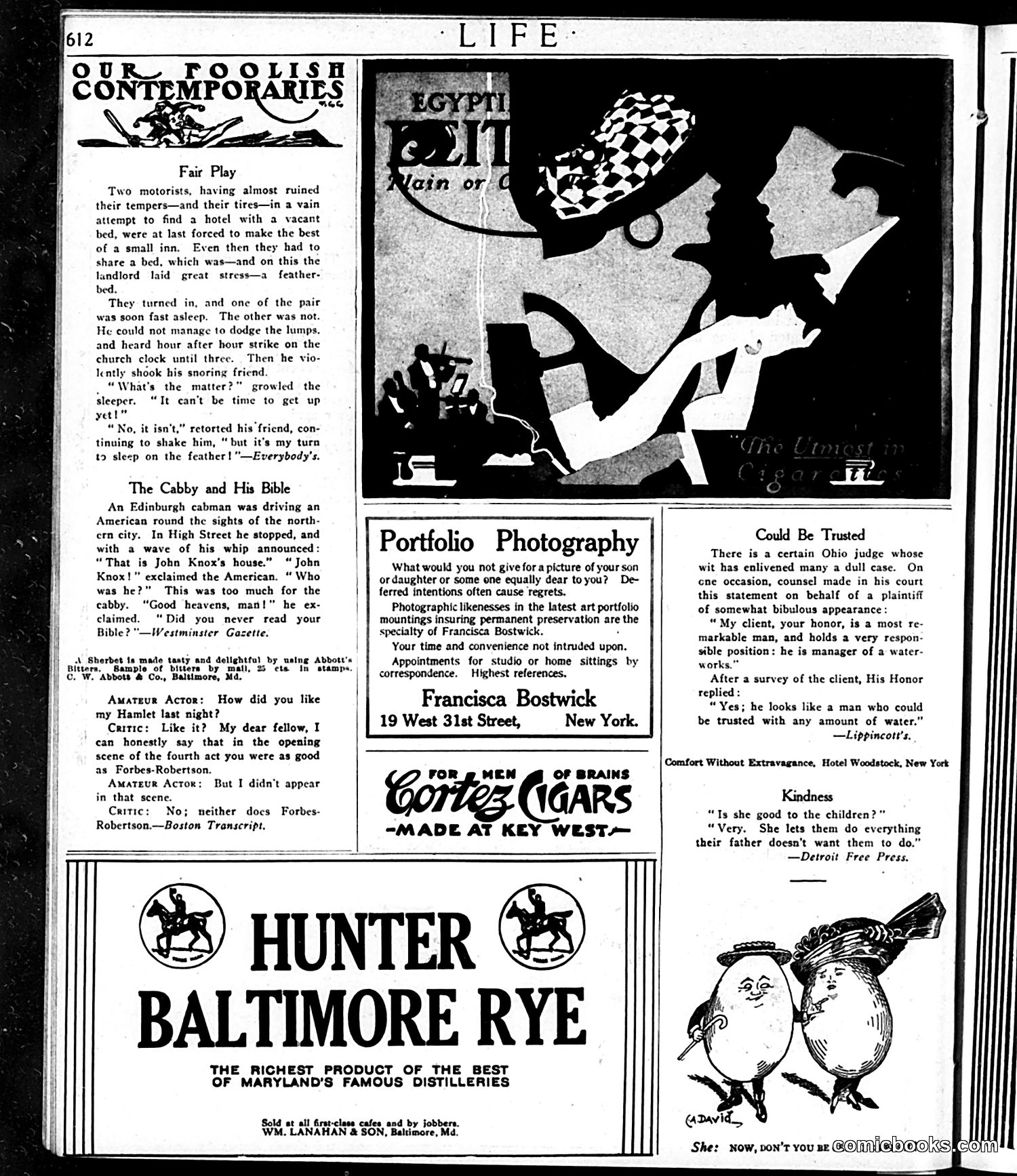
This is a **humor page from Life magazine** mixing jokes, advertisements, and satirical anecdotes—typical of early 20th-century humor publications. **The cartoons/humor:** The top illustration depicts two motorists forced to share a feather bed at an inn during a housing shortage. The joke: unable to sleep on the lumpy feather bed, one man wakes the other, claiming "it's my turn to sleep on the feather!"—absurdist humor about shared misery. Below are brief anecdotes satirizing social types: an Edinburgh cabman shocked that an American tourist doesn't know John Knox (Scottish religious figure); a theater critic praising an amateur actor for being "as good as Forbes-Robertson" in a scene where he didn't appear (mock insult); and an Ohio judge's quip that a courthouse plaintiff managing a waterworks "looks like a man who could be trusted with any amount of water" (implying the man drinks excessively). **The advertisements** for cigars, rye whiskey, and photography services are period-typical filler. The humor relies on wordplay, social embarrassment, and character types rather than visual sophistication.
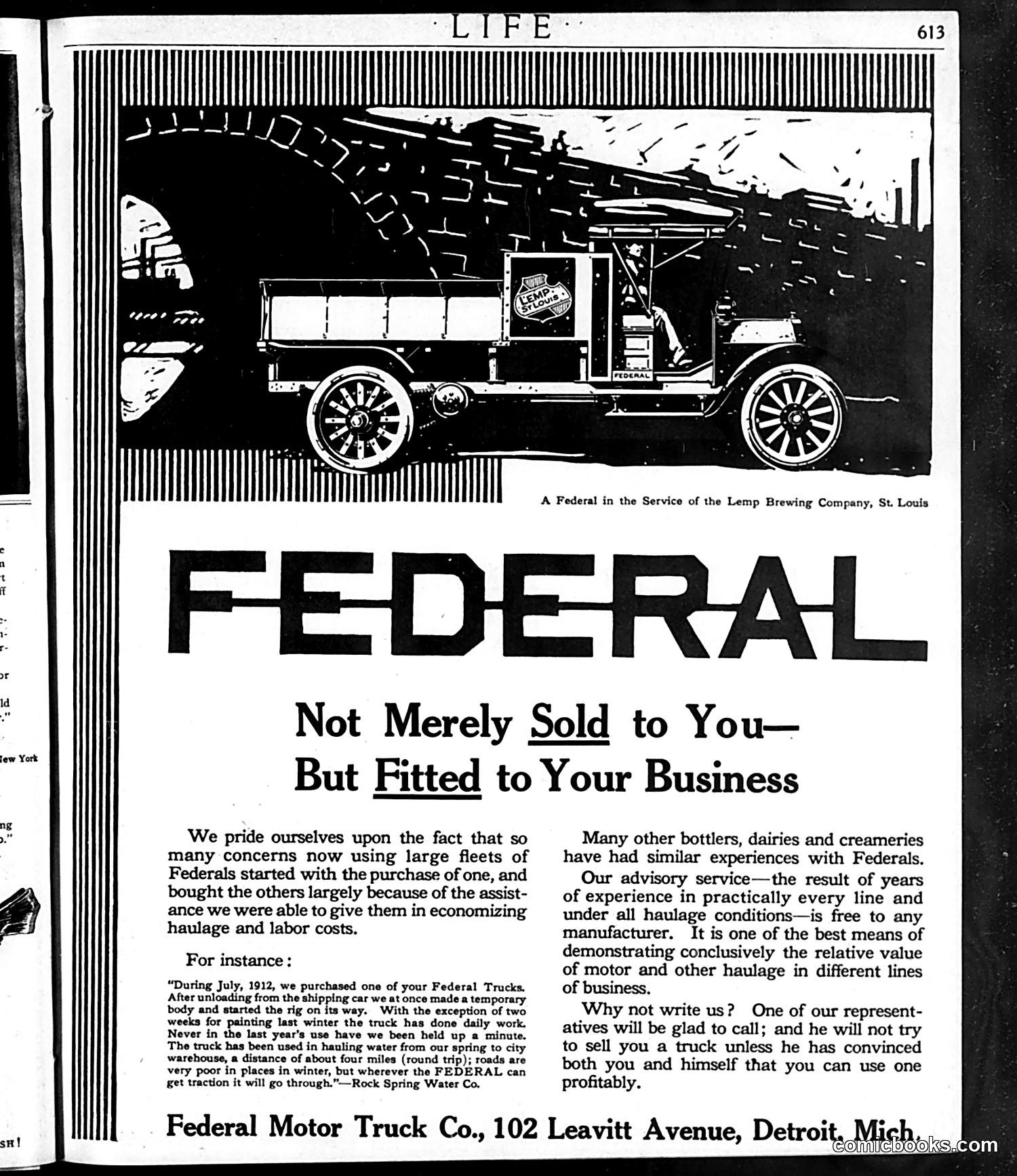
This is **not a cartoon or satire**, but a **commercial advertisement** for Federal Motor Trucks, published in *Life* magazine (page 613). The image shows a Federal truck in service for the Lemp Brewing Company of St. Louis, depicted hauling beer delivery cargo. The ad's headline promises trucks are "Fitted to Your Business"—not merely sold. The text is a testimonial-style pitch emphasizing Federal's reliability and advisory services. A quoted customer (Rock Spring Water Co.) claims their Federal truck ran continuously for a year with minimal downtime, even on poor winter roads, hauling water four miles daily. The sales strategy targets small manufacturers and beverage distributors by promising free consultation to demonstrate the truck's value versus traditional horse-drawn hauling. For a modern reader: this is early automotive industry marketing (circa 1912-1913), positioning motorized trucks as practical business investments for regional distributors before trucking became standardized.
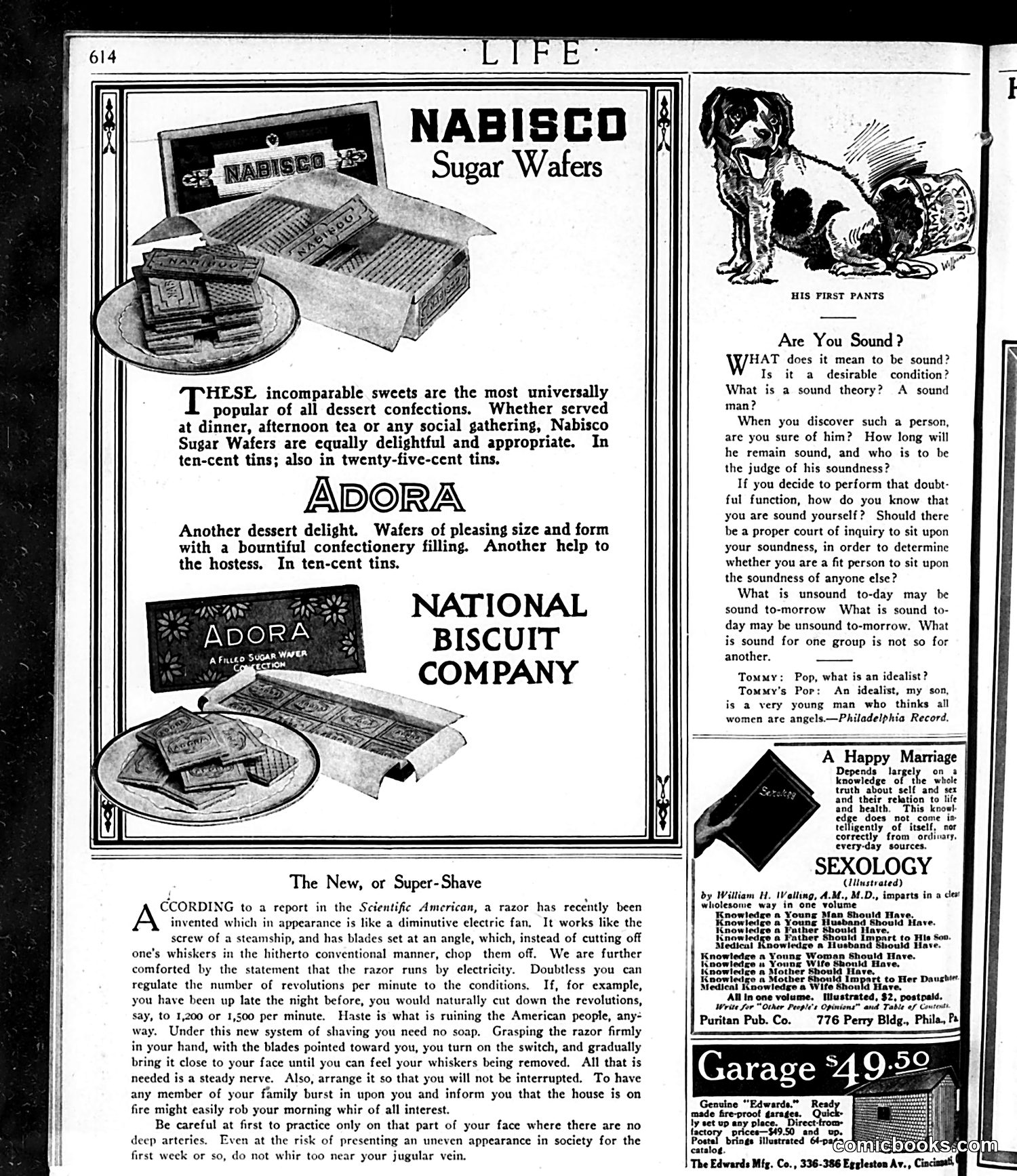
This page is primarily **advertisements and light satirical content**, typical of Life magazine's format. The main satire is "The New, or Super-Shave"—a mock-serious piece about an imaginary electric razor that works like a ship's propeller, with blades at angles that "chop" whiskers instead of cutting them. The humor comes from the absurd safety warnings: operating it requires a "steady nerve," avoiding the jugular vein, and hoping family members don't interrupt with emergencies. This satirizes American impatience and the era's obsession with electrical gadgets as solutions to everyday problems. The other content includes: - **Nabisco and Adora** candy advertisements (standard period ads) - **"Are You Sound?"**—philosophical humor about judging soundness/character - **"His First Pants"** cartoon (unclear subject, likely a child-related joke) - **Sexology book advertisement**—selling sex education as necessary knowledge for marriage The page reflects 1920s consumer culture and anxieties about modernity, efficiency, and propriety.
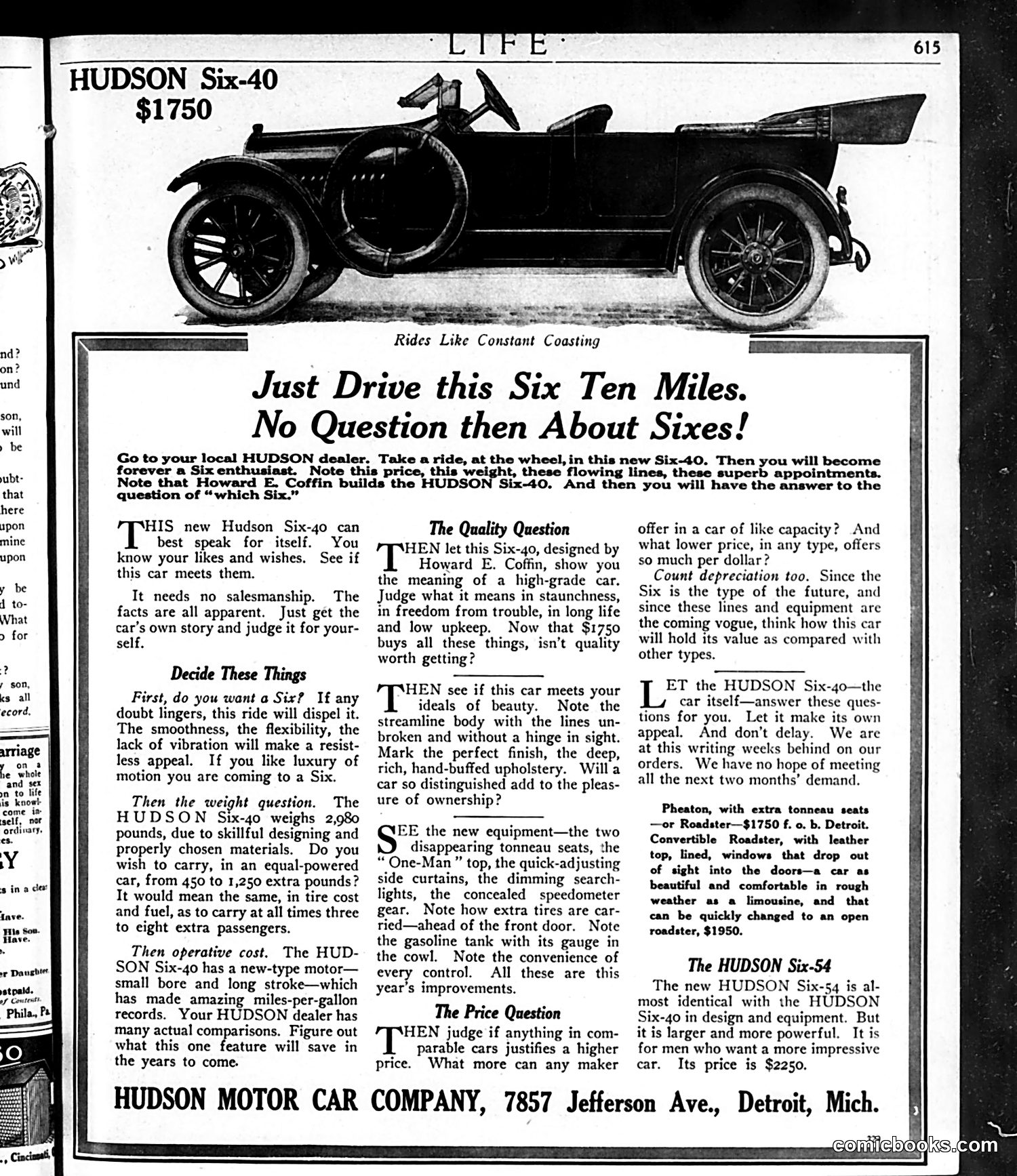
This page is **primarily automobile advertising**, not political satire. It's a 1910s-era advertisement for the Hudson Motor Car Company's Six-40 model priced at $1750. The ad uses a persuasive strategy common to the era: it encourages potential buyers to test-drive the vehicle themselves rather than rely on salesmanship. The text emphasizes the car's technical features—its six-cylinder engine, lightweight design (2,980 pounds), fuel efficiency, and innovative equipment like disappearing tonneau seats and dimming searchlights. The only notable figure mentioned is **Howard E. Coffin**, the engineer who designed the Six-40. He's presented as a mark of quality and reliability. The "no question then about sixes" slogan reflects a period debate about vehicle power: whether six-cylinder engines justified their cost compared to four-cylinder alternatives. The page also advertises a larger model, the Six-54, at $2,250. This is straightforward commercial messaging with no apparent satirical intent.
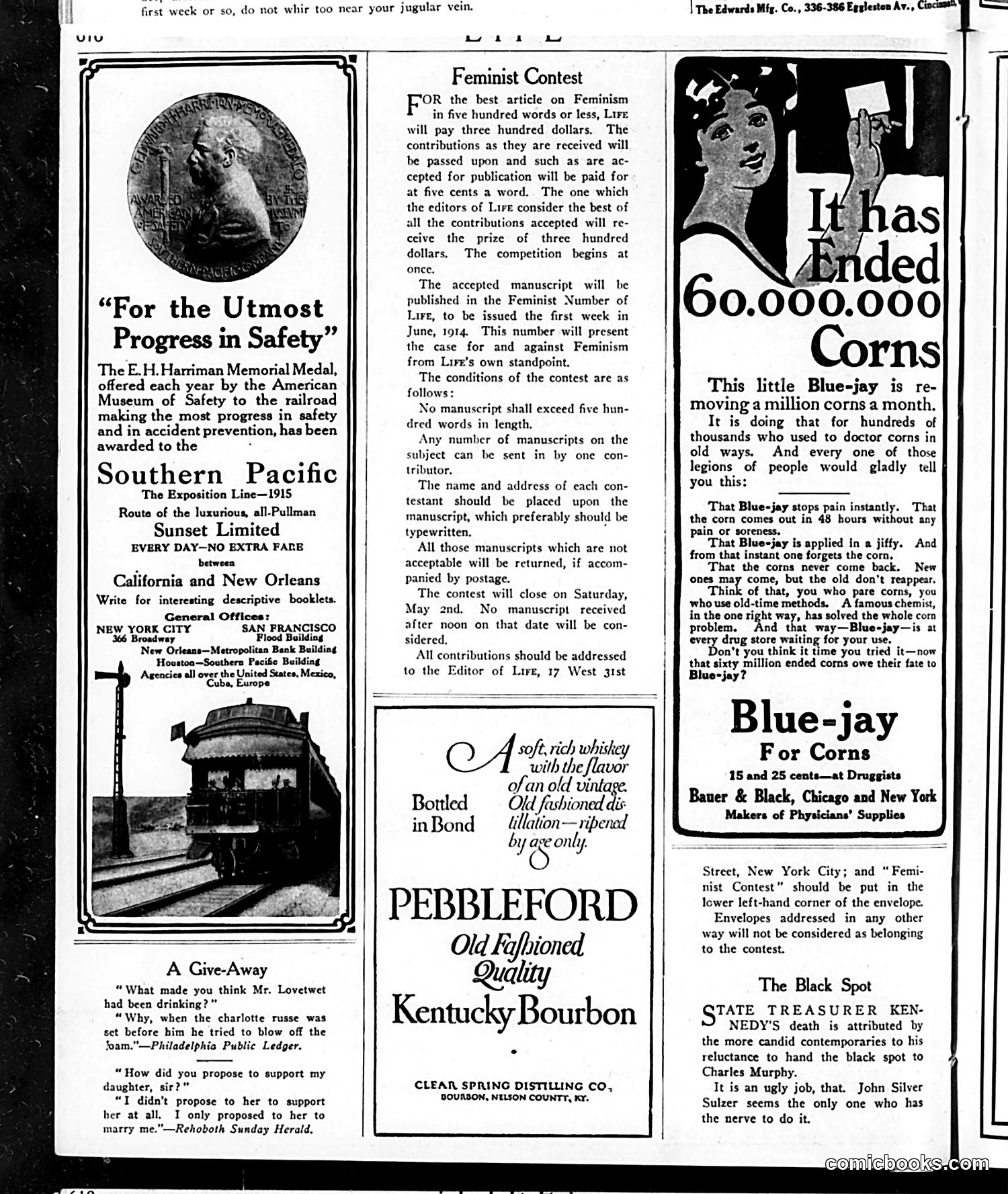
This page from *Life* magazine (circa 1914) contains advertisements and contest announcements, not political cartoons. **Key content:** 1. **Feminist Contest**: *Life* announces a $300 prize for the best essay on Feminism (under 500 words). The magazine notes it will publish opposing viewpoints in a special "Feminist Number." This reflects the active suffrage and women's rights debates of the 1910s era. 2. **Advertisements**: The page includes ads for Southern Pacific Railway's "Sunset Limited" train, Pebbleford Kentucky Bourbon whiskey, and Blue-jay corn remover (a medical product). 3. **"Give-Away" jokes**: Two brief humorous anecdotes about misunderstandings appear at bottom left—typical light humor filler for magazines of this period. The page primarily documents how early 20th-century publications engaged with contemporary feminist debate while generating revenue through advertising and reader contests.

This is a **full-page advertisement**, not a political cartoon. It promotes Kelly-Springfield automobile tires through humorous copy rather than visual satire. The ad's joke relies on a **psychological reversal**: instead of claiming their tires are superior, Kelly-Springfield suggests their product is so good that customers take *years* deciding to buy it—implying people are naturally reluctant to switch brands due to inertia ("some people have more patience than others"). The central image shows a tire with a smiling face visible through its center, a personification technique common in early 20th-century advertising to create brand personality. **Historical context**: This appears from *Life* magazine's advertising section, likely 1910s-1920s, when automobile tire purchases were significant consumer decisions and brand loyalty advertising was emerging.
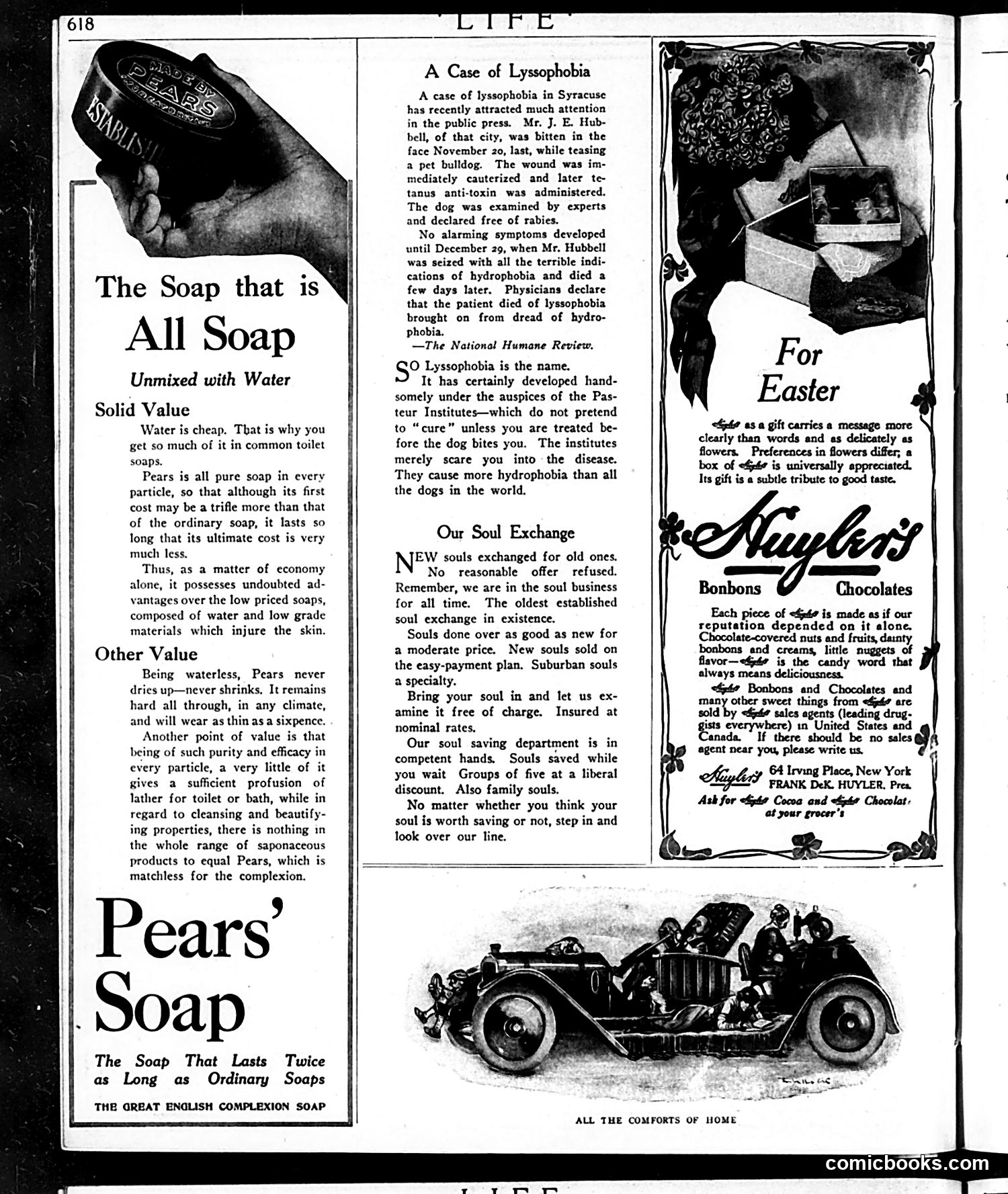
This page is primarily **advertising** for Pears' Soap and Huyler's Chocolates, with two satirical pieces inserted. **"A Case of Lyssophobia"** mocks the Pasteur Institutes' rabies treatment. A Syracuse man was bitten by a dog declared rabies-free, yet died of "lyssophobia"—fear of hydrophobia itself. The satire suggests that Pasteur Institutes frighten people so thoroughly about rabies that fear alone kills them, causing "more hydrophobia than all the dogs in the world." **"Our Soul Exchange"** is deadpan satire attacking commercialized religion and spiritual charlatanism—likely targeting evangelical revivals or dubious "soul-saving" services popular in the early 20th century. It mocks the commodification of salvation, offering souls "as good as new" on "easy-payment plans," with bulk discounts and warranties. Both pieces exemplify Life magazine's satirical approach: attacking public health quackery and religious fraud through absurdist humor that exaggerates real contemporary problems.
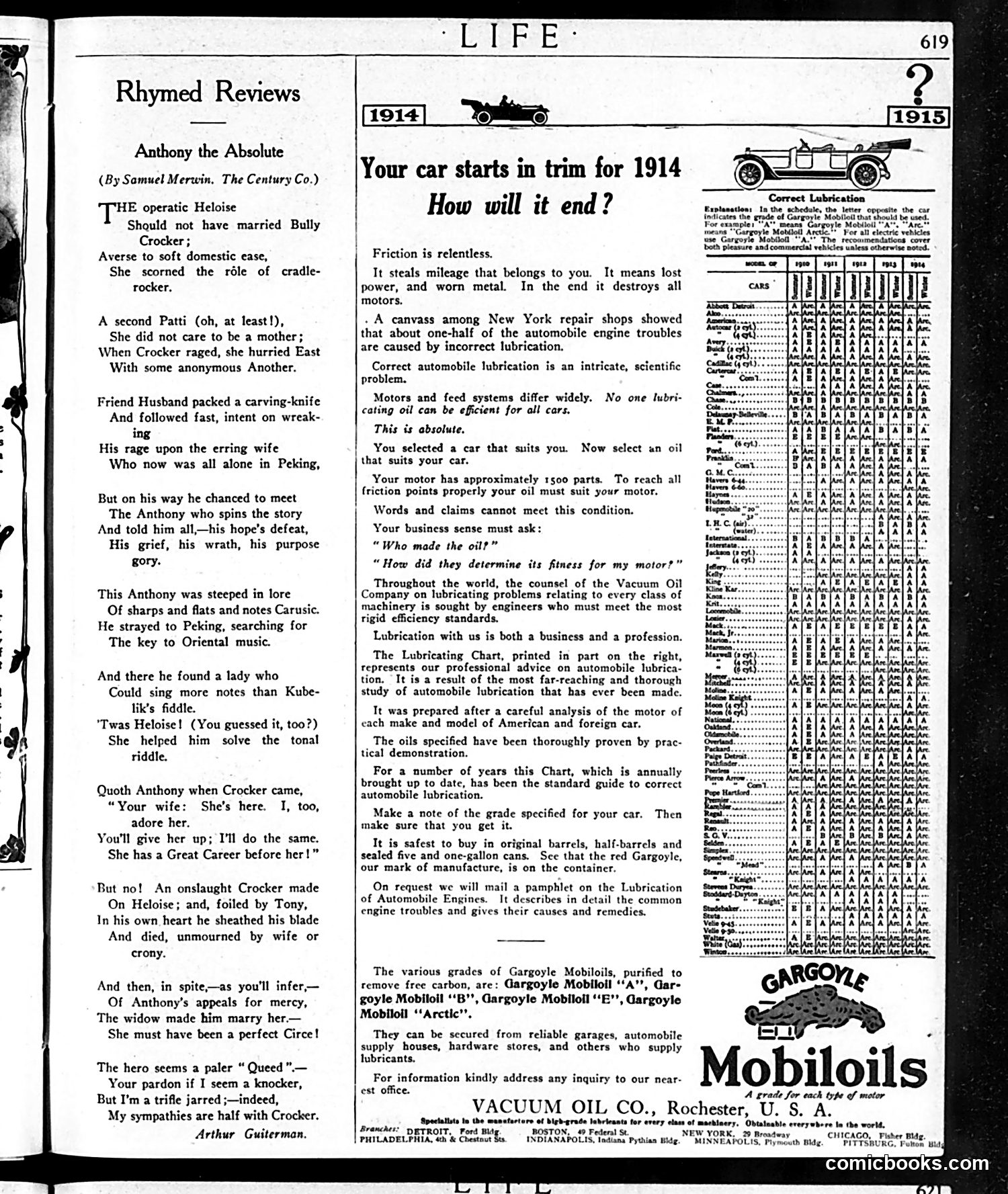
This page contains two unrelated items: a book review and an advertisement. **"Anthony the Absolute" Review** (left): Arthur Guiterman reviews a novel about romantic entanglement. The plot involves a wife (Heloise) who abandons her husband (Bully Crocker) for a musician (Anthony). The husband pursues them to Peking with murderous intent but ultimately kills himself. Heloise then forces Anthony to marry her. Guiterman criticizes the story as melodramatic and expresses sympathy for the wronged husband—a sardonic commentary on the novel's morality. **Gargoyle Mobiloils Advertisement** (right): This is a lengthy pitch for motor oil, featuring a lubrication chart for different car models (1910-1915). The ad emphasizes that proper oil selection is scientifically complex and specific to each vehicle model. It positions the Vacuum Oil Company as authoritative on the subject and encourages buyers to consult their chart and purchase original Gargoyle-branded containers. This reflects early automotive concerns about engine wear and lubrication efficiency.
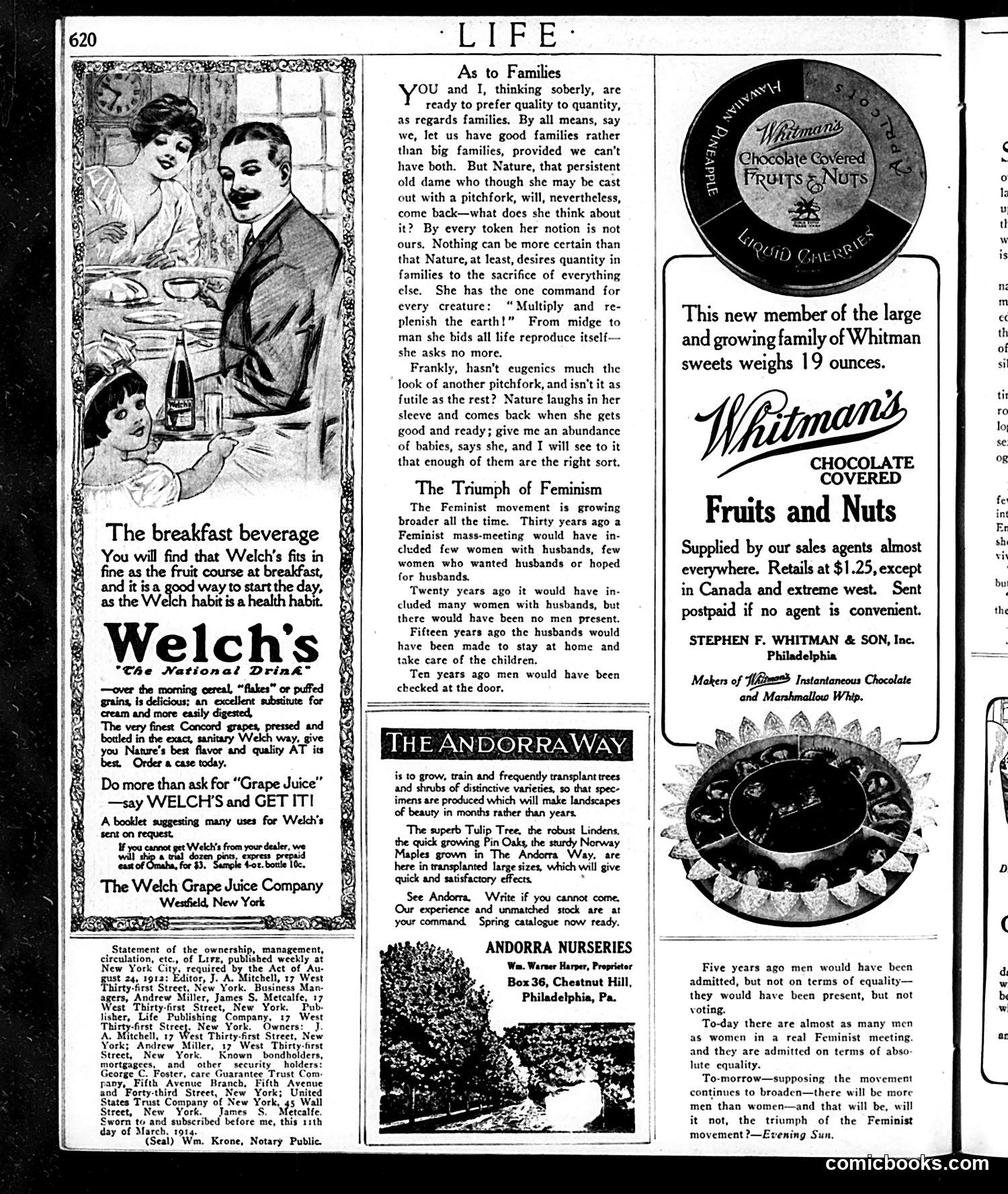
This page contains two editorial essays on family size and feminism's social progress. The first argues against eugenics movements—claiming Nature favors large families over "quality" breeding. It's skeptical of human attempts to control reproduction, suggesting Nature will override such efforts. The second piece traces feminism's expanding reach over three decades. The satire is chronological: thirty years prior, feminist meetings excluded married women; twenty years ago, husbands weren't present; fifteen years ago, men stayed home with children; ten years ago, men were barred from meetings entirely. The implicit humor and concern is that feminism has progressively infiltrated institutions and domestic life, with men now apparently welcome at gatherings—suggesting either feminism's success or (from the author's perspective) its troubling normalization. Both essays reflect early-1910s anxieties about women's expanding rights and changing family structures.
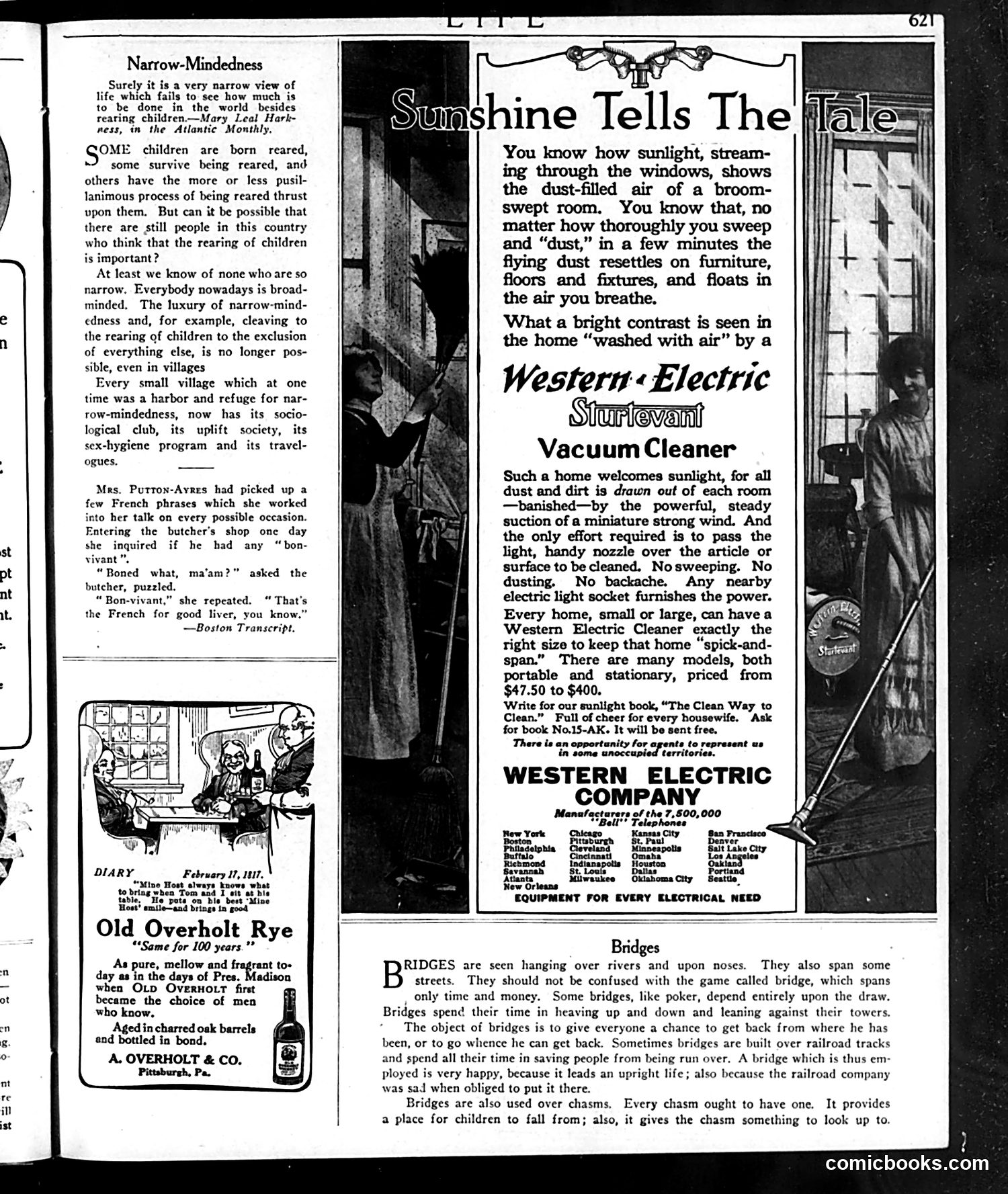
This Life magazine page combines social commentary with period advertising. The "Narrow-Mindedness" essay satirizes modern women who've abandoned child-rearing for social clubs and self-improvement—mocking the era's tension between traditional motherhood and "broadmindedness." A humorous anecdote about a woman misusing French phrases ("bon-vivant" for meat) ridicules social pretension. The bulk of the page features advertisements: Old Overholt Rye whiskey (emphasizing its 100-year heritage and quality) and Western Electric's Surlyvant vacuum cleaner (targeting housewives with promises that electric cleaning eliminates dust better than sweeping). The "Bridges" piece at bottom is whimsical filler—playful definitions contrasting literal bridges with social metaphors. The overall message reflects 1910s-era anxieties about women's changing roles, modern technology's promises, and class anxieties about proper behavior.
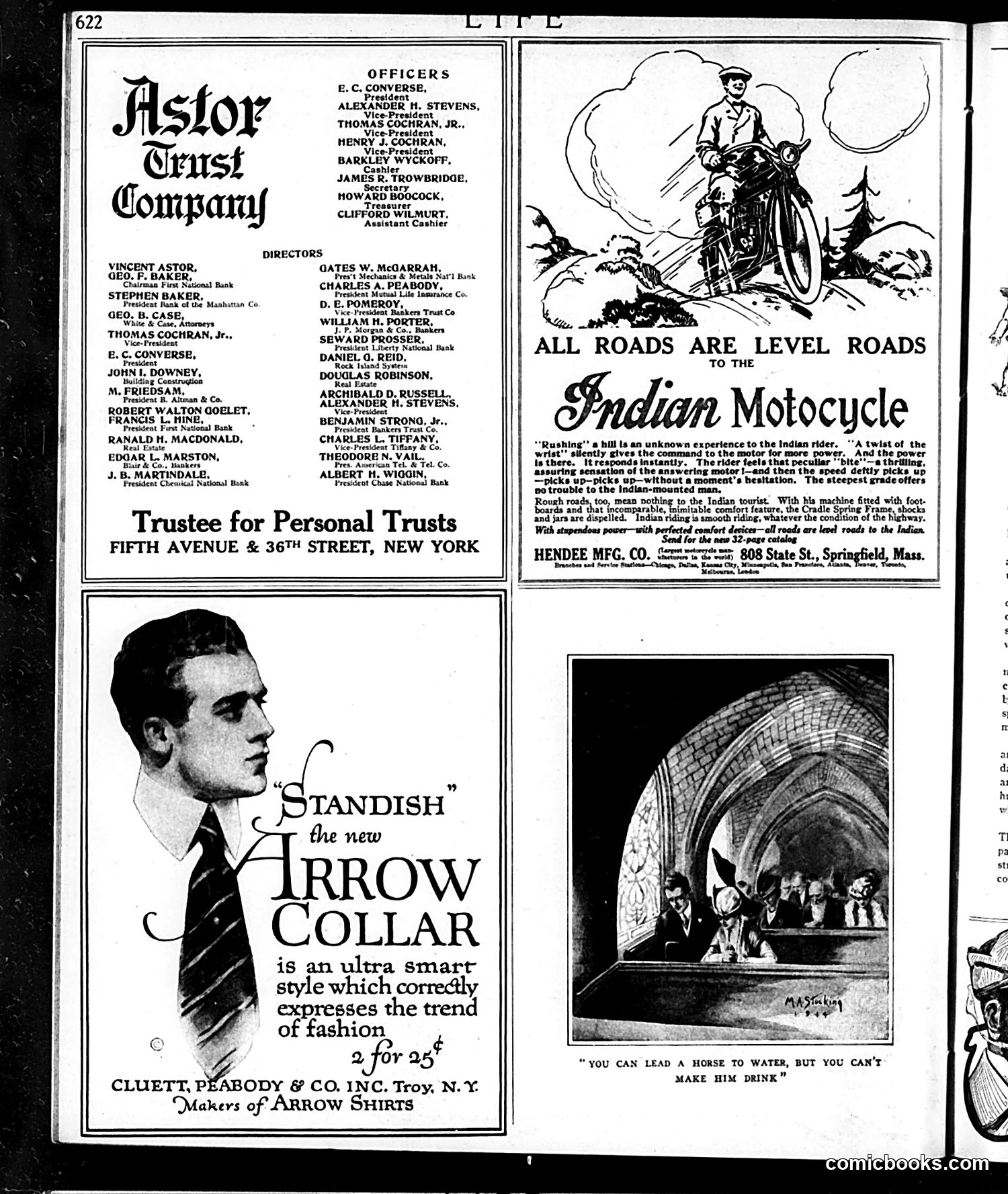
This page is primarily **financial/corporate advertising and listing**, not political satire. **Left column:** The Astor Trust Company lists its officers and directors—wealthy New York financiers and businessmen (Vincent Astor, George F. Baker, etc.). This is a trust company advertisement targeting the wealthy. **Center:** An Arrow Collar advertisement promoting a new "standish" collar style for 25 cents. **Right side:** An Indian Motorcycle advertisement claiming superior hill-climbing and road performance, with an illustration of a rider on rough terrain and a separate image labeled "You can lead a horse to water, but you can't make him drink"—likely suggesting the motorcycle outperforms traditional horses. The page represents early 20th-century advertising aimed at affluent readers, with no political cartoon or satire present. The "horse to water" caption appears to be an oblique advertisement claim rather than social commentary.
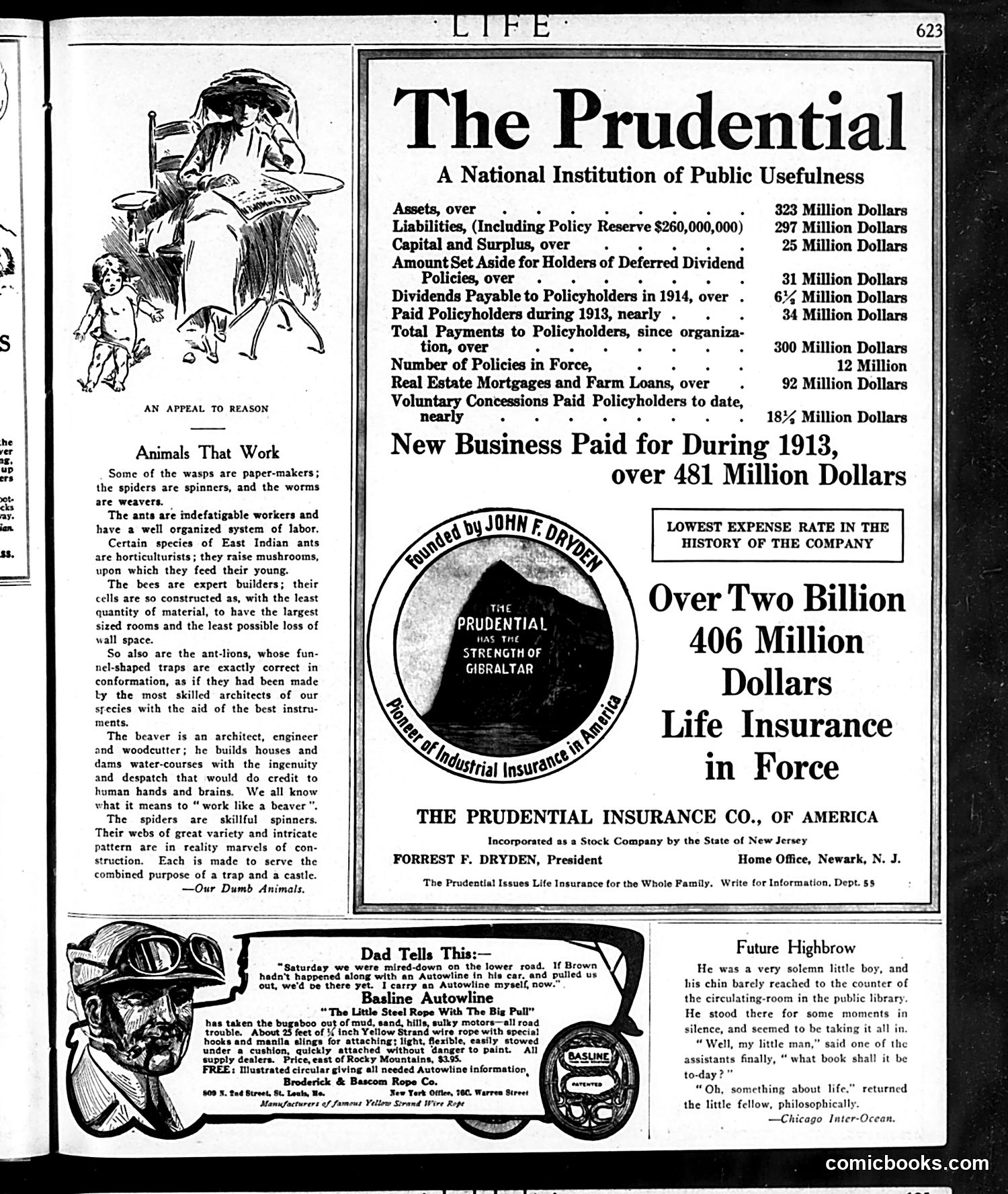
This page is primarily **advertising**, dominated by a large Prudential Insurance Company advertisement promoting the company's financial strength and life insurance business (over $406 million in force). The left side contains two unrelated content pieces: "Animals That Work," an essay comparing animal architecture and labor to human ingenuity (ants, beavers, spiders), and two brief humorous items—"Dad Tells This" promoting Autowline rope for automobile emergencies, and "Future Highbrow," a short joke about a solemn boy requesting a book "about life" at a library. There is **no political satire or cartooning** on this page. The small illustration shows a woman with children (likely representing "usefulness"), but serves only as generic imagery for the insurance ad. The content is typical early-1900s magazine filler—light humor and advertising aimed at middle-class readers interested in life insurance, automobiles, and genteel entertainment.
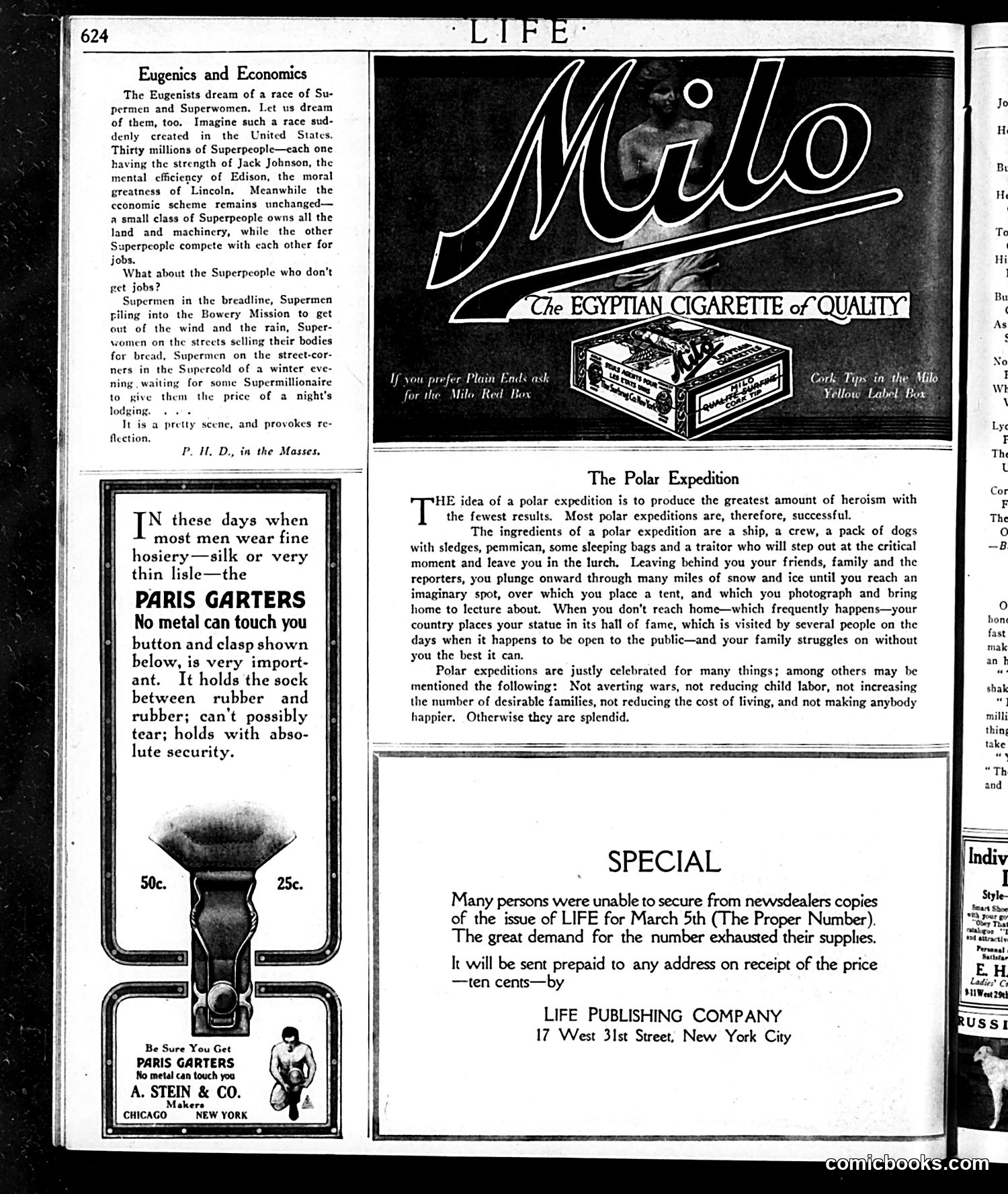
This page showcases Life's satirical commentary on early 20th-century American society. **"Eugenics and Economics"** critiques the eugenics movement, which advocated breeding "superior" humans. The piece sardonically imagines 30 million superhuman Americans—each combining Jack Johnson's strength, Edison's intellect, and Lincoln's morality—yet notes the economy remains unchanged. The bitter joke: even supermen would face unemployment, breadlines, and poverty. It exposes how eugenics ignores systemic economic inequality; biological perfection cannot solve structural problems. **"The Polar Expedition"** mocks Arctic exploration's cultural cachet. It cynically describes expeditions as exercises in producing "heroism with fewest results"—heroes die or disappear, nations erect statues to honor them, and families "struggle on." The satire questions whether dangerous expeditions serve humanity or merely satisfy romantic nationalism and individual ambition. Both pieces reflect Life's progressive skepticism toward contemporary enthusiasms—eugenics and imperial adventure—revealing their actual social costs.
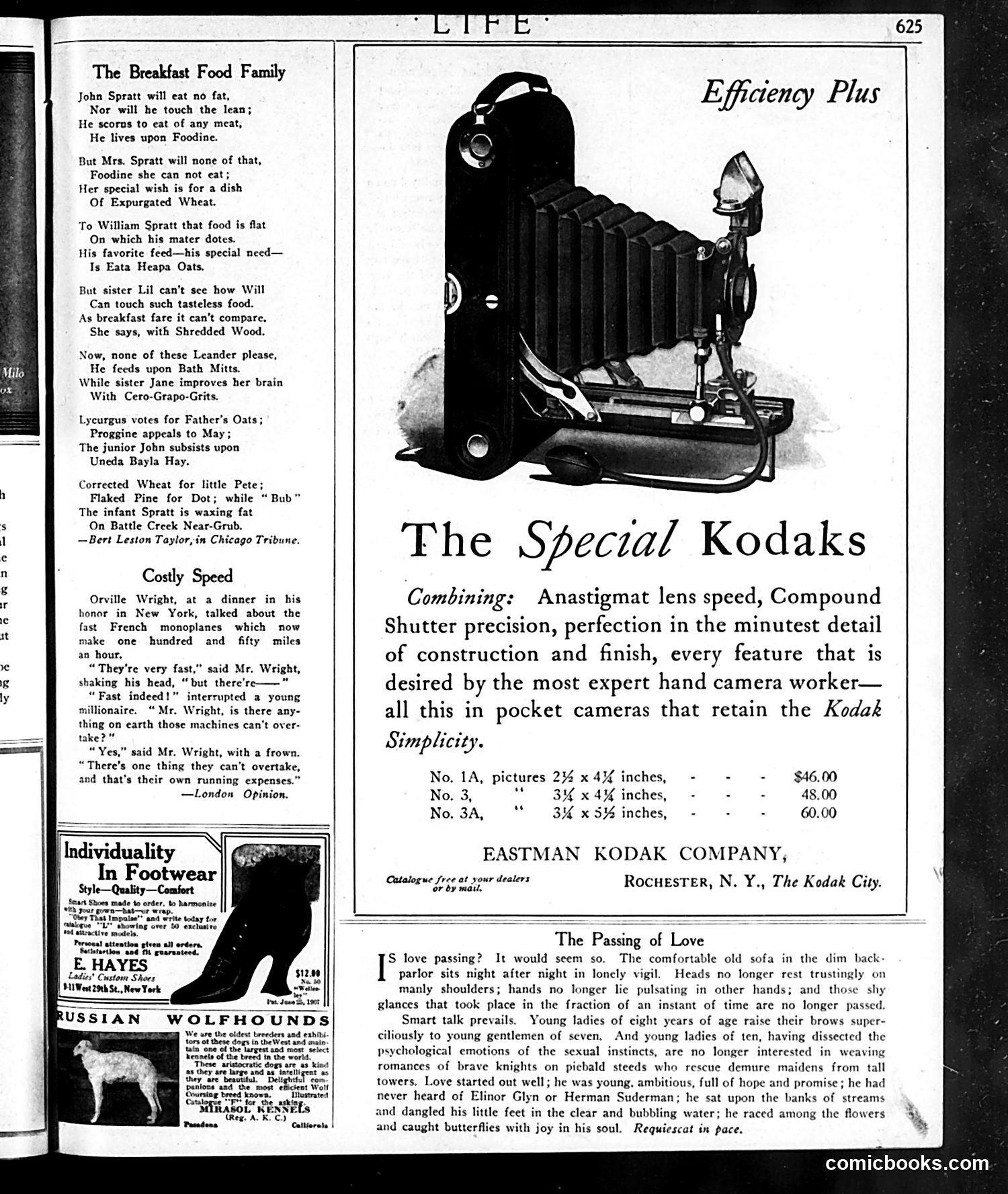
**"The Breakfast Food Family"** is satire mocking the proliferation of branded breakfast cereals flooding the American market. The poem lists absurdly named products (Foodine, Expurgated Wheat, Eata Heapa Oats, Shredded Wood, Bath Mitts, Cero-Grapo-Grits) — some real brands, some invented — suggesting the breakfast cereal industry had become ridiculous. Each family member consumes a different product, satirizing aggressive marketing that targeted different demographics. **"Costly Speed"** jokes about the new Wright Brothers' airplane technology. A millionaire asks if their fast French monoplanes can overtake anything; Wright replies the one thing they can't overtake is "their own running expenses" — a dry comment on how expensive new aviation technology was, despite its speed. **"The Passing of Love"** is a sentimental essay lamenting that modern youth (particularly girls aged 8-10) have become cynical and intellectually precocious, losing romantic innocence. It references authors Elinor Glyn and Herman Sudermann, suggesting exposure to sophisticated literature has corrupted youthful romance. The page is otherwise **advertising** (Kodak cameras, shoes, Russian wolfhounds).
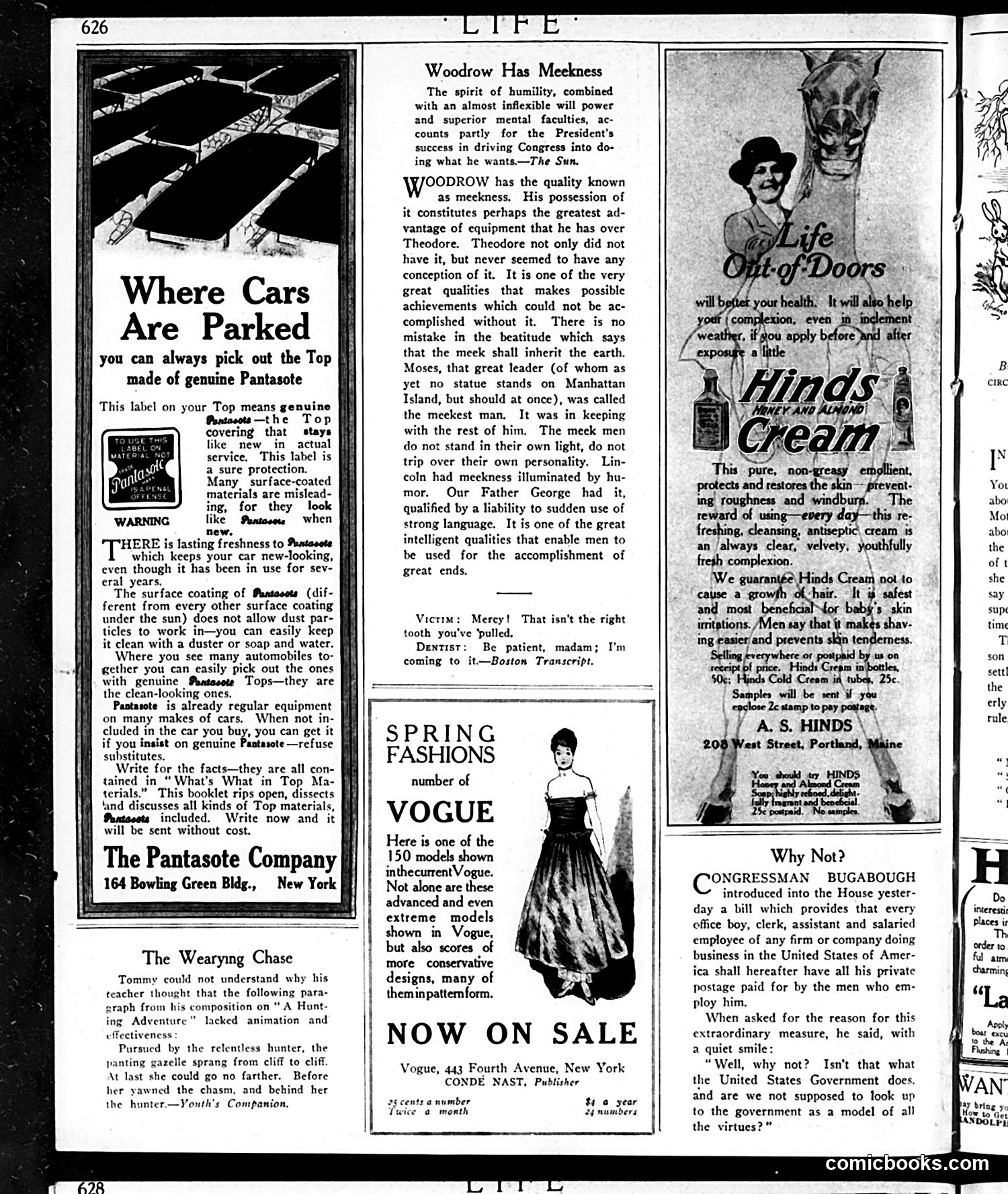
This page primarily features **advertising and filler content** rather than political satire. The main elements are: **"Woodrow Has Meekness"** - An editorial praising President Woodrow Wilson's humility as superior to Theodore Roosevelt's temperament. It argues Wilson's "meekness" actually gives him greater power over Congress, comparing him favorably to historical figures like Moses and Lincoln. This appears to be **straightforward praise** rather than satire. **Other content** includes: - Pantasote car-top advertisements - Hinds Honey and Almond Cream beauty product ad - A brief joke about a dentist - Vogue fashion advertisement The Wilson piece suggests this Life issue dates to Wilson's presidency (1913-1921), when such comparisons to Roosevelt would be timely. However, **there is no clear political cartoon or satirical commentary** on this particular page—mainly commercial advertising surrounding an admiring presidential profile.
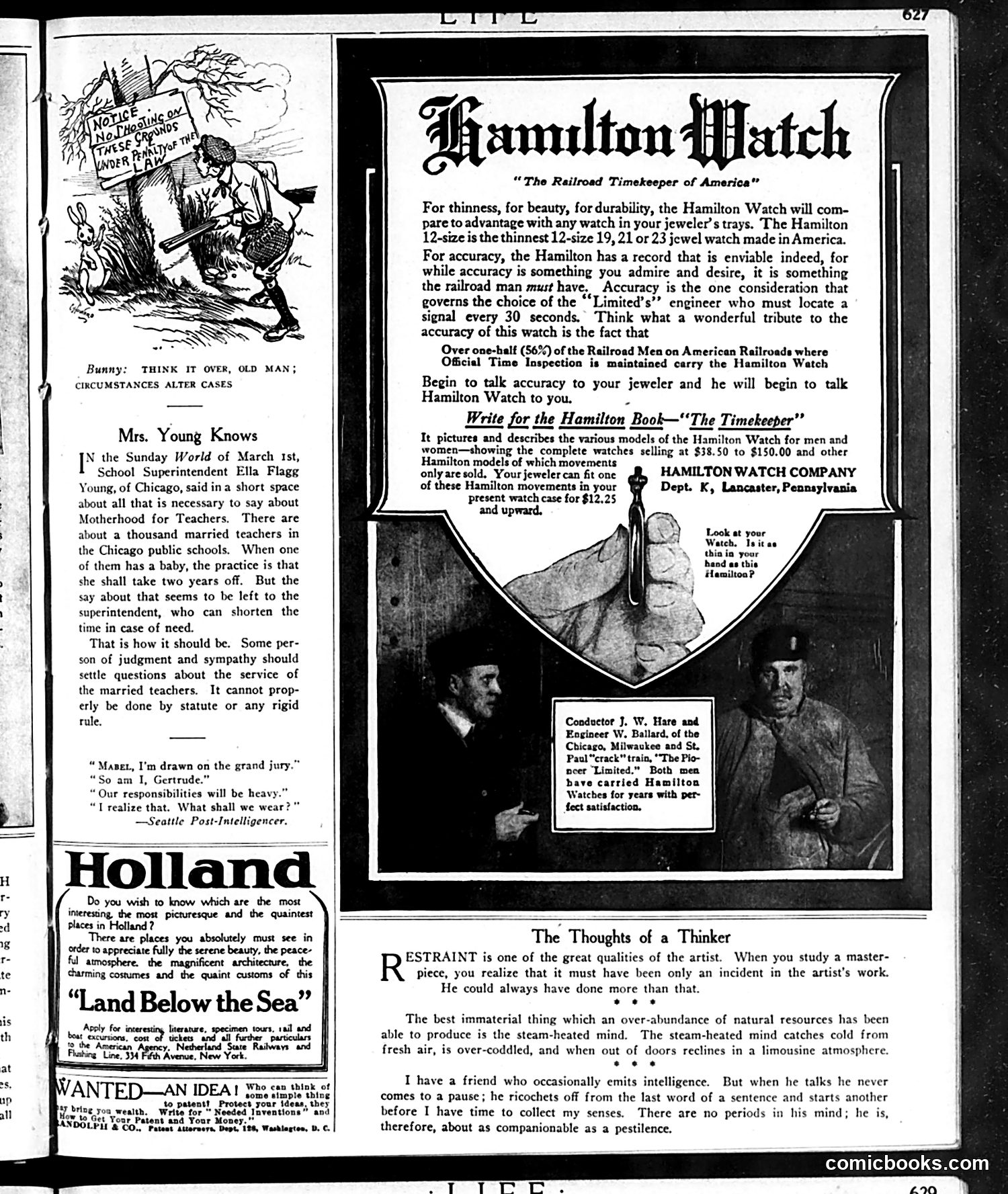
This page mixes editorial commentary with advertising. The top cartoon shows a rabbit advising an old man to "think it over" because "circumstances alter cases"—a gentle moral about flexibility versus rigid rules. The text below discusses Chicago School Superintendent Ella Flagg Young's policy allowing married female teachers two-year maternity leaves, with discretionary shortening by administrators. The piece argues sympathetic judgment should govern such matters rather than inflexible rules—echoing the cartoon's theme. The Hamilton Watch advertisement dominates the right side, emphasizing railroad workers' reliance on this brand for precision timekeeping. It features testimonials from actual railroad conductors and engineers. Additional content includes brief humor (a Seattle Post-Intelligencer joke about women summoned for jury duty worrying about wardrobe), travel advertising for Holland, and a philosophy column mocking people who talk incessantly without pausing. The page reflects early 1900s concerns: women's workplace rights, industrial safety standards, and social etiquette.
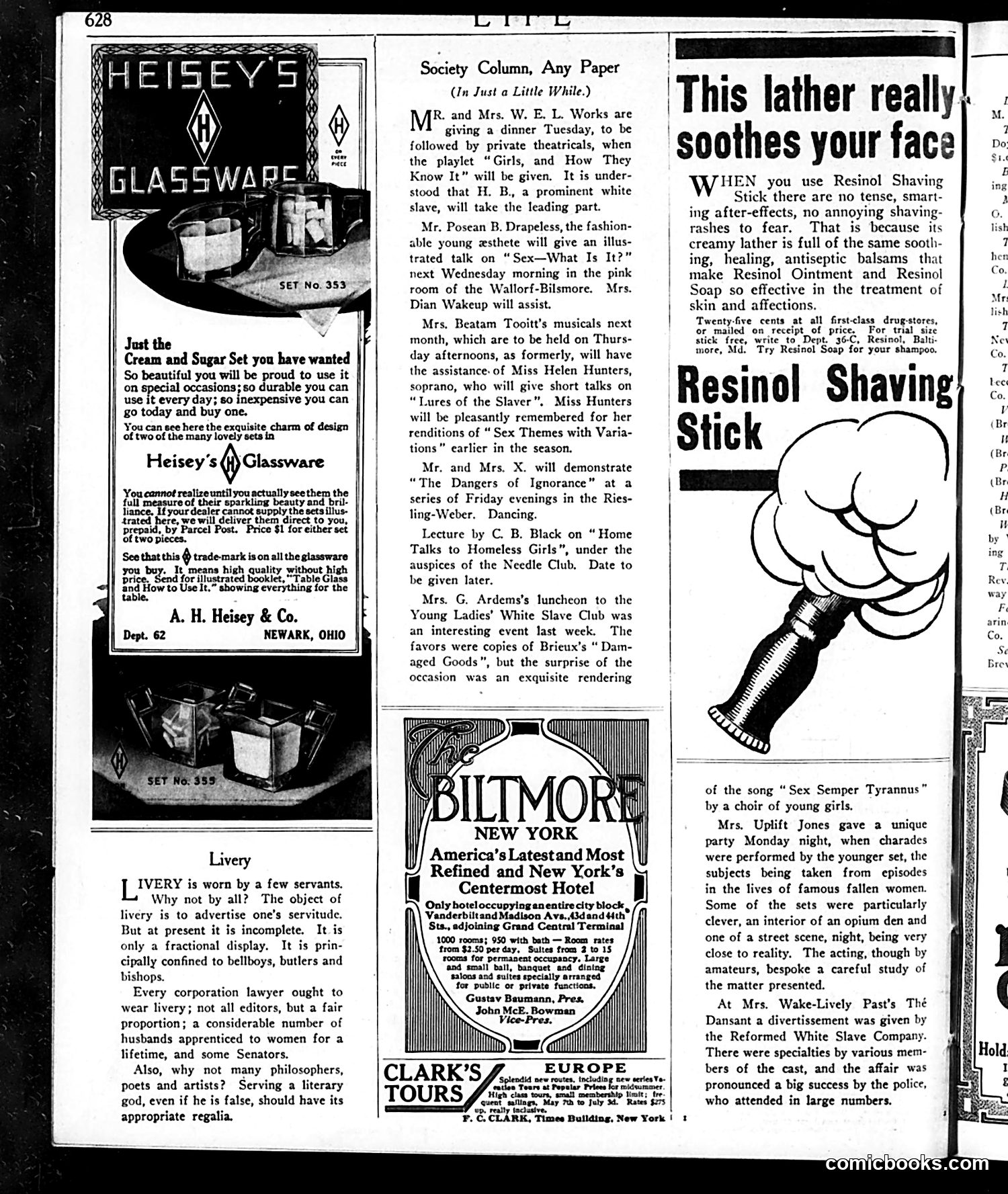
This is primarily a **commercial advertising page** with one notable satirical section. The main satire appears in the "Society Column" mock-up, which parodies high-society announcements by replacing typical topics with crude sexual references. The column mocks progressive-era social concerns about white slavery and sexual exploitation—serious reform issues of the early 1900s—by embedding them absurdly into genteel society announcements. References like "prominent white slave," "Sex—What Is It?" lectures, and the "Young Ladies' White Slave Club" treat grave social problems with flippant mockery, suggesting the magazine found contemporary moral reformism ridiculous or pretentious. The "Livery" essay below satirizes class hierarchies by proposing that servants shouldn't monopolize livery uniforms—lawyers, editors, husbands "apprenticed to women," and even philosophers should wear them to openly display servitude. The page otherwise features standard period advertisements for Heisey glassware, the Biltmore Hotel, Resinol Shaving Stick, and Clark's Tours—typical Life magazine commercial content.
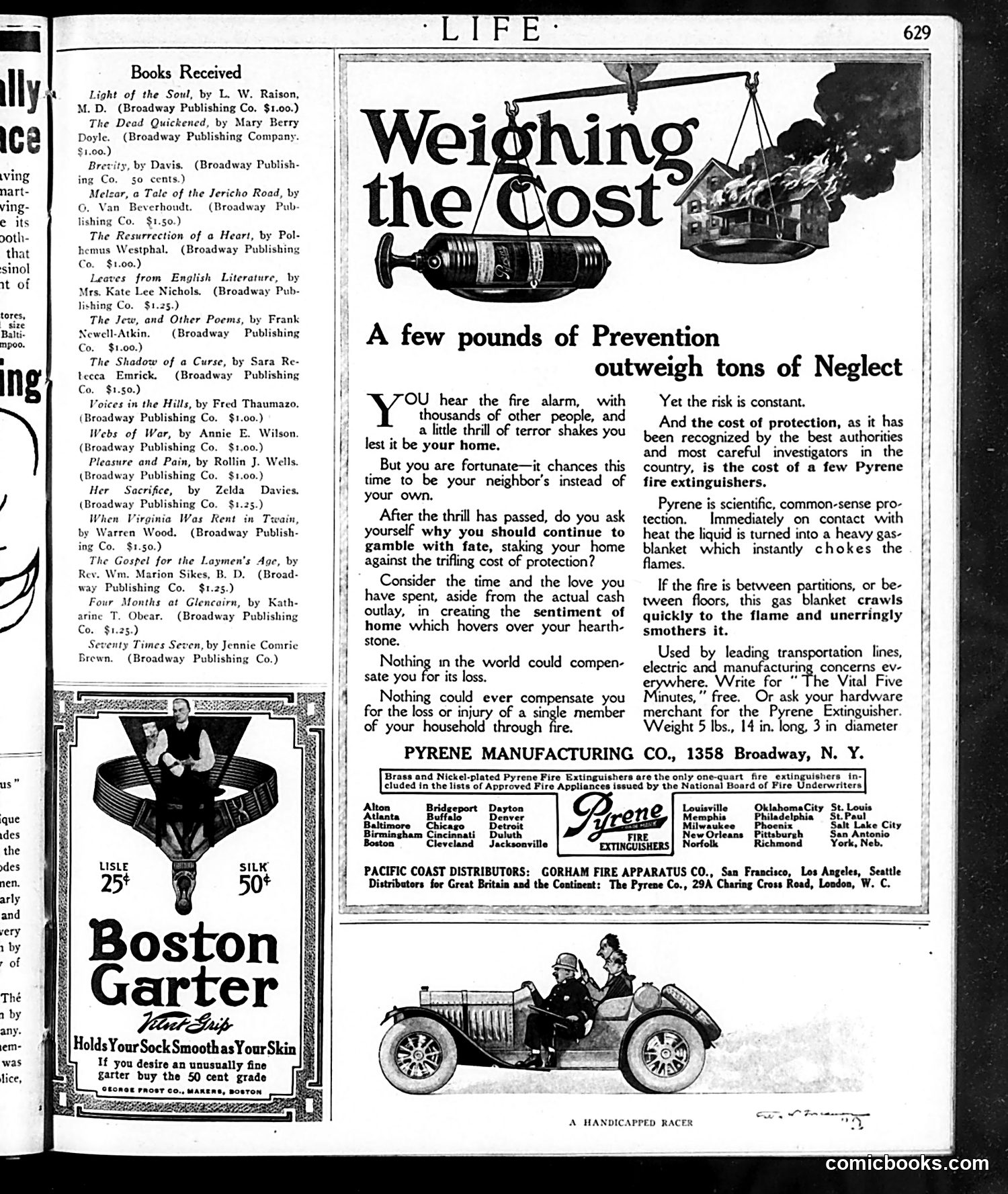
This page is primarily **advertising and book listings**, not political satire. The main content is a **Pyrene fire extinguisher advertisement** occupying the right half of the page. The ad uses fear-based marketing: it opens by describing the terror of hearing a fire alarm, then argues that while homeowners feel relieved when fire strikes a neighbor's house instead, they should protect their own property with Pyrene extinguishers—framed as inexpensive prevention against catastrophic loss. The visual metaphor shows a scale weighing a small fire extinguisher against burning houses, illustrating the tagline "A few pounds of Prevention outweigh tons of Neglect." The left side lists recently published books, mostly from Broadway Publishing Company. At the bottom is an unrelated advertisement for **Boston Garter** (hosiery), using a woman in silk stockings. There is **no political cartoon or satire** on this page—it's a commercial publication selling products and promoting books through standard early-20th-century advertising techniques.
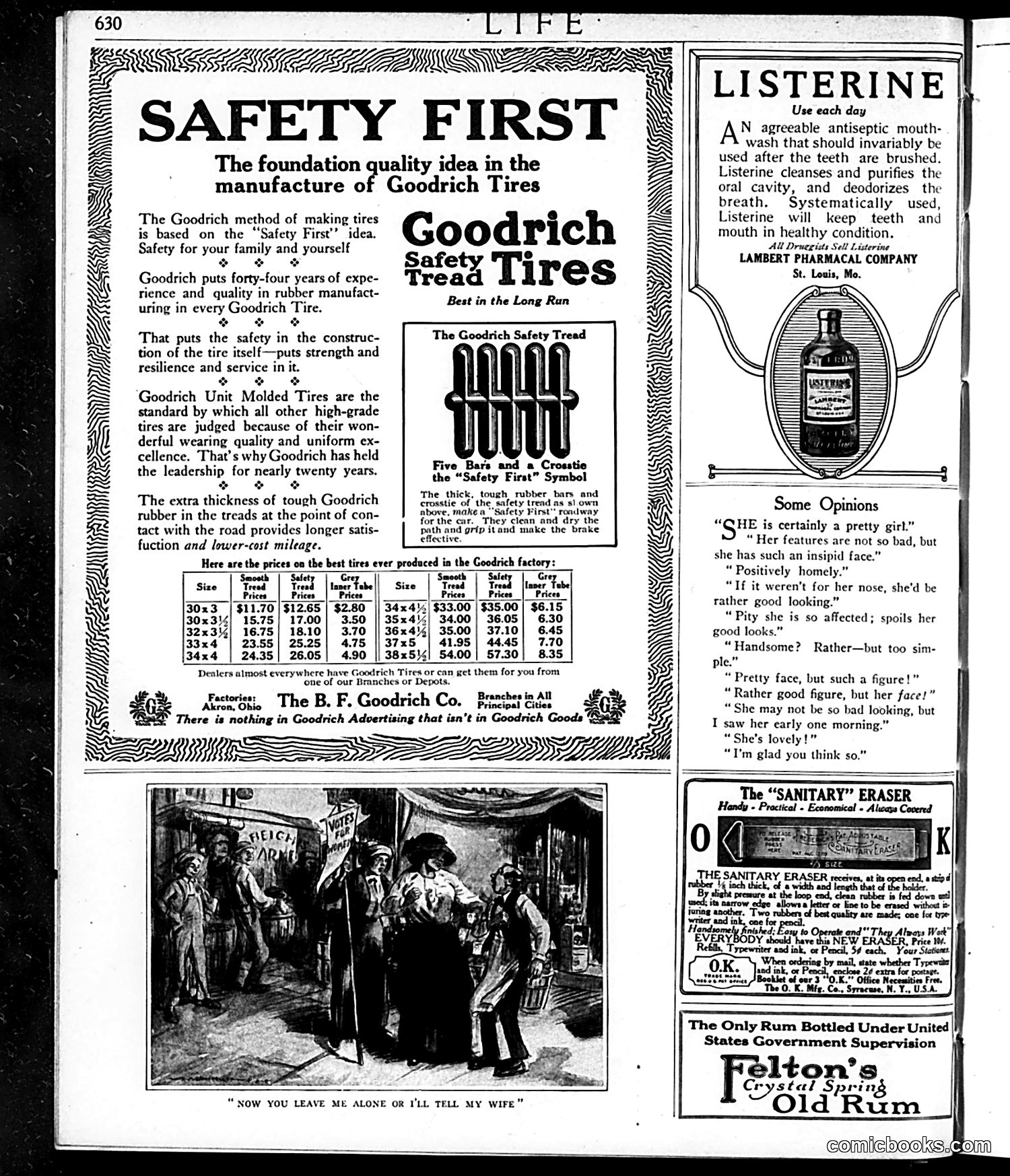
This page is primarily **advertising**, not political satire. The main content features: **Large Advertisement: Goodrich Safety Tires** A straightforward commercial promoting tire quality, emphasizing "Safety First" as the manufacturing philosophy. The ad includes a pricing table and the company's 44 years of experience. **Side Advertisements:** - **Listerine** mouthwash (antiseptic oral hygiene product) - **The "Sanitary" Eraser** (office supply) - **Felton's Crystal Spring Old Rum** (bottled under U.S. government supervision) **Small Cartoon:** A single cartoon captioned "NOW YOU LEAVE ME ALONE OR I'LL TELL MY WIFE" depicts what appears to be a domestic/marital dispute scene, likely humorous domestic commentary typical of the era. **"Some Opinions" Section:** A humorous list of contradictory observations about a woman's appearance, poking fun at how subjective and inconsistent people are in judging beauty. The page reflects early 20th-century consumer culture and advertising design rather than political messaging.
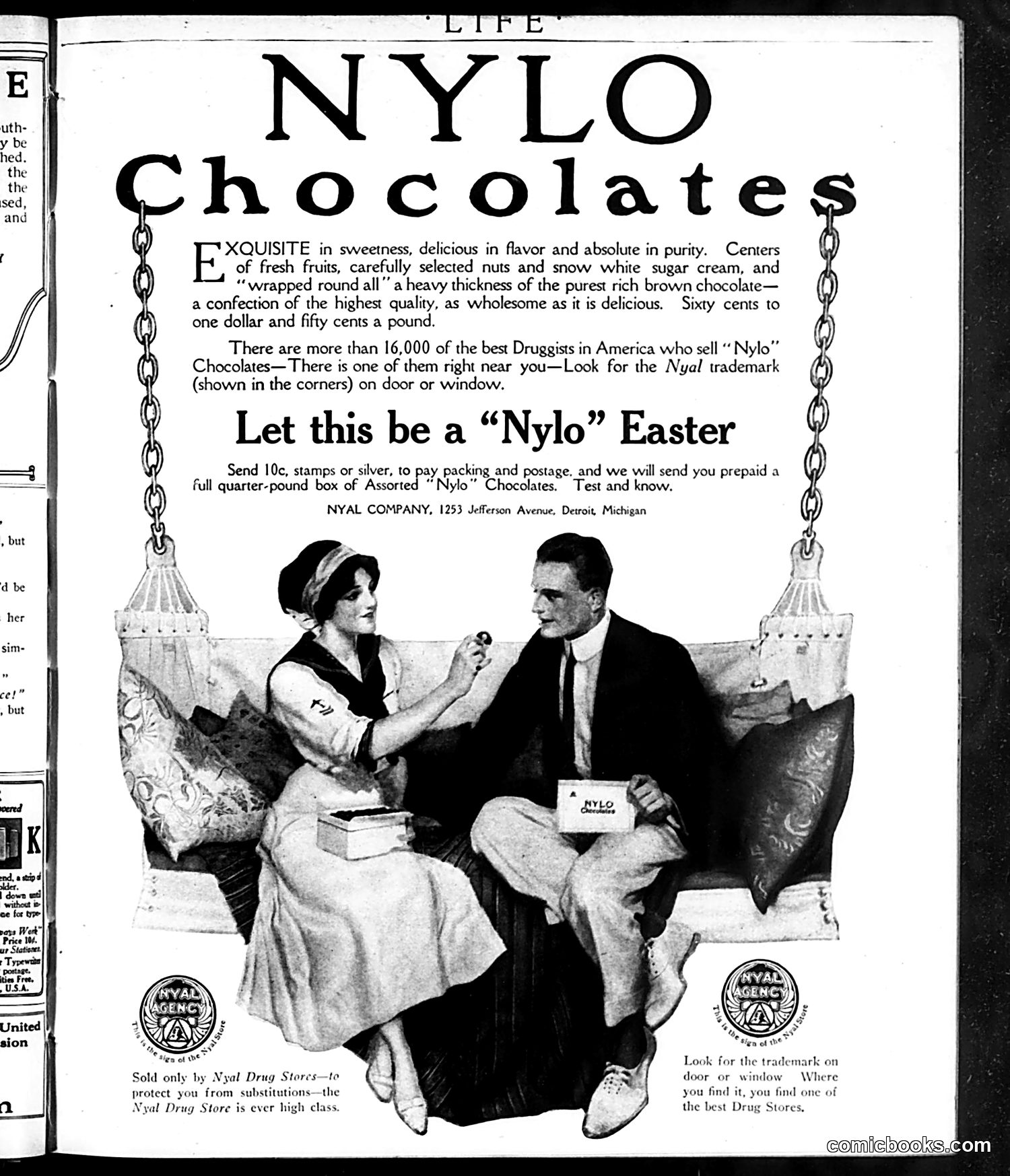
This is primarily a **commercial advertisement**, not political satire. It promotes Nylo brand chocolates manufactured by the Nyal Company in Detroit, Michigan. The page features a photograph of a well-dressed couple in a swing, with the man offering chocolate to the woman—a romantic scene designed to appeal to Easter shoppers. The ad emphasizes product quality (fresh fruits, nuts, pure chocolate) and price ($0.60–$1.50 per pound). The key marketing angle is **distribution through drugstores**: the ad claims over 16,000 American druggists sell Nylo products and encourages consumers to look for the Nyal trademark. There's also a mail-order offer (10 cents for a quarter-pound sample). The only potentially satirical element is the tagline "Let this be a 'Nylo' Easter"—a gentle pun playing on the product name and the holiday—but this appears to be straightforward advertising copy rather than social commentary.

This is **not a political cartoon or satire**—it's a straightforward advertisement for Williams' Holder Top Shaving Stick, published in *Life* magazine on April 2, 1912. The page promotes a patented grooming product: a shaving soap stick housed in a metal cap/holder. The advertisement emphasizes practical benefits: users grasp the metal cap rather than touching soap directly, can use the stick down to its final bit conveniently, and keep it in a nickeled container. The image shows a hand demonstrating how to hold the product by its metal cap. Below, three alternative Williams shaving products are illustrated (powder, cream in tubes, and stick with hinged box). This represents early 20th-century consumer marketing—emphasizing hygiene (fingers don't touch soap), convenience, and quality. The appeal to "Greater Convenience—Greater Satisfaction" reflects the era's embrace of modern consumer goods and innovation in personal grooming products.