
Life, 1914-04-02 · page 30 of 68
Life — April 2, 1914 — page 30: what you’re looking at
What you’re looking at
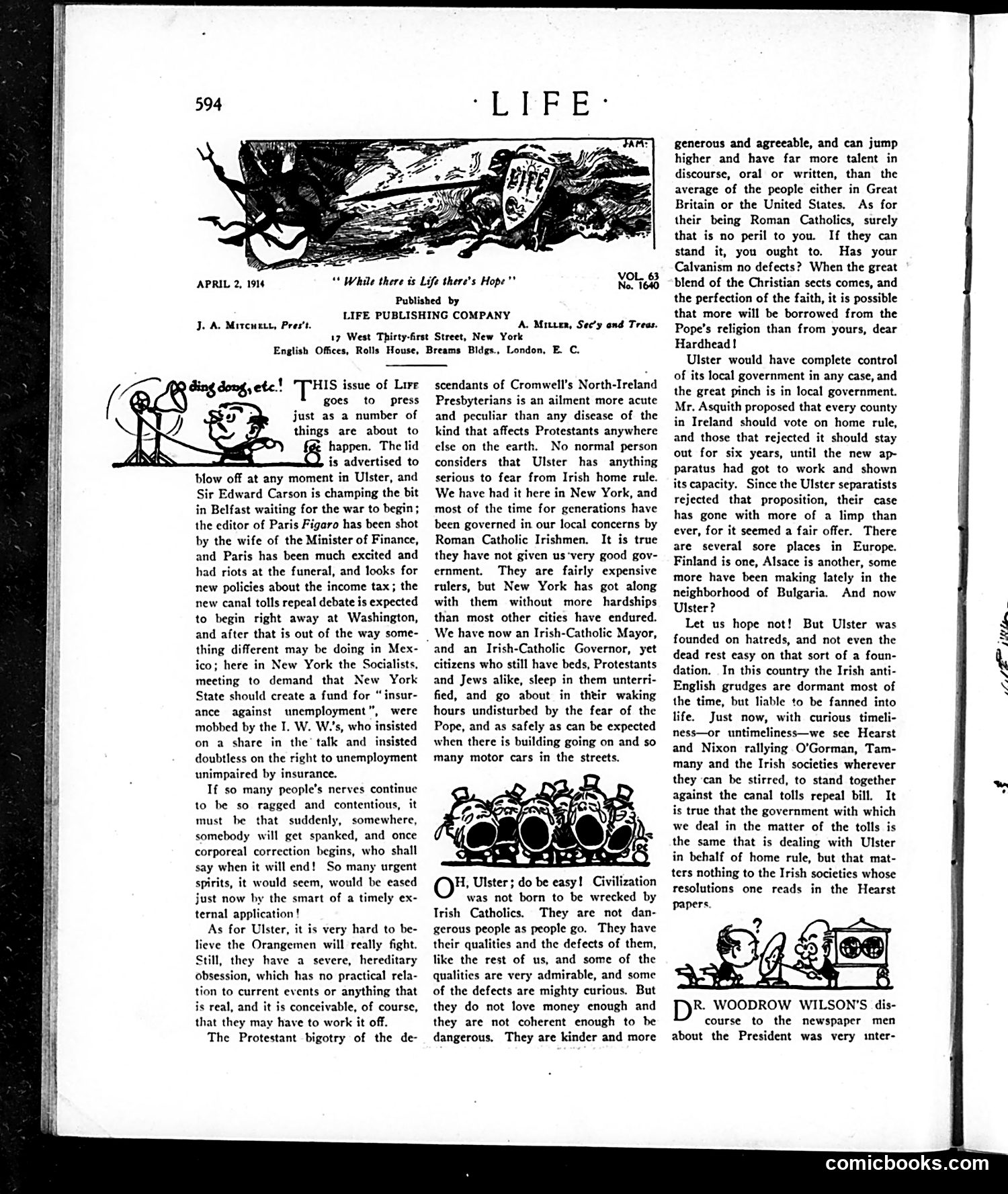
This editorial addresses the imminent Irish Home Rule crisis. The main cartoon (top) depicts a figure lying down with "Ulster" marked on his chest, illustrating Ulster's anxiety about Catholic Irish self-governance. The text argues that Protestant Ulster's fears are irrational prejudice rather than practical concern. The author cites New York's experience with Irish-Catholic mayors and governors as proof that Catholics can govern competently without oppressing Protestants. He characterizes Ulster Protestants as suffering from hereditary bigotry—specifically "Protestant bigotry of the descendants of Cromwell's North-Ireland Presbyterians"—disconnected from current reality. The piece dismisses Irish Catholics as insufficiently organized or greedy to be genuinely "dangerous," while praising their intelligence and generosity. It's a sarcastic plea for Ulster to accept Home Rule rationally rather than violently resist it. The subtext: Life's editors view Ulster's opposition as emotional sectarianism masking political obstruction.
📄 Transcribed text from this page (OCR, searchable)
Machine-transcribed from the original scan — historical spelling and the odd misread are preserved.
APRIL 2, 191¢ “ While there is Life there's Hope” Published by LIFE PUBLISHING COMPANY 17 West Thirty-first Street, New York English Offices, Rolls House, Breams Bldgs., London, E. C. J. A. Mivcuent, Pres’t. HIS issue of Lire goes to press just as a number of things are about to happen, The lid is advertised to blow off at any moment in Ulster, and Sir Edward Carson is champing the bit in Belfast waiting for the war to begin; the editor of Paris Figaro has been shot by the wife of the Minister of Finance, and Paris has been much excited and had riots at the funeral, and looks for new policies about the income tax; the new canal tolls repeal debate is expected to begin right away at Washington, and after that is out of the way some- — thing different may be doing in Mex- ico; here in New York the Socialists, meeting to demand that New York State should create a fund for “insur- ance against unemployment”, were mobbed by the I. W. W.’'s, who insisted on a share in the’ talk and insisted doubtless on the right to unemployment unimpaired by insurance. If so many people’s nerves continue to be so ragged and contentious, it must be that suddenly, somewhere, somebody will get spanked, and once corporeal correction begins, who shall say when it will end! So many urgent spirits, it would seem, would be eased just now by the smart of a timely ex- ternal application! As for Ulster, it is very hard to be- lieve the Orangemen will really fight. Still, they have a severe, hereditary obsession, which has no practical rela- tion to current events or anything that is real, and it is conceivable, of course, that they may have to work it off. The Protestant bigotry of the de- A. Mitusn, Sec’y ond Treas. scendants of Cromwell’s North-Ireland Presbyterians is an ailment more acute and peculiar than any disease of the kind that affects Protestants anywhere else on the earth. No normal person considers that Ulster has anything serious to fear from Irish home rule. We have had it here in New York, and most of the time for generations have been governed in our local concerns by Roman Catholic Irishmen. It is true they have not given us‘very good gov- ernment. They are fairly expensive rulers, but New York has got along with them without more hardships than most other cities have endured. We have now an Irish-Catholic Mayor, and an Irish-Catholic Governor, yet citizens who still have beds, Protestants and Jews alike, sleep in them unterri- fied, and go about in their waking hours undisturbed by the fear of the Pope, and as safely as can be expected when there is building going on and so many motor cars in the streets. H, Ulster; do be easy! Civilization was not born to be wrecked by Trish Catholics. They are not dan- gerous people as people go. They have their qualities and the defects of them, like the rest of us, and some of the qualities are very admirable, and some of the defects are mighty curious. But they do not love money enough and they are not coherent enough to be dangerous, They are kinder and more generous and agreeable, and can jump higher and have far more talent in discourse, oral or written, than the average of the people cither in Great Britain or the United States. As for their being Roman Catholics, surely that is no peril to you. If they can stand it, you ought to. Has your Calvanism no defects? When the great blend of the Christian sects comes, and the perfection of the faith, it is possible that more will be borrowed from the Pope's religion than from yours, dear Hardhead! Ulster would have complete control of its local government in any case, and the great pinch is in local government. Mr. Asquith proposed that every county in Ireland should vote on home rule, and those that rejected it should stay out for six years, until the new ap- paratus had got to work and shown its capacity. Since the Ulster separatists rejected that proposition, their case has gone with more of a limp than ever, for it seemed a fair offer. There are several sore places in Europe. Finland is one, Alsace is another, some more have been making lately in the neighborhood of Bulgaria. And now Ulster? Let us hope not! But Ulster was founded on hatreds, and not even the dead rest easy on that sort of a foun- dation. In this country the Irish anti- English grudges are dormant most of the time, but liable to be fanned into life. Just now, with curious timeli- ness—or untimeliness—we see Hearst and Nixon rallying O'Gorman, Tam- many and the Irish societies wherever they ‘can be stirred, to stand together against the canal tolls repeal bill. It is true that the government with which we deal in the matter of the tolls is the same that is dealing with Ulster in behalf of home rule, but that mat- ters nothing to the Irish societies whose resolutions one reads in the Hearst papers. R. WOODROW WILSON'’S dis- course to the newspaper men about the President was very inter- comicbooks.com Ot Jee jit