
Life, 1914-04-02 · page 16 of 68
Life — April 2, 1914 — page 16: what you’re looking at
What you’re looking at
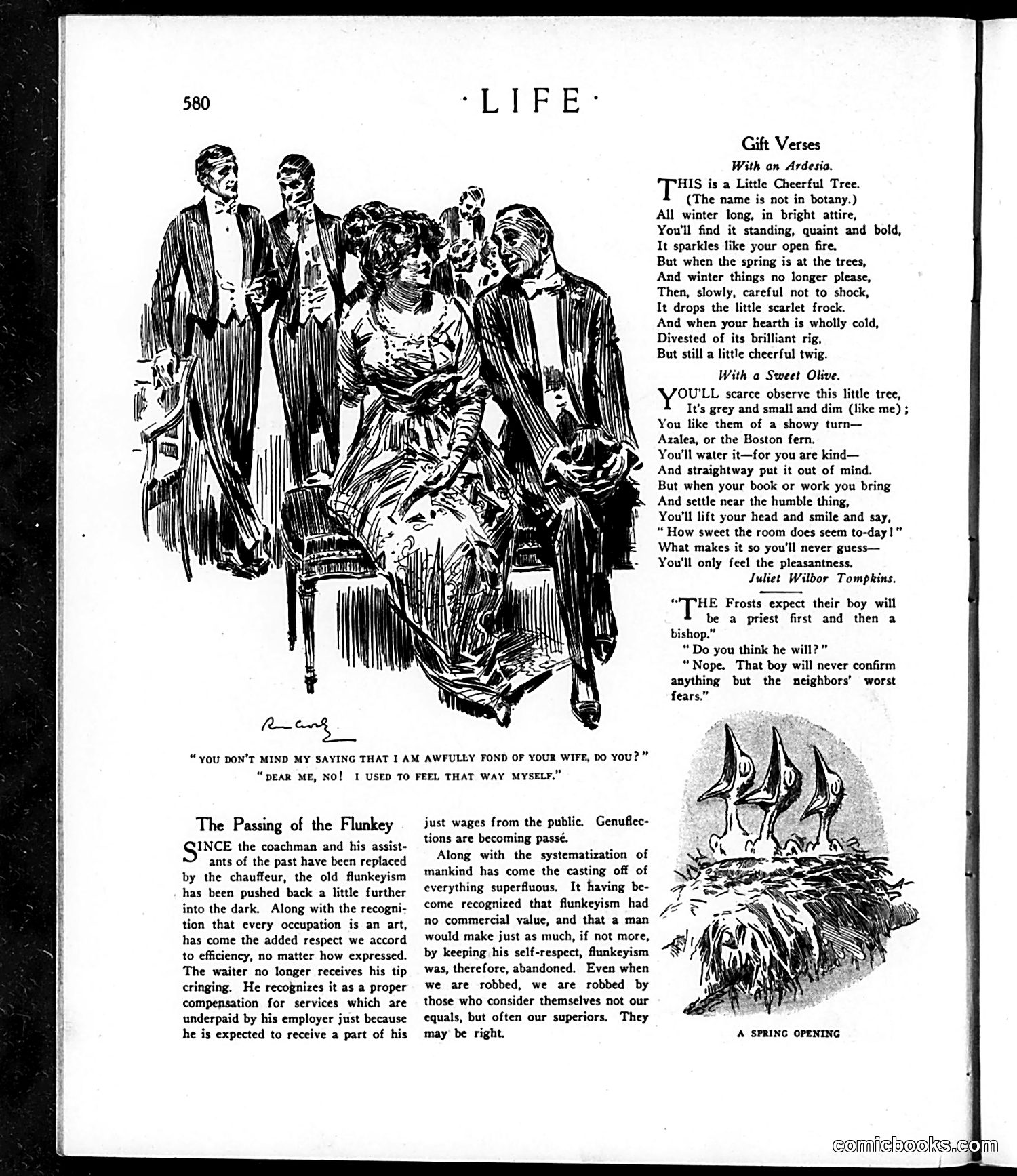
**The Main Cartoon**: A well-dressed man tells another man he's "awfully fond of your wife," to which the other replies he "used to feel that way myself." This is a joke about infidelity and the casual acceptance of romantic indiscretion among the wealthy classes—the humor lies in the bland, matter-of-fact admission rather than jealousy. **"The Passing of the Flunkey"**: This essay satirizes the decline of servile deference. It argues that modern efficiency has made obsequious behavior obsolete. Waiters, coachmen, and servants no longer need to grovel for tips since their labor is increasingly recognized as legitimate work deserving fair wages. The piece celebrates this shift as progress—even robbers now consider themselves "superiors" rather than inferiors, suggesting a democratization of respect. **Gift Verses**: Sentimental poems accompanying potted plants, typical of the era's genteel gift-giving culture. **Bottom Joke**: A brief anecdote mocking parental expectations—the Frosts hope their boy becomes a priest or bishop, but he'll only "confirm the neighbors' worst fears," suggesting moral failure.
📄 Transcribed text from this page (OCR, searchable)
Machine-transcribed from the original scan — historical spelling and the odd misread are preserved.
“you DON’T MIND MY SAYING THAT I AM AWFULLY FOND OF YOUR WIFE, Do You?” “DEAR ME, No! The Passing of the Flunkey INCE the coachman and his assist- ants of the past have been replaced by the chauffeur, the old flunkeyism has been pushed back a little further into the dark. Along with the recogni- tion that every occupation is an art, has come the added respect we accord to efficiency, no matter how expressed. The waiter no longer receives his tip cringing. He recognizes it as a proper compensation for services which are underpaid by his employer just because he is expected to receive a part of his I USED TO FEEL THAT WAY MYSELF.” just wages from the public. Genuflec- tions are becoming passé. Along with the systematization of mankind has come the casting off of everything superfluous, It having be- come recognized that flunkeyism had no commercial value, and that a man would make just as much, if not more, by keeping his self-respect, flunkeyism was, therefore, abandoned. Even when we are robbed, we are robbed by those who consider themselves not our equals, but often our superiors. They may be right. Gift Verses With an Ardesia. HIS is a Little Cheerful Tree. (The name is not in botany.) All winter long, in bright attire, You'll find it standing, quaint and bold, It sparkles like your open fire. But when the spring is at the trees, And winter things no longer please, Then, slowly, careful not to shock, It drops the little scarlet frock. And when your hearth is wholly cold, Divested of its brilliant rig, But still a little cheerful twig. With a Sweet Olive. ‘OU'LL scarce observe this little tree, It's grey and small and dim (like me) ; You like them of a showy turn— Azalea, or the Boston fern. You'll water it—for you are kind— And straightway put it out of mind. But when your book or work you bring And settle near the humble thing, You'll lift your head and smile and say, “How sweet the room does seem to-day!” What makes it so you'll never guess— You'll only feel the pleasantness. Juliet Wilbor Tompkins. “"THE Frosts expect their boy will be a priest first and then a bishop.” “Do you think he will?" “Nope. That boy will never confirm anything but the neighbors’ worst fears.” am A SPRING OPENING comichooks.