
Life, 1914-04-02 · page 38 of 68
Life — April 2, 1914 — page 38: what you’re looking at
What you’re looking at
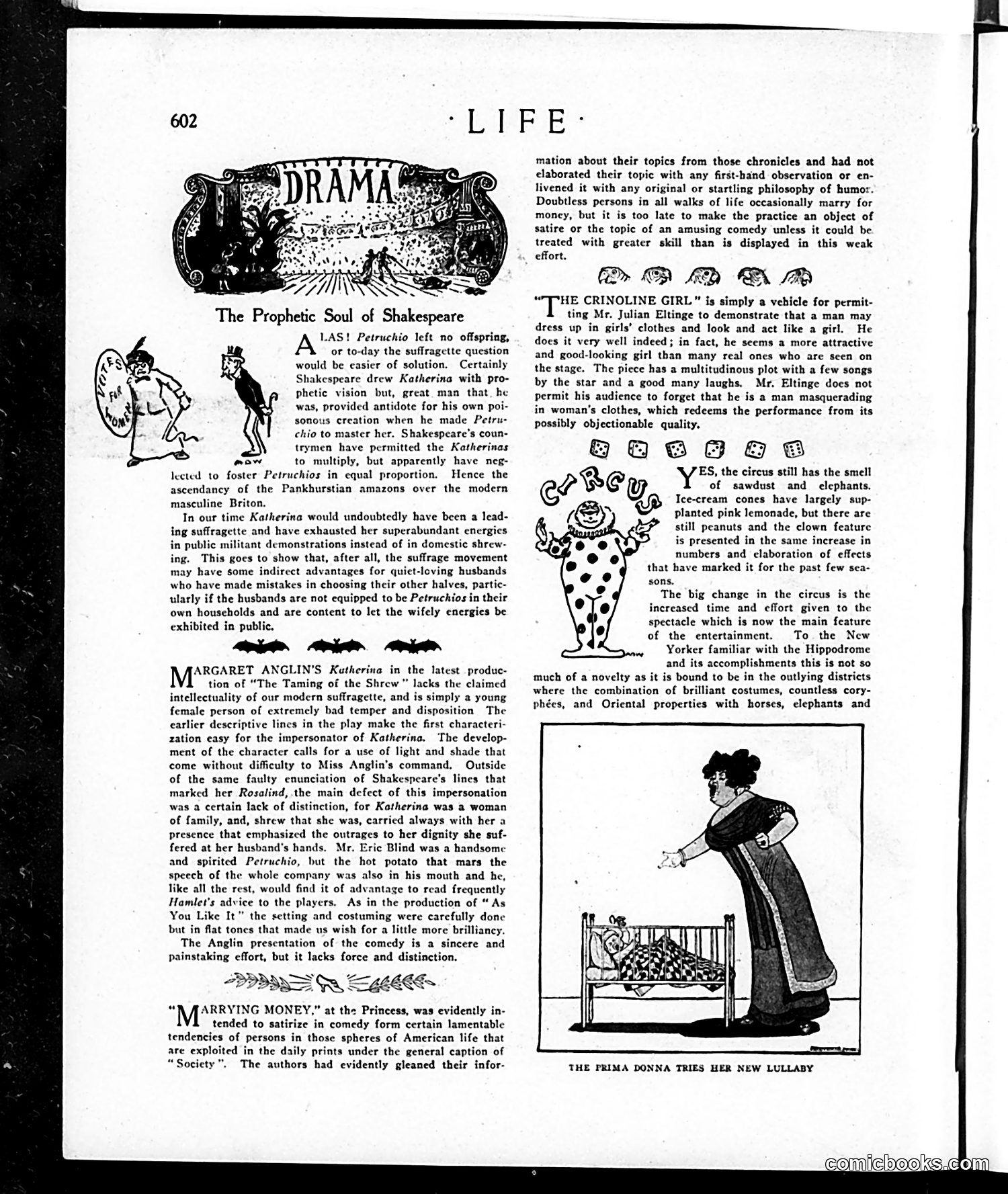
This page critiques contemporary theater productions while making a pointed political argument about women's suffrage. The main article discusses actress Margaret Anglin's performance in *The Taming of the Shrew*. The reviewer uses Shakespeare's play as a springboard for satire: he suggests that if Petruchio (the husband who "tames" the shrew Katherina) had produced offspring, the modern "suffragette question" would be solved. The joke is caustic—he implies suffragettes like the Pankhursts are modern versions of Shakespeare's Katherina, and that Britain lacks men strong enough to "master" them as Petruchio did. The article sardonically notes that channeling women's rebellious energy into public suffrage activism may actually *benefit* husbands by removing shrewish wives from their homes. This reflects anti-suffrage sentiment common in the 1910s: women demanding voting rights were mocked as irrational shrews needing male control. The page also reviews other theatrical productions, including Julian Eltinge's cross-dressing performance in "The Crinoline Girl."
📄 Transcribed text from this page (OCR, searchable)
Machine-transcribed from the original scan — historical spelling and the odd misread are preserved.
ERR VE * 7) SoS ee The Prophetic Soul of Shakespeare LAS! Petruchio left no offspring, or to-day the suffragette question would be easier of solution. Certainly Shakespeare drew Katherina with pro- phetic vision but, great man that. he was, provided antidote for his own poi- sonous creation when he made Petru- chio to master her. Shakespeare's coun- trymen have permitted the Katherinas now to multiply, but apparently have neg- lected to foster Petruchios in equal proportion. Hence the ascendancy of the Pankhurstian amazons over the modern masculine Briton. In our time Katherina would undoubtedly have been a lead- ing suffragette and have exhausted her superabundant energics in public militant demonstrations instead of in domestic shrew- ing. This goes to show that, after all, the suffrage movement may have some indirect advantages for quiet-loving husbands who have made mistakes in choosing their other halves, partic- ularly if the husbands are not equipped to be Petruchios in their own households and are content to let the wifely energies be exhibited in public, ae tie aie ARGARET ANGLIN'S Kutherina in the latest produc- tion of “The Taming of the Shrew" lacks the claimed intellectuality of our modern suffragette, and is simply a young female person of extremely bad temper and disposition The earlier descriptive lines in the play make the first characteri- zation easy for the impersonator of Katherina. The develop- ment of the character calls for a use of light and shade that come without difficulty to Miss Anglin’s command. Outside of the same faulty enunciation of Shakespeare's lines that marked her Rosalind, the main defect of this impersonation was a certain lack of distinction, for Katherina was a woman of family, and, shrew that she was, carried always with her a presence that emphasized the outrages to her dignity she suf- fered at her husband's hands. Mr. Eric Blind was a handsome and spirited Petruchio, but the hot potato that mars the speech of the whole company was also in his mouth and he, like all the rest, would find it of advantage to read frequently Hamlet's advice to the players. As in the production of “As You Like It” the setting and costuming were carefully done but in flat tones that made us wish for a little more brilliancy. The Anglin presentation of the comedy is a sincere and painstaking effort, but it lacks force and distinction. SMR Ns MONEY,” at the Princess, was evidently ii tended to satirize in comedy form certain lamentable tendencies of persons in those spheres of American life that are exploited in the daily prints under the general caption of “Society”. The authors had evidently gleaned their infor- mation about their topics from those chronicles and had not elaborated their topic with any first-hand observation or en- livened it with any original or startling philosophy of humor. Doubtless persons in all walks of life occasionally marry for money, but it is too late to make the practice an object of satire or the topic of an amusing comedy unless it could be treated with greater skill than is displayed in this weak HE CRINOLINE GIRL” is simply a vehicle for permit- ting Mr. Julian Eltinge to demonstrate that a man may dress up in girls’ clothes and look and act like a girl. He does it very well indeed; in fact, he seems a more attractive and good-looking girl than many real ones who are seen on the stage. The piece has a multitudinous plot with a few songs by the star and a good many laughs. Mr. Eltinge does not permit his audience to forget that he is a man masquerading in woman's clothes, which redeems the performance from its possibly objectionable quality. Saas gags ES, the circus still has the smell of sawdust and elephants. Ice-cream cones have largely sup- planted pink lemonade, but there are still peanuts and the clown feature is presented in the same increase in numbers and elaboration of effects that have marked it for the past few sea- sons. The big change in the circus is the increased time and effort given to the spectacle which is now the main feature of the entertainment. To the New Yorker familiar with the Hippodrome and its accomplishments this is not so much of a novelty as it is bound to be in the outlying districts where the combination of brilliant costumes, countless cory- phées, and Oriental properties with horses, elephants and THE PRIMA DONNA TRIES HER NEW LULLABY