
Life, 1914-04-02 · page 25 of 68
Life — April 2, 1914 — page 25: what you’re looking at
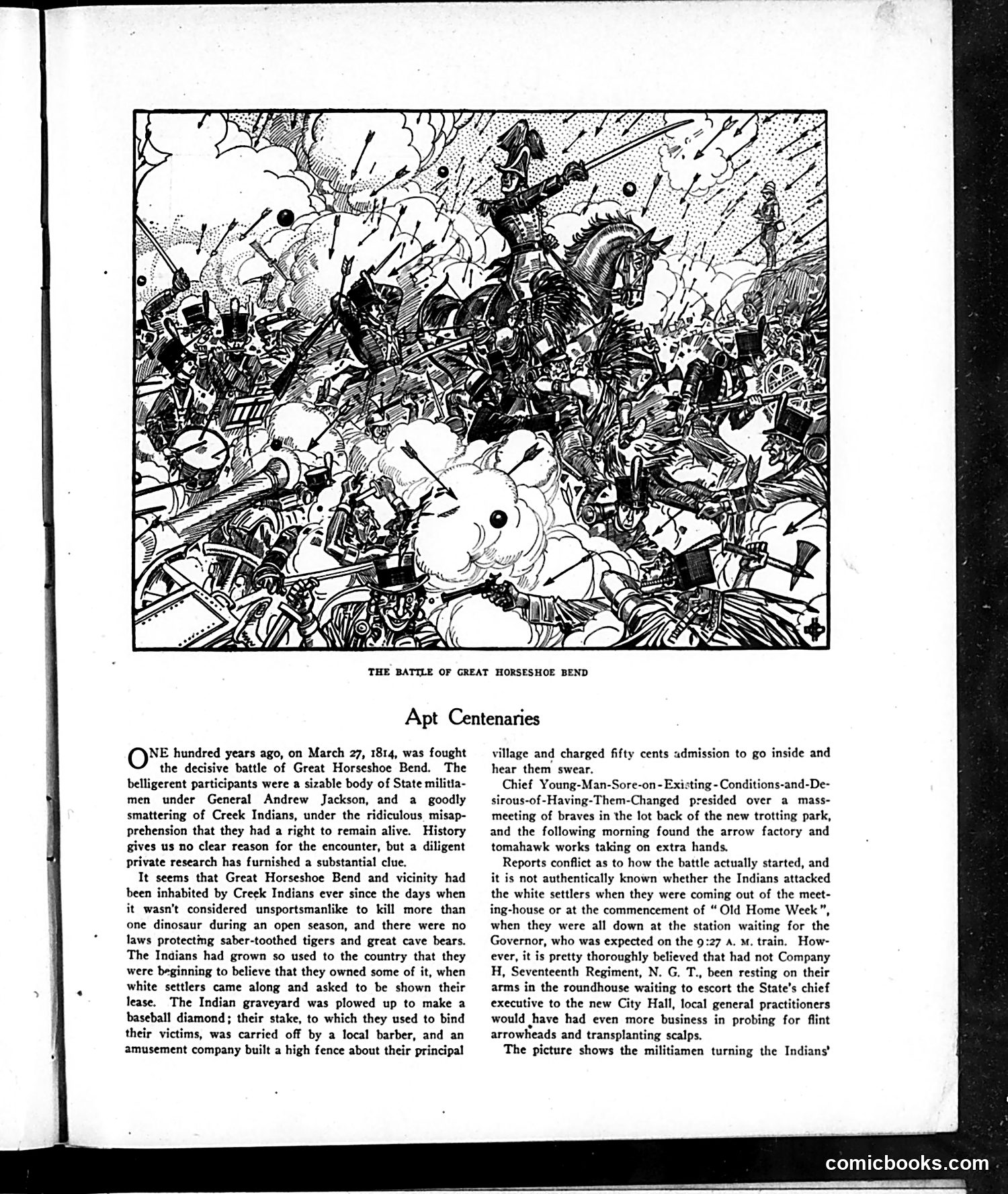
What you’re looking at
This is a satirical centennial piece mocking the 1814 Battle of Great Horseshoe Bend, where Andrew Jackson's militia defeated Creek Indians. The satire's target is white American treatment of Native Americans and the self-serving historical narrative. The text ridicules the settlers' appropriation of Creek lands—desecrating burial grounds to build a baseball diamond, turning sacred sites into paid tourist attractions ("charged fifty cents admission"), and commodifying Indigenous culture. The mocking "Chief" name ("Young-Man-Sore-on-Existing-Conditions") undercuts dignity while describing legitimate grievances. The satire's bite: the text suggests the battle was inevitable only because armed militia happened to be present, implying the outcome was predetermined rather than militarily necessary. It portrays colonization as absurd—settlers demanding proof of ownership from people who'd inhabited the land since prehistoric times—while treating Indigenous resistance as unreasonable. The crude cartoon depicts the chaotic violence, illustrating the "ridiculous misapprehension" that Native Americans believed they had "a right to remain alive"—the satire's darkest, most direct indictment of settler-colonial violence.
📄 Transcribed text from this page (OCR, searchable)
Machine-transcribed from the original scan — historical spelling and the odd misread are preserved.
Se THE BATILE OF GREAT HORSESHOE BEND Apt Centenaries O*E hundred years ago, on March 27, 1814, was fought the decisive battle of Great Horseshoe Bend. The belligerent participants were a sizable body of State militia- men under General Andrew Jackson, and a goodly smattering of Creek Indians, under the ridiculous misap- prehension that they had a right to remain alive. History gives us no clear reason for the encounter, but a diligent private research has furnished a substantial clue. It seems that Great Horseshoe Bend and vicinity had been inhabited by Creek Indians ever since the days when it wasn’t considered unsportsmanlike to kill more than one dinosaur during an open season, and there were no laws protecting saber-toothed tigers and great cave bears. The Indians had grown so used to the country that they were beginning to believe that they owned some of it, when white settlers came along and asked to be shown their lease. The Indian graveyard was plowed up to make a baseball diamond; their stake, to which they used to bind their victims, was carried off by a local barber, and an amusement company built a high fence about their principal village and charged fifty cents admission to go inside and hear them swear. Chief Young-Man-Sore-on- Existing - Conditions-and-De- sirous-of-Having-Them-Changed presided over a mass- meeting of braves in the lot back of the new trotting park, and the following morning found the arrow factory and tomahawk works taking on extra hands. Reports conflict as to how the battle actually started, and it is not authentically known whether the Indians attacked the white settlers when they were coming out of the meet- ing-house or at the commencement of “Old Home Week”, when they were all down at the station waiting for the Governor, who was expected on the 9:27 A. M. train. How- ever, it is pretty thoroughly believed that had not Company H, Seventeenth Regiment, N. G. T., been resting on their arms in the roundhouse waiting to escort the State’s chief executive to the new City Hall, local general practitioners would have had even more business in probing for flint arrowheads and transplanting scalps. The picture shows the militiamen turning the Indians’ comicbooks.com ————