
Life, 1914-04-02 · page 40 of 68
Life — April 2, 1914 — page 40: what you’re looking at
What you’re looking at
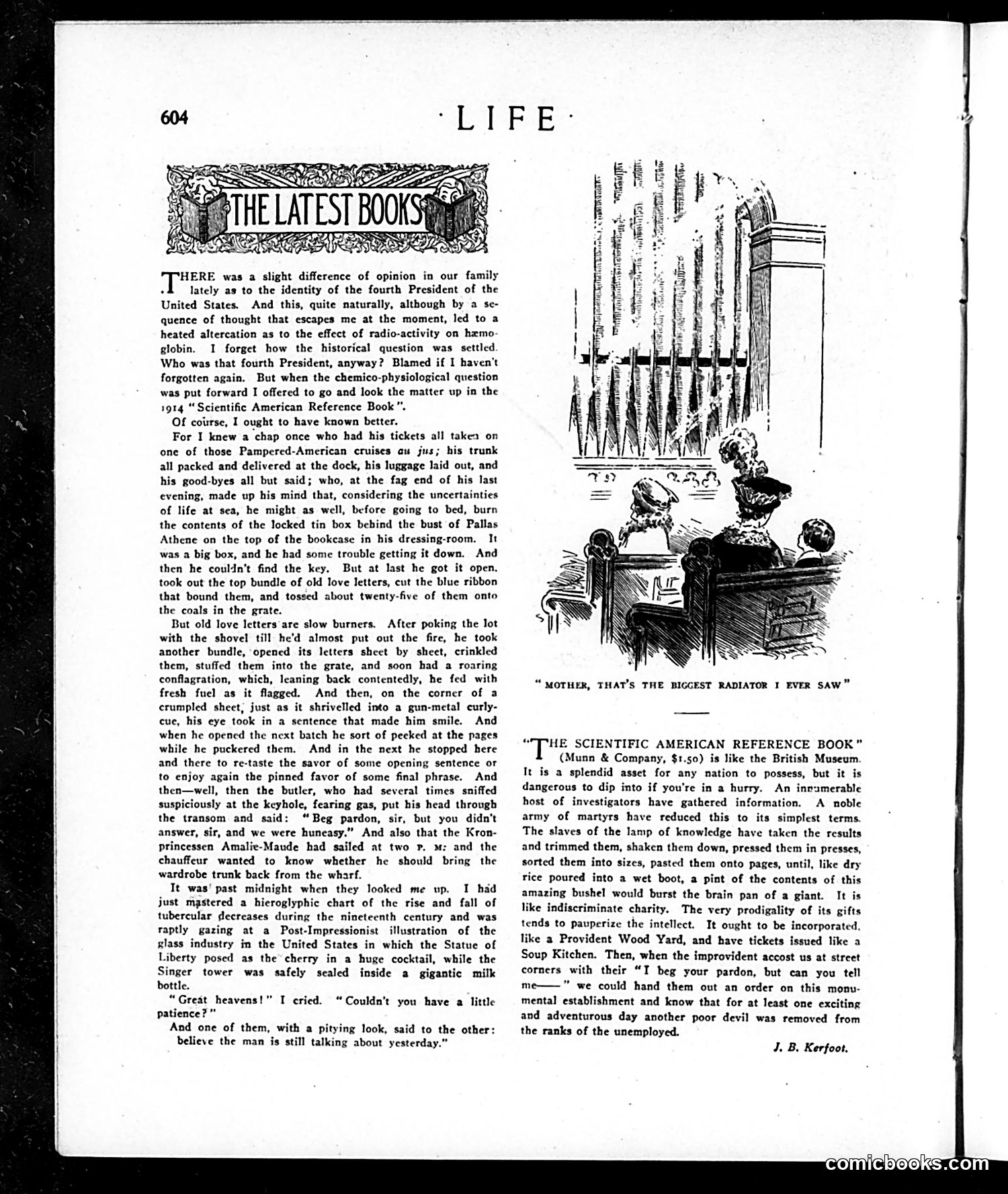
This page presents a humorous essay satirizing the *Scientific American Reference Book* (1914). The author recounts a family dispute over which president was fourth, which spiraled into debates about radio-activity's effect on hemoglobin—illustrating how consulting reference books can trap readers in endless rabbit holes. The accompanying anecdote mocks over-consultation of information sources: a man planning ocean travel attempts to look up an obscure fact before departure, gets distracted by old love letters, and nearly misses his ship entirely. The cartoon (captioned "Mother, that's the biggest radiator I ever saw") appears to be a child's innocent misidentification of some object—likely satirizing how reference books create confusion rather than clarity for casual users. The review's concluding point: the *Scientific American Reference Book* is valuable but dangerous "if you're in a hurry"—a witty critique of how comprehensive reference materials, while impressive, can overwhelm rather than assist rushed readers.
📄 Transcribed text from this page (OCR, searchable)
Machine-transcribed from the original scan — historical spelling and the odd misread are preserved.
HERE was a slight difference of opinion in our family «1 lately as to the identity of the fourth President of the United States. And this, quite naturally, although by a se- quence of thought that escapes me at the moment, led to a heated altercation as to the effect of radio-activity on hemo globin. I forget how the historical question was. settled. Who was that fourth President, anyway? Blamed if I haven't forgotten again, But when the chemico-physiological question was put forward I offered to go and look the matter up in the 1914 “Scientific American Reference Book”. Of coirrse, I ought to have known better. For I knew a chap once who had his tickets all takea on one of those Pampered-American cruises au jus; his trunk all packed and delivered at the dock, his luggage Jaid out, and his good-byes all but said; who, at the fag end of his last evening, made up his mind that, considering the uncertainties of life at sea, he might as well, before going to bed, burn the contents of the locked tin box behind the bust of Pallas Athene on the top of the bookcase in his dressing-room. It was a big box, and he had some trouble getting it down. And then he couldn't find the key. But at last he got it open. took out the top bundle of old love letters, cut the blue ribbon that bound them, and tossed about twenty-five of them onto the coals in the grate. But old love letters are slow burners. After poking the lot with the shovel till he’d almost put out the fire, he took another bundle, opened its letters sheet by sheet, crinkled them, stuffed them into the grate, and soon had a roaring conflagration, which, leaning back contentedly, he fed with fresh fuel as it flagged. And then, on the corner of a crumpled sheet, just as it shriveled into a gun-metal curly- cue, his eye took in a sentence that made him smile. And when he opened the next batch he sort of peeked at the pages while he puckered them. And in the next he stopped here and there to re-taste the savor of some opening sentence or to enjoy again the pinned favor of some final phrase. And then—well, then the butler, who had several times sniffed spiciously at the keyhole, fearing gas, put his head through the transom and said: “Beg pardon, sir, but you didn’t answer, sir, and we were huneasy.” And also that the Kron- princessen Amalie-Maude had sailed at two pr. mz and the chauffeur wanted to know whether he should bring the wardrobe trunk back from the wharf. It was! past midnight when they looked me up. I had just mastered a hieroglyphic chart of the rise and fall of tubercular decreases during the nineteenth century and was raptly gazing at a Post-Impressionist illustration of the glass industry im the United States in which the Statue of Liberty posed as the cherry in a huge cocktail, while the Singer tower was safely sealed inside a gigantic milk bottle. “Great heavens!" I cried. patience?” And one of them, with a pitying look, said to the other: believe the man is still talking about yesterday.” “Couldn't you have a little “ MOTHER, THAT'S THE BIGGEST RADIATOR I EVER SAW” “"THE SCIENTIFIC AMERICAN REFERENCE BOOK” (Munn & Company, $1.50) is like the British Museum. It is a splendid asset for any nation to possess, but it is dangerous to dip into if you're in a hurry. An innumerable host of investigators have gathered information. A noble army of martyrs have reduced this to its simplest terms. The slaves of the lamp of knowledge have taken the results and trimmed them, shaken them down, pressed them in presses, sorted them into sizes, pasted them onto pages, until, like dry rice poured into a wet boot, a pint of the contents of this amazing bushel would burst the brain pan of a giant. It is like indiscriminate charity. The very prodigality of its gifts tends to pauperize the intellect. It ought to be incorporated, like a Provident Wood Yard, and have tickets issued like a Soup Kitchen. Then, when the improvident accost us at street corners with their “I beg your pardon, but can you tell me——" we could hand them out an order on this monu- mental establishment and know that for at least one exciting and adventurous day another poor devil was removed from the ranks of the unemployed. J. B, Kerfoot.