
Life, 1914-04-02 · page 44 of 68
Life — April 2, 1914 — page 44: what you’re looking at
What you’re looking at
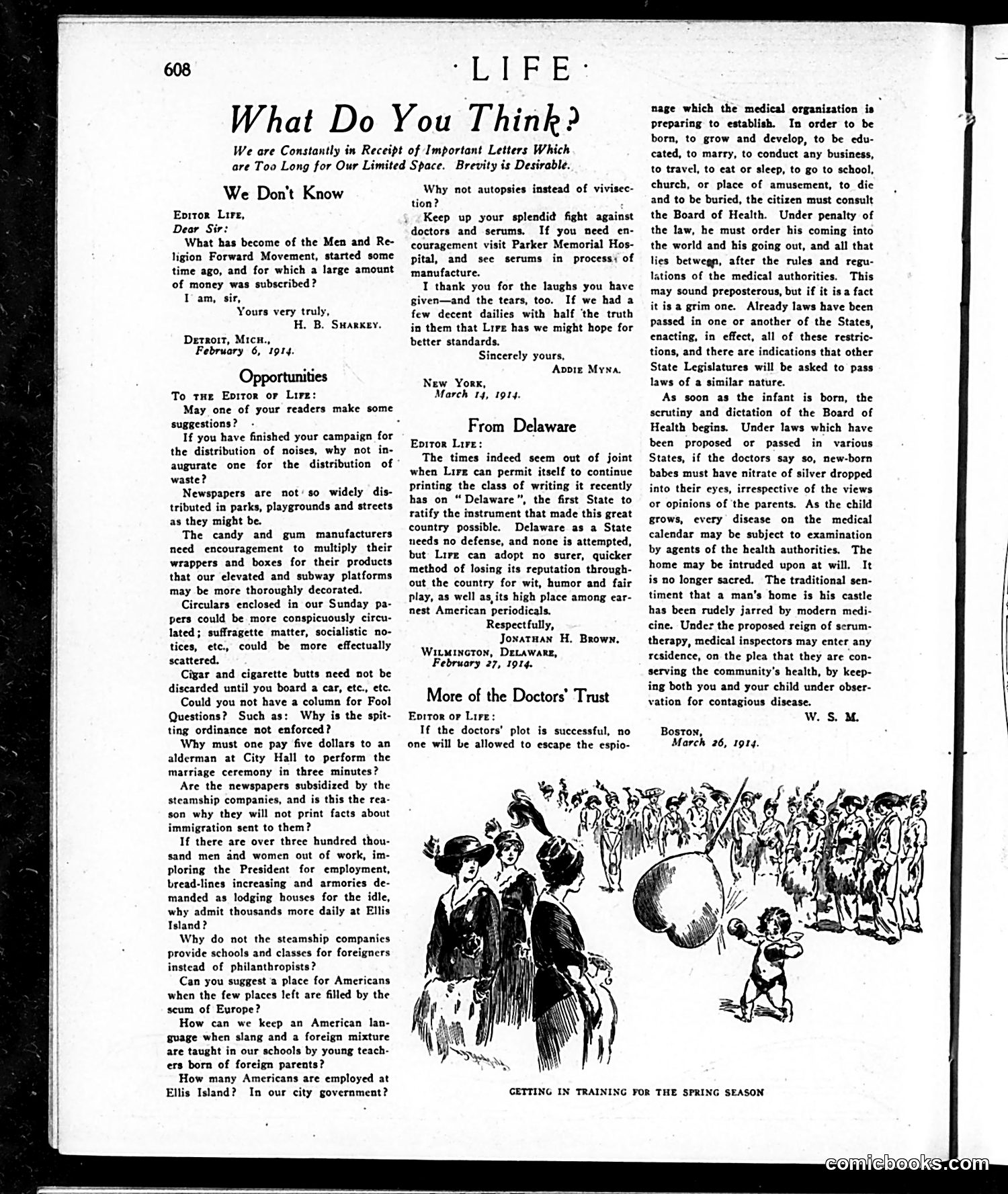
This page features reader letters to Life's editor, showcasing the magazine's satirical role as social critic. The letters reveal early 20th-century American anxieties: **Key concerns addressed:** - The "Men and Religion Forward Movement" (a Progressive-era reform initiative) and its accountability - Immigration policy at Ellis Island—a writer sarcastically suggests distributing "waste" (litter) as efficiently as immigrants are admitted, implying overly permissive immigration - Labor unemployment despite thousands seeking work - Medical authority overreach ("Doctors' Trust")—one writer warns of doctors gaining surveillance power over citizens' private lives (birth, death, travel, eating) - Foreign-born teachers and language preservation **The satire:** Life presents these letters to ridicule both genuine social problems and cranky reader obsessions. The sarcastic "opportunities" letter mocks complaint-culture itself. The doctors' letter reflects contemporary anti-medical establishment sentiment and fears of institutional control. The bottom illustration shows figures training for "spring season"—likely satirizing athletic preparation or some contemporary fad, though context is unclear.
📄 Transcribed text from this page (OCR, searchable)
Machine-transcribed from the original scan — historical spelling and the odd misread are preserved.
What Do You Think? We are Constantly in Receipt of Important Letters Which are Too Long for Our Limited Space. Brevity is Desirable. We Don’t Know Eprror Lire, Dear Sir: What has become of the Men and Re- ligion Forward Movement, started some time ago, and for which a large amount of money was subscribed? I am, sir, Yours very truly, H. B. Swarxey. Detroit, Micu., February 6, 1914. Opportunities To tHe Evitor or Lire: May one of your readers make some suggestions? If you have finished your campaign for the distribution of noises, why not in- augurate one for the distribution of waste? Newspapers are not’ so widely dis- tributed in parks, playgrounds and streets as they might be. The candy and gum manufacturers need encouragement to multiply their wrappers and boxes for their products that our elevated and subway platforms may be more thoroughly decorated. Circulars enclosed in our Sunday pa- pers could be more conspicuously circu- lated; suffragette matter, socialistic no- tices, etc. could be more effectually scattered. Cigar and cigarette butts need not be discarded until you board a car, etc., etc. Could you not have a column for Fool Questions? Such as: Why is the spit- ting ordinance not enforced? Why must one pay five dollars to an alderman at City Hall to perform the marriage ceremony in three minutes? Are the newspapers subsidized by the steamship companies, and is this the rea- son why they will not print facts about immigration sent to them? If there are over three hundred thou- sand men and women out of work, im- ploring the President for employment, bread-lines increasing and armories de- manded as lodging houses for the idle, why admit thousands more daily at Ellis Island? Why do not the steamship companics provide schools and classes for foreigners instead of philanthropists? Can you suggest a place for Americans when the few places left are filled by the scum of Europe? How can we keep an American lan- guage when slang and a foreign mixture are taught in our schools by young teach- ers born of foreign parents? How many Americans are employed at Ellis Island? In our city government? Why not autopsies instead of vivisec- tion? Keep up your splendid fight against “doctors and serums. If you need en- couragement visit Parker Memorial Hos- pital, and see serums in process; of manufacture. I thank you for the laughs you have given—and the tears, too. If we had a few decent dailies with half the truth in them that Lire has we might hope for better standards. Sincerely yours, Avoig Myna. New Yorx, March 14, 1914. From Delaware Epitor Lire: The times indeed seem out of joint when Lirg can permit itself to continue printing the class of writing it recently has on “ Delaware”, the first State to ratify the instrument that made this great country possible. Delaware as a State needs no defense, and none is attempted, but Lire can adopt no surer, quicker method of losing its reputation through- out the country for wit, humor and fair play, as well as, its high place among ear- nest American periodicals. Respectfully, Joxatuan H. Brown, Witamrncton, Detawarg, February 27, 1914. More of the Doctors’ Trust Eprtor or Lire: If the doctors’ plot is successful, no one will be allowed to escape the espio- nage which the medical organization is Preparing to establish. In order to be born, to grow and develop, to be edu- cated, to marry, to conduct any business, to travel, to eat or sleep, to go to school, church, or place of amusement, to die and to be buried, the citizen must consult the Board of Health. Under penalty of the law, he must order his coming into the world and his going out, and all that lies betwegn, after the rules and regu- lations of the medical authorities. This may sound preposterous, but if it is a fact it isa grim one. Already laws have been passed in one or another of the States, enacting, in effect, all of these restric- tions, and there are indications that other State Legislatures will be asked to pass laws of a similar nature. As soon as the infant is born, the scrutiny and dictation of the Board of Health begins. Under laws which have been proposed or passed in various States, if the doctors say so, new-born babes must have nitrate of silver dropped into their eyes, irrespective of the views or opinions of ‘the parents. As the child Brows, every disease on the medical calendar may be subject to examination by agents of the health authorities. The home may be intruded upon at will. It is no longer sacred. The traditional sen- timent that a man’s home is his castle has been rudely jarred by modern medi- cine. Under the proposed reign of serum- therapy, medical inspectors may enter any residence, on the plea that they are con- serving the community's health, by keep- ing both you and your child under obser- vation for contagious disease. WwW. S. M. Boston, March 26, 1914.