
Life, 1914-04-02 · page 57 of 68
Life — April 2, 1914 — page 57: what you’re looking at
What you’re looking at
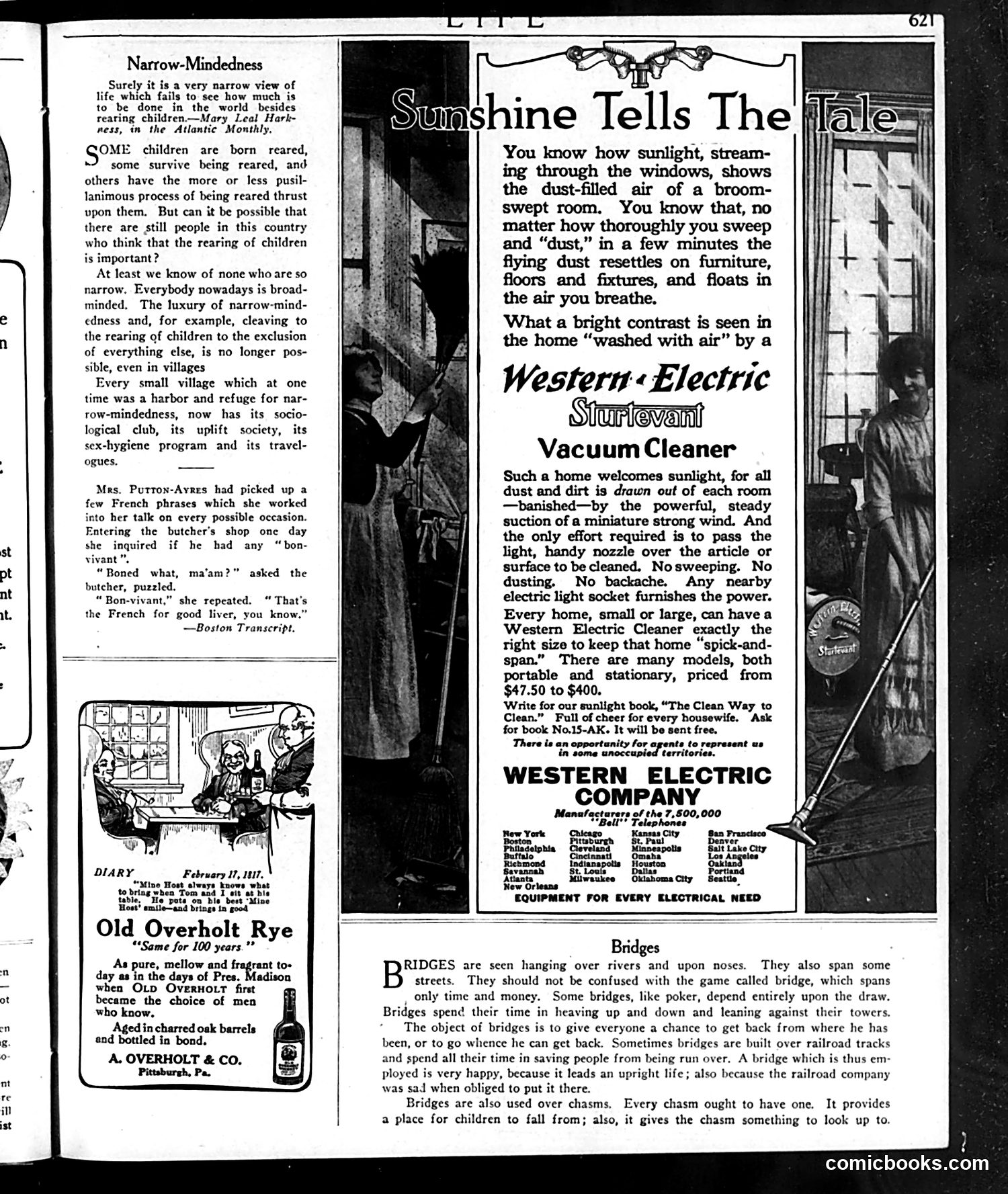
This Life magazine page combines social commentary with period advertising. The "Narrow-Mindedness" essay satirizes modern women who've abandoned child-rearing for social clubs and self-improvement—mocking the era's tension between traditional motherhood and "broadmindedness." A humorous anecdote about a woman misusing French phrases ("bon-vivant" for meat) ridicules social pretension. The bulk of the page features advertisements: Old Overholt Rye whiskey (emphasizing its 100-year heritage and quality) and Western Electric's Surlyvant vacuum cleaner (targeting housewives with promises that electric cleaning eliminates dust better than sweeping). The "Bridges" piece at bottom is whimsical filler—playful definitions contrasting literal bridges with social metaphors. The overall message reflects 1910s-era anxieties about women's changing roles, modern technology's promises, and class anxieties about proper behavior.
📄 Transcribed text from this page (OCR, searchable)
Machine-transcribed from the original scan — historical spelling and the odd misread are preserved.
Narrow-Mindedness Surely it is a very narrow view of life which fails to see how much is to be done in the world besides rearing children.—Mary Leal Hark- ness, in the Atlantic Monthly, Some children are born reared, some survive being reared, and others have the more or less pusil- lanimous process of being reared thrust upon them. But can it be possible that there are still people in this country who think that the rearing of children is important? At least we know of none who are so narrow. Everybody nowadays is broad- minded, The luxury of narrow-mind- edness and, for example, cleaving to the rearing of children to the exclusion of everything else, is no longer pos- sible, even in villages Every small village which at one time was a harbor and refuge for nar- row-mindedness, now has its socio- logical club, its uplift society, its sex-hygiene program and its travel- ogues, Mrs. Putron-Ayres had picked up a few French phrases which she worked into her talk on every possible occasion. Entering the butcher's shop one day she inquired if he had any “bon- vivant”, “Boned what, ma‘am?" asked the butcher, puzzled. “ Bon-vivant,” she repeated. “ That's the French for good liver, you know,” —Boston Transcript. DIARY February I, 1817, “Mino Host always knows what to bring when Tom and I table, He pote on bis ‘Host! emile—end brings in good Old Overholt Rye “‘Same for 100 years.”” As pure, mellow and fragrant to- day as in the days of Pres. Madison when Ovo OveRHOLT first n became the choice of men 1B who know, Aged in charred oak barrels and bottled in bond. A. OVERHOLT & CO. Pit Pa. You know how sunlight, stream- ing through the windows, shows the dust-filled air of a broom- swept room. You know that, no matter how thoroughly you sweep and “dust,” in a few minutes the flying dust resettles on furniture, floors and fixtures, and floats in the air you breathe. ‘What a bright contrast is seen in the home “washed with air” by a Western Electric SuSE Vacuum Cleaner Such a home welcomes sunlight, for all dust and dirt is drawn out of each room —banished—by the powerful, steady suction of a miniature strong wind. And the only effort required is to pass the light, handy nozzle over the article or surface to be cleaned. Nosweeping. No dusting. No backache. Any nearby electric light socket furnishes the power. Every home, small or large, can have a Western Electric Cleaner exactly the right size to keep that home “spick-and- span.” There are many models, both portable and stationary, priced from $47.50 to $400. ‘Write for our sunlight book, “The Clean Way to Clean.” Full of cheer for every housewife. Ask for book No.15-AK. It will be sent free. There is an opportunity for ite to represent us in some unoccupied territories. WESTERN ELECTRIC COMPANY Manafactarers of the 7,500,000 “*Bell’’ Telephones Kansas, cere? RIDGES are seen hanging over rivers and upon noses. They also span some streets. They should not be confused with the game called bridge, which spans , only time and money. Some bridges, like poker, depend entirely upon the draw. Bridges spend their time in heaving up and down and leaning against their towers. The object of bridges is to give everyone a chance to get back from where he has been, or to go whence he can get back. Sometimes bridges are built over railroad tracks and spend all their time in saving people from being run over. A bridge which is thus em- ployed is very happy, because it leads an upright life; also because the railroad company was sad when obliged to put it there. Bridges are also used over chasms. Every chasm ought to have one. It provides a place for children to fall from; also, it gives the chasm something to look up to. ) comicbooks.com