
A complete issue · 94 pages · 1916
Life — December 7, 1916
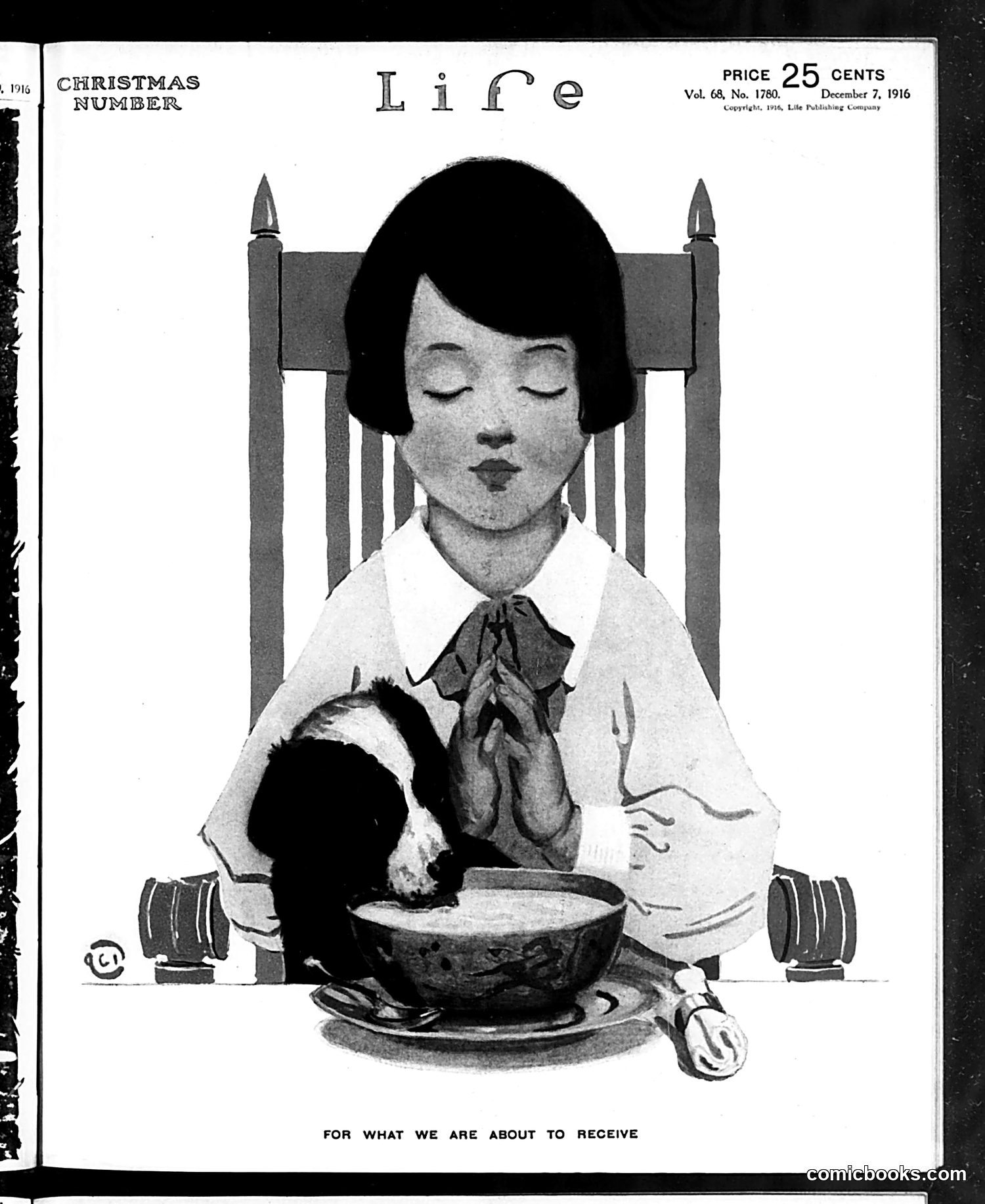
This is a Christmas 1916 *Life* magazine cover depicting a young woman seated in a wooden chair, eyes closed in prayer or contemplation. She holds a bowl and appears to be saying grace before a modest meal. The caption reads "FOR WHAT WE ARE ABOUT TO RECEIVE." The satire likely references **food scarcity or rationing concerns during World War I**. America entered WWI in April 1917, but by late 1916, war-related economic disruptions and food shortages were already affecting civilians. The image suggests gratitude for limited provisions—a commentary on wartime deprivation. The woman's solemn expression and simple meal contrast with typical Christmas abundance, emphasizing the hardship civilians faced as the conflict escalated.
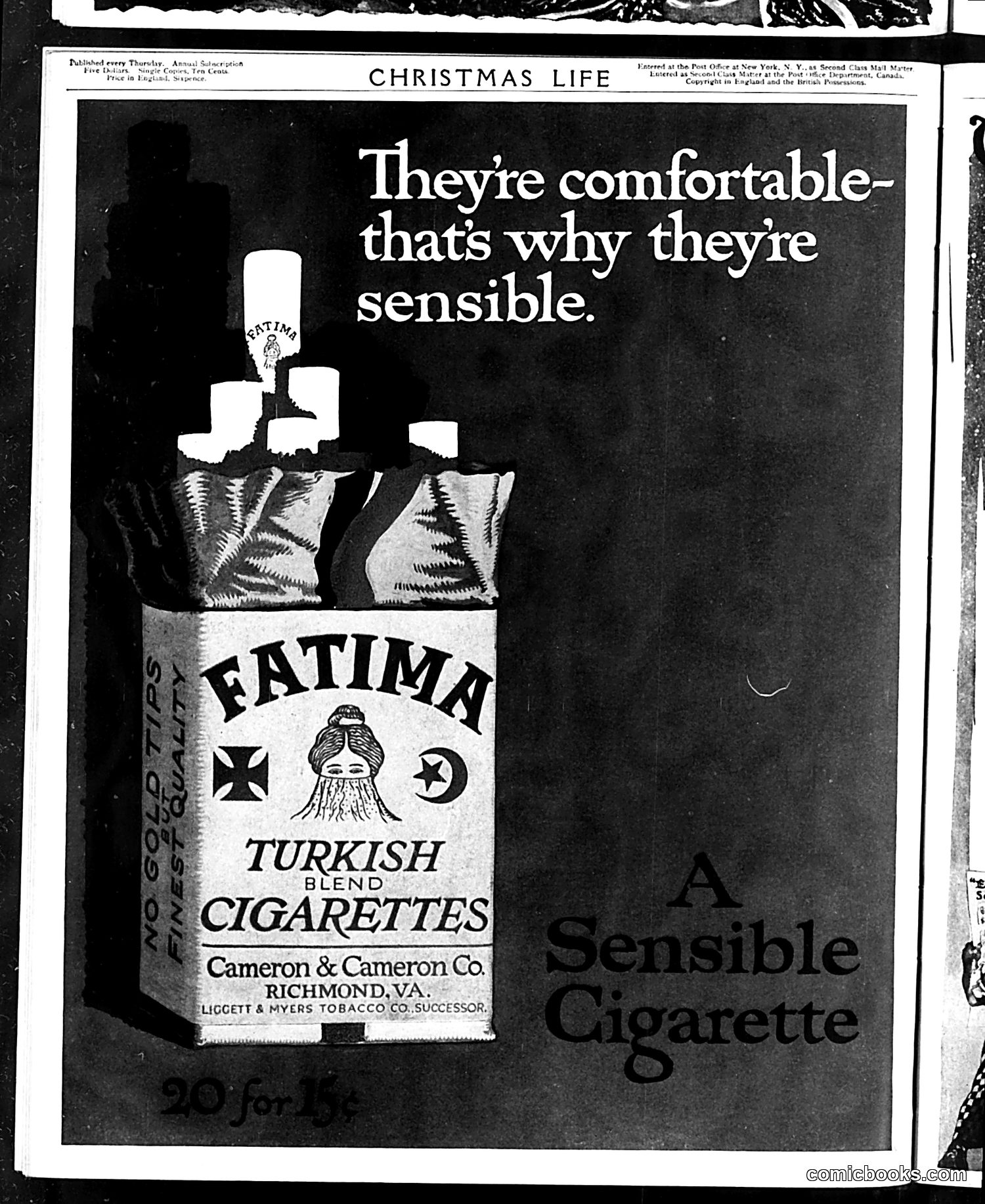
This is a **cigarette advertisement**, not satire or editorial content. It advertises Fatima Turkish Blend Cigarettes, manufactured by Cameron & Cameron Co. of Richmond, VA (successor to Liggett & Myers Tobacco Co.). The ad's tagline—"They're comfortable—that's why they're sensible"—uses the word "sensible" as a marketing appeal, apparently positioning these cigarettes as a rational, practical choice. The phrase "A Sensible Cigarette" appears at bottom right. The visual shows a Fatima cigarette pack decorated with evergreen branches, framed within the Christmas Life magazine issue. This seasonal presentation links the product to holiday gift-giving. By modern standards, this represents tobacco advertising before health warnings existed—marketing cigarettes directly to consumers with health-adjacent language.
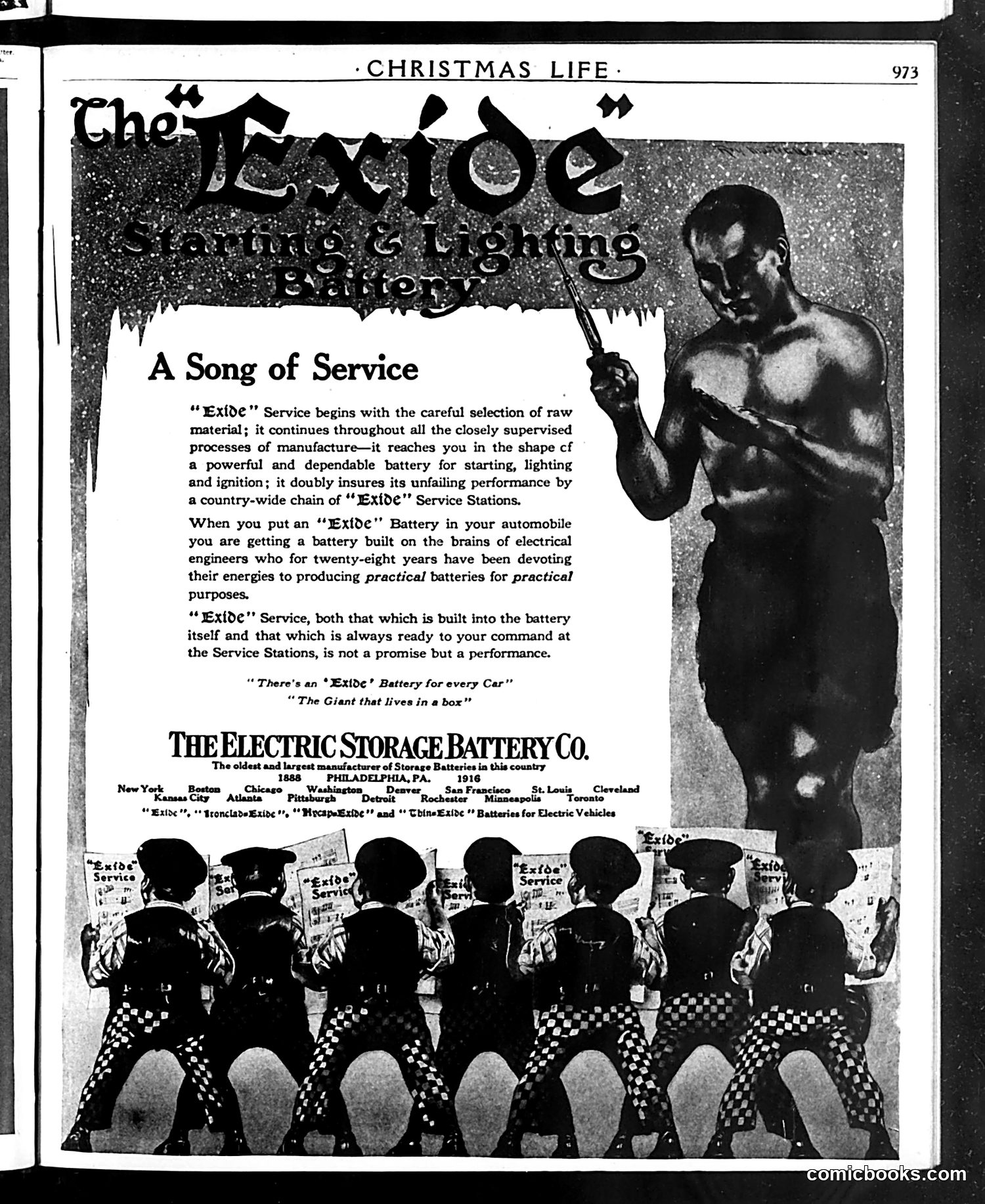
This page is primarily **advertising, not satire or political commentary**. It's a full-page advertisement for "Exide" automobile batteries by The Electric Storage Battery Company (Philadelphia, PA). The ad uses a striking visual metaphor: a muscular male figure (appearing to represent strength/power) holds up a large battery, while below, seven silhouetted figures in checkered pants hold papers labeled "Exide Service." This imagery emphasizes the battery's reliability and the company's service network. The headline "A Song of Service" frames battery performance as dependable and engineered by experienced professionals ("twenty-eight years" of expertise mentioned). The slogan "The Giant that lives in a box" references the product's concentrated power. This reflects 1920s-era advertising strategies emphasizing industrial reliability and service infrastructure.
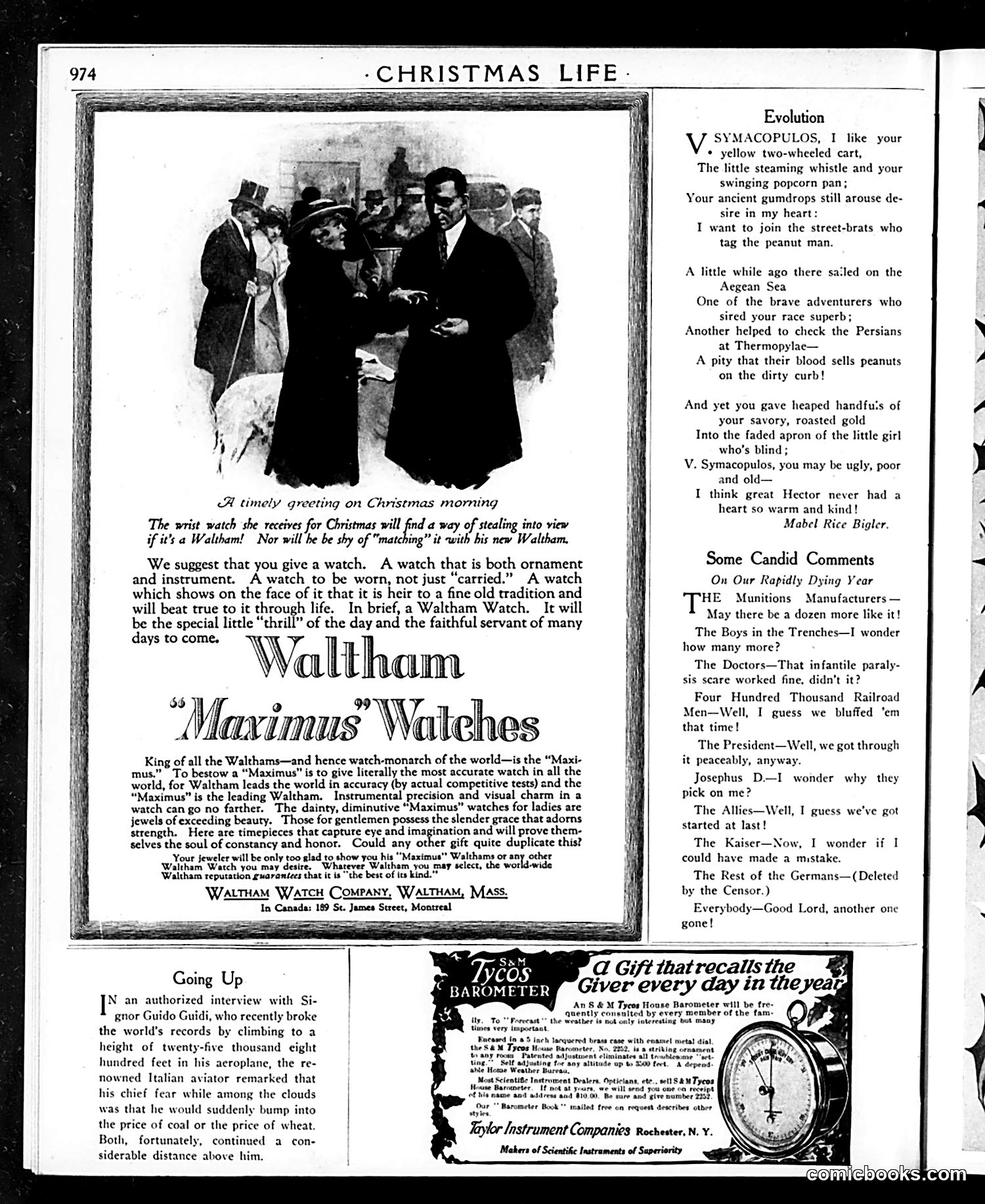
This page contains primarily **advertising rather than political satire**. The dominant content is a Waltham watch advertisement featuring an illustration labeled "A timely greeting on Christmas morning," showing well-dressed men in top hats exchanging greetings on a snowy street. The advertisement promotes Waltham "Maximus" watches as luxury gifts, emphasizing their accuracy and craftsmanship. Below this is a brief article titled "Going Up" about aviator Signor Guido Guidi breaking altitude records in an airplane—a notable technological achievement of the era. The right column contains a poem titled "Evolution" and "Some Candid Comments" section with brief social observations. A barometer advertisement appears at the bottom. **The page reflects early 20th-century consumer culture and technological progress rather than political commentary.**
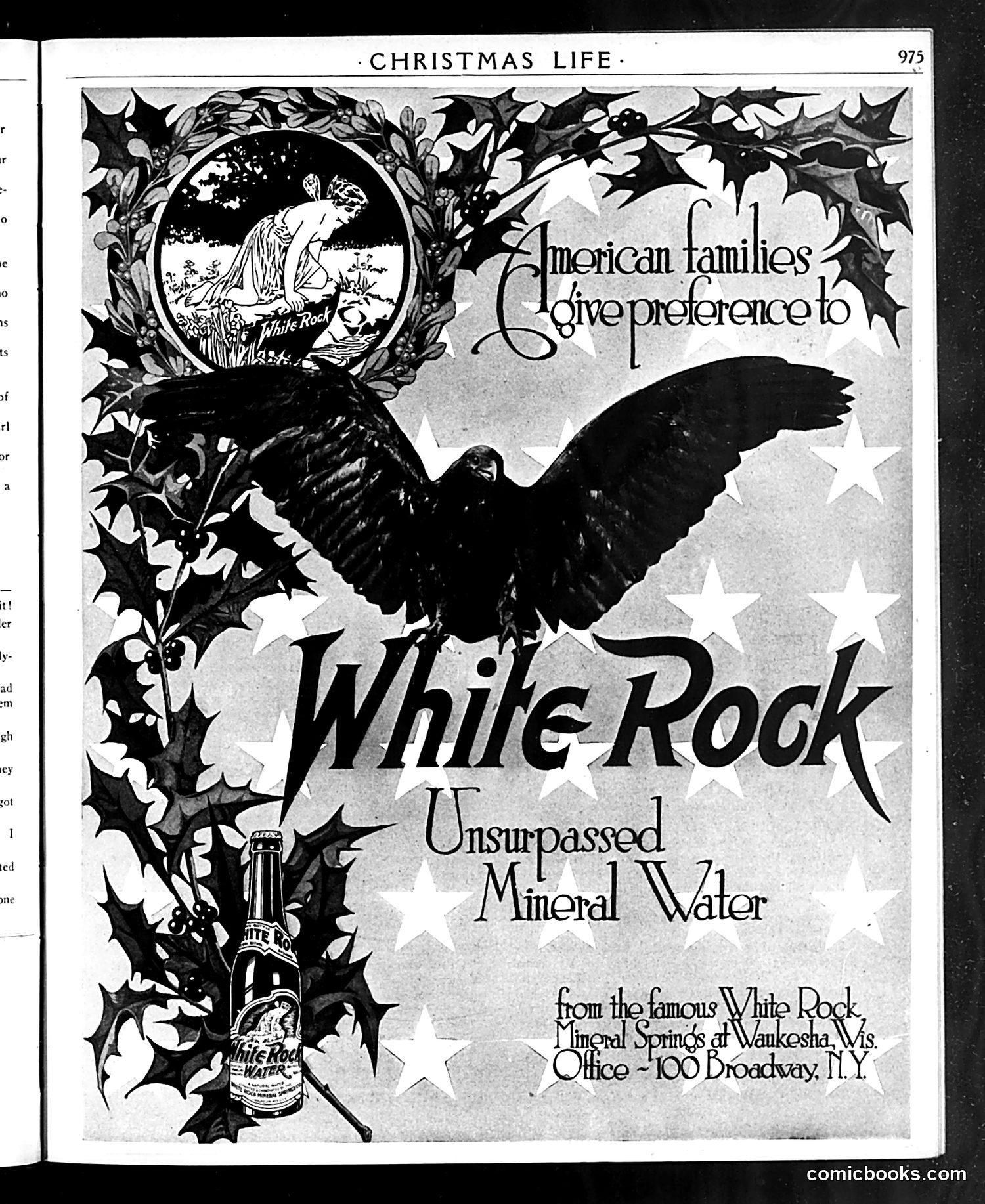
This page is primarily a **Christmas-season advertisement** for White Rock mineral water, not political satire or commentary. The ad features patriotic imagery—an eagle with spread wings and stars—alongside Christmas decorations (holly, mistletoe) to create a festive, nationalist appeal. The text claims "American families give preference to White Rock," positioning the product as patriotically American. The circular vignette in the upper left shows a figure at White Rock springs (located in Waukesha, Wisconsin, per the address given). A mineral water bottle appears at the bottom. The design uses the visual language of American patriotism and holiday sentiment to market the water as a preferred, quality product. There is no apparent political cartoon or satirical content—this is straightforward commercial advertising dressed in patriotic and seasonal appeal.
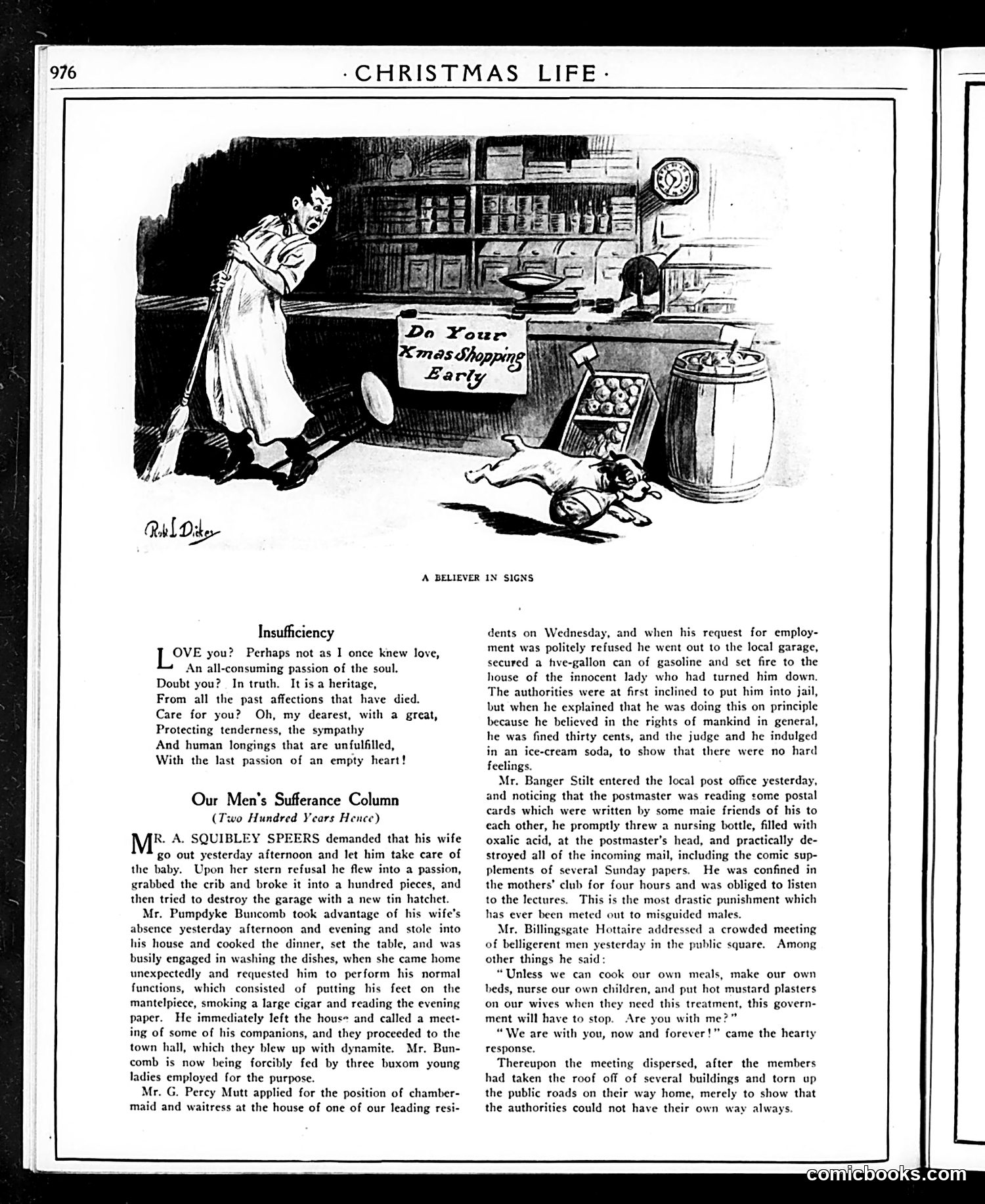
**The Cartoon: "A Believer in Signs"** This satirical illustration depicts a shopkeeper displaying a sign reading "Do Your Xmas Shopping Early" while appearing to sleep or be negligent at the counter. A small dog lies on the floor nearby, suggesting disorder or inattention. The joke targets retail merchants who promote early Christmas shopping while seeming unprepared or disorganized themselves—a contradiction between their commercial messaging and actual business practices. The sleeping figure and messy shop underscore the irony: the shopkeeper urges customers to shop early yet appears incapable of proper service. This reflects early 20th-century consumer culture tensions, where merchants increasingly used persuasive signage to drive sales, sometimes with dubious sincerity about customer welfare or operational readiness.
This is a **commercial advertisement**, not a cartoon or satire. It announces the White Company's new "Sixteen Valve Four" automobile engine, marketed as combining high performance with four-cylinder simplicity. The ad emphasizes engineering innovation—specifically that superior performance comes from increased valve capacity rather than multiplying cylinders, a notable technical claim for the era. The White Company, based in Cleveland, promises features like power, speed, hill-climbing ability, and silent operation. A seven-passenger touring car is priced at $4,600. The ad notes that complete displays of new White models with custom bodies will debut at New York and Chicago automobile salons, with January deliveries beginning. This is purely a product advertisement with no satirical or political content.
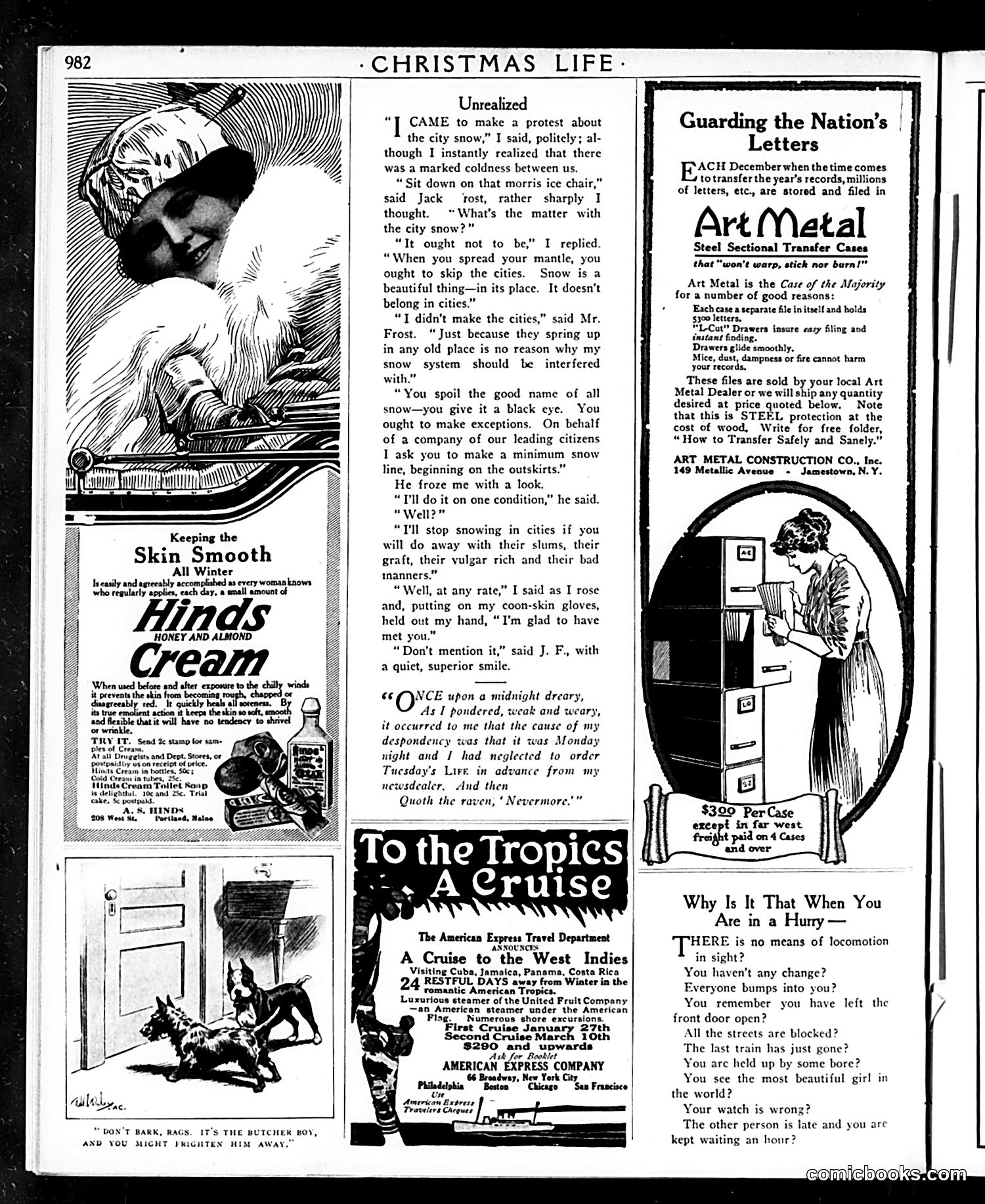
This page mixes fiction and advertising. The main story "Unrealized" depicts a conversation between the narrator and "Jack Frost" (personified winter) about city snow. The narrator protests against urban snow, but Frost defends snow as natural and beautiful, refusing to stop snowing in cities unless the narrator addresses broader social issues: slums, graft, vulgar wealth, and bad manners. The cartoon below shows a dog frightening a butcher boy—a humorous domestic scene with no political content. The advertisements promote Hinds Cream (skin care), Art Metal filing cabinets, and an American Express cruise to the West Indies. This page is primarily **advertising and light entertainment** rather than political satire.
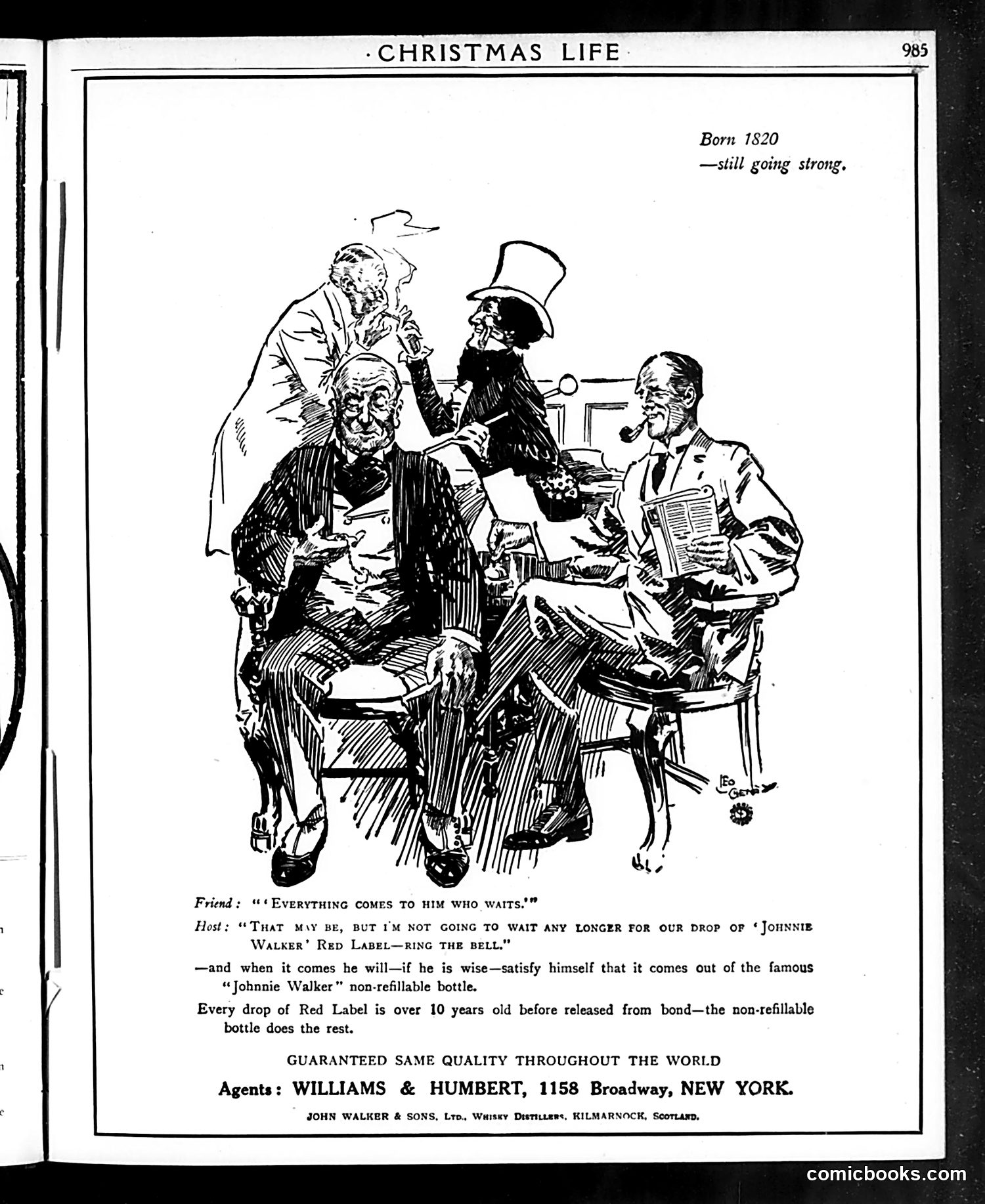
This is primarily a **Johnnie Walker whisky advertisement** disguised as editorial cartoon content. The illustration shows four seated men in Victorian dress, with the caption playing on the proverb "Everything comes to him who waits." The host declares he won't wait for Johnnie Walker Red Label whisky—he'll ring the bell immediately. The ad emphasizes that every drop is "over 10 years old before released from bond," highlighting the whisky's aging process as a quality marker. The "Born 1820—still going strong" tagline at top suggests the brand's longevity and established reputation. The artwork's style mimics political satire typical of *Life* magazine, but the content is purely commercial, promoting the product to upscale consumers through humor and social sophistication.
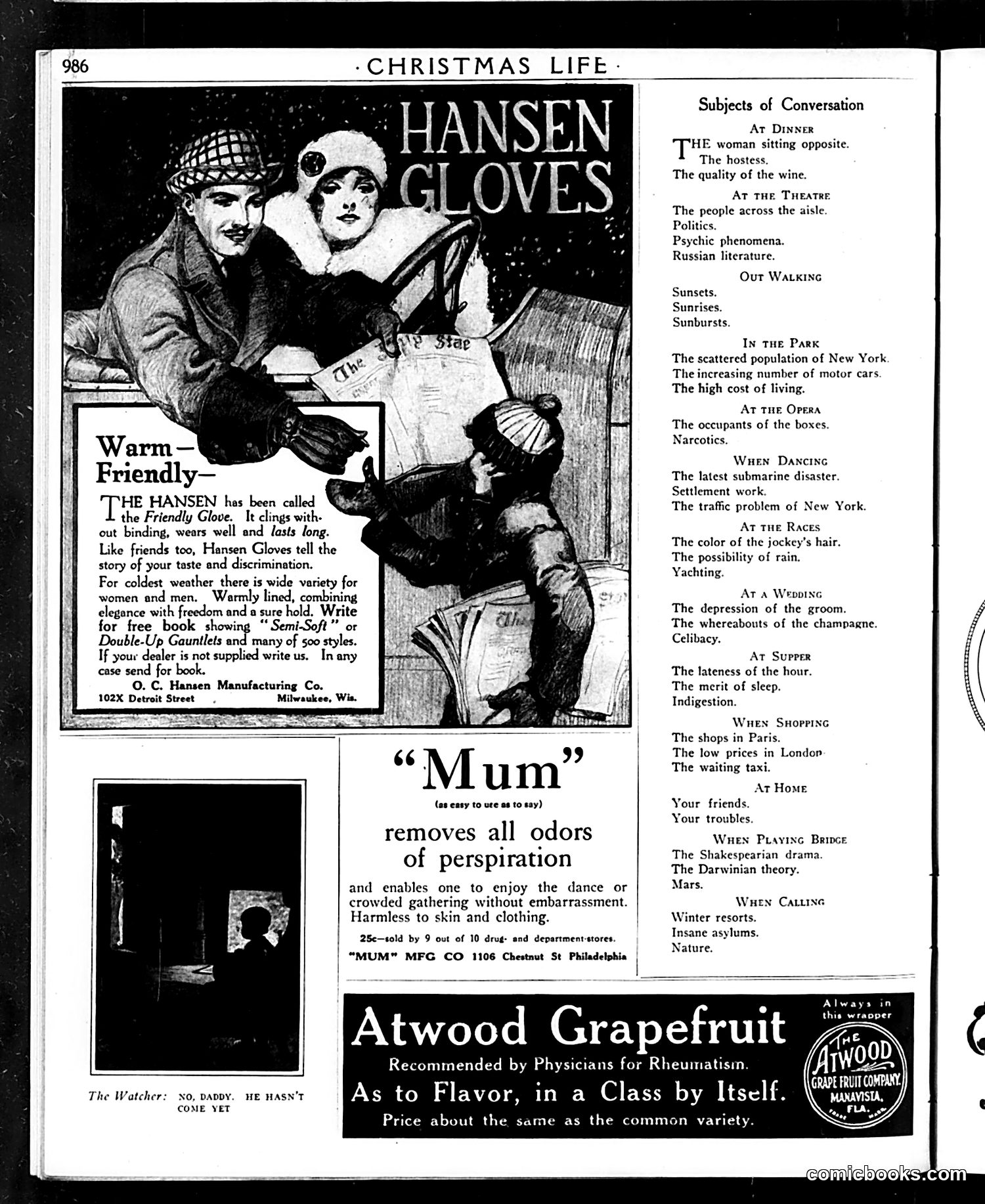
This page is primarily **advertising content** rather than editorial satire. The main items are: 1. **Hansen Gloves ad** - promoting women's gloves as "Friendly Glove" with long-lasting quality 2. **"Mum" deodorant ad** - claiming to remove perspiration odors so people can dance and socialize "without embarrassment" 3. **Atwood Grapefruit ad** - marketed for rheumatism treatment The right column titled "Subjects of Conversation" lists mundane social topics (dinner companions, theater crowds, weather, urban problems) — likely satirizing the vapid small-talk of upper-class social gatherings of that era. This contrasts with the products' promises to enable carefree socializing.
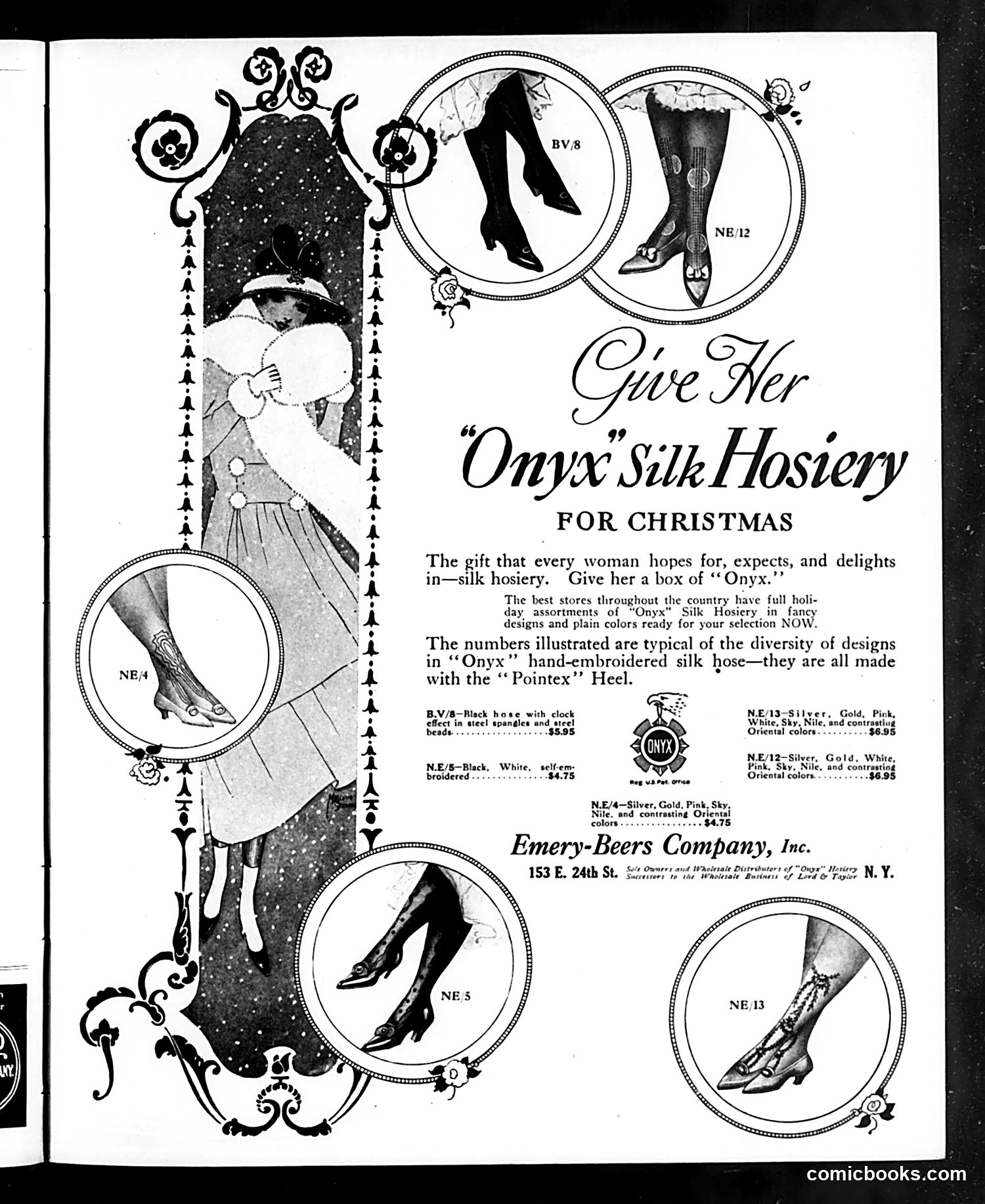
This page is primarily **advertising, not editorial content or satire**. It's a Christmas gift advertisement for "Onyx" brand silk hosiery, published by Emery-Beers Company in New York. The layout features an elegant woman in 1920s fashion alongside circular vignettes showcasing different hosiery styles (numbered N.E.4, N.E.5, B.V.8, N.E.12, N.E.13). The ornate border and decorative typography are typical of Art Deco design from this era. The ad's pitch: silk stockings were a coveted luxury gift that "every woman hopes for, expects, and delights in." The product emphasizes quality construction with the "Pointex" heel and variety in "fancy designs and plain colors." There is **no political satire or editorial commentary**—this is straightforward consumer marketing targeting Christmas shoppers.
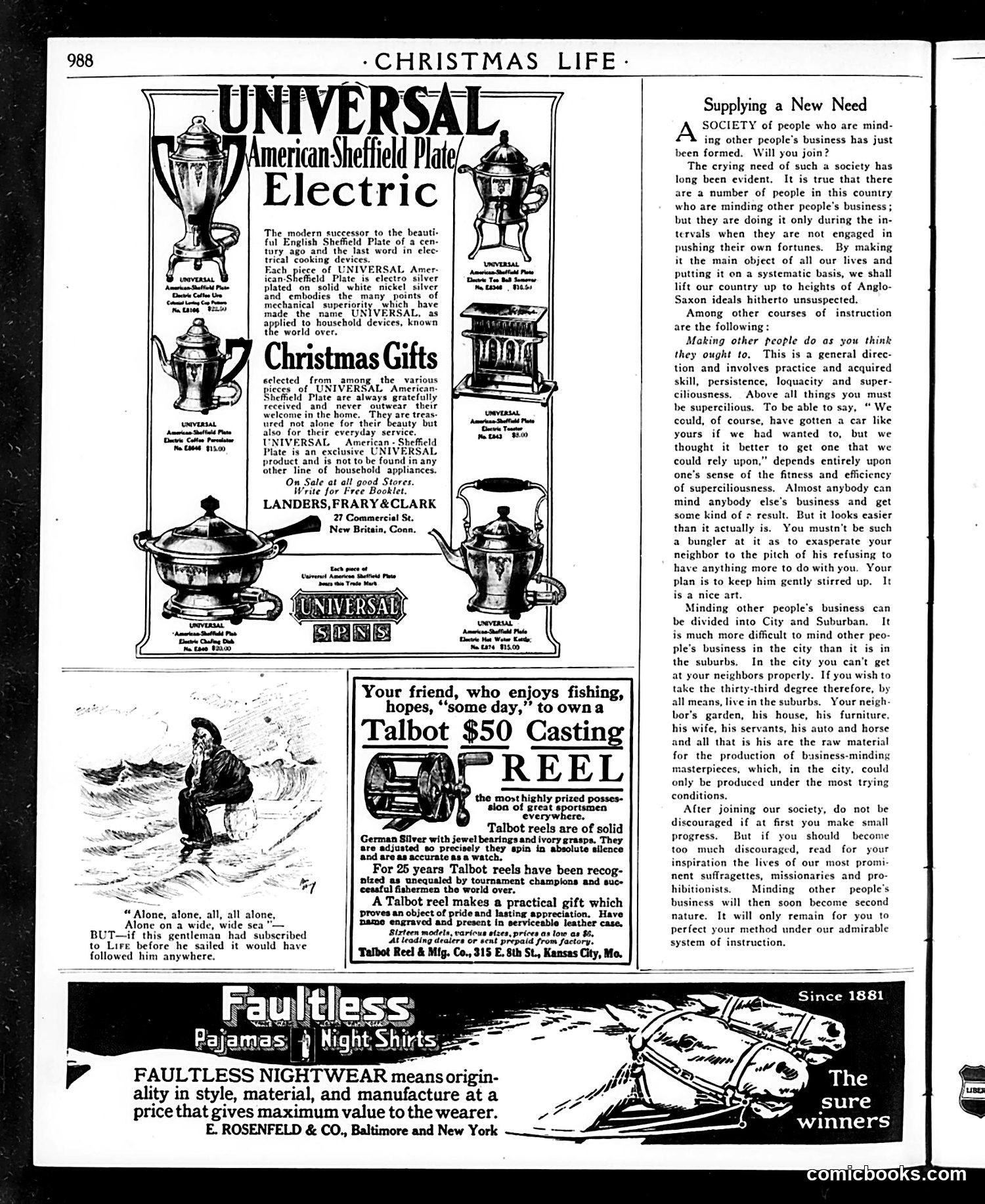
This page is primarily **advertisements and one editorial essay**, not political cartoons. **Content:** - **Universal American Sheffield Plate Electric** cooking devices dominate the left side—Christmas gift advertisements for teapots, percolators, and serving pieces - **Talbot Fishing Reel** advertisement ($50 casting reel) with a small illustration of a lone fisherman - **Faultless Pajamas** advertisement at bottom - **Right column**: An essay titled "Supplying a New Need" discusses a society for people who mind others' business—a humorous satirical piece about busybodies and the importance of minding one's own affairs, particularly regarding suburban versus city living The page reflects early 20th-century consumer culture and gentle social commentary about American manners and domestic life.
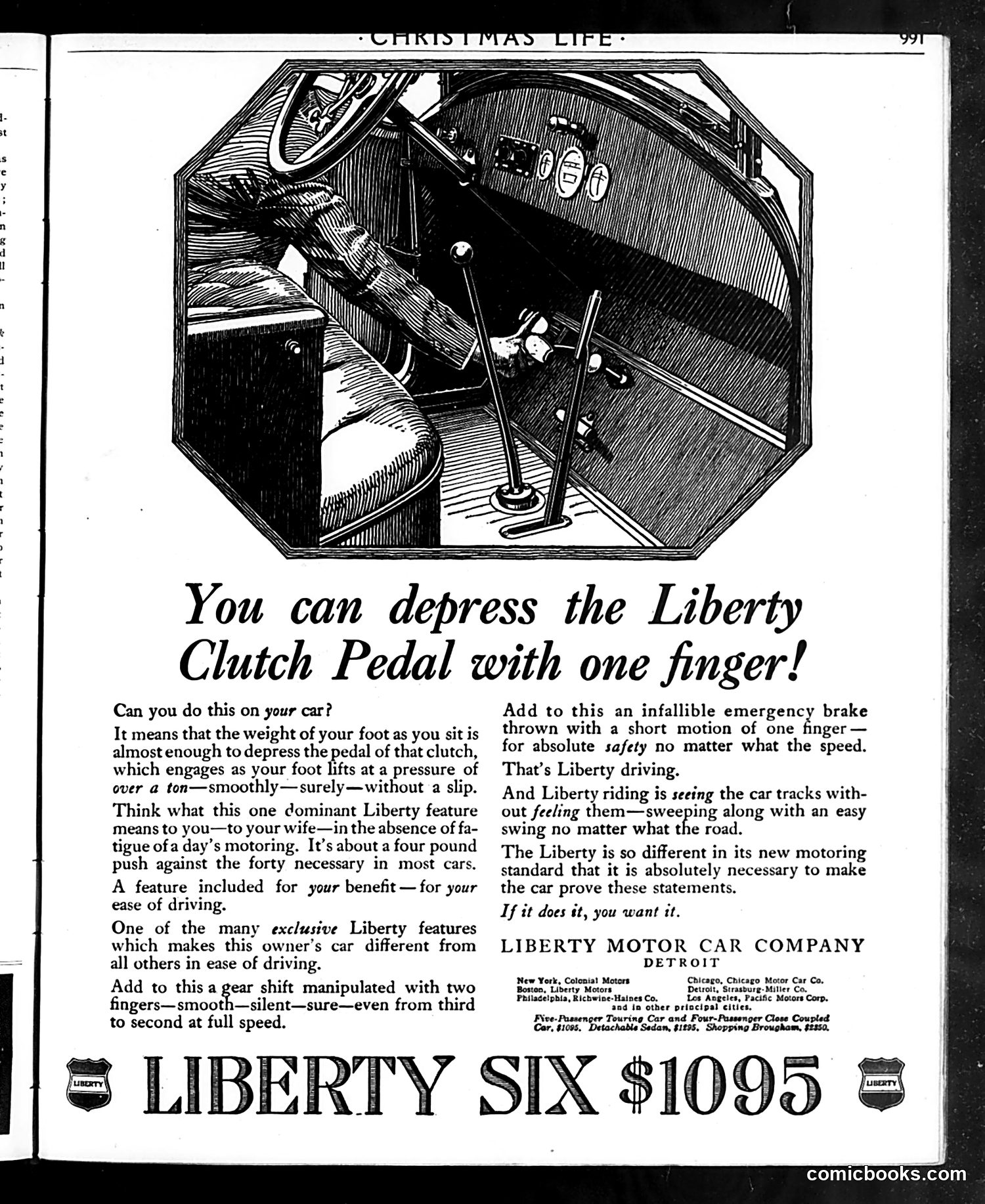
This is primarily an advertisement for the Liberty Six automobile, priced at $1095. The ad highlights the car's innovative clutch pedal design—so responsive that it requires only one finger to disengage, reducing driver fatigue compared to competitors' vehicles requiring "over a ton" of pressure. The illustration shows a car's interior from above, demonstrating the light-touch clutch mechanism. The ad emphasizes exclusive Liberty features: the low-effort clutch, a two-finger gear shift, and superior braking. The copy argues these innovations make Liberty driving effortless and safer. This reflects early 1920s automotive marketing, when such mechanical refinements were genuinely novel selling points. The ad aims at buyers—particularly women, suggested by phrases like "wife"—seeking easier, more accessible driving experiences in an era when operating cars required significant physical effort.
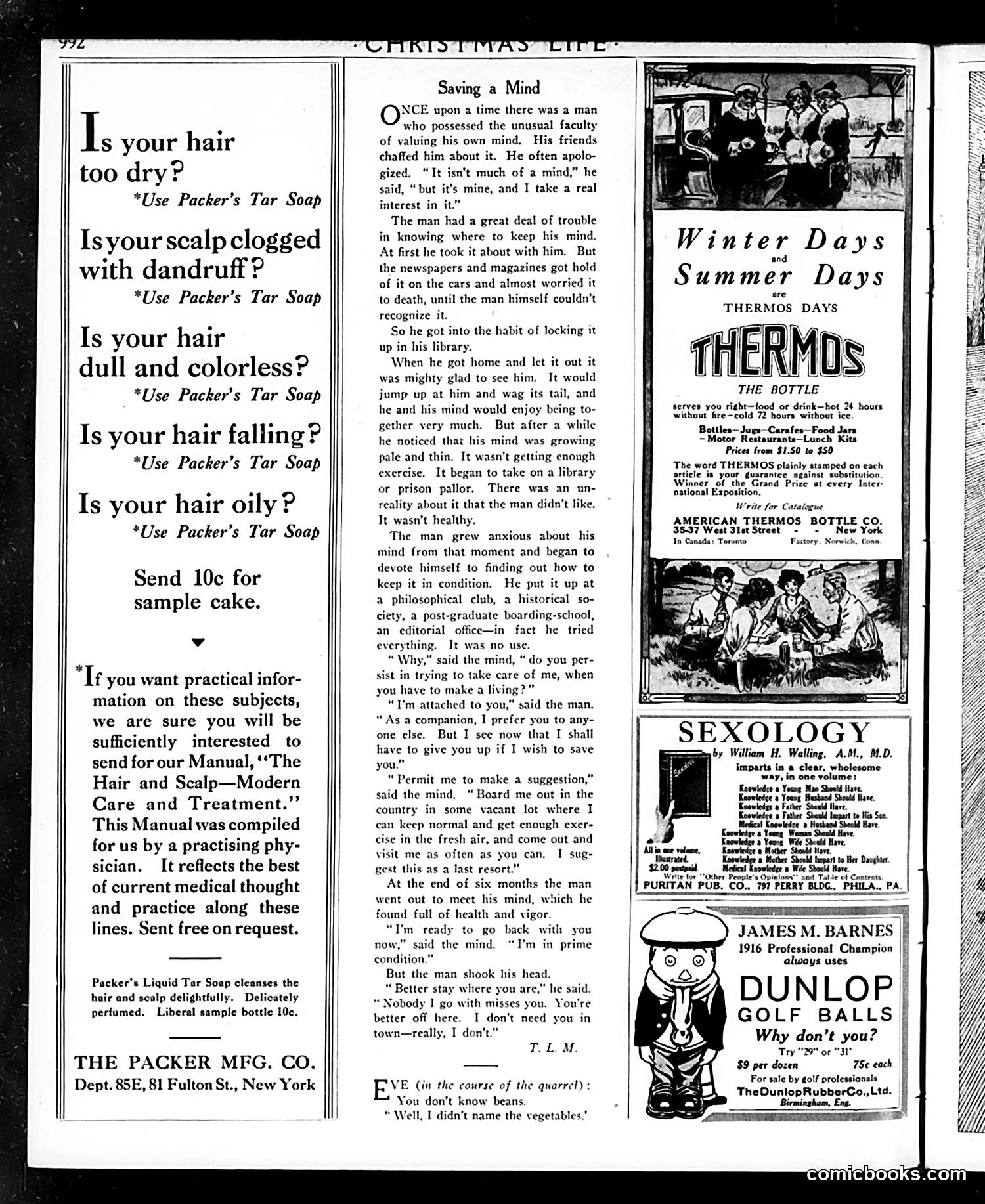
This page is primarily **advertisements and a short story**, not political satire. The left side advertises **Packer's Tar Soap** for various hair problems (dryness, dandruff, dullness, hair loss, oiliness). The copy reflects early 20th-century medical marketing—promising a product could address multiple conditions. The center contains **"Saving a Mind,"** a moral tale about a man whose friends worry he's becoming mentally unstable from excessive introspection. His mind (personified as a character) suggests he take a country retreat for physical exercise and fresh air—reflecting period beliefs linking mental health to outdoor activity and bodily vigor. The right side features advertisements for **Thermos bottles, Sexology books, and Dunlop golf balls**—typical consumer products of the era. No political content is present on this page.
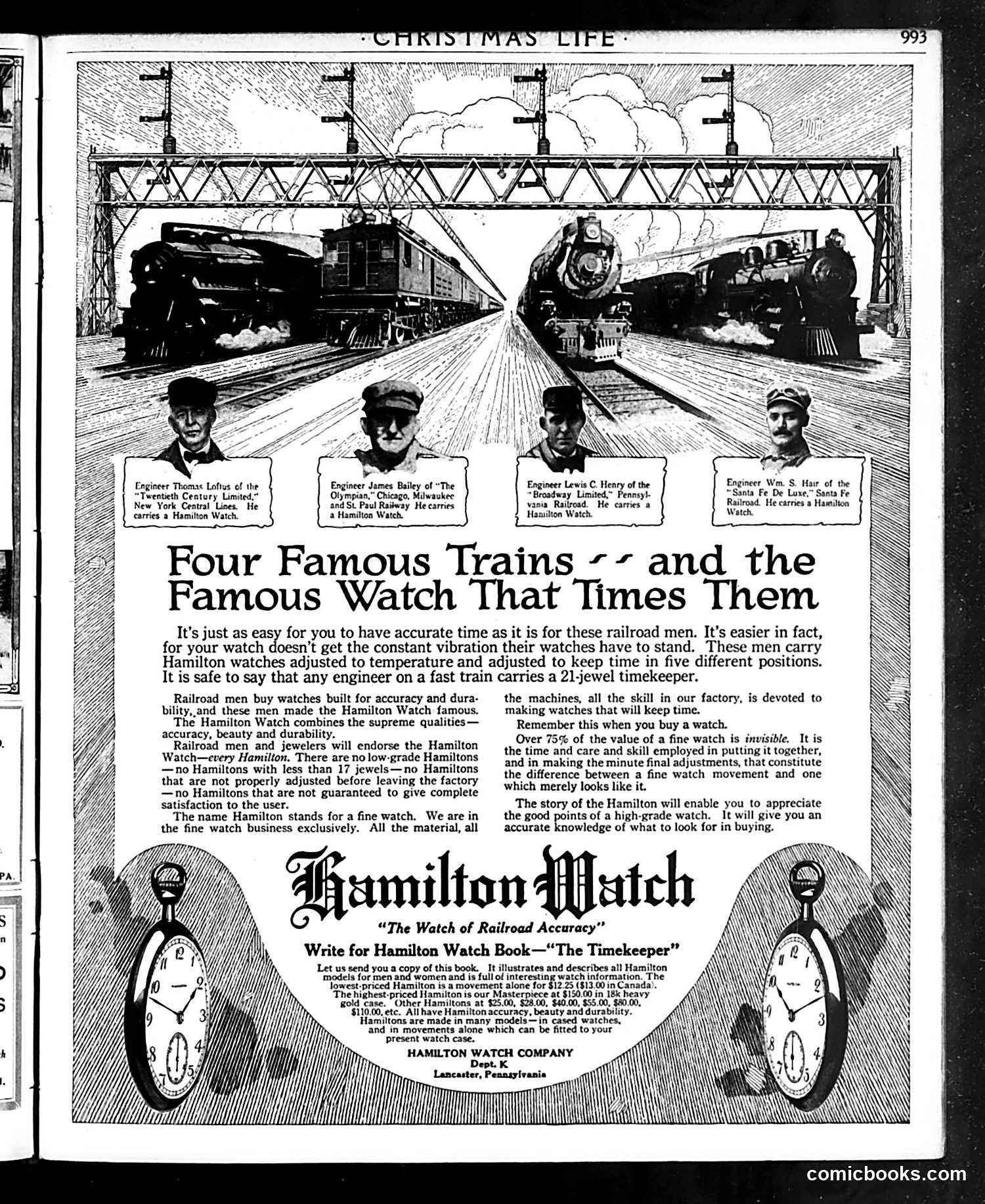
This is a **Hamilton Watch advertisement**, not a political cartoon. The page features four railroad engineers identified by name and their locomotives: - Engineer Thomas Lehfert (Twentieth Century Limited) - Engineer James Bailey (Olympic and St. Paul Railway) - Engineer Lewis C. Henry (Broadway Limited) - Engineer Wm. S. Har (Santa Fe Limited) The ad's central claim: these famous engineers trust Hamilton Watches to keep precise time on fast trains. The advertisement argues that accurate timekeeping is crucial for railroad safety and efficiency, and that Hamilton Watches—being durable, precise, and reliable—have earned the reputation of railroad men. This reflects **early 20th-century advertising strategy**: using testimonials from respected professionals to build consumer trust. The emphasis on railroad accuracy reflects the era's fascination with speed, technology, and American industrial achievement.
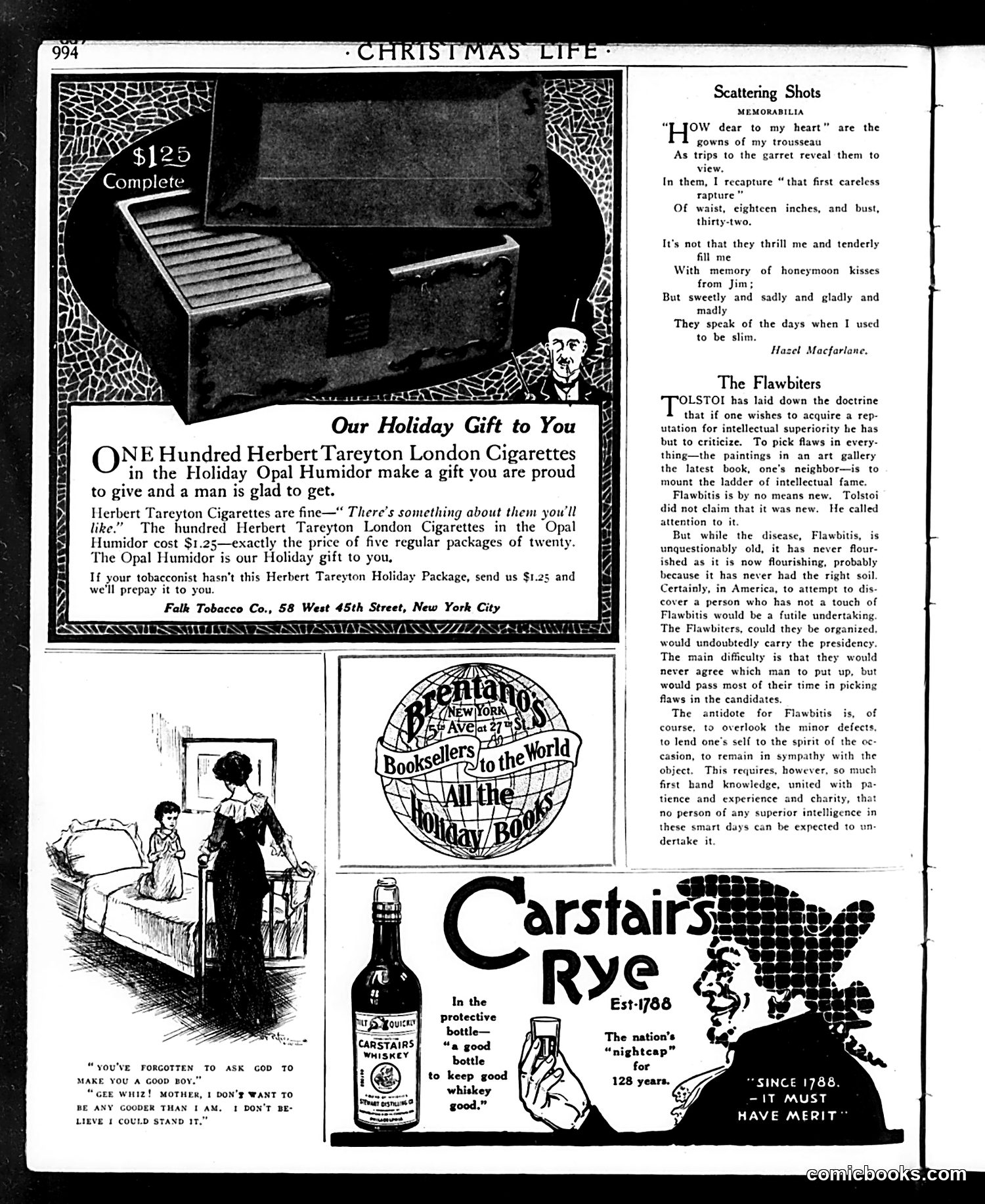
This page contains **primarily advertisements and light satirical commentary**, not political cartoons. **"Scattering Shots"** features a poem by Hazel Macfarlane about a woman nostalgically recalling her slim wedding days through old trousseau gowns—humor about aging and weight gain common to the era. **"The Flawbiters"** satirizes intellectuals who gain status by constantly criticizing everything (art, literature, neighbors). The piece references Tolstoi's doctrine that fault-finding confers intellectual superiority, calling this tendency "Flawbitis"—a disease of chronic criticism. It suggests such people could never organize politically because they'd endlessly criticize each other's candidates. **Advertisements** dominate: Herbert Tareyton cigarettes in an Opal Humidor ($1.25), a globe-themed bookstore promotional, and Carstairs Rye whiskey (Est. 1788). A small illustration shows a mother and child, with dialogue about the boy being "good"—likely part of an advertisement. The page reflects 1920s attitudes toward intellectual pretension and consumer culture.
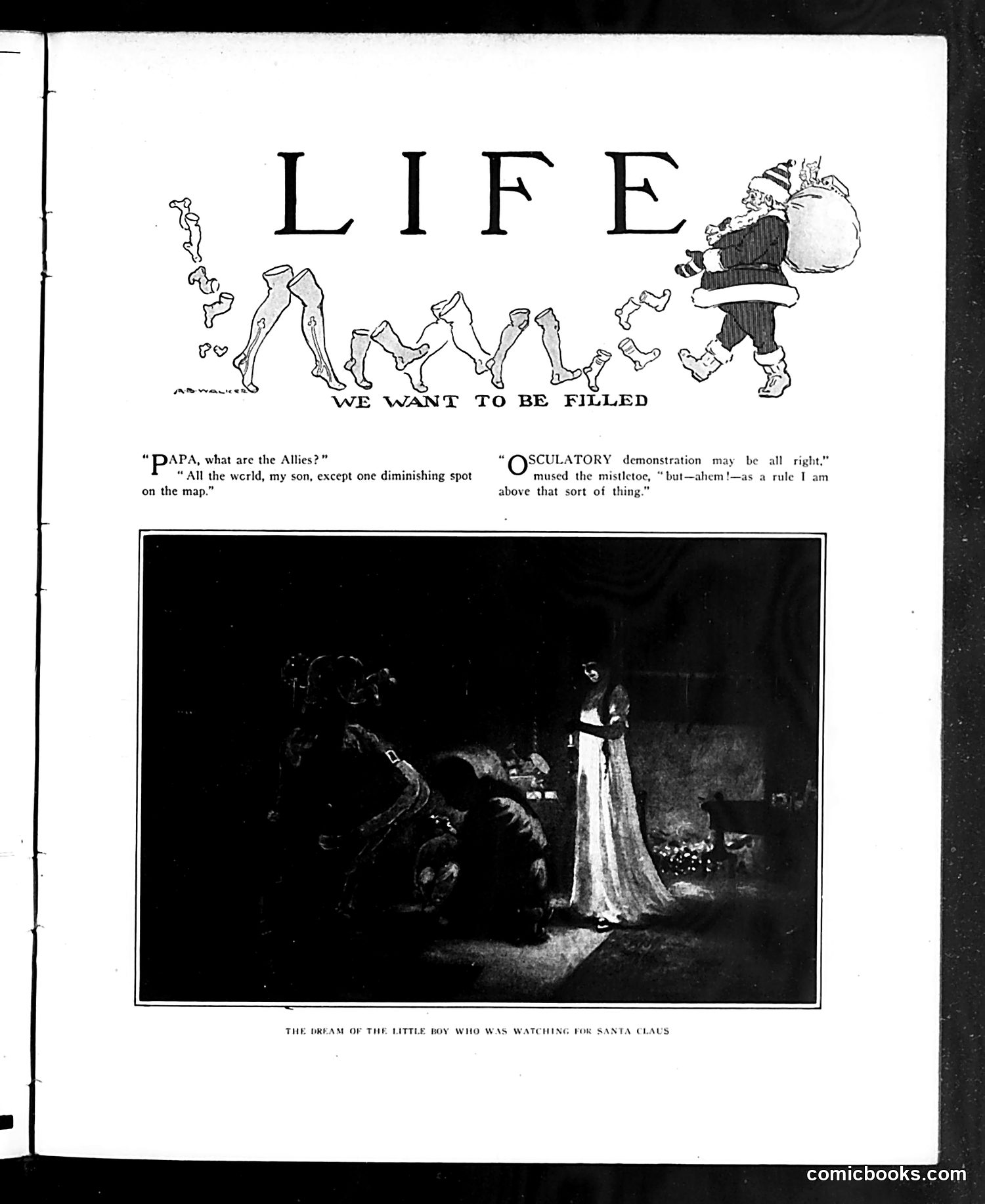
This page satirizes World War I-era attitudes through two jokes: **Top cartoon**: A father explains "the Allies" to his son as "all the world, my son, except one diminishing spot on the map"—mocking how the Central Powers (likely Germany) were portrayed as increasingly isolated and defeated as the war progressed. **Bottom image and captions**: The mistletoe joke plays on "osculation" (kissing), with the mistletoe refusing to participate in holiday kissing, claiming it's "above that sort of thing." This appears to mock social pretension or prudishness. **Main illustration**: "The Dream of the Little Boy Who Was Watching for Santa Claus" depicts a child's fantastical Christmas Eve vision, where Santa appears as a wartime figure among soldiers—likely commenting on how WWI dominated even children's holiday expectations during the conflict. The page overall reflects how thoroughly war permeated American popular culture and domestic life.
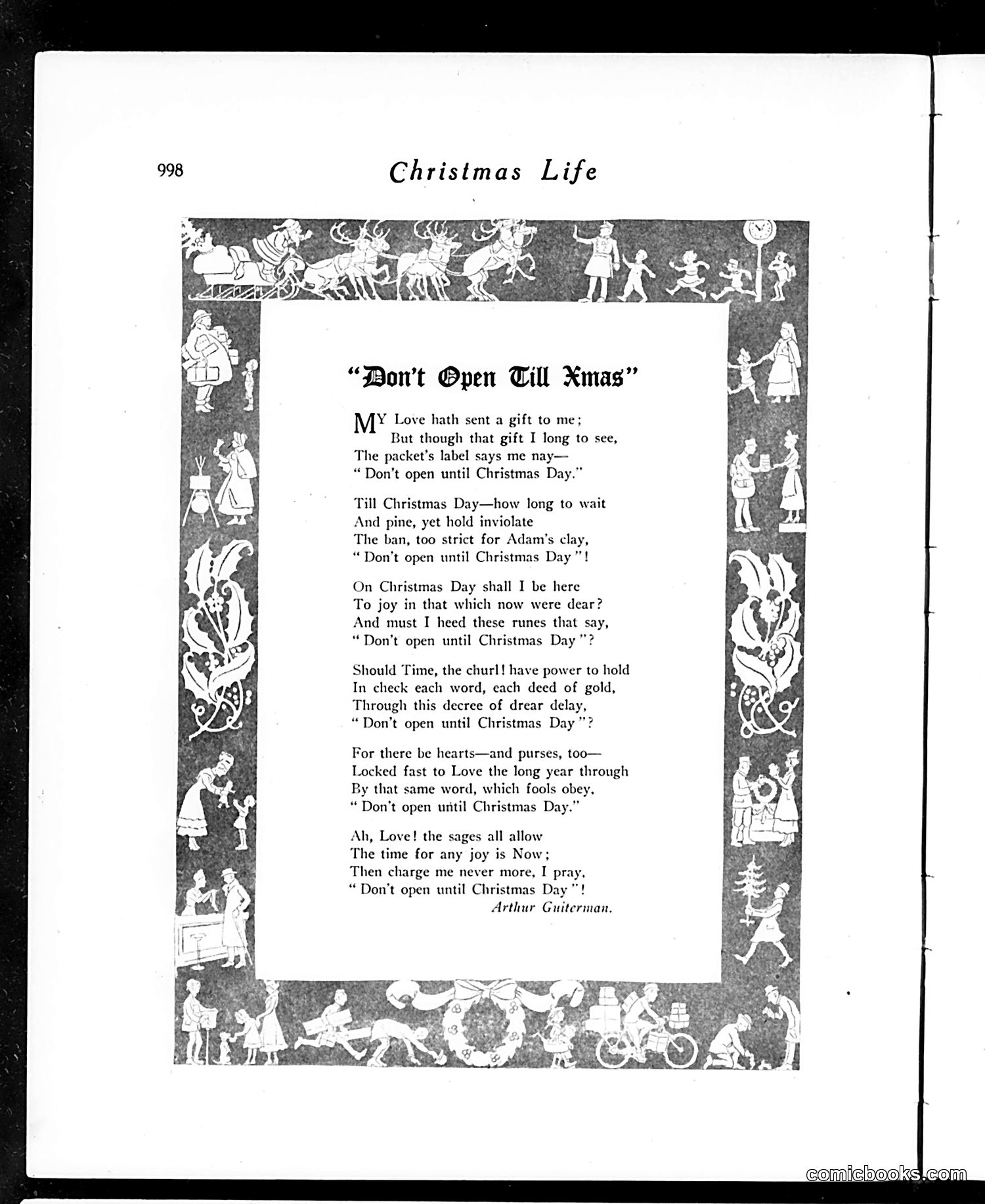
This is a sentimental poem by Arthur Guiterman, not political satire. The page features a Christmas-themed poem about the frustration of receiving a wrapped gift with instructions not to open it until Christmas Day. The poem explores the tension between desire and delayed gratification—the speaker has received a gift from their beloved but must wait to open it. Beyond the literal gift, Guiterman uses the sealed package as a metaphor for love and joy that are "locked fast" and withheld throughout the year. The philosophical argument builds across stanzas: the speaker questions whether Time permits them to survive until Christmas, whether waiting honors true love, and finally appeals to the "sages" who teach that joy should be seized in the present moment ("Now") rather than deferred. The decorative border features Christmas imagery (Santa, children, toys, wreaths) typical of early 20th-century holiday publications. This is simply festive, sentimental verse—not commentary or satire.
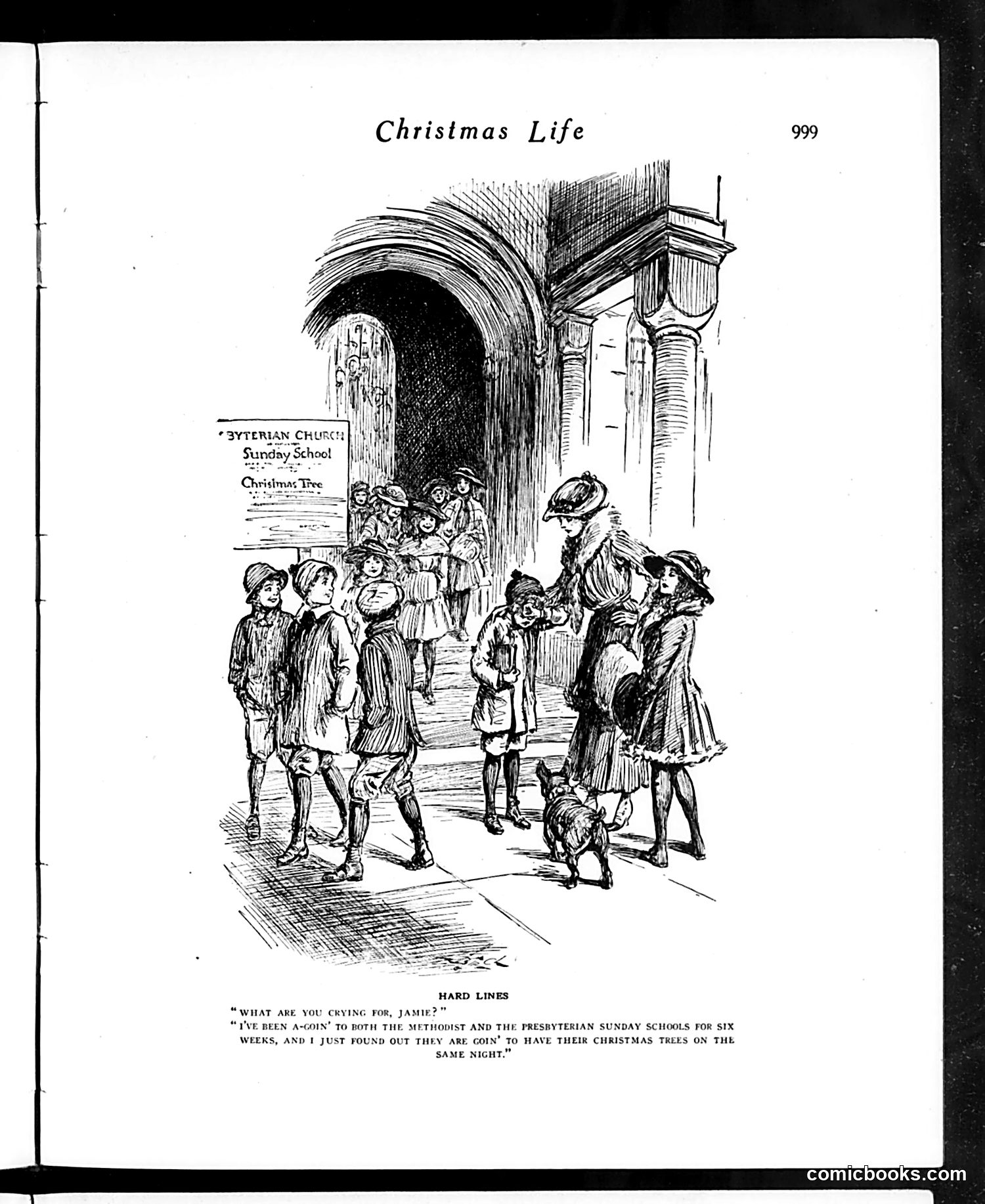
This cartoon satirizes a common Christmas-season problem among American Protestant churches in the early 20th century. A boy named Jamie is distressed because he's been attending both Methodist and Presbyterian Sunday schools simultaneously—likely receiving gifts or treats at both—only to discover their Christmas celebrations fall on the same night, forcing him to choose. The joke targets the competitive nature of rival Protestant denominations and their Sunday schools, which used Christmas festivities as recruitment tools. The satire highlights the absurdity of a child's dilemma and implicitly critiques the denominations' lack of coordination and their emphasis on material celebrations rather than religious substance.
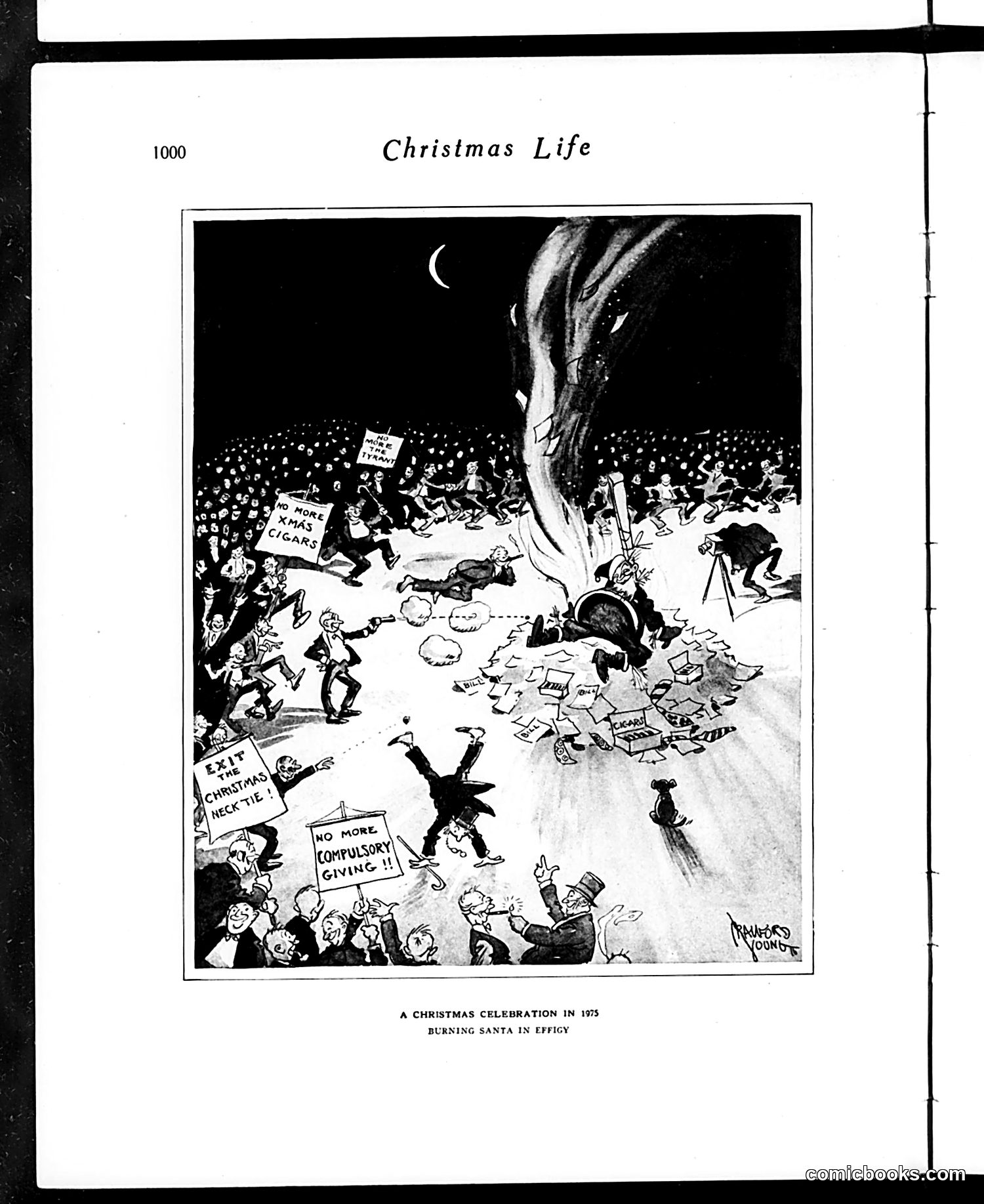
This 1925 satirical cartoon depicts a dystopian Christmas celebration set in 1975—fifty years in the future. A crowd burns Santa Claus in effigy beneath a crescent moon, suggesting a nighttime rebellion or protest. Visible protest signs read "NO MORE CHRISTMAS NECKTIES," "EXIT THE CHRISTMAS NECK TIE," and "NO MORE COMPULSORY GIVING!!" The cartoon satirizes anxieties about commercialization and obligatory gift-giving that had already troubled Americans in the 1920s. The chaotic scene with numerous figures suggests social unrest. This reflects Life magazine's satirical commentary on how unchecked commercialism and social pressure around holiday gift-giving might eventually provoke public backlash, transforming Christmas from religious celebration into consumer obligation—a remarkably prescient critique of modern consumer culture.
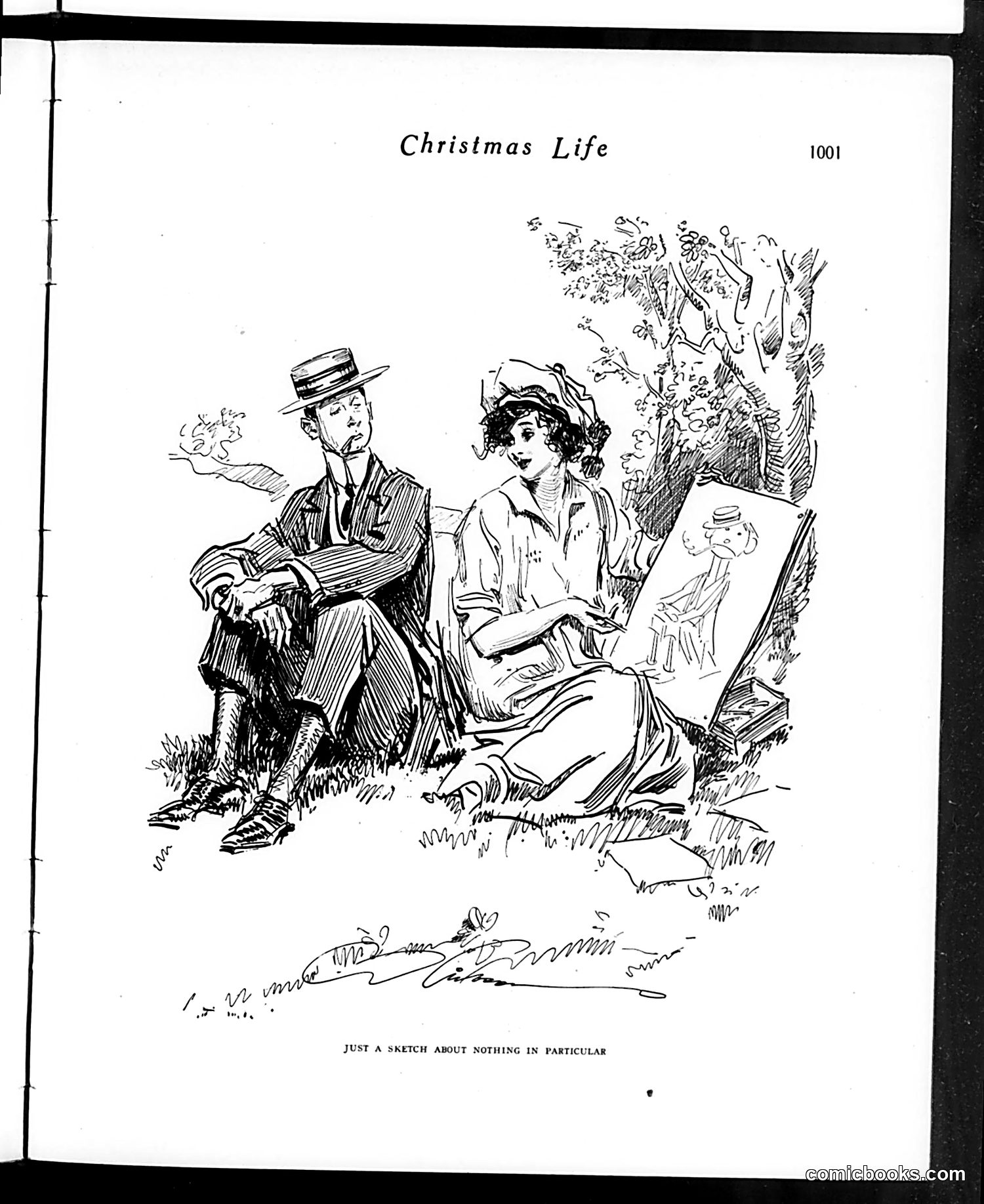
This is a gentle romantic illustration rather than political satire. The page shows a well-dressed man in a striped suit and boater hat sitting outdoors with a woman in Edwardian-era clothing. They appear to be in a countryside setting with bare trees, suggesting winter or late autumn. The caption—"Just a Sketch About Nothing in Particular"—signals this is lighthearted, domestic humor with no specific satirical target. The sketch appears to capture an intimate moment between a couple, likely meant to evoke Christmas sentimentality and romance during the holiday season. The page number (1001) and magazine title indicate this ran in *Life* magazine, which regularly published such gentle, sentimental illustrations alongside its sharper political cartoons. This represents the magazine's softer, more romantic editorial content rather than its satirical commentary.
This is not a cartoon page but an editorial essay by Edward S. Martin in *Life* magazine's Christmas 1916 issue. The piece is a serious moral critique of World War I, written while America remained officially neutral (it would enter the war in 1917). Martin argues that the war resulted from nations pursuing material wealth and world domination—violations of the tenth commandment ("Thou shalt not covet"). He appears to reference Germany as "the richest and ablest countries" that initiated the conflict through "calculated attempt to impose its doctrines...on mankind." The essay suggests that widespread suffering may paradoxically produce moral improvement: when people recognize life isn't "worth while" under current values, reform movements emerge. Martin notes Europeans are "gradually changing" their priorities toward peace-compatible values, but Americans remain "very confused." The piece reflects pre-1917 American ambivalence about the European war—moral concern without yet taking sides militarily.
This is not a cartoon but an editorial essay with decorative Christmas border illustration. The unsigned piece addresses American ambivalence during World War I—likely written before U.S. entry (1917). The text critiques national division: half blame government inadequacy; half credit government competence for avoiding worse outcomes. Americans are wealthy yet dissatisfied, reluctant to enter war yet unsatisfied staying neutral. The author suggests deeper anxiety: material prosperity masks spiritual poverty. Citizens fear the war will end without forcing national sacrifice or discipline upon them. The essay's conclusion appeals to Christmas values—moral courage, justice, neighborly love—as the only true national salvation. External defenses (armies, navies) cannot protect a spiritually weakened nation. The piece reflects Progressive-era anxieties about materialism, national character, and moral purpose during wartime uncertainty.
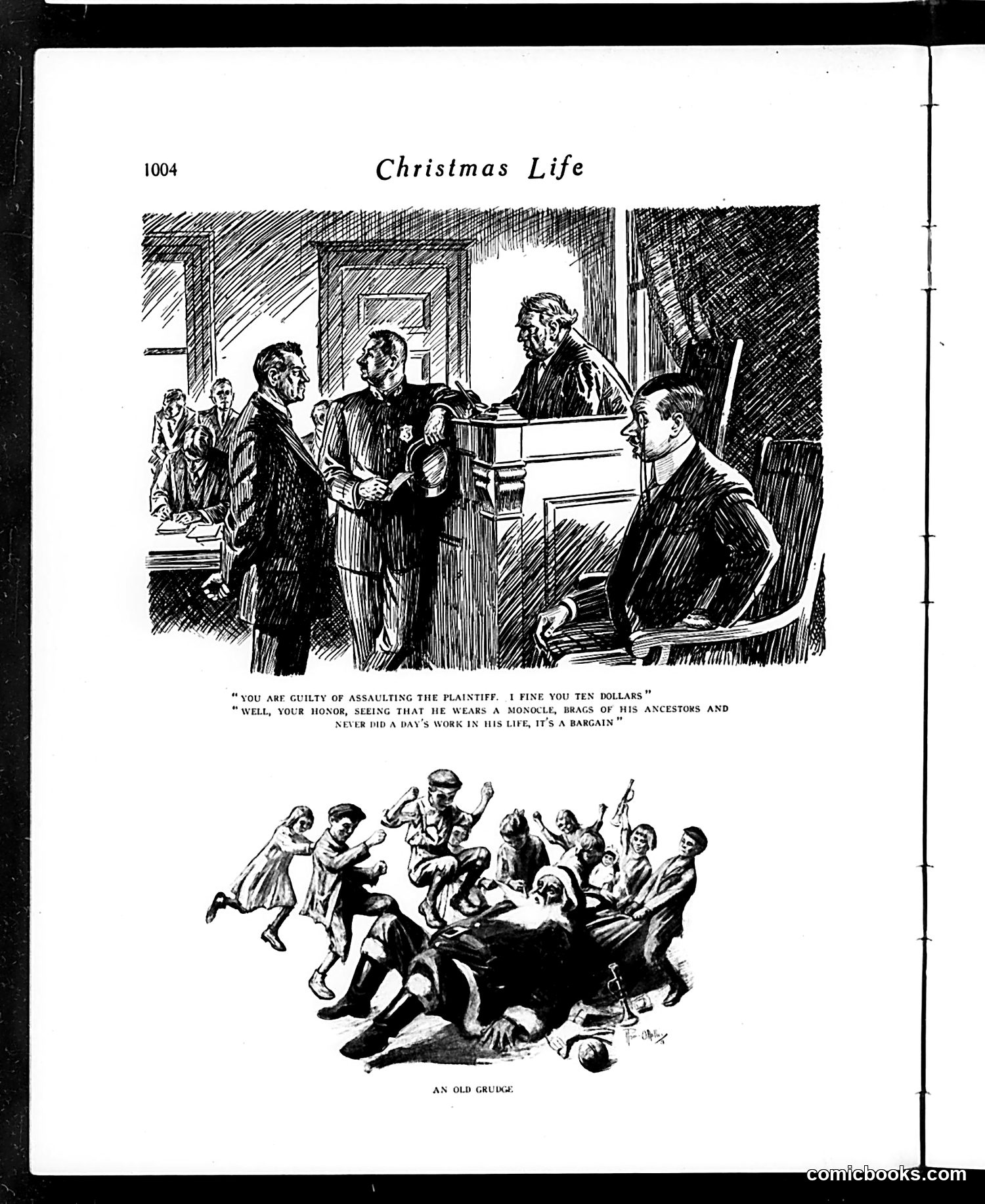
This page contains two satirical cartoons about class conflict during the Christmas season. The upper cartoon depicts a courtroom scene where a judge fines a defendant $10 for assault. The defendant's response mocks the victim as an idle aristocrat—someone who wears a monocle (symbol of upper-class pretension), boasts about ancestry, and has never worked. The joke suggests the assault was justified given the victim's uselessness to society; a $10 fine is "a bargain" for punching such a worthless person. The lower cartoon, titled "An Old Grudge," shows children playing rough around what appears to be a poor or working-class man, suggesting longstanding social resentment between classes. Both cartoons satirize class divisions and wealthy idleness, expressing working-class resentment toward aristocrats who contribute nothing to society while maintaining pretensions of superiority.
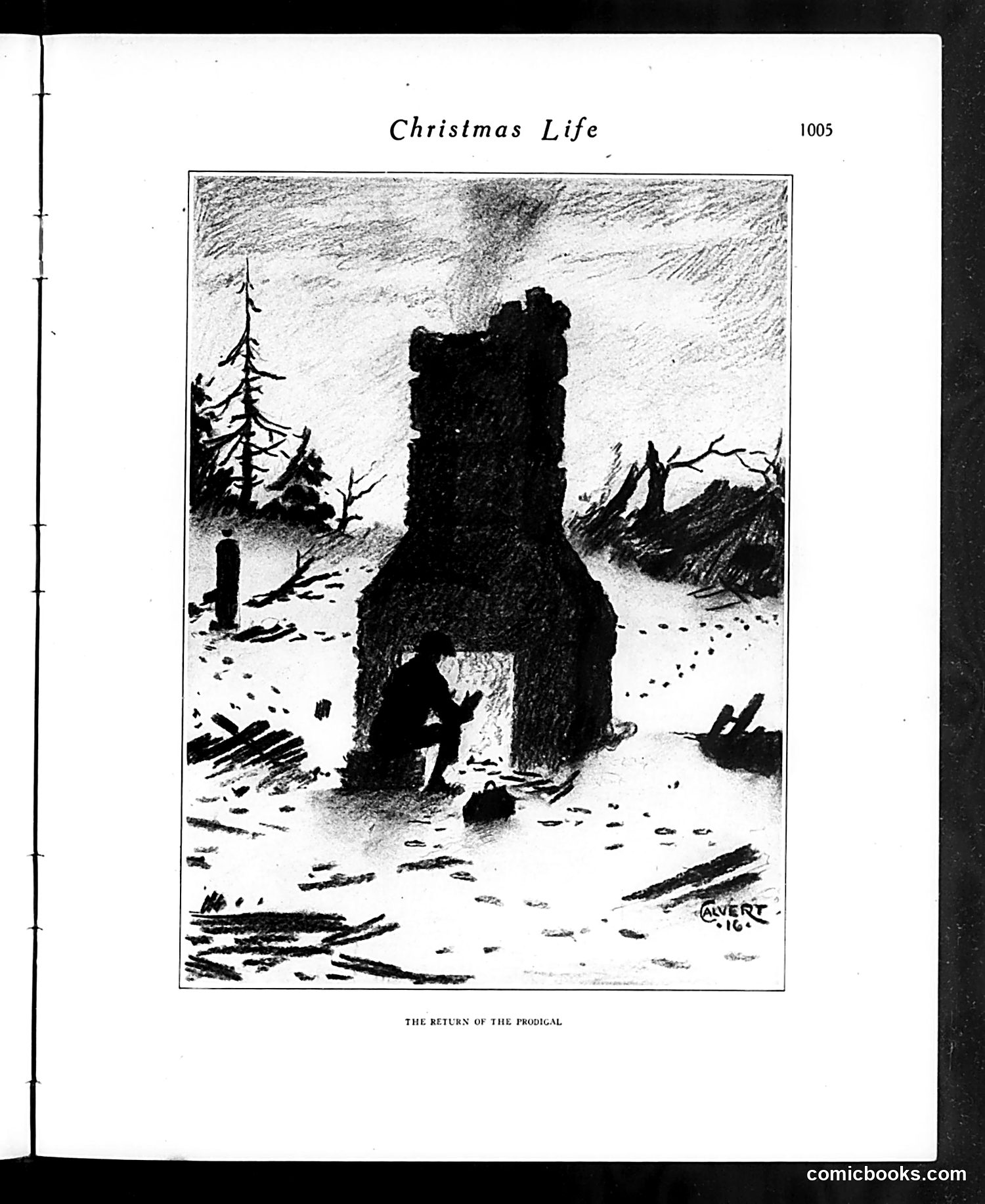
This is a single-panel cartoon titled "The Return of the Prodigal," signed by Calvert (the artist). It depicts a solitary figure approaching a crude stone structure—possibly a chimney or shelter—in a desolate, snowy winter landscape scattered with logs and bare trees. The title references the Biblical parable of the prodigal son, about a wayward child returning home. The cartoon appears to satirize this theme in a Christmas context, likely commenting on someone or something returning after absence or failure. Without additional context about Life magazine's 1905 political climate, the specific target remains unclear—it could reference a disgraced public figure, a returned soldier, or a failed enterprise seeking redemption. The harsh, lonely setting suggests an ironic take on the prodigal's homecoming.
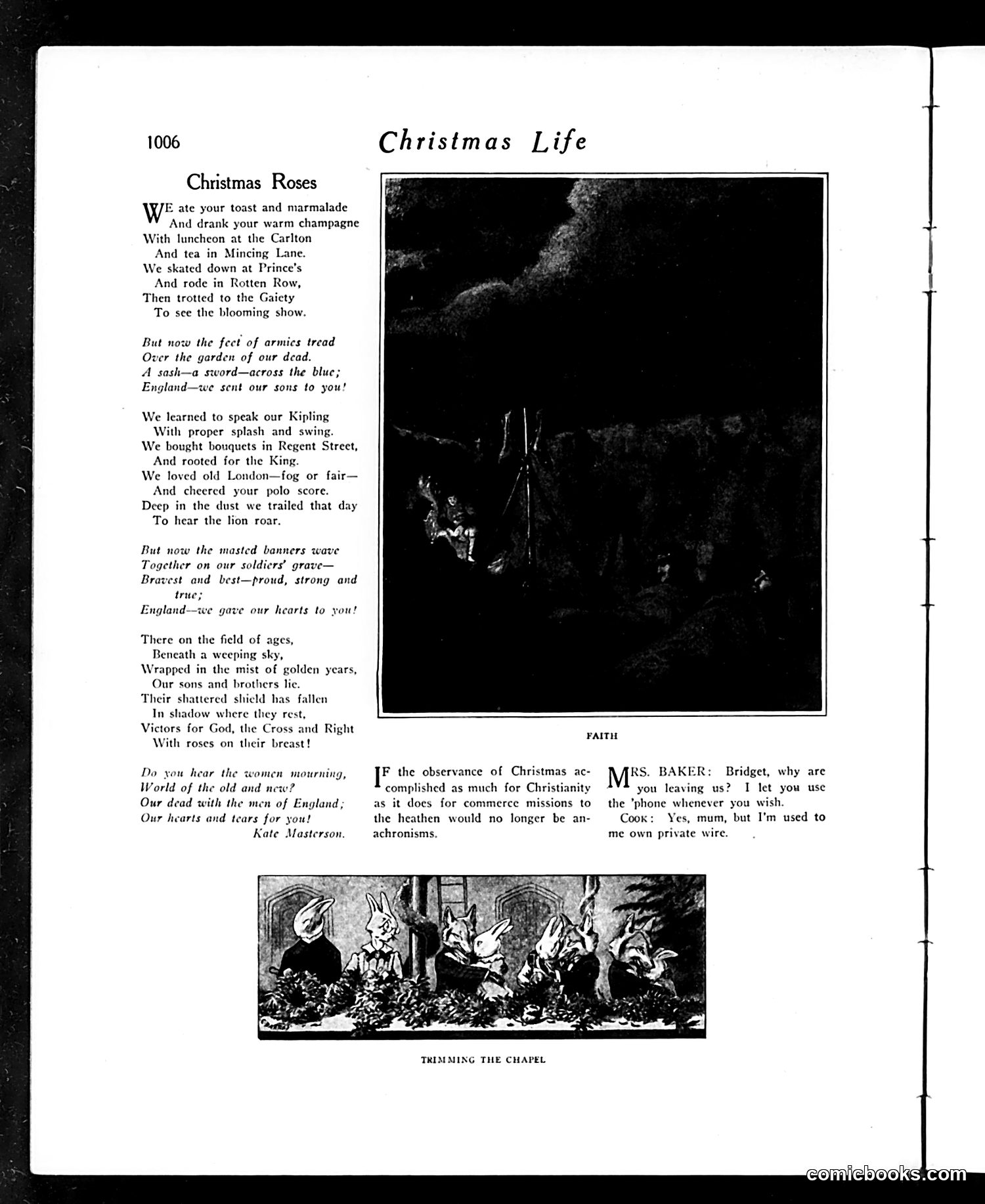
This page presents **World War I era Christmas content** (likely 1914-1918). The poem "Christmas Roses" is a sentimental elegy contrasting pre-war London pleasures—champagne lunches, skating, polo—with soldiers' deaths. The refrain "England—we sent our sons to you!" expresses the sacrifice demanded by the war. The illustration labeled "FAITH" appears to depict soldiers or a grave scene, reinforcing the elegiac tone. The brief satirical dialogue at bottom—"Trimming the Chapel"—mocks class pretension: a servant leaves her employer despite generous telephone privileges because she now has "me own private wire," suggesting wartime social mobility and newfound independence for working-class people. The short editorial quip questions whether Christmas's commercial exploitation actually benefits Christian mission work, implying hypocrisy in how the holiday is observed. **Overall theme**: Wartime loss juxtaposed with domestic social shifts and critiques of commercialism.
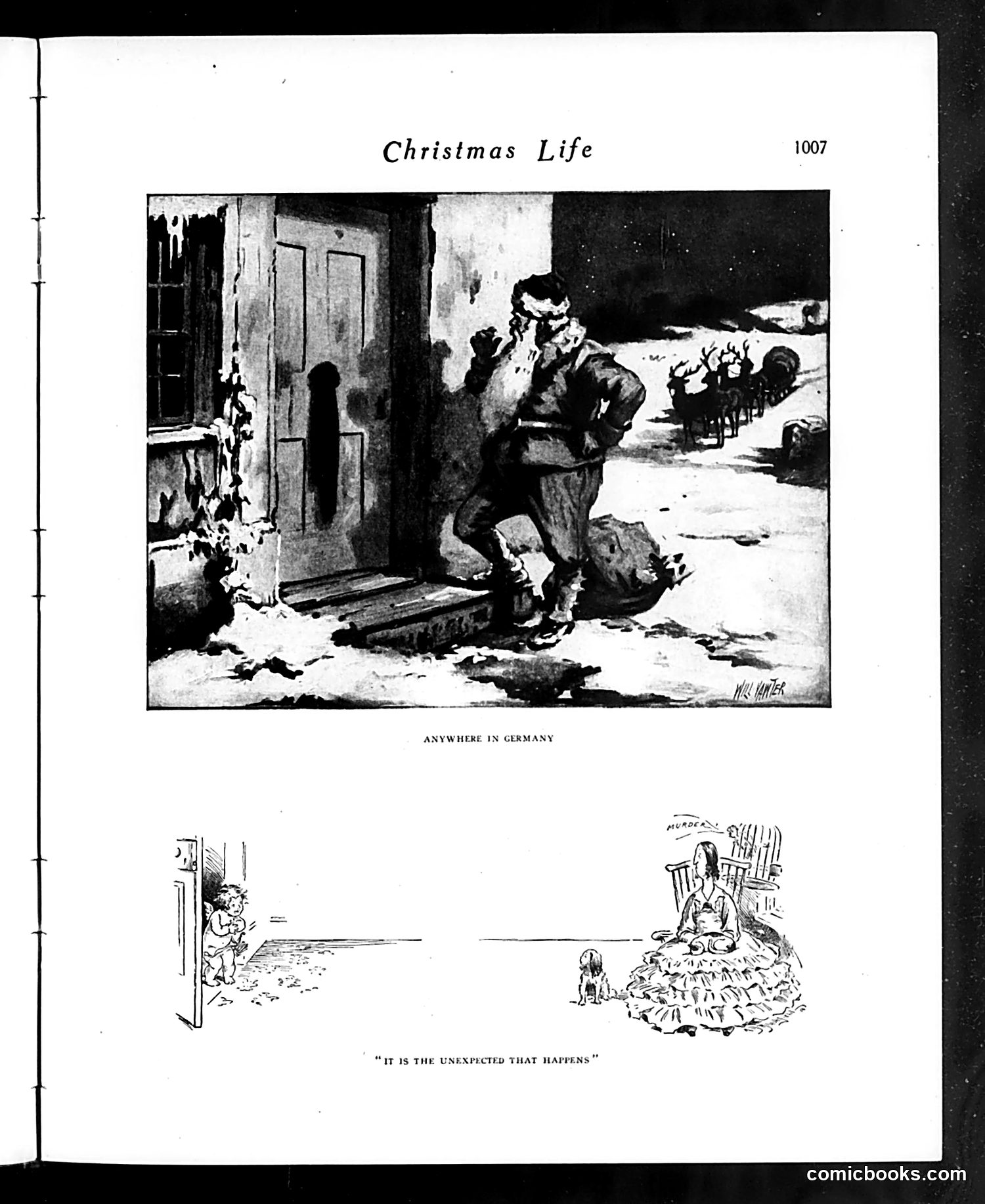
This page presents Christmas-themed satirical content from Life magazine. The top illustration, titled "Anywhere in Germany," depicts Santa Claus arriving at a snowy German village home, with his reindeer visible in the background. The image appears to comment on Christmas celebrations during wartime or conflict in Germany. Below, the caption "It Is the Unexpected That Happens" introduces two smaller cartoon panels showing domestic Christmas scenes—a child peeking around a doorway and a woman with presents. The juxtaposition suggests ironic contrast: while families elsewhere experience traditional Christmas joy, the German scene implies disruption or danger, even during the holiday season. This likely reflects American perspectives on German circumstances during a period of conflict or tension.
This is a humorous short story rather than a political cartoon. It satirizes working-class married life and domestic discord in early 20th-century England. The "invention" is a husband's strategy: a big laborer with a wife he quarrels with discovers that being a teetotaler (abstainer from alcohol) keeps him home too much, aggravating their relationship. His solution is to work overtime constantly, staying away from home to avoid conflict—a commentary on how marriage problems drive men to escape rather than resolve them. The opening philosophical riff mocks the suggestion that "common sense" could improve marriage, arguing that common sense would prevent marriage altogether. The story uses working-class London dialect and characters (a road worker, laborers) to explore the gap between romantic ideals and domestic reality—a theme satirizing middle-class marriage advice that assumes rational problem-solving could work in actual relationships.
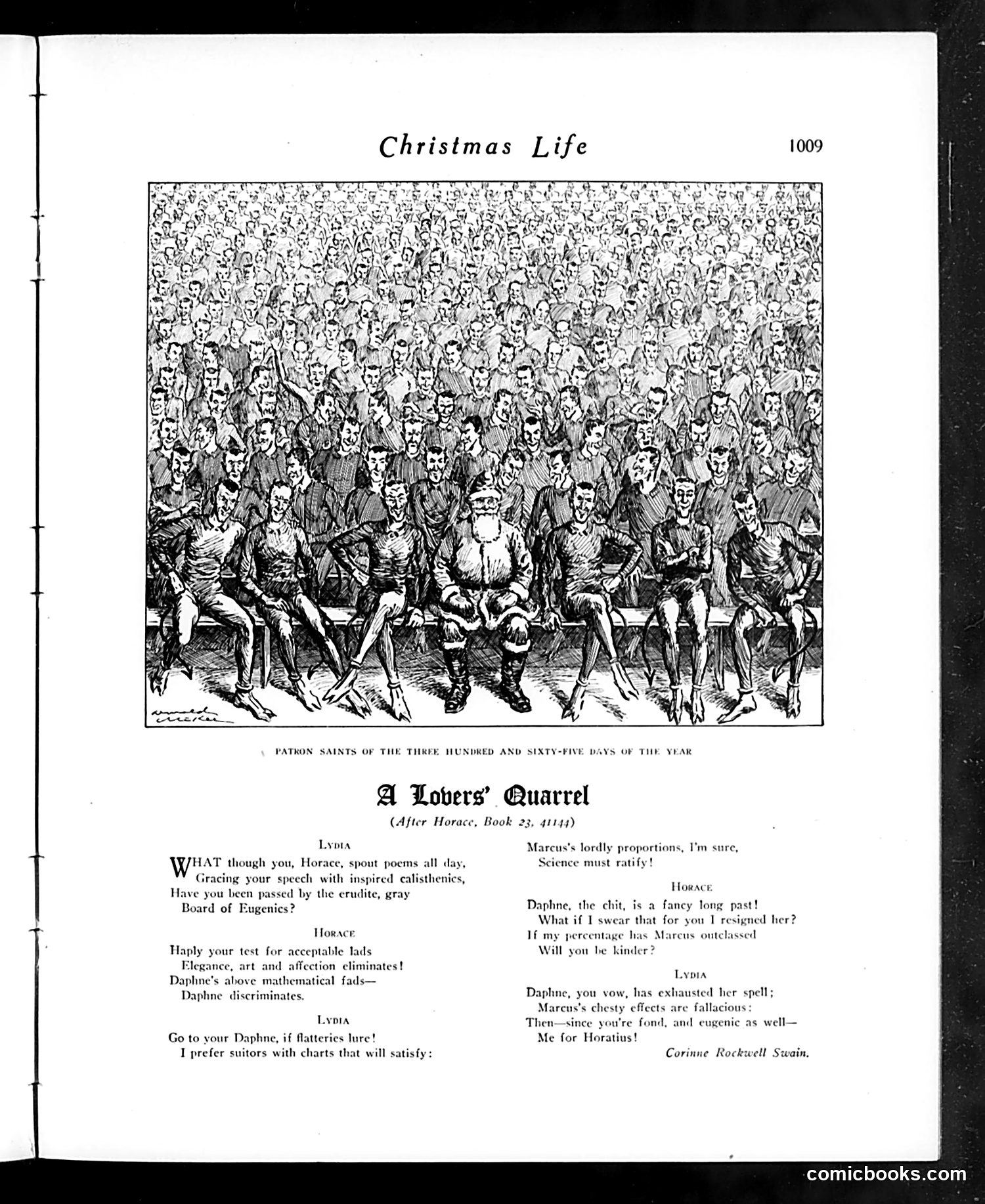
This page satirizes the early 20th-century eugenics movement through a mock-classical poem (styled after Horace). The "lovers' quarrel" between Lydia, Horace, Daphne, and Marcus centers on romantic choices justified by eugenic pseudoscience rather than genuine affection. The joke: characters evaluate potential partners not on love or character, but on whether they've passed "eugenics board" tests and possess scientifically "superior" proportions and percentages. Lydia prefers Marcus because "science must ratify" him; Horace offers to abandon his beloved Daphne if his eugenic "percentage" ranks higher than Marcus's. The satire mocks how eugenics rhetoric had permeated even intimate personal decisions in 1920s America, reducing romance to pseudo-scientific measurement. The elaborate classical framing underscores the absurdity of applying reductive biological determinism to human relationships.
This satirical story mocks the aggressive sales tactics and deceptive practices of early 20th-century home-financing schemes. The narrator encounters an agent for the "Automatic Home Construction and Long Island Land Reviving Company" who initially quotes $400 down and $42/month—seemingly affordable. However, the fine print reveals the true cost: a 10% down payment (actually $900), 120 monthly payments totaling thousands, plus 5% interest, with life insurance requirements. The satire targets the predatory lending practices targeting working-class homebuyers, particularly those tempted by the promise of ownership. The agent's manipulative reassurances ("the company looks out for everyone") and vague contract terms exemplify how such companies exploited consumers' dreams of homeownership. The poem "Christmas" inserted mid-story provides emotional counterpoint—depicting genuine human suffering—suggesting the real stakes when families lose homes due to financial hardship. The humor derives from the narrator's dawning realization that he's been thoroughly bamboozled.
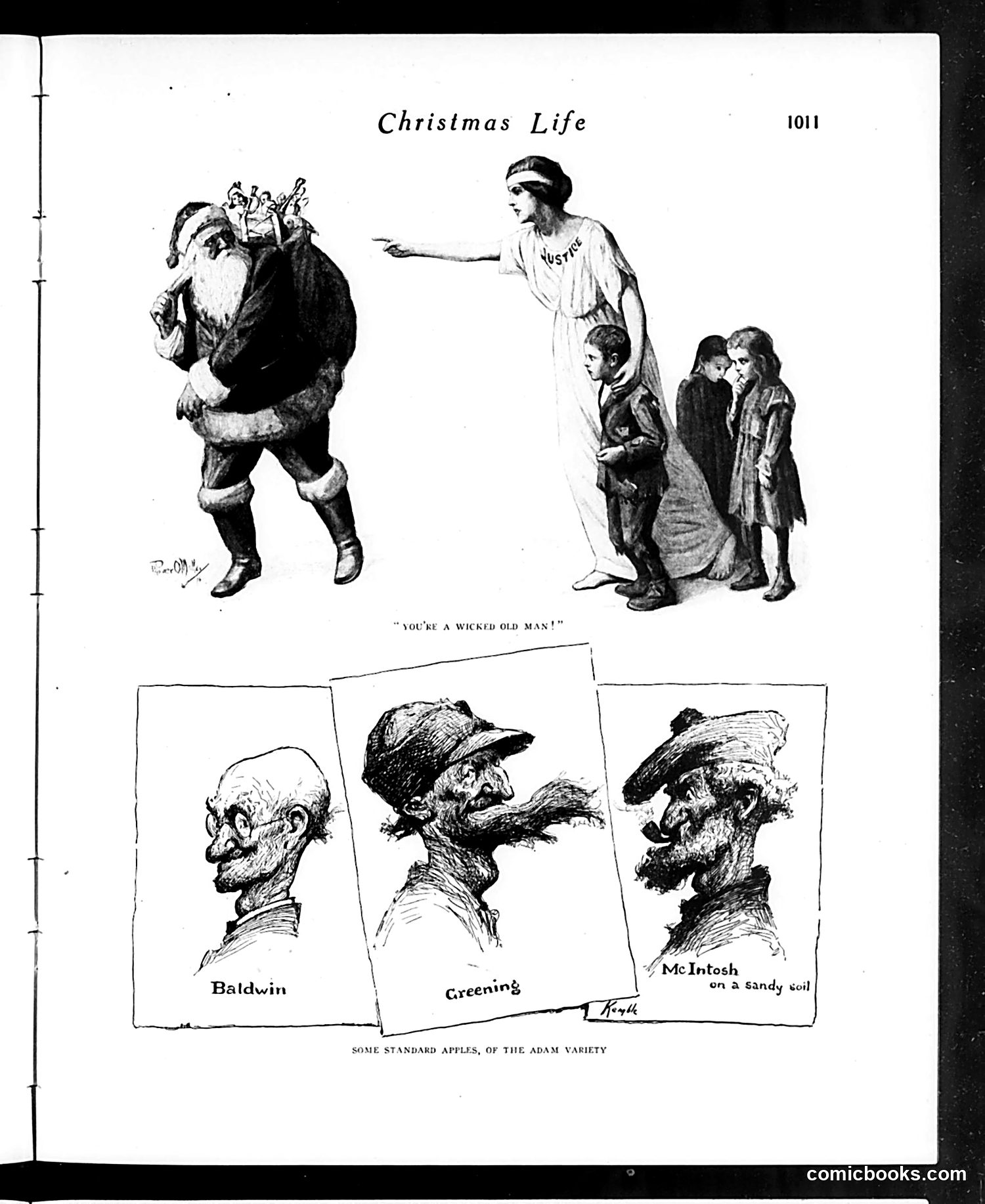
This page contains two satirical illustrations. The top cartoon shows Santa Claus confronted by a figure labeled "Justice" with several children, captioned "You're a wicked old man!" — likely a sardonic comment on Santa's moral character or Christmas commercialism. The bottom section presents three apple varieties labeled "Baldwin," "Greening," and "McIntosh" with the subtitle "Some Standard Apples, of the Adam Variety." These are actual apple cultivar names, but the "Adam variety" reference is a biblical pun suggesting these apples represent human character types — playing on the Adam and Eve story. The caricatured faces suggest personality stereotypes associated with each apple type, making this a clever visual pun about human nature disguised as agricultural commentary.
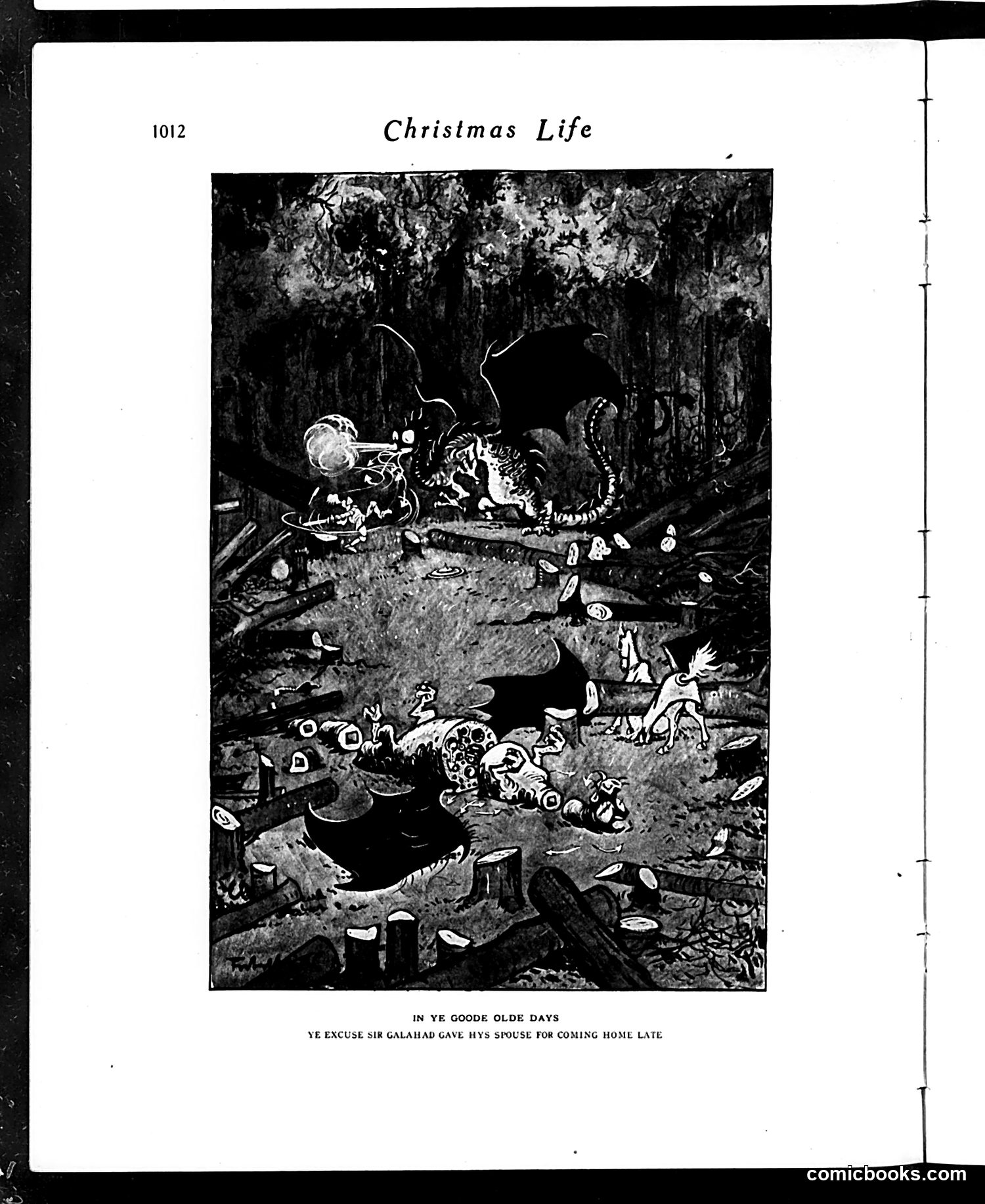
This is a satirical cartoon showing a medieval/fantasy scene titled "In Ye Goode Olde Days." The illustration depicts what appears to be Sir Galahad (a legendary knight) surrounded by fantastical creatures in a forest setting, apparently explaining his late arrival home to his wife. The joke is a humorous contrast: the caption suggests Sir Galahad is using elaborate medieval excuses ("ye excuse") for coming home late—implying he's been on some knightly adventure fighting monsters or magical beings. The satire targets husbands of the era (or any era) who fabricate elaborate stories to explain their tardiness to their spouses, rather than admitting simpler truths. It's a timeless joke about marital deception dressed in fanciful medieval language and imagery.
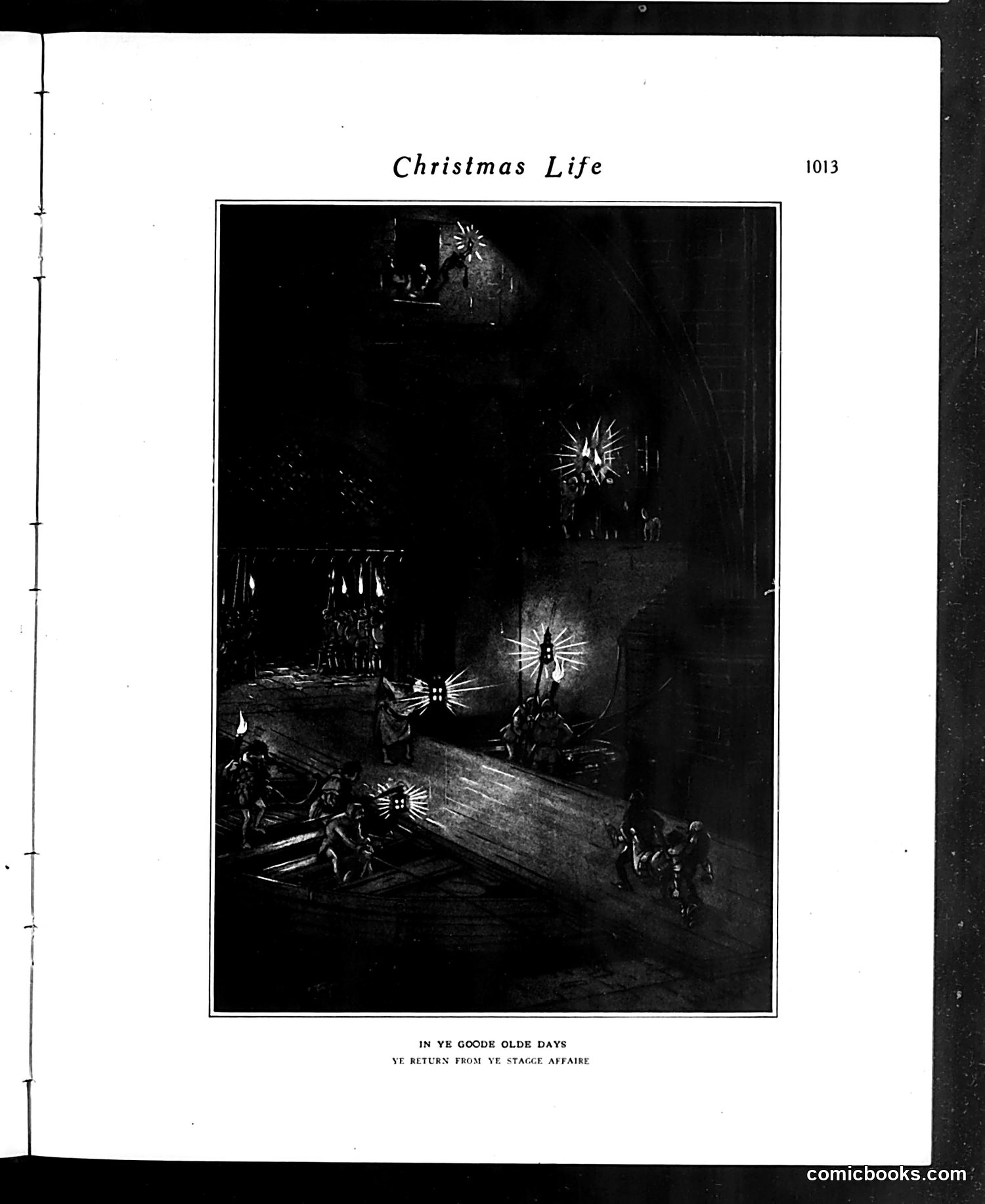
This appears to be a nostalgic Christmas illustration satirizing Victorian-era holiday traditions. The image depicts a darkly lit nativity or Christmas scene with figures gathered around what seems to be a manger, illuminated by star-like halos above figures' heads—characteristic of religious artwork depicting the Nativity. The caption "In Ye Goode Olde Days / Ye Return From Ye Stage Affaire" suggests satire about romanticized past Christmas customs. The deliberately archaic spelling ("ye goode olde") is tongue-in-cheek, mocking sentimental nostalgia for "simpler times." The dramatic, shadowy black-and-white rendering creates an ironic tone—the scene appears gloomy rather than joyful, undercutting the sentimental reverence typically associated with Christmas tradition. This likely critiques contemporary Americans' idealized but inaccurate views of historical holiday celebrations.
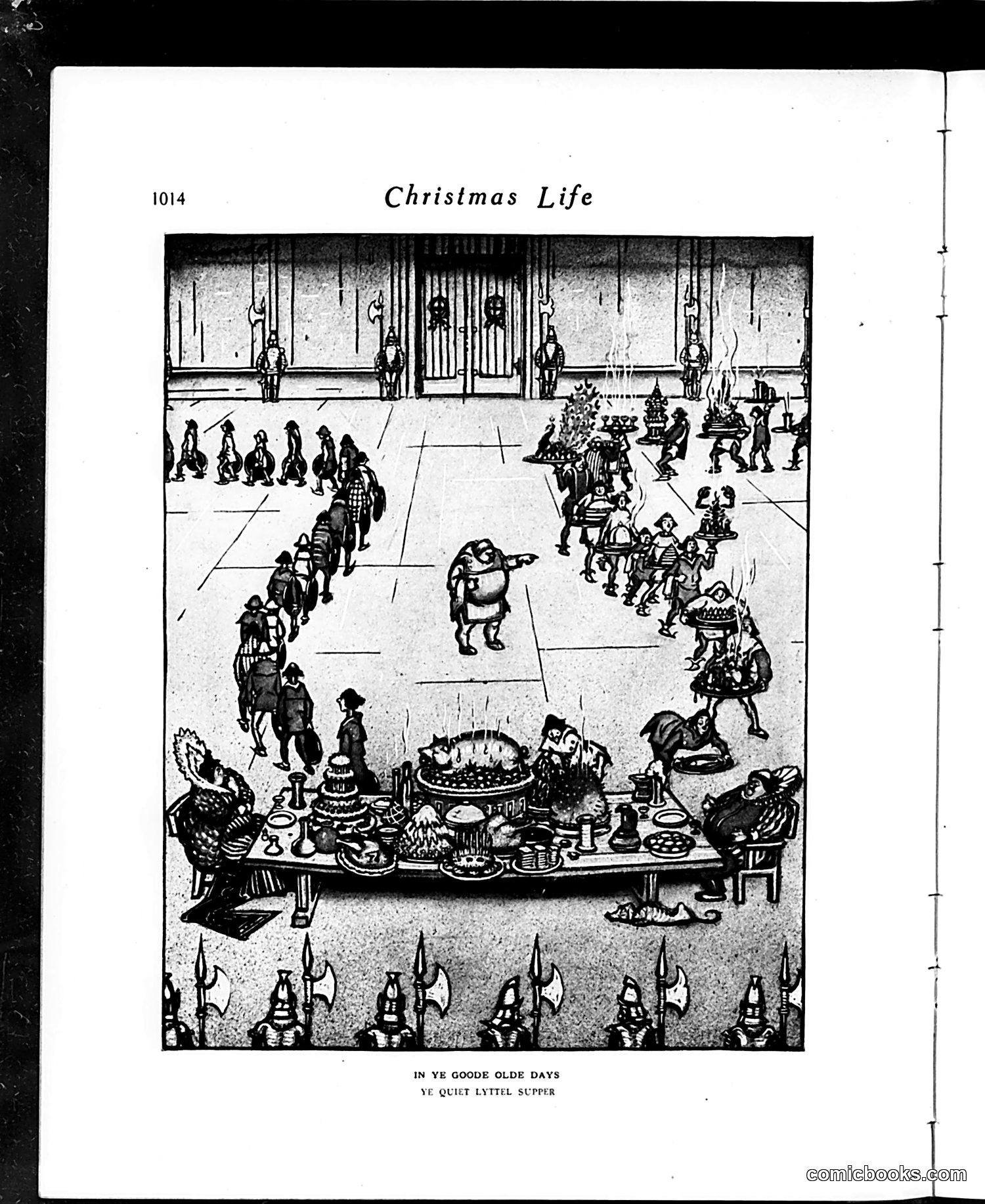
This satirical illustration contrasts modern Christmas chaos with an idealized past. The caption "In Ye Goode Olde Days: Ye Quiet Lyttel Supper" employs mock-archaic language to present what appears nostalgic. The image depicts a massive medieval or Tudor-era feast scene with hundreds of people—some eating at a long table laden with food, others processing through a courtyard, musicians performing, servants working, and armed guards stationed at the perimeter. Despite the caption's promise of "quiet," the scene is visibly chaotic and crowded. The satire targets sentimental nostalgia: the joke is that "the good old days" were never actually quiet or simple. By showing a hectic historical banquet, *Life* mocks readers who idealize the past while enduring modern Christmas stress. It's commentary on how memory romanticizes reality.
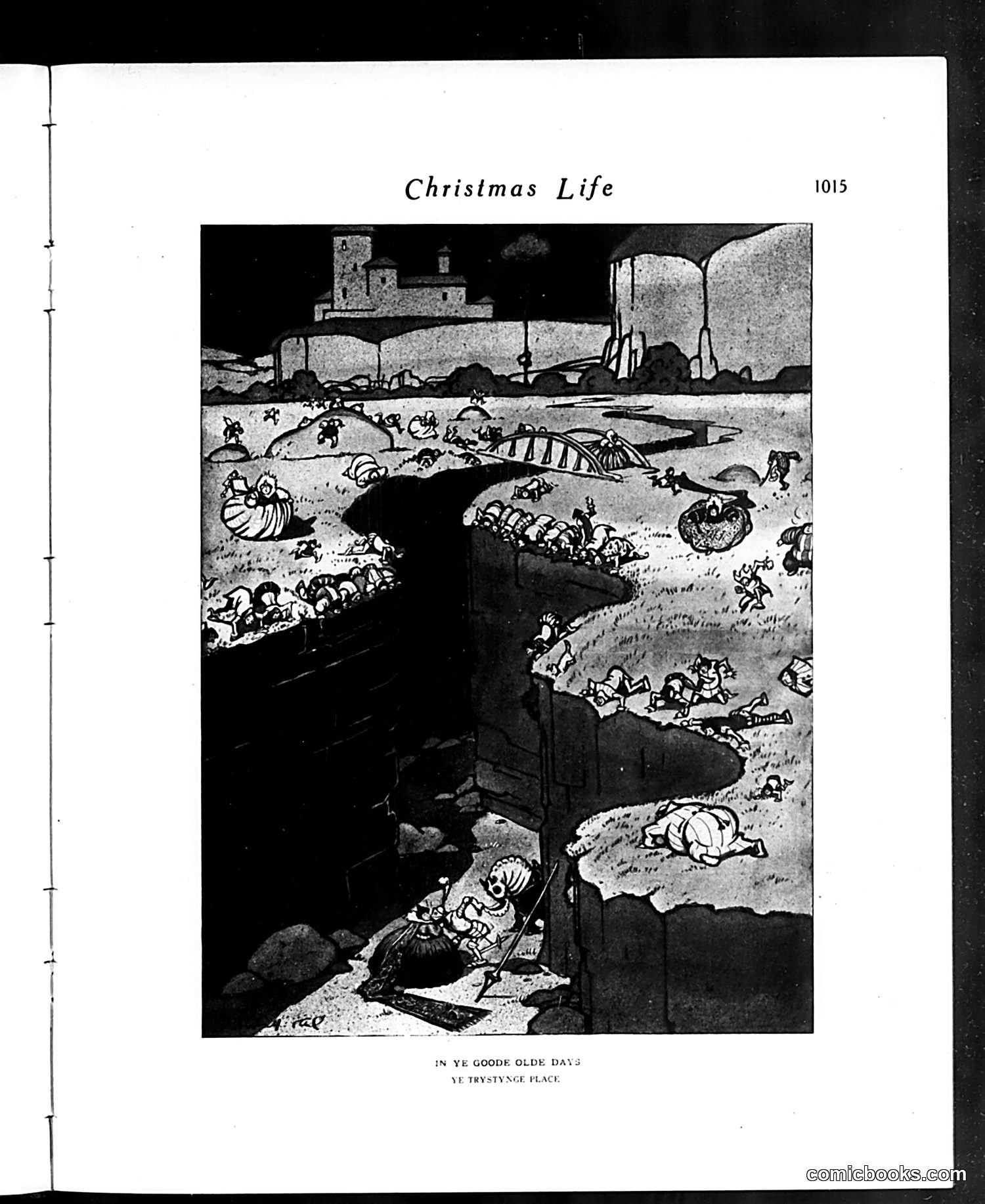
This page from *Life* magazine presents a nostalgic satirical illustration titled "In Ye Goode Olde Days: Ye Trystynge Place." The cartoon depicts a romanticized medieval or fantasy landscape where numerous small figures engage in various activities across rolling terrain, with a prominent castle or fortification in the background. The satire appears to mock the period's sentimentality about "the good old days"—a common target of *Life*'s humor. The crowded, chaotic scene with its many figures suggests the reality of historical life was messier and less romantic than popular imagination suggests. The archaic spelling ("Ye Goode Olde Days," "Trystynge Place") emphasizes the artificial, theatrical nature of such nostalgia. The illustration style and composition suggest this is gentle, whimsical satire rather than harsh political commentary.
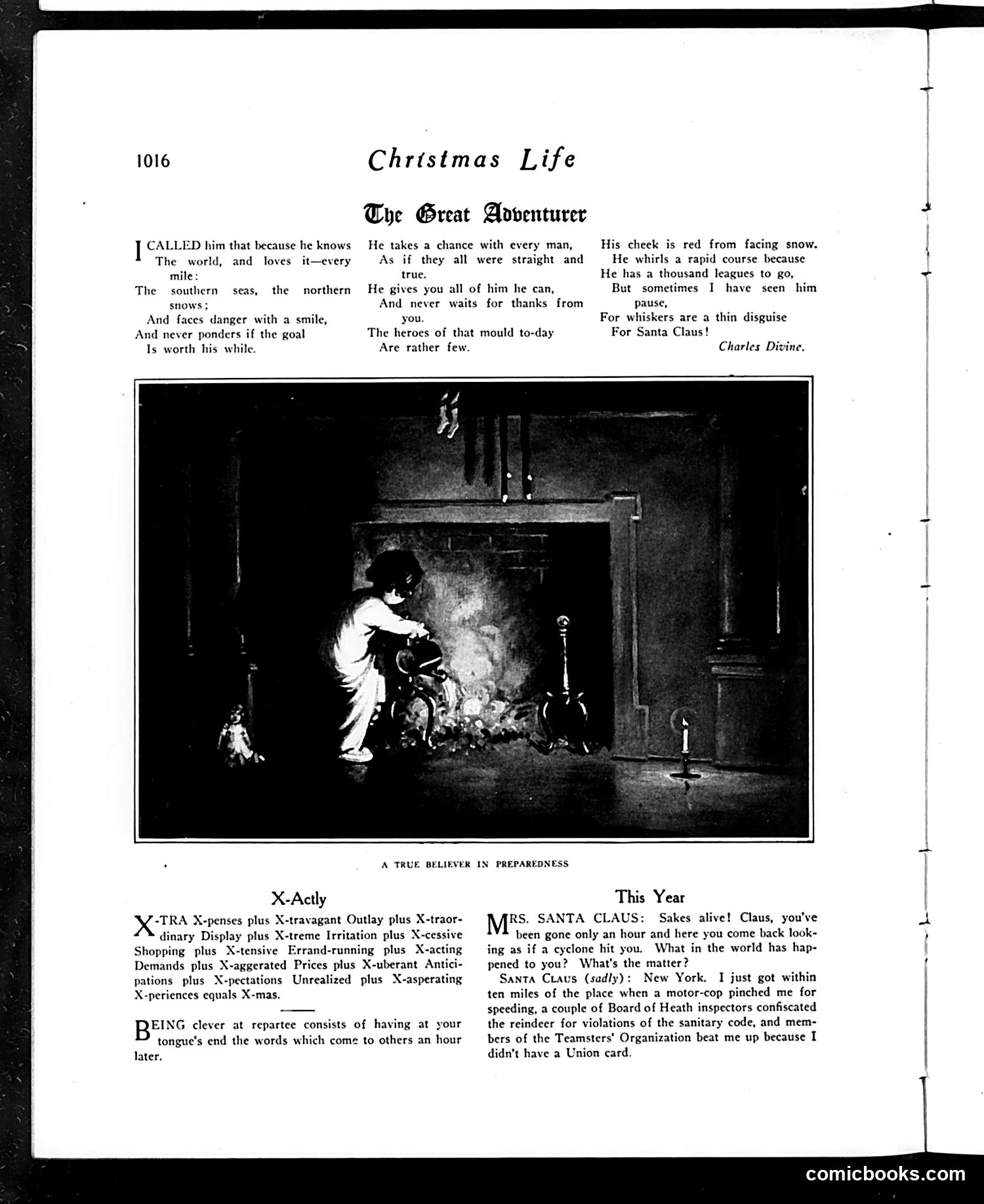
This *Life* magazine page contains two interconnected Christmas satires: **"The Great Adventurer"** is a romantic poem praising Santa Claus as a daring, selfless figure who traverses dangerous terrain to deliver joy without expecting thanks—his "whiskers" being merely a disguise. **The cartoon below deflates this sentiment ruthlessly.** It depicts modern New York City's bureaucratic and labor hostilities destroying Santa's mission: a motor cop tickets him for speeding, Health Department inspectors confiscate his reindeer as unsanitary, and union teamsters beat him for lacking a membership card. The satire critiques early 20th-century urban America—its rigid traffic enforcement, health regulations, and militant labor organizations—as obstacles to generosity and holiday spirit. Santa cannot function in this regulatory maze. The joke highlights tension between nostalgic Christmas idealism and the harsh, litigious modern city. **"X-Actly"** above further mocks Christmas commercialism, where "X-mas" becomes an equation of expenses, aggravation, and disappointed expectations.
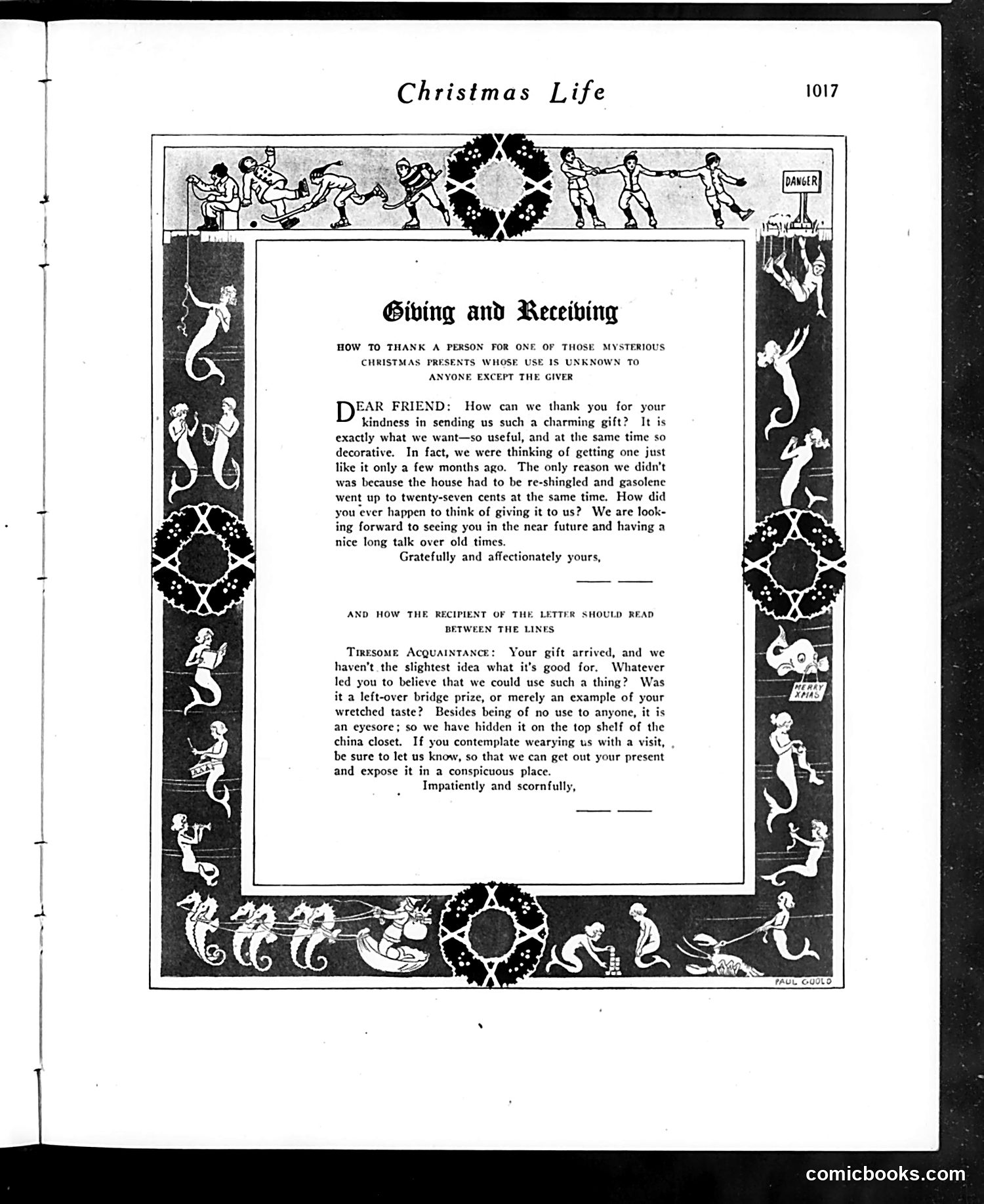
This satirical piece humorously exposes the gap between polite thank-you letters and recipients' true feelings about unwanted Christmas gifts. The page presents two versions of a response letter: **The polite version** graciously thanks the giver, calling the gift "charming," "useful," and "decorative," claiming it was exactly wanted. **The "between the lines" translation** reveals the actual sentiment: the recipients have no idea what the gift does, suspect it's a regifted bridge prize or evidence of terrible taste, find it an eyesore, and have hidden it away. They only promise to display it if the giver announces a visit. The satire targets the social hypocrisy of gift-giving etiquette—the elaborate pretense required to maintain politeness when receiving genuinely useless presents. The decorative border of cherubs and holiday imagery adds visual irony to this cynical commentary on Christmas propriety.
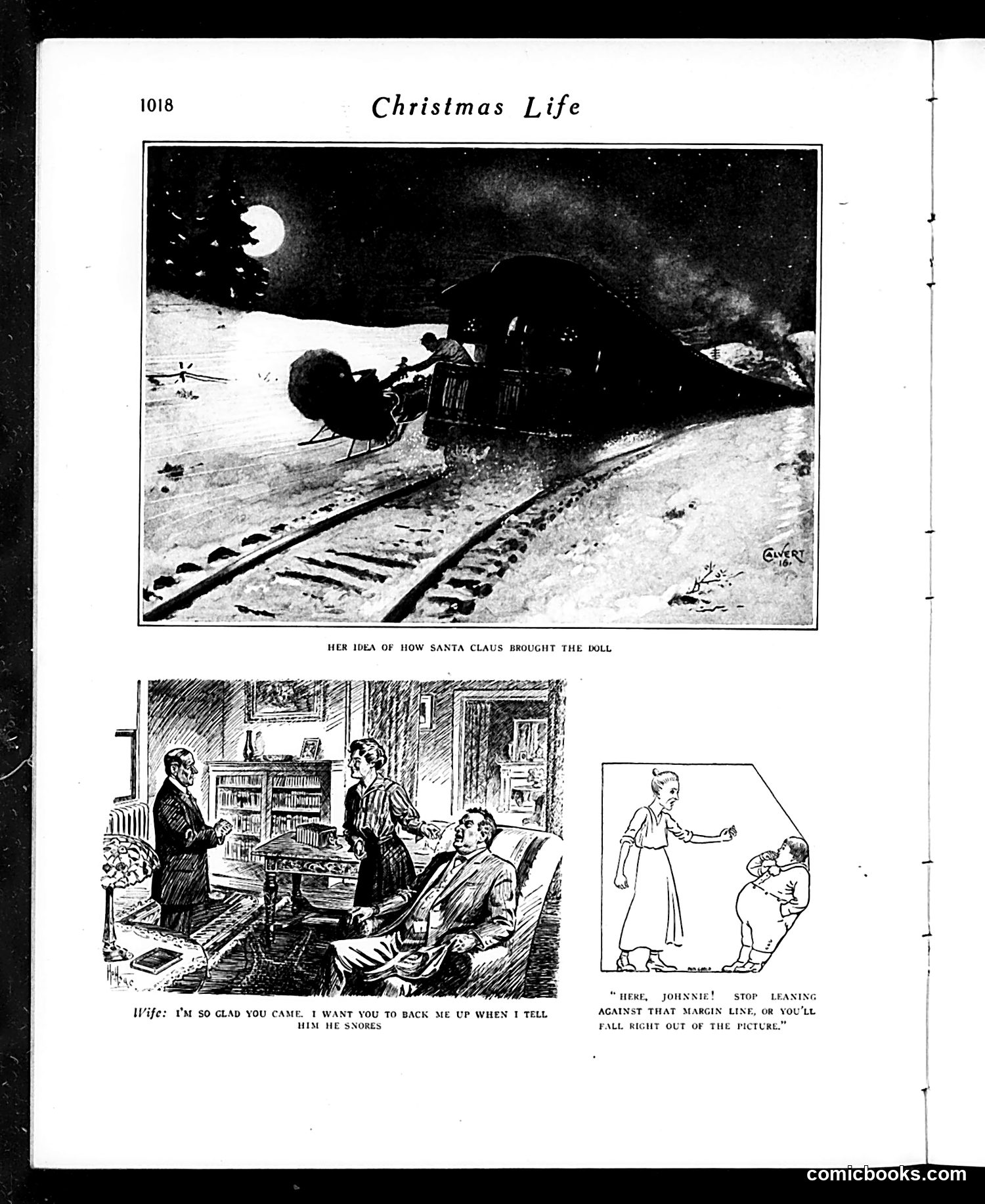
This page contains three separate humorous cartoons satirizing Christmas and domestic life: 1. **Top cartoon**: "Her Idea of How Santa Claus Brought the Doll" depicts Santa arriving by steam locomotive instead of sleigh—a whimsical, mechanized take on the traditional Christmas legend. 2. **Bottom left**: A domestic scene where a wife asks her husband to support her when scolding their child, suggesting marital coordination in parenting. 3. **Bottom right**: A child is being warned not to lean against the picture frame's margin line, or he'll "fall right out of the picture"—a meta-joke about the cartoon's own physical boundaries, playing on the artificiality of the drawn image. The humor targets both Christmas sentimentality and everyday domestic interactions, typical of Life's satirical approach to American middle-class life.
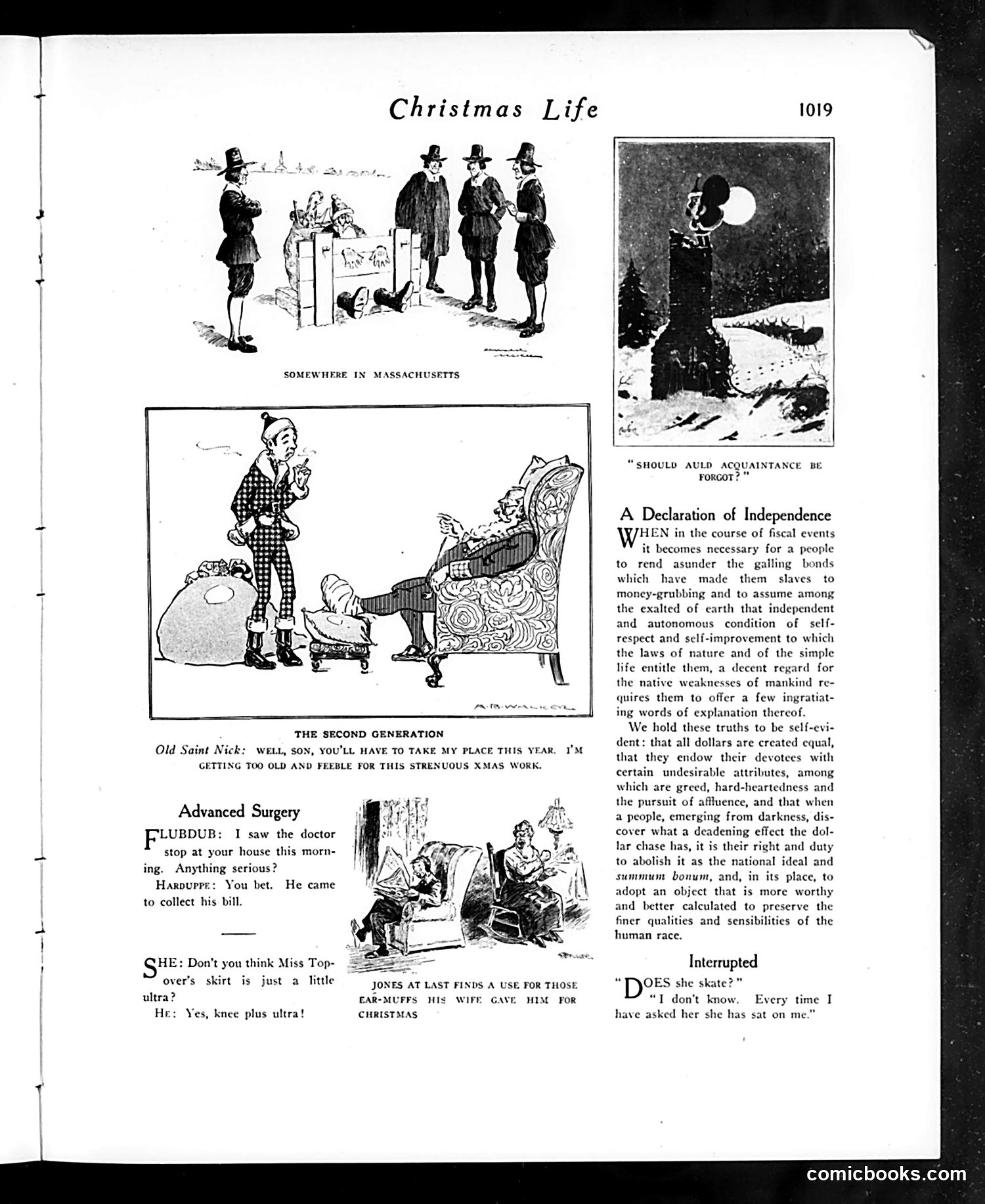
This Christmas-themed satirical page contains several disconnected jokes targeting early 20th-century American life: **"A Declaration of Independence"** parodies the Declaration of Independence, ironically arguing that money and dollar-chasing corrupt human virtue. It advocates abandoning materialism for "the simple life"—likely referencing the contemporary back-to-nature movement popular among progressives. **"The Second Generation"** shows Santa Claus retiring, telling his successor the job has become too exhausting—commentary on commercialized Christmas's toll. **"Advanced Surgery"** jokes about a doctor's bill-collecting visit, satirizing medical costs. The remaining cartoons are light domestic humor about clothing and ear-muffs, typical of period comedy. Overall, the page balances anti-materialist social criticism with gentle domestic satire, reflecting turn-of-century American anxiety about commercialism and modern life.
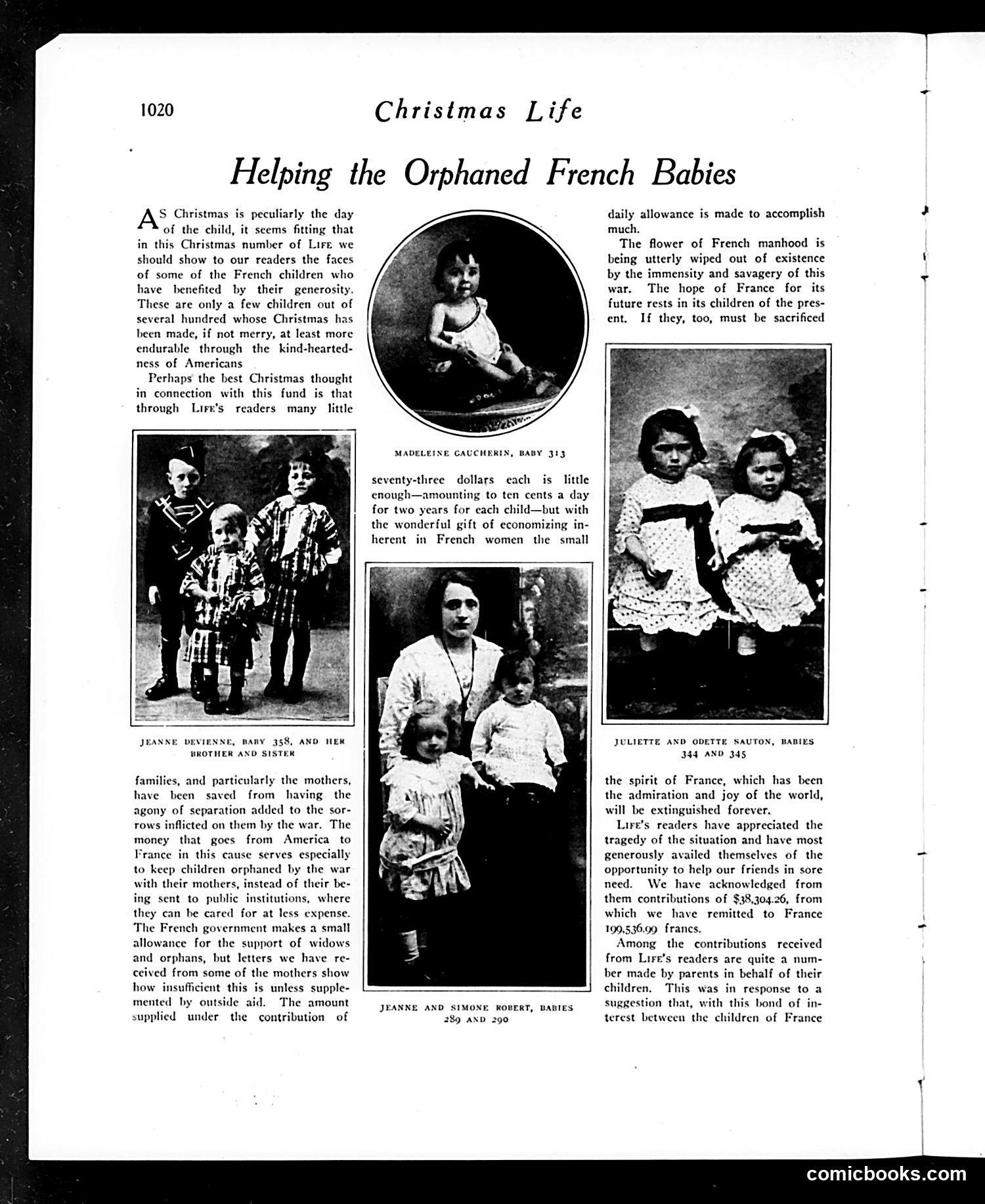
This is not satire but a charitable appeal. During World War I, Life magazine solicited American donations to support French children orphaned or separated from mothers by war. The page features photographs of actual French children (identified by number: Baby 313, Babies 289-290, etc.) who benefited from reader contributions. The appeal emphasizes that $73 per child—ten cents daily for two years—keeps orphans with mothers rather than institutions. It argues France's future depends on these children, as "the flower of French manhood is being utterly wiped out." The page notes readers raised $38,304.26, remitted as 199,536.09 francs to France. Some American parents donated "in behalf of their children," creating symbolic bonds between American and French youth. This represents wartime humanitarian fundraising, not political commentary.
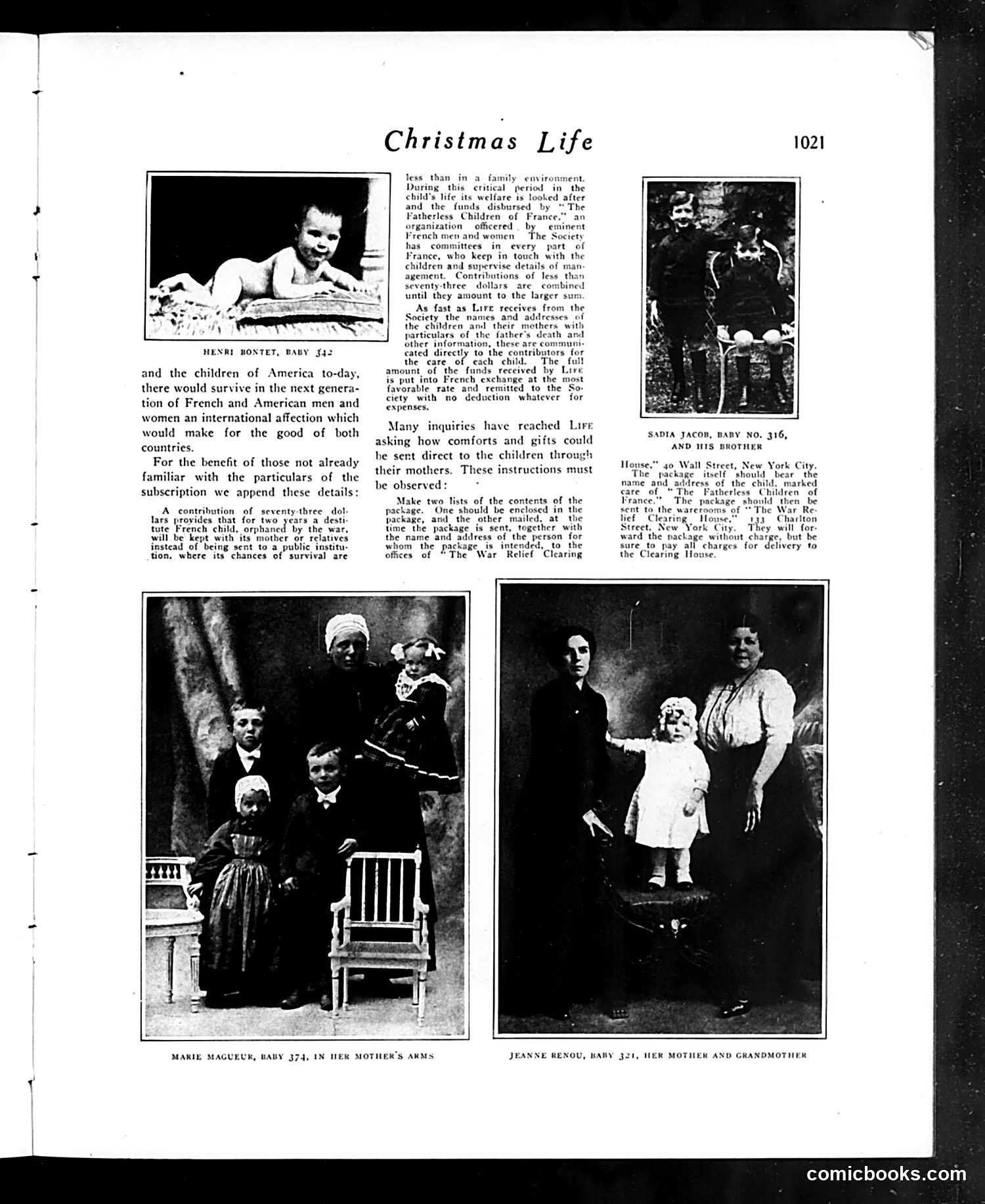
This is not satire but a humanitarian fundraising page from *Life* magazine promoting "Fatherless Children of France," a WWI relief organization. The page showcases photographs of French orphans and war-affected children alongside detailed instructions for American donors. The text explains that a $73 contribution supports a destitute French child for two years, keeping them with family rather than institutions—critical during the post-war crisis. It provides step-by-step instructions for sending packages directly to children through the War Relief Clearing House in New York, emphasizing that *Life* magazine charges no overhead on funds. The children pictured (Henri Bontet, Sadia Jacob, Marie Maguet, Jeanne Renou) represent the beneficiaries of this transatlantic charitable effort, intended to foster international goodwill between American and French families. This reflects early 20th-century American philanthropic engagement with European war relief.
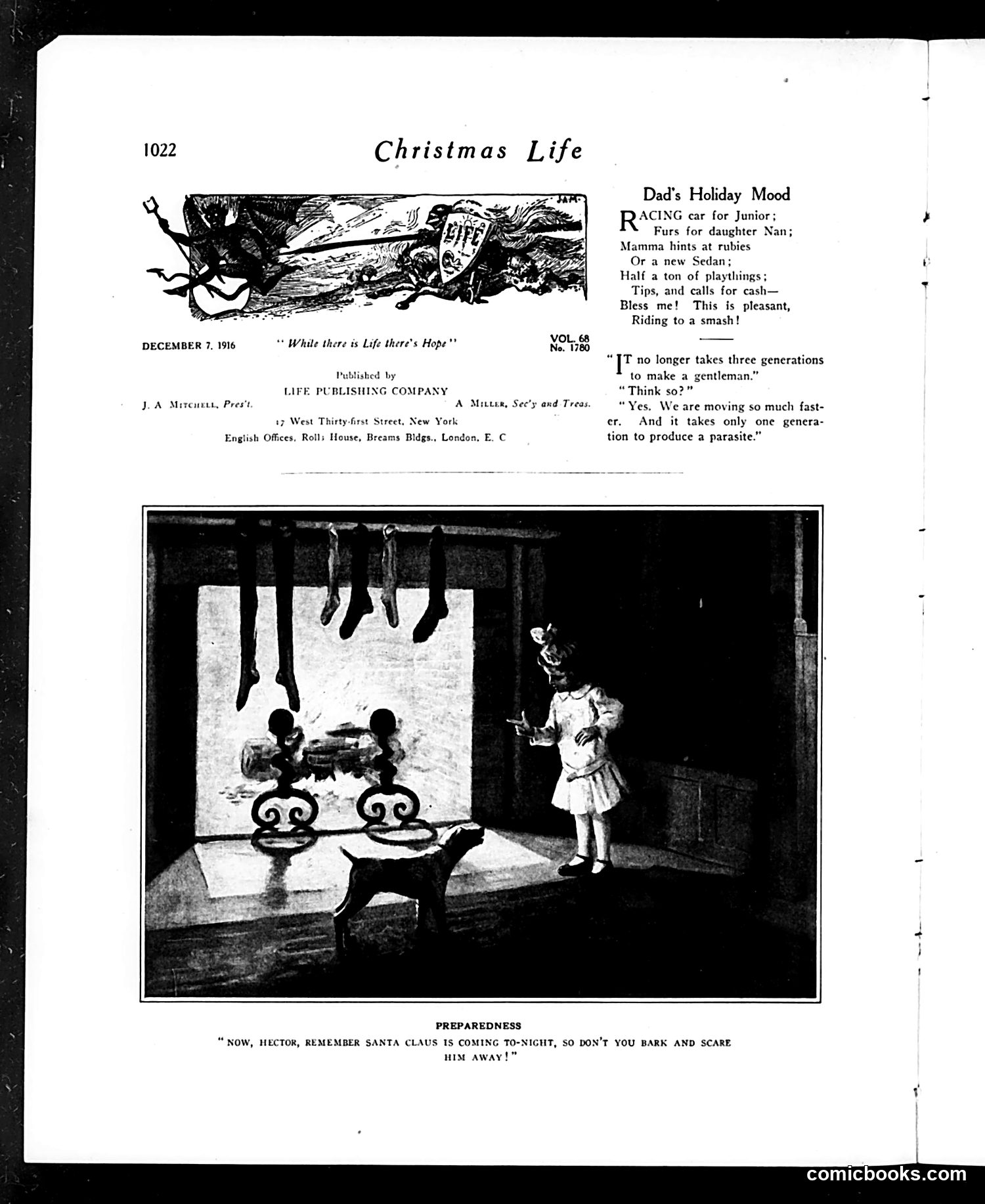
This page contains two satirical pieces about contemporary American society. **"Dad's Holiday Mood"** (top right) mocks the commercialization of Christmas and consumer excess. The poem describes a father indulging in holiday shopping—racing cars, furs, rubies, sedans, and toys—while making "tips and calls for cash," ending with dark irony about "riding to a smash" (financial ruin). It critiques how fathers feel pressured to spend lavishly during the holidays. **"Preparedness"** (bottom) shows a woman instructing a dog named Hector not to bark at Santa Claus. The humor lies in treating the dog as a rational actor who needs reminding of social niceties—a gentle satire on household dynamics and discipline. The page's title dialogue mocks social mobility: someone claims modern society produces parasites in one generation instead of taking three generations to make a gentleman—suggesting rapid moral decline among the newly wealthy or socially climbing classes. All three pieces reflect early-20th-century anxieties about commercialism, social status, and changing American values.
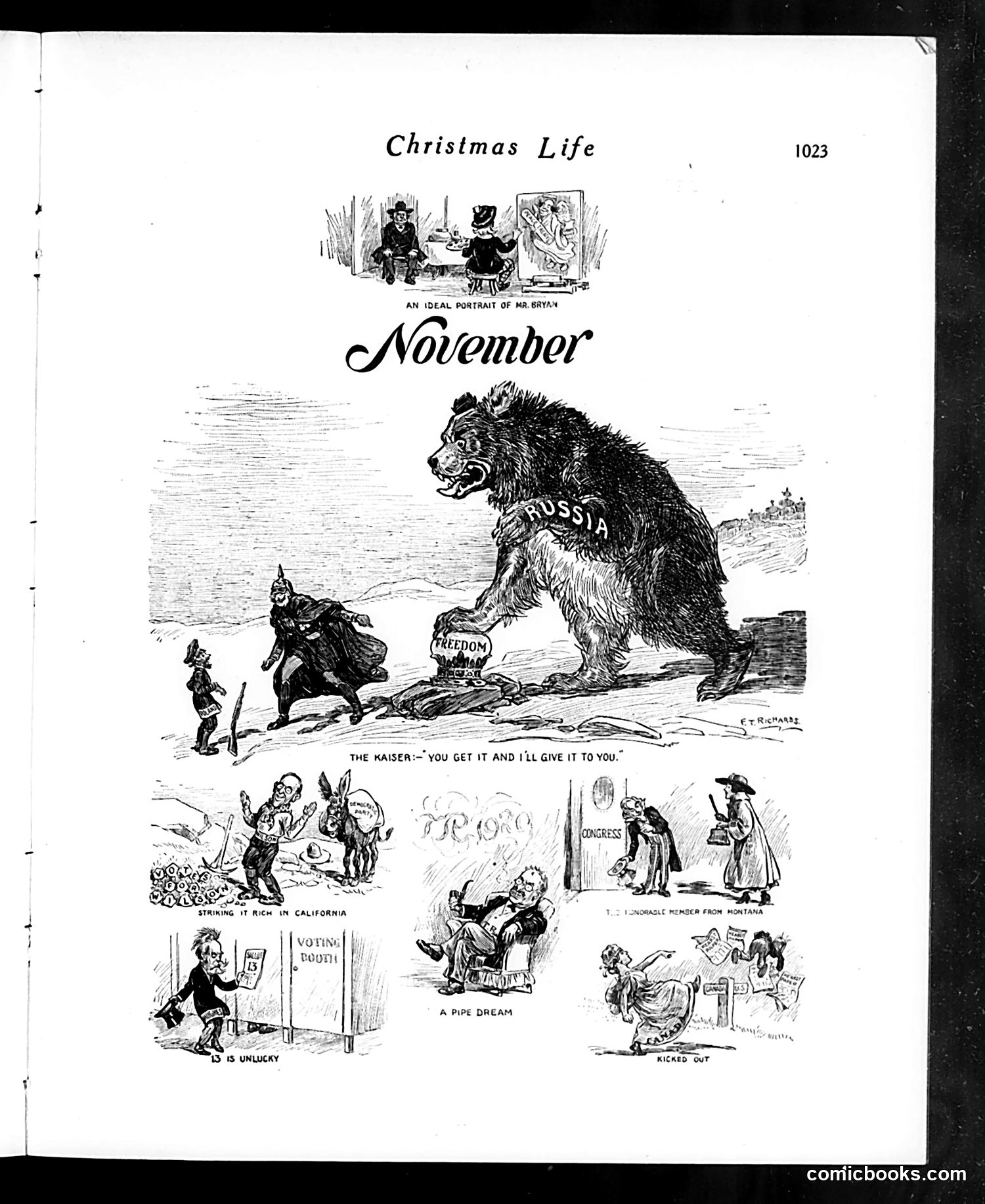
This page features satirical political cartoons about November 1917, during World War I. The central image shows a large bear labeled "Russia" menacing a small figure representing "Freedom," while the Kaiser (German emperor) watches, saying "You get it and I'll give it to you." This references the Russian Revolution and Bolshevik seizure of power that month. The surrounding smaller cartoons mock various political situations: striking workers in California, congressional inaction, voting booth superstitions, and what appears to be domestic political turmoil ("Kicked Out," "A Pipe Dream"). Overall, the page satirizes how Russia's revolutionary upheaval threatened democratic freedoms while the Kaiser potentially benefited from the chaos. The cartoons suggest American anxiety about radical change and political instability during the final year of WWI.
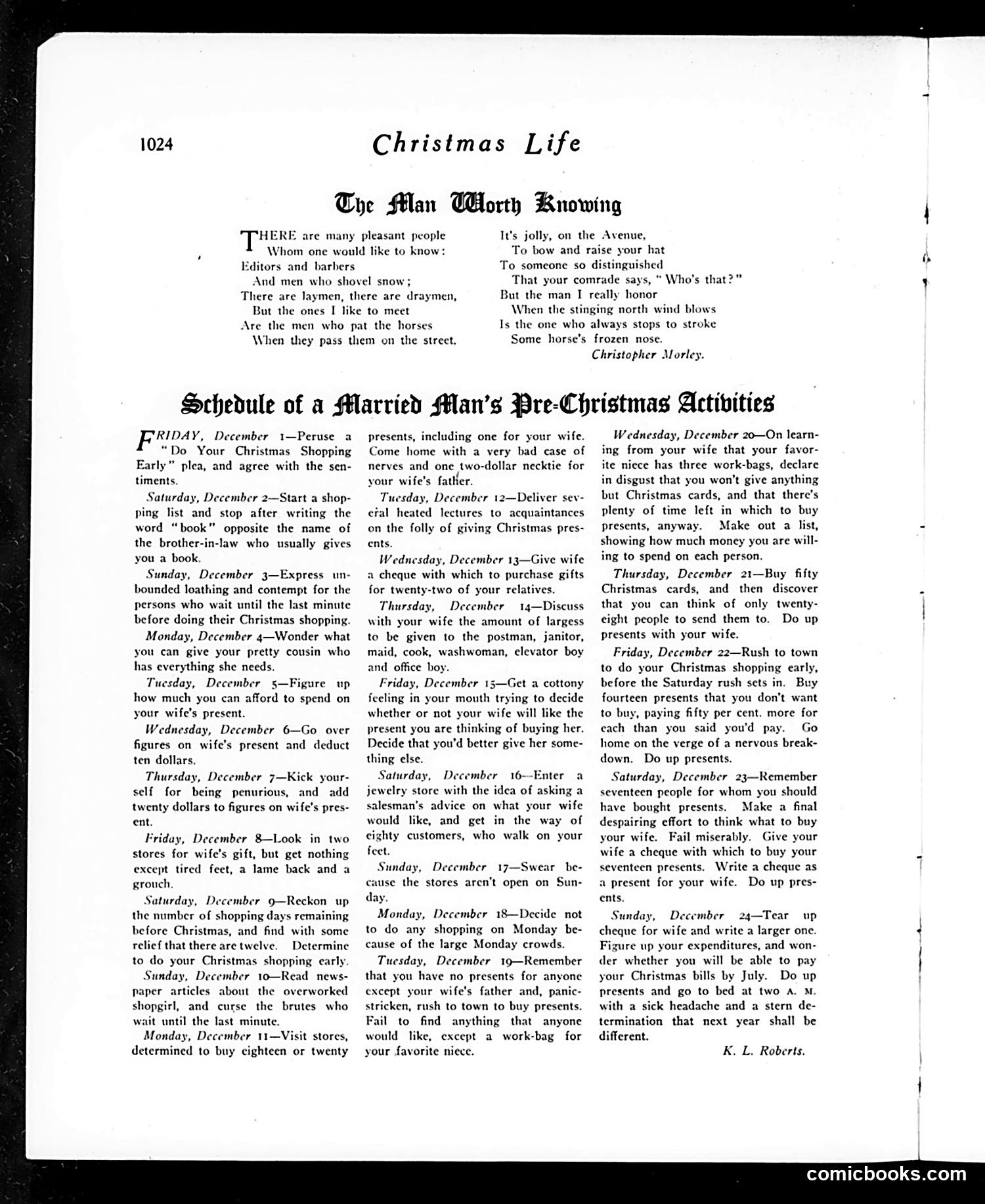
This page from *Life* magazine presents satirical content about Christmas shopping and masculine virtue, aimed at early 20th-century readers. **"The Man Worth Knowing"** is a poem by Christopher Morley celebrating ordinary working men—particularly one who kindly strokes a frozen horse's nose during winter. The satire lies in elevating such humble decency over wealth or status, mocking society's usual markers of admiration. **"Schedule of a Married Man's Pre-Christmas Activities"** is humorous social commentary on male incompetence and procrastination. The joke follows a husband's predictable December spiral: ignoring early shopping advice, vacillating on his wife's gift budget (adding and subtracting twenty dollars), complaining about crowds while causing them, and ultimately buying worthless items (a necktie for his father-in-law, duplicate work-bags). The satire ridicules both masculine anxiety about gift-giving and the commercial Christmas season's mounting stress. For modern readers, it's notable that the wife handles purchasing for twenty-two relatives while the husband fumbles—reflecting 1920s gender roles where women managed social obligations.
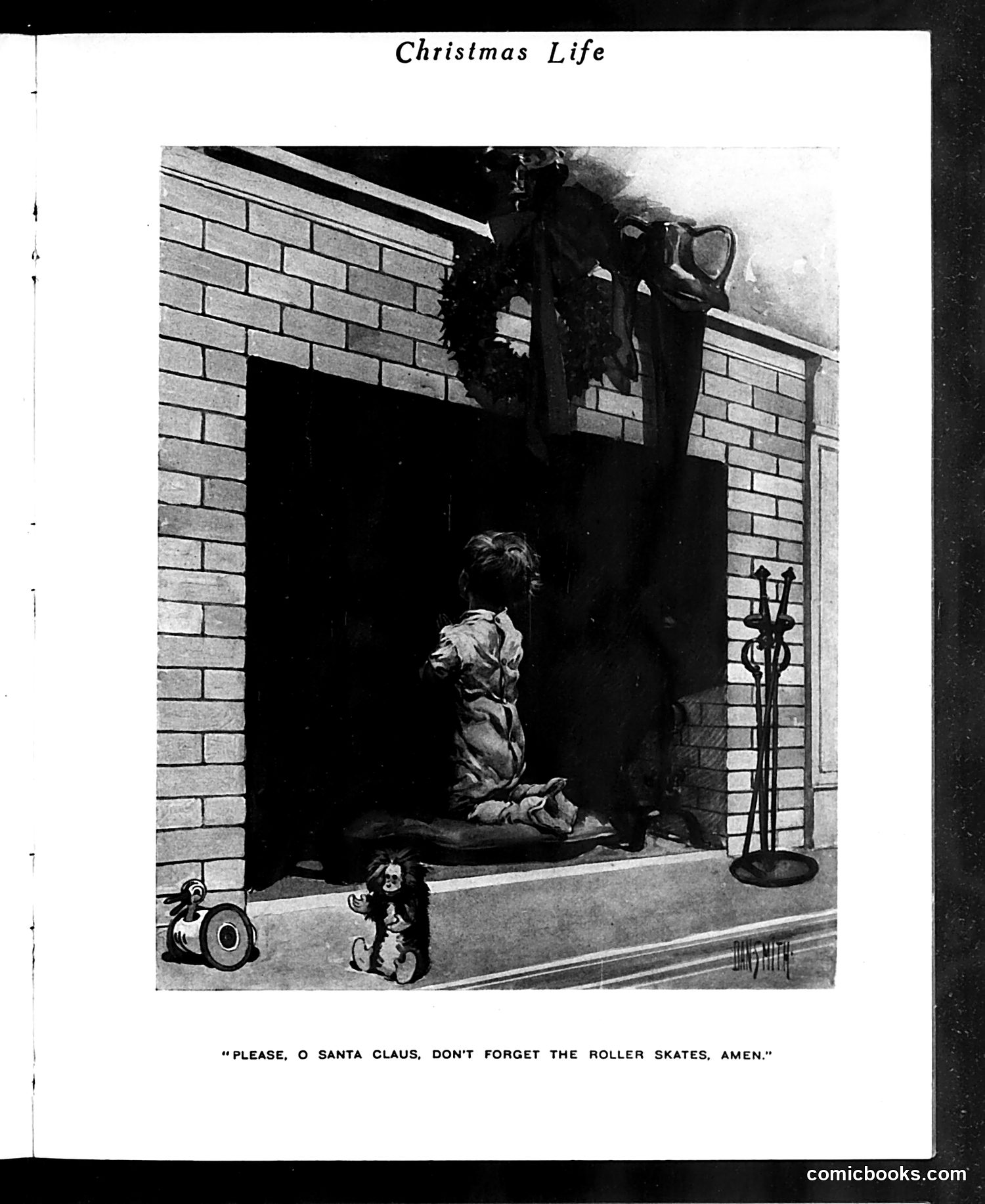
This is a satirical illustration titled "Christmas Life" depicting a child kneeling in prayer at a fireplace on Christmas Eve. The child is shown in silhouette, praying toward the chimney where Santa's wreath and supplies are visible above. The humor lies in the caption: "PLEASE, O SANTA CLAUS, DON'T FORGET THE ROLLER SKATES, AMEN." The joke combines religious reverence (the child literally praying as if to a deity) with secular materialism—roller skates represent the era's popular toys. The satire critiques how Christmas had become commercialized and consumer-focused, with children's desires for toys elevated to the level of religious devotion. The "amen" further emphasizes the mock-religious tone, suggesting Americans treated Santa Claus and holiday gift-giving with quasi-religious fervor rather than spiritual meaning.
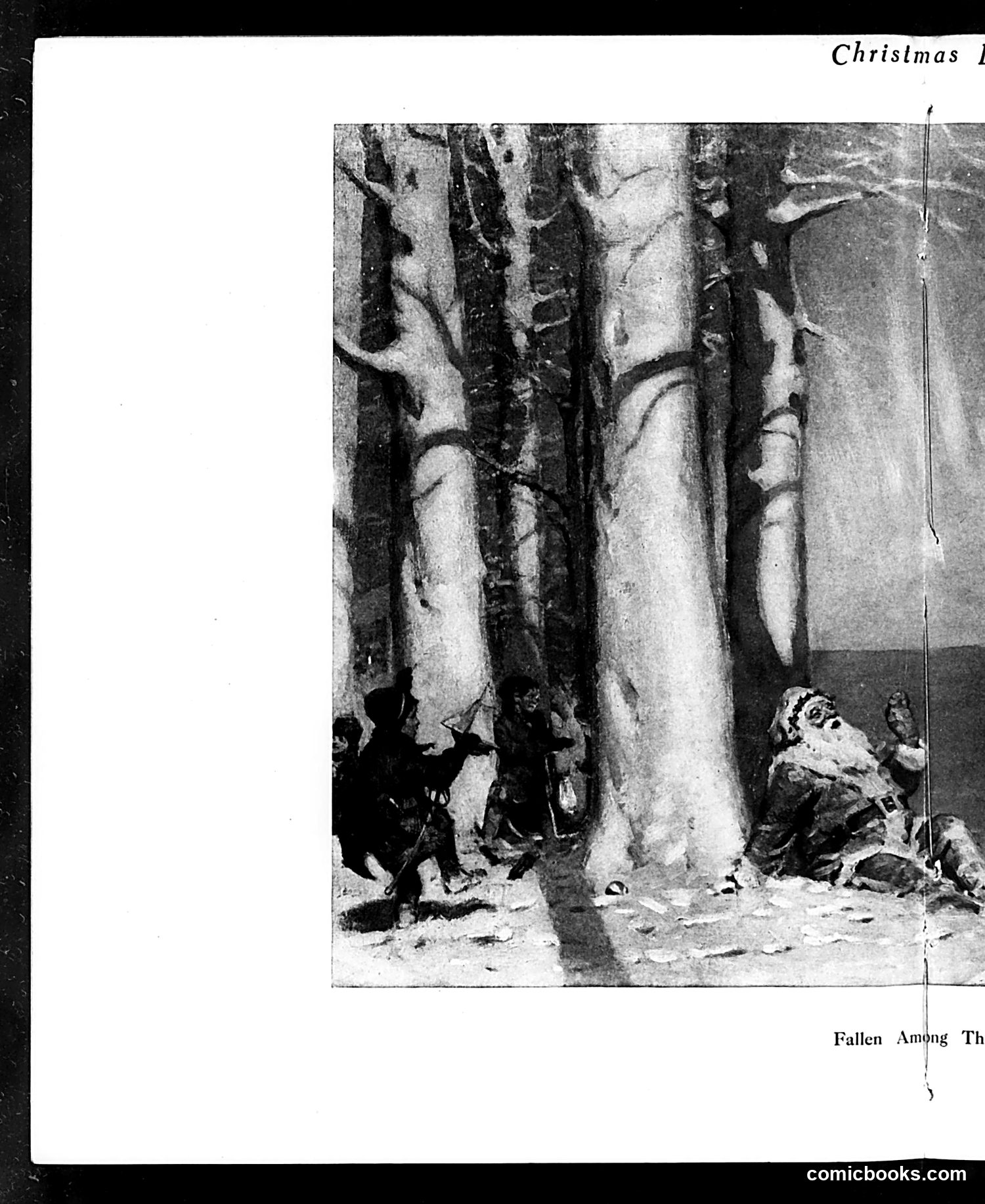
This page shows a black and white photograph titled "Fallen Among Th[e]" (text appears cut off). The image depicts figures positioned among massive tree trunks in what appears to be a forest setting. Given the "Christmas" header and the title's reference to "fallen," this likely illustrates a seasonal or moral theme—possibly a literary or religious reference about misfortune or degradation. However, without the complete caption or additional context from the original Life magazine issue, I cannot definitively identify the specific figures, historical event, or satirical point being made. The photograph's composition and the positioning of the small human figures against enormous trees suggests commentary on human insignificance or vulnerability, but the exact political or social reference remains unclear from this fragment alone.
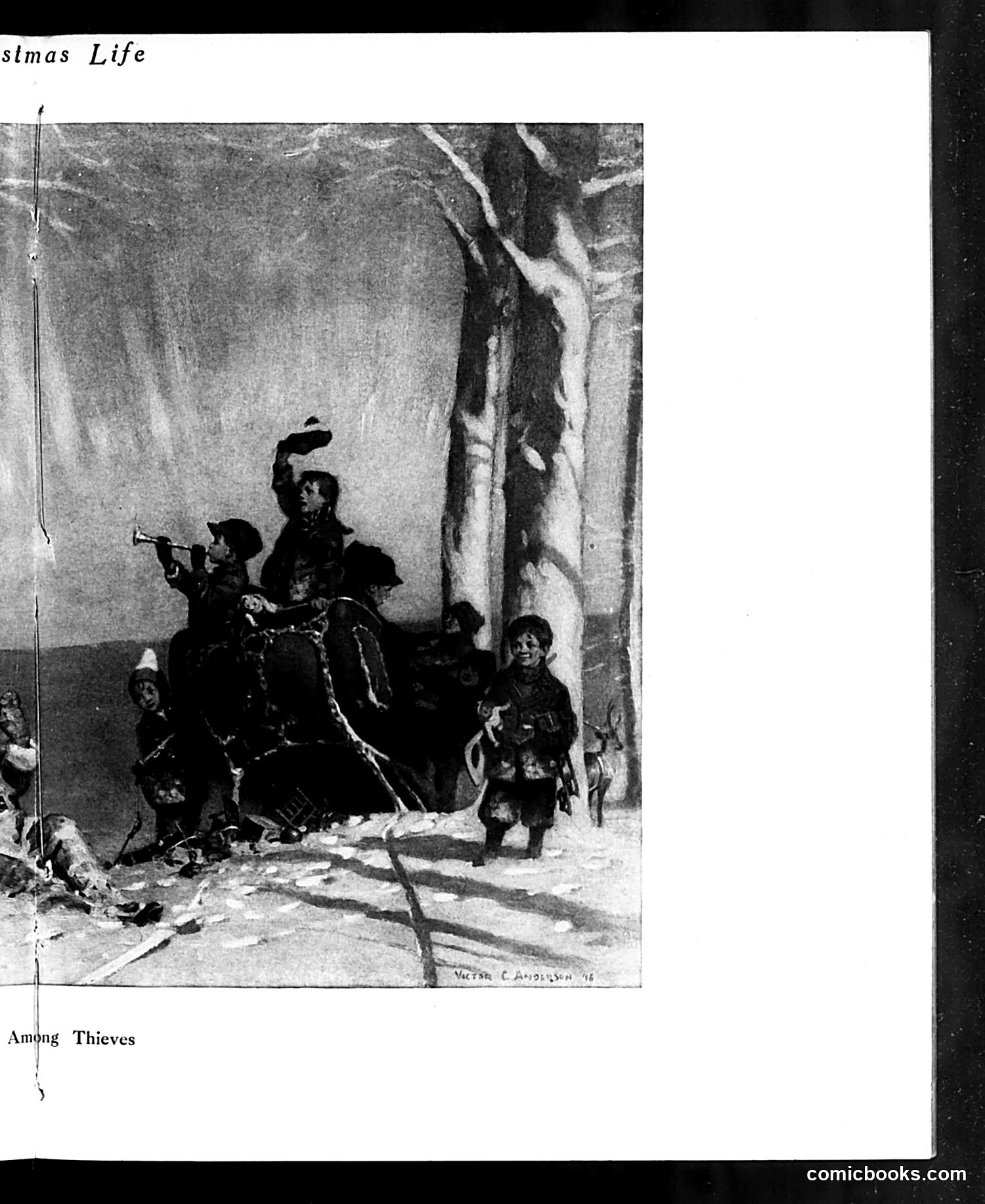
This appears to be a satirical illustration from *Life* magazine showing figures in dark clothing gathered against a large wall in what looks like an alley or confined space. The caption "Among Thieves" suggests social commentary on criminal activity or moral corruption. The photograph-style image depicts what appears to be multiple figures in period costume, possibly meant to represent thieves or disreputable characters huddled together. Without clearer OCR text or visible publication date, the specific political or social target of this satire is unclear. It may reference organized crime, political corruption, or social vice common to *Life's* satirical tradition, but the exact historical context and intended figures cannot be definitively determined from the visible information.
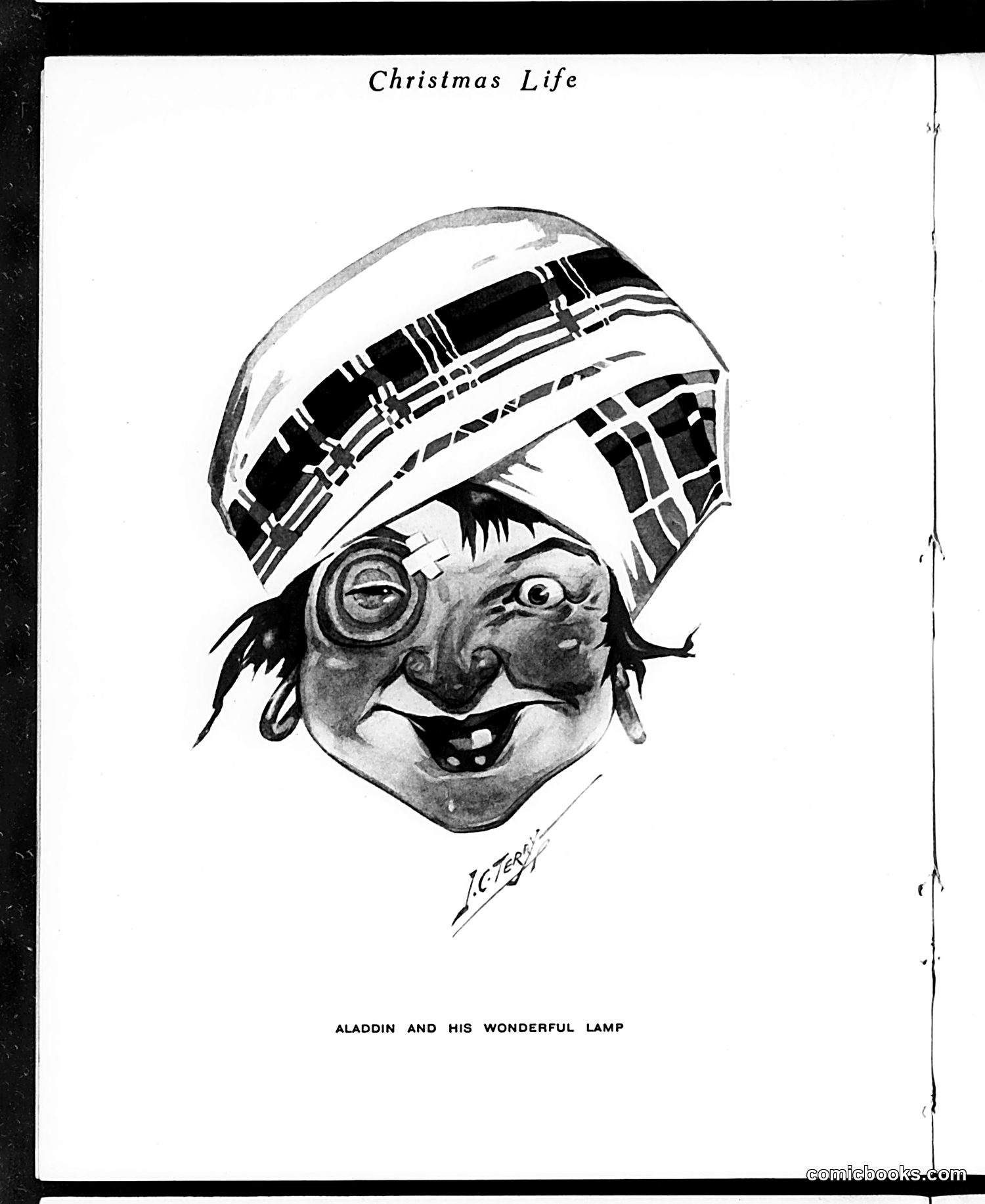
This is a Christmas-themed illustration from *Life* magazine depicting a character labeled "Aladdin and His Wonderful Lamp." The artwork shows an exaggerated caricatured face wearing an ornate turban with decorative striping and a monocle, displaying comedic facial features including an open-mouthed grin. The reference to Aladdin suggests this is likely holiday entertainment content—possibly advertising or promotion for a Christmas pantomime, theatrical production, or story. The caricature style and exaggerated features are typical of early *Life* magazine's satirical approach to popular entertainment. Without additional context or byline visible, the specific satirical target remains unclear, though the piece clearly comments on Christmas-season theatrical productions popular at that time.
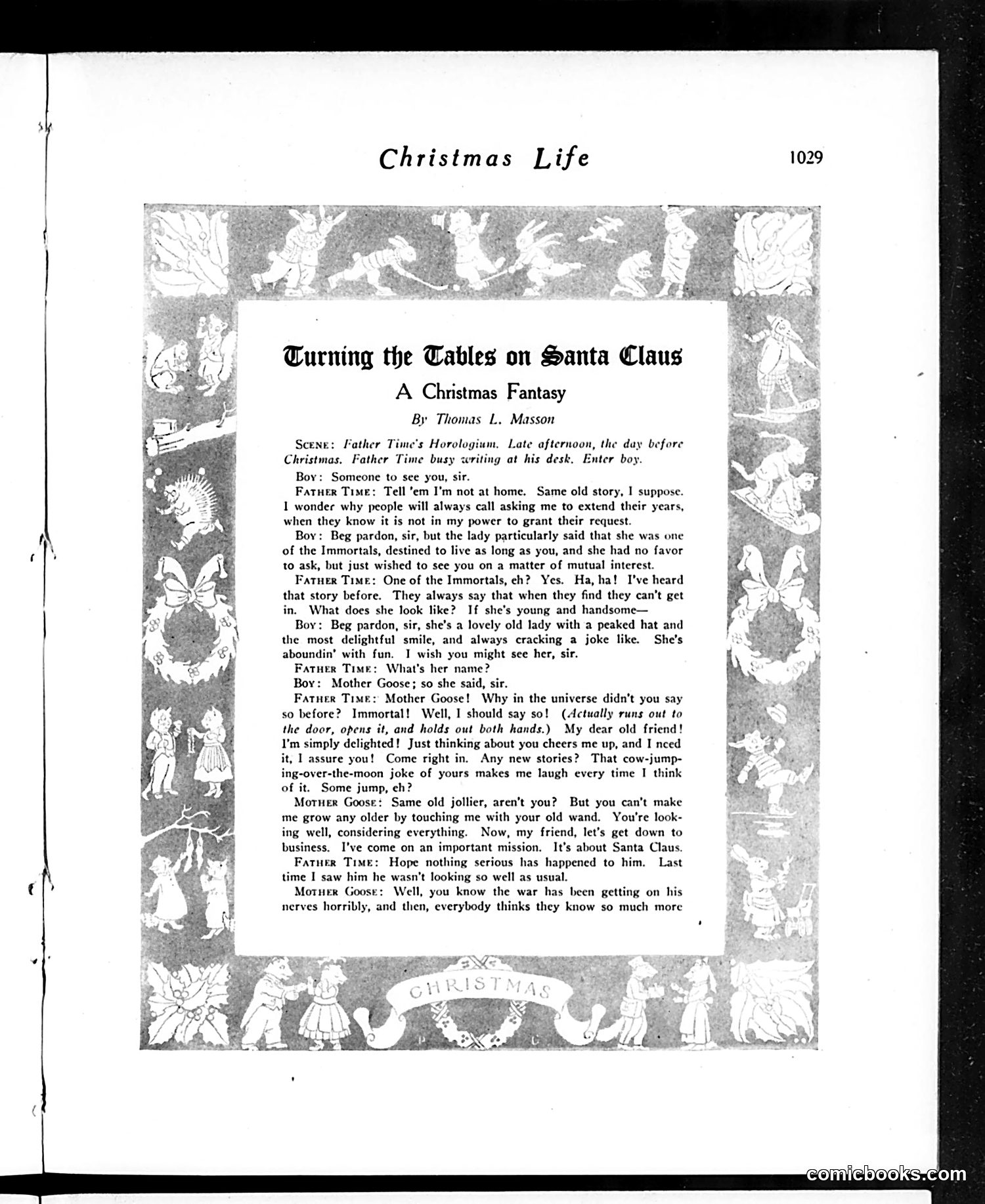
This is a Christmas fantasy playlet by Thomas L. Masson featuring Father Time and Mother Goose meeting to discuss Santa Claus's troubles. The satire appears to be **early-20th-century social commentary**: Father Time is skeptical of visitors asking him to extend their lives, but welcomes Mother Goose as a fellow immortal. The humor rests on treating mythological/literary figures as real beings affected by contemporary concerns. Mother Goose mentions that "the war" has been straining Santa Claus's nerves—likely referencing **World War I** and its cultural impact. The joke suggests that even timeless, magical figures cannot escape modern anxieties. The piece gently satirizes how global conflict disrupts even cherished traditions and the innocence associated with Christmas lore.
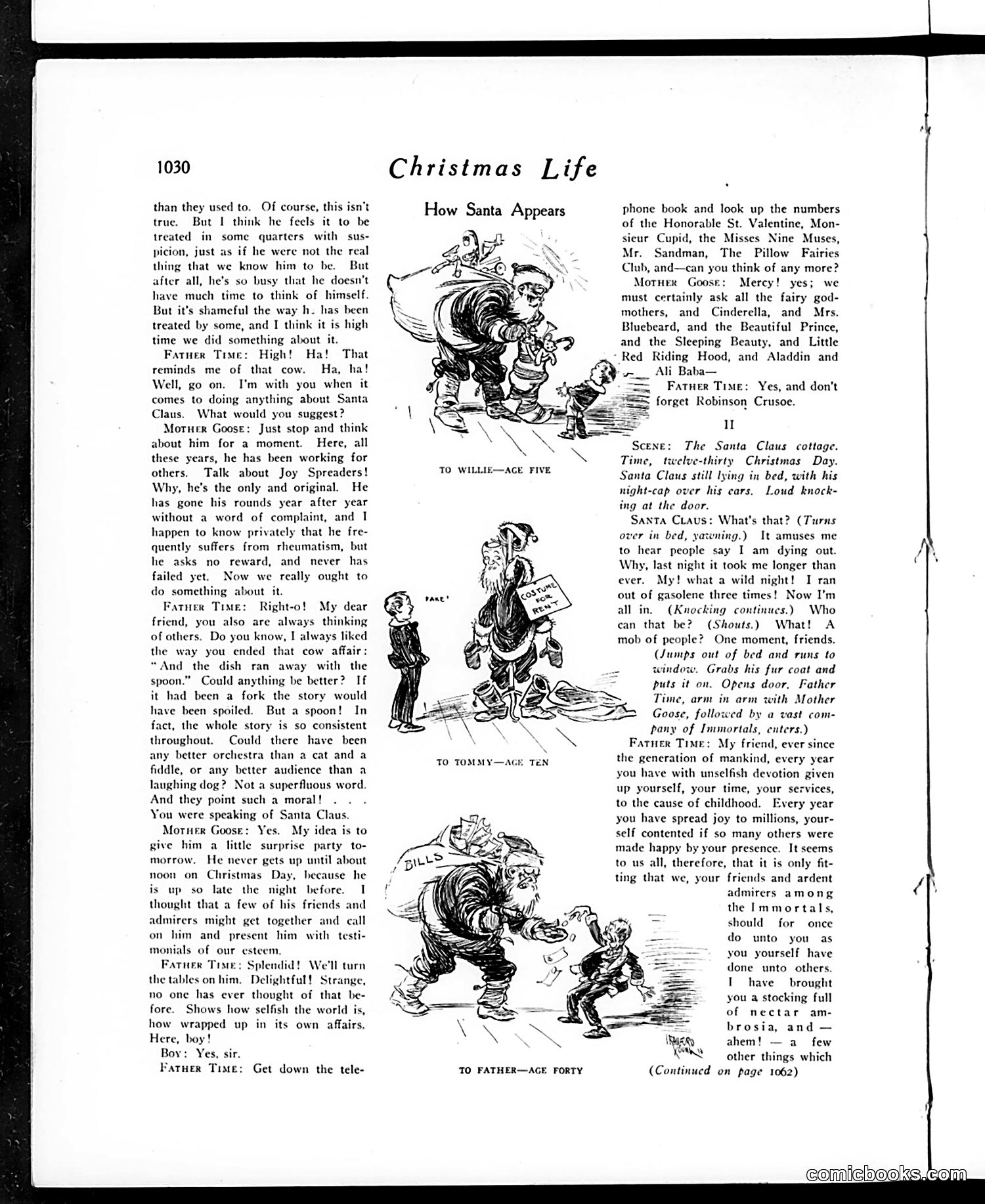
This page presents a theatrical sketch honoring Santa Claus through contrasting perspectives. The top section shows Father Time and Mother Goose (classic nursery rhyme characters) conversing about Santa's underappreciation. They decide to throw him a surprise party. The illustrated vignettes show Santa as perceived by different ages: a magical, fantastical figure to a five-year-old child, versus a tired, exhausted man who runs out of gasoline to a forty-year-old adult—satirizing how adulthood strips away childhood wonder. The second scene depicts Father Time and Mother Goose organizing a surprise gathering of literary/mythological immortals (Cinderella, Robinson Crusoe, etc.) to honor Santa's lifelong service to children. The satire celebrates Santa as an overlooked cultural figure deserving recognition for selfless devotion, while gently mocking adult cynicism about Christmas magic.
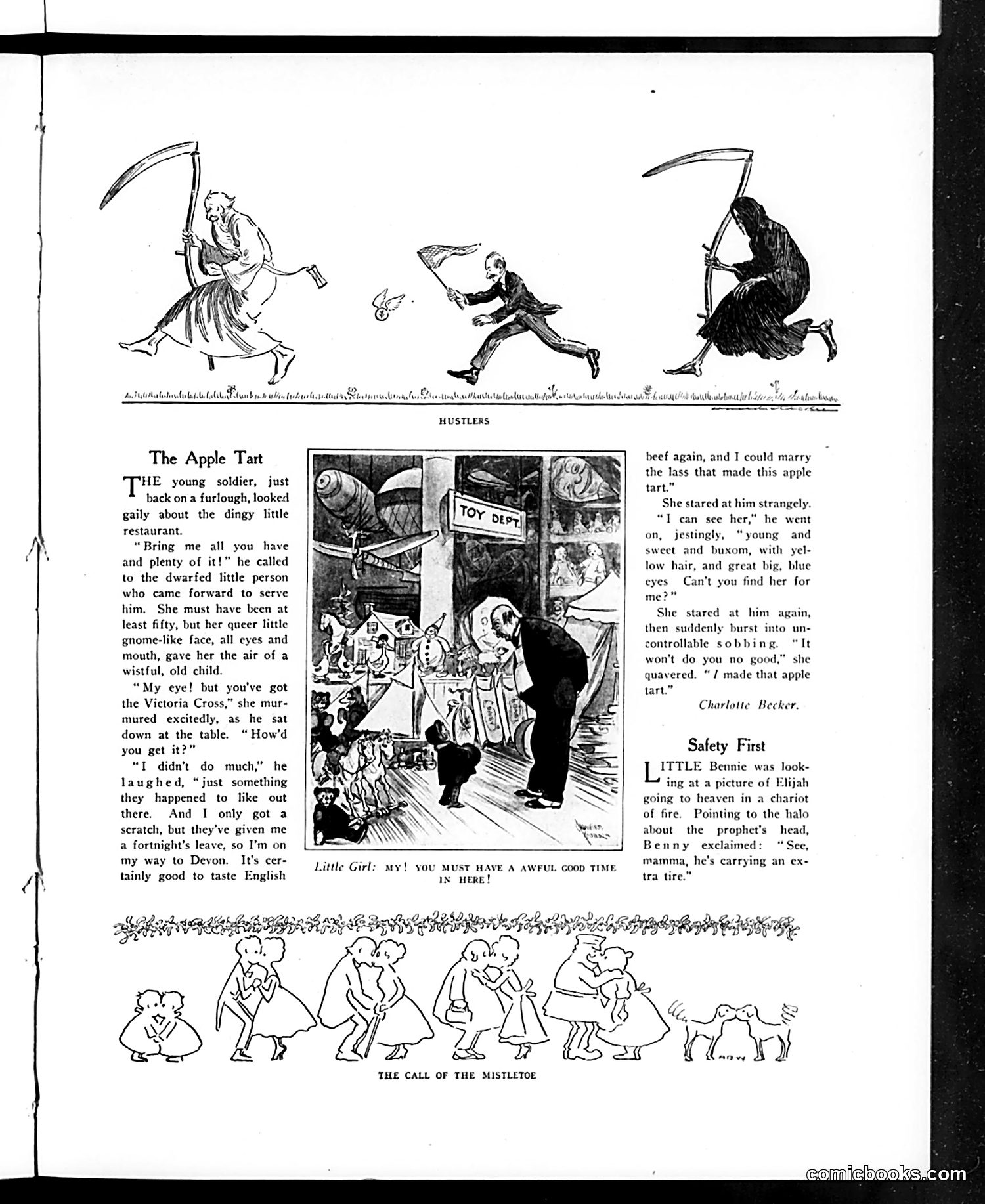
This page contains three distinct pieces of satire: **"The Apple Tart"** (main story): A poignant tale by Charlotte Becker about a WWI soldier on furlough who jestingly compliments a dwarfed, elderly waitress's apple tart, saying he'd marry whoever made it. The twist reveals she made it herself—she's the woman he was unconsciously describing, now aged and worn. It's sentimental wartime fiction exploiting post-war soldier nostalgia and class dynamics. **"Safety First"** (bottom right): A brief comic where a child misinterprets a religious halo as a car tire, conflating spiritual imagery with automobile safety concerns—a gentle joke about modern industrial concerns replacing traditional religious understanding. **"Hustlers" and "The Call of the Mistletoe"** (top and bottom illustrations): Satirical drawings mocking con artists and holiday social conventions through exaggerated characters and behaviors. The page reflects early 20th-century American magazine humor mixing sentimentality, social observation, and gentle domestic comedy.
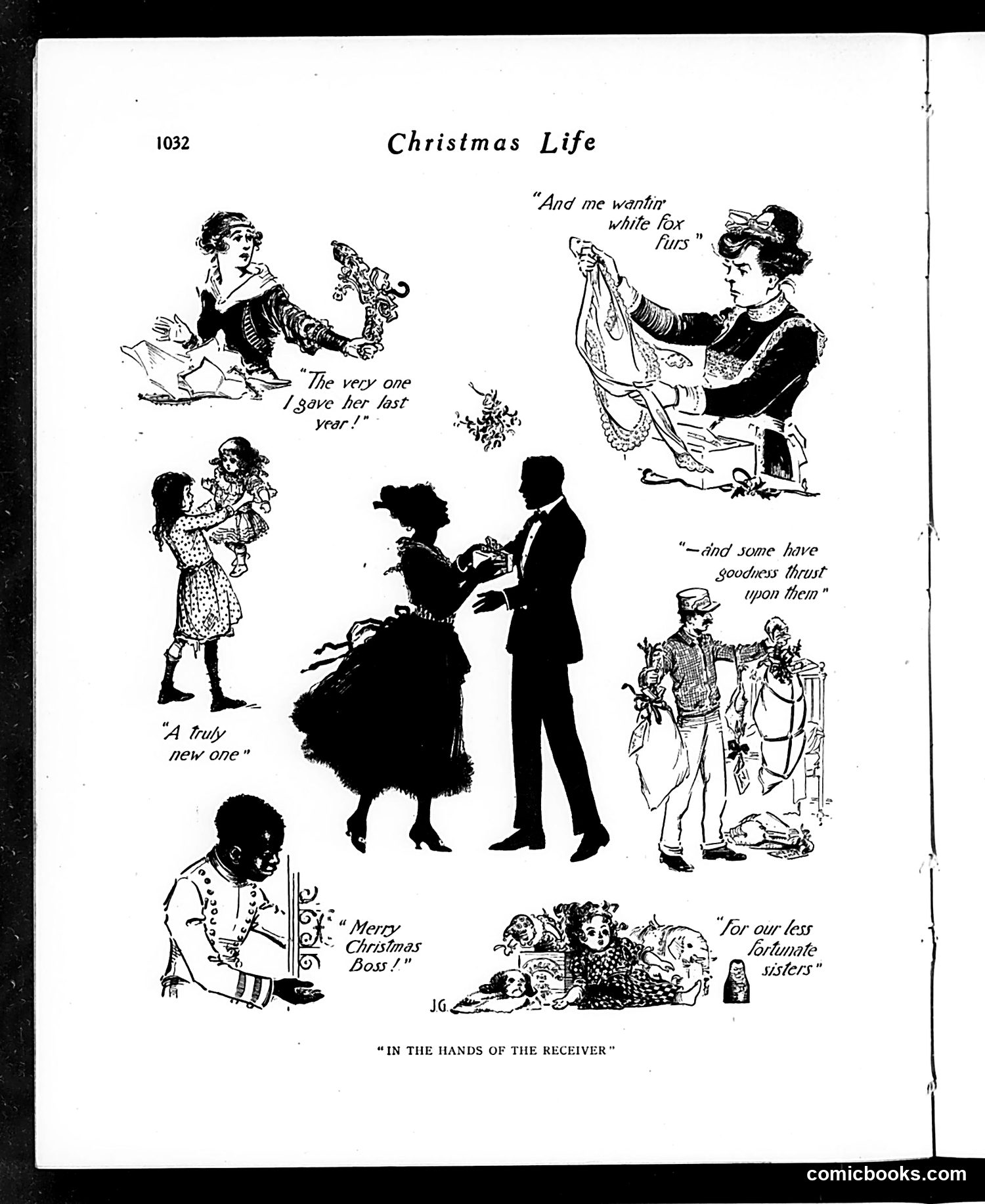
This satirical cartoon mocks the social anxieties around Christmas gift-giving. The page shows various scenarios of gift exchanges with comic quotations: - A woman presenting the same item she gave last year - Someone receiving unwanted items ("white fox furs") - A child receiving a doll ("a truly new one") - A boss receiving Christmas greetings - Charitable giving to the less fortunate The title "In the Hands of the Receiver" suggests the joke: the appropriateness or success of gifts depends entirely on whether recipients actually want them. The satire targets the obligatory nature of Christmas gift-giving and the social performance it requires—giving the same gifts annually, struggling to find acceptable presents, and the awkwardness when expectations don't match reality. It's commentary on commercialized Christmas and the pressure to give "proper" gifts across social hierarchies.
This is a humorous domestic story about masculine pride and one-upmanship during WWI. The narrator returns home to find his wife has wallpapered a room herself while he was away—a remarkable feat for the era. Panicked that his contributions to the household pale beside hers, and anxious about what he'll tell his children when they ask "what did you do, daddy?" during the war, he decides he must accomplish something equally tangible. The satire targets Edwardian masculinity: the narrator is ineligible for military service, so he cannot claim wartime heroism. His "achievement" becomes laying linoleum in his smoking room—a decidedly unglamorous domestic task. The humor lies in the gap between his anxiety about masculine inadequacy and the trivial nature of his response, reflecting anxieties about civilian men's roles during WWI.
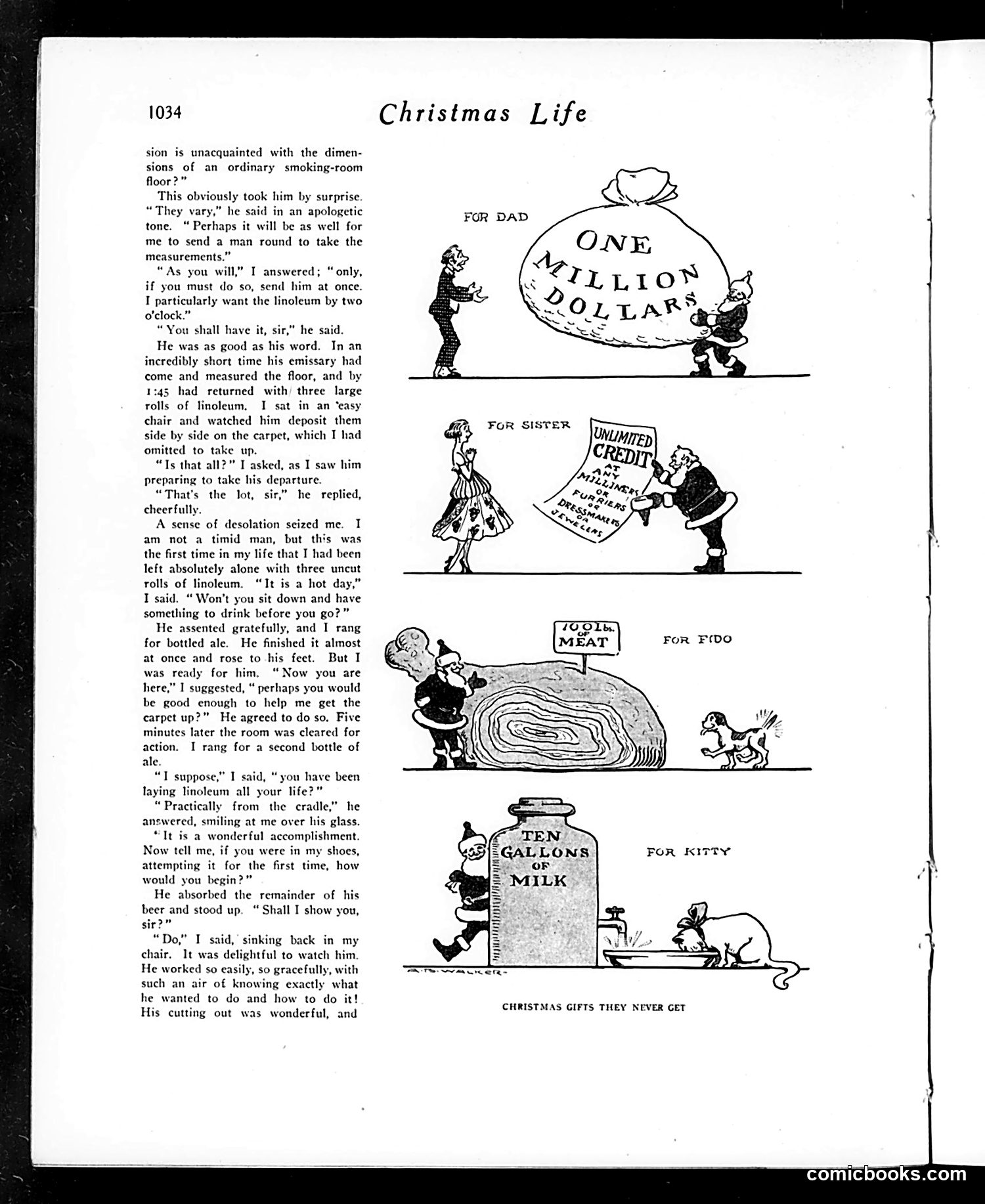
This page contains a humorous narrative essay (left column) about the author hiring a tradesman to lay linoleum, combined with a satirical illustration series (right side) titled "Christmas Gifts They Never Get." The essay depicts the author's resourcefulness in getting free labor by repeatedly offering the worker drinks and flattery, gradually expanding the job from simple linoleum-laying to removing carpet—a comedic commentary on manipulation and class dynamics. The accompanying cartoons mock the gap between what family members *want* and what they actually *receive* as Christmas gifts: - **Dad** receives only an egg instead of one million dollars - **Sister** gets limited credit instead of unlimited - **Fido** (dog) gets meat scraps instead of quality food - **Kitty** (cat) receives milk instead of the luxuries depicted The satire critiques consumer desires and the modest reality of holiday gift-giving, likely resonating during a period of economic constraint (possibly post-WWI era, given Life's 1920s satirical style).
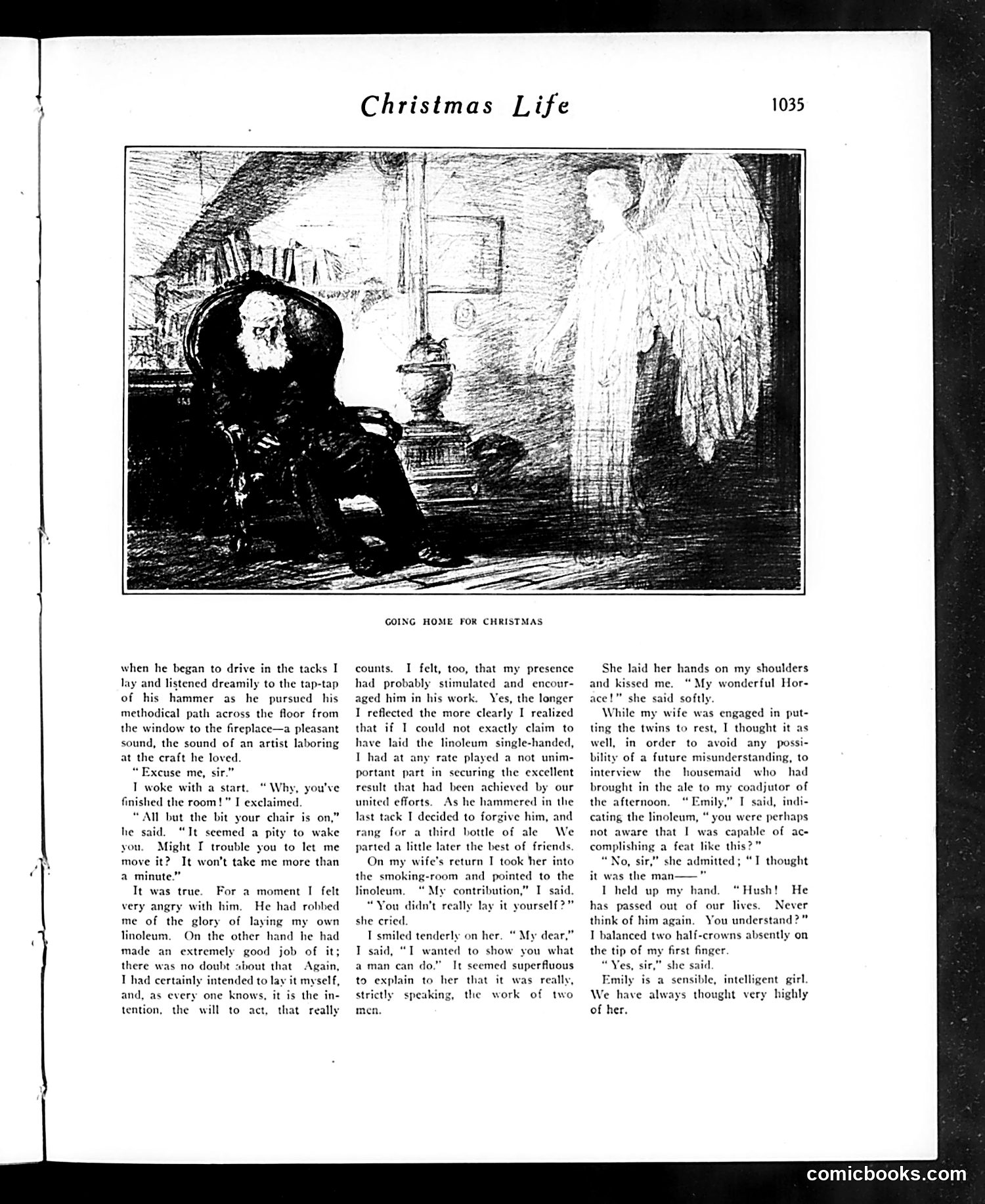
This is a humorous domestic story satirizing male ego and credit-taking. The narrative follows a man who allows a workman to lay linoleum in his home, then takes full credit for the job to his wife, claiming "My contribution." The satire targets masculine vanity: the protagonist convinces himself he deserves credit merely for *intending* to do the work and being *present* while someone else labored. He then manages his wife's perception, accepts her admiration under false pretenses, and even bribes his housemaid Emily to forget the actual workman existed—erasing the real laborer from history. The illustration (captioned "Going Home for Christmas") shows an angel visiting a man, likely representing this moral lesson about dishonesty and self-aggrandizement. The story mocks how men rationalize taking credit for others' work through sophistry and selective truth-telling, particularly within domestic contexts where wives are expected not to question such narratives.
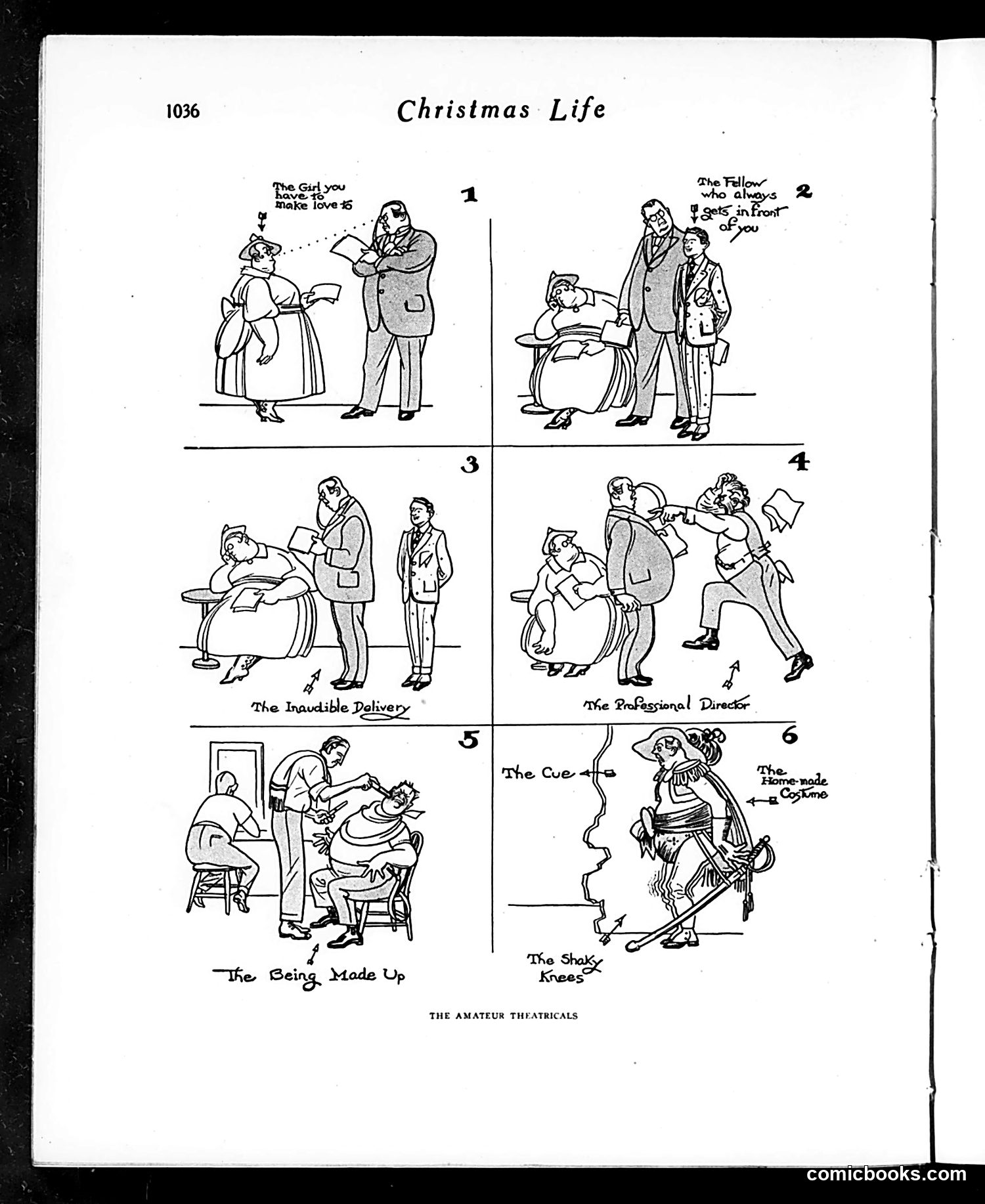
This page satirizes six common pitfalls in amateur theater productions during the Christmas season. Each panel humorously depicts a theatrical stereotype: 1. **The Girl You Have to Make Love To** - An awkward romantic scene 2. **The Fellow Who Always Gets in Front of You** - A blocking problem 3. **The Invisible Delivery** - An actor fumbling props or lines 4. **The Professional Director** - Overly elaborate gesturing and direction 5. **The Being Made Up** - Excessive makeup application 6. **The Shaky Knees** - Stage fright and nervousness The humor relies on recognizing universal experiences of community theater: miscommunication, overacting, technical mishaps, and performer anxiety. The satire gently mocks both amateur actors' pretensions and the inherent chaos of volunteer productions, likely reflecting widespread holiday theatrical traditions among American social groups in the early 20th century.
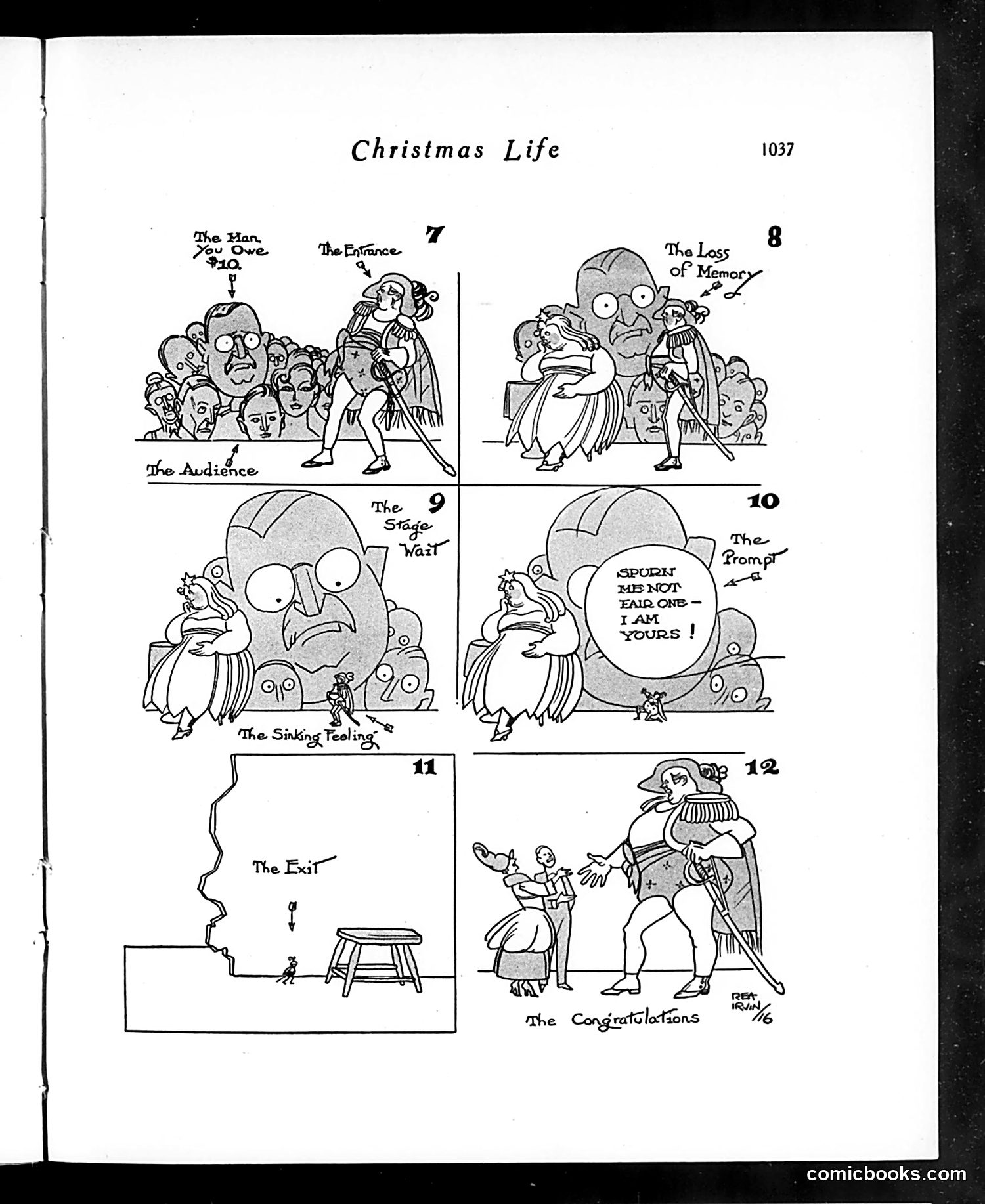
This is a twelve-panel comic strip titled "Christmas Life" that satirizes the theatrical performance of Christmas sentiment. It depicts the "stages" of experiencing Christmas as if orchestrating a play: 1. **"The Audience"** - ordinary people watching 2. **"The Entrance"** - a dramatic character arrival 3. **"The Loss of Memory"** - forced forgetfulness of past grievances 4. **"The Stage Wait"** - anticipatory tension 5. **"The Sinking Feeling"** - emotional descent 6. **"The Prompt"** - a character delivering false reassurance ("Scorn his not, fair one—I am yours!") 7. **"The Exit"** - departure from the performance 8. **"The Congratulations"** - false celebration The satire suggests Christmas goodwill is performative theater—people artificially adopt cheerfulness and forgiveness, suppress negative memories, and congratulate themselves on the charade. The exaggerated caricatures and stage directions emphasize the artificiality of seasonal sentiment.
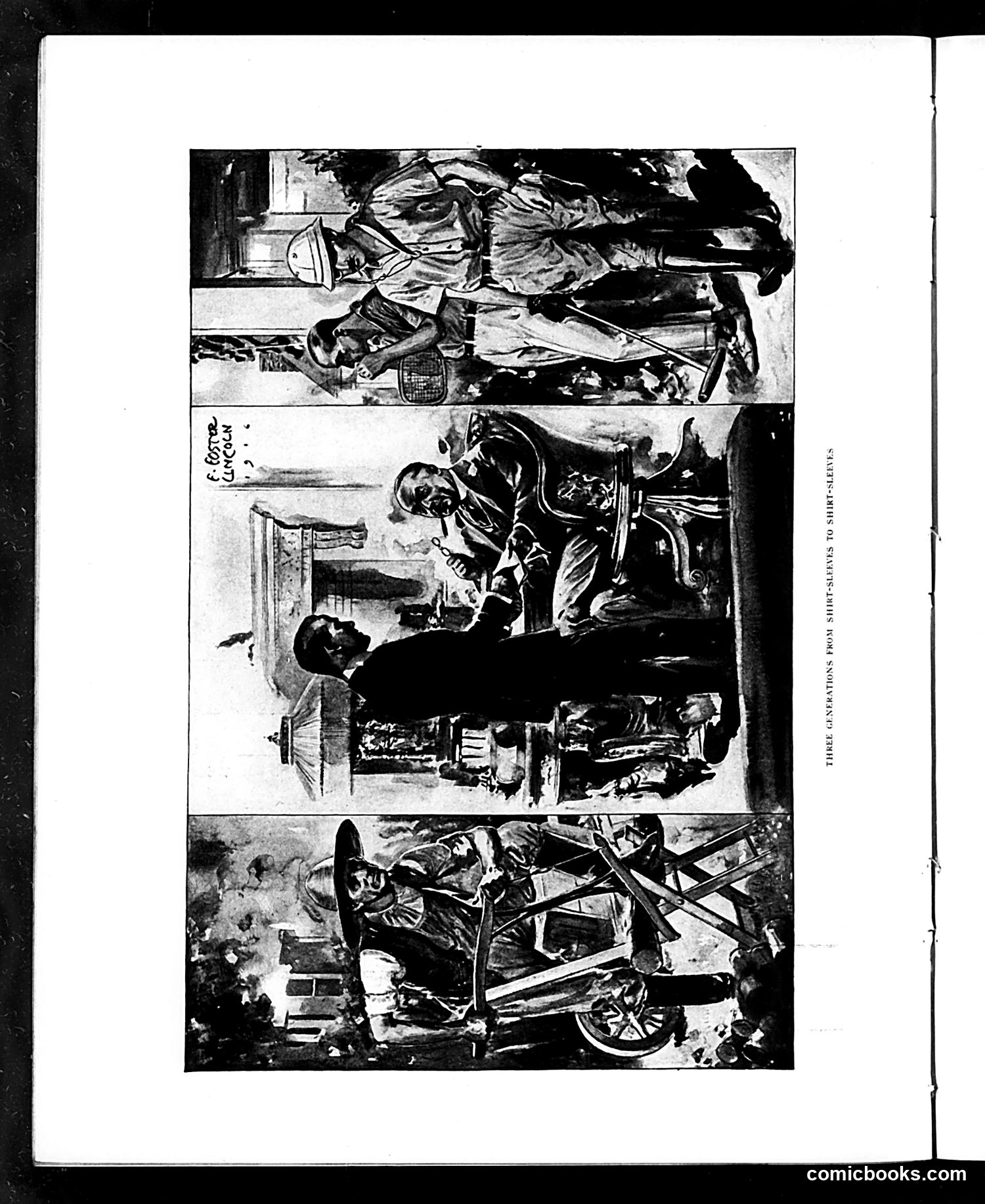
This page contains three black-and-white photographs arranged vertically, accompanied by the caption "THREE GENERATIONS FROM SHIRT-SLEEVES TO SHIRT-SLEEVES." The images appear to document a family progression across generations—likely showing different social or economic circumstances. The caption references a common Victorian-era saying about wealth and status: the proverb that family fortunes typically decline from "shirt-sleeves to shirt-sleeves" in three generations (implying poor-to-rich-to-poor cycles). Without clearer visibility of the individuals pictured or additional context, I cannot identify the specific family depicted. However, this appears to be satirical social commentary on class mobility, wealth management, or generational decline—a pointed observation about the impermanence of financial or social standing in American life.
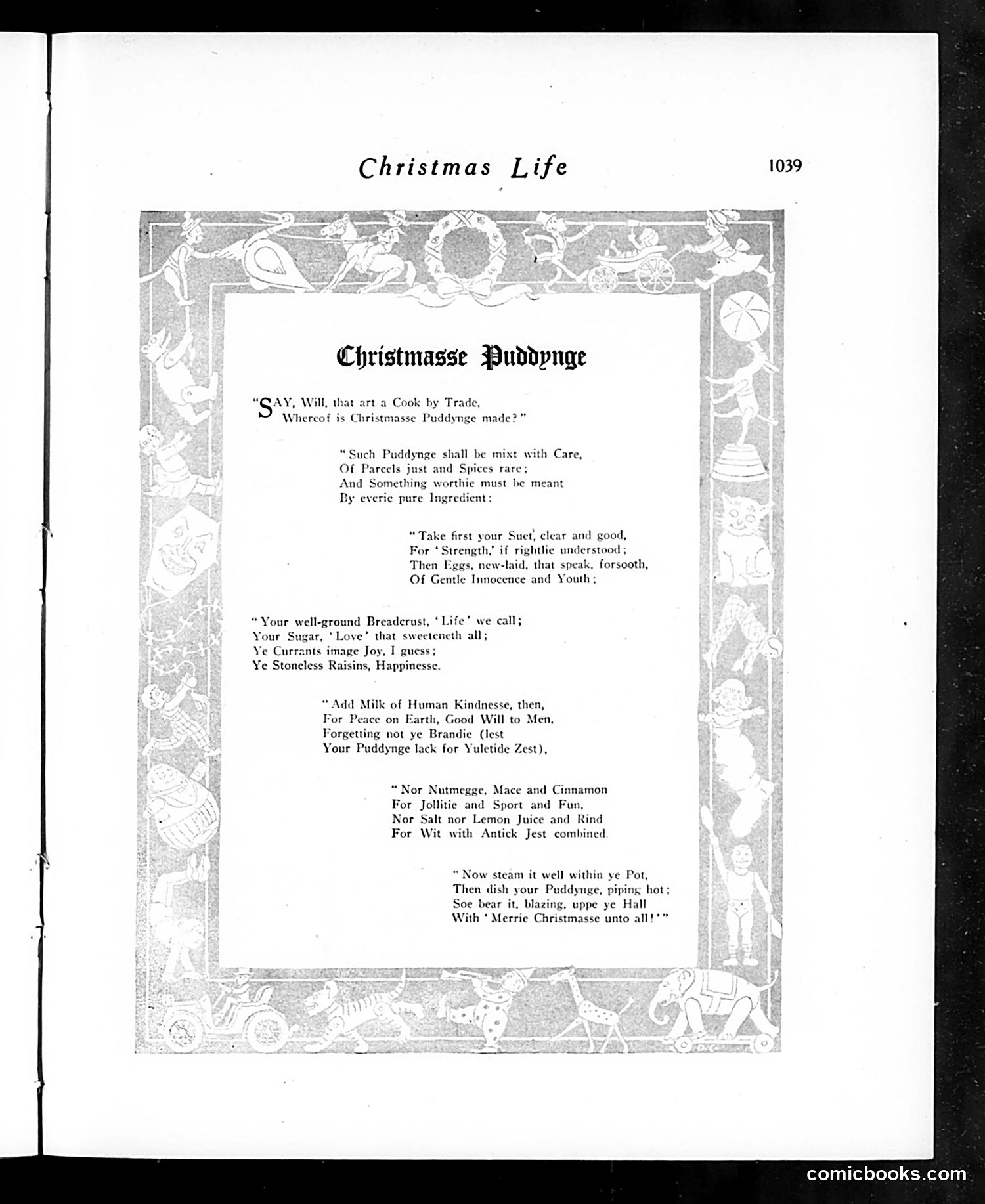
This is a Victorian-era allegorical poem disguised as a Christmas pudding recipe. Using deliberately archaic spelling ("ye," "Puddynge"), it presents pudding ingredients as moral and emotional virtues. Each ingredient symbolizes an abstract concept: suet represents "Strength," eggs symbolize "Innocence and Youth," breadcrust means "Life," sugar stands for "Love," currants represent "Joy," and raisins signify "Happiness." Crucially, "Milk of Human Kindness" and brandy (for "Yuletide Zest") anchor the recipe's moral message—the pudding becomes a metaphor for creating Christmas goodwill and peace on earth. The satire appears gentle: *Life* magazine uses cooking instructions to encode Victorian moral values, suggesting that proper Christmas celebration requires blending virtue, joy, kindness, and merriment. The ornamental border and formal presentation emphasize this is sentimental, middle-class Victorian sentiment wrapped in whimsical antiquity.
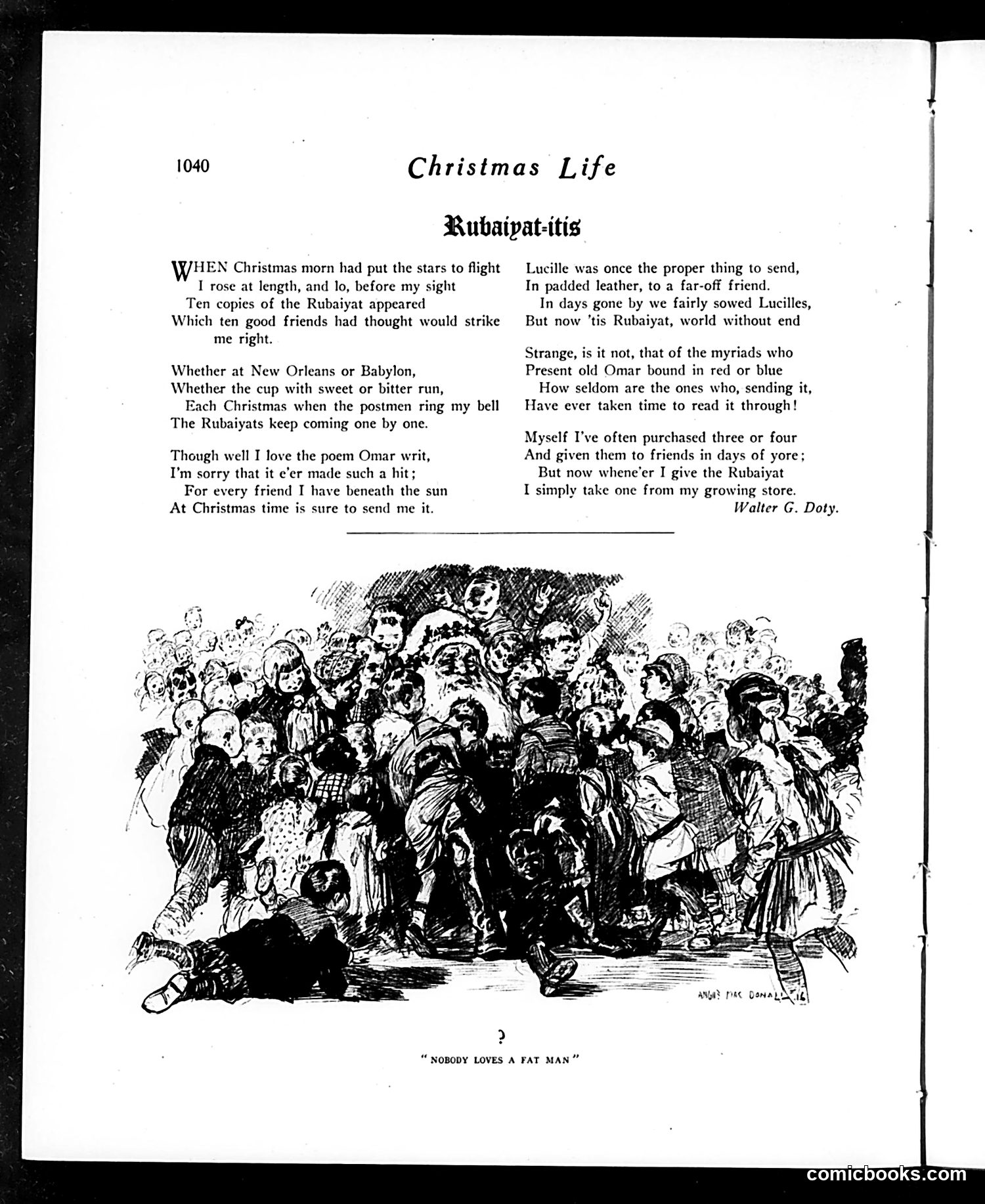
This satirical poem by Walter G. Doty mocks the fashionable over-gifting of Edward FitzGerald's translation of *The Rubaiyat of Omar Khayyam*, a Persian poetry collection that became wildly popular in America during the late 19th/early 20th century. The joke: Everyone gives copies as Christmas gifts without actually reading them. The author receives so many identical copies that he now simply regifts them from his accumulated pile. The poem notes that *Lucille* (another book, now forgotten) was the previous year's obligatory gift—suggesting this represents a cycle of thoughtless, trendy gift-giving. The accompanying illustration shows a crowd of people, likely representing the masses thoughtlessly participating in this fad. The satire targets both consumer culture and intellectual pretension: the Rubaiyat became a status symbol to own and gift, regardless of genuine literary interest.
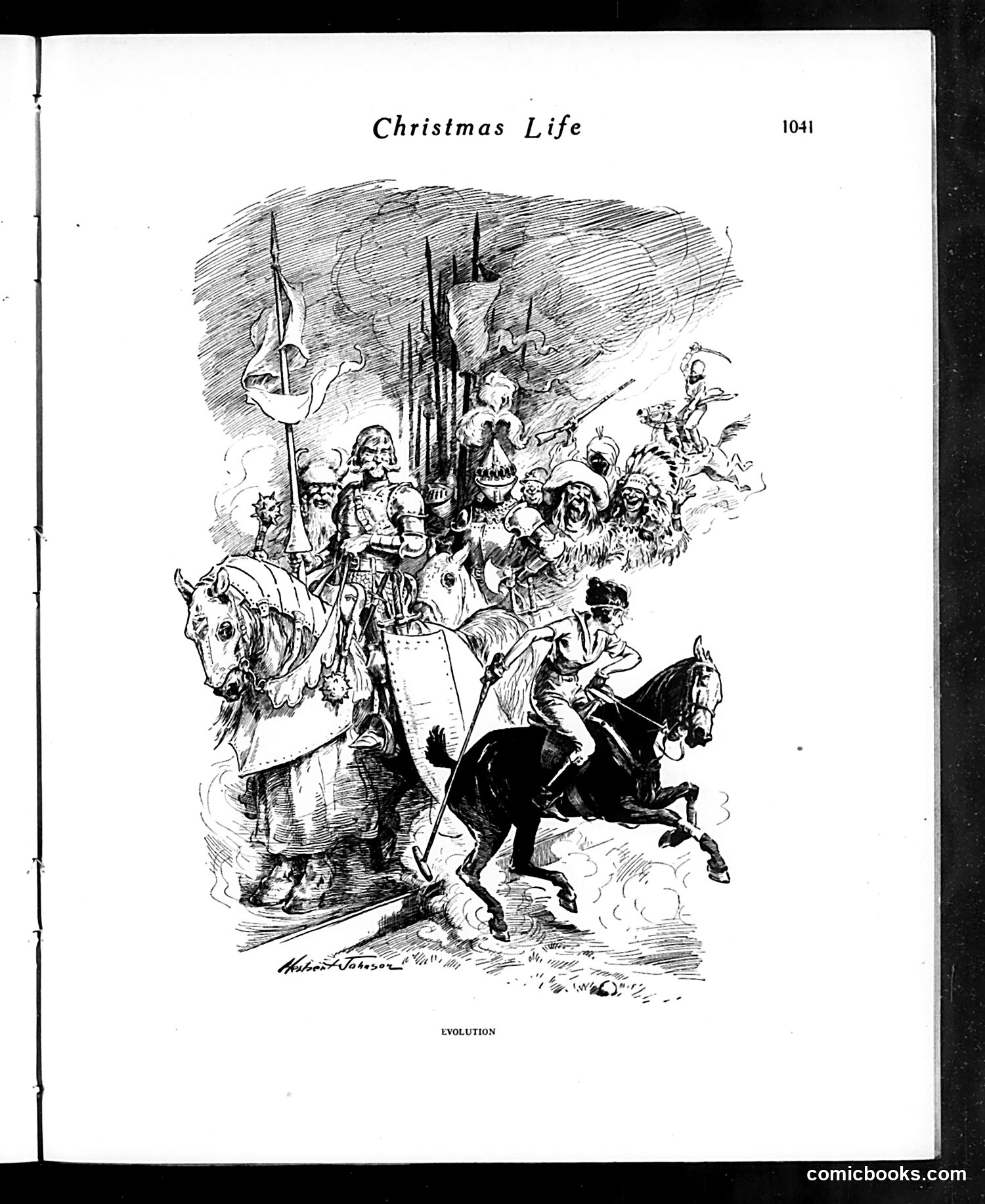
This is a satirical illustration titled "Evolution," depicting a procession of increasingly elaborate and grotesque figures riding horses and mounted on what appears to be a castle or fortification. The style suggests late 19th or early 20th-century social commentary. The cartoon likely satirizes the concept of progress or "evolution" in society, military, or politics—showing how civilization or institutions have supposedly "advanced" into absurdity. The parade of costumed, elaborately dressed figures suggests mockery of pretension, militarism, or ostentatious display. Without clearer context about Life magazine's specific publication date or political moment, the exact targets remain unclear, but the overall message criticizes some form of societal "progress" as actually representing decline into chaos or ridicule.
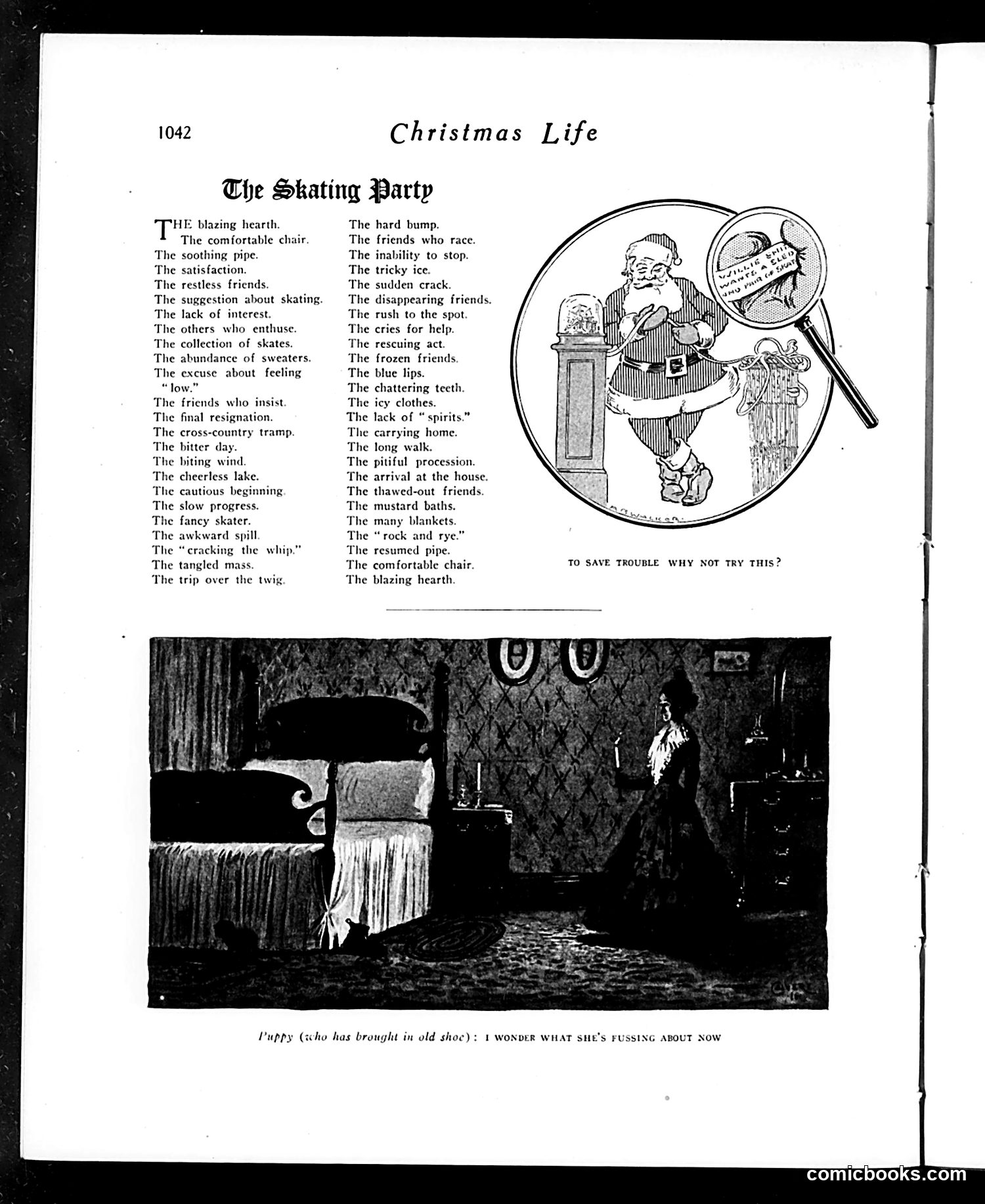
This page satirizes the idealized Christmas skating party through humorous contrast. The left column lists all the *romantic notions* people have about skating (blazing hearth, comfortable chair, soothing pipe), while the right column reveals the *actual miserable reality* (hard bumps, tricky ice, disappearing friends, blue lips, chattering teeth). The illustration shows Santa delivering gifts—a romanticized winter scene. The bottom photograph depicts a bedroom interior with the caption about a puppy bringing in an old shoe, humorously suggesting domestic chaos undermines holiday perfection. The joke: Christmas activities rarely match their idealized image. What people *imagine* will be cozy and pleasant typically devolves into cold, injury, exhaustion, and needing warming blankets and alcohol ("rock and rye") to recover. The circular framing of Santa reinforces the gap between fantasy and reality. The final suggestion "TO SAVE TROUBLE WHY NOT TRY THIS?" sarcastically endorses staying home by the fire instead.
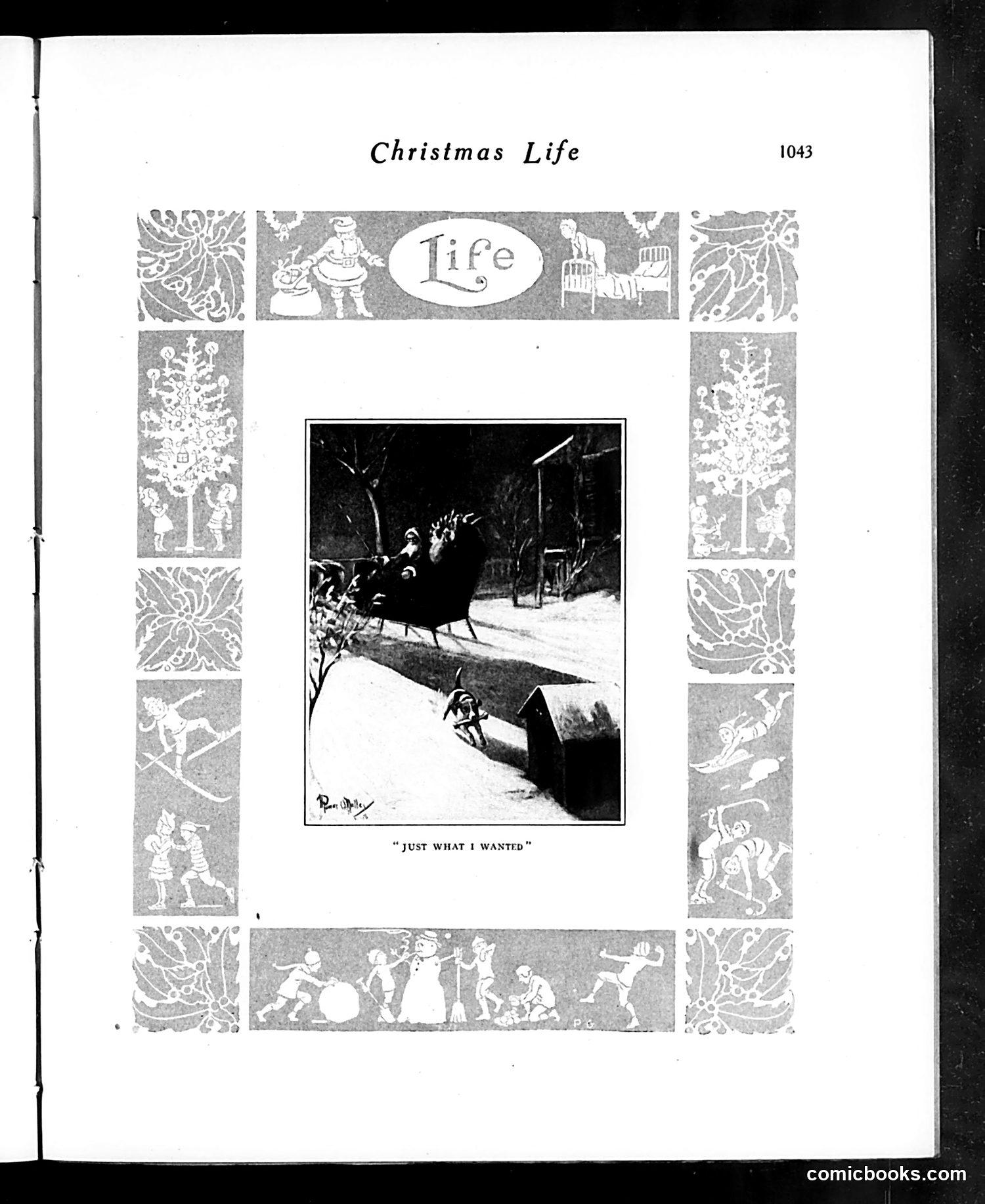
This is a Christmas-themed page from *Life* magazine featuring a single cartoon titled "Just What I Wanted." The image shows a winter scene with a child sledding down a snowy slope toward a large log. An adult (likely a parent) watches from above, apparently having arranged this somewhat dangerous scenario as a Christmas gift. The satire targets parental judgment and the gap between what children actually desire versus what adults think is good for them. The "gift" is presented as if it were a thoughtful present, when it's clearly a hazardous setup. The humor derives from the ironic contradiction: the child is delighted with something that appears reckless by modern safety standards, while the parent seems oblivious to the danger—or intentionally indifferent. It's a commentary on outdated or misguided gift-giving and parenting attitudes.
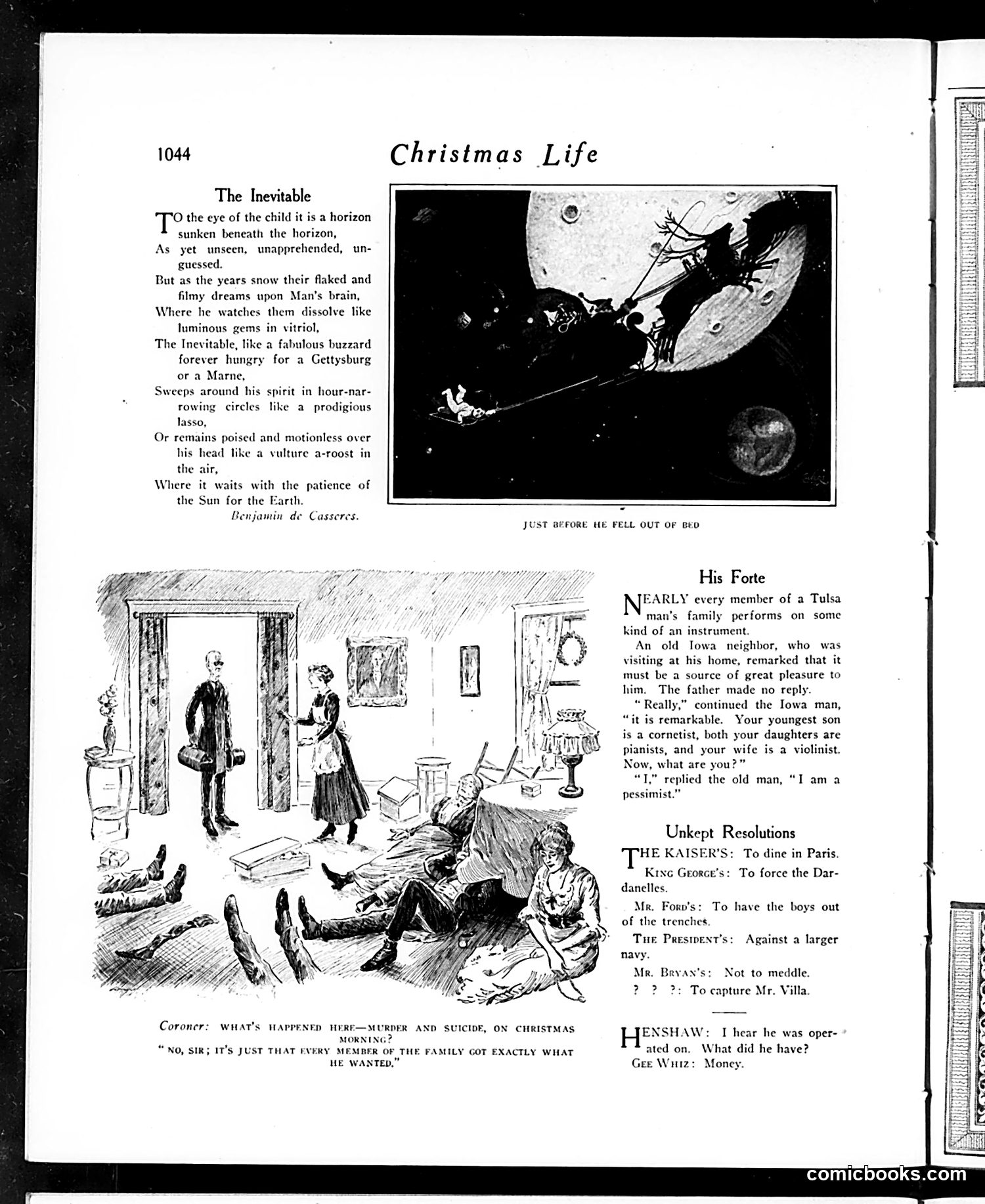
This *Life* magazine page from around 1916-1918 uses dark humor to mock Christmas during World War I. The main cartoon depicts a coroner at a family death scene on Christmas morning. The joke: the coroner misinterprets the "murder and suicide" as actually just each family member getting exactly what they wanted—suggesting Christmas gifts are so disappointing they're literally fatal. The second item, "His Forte," jokes that a Tulsa man whose entire family plays instruments describes himself as a "pessimist"—implying constant musical practice in close quarters is torture. "Unkept Resolutions" satirizes world leaders' failed war aims: the Kaiser wanted to dine in Paris; King George aimed to force the Dardanelles; President Wilson wanted troops out of trenches; Bryan promised non-interference; and capturing Mexican revolutionary Villa remained elusive. The humor lies in these grand military objectives remaining unfulfilled despite the war's continuation.
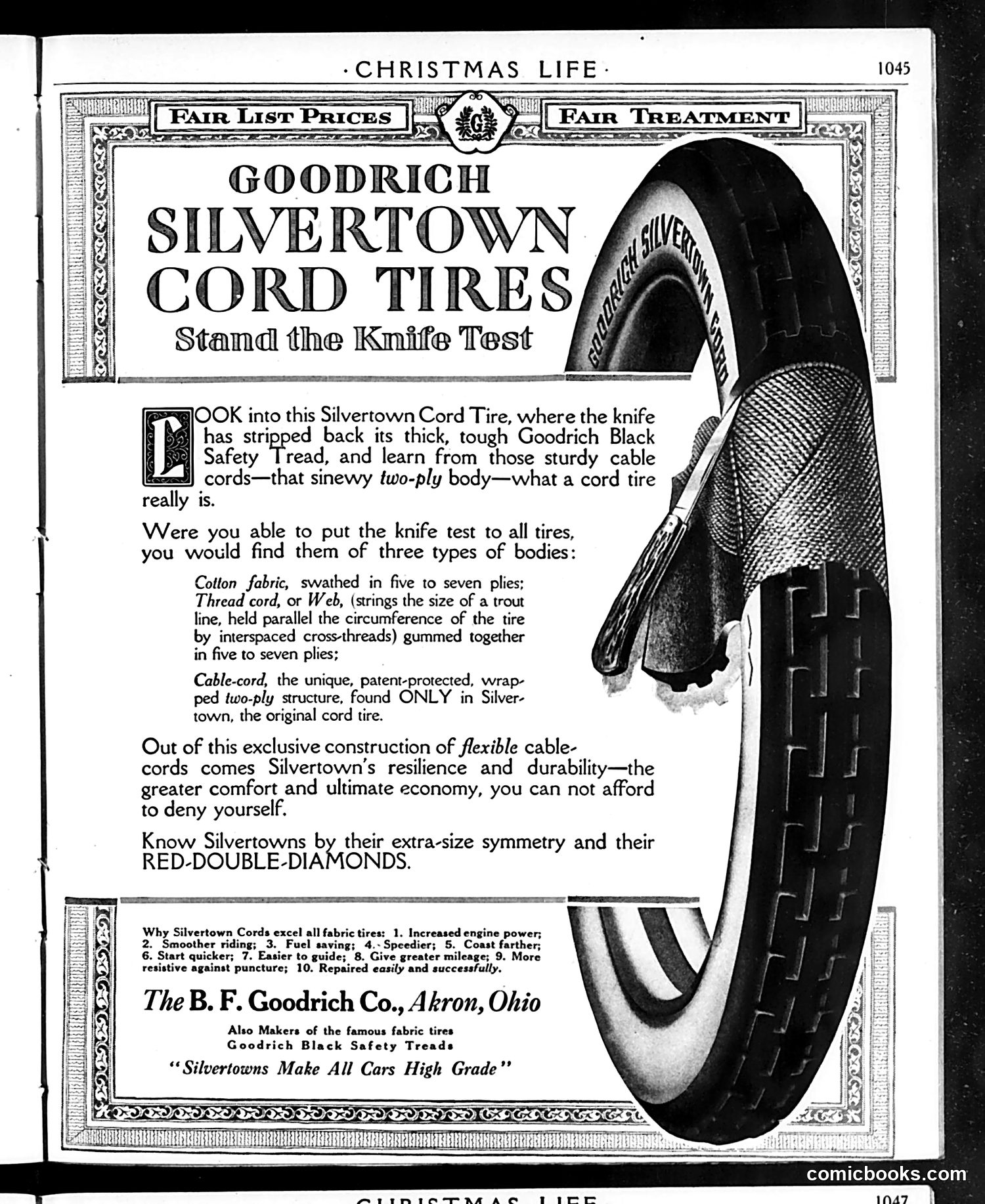
This is **not a cartoon or satire**—it's a straightforward **advertisement** for B.F. Goodrich Silvertown cord tires, appearing in Life magazine's Christmas issue. The "knife test" is a literal product demonstration: the ad shows a tire cross-section with a knife blade revealing its internal structure. The advertiser emphasizes Silvertown's superior "cable-cord" construction (a two-ply design) compared to competitors' cotton fabric or thread-cord alternatives, claiming advantages like better fuel economy, faster acceleration, and durability. The imagery—a large tire photographed with a knife cutting into it—serves as visual proof of product superiority. The red double-diamonds are the brand's identifying mark. This reflects early automotive advertising strategy: using technical demonstrations and comparative claims to establish product differentiation. For modern readers, it's notable mainly as period advertising style and the era when tire quality was apparently a major consumer concern.
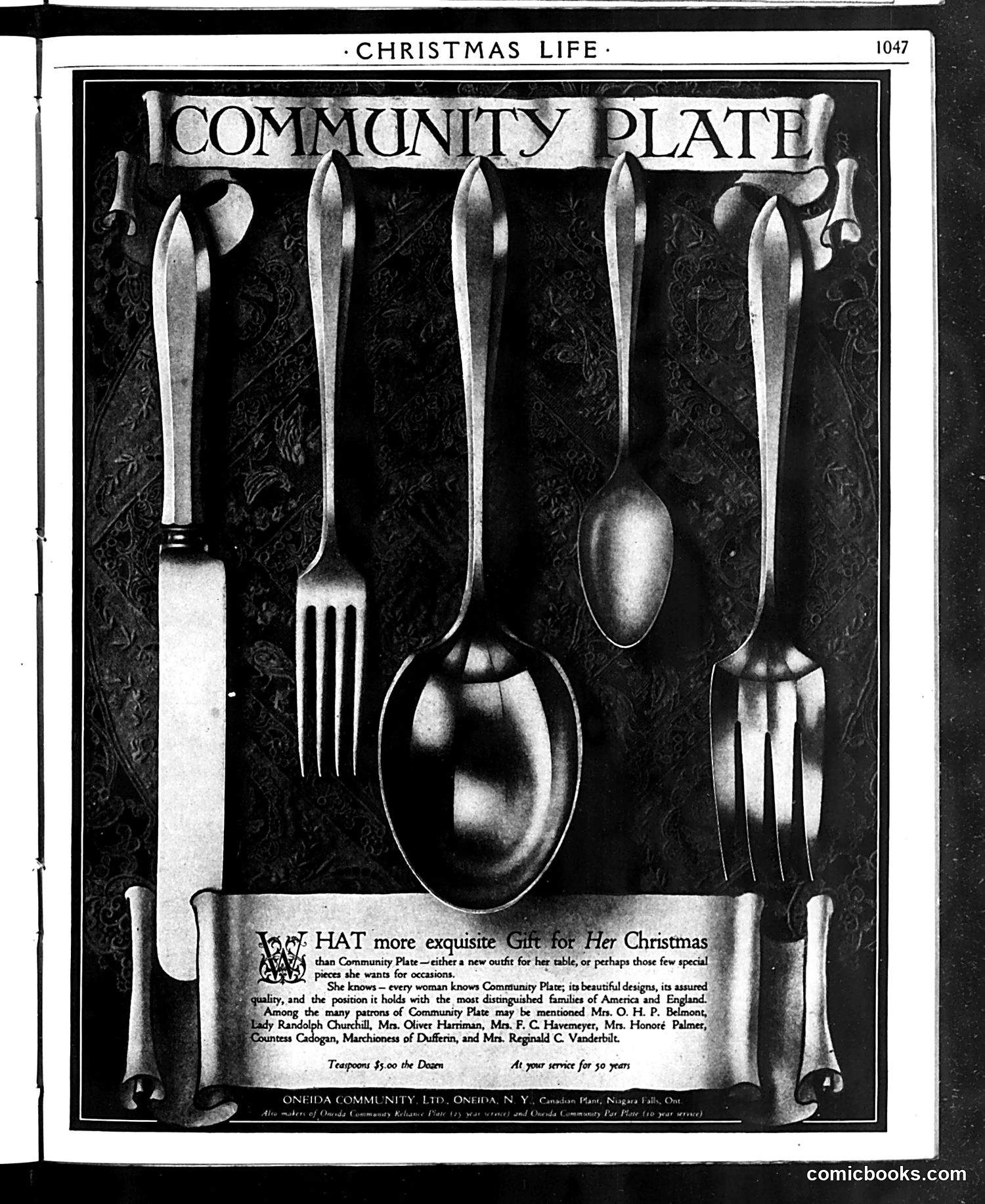
This is a **Christmas advertisement**, not a cartoon or satire. It promotes "Community Plate" silverware as a gift, displaying flatware (knife, fork, spoons) arranged against a decorative background. The ad's appeal relies on **social status signaling**. It claims Community Plate is favored by wealthy, prominent families—specifically naming socialites like Mrs. O.H.P. Belmont, the Vanderbilts, and the Churchills. For a modern reader, this is straightforward luxury marketing: the product gains prestige through association with established American wealth and European nobility. The text emphasizes "beautiful designs" and "distinguished families," positioning silverware as aspirational consumer goods suitable for formal entertaining. Priced at $5 per teaspoon (expensive for the era), it targets middle-to-upper-class readers of *Life* magazine who could afford such items. There is no political satire here—just period advertising that equates tableware with social respectability.
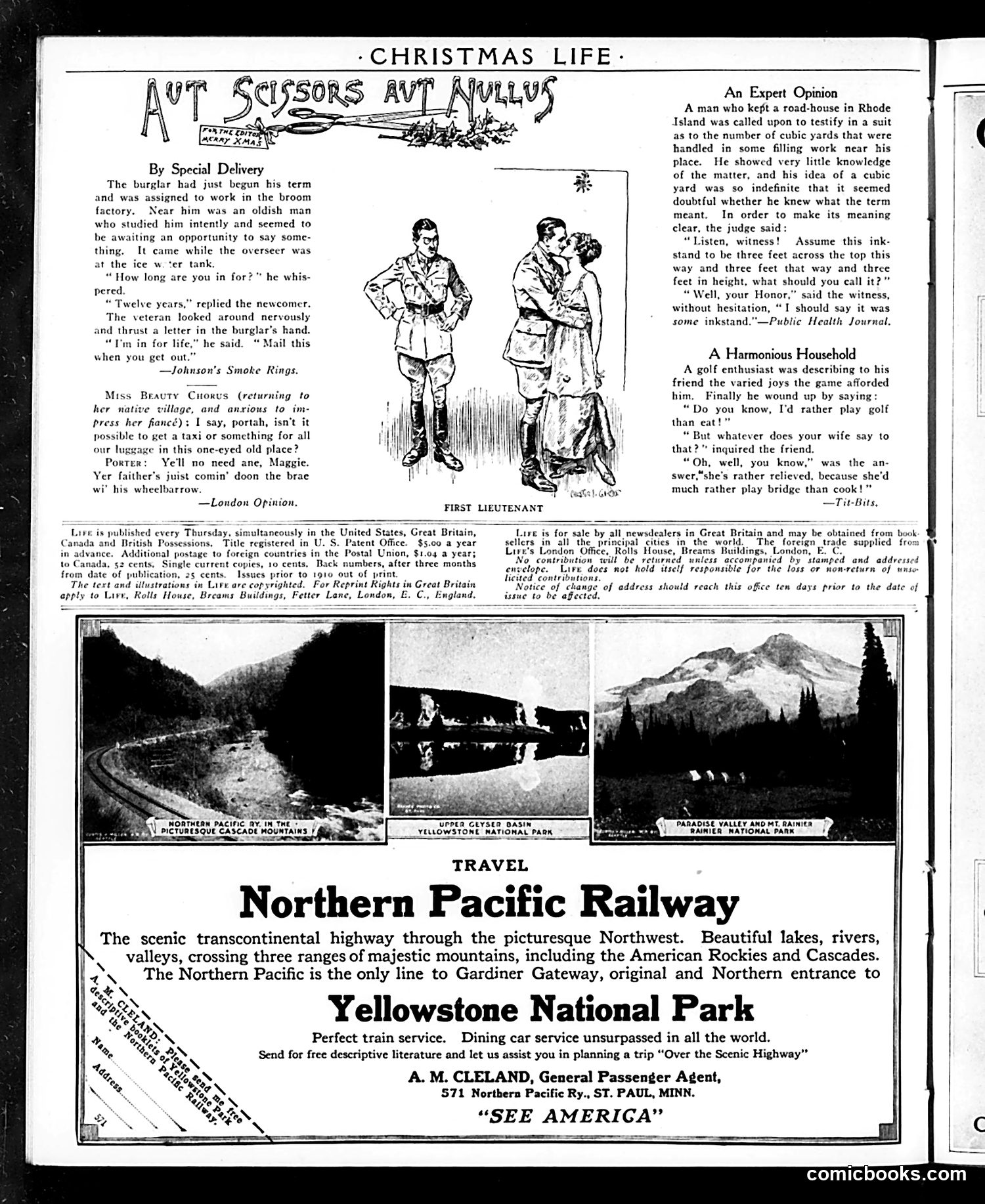
This page from *Life* magazine contains three unrelated humor pieces typical of early 20th-century satirical journalism: 1. **"By Special Delivery"** (Johnson's Smoke Rings): A prison anecdote where a lifer asks a newly sentenced burglar to mail a letter after release—dark humor about incarceration. 2. **"Miss Beauty Chorus"** (London Opinion): A Scottish joke about a returning city woman expecting taxi service in her rural village, only to find her father arriving with a wheelbarrow. The humor relies on class contrast and dialect comedy common to the era. 3. **"An Expert Opinion"** and **"A Harmonious Household"**: Brief joke items about a road-house owner unable to define "cubic yard" and a husband who prefers golf to eating (while his wife prefers bridge to cooking). These reflect domestic tensions and leisure-culture humor of the period. The page is primarily advertising—the Northern Pacific Railway dominates the lower half with scenic photography promoting Yellowstone travel.
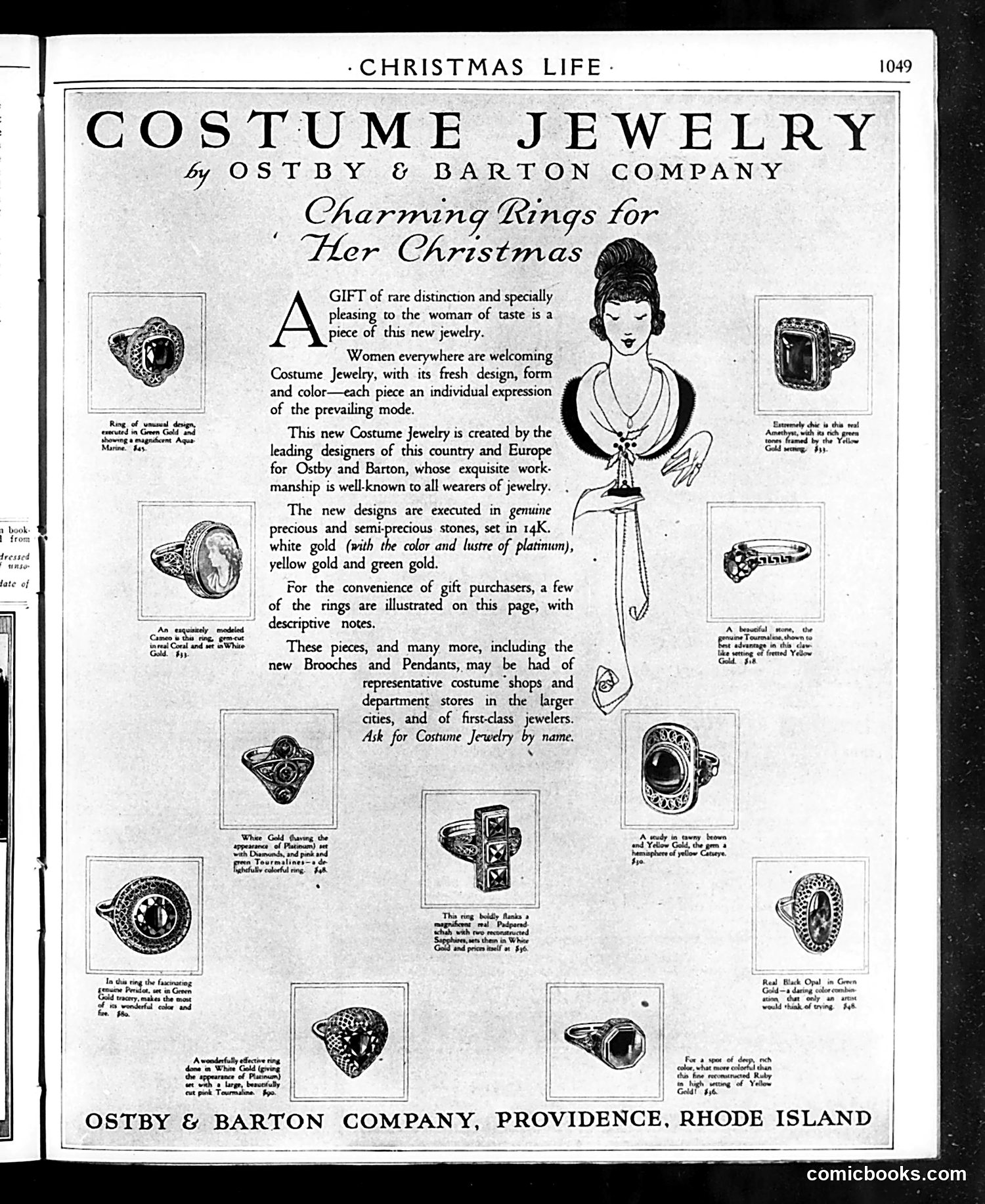
This is not a cartoon or satire—it's a **straightforward advertisement** for costume jewelry by the Ostby & Barton Company. The page features a glamorous illustration of a fashionable woman modeling rings, surrounded by photographs of various ring designs. The text emphasizes that costume jewelry (affordable imitation jewelry using semi-precious stones and gold-plated metals) is now fashionable and respectable as a Christmas gift for women of "taste." The social context: In the 1920s-30s era suggested by the styling, costume jewelry was becoming socially acceptable among middle and upper classes as a practical, fashionable alternative to expensive fine jewelry. The advertisement targets gift-givers seeking to give "rare distinction" without premium prices. There is no political satire or social commentary here—simply a period advertisement marketing the acceptability and elegance of costume jewelry for holiday shopping.
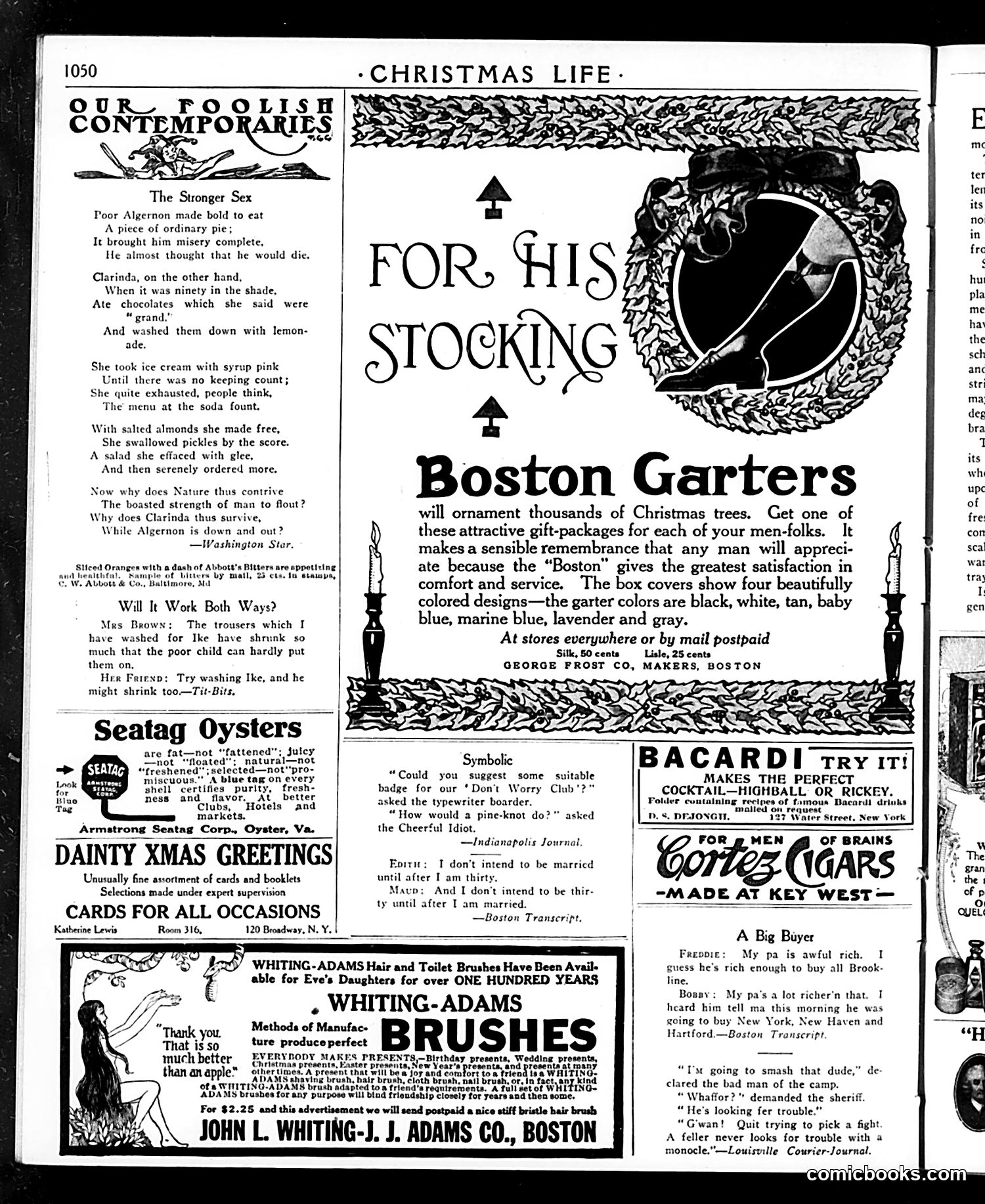
This page is primarily **advertisements and light humor** rather than political satire. The content includes: **"The Stronger Sex"** — A humorous poem contrasting a man (Algernon) who becomes ill eating ordinary pie with a woman (Clarinda) who consumes enormous quantities of rich foods without consequence. The joke plays on contemporary gender stereotypes about female delicacy versus male fragility, subverting expected roles. **"Will It Work Both Ways?"** — A brief joke about laundry shrinkage, suggesting sarcastically that washing a child might shrink him as clothes shrink. **Other brief jokes** include wordplay about a "pine-knot" badge for a "Don't Worry Club" and playful children's boasts about their fathers' wealth. The dominant content is **product advertising**: Boston Garters (men's hosiery), Seatag Oysters, Bacardi cocktail mix, and Whiting-Adams brushes. These ads use period conventions like testimonials and emphasis on quality and tradition (one brush company claims over 100 years of history).
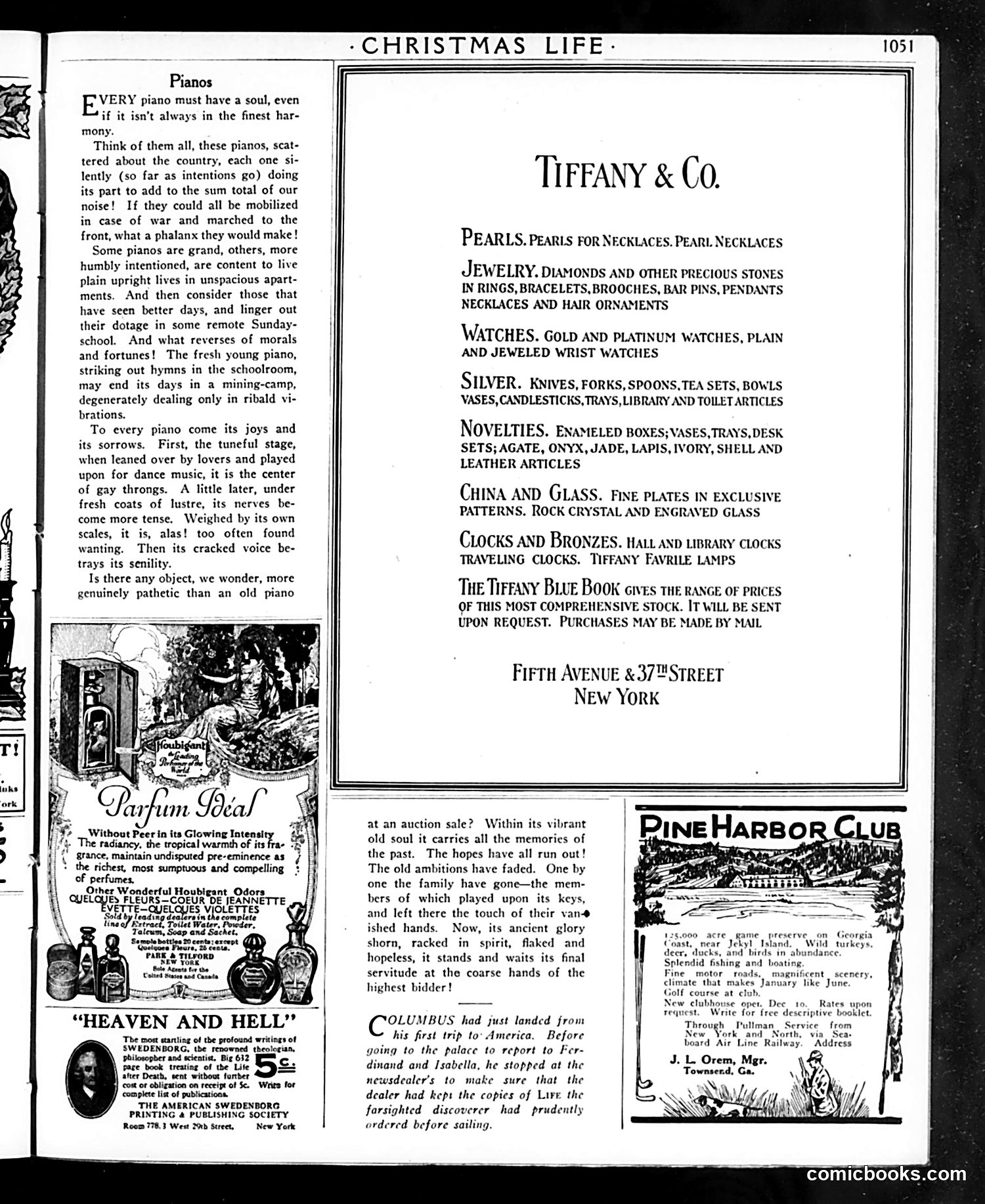
This is primarily an **advertising and editorial page** from Life magazine's Christmas issue (page 1051). The main content consists of luxury brand advertisements rather than political cartoons or satire. **Key Content:** The left column contains a **sentimental essay on pianos**—personifying them as objects with "souls," tracing their lifecycle from joyful dance-hall instruments to deteriorating relics abandoned in remote Sunday schools or mining camps. The tone is melancholic, treating old pianos as tragic figures. **Advertisements dominate the right side:** - **Tiffany & Co.** luxury goods (pearls, diamonds, watches, silver) - Perfume advertisement ("Parfum Boal") - **Pine Harbor Club** (Georgia resort) - A brief humorous anecdote about Columbus checking that a newsdealer stocked copies of *Life* magazine before reporting to the Spanish monarchy **The satire is light:** Columbus's priority is ensuring his magazine copies were saved—a gentle jab at American materialism and periodical culture. No political figures or serious commentary appear.
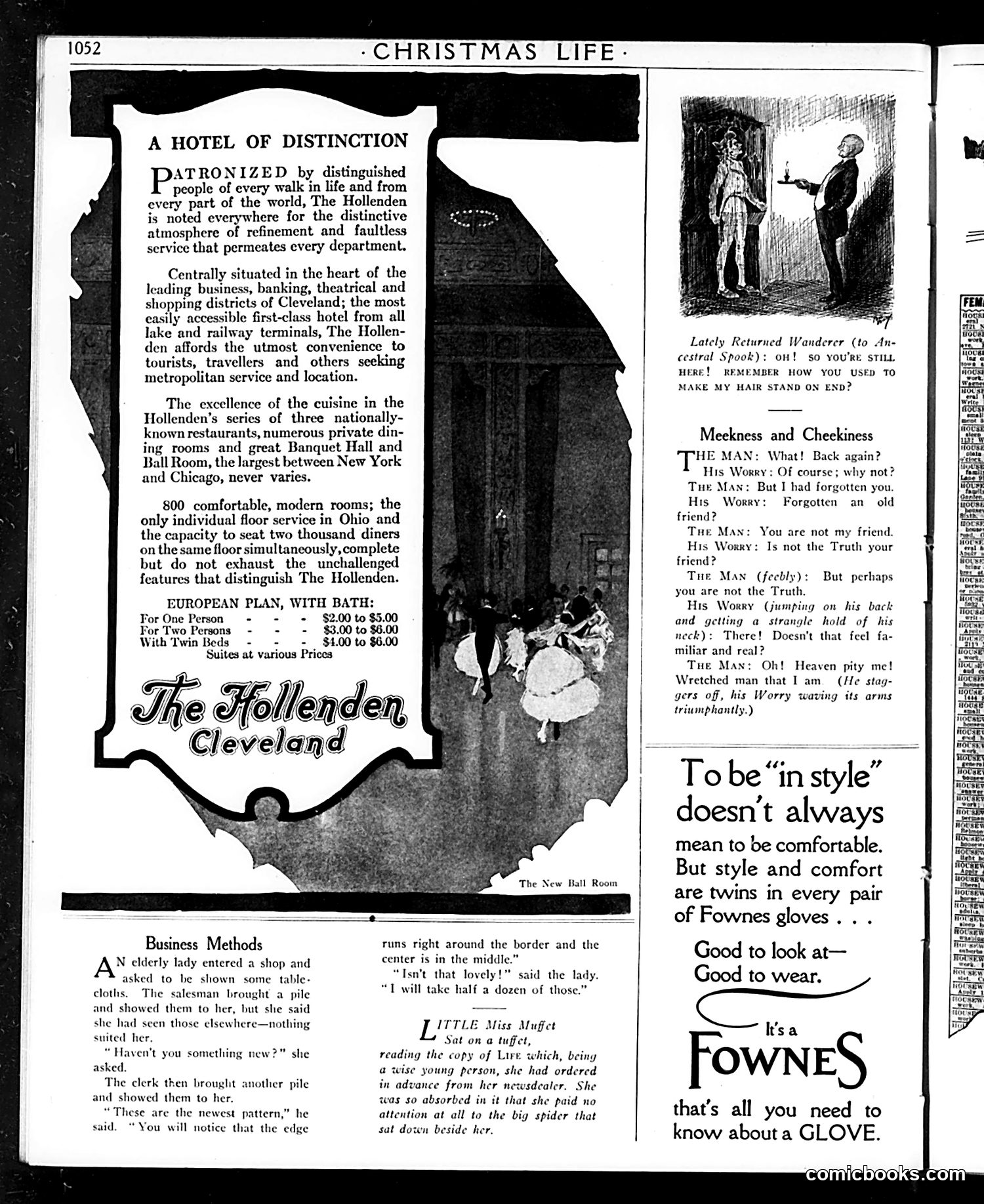
This is primarily an **advertising and humor page** from Life magazine, not a political cartoon page. **Main Content:** - **The Hollenden Hotel advertisement** (left): A Cleveland luxury hotel promoting its amenities, cuisine, and room rates to wealthy travelers - **Comic vignettes** (center/right): Four brief humorous sketches depicting everyday social situations: 1. A shopkeeper's absurd sales pitch about tablecloths with borders and centers 2. "Little Miss Muffet" as a distracted Life magazine reader (self-promotional humor) 3. A ghost returning to scare its former victim 4. "Meekness and Cheekiness"—personified Truth literally wrestling with a man - **Fownes Gloves advertisement** (right): Promoting style and comfort in gloves **Historical Context:** This reflects early 20th-century consumer culture and genteel humor. The jokes target middle-class pretension and absurdity in everyday commerce. Nothing here requires specialized historical knowledge beyond understanding this is period advertising mixed with light satirical sketches.
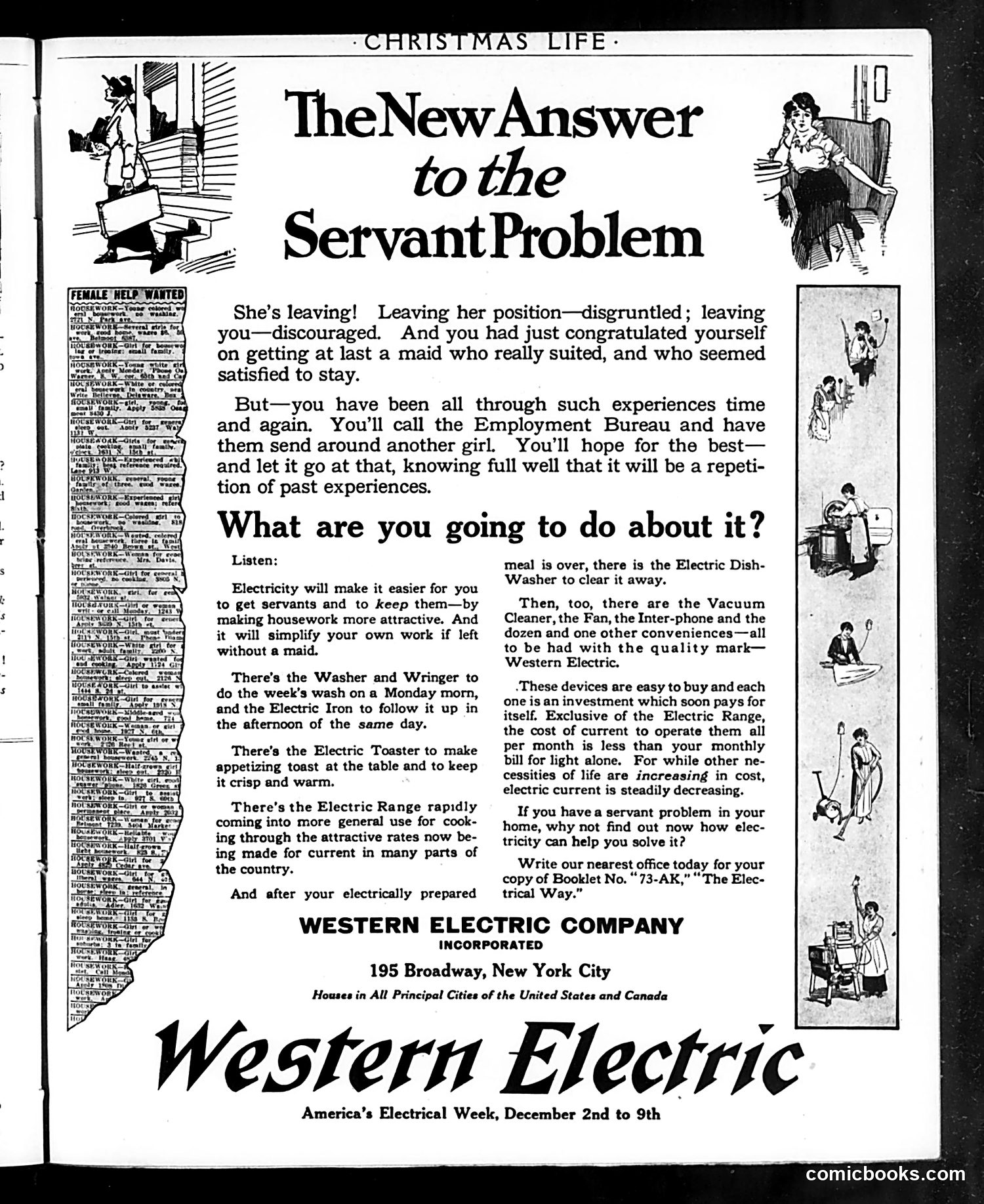
This is a **Western Electric Company advertisement disguised as advice**, not satire. It addresses a genuine early-20th-century domestic crisis: servant shortage and high turnover. The "problem" presented is a maid quitting, leaving the employer frustrated. Rather than solving labor practices or wages, Western Electric proposes electrical appliances as the answer—making housework attractive enough to retain servants, or eliminating the need for them entirely. The irony (likely unintentional from the advertiser's perspective) is striking to modern readers: the ad acknowledges widespread servant dissatisfaction while offering appliances instead of addressing why servants left. The images on the right show women using these devices, suggesting electrified housework as liberation. This reflects a pivotal moment when domestic technology promised to solve "the servant problem" through mechanization rather than improved labor conditions—a narrative that shaped modern housework expectations.
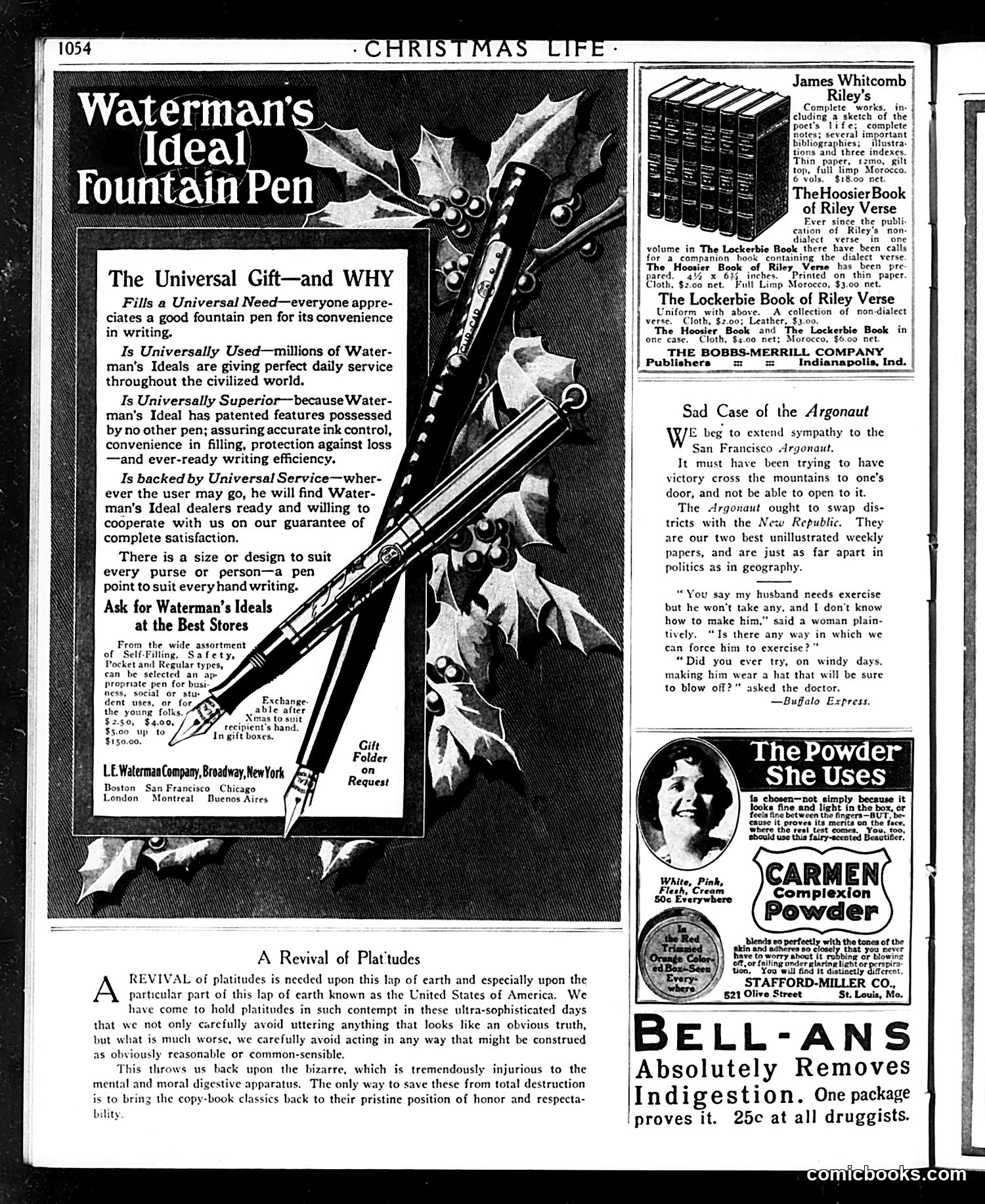
This is primarily a **vintage advertising and editorial page** (circa early 1900s based on style), not political satire. **Main Content:** - **Waterman's Fountain Pen ad** (left): Promotes fountain pens as the ideal universal gift, emphasizing reliability and service—a major consumer product of the era when handwriting was essential to daily life. - **"A Revival of Platitudes"** (center): Editorial arguing Americans should return to common-sense values and traditional wisdom ("copy-book classics") rather than pursuing bizarre behavior. The author critiques ultra-sophisticated cynicism as harmful to moral health. - **Right sidebar**: Book advertisements (James Whitcomb Riley poetry collections) and product ads (Carmen Complexion Powder, Bell-Ans indigestion remedy). - **Humor items**: Brief anecdotes about marriage and exercise, typical of the era's light magazine fare. **No political cartoon is present.** The page reflects early 20th-century consumer culture and gentle social commentary on manners and sophistication, with no identifiable caricatures or partisan satire.
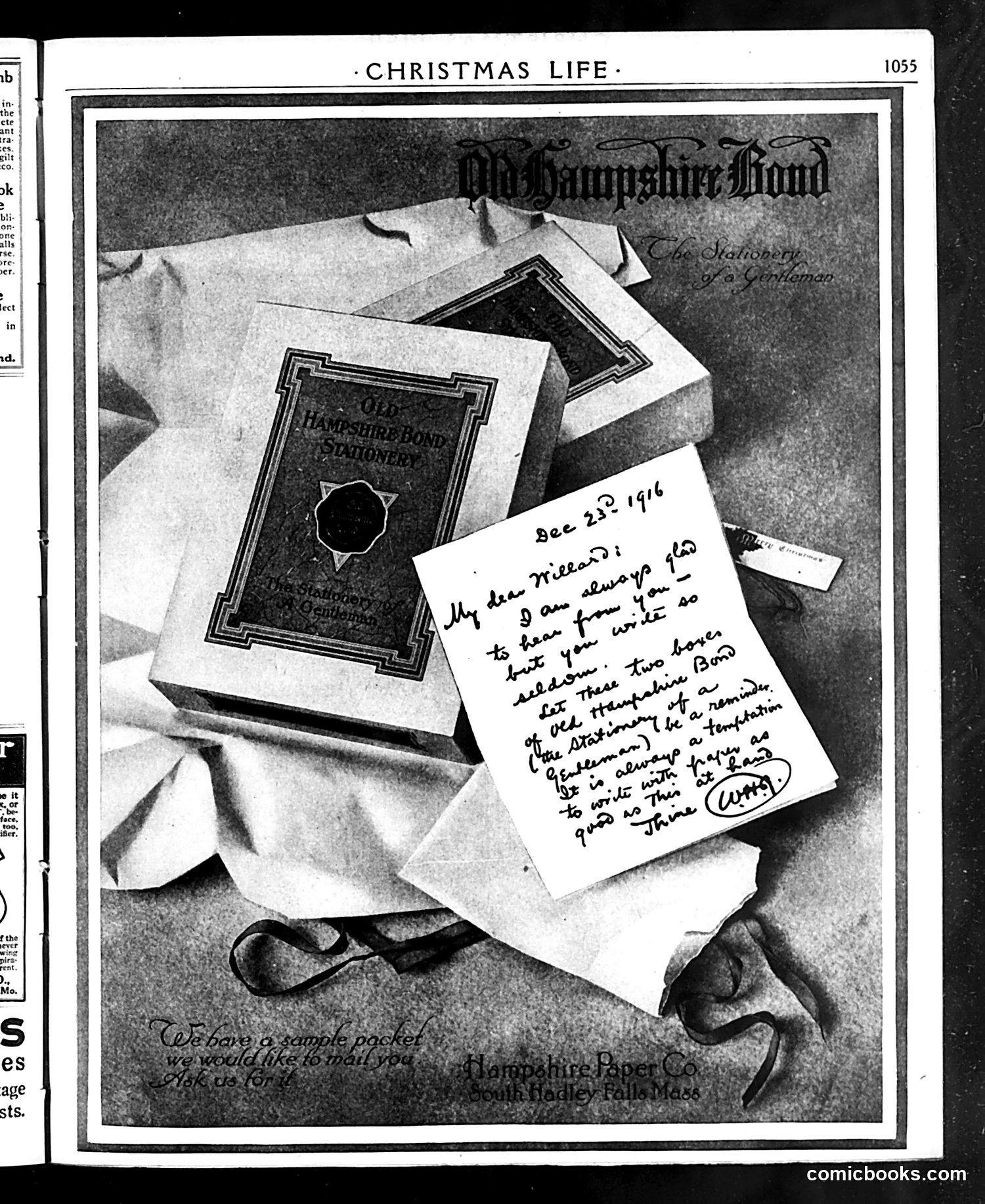
This is a Christmas-themed advertisement rather than political satire. It showcases "Our Hampshire Bond" stationery products from Hampshire Paper Co. (South Hadley Falls, Mass.). The image displays elegant writing materials—boxed stationery sets and a handwritten note dated "Dec 23 1916"—arranged artfully with ribbon and tissue paper as a gift presentation. The handwritten note serves as a testimonial, praising the stationery's quality for correspondence. The ad's appeal targets middle-class consumers seeking refined writing materials as Christmas gifts, emphasizing both the product's aesthetic appeal and its practical value for personal communication. The vintage handwriting and packaging reflect early 20th-century standards for quality correspondence materials.
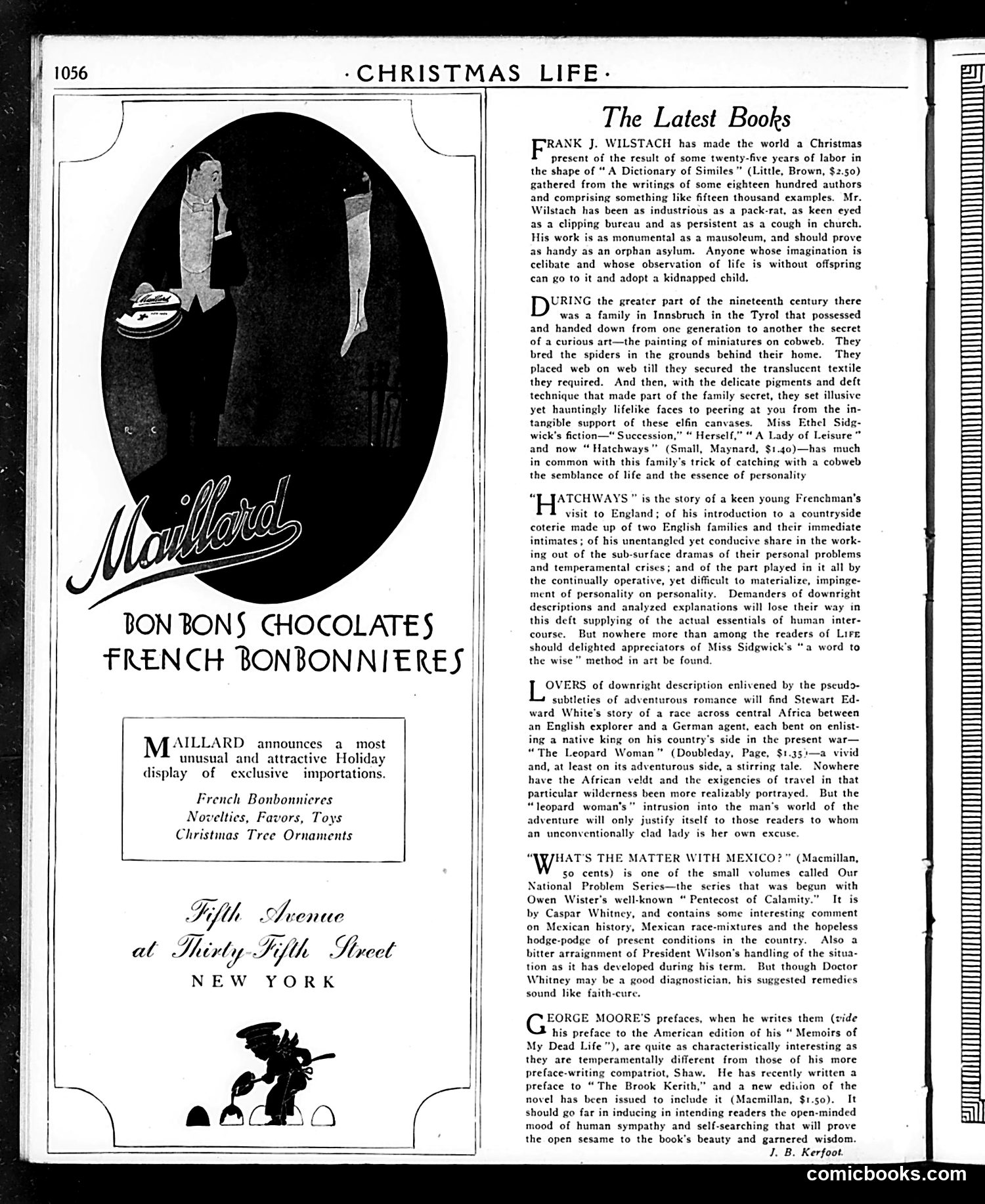
This is primarily a **book review and advertising page** from Life magazine's Christmas issue, not a political cartoon. The page contains: **Content:** - Book reviews by critic I.B. Kerfoot covering recent publications including Frank J. Wilstach's "Dictionary of Similes," Ethel Sidgwick's fiction works, Stewart Edward White's "The Leopard Woman," and Caspar Whitney's "What's the Matter with Mexico?" **Advertising:** - A Maillard chocolate advertisement (top left) featuring an elegant art deco design promoting French bonbonnières and Christmas items at their Fifth Avenue store - A smaller decorative advertisement below **Notable:** The reviews employ witty, sardonic comparisons—Wilstach's work is "as industrious as a pack-rat" and "as persistent as a cough in church." The page reflects early 20th-century literary taste and holiday consumer culture rather than political satire.
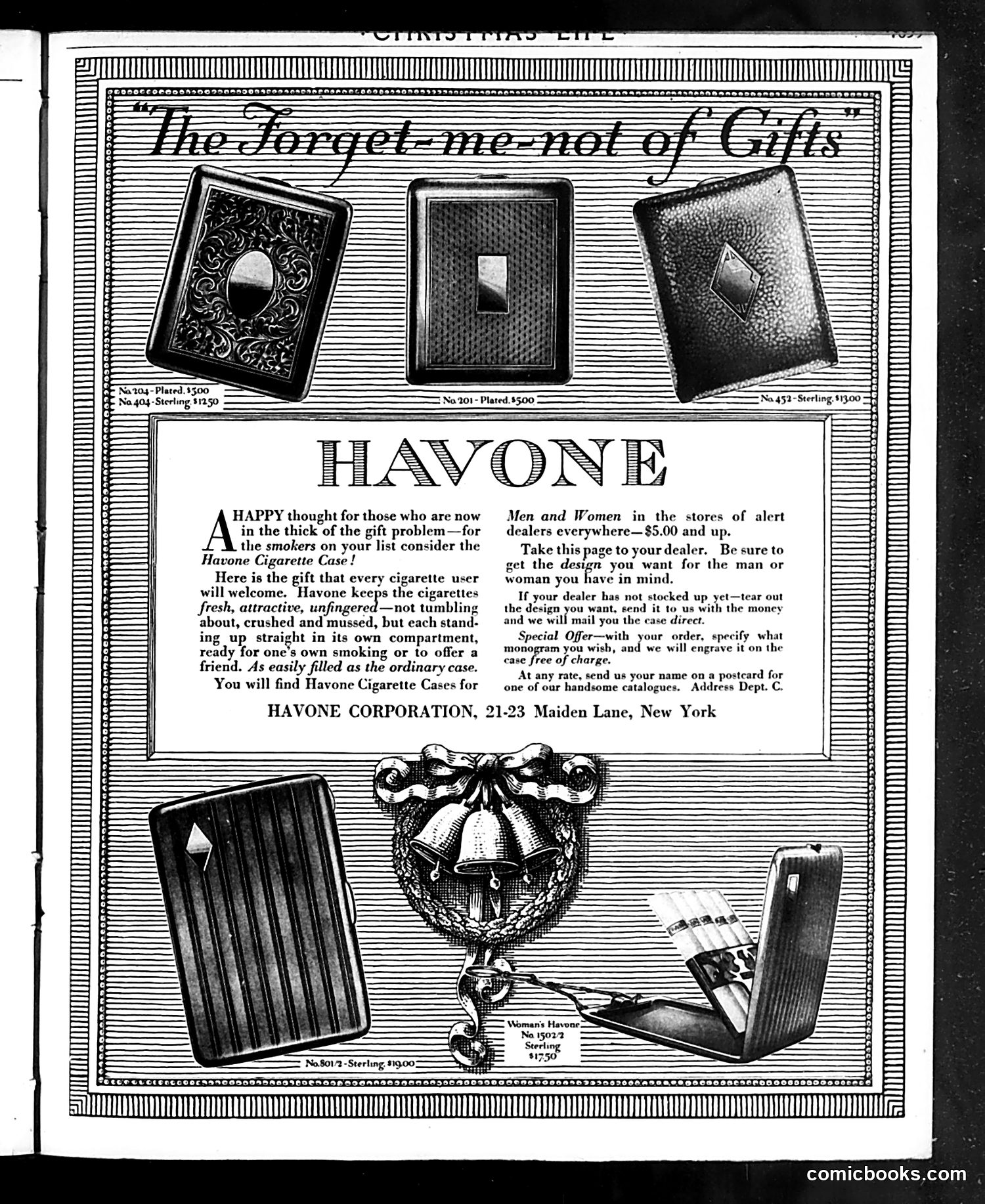
This is primarily a **cigarette case advertisement**, not political satire. The page promotes Havone brand cigarette cases as Christmas gifts for smokers. The ad presents luxury metal cases in various designs (ornate, textured, geometric) priced $5-$13.50 (sterling silver options available). The copywriting targets both male and female consumers, emphasizing the cases keep cigarettes "fresh, attractive, unfingered" — a practical gift solution for the "gift problem" of 1920s shopping. The decorative Christmas imagery (holly wreath, bow) frames the product display. The text offers personalization (free monogramming) and mail-order convenience. **For modern readers**: This reflects when cigarette smoking was completely normalized and cigarette cases were considered prestigious accessories — comparable to today's phone cases. The gendered marketing ("Men and Women") and emphasis on elegant presentation reflect early 20th-century consumer culture before health concerns altered cigarette advertising.
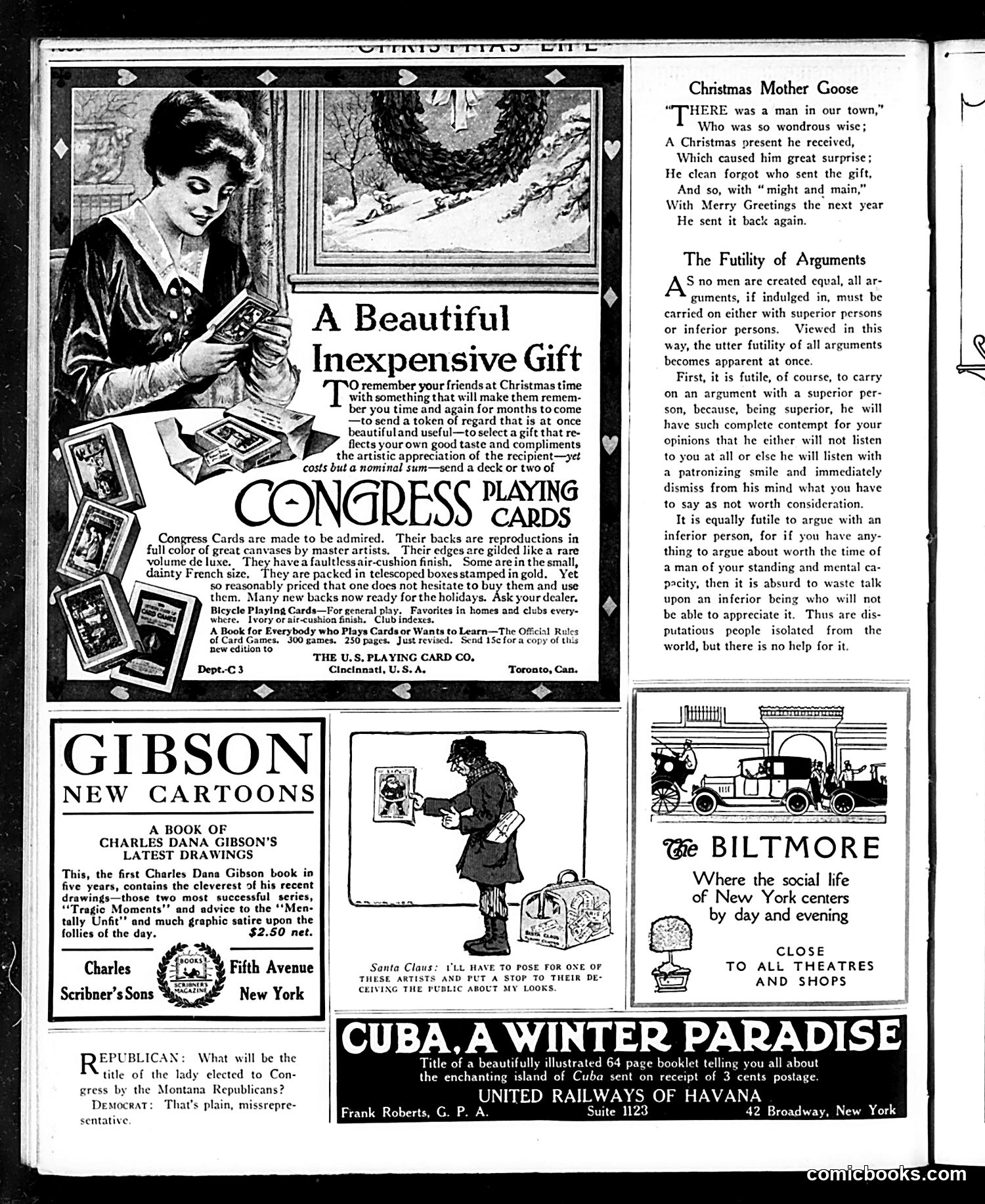
This page is primarily **advertising and light humor**, not political satire. Key content: **Main Advertisement**: Congress Playing Cards are pitched as an ideal Christmas gift—affordable yet elegant, with artistic backs reproducing masterworks and gilded edges. The appeal targets middle-class gift-givers seeking tasteful, inexpensive presents. **Gibson Cartoons**: A book advertisement for Charles Dana Gibson's latest drawings, featuring his characteristic satirical commentary on social follies and "mentally unfit" behavior. **Political Joke**: A brief Republican/Democrat exchange jokes about a woman elected to Congress by Montana Republicans—the punchline being she'd be a "missrepresentative" (pun on "misrepresentation"). This appears to reference early 1910s debates over female suffrage and political representation, treating women politicians as inherently absurd. **Other Humor**: A Santa Claus cartoon complains about artists misrepresenting his appearance; separate pieces include Christmas verse and an essay on the futility of arguments. **Travel Ads**: Cuba and the Biltmore Hotel receive promotional space. The page reflects early 20th-century commercial culture and modest gender-politics humor typical of the era.
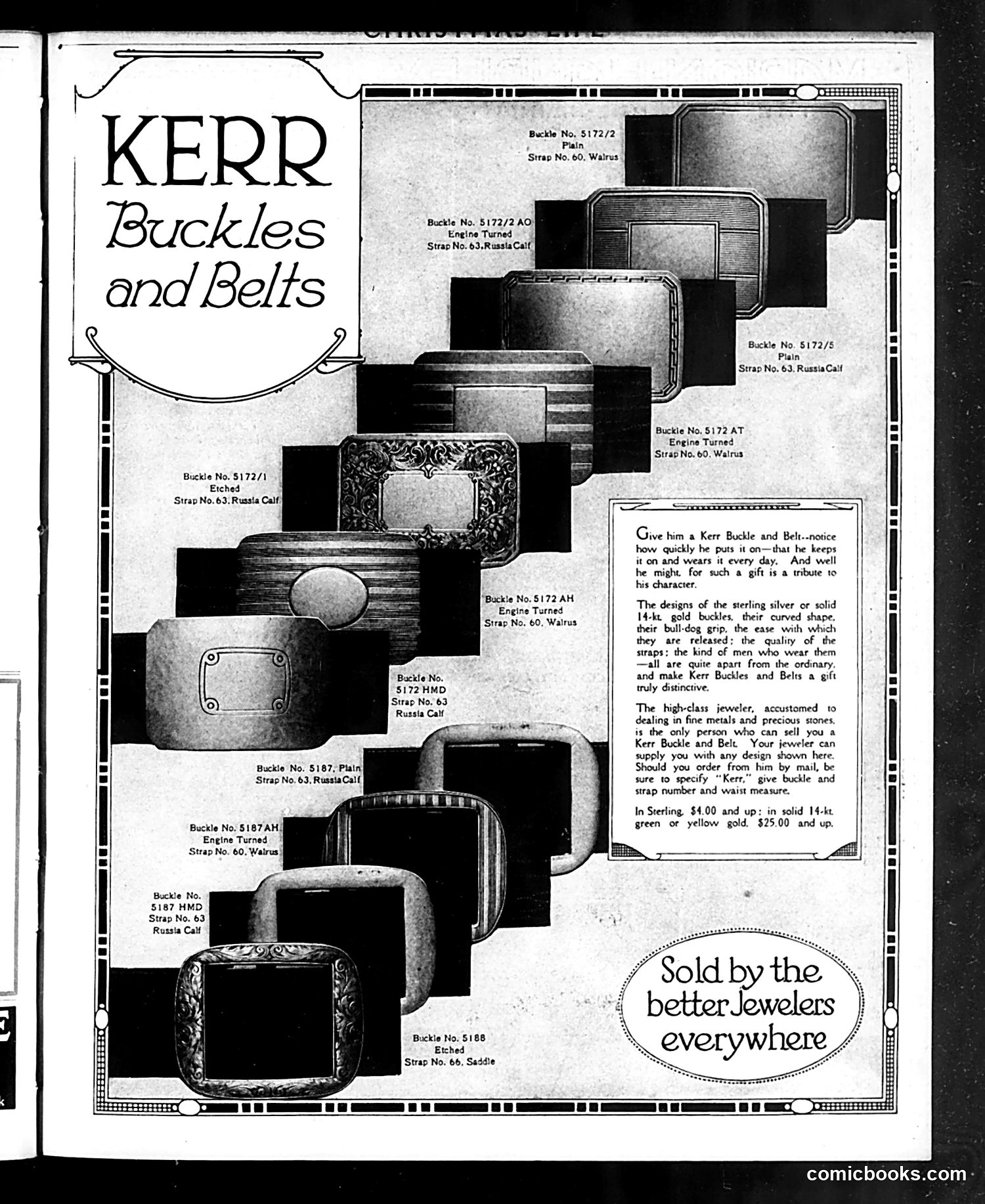
This is a **Kerr Buckles and Belts advertisement**, not a political cartoon or satirical comic. It's a full-page product catalog showcasing various belt buckle designs from the Kerr company. The page displays approximately 8-10 different buckle styles (numbered models like 5172, 5187, 5188) paired with different strap materials (walrus leather, Russian calf, etc.). Each buckle features variations like "Plain," "Engine Turned," "Etched," and "HMD" finishes. The accompanying text positions these as luxury gifts for men of character, appealing to the high-end market through jewelers. Pricing ranges from $4.00 in sterling silver to $25.00+ in solid 14-karat gold. The decorative border and art deco styling are typical of early 20th-century magazine advertising. There is no satire or political commentary—this is straightforward luxury goods marketing aimed at affluent male consumers through elite jewelers.
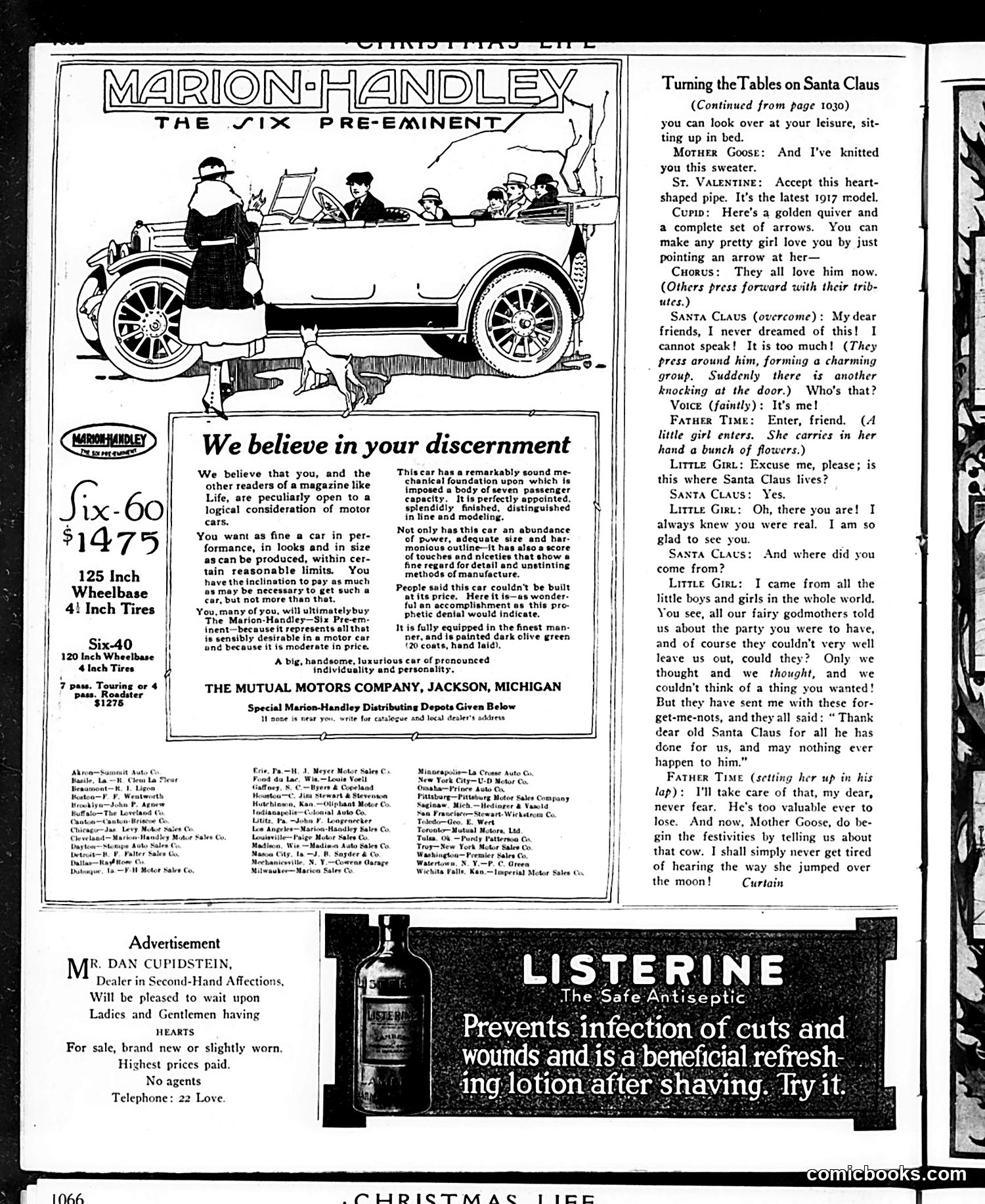
This page contains two main elements: **Left side:** A Marion-Handley automobile advertisement disguised as editorial content, emphasizing the car's quality and reasonable price ($1,475). The ad includes technical specifications and dealer locations. **Right side:** A serialized humorous story titled "Turning the Tables on Santa Claus" (continued from page 1032). The narrative depicts Santa Claus receiving gifts from fairy-tale figures (Mother Goose, St. Valentine, Cupid) at what appears to be a Christmas celebration. When a little girl arrives with flowers from "all the fairy godmothers" worldwide, Father Time promises to protect Santa, declaring "He's too valuable ever to lose." **The satire's point:** The story inverts traditional gift-giving by having mythical characters honor Santa rather than vice versa—a sentimental twist on the usual narrative. It's gentle, family-friendly humor typical of *Life* magazine's 1917 content. **Bottom:** A Listerine antiseptic advertisement. The page reflects early 20th-century advertising integration with editorial content.
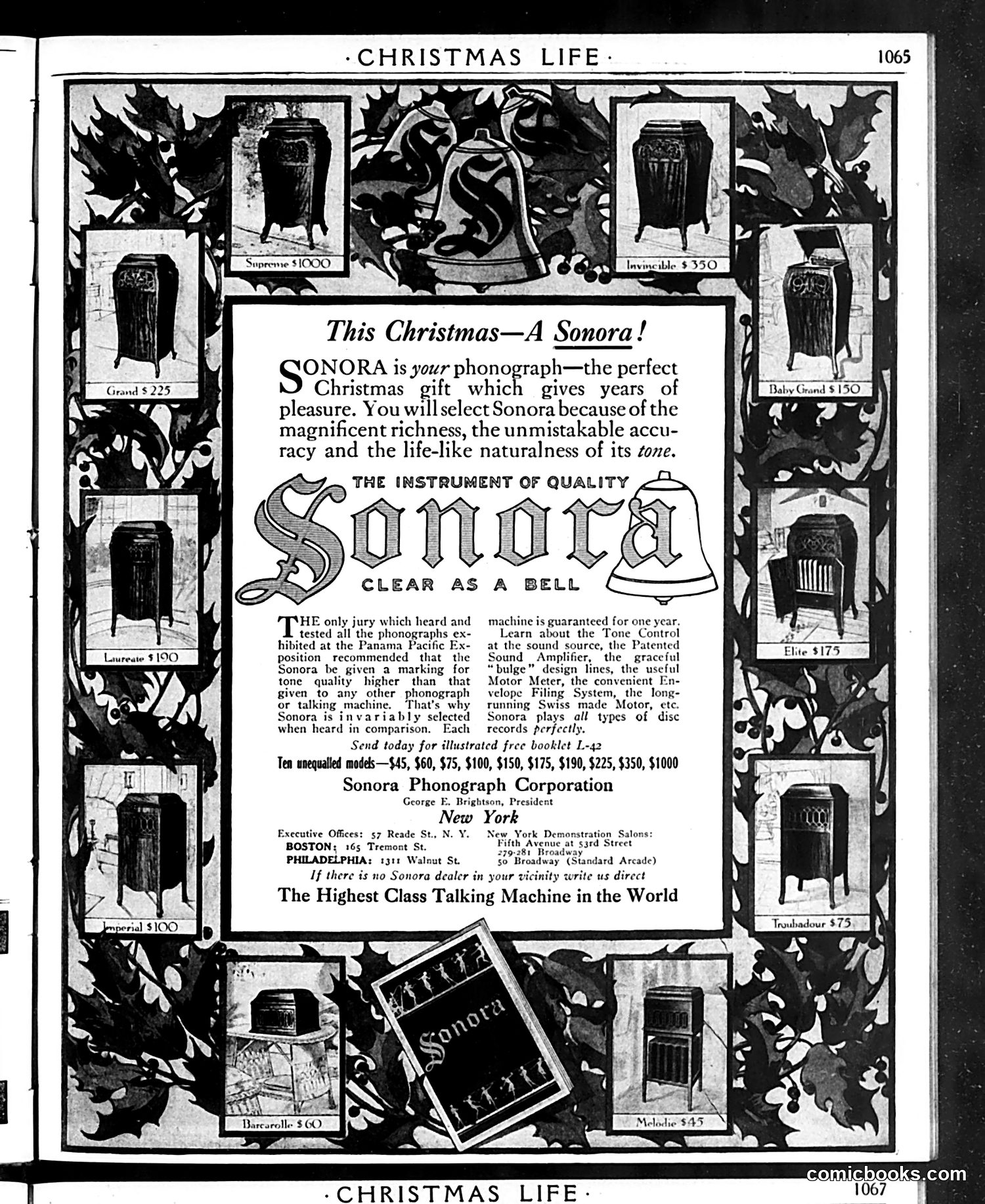
This is a **Christmas advertisement**, not political satire or cartoon commentary. The page promotes the Sonora phonograph as an ideal holiday gift. The content features: - **Product displays**: Multiple Sonora phonograph models shown in decorative frames, ranging from $45 to $1,000, with names like "Grand," "Baby Grand," "Elite," and "Imperial" - **Marketing claims**: Emphasizes superior sound quality, referencing a Panama Pacific Exposition jury that rated Sonora's tone highest among all phonographs - **Seasonal framing**: Holly and festive decorative borders position the product as perfect for Christmas giving - **Company details**: Lists the Sonora Phonograph Corporation's New York headquarters and demonstration locations in Boston and Philadelphia The advertising strategy appeals to wealthy consumers seeking luxury gifts. The "highest class talking machine in the world" slogan targets the affluent market willing to spend substantial sums on home entertainment technology—notable in an era before radio became standard household equipment.
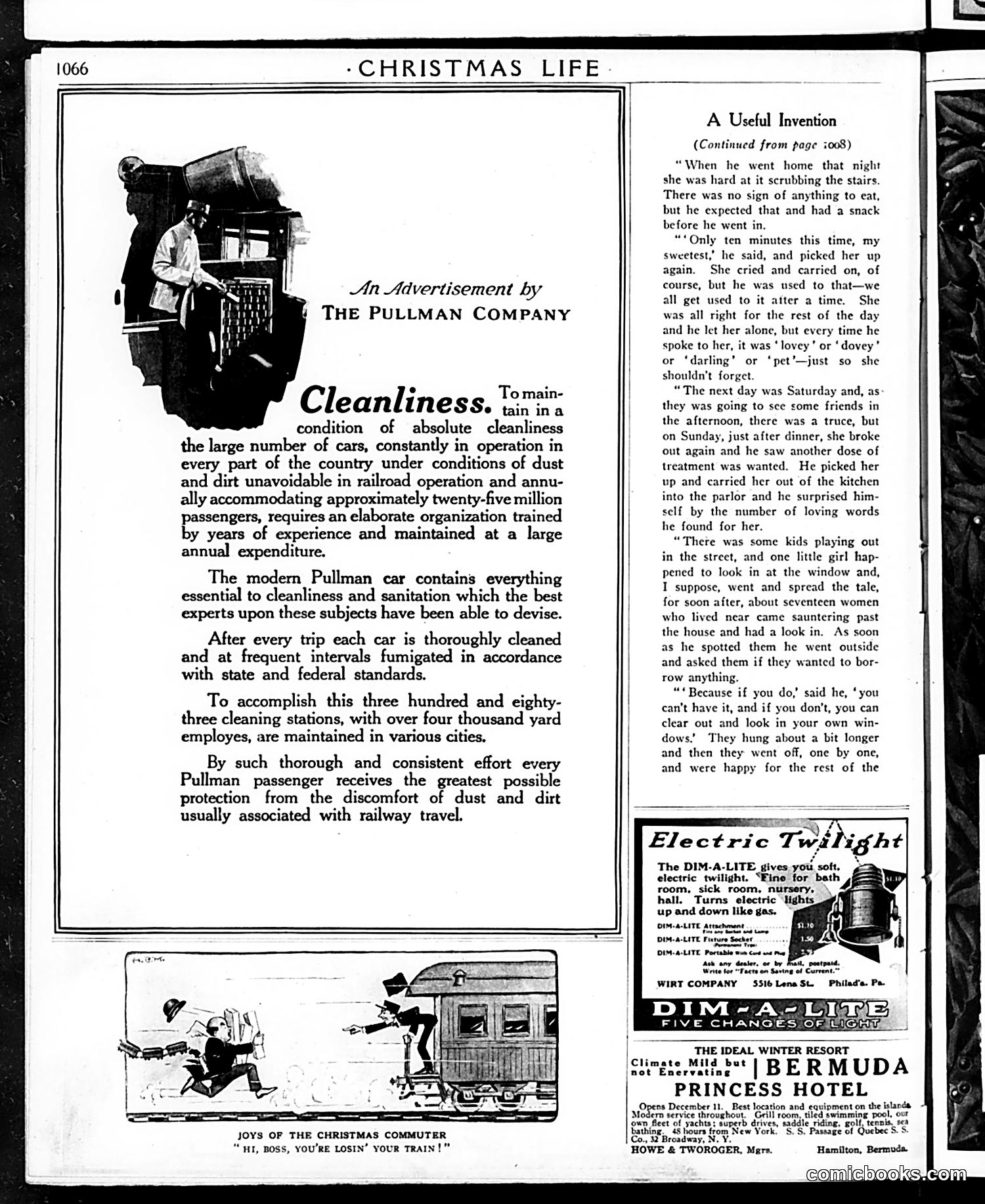
This page is primarily **advertising content** with minimal editorial material. The dominant feature is a Pullman Company advertisement about railroad car cleanliness, emphasizing their 383 cleaning stations and 4,000+ employees maintaining hygiene standards for 25 million annual passengers. This reflects early 20th-century concerns about sanitation in public transportation. The small cartoon at bottom, captioned "Joys of the Christmas Commuter," appears to depict a man nearly missing his train while a porter alerts him—a lighthearted holiday-season joke about the rushed, chaotic nature of Christmas travel and commuting. The page also contains advertisements for the Dim-a-Lite (an electric dimmer device) and the Bermuda Princess Hotel resort. A serialized story titled "A Useful Invention" (continued from an earlier page) occupies the right column, describing domestic life and marital dynamics with period-appropriate language and attitudes. The content is typical of early 20th-century Life magazine: commercial advertisements mixed with serialized fiction and minor satirical illustrations.
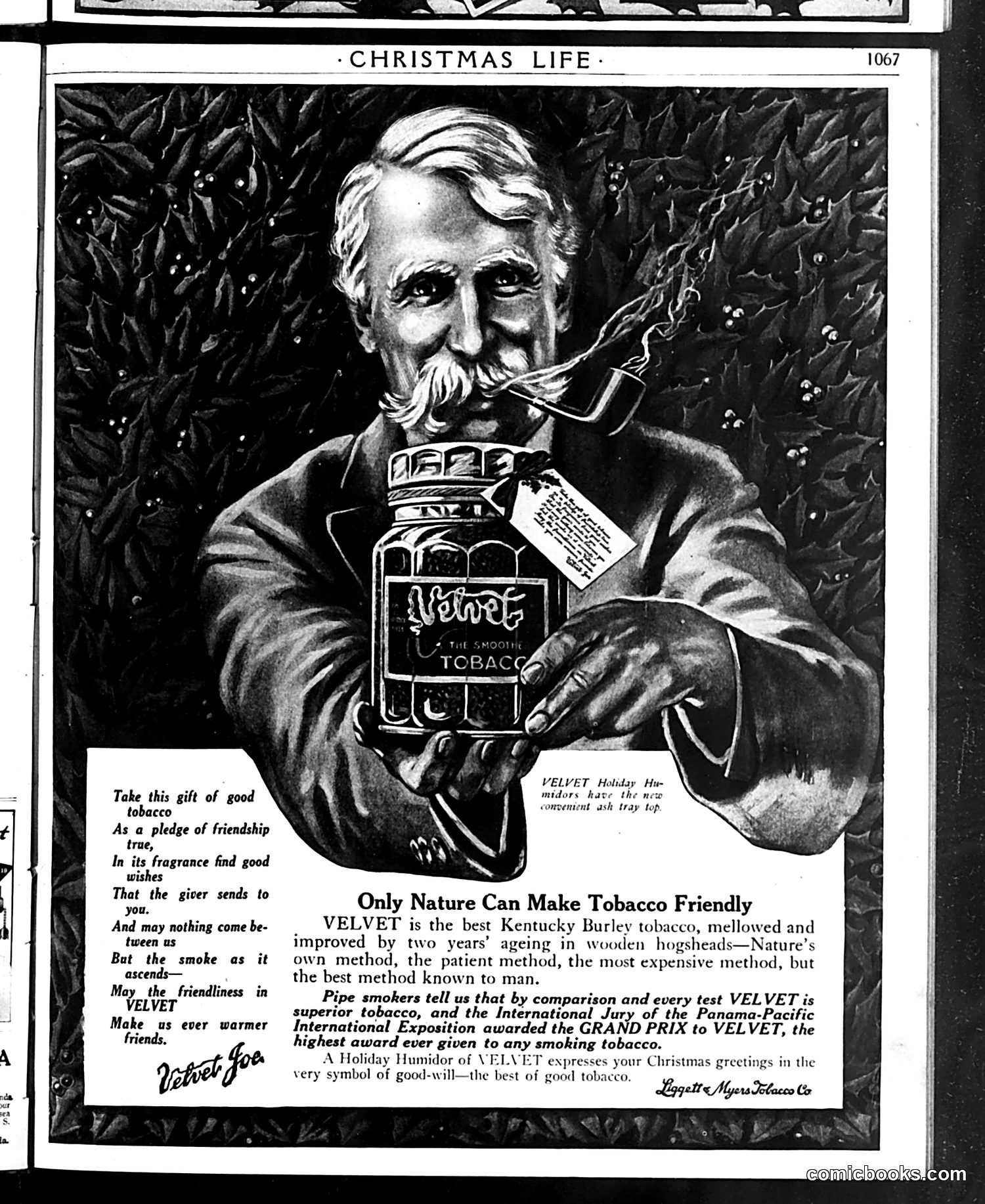
This is primarily a **tobacco advertisement**, not satire. It's a Velvet brand cigarette/pipe tobacco ad from Life magazine's Christmas issue (page 1067). The image shows an elderly gentleman with a pipe, holding a tin of Velvet tobacco as a Christmas gift. The ad employs sentimentalist messaging typical of early 20th-century advertising: tobacco as a symbol of friendship and good will. **Key claims made:** - Velvet is "superior tobacco" aged two years in wooden hogsheads using "Nature's own method" - It won the Grand Prix at the Panama-Pacific International Exposition (suggesting prestige/awards) - It's positioned as an appropriate holiday gift between friends **What's notable to modern readers:** The advertisement freely promotes tobacco without health warnings, frames smoking as wholesome friendship-building, and targets gift-giving occasions—all practices now prohibited in most Western countries. The poetic verse and emphasis on "nature" reflects early advertising strategies before tobacco's dangers were widely acknowledged or regulated.
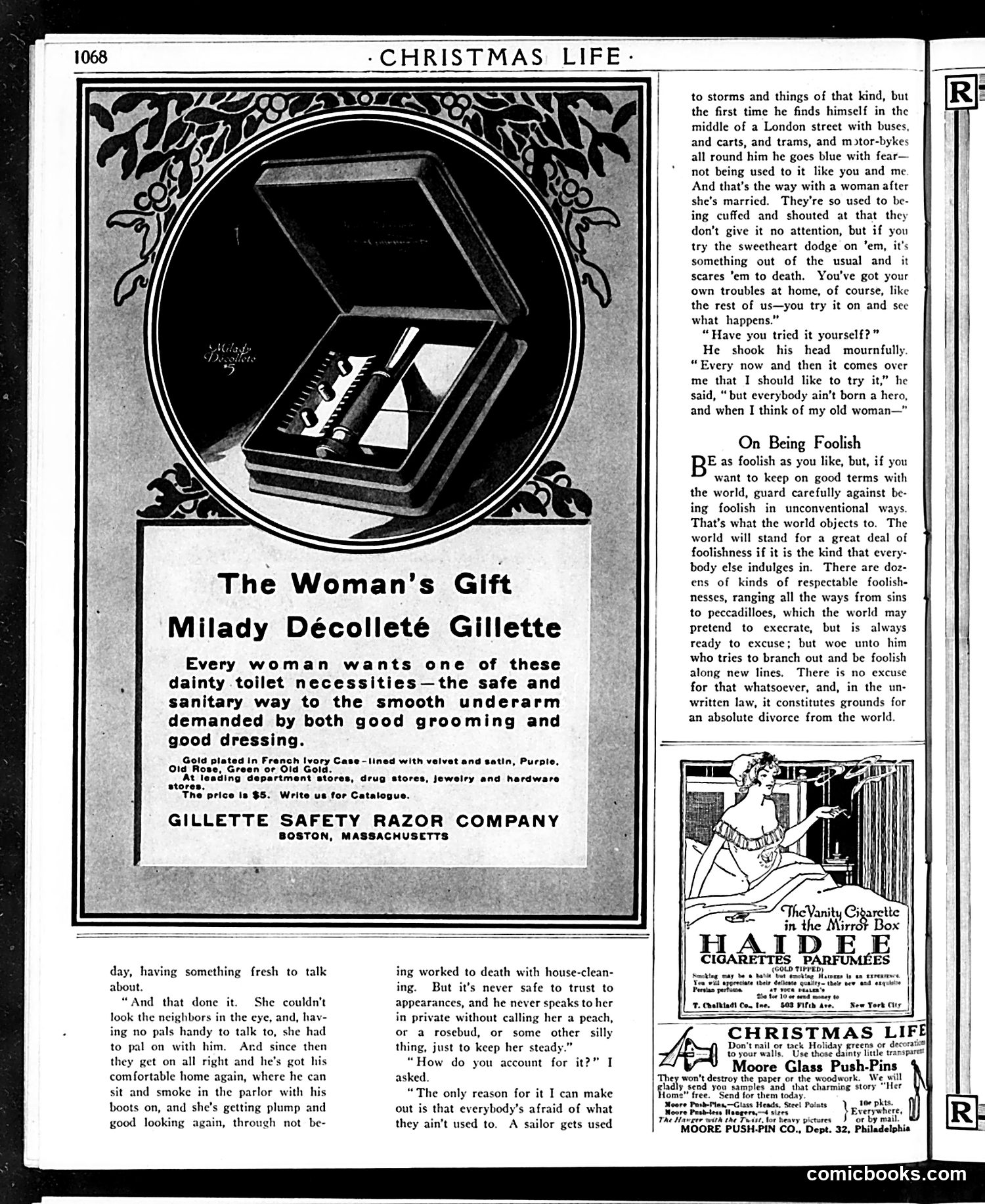
This page primarily contains **advertising** rather than political satire. The main content is a Gillette Safety Razor advertisement for women ("Milady Décolleté Gillette"), marketed as an ideal Christmas gift for smooth underarm grooming. The right-hand column presents a **social commentary piece titled "On Being Foolish,"** which argues that society tolerates conventional foolishness but severely punishes unconventional behavior. The piece warns readers not to deviate from socially accepted norms—doing so invites social ostracism and even divorce. This reflects early 20th-century anxieties about conformity and social propriety. The accompanying text features a dialogue between two men discussing married life and courtship, illustrating how fear of the unfamiliar governs human behavior. Additional advertisements appear for vanity cigarettes and Moore Glass Push-Pins. The page reflects period attitudes toward gender, marriage, and social conformity rather than specific political satire.
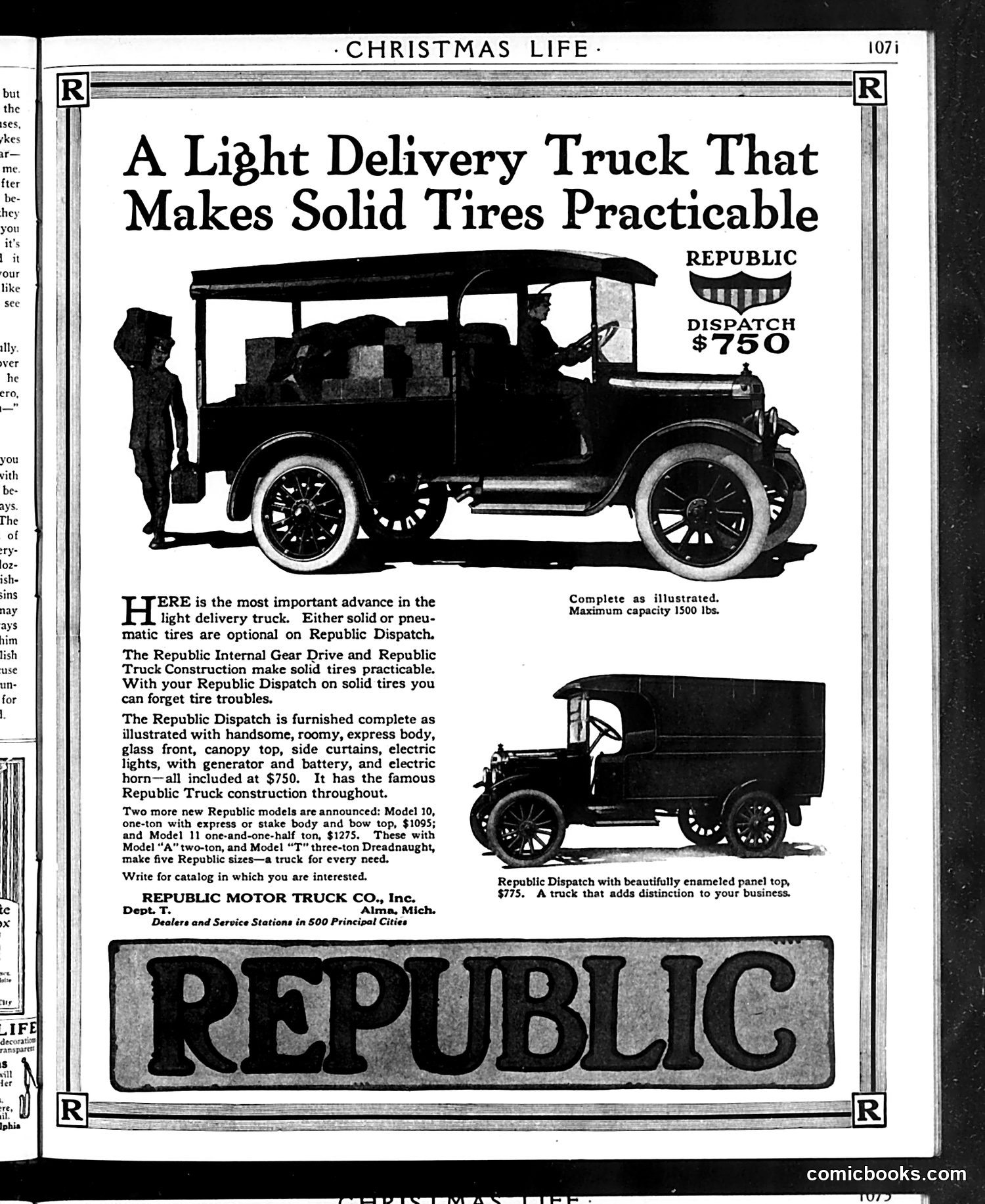
This is **not a cartoon or satire**—it's a straightforward advertisement for Republic Motor Trucks, appearing in a Christmas issue of *Life* magazine. The page promotes the Republic Dispatch, a light delivery truck priced at $750, emphasizing its practical innovation: the ability to use solid tires instead of pneumatic (air-filled) ones. For modern readers, this matters because tire reliability was a genuine business problem in the early automotive era—flat tires were frequent and expensive. Republic's engineering supposedly made solid tires feasible, reducing "tire troubles." The ad highlights luxury features (electric lights, glass front, canopy top) and multiple model options ranging from one to three tons, targeting small business owners who needed reliable delivery vehicles. There is no satire, political commentary, or caricature present. This represents typical early 1900s automotive advertising in a popular magazine.
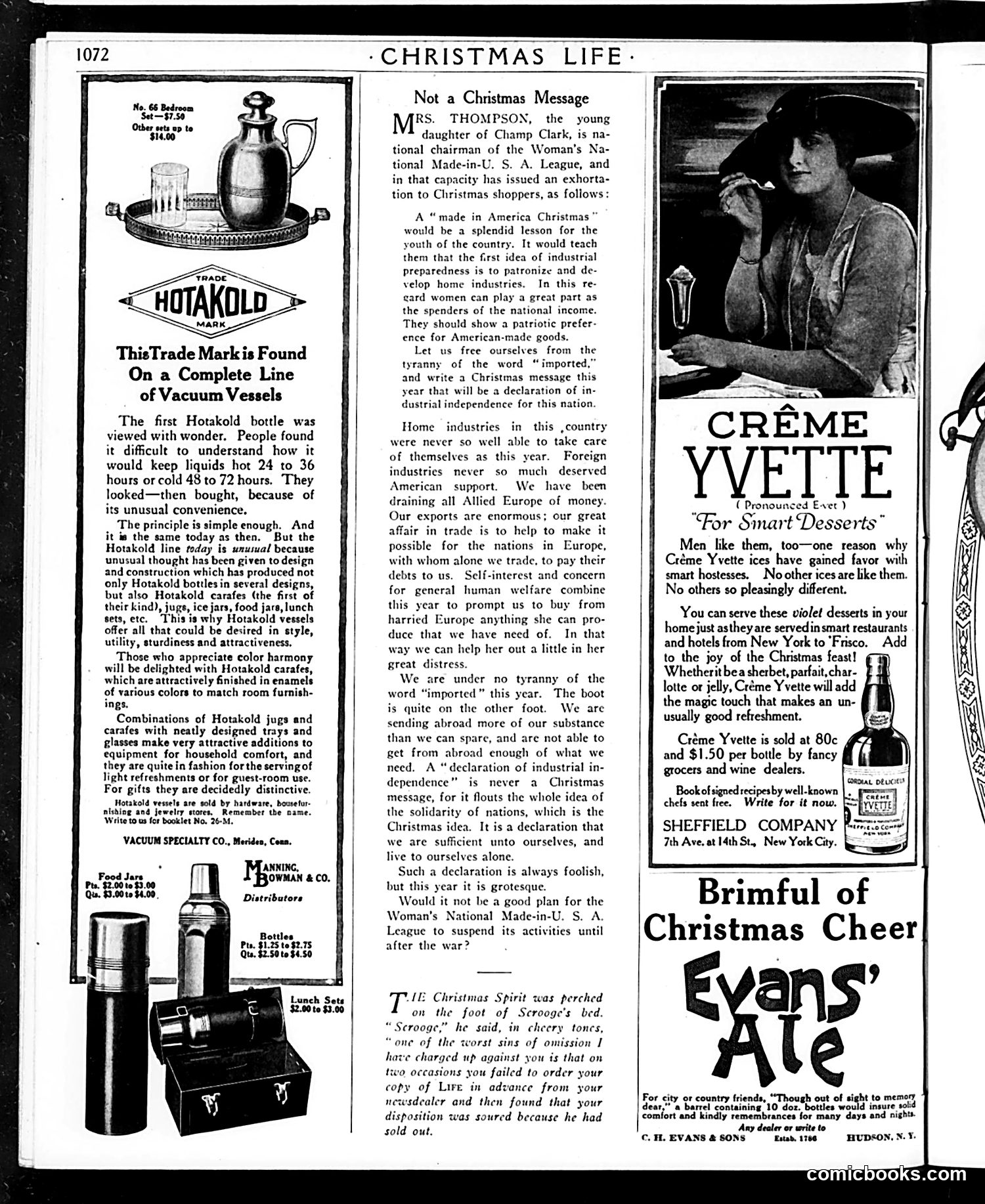
This page critiques a patriotic campaign by Mrs. Thompson (daughter of Congressman Champ Clark), national chair of the "Woman's National Made-in-U.S.A. League," who urged Christmas shoppers to buy American goods as an act of industrial patriotism. The unnamed satirist (likely a Life editor) argues this position is wrongheaded, especially during World War I. While acknowledging American manufacturing strength, the author points out that Allied Europe—America's trading partners—desperately needs American exports to pay war debts and survive. Buying only American goods, the piece argues, contradicts the Christmas spirit of international solidarity and human welfare. The satire's bite: patriotic "made in America" messaging, however well-intentioned, is actually *selfish isolationism* disguised as virtue. The author suggests the League suspend operations until after the war. The rest of the page contains period advertisements for vacuum bottles and liqueurs.
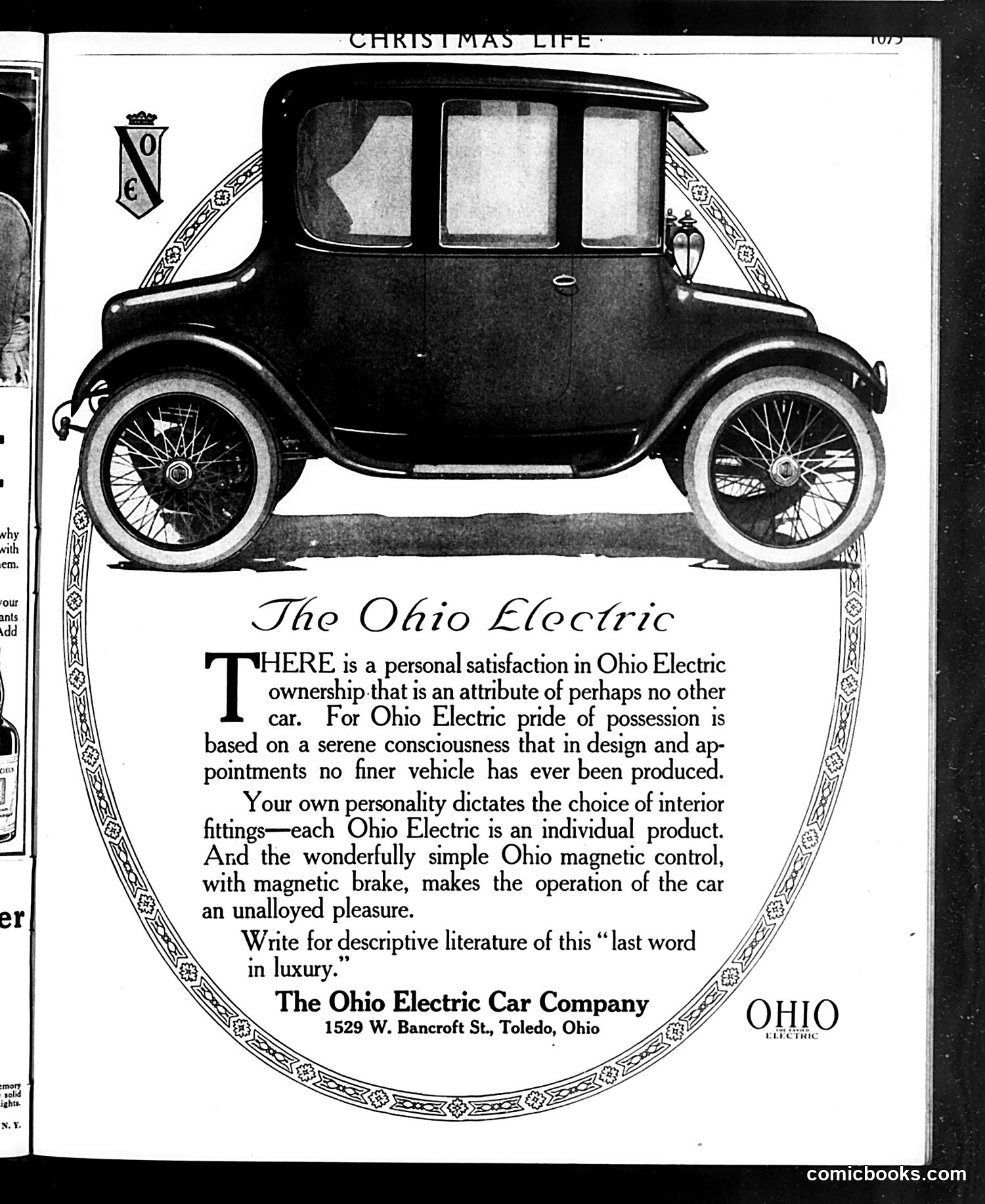
This is **not a cartoon or satire**—it's a straightforward advertisement for the Ohio Electric Car Company, published in *Life* magazine (likely early 1910s, based on the vehicle design and typography). The page promotes electric automobiles as luxury vehicles, emphasizing their refined design, customizable interiors, and ease of operation via "magnetic control" and braking. The ad targets wealthy consumers by positioning Ohio Electric ownership as a status symbol reflecting personal sophistication and taste. The decorative border and elegant typography reinforce the "luxury" positioning. This reflects a historical moment when electric cars were viable competitors to gasoline vehicles—particularly appealing to affluent urban drivers before gasoline engines became dominant. There is no political satire or social commentary intended here; it's period advertising reflecting early automotive market competition.
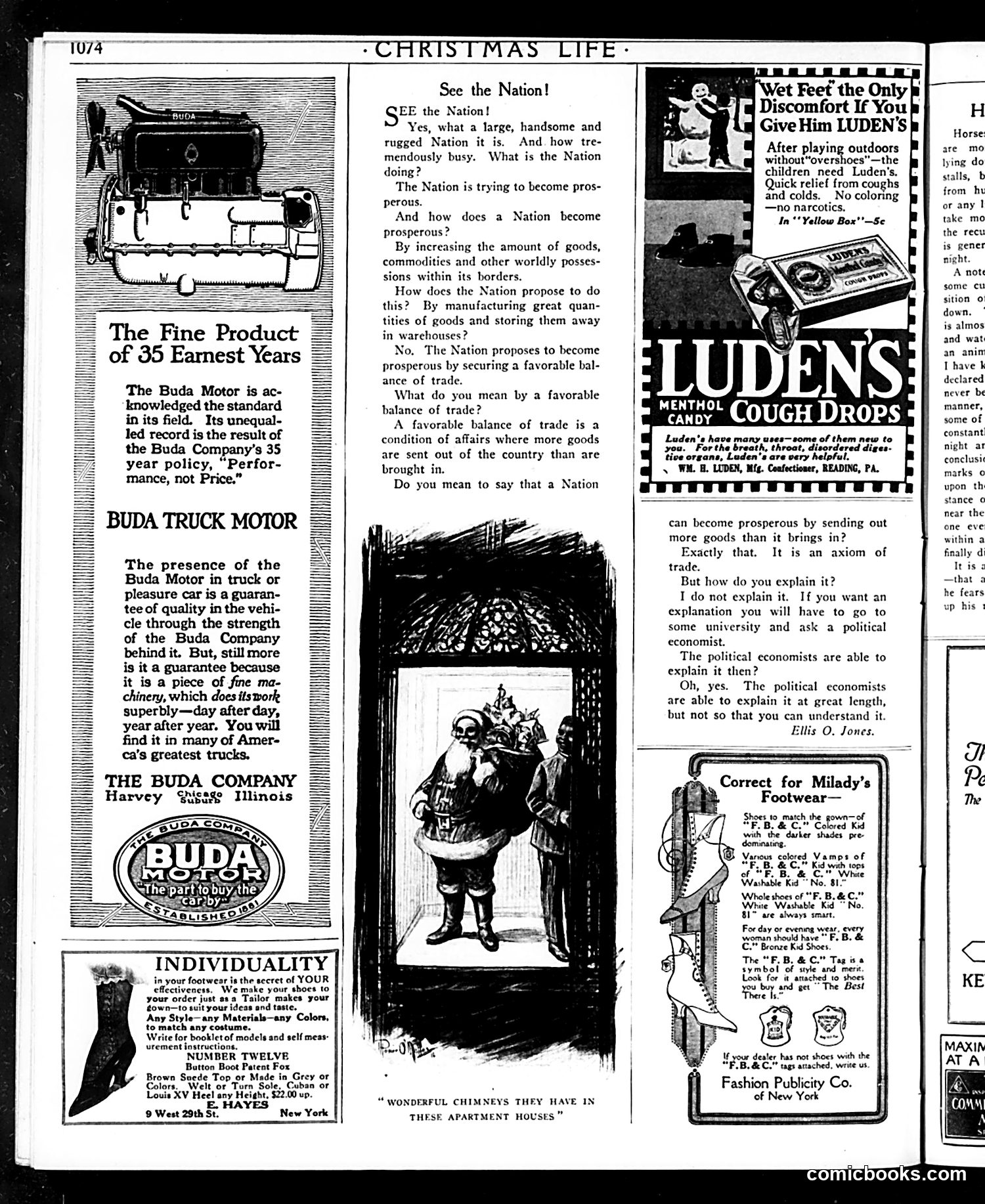
This page is primarily **advertising** interspersed with one satirical article. The central piece is "See the Nation!" by Ellis O. Jones—a mock-serious dialogue about national prosperity and international trade that appears to critique economic policy or theory of the era. The cartoon illustration (showing Santa Claus entering through a chimney in an apartment building) accompanies the trade discussion, though its specific satirical point remains unclear without fuller context. The satire's humor lies in Jones's deadpan explanation: a nation becomes prosperous by exporting more goods than it imports—a paradox he admits cannot be logically explained, only justified by "political economists" at "great length" but incomprehensibly. This likely mocks either protectionist trade policies, economic theory itself, or government economic claims popular at Life's publication date. The remaining content consists of product advertisements: Buda Motors, custom shoes, Luden's cough drops, and footwear—typical magazine filler of the period. The page number suggests this is from early 20th-century Life.
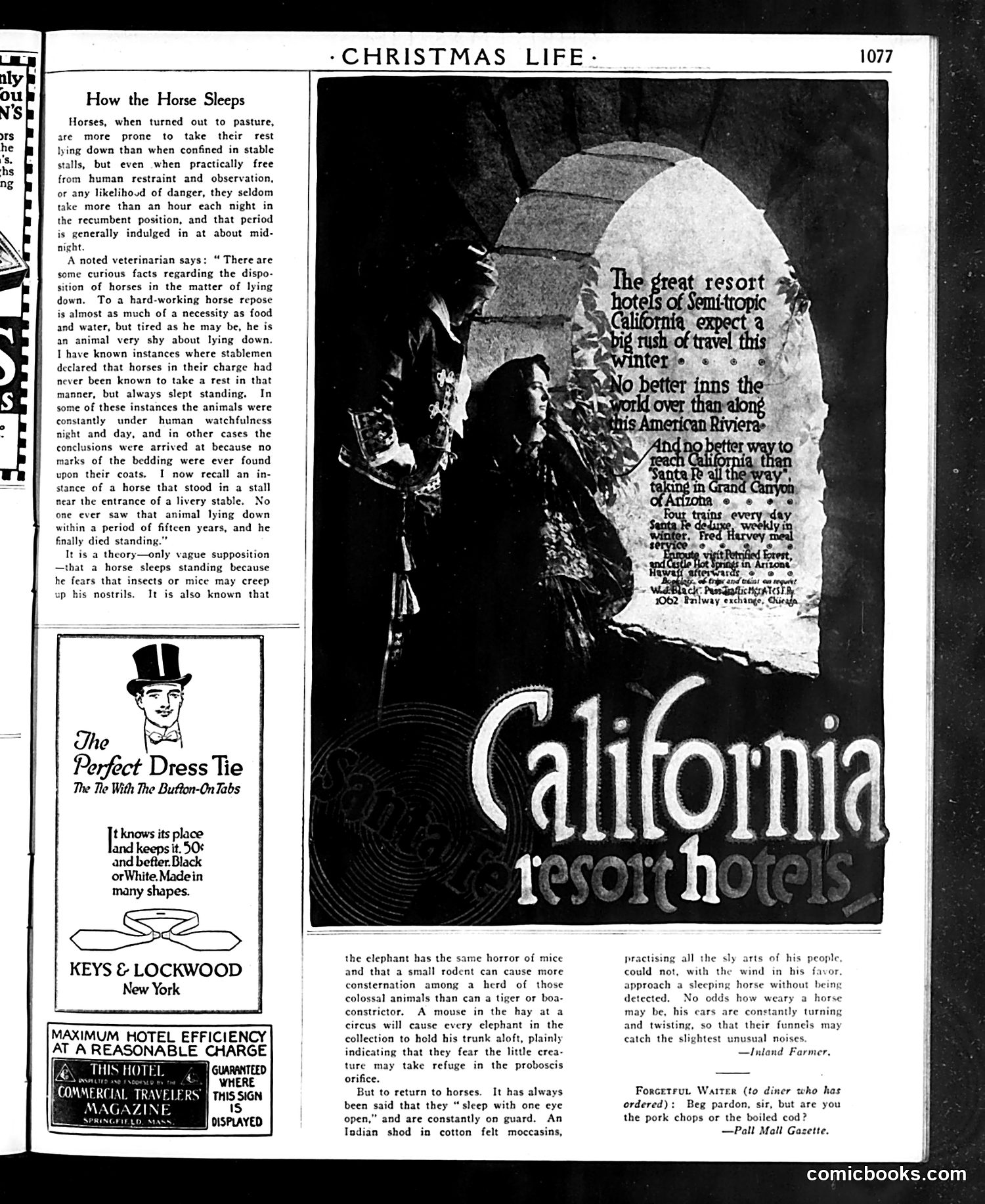
This page from *Life* magazine contains primarily **educational/informational content** rather than political satire. The main article, "How the Horse Sleeps," discusses veterinary facts about equine sleep behavior—specifically that horses rarely lie down, typically sleeping standing up for only about an hour nightly. A veterinarian is quoted explaining this is partly defensive behavior; horses remain alert to dangers and are averse to lying down despite needing rest. The article extends the observation to elephants, noting they share an irrational fear of mice entering their nostrils. **Advertisements** occupy the left side: a dress tie ("The Perfect Dress Tie") and hotel efficiency notices. At the bottom are two brief **humor items**: a joke about a dress tie's durability, and a waiter's comic mishearing (asking if the diner ordered "pork chops or boiled cod" rather than which dish). The large **California resort hotels advertisement** on the right is unrelated to the editorial content—standard magazine layout of the era.
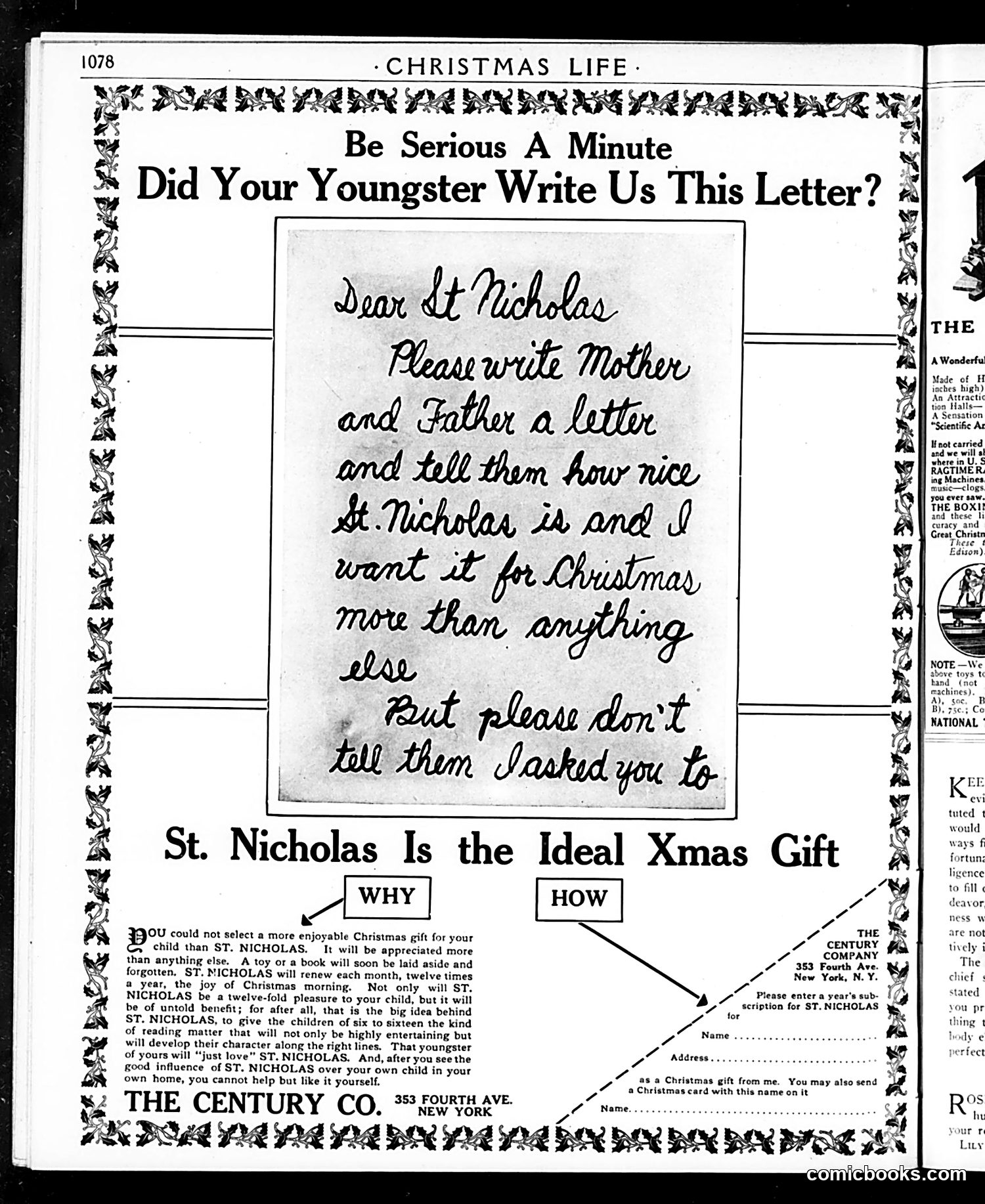
This is primarily a **Christmas advertisement**, not political satire. It promotes *St. Nicholas* magazine as an ideal gift for children. The handwritten letter shown is a fake testimonial—a child supposedly writing to St. Nicholas asking their parents to subscribe. The letter's emotional appeal ("I want it for Christmas more than anything else") is the advertisement's selling point. The pitch emphasizes that unlike toys that are quickly forgotten, a magazine subscription provides "twelve times a year, the joy of Christmas morning" and claims moral value: the publication will "develop their character along the right lines." This reflects **early 20th-century parenting ideology**—the belief that children's reading should be carefully curated for character development, not mere entertainment. The advertisement targets parents' desires to give meaningful, improving gifts rather than frivolous ones. There is no political satire or caricature here—just commercial messaging disguised as a child's genuine wish.
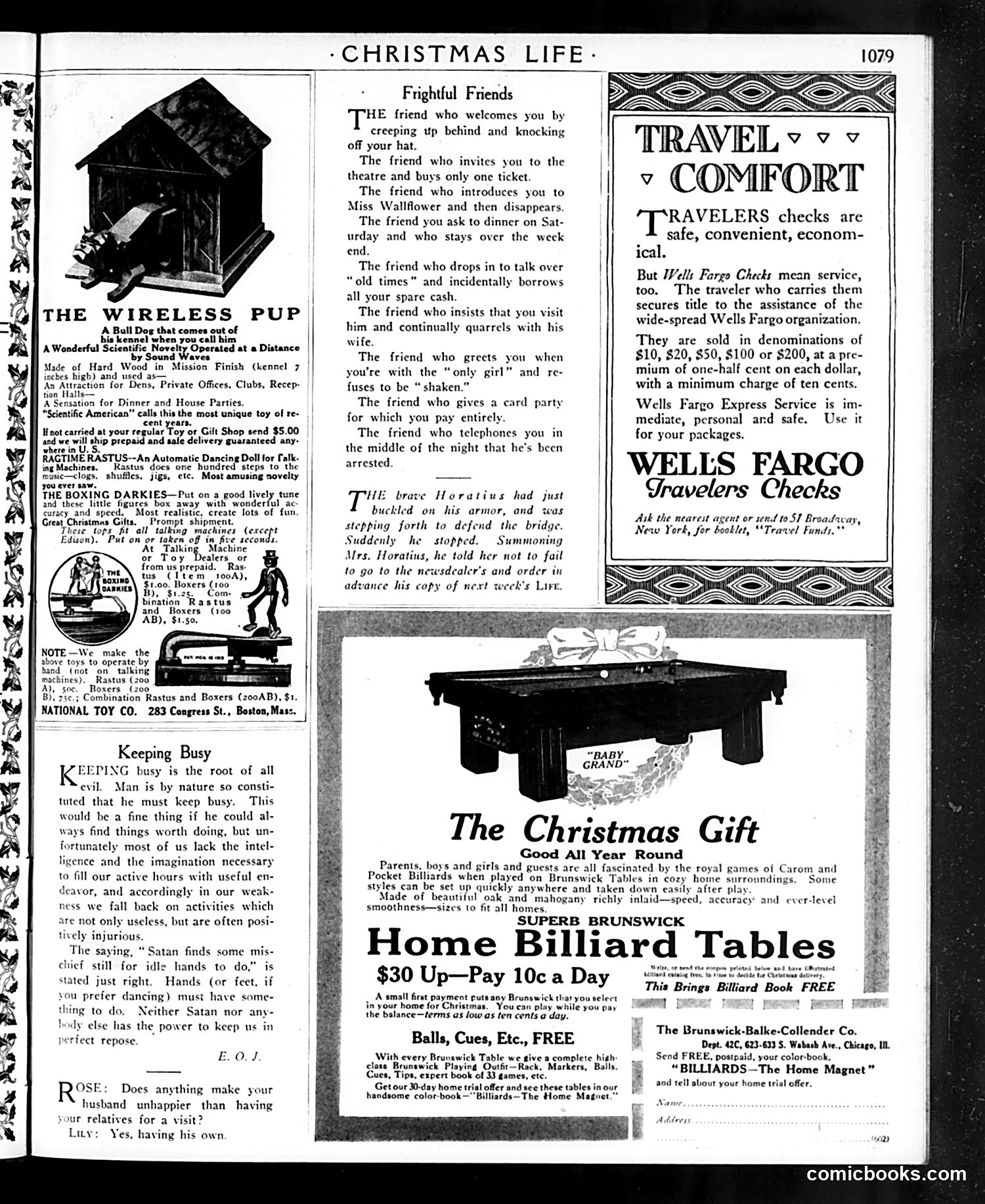
This page is primarily **advertising and light humor**, with minimal political content. **Main Items:** 1. **"The Wireless Pup"** and other toy advertisements use now-offensive racial caricatures ("Ragtime Rastus," "Boxing Darkies") typical of early 1900s marketing. These reflect the era's casual racism in commercial products. 2. **"Frightful Friends"** is a humorous list satirizing annoying social behaviors—gate-crashing guests, freeloaders, and bad-timed phone calls. It's gentle domestic comedy with no political edge. 3. **"Keeping Busy"** discusses idleness philosophically, suggesting busy work prevents mischief—a mild commentary on human nature. 4. **The "Horatious" quip** is a clever joke: even a Roman hero rushing to defend a bridge remembers to pre-order the next week's *Life* magazine—self-promotional humor. The page is dominated by advertisements for Wells Fargo Travelers Checks and Brunswick billiard tables. The humor is topical to the era but not politically charged—mainly domestic satire and consumerist messaging.
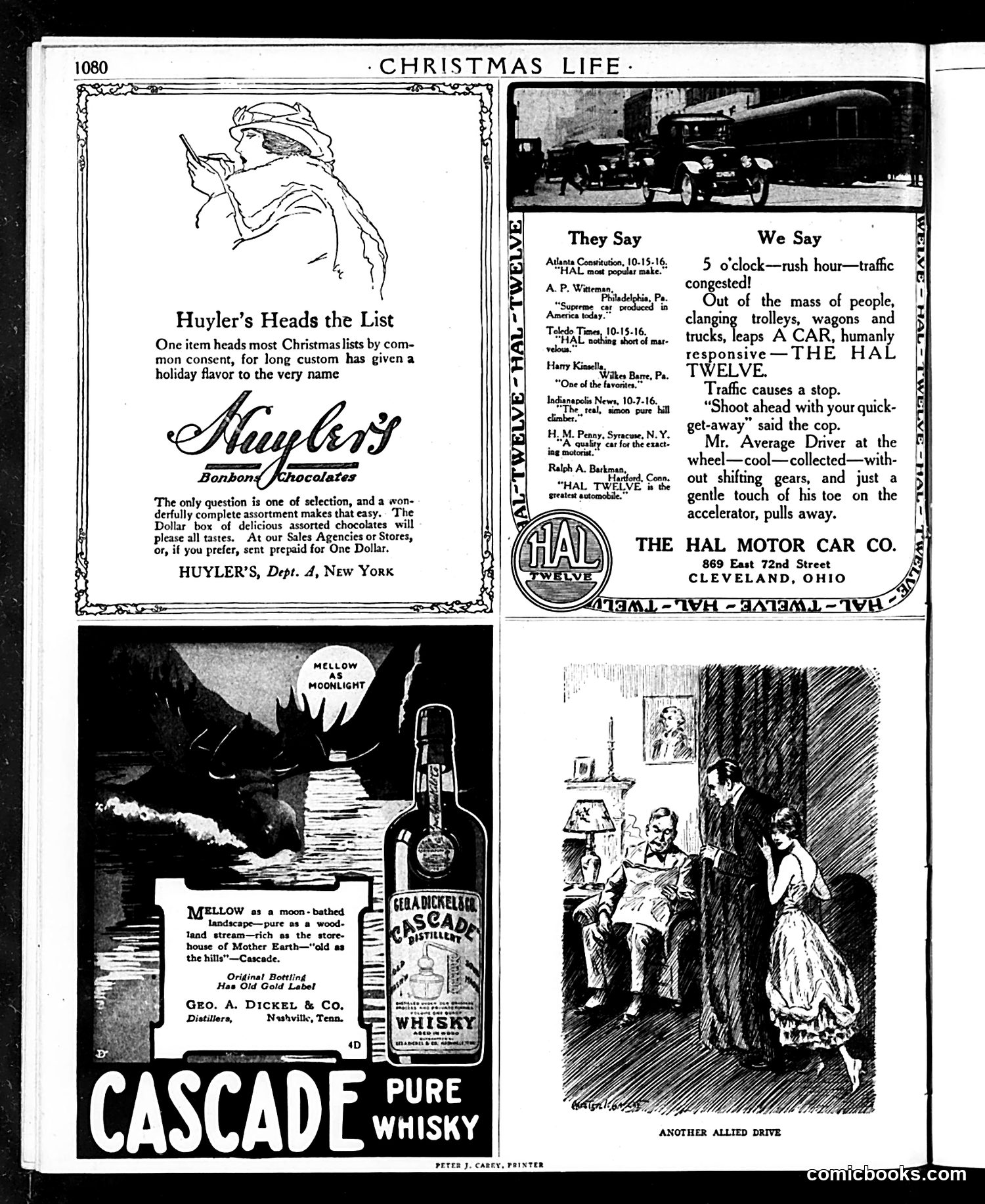
This page from *Life* magazine contains **mostly advertisements** with one satirical cartoon about traffic safety. The main content is an "**They Say / We Say**" comparison contrasting public perception of rush-hour driving with reality. Newspapers and observers claimed that 5 o'clock traffic caused congestion and chaos. *Life*'s counter-argument praises the HAL automobile as "humanly responsive" and its driver as composed and skilled—able to navigate through trolleys and wagons with gentle acceleration control. The satire targets **automotive advertising's exaggeration** of safety and driver competence during congested urban conditions. While advertisers promoted cars as reliable solutions to traffic, the cartoon ironically suggests that only an exceptionally calm, skilled driver operating a superior vehicle could manage such chaos—an unrealistic standard for average motorists. The page also advertises **Huyler's chocolates, Cascade whisky, and other luxury goods** typical of era Christmas shopping.
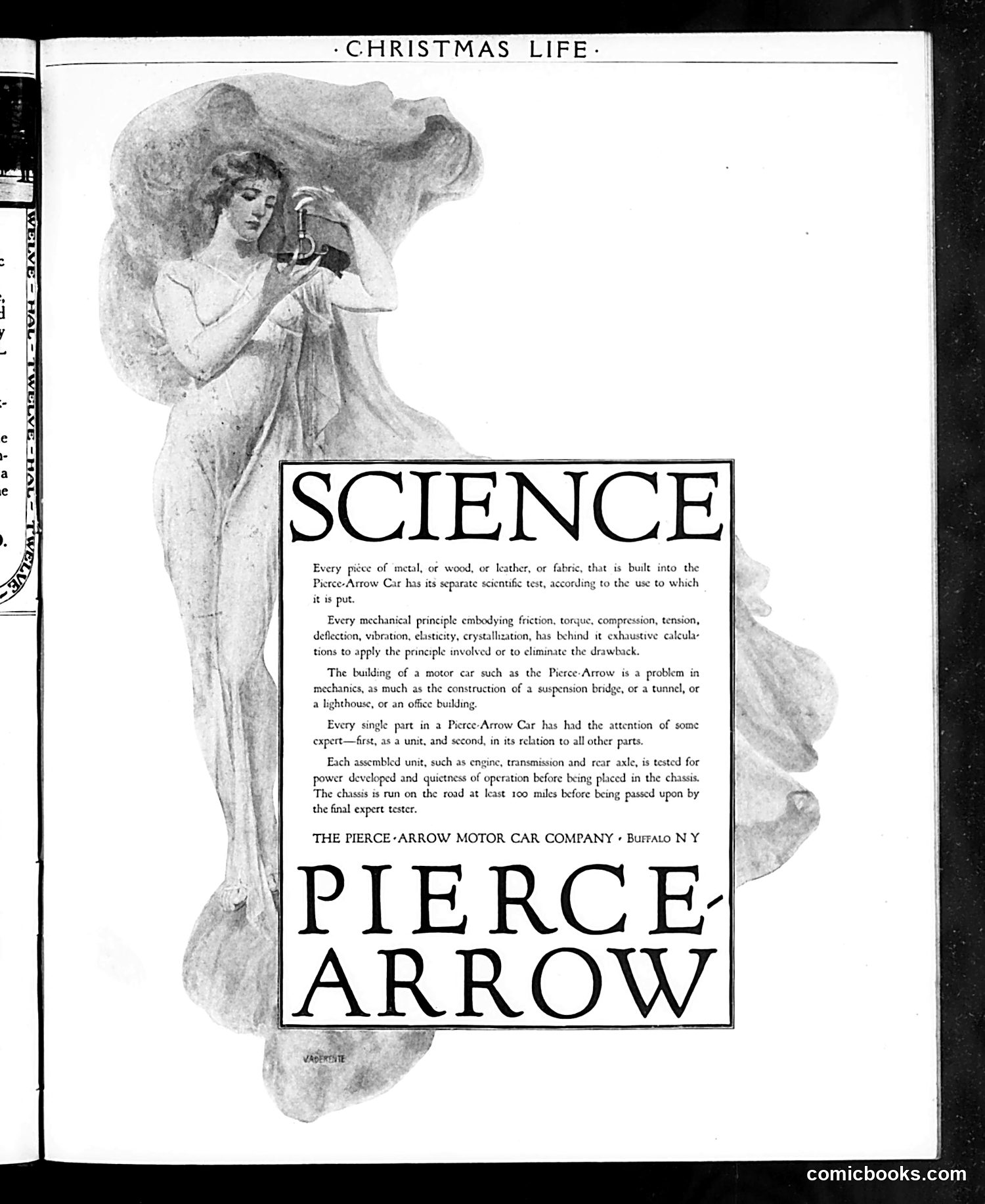
This is a **Pierce-Arrow automobile advertisement**, not political satire. The page appears in *Life* magazine's Christmas issue and promotes the Pierce-Arrow motor car through an elegant illustration of a woman in classical dress holding what appears to be mechanical components or a wrench. The "Science" heading frames the advertisement's central claim: Pierce-Arrow vehicles represent rigorous engineering excellence. The text emphasizes scientific testing at every stage—each material, mechanical principle, and assembled unit undergoes expert scrutiny. The company compares car manufacturing to major infrastructure projects (suspension bridges, tunnels, lighthouses), elevating automobiles to monuments of precision engineering. The classical female figure symbolizes refinement and quality, a common advertising trope of the era associating luxury goods with beauty and sophistication. This Christmas-season placement targets affluent readers as aspirational holiday gift-giving. The advertisement makes no political or satirical statement; it's straightforward marketing positioning Pierce-Arrow as the scientifically superior choice for discerning buyers.
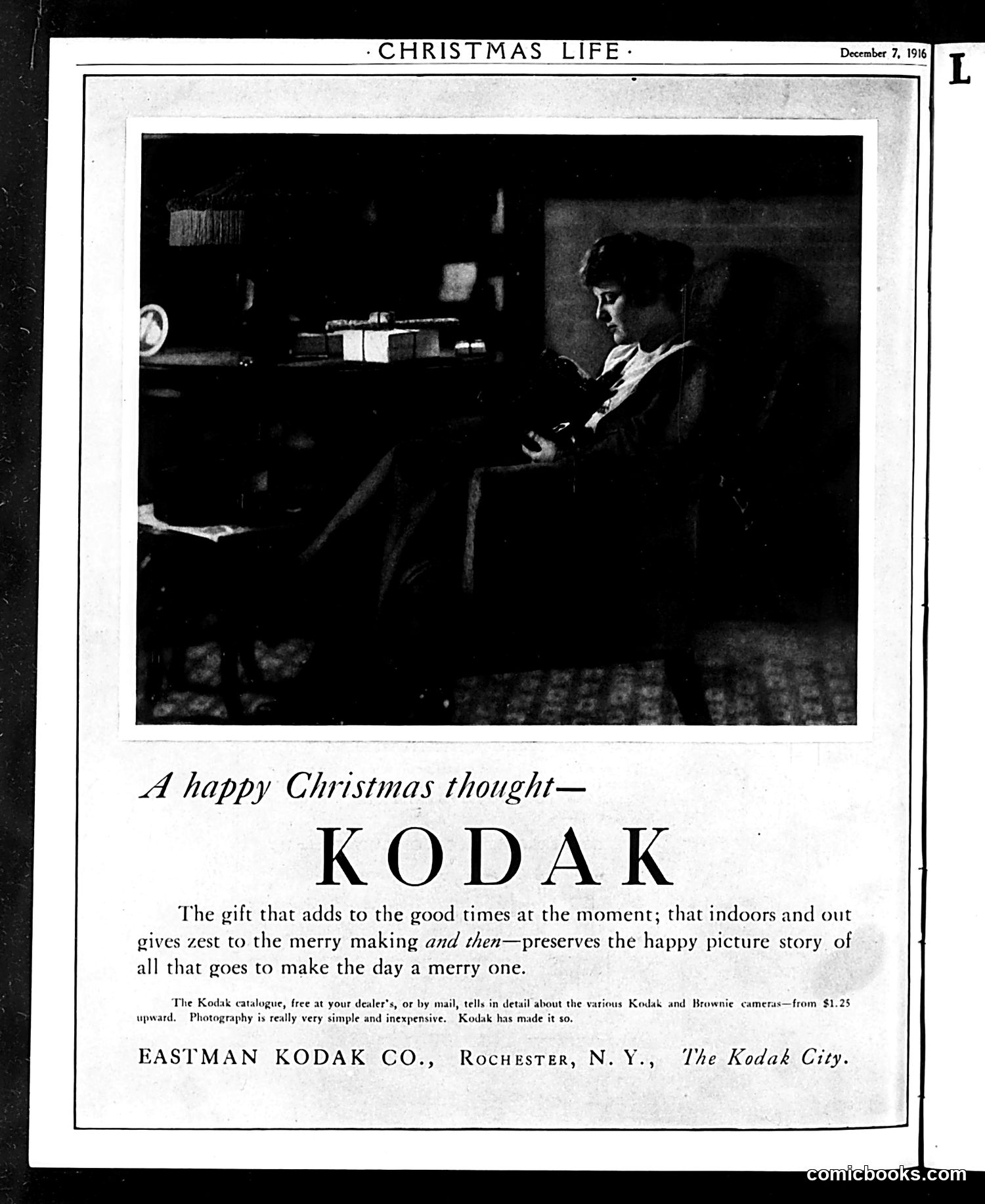
This is not a cartoon or satire—it's a Christmas advertisement for Kodak cameras from December 1916. The image shows a woman in dark clothing examining or holding a Kodak camera indoors, likely in a home setting with wrapped gifts visible. The ad's pitch is straightforward marketing: Kodak cameras make ideal Christmas gifts because they capture and preserve holiday memories. The message emphasizes accessibility ("Photography is really very simple and inexpensive") and affordability (cameras starting at $1.25), positioning photography as an increasingly consumer-friendly hobby during this era when camera technology was becoming domesticated for average households. There is no political satire or hidden meaning—this is simply period advertising reflecting early 20th-century consumer culture and the popularization of personal photography.