
Life, 1916-12-07 · page 15 of 94
Life — December 7, 1916 — page 15: what you’re looking at
What you’re looking at
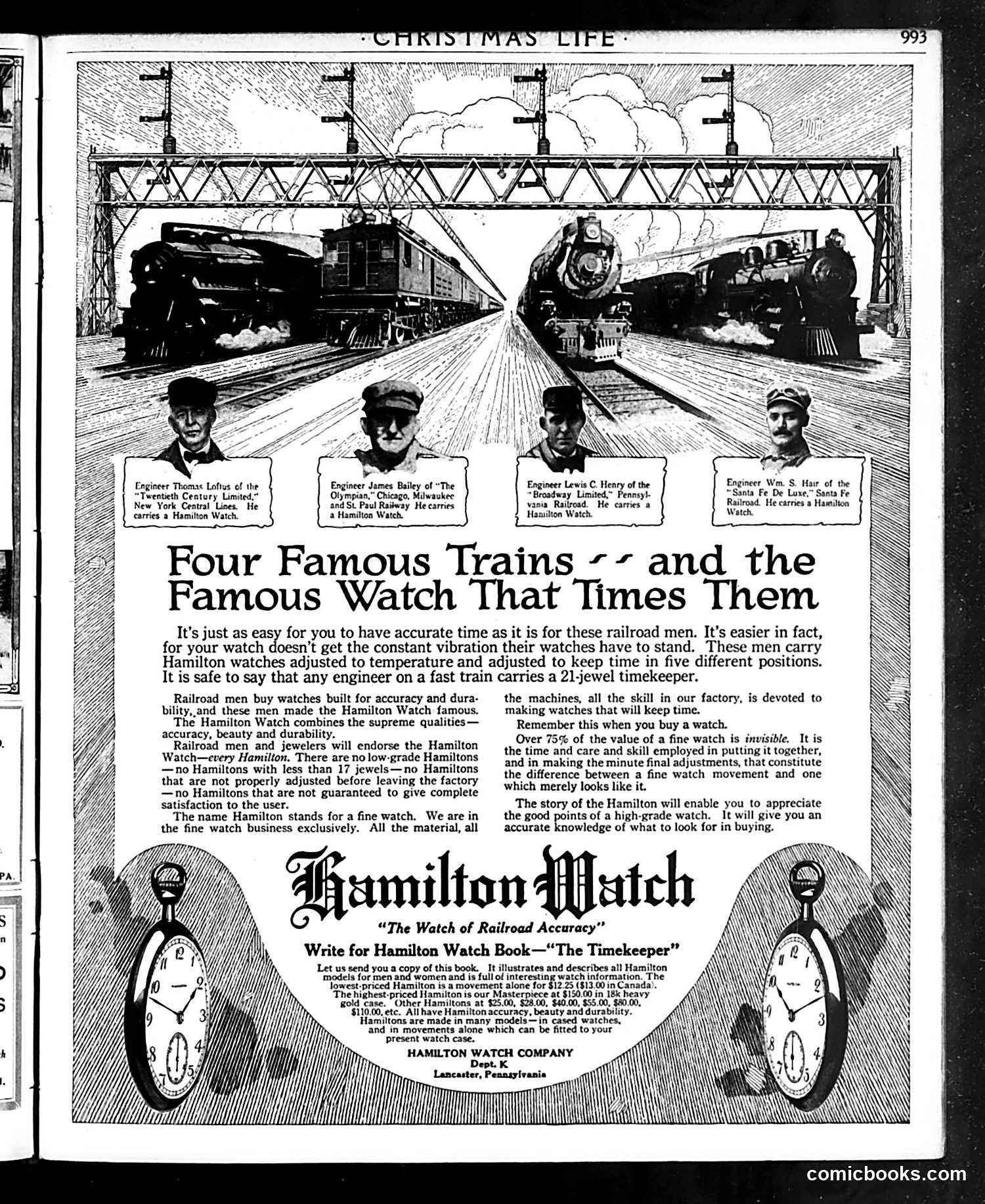
This is a **Hamilton Watch advertisement**, not a political cartoon. The page features four railroad engineers identified by name and their locomotives: - Engineer Thomas Lehfert (Twentieth Century Limited) - Engineer James Bailey (Olympic and St. Paul Railway) - Engineer Lewis C. Henry (Broadway Limited) - Engineer Wm. S. Har (Santa Fe Limited) The ad's central claim: these famous engineers trust Hamilton Watches to keep precise time on fast trains. The advertisement argues that accurate timekeeping is crucial for railroad safety and efficiency, and that Hamilton Watches—being durable, precise, and reliable—have earned the reputation of railroad men. This reflects **early 20th-century advertising strategy**: using testimonials from respected professionals to build consumer trust. The emphasis on railroad accuracy reflects the era's fascination with speed, technology, and American industrial achievement.
📄 Transcribed text from this page (OCR, searchable)
Machine-transcribed from the original scan — historical spelling and the odd misread are preserved.
Engineer James Bailey of “The Olympian,” Chicago, Milwaukee and St Paul Railway He carries a Hamilton Watch. Engineer Wm. S. Hair of the “Santa Fe De Luxe,” Santa Fe Railroad. He carries a Hamtiltoa Watch. Engineer Thomas Loftus of the “Twentieth Century Limited,” New York Central Lines. He carries a Hamilton Watch. Engineer Lewis C. Henry of the “Broadway Limited,” Pennsyl- vania Railroad. He carries a Hamilton Watch. Four Famous Trains ~” and the Famous Watch That Times Them It’s just as easy for you to have accurate time as it is for these railroad men. It’s easier in fact, for your watch doesn’t get the constant vibration their watches have to stand. These men carry Hamilton watches adjusted to temperature and adjusted to keep time in five different positions. It is safe to say that any engineer on a fast train carries a 21-jewel timekeeper. Railroad men buy watches built for accuracy and dura- bility,,and these men made the Hamilton Watch famous. The Hamilton Watch combines the supreme qualities— accuracy, beauty and durability. Railroad men and jewelers will endorse the Hamilton Watch—every Hamilton, There are no low-grade Hamiltons —no Hamiltons with less than 17 jewels—no Hamiltons that are not properly adjusted before leaving the factory —no Hamiltons that are not guaranteed to give complete satisfaction to the user. The name Hamilton stands for a fine watch. We are in the fine watch business exclusively. All the material, all the machines, all the skill in our factory, is devoted to making watches that will keep time. Remember this when you buy a watch. Over 75% of the value of a fine watch is invisible. It is the time and care and skill employed in putting it together, and in making the minute final adjustments, that constitute the difference between a fine watch movement and one which merely looks like it. The story of the Hamilton will enable you to appreciate the good points of a high-grade watch. It will give you an accurate Knowledge of what to look for in buying. “The Watch of Railroad Accuracy” Write for Hamilton Watch Book—“The Timekeeper” Let us send you a copy of this book. It illustrates and describes all Hamilton ‘models for men and women and is full of interesting watch information. The lowest-priced Hamilton is a movement alone for $12.25 ($13.00 in Canada). ‘The highest-priced Hamilton is our Masterpiece at $150.00 in 18k heavy Gold case. Other Hamiltons at $25.00, $68.00, $40.00, $55.00, $80.00, $110.00, ete. All have Hamilton accuracy, beauty and durability. Hamiltons are made in many models—in cased watches, and in movements alone which can be fitted to your present watch case. >» CH . » Mamilton futch HAMILTON WATCH COMPANY ‘Ni 4, x in mn ml