
Life, 1916-12-07 · page 89 of 94
Life — December 7, 1916 — page 89: what you’re looking at
What you’re looking at
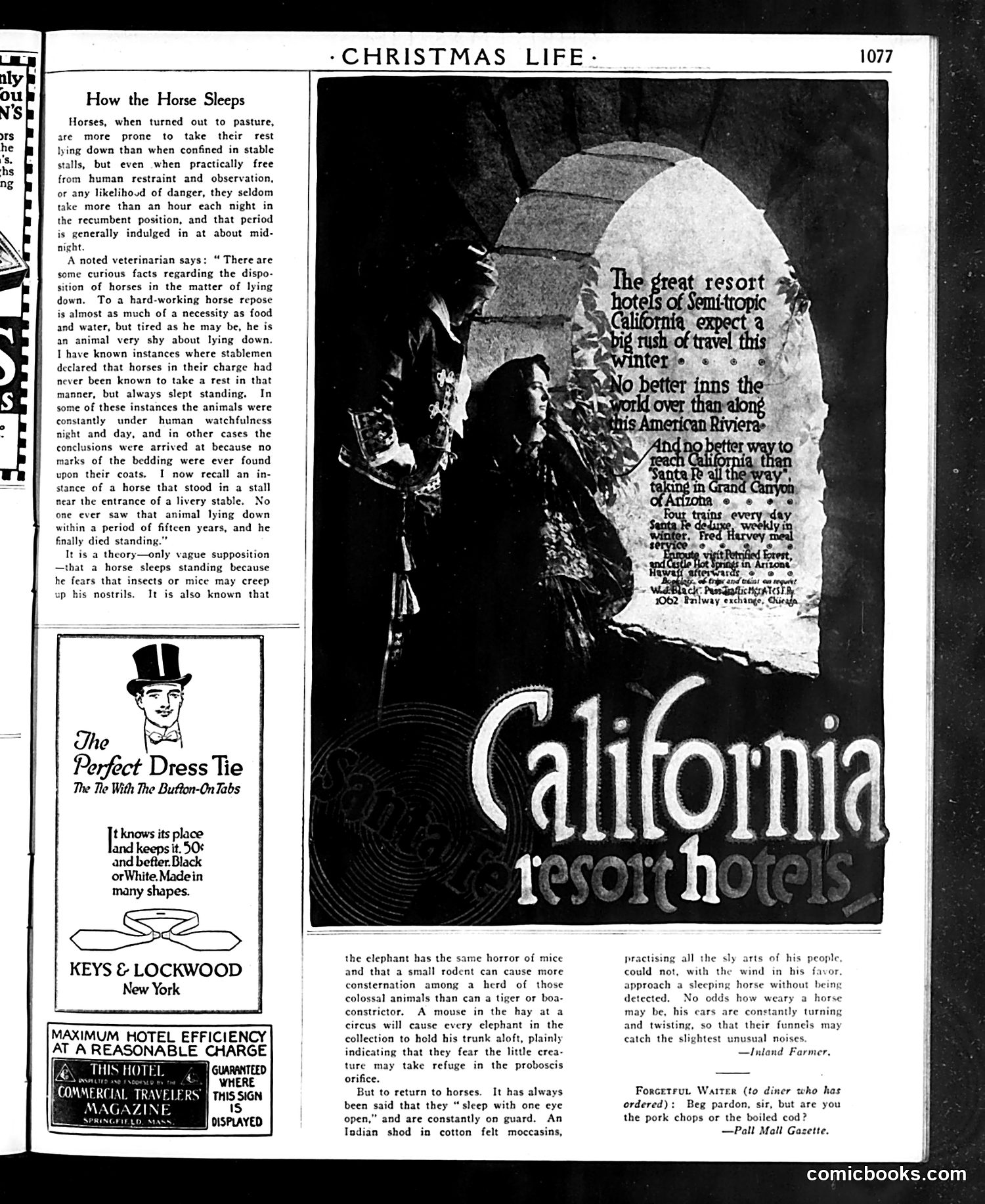
This page from *Life* magazine contains primarily **educational/informational content** rather than political satire. The main article, "How the Horse Sleeps," discusses veterinary facts about equine sleep behavior—specifically that horses rarely lie down, typically sleeping standing up for only about an hour nightly. A veterinarian is quoted explaining this is partly defensive behavior; horses remain alert to dangers and are averse to lying down despite needing rest. The article extends the observation to elephants, noting they share an irrational fear of mice entering their nostrils. **Advertisements** occupy the left side: a dress tie ("The Perfect Dress Tie") and hotel efficiency notices. At the bottom are two brief **humor items**: a joke about a dress tie's durability, and a waiter's comic mishearing (asking if the diner ordered "pork chops or boiled cod" rather than which dish). The large **California resort hotels advertisement** on the right is unrelated to the editorial content—standard magazine layout of the era.
📄 Transcribed text from this page (OCR, searchable)
Machine-transcribed from the original scan — historical spelling and the odd misread are preserved.
-CHRISTMAS LIFE- How the Horse Sleeps Horses, when turned out to pasture, are more prone to take their rest lying down than when confined in stable stalls, but even when practically free from human restraint and observation, or any likelihoud of danger, they seldom take more than an hour each night in the recumbent position, and that period is generally indulged in at about mid- night. A noted veterinarian says: “ There are some curious facts regarding the dispo- sition of horses in the matter of lying down. To a hard-working horse repose is almost as much of a necessity as food and water, but tired as he may be, he is an animal very shy about lying down. I have known instances where stablemen declared that horses in their charge had never been known to take a rest in that manner, but always slept standing. In some of these instances the animals were constantly under human watchfulness night and day, and in other cases the conclusions were arrived at because no marks of the bedding were ever found upon their coats. I now recall an in- stance of a horse that stood in a stall near the entrance of a livery stable. No one ever saw that animal lying down within a period of fifteen years, and he finally died standing.” It is a theory—only vague supposition —that a horse sleeps standing because he fears that insects or mice may creep up his nostrils. It is also known that Perfect Dress Tie The The With The Bufton-OnTabs I knows its place land keeps it. 50* and befter. Black orWhite. Madein many shapes. KEYS & LOCKWOOD MAXIMUM HOTEL EFFICIENCY AT A REASONABLE CHARGE Ay, THIS HOTEL Peay user COMMERCIAL TRAVELERS, THISSIGN the elephant has the same horror of mice and that a small rodent can cause more consternation among a herd of those colossal animals than can a tiger or boa- constrictor. A mouse in the hay at a circus will cause every elephant in the collection to hold his trunk aloft, plainly indicating that they fear the little crea- ture may take refuge in the proboscis orifice. But to return to horses. It has always been said that they “sleep with one eye open,” and are constantly on guard. An Indian shod in cotton felt moccasins, practising all the sly arts of his people could not, with the wind in his fa approach a slecping horse without being detected. No odds how weary a horse may be, his cars are constantly turning and twisting, so that their funnels may catch the slightest unusual noises. —Inland Farmer, Forcetrut Waiter (to diner who has ordered): Beg pardon, sir, but are you the pork chops or the boiled cod? —Pall Mall Gazette. comicbooks.com