
Life, 1916-12-07 · page 30 of 94
Life — December 7, 1916 — page 30: what you’re looking at
What you’re looking at
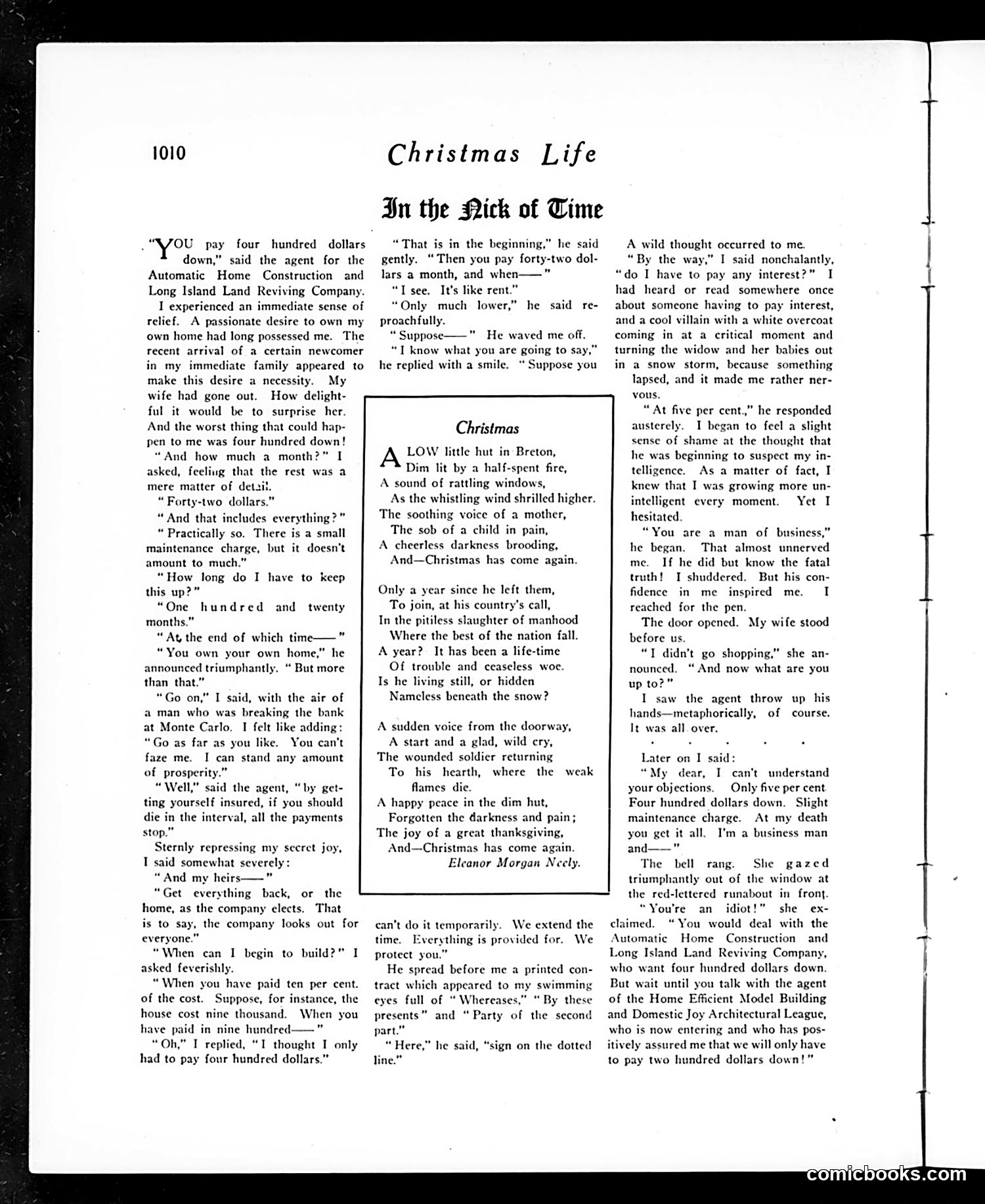
This satirical story mocks the aggressive sales tactics and deceptive practices of early 20th-century home-financing schemes. The narrator encounters an agent for the "Automatic Home Construction and Long Island Land Reviving Company" who initially quotes $400 down and $42/month—seemingly affordable. However, the fine print reveals the true cost: a 10% down payment (actually $900), 120 monthly payments totaling thousands, plus 5% interest, with life insurance requirements. The satire targets the predatory lending practices targeting working-class homebuyers, particularly those tempted by the promise of ownership. The agent's manipulative reassurances ("the company looks out for everyone") and vague contract terms exemplify how such companies exploited consumers' dreams of homeownership. The poem "Christmas" inserted mid-story provides emotional counterpoint—depicting genuine human suffering—suggesting the real stakes when families lose homes due to financial hardship. The humor derives from the narrator's dawning realization that he's been thoroughly bamboozled.
📄 Transcribed text from this page (OCR, searchable)
Machine-transcribed from the original scan — historical spelling and the odd misread are preserved.
‘OU pay four hundred dollars said the agent for the Automatic Home Construction and Long Island Land Reviving Company. I experienced an immediate sense of relief. A passionate desire to own my own home had long possessed me. The recent arrival of a certain newcomer in my immediate family appeared to make this desire a necessity. My wife had gone out. How delight- ful it would be to surprise her. And the worst thing that could hap- pen to me was four hundred down! “And how much a month?” I asked, feeling that the rest was a mere matter of det. “Forty-two dollars. “And that includes everything?” “ Practically so. There is a small maintenance charge, but it doesn’t amount to much,” “How long do I have to keep this up?” “One hundred and twenty months.” “At the end of which time—” “You own your own home,” he nounced triumphantly. “ But more than that “Go on,” I said, with the air of a man who was breaking the bank at Monte Carlo, I felt like adding: “Go as far as you like. You can’t faze me. I can stand any amount of prosperity.” “Well,” said the agent, “by get- ting yourself insured, if you should die in the interval, all the payments stop.” Sternly repressing my I said somewhat severely: “And my heirs—” “Get everything back, or the home, as the company elects. That is to say, the company looks out for everyone.” “When can I begin to build?” asked feverishly. “When you have paid ten per cent. of the cost. Suppose, for instance, the house cost nine thousand. When you have paid in nine hundred— ” “Oh,” I replied, “I thought I only had to pay four hundred dollars.” eret joy, I Christmas Life “That is in the beginning,” he said gently. “Then you pay forty-two dol- lars a month, and when——” “Tsee. It's like rent.” “Only much lower,” he said re- proachfully, uppose—" He waved me off. “I know what you are going to say,” he replied with a smile. “ Suppose you Christmas LOW little hut in Breton, Dim lit by a half-spent fire, A sound of rattling windows, As the whistling wind shrilled higher. The soothing voice of a mother, The sob of a child in pain, A cheerless darkness brooding, And—Christmas has come again. Only a ir since he left them, To join, at his country’s call, In the pitile: aughter of manhood Where the best of the nation fall. A year? It has been a life-time Of trouble and ceaseless woe. Is he living still, or hidden Nameless beneath the snow? A sudden voice from the doorway, A start and a glad, wild er: The wounded soldier returning To his hearth, where the weak flames die. A happy peace in the dim hut, Forgotten the darkness and pain; The joy of a great thanksgi And—Christmas has come a! Eleanor Morgan Neely. can’t do it temporarily. We extend the time. Everything is provided for. We Protect you.” He spread before me a printed con- tract which appeared to my swimming eyes full of “ Whereases,” “ By these present: and “Party of the second part.” “Here,” he said, “sign on the dotted line. In the Nick of Time A wild thought occurred to me. “By the way,” I said nonchalantly, “do I have to pay any interest?” I had heard or read somewhere once about someone having to pay interest, and a cool villain with a white overcoat coming in at a critical moment and turning the widow and her babies out in a snow storm, because something lapsed, and it made me rather ner- vous “At five per cent.” he responded austerely. I began to feel a slight sense of shame at the thought that he was beginning to suspect my in- telligence. As a matter of fact, I knew that I was growing more un- intelligent every moment. Yet I hesitated. “You are a man of business,” he began. That almost unnerved me. If he did but know the fatal truth! I shuddered. But his con- fidence in me inspired me. I reached for the pen. The door opened. My wife stood before us. “T didn’t go shopping,” she an- nounced. “And now what are you up to?” I saw the agent throw up his hands—metaphorically, of course. It was all. over. Later on I said: “My dear, I can't. understand your objections. Only five per cent Four hundred dollars down. Slight maintenance charge. At my death you get it all. I'm a business man and——” The bell rang. She triumphantly out of the wv the red-lettered runabout in front. “You're an idiot!” she ex- claimed. “You would deal with the Automatic Home Construction and Long Island Land Reviving Company, who want four hundred dollars down. But wait until you talk with the agent of the Home Efficient Model Building and Domestic Joy Architectural League, who is now entering and who has pos- itively assured me that we will only hav to pay two hundred dollars down!" gazed indow at H |