
Life, 1916-12-07 · page 28 of 94
Life — December 7, 1916 — page 28: what you’re looking at
What you’re looking at
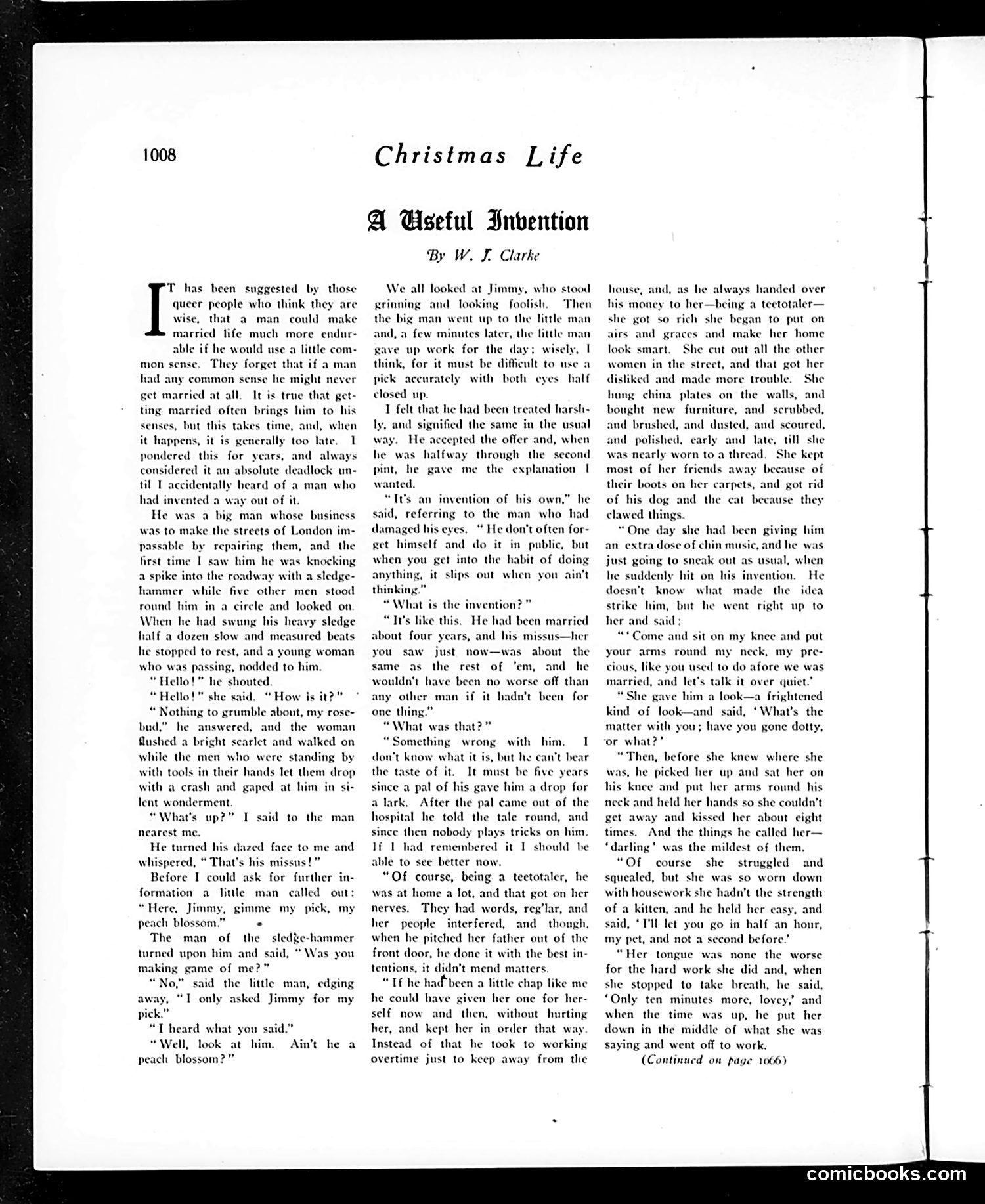
This is a humorous short story rather than a political cartoon. It satirizes working-class married life and domestic discord in early 20th-century England. The "invention" is a husband's strategy: a big laborer with a wife he quarrels with discovers that being a teetotaler (abstainer from alcohol) keeps him home too much, aggravating their relationship. His solution is to work overtime constantly, staying away from home to avoid conflict—a commentary on how marriage problems drive men to escape rather than resolve them. The opening philosophical riff mocks the suggestion that "common sense" could improve marriage, arguing that common sense would prevent marriage altogether. The story uses working-class London dialect and characters (a road worker, laborers) to explore the gap between romantic ideals and domestic reality—a theme satirizing middle-class marriage advice that assumes rational problem-solving could work in actual relationships.
📄 Transcribed text from this page (OCR, searchable)
Machine-transcribed from the original scan — historical spelling and the odd misread are preserved.
T has been suggested by those queer people who think they are wise, that a man could make married life much more endur- able if he would us little com- mon sense. They forget that if a man had any common sense he might never get married at all. It is true that get- ting married often brings him to his senses, but this takes time, and, when it happens, it is generally too late. 1 pondered this for years, and alw considered it an absolute deadlock un- til T accidentally heard of a man who had invented a way out of it. He was a big man whose business was to make the streets of London im- passable by repairing them, and the first time I saw him he was knocking a spike into the roadway with a sledge- hammer while five other men stood round him in a circle and looked on. When he had swung his heavy sledg: half a dozen slow and measured beats he stopped to rest, and a young woman who was passing, nodded to him “Hello!” he shouted “Hello!” she sa “ How is it?” Nothing to grumble about, my rose- bud,” he answered, and the woman Mushed a bright scarlet and walked on while the men who were standing by with tools in their hands let them drop with a crash and gaped at him in si- lent wonderment “What's up?" nearest me He turned his dazed face to me and whispered, “ That's his missus! Before I could ask for further in- formation a little called out: “Here, Jimmy, gimme my pick, my peach blossom.” - The man of the slede-hammer turned upon him and said, “ Was you making game of me?” “No,” said the little man, edging away, “I only asked Jimmy for my pick. “T heard what you said.” “Well, look at him. Ain't he a peach blossom?” said to the man man Christmas Life A Aseful Invention By W. SF. Clarke Ve all looked at Jimmy, who stood grinning and looking foolish. Then the big man went up to the little man and, a few minutes later, the lithe man gave up work for the day; wisely, | think, for it must be difficult to use pick accurately with both eyes half closed up. 1 felt that he had been treated harsh- ly, and signified the same in the usual way, He accepted the offer and, when he was halfway through the second pint, he gave me the explanation | wanted. It's an invention of his own,” he said, referring to the man who had damaged his eyes. “ He don't often for- get himself and do it in public, but when you get into the habit of doing anything, it slips out when you ain't thinking. “What is the invention? “T's like this. He had been married about four years, and his missus—her you saw just about the same as the rest of ‘em, and he wouldn't have been no worse off than any other man if it hadn't been for one thing.” “What was that?” “Something wrong don’t know what it is, but he can't bear the taste of it. It must be five y since a pal of his gave him a drop for a lark. After the pal came out of the hospital he told the tale round, and since then nobody plays tricks on him. If 1 had remembered it T should be ble to see better now. “Of course, being a tectotaler, he was at home a lot, and that got on her nerves. They had words, reg’lar, and her people interfered, and though, when he pitched her father out of the front door, he done it with the best in- tentions, it didn’t mend matters. “TE he had“been a little chap like me he could have given her one for her- self now and then, without hurting her, and kept her in order that way Instead of that he took to working overtime just to keep away from the now—was with him. 1 house, and, as he always handed over his money to her—being a tectotaler— she got so rich she began to put on airs and graces and make her home look smart. She cut out all the other women in the street, and that got her disliked and made more trouble. She hung china plates on the walls, and bought new furniture, and scrubbed, and brushed, and dusted, and scoured, and polished, carly and late, till she was nearly worn to a thread. She kept most of her friends away because of their boots on her carpets, and got rid of his dog and the cat because they clawed things. “One day she had been giving him an extra dose of chin music, and he was just going to sneak out as usual, when he suddenly hit on his invention. He know what made the idea him, but he went right up to doesn’t strike her and said: “©Come and sit on my knee and put your arms round my neck, my pre- cious, like you used to do afore we was married, and let's talk it over quiet.’ She gave him a look—a frightened kind of look—and said, ‘What's the matter with you; have you gone dotty, ‘or what?’ “Then, before she knew where she was, he picked her up and sat her on his knee and put her arms round his neck and held her hands so she couldn't get away and kissed her about eight times. And the things he called her— ‘darling’ was the mildest of them. “Of course she struggled and squealed, but she was so worn down with housework she hadn't the strength of a kitten, and he held her easy, and said, ‘I'll let you go in half an hour, my pet, and not a second before.” “Her tongue was none the worse for the hard work she did and, when she stopped to take breath, he said, ‘Only ten minutes more, lovey,’ and when the time was up, he put her down in the middle of what she was saying and went off to work. (Continued on page 1066) comicbooks.com