
A complete issue · 60 pages · 1910
Life — October 6, 1910
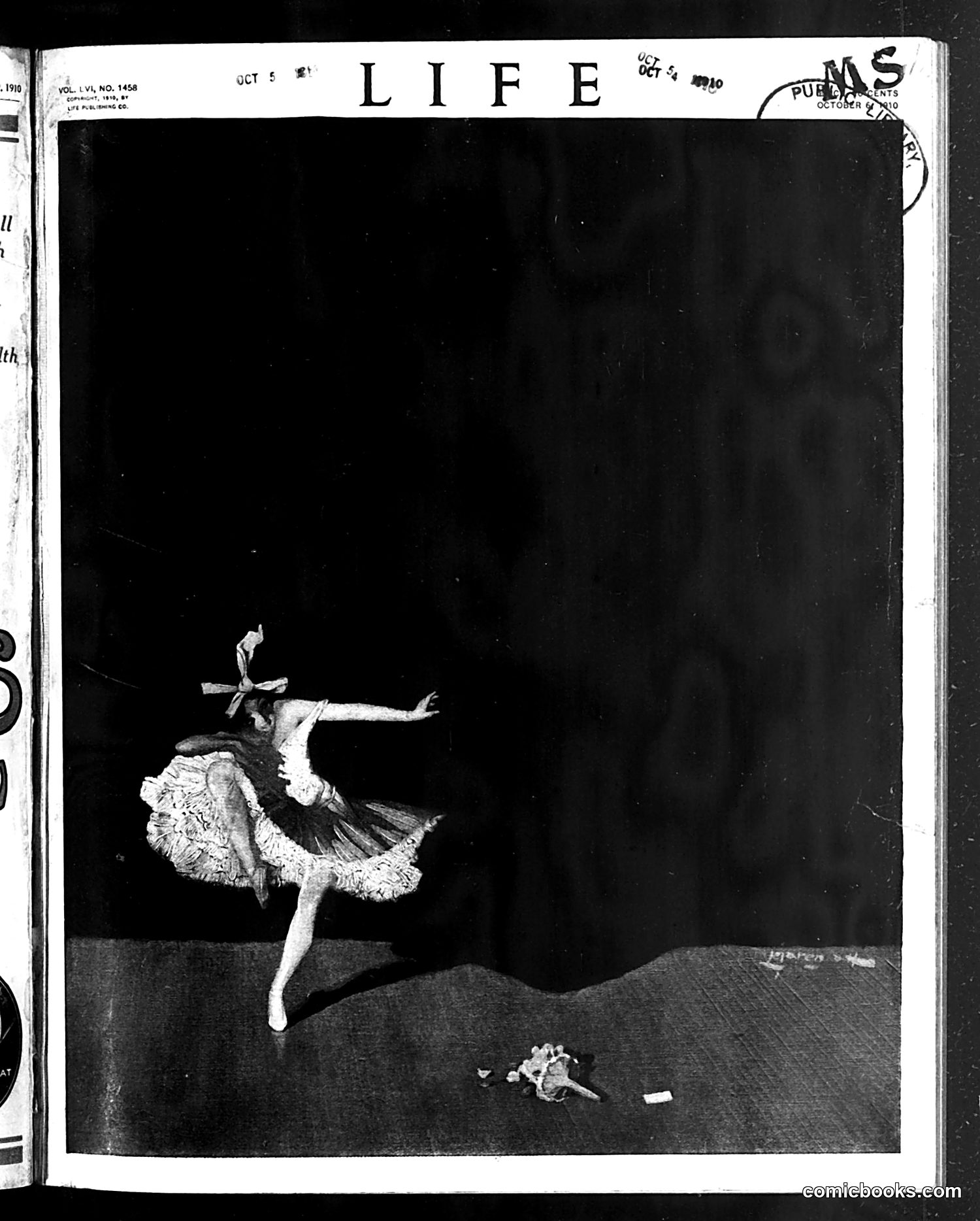
This appears to be a cover or illustration from *Life* magazine showing a classical ballet dancer in an arabesque pose against a dark background, with what looks like a small bouquet on the stage floor below. Without legible OCR text or clear contextual clues visible in the image itself, I cannot definitively identify: - Which specific dancer or production this depicts - What satirical point is being made - Whether this is commentary on a particular cultural or political event The composition suggests this may be celebrating or commenting on high-culture ballet, possibly with social satire about artistic pretension or the ballet world's conventions. However, without readable accompanying text or clear identifying details, I cannot reliably explain the specific satirical meaning to a modern reader.
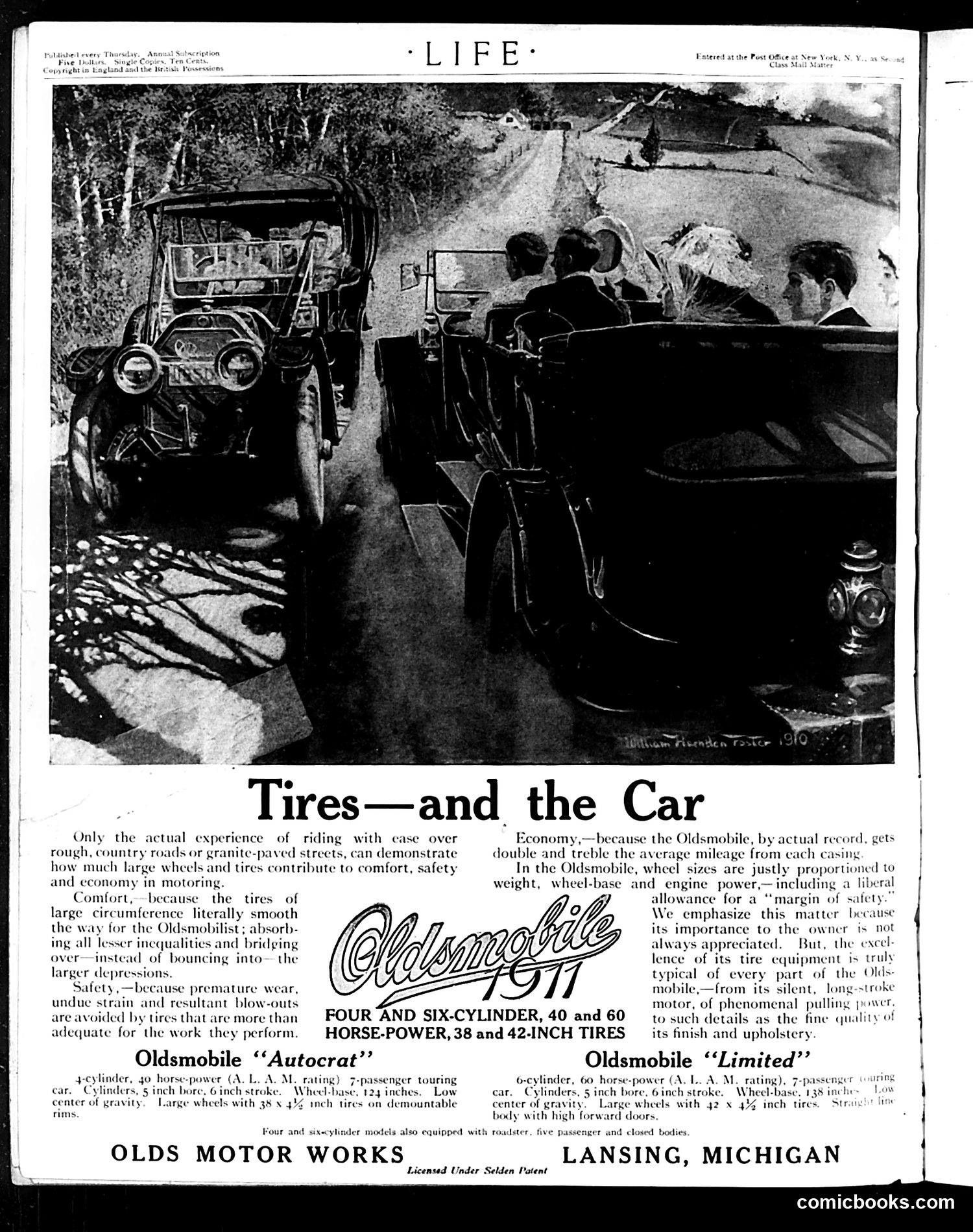
This page is **primarily advertising**, not political satire. It features a large advertisement for Oldsmobile automobiles from Olds Motor Works in Lansing, Michigan. The image shows two early 1900s cars on a rural road. The ad emphasizes practical benefits: comfort from large wheels and tires that smooth rough roads, safety from proper tire sizing, and economy from reliable performance. The text specifically promotes Oldsmobile's "Autocrat" and "Limited" models with various engine and tire configurations (4 and 6-cylinder, 40 and 60 horsepower, 38 and 42-inch tires). This reflects the early automotive era when tire quality and wheel size were major selling points for vehicle comfort and safety—concerns that differ substantially from modern car marketing.
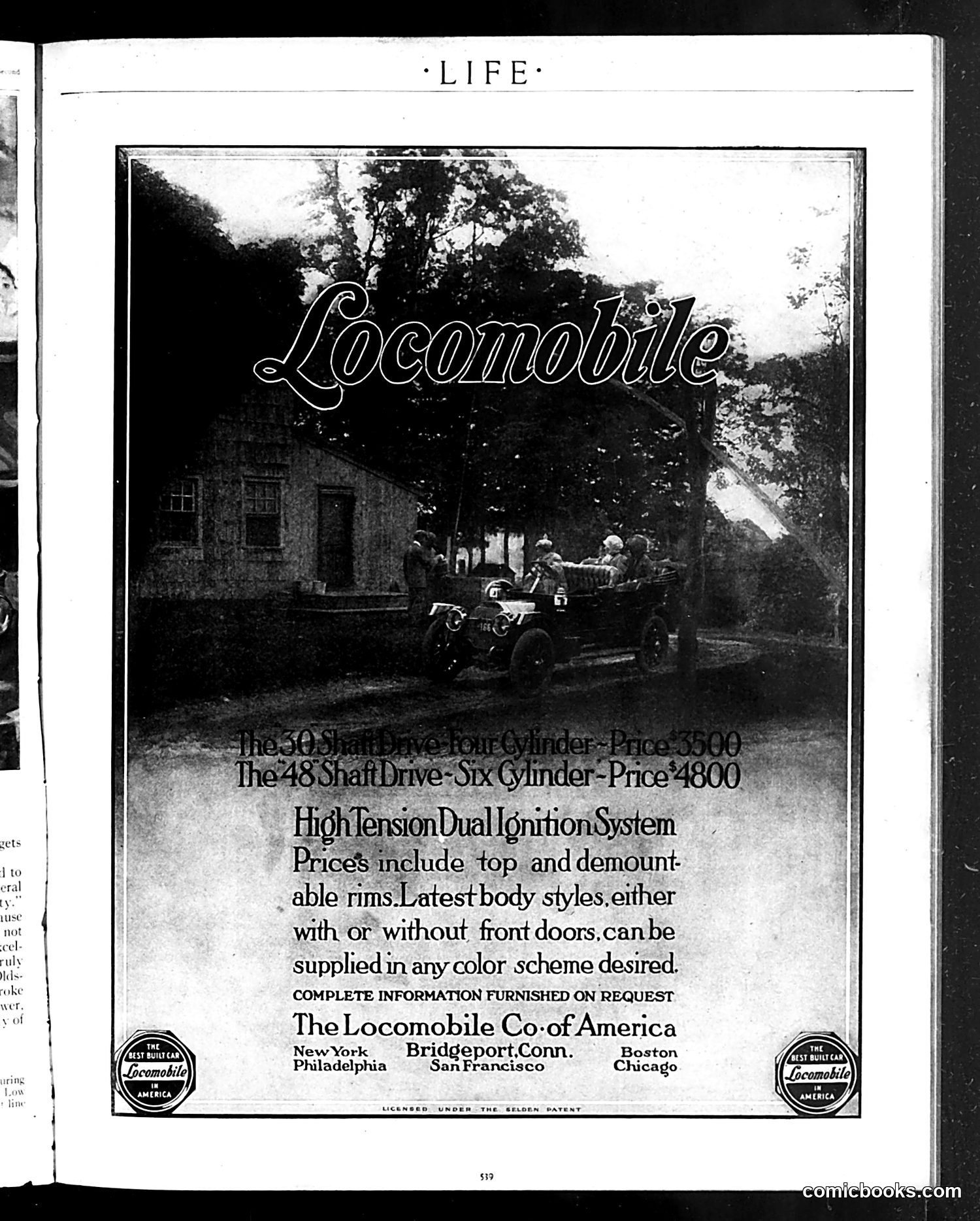
This page is primarily **advertising, not satire or editorial content**. It's a full-page advertisement for the Locomobile automobile, published in *Life* magazine. The ad features a black-and-white photograph of an early motorcar with passengers on a tree-lined road. Text promotes two models: the 30 Shaft Drive Four-Cylinder (priced $3,500) and the 48 Shaft Drive Six-Cylinder (priced $4,800). The copy emphasizes features like "High Tension Dual Ignition System" and customizable body styles. The Locomobile Co. of America lists offices in major cities: New York, Philadelphia, Bridgeport, San Francisco, Boston, and Chicago. This represents early automotive industry marketing targeting *Life*'s affluent readership during the pioneering era of motorcar manufacturing.
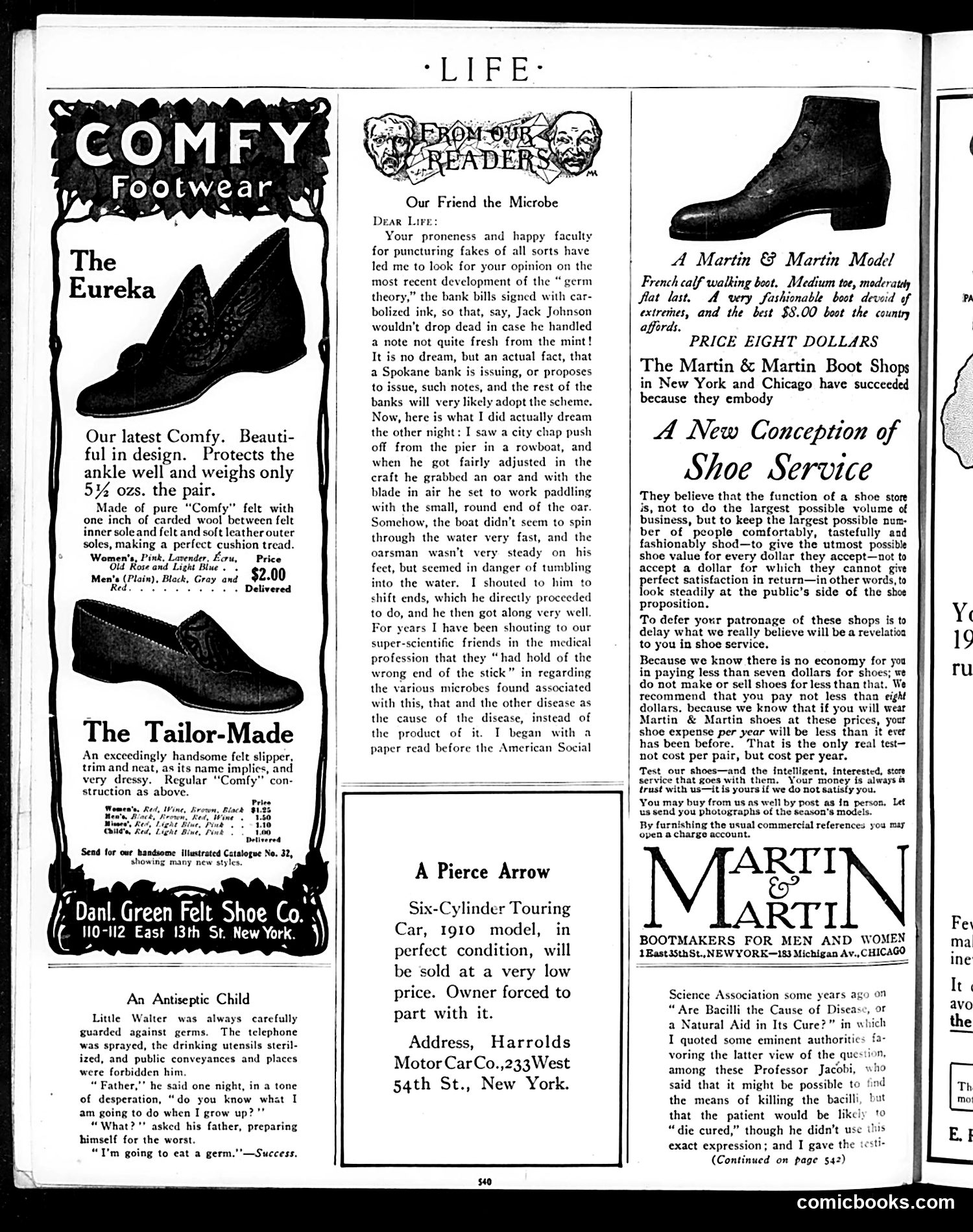
This page is primarily **advertising and advice columns** rather than political satire. It contains: **Advertisements:** - Comfy Footwear (felt slippers and boots) - Martin & Martin Boot Shops (promoting affordable, quality shoe service) - Pierce Arrow automobiles **Editorial Content:** - "From Our Readers" column featuring a letter about a "Microbe" (likely a humorous discussion of germ theory) - "An Antiseptic Child" anecdote mocking parental germaphobia—a father spraying his child with disinfectant, with the child joking he'll "eat a germ" when grown The humor reflects **early 20th-century anxieties about new scientific discoveries** (germ theory) and reflects contemporary debates about overly cautious parenting. There is **no apparent political satire** on this page—it's consumer-focused content typical of Life magazine's mixed editorial-advertising format.
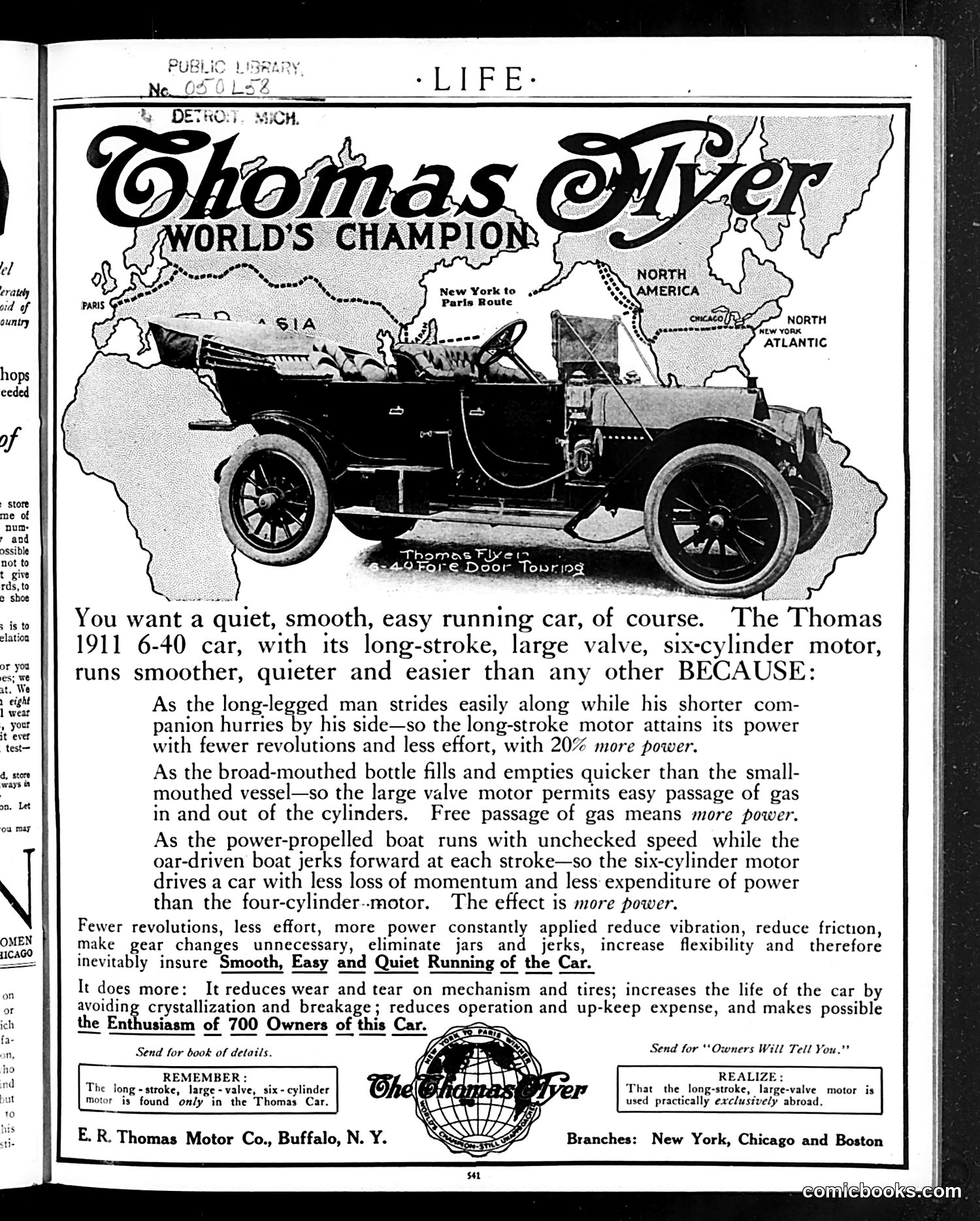
This page is **primarily an advertisement**, not satirical content. It's a full-page ad for the Thomas Flyer automobile, marketed as "World's Champion." The ad uses comparative analogies to explain the car's engineering advantages: the long-stroke motor works like a long-legged man outpacing a shorter companion; the large-valve design functions like a broad-mouthed bottle filling faster than a narrow one; the six-cylinder engine operates like a power-boat rather than an oar-driven boat. The map showing "New York to Paris Route" references the Thomas Flyer's actual 1908 racing victory—a famous long-distance automotive competition that served as effective marketing. The ad emphasizes "smooth, quiet, easy running" and claims ownership by "700 Owners of this Car," positioning it as an established, reliable choice for early automobile buyers.
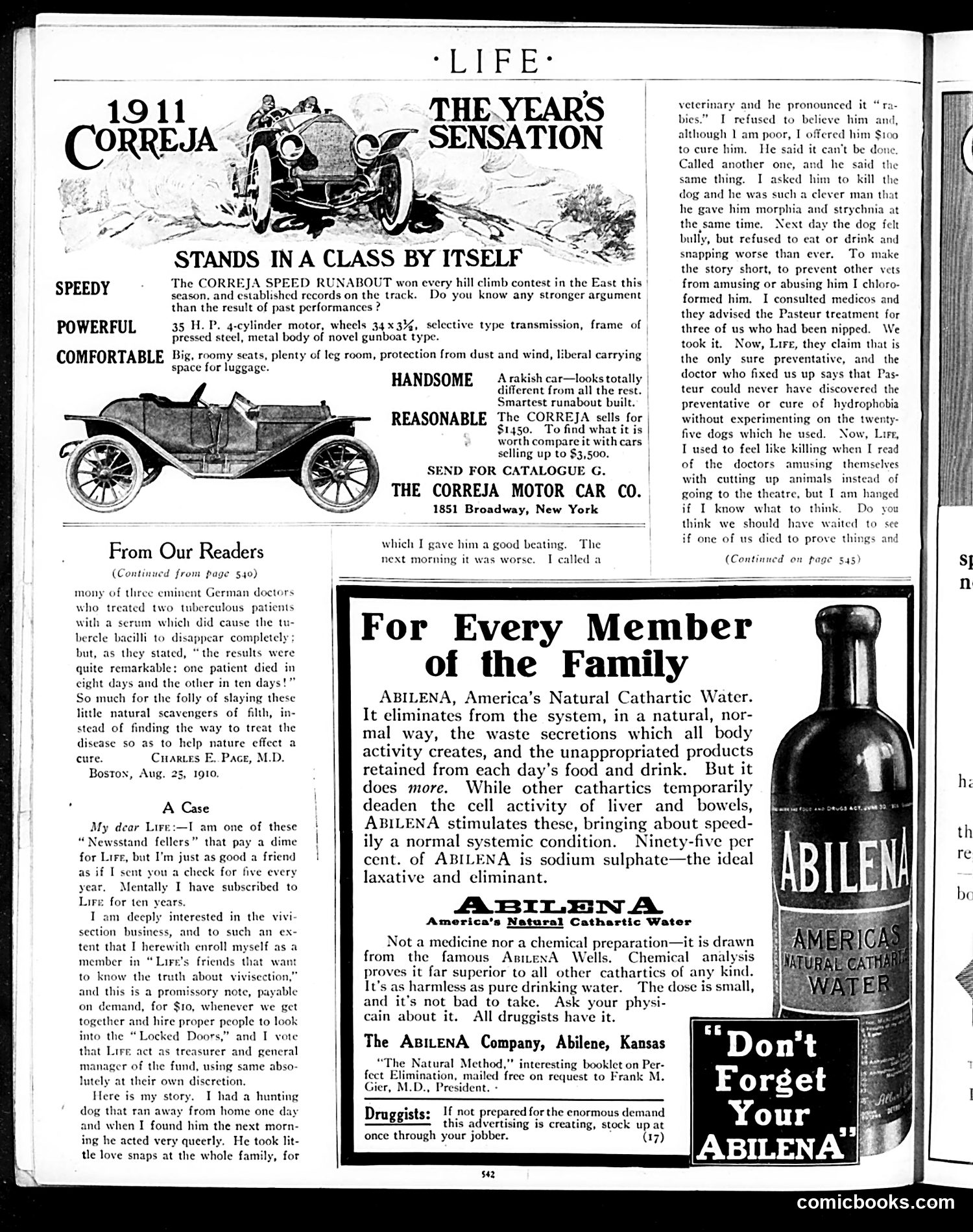
This page is primarily **advertising and readers' letters**, not satire or political commentary. The main content features a **1911 Correja automobile advertisement** emphasizing the car's speed, power, comfort, and reasonable price ($1,450). The vehicle is depicted as "the year's sensation" and "stands in a class by itself." Below is a "From Our Readers" section containing letters about medical treatments—specifically discussing tuberculosis cures and a hunting dog's illness. The remaining space contains an **Abilena Natural Cathartic Water advertisement**, promoting it as a laxative for digestive health, with text assuring it's harmless and recommending druggists stock it. There is **no political cartoon or satire** on this page. It represents typical early-1900s magazine content: product advertising mixed with reader correspondence.
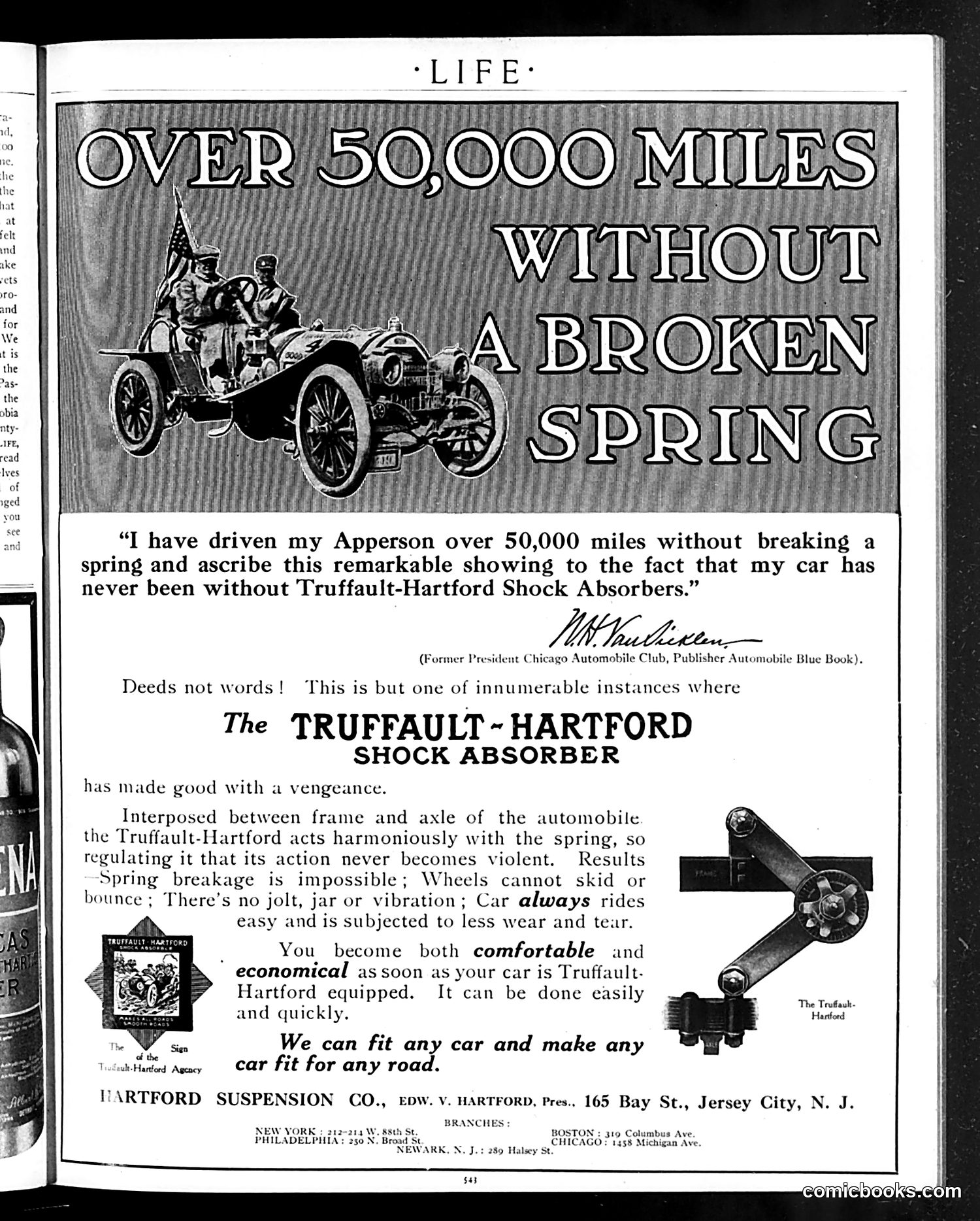
This is **not a cartoon or satire page**—it's a vintage automobile advertisement disguised as editorial content in *Life* magazine. The page advertises the **Truffault-Hartford Shock Absorber** for cars. It features a testimonial (with signature) from someone identified as "Former President Chicago Automobile Club, Publisher Automobile Blue Book," claiming to have driven an Apperson car over 50,000 miles without breaking a spring thanks to this shock absorber. The advertisement uses pseudo-journalistic framing ("Deeds not words!") to present the product's technical benefits: reduced vibration, better comfort, and universal compatibility. The mechanical diagrams show how the absorber works between frame and axle. This represents early 20th-century advertising strategy: using celebrity endorsements and technical claims to market automotive components to an affluent audience.
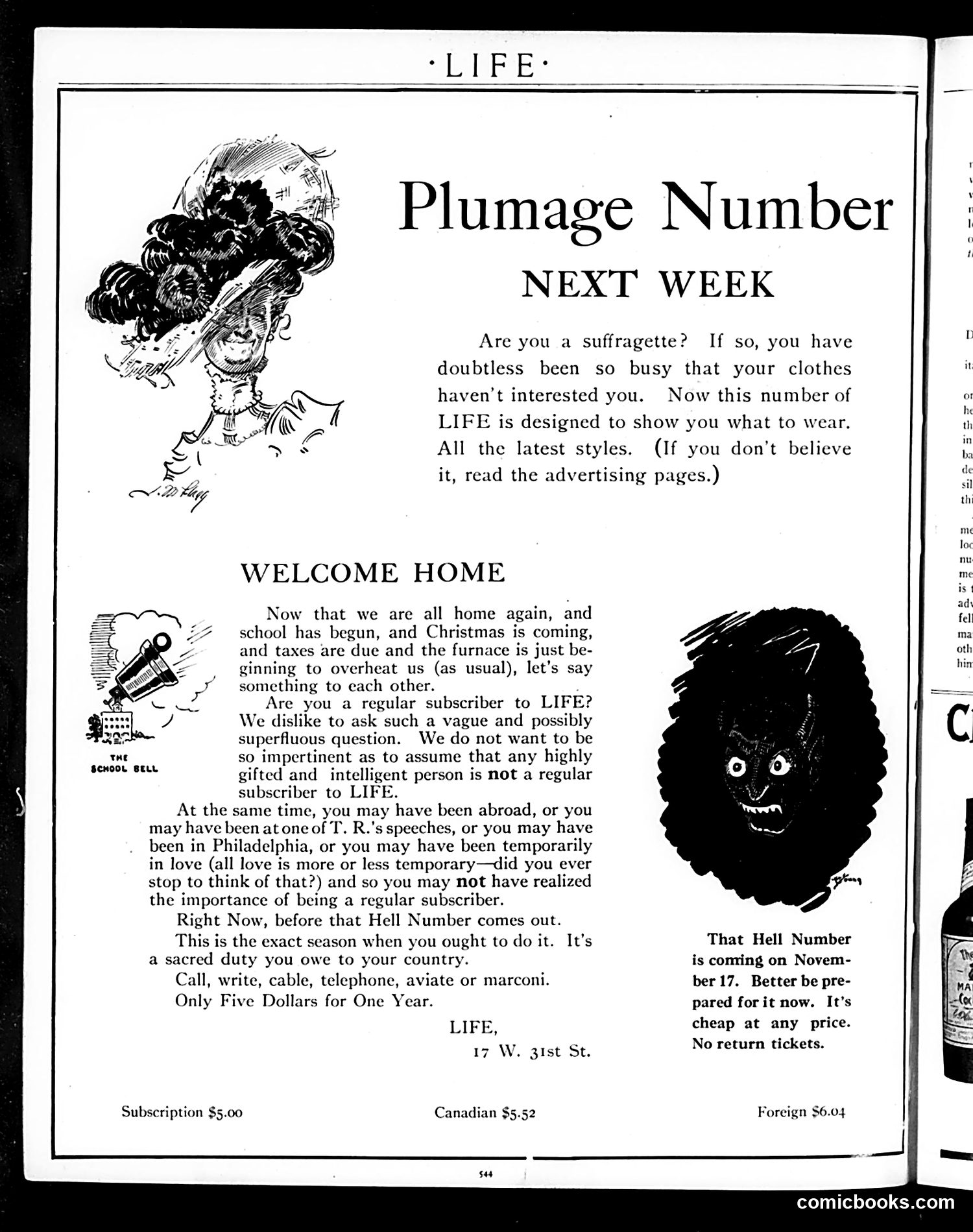
This is primarily a **subscription appeal page** rather than political satire. The content targets two audiences: 1. **Suffragettes** (women's voting rights activists): The opening jokingly assumes female readers are too busy with activism to care about fashion, then promises the magazine will show them "latest styles." 2. **"Hell Number" campaign**: The right side features a grotesque black caricature (likely a racist depiction of an African American or minstrel-show figure) advertising a coming special issue on November 17, using inflammatory language ("Hell Number...No return tickets") apparently as sensationalist marketing. The "Welcome Home" section appeals to regular subscribers, framing subscription renewal as a patriotic duty during wartime. The overall tone is lighthearted but reflects period prejudices and gender assumptions.
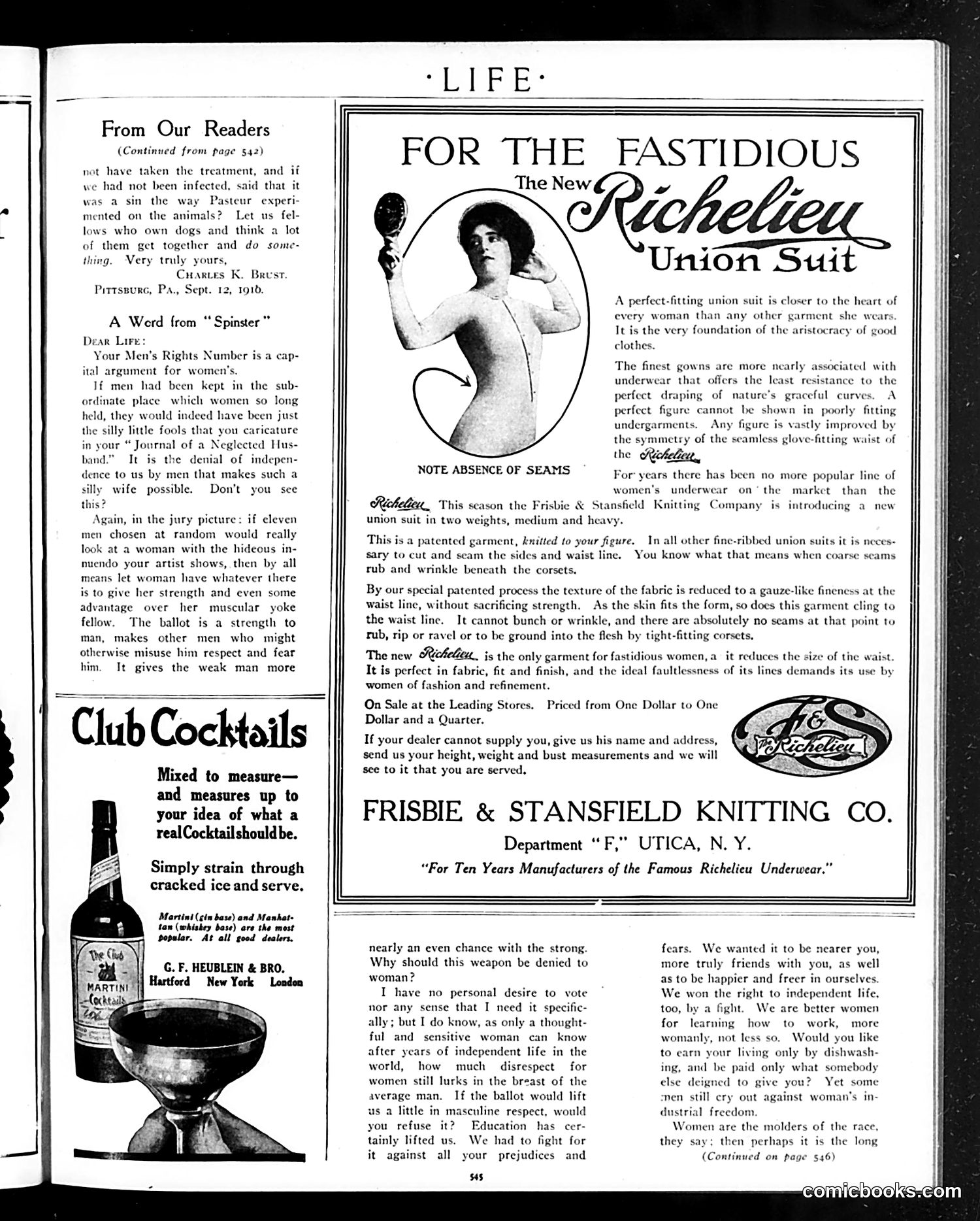
This page contains a letters section ("From Our Readers") and advertisements rather than political cartoons. The letters debate women's suffrage. One writer ("Spinster") argues that women deserve voting rights, countering claims that women are unsuitable voters. She challenges the notion that women lack the judgment for independent decision-making, sarcastically questioning why women should be denied this "weapon" when they possess equal reasoning capacity to men. The advertisements include a cocktail liqueur ad and prominently feature the "Richelieu Union Suit"—women's undergarments marketed as providing perfect fit and wrinkle-free appearance. The ads suggest the page's target audience and era's consumer culture concerns. The suffrage debate reflects early 20th-century arguments over women's political equality, a contentious issue before the 19th Amendment (1920).
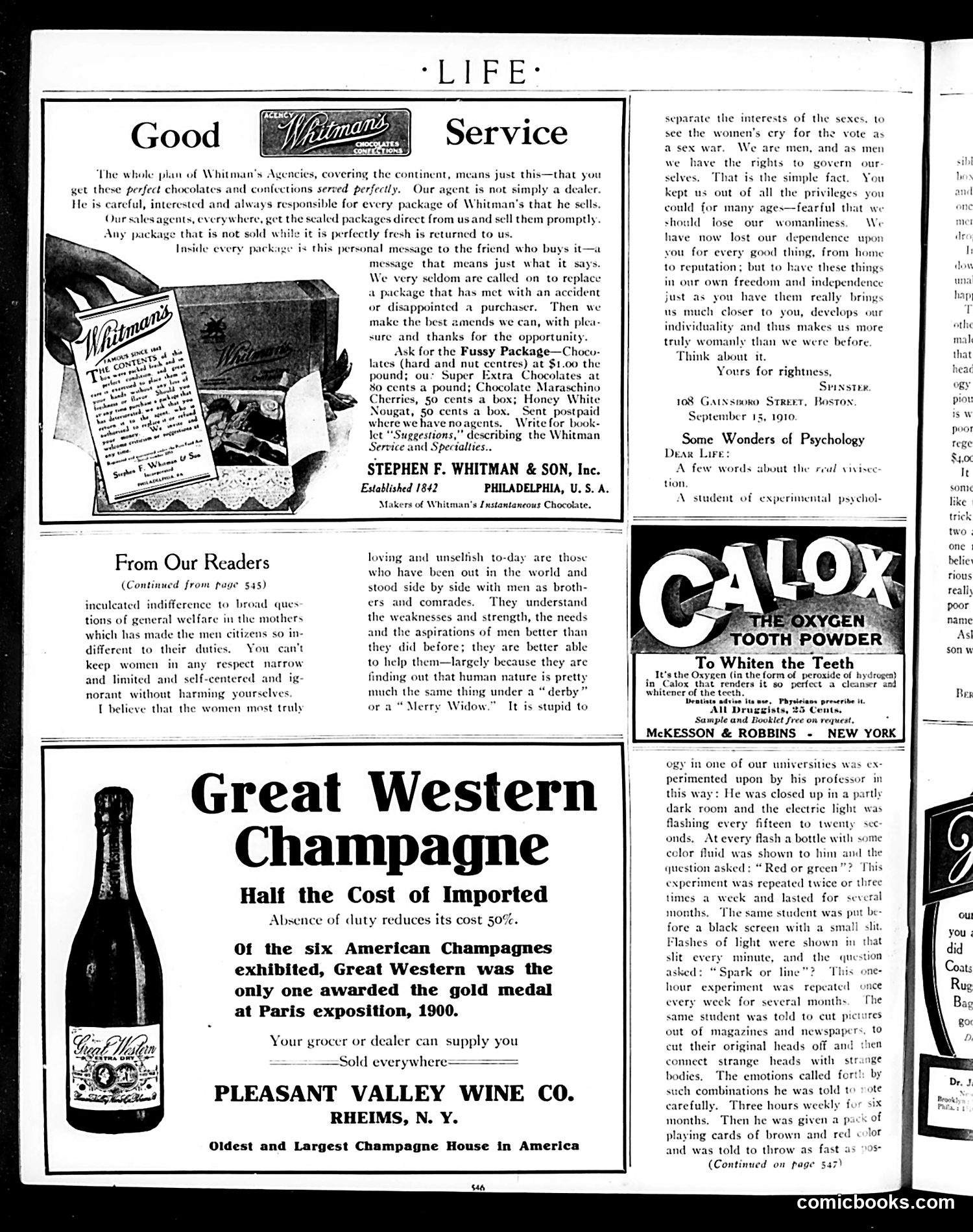
This page is primarily **advertising and advice columns**, not political satire. The main content includes: **Advertisements:** - Whitman's chocolates (established 1842) - Calox tooth powder ("The Oxygen Tooth Powder") - Great Western Champagne (half the cost of imported; won a gold medal at the 1900 Paris Exposition) - Pleasant Valley Wine Company **Editorial Content:** - "From Our Readers" column discussing women's roles and independence - "Some Wonders of Psychology" — an anecdote about a psychology student conducting light-flash experiments The page reflects early 1900s consumer culture and gender debates, but contains no political cartoons or satirical commentary requiring historical context to understand.
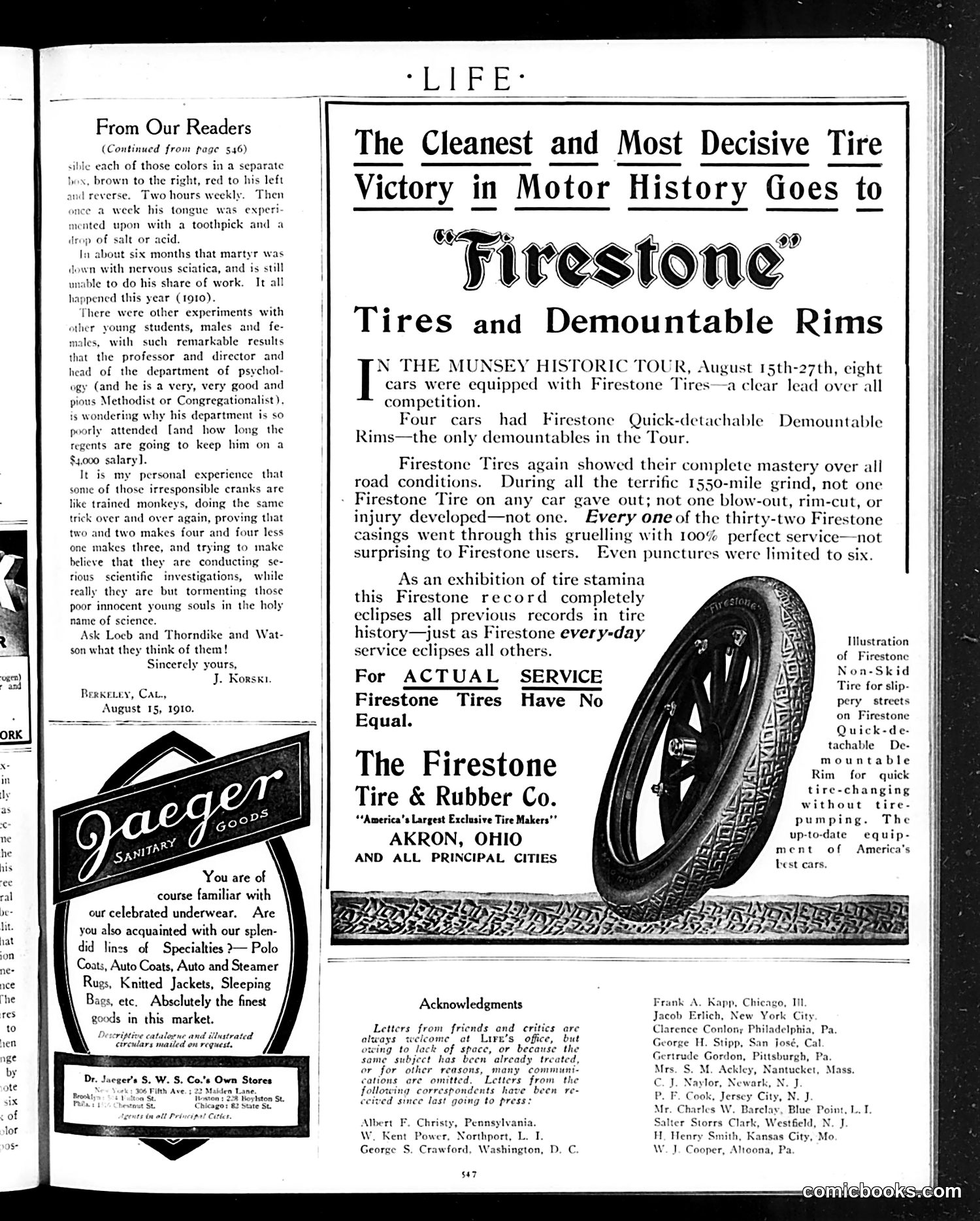
This page consists primarily of **period advertising**, not political satire. It contains: 1. **A reader's letter** (top left) discussing psychological experiments on a student with nervous sciatica—a personal anecdote about medical treatment. 2. **Jaeger Sanitary Goods advertisement** (left) promoting underwear and clothing items—standard consumer advertising for the era. 3. **Firestone Tires advertisement** (right, dominant) celebrating their victory in the Munsey Historic Tour motor race (August 15-27), highlighting tire durability and promoting their "Quick-detachable Demountable Rims" for easy tire-changing. The page reflects early 1900s automotive culture and consumer product marketing rather than political commentary or satirical cartooning. It's a straightforward magazine page combining reader correspondence with commercial advertisements.
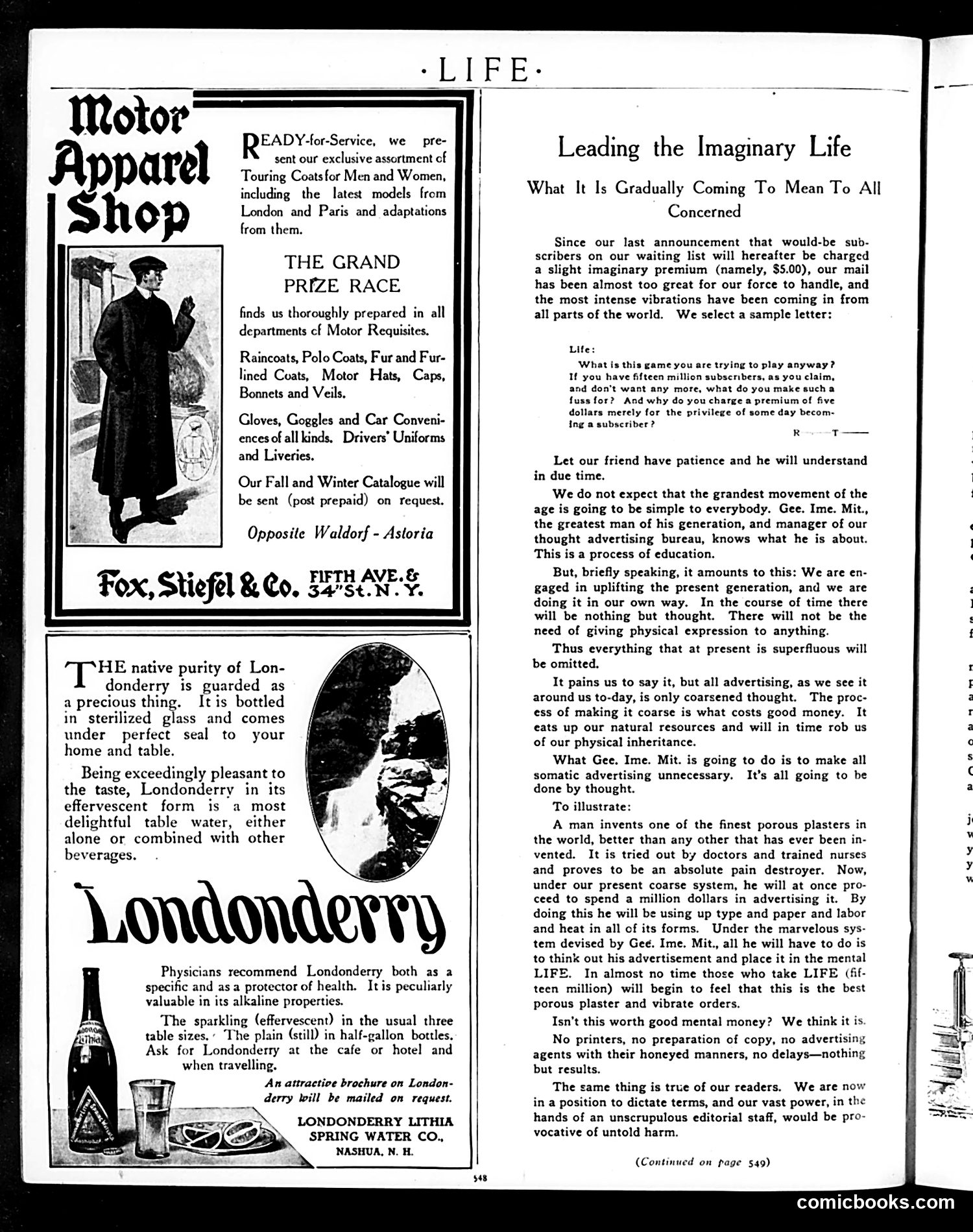
This page is primarily **advertising and editorial content** rather than political satire. The left side contains two ads: one for **Fox, Stiefel & Co.**, a Motor Apparel Shop near the Waldorf-Astoria advertising touring coats and accessories; and one for **Londonderry** spring water, emphasizing its purity and health benefits. The right side features an editorial titled "Leading the Imaginary Life," discussing Life magazine's upcoming premium subscription service ($5). The piece defends against criticism, arguing that advertising is becoming unnecessary as thought and editorial content will replace commercial messaging—a satirical commentary on evolving marketing and media strategy circa the 1910s-1920s. The page reflects early 20th-century advertising aesthetics and magazine economics.
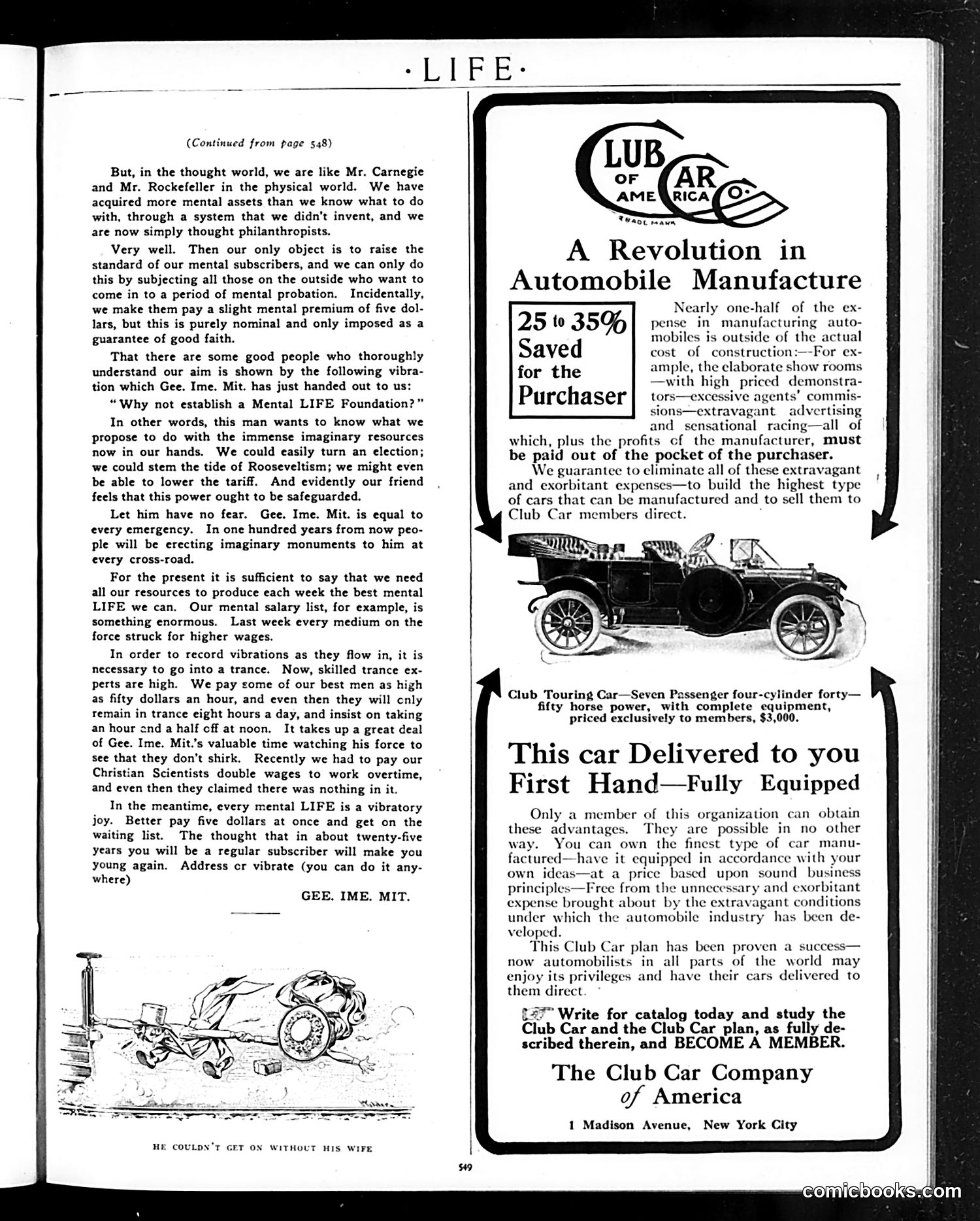
This page contains two distinct elements: **Left side:** A satirical article (continued from page 548) by "Gee. Ime. Mit." discussing establishing a "Mental LIFE Foundation." The text critiques wealthy industrialists like Carnegie and Rockefeller, suggesting they've accumulated mental assets through systems they didn't invent. The author proposes redirecting resources toward "thought philanthropy" and discusses trance experts' high wages. A small cartoon below shows a man surrounded by mechanical parts, captioned "HE COULDN'T GET ON WITHOUT HIS WIFE." **Right side:** A full-page advertisement for the Club Car Company of America, promoting their exclusive automobile club membership. The ad promises savings of 25-35% on car purchases and emphasizes delivering "first hand" vehicles directly to members, eliminating middleman expenses. The juxtaposition satirizes American capitalism—critiquing industrialist philanthropy while showcasing consumerist marketing.
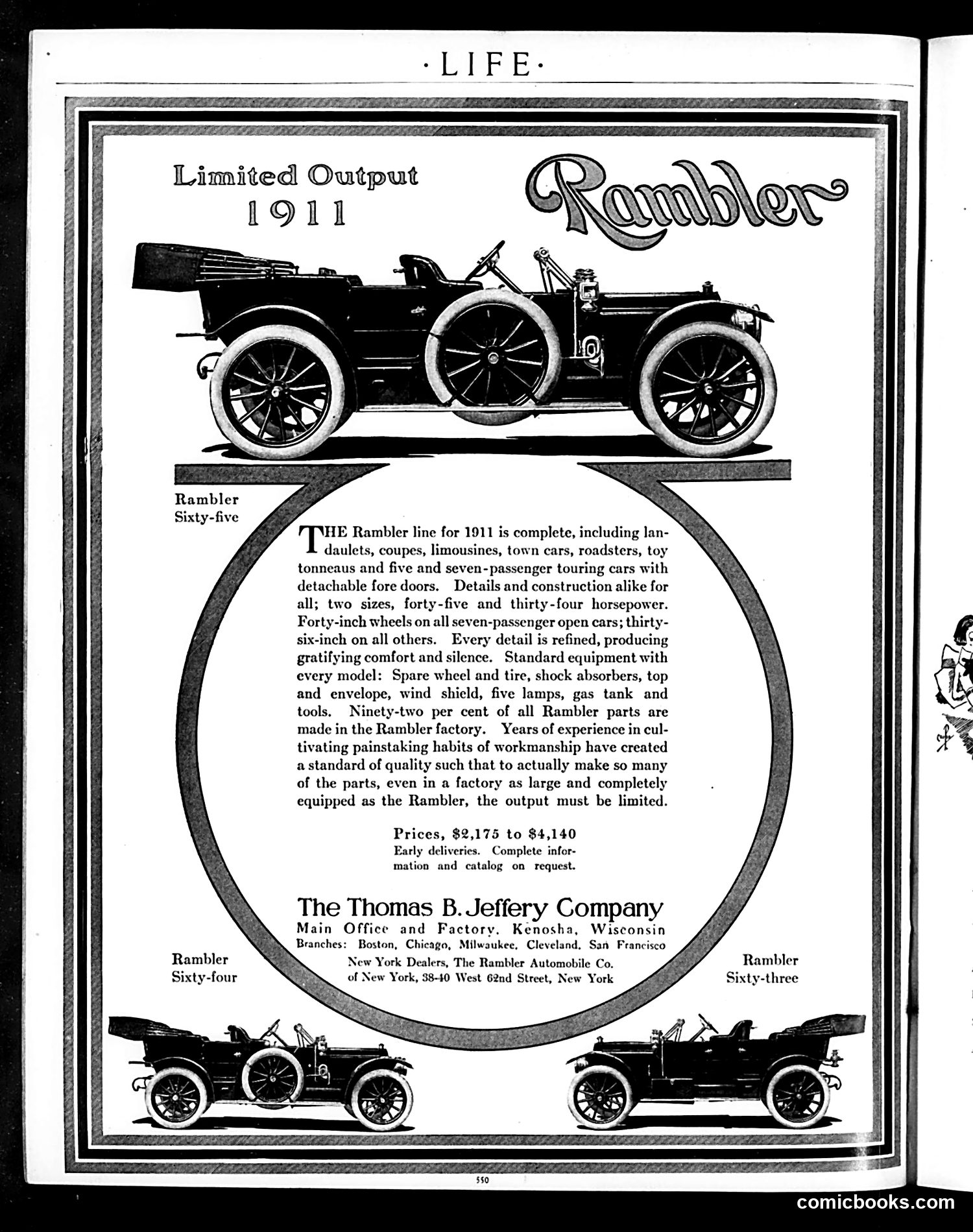
This is a straightforward automobile advertisement, not satire or political commentary. It promotes the 1911 Rambler automobile line by The Thomas B. Jeffery Company of Kenosha, Wisconsin. The ad emphasizes quality manufacturing—notably that 92% of parts are made in-house—and claims this commitment to craftsmanship necessitates "limited output." The advertisement lists features (spare wheels, shock absorbers, wind shields, lamps), available models (coupes, limousines, roadsters, touring cars), and prices ($2,175-$4,140). Three car illustrations show different Rambler models. The "limited output" framing appears to be a marketing strategy positioning scarcity and quality as virtues during the early automotive era. This represents period advertising in *Life* magazine, aimed at affluent readers who could afford such vehicles.
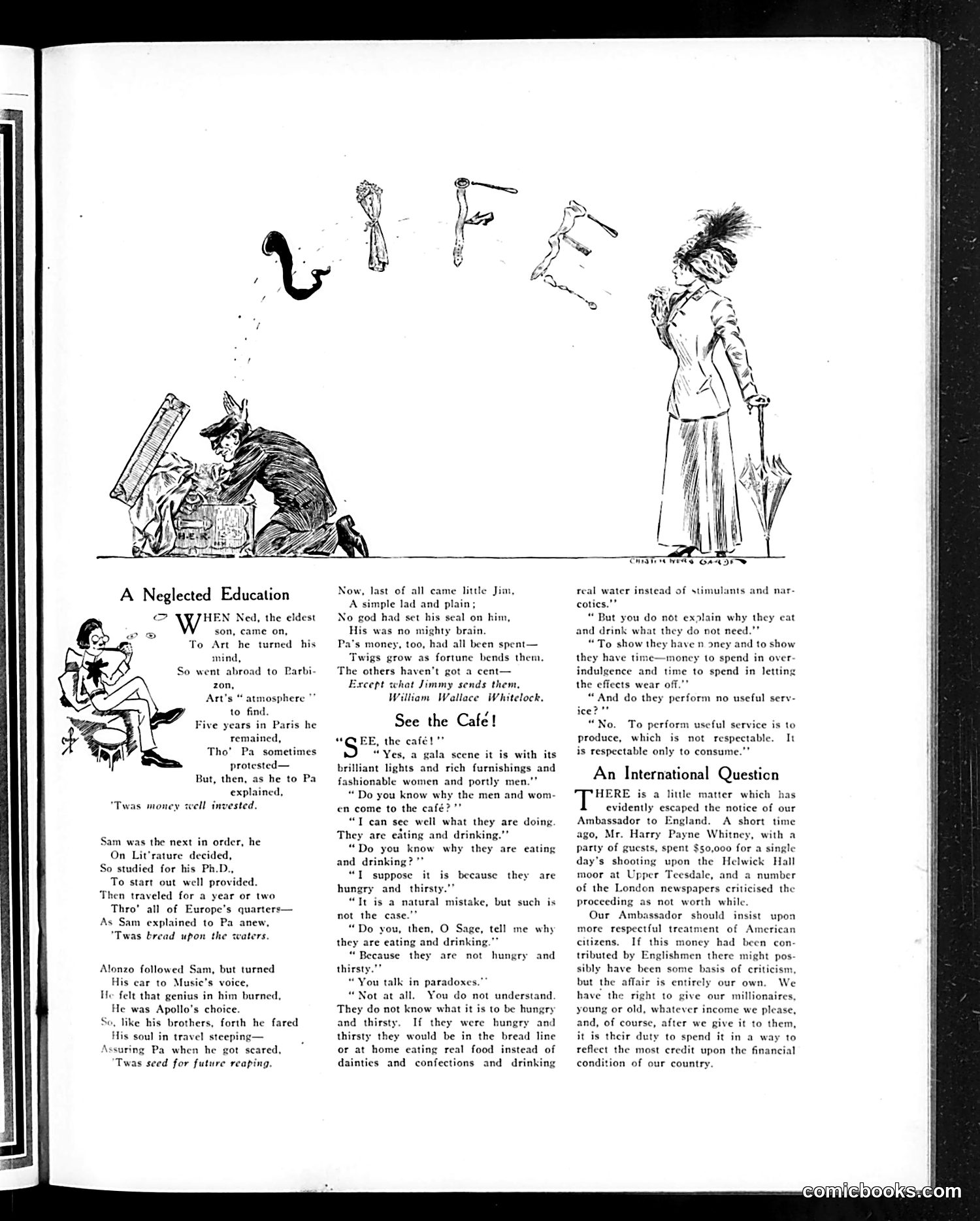
**"A Neglected Education"** satirizes the era's wealthy class and their pretensions. Three sons—Ned, Sam, and Alonzo—spend years abroad pursuing art, literature, and music while their father bankrolls their "self-improvement." Each justifies the expense as investment ("bread upon the waters," "seed for future reaping"). The punchline: youngest Jim, "simple" and "plain," stays home and becomes successful enough to support all his brothers. The cartoon mocks the idle rich's faith in impractical European cultivation while ignoring practical productivity. **"See the Café!"** presents a philosophical dialogue mocking wealthy café-goers. The "Sage" argues patrons eat and drink not from hunger but to display wealth and leisure—consumption as status performance rather than necessity. **"An International Question"** defends American millionaire Harry Payne Whitney's extravagant $50,000 shooting party in England against British newspaper criticism. The author argues Americans have the right to spend their wealth however they choose, and doing so actually "reflects credit" on America's financial condition—a tongue-in-cheek defense of conspicuous consumption.
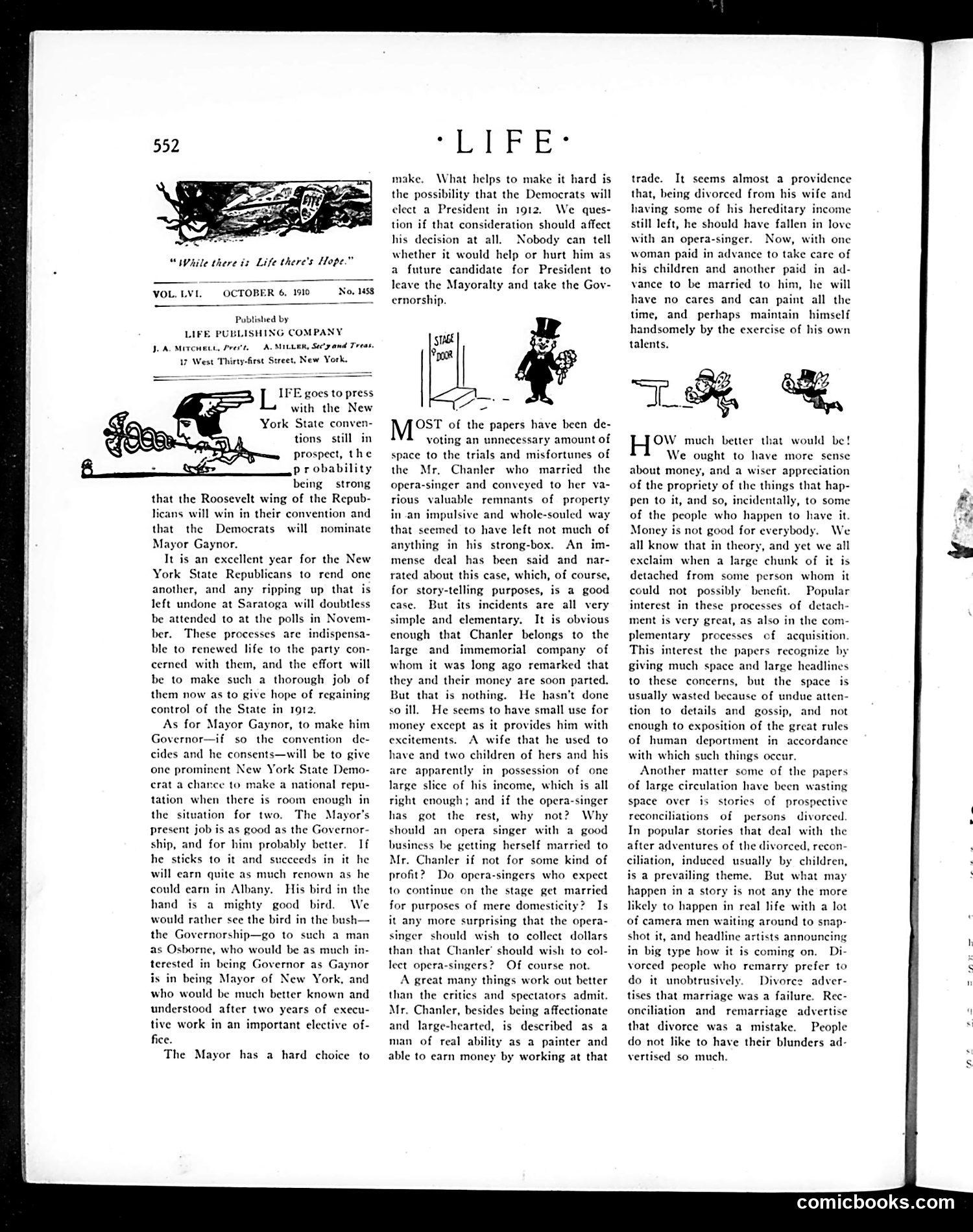
This page discusses New York State politics ahead of the 1912 election. The editorial debates whether Mayor Gaynor should run for Governor, concluding he's better off staying as Mayor—his "bird in the hand"—rather than pursuing higher office. The second section satirizes newspaper coverage of a divorce case involving "Mr. Chanler" (likely referring to the wealthy Chanler family) who married an opera singer and gave her substantial property. Life's writers mock the excessive media attention to this "simple and elementary" story of a rich man parting with his money. They defend both parties pragmatically: the opera singer logically sought financial security through marriage, and Chanler simply enjoys spending money on excitement rather than accumulation. The satire mocks sensationalist journalism more than the principals involved. The small cartoons illustrate these themes with caricatured figures, though specific identities are unclear without additional context.
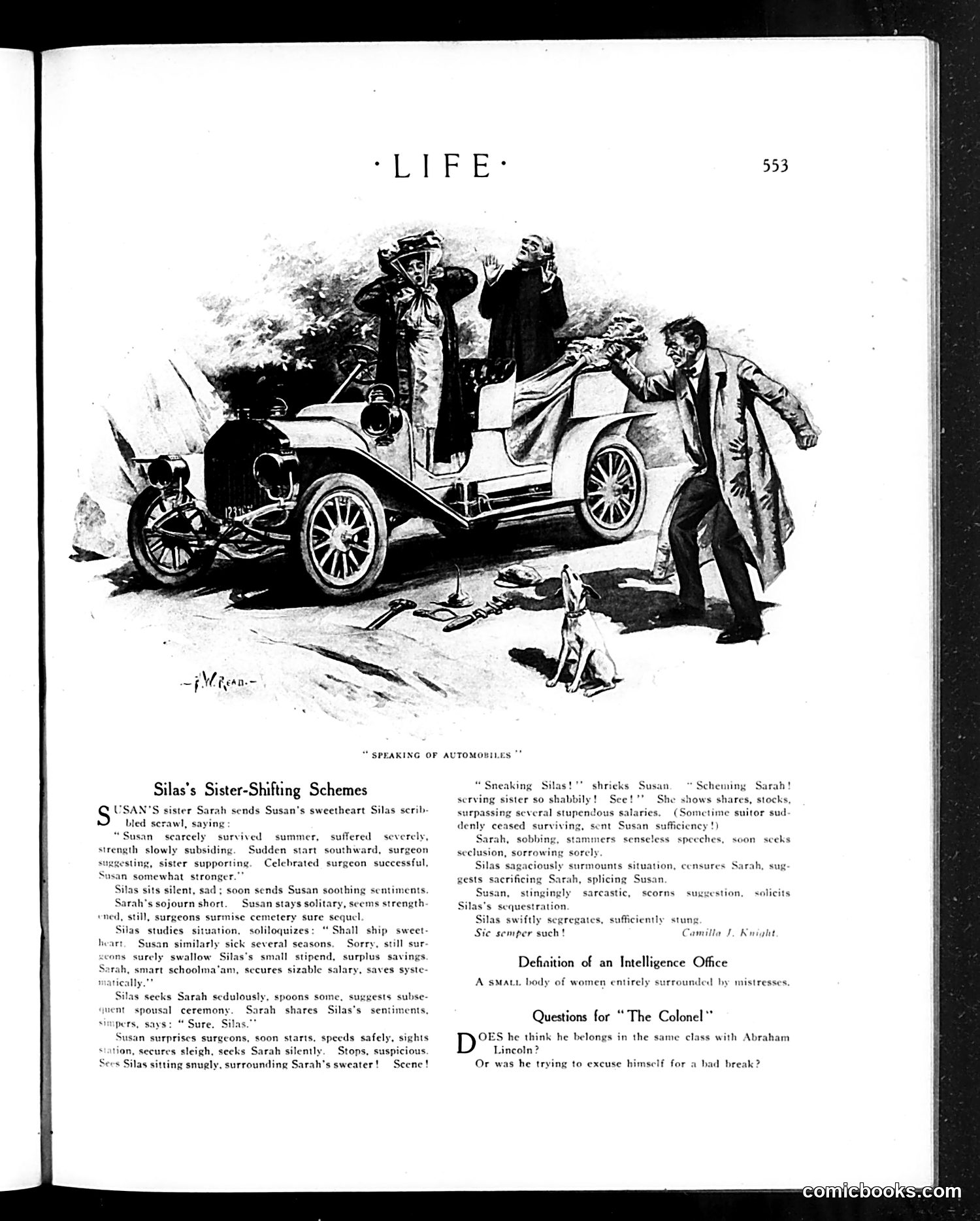
This page contains two unrelated pieces of satirical humor typical of early 20th-century Life magazine. **"Silas's Sister-Shifting Schemes"** is a comedic story told almost entirely in alliteration (words beginning with 'S'). It describes a love triangle: Susan's sister Sarah manipulates Silas (Susan's sweetheart) by claiming Susan is ill and needs care. While Sarah recovers Susan's health through a surgeon, she secretly courts Silas, hoping to marry him for financial security. When Susan discovers them together, she demands Silas choose. He ultimately picks Susan, and Sarah is rejected—a comeuppance for her scheming. The joke relies on the virtuosic linguistic constraint of the alliteration rather than sophisticated satire. **"Definition of an Intelligence Office"** offers a brief barb: an intelligence office supposedly exists to place domestic servants, but is actually surrounded by their mistresses—implying the office primarily serves wealthy women seeking household help. **"Questions for 'The Colonel'"** references an unidentified public figure, asking whether he considers himself Abraham Lincoln's equal or was merely making excuses for poor behavior. Without more context, the specific target remains unclear.
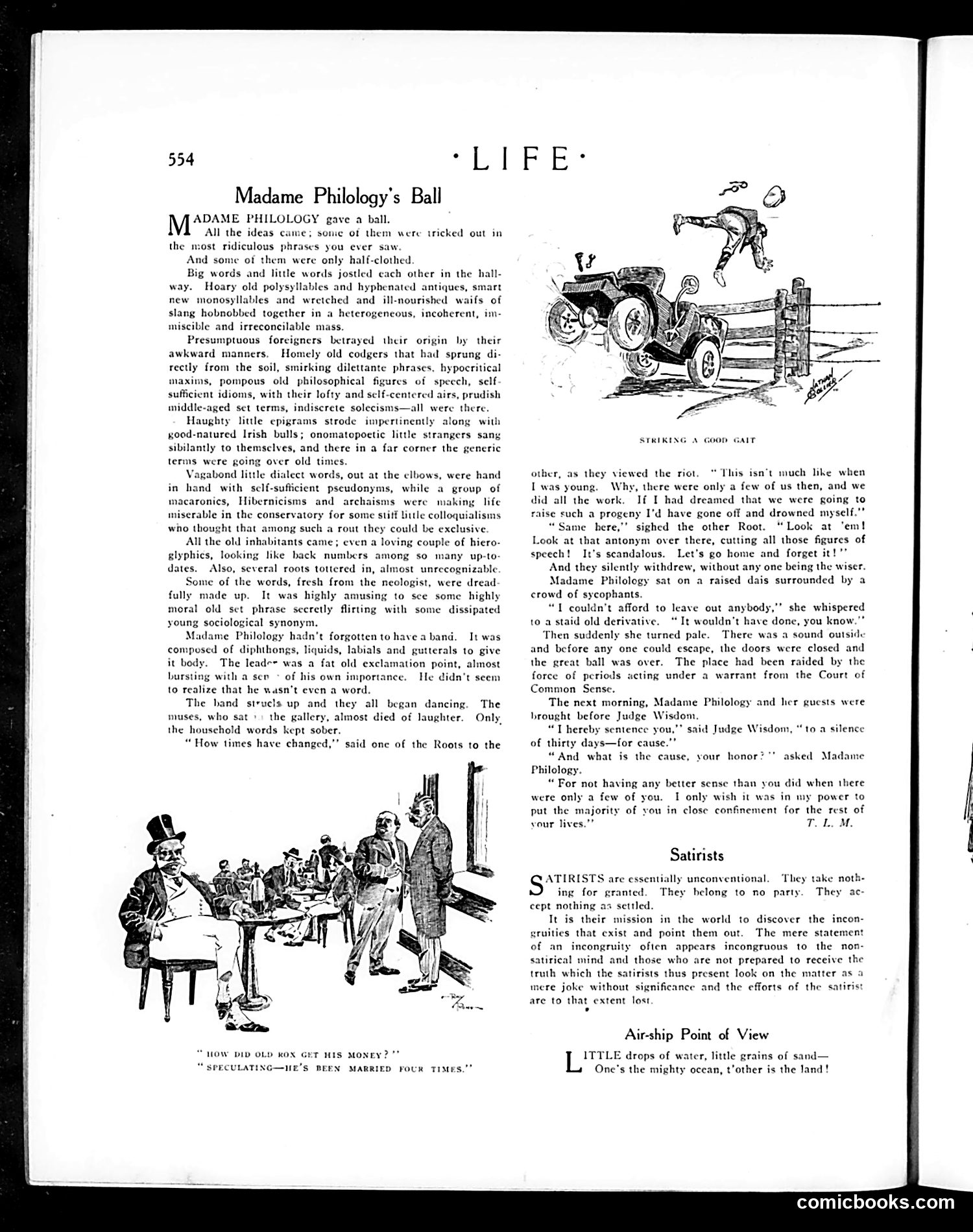
This satirical story personifies language itself as a society hostess throwing a party where different types of words and linguistic elements are guests. The satire mocks the perceived corruption and degradation of language through overuse, pretension, and mixing of styles. The "characters" represent linguistic categories: pompous old polysyllables, trendy new monosyllables, affected foreign borrowings, slang "vagabonds," dialectal words, and affected neologisms all mingle chaotically. The story suggests that language has become a disorderly mess of pretension and affectation. The punchline involves Judge Wisdom raiding the ball and sentencing Madame Philology to thirty days for allowing such linguistic chaos. This reflects early 20th-century anxieties about language "purity" being threatened by slang, Americanisms, and modern coinages—common complaints in genteel publications of the era.
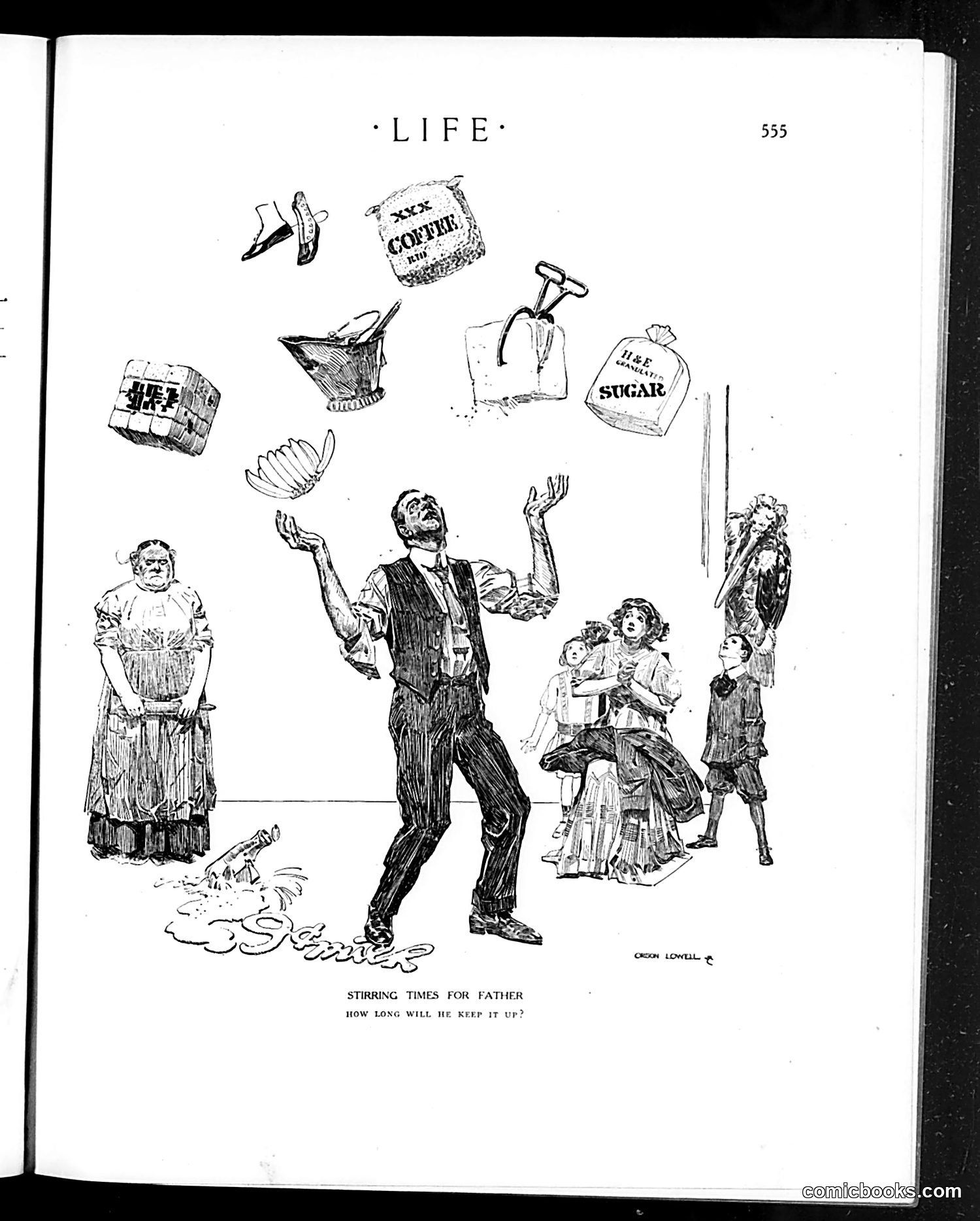
This cartoon satirizes a father juggling household domestic duties and supplies. The central male figure tosses various items—coffee, sugar, bananas, eggs, and butter—while family members (a woman, children, and what appears to be a maid) watch. The caption "Stirring Times for Father" and "How Long Will He Keep It Up?" suggests the satire concerns a father attempting to manage household tasks, likely groceries or cooking—work traditionally assigned to women and servants. This appears to be early-to-mid 20th century satire mocking men who venture into domestic work, implying such activity is unstable, comical, or unsustainable—a common trope ridiculing gender role reversals of that era.
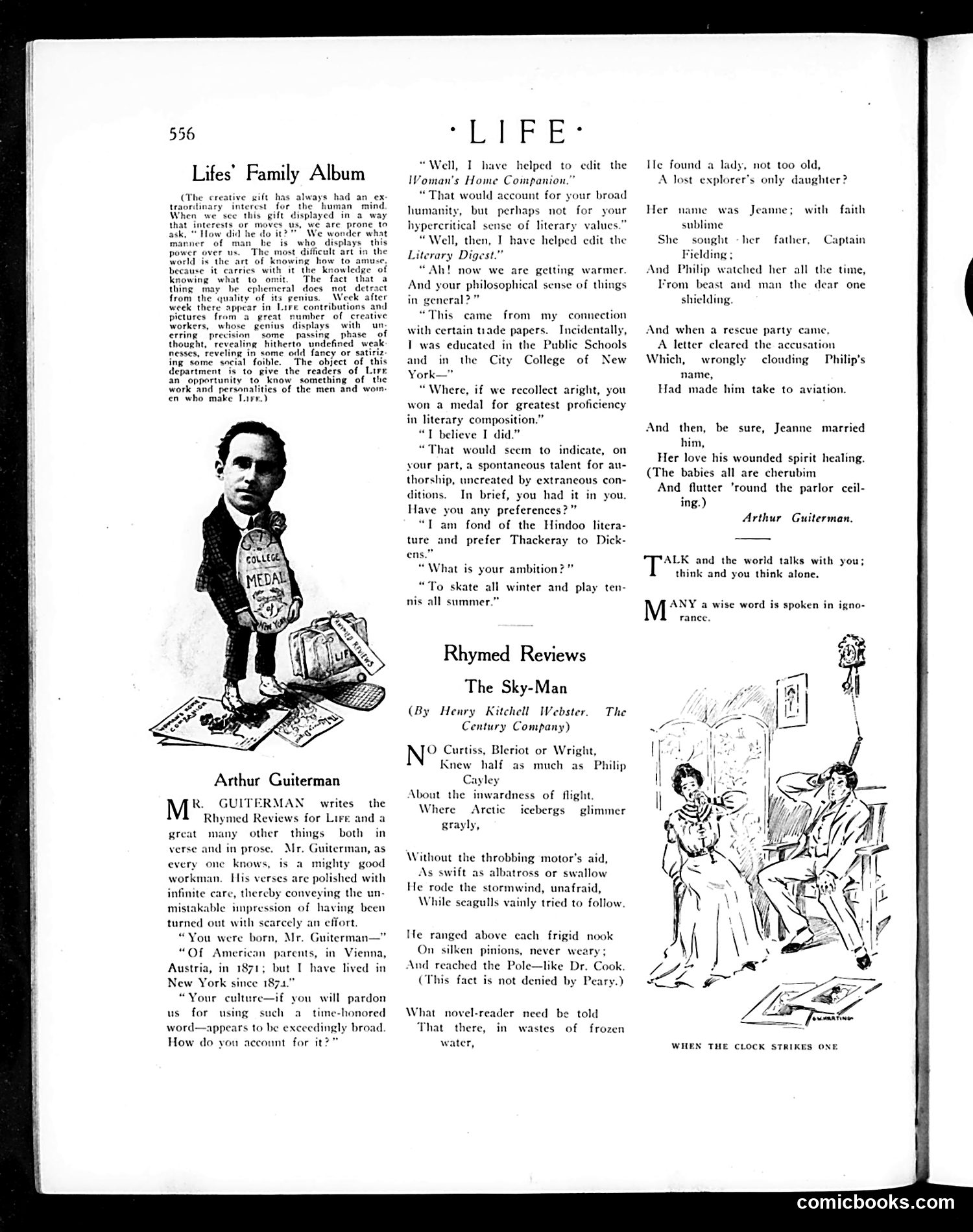
This page features a profile of Arthur Guiterman, a prolific writer of satirical verse for *Life* magazine. The accompanying caricature shows him laden with medals and publications—visual shorthand for his broad accomplishments. The interview is a gentle self-parody: Guiterman attributes his literary sophistication to editing mass-market publications (*Woman's Home Companion*, *Literary Digest*) rather than highbrow sources, earning increasingly knowing responses from the interviewer. His stated ambition—skating and tennis—humorously deflates any pretense of artistic seriousness. The "Rhymed Reviews" section below critiques Henry Kitchell Webster's novel *The Sky-Man*, a pulp adventure story mixing aviation (then-modern technology) with romance. Guiterman's verse mockingly summarizes the formulaic plot: a mysterious flying man, a lost explorer's daughter, false accusations, and redemptive marriage. The review gently ridicules the book's transparent sentimentality and contrived happy ending, typical of early 20th-century popular fiction.
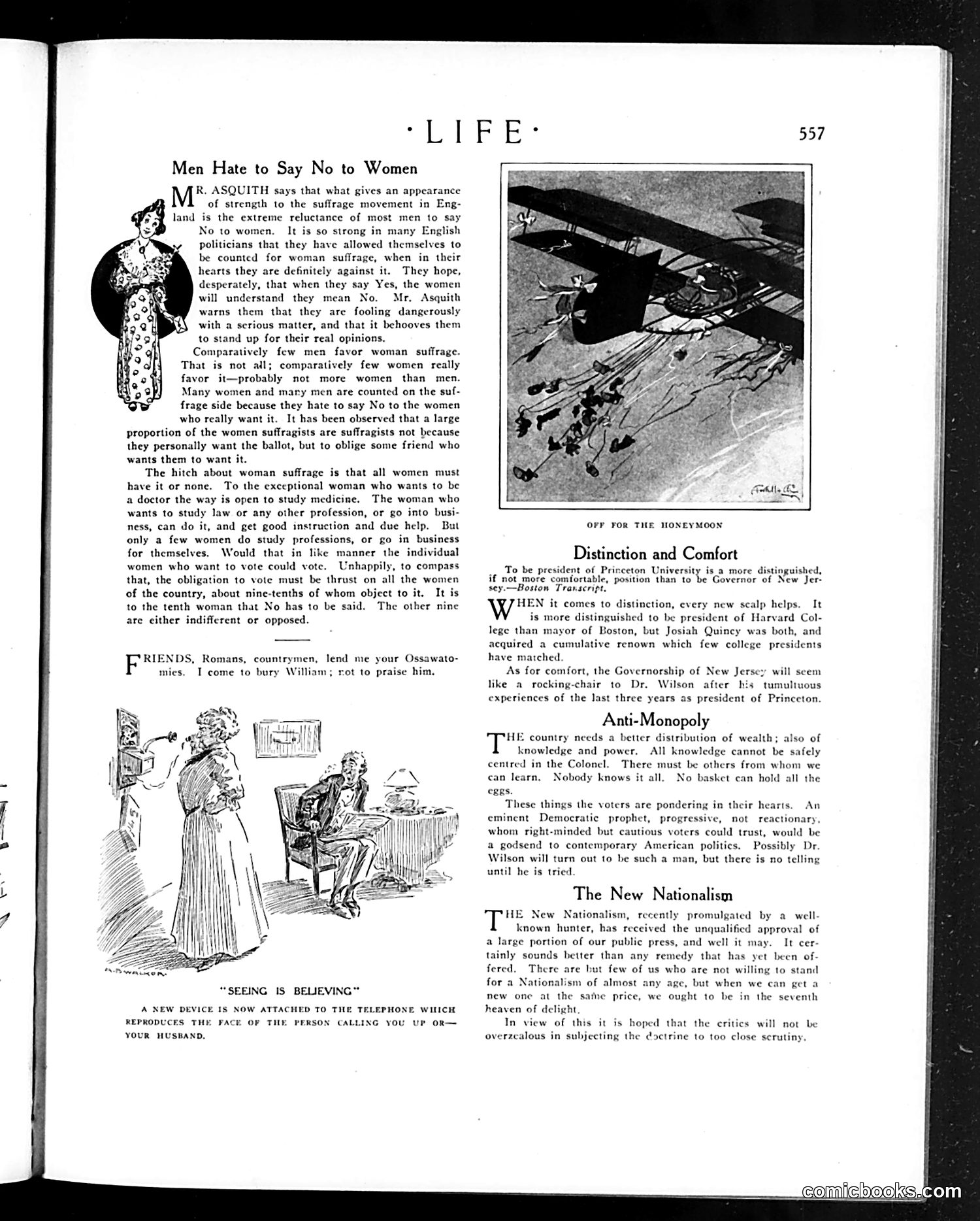
This page contains three satirical pieces: 1. **"Men Hate to Say No to Women"**: An essay by H.R. Asquith (British Prime Minister) critiquing the women's suffrage movement. The text argues that many male politicians publicly support suffrage only because they're reluctant to refuse women directly, despite privately opposing it. Asquith warns this is dangerous dishonesty. The satire suggests male cowardice undermines genuine political debate. 2. **"Seeing is Believing"**: A cartoon mocking a new telephone device that displays callers' faces. The caption humorously suggests husbands might use it to avoid being recognized by their wives—implying infidelity or marital deception. 3. **"Distinction and Comfort"**: Commentary on Woodrow Wilson's transition from Princeton University president to New Jersey governor, suggesting academic prestige differs from political comfort. 4. **"The New Nationalism" & **"Anti-Monopoly"**: Brief political commentary on wealth distribution and Democratic politics, appearing to discuss Theodore Roosevelt's "New Nationalism" platform.
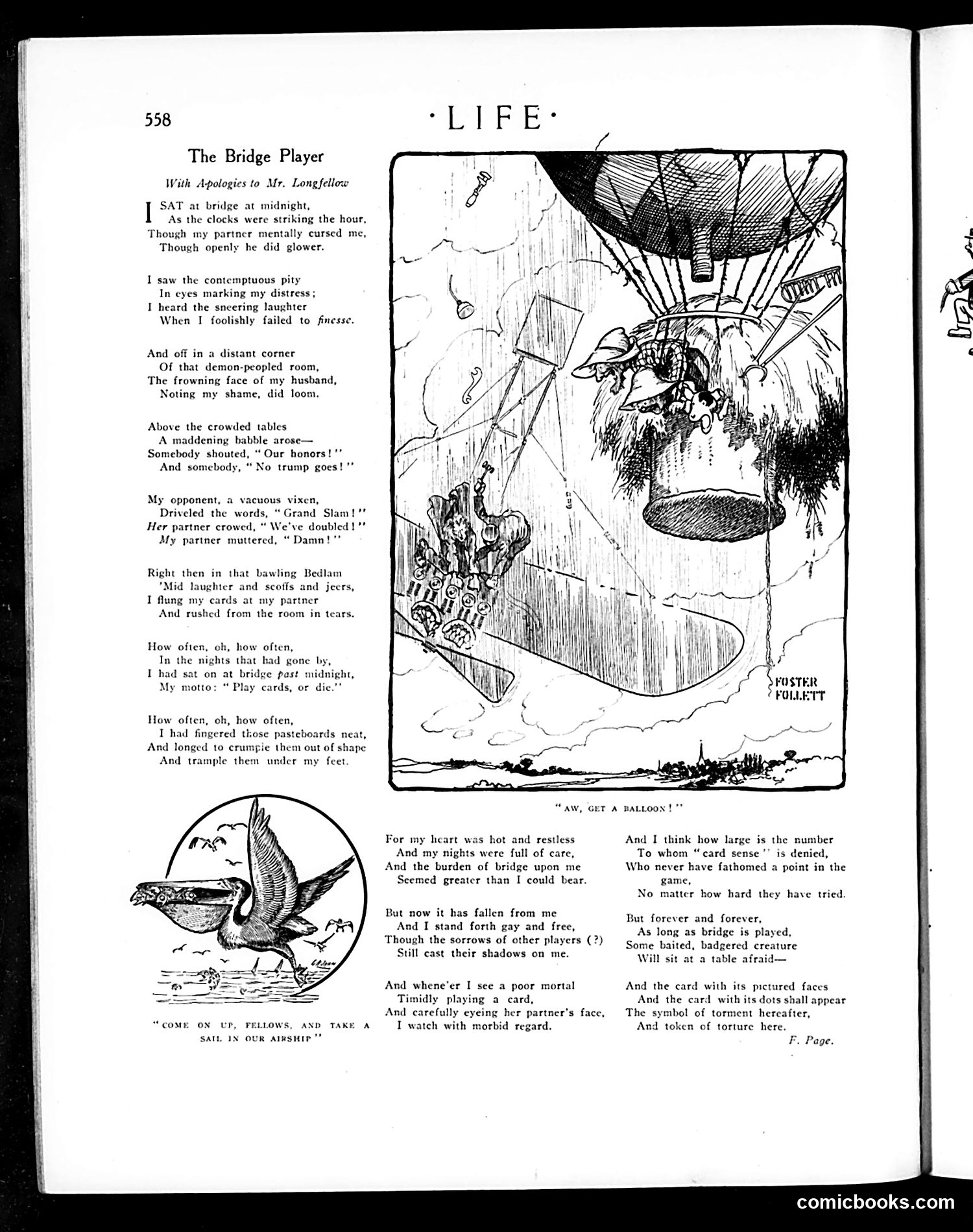
This satirical poem parodies Longfellow's "The Midnight Rider," replacing heroic narrative with domestic complaint about bridge—the card game that was enormously popular among American society women in the early 20th century. The satire targets the obsessive nature of bridge culture: a woman describes her anxiety while playing, her husband's disapproval, her partner's silent contempt, and competitive social pressure. The illustrations show the chaos of a crowded bridge party (top) and whimsical vignettes (bottom). The joke is the gap between bridge's perceived importance and actual stakes. The poem escalates her emotional distress absurdly—from poor play to fleeing in tears—then her "liberation" from the game becomes equally melodramatic. The final lines mock bridge enthusiasts by treating cards as instruments of eternal torment. This mocks both bridge addiction among society women and the pretentiousness of applying grand poetic language to trivial social competition.
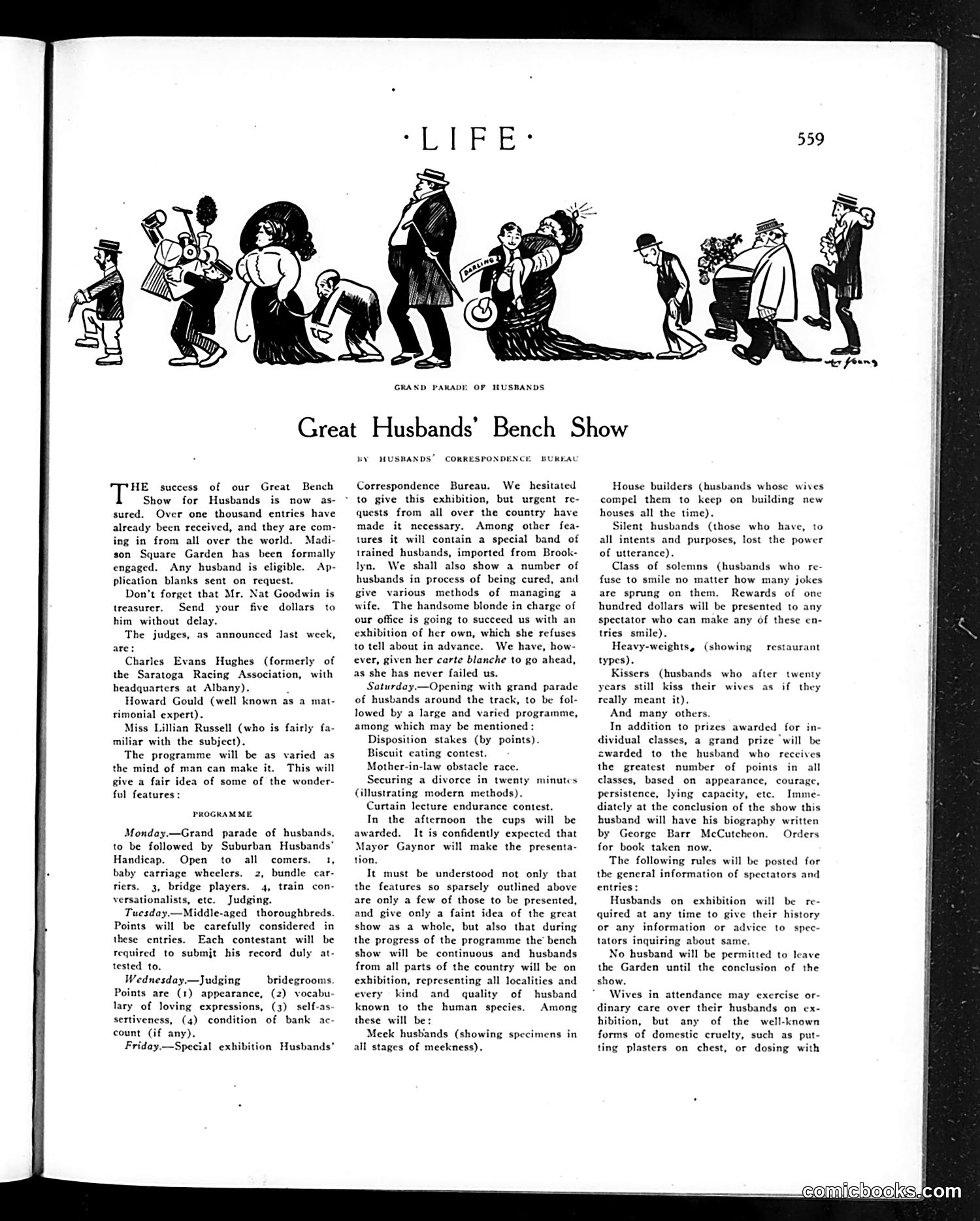
This 1910s Life magazine article satirizes marriage by staging a mock "bench show"—borrowing language from dog shows—where husbands are judged like livestock. The cartoon depicts various husband "types" paraded for display. The satire targets both husbands and wives. Husbands are categorized by stereotypical flaws: "meek" husbands, silent ones who've "lost the power of utterance," those compelled to build endless houses for demanding wives, and men who perform affection. The judges—Charles Evans Hughes, Howard Gould (described as "matrimonial expert"), and Lillian Russell—were likely well-known figures of the era, adding satirical weight. The joke exposes marital tension as entertainment. Events like the "Mother-in-law obstacle race" and "Curtain lecture endurance contest" mock common domestic conflicts. By treating husbands as exhibition specimens requiring "training" and "curing," the article satirizes both rigid gender expectations and the practical realities of early 20th-century marriage.
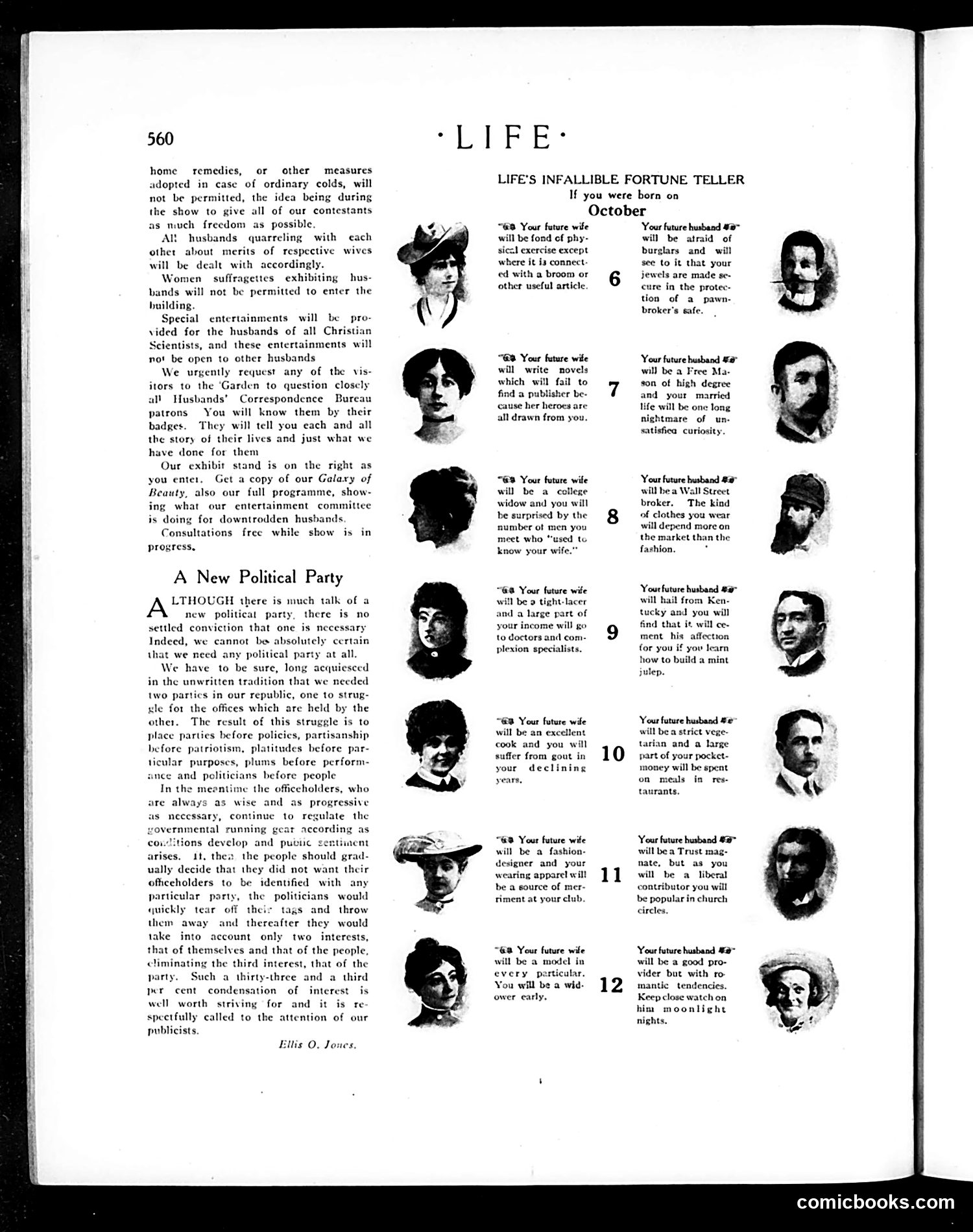
This page contains a satirical "fortune teller" feature predicting futures for people born in October, paired with a political essay arguing against forming a new political party. The **fortune teller section** mocks romantic relationships and gender roles of the era. Each numbered entry (6-12) pairs predictions for wives and husbands in deliberately contradictory or comedic ways—wives become novelists or college widows while husbands become free masons or Wall Street brokers. The humor relies on stereotypes about marriage, female ambitions, and social climbing. The **political essay** argues that America's two-party system, while imperfect, shouldn't be replaced. The author contends that politicians will inevitably prioritize office-seeking over principles, making party affiliation less important than the system's stability. It's a cynical defense of the status quo. Together, these sections exemplify *Life* magazine's satirical approach: mocking both domestic life and political institutions through exaggeration and stereotype.
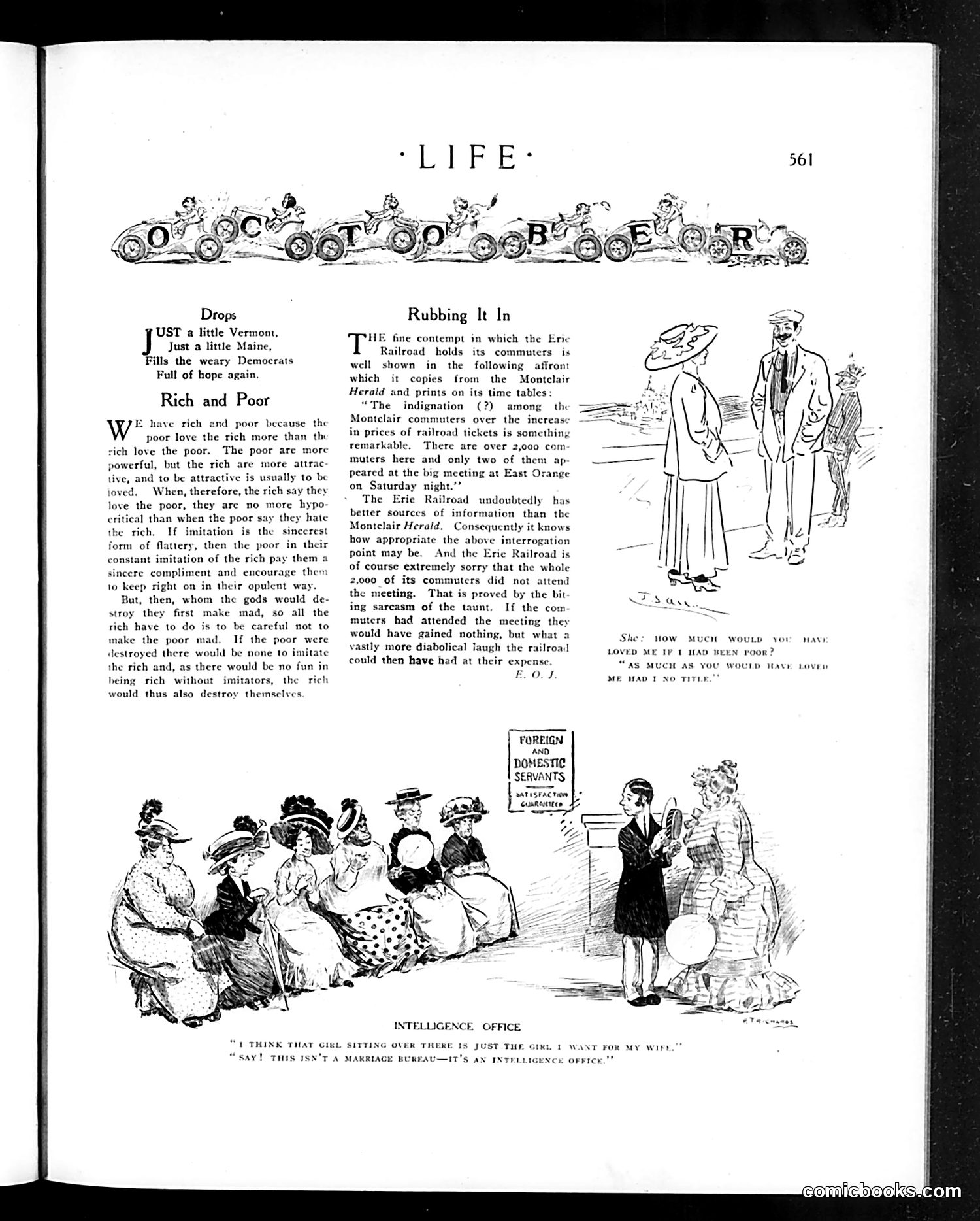
**"Rich and Poor"** essay critiques class dynamics: the poor imitate and admire the rich more than vice versa, yet this dependency paradoxically protects society—if the rich mistreat the poor into revolt, they destroy their own imitators and lose the validation wealth requires. The piece warns the wealthy against making the poor "mad." **"Rubbing It In"** mocks the Erie Railroad's contempt for commuters. The railroad printed a sarcastic interrogation about only 2 of 2,000 Montclair commuters attending a meeting protesting ticket-price increases, clearly designed to humiliate them. **Cartoons:** - Upper right shows a man and woman discussing poverty and titles—satirizing class-conscious marriage prospects. - Lower cartoon depicts an "Intelligence Office" (domestic servant employment agency) where a man mistakes it for a marriage bureau, wanting to "interview" an attractive woman as a potential wife rather than servant—mocking both servant-class exploitation and men's objectification.
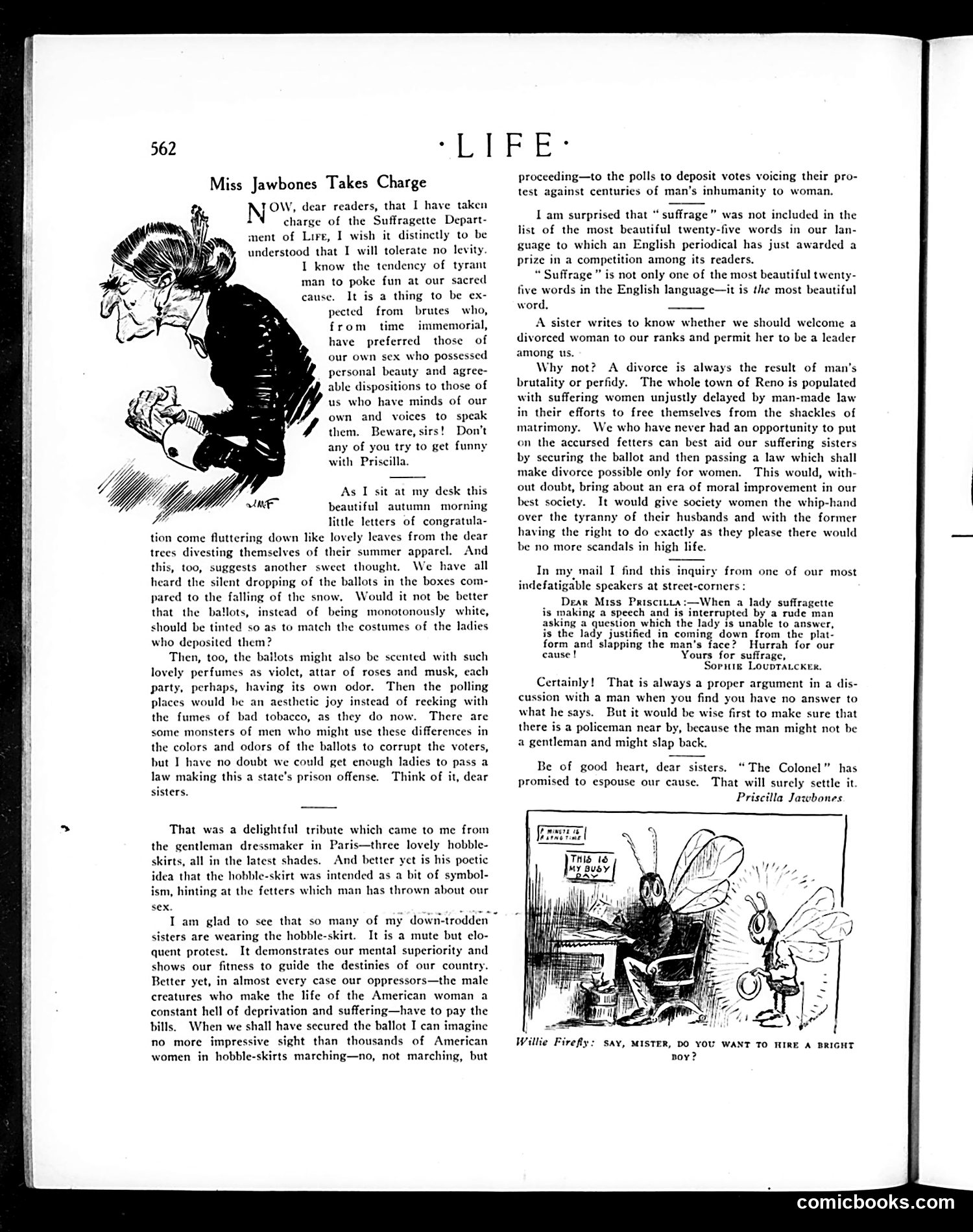
This page satirizes the early 20th-century women's suffrage movement through the persona of "Miss Jawbones," the new editor of Life's "Suffragette Department." The satire mocks suffragists by having Jawbones propose absurdly impractical ideas presented as serious feminist improvements: scenting ballots with perfume, tinting them to match women's clothing, and marching to polls in hobble-skirts (the restrictive fashion she ironically frames as "protest"). The cartoon below depicts "Willie Firefly" asking a fairy character about hiring "a bright boy," likely mocking suffragists' broader ambitions. The satire's core joke: it presents extreme, illogical positions as suffragist ideology—from praising the hobble-skirt as symbolic resistance to proposing women-only divorce laws. By exaggerating feminist arguments to absurdity, Life ridicules suffragists as impractical, vain, and contradictory. The piece reflects anti-suffrage sentiment common in American magazines of this era.
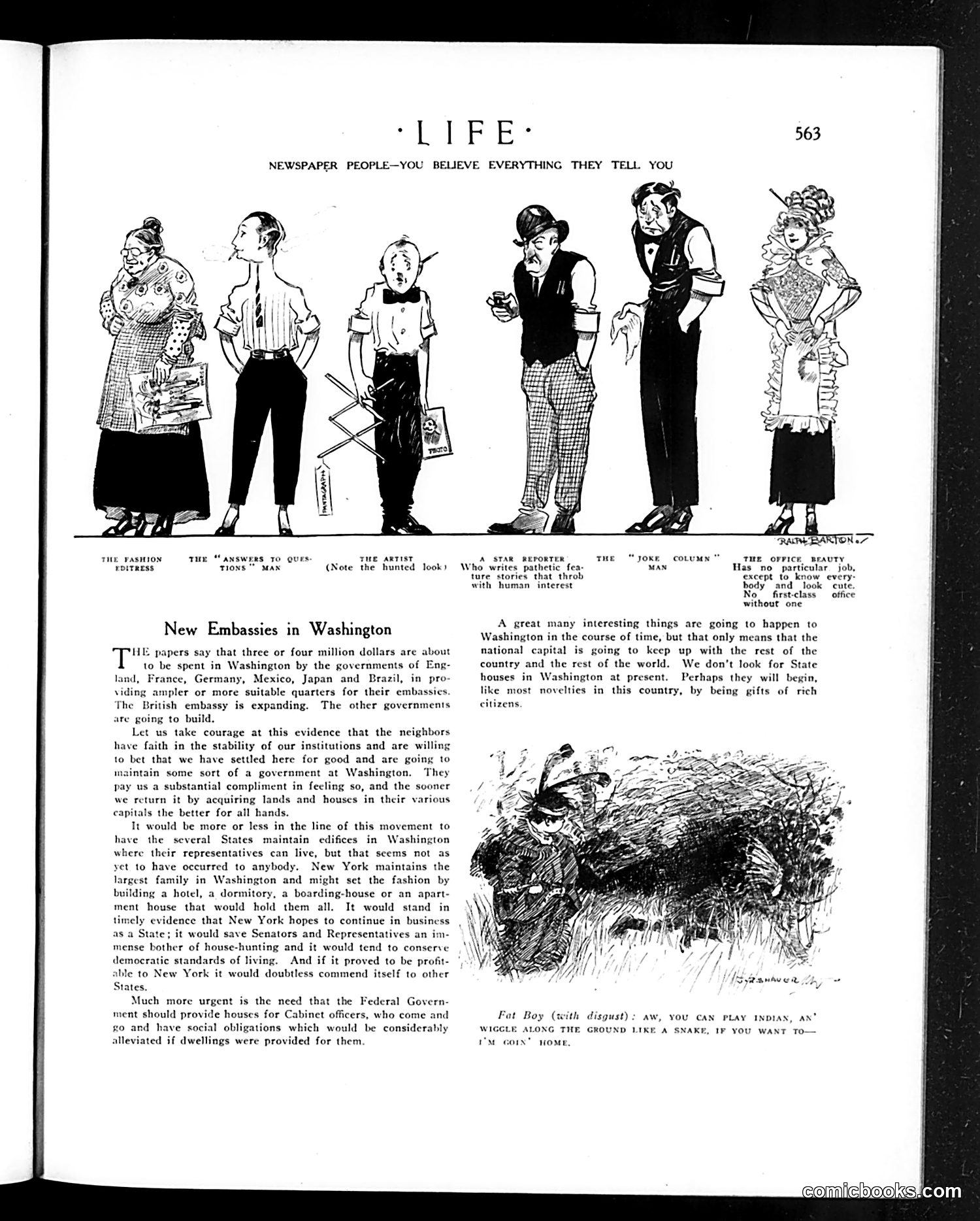
The top cartoon satirizes newspaper journalists as stereotypes who uncritically spread information. Six figures represent different newspaper roles: the Fashion Editress (concerned with appearances), the "Answers to Questions" Man (seeking sensational details), the hunted-looking Artist, a pathetic feature writer, a "Star Reporter," and a society columnist—each representing a cliché journalistic type prone to exaggeration or superficiality. The caption's sarcasm ("Newspaper People—You Believe Everything They Tell You") mocks both journalists' reliability and the public's gullibility. The article discusses new embassy construction in Washington by Britain, France, Germany, Mexico, Japan, and Brazil, framing it as confidence in American stability. It advocates for states to build representative housing in Washington and for the federal government to provide residences for Cabinet officers. The lower cartoon (credited to artist signature) shows a fat boy with a frog, making an apparently crude joke about the boy's movements and intentions—typical period humor referencing childhood mischief.
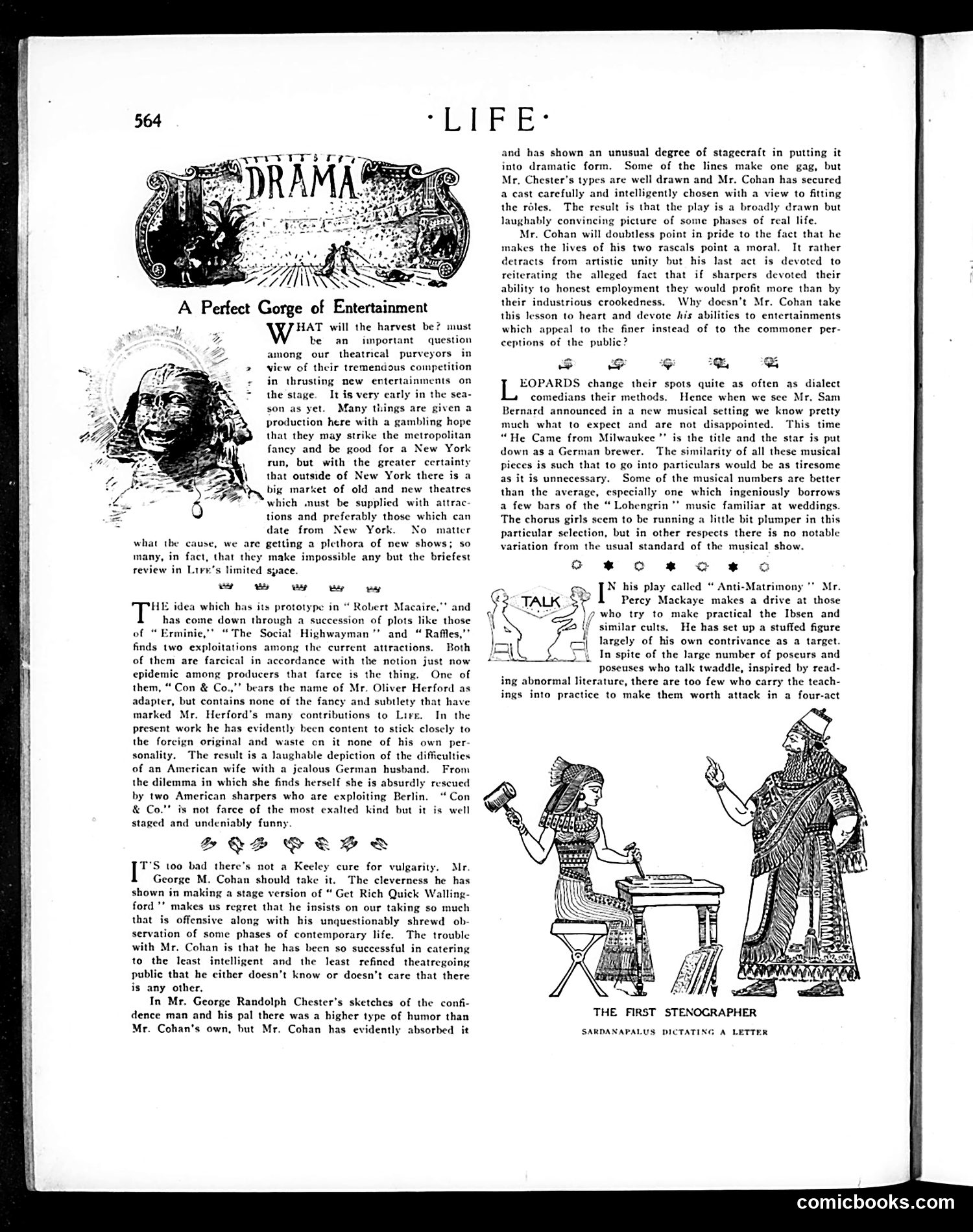
This page reviews current Broadway productions from an early 20th-century perspective. The critic discusses several plays: **"Con & Co."** — A farce adapted by Oliver Herford about an American wife's marital troubles with a jealous German husband, resolved by two American con artists operating in Berlin. The review finds it funny but lightweight. **"Get Rich Quick Wallingford"** — Adapted by George M. Cohan from Chester's confidence-man stories. The critic praises Cohan's stagecraft and casting but *harshly criticizes* his vulgarity and pandering to "the least intelligent and least refined" theatergoers. Though the play morally condemns sharpers, the reviewer sarcastically questions why Cohan doesn't apply his talents to finer entertainment rather than crude material. **"He Came from Milwaukee"** — A musical with Sam Bernard, where the critic expects (and gets) predictable ethnic-dialect comedy. The bottom illustration shows "The First Stenographer"—Barbara's dictating a letter—a historical reference to early office technology.
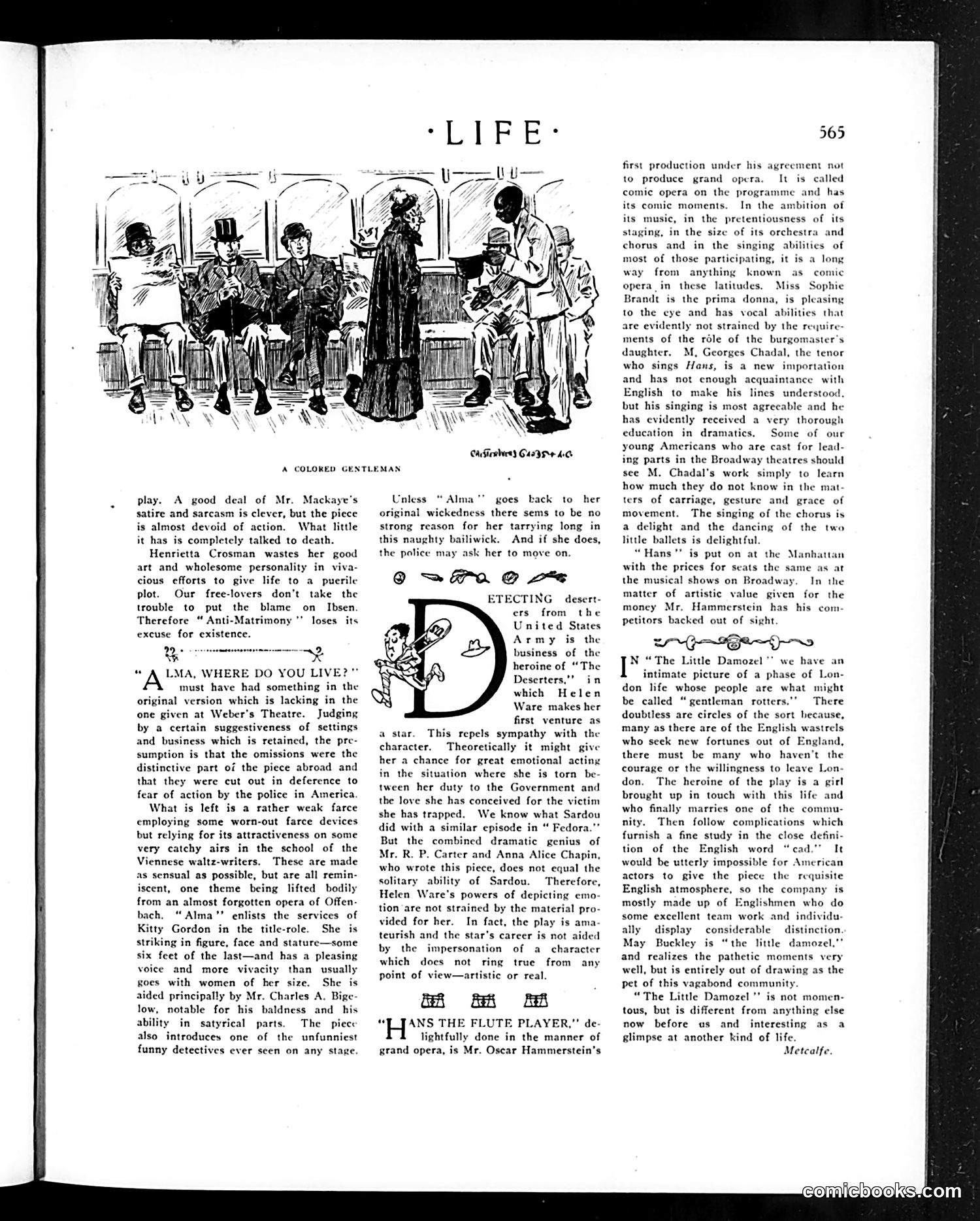
This page contains theater reviews from Life magazine's arts section. The cartoon at top left ("A Colored Gentleman") illustrates one review, showing a man in formal dress seated among well-dressed theatergoers—likely satirizing racial social barriers of the era by depicting an African American in an elite cultural space. The reviews critique contemporary Broadway productions: "Anti-Matrimony" (criticized as talky and weak), "Alma" (a Viennese operetta deemed scandalous, with cuts made for American audiences), "The Deserters" (starring Helen Ware, deemed amateurish despite serious subject matter involving Army desertion), and "Hans the Flute Player" (Hammerstein's "comic opera" with foreign leads whose English is poor but whose singing is praised). The tone is acidly dismissive throughout—typical of Life's satirical theatrical criticism of the period.
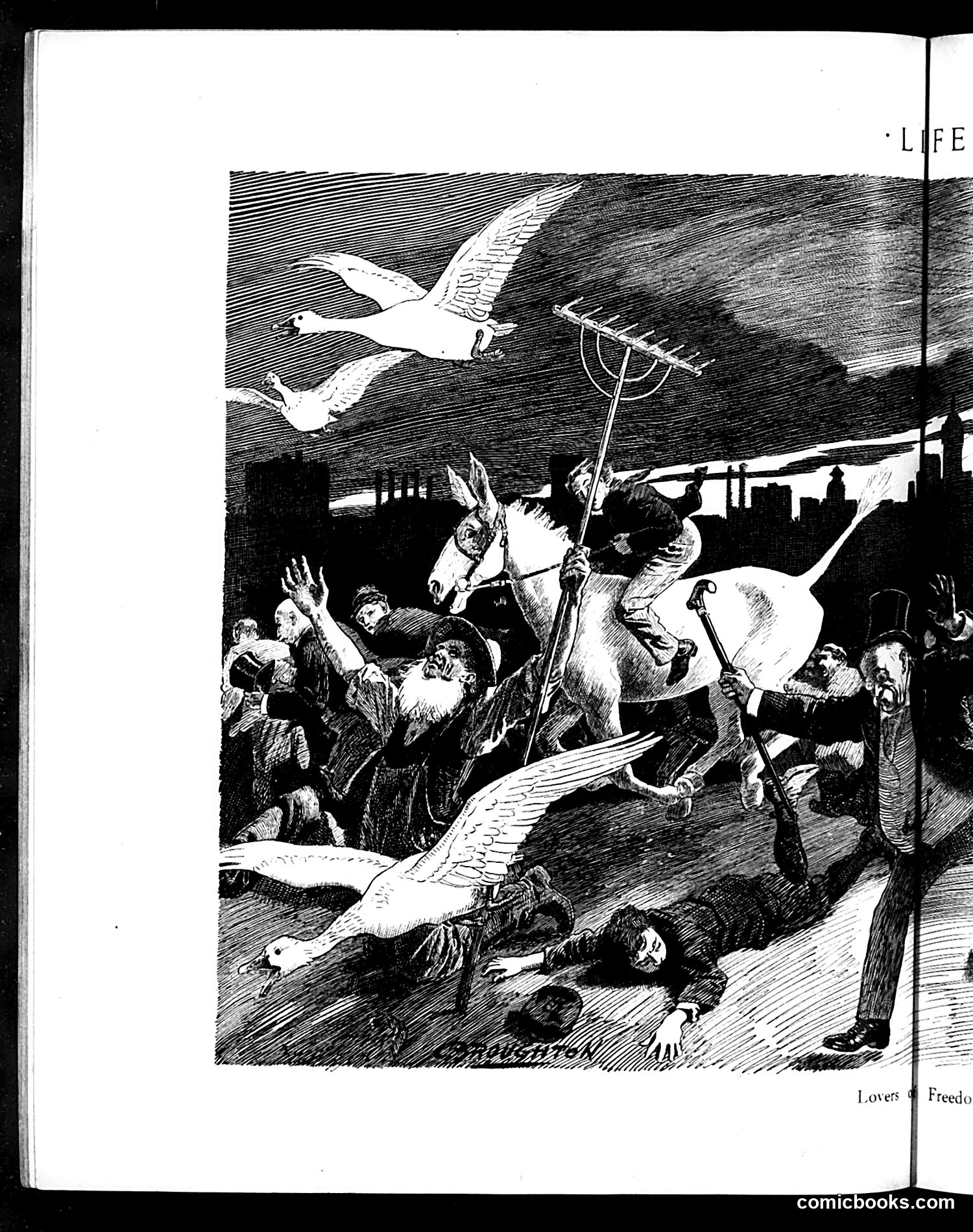
This is a satirical engraving depicting what appears to be a religious or mystical procession. A mounted figure holds aloft a menorah (Jewish candlestick), while winged figures float overhead. A crowd of onlookers gestures in apparent awe or distress below. The caption "Lovers Freedo" (likely "Lovers of Freedom") suggests this critiques religious fervor or manipulation of crowds through spiritual symbolism. Without a visible date or clearer context, the specific historical reference is unclear. However, the imagery—using religious symbols to command a crowd's devotion—suggests satire of either religious revival movements, messianic claims, or the political exploitation of religious sentiment that was common in early 20th-century American satirical magazines. The engraving style and composition indicate this is likely mocking the psychology of mass religious or political movements.
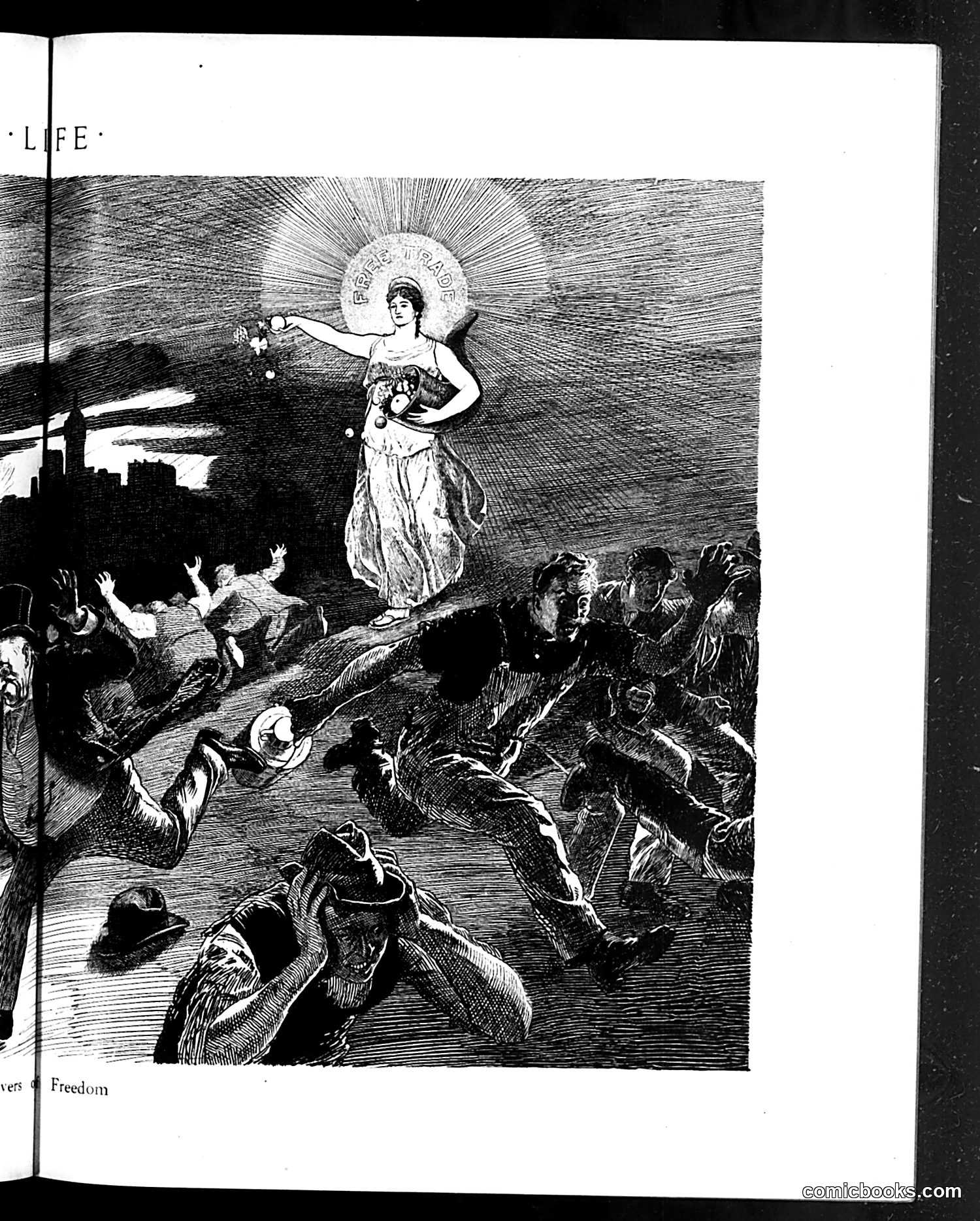
This engraving depicts "Freedom" as an allegorical female figure with a radiant halo, standing elevated above a crowd of struggling people below. She scatters flowers or tokens downward while the masses reach upward desperately toward her. The image appears to be satirizing the gap between the idealized concept of freedom and its actual accessibility to ordinary people. The figure of Freedom—portrayed as ethereal, unreachable, and almost divine—contrasts sharply with the earthbound crowd's frantic attempts to grasp it. This likely critiques either the broken promises of freedom or the inequality in who actually experiences liberty in practice. The satirical point suggests that "Freedom" remains a distant ideal rather than a tangible reality for the common person.
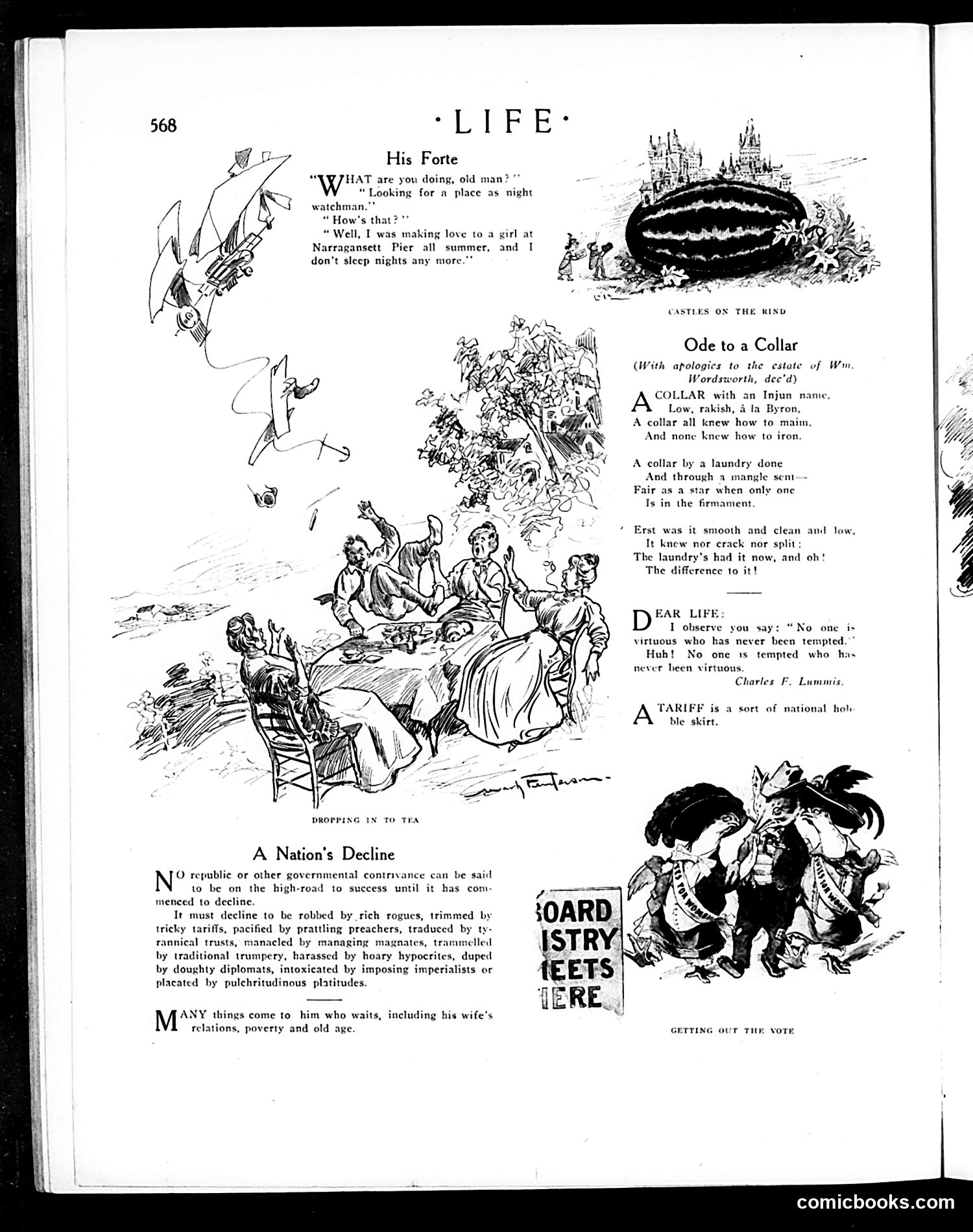
This page from the satirical magazine *Life* contains several distinct pieces of social and political commentary: **"His Forte"** is a romantic joke: a man seeking night watchman work admits he can't sleep because he spent summer courting a girl at Narragansett Pier (a fashionable resort), suggesting lovesickness keeps him awake. **"Ode to a Collar"** parodies Wordsworth's poetry to mock laundry services. It ironically celebrates a collar that was once pristine but has been ruined by commercial laundries—a common frustration of the era when collars were separately starched and laundered. **"A Nation's Decline"** is a political critique using alliteration and wordplay to attack corruption: wealthy criminals, unfair tariffs, corrupt preachers, monopolistic trusts, and imperialist policies. It sarcastically argues nations must "decline" by resisting these ills. The bottom cartoon, "Getting Out the Vote," appears to satirize electoral politics, though the specific reference is unclear from the visible portion. Throughout, *Life* targets early 20th-century American commercial, religious, and political institutions with humor and moral commentary.
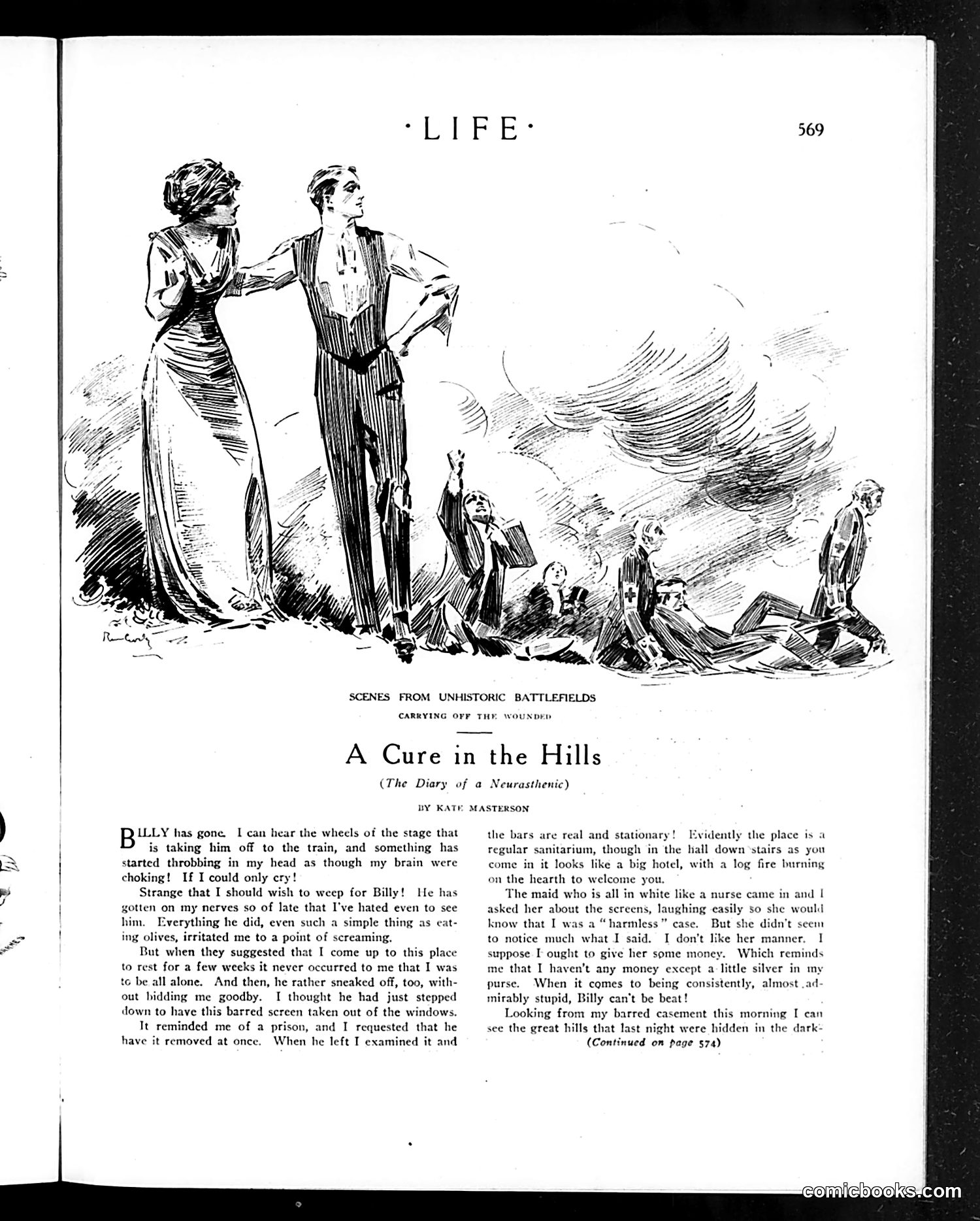
This page presents **"A Cure in the Hills,"** a satirical story about a neurasthenic (a nervous, high-strung person—a common diagnosis for anxiety in the early 20th century). The illustration's caption, "Scenes From Unhistoric Battlefields / Carrying Off The Wounded," uses mock-heroic language to depict what appears to be a woman and man among smaller figures, suggesting domestic conflict portrayed as warfare. The story itself satirizes: 1. **Neurasthenia as fashionable affliction**: The narrator's nervous condition is treated as a legitimate reason for sanitarium rest—a common, often frivolous practice among the wealthy. 2. **Marriage dynamics**: The narrator resents her husband Billy yet is upset he's left; she realizes the "rest cure" location is actually a psychiatric facility disguised as a resort hotel. 3. **Gender and power**: The barred windows, controlling staff, and her husband's role in her confinement suggest anxieties about women's autonomy and medical authority over female patients. The satire targets both the neurotic patient and the medical establishment that profits from treating (or confining) nervous disorders as genuine illnesses.
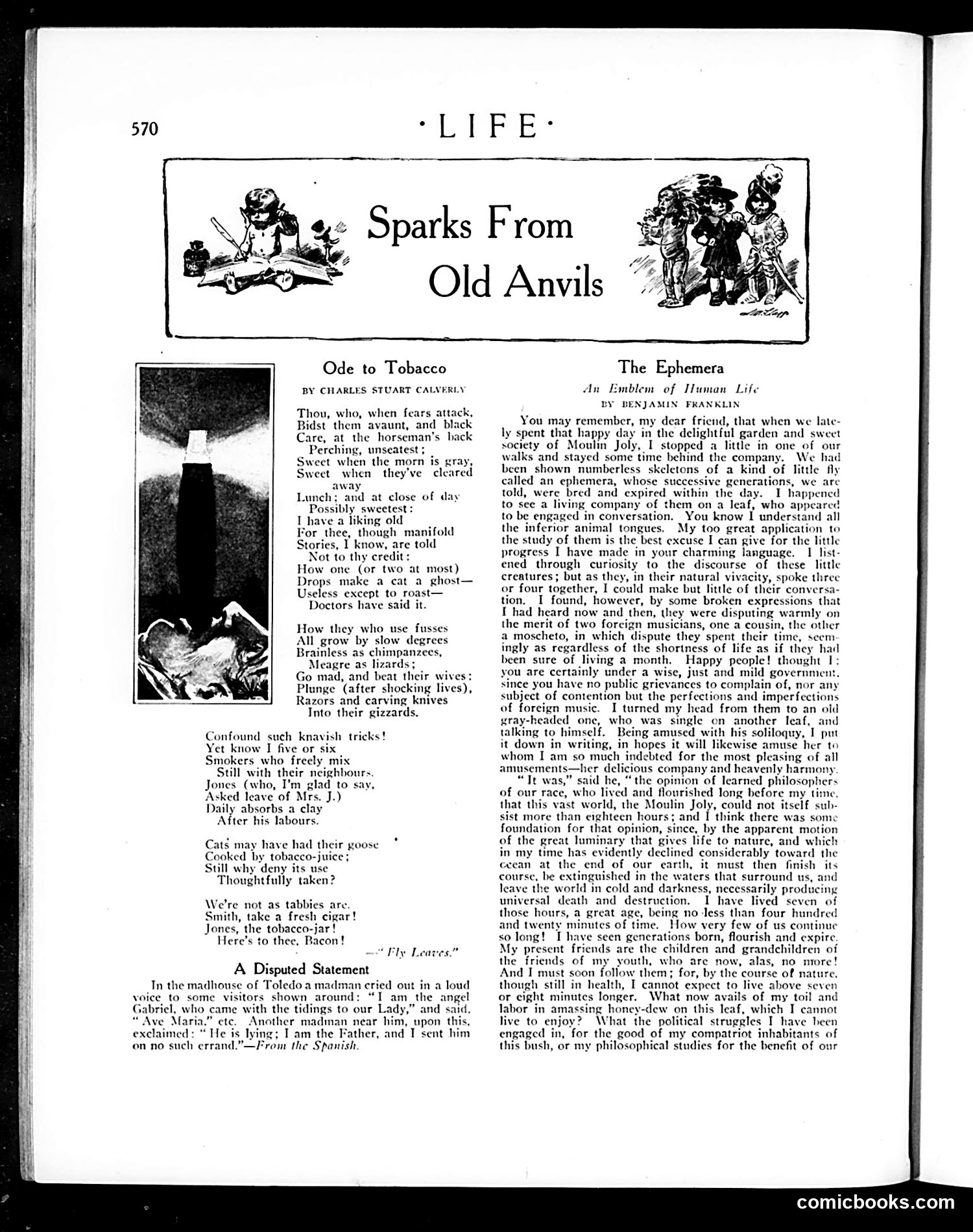
This page contains three distinct literary pieces, not political cartoons: **"Ode to Tobacco"** by Charles Stuart Calverly satirizes anti-smoking arguments. It humorously defends tobacco against exaggerated health claims circulating in the era—that smoking causes madness, wife-beating, and suicide. The poem mocks these "knavish tricks" of anti-tobacco propagandists while celebrating smoking as a gentleman's pleasure. **"A Disputed Statement"** is a brief anecdote about two madmen in a Toledo asylum, each claiming divine authority, illustrating absurdist humor about competing claims of legitimacy. **"The Ephemera"** by Benjamin Franklin is a philosophical essay presented as a fable. Franklin observes short-lived insects debating foreign musicians, using their brief lifespan as commentary on human priorities—suggesting people blessed with good governance waste time on trivial disputes rather than addressing real grievances. It's social satire about wasted human potential. The page demonstrates *Life* magazine's literary humor focused on social observation rather than visual cartooning.
This page contains no political cartoons but rather three separate text pieces: 1. **B. Franklin passage**: A philosophical reflection (likely from Benjamin Franklin's famous "Ephemera" essay) on human ambition and mortality, using the conceit of creatures living only one day. 2. **"The Bizzy Body" by Josh Billings**: A humorous character sketch satirizing busybodies—meddlesome people who waste time and others' time with constant activity and intrusive questions. Written in deliberately misspelled dialect humor (popular 19th-century style), it describes such people as unproductive and irritating as "a sucked orange" or "fleas on a dog." 3. **Brief excerpts** on wit, anecdotes, and definitions—likely filler content. The page is primarily **literary/humorous content**, not visual satire. The "Bizzy Body" piece uses social observation rather than political commentary, mocking a universal human type.
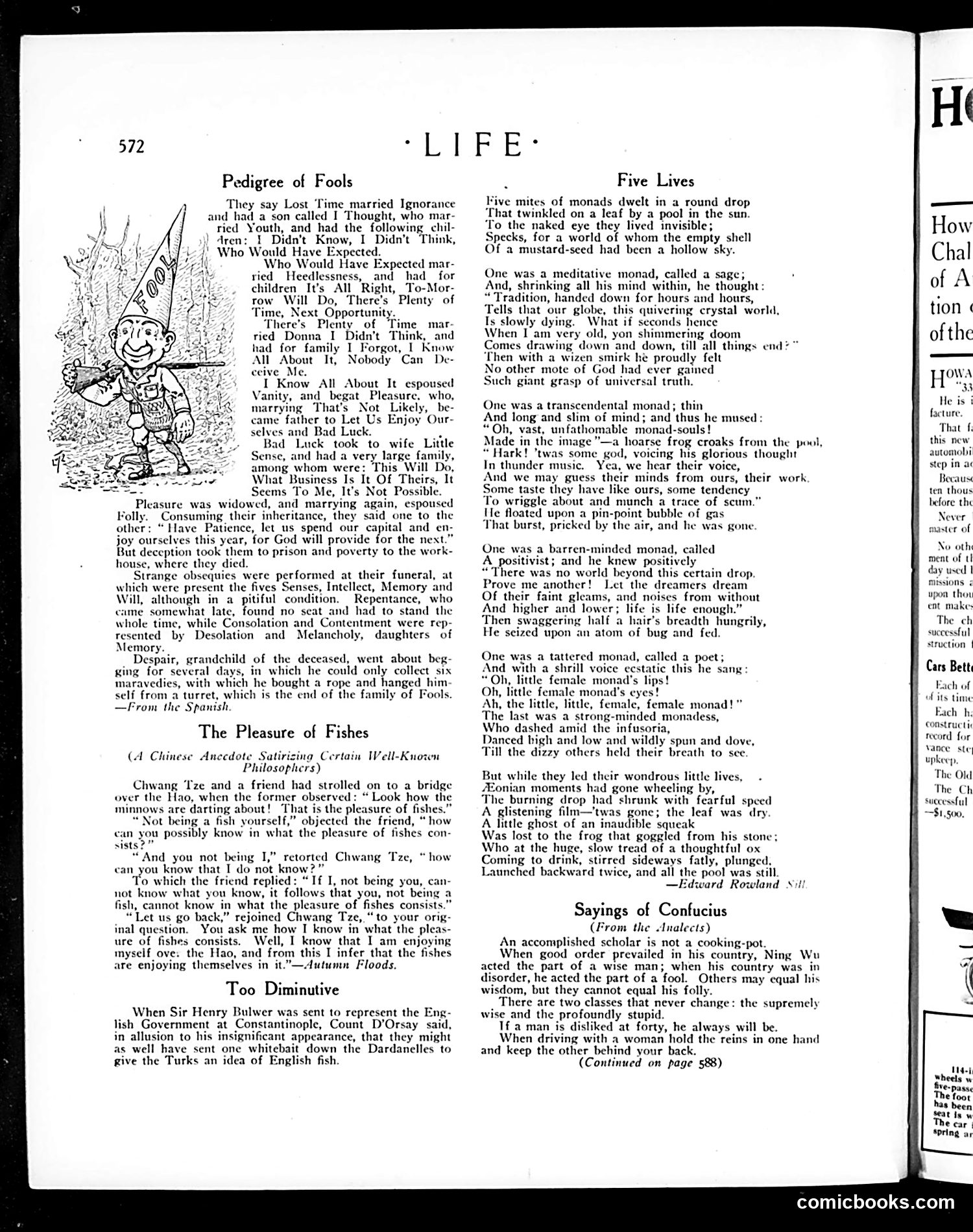
This page contains moral allegories satirizing human folly and poor reasoning. The main cartoon illustrates a Spanish fable tracing foolishness through generations: "Lost Time" marries "Ignorance," producing children like "I Didn't Know" and "Who Would Have Expected." These personified vices intermarry, multiplying flaws until descendants squander inherited wealth, end in poverty and prison, and ultimately lead to suicide. The accompanying pieces — "The Pleasure of Fishes" (a Chinese philosophical dialogue) and "Too Diminutive" (a witty anecdote about diplomat Sir Henry Bulwer) — continue the theme: satirizing people who claim knowledge they cannot possess, and mocking those with pretensions exceeding their actual capacity. The overall message targets self-deception, inherited ignorance, and the human tendency toward unexamined assumptions — perennial subjects of satirical magazines.
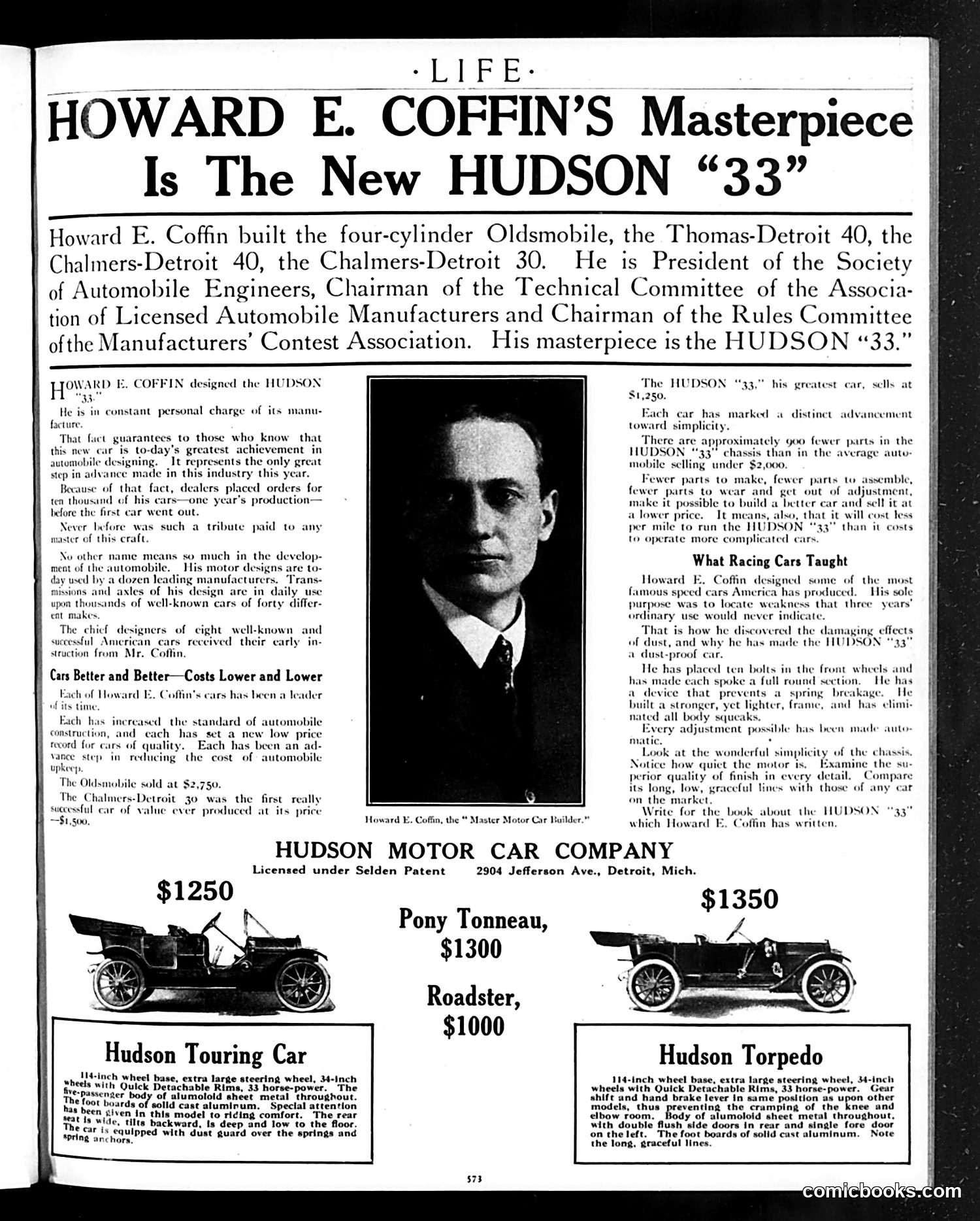
This is primarily **advertising, not satire**. It's a promotional article for the Hudson "33" automobile, featuring engineer Howard E. Coffin as the designer. The page celebrates Coffin's credentials—he designed earlier successful cars (Oldsmobile, Chalmers-Detroit models)—positioning him as automobile industry royalty. The text argues the Hudson "33" represents a major engineering breakthrough: it has approximately 900 fewer parts than comparable cars, reducing manufacturing costs and complexity while improving reliability. For modern readers: This reflects early-1900s auto industry competition based on **engineering innovation and price reduction**. The emphasis on "fewer parts" and simplicity was genuinely revolutionary then. Coffin's reputation apparently mattered enormously—dealers allegedly pre-ordered 10,000 cars before any were built. The accompanying car illustrations show different body styles (Touring Car, Torpedo, Roadster, Pony Tonneau) available at various prices ($1,000–$1,350), demonstrating the product range. This was aspirational technology for middle-class buyers.
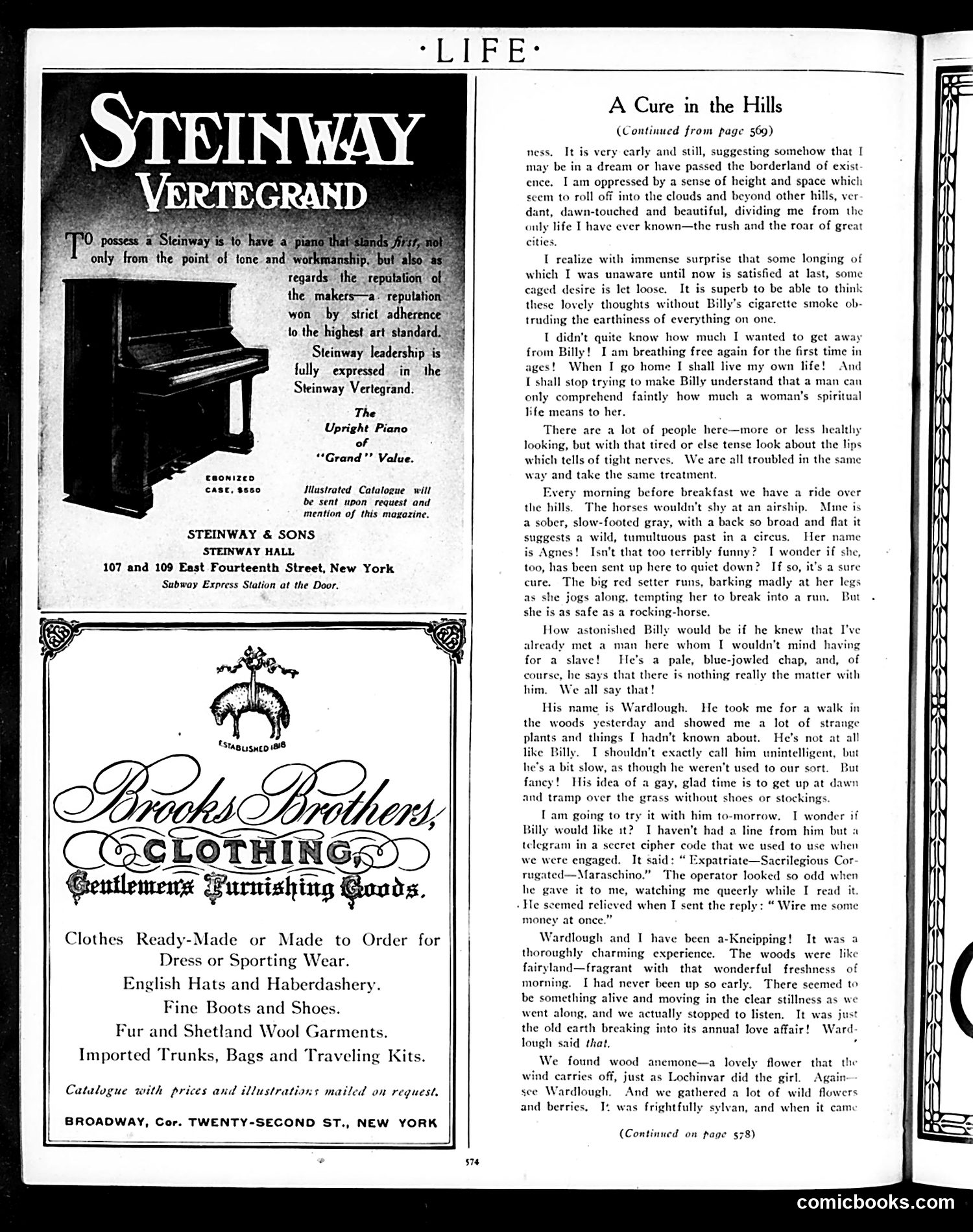
This page is primarily **advertising**, not political satire. It contains two major ads: 1. **Steinway Piano advertisement** (left): Promotes the Steinway Vertegrand upright piano, emphasizing its reputation for quality craftsmanship and "Grand" value at $550. 2. **Brooks Brothers advertisement** (lower left): Showcases gentlemen's clothing, hats, shoes, and travel goods from their Broadway location. The right column contains **serialized fiction** titled "A Cure in the Hills," a narrative about a woman finding respite at a health resort. She escapes her husband Billy, befriends a man named Wardlough, and discovers personal freedom through nature walks and the "Kneipping" cure (water therapy). The story explores early-20th-century themes of women's spiritual independence and marital dissatisfaction. There are **no political cartoons** on this page. This is a typical Life magazine layout mixing advertisements with serialized entertainment content.
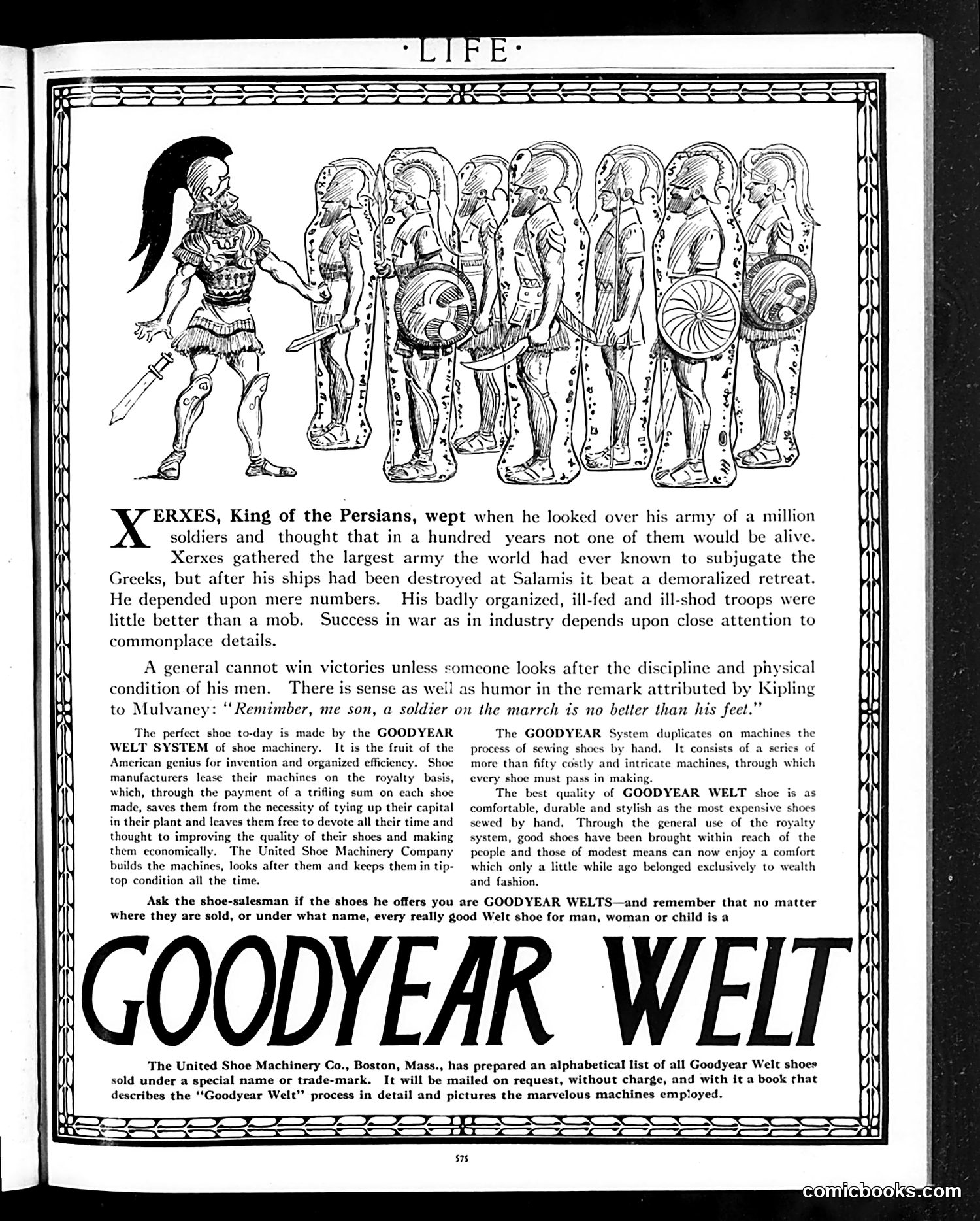
This is primarily a **shoe advertisement**, not political satire. The illustration shows King Xerxes of Persia examining his massive army before his defeat by the Greeks at Salamis—a historical reference used as a moral lesson. The ad's argument: Xerxes failed because he relied on mere numbers rather than proper organization and care for his troops' basic needs. The key phrase, attributed to Kipling, emphasizes that soldiers' quality depends on their feet: "a soldier on the march is no better than his feet." This premise launches the **Goodyear Welt shoe pitch**: superior shoe manufacturing through mechanized efficiency (the "Welt System") makes quality footwear affordable to ordinary people, not just the wealthy. The ad positions well-made shoes as essential to both military success and democratic access to comfort. The satire is gentle—using ancient history to make a mundane product seem philosophically important.
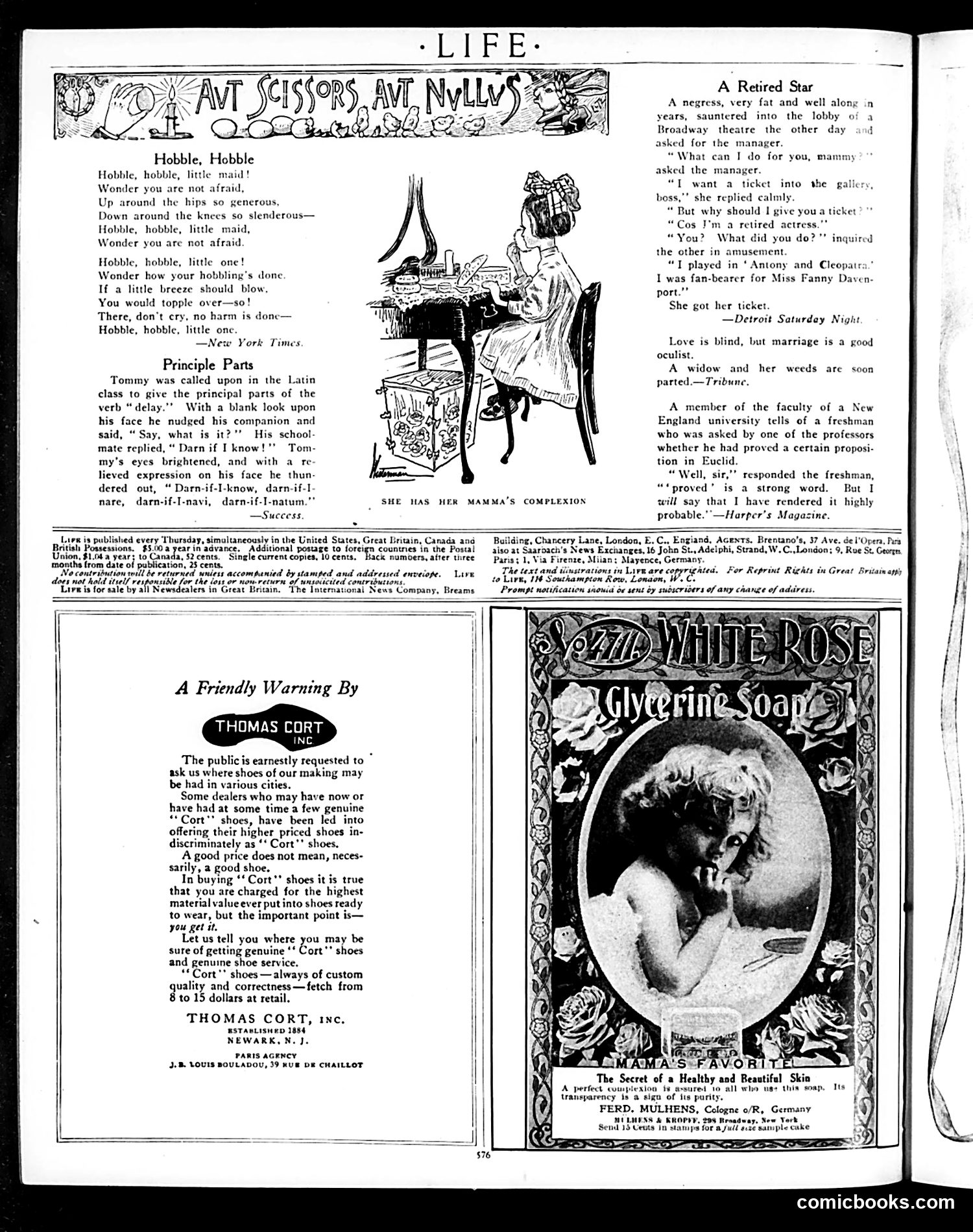
This page contains **four distinct humor pieces** rather than political cartoons: 1. **"Hobble, Hobble"** - A poem mocking the "hobble skirt" fashion trend of the era, which restricted women's movement at the knees and hips. The satire lies in the impracticality and absurdity of the garment. 2. **"A Retired Star"** - A brief anecdote with racial stereotyping typical of the period, depicting a Black woman claiming former theatrical employment. The "humor" relies on period prejudices. 3. **"Principle Parts"** - A school joke playing on Latin verb conjugation wordplay, with no political content. 4. **"Faculty Anecdote"** - A campus humor piece about mathematical proof versus probability. The page also contains **advertisements** (Thomas Cort shoes, White Rose Glycerine Soap) and standard magazine publication information. There are no identifiable political figures or events referenced—this is primarily **light satirical humor and advertising**, typical of Life magazine's early 20th-century format.
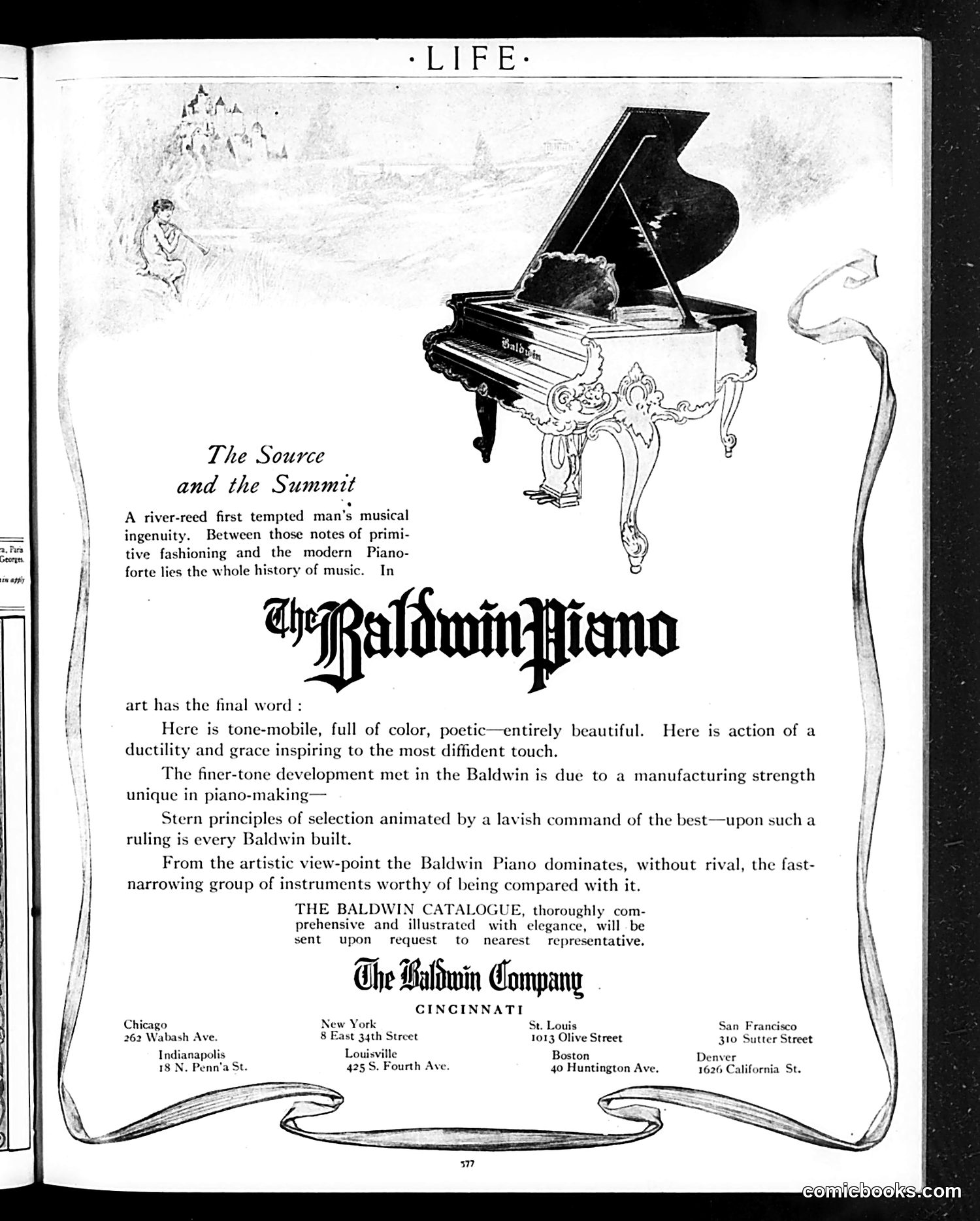
This is primarily a **Baldwin Piano Company advertisement**, not a political cartoon. The page uses classical artistic framing rather than satire. The illustration depicts a pianist at a grand piano with decorative cherub-like figures supporting it, set against a romantic landscape. This romanticized imagery is typical of early 20th-century luxury goods advertising. The text's central argument is hierarchical: it traces piano evolution from primitive "river-reed" instruments to the modern "Pianoforte," positioning Baldwin pianos at the artistic and technical pinnacle. The copy emphasizes Baldwin's manufacturing superiority and artistic dominance among "instruments worthy of being compared with it." **For modern readers:** This reflects pre-1920s advertising strategy—associating products with high culture and refinement to justify premium pricing. The language ("stern principles," "lavish command of the best") appeals to aspirational middle/upper-class buyers. There is no political satire here; it's straightforward commercial promotion emphasizing Baldwin's position as the supreme piano maker.
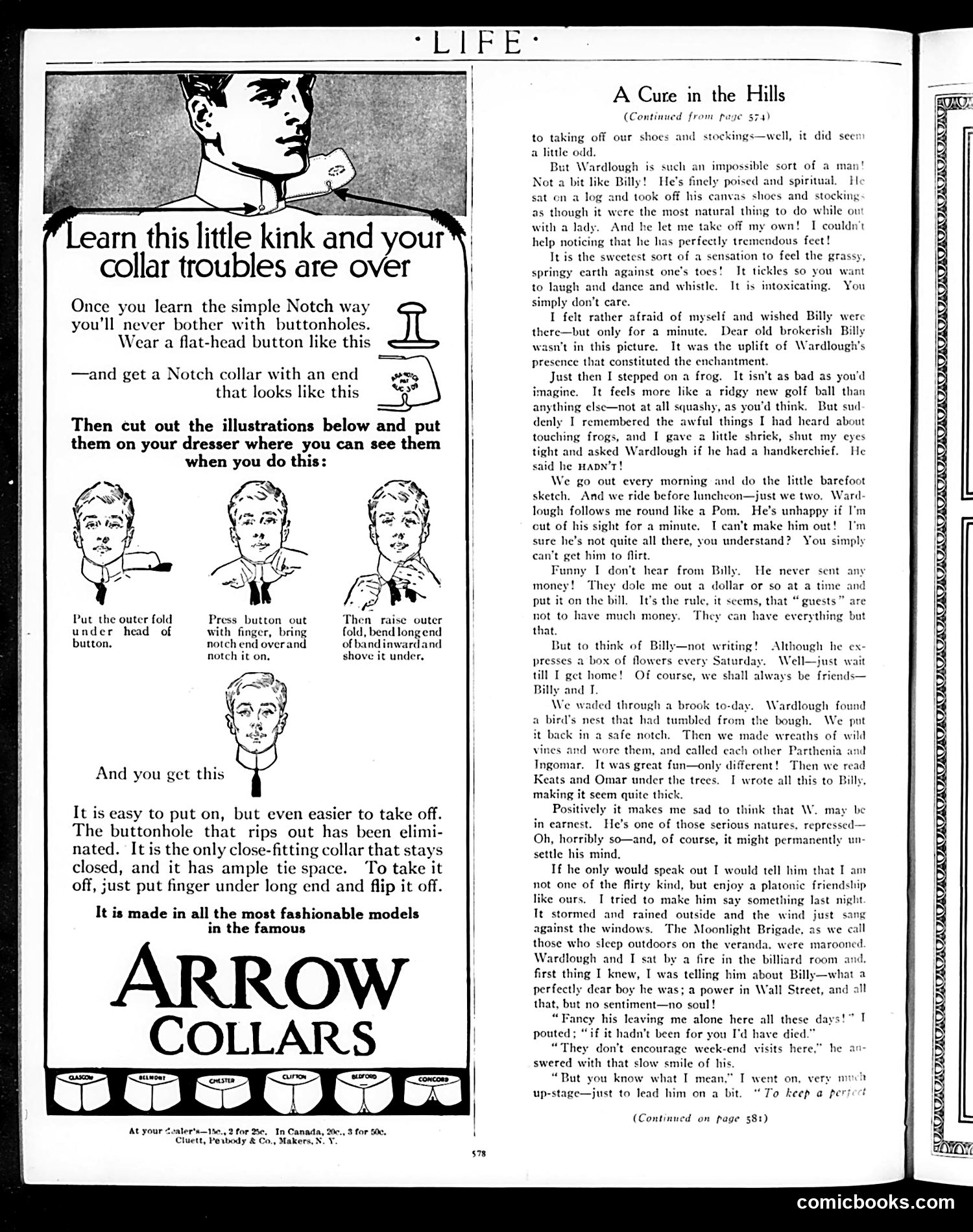
This page is primarily **advertising for Arrow Collars** (left side), with an unrelated fictional story excerpt on the right titled "A Cure in the Hills." ## The Advertisement The Arrow Collar ad addresses a common men's grooming frustration of the era: buttonholes on shirt collars that would tear or wear out. The ad promotes the "Notch" collar design—a detachable collar with a flat-head button system that eliminates traditional buttonholes. The illustrated instructions show how to fold and attach it. This was a practical solution for early 20th-century menswear, when collars were frequently replaced rather than shirts. ## The Story The accompanying serialized fiction appears to be a romantic narrative about a woman vacationing in the hills with a man named Wardlough (not her fiancé Billy). The excerpt depicts flirtation and growing emotional attachment—barefoot walks, wading, shared literary moments. The woman expresses confusion about Wardlough's intentions while receiving flowers from absent Billy. This captures the genteel romantic conventions of the period. The page combines practical product information with light entertainment typical of Life magazine's mixed content approach.
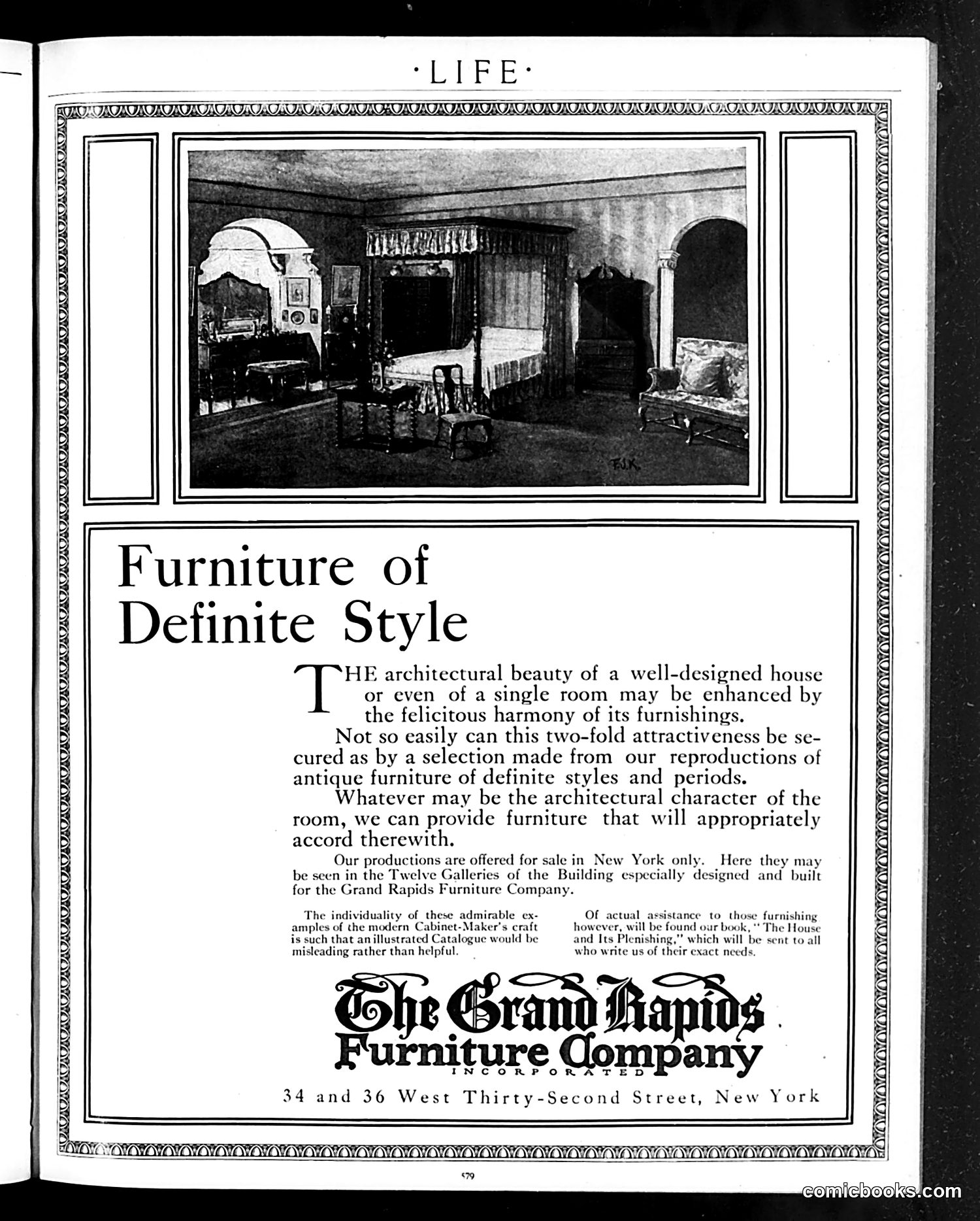
This page is **not a cartoon or satirical content**—it is a straightforward advertisement for The Grand Rapids Furniture Company, published in *Life* magazine. The ad promotes antique furniture reproductions "of definite styles and periods" available in New York. It emphasizes that quality furnishings enhance architectural beauty and harmony in homes. The company offers an illustrated catalog called "The House and Its Plenishing" for customers to request. The large photograph at the top shows an elegantly furnished bedroom with a canopied bed, dressing table, and period pieces, serving as aspirational display of their wares. This represents early-20th-century American advertising in a high-end lifestyle magazine, targeting wealthy consumers interested in historically-styled home furnishings rather than modern design.
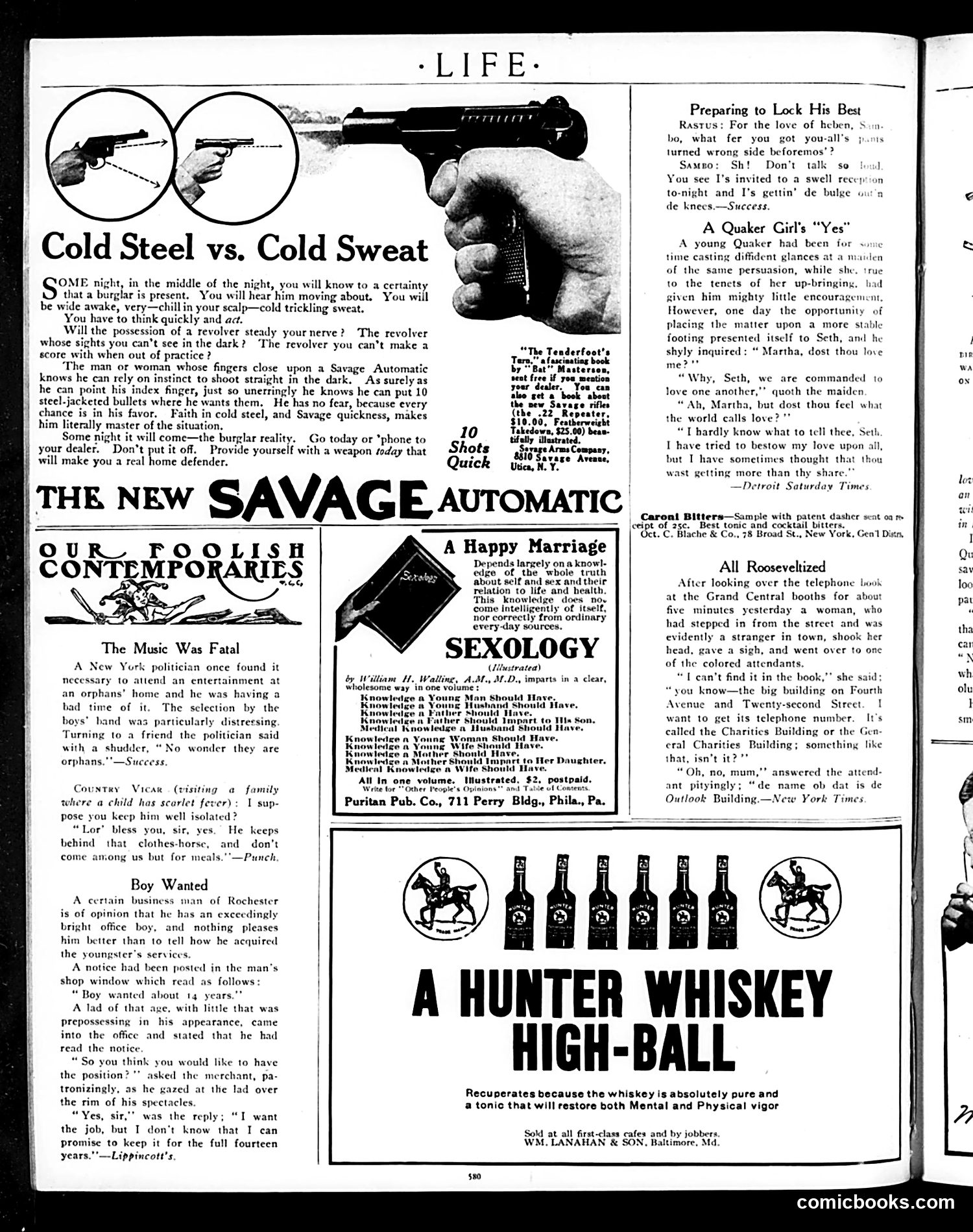
This page from *Life* magazine contains several satirical pieces reflecting early 20th-century American humor and social attitudes: **"Cold Steel vs. Cold Sweat"** is a Savage Automatic revolver advertisement disguised as practical advice, exploiting burglary anxieties to sell weapons to home defenders. **"A Quaker Girl's Yes"** satirizes the tension between strict Quaker religious principles (commanding universal love) and romantic attraction. The joke plays on the young woman's formal religious language masking romantic interest—she's loved "everyone" equally until Seth got "more than thy share." **"The Music Was Fatal"** jokes that orphans' terrible musical performances explain why they're orphans—a dark humor typical of the era. **"All Rooseveltized"** references Theodore Roosevelt's prominence; a woman searching for a telephone number in Grand Central can't find the "Charities Building" because she's looking in the wrong place, suggesting confusion or disorientation (the pun's exact logic is unclear from context). The page is primarily **advertising-driven**, with whiskey and other product promotions dominating space. The satirical pieces are brief, topical humor fragments typical of *Life*'s format.
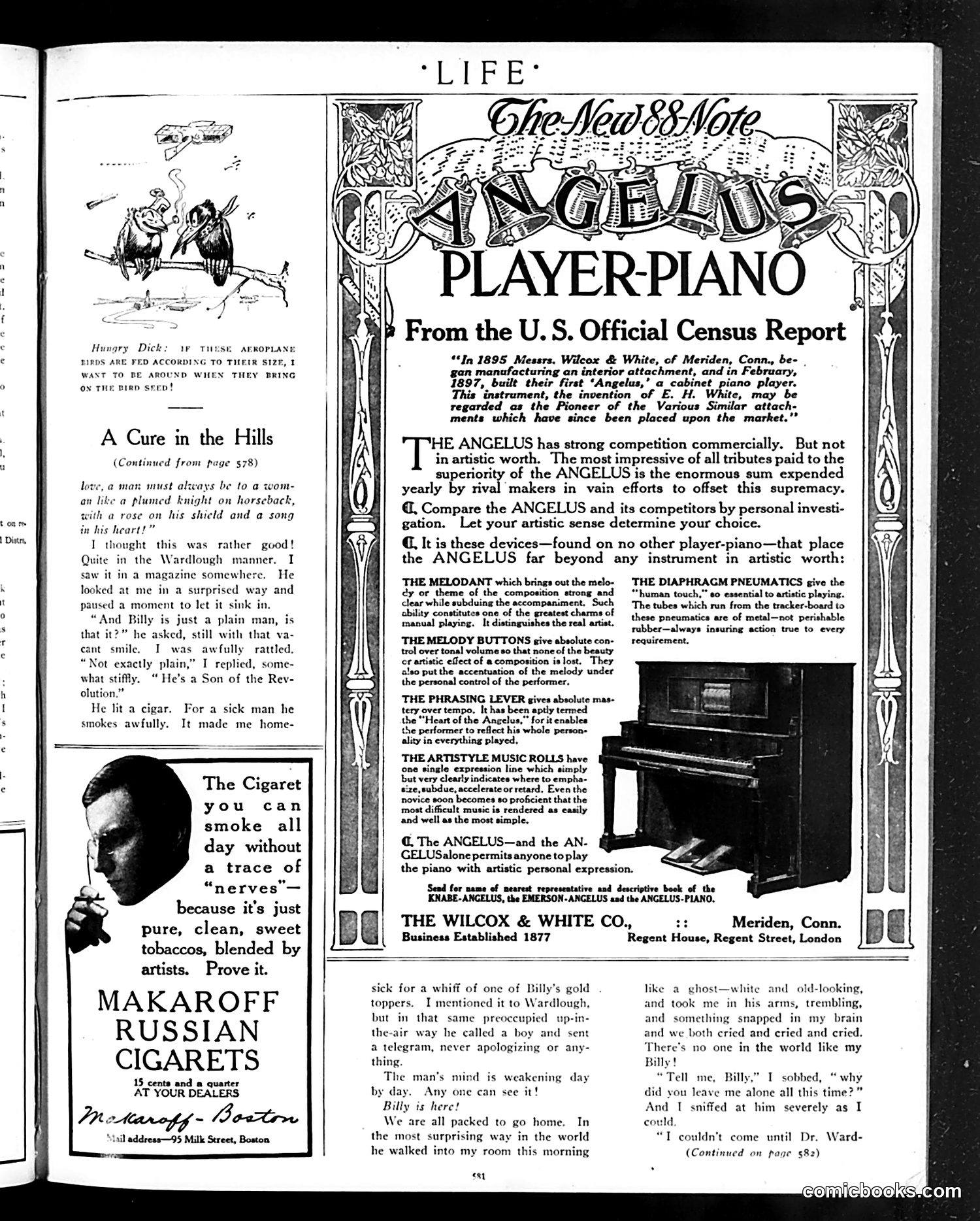
This page contains **mostly advertising** with a modest cartoon and serialized fiction. **The Cartoon ("Hungry Dick"):** A simple visual gag showing two vultures discussing feeding arrangements. One bird jokes that if aircraft are fed according to size, he wants to be present when they "bring on the bird seed"—playing on the double meaning of "bird" (the aircraft and actual birds). **Main Content:** The page is dominated by a large **Angelus Player-Piano advertisement** from Wilcox & White Co., claiming superiority over competitors through features like the "Melodant" and "Phrasing Lever" that allow artistic expression. This represents typical early-1900s advertising claims of technological superiority. **The Makaroff Cigarette Ad** emphasizes purity and absence of "nerves"—reflecting period anxieties about cigarette effects. **"A Cure in the Hills"** is serialized fiction (continued from page 578), depicting domestic/romantic drama in what appears to be a rural setting. The page reflects pre-WWI consumer culture and leisurely magazine reading conventions.
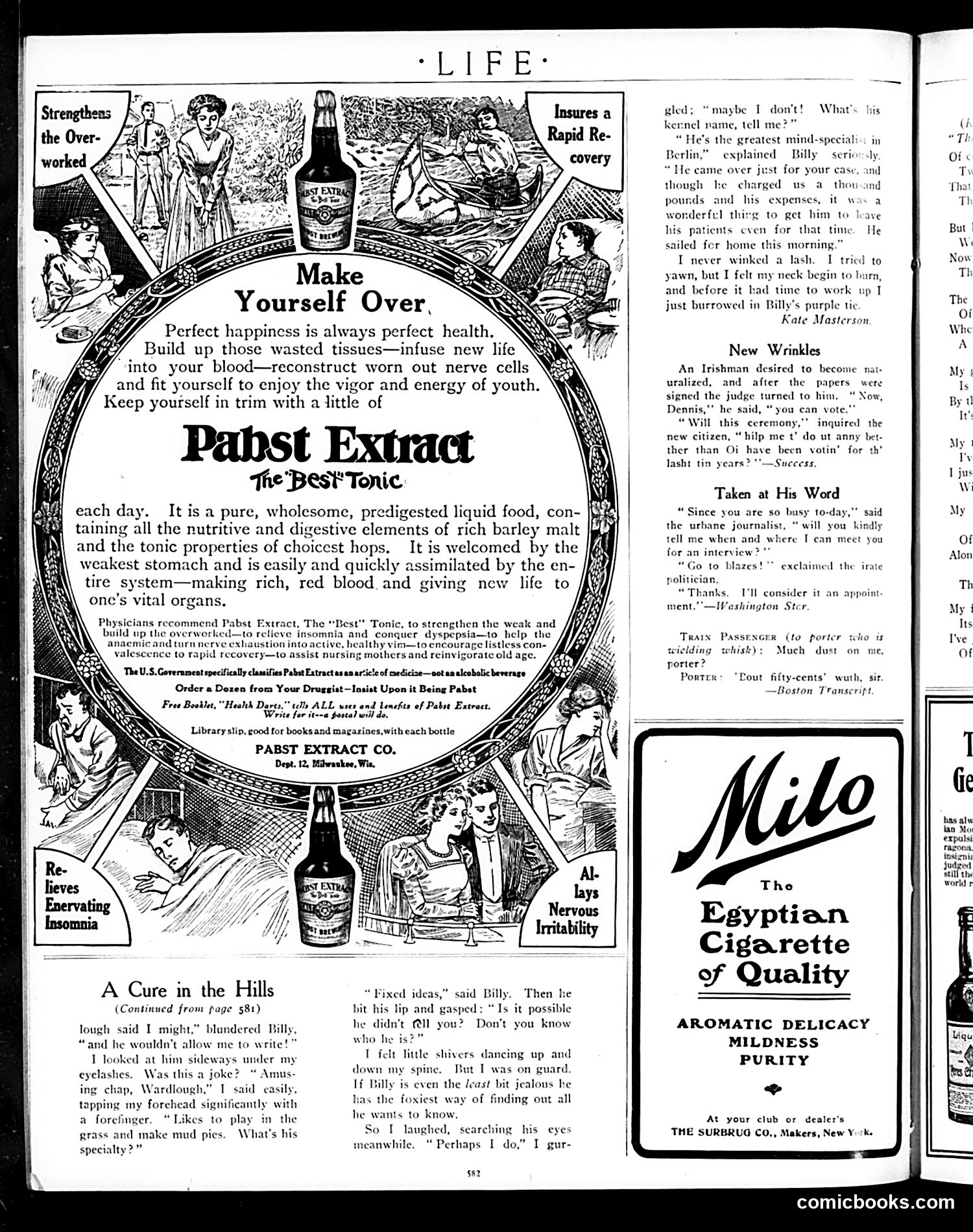
This page is primarily **advertising with supplementary humor content**. The dominant feature is a large Pabst Extract advertisement claiming medicinal benefits—it promises to cure exhaustion, insomnia, and weak digestion through a "predigested liquid food" of barley malt and hops. The U.S. Government classified it as medicine, not alcohol (a legal distinction likely important for early 20th-century patent medicine marketing). The page also includes: - **Short humorous anecdotes** ("New Wrinkles," "Taken at His Word," "Train Passages") typical of Life's satirical content - A **Milo Egyptian Cigarette ad** touting "quality" Modern readers should note: These ads represent the era before FDA regulations when such tonics made unsubstantiated health claims, and patent medicines were largely unregulated. The Pabst Extract's emphasis on government classification reflects contemporary marketing tactics exploiting regulatory ambiguity around alcohol content and medicinal claims.
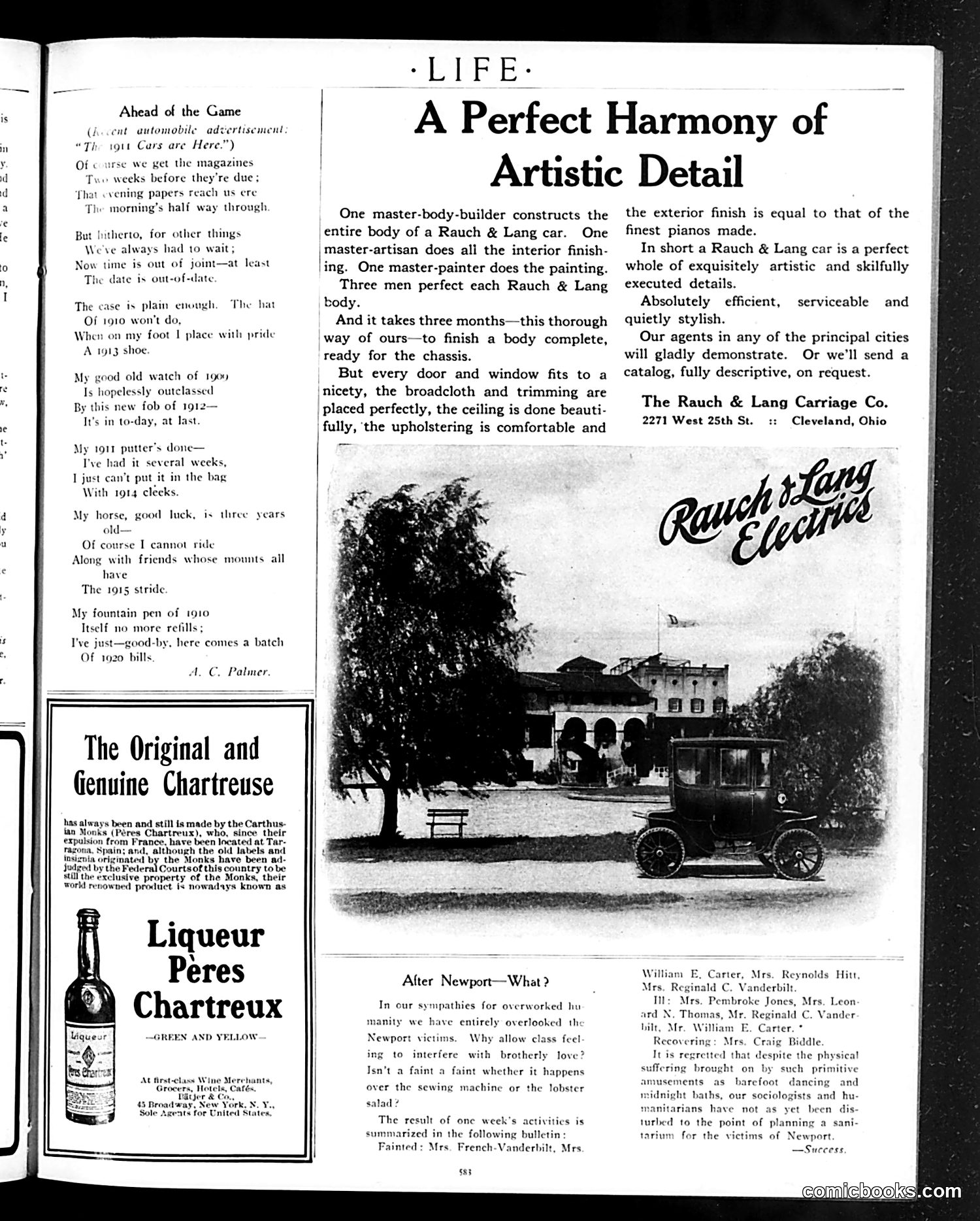
This page contains a satirical poem titled "Ahead of the Game" by A.C. Palmer (left column) that mocks the rapid pace of consumer obsolescence in early 1910s America. The poem's speaker complains that everything he owns—watches, golf putters, fountain pens, even his horse—has become outdated almost immediately by newer models. The humor lies in the absurdity: a 1900 watch is "hopelessly outclassed" by a 1912 fob, and his 1915 horse can't keep up with friends' 1915-stride mounts. The satire critiques consumerism and manufacturers' artificial creation of "newness" to drive sales. Ironically, the page is surrounded by advertisements (Rauch & Lang carriages, Chartreuse liqueur) promoting their own products as superior. The "After Newport—What?" section briefly mocks wealthy socialites' trivial complaints, noting society women fainting from exhaustion—a satirical jab at upper-class leisure. The page reflects Progressive Era anxiety about materialism and corporate manipulation of desire.
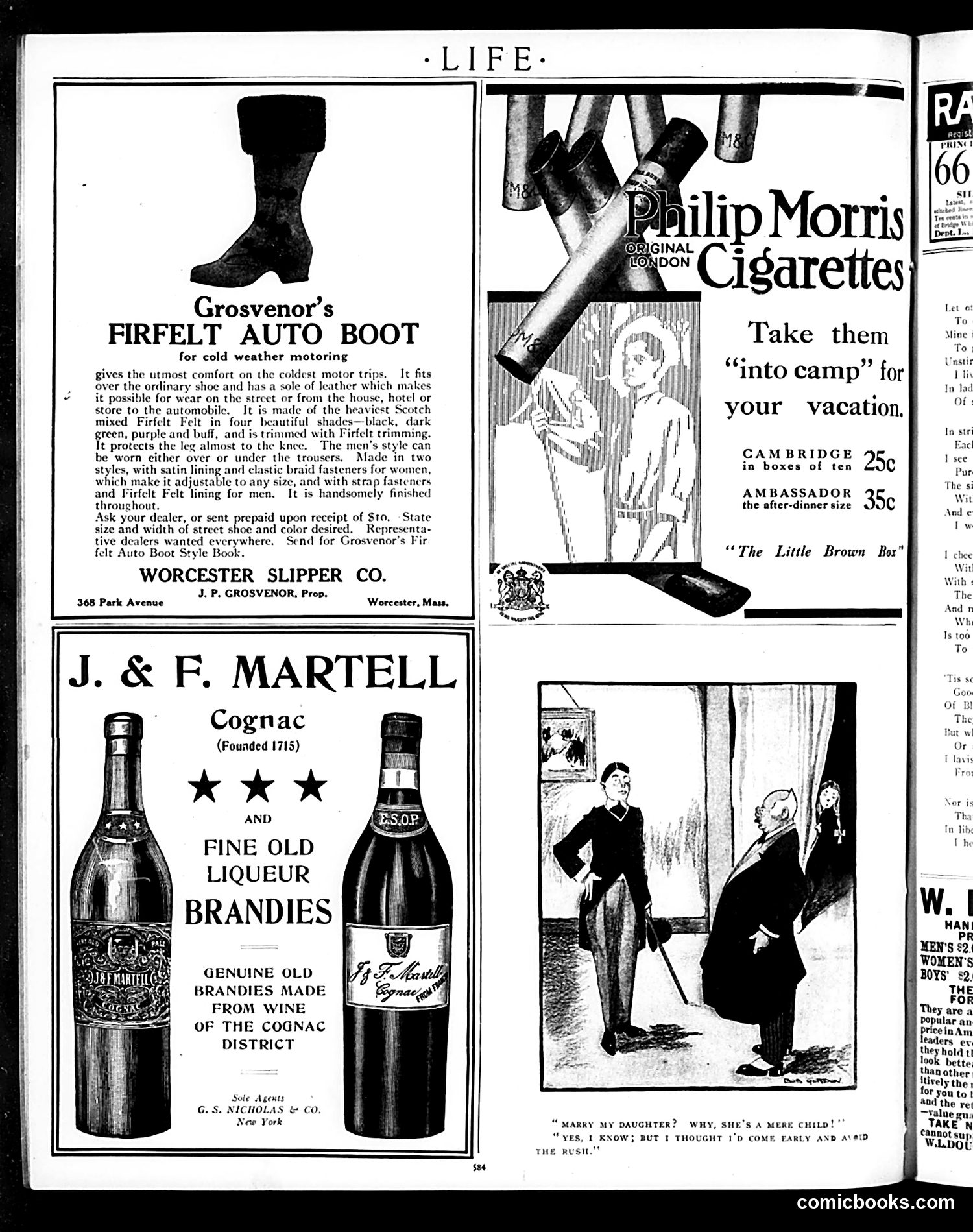
This page is primarily **advertisements** rather than editorial content or satire. The main advertised products are: 1. **Grosvenor's Firfelt Auto Boot** — a felt overshoe for cold-weather driving, priced at $10 2. **J. & F. Martell Cognac and Brandies** — French liquor (Founded 1715) 3. **Philip Morris Cigarettes** — promoting their Cambridge (10¢) and Ambassador (35¢) sizes as vacation items The only cartoon element is a small illustration with the caption "MARRY MY DAUGHTER? WHY, SHE'S A MERE CHILD!" / "YES, I KNOW; BUT I THOUGHT I'D COME EARLY AND AVOID THE RUSH." This appears to be a joke about eager suitors arriving early to court a young woman, playing on 1920s courtship conventions. The page reflects early 20th-century consumer culture and brand advertising in a humor magazine, with products (automobiles, alcohol, cigarettes) marketed to leisure and vacation activities.
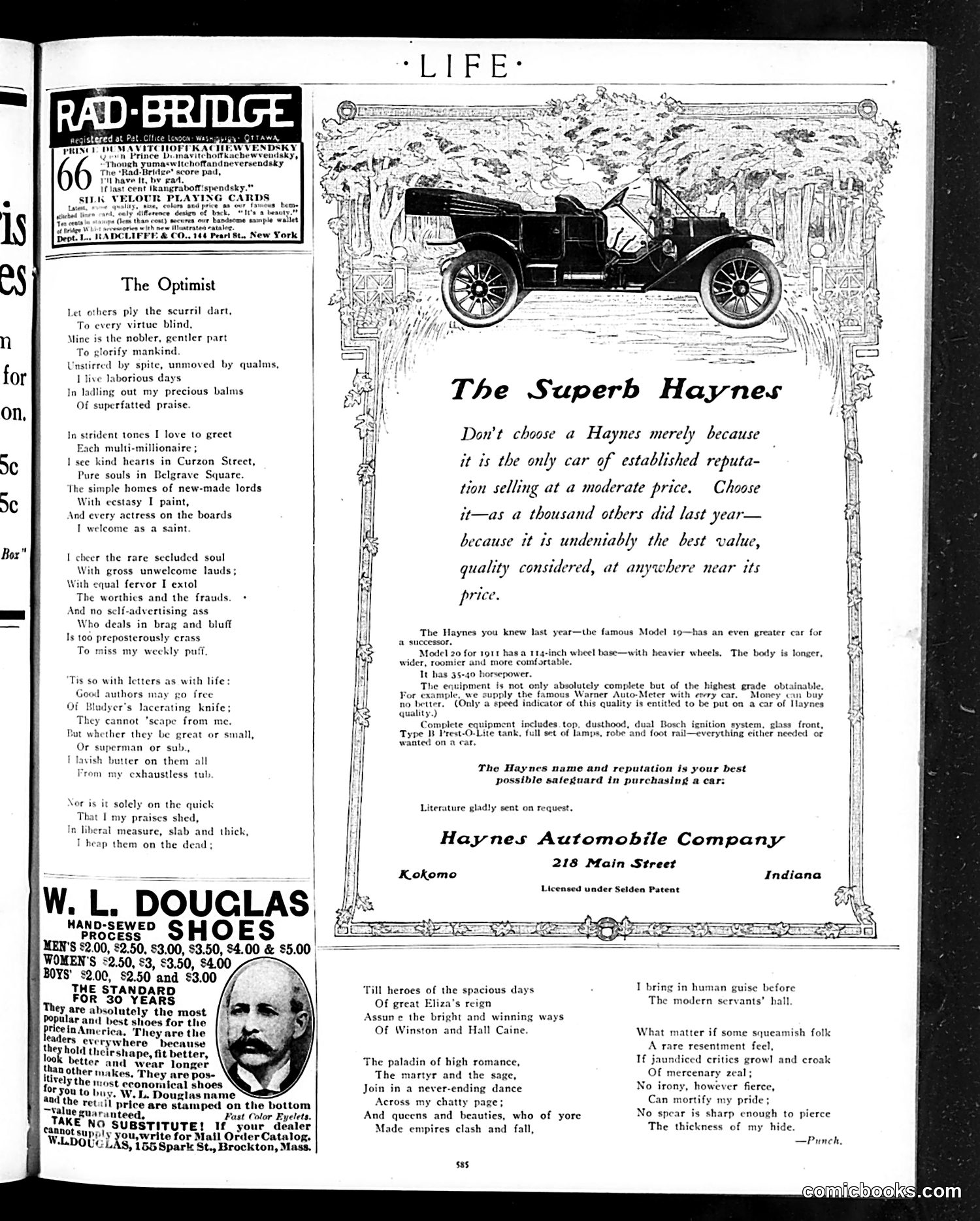
This page consists primarily of **advertisements and poetry**, not political cartoons. The main content is "The Optimist," a satirical poem mocking obsequious praise and flattery. The speaker boasts of lavishing indiscriminate compliments on everyone—millionaires, actresses, fraudsters alike—with no regard for merit. The satire targets those who profit from empty praise and lack integrity. The advertisements include **W.L. Douglas shoes** (emphasizing durability and value) and the **Haynes Automobile Company** (Model 20, positioned as superior quality at moderate price). There is **no political cartoon visible**. The poem's satire is social rather than political, critiquing the culture of false flattery in Edwardian society and the advertising industry's manipulative practices.
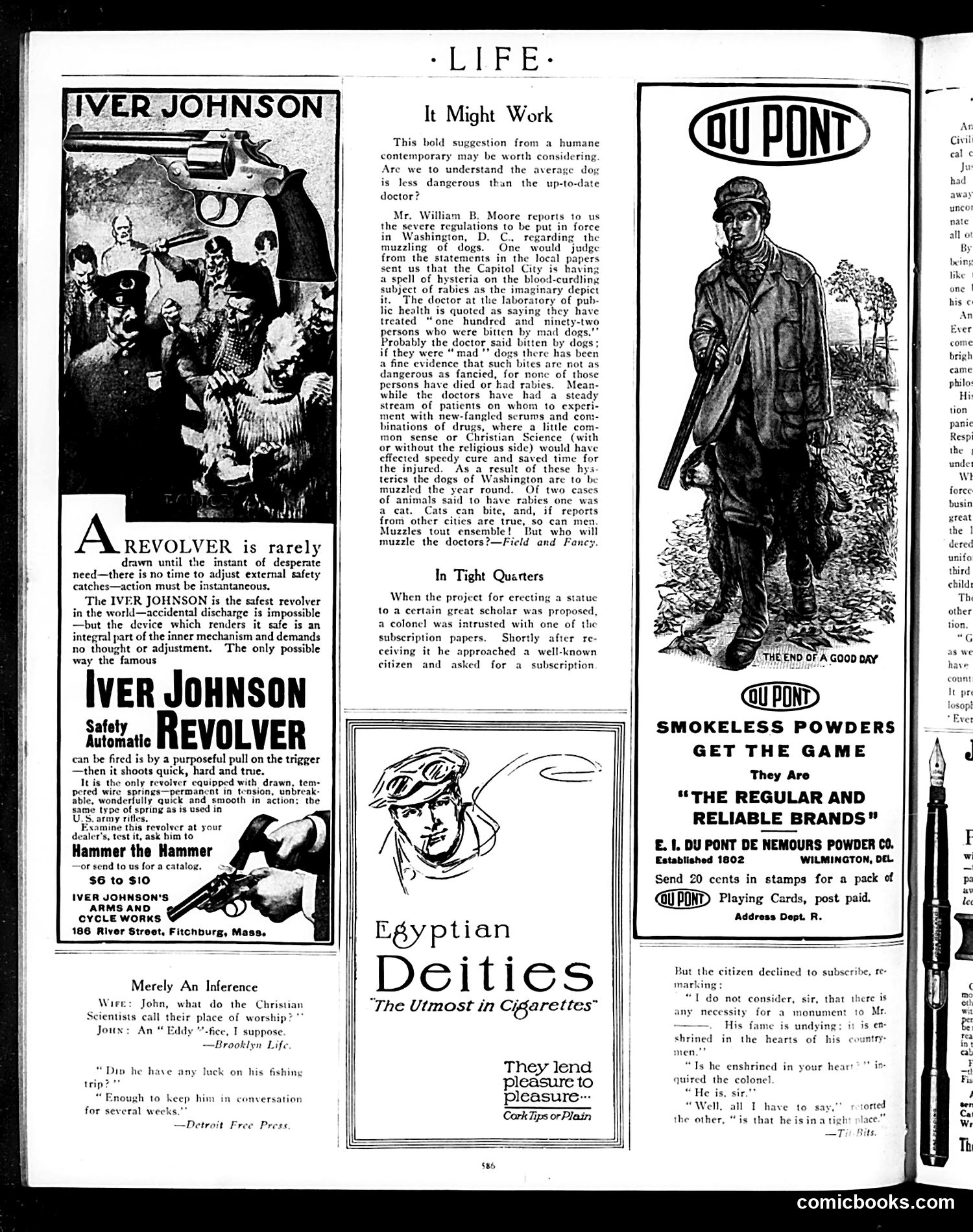
This page contains satirical commentary and advertisements from an early 20th-century American magazine. The main content includes: **"It Might Work"** — A humorous editorial criticizing Washington D.C.'s dog-muzzling regulations during a rabies scare. The writer argues the danger is exaggerated (only one animal was actually a dog; one was a cat), and suggests doctors' experimental treatments are equally risky. The satire mocks public hysteria and medical overconfidence. **"In Tight Quarters"** — A brief joke about a colonel soliciting donations for a statue to a scholar. When a citizen refuses, claiming the scholar's fame is eternal ("enshrined in hearts"), the colonel replies the man should donate anyway—a dig at philanthropic hypocrisy. **"Merely An Inference"** — Two quick jokes, including a pun on Christian Science ("Eddy-fice," referencing founder Mary Baker Eddy). The page also features period advertisements for Iver Johnson revolvers, Du Pont smokeless powders, and Egyptian Deities cigarettes. These are straightforward product ads, not satirical content.
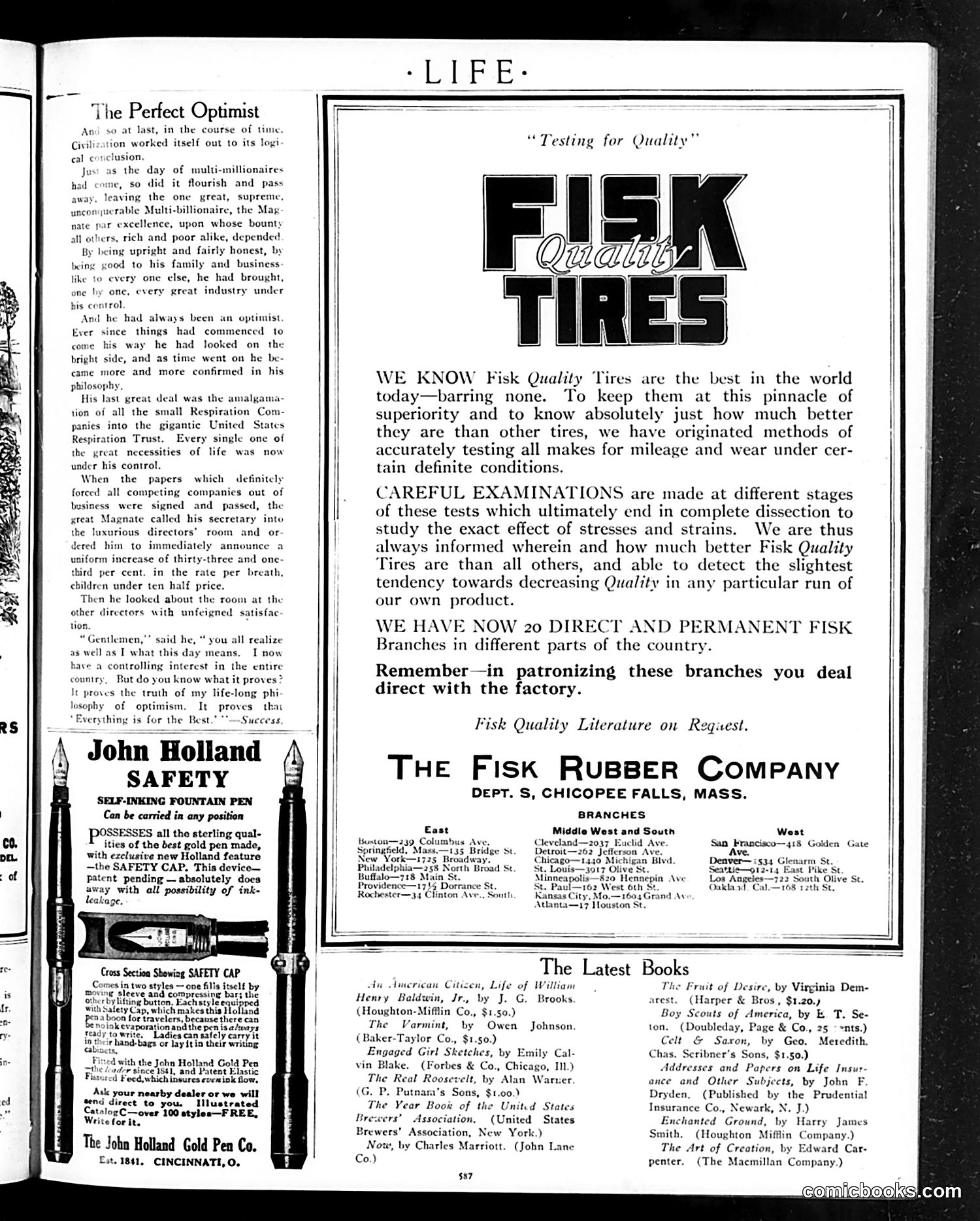
This page contains a satirical short story mocking unchecked capitalism and monopoly. The narrative follows a ruthless businessman who consolidates every competing company into massive trusts—culminating in his monopoly over "United States Respiration Trust" (literally controlling the air people breathe). When he announces a 33% price increase on *breathing itself*, he congratulates himself on proving his optimistic philosophy that "Everything is for the Best." The satire targets Gilded Age robber barons and their rhetoric of inevitable progress. By reducing monopoly to the absurd extreme of charging for oxygen, the author exposes the cruelty and exploitation underlying real business consolidation of the era. The magnate's smug optimism despite creating artificial scarcity is the joke—his "success" directly harms the public, yet he sees no contradiction. The surrounding advertisements (fountain pens, tires) provide ironic contrast to this critique of unregulated industry.
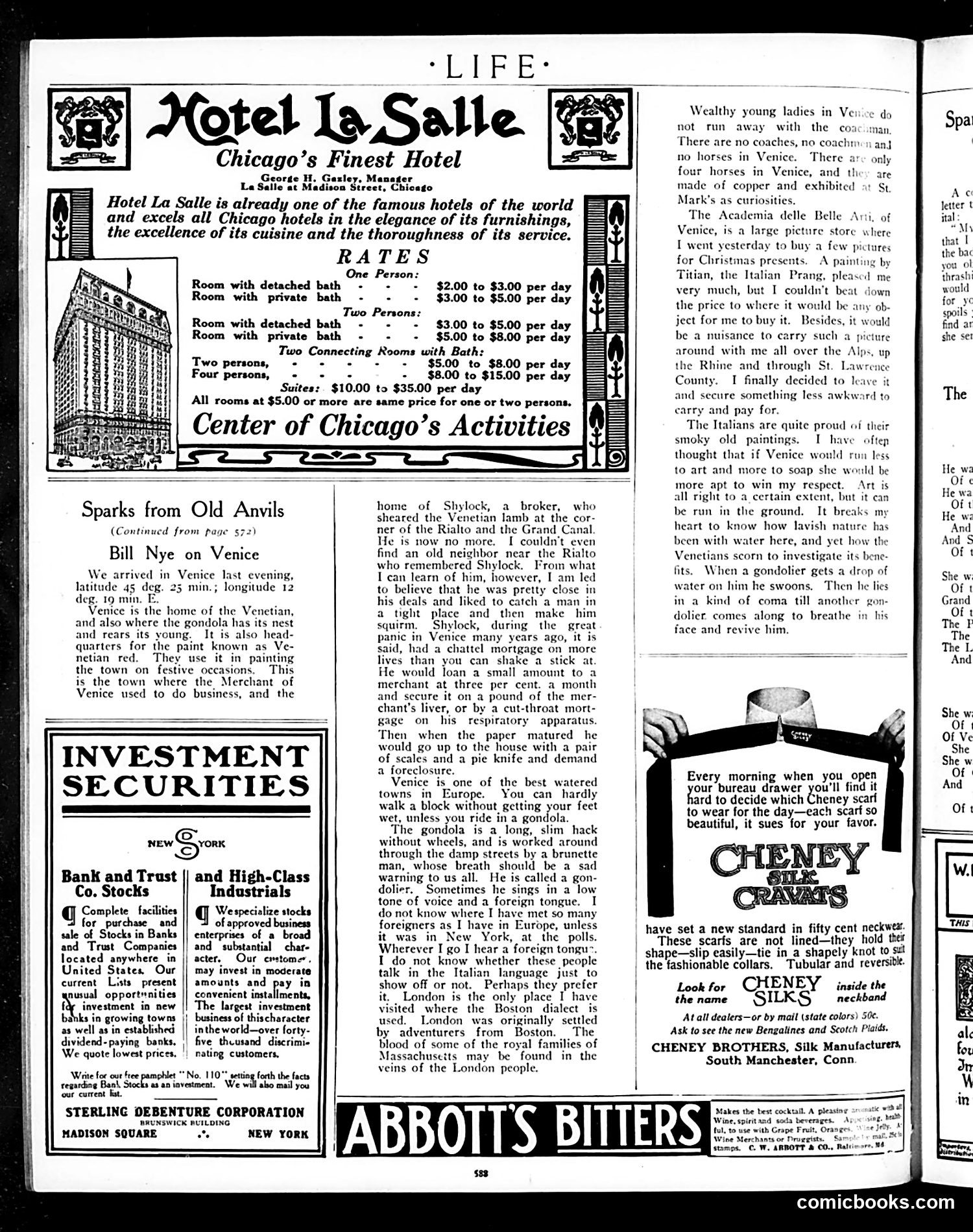
This page is primarily **commercial advertising** for Hotel La Salle in Chicago, with a humorous travel essay called "Bill Nye on Venice" interspersed. The essay is **satirical commentary** by Bill Nye (a well-known 19th-century humorist) about Venice. Rather than praise the city's famous art and romance, Nye sarcastically criticizes it for obsessing over paintings while neglecting basic hygiene and cleanliness. He mocks Venetians for swooning at water droplets despite living surrounded by it, and complains about carrying artworks as souvenirs. The humor relies on **deflating romantic expectations**—readers expecting praise for Venice's cultural treasures get instead complaints about dirt and impracticality. Nye's references to Shylock (Shakespeare's "Merchant of Venice") connect Venice's legendary financial dealings to modern commercial greed. The page also advertises Cheney silk scarves and Abbott's Bitters, typical of *Life* magazine's revenue model: mixing editorial content with paid advertisements.
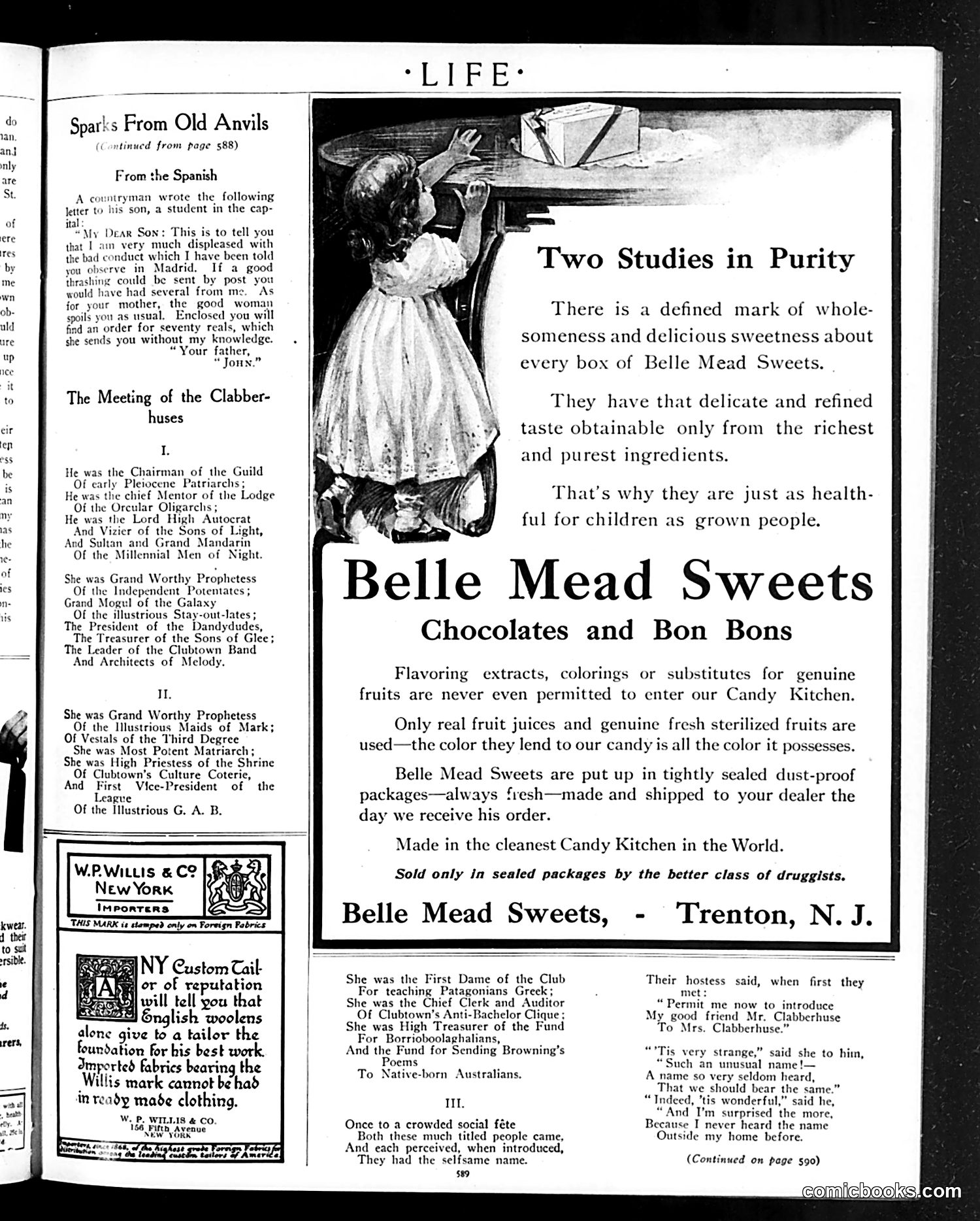
This page contains satirical social commentary rather than a political cartoon. "The Meeting of the Clapperhouses" mocks the verbose self-importance of fraternal and civic organizations that proliferated in early 20th-century America. The joke operates in three parts: First, it catalogues absurdly grandiose titles held by a man and woman—"Lord High Autocrat," "Grand Mogul," "Sultan and Grand Mandarin"—in organizations with invented names ("Orcular Oligarchs," "Millennial Men of Night"). Second, it reveals both characters hold identical prestigious-sounding positions in these societies. Finally, when they meet at a social event, they discover they share the same surname—yet neither has encountered that name outside their own family. The satire critiques how these organizations inflated members' egos with elaborate titles and ranks while remaining isolated, insular communities. The ironic punchline suggests that despite their grandiose self-perception, these societies are parochial and unremarkable beyond their members' narrow circles. The rest of the page is advertisements for Belle Mead Sweets candy and W.P. Willis & Co. woolens.
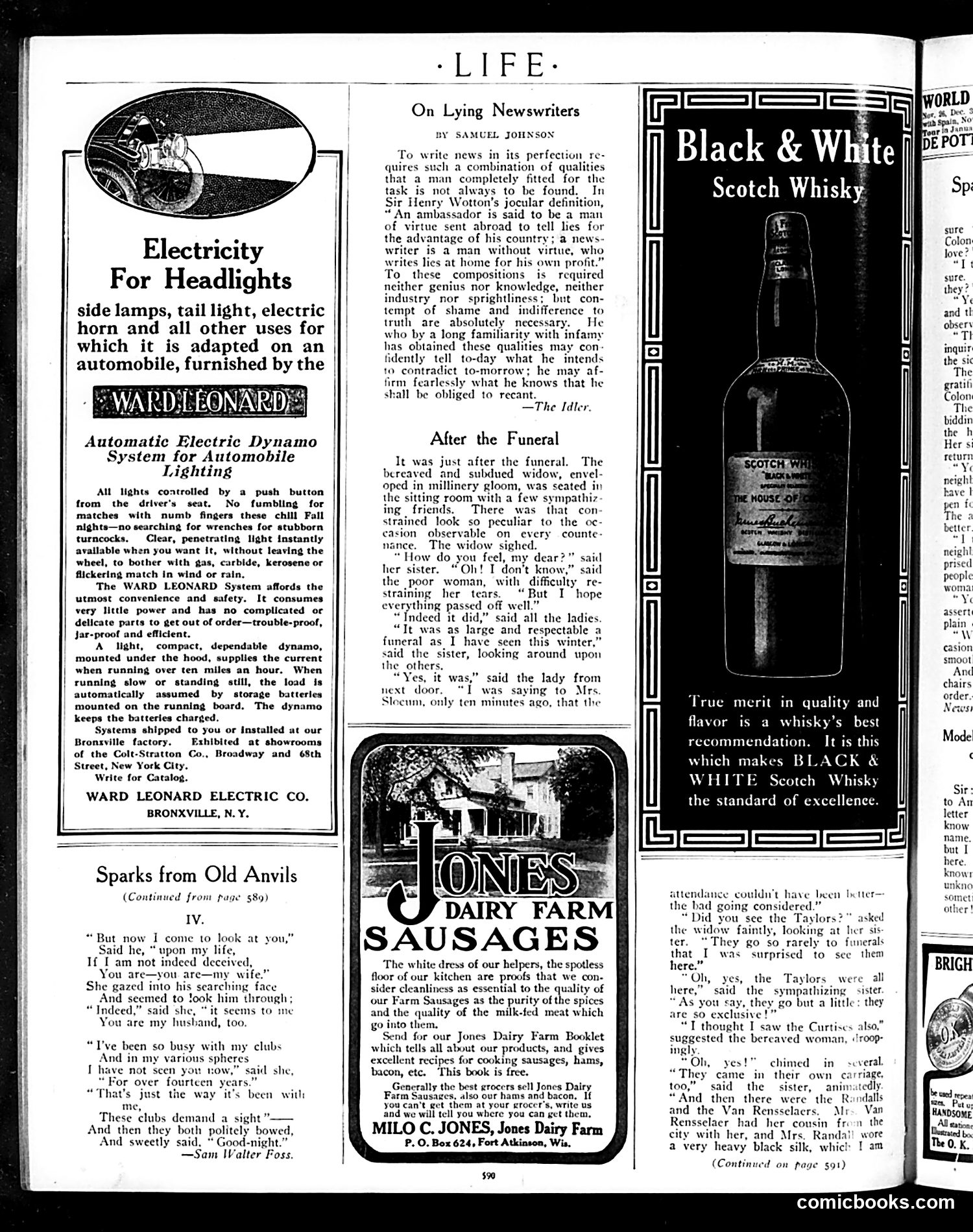
This page mixes advertisements with satirical content typical of *Life* magazine's format. **The Satire:** Samuel Johnson's essay "On Lying Newswriters" attacks journalists who deliberately publish false information for profit, then contradict themselves later without shame. Johnson compares newswriters unfavorably to ambassadors, suggesting they lack even the virtue of official liars. This 18th-century critique remains relevant—it mocks media dishonesty and the public's tolerance of it. **"After the Funeral":** A social satire about superficial mourning etiquette. Bereaved widow and guests discuss the funeral's "respectability" as a social event rather than grieving genuinely. The final poem "Sparks from Old Anvils" humorously depicts a married couple so absorbed in separate pursuits (clubs) they've become strangers, greeting each other like acquaintances. **Advertisements:** Ward Leonard electric automobile lighting systems and Jones Dairy Farm Sausages represent period commerce—early automotive technology and food products emphasizing cleanliness and quality. The page reflects early-20th-century concerns: journalism ethics, social hypocrisy, marital disconnection, and emerging consumer culture.
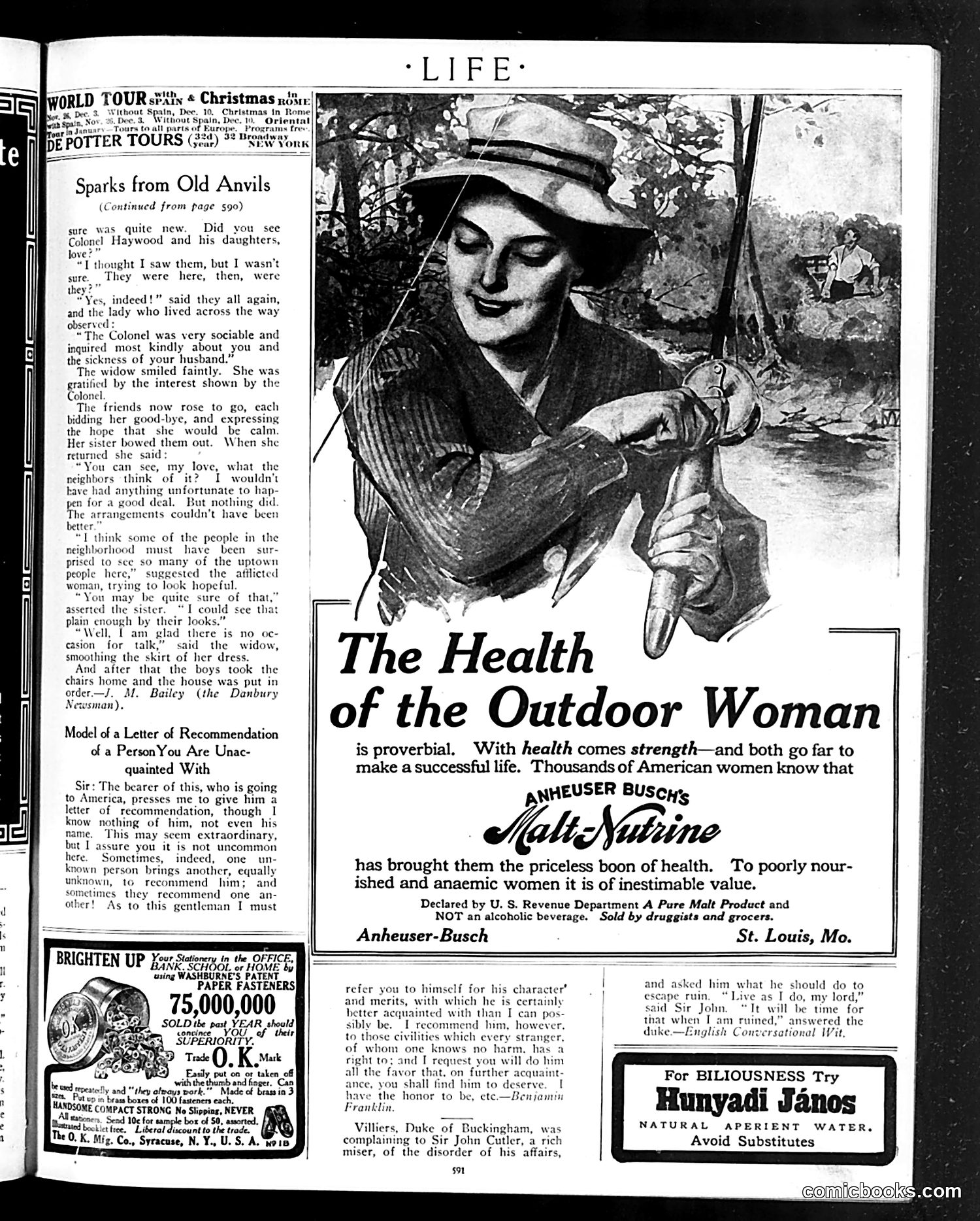
This page contains mostly **period advertisements and literary content**, not political cartoons. The main image shows a woman outdoors with a child, promoting **Anheuser-Busch's Malt-Nutrine**—a malt beverage marketed as health tonic for "poorly nourished and anaemic women." The ad emphasizes that the product was "Declared by U.S. Revenue Department A Pure Malt Product" and "NOT an alcoholic beverage," suggesting contemporaries questioned whether it truly wasn't alcohol. The text includes two sections: "Sparks from Old Anvils" (a continuing story about a widow and neighbors discussing propriety), and "Model of a Letter of Recommendation"—a humorous essay by Benjamin Franklin about recommending someone one knows nothing about, satirizing the hollowness of social recommendation letters. The page reflects **early 20th-century concerns**: gender health, patent medicines, and social etiquette. The Malt-Nutrine ad is particularly notable as vintage advertising that markets a malt product to women as medicine—a common practice before modern drug regulation.
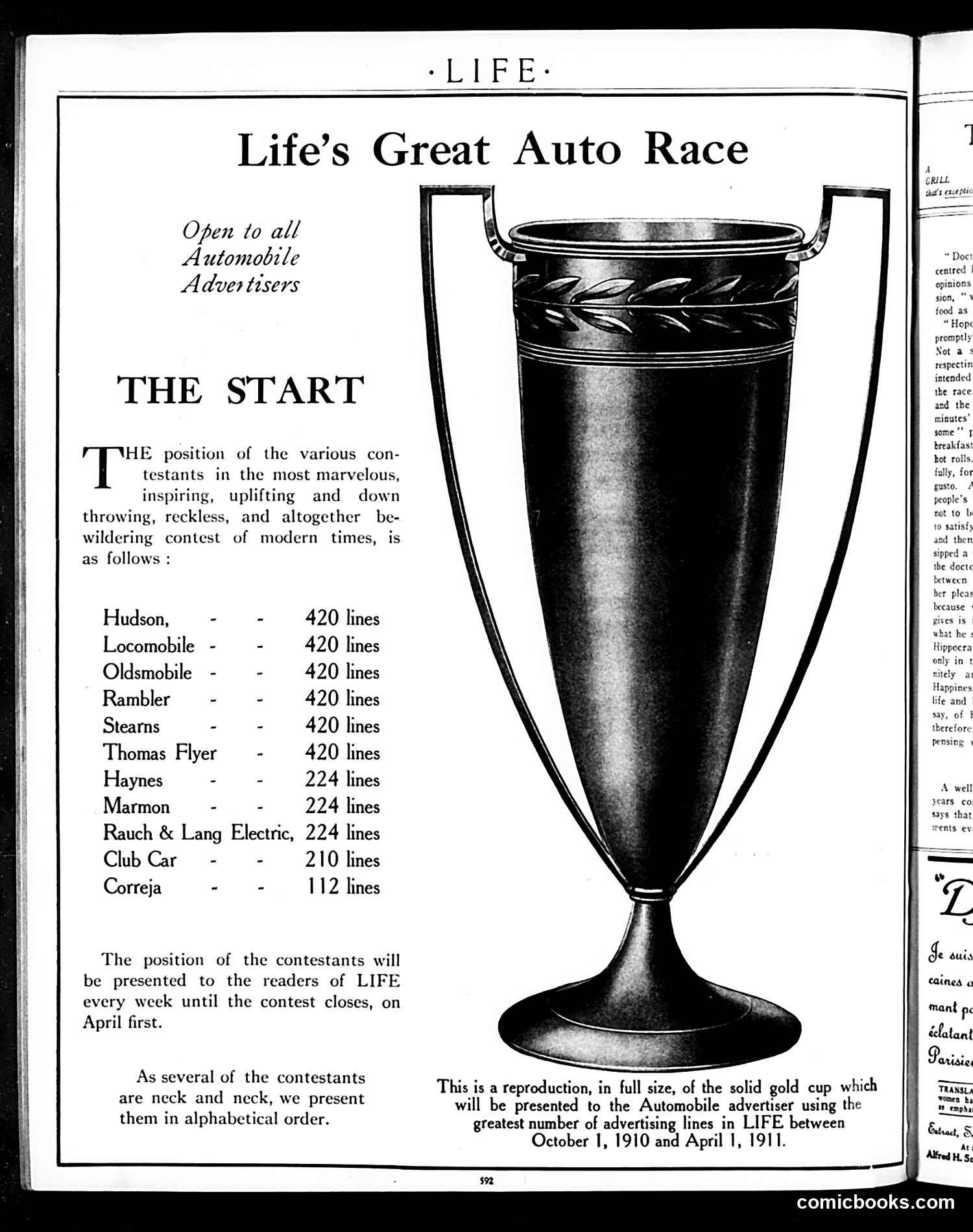
This page satirizes automobile manufacturers' advertising competition in *Life* magazine. Between October 1, 1910 and April 1, 1911, car companies competed to win a solid gold cup by purchasing the most advertising lines in the magazine. The satire lies in treating this commercial contest as a grand "race"—using martial language ("marvelous," "bewildering," "reckless")—while the actual competition is purely about ad spending, not automotive merit. The participating brands (Hudson, Oldsmobile, Rambler, etc.) are ranked by advertising volume rather than vehicle quality or performance. The ornate golden trophy reinforces the mock-heroic tone: companies are literally racing to spend the most money on ads. This gently mocks both the automobile industry's aggressive marketing tactics and the magazine's willingness to profit from intensifying that competition among advertisers.
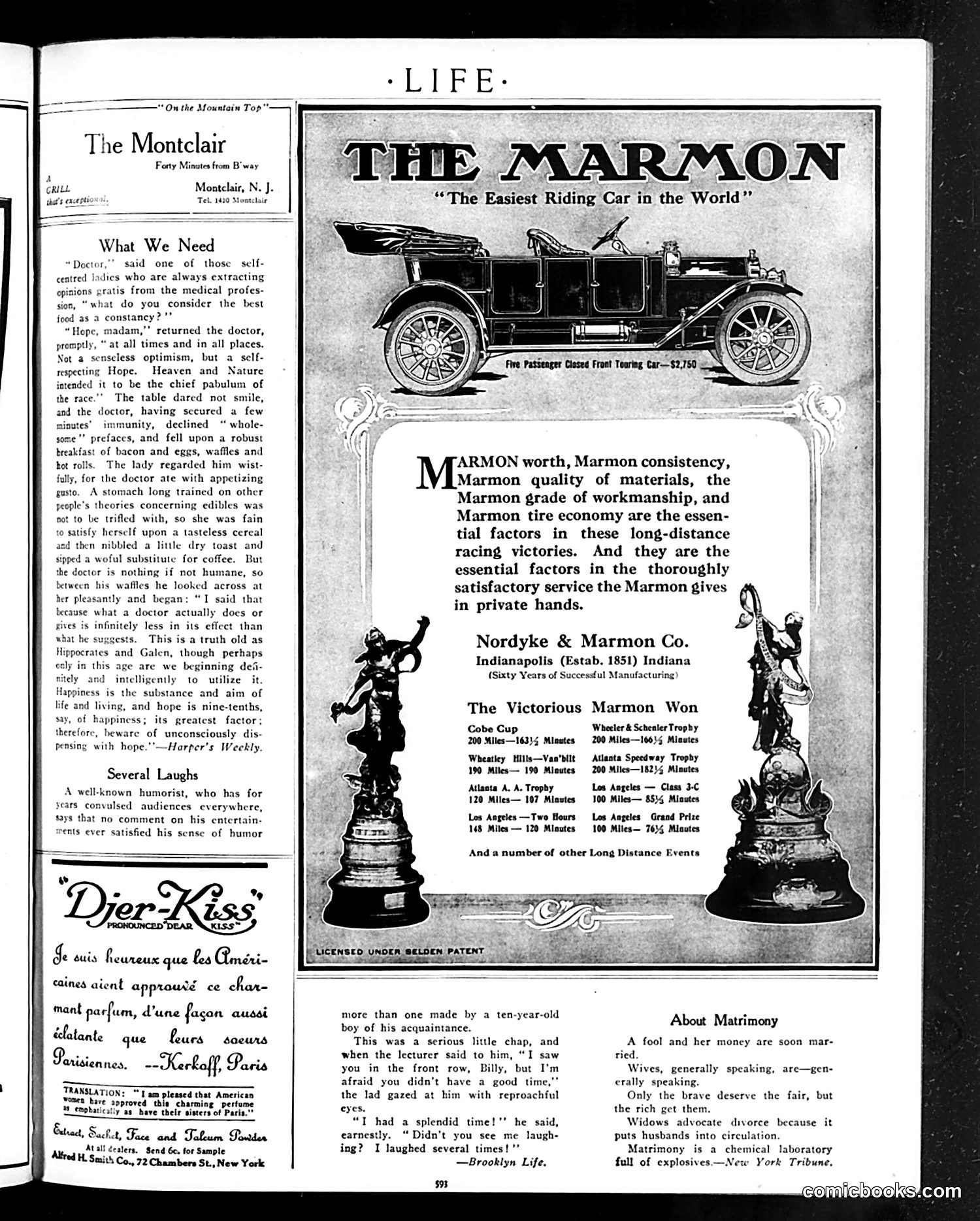
This is primarily an **advertising page** from Life magazine, dominated by a large Marmon automobile ad. The page includes three separate humorous pieces typical of Life's satirical content: 1. **"What We Need"** (left): A dialogue where a self-centered wealthy woman asks a doctor about proper diet. He philosophically recommends "Hope" as life's essential nourishment, then ironically eats heartily while she suffers on bland food—satirizing the gap between idealistic advice and actual behavior. 2. **"Several Laughs"** (bottom left): A brief anecdote about a humorist and a serious boy who laughed at his lecture, illustrating dry humor about expectations versus reality. 3. **"About Matrimony"** (bottom right): A series of cynical one-liners about marriage—poking fun at women's materialism ("A fool and her money are soon married") and gender dynamics. The **Dier-Kiss perfume ad** uses a fake French testimonial, satirizing American women's supposed admiration for Parisian sophistication. The Marmon ad emphasizes racing victories to sell cars—typical early automotive marketing.
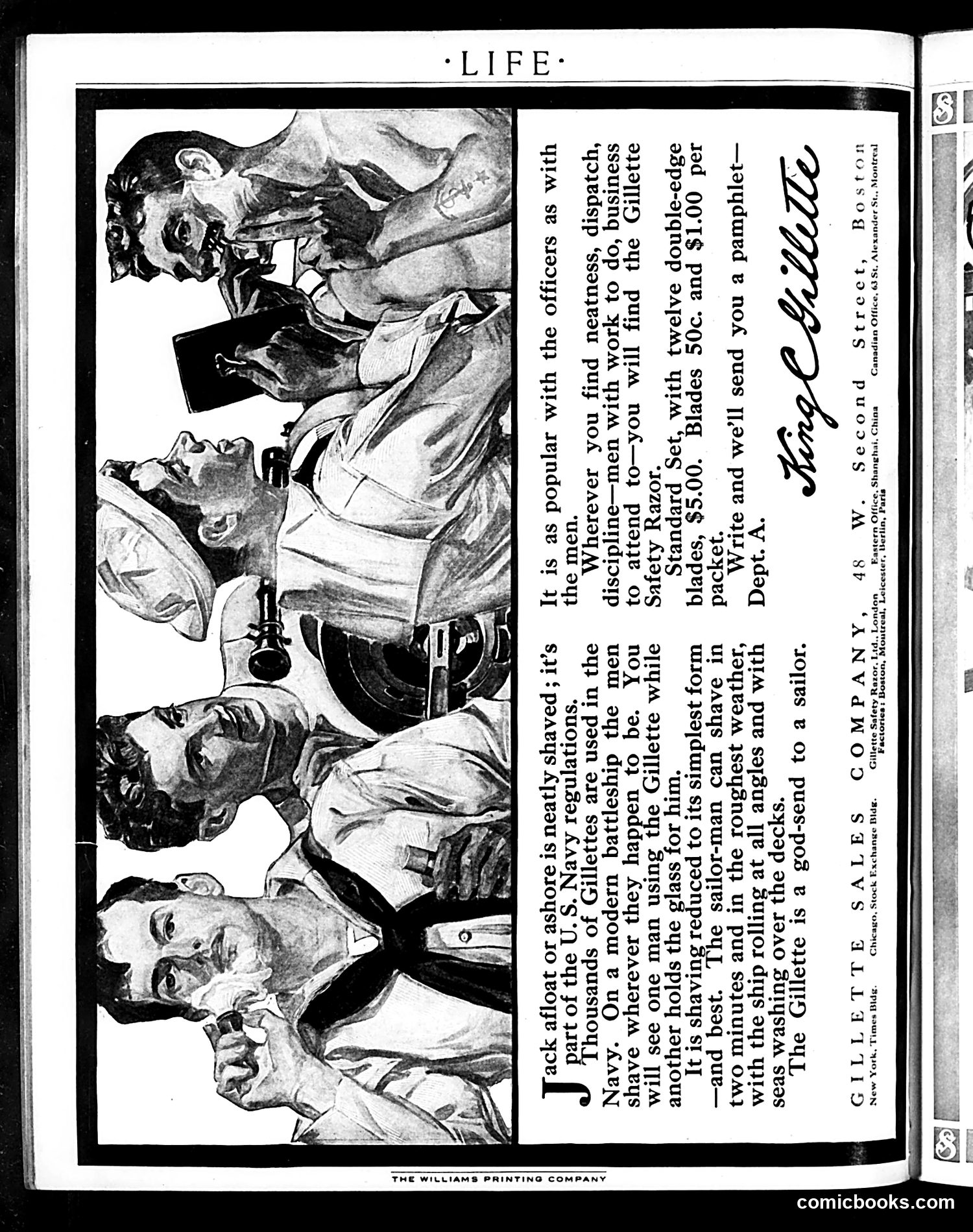
This is a satirical advertisement for "Jack ashore," appearing in Life magazine. The OCR text is largely corrupted and unreadable, but the image shows what appears to be a naval or maritime-themed illustration with multiple male figures in uniform. The ad copy (readable portions) discusses Navy recruitment, mentioning "Jack ashore is as popular with the officers as with the men" and references to "Gillette" safety razors, ship duties, and sailor life. The satire likely plays on romanticized notions of Navy life—contrasting the glamorous shore leave depicted in the illustration with the less glamorous reality of naval service. The advertisement uses humor to appeal to young men considering enlistment by emphasizing leisure activities and product endorsements rather than military discipline. The specific joke or satirical point is difficult to extract fully due to text degradation, but it appears to mock the recruiting industry's tendency to oversell the attractive aspects of military service.
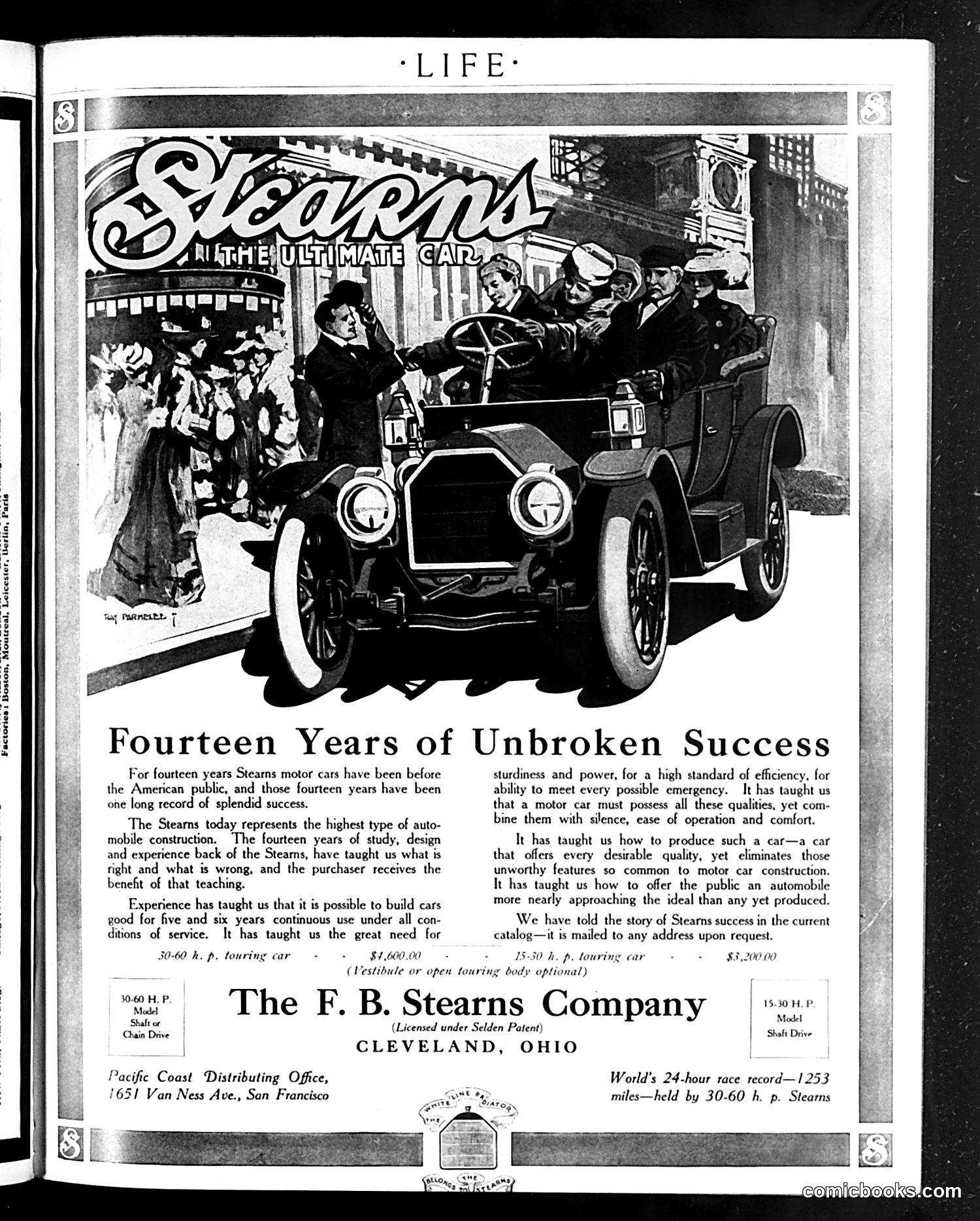
This is **not a cartoon or satire**, but rather a straightforward **automobile advertisement** from Life magazine (likely early 1900s based on vehicle design). The illustration shows a wealthy man and woman in an open-air Stearns motorcar, with admirers watching from a street corner—a common advertising trope depicting automobiles as status symbols. The accompanying text emphasizes 14 years of manufacturing success and claims about quality, reliability, and engineering superiority. The sole "narrative" element is the implicit message: Stearns cars represent the pinnacle of automotive construction, combining power, efficiency, and comfort. The reference to holding "World's 24-hour race record—1253 miles" serves as proof of durability and performance. This is product promotion, not editorial content or satire. Life magazine mixed advertising and editorial material throughout its pages.
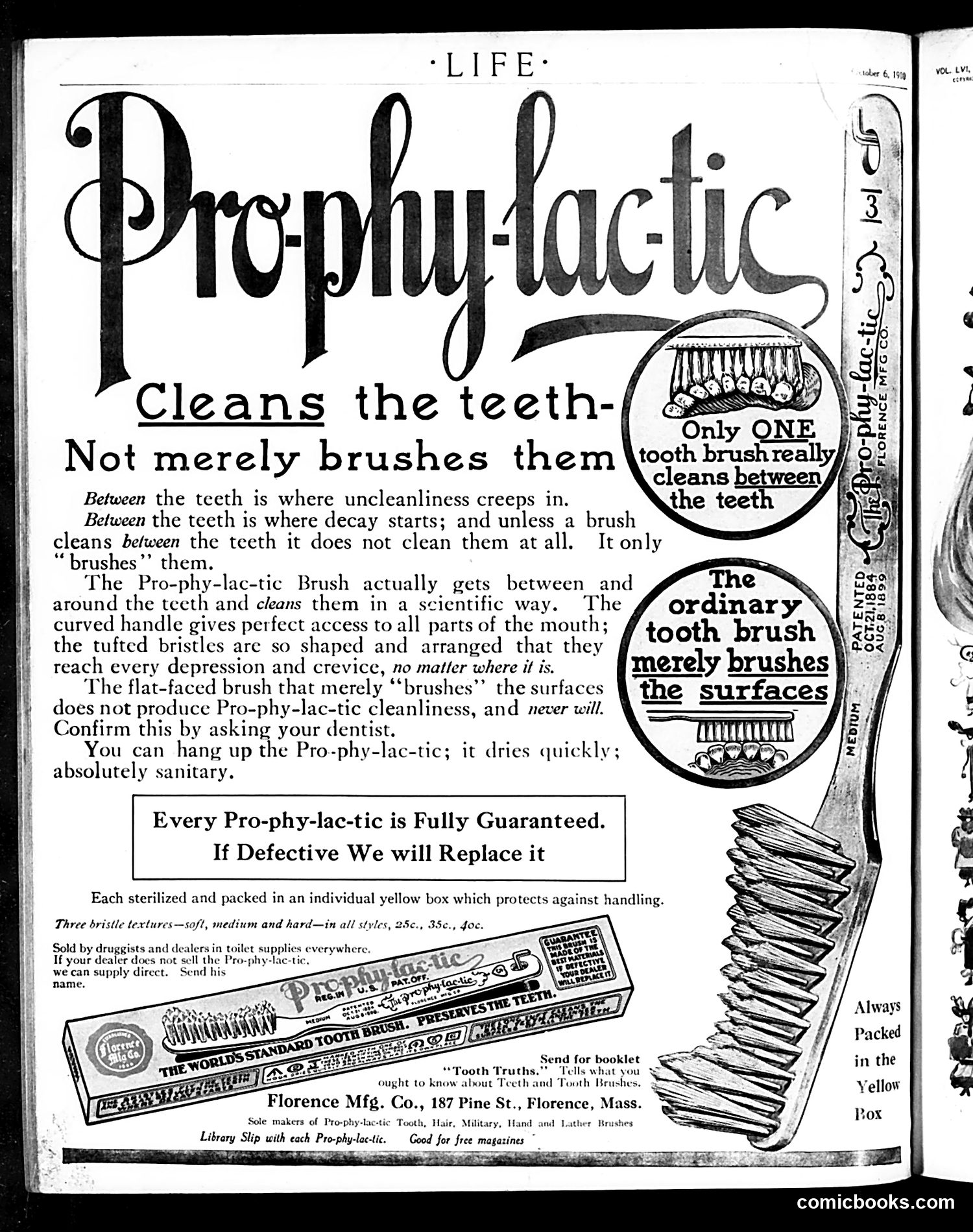
This is a **product advertisement**, not satire or political commentary. The page promotes the "Pro-phy-lactic" toothbrush, manufactured by Florence Mfg. Co. in Massachusetts. The ad uses comparison diagrams to claim superiority over ordinary brushes: the Pro-phy-lactic allegedly reaches *between* teeth through its curved handle and specially-arranged bristles, while regular brushes merely brush surfaces. This addresses a genuine dental concern—interdental cleaning—that wasn't widely understood then. The marketing emphasizes scientific design, sterility (packed in individual yellow boxes), a money-back guarantee, and three bristle options. It closes with an offer for a free "Tooth Truths" booklet to educate consumers about dental hygiene. This reflects early 20th-century advertising's growing emphasis on scientific claims and consumer education to differentiate products in an emerging market.