
Life, 1910-10-06 · page 25 of 60
Life — October 6, 1910 — page 25: what you’re looking at
What you’re looking at
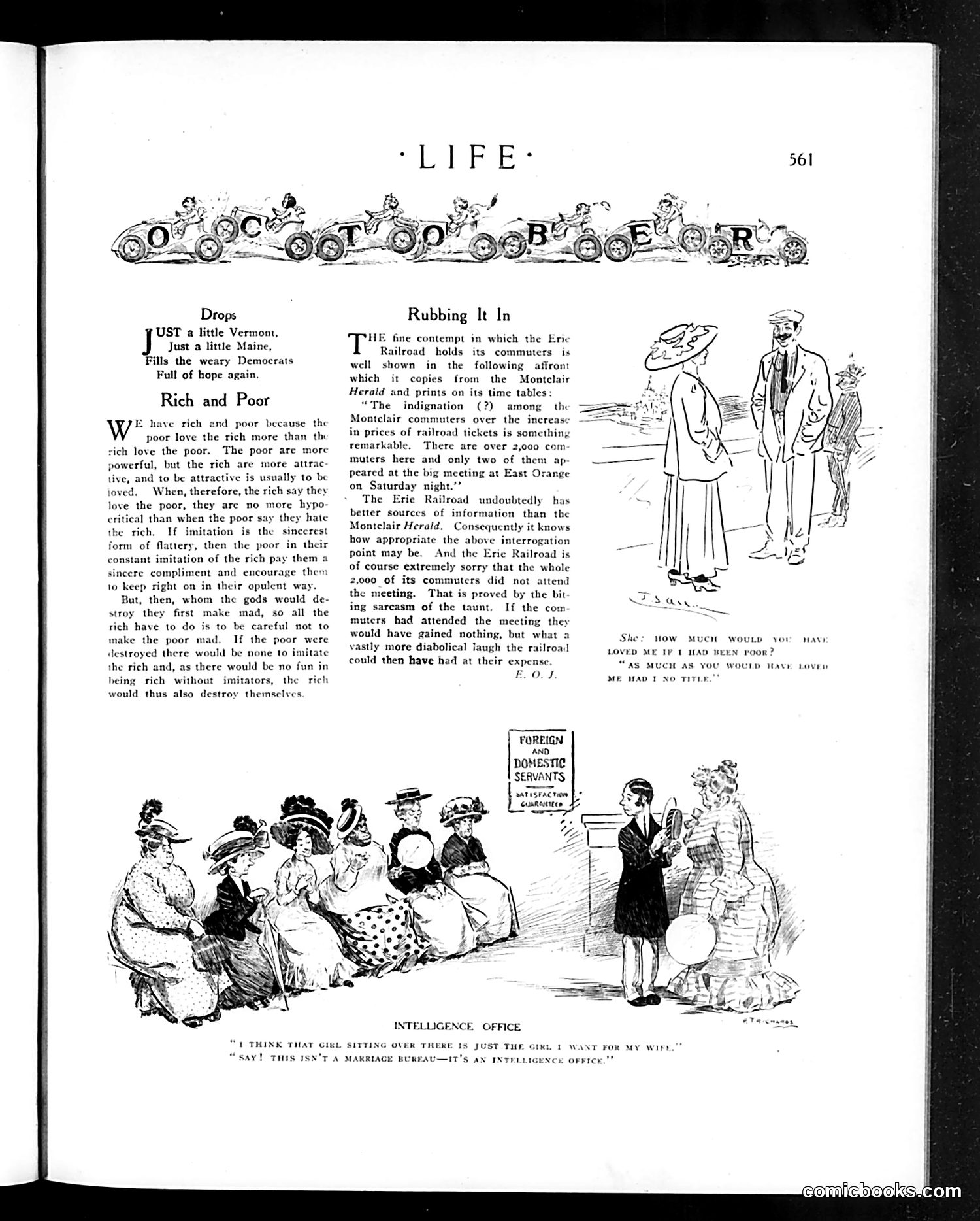
**"Rich and Poor"** essay critiques class dynamics: the poor imitate and admire the rich more than vice versa, yet this dependency paradoxically protects society—if the rich mistreat the poor into revolt, they destroy their own imitators and lose the validation wealth requires. The piece warns the wealthy against making the poor "mad." **"Rubbing It In"** mocks the Erie Railroad's contempt for commuters. The railroad printed a sarcastic interrogation about only 2 of 2,000 Montclair commuters attending a meeting protesting ticket-price increases, clearly designed to humiliate them. **Cartoons:** - Upper right shows a man and woman discussing poverty and titles—satirizing class-conscious marriage prospects. - Lower cartoon depicts an "Intelligence Office" (domestic servant employment agency) where a man mistakes it for a marriage bureau, wanting to "interview" an attractive woman as a potential wife rather than servant—mocking both servant-class exploitation and men's objectification.
📄 Transcribed text from this page (OCR, searchable)
Machine-transcribed from the original scan — historical spelling and the odd misread are preserved.
UST a little Vermont, Just a little Maine, Fills the weary Democrats Full of hope again. Rich and Poor have rich and poor because the W poor love the rich more than the rich love the poor. The poor are more powerful, but the rich are more attrac tive, and to be attractive is usually to be When, therefore, the rich say they the poor, they are no more hypo- al than when the poor say they hate the rich, If imitation is the sincerest form of flattery, then the poor in their constant imitation of the rich pay them sincere compliment and encourage th to keep right on in their opulent way. But, then, whom the gods would de- stroy they first make mad, so all the rich have to do is to be careful not to make the poor mad. If the poor were destroyed there would be none to imitate the rich and, as there would be no fun in heing rich without imitators, the rich would thus also destroy themselves Rubbing It In HE fine contempt in which the Eric Railroad holds its commuters is ell shown in the following affront which it copies from the Montclair Herald and prints on its time tables: “The indignation (?) among the Montclair commuters over the increase in prices of railroad tickets is something remarkable. There are over 2,000 com muters here and only two of them ap- peared at the big meeting at East Orange on Saturday night.”” The Erie Railroad undoubtedly has better sources of information than the Montelair Herald. Consequently it knows how appropriate the above interrogation point may be. And the Erie Railroad is of course extremely sorry that the whole 2,000 of its commuters did not attend the meeting. That is proved by the bit ing sarcasm of the taunt. If the com- muters had attended the mecting they would have gained nothing, but what a vastly more diabolical laugh the railroad could then have had at their expense E.O.4 "OREIGN AND DOMESTIC SERVANTS SATISFACTION GuARetten INTELLIGENCE. OFFICE, a WEAK She: mow atuen wouLp yor nay LOVED ME IP THAD BEEN Poor? “AS MUCH AS YOU WOULD Have Loven ME MAD TNO TITLE.” “1 THINK THAT GIKL SITTING OVER THERE 18 JUST THE GIRL 1 WANT POR MY Wire “Say! THIS ISN'T A MARRIAGE BURPAU—IT'S AN INTELLIGENCE: Orrice