
Life, 1910-10-06 · page 35 of 60
Life — October 6, 1910 — page 35: what you’re looking at
What you’re looking at
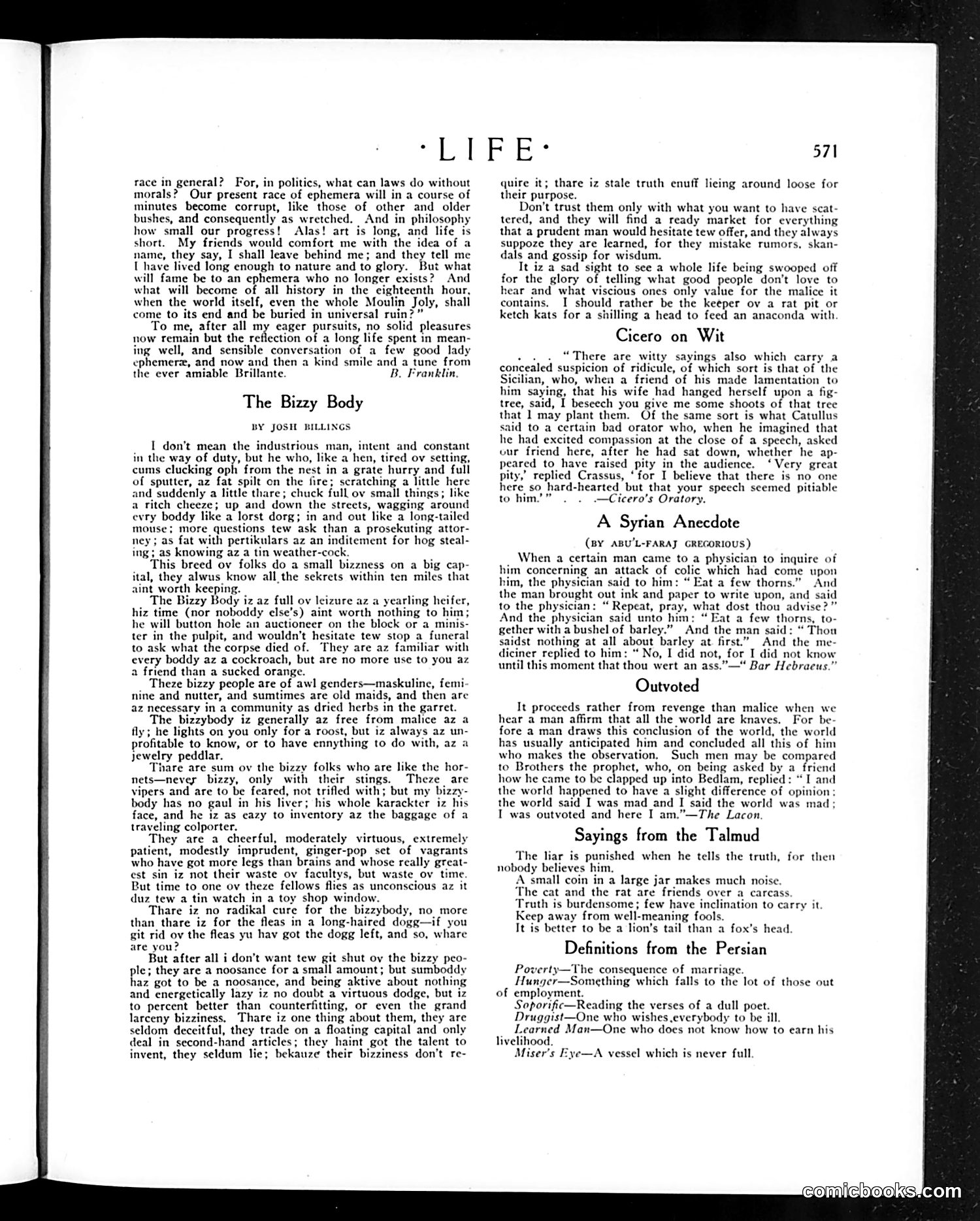
This page contains no political cartoons but rather three separate text pieces: 1. **B. Franklin passage**: A philosophical reflection (likely from Benjamin Franklin's famous "Ephemera" essay) on human ambition and mortality, using the conceit of creatures living only one day. 2. **"The Bizzy Body" by Josh Billings**: A humorous character sketch satirizing busybodies—meddlesome people who waste time and others' time with constant activity and intrusive questions. Written in deliberately misspelled dialect humor (popular 19th-century style), it describes such people as unproductive and irritating as "a sucked orange" or "fleas on a dog." 3. **Brief excerpts** on wit, anecdotes, and definitions—likely filler content. The page is primarily **literary/humorous content**, not visual satire. The "Bizzy Body" piece uses social observation rather than political commentary, mocking a universal human type.
📄 Transcribed text from this page (OCR, searchable)
Machine-transcribed from the original scan — historical spelling and the odd misread are preserved.
“LIFE: 571 race in general? For, in politics, what can laws do without morals? Our present race of ephemera will in a course of minutes become corrupt, like those of other and older bushes, and consequently as wretched. And in philosophy how small our progress! Alas! art long, and life is short. My friends would comfort me with the idea of a name, they say, I shall leave behind me; and they tell me I have lived long enough to nature and to glory. But what will fame be to an ephemera who no longer exists? And what will become of all history in the eighteenth hour, when the world itself, even the whole Moulin Joly, shall come to its end and be buried in universal ruin?” To me, after all my eager pursuits, no solid pleasures now remain but the reflection of a long life spent in mean- ing well, and sensible conversation of a few good lady ephemerz, and now and then a kind smile and a tune from the ever amiable Brillante. B. Franklin. The Bizzy Body BY JOSH BILLINGS 1 don't mean the industrious man, intent and constant in the way of duty, but he who, like a hen, tired ov setting, cums clucking op from the nest in a grate hurry and full of sputter, az fat spilt on the fire; scratching a little here and suddenly a little thare; chuck full ov small things; like a ritch cheeze; up and down the streets, wagging around evry boddy like a lorst dorg; in and out like a long-tailed mouse; more questions tew ask than a prosekuting attor- ney ; as fat with pertikulars az an inditement for hog steal- ing; as knowing az a tin weather-cock. This breed ov folks do a small bizzness on a big cap- ital, they alwus know all the sekrets within ten miles that aint worth keeping. The Bizzy Body iz az full ov leizure az a yearling heifer, hiz time (nor noboddy else’s) aint worth nothing to him; he will button hole an auctioneer on the block or a mi: ter in the pulpit, and wouldn't hesitate tew stop a funeral to ask what the corpse died of. They are az familiar with every boddy az a cockroach, but are no more use to you az a friend than a sucked orange. Theze bizzy people are of awl genders—maskuline, femi. nine and nutter, and sumtimes are old maids, and then are az necessary in a community as dried herbs in the garret. The bizzybody iz generally az free from malice az a fly; _he lights on you only for a roost, but iz always az un- profitable to know, or to have ennything to do with, az a jewelry peddlar. Thare are sum ov the bizzy folks who are like the hor- nets—nevey bizzy, only with their stings. Theze are vipers and are to be feared, not trifled with; but my bizzy body has no gaul in his liver; his whole karackter iz his face, and he iz as cazy to inventory az the baggage of a traveling colporter, They are a cheerful, moderately virtuous, extremely patient, modestly imprudent, ginger-pop set of vagrants who have got more legs than brains and whose really great- est sin iz not their waste ov facultys, but waste ov time. But time to one ov theze fellows flies as unconscious az it duz_tew a tin watch in a toy shop window. Thare iz no radikal cure for the bizzybody, no more than thare iz for the fleas in a long-haired dogg—if you git rid ov the fleas yu hav got the dogg left, and so, whare are you? But after all i don’t want tew git shut oy the bizzy pco- ple; they are a noosance for a small amount; but sumbodd haz got to be a noosance, and being aktive about nothing and energetically lazy iz no doubt a virtuous dodge, but iz to percent better than counterfitting, or even the grand larceny bizziness. Thare iz one thing about them, they are seldom deceitful, they trade on a floating capital and only deal in second-hand articles; they haint got the talent to invent, they seldum lie; bekauze their bizziness don’t re- quire it; thare iz stale truth enuff lieing around loose for their purpose. Don’t trust them only with what you want to have scat- tered, and they will find a ready market for everything that a prudent man would hesitate tew offer, and they always suppoze they are learned, for they mistake rumors, skan- dals and gossip for wisdum. It iz a sad sight to see a whole life being swooped off for the glory of telling what good people don't love to hear and what viscious ones only value for the malice it contains. I should rather be the keeper ov a rat pit or ketch kats for a shilling a head to feed an anaconda with Cicero on Wit +. . “There are witty sayings also which carry a concealed suspicion of ridicule, of which sort is that of the Sicilian, who, when a friend of his made lamentation to him saying, that his wife had hanged herself upon a fig- tree, said, I beseech you give me some shoots of that tree that 1 may plant them. Of the same sort is what Catullus said to a certain bad orator who, when he imagined that he had excited compassion at the close of a speech, asked our friend here, after he had sat down, whether he ap- ared to have raised pity in the audience. ‘Very great pity,’ replied Crassus, ‘for I believe that there is no one here so hard-hearted but that your speech seemed pitiable to him!” -—Cicero’s Oratory. A Syrian Anecdote (BY ABU’L-FARAJ GREGORIOUS) When a certain man came to a physician to inquire of him concerning an attack of colic which had come upon him, the physician said to him: “ Eat a few thorns.” And the man brought out ink and paper to write upon, and said to the phys “ Repeat, pray, what dost thou advise?” And the physician said unto him: “Eat a few tho to- gether with a bushel of barley.” And the man said: “ Thou saidst nothing at all about barley at first.” And the me- diciner replied to him: “ No, I did not, for I did not know until this moment that thou wert an ass.”—“ Bar Hebraeus.” Outvoted It proceeds rather from revenge than malice when we hear a man affirm that all the world are knaves. For be- fore a man draws this conclusion of the world, the world has usually anticipated him and concluded all this of him who makes the observation, Such men may be compared to Brothers the prophet, who, on being asked by a friend how he came to be clapped up into Bedlam, replied: “I and the world happened to have a slight difference of opinion; the world said I was mad and I said the world was mad; I was outvoted and here I am.”—The Lacon. Sayings from the Talmud The liar is punished when he tells the truth, for then nobody believes him. A small coin in a large jar makes much noise. The cat and the rat are friends over a carcass. Truth is burdensome; few have inclination to carry it. Keep away from well-meaning fools. It is better to be a lion’s tail than a fox’s head. Definitions from the Persian Poverty—The consequence of marriage. Hunger—Something which falls to the lot of those out of employment. Soporific—Reading the verses of a dull poet. Druggist—One who wishes everybody to be ill. Learned Man—One who does not know how to earn his livelihood. Miser’s Eye—A vessel which is never full