
Life, 1910-10-06 · page 28 of 60
Life — October 6, 1910 — page 28: what you’re looking at
What you’re looking at
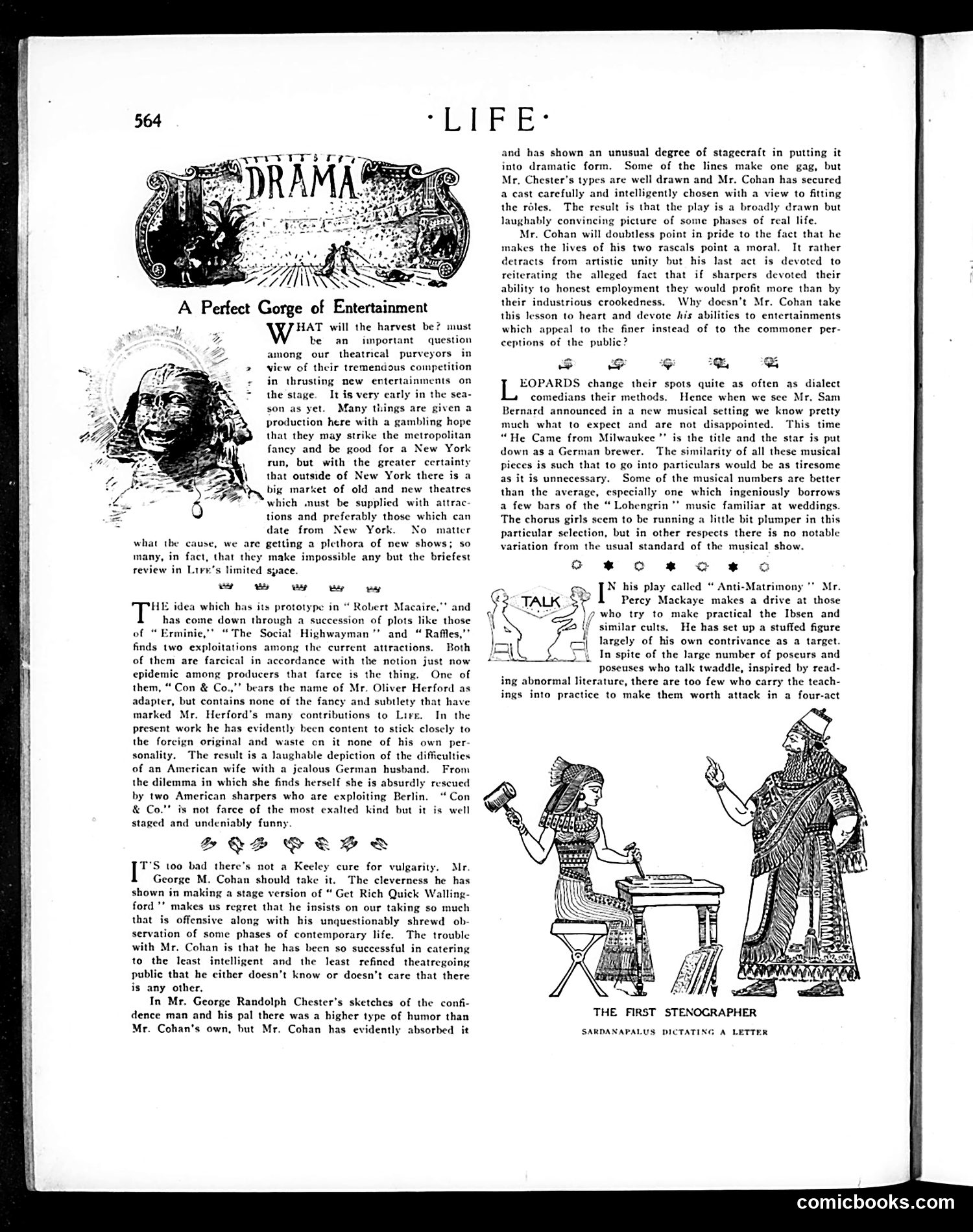
This page reviews current Broadway productions from an early 20th-century perspective. The critic discusses several plays: **"Con & Co."** — A farce adapted by Oliver Herford about an American wife's marital troubles with a jealous German husband, resolved by two American con artists operating in Berlin. The review finds it funny but lightweight. **"Get Rich Quick Wallingford"** — Adapted by George M. Cohan from Chester's confidence-man stories. The critic praises Cohan's stagecraft and casting but *harshly criticizes* his vulgarity and pandering to "the least intelligent and least refined" theatergoers. Though the play morally condemns sharpers, the reviewer sarcastically questions why Cohan doesn't apply his talents to finer entertainment rather than crude material. **"He Came from Milwaukee"** — A musical with Sam Bernard, where the critic expects (and gets) predictable ethnic-dialect comedy. The bottom illustration shows "The First Stenographer"—Barbara's dictating a letter—a historical reference to early office technology.
📄 Transcribed text from this page (OCR, searchable)
Machine-transcribed from the original scan — historical spelling and the odd misread are preserved.
“DPE HAT will the harvest be? must be an important question among our theatrical purveyors in view of their tremendous competition in thrusting new entertainments on the stage. It is very early in the sea- son as yet. Many things are given a production here with a gambling hope that they may strike the metropolitan fancy and be good for a New York , fun, but with the greater certainty that outside of New York there is a Py dig market of old and new theatres which must be supplied with attrac- tions and preferably those which can date from New York. No matter what the cause, we are getting a plethora of new shows; so many, in fact, that they make impossible any but the briefest review in Live's limited space. woe ee HE idea which bas its prototype in “ Robert Macair has come down through a succession of plots lil “The Social Highwayman "’ and “ Rafiles,’’ finds two exploitations among the current attractions. Both of them are farcical in accordance with the notion just now epidemic among producers that farce is the thing. One of them, “ Con & Co.,"’ bears the name of Mr. Oliver Herford as adapter, but contains none of the fancy and subtlety that have marked Mr. Herford’s many contributions to Lire. In the present work he has evidently been content to stick closely to the forcign original and waste on it none of his own per. sonality, The result is a laughable depiction of the difficulties of an American wife with a jealous German husband. From the dilemma in which she finds herself she is absurdly rescued by two American sharpers who are exploiting Berlin. “Con & Co." is not farce of the most exalted kind but it is well staged and undeniably funny BUYS SBS T’S too bad there's not a Keeley cure for vulgarity. Mr. George M. Cohan should take it. The cleverness he has shown in making a stage version of “ Get Rich Quick Walling- ford ’’ makes us regret that he insists on our taking so much that is offensive along with his unquestionably shrewd ob- servation of some phases of contemporary life. The trouble with Mr. Cohan is that he has been so successful in catering to the least intelligent and the least refined theatregoing public that he cither doesn’t know or doesn’t care that there is any other. In Mr. George Randolph Chester's sketches of the confi- dence man and his pal there was a higher type of humor than Mr. Cohan’s own, but Mr. Cohan has evidently absorbed it and has shown an unusual degree of stagecraft in putting it into dramatic form. Some of the lines make one gag, but Mr, Chester's types are well drawn and Mr. Cohan has secured a cast carefully and intelligently chosen with a view to fitting the roles. The result is that the play is a broadly drawn but laughably convincing picture of some phases of real life. Mr. Cohan will doubtless point in pride to the fact that he makes the lives of his two rascals point a moral. It rather detracts from artistic unity but his last act is devoted to reiterating the alleged fact that if sharpers devoted their y to honest employment they would profit more than by industrious crookedness. Why doesn’t Mr. Cohan take this lesson to heart and devote his abilitics to entertainments which appeal to the finer instead of to the commoner per- ceptions of the public? EOPARDS change their spots quite as often as dialect comedians their methods, Hence when we sce Mr, Sam Bernard announced in a new musical setting we know pretty much what to expect and are not disappointed. This time “He Came from Milwaukee ’’ is the title and the star is put down as a German brewer. The similarity of all these musical pieces is such that to go into particulars would be as tiresome as it is unnecessary. Some of the musical numbers are better than the average, especially one which ingeniously borrows a few bars of the “ Lohengrin’ music familiar at weddings. The chorus girls scem to be running a little bit plumper in this particular selection, but in other respects there is no notable variation from the usual standard of the musical show. o * OC *# G # 8 N his play called “ Anti-Matrimony " Mr. Percy Mackaye makes a drive at those who try to make practical the Ibsen and similar cults. He has set up a stuffed figure largely of his own contrivance as a target. In spite of the large number of poseurs and poseuses who talk twaddle, inspired by read- ing abnormal literature, there are too few who carry the teach- ings into practice to make them worth attack in a four-act THE FIRST STENOGRAPHER SARDANAPALUS DICTATING A LETTER comicbooks.com