
Life, 1910-10-06 · page 15 of 60
Life — October 6, 1910 — page 15: what you’re looking at
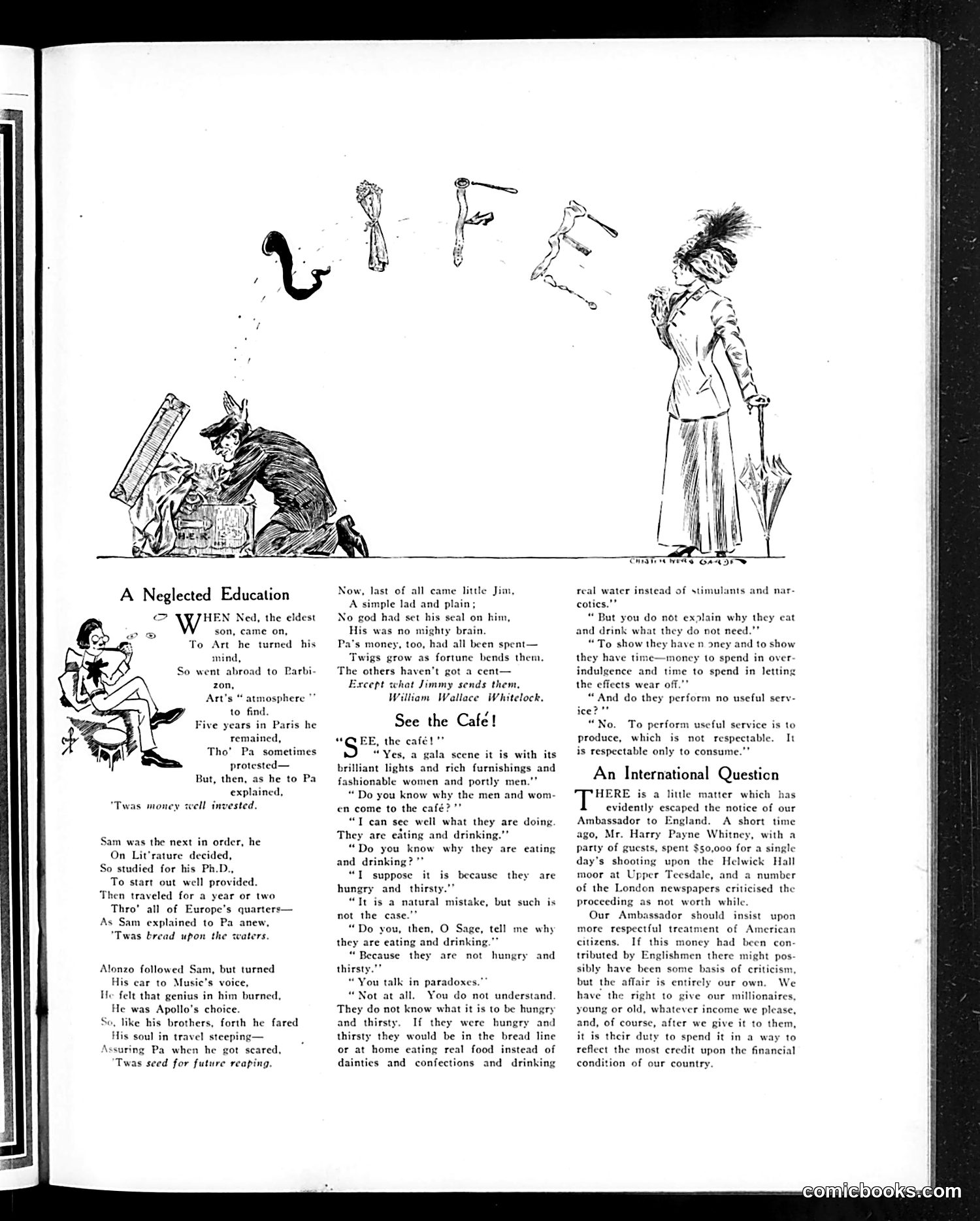
What you’re looking at
**"A Neglected Education"** satirizes the era's wealthy class and their pretensions. Three sons—Ned, Sam, and Alonzo—spend years abroad pursuing art, literature, and music while their father bankrolls their "self-improvement." Each justifies the expense as investment ("bread upon the waters," "seed for future reaping"). The punchline: youngest Jim, "simple" and "plain," stays home and becomes successful enough to support all his brothers. The cartoon mocks the idle rich's faith in impractical European cultivation while ignoring practical productivity. **"See the Café!"** presents a philosophical dialogue mocking wealthy café-goers. The "Sage" argues patrons eat and drink not from hunger but to display wealth and leisure—consumption as status performance rather than necessity. **"An International Question"** defends American millionaire Harry Payne Whitney's extravagant $50,000 shooting party in England against British newspaper criticism. The author argues Americans have the right to spend their wealth however they choose, and doing so actually "reflects credit" on America's financial condition—a tongue-in-cheek defense of conspicuous consumption.
📄 Transcribed text from this page (OCR, searchable)
Machine-transcribed from the original scan — historical spelling and the odd misread are preserved.
A Neglected Education go Ww EN Ned, the eldest son, came on, To Art he turned his mind, So went abroad to Parbi- zon, Art’s “ atmosphere" to find. Five years in Paris he remained, Tho’ P: protested— But, then, as he to Pa =e ‘Twas money well invested. sometimes Sam was the next in order, he On Lit’rature decided, So studied for his Ph.D., To start out well provided. Then traveled for a year or two Thro’ all of Europe's quarters— As Sam explained to Pa anew, ‘Twas bread upon the waters. Alonzo followed Sam, but turned His car to Music's voice, He felt that genius in him burned, He was Apollo's choice. So, like his brothers, forth he fared His soul in travel steeping — Assuring Pa when he got scared, Twas seed for future reaping, Now, last of all came little Jim, A simple lad and plain; No god had set his seal on him, His was no mighty brain. Pa’s money, too, had all been spent— Twigs grow as fortune bends them. The others haven't got a cent— Except what Jimmy sends them, William Wallace Whitelock. See the Café! “ S the café!" “Yes, a gala with its brilliant lights and rich furnishings and fashionable women and portly men."” “Do you know why the men and wom- en come to the café?" “T can see well what they are doing They are eating and drinking.’ “Do you know why they are eating and drinking?” “I suppose it is because they are hungry and thirsty. “It is a natural mistake, but such is not the case."” “Do you, then, O Sage, tell me why they are eating and drinking.”” “Because they are not hungry and thirsty.” “You talk in paradoxes.”" Not at all. You do not understand. They do not know what it is to be hungry and thirsty. If they were hungry and thirsty they would be in the bread line or at home eating real food instead of dainties and confections and drinking THT NERD GAA SEO real water instead of stimulants and nar cotics."” “ But you do not exlain why they eat and drink what they do not need. “To show they have n oney and to show they have time—moncy to spend in over indulgence and time to spend in letting the effects wear off.”” “ And do they perform no useful serv- ice?" “No. To perform useful service is to produce, which is not respectable. It is respectable only to consume. An International Question HERE is a little matter which has evidently escaped the notice of our Ambassador to England. A short time ago, Mr. Harry Payne Whitney, with a party of guests, spent $50,000 for a single day’s shooting upon the Helwick Hall moor at Upper Teesdale, and a number of the London newspapers criticised the proceeding as not worth while Our Ambassador should upon more respectful treatment of American citizens. If this money had been con tributed by Englishmen there might pos sibly have been some basis of critici but the affair is entirely our own. We have the right to give our millionaires, young or old, whatever income we please, and, of course, after we give it to them, it is their duty to spend it in a way to reflect the most credit upon the financial condition of our country insist