
Life, 1910-10-06 · page 34 of 60
Life — October 6, 1910 — page 34: what you’re looking at
What you’re looking at
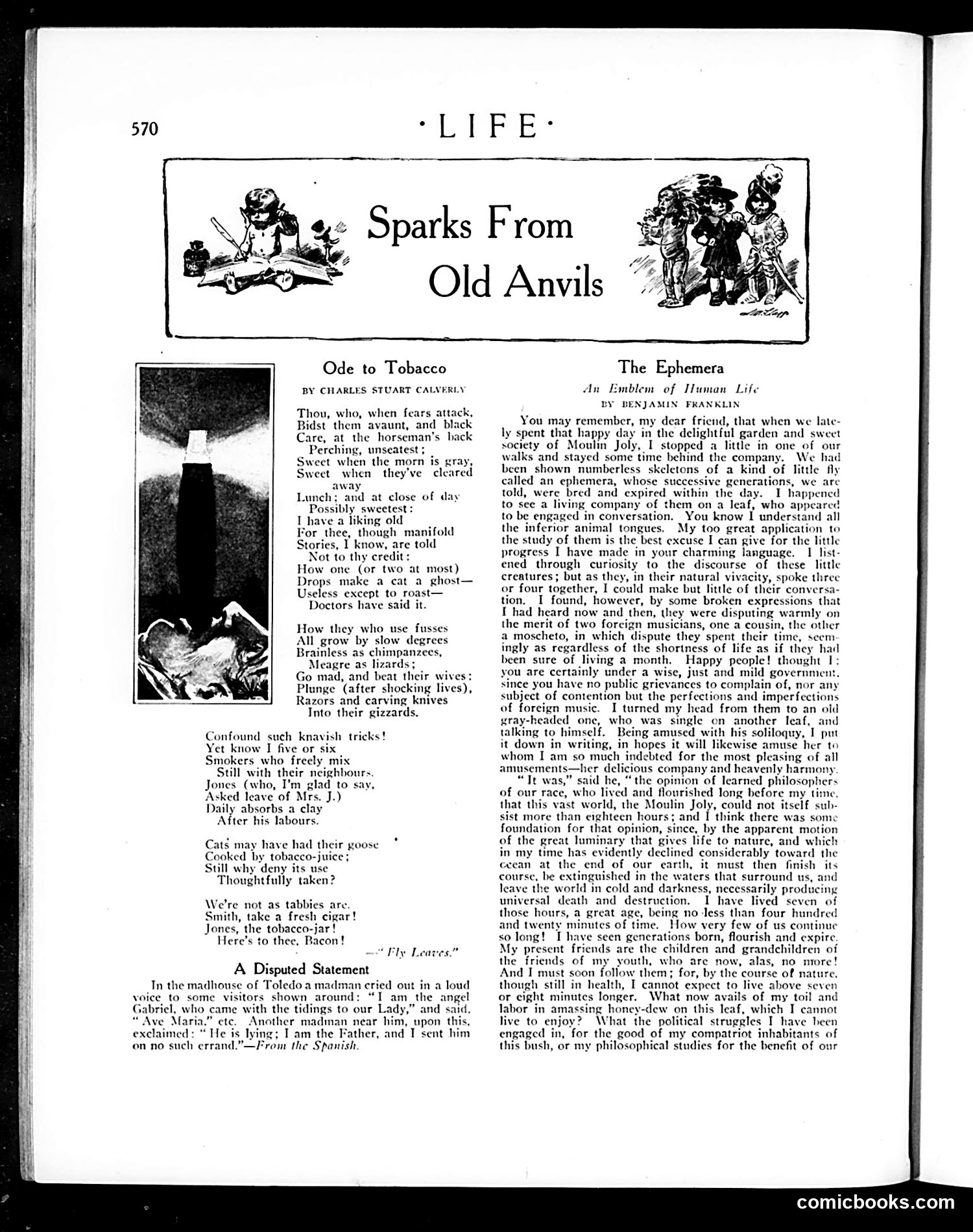
This page contains three distinct literary pieces, not political cartoons: **"Ode to Tobacco"** by Charles Stuart Calverly satirizes anti-smoking arguments. It humorously defends tobacco against exaggerated health claims circulating in the era—that smoking causes madness, wife-beating, and suicide. The poem mocks these "knavish tricks" of anti-tobacco propagandists while celebrating smoking as a gentleman's pleasure. **"A Disputed Statement"** is a brief anecdote about two madmen in a Toledo asylum, each claiming divine authority, illustrating absurdist humor about competing claims of legitimacy. **"The Ephemera"** by Benjamin Franklin is a philosophical essay presented as a fable. Franklin observes short-lived insects debating foreign musicians, using their brief lifespan as commentary on human priorities—suggesting people blessed with good governance waste time on trivial disputes rather than addressing real grievances. It's social satire about wasted human potential. The page demonstrates *Life* magazine's literary humor focused on social observation rather than visual cartooning.
📄 Transcribed text from this page (OCR, searchable)
Machine-transcribed from the original scan — historical spelling and the odd misread are preserved.
*LIPE* Sparks From Old Anvils Ode to Tobacco BY CHARLES STUART CALVERLY Thou, who, when fears attac’ Bidst them avaunt, and blac! Care, at the horseman’s back Perching, unseatest ; Sweet when the morn is gray, Sweet when they've cleared away Lunch; and at close of day Possibly sweetest: I have a liking old For thee, though manifold Stories, 1 know, are told Not to thy credit: How one (or two at most) s make a cat a ghost— ss except to roast— Doctors have said it. How they who use fusses All grow by slow degrees Brainless as chimpanzees, Meagre as lizards; Go mad, and beat their wives Plunge (after shocking lives), Razors and carving knives Into their gizzards. Confound such knavish tricks! Yet know I five or si Smokers who freel Still with their neighbours Jones (who, I’m glad to say, Asked leave of Mrs. J.) Daily absorbs a clay After his labours. Cat$ may have had their goose * Cooked by tobacco-juice; Still why deny its use Thoughtfully taken? We're not as tabbies are. Smith, take a fresh cigar! Jones, the tobacco-jar! Here's to thee, Bacon! —-* Fly Leaves.” A Disputed Statement In the madhouse of Toledo a madman cried out in a loud ice to some visitors shown around: “TIT am_ the angel briel, who came with the tidings to our Lady,” and said, “Ave Maria.” ete. Another madman near him, upon this, exclaimed: “* He is lying; Iam the Father, and T sent him on no such errand."—From the Spanish The Ephemera imblem of Human Life LY BENJAMIN FRANKLIN You may remember, my dear friend, that when we late- ly spent that happy day in the delightful garden and sweet society of Moulin Joly, I stopped a little in one of our walks and stayed some time behind the company. We had been shown numberless skeletons of a kind of little fly called an ephemera, whose successive generations, we are told, were bred and expired within the day. I happened to sce a living company of them on a leaf, who appeared to be engaged in conversation. You know | understand all the inferior animal tongues. My too great application to the study of them is the best excuse I can give for the little progress I have made in your charming language. I list- ened through curiosity to the discourse of these little creatures; but as they, in their natural vivacity, spoke three or four together, I could make but little of their conversa- tion. I found, however, by some broken expressions that I had heard now and then, they were disputing warmly on the merit of two foreign musicians, one a cousin, the other a moscheto, in which dispute they spent their time, seem: ingly as regard) of the shortness of life as if they had been sure of living a month. Happy people! thought |: you are certainly under a wise, just and mild government. since you have no public grievances to complain of, nor any subject of contention but the perfections and imperfections of foreign music. I turned my head from them to an old xray-headed one, who was single on another leaf, and talking to himself. Being amused with his soliloquy, I put it down in writing, in hopes it will likewise amuse her to whom I am so much indebted for the most pleasing of all amusements—her delicious company and heavenly harmony “Te was,” said he, “the opinion of learned philosophers of our race, who lived and flourished long before my time. that this vast world, the Moulin Joly, could not itself sub- sist more than eighteen hours; and I think there was some foundation for that opinion, since, by the apparent motion of the great luminary that gives life to nature, and which in my time has evidently declined considerably toward the ceean at the end of our earth, it must then finish its course, be extinguished in the waters that surround us, and leave the world in cold and darkness, necessarily producing universal death and destruction. I have lived seven of those hours, a great age, being no-less than four hundred and twenty minutes of time. How very few of us continue so long! I have seen generations born, flourish and expire. My present friends are the children and grandchildren of the friends of my youth, who are now, alas, no more! And I must soon follow them; for, by the course of nature. though still in health, I cannot expect to live above seven or cight minutes longer. What now avails of my toil and labor in amassing honey-dew on this leaf, which I cannot live to enjoy? What the political struggles Ih: heen engaged in, for the good of my compatriot inhabitants of this bush, or my philosophical studies for the benefit of our comicbooks.com