
Life, 1910-10-06 · page 21 of 60
Life — October 6, 1910 — page 21: what you’re looking at
What you’re looking at
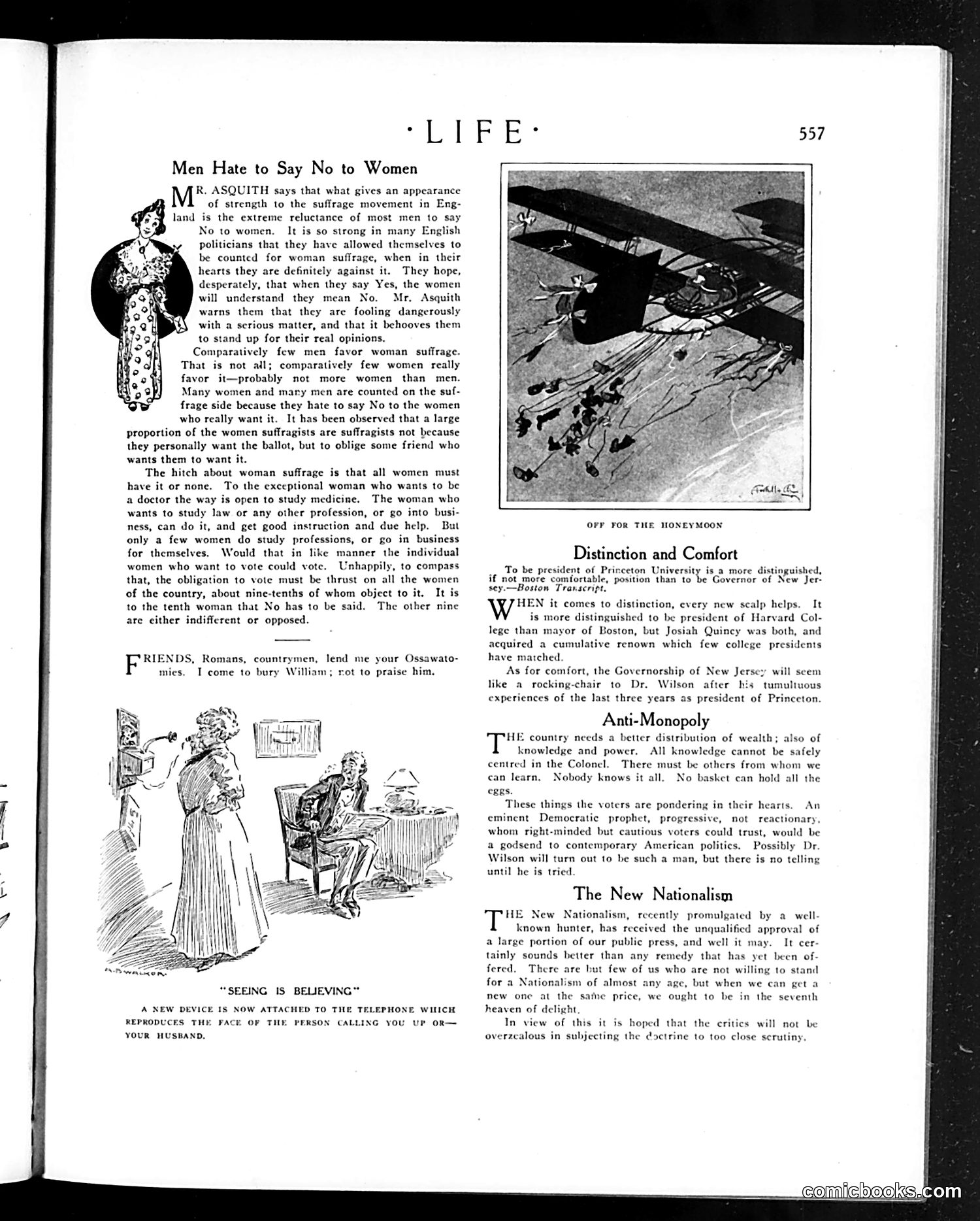
This page contains three satirical pieces: 1. **"Men Hate to Say No to Women"**: An essay by H.R. Asquith (British Prime Minister) critiquing the women's suffrage movement. The text argues that many male politicians publicly support suffrage only because they're reluctant to refuse women directly, despite privately opposing it. Asquith warns this is dangerous dishonesty. The satire suggests male cowardice undermines genuine political debate. 2. **"Seeing is Believing"**: A cartoon mocking a new telephone device that displays callers' faces. The caption humorously suggests husbands might use it to avoid being recognized by their wives—implying infidelity or marital deception. 3. **"Distinction and Comfort"**: Commentary on Woodrow Wilson's transition from Princeton University president to New Jersey governor, suggesting academic prestige differs from political comfort. 4. **"The New Nationalism" & **"Anti-Monopoly"**: Brief political commentary on wealth distribution and Democratic politics, appearing to discuss Theodore Roosevelt's "New Nationalism" platform.
📄 Transcribed text from this page (OCR, searchable)
Machine-transcribed from the original scan — historical spelling and the odd misread are preserved.
“LIPFE* Men Hate to Say No to Women R. ASQUITH says that what gives an appearance of strength to the suffrage movement in Eng- land is the extreme reluctance of most men to say No to women. It is so strong in many English politicians that they have allowed themselves to be counted for woman suffrage, when in their hearts they are definitely against it. They hope, desperately, that when they say Yes, the women will understand they mean No. Mr. Asquith warns them that they are fooling dangerously with a serious matter, and that it behooves them to stand up for their real opinions. Comparatively few men favor woman suffrage. That is not ail; comparatively few women really favor it—probably not more women than men. Many women and mary men are counted on the suf- frage side because they hate to say No to the women who really want it. It has been observed that a large proportion of the women suffragists are suffragists not because they personally want the ballot, but to oblige some friend who wants them to want it. The hitch about woman suffrage is that all women must have it or none. To the exceptional woman who wants to be a doctor the way is open to study medicine. The woman who wants to study law or any other profession, or go into busi- ness, can do it, and get good instruction and due help, But only a few women do study professions, or go in business for themselves. Would that in like manner the individual women who want to vote could vote. Unhappily, to compass that, the obligation to vote must be thrust on all the women of the country, about nine-tenths of whom object to it. It is to the tenth woman that No has to be said. The other nine are either indifferent or opposed. ogoro”, ‘08 20 o go ®, DS, Romans, countrymen, lend me your Ossawato- mies. I come to bury William; rot to praise him. “SEEING IS BELIEVING” A NEW DEVICE IS NOW ATTACHED TO THE TELEPHONE WILICH KEPRODUCES THE FACE OF THE PERSON CALLING YOU UP OR— YOUR HUSBAND, OFP FOR THE HONEYMOON Distinction and Comfort __ To be president of Princeton University is a more distinguished, if not more comfortable, position than to te Governor of New Jer- sey.—Boston Transcript. HEN it comes to distinction, every new scalp helps. It is more distinguished to be president of Harvard Col- lege than mayor of Boston, but Josiah Quincy was both, and acquired a cumulative renown which few college presidents have matched As for comfort, the Governorship of New Jerse will seem like a rocking-chair to Dr. Wilson after his tumultuous experiences of the last three years as president of Princeton. Anti-Monopoly HE country needs a better distribution of wealth; also of knowledge and power. All knowledge cannot be safely centred in the Colonel, There must be others from whom we can learn, Nobody knows it all. No basket can hold all the eggs. These things the voters are pondering in their hearts. An eminent Democratic prophet, progressive, not reactionary, whom right-minded but cautious voters could trust, would be a godsend to contemporary American politics. Possibly Dr Wilson will turn out to be such a man, but there is no telling until he is tried The New Nationalism T" ‘ew Nationalism, recently promulgated by a well known hunter, has received the unqualified approval of a large portion of our public press, and well it may. It cer- tainly sounds better than any remedy that has yet been of- fered. There are hut few of us who are not willing to stand for a Nationalism of almost any age, but when we can get a new one at the sate price, we ought to be in the seventh heaven of delight. In view of this it is hoped that the critics will not be overzealous in subjecting the doctrine to too close scrutiny.