
Life, 1910-10-06 · page 18 of 60
Life — October 6, 1910 — page 18: what you’re looking at
What you’re looking at
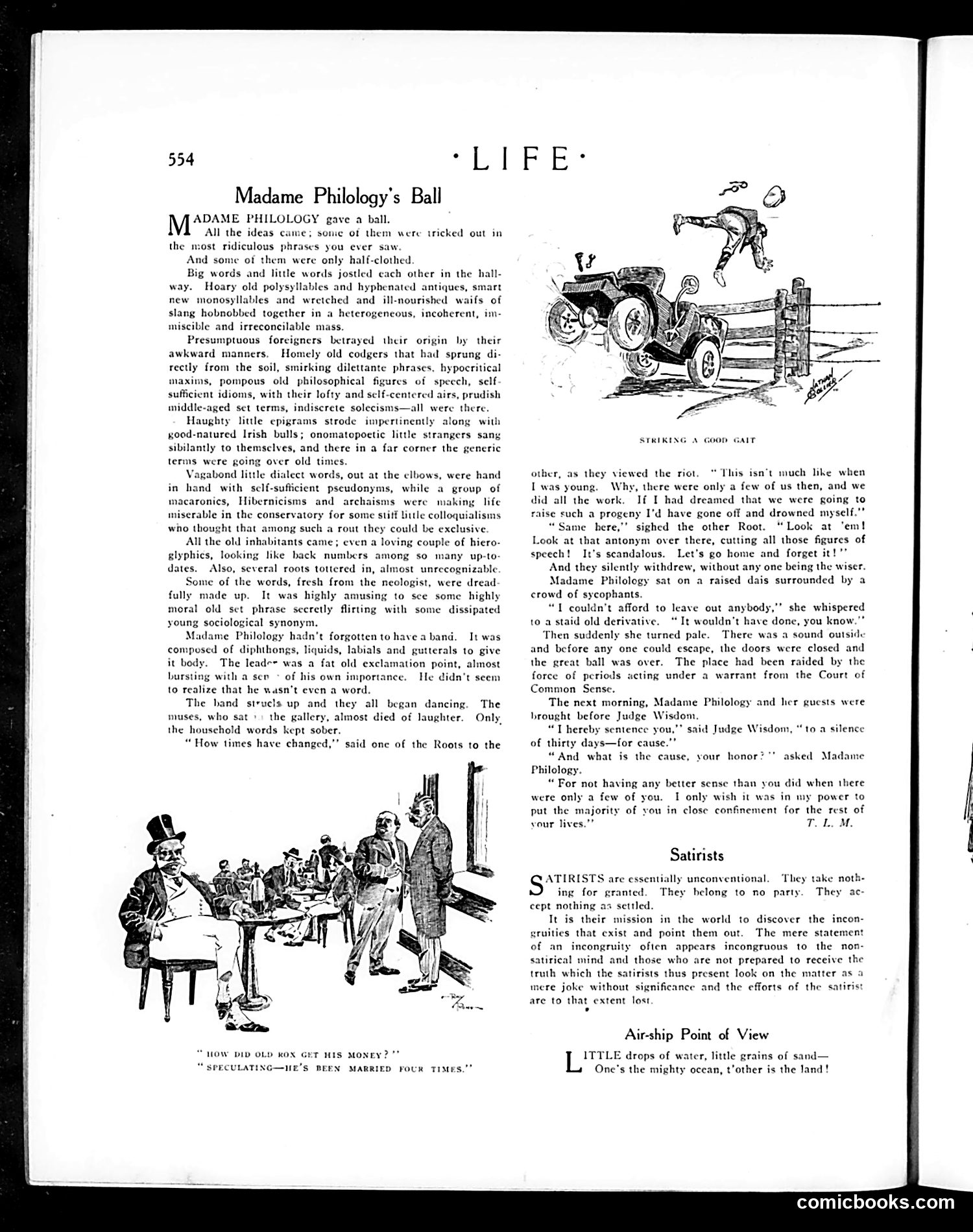
This satirical story personifies language itself as a society hostess throwing a party where different types of words and linguistic elements are guests. The satire mocks the perceived corruption and degradation of language through overuse, pretension, and mixing of styles. The "characters" represent linguistic categories: pompous old polysyllables, trendy new monosyllables, affected foreign borrowings, slang "vagabonds," dialectal words, and affected neologisms all mingle chaotically. The story suggests that language has become a disorderly mess of pretension and affectation. The punchline involves Judge Wisdom raiding the ball and sentencing Madame Philology to thirty days for allowing such linguistic chaos. This reflects early 20th-century anxieties about language "purity" being threatened by slang, Americanisms, and modern coinages—common complaints in genteel publications of the era.
📄 Transcribed text from this page (OCR, searchable)
Machine-transcribed from the original scan — historical spelling and the odd misread are preserved.
554 “LIFE: Madame Philology’s Ball Maras PHILOLOGY gave a ball. All the ideas came; some of them were tricked out in the most ridiculous phrases you ever saw And some of them were only half-clothed Big words and little words jostled cach other in the hall- way. Hoary old polysyllables and hyphenated antiques, smart new monosyllables and wretched and ill-nourished waifs of slang hobnobbed together in a heterogencous, incoherent, im- miscible and irreconcilable mass. Presumptuous foreigners betrayed their origin by their awkward manners, Homely old codgers that had sprung di- rectly from the soil, smirking dilettante phrases, hypocritical mS, pompous old philosophical figures of specch, self sufficient idioms, with their lofty and self-centered airs, prudish middle-aged set terms, indiscrete solecisms—all were there. Haughty little epigrams strode impertinently along with good-natured Irish bulls; onomatopoetic little strangers sang sibilantly to themselves, and there in a far corner the generic terms were going over old times. Vagabond little dialect words, out at the elbows, were hand in hand with self-sufficient pseudonyms, while a group of macaronics, Hibernicisms and archaisms were making life iserable in the conservatory for some stiff little colloquialisms who thought that among such a rout they could be exclusive All the old inhabitants came; even a loving couple of hiero- glyphics, looking like back numbers among so many up-to dates. Also, several roots tottered in, almost unrecognizable Some of the words, fresh from the neologist, were dread fully made up. It was highly amusing to sce some highly moral old set phrase secretly flirting with some dissipated young sociological synonym. Madame Philology hadn't forgotten to havea band. It was composed of diphthongs, liquids, labials and gutterals to give it body. The leader was a fat old exclamation point, almost bursting with a sev ~ of his own importance. He didn’t seem to realize that he wasn't even a word. The band structs up and they all began dancing. The muses, who sat the gallery, almost died of laughter. Only the houschold words kept sober. ° “How times have changed,” said one of the Roots to the HOW DID OLD KOX GET HIS MONEY? SPECULATING—HE’S BEEN MARRIED FOUR TIMES." STRIKING DD GAIT other, as they viewed the riot, “This isn’t much like when Iwas young. Why, there were only a few of us then, and we did all the work. If I had dreamed that we were going to aise such a progeny I’d have gone off and drowned myself."" “Same here,” sighed the other Root. “Look at ‘em! Look at that antonym over there, cutting all those figures of speech! It’s scandalous. Let's go home and forget it!" And they silently withdrew, without any one being the wiser. Madame Philology sat on a raised dais surrounded by a crowd of sycophants. “TL couldn’t afford to leave out anybody,” she whispered to a staid old derivative. “It wouldn’t have done, you know.” ‘Then suddenly she turned pale, There was a sound outside and before any one could escape, the doors were closed and the great ball was over. The place had been raided by the force of periods acting under a warrant from the Court of Common Sense. The next morning, Madame Philology and her guests were brought before Judge Wisdom. “Thereby sentence you,”” said Judge Wisdos of thirty days—for cause.” “And what is the cause, your honor?" asked Madame Philology. “For not having any better sense than you did when there were only a few of you. I only wish it was in my power to put the majority of you in close confinement for the rest of vour lives.” ToL. M. to a silence Satirists ATIRISTS are essentially unconventional. ‘They take noth- ing for granted. They belong to no party. They ac- cept nothing as settled. It is their mission in the world to discover the incon- ities that exist and point them out. The mere statement an incongruity often appears incongruous to the non- mind and those who are not prepared to receive the truth which the satirists thus present look on the matter asa mere joke without significance and the efforts of the satirist are to that extent lost Airship Point of View ITTLE drops of water, little grains of sand— One's the mighty ocean, t’other is the land! comicbooks.com