
Life, 1910-10-06 · page 29 of 60
Life — October 6, 1910 — page 29: what you’re looking at
What you’re looking at
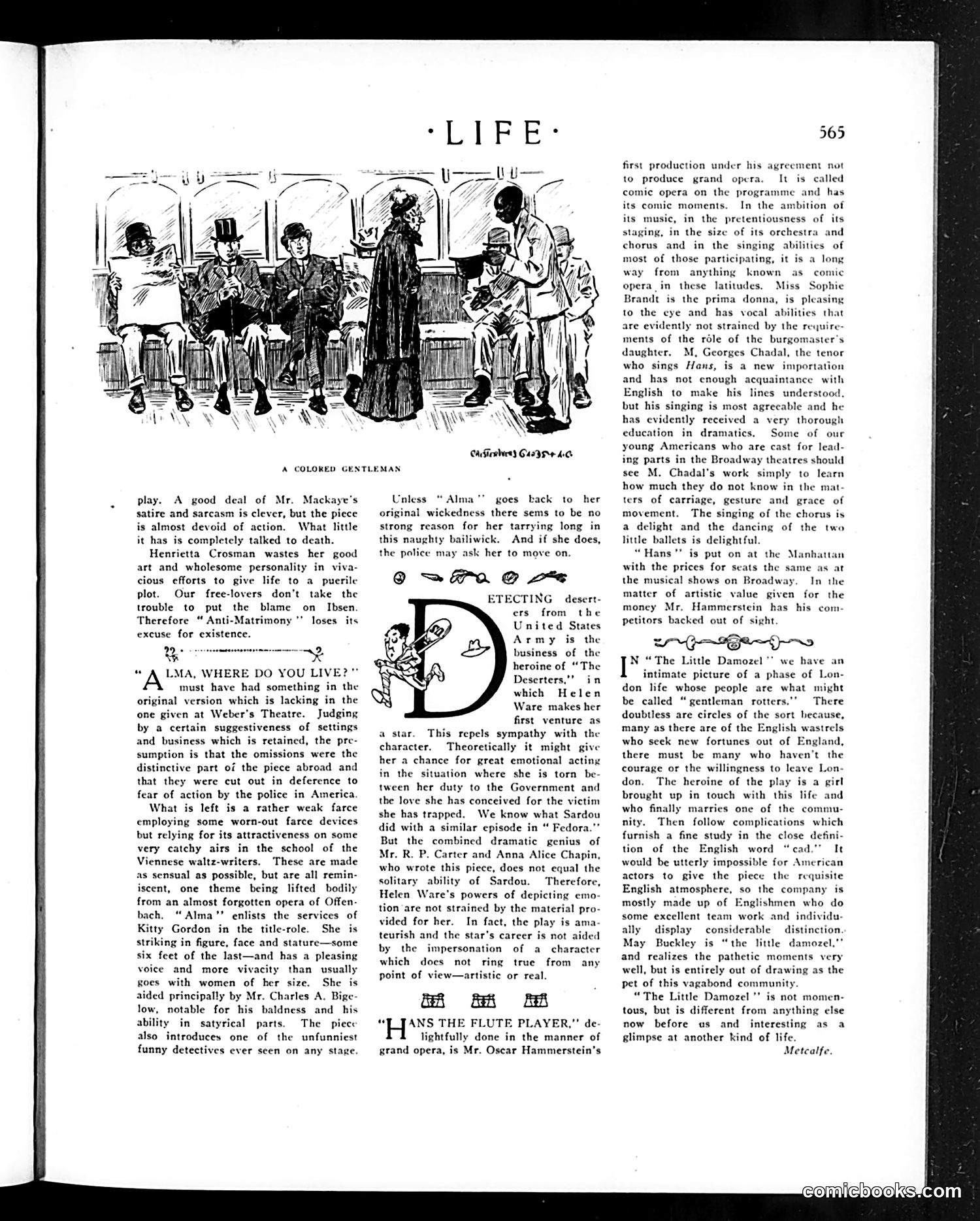
This page contains theater reviews from Life magazine's arts section. The cartoon at top left ("A Colored Gentleman") illustrates one review, showing a man in formal dress seated among well-dressed theatergoers—likely satirizing racial social barriers of the era by depicting an African American in an elite cultural space. The reviews critique contemporary Broadway productions: "Anti-Matrimony" (criticized as talky and weak), "Alma" (a Viennese operetta deemed scandalous, with cuts made for American audiences), "The Deserters" (starring Helen Ware, deemed amateurish despite serious subject matter involving Army desertion), and "Hans the Flute Player" (Hammerstein's "comic opera" with foreign leads whose English is poor but whose singing is praised). The tone is acidly dismissive throughout—typical of Life's satirical theatrical criticism of the period.
📄 Transcribed text from this page (OCR, searchable)
Machine-transcribed from the original scan — historical spelling and the odd misread are preserved.
CASica Worry Cas9Se Ao A COLOKED GENTLEMAN play. A good deal of Mr. Mackaye’s satire and sarcasm is clever, but the piece is almost devoid of action, What little it has is completely talked to death. Henrietta Crosman wastes her good art and wholesome personality in viva- cious efforts to give life to a puerile plot. Our free-lovers don’t take the trouble to put the blame on Ibsen Therefore “ Anti-Matrimony "’ loses its excuse for existence. % x “ LMA, WHERE DO YOU LIVE must have had something in the original version which is lacking in the one given at Weber's Theatre. Judging by a certain suggestiveness of settings and business which is retained, the pre- sumption is that the omissions were the distinctive part of the piece abroad and that they were cut out in deference to fear of action by the police in America. What is left is a rather weak farce employing some worn-out farce devices but relying for its attractiveness on some very catchy airs in the school of the Viennese waltz-writers. These are made as sensual as possible, but are all remin- iscent, one theme being lifted bodily from an almost forgotten opera of Offen- bach, “Alma’’ enlists the services of Kitty Gordon in the title-role. She is striking in figure, face and stature—some six feet of the last—and has a pleasing voice and more vivacity than usually goes with women of her size. She is aided principally by Mr. Charles A. Bi: low, notable for his baldness and his ability in satyrical parts. The piece also introduces one of the unfunniest funny detectives ever seen on any stage. Unless “ Alma" goes back to her original wickedness there sems to be no strong reason for her tarrying long in this naughty bailiwick. And if she does, the police may ask her to move on. o>. Oo 2s ETECTING desert- ers from the United States Army is the business of the heroine of “The Deserters,"’ in which Helen Ware makes her first venture as a star. This repels sympathy with the character. Theoretically it might give her a chance for great emotional acting in the situation where she is torn be- tween her duty to the Government and the love she has conceived for the victim she has trapped. We know what Sardou did with a similar episode in “ Fedora." But the combined drama genius of Mr. R. P. Carter and Anna Alice Chapin, who wrote this piece, does not equal the solitary ability of Sardou. Therefore, Helen Ware's powers of depicting emo- tion are not strained by the material pro- vided for her. In fact, the play is ama- teurish and the star's career is not aided by the impersonation of a character which does not ring true from any point of view—artistic or real. & i A “TLJANS THE FLUTE PLAYER," de- lightfully done in the manner of grand opera, is Mr. Oscar Hammerstein's 565 first production under his agreement not to produce grand opera. It is called comic opera on the programme and has its comic moments. In the ambition of its music, in the pretentiousness of its staging, in the size of its orchestra and chorus and in the singing abilities of most of those participating, it is a long way from anything known as opera in these latitudes. Miss Sophie Brandt is the prima donna, is pleasing to the eye and has vocal abilities that are evidently not strained by the ments of the rdle of the burgomaster’s daughter. M, Georges Chadal, the tenor who sings Hans, is a new importation and has not enough acquaintance with English to make his lines understood. but his singing is most agrecable and he has evidently received a very thorough education in dramatics. Some of our young Americans who are cast for lead- ing parts in the Broadway theatres should see M. Chadal’s work simply to learn how much they do not know in the mat- ters of carriage, gesture and grace of movement. The singing of the chorus is a delight and the dancing of the two little ballets is delightful. “Hans" is put on at the Manhattan with the prices for seats the same as at the musical shows on Broadway. In the matter of artistic value given for the money Mr. Hammerstein has his com- petitors backed out of sight. wy “The Little Damozel"’ we have an intimate picture of a phase of Lon- don life whose people are what might be called “gentleman rotters.’’ There doubtless are circles of the sort because, many as there are of the English wastrels who seek new fortunes out of England, there must be many who haven't the courage or the willingness to leave Lon- don. The heroine of the play is a girl brought up in touch with this life and who finally marries one of the commu- nity. Then follow complications which furnish a fine study in the close defini- tion of the lish word “cad."’ It would be utterly impossible for American actors to give the piece the requisite English atmosphere, so the company is mostly made up of Englishmen who do some excellent team work and individu- ally display considerable distinction May Buckley is “the little damozel."* and realizes the pathetic moments very well, but is entirely out of drawing as the pet of this vagabond community. “The Little Damozel "’ is not momen- tous, but is different from anything else now before us and interesting as a glimpse at another kind of life. Metcalfe. comic aquire-