
Life, 1910-10-06 · page 16 of 60
Life — October 6, 1910 — page 16: what you’re looking at
What you’re looking at
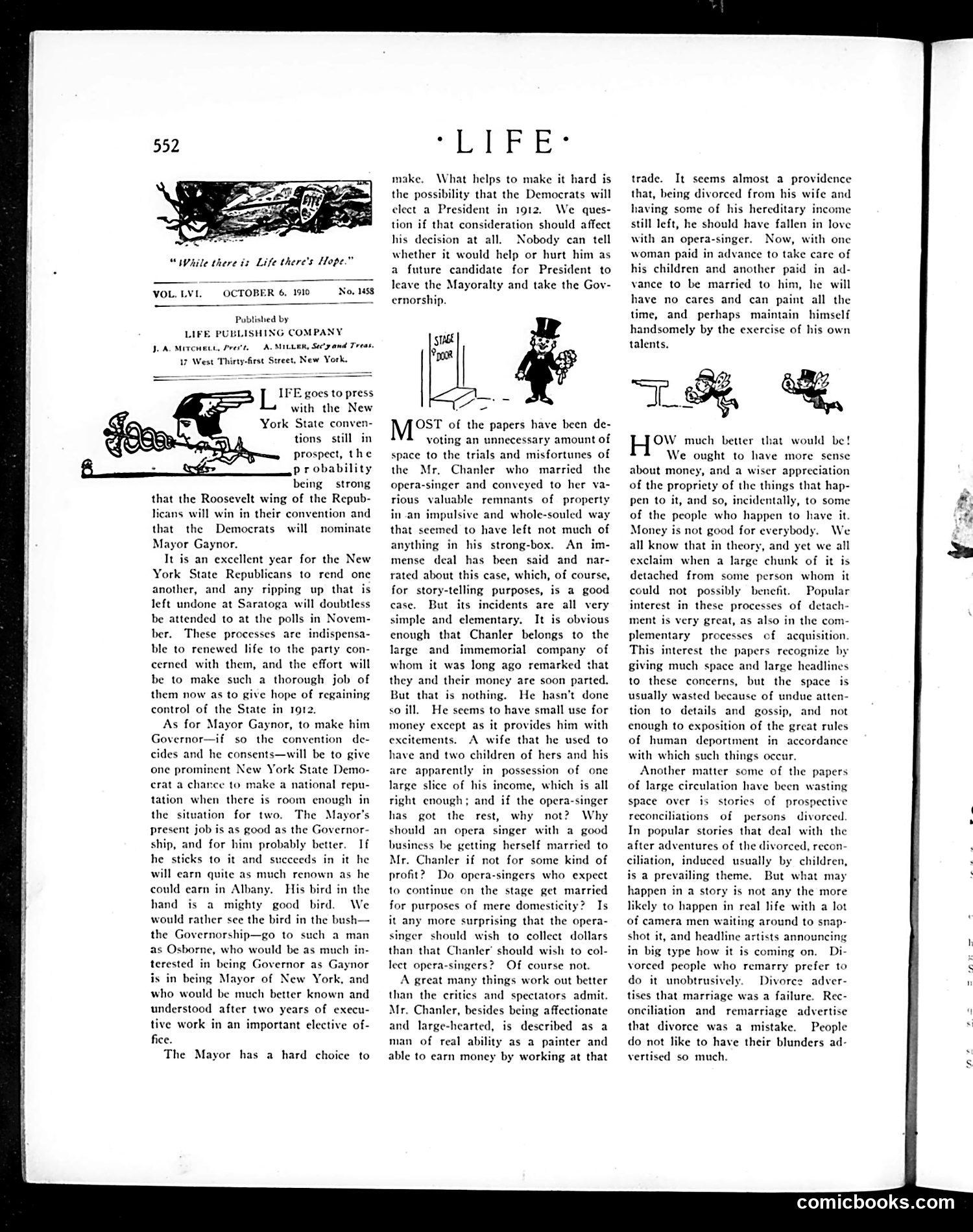
This page discusses New York State politics ahead of the 1912 election. The editorial debates whether Mayor Gaynor should run for Governor, concluding he's better off staying as Mayor—his "bird in the hand"—rather than pursuing higher office. The second section satirizes newspaper coverage of a divorce case involving "Mr. Chanler" (likely referring to the wealthy Chanler family) who married an opera singer and gave her substantial property. Life's writers mock the excessive media attention to this "simple and elementary" story of a rich man parting with his money. They defend both parties pragmatically: the opera singer logically sought financial security through marriage, and Chanler simply enjoys spending money on excitement rather than accumulation. The satire mocks sensationalist journalism more than the principals involved. The small cartoons illustrate these themes with caricatured figures, though specific identities are unclear without additional context.
📄 Transcribed text from this page (OCR, searchable)
Machine-transcribed from the original scan — historical spelling and the odd misread are preserved.
“While there is Life there's Hope.” No, 1458 VOL. L OCTOBER 6. 1910 Published by LIFE PUBLISHING COMPANY JA MITCHELL, Prem AL MILLER, See’y and Treas, 17 West Thirty-first Street, New York, [fees to ncess with the New York State conv: tions still in prospect, the ama ri & ce probability being strong that the Roosevelt wing of the Repub- licans will win in their convention and that the Democrats will nominate Mayor Gaynor. It is an excellent year for the New York State Republicans to rend one another, and any ripping up that is left undone at Saratoga will doubtless be attended to at the polls in Novem- ber. These processes are indispensa- ble to renewed life to the party con- cerned with them, and the effort will be to make such a thorough job of them now as to give hope of regaining control of the State in 1912. As for Mayor Gaynor, to make him Governor—if so the convention de- cides and he consents—will be to give one prominent New York State Demo- crat a chance to make a national repu- tation when there is room enough in the situation for two, The Mayor's present job is as good as the Governor- ship, and for him probably better. If he sticks to it and succeeds in it he will earn quite as much renown as he could earn in Albany. His bird in the hand is a mighty good bird. We would rather see the bird in the bush— the Governorship—go to such a man as Osborne, who would be as much in- terested in being Governor as Gaynor is in being Mayor of New York, and who would be much better known and understood after two years of execu- tive work in an important elective of- fice. The Mayor has a hard choice to “LIF E* make. What helps to make it hard is the possibility that the Democrats will elect a President in 1912. We ques- tion if that consideration should affect his decision at all. Nobody can tell whether it would help or hurt him as a future candidate for President to leave the Mayoralty and take the Gov- ernorship. sust " p00 [oe OST of the papers have been de- voting an unnecessary amount of space to the trials and misfortunes of the Mr, Chanler who married the opera-singer and conveyed to her va- rious valuable remnants of property in.an impulsive and whole-souled way that seemed to have left not much of anything in his strong-box. An im- mense deal has been said and rated about this case, which, of course, for story-telling purposes, is a good case. But its incidents are all very simple and elementary. It is obvious enough that Chanler belongs to the large and immemorial company of whom it was long ago remarked that they and their money are soon parted. But that is nothing. He hasn't done so ill. He seems to have small use for money except as it provides him with excitements. A wife that he used to have and two children of hers and his are apparently in possession of one large slice of his income, which is all right cnough; and if the opera-singer has got the rest, why not? Why should an opera singer with a good business be getting herself married to Mr. Chanler if not for some kind of profit? Do opera-singers who expect to continue on the stage get married for purposes of mere domesticity? Is it any more surprising that the opera- singer should wish to collect dollars than that Chanler’ should wish to col- lect opera-singers? Of course not. A great many things work out better than the critics and spectators admit. Mr. Chanler, besides being affectionate and large-hearted, is described as a man of real ability as a painter and able to carn money by working at that nar- trade. It seems almost a providence that, being divorced from his wife and having some of his hereditary income still left, he should have fallen in love with an opera-singer. Now, with one woman paid in advance to take care of his children and another paid in ad- vance to be married to him, he will have no cares and can paint all the time, and perhaps maintain himself handsomely by the exercise of his own talents. OW much better that would be! We ought to have more sense about money, and a wiser appreciation of the propriety of the things that hap- pen to it, and so, incidentally, to some of the people who happen to have it Money is not good for everybody. We all know that in theory, and yet we all exclaim when a large chunk of it is detached from some person whom it could not possibly benefit. Popular interest in these processes of detach- ment is very great, as also in the com- plementary processes of acquisition. This interest the papers recognize by giving much space and large headlines to these concerns, but the space is usually wasted because of undue atten- tion to details and gossip, and not enough to exposition of the great rules of human deportment in accordance with which such things occur. Another matter some of the papers of large circulation have been wasting space over is stories of prospective reconciliations of persons divorced In popular stories that deal with the after adventures of the divorced, recon- ciliation, induced usually by children, is a prevailing theme. But what may happen in a story is not any the more likely to happen in real life with a lot of camera men waiting around to snap- shot it, and headline artists announcing in big type how it is coming on. Di- vorced people who remarry prefer to do it unobtrusively. Divorces adver- tises that marriage was a failure. Rec- onciliation and remarriage advertise that divorce was a mistake. People do not like to have their blunders ad- vertised so much. comicbooks.com