
Life, 1910-10-06 · page 36 of 60
Life — October 6, 1910 — page 36: what you’re looking at
What you’re looking at
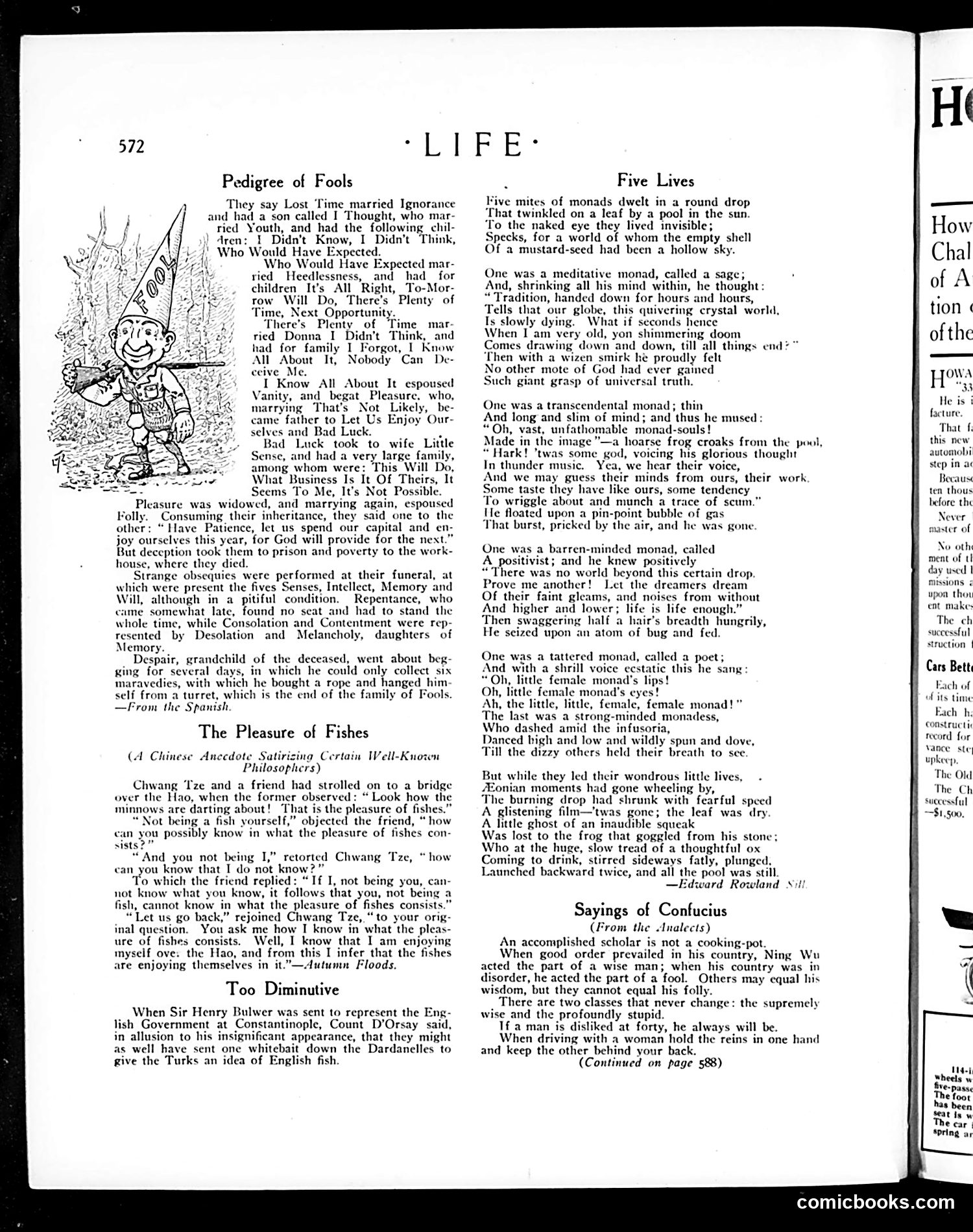
This page contains moral allegories satirizing human folly and poor reasoning. The main cartoon illustrates a Spanish fable tracing foolishness through generations: "Lost Time" marries "Ignorance," producing children like "I Didn't Know" and "Who Would Have Expected." These personified vices intermarry, multiplying flaws until descendants squander inherited wealth, end in poverty and prison, and ultimately lead to suicide. The accompanying pieces — "The Pleasure of Fishes" (a Chinese philosophical dialogue) and "Too Diminutive" (a witty anecdote about diplomat Sir Henry Bulwer) — continue the theme: satirizing people who claim knowledge they cannot possess, and mocking those with pretensions exceeding their actual capacity. The overall message targets self-deception, inherited ignorance, and the human tendency toward unexamined assumptions — perennial subjects of satirical magazines.
📄 Transcribed text from this page (OCR, searchable)
Machine-transcribed from the original scan — historical spelling and the odd misread are preserved.
“LIF E* Pedigree of Fools They say Lost Time married Ignorance and had a son called I Thought, who mar- ried Youth, and had the following chil- )} dren: 1 Didn’t Know, I Didn't Think, ' Who Would Have Expected. i Who Would Have Expected mar- ried Heedlessness, and had_ for children It’s All| Right, To-Mor- Will Do, There’s Plenty of ere s ime mar- ried Donna I Didn't Think, and had for family 1 Forgot, 1 Know All About It, Nobody Can De- ceive Me. I Know All About It espoused Vanity, and begat Pleasure. marrying That's Not Likel came father to Let Us Enjoy Our- selves and Bad Luck. 7 Bad Luck took to wife Little Sense, and had a very large family, among whom were: This Will Do, What Business Is It Of The Seems To Me, It’s Not Possible. Pleasure was widowed, and marrying again, espoused Consuming their inheritance, they said one to the other: “Have Patience, let_us spend our capital and en- joy ourselves this year, for God will provide for the next.” But deception took them to prison and poverty to the work- house, where they died. . Strange obsequies were performed at their funeral, at which were present the fives Senses, Intellect, Memory and Will, although in a pitiful condition, Repentance, who came somewhat late, found no seat and had to stand the whole time, while Consolation and Contentment were rep- resented by Desolation and Melancholy, daughters of Memory. Despair, grandchild of the deceased, went about be ging for several days, in which he could only collect six maravedies, with which he bought a rope and hanged him self from a turret, which is the end of the family of Fools. —From the Spanish. The Pleasure of Fishes (A Chinese Ancedote Satirizing Certain Well-Known Philosophers) Chwang ‘Tze and a friend had strolled on to a bridge over the Hao, when the former observed: “ Look how th minnows are darting about! That is the pleasure of fishe: “Not being a fish yourself,” objected the friend, “how can you possibly know in what the pleasure of fishes con- sists?” “And you not being I,” retorted Chwang Tze, “how can_you know that I do not know?” . To which the friend replied: “If I, not being you, can- not know what you know, it follows that you, not being a fish, cannot know in what the pleasure of fishes consists.” “Let us go back,” rejoined Chwang Tze, “to your orig- al question. You ask me how I know in what the pleas- ure of fishes consists. Well, I know that I am enjoying myself ove: the Hao, and from this I infer that the fishes are enjoying themselves in it."—Autumn Floods, Too Diminutive When Sir Henry Bulwer was sent to represent the Eng- lish Government at Constantinople, Count D’Orsay said, in allusion to his insignificant appearance, that they might as well have sent one whitebait down the Dardanelles to give the Turks an idea of English fish . Five Lives Vive mites of monads dwelt in a round drop ‘That twinkled on a leaf by a pool in the sun. ‘To the naked eye they lived invisible; Specks, for a world of whom the empty shell Of a mustard-seed had been a hollow sky. One was a meditative monad, called a sage; And, shrinking all his mind within, he thought: “Tradition, handed down for hours and hours, Tells that our globe, this quivering crystal world, Is slowly dying. What if seconds hence When I am very old, yon shimmering doom Comes drawing down and down, till all things end?” Then with a wizen smirk he proudly felt No other mote of God had ever gained Such giant grasp of universal truth. One was a transcendental monad ; thin And long and slim of mind; and thus he mused: “Oh, vast, unfathomable monad-souls! Made in the image "—a hoarse frog croaks from the pool, “Hark! "twas some god, voicing his glorious thought In thunder music. Yea, we hear their voice, And we may guess their minds from ours, their work Some taste they have like ours, some tendency To wriggle about and munch a trace of scum.” He floated upon a pin-point bubble of gas That burst, pricked by the air, and he was gone positivist; and he knew positively “There was no world beyond this certain drop. Prove me another! Let the dreamers dream Of their faint gleams, and noises from without And higher and lower; life is life enough.” Then swaggering half a hair’s breadth hungrily, He seized upon an atom of bug and fed. One was a tattered monad, called a poet; And with a shrill voice ecstatic this he sang: , little female monad’s lips! Oh, little female monad’s ¢ Ah, the little, little, female, female monad!” The last was a strong-minded monadess, Who dashed amid the infusoria, Danced high and low and wildly spun and dove, Till the dizzy others held their breath to see. But while they led their wondrous little lives, Eonian moments had gone wheeling by, The burning drop had shrunk with fearful speed A glistening film—'twas gone; the leaf was dry. A little ghost of an Inaudible squeak Was lost to the frog that goggled from his stone; Who at the huge, slow tread of a thoughtful ox Coming to drink, stirred sideways fatly, plunged, Launched backward twice, and all the pool was still. —Edward Rowland S11! Sayings of Confucius (From the Analects) An accomplished scholar is not a cooking-pot. When good order prevailed in his country, Ning Wu acted the part of a wise man; when his country was in disorder, he acted the part of a fool. Others may equal his wisdom, but they cannot equal his folly. There are two classes that never change: the supremely wise and the profoundly stupid. If a man is disliked at forty, he always will be. When driving with a woman hold the reins in one hand and keep the other behind your back. (Continued on page 588) He — How Chal of A tion « of the HY He is | facture. That f this new automo step in at Because ten thous before the Never master ¢ No oth ment of tl day used | struction | Cars Bett Each constructic ord for vance ste upkeep. The Old The Ch Successfull $1,500. comicbooks.com