
A complete issue · 56 pages · 1909
Life — June 3, 1909
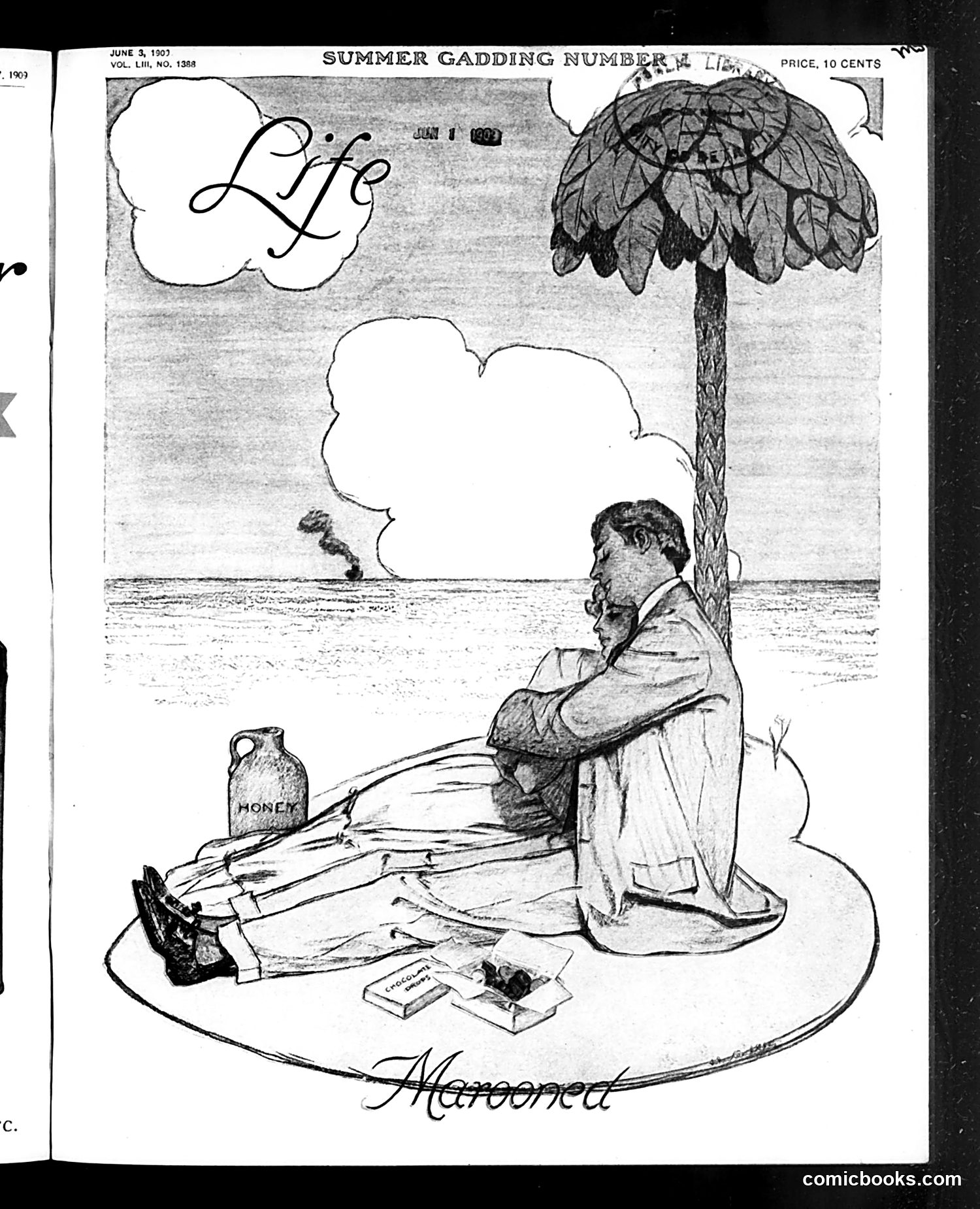
**Date & Context:** June 3, 1902 issue **The Image:** A man sits under a parasol-like umbrella on a beach, reading. He appears marooned or stranded—there's a bottle (marked "HONEY"), matches, and other survival items nearby. A small figure can be seen in the distant water. **The Satire:** The title "Marooned" suggests this depicts someone isolated or abandoned. The honey bottle and basic supplies indicate survival preparations. The beach setting and distant figure suggest either shipwreck or deliberate isolation. **Likely Meaning:** Without additional context from the magazine's text, this appears to satirize either a contemporary news story (possibly involving a shipwreck or stranded person) or a social commentary on isolation/abandonment. The figure's resigned posture under the umbrella suggests acceptance of an unfortunate situation.
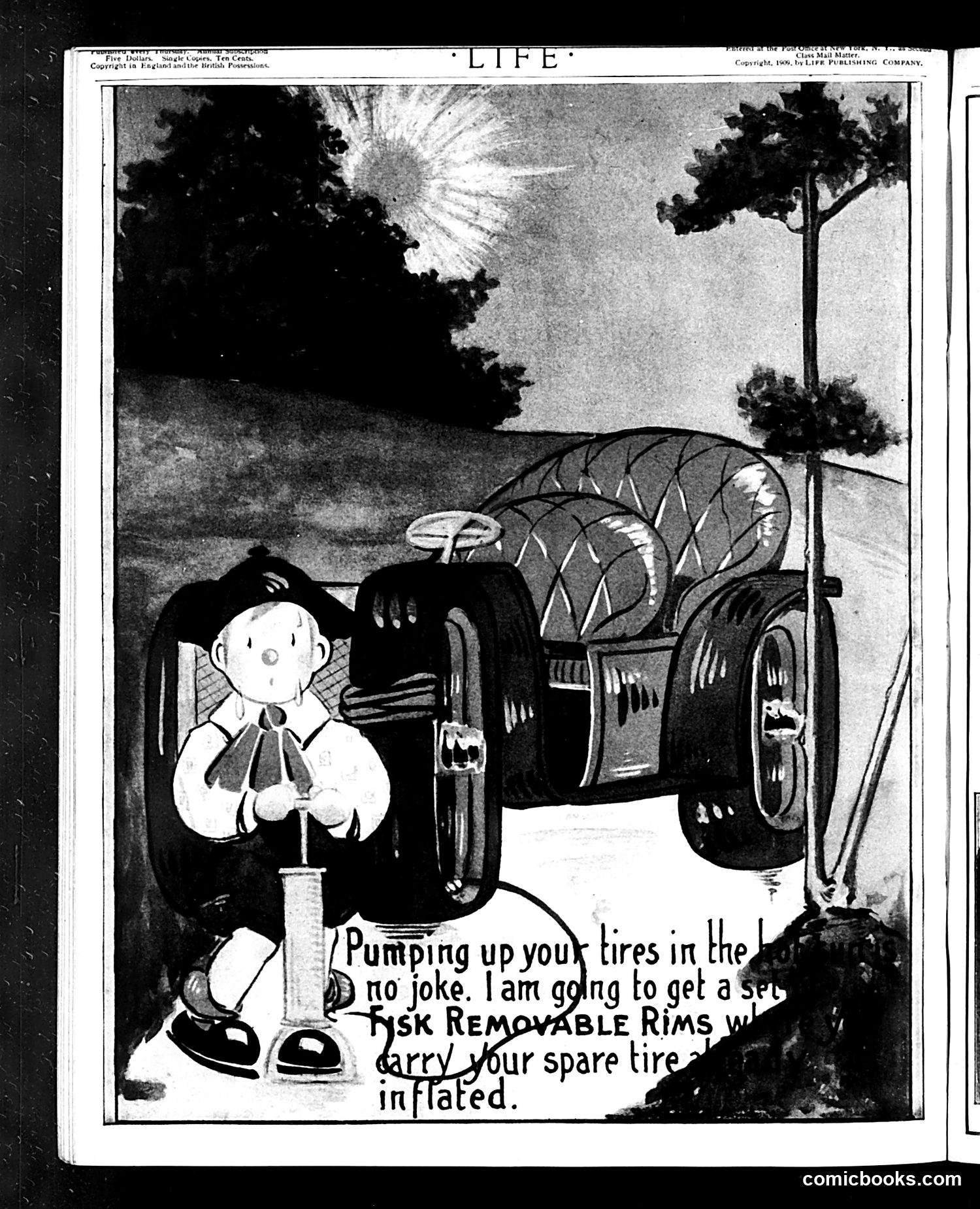
This is an advertisement for Fisk Removable Rims tires, not a political cartoon. It features the Fisk Tire Company's mascot—a rotund, cherubic character in pajamas (the "Fisk Boy")—actively pumping air into a tire. The accompanying text reads: "Pumping up your tires is no joke. I am going to get a set Fisk Removable Rims which carry your spare tire already inflated." The ad's humor relies on the frustration of early automobile owners who frequently had to manually pump up tires. Fisk's removable rim system promised convenience by allowing drivers to swap out pre-inflated spare tires rather than repair flats roadside. The Fisk Boy's determined expression and the contrast between his small size and the large, demanding task emphasizes how burdensome tire maintenance was—and how Fisk's solution offered relief.
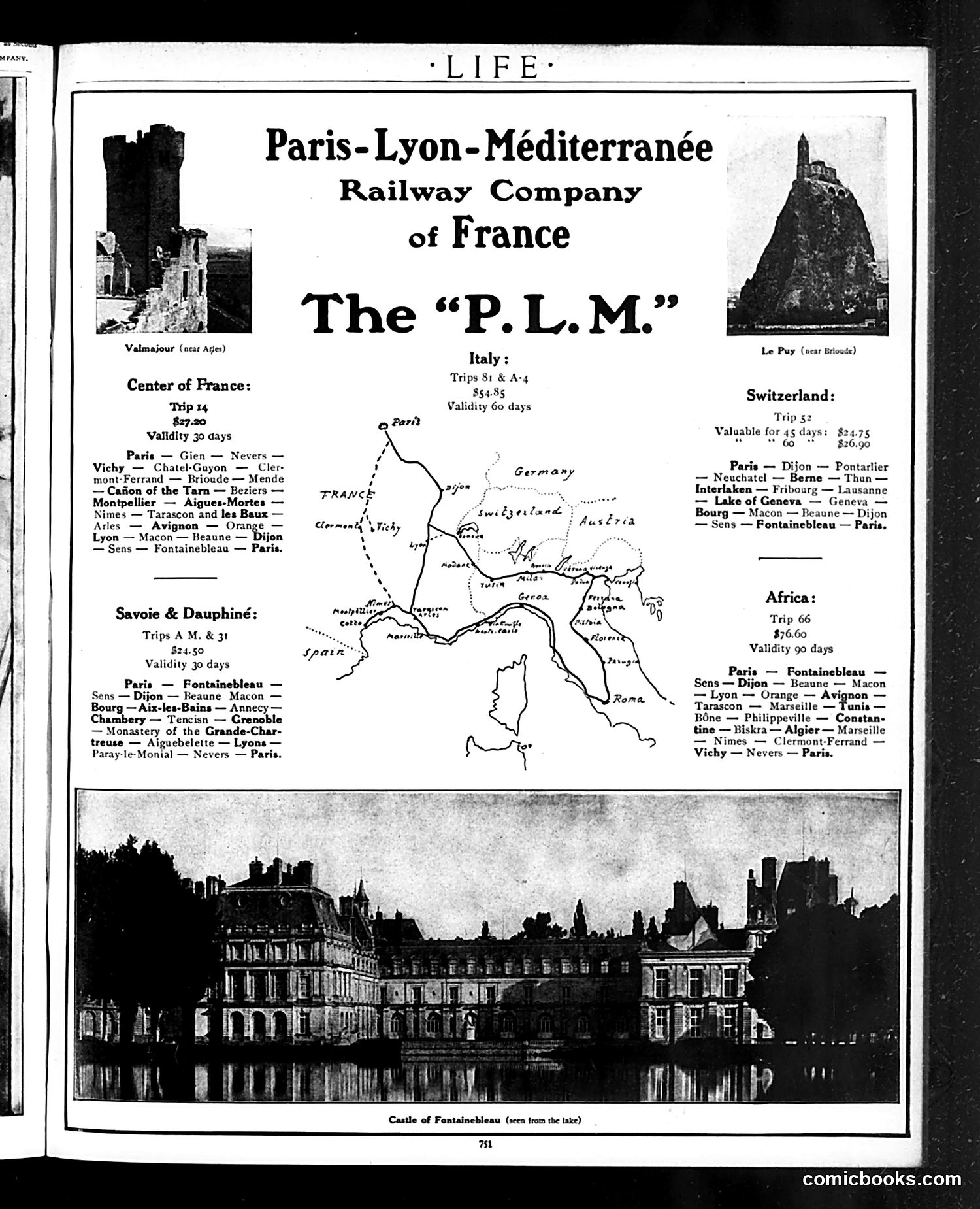
This page is **not a cartoon or satire**—it's a travel advertisement for the Paris-Lyon-Méditerranée (P.L.M.) Railway Company of France, published in *Life* magazine. The advertisement promotes three tourist packages: trips through the Center of France, Savoie & Dauphiné, Italy, Switzerland, and Africa. Each package lists destinations, duration, and cost. The page includes a detailed railway map of France and Switzerland, two architectural photographs (Valmajour tower and Le Puy rock formation), and a scenic image of Fontainebleau Castle. The P.L.M. was a major European rail operator marketing leisure travel to American readers. This represents early 20th-century tourism promotion rather than political commentary.
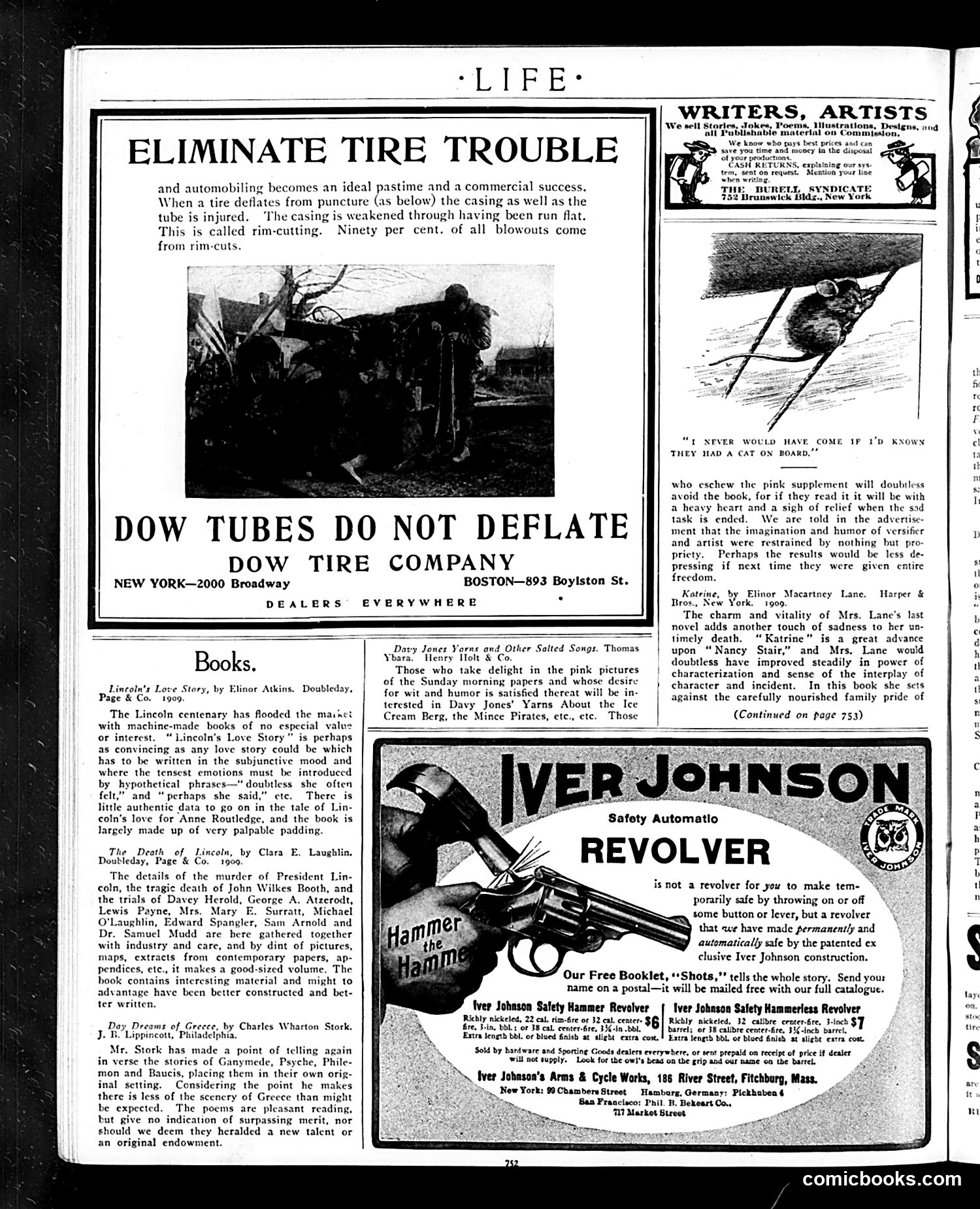
This page is primarily **advertising and book reviews** rather than political satire. The main content includes: 1. **Dow Tire advertisement** - promoting "Dow Tubes" that "do not deflate," featuring an image of what appears to be a tire repair or maintenance scene. 2. **Iver Johnson revolver advertisement** - a large safety-focused ad emphasizing the gun's "patented exclusive" construction, marketed as a legitimate firearm for sale. 3. **Book reviews** - covering titles like "Lincoln's Love Story" and "The Death of Lincoln," reflecting early 1900s literary interests in historical subjects. The page reflects **early 20th-century consumer advertising** alongside cultural commentary through literature reviews. There is no evident political cartoon or satirical content attacking specific figures or events visible here.
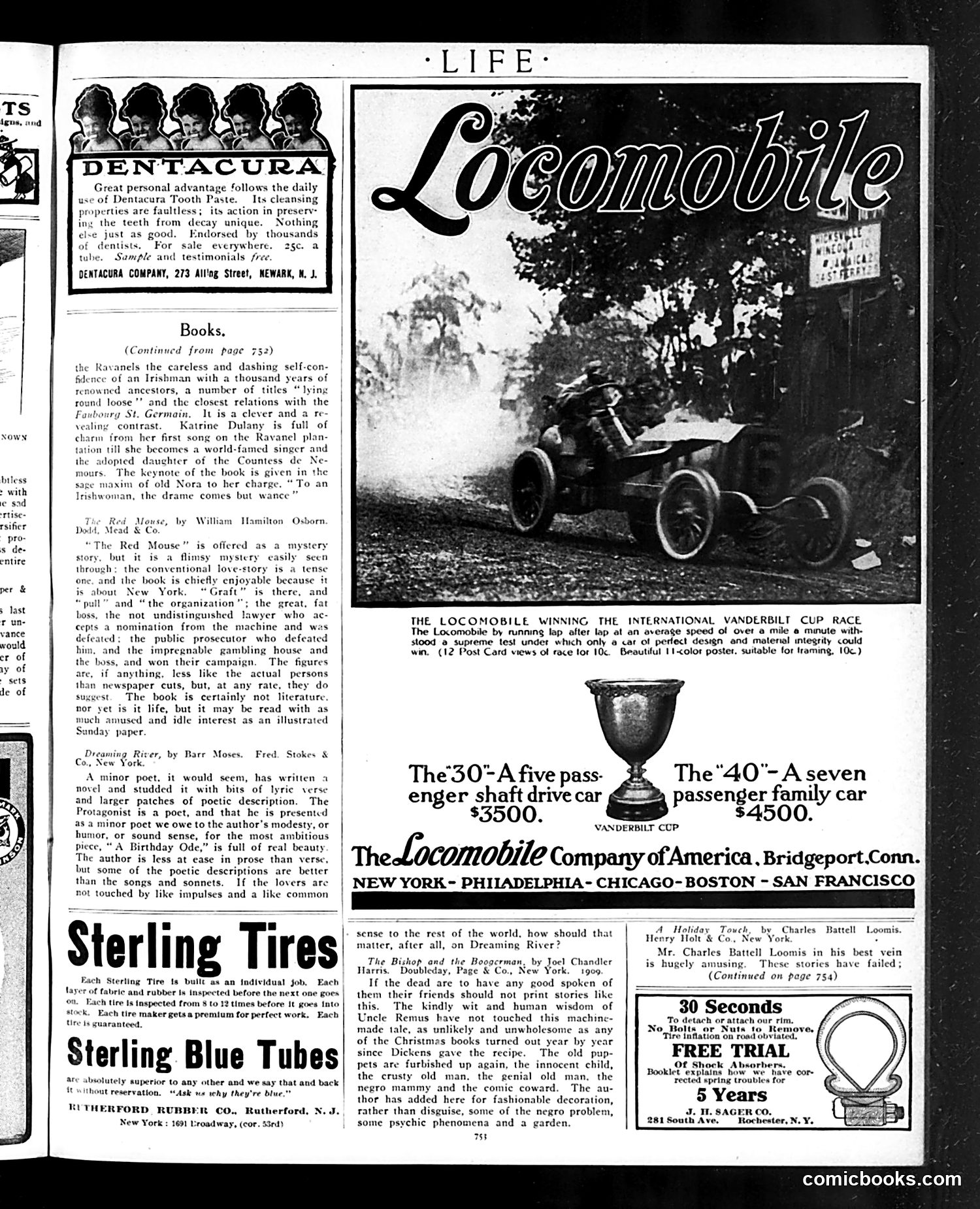
This page contains **primarily advertisements rather than political cartoons**. The main content features: 1. **Dentacura advertisement** (top left) - a tooth paste product endorsement 2. **A "Books" section** (left column) - reviewing recent novels including works by William Hamilton Osborn and Barr Moses 3. **Large Locomobile automobile advertisement** (center/right) - prominently featuring a racing car that won the Vanderbilt Cup race, with pricing for two car models ($3,500 and $4,500) 4. **Sterling Tires advertisement** (bottom left) 5. **Various smaller ads** for other products The Locomobile ad is the most visually dominant element, celebrating automotive achievement and luxury consumer goods. No political satire or social commentary is evident on this particular page—it reflects early 20th-century consumer culture and advertising practices.
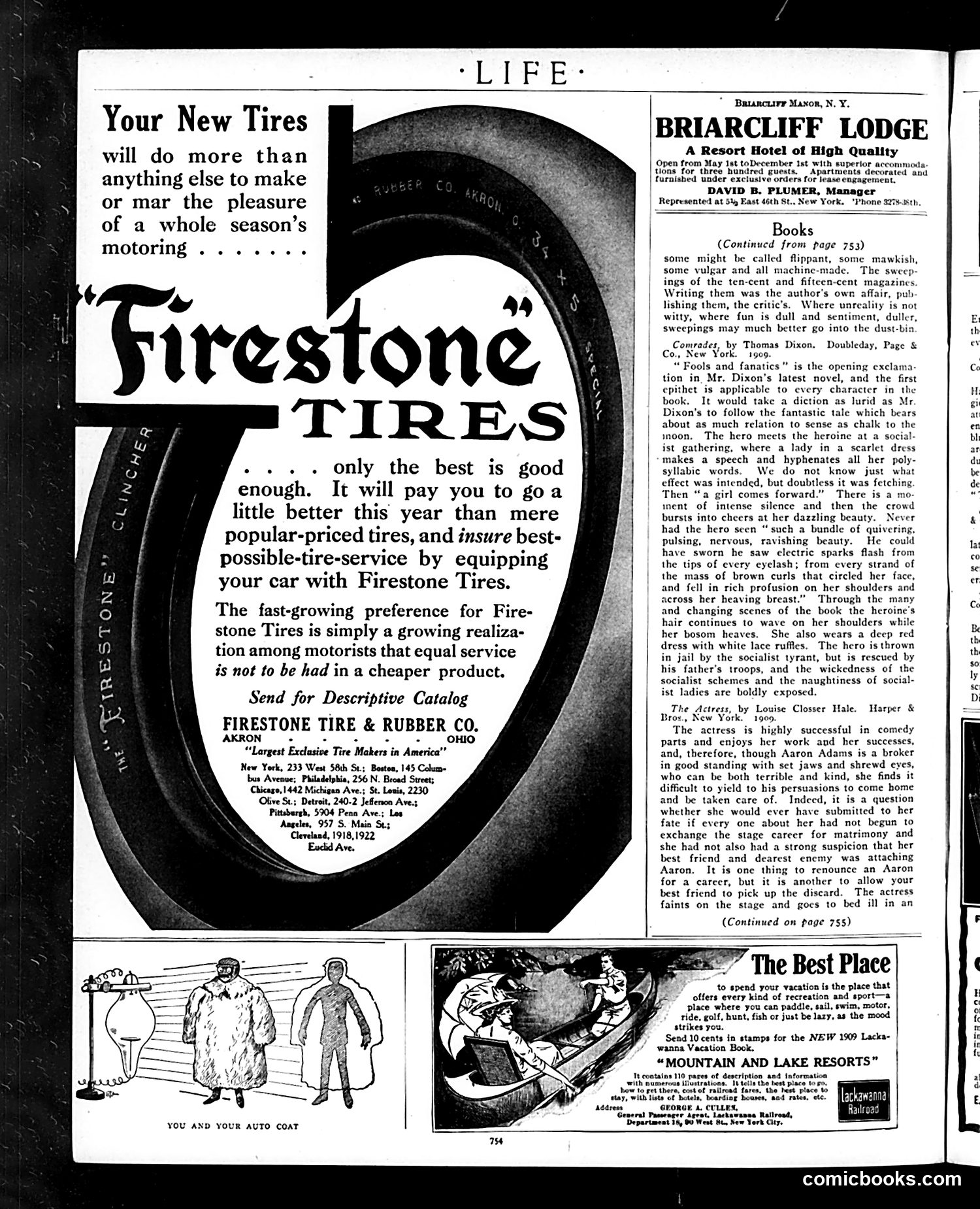
This page is primarily **advertising rather than political satire**. The dominant content comprises commercial advertisements: 1. **Firestone Tires** (large central ad): A straightforward product advertisement emphasizing quality and service, with no satirical intent. 2. **Briarcliff Lodge** (top right): A resort hotel advertisement for upstate New York. 3. **Book reviews** (right column): Literary notices for works including Thomas Dixon's "Comrades" and Louise Closser Hale's "The Actress." 4. **Mountain and Lake Resorts** (bottom right): A vacation advertisement. 5. **Auto coats illustration** (bottom left): A simple cartoon showing clothing options, purely functional rather than satirical. The page contains **no political cartoons or meaningful satire**—it's a standard early-1900s magazine page mixing advertisements with book reviews.
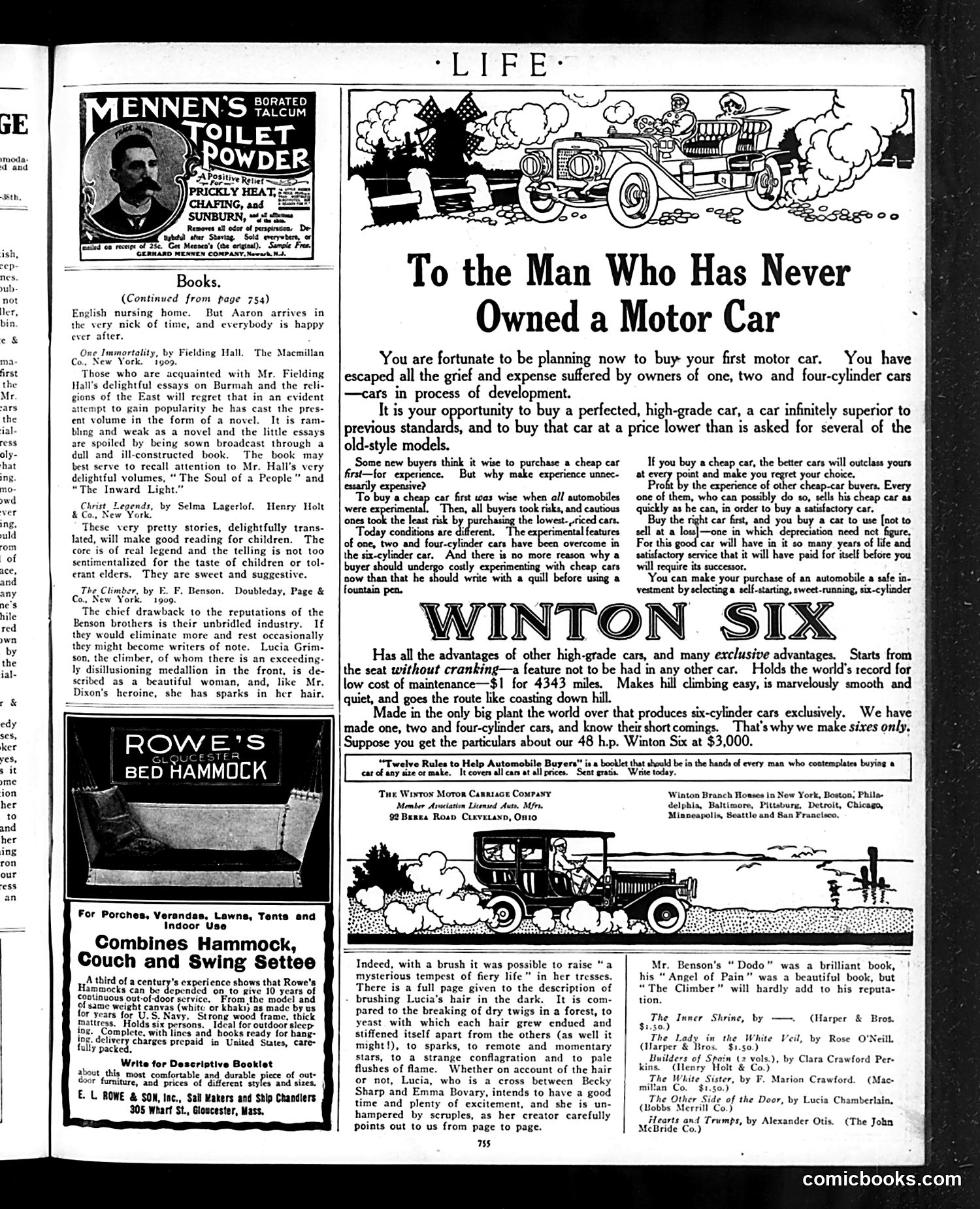
This page is primarily **advertising**, not satire or political commentary. The dominant feature is a large Winton Six automobile advertisement ("To the Man Who Has Never Owned a Motor Car"), which occupies most of the page. The ad targets first-time car buyers, arguing that purchasing a quality six-cylinder Winton is superior to buying cheaper models. It emphasizes reliability, low maintenance costs, and exclusivity—claiming Winton produces only sixes, not cheaper alternatives. Secondary advertisements include Mennen's Talcum Powder and Rowe's Bed Hammock. The page also contains a "Books" section reviewing recent publications, unrelated to advertising. There are no political cartoons or satirical commentary visible. This is straightforward commercial content from an era when Life magazine featured substantial advertising alongside editorial material.
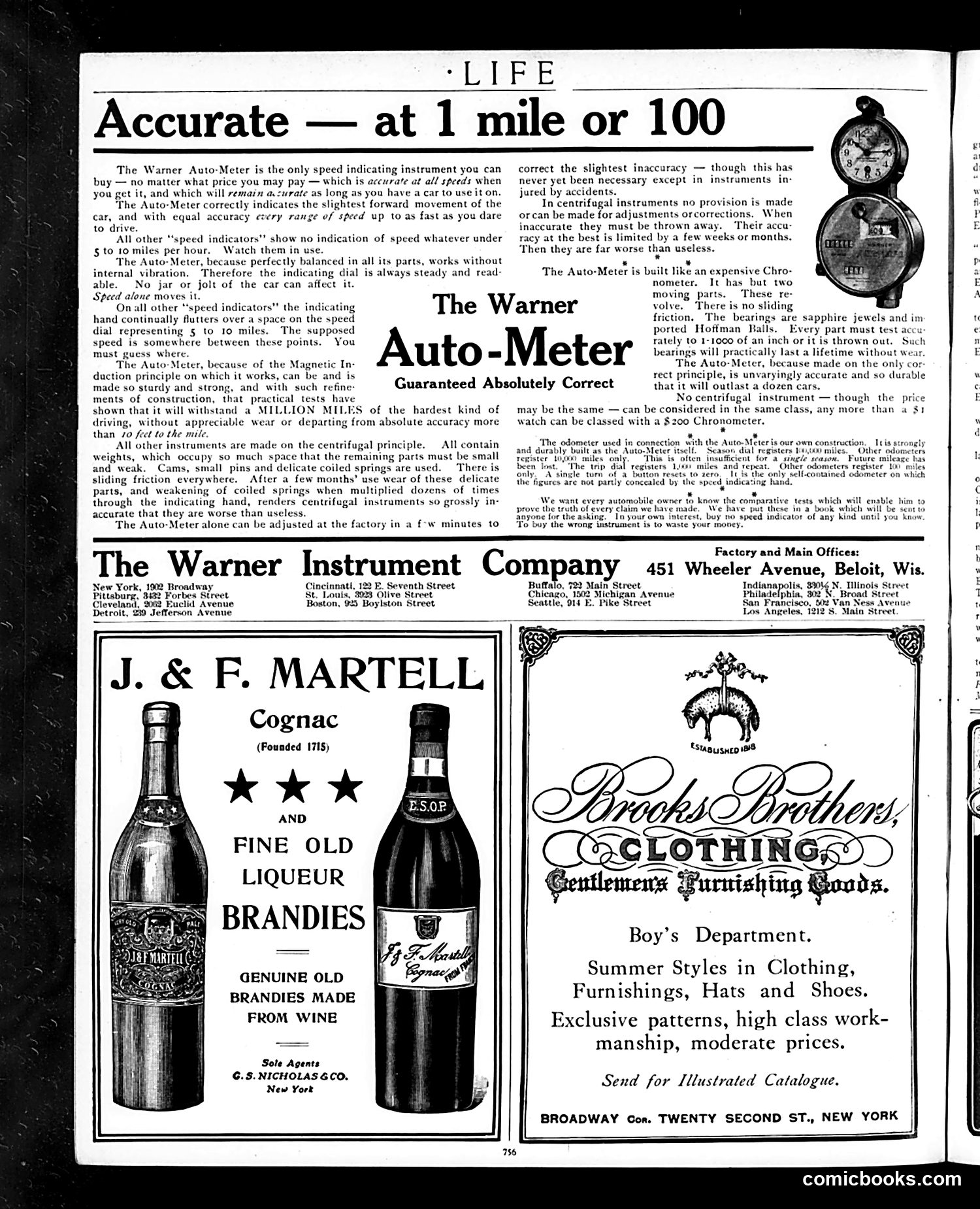
This page contains **no political cartoons or satirical content**. It is primarily **advertising**, featuring three distinct commercial advertisements: 1. **Warner Auto-Meter** (top): An extended product advertisement for a car speedometer, emphasizing its accuracy and reliability compared to competitors. 2. **J. & F. Martell Cognac** (bottom left): A spirits advertisement promoting French brandy, founded 1715, sold by C.S. Nichols & Co. in New York. 3. **Brooks Brothers** (bottom right): A clothing advertisement for boys' department, highlighting summer styles and "high class workmanship" at "moderate prices," located on Broadway at Twenty-Second Street, New York. The page serves as a revenue-generating advertisement section rather than editorial content.
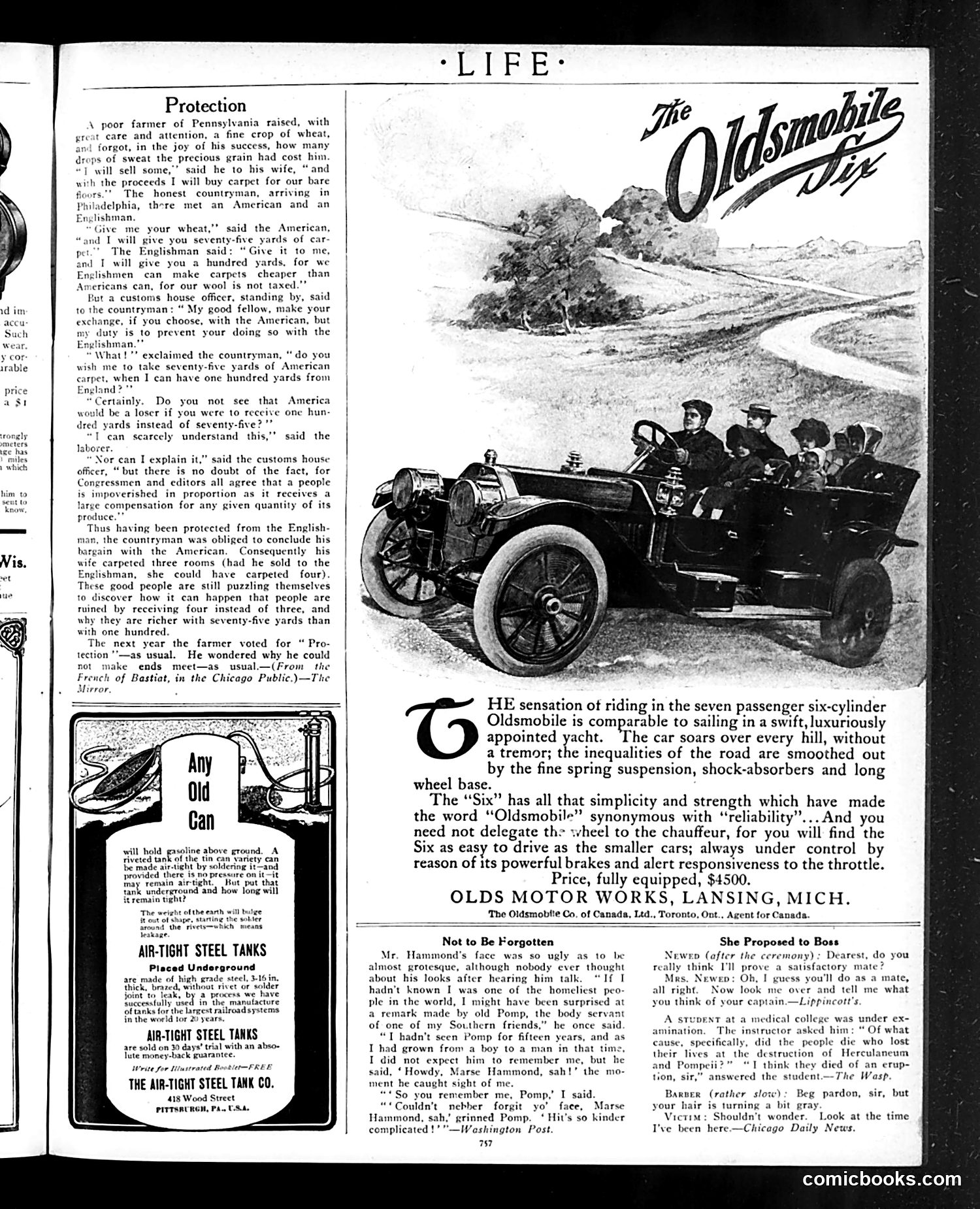
This page is primarily **advertising**, not political satire. The main content is a full-page advertisement for the Oldsmobile "Six" automobile, featuring a luxury seven-passenger vehicle and promotional text emphasizing reliability, smooth riding, and ease of driving. On the left side is a separate anecdote titled "Protection," depicting a commercial dispute between an English wool merchant and an American farmer over carpet tariffs—a gentle satire on protectionist trade policies and national pride, common themes in *Life* magazine. Below that is an advertisement for "Air-Tight Steel Tanks" for underground gasoline storage. The page also includes two brief humorous social vignettes at bottom: "Not to Be Forgotten" (about a servant remembering an old acquaintance) and "She Proposed to Boss" (a college romance story). This reflects *Life*'s typical mixed format of advertising, light humor, and social commentary.
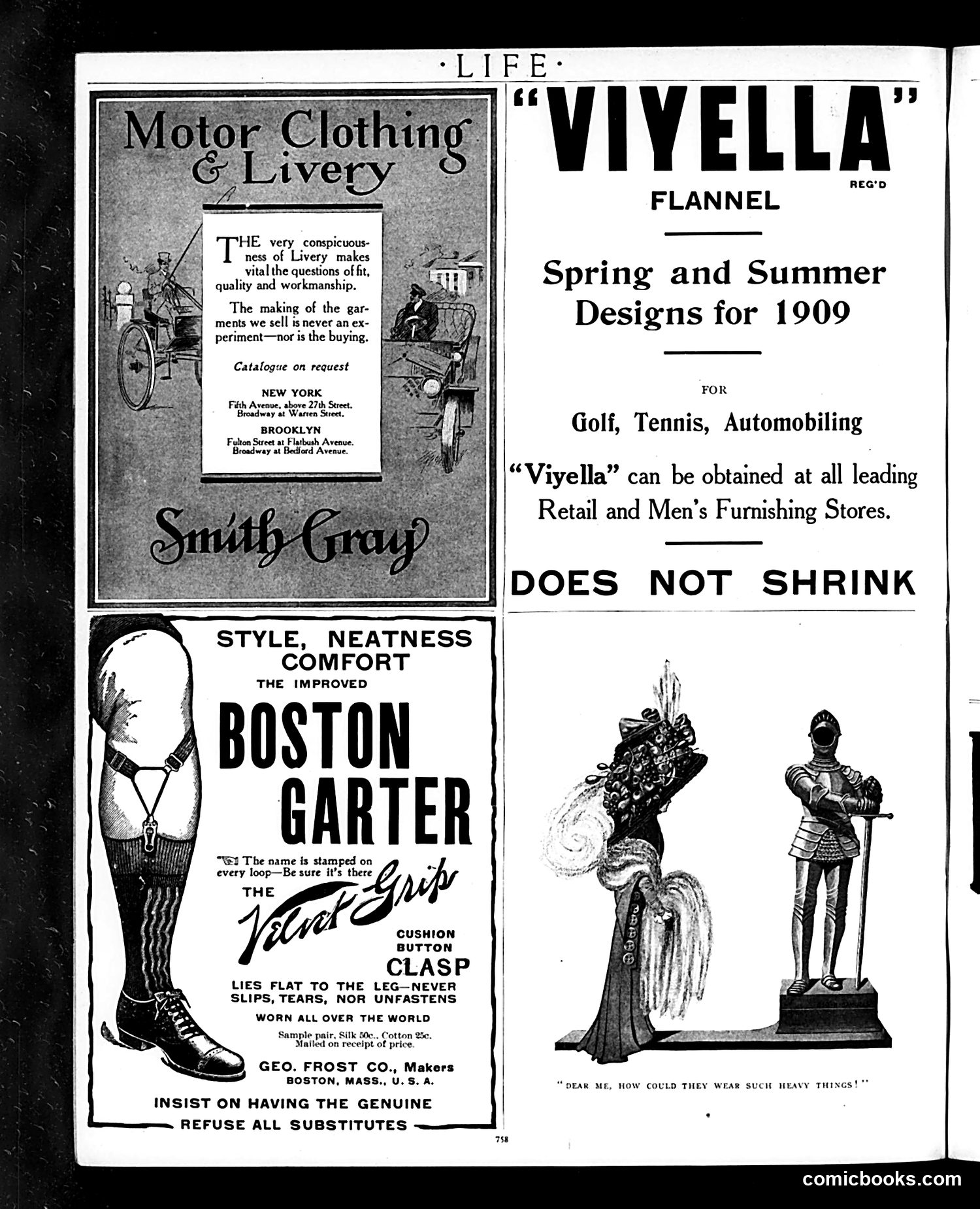
This page is primarily **advertising**, not satire or editorial content. The ads promote early 1900s menswear and accessories: Smith-Gray's motor clothing and livery services for automobile owners; the "Boston Garter" (an elastic leg garter with cushioned clasp) marketed to prevent slipping; and "Viyella" flannel fabric for sports clothing (golf, tennis, automobiling), emphasizing it "does not shrink." The only illustrative humor appears in the Viyella ad's caption: "Dear Me, How Could They Wear Such Heavy Things!"—a mild joke about the contrast between the heavy armor worn by the medieval knight figure versus the lightweight modern flannel being advertised. This is gentle product humor rather than political satire.
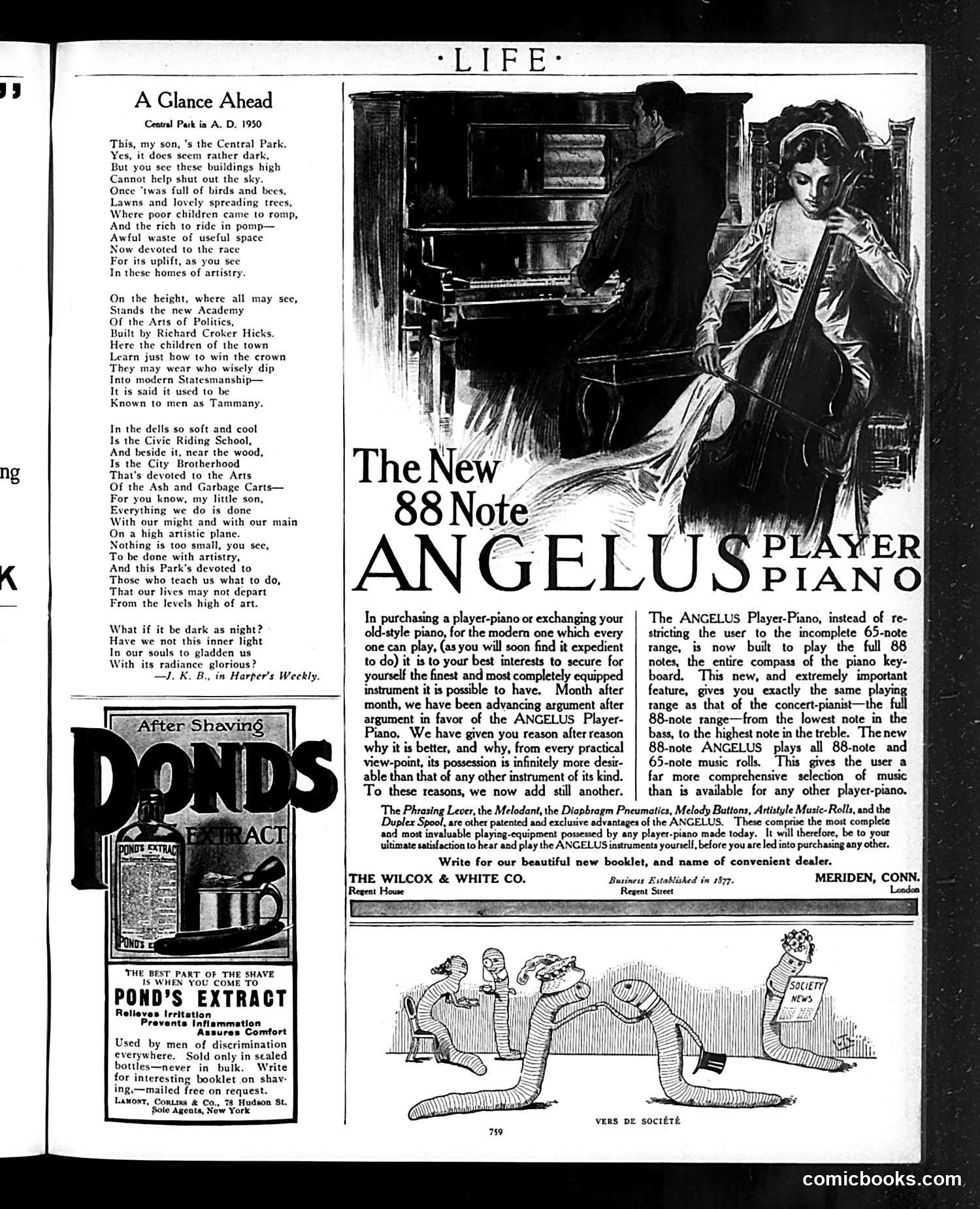
This Life magazine page is primarily **advertising and poetry**, not political satire. The left side features a poem titled "A Glance Ahead" describing Central Park in A.D. 1950—a futuristic vision of improved urban institutions (Academy of Arts and Politics, Civic Riding School, City Brotherhood). It's nostalgic social commentary rather than sharp satire. Below is a Ponds Extract shaving product advertisement. The dominant right-side content is a full advertisement for the Angelus Player Piano, emphasizing its expanded 88-note range compared to older models. The illustration shows a woman playing the instrument. At the bottom, "Vers de Société" appears to be a humorous cartoon about socialites or society figures, but the image quality makes specific identification unclear. Overall, this is a **commercial page with light, optimistic social commentary**—not political cartoon satire.
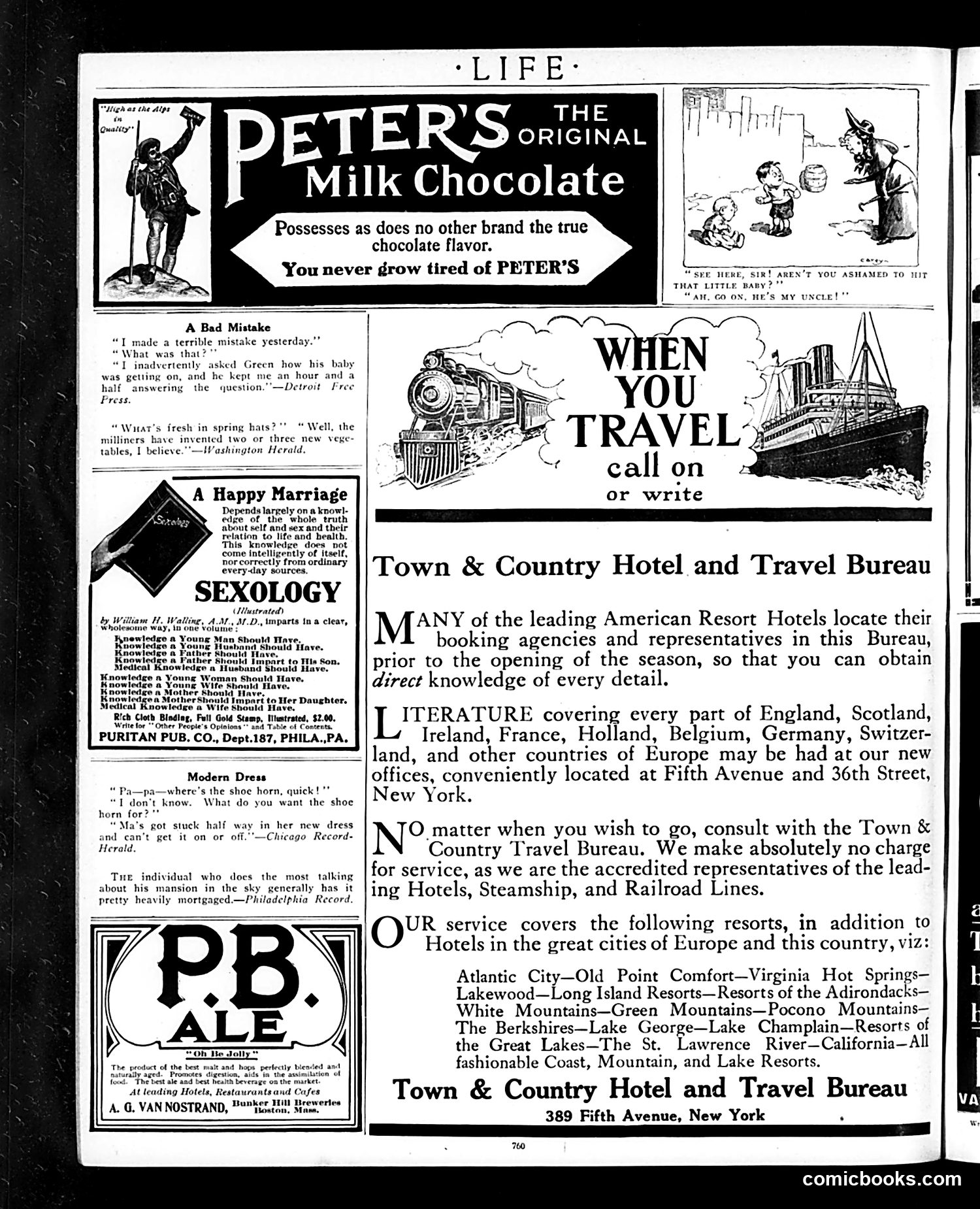
This page is primarily **advertising and filler content** rather than satirical cartoons. The main elements include: 1. **Peter's Milk Chocolate advertisement** (top) — a straightforward product endorsement claiming superior chocolate flavor. 2. **Four brief humor snippets** ("A Bad Mistake," "A Happy Marriage," "Modern Dress") — these are short joke items, not political satire. They reference domestic situations and appear designed as light entertainment. 3. **Sexology book advertisement** — promoting a guide to marital relations, suggesting early 20th-century interest in relationship education. 4. **Town & Country Hotel and Travel Bureau advertisement** (large, right side) — promoting resort booking services and European travel literature. 5. **P.B. Ale advertisement** (bottom left) — beer product promotion. The page reflects typical Life magazine content: mixed commercial advertisements interspersed with light humor pieces targeting middle-class readers interested in travel, consumption, and domestic life.
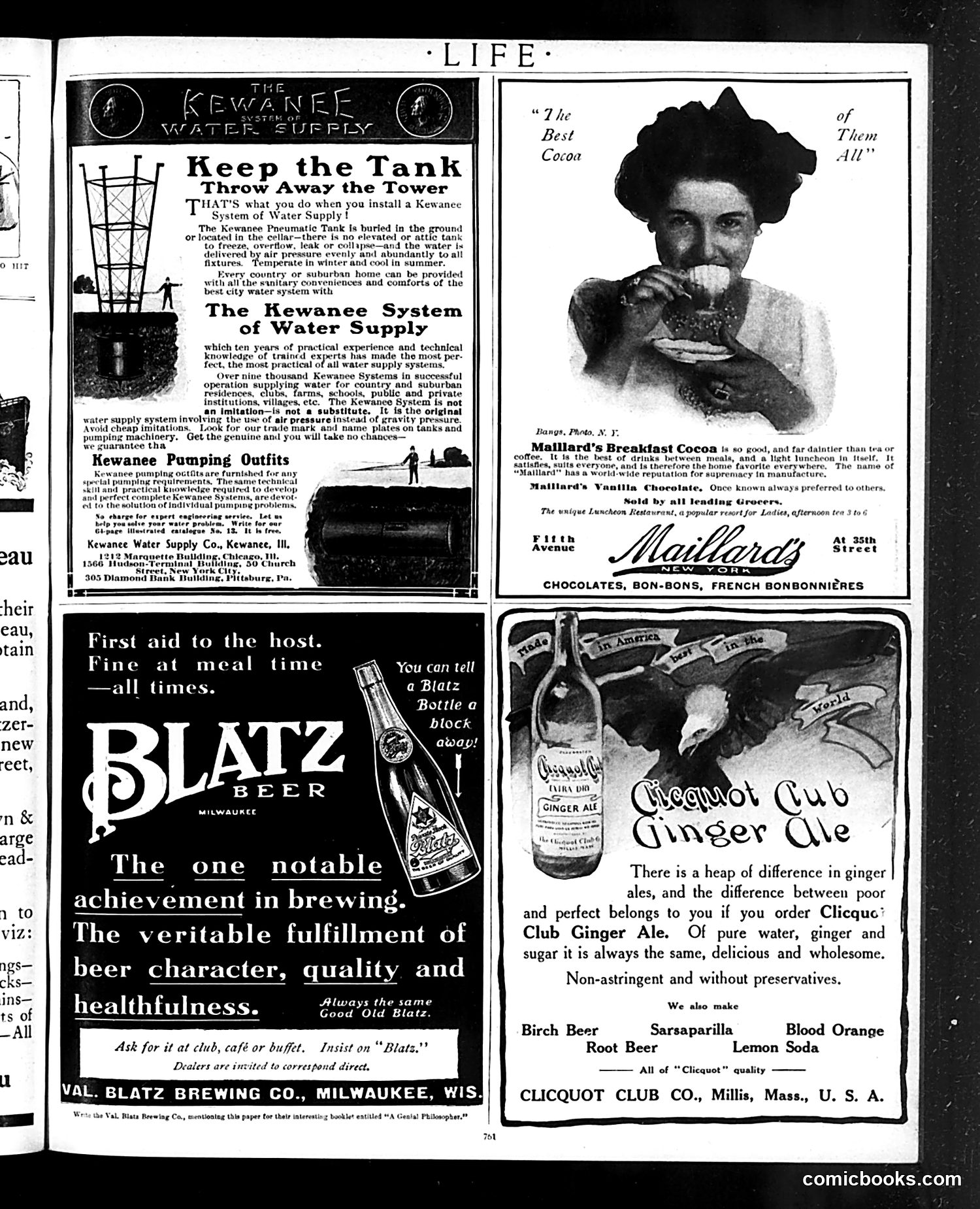
This page is primarily **advertising content** rather than political satire. It contains four distinct ads: 1. **Kewanee Water Supply System** — promoting underground water tank systems for homes and businesses, emphasizing sanitary conveniences comparable to city systems. 2. **Maillard's Chocolate** — featuring a photograph of a woman enjoying cocoa, marketed as superior to competing brands. 3. **Blatz Beer** (Milwaukee) — advertising beer's "quality and healthfulness," a standard brewing industry claim of the era. 4. **Cliequot Club Ginger Ale** — promoting their non-alcoholic beverage as pure and preservative-free. The page reflects early 20th-century consumer advertising focused on modern conveniences, quality goods, and health claims. There is **no political cartoon or satire present** — this is a commercial advertising page typical of *Life* magazine's revenue model.
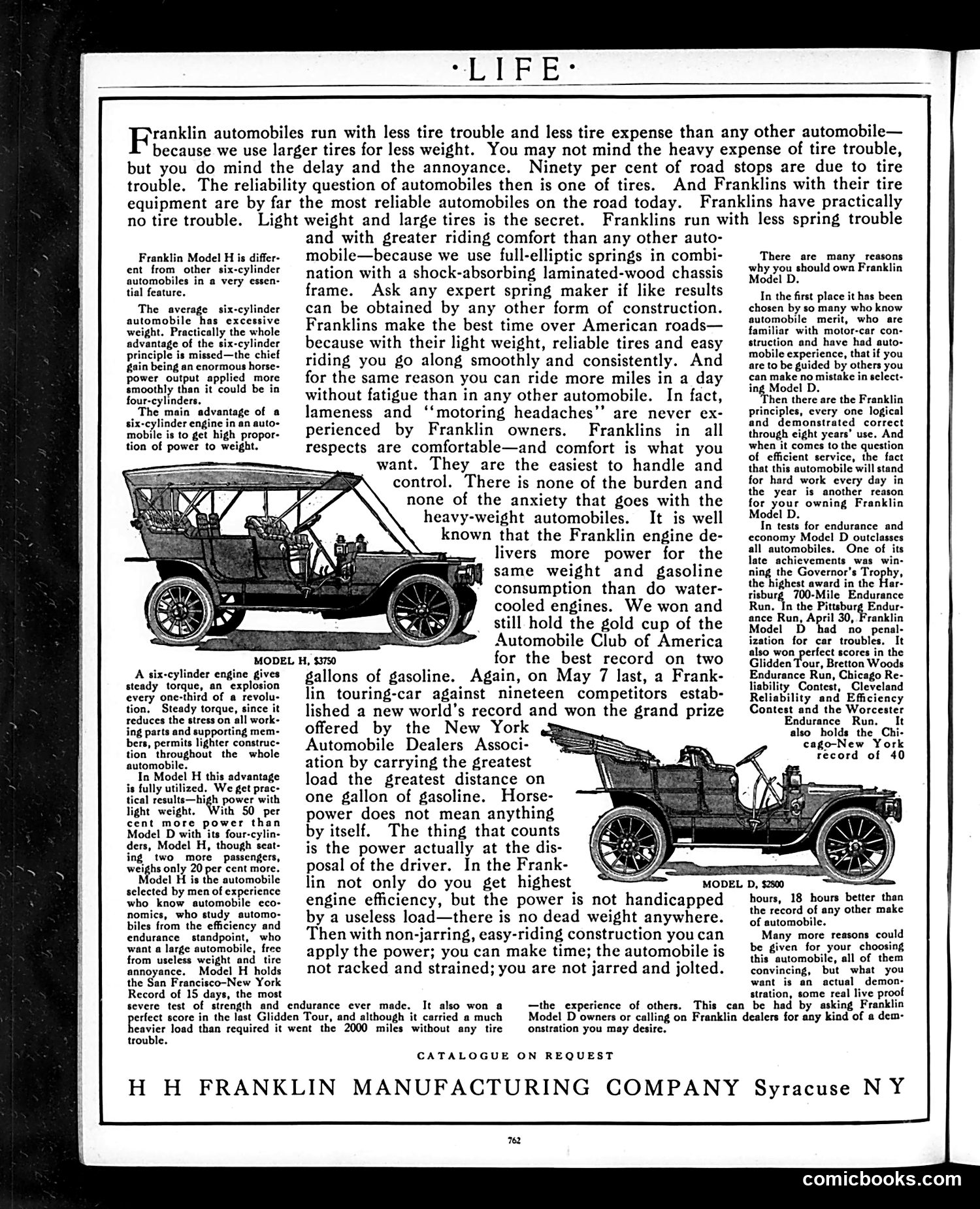
This is a **full-page advertisement**, not satire or political commentary. The H.H. Franklin Manufacturing Company promotes their Model H and Model D automobiles to early 20th-century readers. The ad's central claim: Franklin cars are superior because they use **large tires on lightweight frames**, reducing tire trouble (which caused 90% of road breakdowns). Key selling points include: - Six-cylinder engines delivering high horsepower without excess weight - Full-elliptic springs for smooth riding - Proven endurance records (San Francisco-New York run, Glidden Tour) - Superior fuel economy (winning records for distance on limited gasoline) The accompanying **technical drawings** show the Model H and Model D vehicles from the side, illustrating their construction. The advertisement targets mechanically-informed buyers concerned with reliability and efficiency—practical concerns for early automobile owners facing frequent breakdowns and high maintenance costs.
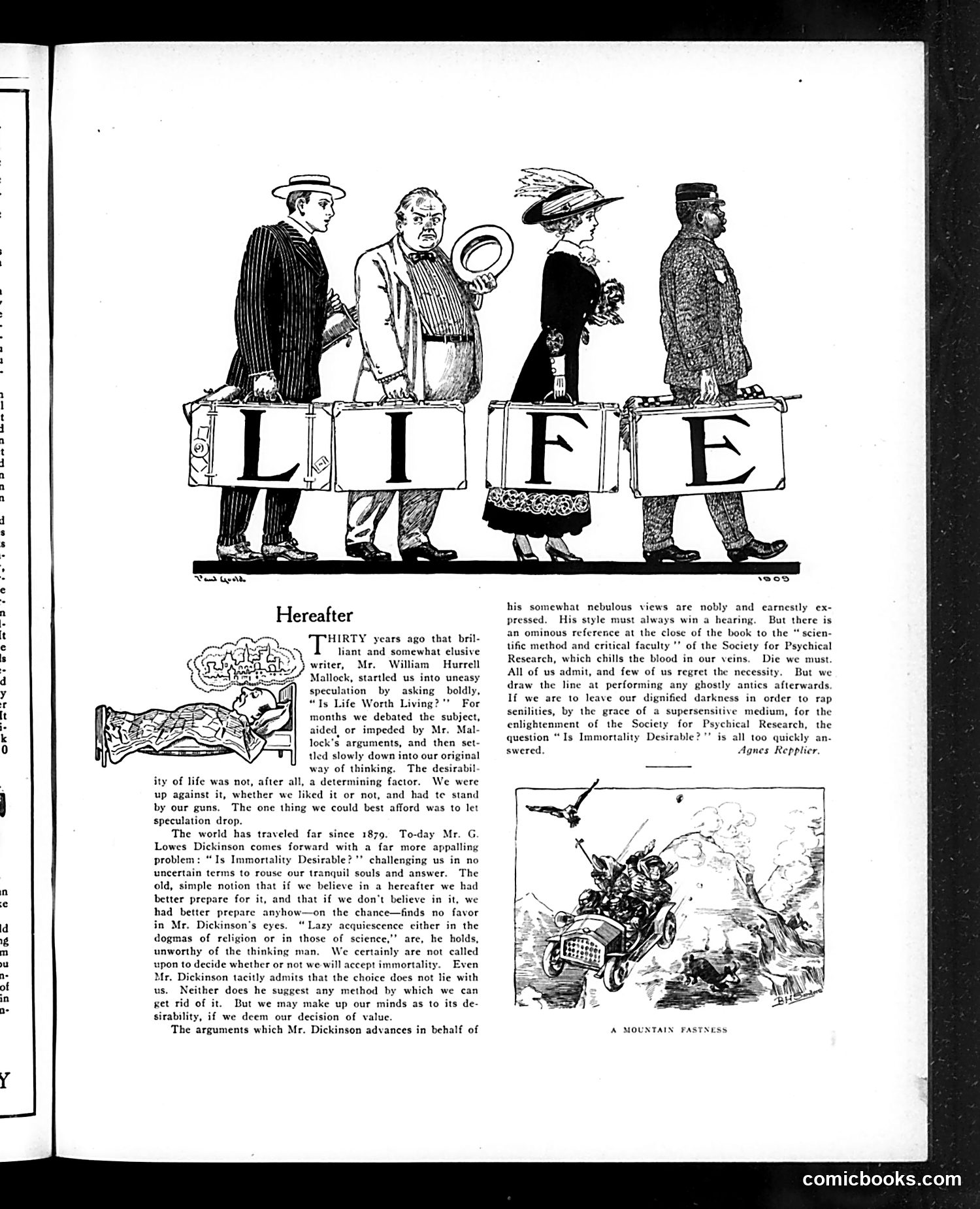
The top cartoon depicts four figures carrying suitcases labeled "L-I-F-E," satirizing different approaches to life's meaning. The accompanying article by Agnes Repplier discusses philosopher G. Lowes Dickinson's question: "Is Immortality Desirable?" Repplier defends living without obsessing over life's ultimate value—a debate dating to 1879. However, she expresses alarm at Dickinson's endorsement of the Society for Psychical Research, which investigated spiritualism and communication with the dead through mediums. The satire's point: while immortality might seem desirable in theory, the *reality* of becoming a ghost performing séances for spiritualist researchers is decidedly unappealing. Repplier argues we should accept death with dignity rather than risk undignified "ghostly antics" afterward—a critique of both spiritualism's pretensions and the era's fascination with contacting the deceased.
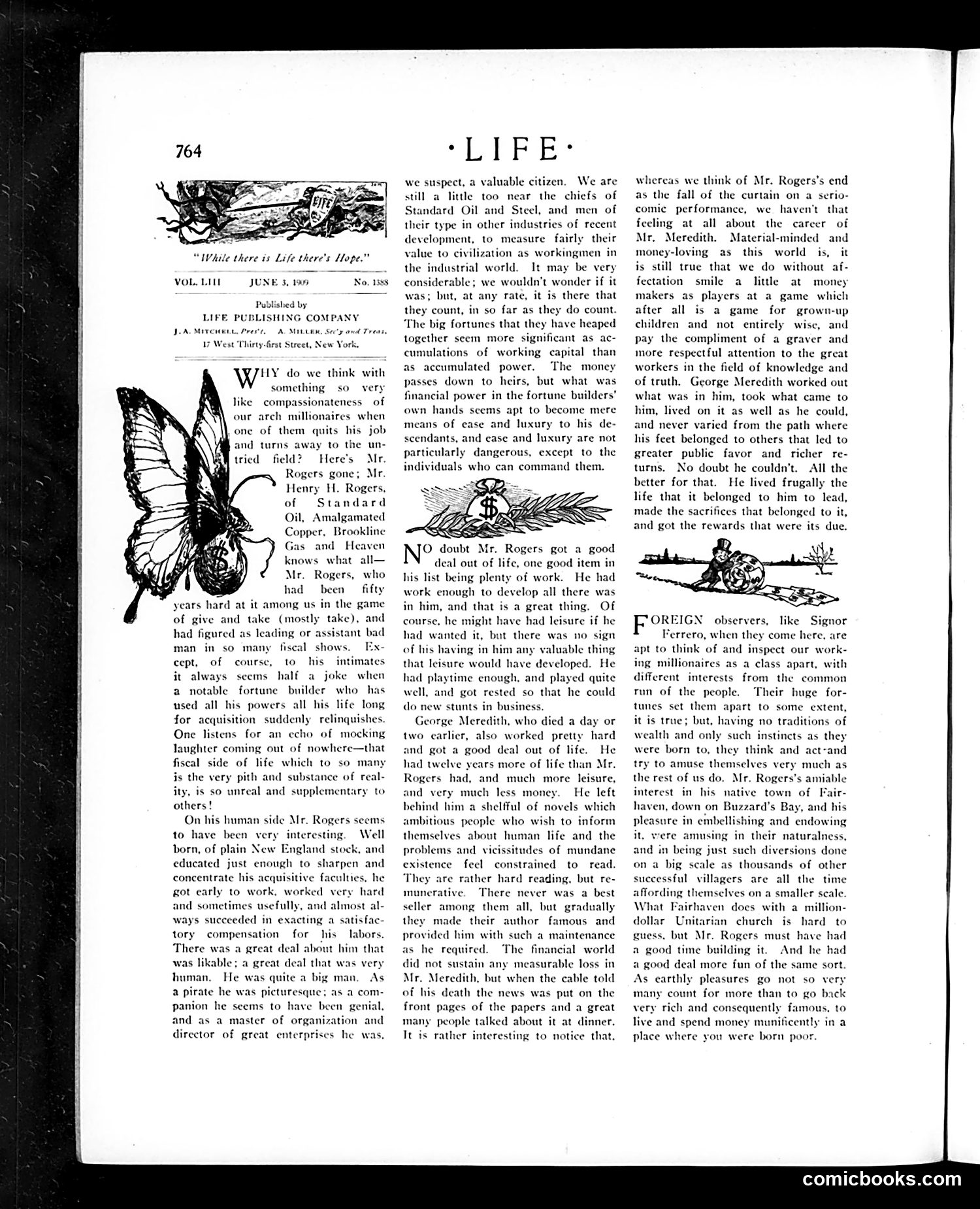
This page from *Life* magazine (June 3, 1903) reflects on the recent retirement of **Henry H. Rogers**, a Standard Oil and Amalgamated Copper magnate who had spent fifty years accumulating wealth through aggressive business practices. The satire's point: The article expresses wry compassion for Rogers abandoning his "fiscal" pursuits, noting that millionaires quitting seem absurdly out of character—one expects "mocking laughter." The piece questions whether such industrial titans truly benefited civilization, concluding their fortunes matter mainly as "accumulated working capital" rather than genuine power. The comparison to **George Meredith** (novelist, died around same time) sharpens the critique: Meredith created lasting cultural value through difficult but ultimately rewarding work, while Rogers merely accumulated money that will devolve into heirs' idle luxury. The implicit judgment: intellectual/artistic labor produces meaningful legacy; ruthless capitalism produces only unearned ease for descendants. The butterfly illustration appears decorative rather than symbolic.
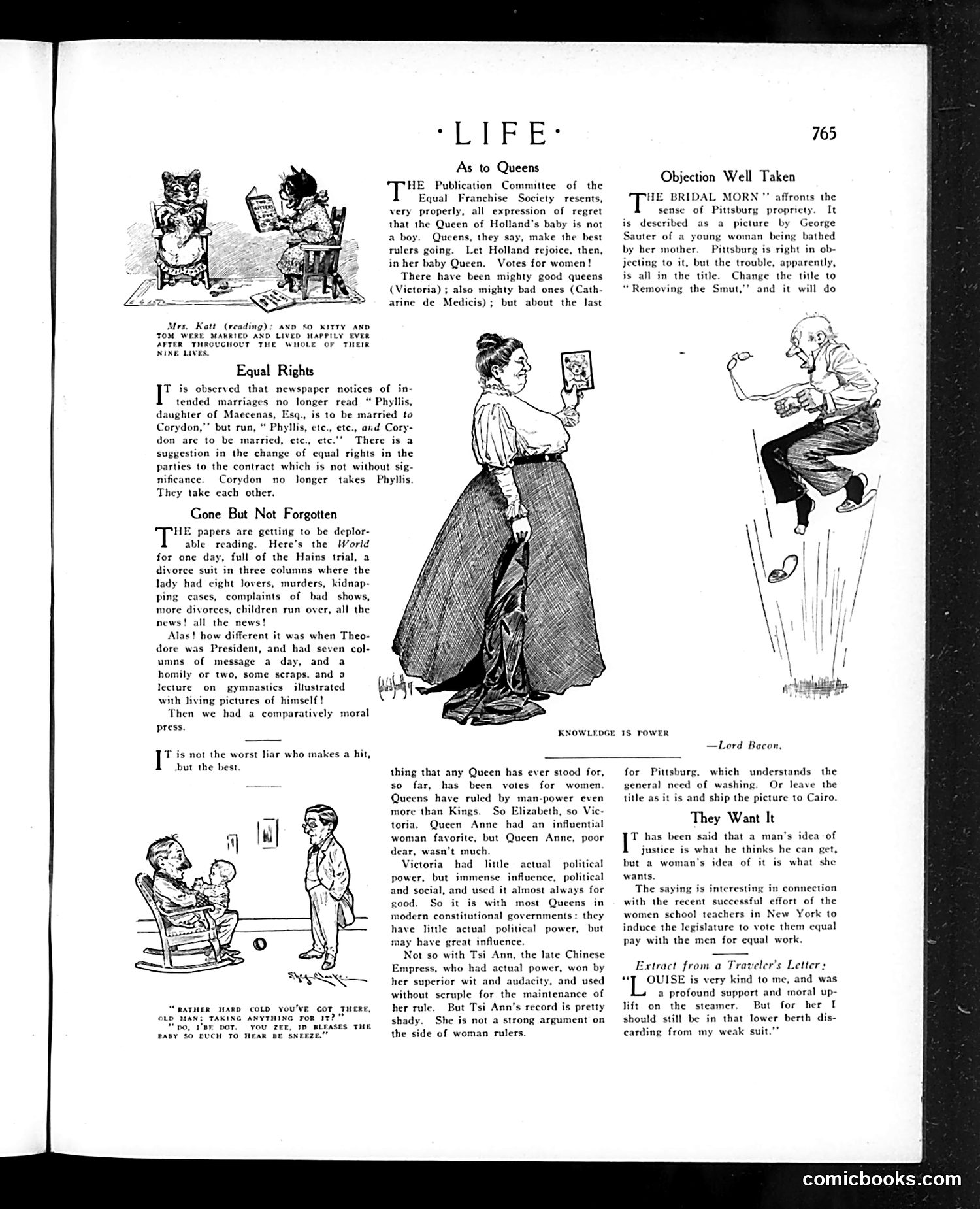
This page satirizes early 1900s debates about women's rights and propriety. The main article "As to Queens" defends female monarchs against those lamenting that the Dutch Queen's baby wasn't male—arguing queens have historically ruled as effectively as kings. It cites Victoria and Elizabeth as examples, though notes the Chinese Empress Tsi Ann, while powerful, was morally questionable. The cartoons mock related social conventions: one shows a woman reading a children's story where characters now marry as equals ("Phyllis...and Corydon are to be married") rather than the old phrasing listing the man first. Another jokes about Pittsburgh's prudish objection to a bathing scene titled "The Bridal Morn"—suggesting renaming it "Removing the Smut" would satisfy their morality. A final item quips that women's "idea of justice is what she wants," while celebrating female teachers successfully demanding equal pay in New York. The satire targets Victorian gender conventions while supporting suffrage and equality—progressive positions for the era.
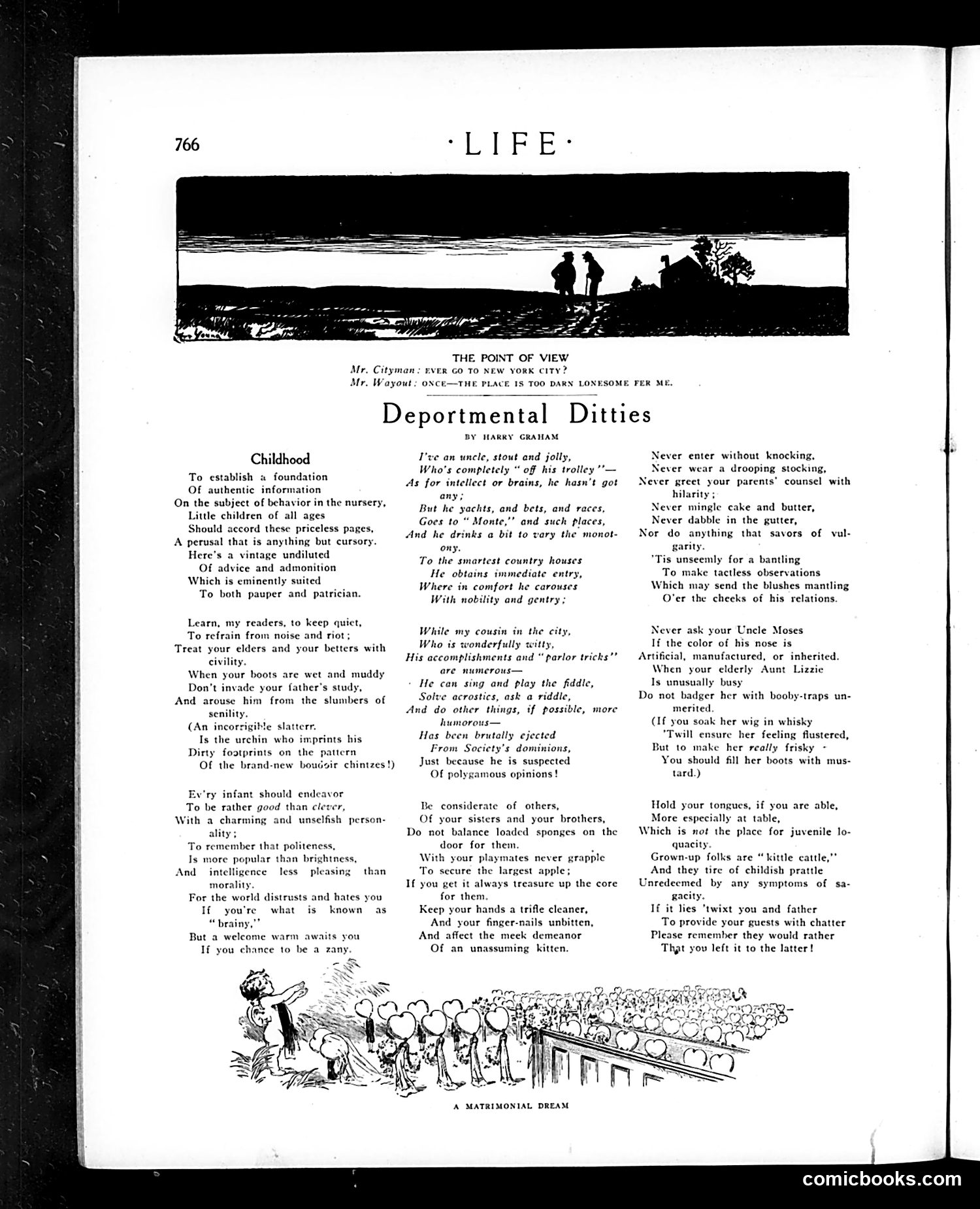
This page presents humorous Victorian-era etiquette advice for children, written by Harry Graham. The content satirizes rigid, stuffy social rules through exaggerated "do's and don'ts"—never knock, avoid wet boots in father's study, don't ask about Uncle Moses's artificial nose, sock Aunt Lizzie's wig in whisky. The accompanying cartoon "A Matrimonial Dream" (bottom) shows a wedding scene, likely illustrating the absurd consequences of poor childhood manners. The "Point of View" dialogue above mocks rural simplicity: a country visitor finds New York City "too darn lonesome," suggesting cultural disconnection between urban and rural America. Graham's poem "Departmental Ditties" contrasts an intellectually brilliant but socially rejected cousin with an intellectually vapid uncle accepted into high society—satirizing how actual social acceptance depends on wealth and connections, not merit or intelligence. The overall message gently ridicules both strict etiquette culture and society's arbitrary social standards.
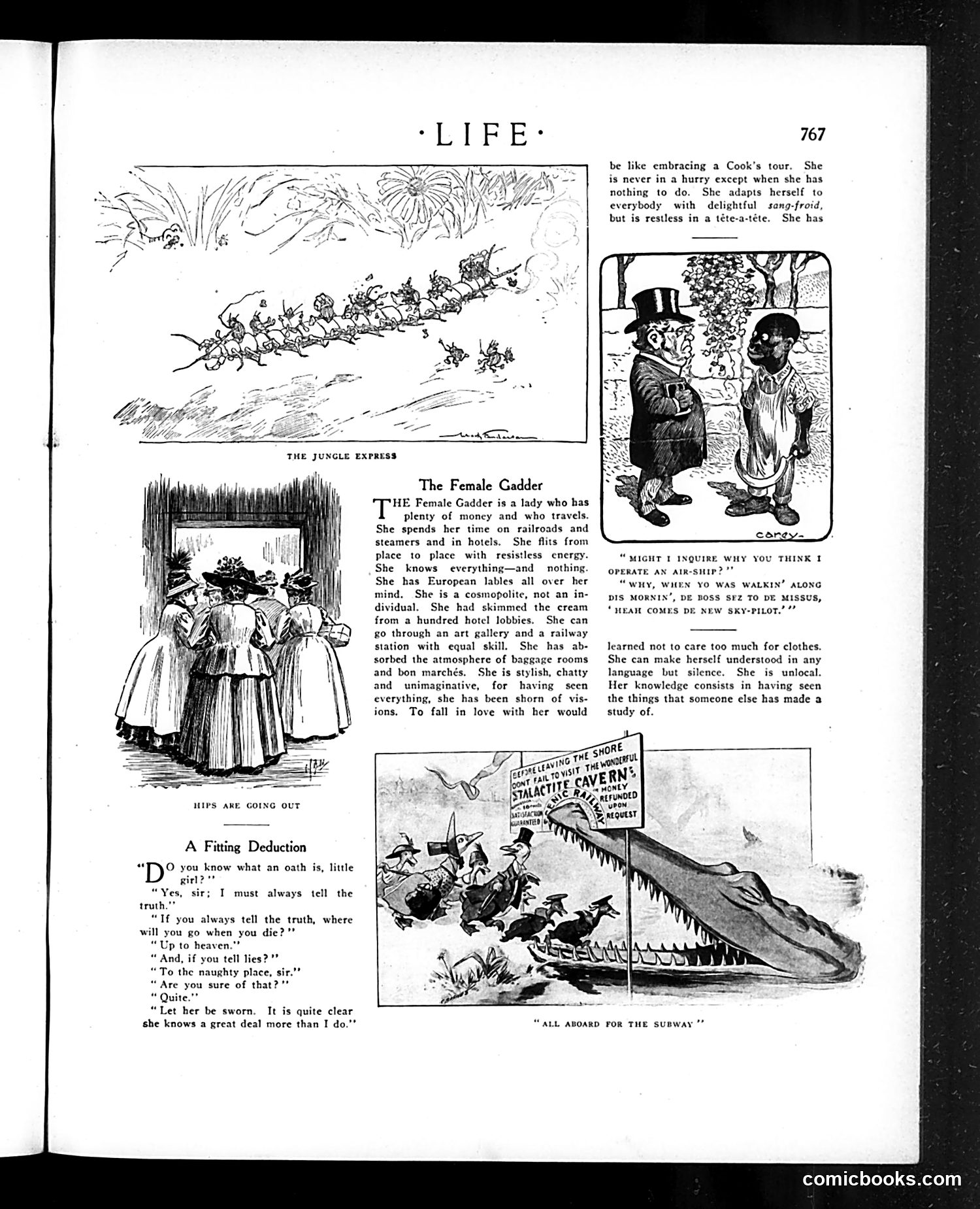
**"A Fitting Deduction"** satirizes legal proceedings. A lawyer questions a child witness about oaths and truthfulness, testing whether she understands heaven and hell. She demonstrates clear moral knowledge. The lawyer's conclusion—that she "knows a great deal more than I do"—mocks the legal profession's pretentious questioning of obvious truths. **"The Female Gadder"** is a social satire describing a wealthy, perpetually traveling woman. She's characterized as superficial: constantly moving between hotels, steamers, and galleries; collecting European sophistication without genuine depth; adaptable but restless; knowledgeable only through secondhand experience of others' accomplishments. The piece critiques idle, cosmopolitan wealth and the female tourist class—she's "never in a hurry except when she has nothing to do," satirizing both aimlessness and shallow cosmopolitanism. The accompanying cartoon "All Aboard for the Subway" appears to be a separate joke, likely about urban transportation or social types.
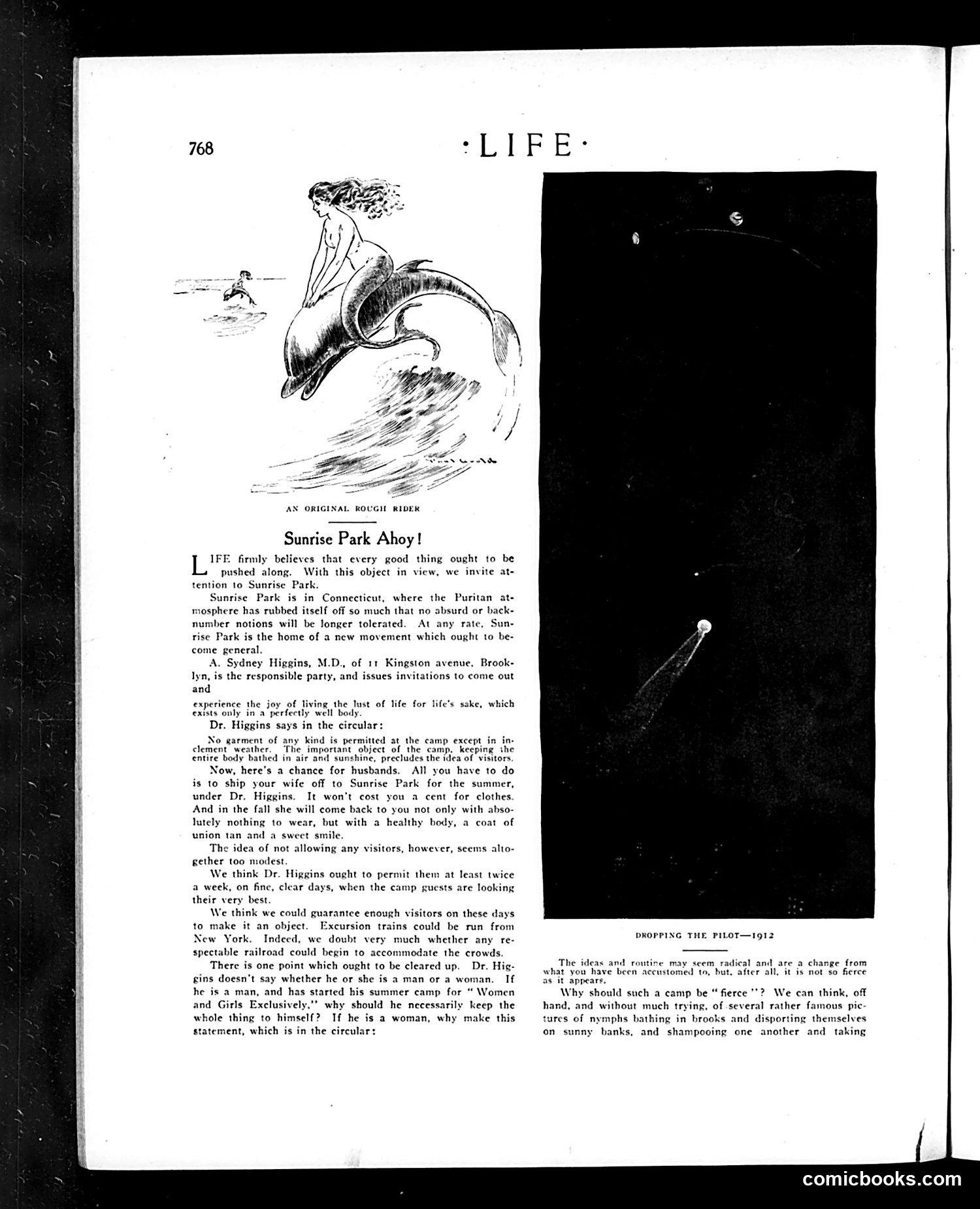
This satirical piece mocks a Connecticut nudist camp called "Sunrise Park," operated by Dr. A. Sydney Higgins. The cartoon depicts a woman on a wave labeled "An Original Rough Rider"—likely a cheeky reference to Theodore Roosevelt's famous "Rough Riders," here repurposed as sexual innuendo. Life magazine's satire targets the camp's rules prohibiting visitors and requiring complete nudity (except in bad weather). The editors mock this prudishness, sarcastically suggesting husbands should send wives there, then arguing visitors should be allowed—implying the real appeal is voyeurism. They joke about trains needed to accommodate crowds. The piece also exploits ambiguity about Dr. Higgins' gender, suggesting that operating a women-only nude camp is suspicious. The final jab references classical artistic nudes to mock the camp's claims of health-focused purity. This reflects early-20th-century anxieties about nudism, sexual propriety, and changing social norms, presented through crude sexual humor typical of Life's satirical approach.
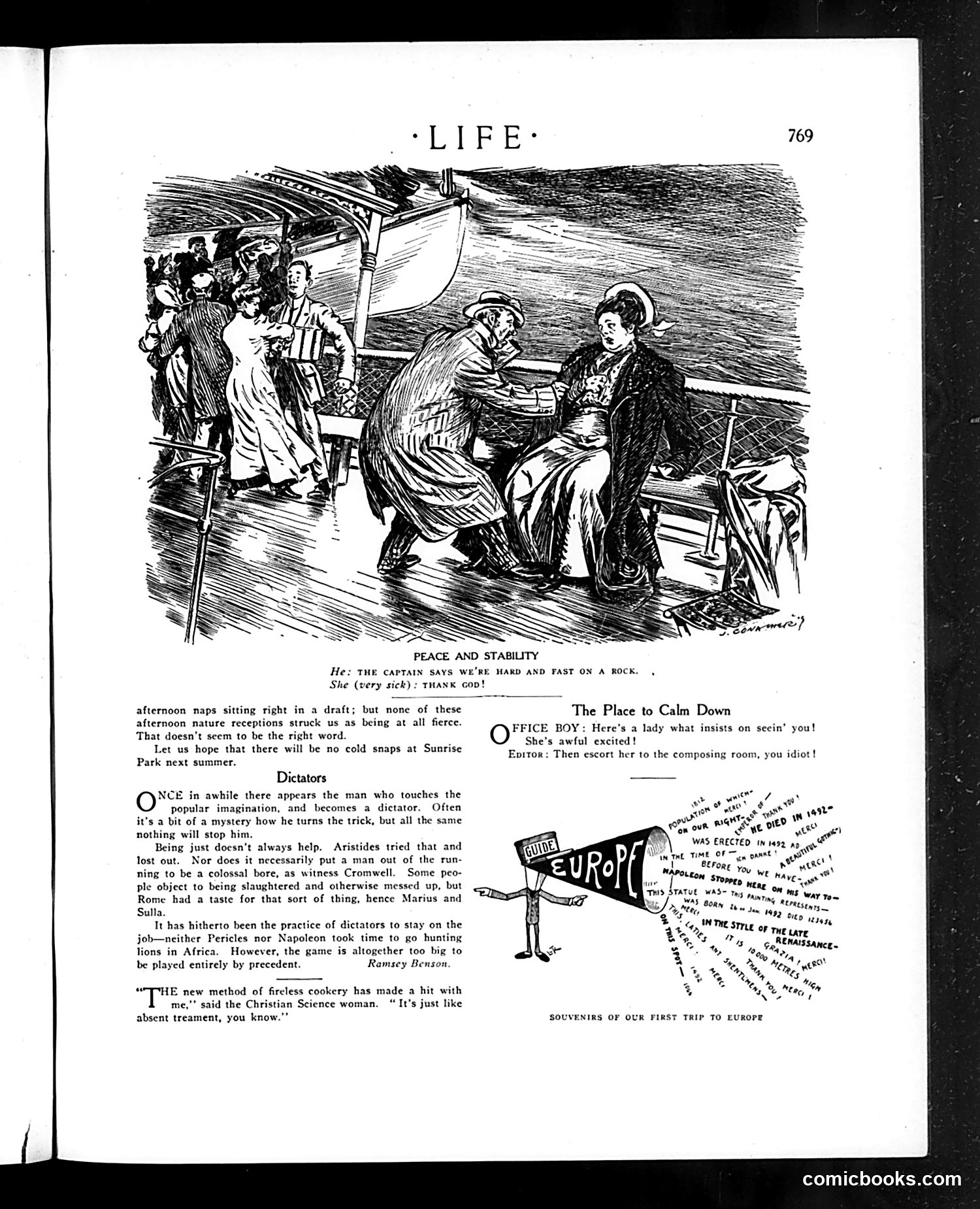
This page contains multiple satirical pieces typical of Life magazine's humor. **"Peace and Stability"** (top cartoon): A couple on a ship has run aground on a rock. The seasick woman is relieved, saying "Thank God!"—the joke being that being stuck on a rock is preferable to the ship's motion causing her illness. **"Dictators"** (essay): A reflective piece about historical strongmen (Aristides, Cromwell, Marius, Sulla, Pericles, Napoleon are named). The author notes dictators typically stay in power, but suggests the "game" has changed—implying modern dictators might operate differently. This appears commentary on contemporary authoritarian figures, though no specific modern dictator is named. **"The Place to Calm Down"** (bottom): An office joke where an excited woman visits an editor. The editor dismisses her to the "composing room"—where loud printing machinery would silence her excitement. **Right cartoon**: A tour-guide sign humorously recites pseudo-historical facts about European monuments, poking fun at tourist memorabilia and garbled historical claims.
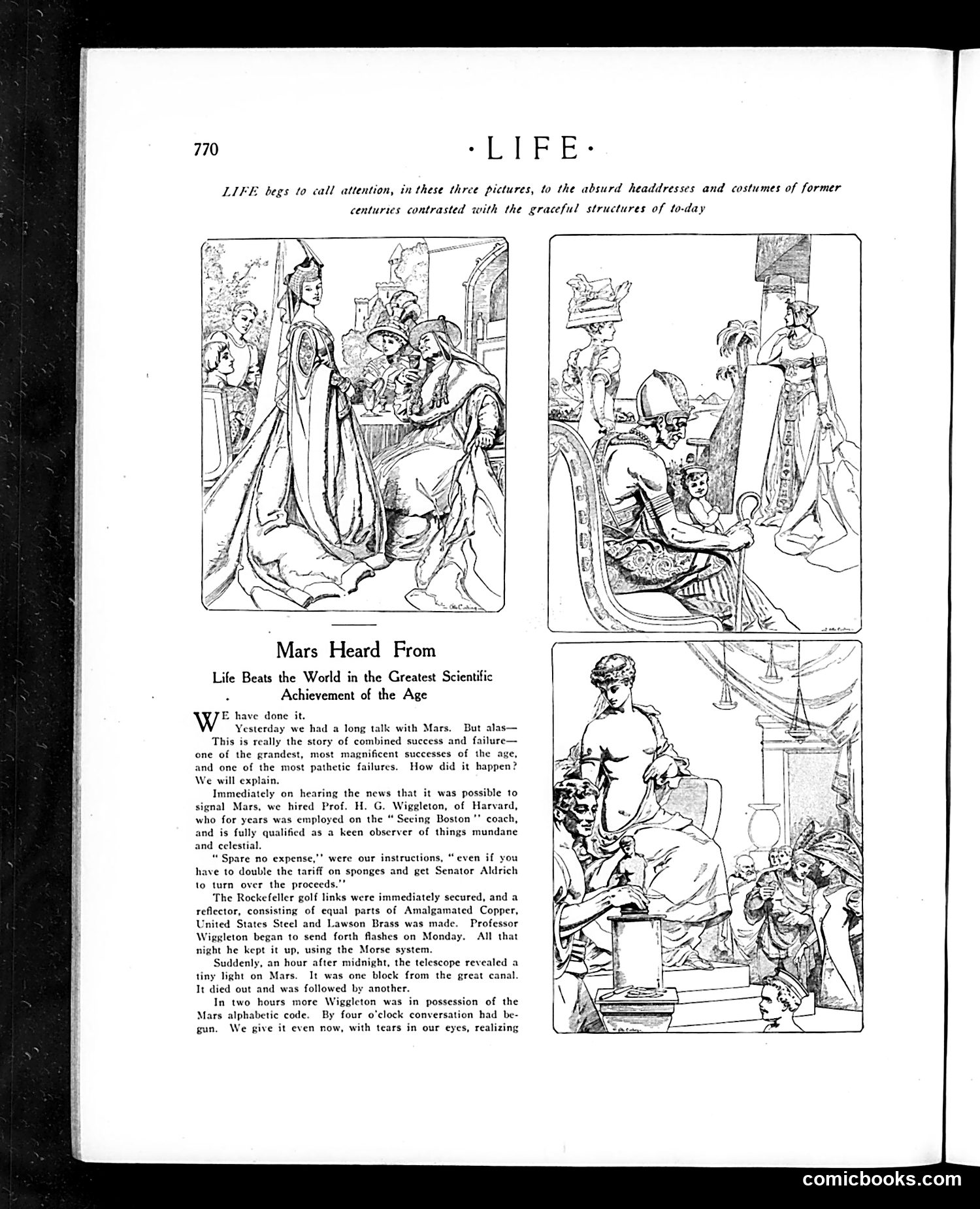
This is a satirical piece mocking contemporary scientific pretension. Life claims to have achieved "the greatest scientific achievement of the age" by contacting Mars—a reference to real debates about potential Martian life and canal observations by astronomers like Percival Lowell (popular in the early 1900s). The satire targets American excess and vanity: Life hires Professor Wiggleton (a fabricated expert previously employed as a "Seeing Boston coach"), spares no expense using Rockefeller's golf links, and casually references manipulating Senator Aldrich and commodity tariffs. The absurdity escalates with Morse code communication allegedly established within hours. The accompanying illustrations contrast ridiculous historical costumes with "graceful structures of to-day," suggesting smugness about modern superiority. The joke is that Life presents this fantastical achievement as real, mocking both scientific overconfidence and the magazine's own grandiose self-promotion.
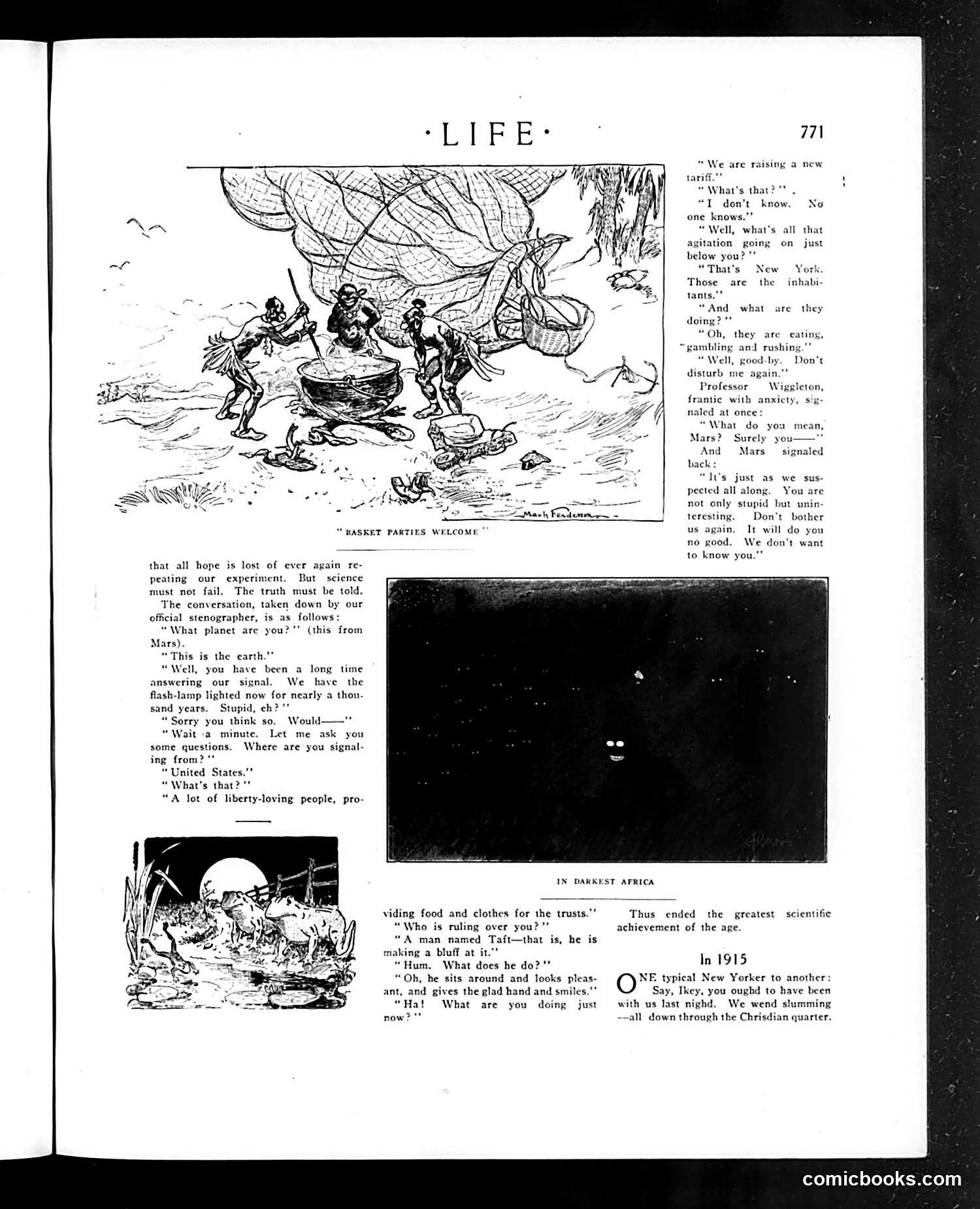
This page satirizes American society through an imagined conversation between Mars and Earth. When Martians contact Earth via the United States, they're deeply unimpressed. The satire targets: 1. **American politics**: President Taft is mocked as someone who merely "sits around and looks pleasant" rather than governing effectively—a common contemporary criticism of his presidency. 2. **Capitalism/trusts**: Americans are depicted as serving wealthy corporations ("providing food and clothes for the trusts"). 3. **Social chaos**: The Martians observe "eating, gambling and rushing"—characterizing American life as materialistic and frenetic. 4. **National arrogance**: America's tardiness in responding to aliens, and its supposed stupidity, make Earth itself seem contemptible to superior beings. The joke: Martians conclude Americans aren't worth knowing. It's a withering commentary on American priorities and governance circa 1912, using extraterrestrial perspective to expose domestic failings.
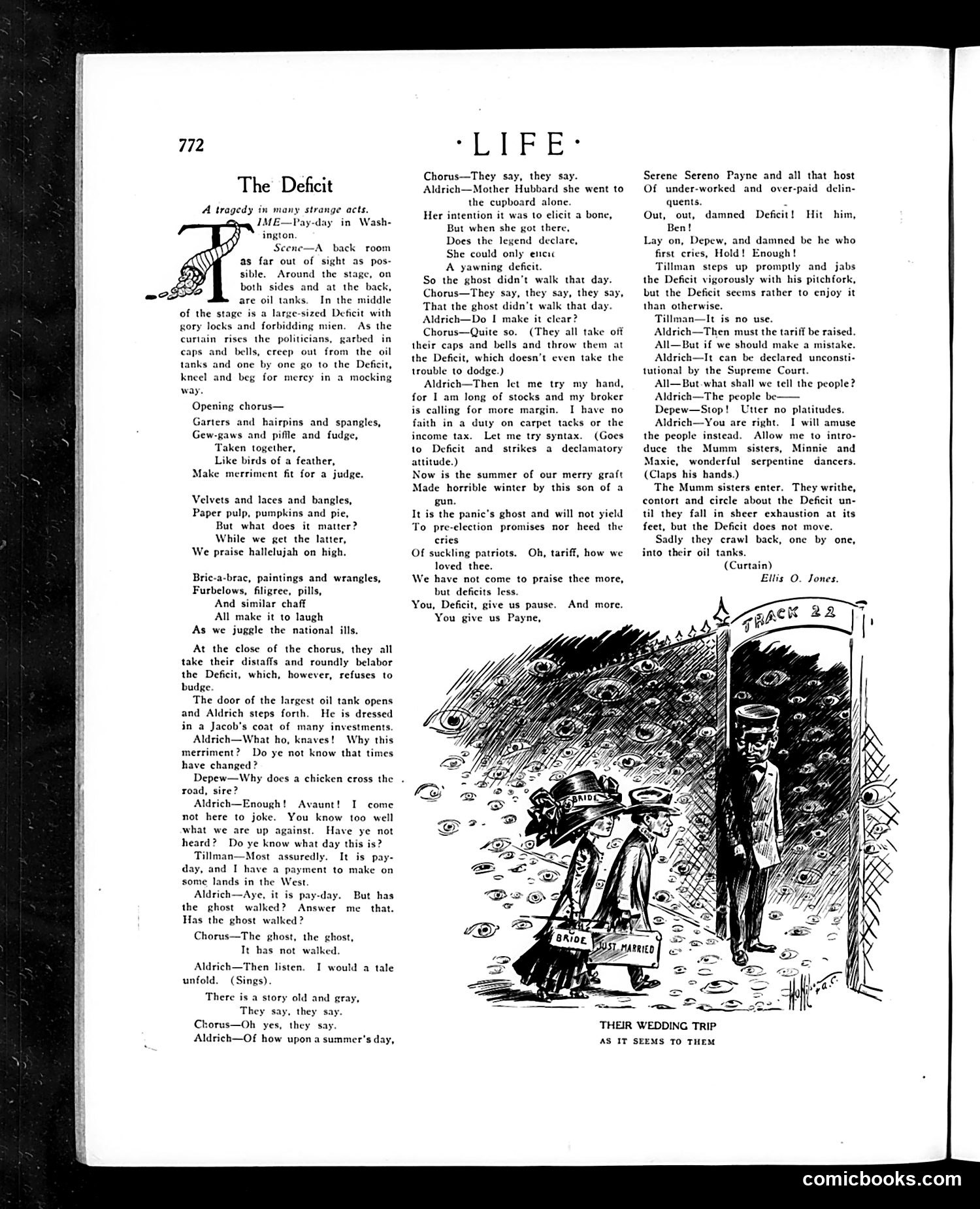
This is a theatrical parody mocking Congressional inability to address the federal deficit. The "Deficit" is personified as an indestructible monster that politicians cannot defeat. **Key figures:** - **Aldrich** (Senator Nelson Aldrich): Republican leader representing wealthy financial interests, advocating tariff increases - **Depew** and **Tillman**: Other politicians shown as ineffectual - **Payne**: References Secretary of Treasury Sereno Payne **The satire targets:** Politicians' reliance on procedural tricks (tariffs, constitutional court appeals) rather than solving actual problems. The opening chorus mocks how Congress treats serious fiscal matters as entertainment—juggling "national ills" while pursuing personal gain ("garters and hairpins"). The Mother Hubbard nursery rhyme parallels the empty cupboard (treasury) to the government's financial depletion. Politicians' attempted beatings of the Deficit prove useless, emphasizing their powerlessness. **The joke for modern readers:** This 1909-era critique of political theater, deficit spending, and using tariffs as band-aids remains remarkably relevant.
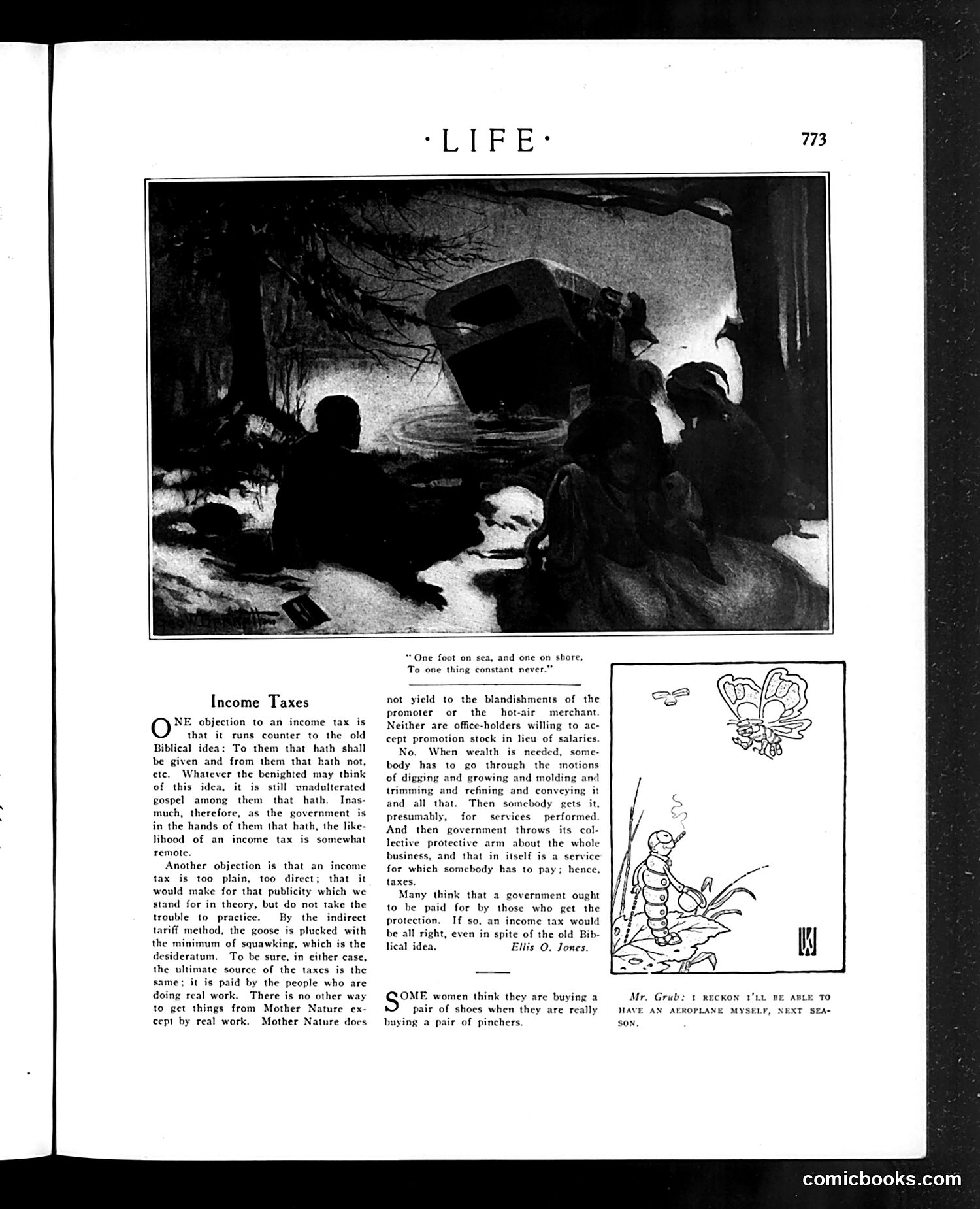
This Life magazine page critiques income tax proposals through satirical argument. The main essay argues that wealthy people ("them that hath") oppose direct income taxes despite claiming to support transparency, preferring indirect tariffs that hide the cost from workers ("the goose is plucked with minimum of squawking"). The author notes that ultimately, working people fund government regardless of tax method, since wealth comes only from actual labor. The cartoon below shows a humble worker ("Mr. Grub") joking he'll buy an airplane next season—satirizing how workers bear all tax burdens while the wealthy enjoy luxuries. The small illustrations on the right appear to be unrelated humorous sketches. The page's core message: income taxes fairly represent who actually pays for government, contrary to wealthy objections rooted in outdated Biblical ideas about wealth distribution.
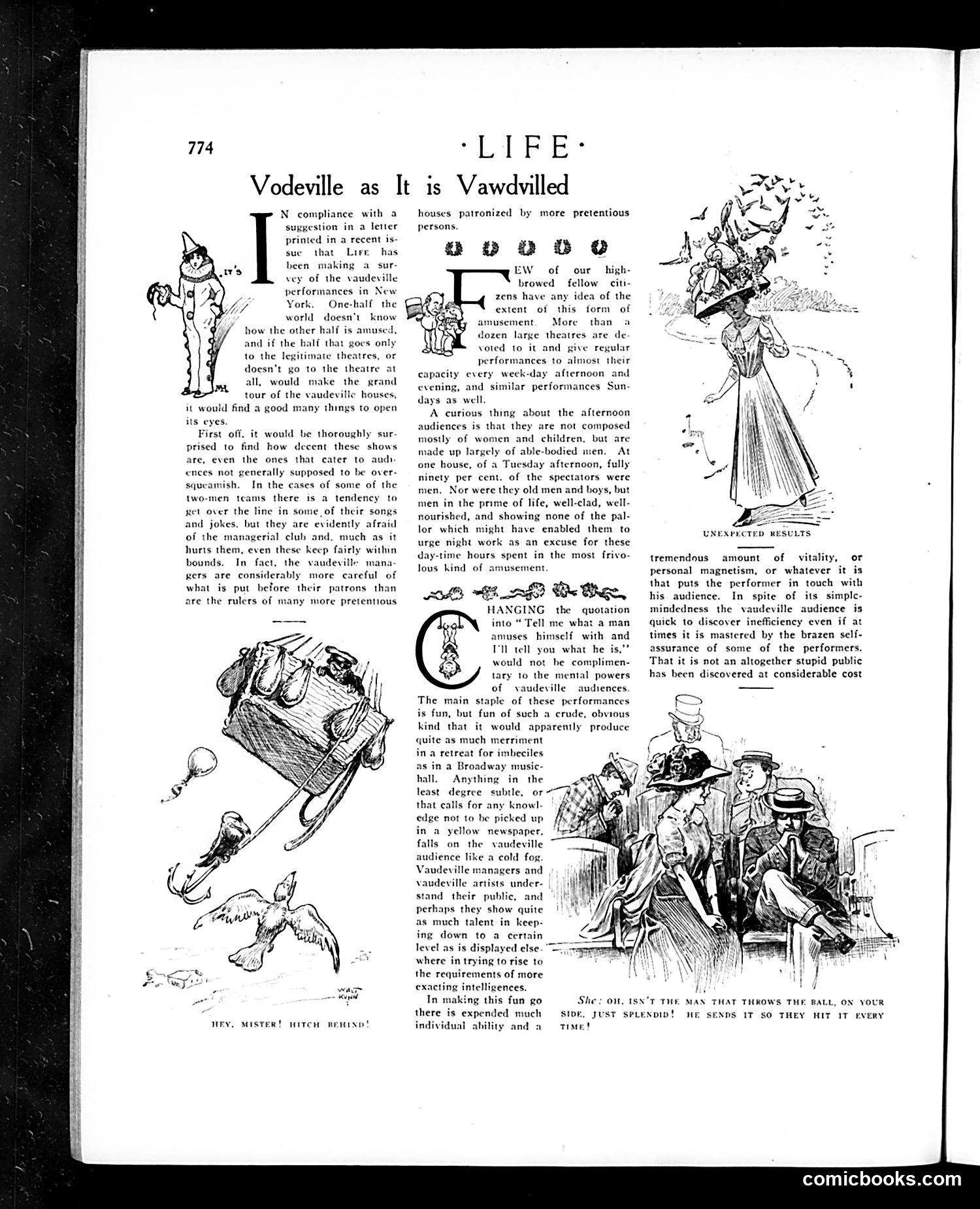
This Life magazine article surveys New York vaudeville theaters, a then-popular form of live entertainment. The author expresses surprise at vaudeville's respectability and its diverse daytime audiences—notably composed of able-bodied working men rather than just women and children as stereotypically assumed. The satire critiques vaudeville's intellectual level: the humor is "crude" and "obvious," requiring no education beyond what "yellow newspapers" teach. Yet the article acknowledges performers' genuine skill in understanding their audience and maintaining engagement despite simplistic material. The accompanying cartoons illustrate typical vaudeville acts: acrobats, slapstick performers, and comedians. The final caption mocks the obvious nature of the humor—a character praising someone for throwing a ball in predictable patterns. The overall tone is gently mocking toward both vaudeville's lowbrow appeal and the audiences who enjoy it, while grudgingly admitting the performers' talent.
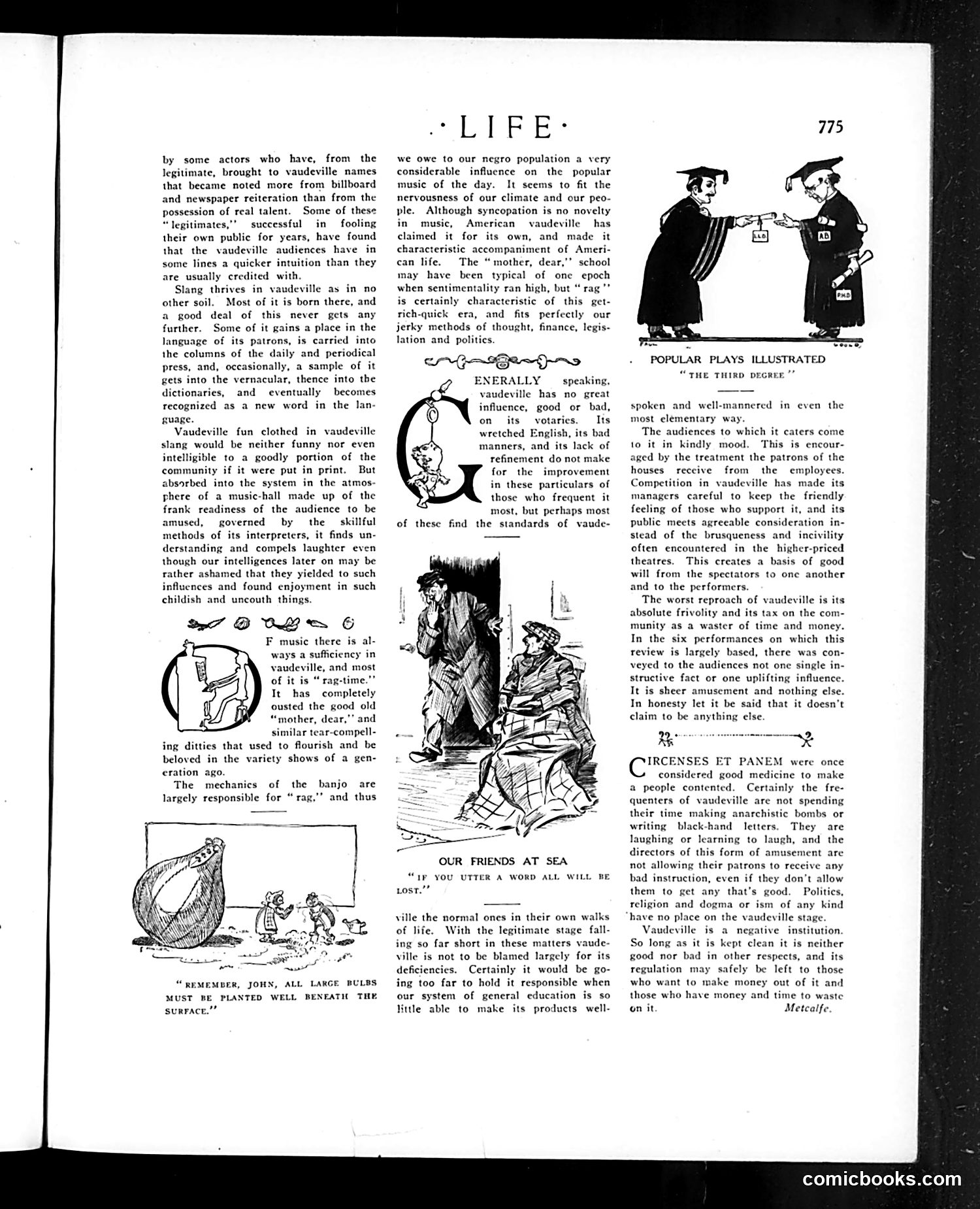
This page discusses vaudeville theater culture, criticizing and defending it simultaneously. The cartoons appear to be humorous illustrations of everyday life rather than political satire. The top cartoon shows two graduates in academic robes—likely representing the "legitimate" theater actors mentioned in text who brought their theatrical credentials to vaudeville but lacked genuine talent. The middle illustration depicts a scene labeled "Our Friends at Sea," showing people in a boat, with the caption "If you utter a word all will be lost"—a visual gag about maintaining silence. The bottom cartoon shows a gardener being instructed about planting bulbs, captioned "Remember, John, all large bulbs must be planted well beneath the surface"—a simple domestic humor piece. The text critiques vaudeville's embrace of "rag-time" music (syncopated African American music), acknowledging it fits the "nervousness" of modern American life while discussing how vaudeville slang influences mainstream language and culture. The author views vaudeville as culturally inferior but acknowledges its significant influence on American entertainment and speech.
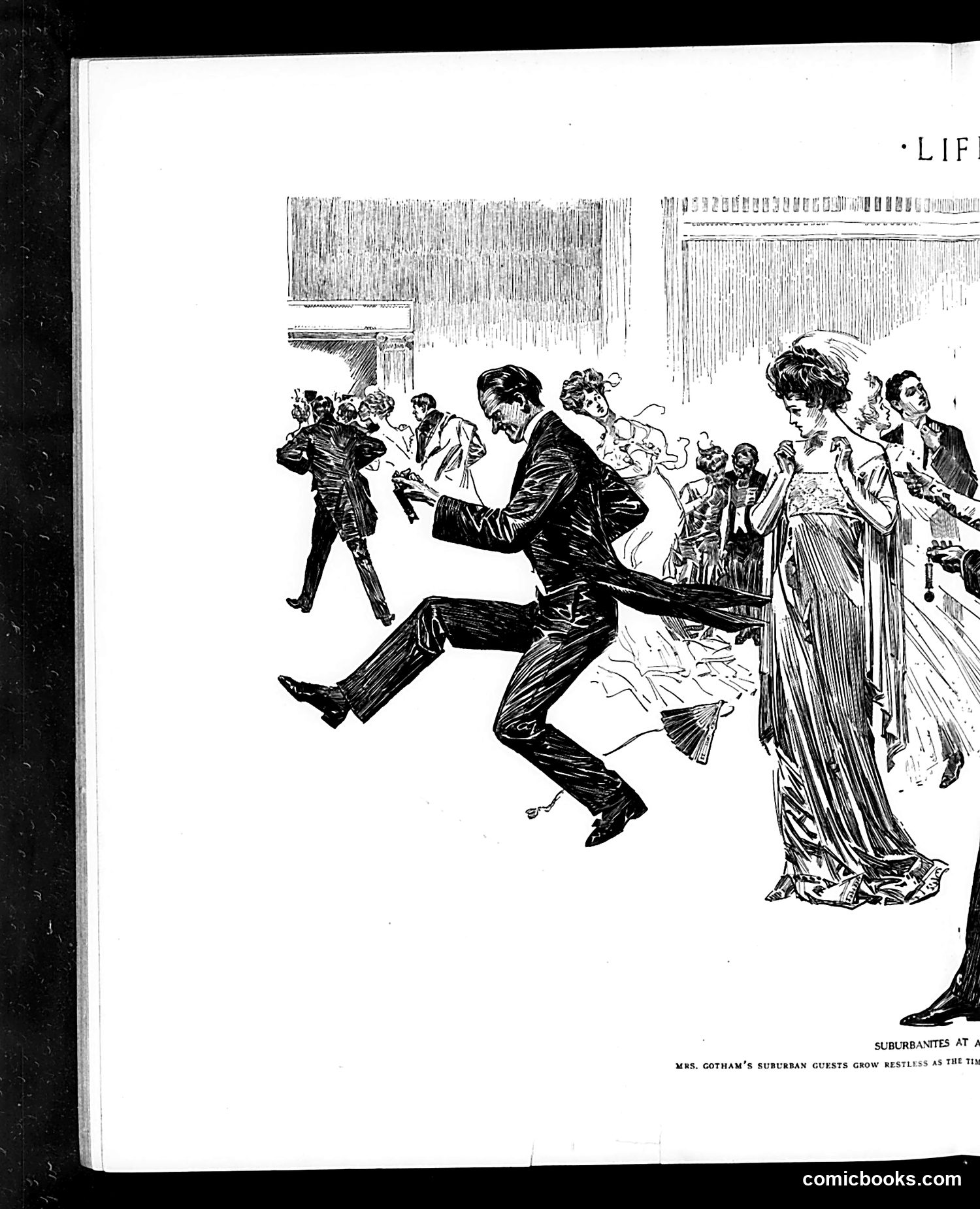
This satirical illustration depicts a formal social gathering where suburban guests at "Mrs. Gotham's" party are behaving wildly—a man in the center leaps and kicks exuberantly while others appear agitated. The cartoon mocks suburban residents' restlessness and loss of propriety in supposedly refined settings. The satire likely critiques early 20th-century suburban culture: newly wealthy or middle-class suburban dwellers attending city social events, unable to maintain proper etiquette despite aspirations to sophistication. The contrast between formal dress (evening gowns, suits) and uncontrolled behavior suggests tension between suburban pretension and authentic urban refinement—a common *Life* magazine theme mocking the nouveau riche and social climbing. The title's incomplete state makes the exact target slightly unclear, but the central joke concerns suburban guests' inability to fit into genteel society.
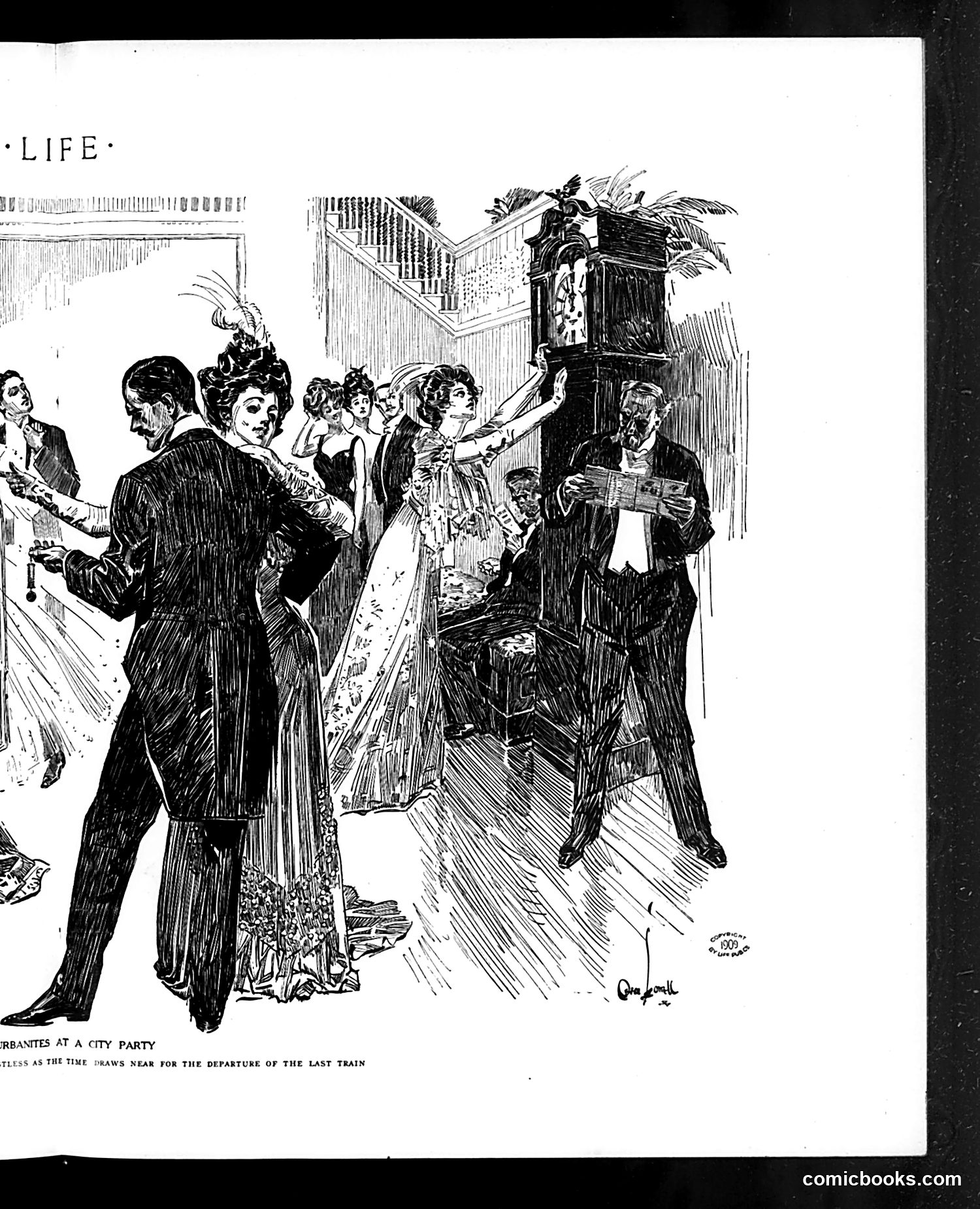
This illustration satirizes upper-class social anxiety about train schedules. The caption indicates guests at an elegant party are becoming anxious as the departure time of "the last train" approaches—suggesting these are suburbanites who must return home by rail and cannot stay late into the evening. The cartoon mocks the tension between urban sophistication (the formal party setting with well-dressed figures) and suburban dependence on rigid transportation schedules. The woman in the center appears distressed, while men check their watches or look concerned. The humor lies in depicting how even affluent urbanites are constrained by practical transit limitations, unable to enjoy the freedom of city nightlife without worrying about missing their train home.
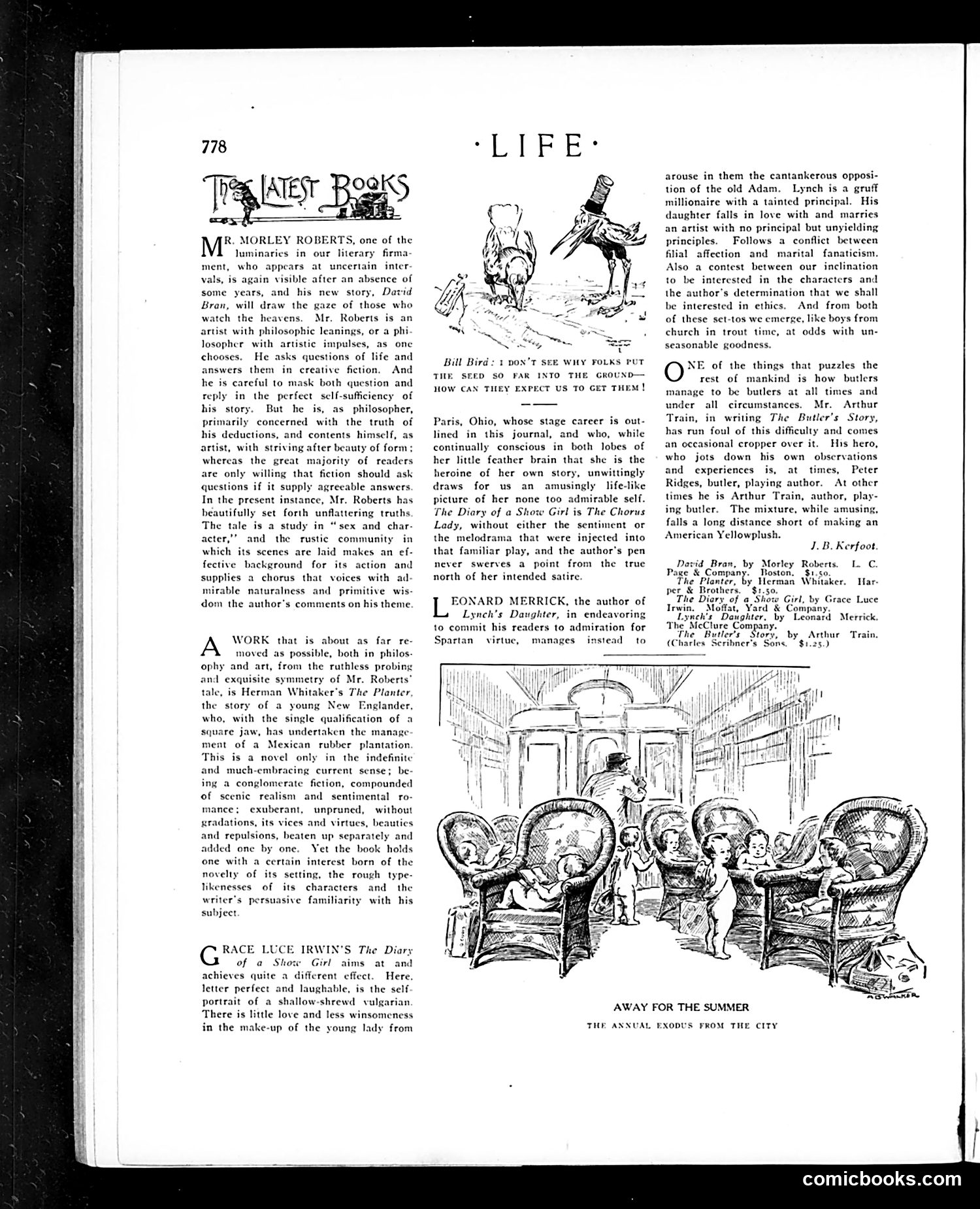
This page reviews several contemporary novels. The cartoon shows "Bill Bird," a rustic character complaining that farmers plant seeds too deep in the ground to expect good crops—a visual metaphor for poor planning or misguided effort. The reviews discuss works by Morley Roberts (*David Bran*), Herman Whitaker (*The Planter*), Grace Luce Irwin (*The Diary of a Show Girl*), and Leonard Merrick (*Lynch's Daughter*). The critic praises Roberts for philosophically probing "sex and character" through rural settings, while criticizing other authors for heavy-handed moralizing or shallow sentimentality. The reviews reflect early 20th-century literary tastes—preferring psychological realism and subtle satire over melodrama or didactic ethics. The mention of "shallow-shrewd vulgarian" characters suggests contemporary interest in satirizing both working-class and theatrical society.
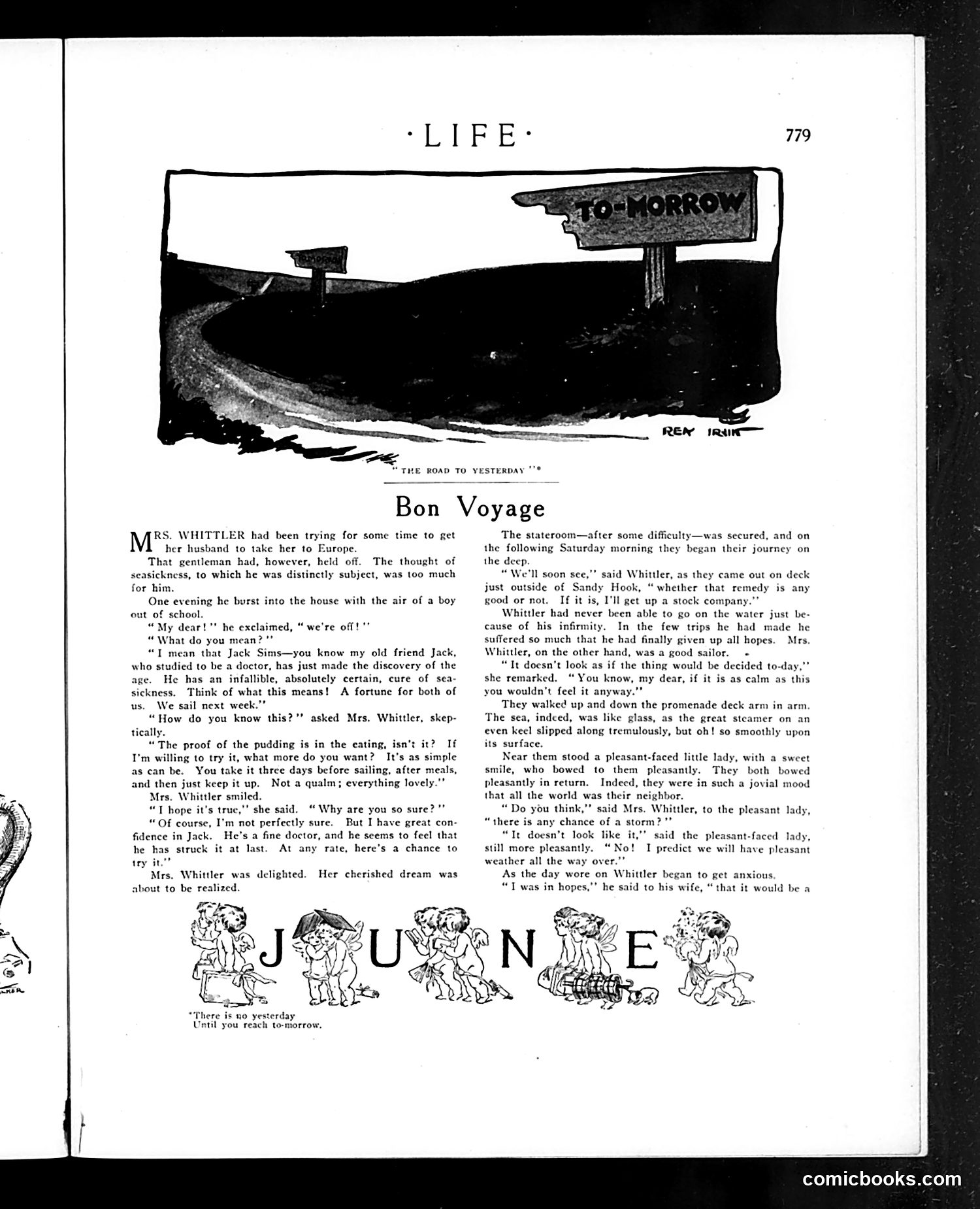
This is a humorous short story rather than a political cartoon. It depicts Mr. Whittler, a man chronically prone to seasickness, finally agreeing to take his wife to Europe after a friend (Jack Sims, a doctor) claims to have discovered an infallible cure. The satire targets **medical quackery and gullible believers**—a common theme in early 20th-century Life magazine. Whittler's willingness to trust an untested remedy simply because his friend "feels" confident about it mocks credulous faith in pseudo-scientific cures. The irony deepens as they board ship in perfectly calm seas, making it impossible to actually test the remedy's effectiveness. The heading "The Road to Yesterday" and the month "June" motif suggest this may be part of a serialized story, with the setup promising comedic consequences to follow. The "To-Morrow" sign in the cartoon hints that expectations will shift—likely suggesting seasickness will eventually strike despite the "cure."
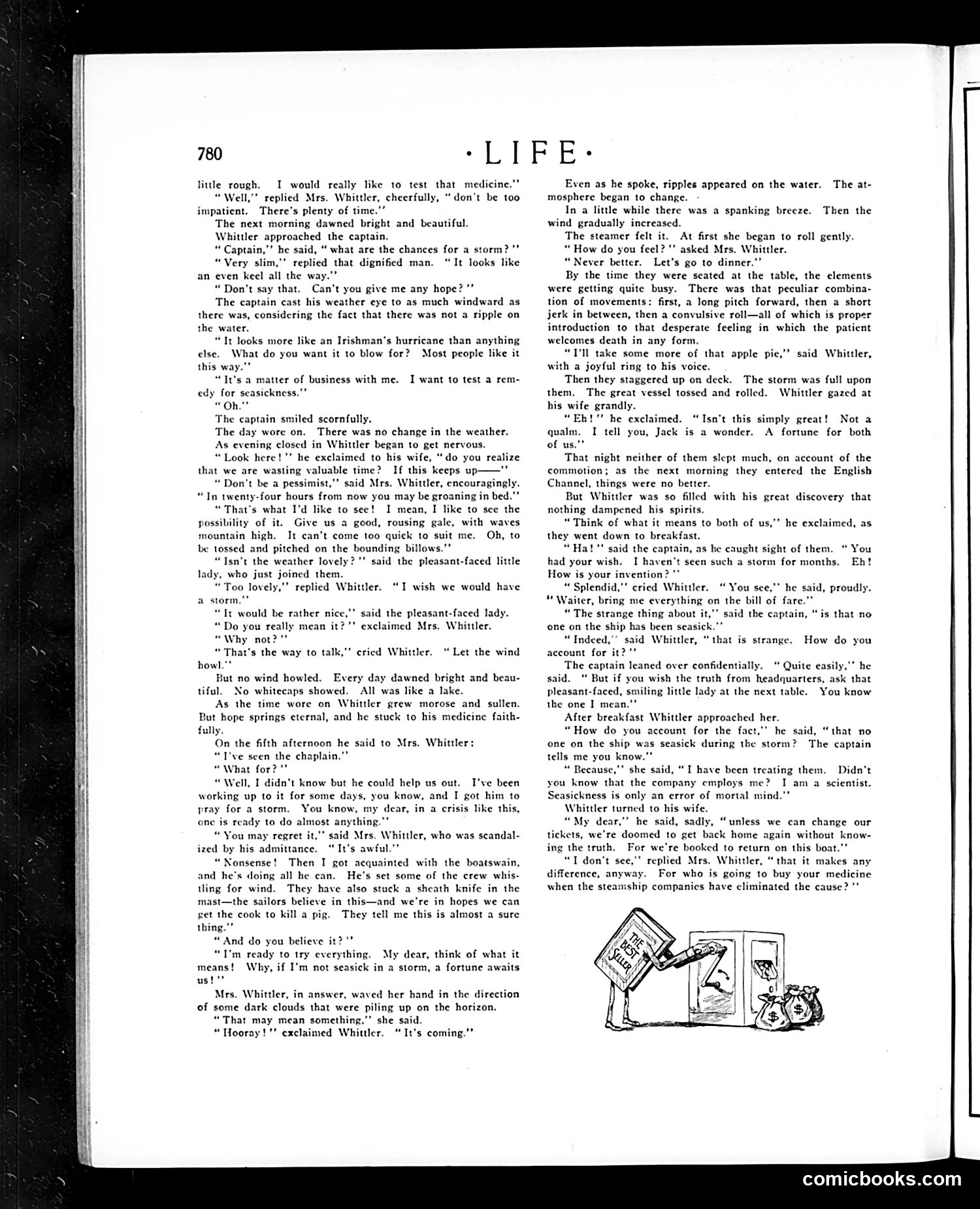
This page presents a serialized story rather than a political cartoon. It satirizes a man named Whittler who has developed a seasickness remedy and desperately needs stormy conditions to test it on ocean voyage passengers. The humor derives from the irony: while normal travelers *hope* for calm seas, Whittler actively *prays* for a storm—even enlisting the ship's chaplain, boatswain, and crew (who employ traditional superstitions like knife-in-mast and pig-slaughtering rituals) to conjure one. The satire mocks both Whittler's misguided entrepreneurship and the era's folk remedies and superstitious beliefs. The small illustration at page bottom shows a character pouring from a medicine bottle—likely depicting Whittler's dubious "cure." The story appears humorous rather than politically charged, typical of Life's satirical fiction content.
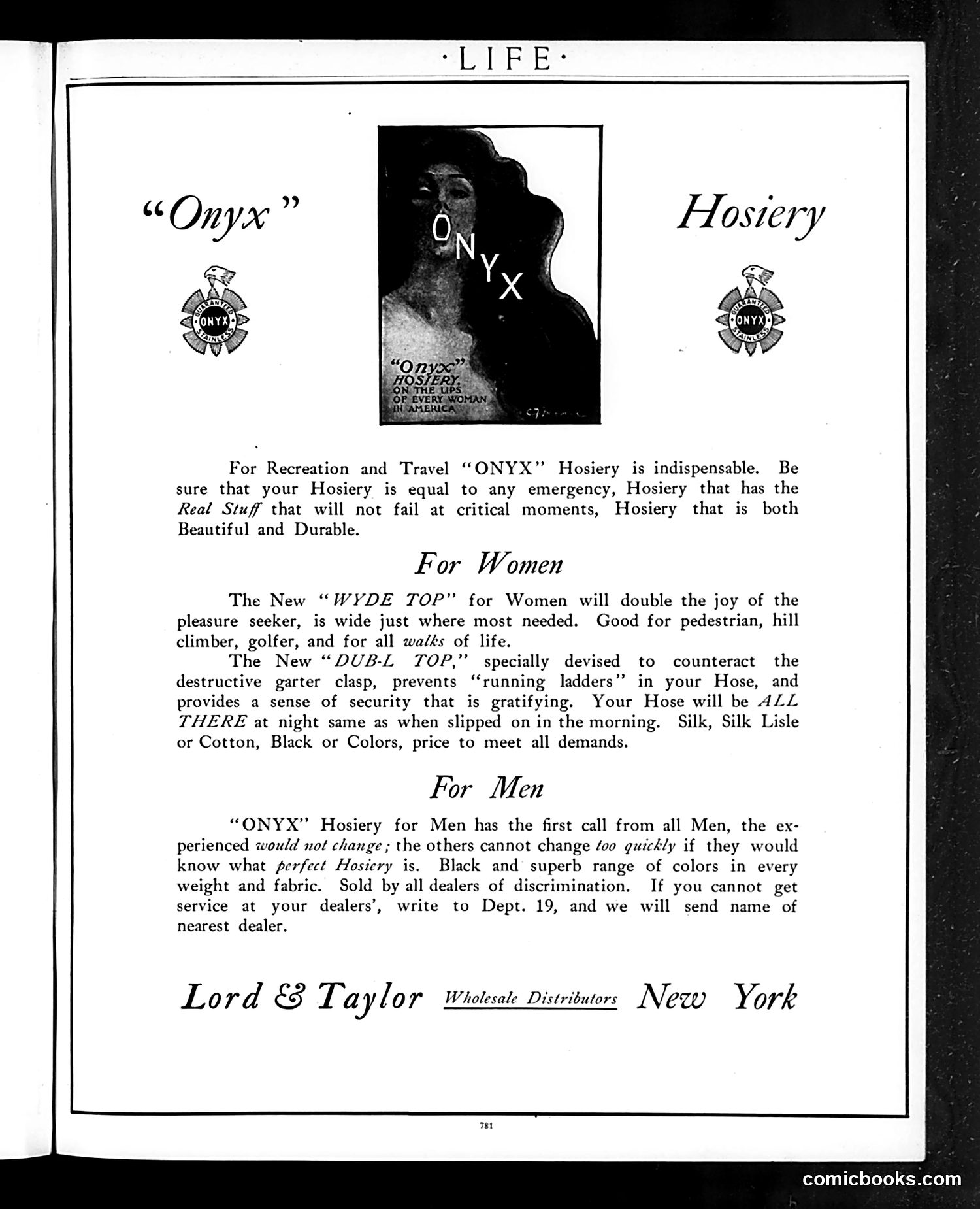
This is a straightforward advertisement for "Onyx" brand hosiery (socks/stockings), not a political cartoon. The page promotes three product lines: general "Onyx" hosiery for travel and recreation, a "Wyde Top" and "Dubl Top" variant for women (designed to prevent "running ladders"—what we'd call runs or snags—and stay secure), and "Onyx" hosiery for men. The central image appears to be a woman modeling or representing the product. The ad emphasizes durability and reliability across different contexts (hiking, golfing, daily wear) and notes availability in silk, cotton, and various colors. Lord & Taylor distributed the brand from New York. There is no satire or political commentary present—this is period advertising from Life magazine's commercial content.
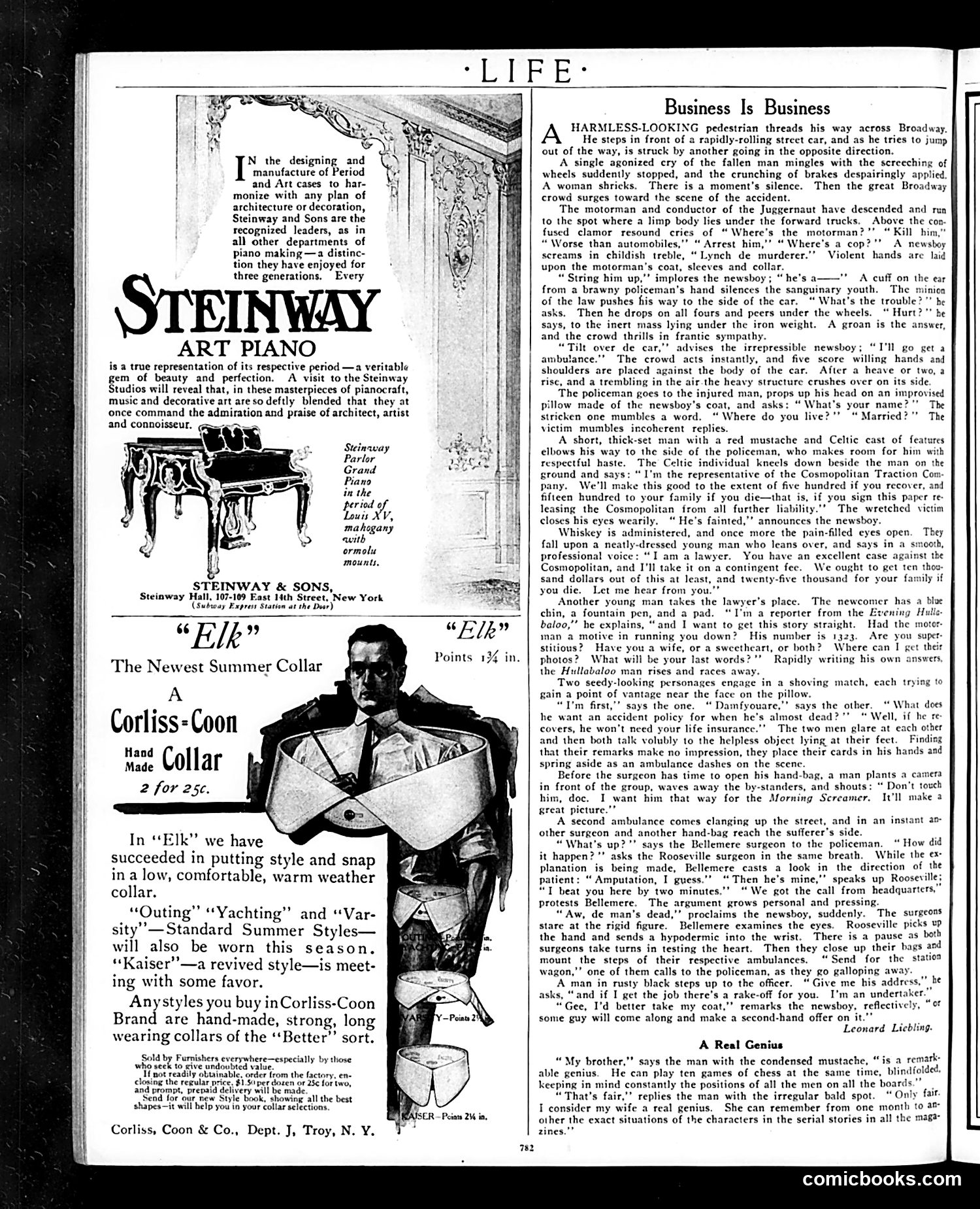
This page's main content is a short story titled "Business Is Business" depicting a pedestrian struck by a streetcar on Broadway. The narrative satirizes urban indifference and opportunism: after the accident, amid genuine concern and chaos, a newsboy immediately commercializes the tragedy, hawking evening papers about the incident. The satire targets how modern city life—even human suffering—becomes mere commercial opportunity. The crowd's emotional response ("Lynch de murderer") contrasts with the practical mundanity of bureaucratic response (the policeman's questions) and the newsboy's mercenary instinct, suggesting that in business-driven America, tragedy is merely product. The surrounding advertisements (Steinway pianos, Corliss-Coon collars) reinforce this theme: even *Life* magazine itself monetizes the page by selling luxury goods alongside dark social commentary.
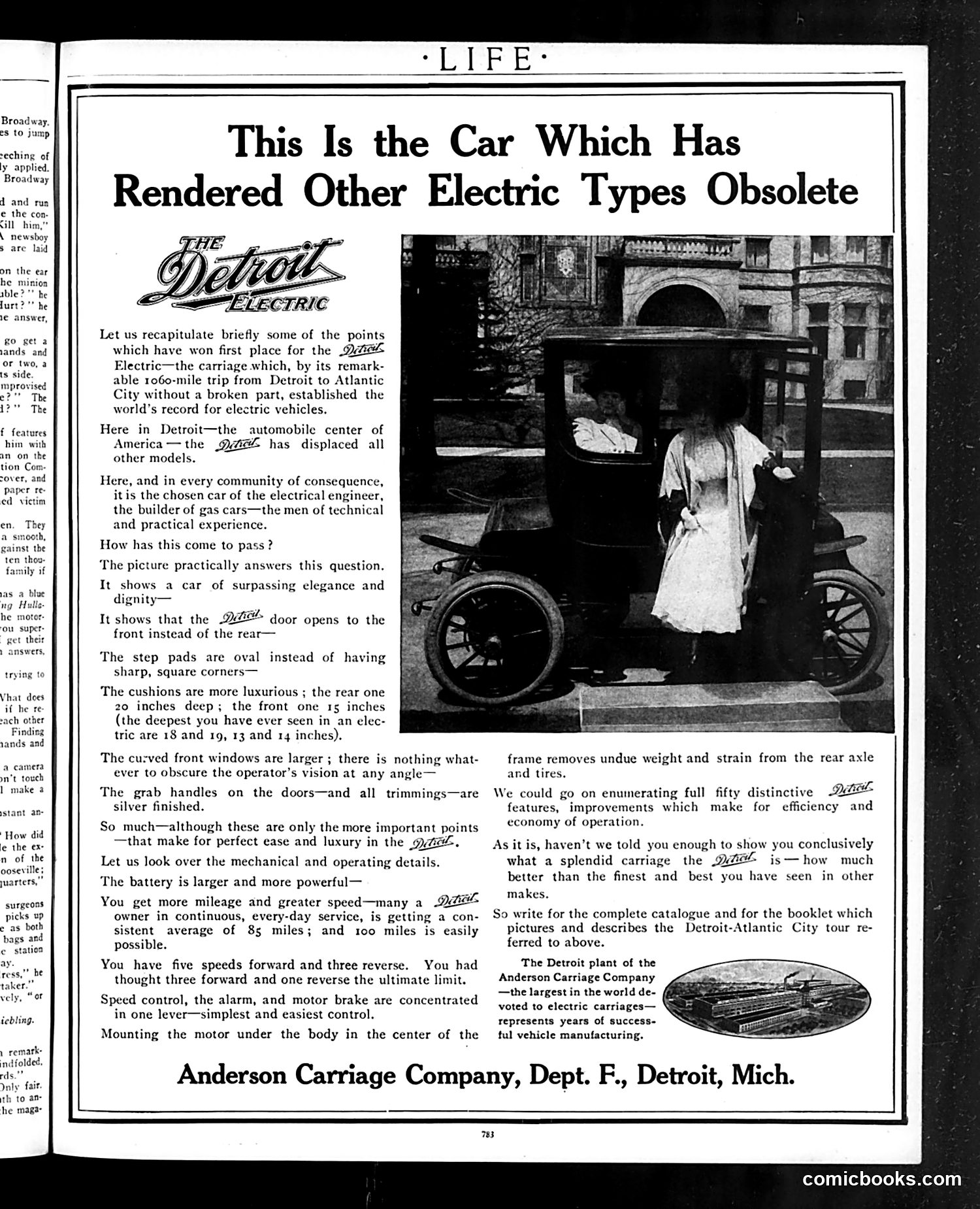
This is **not a cartoon or satire**, but rather a **straightforward advertisement** for the Detroit Electric automobile, published in *Life* magazine (likely early 1900s). The page promotes the Detroit Electric as superior to competing electric vehicles, emphasizing its 1,060-mile Detroit-to-Atlantic City trip without mechanical failure. The advertisement highlights luxury features (silver trim, deep cushions, front-opening doors, curved windows) and technical improvements (larger battery, five forward speeds, centered motor). The photograph shows a well-dressed woman entering the vehicle, appealing to affluent consumers—electric cars were marketed as clean, quiet, and prestigious alternatives to gasoline vehicles. **Historical context**: This predates the mass-market dominance of gasoline cars. Electric vehicles were actually popular among the wealthy before Henry Ford's assembly line and cheap gasoline made internal combustion engines standard.
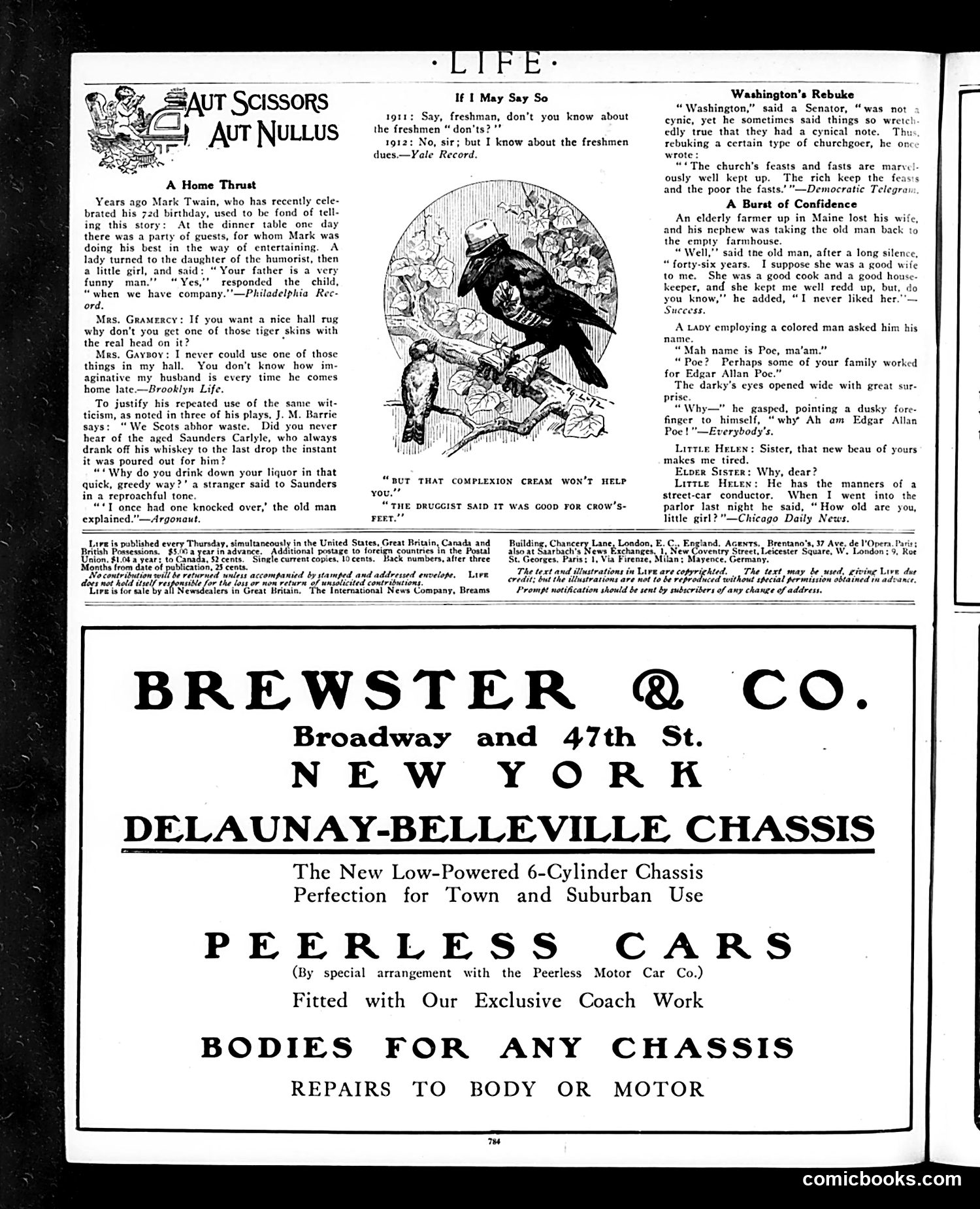
This page from *Life* magazine contains several short humorous anecdotes typical of early-20th-century American satire, plus a Brewster & Co. automobile advertisement. The cartoons/jokes target social pretension and hypocrisy: - **"A Home Thrust"** mocks Mark Twain's daughter for suggesting he's only funny "when we have company"—implying his wit is performative. - **"If I May Say So"** jokes about Yale freshmen concerned with dues rather than rules—a jab at mercenary university culture. - **"Washington's Rebuke"** attributes a cynical observation to George Washington about religious hypocrisy (the rich observing feasts, the poor fasts). - **"A Burst of Confidence"** presents a Maine farmer's blunt admission he never liked his deceased wife despite 46 years together—satirizing rural emotional repression. - **"A Lavy employing..."** uses period-inappropriate racial humor about a Black employee claiming to be Edgar Allan Poe. The page emphasizes observational humor about American social pretense, class distinctions, and gender dynamics typical of early 1910s satire.
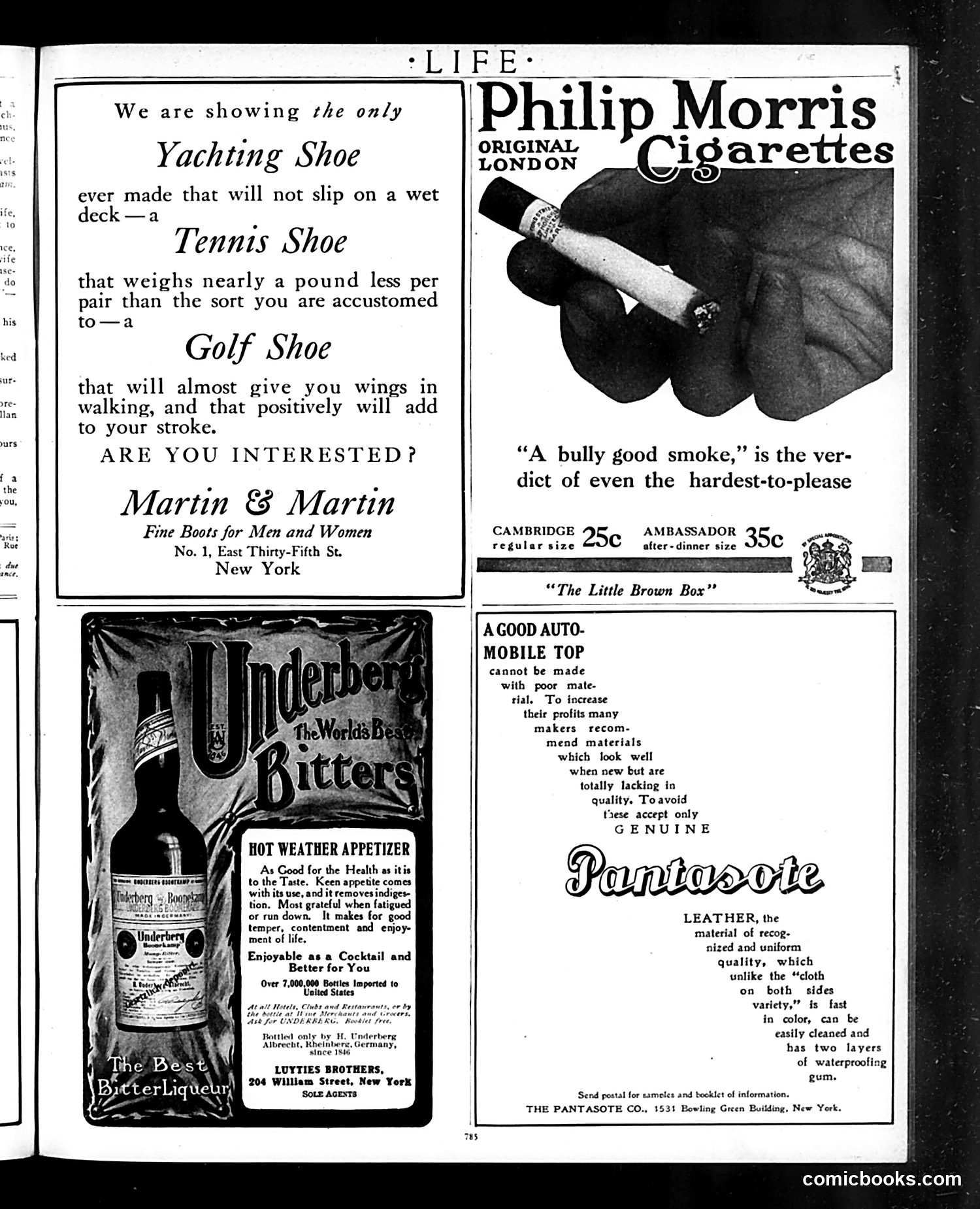
This page is primarily **advertising**, not satirical content. It contains four product advertisements from what appears to be an early 20th-century issue of Life magazine: 1. **Martin & Martin shoes** — promoting specialized footwear (yachting, tennis, golf shoes) with humorous claims about their benefits 2. **Philip Morris Cigarettes** — advertising British cigarettes with the slogan "A bully good smoke," emphasizing quality for discerning smokers 3. **Underberg Bitters** — a digestive liqueur marketed as a "hot weather appetizer" and health tonic, noting over 7 million bottles imported to the U.S. 4. **Pantasote leather** — promoting genuine leather for automobile tops, contrasting it with cheaper cloth alternatives The ads reflect period attitudes: cigarettes and alcohol presented without health warnings, and marketing language emphasizing quality materials and genteel consumption. There is no political satire or social commentary visible on this page—it is straightforward commercial advertising typical of Life's revenue model.
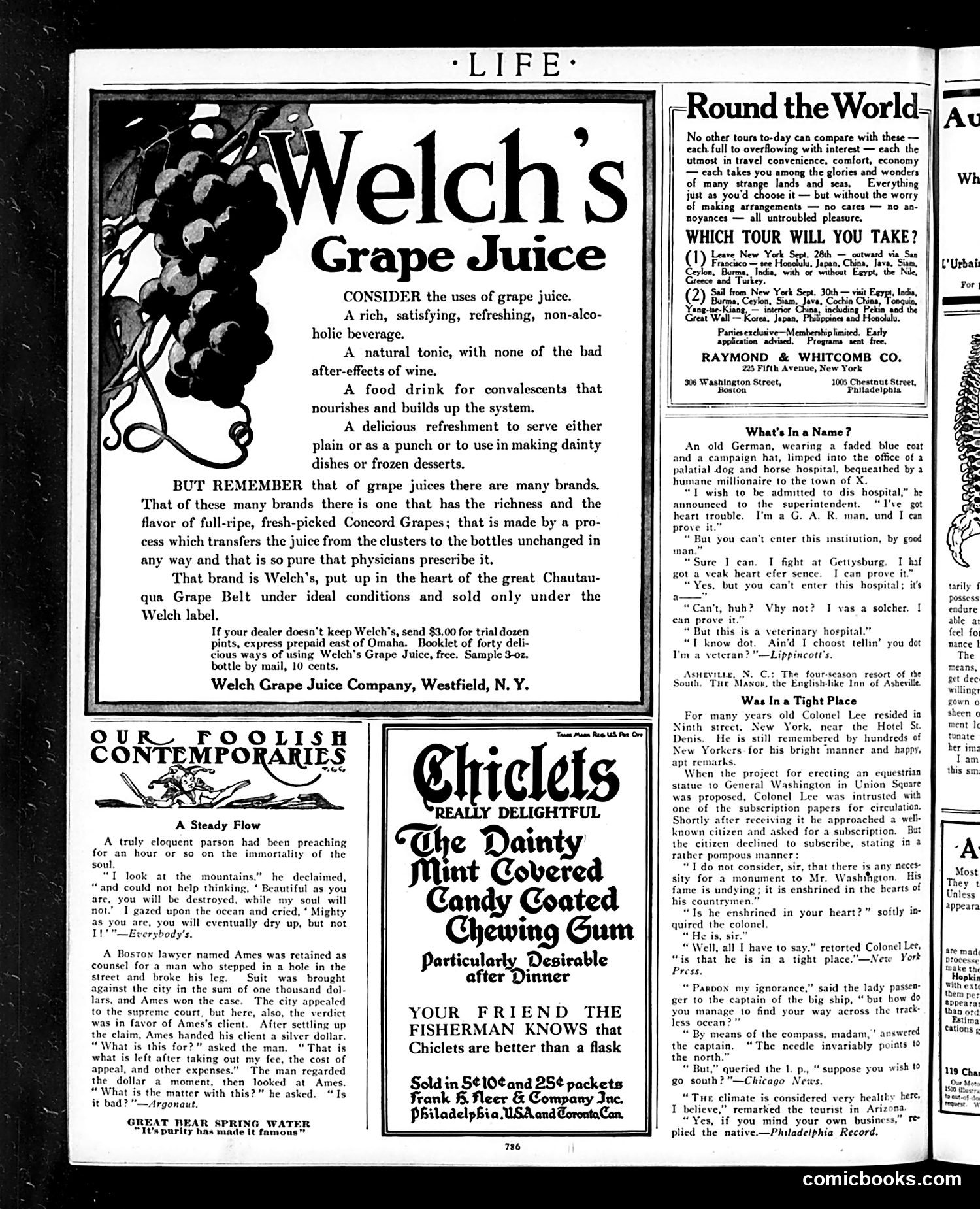
This page is primarily **advertising**, not political satire. The main content promotes **Welch's Grape Juice**, emphasizing its purity, medicinal qualities, and superiority among competing brands—typical early-20th-century product marketing highlighting the product's scientific credibility and healthfulness. Two short **humorous anecdotes** appear: one about an eloquent preacher's overwrought meditation on immortality (mocking verbose religious oratory), and another about a Boston lawyer settling a personal injury case for only a silver dollar after fees (satirizing legal costs). Secondary advertisements promote **Chiclets chewing gum** and **Raymond & Whitcomb travel tours**. The page also includes a "Round the World" travel section offering luxury cruises to Asia and the Orient—typical luxury travel marketing for wealthy Americans of the era. The humor is gentle and domestic—no political commentary is evident. This represents *Life* magazine in its primarily comedic/advertising capacity rather than its satirical editorial function.
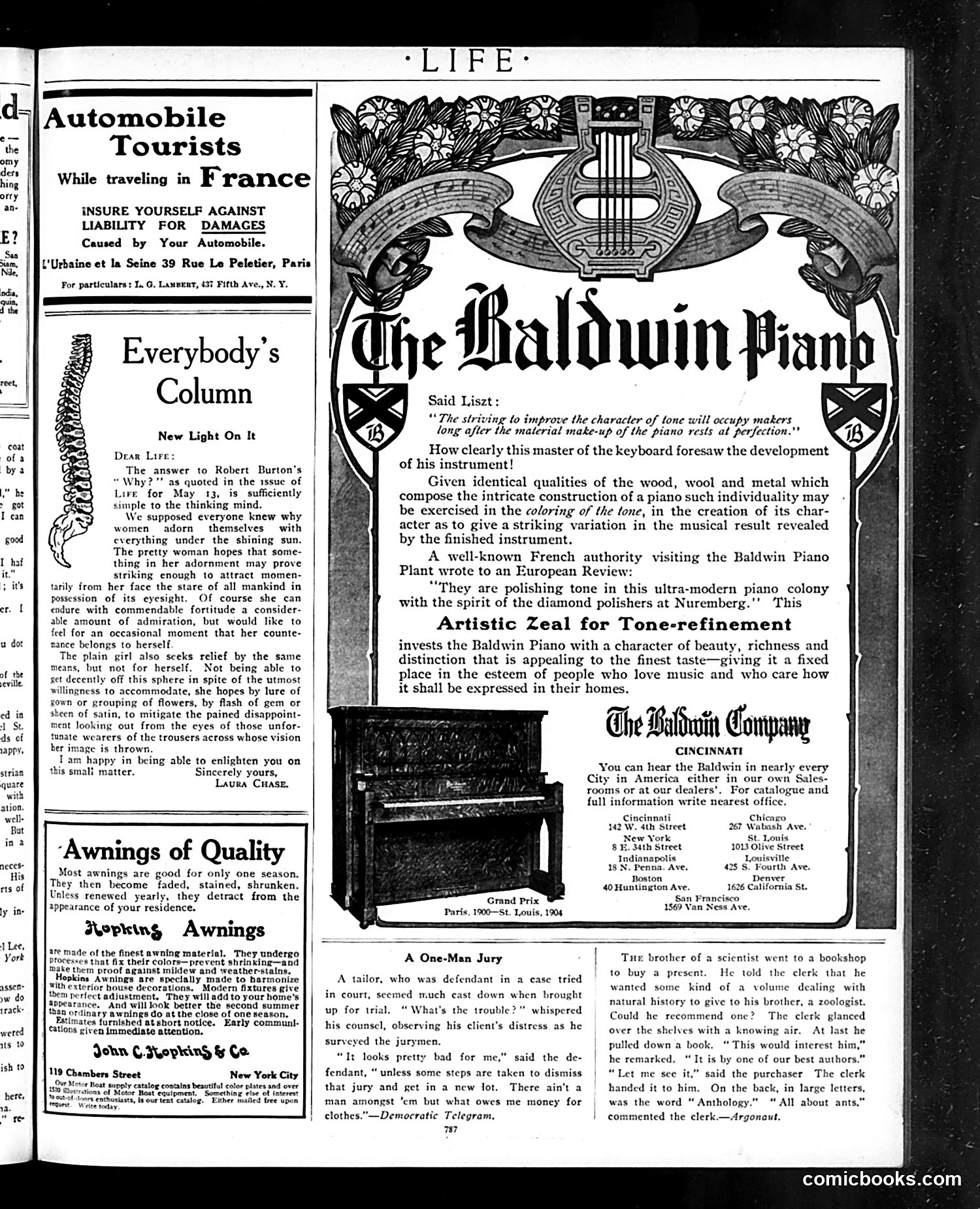
This page is primarily **advertising and advice columns**, not political satire. The main content includes: **Advertisements:** - Automobile liability insurance for French travelers - Baldwin Piano (the dominant ad), quoting composer Franz Liszt on tone quality and craftsmanship - Awnings company - Motor boat supplies **"Everybody's Column":** A letters section responding to reader inquiries about human nature—specifically, why women wear ornaments and adornments. The response, from "Laura Chase," offers social commentary: plain women use jewelry and dress to distract from their appearance, while pretty women wear adornments for modest self-presentation. **"A One-Man Jury":** A humorous anecdote about a tailor defendant who confuses a jury member by speaking nonsense. The page reflects early 20th-century consumer culture and genteel magazine discourse. There is **no political cartoon** visible—it's essentially a commercial and lifestyle page marketed toward affluent readers.
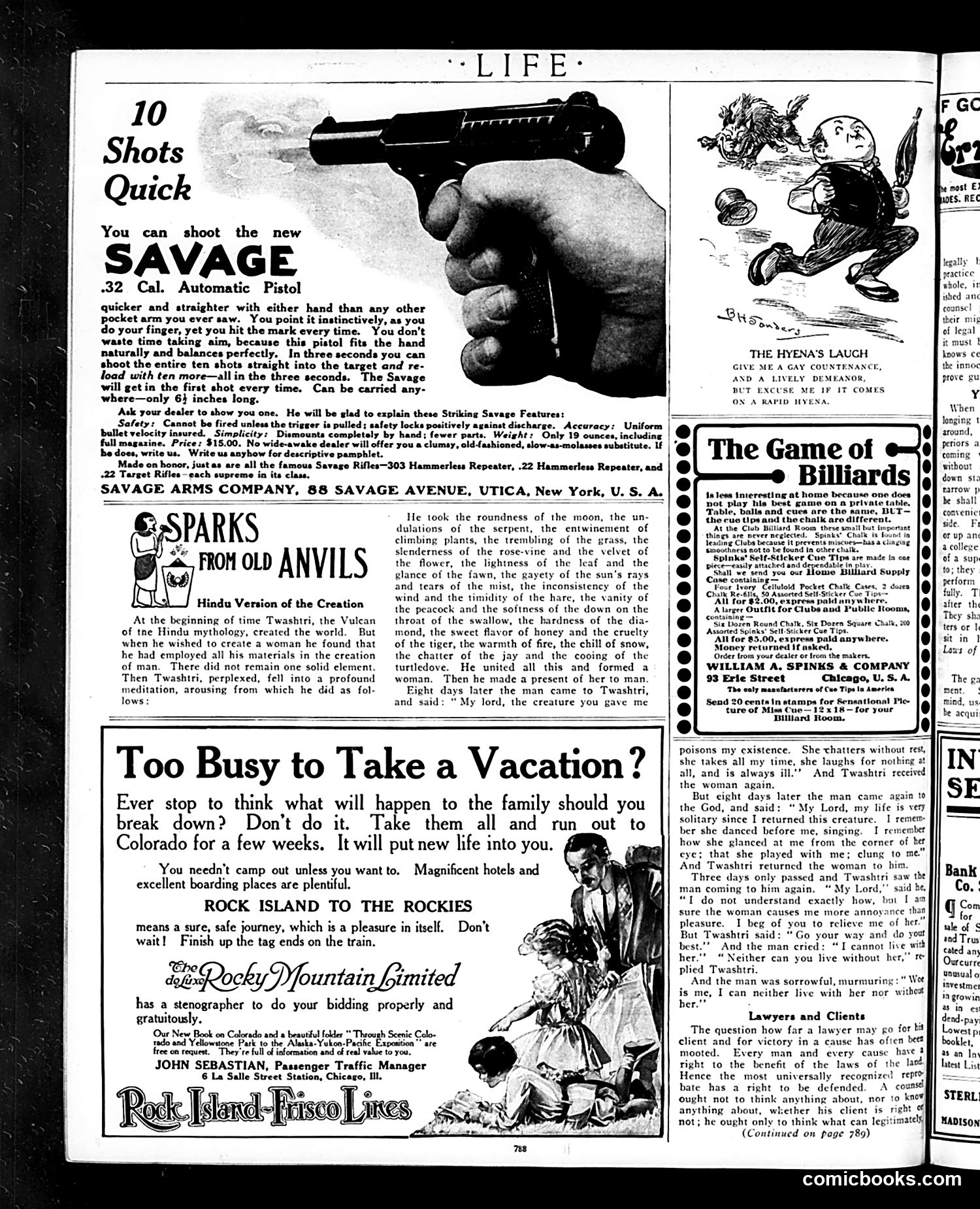
This page is primarily **advertisements and filler content**, not political satire. The main items are: 1. **Savage .32 Caliber Pistol ad** - A straightforward product advertisement emphasizing quick shooting accuracy for self-defense ("pocket arm"). 2. **"The Hyena's Laugh"** - A brief illustrated poem about hyenas, likely humorous filler content with no political meaning. 3. **"Hindu Version of the Creation"** - A retelling of a Hindu creation myth where the god Twashtri creates woman from leftover materials after creating man. The story ends with the man complaining the woman "poisons my existence" due to her chattiness. This reflects period **misogynistic humor** common in early 20th-century magazines, presenting women as burdensome. 4. **Spinks Billiards chalk advertisement** and **Rocky Mountain Limited railroad ad** - Standard commercial advertisements. 5. **"Too Busy to Take a Vacation?"** - A travel promotion for Colorado vacations. The page contains no political cartoons or meaningful satire—it's typical magazine advertising and light humor content from the era.
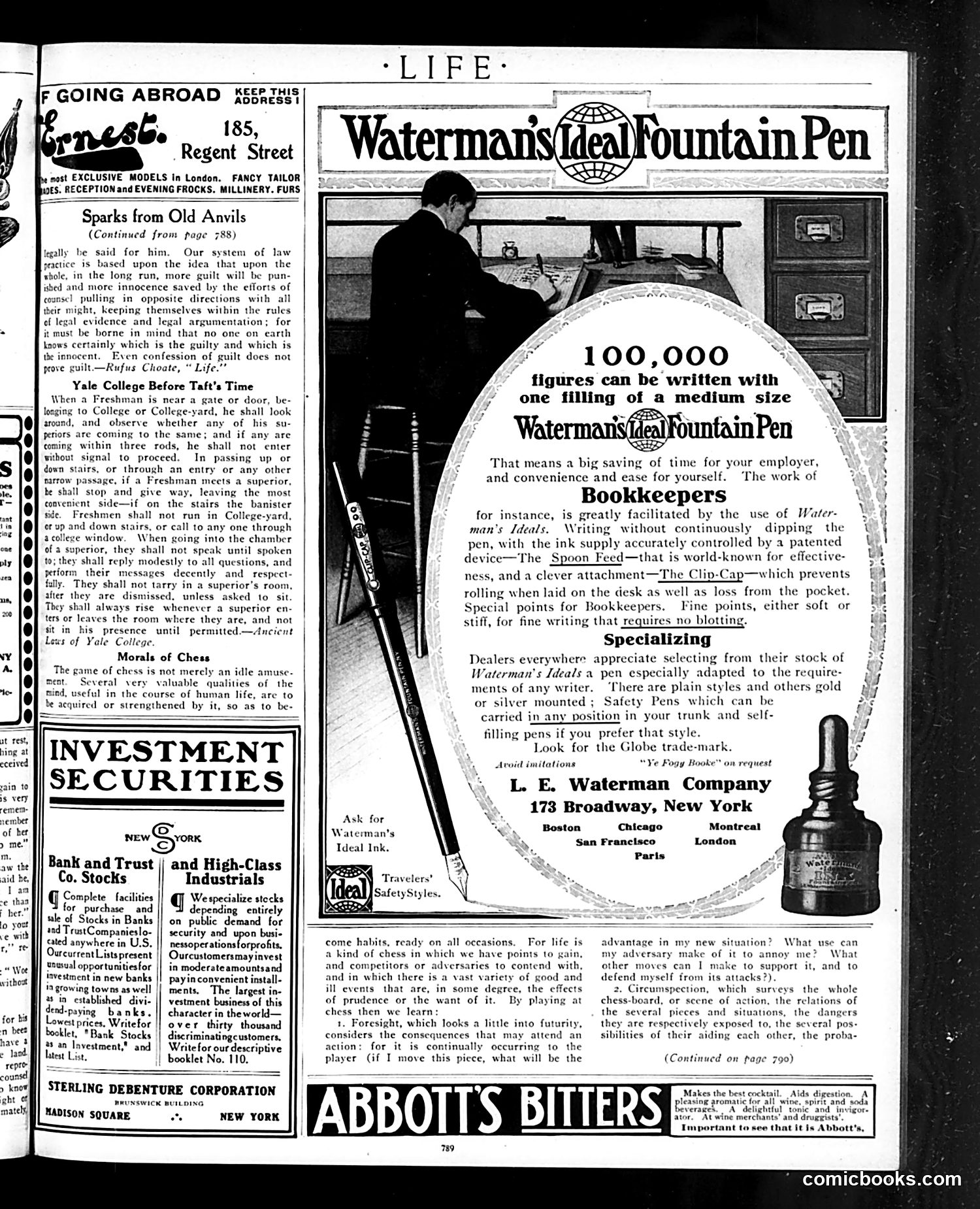
This page is primarily **advertising content** rather than political commentary or satire. The dominant feature is a large **Waterman's Ideal Fountain Pen advertisement** showing a businessman at a desk. The ad's main claim: "100,000 figures can be written with one filling" — emphasizing the pen's efficiency for bookkeepers and office workers. It highlights the "Spoon Feed" ink mechanism and "Cliv-Cap" as practical innovations preventing ink loss and blotting. The page also includes several minor editorial pieces ("Sparks from Old Anvils," Yale College rules, chess morality) and advertisements for Ernest tailoring, investment securities, and Abbott's Bitters. **Context for modern readers:** This represents early 20th-century *Life*'s mixed model — satirical magazine content supplemented by paid advertisements. The fountain pen ad targets white-collar workers, reflecting the era's office culture and emphasis on writing efficiency as a business virtue.
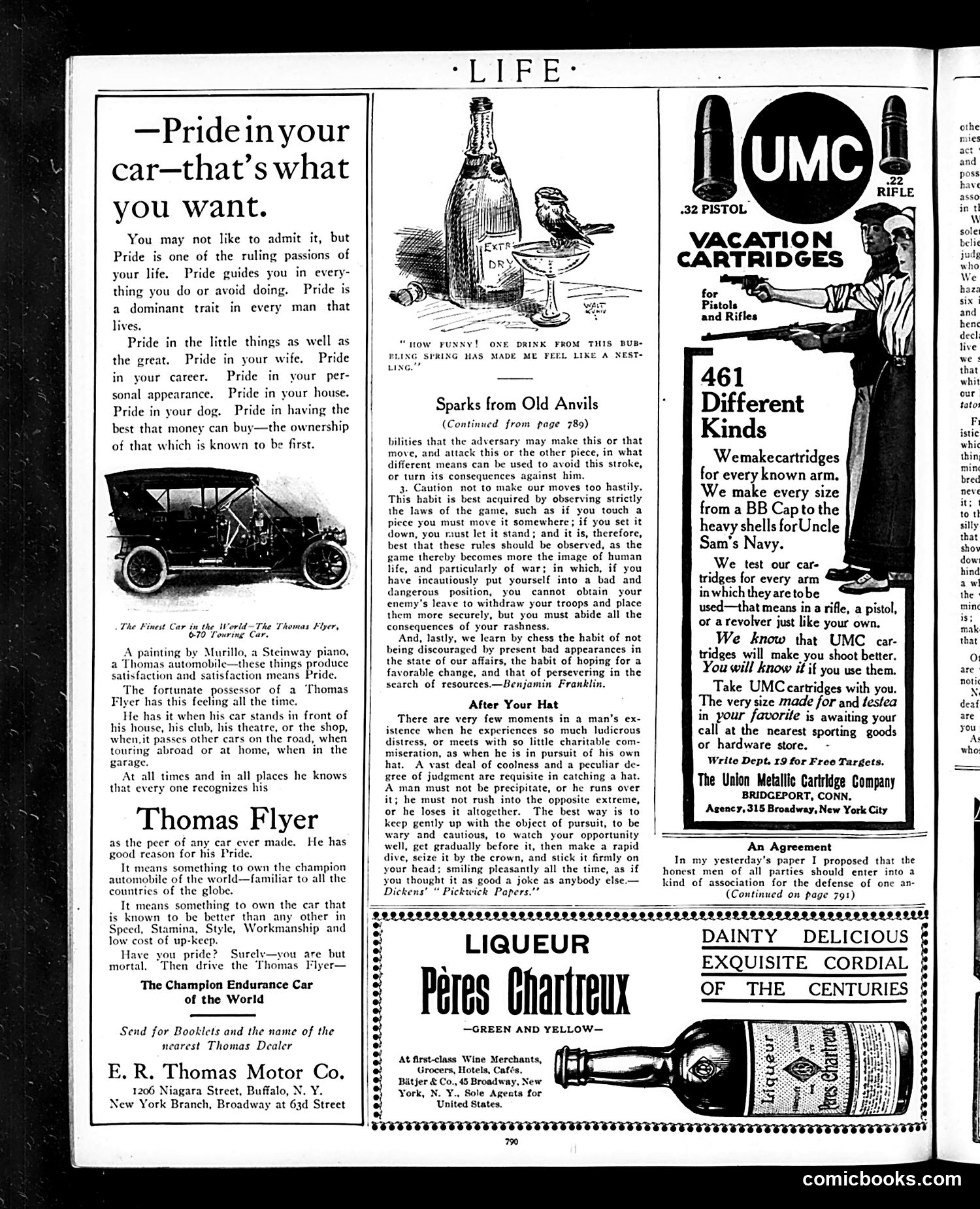
This page is primarily **advertising disguised as editorial content**—a common early-20th-century magazine practice. The main article, "Pride in Your Car," is a Thomas Flyer automobile advertisement dressed up as philosophy about human nature. It argues that owning this car satisfies fundamental human pride—a sales pitch presented as lifestyle advice. The Thomas Flyer was a real luxury automobile marketed as "the champion endurance car of the world," emphasizing status and superiority over competitors. The other content includes: - **"Sparks from Old Anvils"**: a filler piece about chess strategy and hat-catching (humorous observations) - **UMC ammunition ads**: promoting cartridges for hunting - **Peres Chartreaux liqueur ad**: luxury spirit marketing There is **no political cartoon** on this page. The imagery is purely commercial—supporting the advertisements' messaging about wealth, status, and consumption as desirable traits.
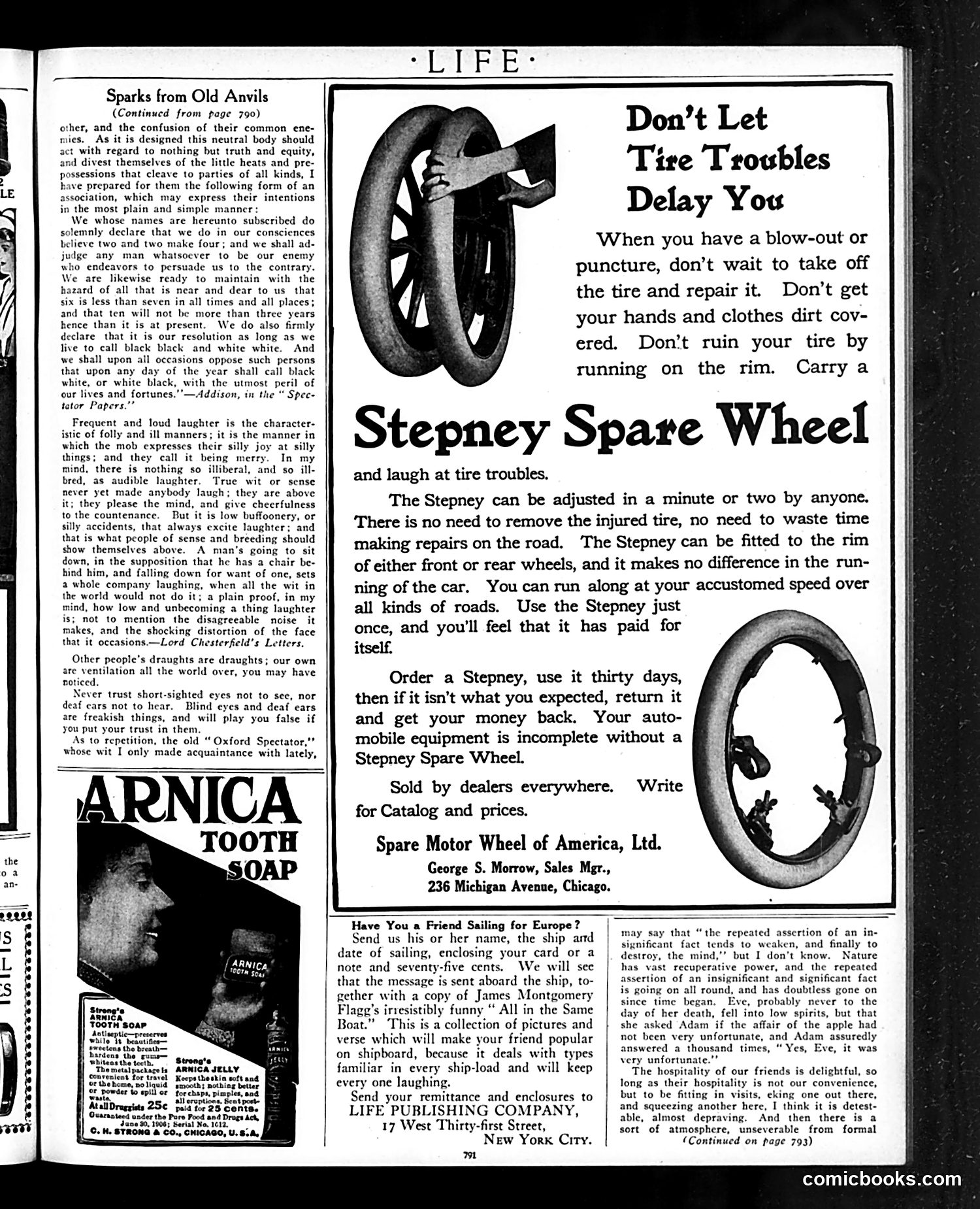
This page is primarily **advertising**, not political satire. It contains two main advertisements: 1. **"Sparks from Old Anvils"** (left column): A philosophical essay reprinting 18th-century quotations from Addison and Lord Chesterfield about truth, laughter, and human conduct. This appears to be filler content—classical wisdom presented without contemporary satirical commentary. 2. **"Stepney Spare Wheel"** (main ad): A product advertisement for an early automobile accessory—a quick-change spare wheel designed to save motorists time and effort during tire emergencies. The ad emphasizes convenience ("adjusted in a minute or two") and includes a 30-day money-back guarantee. A small **"Arnica Tooth Soap"** ad appears at bottom left. The page reflects early 20th-century automotive culture when tire troubles were common inconveniences. There is no political cartoon or satire present—this is straightforward commercial advertising interspersed with classical literary excerpts.
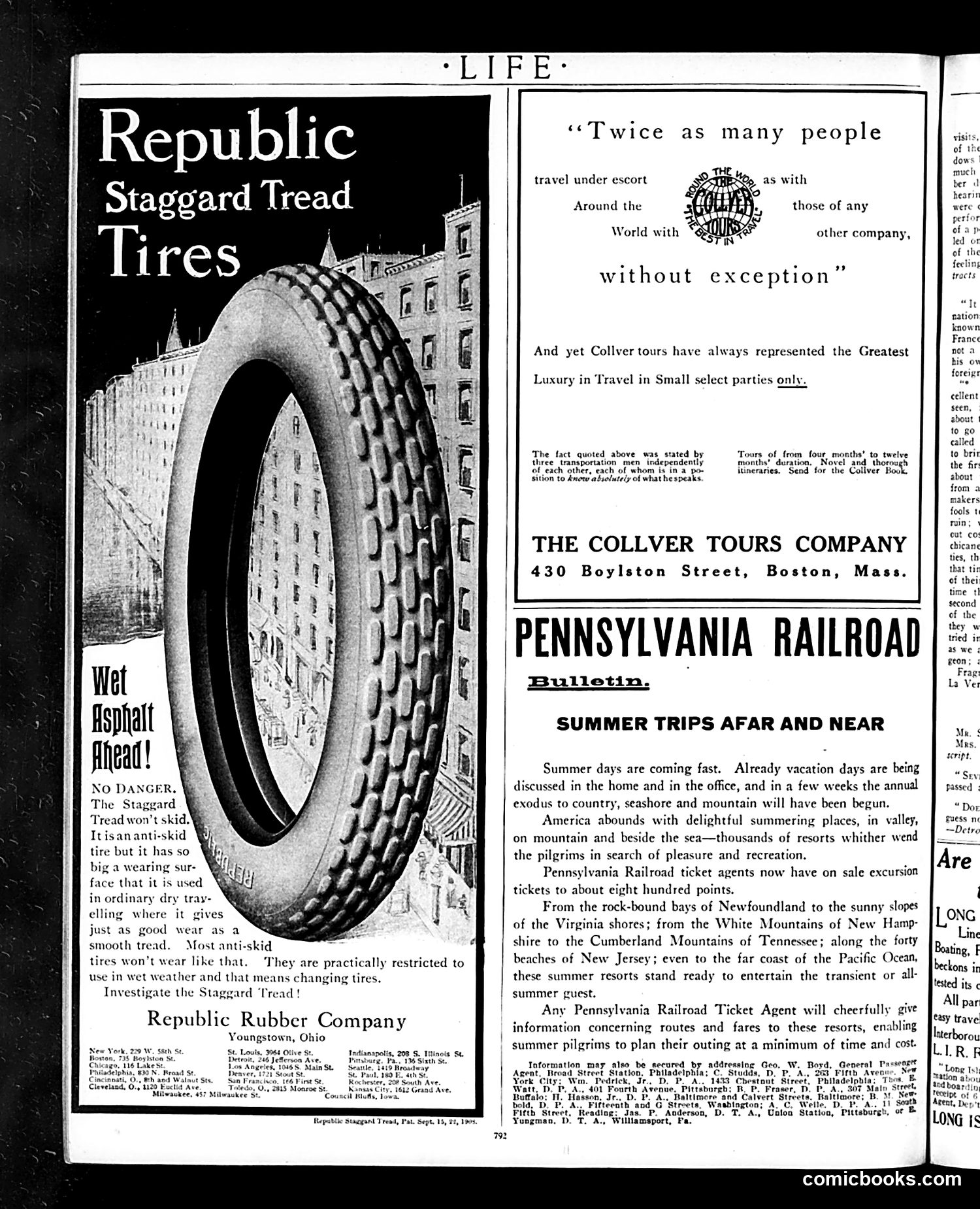
This page contains **three advertisements**, not editorial cartoons or satire. **Left side:** Republic Rubber Company advertises "Staggard Tread" tires, emphasizing their anti-skid tread pattern works in both wet AND dry conditions—unlike competitor anti-skid tires requiring seasonal changes. **Center:** The Collver Tours Company promotes luxury travel packages, claiming their clients travel more safely than those with other companies. The testimonial quotes transportation professionals as evidence. **Right side:** Pennsylvania Railroad advertises summer excursion tickets to eight hundred destinations across America, from Newfoundland to the Pacific Coast, encouraging vacation planning through ticket agents. These are straightforward commercial appeals typical of early 20th-century *Life* magazine advertising—no political satire or caricature is present. The page demonstrates how publications monetized reader attention through paid advertisements.
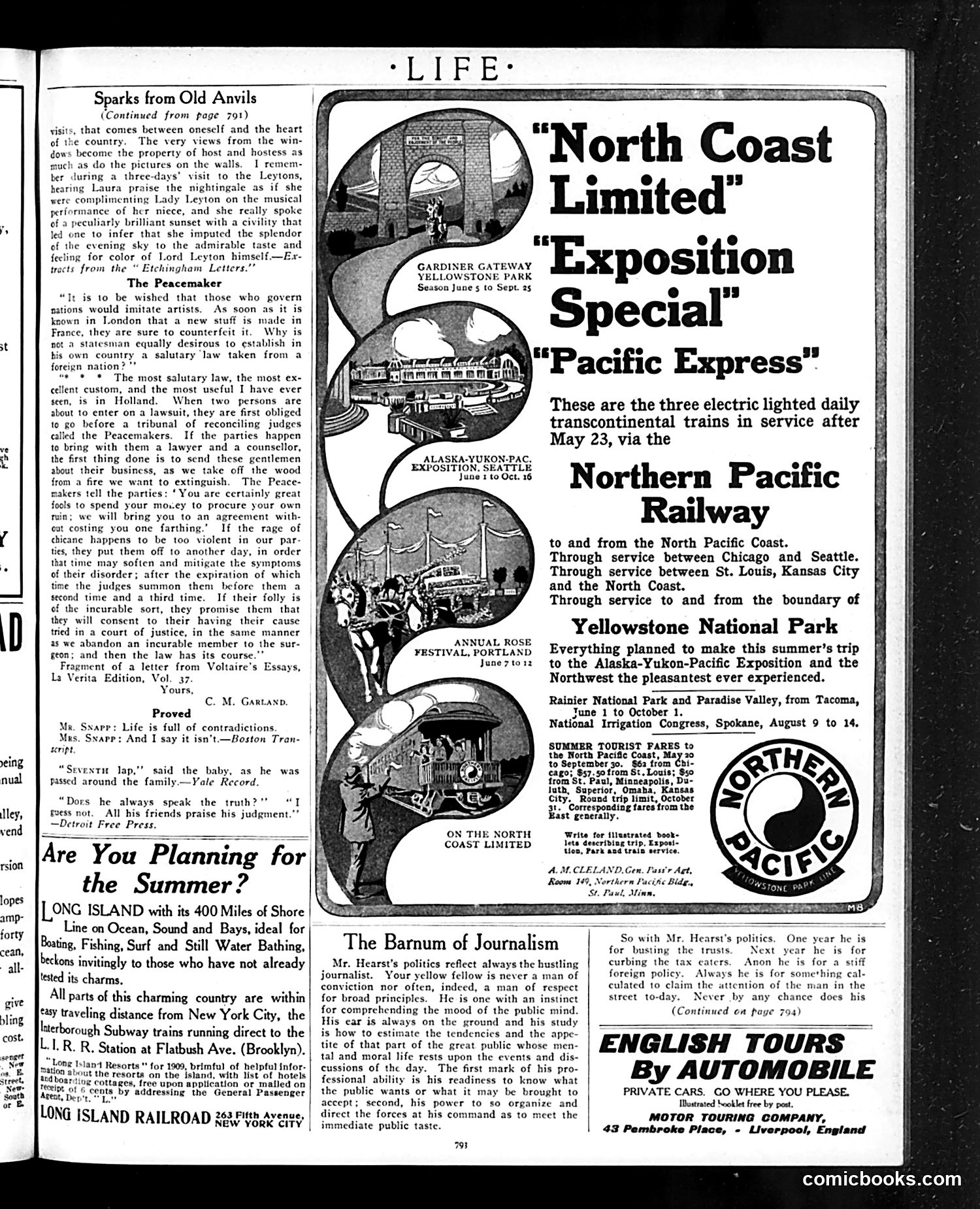
This page is **primarily advertising**, not political satire. The dominant content is a Northern Pacific Railway advertisement promoting three transcontinental trains ("North Coast Limited," "Exposition Special," and "Pacific Express") connecting Chicago, Seattle, and Yellowstone National Park. The ad emphasizes summer travel opportunities and includes illustrations of scenic destinations and train interiors. The left column contains brief humorous pieces titled "Sparks from Old Anvils"—light satirical observations about human nature and social etiquette (discussing how guests compliment hosts' views, a Dutch legal system for dispute resolution, and contradictions in life). These are not political cartoons but rather genteel witticisms typical of Life's satirical humor from this era. At bottom is an advertisement for Long Island Railroad summer destinations and another for English automobile tours. The page reflects early-1900s leisure travel promotion and genteel social commentary rather than political critique.
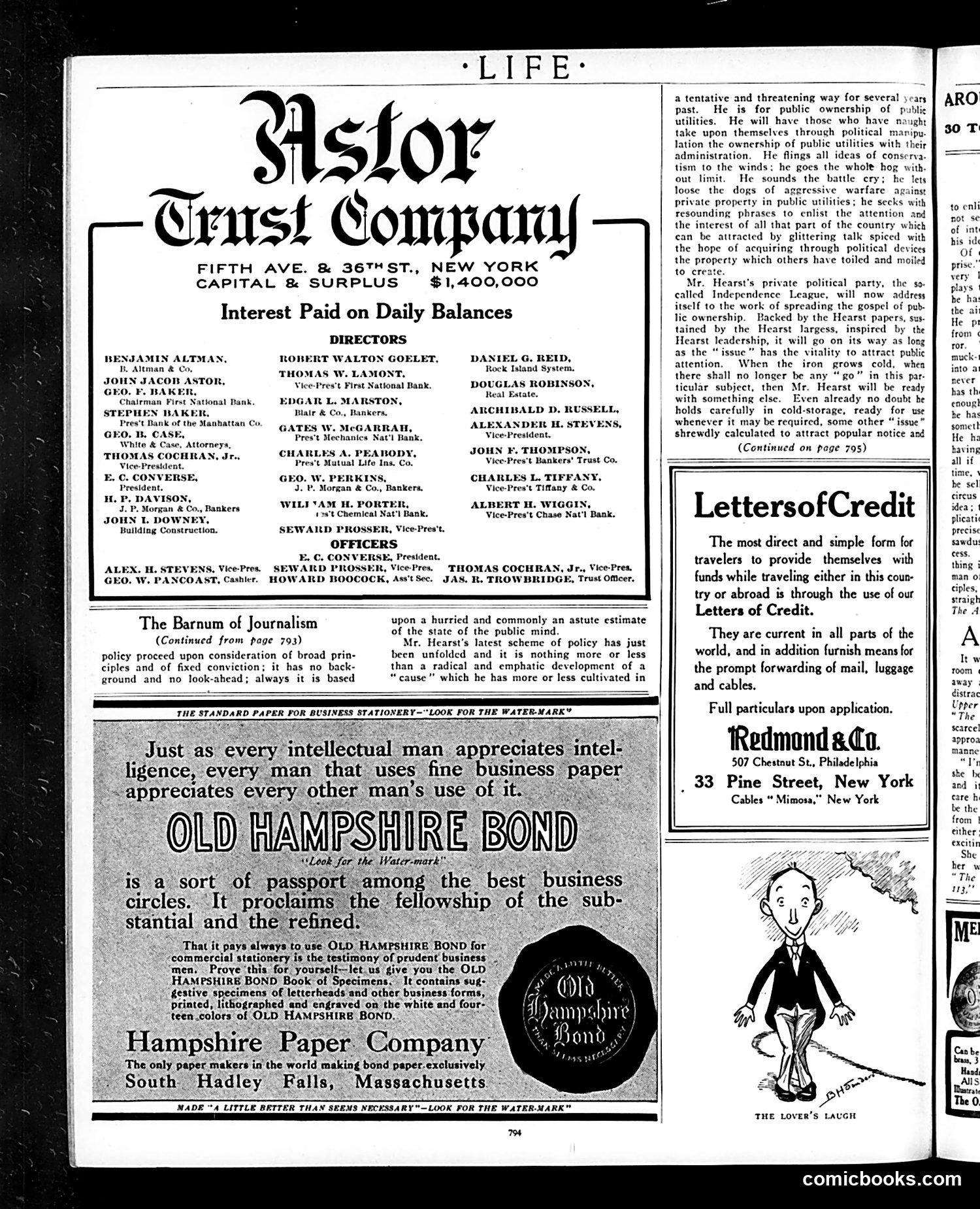
This page is primarily **advertising and financial listings**, not political cartoons. The dominant content includes: 1. **Astor Trust Company advertisement** — a major New York bank listing its directors and officers, representing the era's financial establishment. 2. **"The Barnum of Journalism" article** — a critical piece about **William Randolph Hearst**, attacking his political opportunism. The text accuses Hearst of promoting public ownership of utilities not from principle but from calculated populism. It compares his tactics to P.T. Barnum's showmanship, suggesting Hearst manufactures "issues" to attract public attention, then abandons them when they lose appeal—like his Independence League political party. 3. **Commercial advertisements** — including Old Hampshire Bond paper and Redmond & Co. letters of credit. The satire targets Hearst's perceived cynicism: his radical-sounding causes are presented as mere marketing strategies designed to manipulate working-class voters rather than genuine reform efforts.
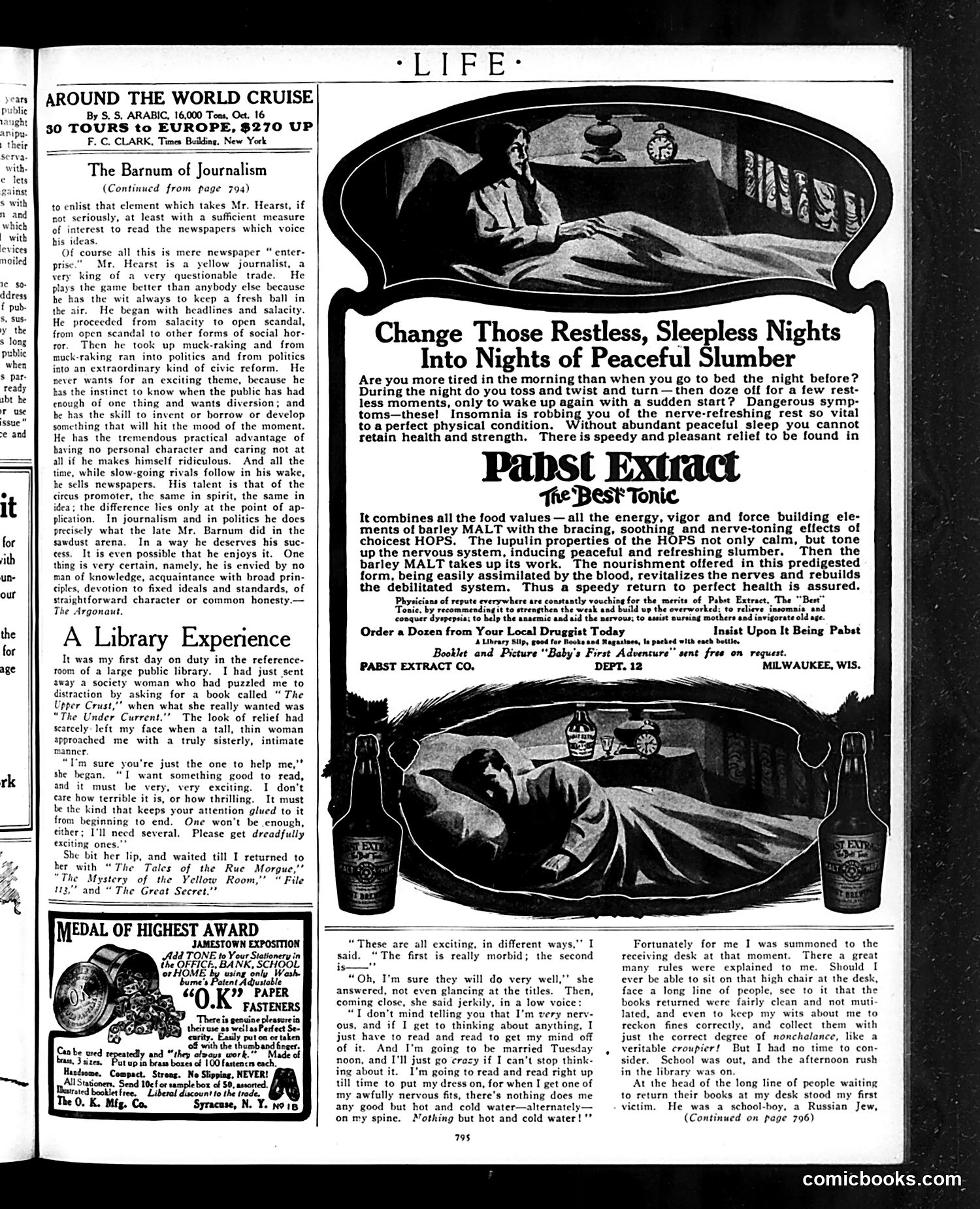
This page from Life magazine (circa early 1900s, based on styling) contains several distinct elements: **Main Editorial Content**: "The Barnum of Journalism" is a critical essay comparing publisher William Randolph Hearst to P.T. Barnum. The piece attacks Hearst as a "yellow journalist" who uses sensationalism, scandal, and constant novelty to sell newspapers rather than inform the public. The author argues Hearst has "no personal character" and employs circus-like promotional tactics in journalism and politics. **Sidebar Story**: "A Library Experience" is a humorous anecdote about a library patron requesting exciting mystery novels, highlighting popular Victorian-era reading tastes. **Advertisements**: The page includes ads for a world cruise, office erasers, and "Pabst Extract" tonic (a patent medicine promising sleep relief), typical of early 20th-century magazine marketing. The satire targets Hearst's sensationalist approach to news, presenting it as entertainment rather than journalism—a critique that remains relevant today regarding media standards.
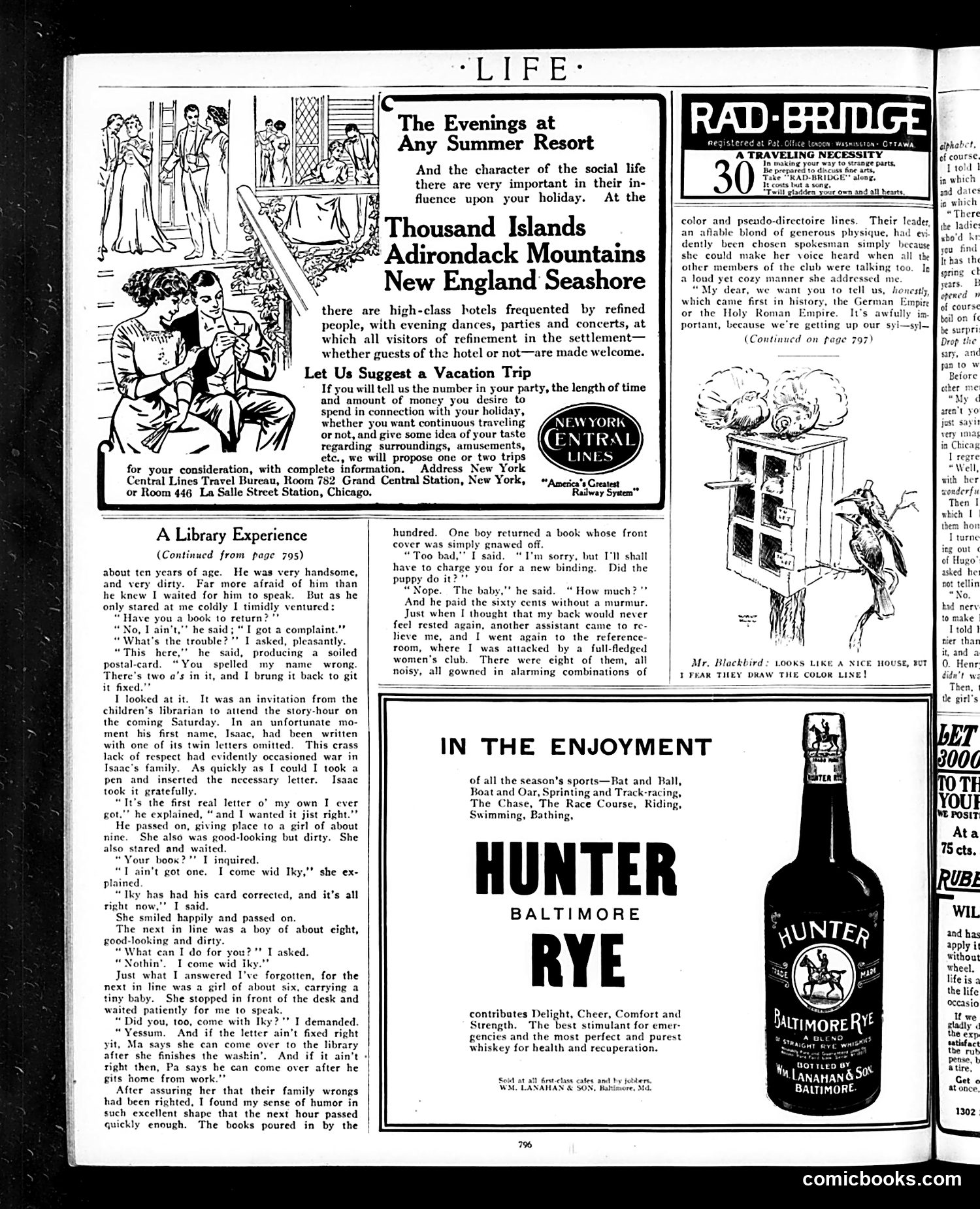
This page contains primarily **advertisements and a serialized story** rather than political satire. The main content is "A Library Experience," a humorous anecdote about a librarian's day. The joke centers on a poor neighborhood family—a boy named "Iky" (Isaac) and his siblings—who become upset over a misspelled name on a library invitation. The humor derives from their earnest indignation over this minor error and their determination to correct it, with escalating family involvement threatening to visit the library. The story satirizes **working-class dignity and pride**, showing how even impoverished children take offense at disrespect. The page also features advertisements for vacation travel (New York Central Lines), Hunter Baltimore Rye whiskey, and Rad-Bridge products. These ads reflect 1920s leisure culture and consumer marketing typical of *Life* magazine's commercial content during this era. The cartoons are generic illustrations accompanying the travel and social commentary, not specific political commentary.
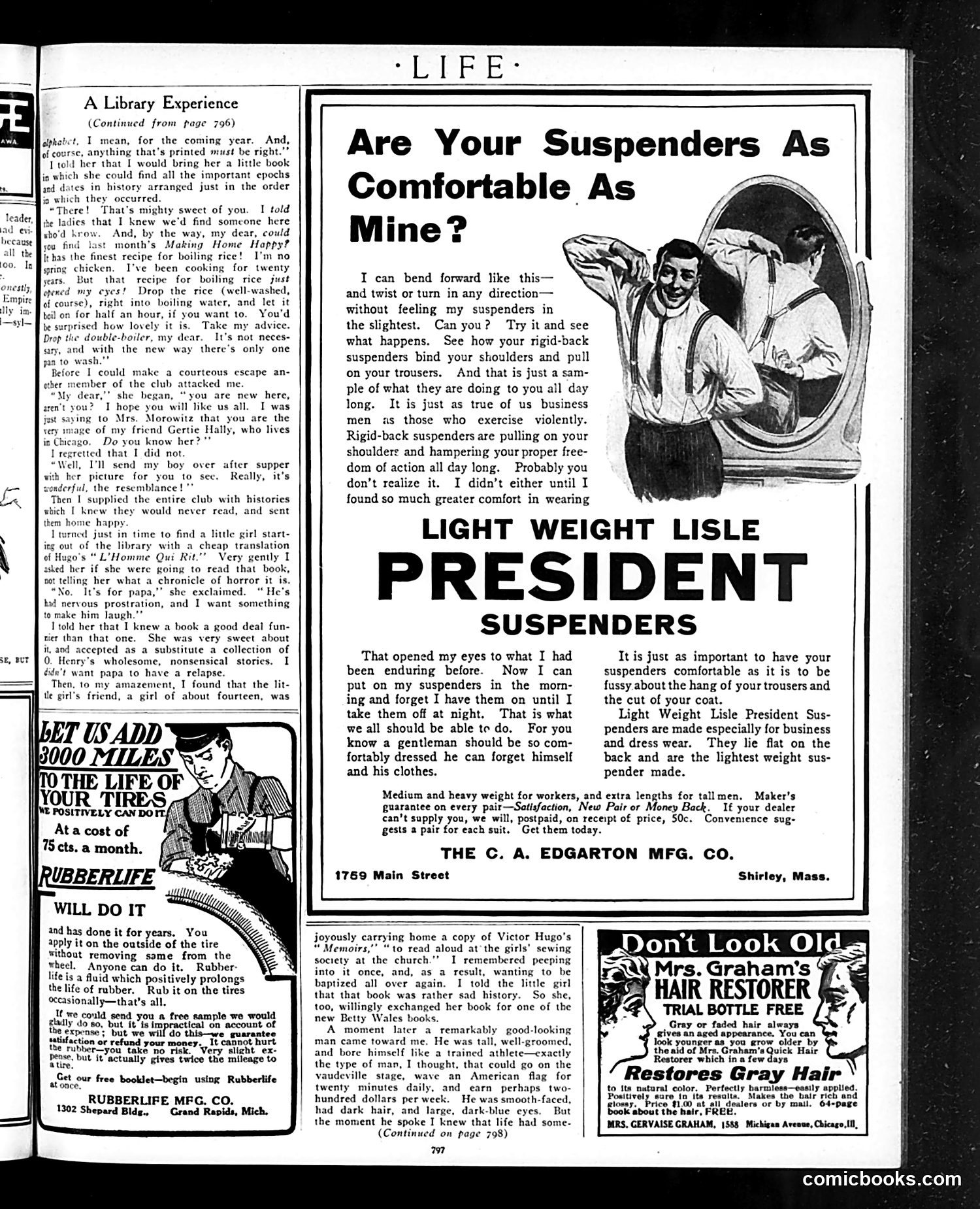
This page contains a humorous short story ("A Library Experience") about a man's awkward encounters at a library club, where chatty women pester him with unsolicited advice about cooking and personal connections. The advertisements reveal period-specific concerns: **Rubberlife** promotes tire preservation fluid (cars were relatively new); **President Suspenders** advertises comfort for businessmen, using the pitch that quality clothing should be "forgotten"—a gentleman shouldn't notice his clothes; and **Mrs. Graham's Hair Restorer** promises to reverse graying hair. The suspender ad's main illustration shows a man bending and twisting freely, contrasting with the discomfort of inferior suspenders. These ads reflect early 20th-century anxieties about maintaining respectability and comfort in a modernizing society. The tone is lighthearted satire about social etiquette, domestic life, and masculine self-presentation—not political commentary.
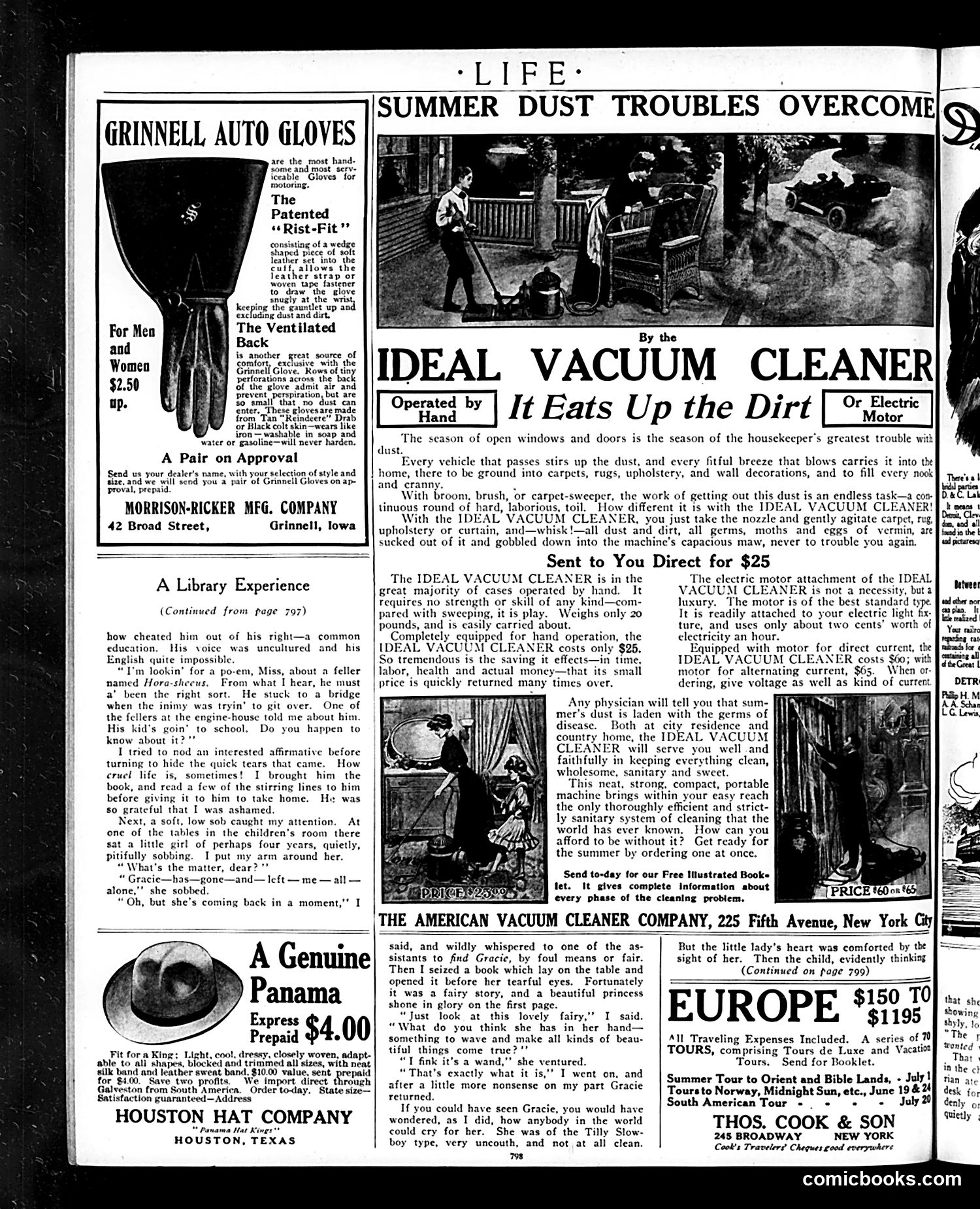
This page is primarily **advertising**, not political satire. It contains product advertisements for: 1. **Grinnell Auto Gloves** — motorist gloves featuring a patented "Rist-Fit" wrist closure and ventilated back to prevent dust and perspiration 2. **Ideal Vacuum Cleaner** — the main feature, marketed as a solution to summer dust problems. The ad emphasizes that open windows and doors allow dust from passing vehicles and breezes to infiltrate homes, making cleaning exhausting work. The vacuum (hand-operated at $25, or motor-powered at $60-65) promises to eliminate this seasonal household burden. 3. **Houston Hat Company** — Panama hats at $4.00 The page also includes a short story titled "A Library Experience" about a sympathetic librarian helping patrons. These are straightforward consumer advertisements typical of early 20th-century Life magazine, reflecting contemporary concerns about dust, household cleanliness, and emerging consumer conveniences.
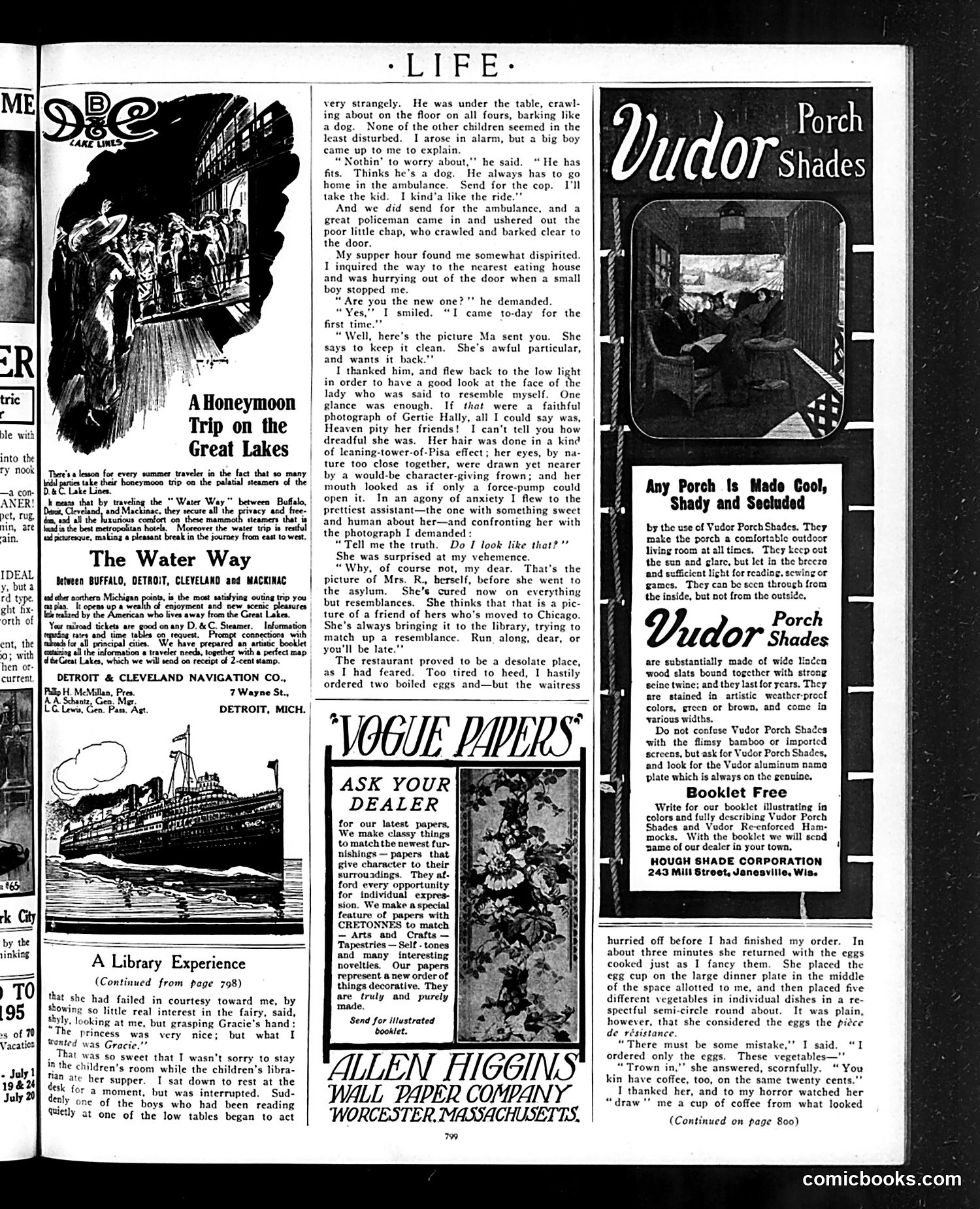
This page is primarily **advertisements and serialized fiction**, not political satire. The main content includes: 1. **"A Honeymoon Trip on the Great Lakes"** — a travel advertisement for Detroit & Cleveland Navigation Company promoting steamship vacations on the Great Lakes. 2. **"A Library Experience"** (continued story) — a serialized narrative about a young woman's first day working in a children's library. The excerpt describes her encounter with a disturbed boy acting like a dog under a table, apparently familiar behavior to staff ("Send for the cop. I'll take the kid. I kind'a like the ride"). Later, she's mistaken for a former librarian named "Mrs. R." and receives a photograph meant for that woman. 3. **Product advertisements** for Vudor Porch Shades, Vogue Papers, and Allen Higgins Wall Paper Company. There is **no political cartoon or satire** on this page. The "Library Experience" story appears to be gentle social humor about workplace misunderstandings rather than political commentary.
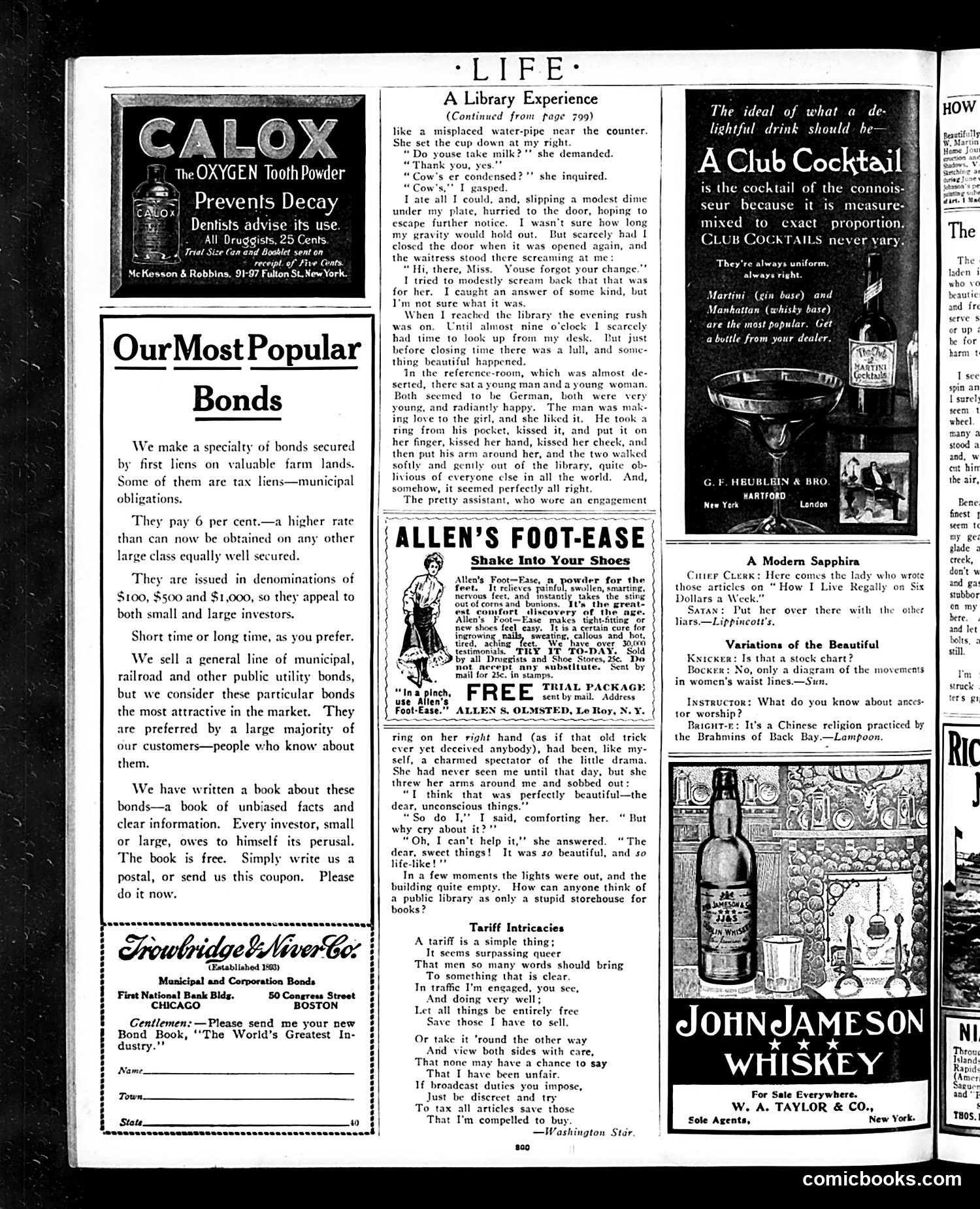
This page from Life magazine is primarily **advertising-focused** rather than containing political cartoons or satire requiring historical context. The main advertisements include: - **Calox Tooth Powder**: A dental hygiene product claiming to prevent decay - **Bonds advertisement**: Promoting farm-secured bonds paying 6% interest—appealing to small and large investors during what appears to be an economically uncertain period - **Allen's Foot-Ease**: A foot powder remedy for corns, bunions, and tired feet - **Club Cocktail**: Promoting pre-mixed cocktails (Martini and Manhattan varieties) - **John Jameson Whiskey**: Liquor advertisement The page also contains a serialized story titled "A Library Experience," describing a woman's visit to a café and library, culminating in witnessing a young couple's engagement moment. **No significant political satire or social commentary** is evident. The content reflects early 20th-century consumer culture and product marketing rather than satirical commentary on contemporary events or figures.
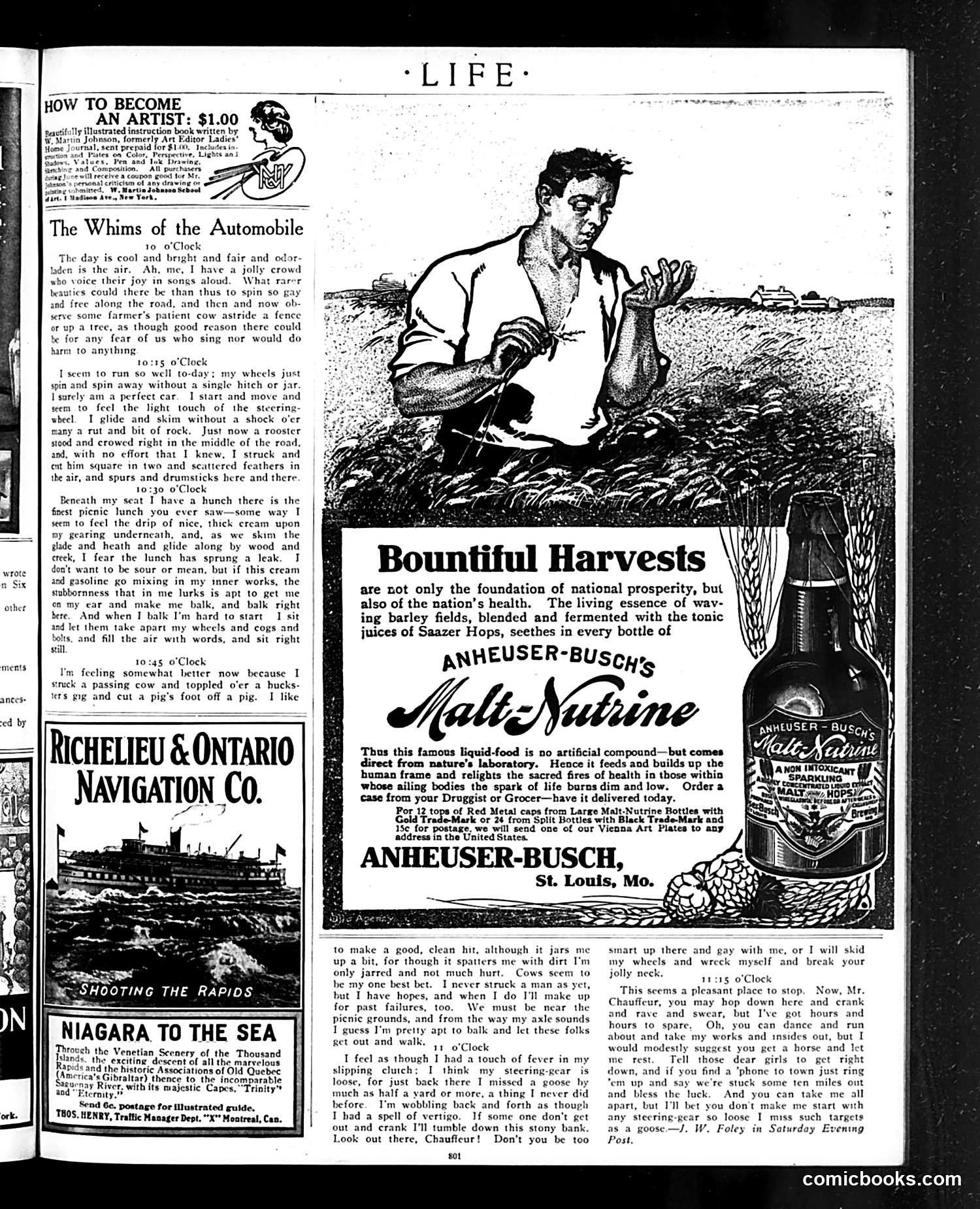
This page satirizes the unreliability and temperamental nature of early automobiles through a humorous monologue by a personified car. The narrative spans from 10 o'clock to 11 o'clock, tracking the vehicle's increasingly erratic behavior—beginning smooth and boastful ("I rarely am a perfect car"), then descending into chaos: striking a rooster, leaking picnic cream into the engine, hitting livestock, and ultimately threatening to break down entirely. The satire targets not the automobile itself but owners' inflated expectations. The car's "whims" mirror human vanity and carelessness: the driver's recklessness (hitting animals without concern), mechanical fragility masked by overconfidence, and the gap between marketing promises and reality. For early-1900s readers, this humorously captured widespread frustration with automobiles as unreliable luxury items prone to sudden, inexplicable failure—a sharp contrast to established horse-and-wagon transportation.
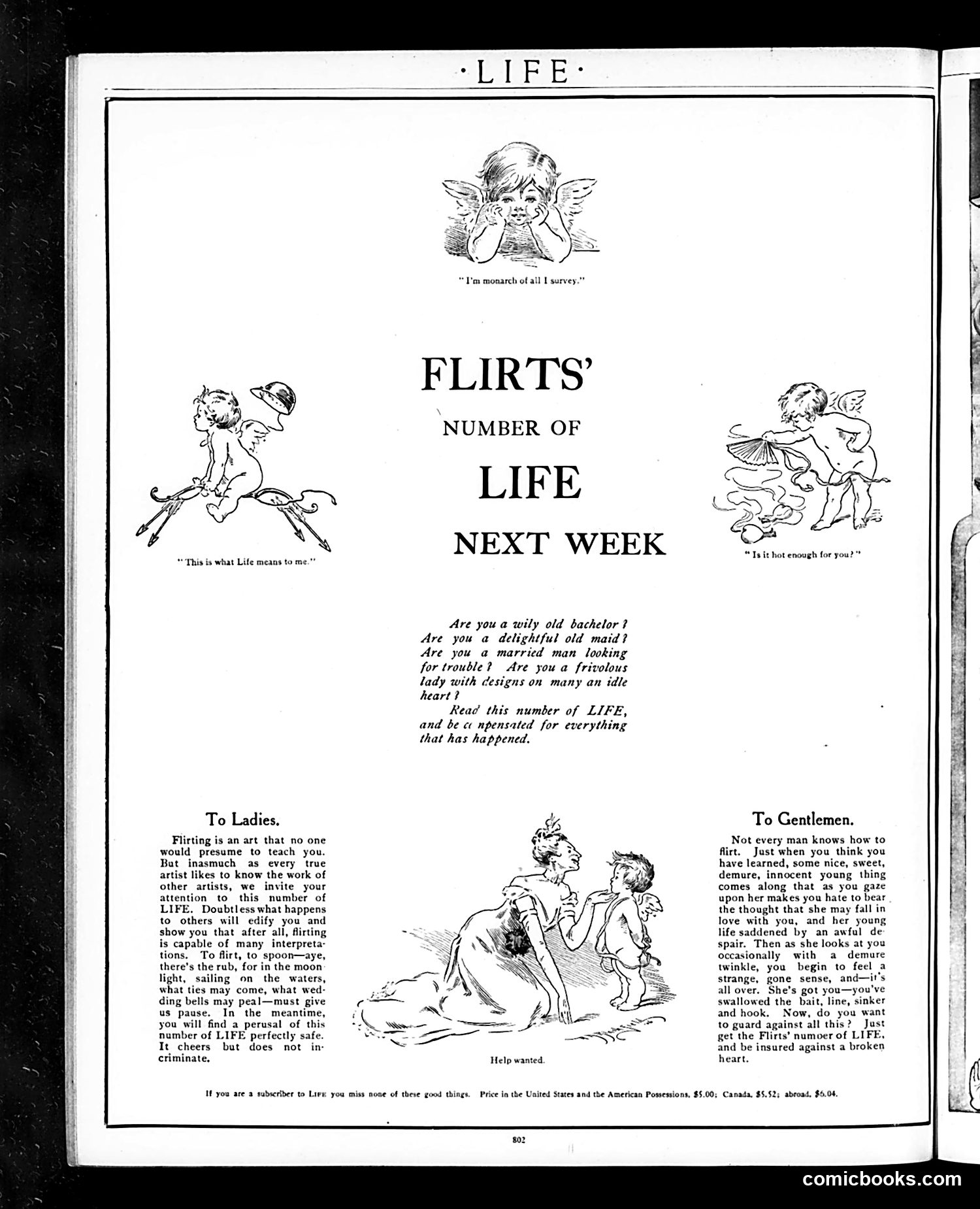
This is a promotional page advertising a special issue of *Life* magazine devoted to flirtation and romantic comedy. The cherub illustrations represent Cupid—the classical symbol of love and romance. The page uses gendered humor typical of early 20th-century American satire, addressing men and women separately with stereotypical scenarios: bachelors, old maids, straying husbands, and frivolous women seeking attention. The premise is that reading stories about flirtation will either educate readers on romantic tactics or provide cautionary entertainment about the consequences of romantic entanglement. The tone is lighthearted mockery of courtship conventions—particularly the tension between flirtation as harmless fun versus its potential to cause emotional damage ("broken heart"). The "Help wanted" caption suggests the magazine itself needs assistance capturing these romantic scenarios. This reflects *Life*'s role as satirical commentary on American social manners and relationships.
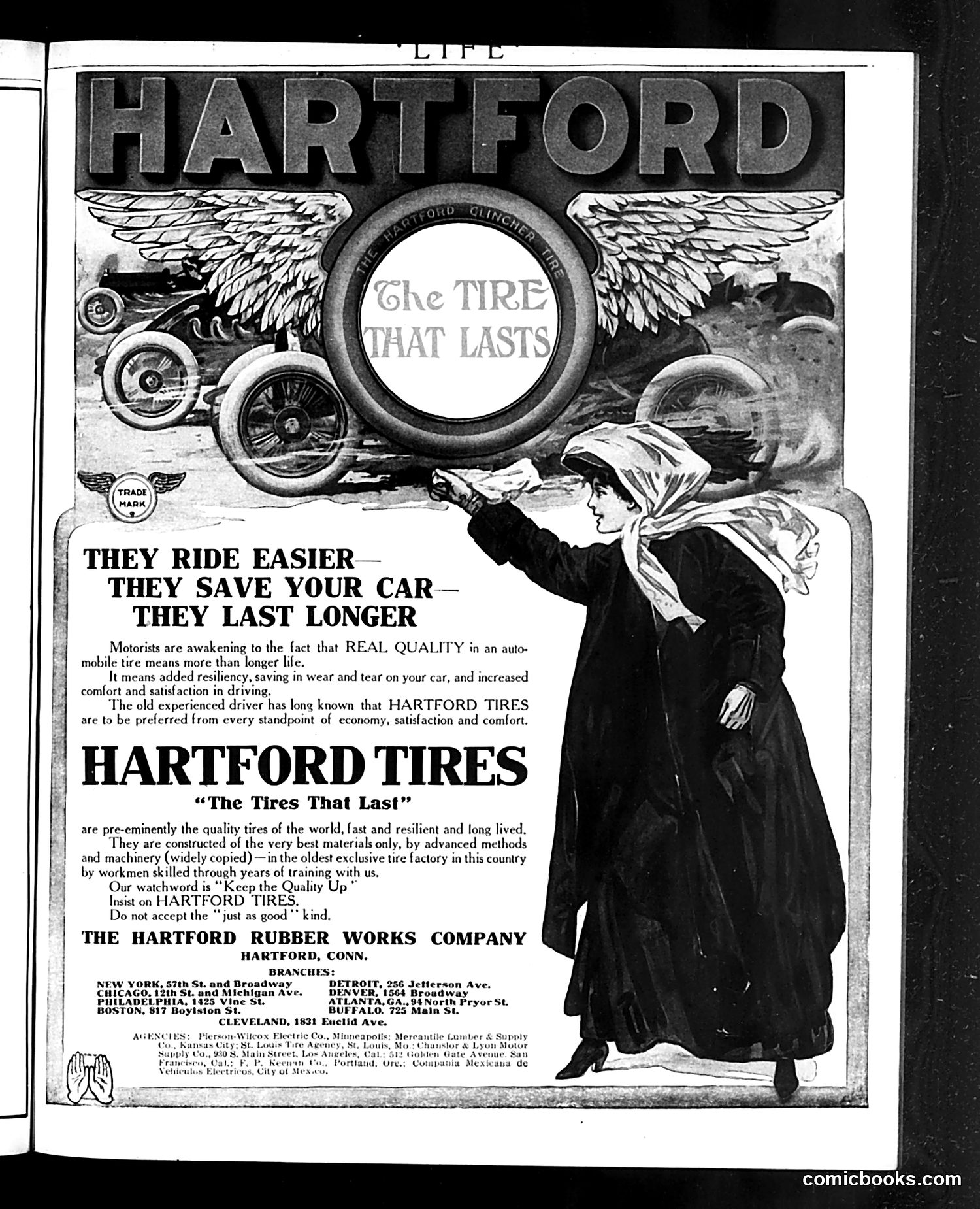
This is a full-page advertisement for Hartford Tires, not political satire. The image shows a woman in early 1900s attire pointing to a large tire with winged emblem imagery, alongside vintage automobiles. The ad's rhetoric emphasizes quality and durability—Hartford Tires "last longer," provide comfort, and save wear on vehicles. The copy appeals to "experienced drivers" and warns against cheaper "just as good" alternatives, positioning Hartford as the premium choice. There is no cartoon or satirical content here. This is straightforward advertising from The Hartford Rubber Works Company, with branches listed across major American cities. The winged imagery and classical styling were typical branding conventions of the era, suggesting prestige and superiority rather than making any political or social commentary.
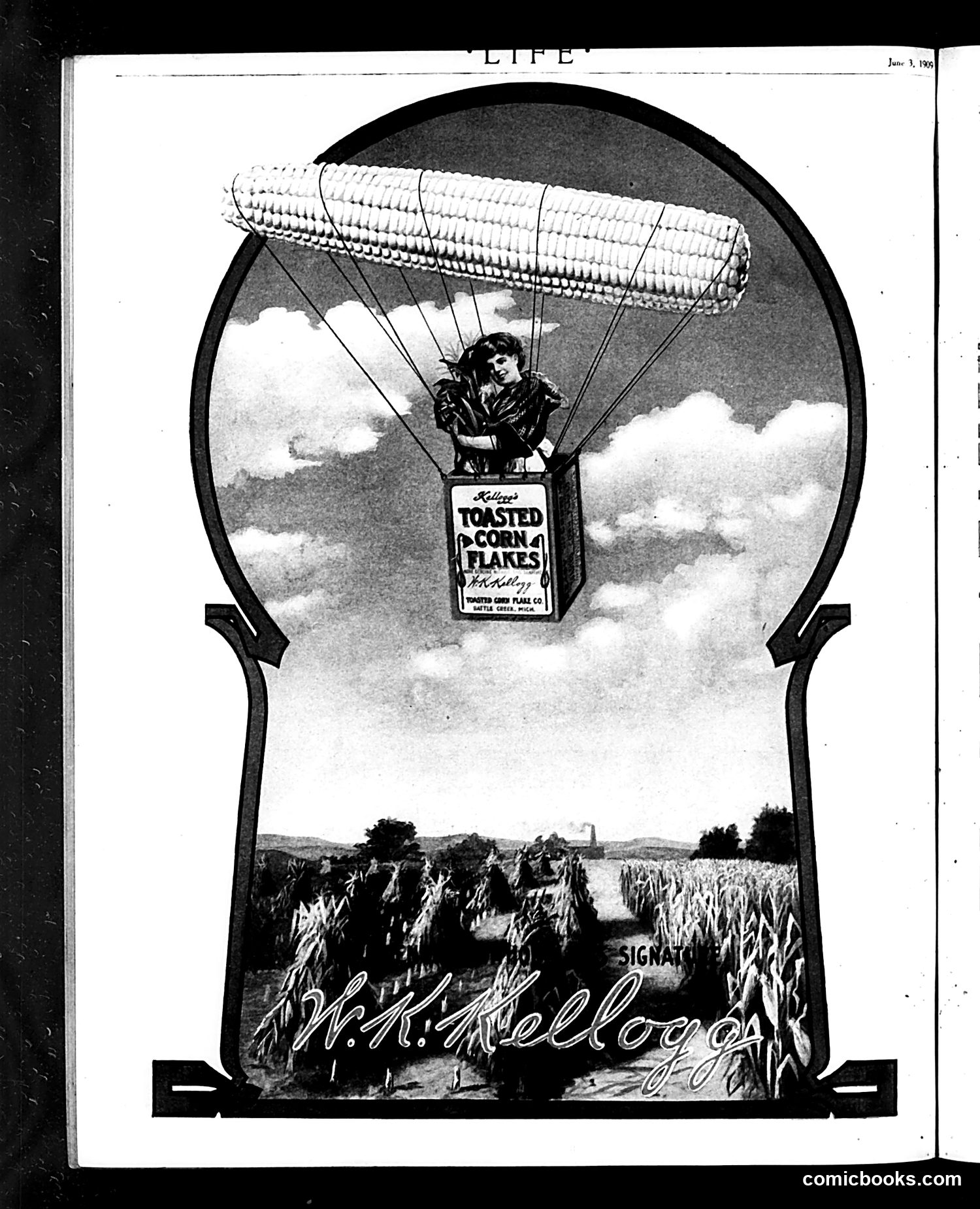
This is a **Kellogg's Toasted Corn Flakes advertisement** from *Life* magazine (dated June 3, 1909, visible at top right). The ad depicts a whimsical hot-air balloon journey: a figure in a basket beneath a large cylindrical balloon (resembling a corn cob) floats above clouds and a corn field. The basket is labeled with the Kellogg's product branding and includes a signature (appears to be W.K. Kellogg's). **The appeal:** Early 20th-century advertising used fantastical imagery to suggest that eating this breakfast cereal would elevate one's experience—literally and figuratively—above the ordinary. The corn field below connects the product to agricultural authenticity, while the ascending balloon promises aspiration and lightness. This is not political satire but rather a commercial advertisement using imaginative visual metaphor common to the era's advertising style.