
Life, 1909-06-03 · page 27 of 56
Life — June 3, 1909 — page 27: what you’re looking at
What you’re looking at
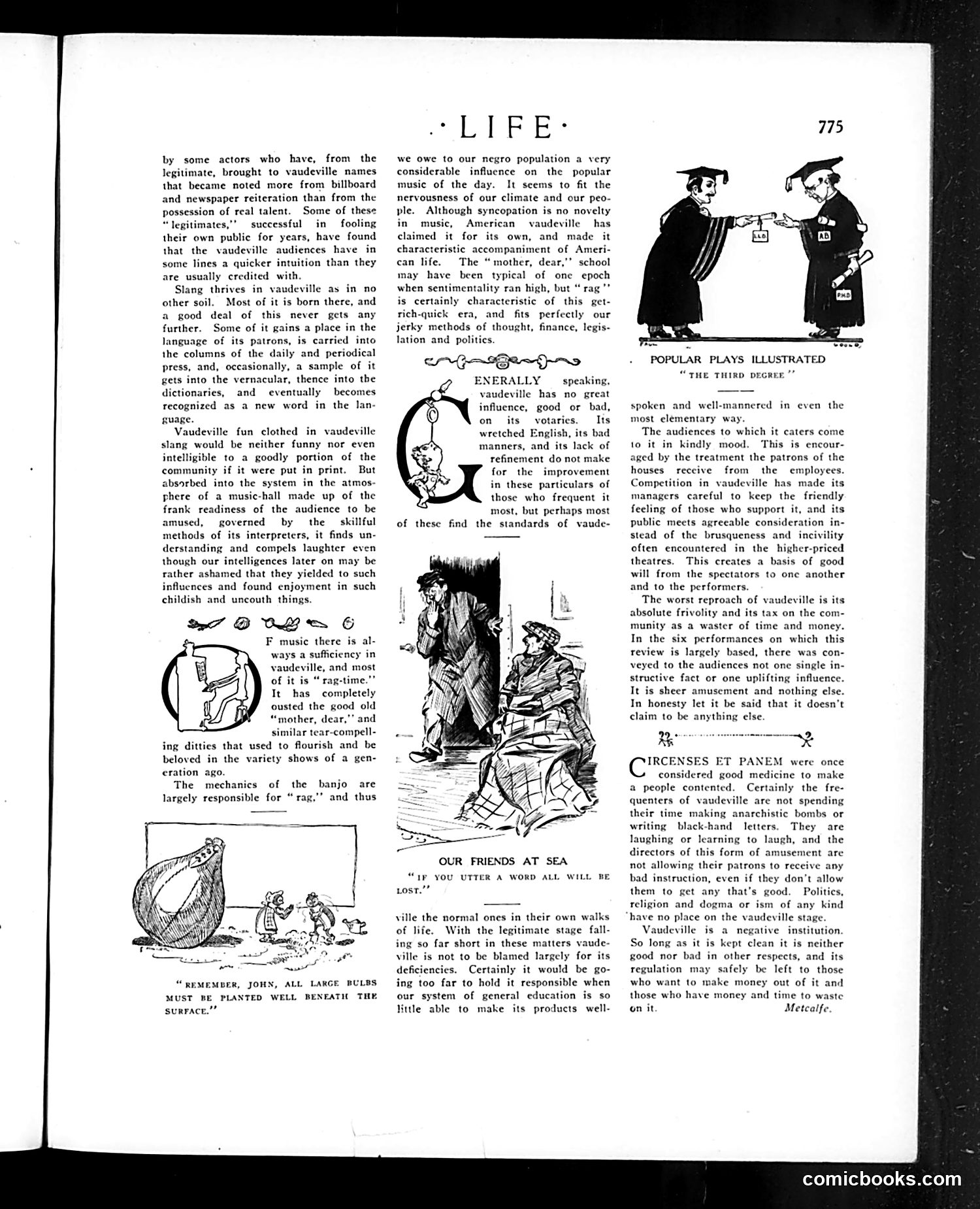
This page discusses vaudeville theater culture, criticizing and defending it simultaneously. The cartoons appear to be humorous illustrations of everyday life rather than political satire. The top cartoon shows two graduates in academic robes—likely representing the "legitimate" theater actors mentioned in text who brought their theatrical credentials to vaudeville but lacked genuine talent. The middle illustration depicts a scene labeled "Our Friends at Sea," showing people in a boat, with the caption "If you utter a word all will be lost"—a visual gag about maintaining silence. The bottom cartoon shows a gardener being instructed about planting bulbs, captioned "Remember, John, all large bulbs must be planted well beneath the surface"—a simple domestic humor piece. The text critiques vaudeville's embrace of "rag-time" music (syncopated African American music), acknowledging it fits the "nervousness" of modern American life while discussing how vaudeville slang influences mainstream language and culture. The author views vaudeville as culturally inferior but acknowledges its significant influence on American entertainment and speech.
📄 Transcribed text from this page (OCR, searchable)
Machine-transcribed from the original scan — historical spelling and the odd misread are preserved.
by some actors who have, from the legitimate, brought to vaudeville names that became noted more from billboard and newspaper reiteration than from the possession of real talent. Some of these “legitimates,”” successful in fooling their own public for years, have found that the vaudeville audiences have in some lines a quicker intuition than they are usually credited with. Slang thrives in vaudeville as in no other soil. Most of it is born there, and a good deal of this never gets any further. Some of it gains a place in the language of its patrons, is carried into the columns of the daily and periodical press, and, occasionally, a sample of it gets into the vernacular, thence into the dictionaries, and eventually becomes recognized as a new word in the lan- guage. Vaudeville fun clothed in vaudeville slang would be neither funny nor even intelligible to a goodly portion of the community if it were put in print. But absorbed into the system in the atmos- phere of a music-hall made up of the frank readiness of the audience to be amused, governed by the skillful methods of its interpreters, it finds un- derstanding and compels laughter even though our intelligences later on may be rather ashamed that they yielded to such influences and found enjoyment in such childish and uncouth things. eZ BOYS G F music there is al- ways a sufficiency in vaudeville, and most of it is “ rag-time.”” It has completely ousted the good old “mother, dear,”’ and similar tear-compell- ing ditties that used to flourish and be beloved in the variety shows of a gen- eration ago. The mechanics of the largely responsible for “ rag,’” banjo are and thus EMEMBER, JOHN, ALL LARGE BULBS MUST RE PLANTED WELL BENEATIC THE survace.’” LEP E* we owe to our negro population a very considerable influence on the popular music of the day. It seems to fit the nervousness of our climate and our peo- ple. Although syncopation is no novelty in music, American vaudeville has claimed it for its own, and made it characteristic accompaniment of Ameri- can life. The “mother, dear,’ school may have been typical of one epoch when sentimentality ran high, but “ rag "” is certainly characteristic of this get- rich-quick era, and fits perfectly our jerky methods of thought, finance, legis- lation and politics. ar p—sGemjrns NERALLY speaking, vaudeville has no great influence, good or bad, on its votar Its wretched English, its bad manners, and its lack of refinement do not make for the improvement in these particulars of those who frequent it most, but perhaps most of these find the standards of vaude- OUR FRIENDS AT SEA IP YOU UTTER A WORD ALL WILL BE ville the normal ones in their own walks of life. With the legitimate stage fall- ing so far short in these matters vaude- ville is not to be blamed largely for its deficiencies. Certainly it would be go- ing too far to hold it responsible when our system of general education is so Kittle able to make its products well- POPULAR PLAYS ILLUSTRATED “THE THIRD DEGREE ’” spoken and well-mannered in even the most elementary way. The audiences to which it caters come lo it in kindly mood. This is encour- aged by the treatment the patrons of the houses receive from the employees. Competition in vaudeville has made its managers careful to keep the friendly feeling of those who support it, and its public meets agreeable consideration in- stead of the brusqueness and incivility often encountered in the higher-priced theatres. This creates a basis of good will from the spectators to one another and to the performers. The worst reproach of vaudeville is its absolute frivolity and its tax on the com- munity as a waster of time and money. In the six performances on which this review is largely based, there was con- veyed to the audiences not one single in- structive fact or one uplifting influence. It is sheer amusement and nothing else. In honesty let it be said that it doesn’t claim to be anything else. IRCENSES ET PANEM were once considered good medicine to make a people contented. Certainly the fre- quenters of vaudeville are not spending their time making anarchistic bombs or writing black-hand letters. They are laughing or learning to laugh, and the directors of this form of amusement are not allowing their patrons to receive any bad instruction, even if they don’t allow them to get any that’s good. Politics, religion and dogma or ism of any kind have no place on the vaudeville stage. Vaudeville is a negative institution. So long as it is kept clean it is neither good nor bad in other respects, and its regulation may safely be left to those who want to make money out of it and those who have money and time to waste on it Metcalfe. comicbooks.com