
Life, 1909-06-03 · page 31 of 56
Life — June 3, 1909 — page 31: what you’re looking at
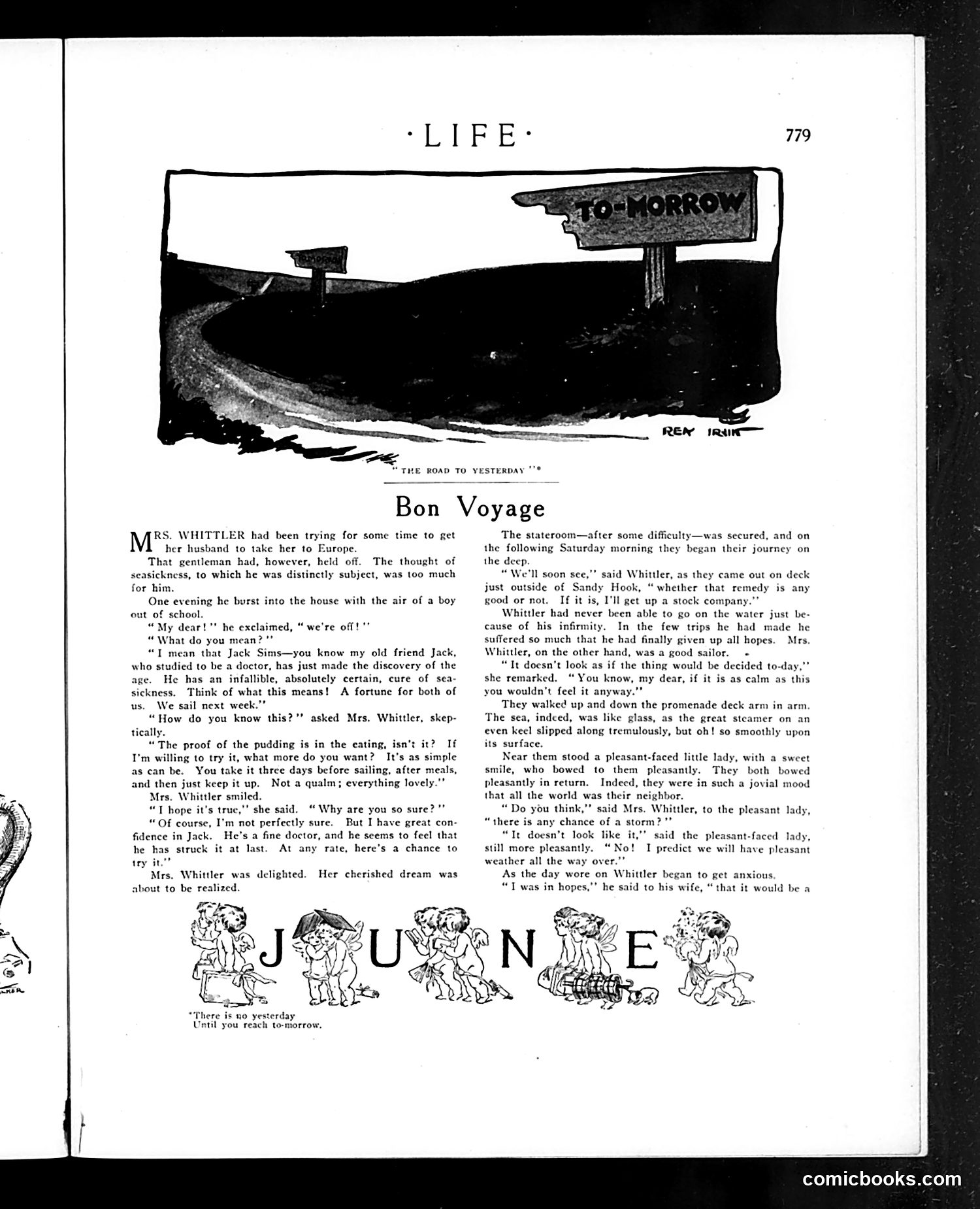
What you’re looking at
This is a humorous short story rather than a political cartoon. It depicts Mr. Whittler, a man chronically prone to seasickness, finally agreeing to take his wife to Europe after a friend (Jack Sims, a doctor) claims to have discovered an infallible cure. The satire targets **medical quackery and gullible believers**—a common theme in early 20th-century Life magazine. Whittler's willingness to trust an untested remedy simply because his friend "feels" confident about it mocks credulous faith in pseudo-scientific cures. The irony deepens as they board ship in perfectly calm seas, making it impossible to actually test the remedy's effectiveness. The heading "The Road to Yesterday" and the month "June" motif suggest this may be part of a serialized story, with the setup promising comedic consequences to follow. The "To-Morrow" sign in the cartoon hints that expectations will shift—likely suggesting seasickness will eventually strike despite the "cure."
📄 Transcribed text from this page (OCR, searchable)
Machine-transcribed from the original scan — historical spelling and the odd misread are preserved.
ROAD TO YESTERDAY * Bon Voyage RS. WHITTLER had been trying for some time to get her husband to take her to Europe. That gentleman had, however, held off. The thought of seasickness, to which he was distinctly subject, was too much for him. One evening he burst into the house with the air of a boy out of school. “My dear!" he exclaimed, “we're off!" “What do you mean?" “T mean that Jack Sims—you know my old friend Jack, who studied to be a doctor, has just made the discovery of the age. He has an infallible, absolutely certain, cure of sea- sickness. Think of what this means! A fortune for both of us, We sail next week.”” “How do you know this?’? asked Mrs. Whittler, skep- tically. “The proof of the pudding is in the cating, isn’t it? If I'm willing to try it, what more do you want? It’s as simple as can be. You take it three days before sailing, after meals, and then just keep it up. Not a qualm; everything lovely.”” Mrs. Whittler smiled. “T hope it's true,” she said. “ Why are you so sure?" “ Of course, I'm not perfectly sure. But I have great con- fidence in Jack. He's a fine doctor, and he seems to feel that he has struck it at last. At any rate, here's a chance to try it Mrs, Whittler was delighted. Her cherished dream was about to be realized sno yesterday Until you reach to-morrow. The stateroom—after some difficulty—was secured, and on the following Saturday morning they began their journey on the deep. “ We'll soon see,” said Whittler, as they came out on deck just outside of Sandy Hook, “whether that remedy is any good or not. If it is, I'll get up a stock company. Whittler had never been able to go on the water just be- cause of his infirmity. In the few trips he had made he suffered so much that he had finally given up all hopes. Mrs. Whittler, on the other hand, was a good sailor. « “It doesn’t look as if the thing would be decided to-day," she remarked. “You know, my dear, if it is as calm as this you wouldn't feel it anyway.” They walked up and down the promenade deck arm in arm. The sea, indeed, was like glass, as the great steamer on an even keel slipped along tremulously, but oh! so smoothly upon its surface. Near them stood a pleasant-faced little lady, with a sweet smile, who bowed to them pleasantly. They both bowed pleasantly in return. Indeed, they were in such a jovial mood that all the world was their neighbor. Do you think," said Mrs. Whittler, to the pleasant lady, “there is any chance of a storm?" “It doesn’t look like it,” s still more pleasantly. “No! weather all the way over.”” As the day wore on Whittler began to get anxious. in hopes,"” he said to his wife, “that it would be a id the pleasant-faced lady, I predict we will have pleasant comicbooks.com