
Life, 1909-06-03 · page 15 of 56
Life — June 3, 1909 — page 15: what you’re looking at
What you’re looking at
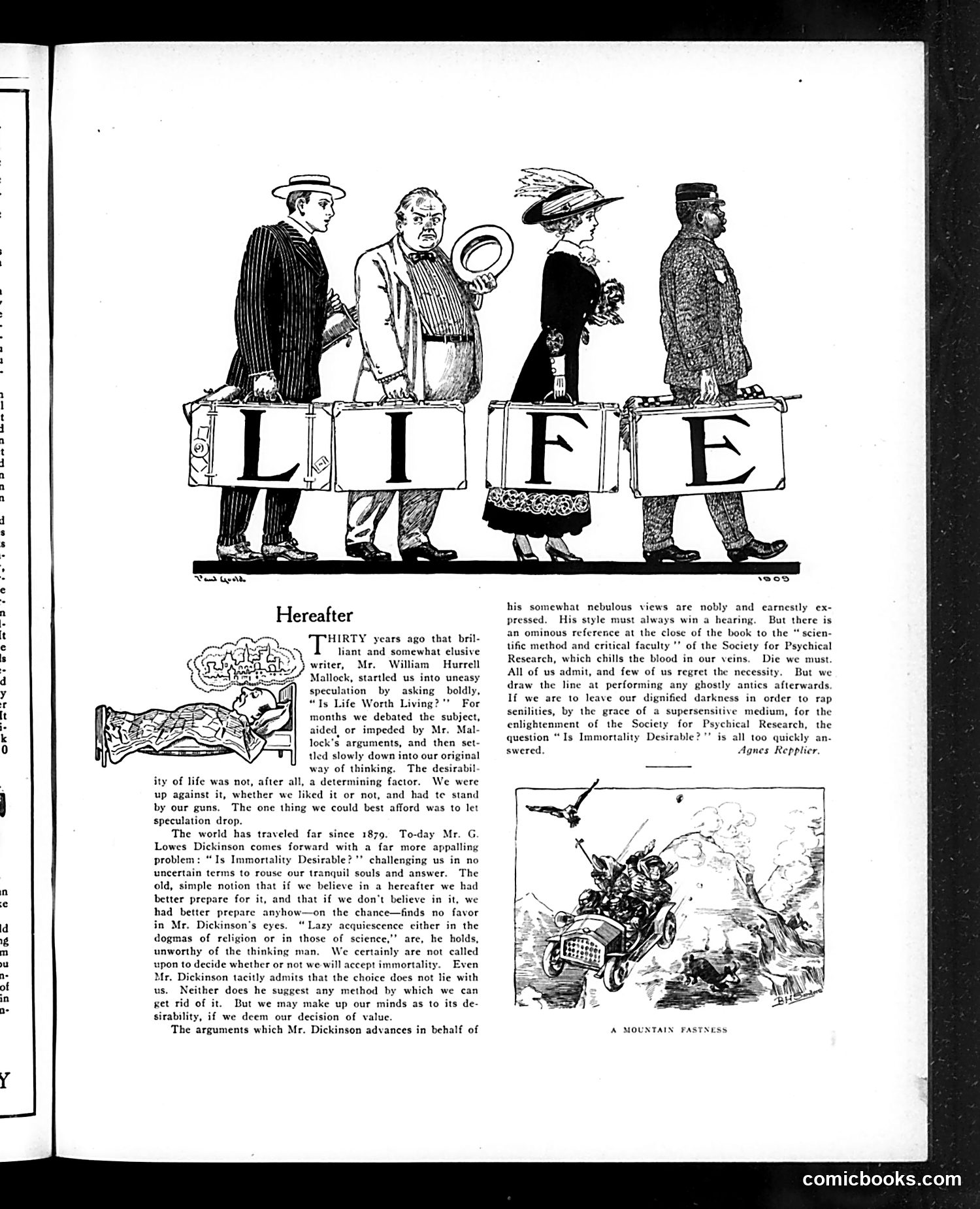
The top cartoon depicts four figures carrying suitcases labeled "L-I-F-E," satirizing different approaches to life's meaning. The accompanying article by Agnes Repplier discusses philosopher G. Lowes Dickinson's question: "Is Immortality Desirable?" Repplier defends living without obsessing over life's ultimate value—a debate dating to 1879. However, she expresses alarm at Dickinson's endorsement of the Society for Psychical Research, which investigated spiritualism and communication with the dead through mediums. The satire's point: while immortality might seem desirable in theory, the *reality* of becoming a ghost performing séances for spiritualist researchers is decidedly unappealing. Repplier argues we should accept death with dignity rather than risk undignified "ghostly antics" afterward—a critique of both spiritualism's pretensions and the era's fascination with contacting the deceased.
📄 Transcribed text from this page (OCR, searchable)
Machine-transcribed from the original scan — historical spelling and the odd misread are preserved.
Ved Gea, Hereafter HIRTY years ago that bril- liant and somewhat elusive writer, Mr. m Hurrell s into uneasy by For months we debated the subject, aided, or impeded by Mr. Mal- lock’s arguments, and then set- tled slowly down into our original way of thinking. The desirabil ity of life was not, after all, a determining factor. We were up against it, whether we liked it or not, and had te stand by our guns, The one thing we could best afford was to let speculation drop. The world has traveled far since 1879. To-day Mr. G Lowes Dickinson comes forward with a far more appalling problem: “Is Immortality Desirable? "’ challenging us in no uncertain terms to rouse our tranquil souls and answer. The old, simple notion that if we believe in a hereafter we had better prepare for it, and that if we don’t believe in it, we had better prepare anyhow—on the chance—finds no favor in Mr. Dickinson's eyes. “Lazy acquiescence cither in the dogmas of rcligion or in those of science,” are, he holds, unworthy of the thinking man. We certainly are not called upon to decide whether or not we will accept immortality. Even Mr. Dickinson tacitly admits that the choice docs not lie with us. Neither does he suggest any method by which we can get rid of it. But we may make up our minds as to its de- sirability, if we deem our decision of value. The arguments which Mr. Dickinson advances in behalf of Y2od his somewhat nebulous views are nobly and earnestly ex- pressed. His style must always win a hearing. But there is an ominous reference at the close of the book to the “ scien- tific method and critical faculty "’ of the Society for Psychical Research, which chills the blood in our veins. Die we must All of us admit, and few of us regret the necessity, But we draw the line at performing any ghostly antics afterwards. If we are to leave our dignified darkness in order to rap senilities, by the grace of a supersensitive medium, for the enlightenment of the Society for Psychical Research, the question “Is Immortality Desirable?" is all too quickly an- swered. Agnes Repplier. A MOUNTAIN FASTNESS comicbooks.com