
Life, 1909-06-03 · page 30 of 56
Life — June 3, 1909 — page 30: what you’re looking at
What you’re looking at
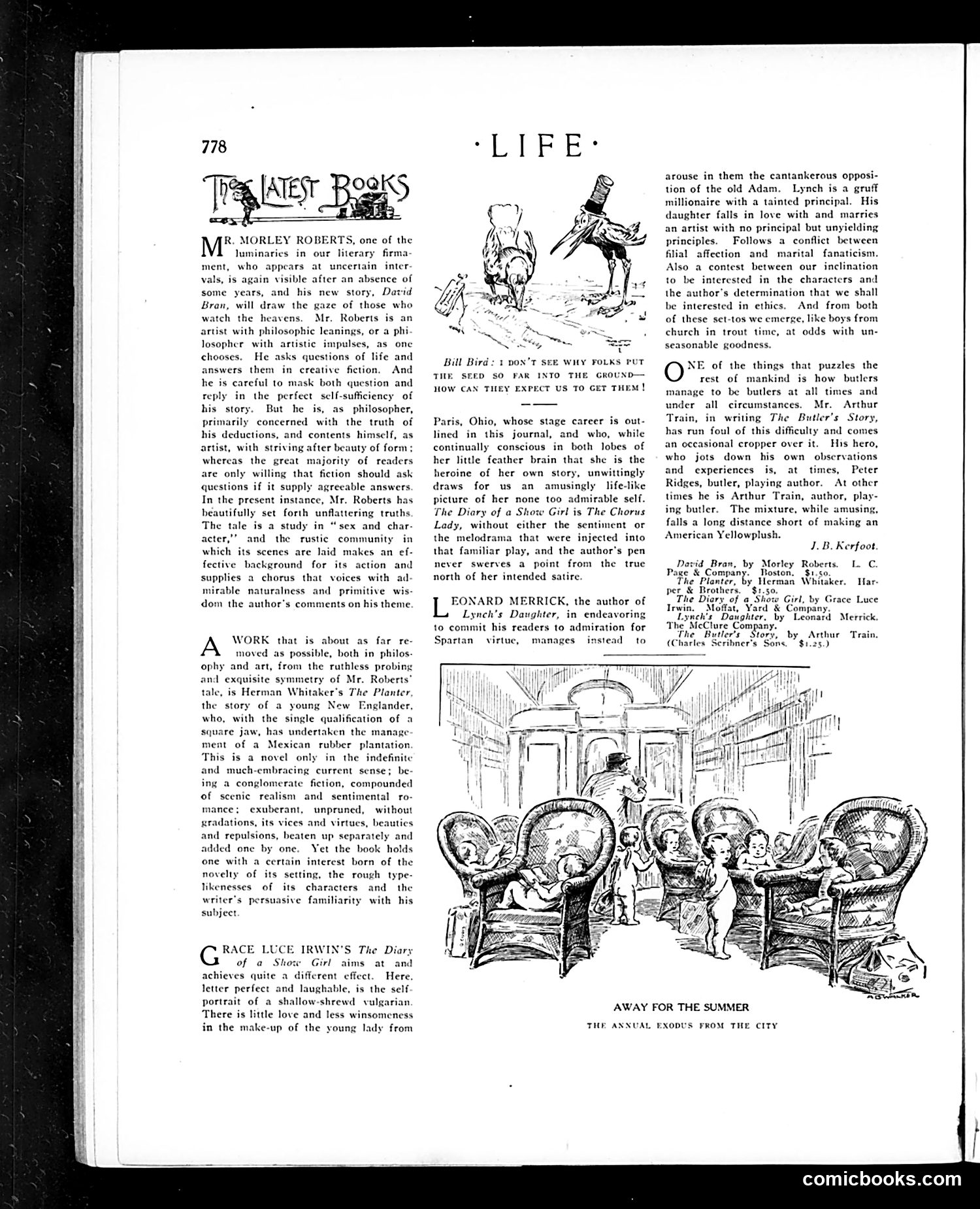
This page reviews several contemporary novels. The cartoon shows "Bill Bird," a rustic character complaining that farmers plant seeds too deep in the ground to expect good crops—a visual metaphor for poor planning or misguided effort. The reviews discuss works by Morley Roberts (*David Bran*), Herman Whitaker (*The Planter*), Grace Luce Irwin (*The Diary of a Show Girl*), and Leonard Merrick (*Lynch's Daughter*). The critic praises Roberts for philosophically probing "sex and character" through rural settings, while criticizing other authors for heavy-handed moralizing or shallow sentimentality. The reviews reflect early 20th-century literary tastes—preferring psychological realism and subtle satire over melodrama or didactic ethics. The mention of "shallow-shrewd vulgarian" characters suggests contemporary interest in satirizing both working-class and theatrical society.
📄 Transcribed text from this page (OCR, searchable)
Machine-transcribed from the original scan — historical spelling and the odd misread are preserved.
i ¥ i R, MORLEY ROBERTS, one of the luminaries in our literary. firma who appears at uncertain inter vals, is again visible after an absence of some years, and his new story, David Bran, will draw the gaze of those who watch the heavens. Mr. Roberts is an artist with philosophic leanings, of a phi losopher with artistic impulses, as one chooses. He asks questions of life and answers them in creative fiction. And he is careful to mask both question and reply in the perfect self-sufficiency of his story. But he is, as philosopher, primarily concerned with the truth of his deductions, and contents nself, as artist, with striving after beauty of form: whereas the great majority of readers are only willing that fiction should ask questions if it supply agreeable answers In the present instance, Mr. Roberts has beautifully set forth unflattering truths The tale is a study in “sex and char- acter,” and the rustic community in which its scenes are laid makes an ef- fective background for its action and supplies a chorus that voices with ad mirable naturalness and_ primitive wi dom the author's comments on his theme: WORK that is about as far re- moved as possible, both in philos- ophy and art, from the ruthless probing and exquisite symmetry of Mr. Roberts’ tale, is Herman Whitaker's The Planter the story of a young New Englander, who, with the single qualification of a square jaw, has undertaken the manage ment of a Mexican rubber plantation This is a novel only in the indefinite dd much-embracing current sense; be- 1g a conglomerate fiction, compounded of scenic realism and sentimental ro mance; exuberant, unpruned, without gradations, its vices and virtues, beauties and repulsions, beaten up separately and added one by one, Yet the book holds one with a certain interest born of the novelty of its setting, the rough type- likenesses of its characters and the er's persuasive familiarity with his subje RACE LUCE IRWIN'S The Diary of a Show Girl aims at and achieves quite a different effect. Here. letter perfect and laughable, is the self portrait of a shallow-shrewd vulgarian There is little love and less winsomeness in the make-up of the young lady from Bill Bird: 1 pox’T See WHY FOLKS PUT THE SEED SO FAR INTO THE GROUND— HOW CAN THEY EXPECT US TO GET THEM! Paris, Ohio, whose stage carcer is out- lined in this journal, and who, while continually conscious in both lobes of her little feather brain that she is the heroine of her own story, unwittingly draws for us an amusingly life-like icture of her none too admirable self. The Diary of a Show Girl is The Chorus Lady, without either the sentiment or the melodrama that were injected into that familiar play, and the author's pen never swerves a point from the true north of her intended satire EONARD MERRICK, the author of Lynch’s Daughter, in endeavoring to commit his readers to admiration for Spartan virtue, manages instead to arouse in them the cantankerous opposi- tion of the old Adam. Lynch is a gruff millionaire with a tainted principal. His daughter falls in love with and marries an artist with no principal but unyielding principles. Follows a conflict between filial affection and marital fanaticism. Also a contest between our inclination to be interested in the characters and the author's determination that we shall be interested in ethics, And from both of these set-tos we emerge, like boys from church in trout time, at odds with un- seasonable goodness. E of the things that puzzles the rest of mankind is how butlers manage to be butlers at all times and under all circumstances. Mr. Arthur Train, in writing The Butler's Story, has run foul of this difficulty and comes an occasional cropper over it. His hero, who jots down his own observations and experiences is, at times, Peter Ridges, butler, playing author. At other times he is Arthur Train, author, play- ing butler. The mixture, while amusin falls a long distance short of making an American Yellowplush. J.B. Kerfoot. David Bran, by Morley Roberts. L. C. Page & Company. Toston. $1.40 The Planter, by Herman Whitaker. Har- per & Brothers. $1.50. The Diary of @ Show Girl, by Grace Luce Irwin. Moffat, Yard & Company, Lynch's Daughter, by Leonard Merrick. The McClure Company. Butler's. Story, by Arthur Train. (Charles Scribner's Sons. $1.25.) AWAY FOR THE SUMMER THE ANNUAL, EXODUS FROM THE CITY comicbooks.com