
Life, 1909-06-03 · page 16 of 56
Life — June 3, 1909 — page 16: what you’re looking at
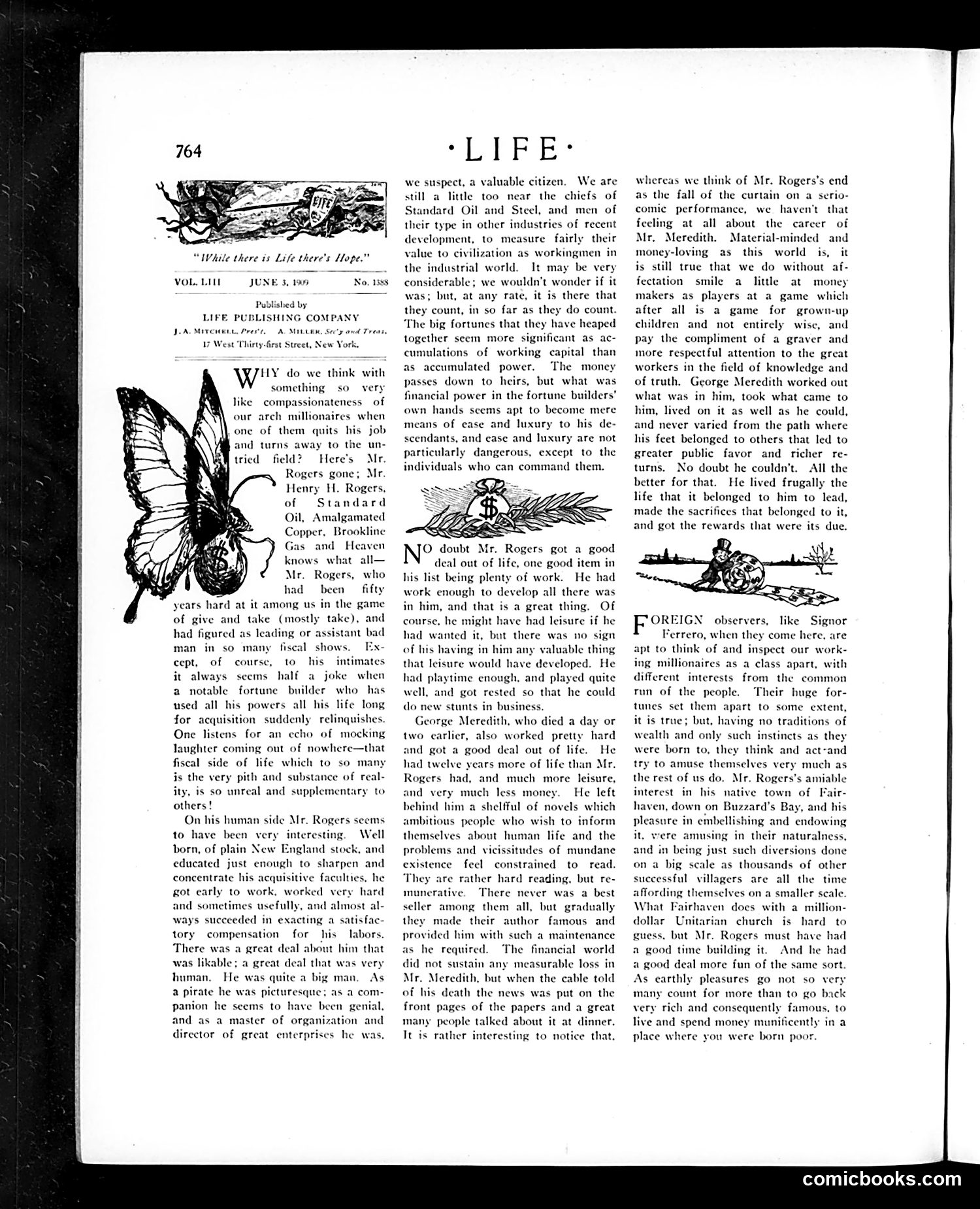
What you’re looking at
This page from *Life* magazine (June 3, 1903) reflects on the recent retirement of **Henry H. Rogers**, a Standard Oil and Amalgamated Copper magnate who had spent fifty years accumulating wealth through aggressive business practices. The satire's point: The article expresses wry compassion for Rogers abandoning his "fiscal" pursuits, noting that millionaires quitting seem absurdly out of character—one expects "mocking laughter." The piece questions whether such industrial titans truly benefited civilization, concluding their fortunes matter mainly as "accumulated working capital" rather than genuine power. The comparison to **George Meredith** (novelist, died around same time) sharpens the critique: Meredith created lasting cultural value through difficult but ultimately rewarding work, while Rogers merely accumulated money that will devolve into heirs' idle luxury. The implicit judgment: intellectual/artistic labor produces meaningful legacy; ruthless capitalism produces only unearned ease for descendants. The butterfly illustration appears decorative rather than symbolic.
📄 Transcribed text from this page (OCR, searchable)
Machine-transcribed from the original scan — historical spelling and the odd misread are preserved.
VOL. LIL JUNE 3, 199 Published by LIFE PUBLISHING J.A. Mevents COMPANY Le Pret, A MILLRK, See'y and Treats 17 West Thirty-firat Street, 3 HY do we think with very like compassionateness of our arch millionaires when one of them quits his job and turns away to the un- tried field? Here's Mr. Rogers gone; Mr. Henry H. Rogers, of Standard Oil, Amalgamated Copper, Brookline Gas and Heaven knows what all— Mr. Rogers, who had been fifty years hard at it among us in the game of give and take (mostly take), and had figured as leading or assistant bad man in so many fiscal shows. EF: cept, of course, to his intimates it always seems half a joke when a notable fortune builder who has used all his powers all his life long for acquisition suddenly relinquishes. One listens for an echo of mocking laughter coming out of nowhere—that fiscal side of life which to so many is the very pith and substance of real- ity, is so unreal and supplementary others! On his human side Mr. Rogers seems to have been very interesting. Well born, of plain New England stock, and educated just enough to sharpen and concentrate his acquisitive faculties, he got early to work, worked very hard and sometimes usefully, and almost al- ways succeeded in exacting a satisfac tory compensation for his labors, There was a great deal about him that was likable; a great deal that was very human. He was quite a big man. As a pirate he was picturesque; as a com- panion he seems to have been genial, and as a master of organization and director of great enterprises he was, something so ‘LIF E* we suspect, a valuable citizen. We are still a little too near the chiefs of Standard Oil and Steel, and men of their type in other industries of recent development, to. measure fairly their value to civilization as workingmen in the industrial world. It may be very considerable; we wouldn't wonder if it was; but, at any rate, it is there that they count, in so far as they do count. ‘The big fortunes that they have heaped together seem more significant as ac- cumulations of working capital than as accumulated power. The money passes down to heirs, but what was financial power in the fortune builders’ own hands seems apt to become mere means of ease and luxury to his de- scendants, and ease and luxury are not particularly dangerous, except to the individuals who can command them. O doubt Mr. Rogers got a good deal out of life, one good item in his list being plenty of work. He had work enough to develop all there was in him, and that is a great thing. Of course, he might have had leisure if he had wanted it, but there was no sign of his having in him any valuable thing that leisure would have developed. He had playtime enough, and played quite well, and got rested so that he could do new stunts in business. George Meredith, who died a day or two carlier, also worked pretty hard and got a good deal out of life. He had twelve years more of life than Mr. Rogers had, and much more leisure, and very much less money. He left behind him a shelfful of novels which ambitious people who wish to inform themselves about human life and the problems and vicissitudes of mundane existence feel constrained to read. They are rather hard reading, but re- munerative. There never was a best seller among them all, but gradually they made their author famous and provided him with such a maintenance as he required. The financial world did not sustain any measurable loss in Mr. Meredith, but when the cable told of his death the news was put on the front pages of the papers and a great many people talked about it at dinner. It is rather interesting to notice that, whereas we think of Mr. Rogers's end as the fall of the curtain on a serio- comic performance, we haven't that feeling at all about the career of Mr. Meredith. Material-minded and money-loving as this world is, it is still true that we do without af- fectation smile a little at money makers as players at a game which after all is a game for grown-up children and not entirely wise, and pay the compliment of a graver and more respectful attention to the great workers in the field of knowledge and of truth. George Meredith worked out what was in him, took what came to him, lived on it as well as he could, and never varied from the path where his feet belonged to others that led to greater public favor and richer re- turns. No doubt he couldn't. All the better for that. He lived frugally the life that it belonged to him to lead, made the sacrifices that belonged to it, and got the rewards that were its due. OREIGN observers, like Signor Ferrero, when they come here, are apt to think of and inspect our work- ing millionaires as a class apart, with different interests from the run of the people. Their huge for- tunes set them apart to some extent, it is true; but, having no traditions of wealth and only such instincts as they were born to, they think and act-and try to amuse themsely much as the rest of us do. Mr. Rogers's amiable interest in his native town of Fair- haven, down on Buzzard’s Bay, and his pleasure in embellishing and endowing it, were amusing in their naturalness, and in being just such diversions done on a big scale as thousands of other successful villagers are all the time flording themselves on a smaller scale. What Fairhaven does with a million- dollar Unitarian church is hard to guess, but Mr. Rogers must have had a good time building it. And he had a good deal more fun of the same sort. As earthly pleasures go not so very many count for more than to go back very rich and consequently famous, to live and spend money munificently in a place where you were born poor. common comicbooks.com