
A complete issue · 60 pages · 1909
Life — January 7, 1909
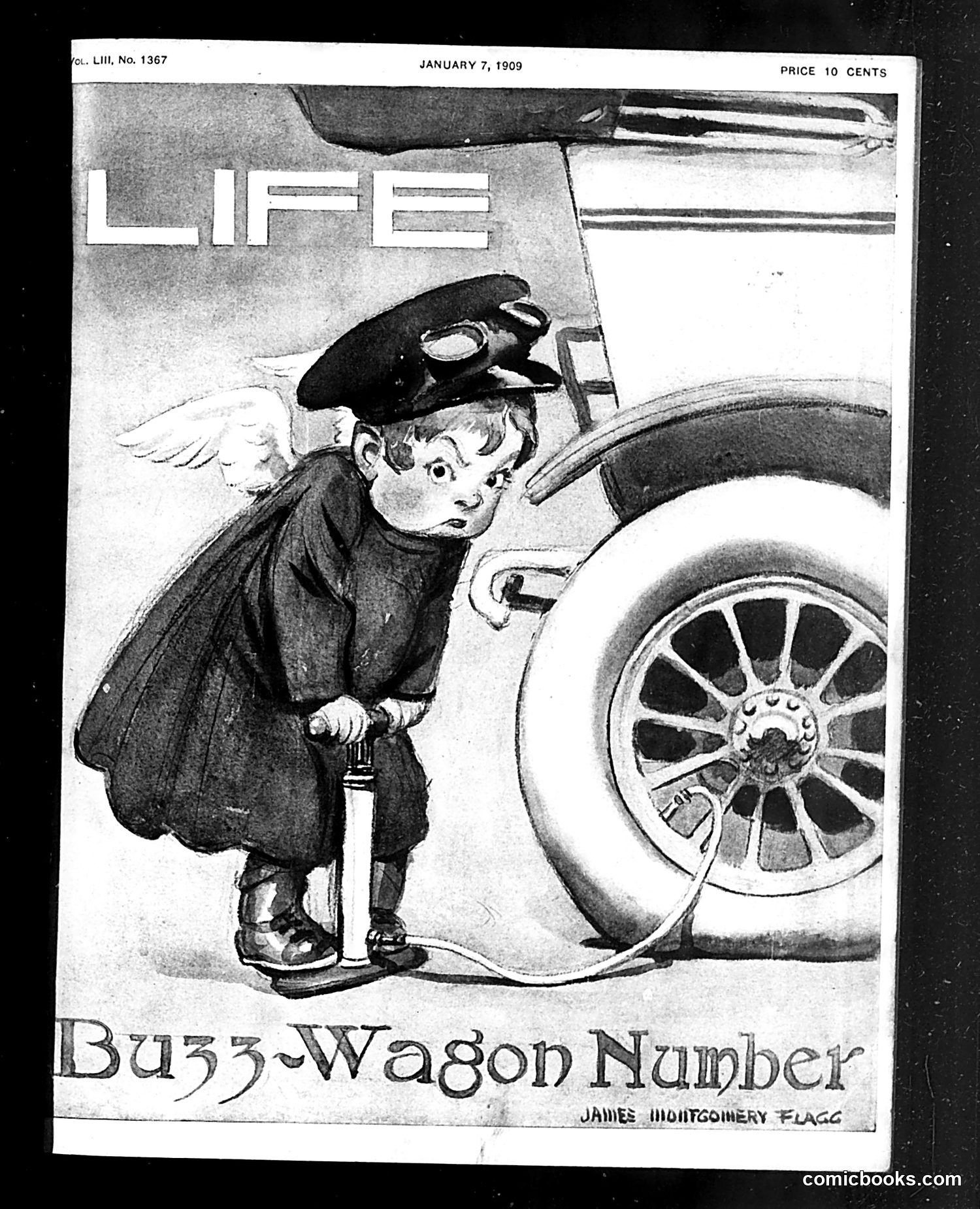
This is a Life magazine cover featuring an illustrated cherub or cupid character with wings, wearing a pilot's cap and goggles, operating a bicycle pump on an automobile tire. The cherub appears small and struggling with the task. The title reads "Busy Wagon Number," credited to artist James Montgomery Flagg. **The joke**: This appears to be a visual pun playing on automobiles as a novelty. The winged cherub (representing "life" or love) is humorously depicted doing automotive maintenance—specifically inflating a tire—suggesting either the absurdity of early car ownership's demands or satirizing the growing automotive industry. The "busy" reference likely comments on the frantic activity surrounding the new automobile craze in early 1900s America.
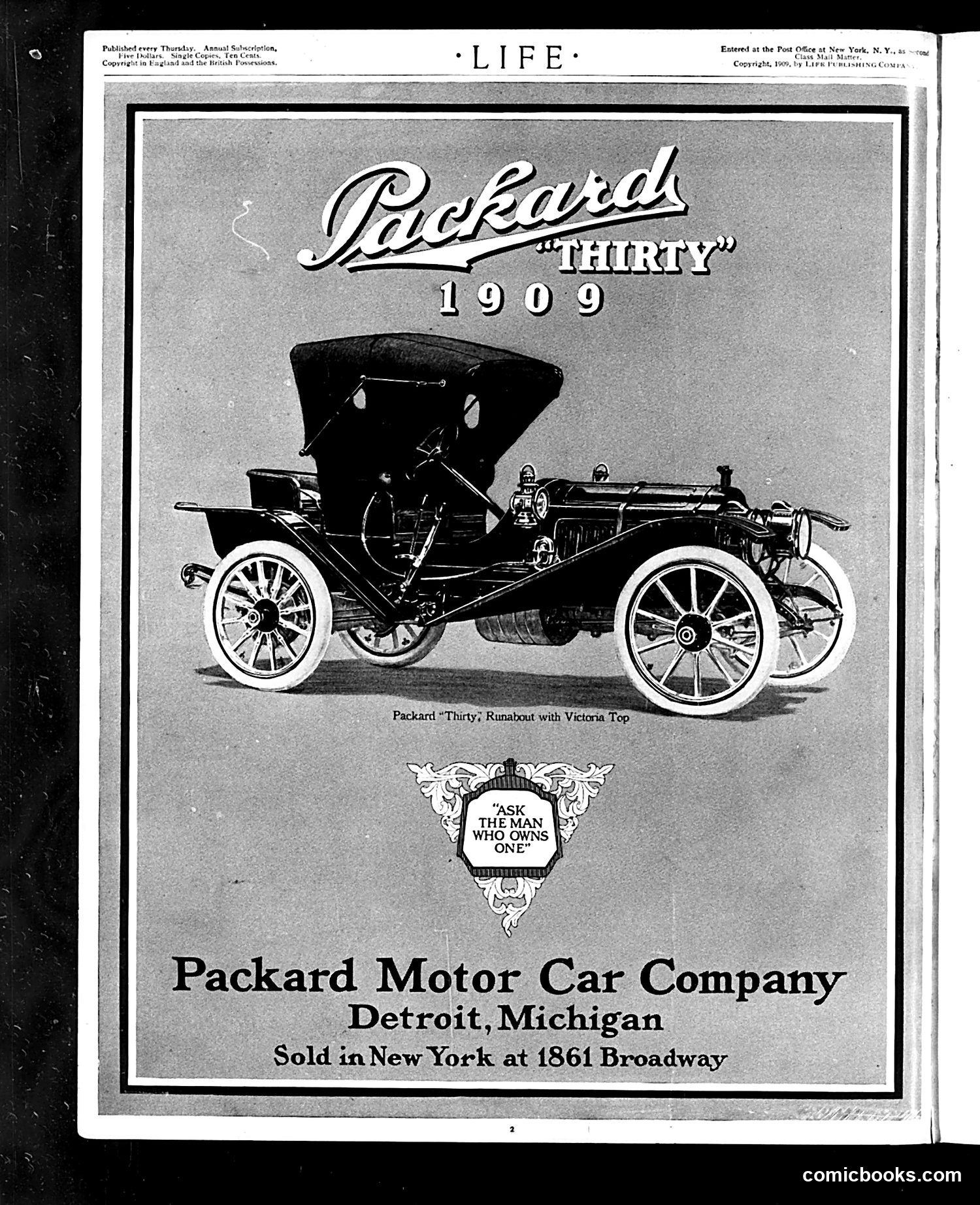
This is primarily **advertising content**, not satire or political commentary. It's a full-page advertisement for the Packard Motor Car Company's 1909 "Thirty" model automobile. The image shows a side-view illustration of an early motorcar with an open Victoria-top convertible design, featuring spoke wheels and period-appropriate engineering. The tagline "Ask the Man Who Owns One" was Packard's actual advertising slogan, suggesting customer satisfaction and reliability as selling points. The company information (Detroit manufacturer, New York sales location at 1861 Broadway) indicates this is straightforward promotional material aimed at wealthy potential buyers of luxury automobiles during the early automotive era.
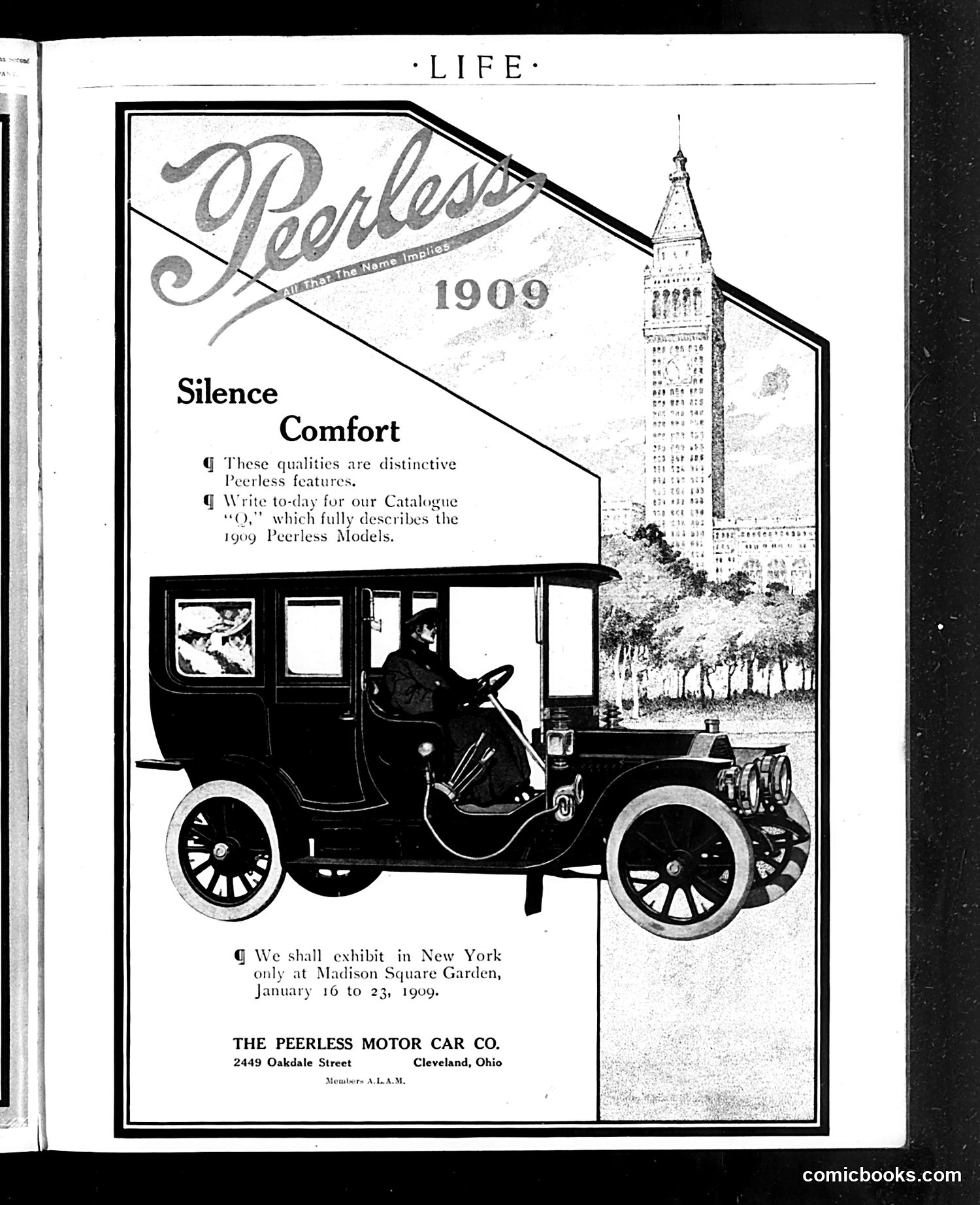
This is **not a cartoon or satire page** — it's a straightforward advertisement for the Peerless Motor Car Company of Cleveland, Ohio, published in *Life* magazine in 1909. The ad promotes the 1909 Peerless automobile model, emphasizing two key selling points: "Silence" and "Comfort." These qualities are presented as distinctive features that set Peerless cars apart from competitors. The image shows a well-dressed passenger in an early motorcar with a tall building (likely New York's Flatiron Building) in the background. The company announces an exhibition at Madison Square Garden, January 16-23, 1909, and invites readers to request a detailed catalog. This represents early automotive advertising targeting affluent consumers for whom quiet, comfortable rides were luxury features.
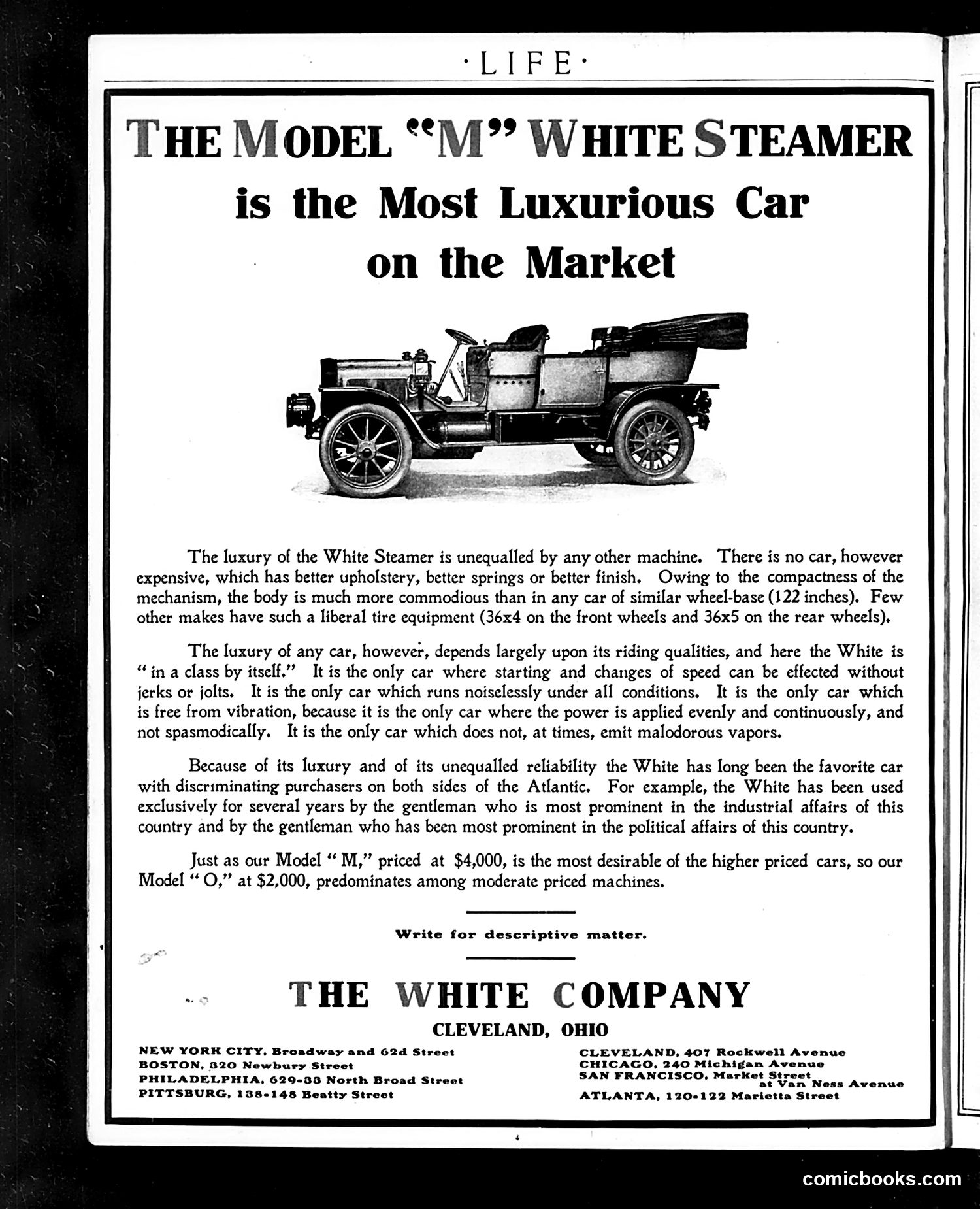
This is not a political cartoon or satirical content—it's a straightforward **advertisement for the White Steamer automobile** from The White Company of Cleveland, Ohio. The page promotes the Model "M" as "the Most Luxurious Car on the Market," priced at $4,000. The ad emphasizes technical features: a steam engine (hence "Steamer"), 122-inch wheelbase, superior tire equipment, and smooth power delivery without vibration or "malodorous vapors." The claims about reliability and use by prominent industrialists and political figures reflect early 1900s marketing conventions. The Model "O" at $2,000 targets the moderate-price market. This is pure product advertising with no satirical intent—Life magazine's pages included commercial ads alongside editorial content.
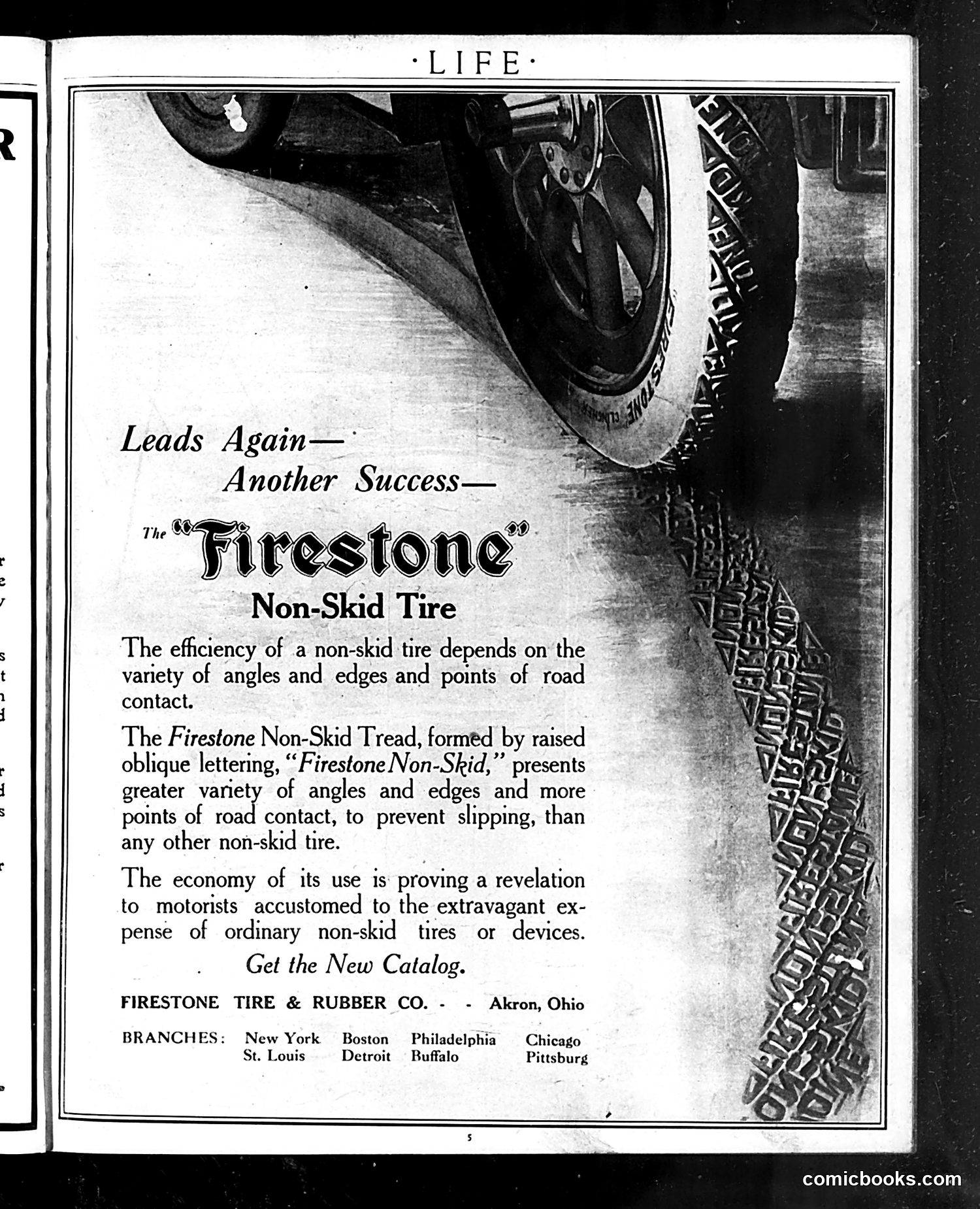
This page is **not a cartoon or satire** — it's a straightforward **advertisement for Firestone Non-Skid Tires**, published in *Life* magazine. The ad shows a close-up photograph of a tire tread pattern and makes technical claims about safety: the oblique lettering in the tread provides "greater variety of angles and edges and more points of road contact, to prevent slipping" compared to competitors. The ad emphasizes **economy**, suggesting Firestone tires cost less than "ordinary non-skid tires or devices" while performing better. **Firestone Tire & Rubber Co.** was based in Akron, Ohio, with branches listed in major American cities (New York, St. Louis, Boston, Detroit, Philadelphia, Buffalo, Chicago, Pittsburgh). There is no satirical content — this is a period advertisement highlighting tire technology and durability.
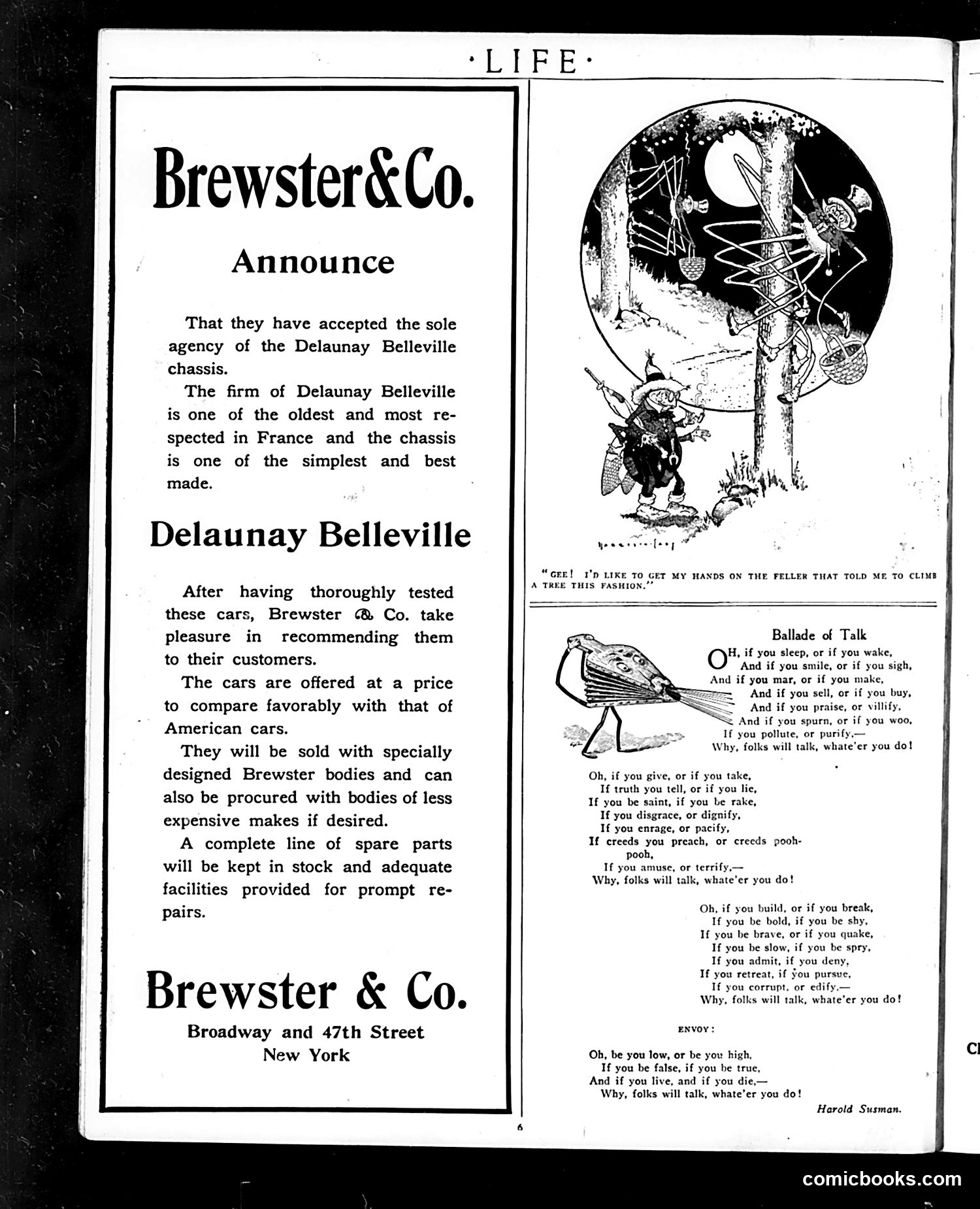
This page is primarily **advertising**, not political satire. The left side contains a Brewster & Co. advertisement announcing they've become the sole U.S. agent for Delaunay Belleville automobiles, a French chassis maker. The ad emphasizes the cars' quality, competitive pricing compared to American vehicles, and availability of spare parts and service. The right side features an illustrated poem titled "Ballad of Talk" by Harold Susman, accompanied by a whimsical drawing of a child climbing a tree while being watched by what appears to be a bird or creature. The poem humorously catalogs human behaviors and their social consequences—essentially: "no matter what you do, people will talk." It's general social commentary on gossip, not political satire.
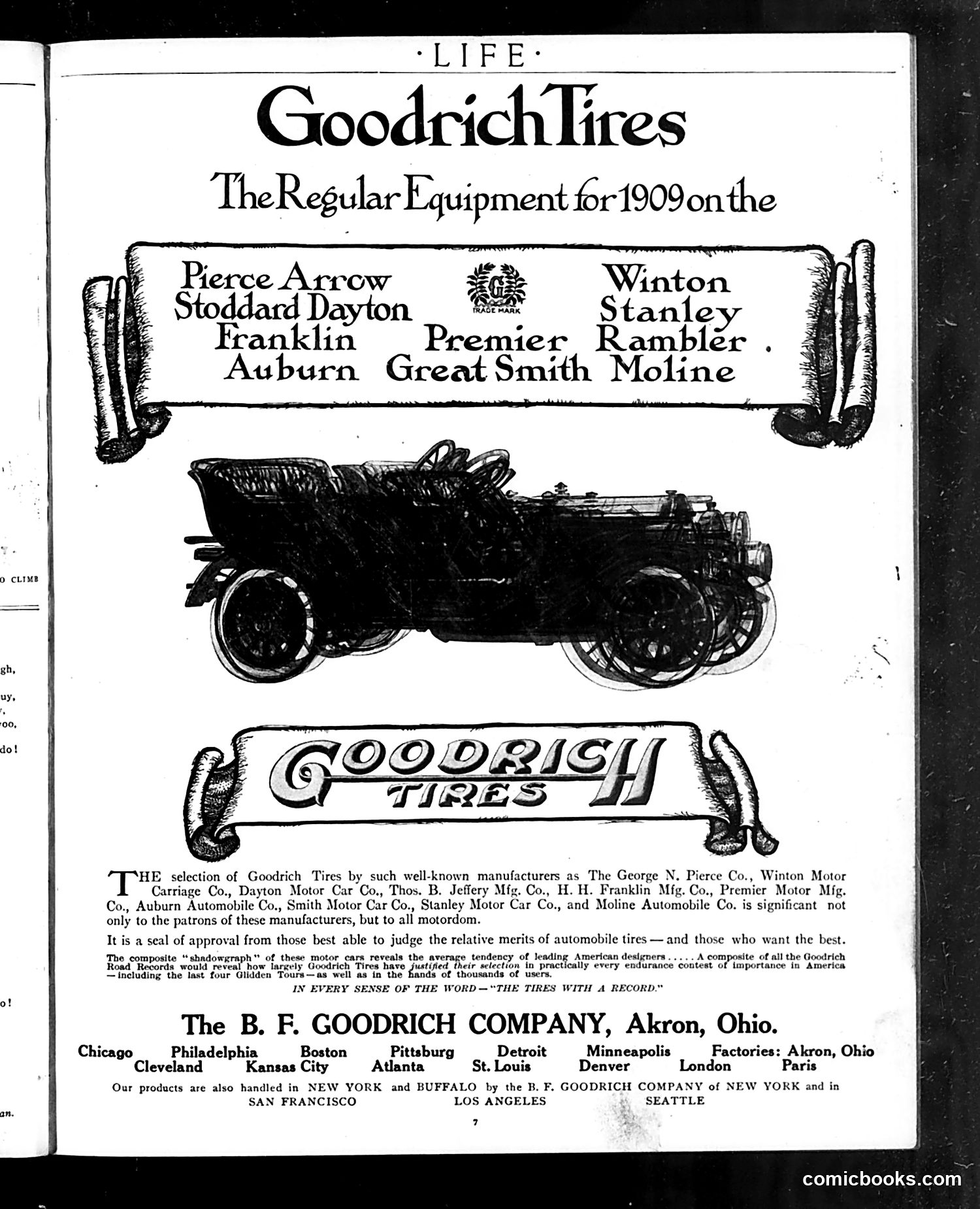
This is primarily an **advertisement for Goodrich Tires**, not satirical content. The page lists prominent 1909 automobile manufacturers—Pierce Arrow, Stoddard Dayton, Franklin, Auburn, Premier, Great Smith, Winton, Stanley, Rambler, and Moline—as users of Goodrich tires as "standard equipment." The advertisement's strategy is **endorsement marketing**: by listing well-known, respected car manufacturers who equipped their vehicles with Goodrich tires, the company argues this selection proves their product's quality. The text emphasizes that these manufacturers' choices serve as "a seal of approval" and demonstrates Goodrich's superiority. This represents early 20th-century advertising that relied on brand association and manufacturer credibility rather than modern consumer testimonials or technical specifications. There is no political satire or cartoon humor present—it's straightforward commercial persuasion.
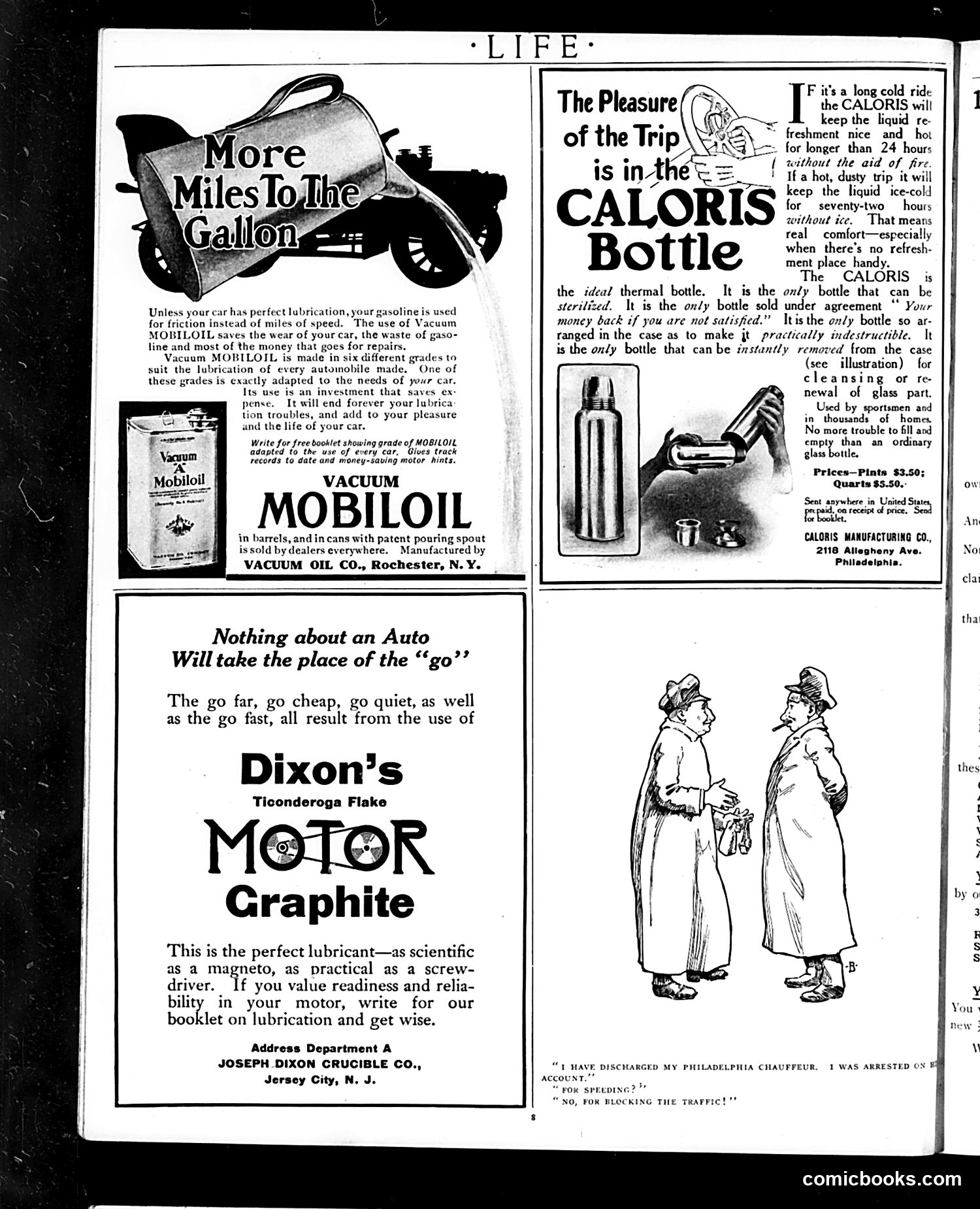
This page consists entirely of vintage automobile-related advertisements rather than satirical cartoons. The ads promote: 1. **Mobiloil lubricant** — emphasizing fuel efficiency and engine protection 2. **Caloris thermal bottle** — marketed for keeping beverages at desired temperatures during car trips 3. **Dixon's Motor Graphite** — a lubricant claiming to enable cars to "go far, go cheap, go quiet, as well as go fast" The bottom illustration shows two men in period clothing (likely early 1900s) with a caption about a discharged Philadelphia chauffeur arrested for "blocking the traffic." This appears to be a humorous vignette rather than political satire. The page reflects early automotive culture's focus on reliability, efficiency, and road trip comfort.
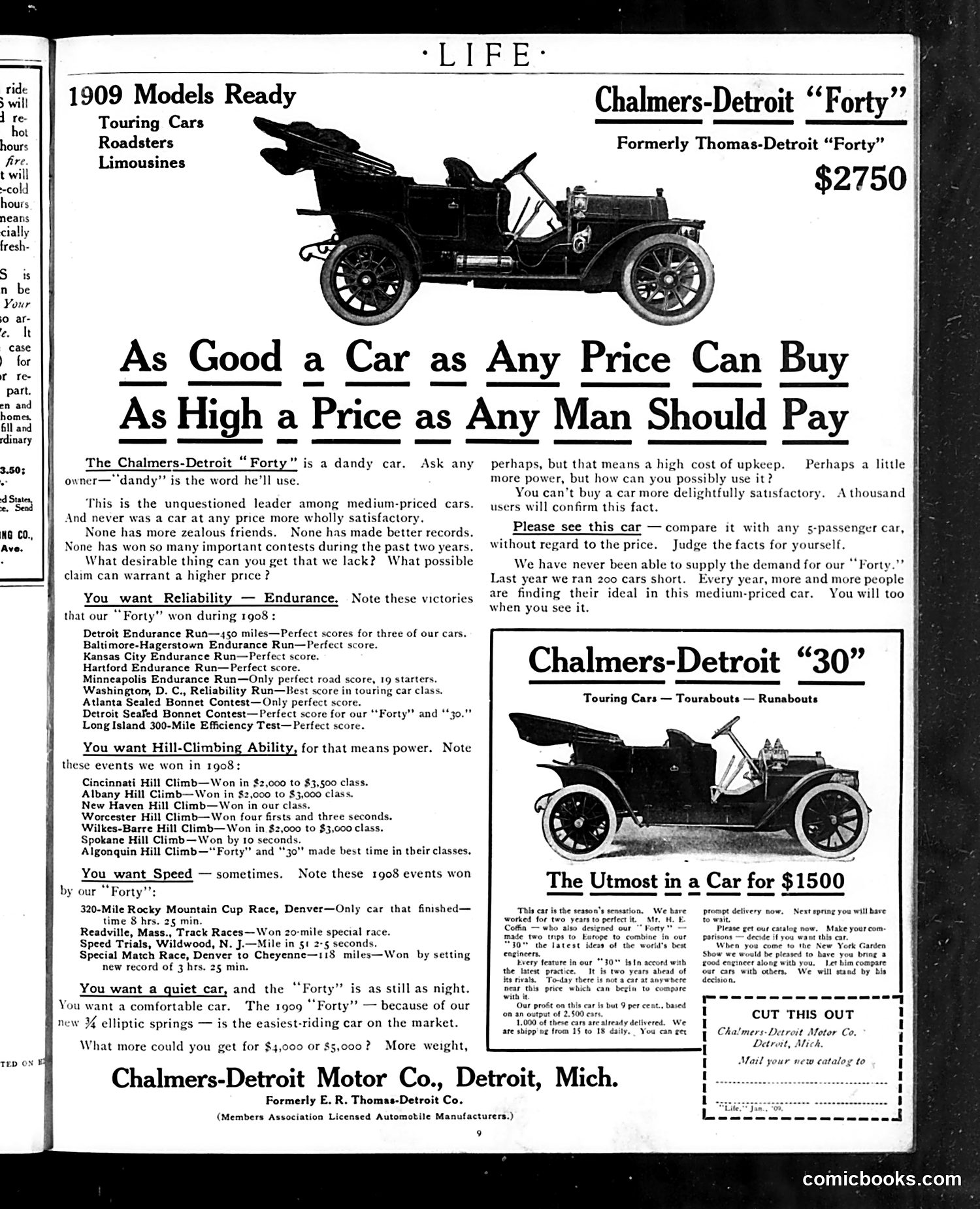
This page is primarily **advertising, not satire or political commentary**. It contains two automobile advertisements from the Chalmers-Detroit Motor Company (formerly E. R. Thomas-Detroit Co.). The "Forty" model is advertised at $2,750 with the slogan "As Good a Car as Any Price Can Buy / As High a Price as Any Man Should Pay." The copy emphasizes the car's reliability and endurance record, listing multiple racing victories from 1908. Below this, the Chalmers-Detroit "30" model is promoted at $1,500 as "The Utmost in a Car for $1500." Both advertisements target middle-class automobile buyers, emphasizing reliability, performance records, and value—typical early 20th-century auto marketing appeals. There is no political cartoons or satire on this page.
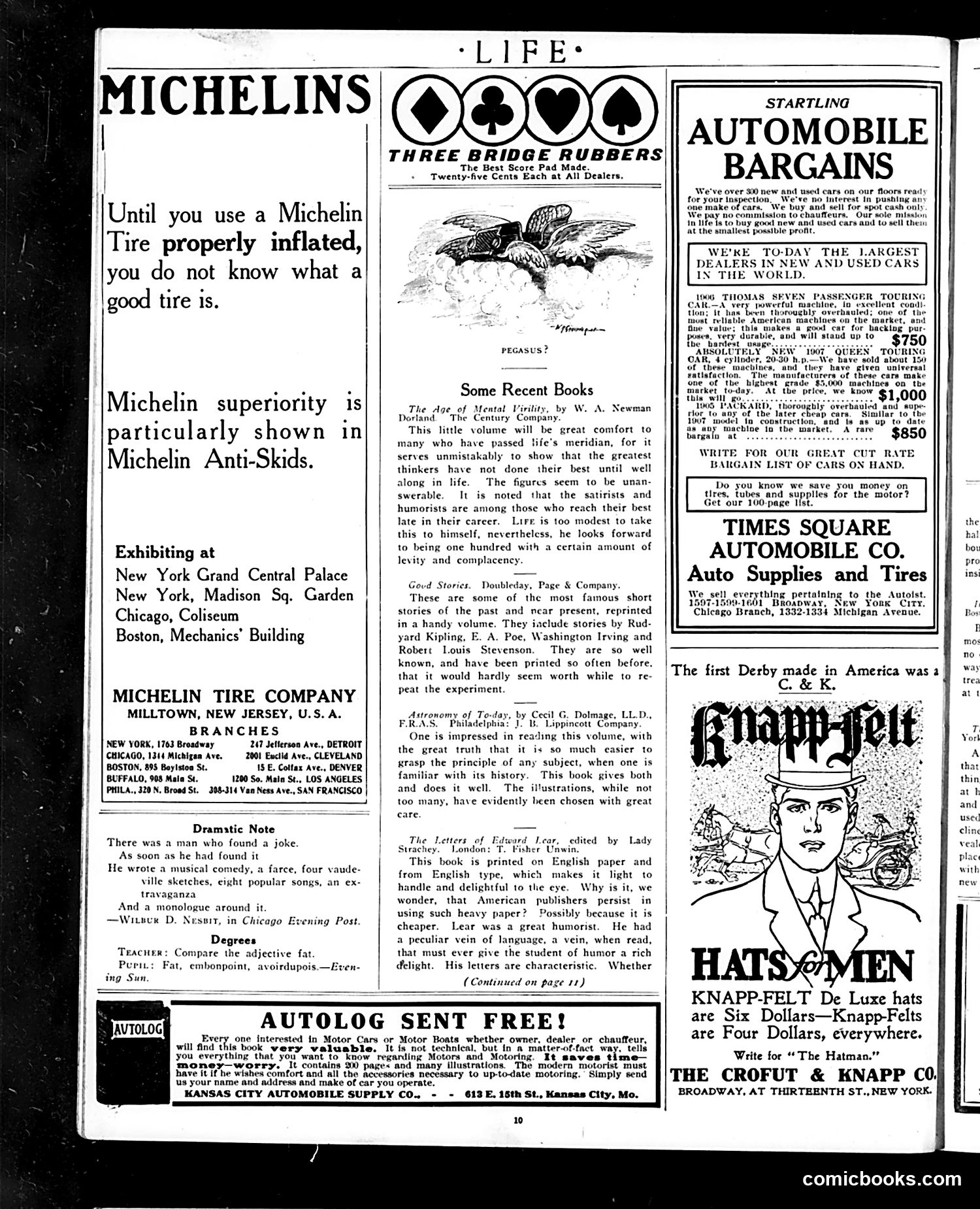
This page is primarily **advertising and book reviews**, not political satire. The content includes: **Advertisements:** Michelin Tires, automobile dealers, Knapp-Felt hats, and an "Autolog" motor car guide. These reflect early 1900s consumer goods. **Book Reviews:** Brief notices of recent publications including works on philosophy, humor, and English literature—standard magazine content. **"Dramatic Note":** A small humor section about a man who found a joke, featuring wordplay ("Pottage"—comparing adjectives like "fat" to "avoirdupois"). **"Snappy Stuff":** An illustration of a woman's face labeled as fashion/lifestyle content. The page lacks political cartoons or social satire. It's a typical magazine layout mixing advertisements with literary content, representative of early 20th-century periodical design.
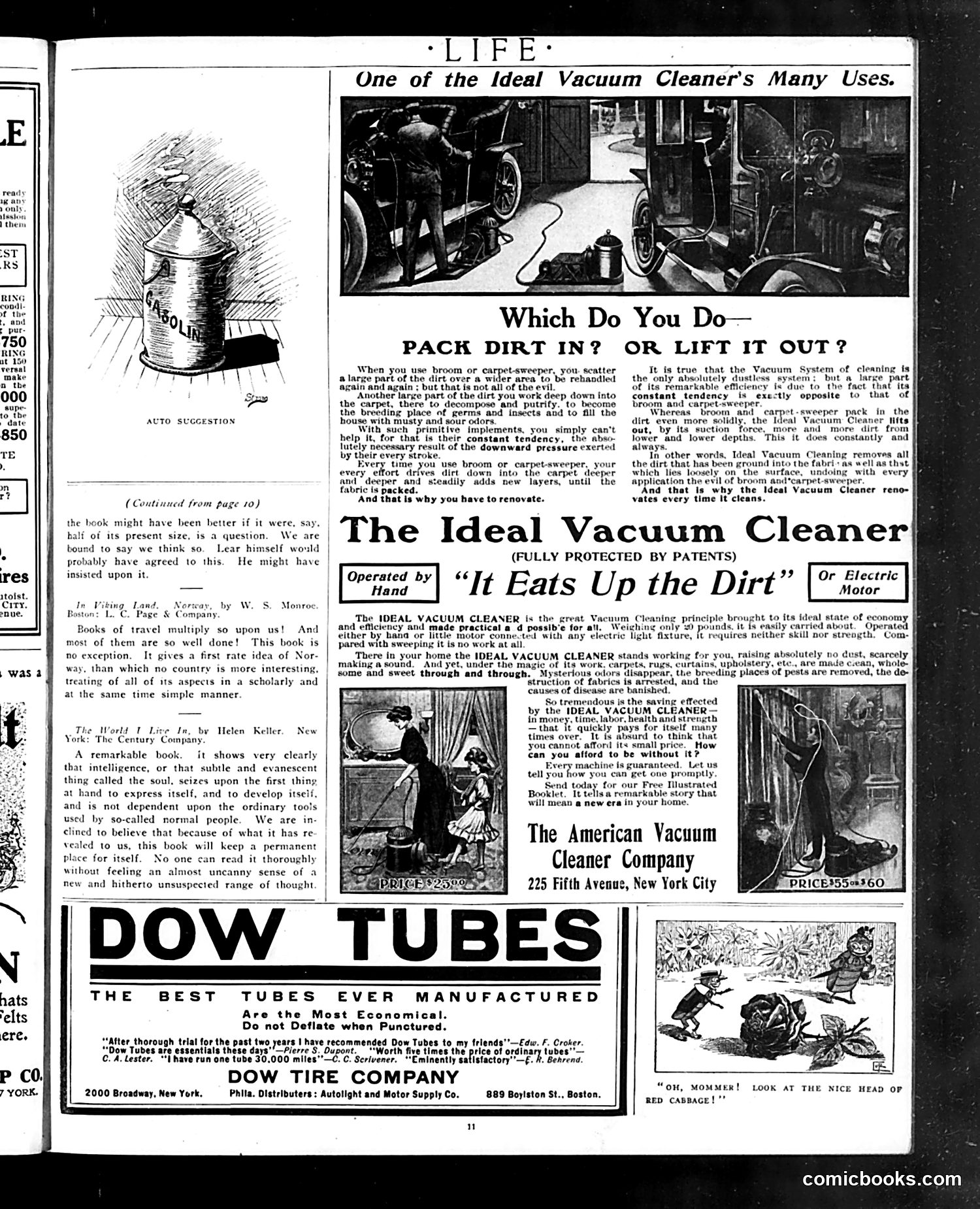
This page is primarily **advertising**, not political satire. It contains three main advertisements: 1. **The Ideal Vacuum Cleaner** (center): A product ad asking "Pack dirt in? Or lift it out?" The copy contrasts vacuum cleaning with traditional broom/sweeper methods, claiming the vacuum removes dirt more thoroughly from carpets and fabrics. 2. **Dow Tubes** (bottom): Advertising automobile inner tubes as "the best tubes ever manufactured," emphasizing economy and durability. 3. **The American Vacuum Cleaner Company** (right): Another vacuum cleaner product ad. There is a small cartoon sketch labeled "Auto Suggestion" (upper left) showing a car, but it's a minor illustration unrelated to the main advertisements. The page reflects early-20th-century consumer culture, promoting new household technology (vacuum cleaners) as modern improvements over traditional cleaning methods.
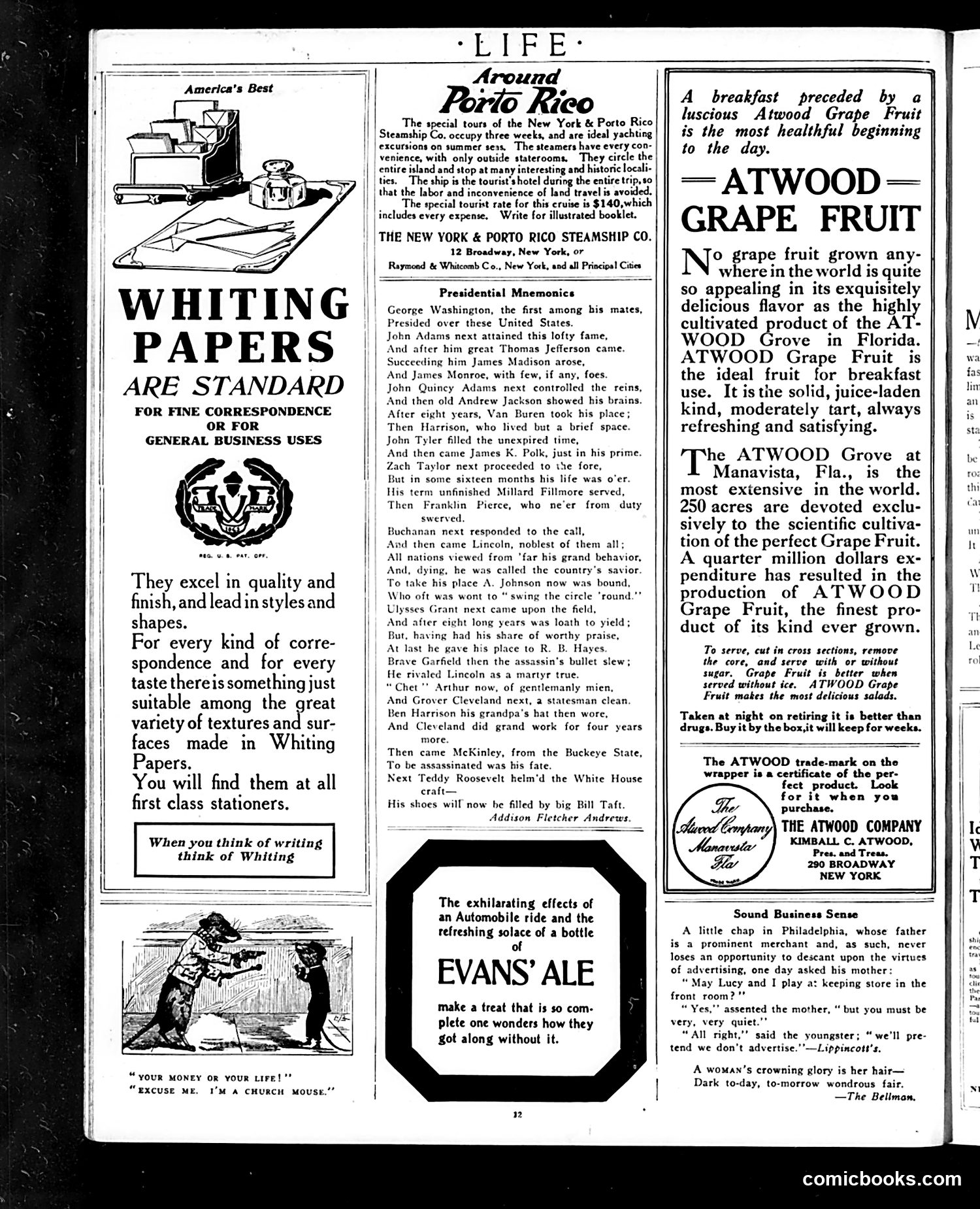
This page is primarily **advertising content** with one historical poem and minimal satire. The main text feature is "Presidential Mnemonics," a humorous poem listing U.S. presidents from Washington through Theodore Roosevelt as memory aids. It's lighthearted doggerel rather than political satire—designed to help readers memorize presidents in order through rhyming couplets and crude characterizations (e.g., "old Andrew Jackson showed his brains"). The advertisements dominate: Whiting Papers, Evans' Ale, Atwood Grape Fruit, and a cruise to Puerto Rico. These represent typical early-20th-century product marketing with period illustrations. The cartoon at bottom-left shows a woman rejecting a man's advances, captioned with gender-based humor common to the era ("'Your money or your life!' 'Excuse me, I'm a church mouse'")—reflecting dated attitudes toward courtship and finance. This appears to be an **entertainment/advertisement issue** rather than politically satirical.
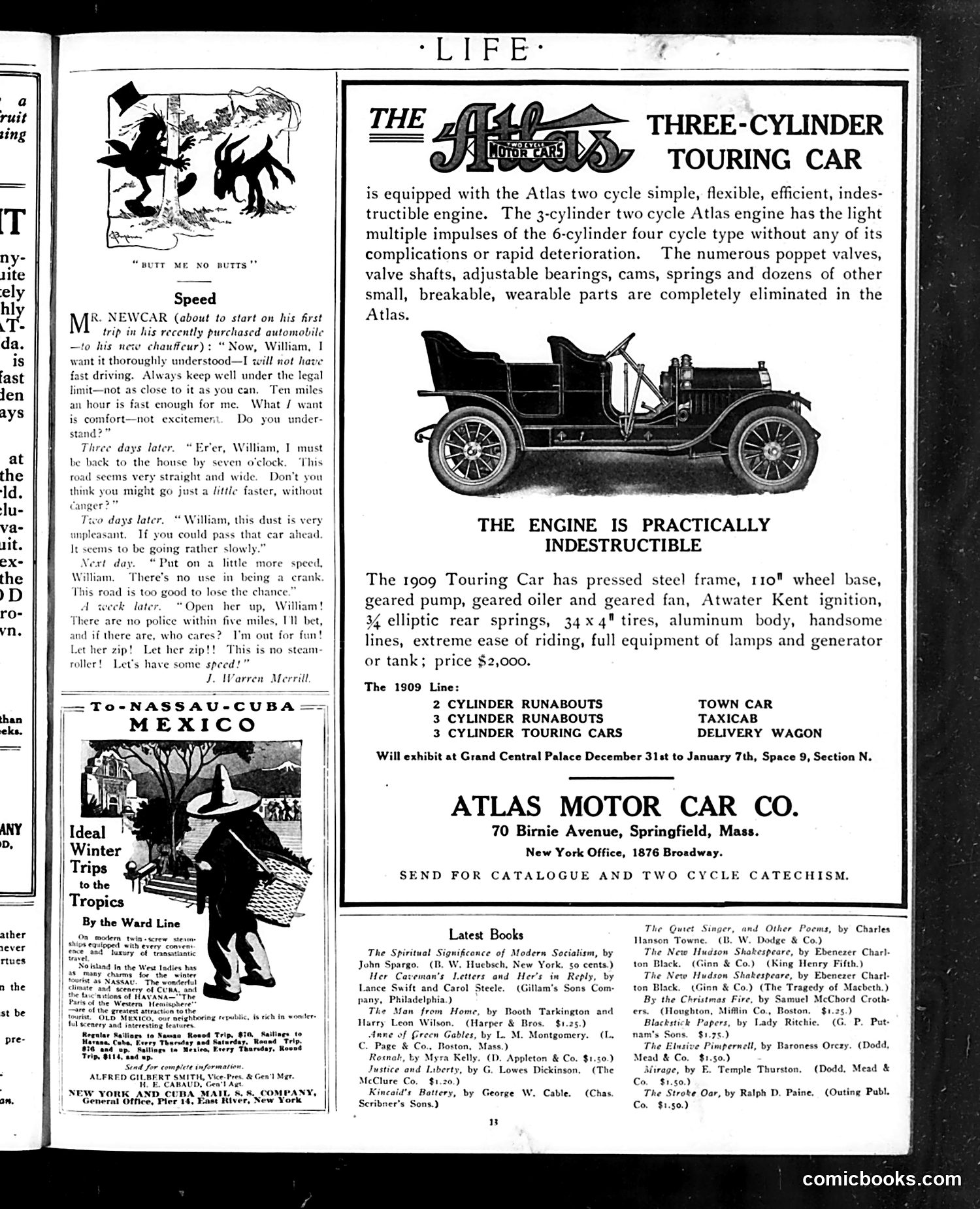
This page is primarily an **advertisement for Atlas Motor Cars**, with a small satirical cartoon and travel feature. The cartoon titled **"Butt Me No Butts"** (upper left) depicts two figures in what appears to be a comedic dispute, likely playing on the double meaning of "butt" — though the specific context isn't entirely clear from the image alone. Below that is a brief humorous story called **"Speed,"** by I. Warren Merrill, about a man named William being urged by Mrs. Newcar to drive faster on a country road. It's light domestic satire about automotive enthusiasm versus caution. The bulk of the page advertises the **1909 Atlas three-cylinder touring car**, emphasizing its simple, durable engine design. An illustration shows the vehicle alongside technical specifications. The bottom includes book recommendations and a travel advertisement for tropical trips via Ward Line.
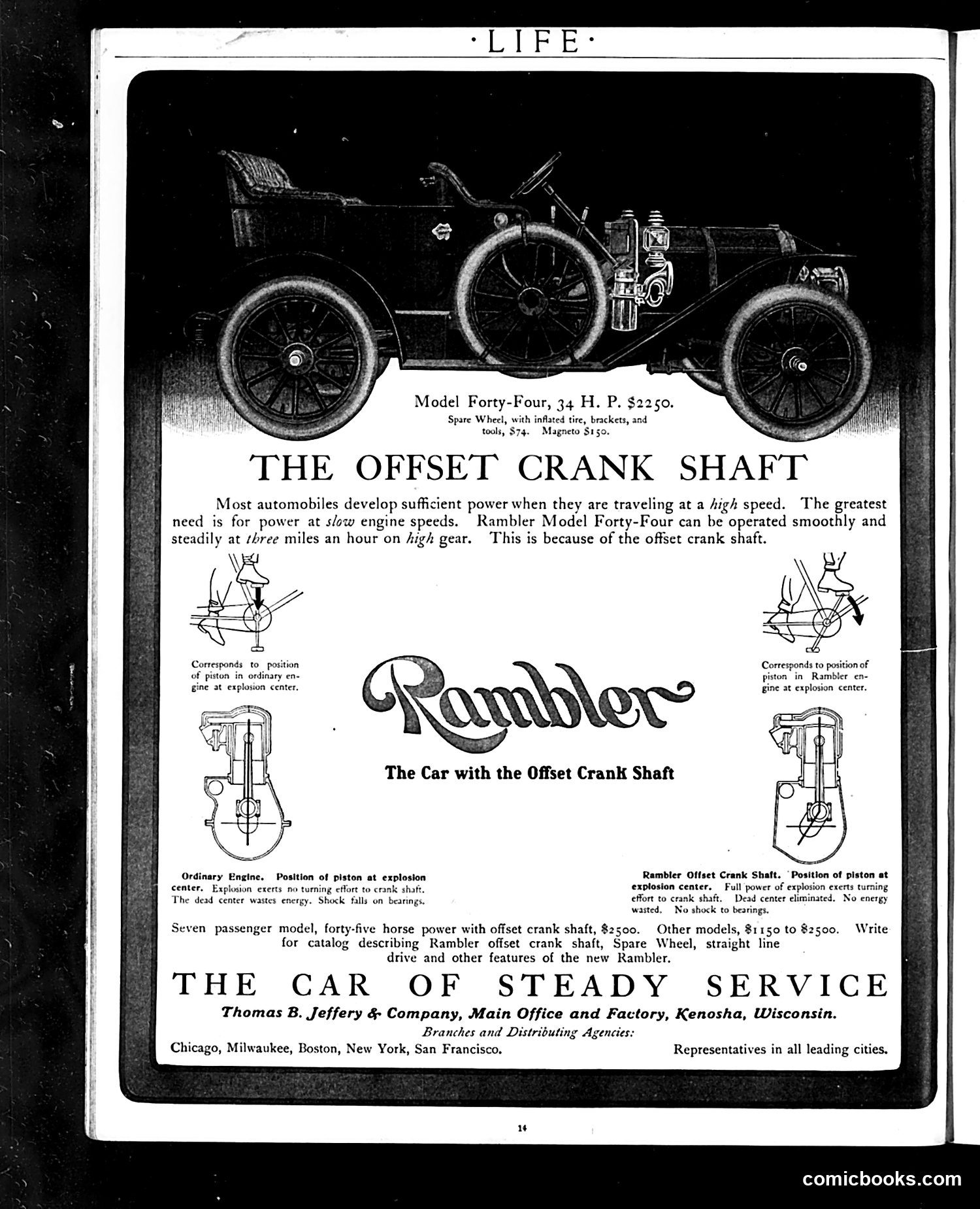
This is not a political cartoon but a **technical automobile advertisement** from *Life* magazine promoting the Rambler Model Forty-Four. The page explains the marketing advantage of the Rambler's "offset crank shaft" design. The diagrams compare an ordinary engine (where piston explosions waste energy at the "dead center") versus the Rambler's improved engineering, which harnesses full power throughout the combustion cycle. The text emphasizes practical benefits: smooth operation at low speeds (three miles per hour) and steady performance—crucial selling points for early 1900s automobiles when reliable, controllable power was still novel technology. This is straightforward product advertising using technical diagrams to demonstrate mechanical superiority, not satire or social commentary. The manufacturer is Thomas B. Jeffery & Company of Kenosha, Wisconsin, with prices ranging from $1,150 to $2,500.
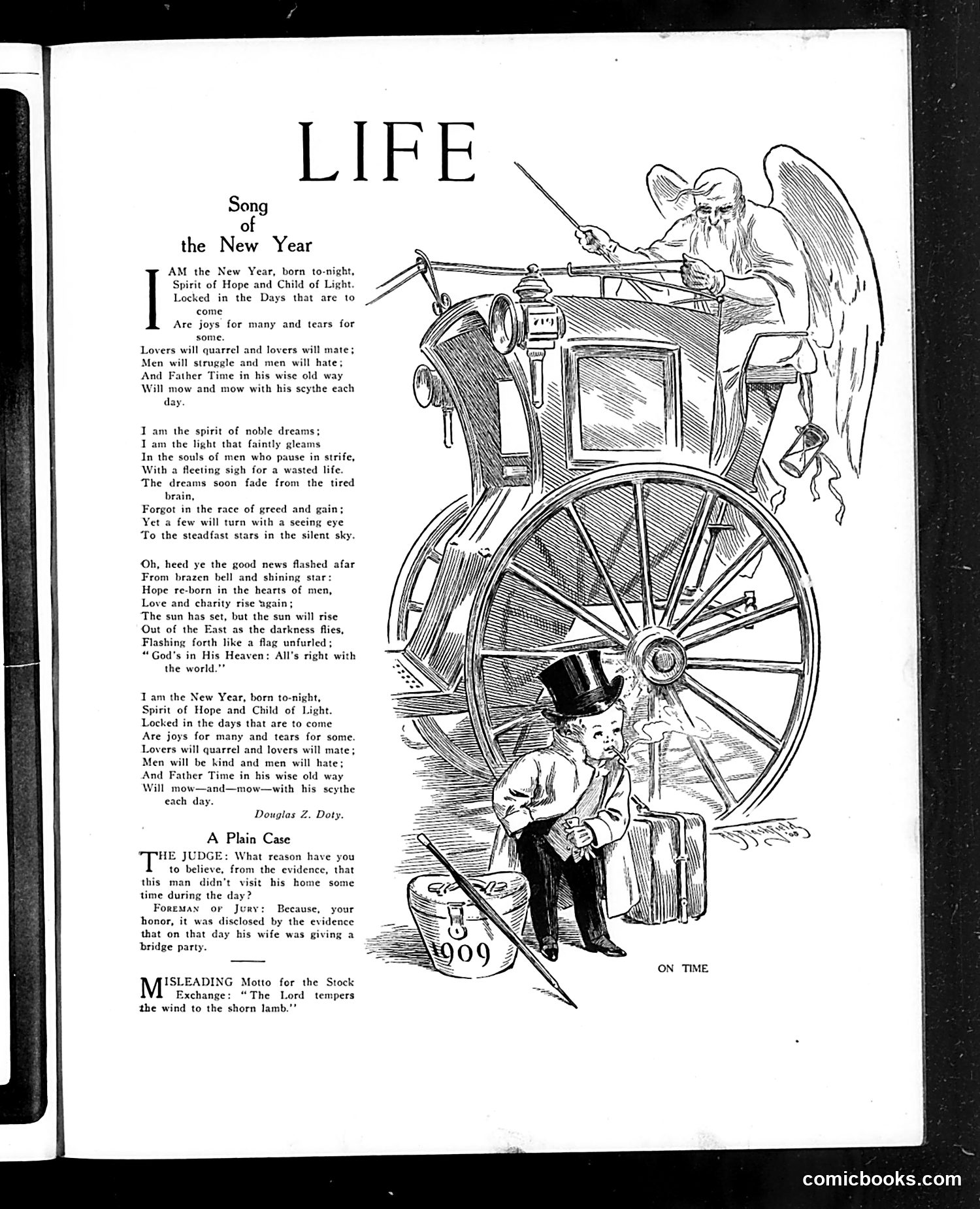
This 1909 Life magazine page contains New Year's themed content mixing idealism with cynicism. **"Song of the New Year"** by Douglas Z. Doty personifies the New Year as a spirit of hope, promising noble dreams and renewal. The accompanying illustration shows Father Time (the bearded figure with wings and scythe) steering a chariot labeled "1909," symbolizing time's passage and control over human destiny. **"A Plain Case"** is a brief humorous courtroom anecdote: a jury foreman explains the defendant couldn't have visited home because his wife was hosting a bridge party—implying wives' social obligations keep husbands away. This reflects early 20th-century gender dynamics and leisure culture. **The stock market motto** satirizes Wall Street practices, suggesting brokers exploit ordinary investors ("shorn lambs") while claiming divine protection. This references the biblical phrase about God tempering hardship for the vulnerable—darkly ironic given financial manipulation. The page balances romantic idealism about the new year against realistic cynicism about human nature, marriage, and capitalist greed—typical of Life's satirical tone.
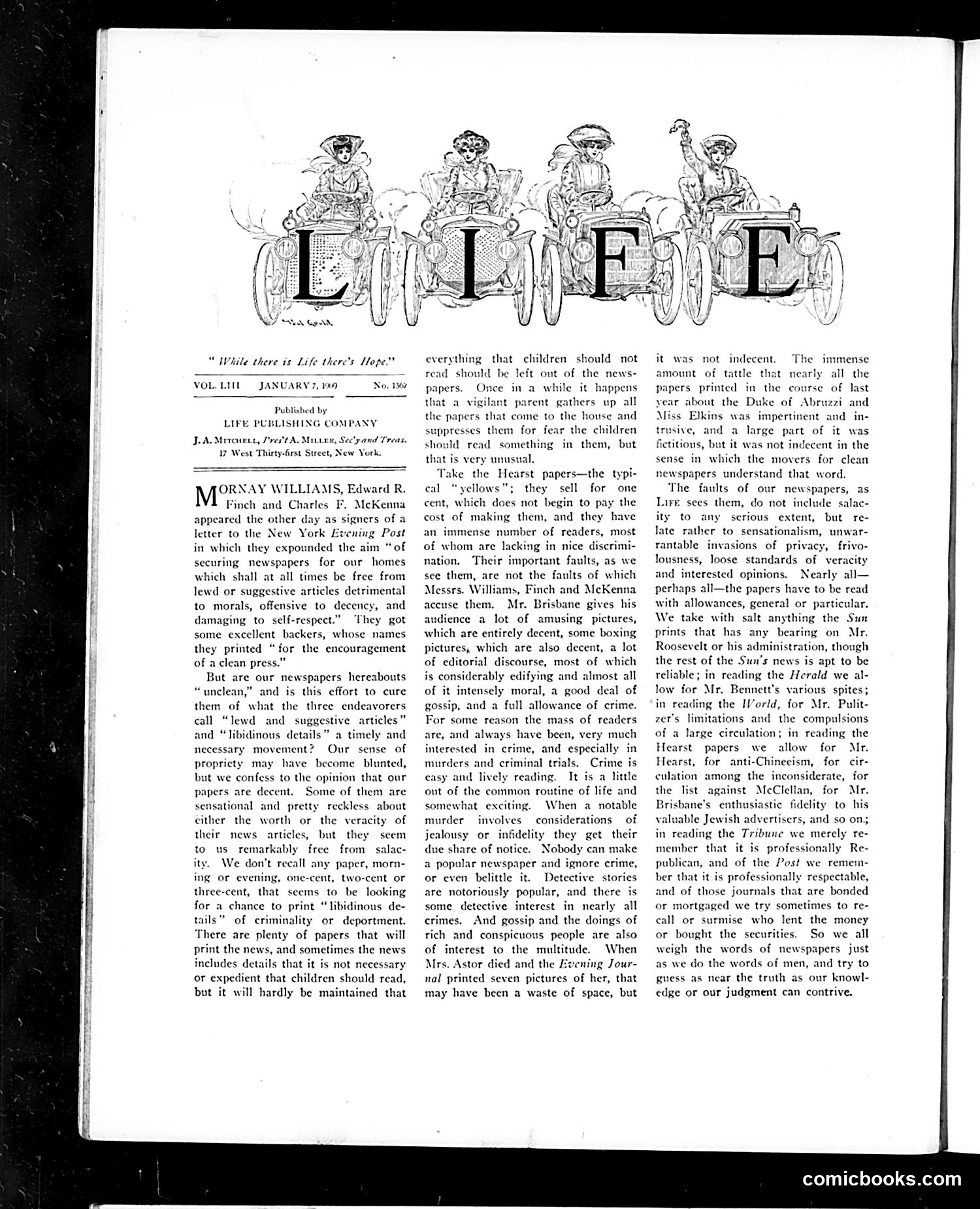
This is an editorial defending American newspapers against a "clean press" campaign launched by Mornay Williams, Edward Finch, and Charles McKenna. These three had written to the *New York Evening Post* criticizing papers for carrying "lewd" and "libidinous" content harmful to children. Life magazine's editor argues newspapers are actually quite decent. He acknowledges they're sensational and sometimes reckless with facts, but denies they print genuinely obscene material. He defends crime coverage and gossip about wealthy figures (like the Astor and Abruzzi coverage) as legitimate news interests, not moral failures. The cartoon header shows well-dressed figures in automobiles spelling "LIFE"—visual shorthand for modernity and progress. The satire's point: the reformers are exaggerating the problem. Papers may be flawed, but not in the prurient way claimed. The real issue is sensationalism and truthfulness, not hidden lewdness.
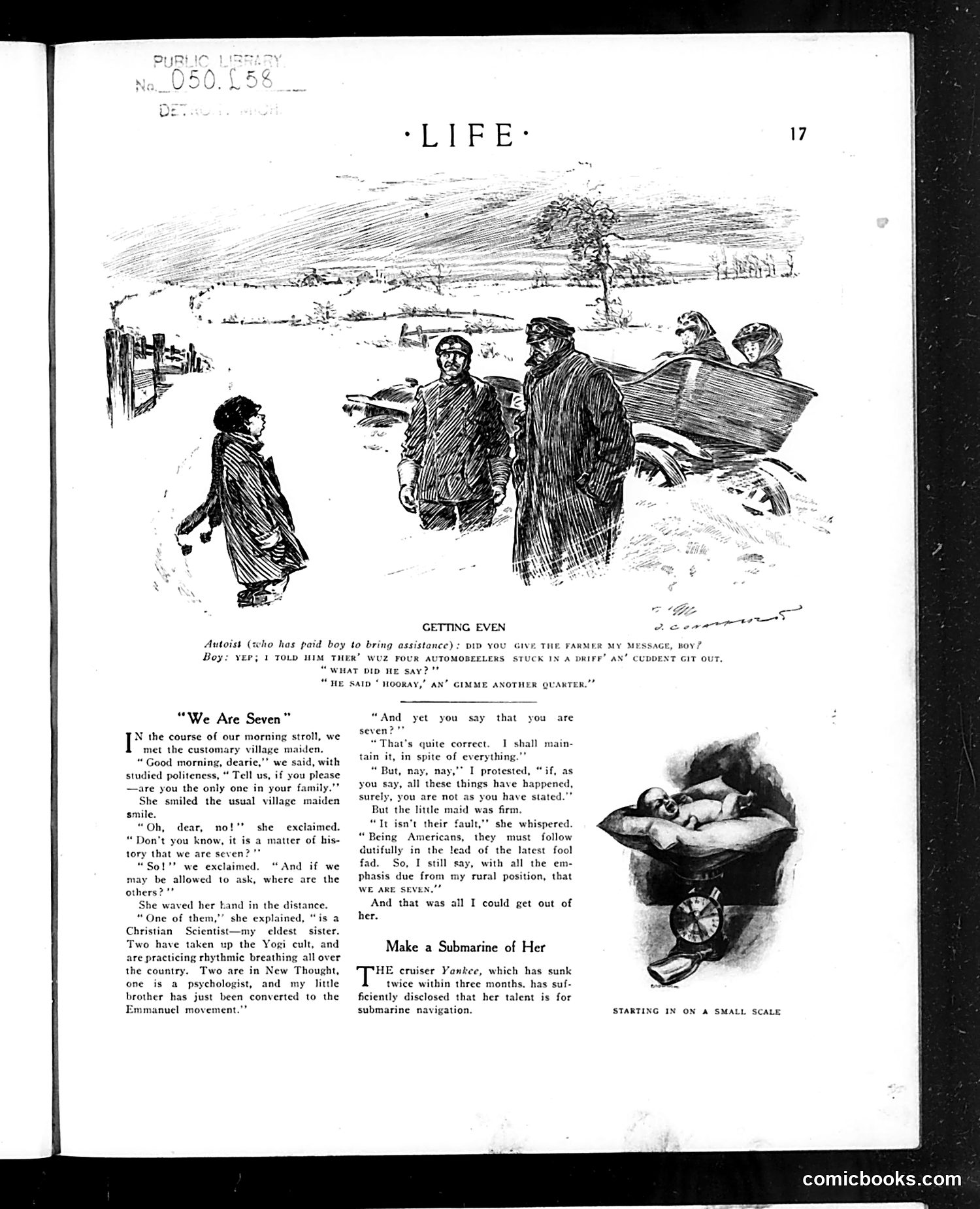
This page contains two satirical pieces mocking early 20th-century American trends. **"Getting Even"** (top cartoon): An motorist stuck in snow pays a boy to deliver a message to a farmer. The farmer, delighted that automobiles are stranded, gleefully refuses help—suggesting rural resentment toward wealthy urban drivers and their newfangled vehicles. **"We Are Seven"** (text piece): A parody of Wordsworth's poem, this satirizes Americans' obsession with trendy movements. A village girl claims seven siblings, but they're scattered among fads: Christian Science, Yoga, "New Thought," psychology, and the "Emmanuel movement" (a faith-healing sect). The joke: Americans blindly follow whatever intellectual/spiritual fashion is current, rather than maintaining stable beliefs. **"Make a Submarine of Her"**: A brief quip about the USS *Yankee*, which sank twice, sarcastically suggesting it should be converted to a submarine since it's so good at sinking. The page ridicules American superficiality and class tensions during the Progressive Era.
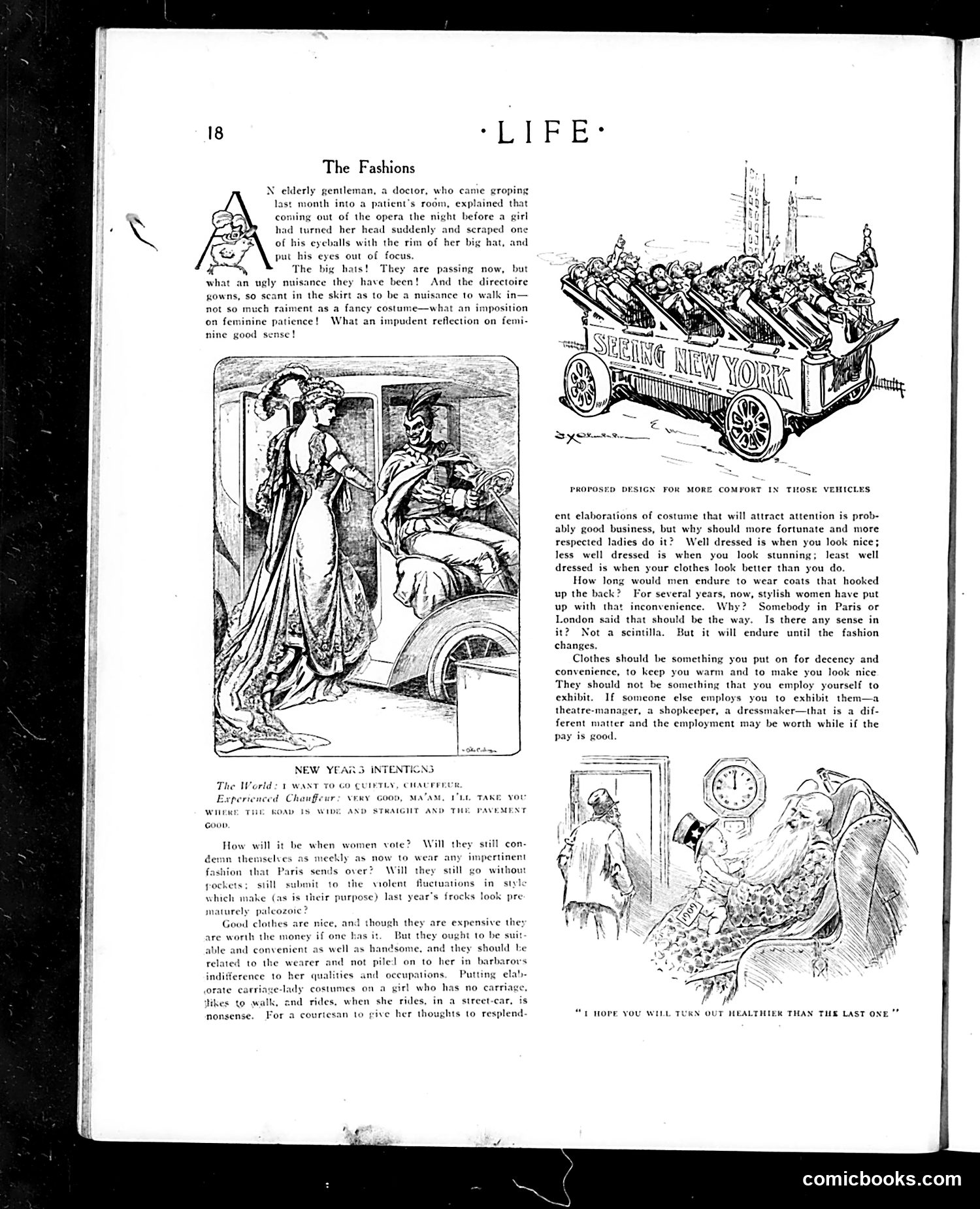
This satirical article criticizes early-1900s women's fashion as impractical and nonsensical. The main targets are: **Large hats**: So oversized they obstruct vision (the opening anecdote about a doctor's eye injury), described as an "ugly nuisance." **Directoire gowns**: Fashionably scanty skirts that impede walking, criticized as uncomfortable "fancy costume" rather than practical clothing. **The core argument**: Women blindly follow Paris and London fashion dictates without questioning sense or convenience. The author mocks women's acceptance of uncomfortable, illogical designs when men would never tolerate equivalent restrictions on their clothing. **The feminist undercurrent**: The piece questions whether women gaining voting rights will finally demand practical fashion, or continue submitting to frivolous trends. It argues clothes should serve function (warmth, modesty, convenience) not vanity, and shouldn't be "piled on to her in barbarous indifference to her qualities." The cartoons illustrate the absurdity: an improbable hat-laden vehicle design and a time-conscious scene mocking fashion's demands on women's time and attention.
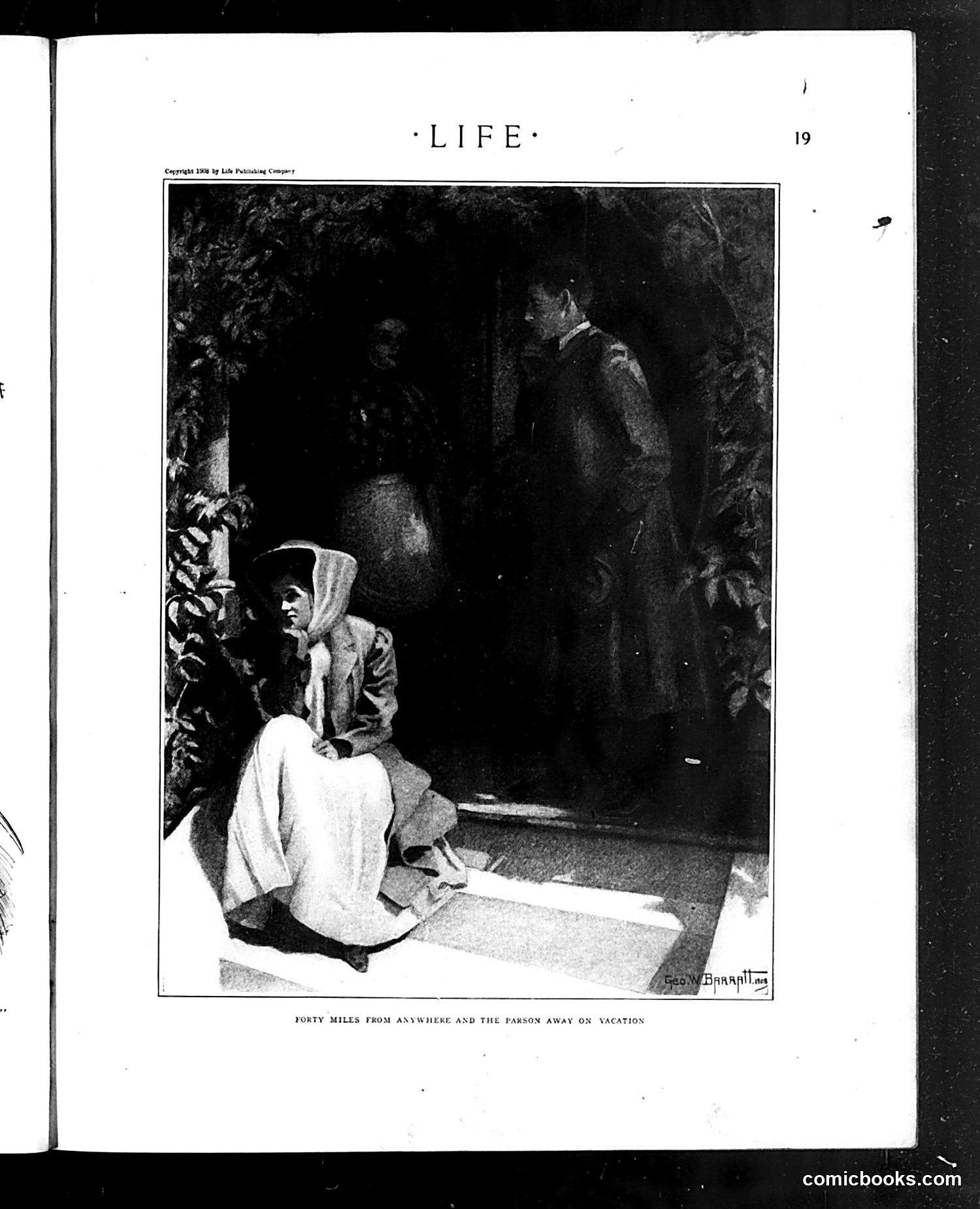
This 1908 Life magazine illustration depicts a rural scene with satirical undertones. A woman sits crouched by a doorway while three men stand in shadow behind her, suggesting an uncomfortable or compromising situation. The caption's humor relies on the absence of moral authority—the parson (clergyman) who would normally maintain propriety is away, and the remote location ("forty miles from anywhere") implies no oversight or witnesses. The joke targets rural isolation and the dependence on religious figures to enforce social morality. It suggests that without the parson's presence, rural communities lack restraint. The image's dark, ominous tone undercuts any lightheartedness, making this primarily a commentary on frontier lawlessness and moral vulnerability rather than gentle humor.
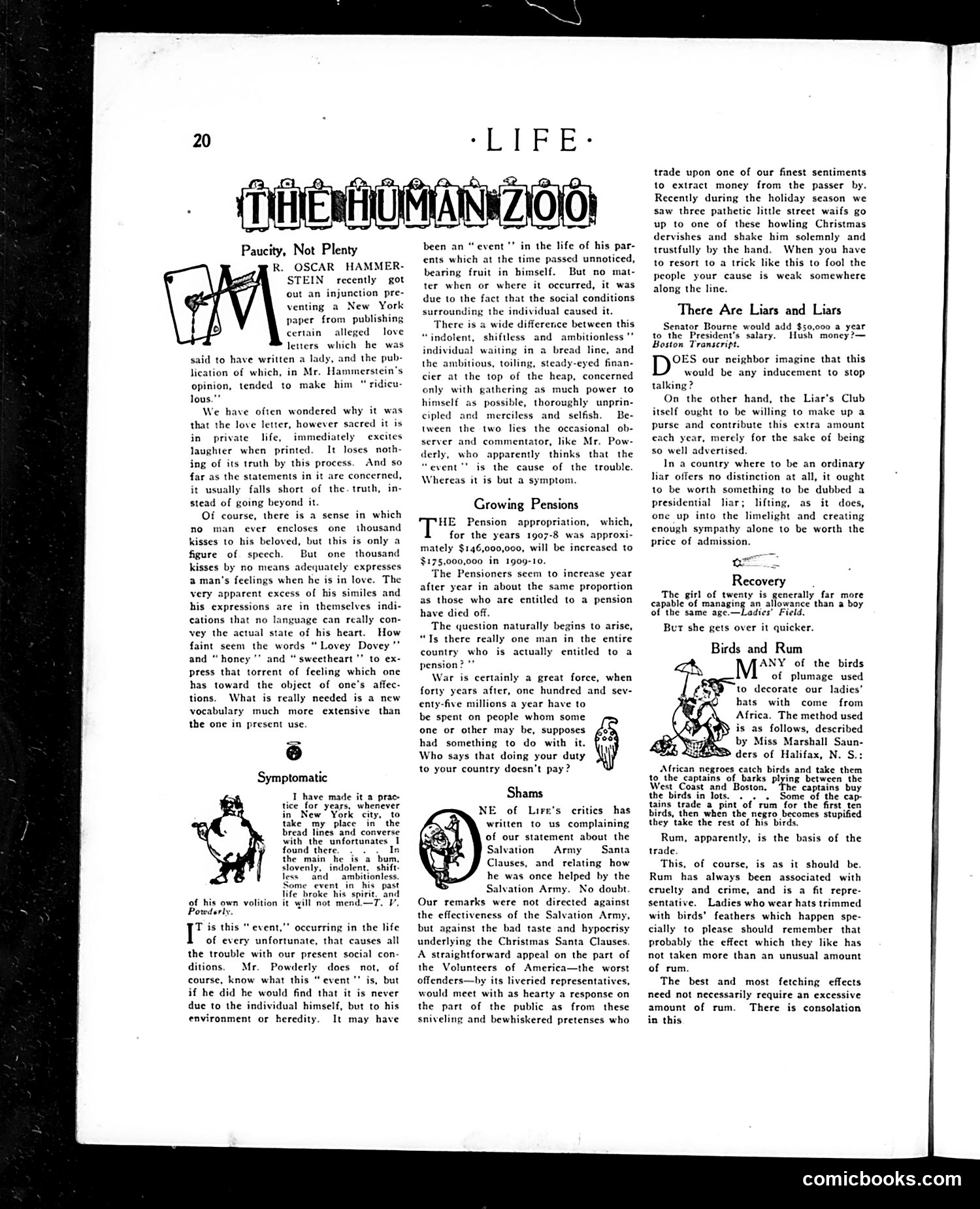
This page contains three satirical essays critiquing American society circa 1908-1909. **"Paucity, Not Plenty"** defends Oscar Hammerstein's attempt to suppress love letters, arguing that exaggerated romantic language (like "one thousand kisses") reflects genuine emotion, not ridiculousness. **"Symptomatic"** attacks labor leader T.V. Powderly's claim that unemployed "bums" lack ambition due to personal "events." Life argues instead that poverty stems from systemic social conditions and heredity—not individual moral failure—contrasting struggling breadline workers with ruthless wealthy financiers. **"Growing Pensions"** sarcastically mocks the escalating military pension budget ($146M to $175M), questioning whether anyone actually deserves pensions forty years after war. **"Shams"** begins defending the Salvation Army against unnamed critics who complained about Life's earlier criticism of their "Santa Clauses" charity campaign. The page employs Life's typical Progressive Era stance: blaming social structures rather than individual character for poverty and inequality.
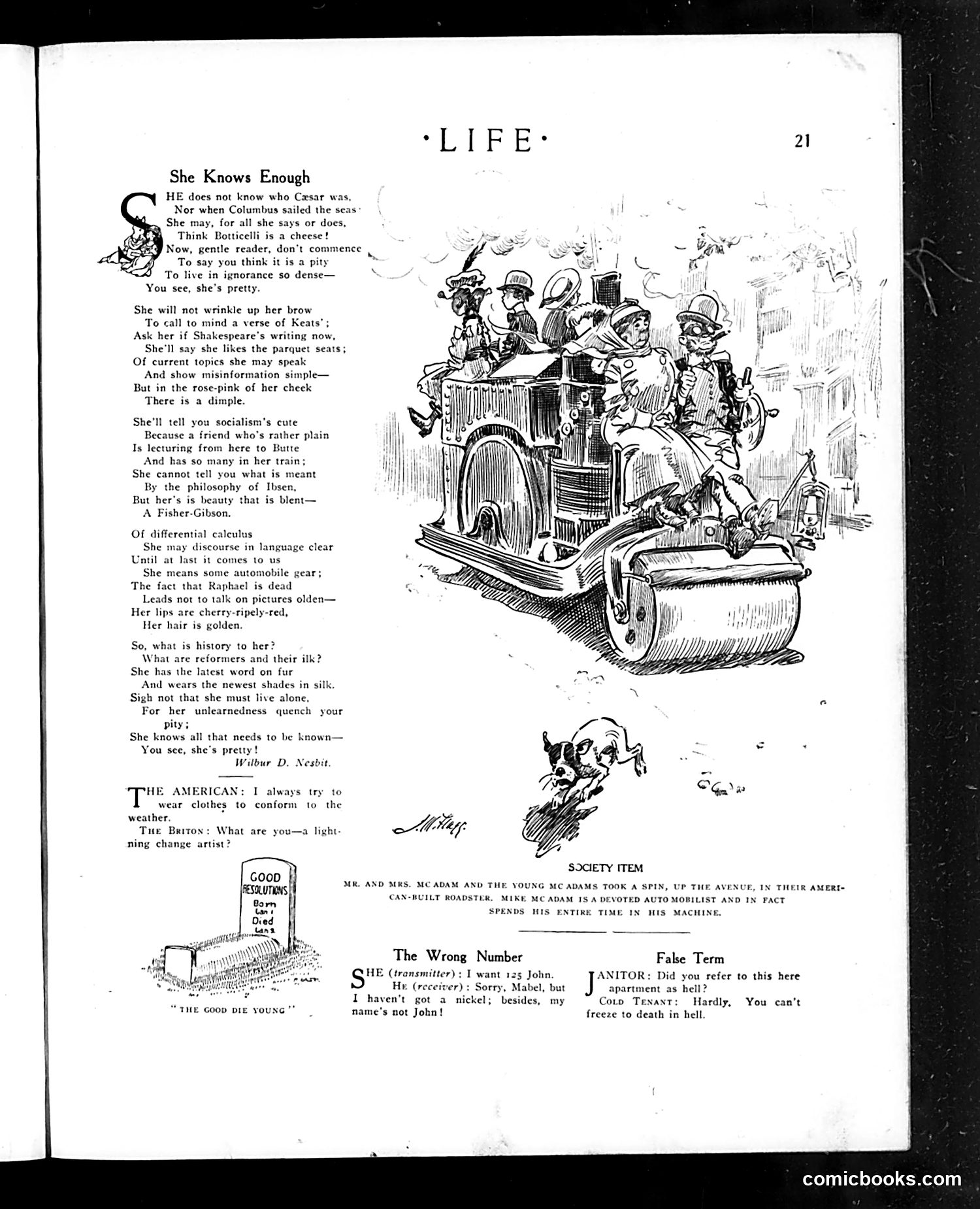
**"She Knows Enough"** is a satirical poem by Wilbur D. Nesbit mocking women who are intellectually ignorant but valued solely for their beauty. The poem lists her failures—not knowing Caesar, Columbus, Botticelli, Shakespeare, or philosophy—yet repeatedly concludes "You see, she's pretty," implying this excuses all ignorance. The accompanying illustration shows a glamorous woman in a fashionable hat, embodying the "Fisher-Gibson" beauty ideal (referencing popular illustrator Charles Dana Gibson's "Gibson Girl"). The satire critiques both shallow women and the society that rewards appearance over knowledge, suggesting beauty is an acceptable substitute for education. **Other items** include brief comic exchanges: a joke about an American's constantly changing clothes (calling him a "lightning change artist"), and two short dialogues—one about a wrong telephone number, another about a cold apartment humorously called "hell." The page reflects early 20th-century anxieties about women's education and changing gender roles.
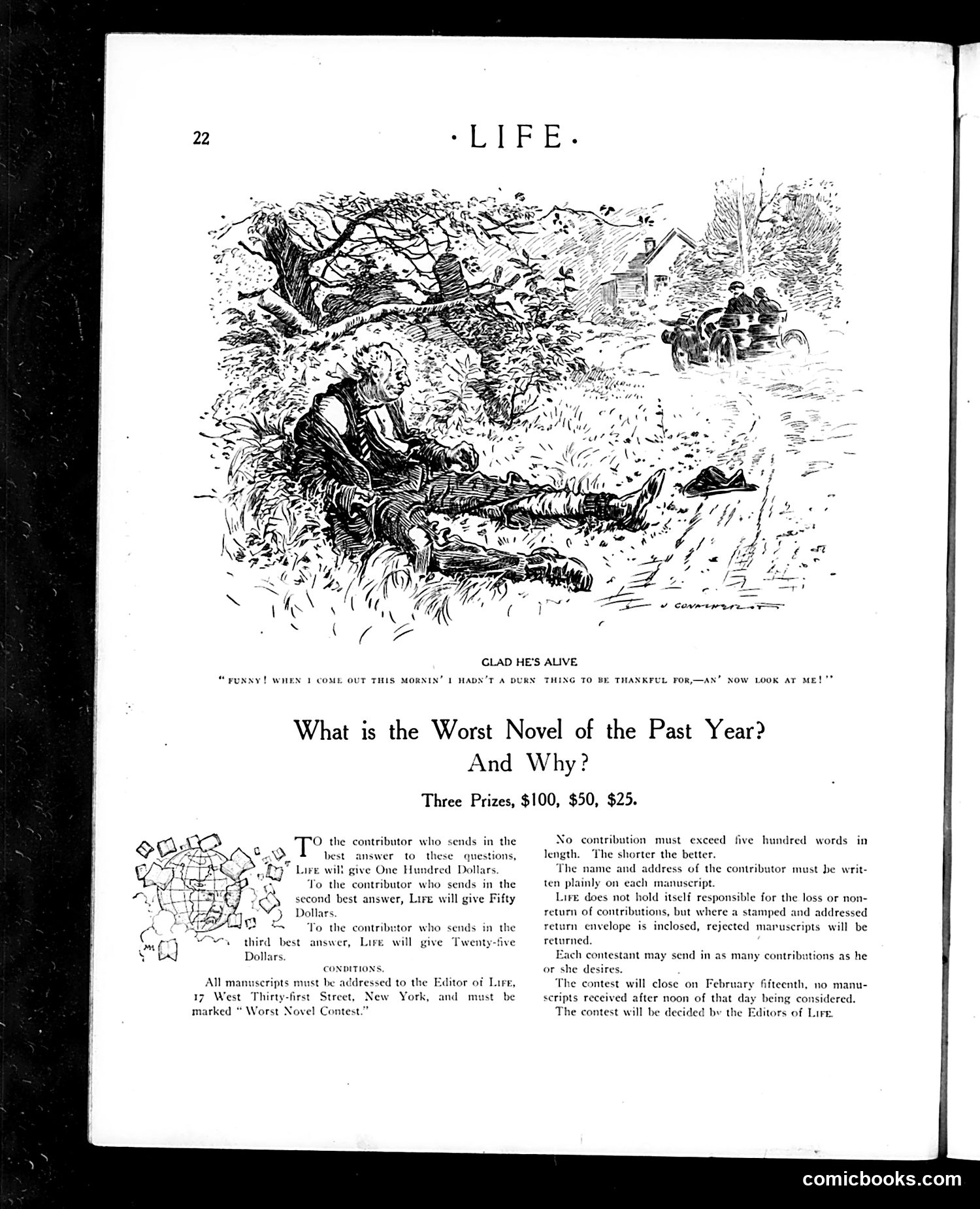
This page combines a cartoon and a magazine contest announcement. **The Cartoon**: Titled "Glad He's Alive," it shows a man lying in grass, apparently homeless or destitute, expressing gratitude simply for being alive. His quote—"Funny! When I come out this mornin' I hadn't a durn thing to be thankful for,—an' now look at me!"—is darkly humorous satire on poverty and lowered expectations. The joke appears to mock both the desperation of the poor and the irony that survival itself becomes cause for celebration when circumstances are dire. **The Contest**: Life magazine announces a humor competition asking readers to identify "the Worst Novel of the Past Year" and explain why, offering monetary prizes ($100, $50, $25). This reflects Life's satirical mission—inviting public participation in literary criticism through comic critique. The specific rules and February 15 deadline suggest this was a recurring feature. Together, the page demonstrates Life's dual focus: editorial cartooning about social conditions and reader engagement through contests.
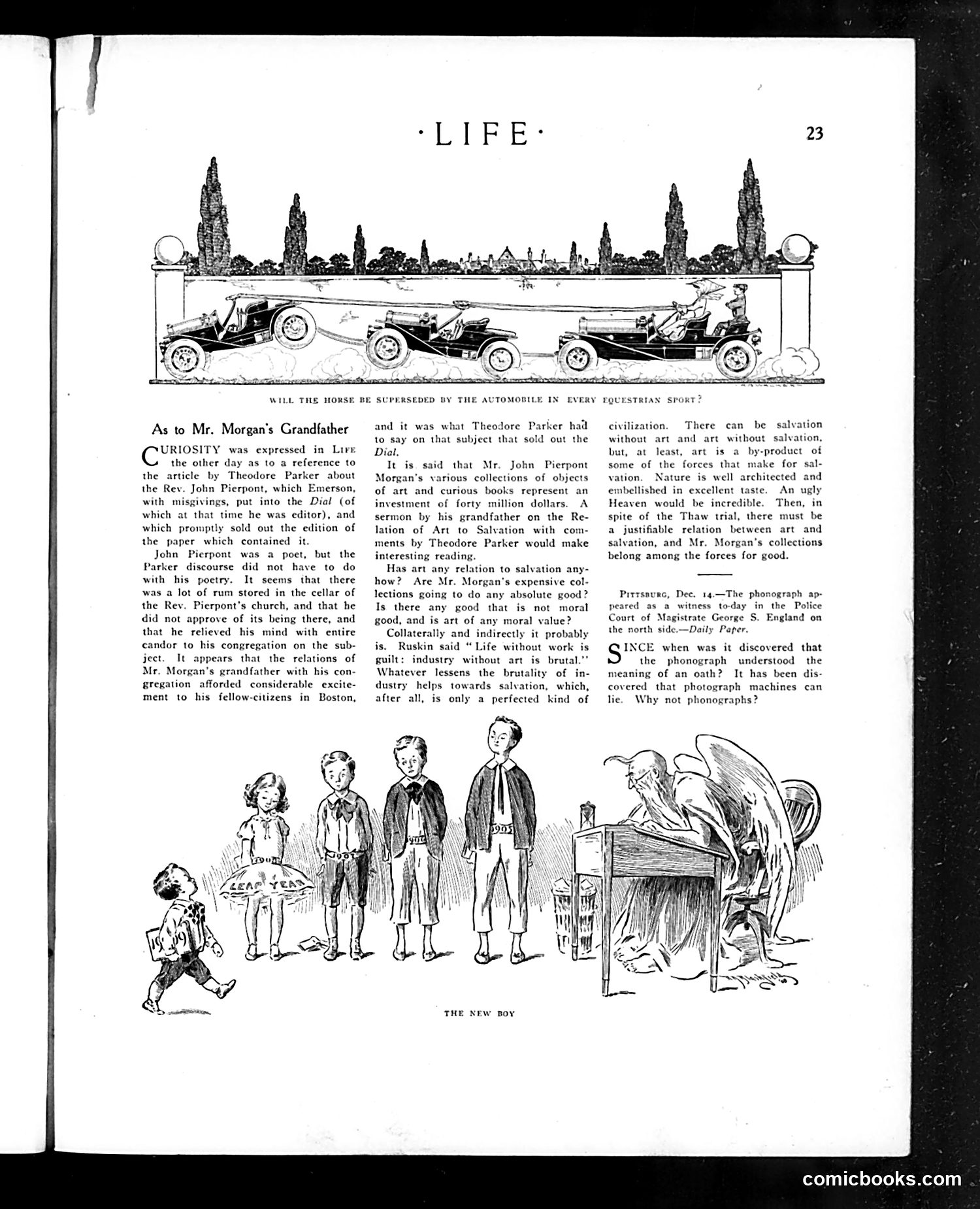
This *Life* magazine page contains two satirical pieces: **Top cartoon:** Questions whether automobiles will replace horses in sports. The illustration shows a progression of early vehicles alongside traditional carriages, posing a contemporary technological debate (automobiles were still novelties). **Main article:** Discusses J.P. Morgan's art collections (worth $40 million) through the lens of his grandfather, Reverend John Pierpont. The satire hinges on historical irony: Pierpont famously condemned alcohol stored in his church cellar, yet Morgan accumulated massive art collections. The article humorously ponders whether expensive art has moral value or aids "salvation," invoking Ruskin's philosophy. The implicit joke: Morgan's grandfather opposed worldly vices in his congregation, while his descendant accumulated worldly treasures. **Bottom item:** A brief satirical note questioning phonograph testimony in court—if machines can malfunction ("lie"), why trust their sworn evidence? This reflects early skepticism about mechanical recording devices as legal evidence. The page satirizes wealth, morality, and emerging technology circa early 1900s.
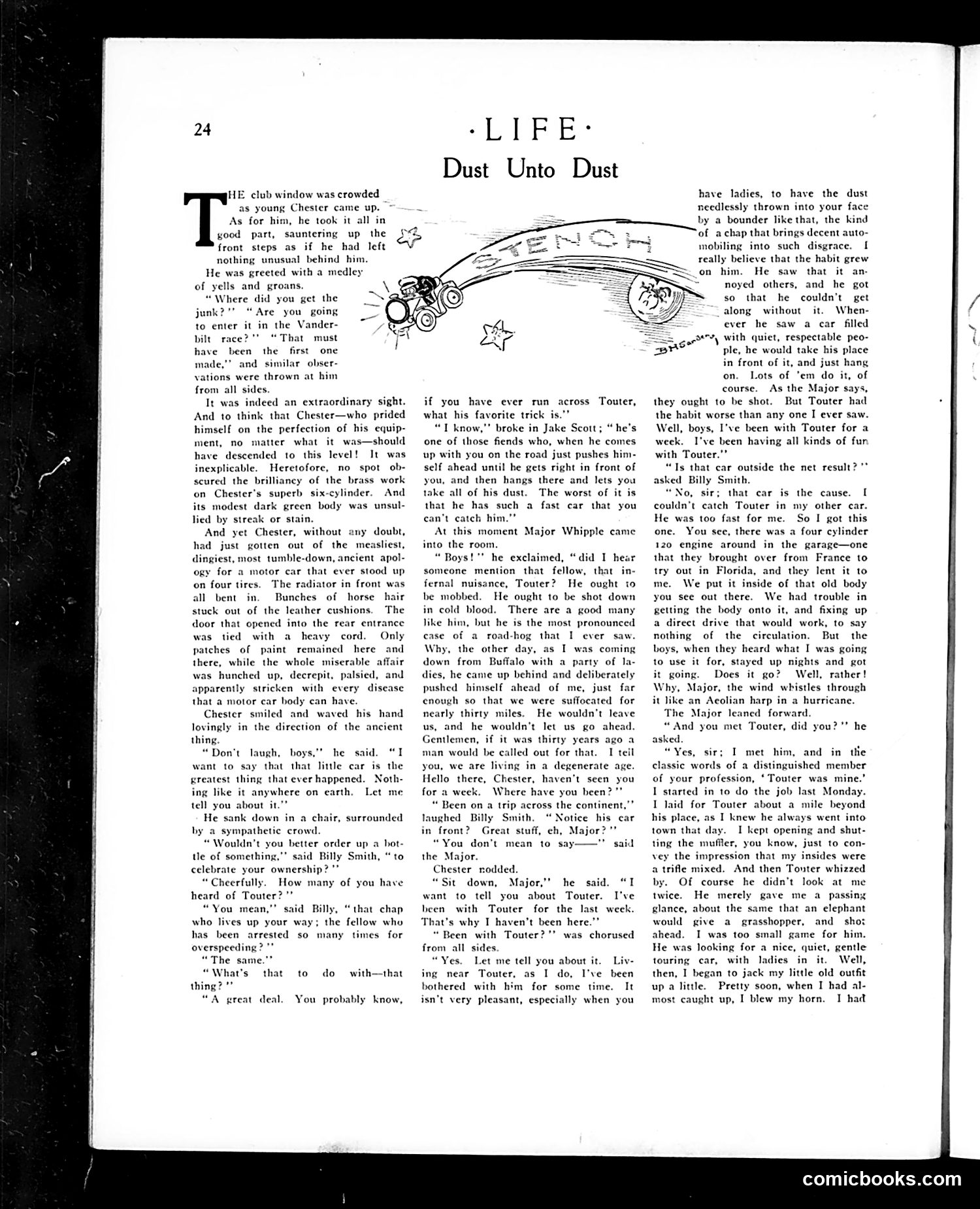
This story satirizes a common early-automobile annoyance: the "road hog" named Touter. The narrative centers on Chester's inexplicably decrepit old car, which puzzles his club friends—a sharp contrast to his usually immaculate vehicle. The joke is that Chester has deliberately purchased this worthless jalopy specifically to deal with Touter, a notorious speeder who deliberately cuts in front of other drivers and forces them to eat his dust for miles, refusing to let them pass or pull ahead. This was apparently an actual traffic menace of the era. The satire mocks both the recklessness of early motorists and society's inability to control them—Major Whipple notes indignantly that such behavior would have warranted a duel "thirty years ago." Chester's solution—using a car so wretched that Touter won't want to harass it—reflects the era's frustration with unregulated automotive behavior and the absence of traffic laws.
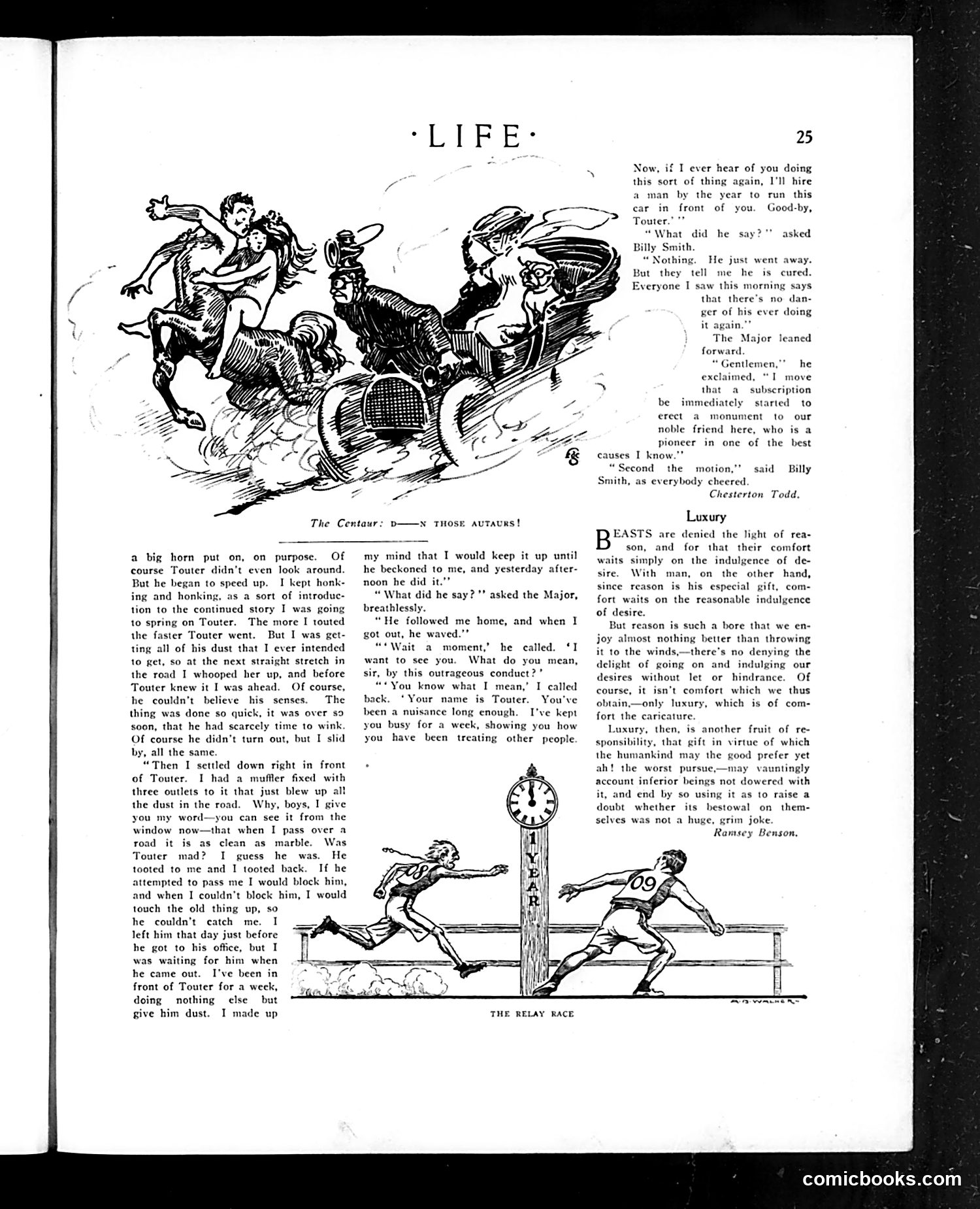
This page contains two distinct pieces from Life magazine: **"The Centaur" cartoon and story** (top): A humorous tale of comeuppance. A driver, fed up with a reckless motorist named "Touter" who habitually tailgates and passes dangerously, spends a week intentionally blocking and out-driving him. The prank teaches Touter a lesson about his own dangerous driving habits—apparently reforming him through embarrassment and frustration. It's a satirical take on road etiquette and revenge justice. **"Luxury" essay** (bottom right): A philosophical commentary contrasting beasts (who lack reason) with humans. The author argues humans often foolishly abandon reason to indulge desires, mistaking "luxury" for genuine comfort. It's a moralistic critique of hedonism and irresponsibility—suggesting humans waste their capacity for reasoned choice. **"The Relay Race" illustration** (bottom): A simple athletic sketch showing runners passing a baton, accompanying the luxury discussion. The page reflects early 20th-century attitudes about personal conduct, reason, and social responsibility.
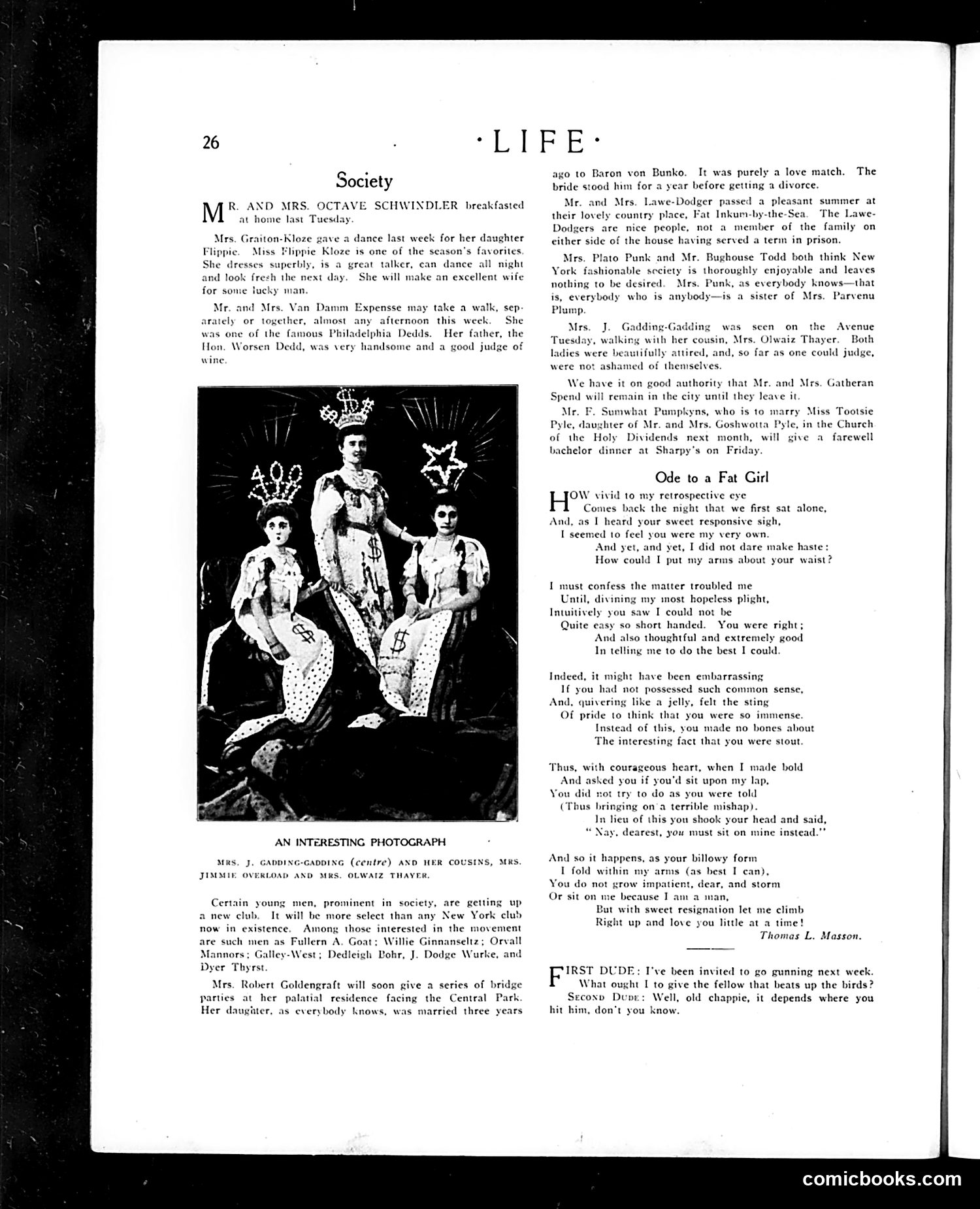
This is a **satirical society column** mocking New York's upper-class elite through invented names that expose their pretensions and moral emptiness. ## The Satire: The photograph caption and society gossip use transparent pseudonyms—"Gadding-Gadding," "Lawe-Dodger," "Parvenu Plump," "Bughouse Todd"—to ridicule wealthy socialites. The jokes target: - **Divorce and fortune-hunting** (Baron von Bunko's marriage lasting one year) - **Criminal family backgrounds** (the Lawe-Dodgers proud *no relatives served prison time*) - **Shallow materialism** (a club for the "select," judging people by appearance) The poem "Ode to a Fat Girl" is cruder satire, humorously depicting a suitor's awkwardness around a heavyset woman and praising her for not expecting romantic delusion. It's period-typical body-shaming humor, though framed as the woman's pragmatism rather than cruelty. ## Context: Life's society pages regularly mocked the nouveau riche and old money alike, exposing hypocrisy beneath refined surfaces—a distinctly American satirical tradition targeting those who took themselves too seriously.
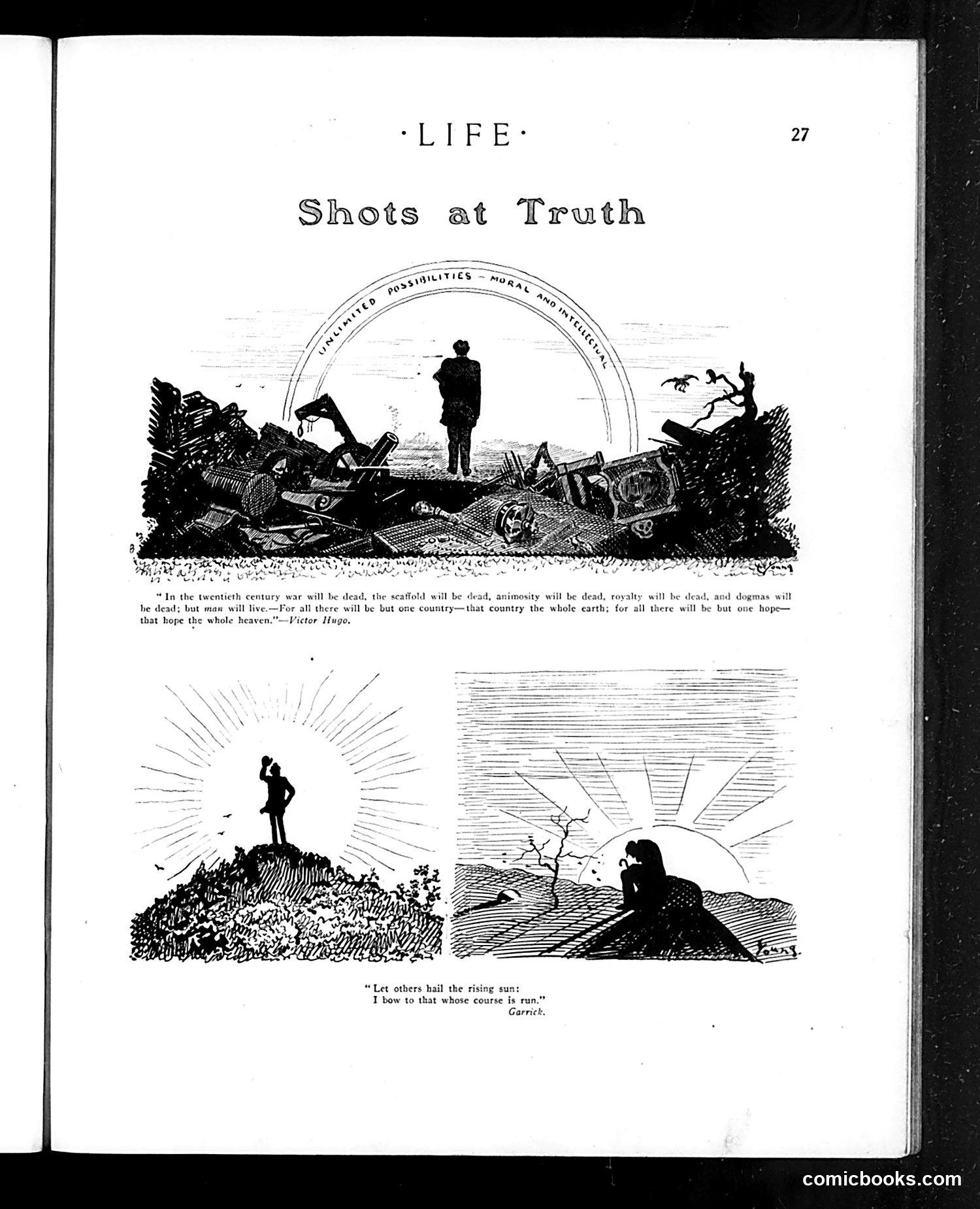
This page presents three allegorical woodcut-style illustrations accompanying optimistic literary quotations about humanity's future. The top image shows a solitary figure standing amid the ruins of war and destruction, gazing toward a glowing circular horizon inscribed with "unrealized possibilities—moral and intellectual." The two lower panels depict figures in contemplative poses—one standing triumphantly on a hill with radiating sunlight, the other bowing before a setting sun—illustrating the paired quotations from Victor Hugo and Garrick about progress, peace, and acceptance of change. The satire appears directed at *naive idealism*: these grandiose predictions about war ending and humanity unifying stand in stark visual contrast to the surrounding devastation. The page likely critiques Victorian-era progressive rhetoric as disconnected from the actual brutality of modern conflict, suggesting that such hopeful visions ignore contemporary realities. The "shots at truth" are ironic—these are shots *missing* truth, hitting only wishful thinking instead.
This sketch mocks the shallow priorities and moral contradictions of wealthy young women. Two society ladies, Maisie and Monica, discuss fashion and romance while pretending to intellectual sophistication. The satire targets several absurdities: **The Fashion Hypocrisy**: Monica's "ordinary feather duster" hat and "flannel bath kimono" are presented as haute couture (Paquin, Virot), satirizing how wealthy women obsess over status symbols. **The Fake Intellectualism**: Maisie explicitly states they avoid "vital subjects" like Ibsen and Rodin when alone, preferring gossip about "clothes and love affairs"—mocking their pretense of cultural refinement. **The Bird Plumage Irony**: The comic climax is Maisie's absurdly elaborate hat decorated with actual bird parts, complete with a live nest. Monica questions the ethics; Maisie dismisses her concern, arguing birds were "given beautiful plumage...to adorn...woman"—a ridiculous rationalization for animal exploitation. The piece satirizes Edwardian-era vanity, conspicuous consumption, and women's casual cruelty toward nature for fashion.
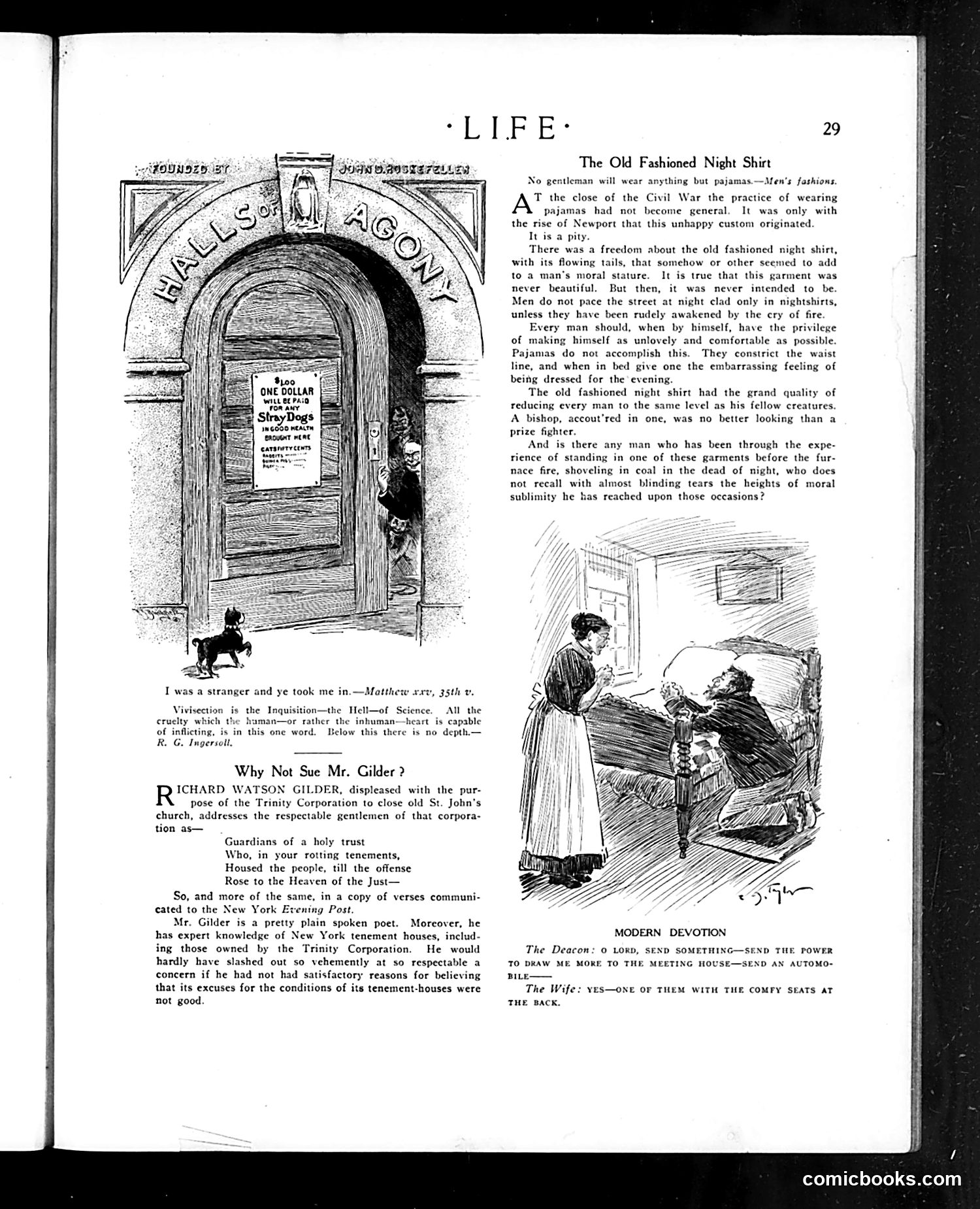
This *Life* magazine page contains three satirical pieces: **"The Old Fashioned Night Shirt"** argues nostalgically that traditional nightshirts were superior to modern pajamas—more comfortable, democratic (a bishop looked no better than a prize fighter in one), and morally elevating. The satire mocks both Victorian prudishness and the new leisure-class fashion adopted from Newport society. **"Why Not Sue Mr. Gilder?"** references Richard Watson Gilder, a poet and social critic who publicly condemned the Trinity Corporation (which owned tenements in New York) for housing poor people in squalid conditions. The piece sarcastically suggests Gilder's harsh criticism must be justified, implying the Trinity Corporation's excuses for tenement conditions were inadequate—a dig at wealthy institutions ignoring urban poverty. **"Modern Devotion"** (bottom right illustration) satirizes shallow religiosity: a deacon prays for spiritual connection but asks God for an automobile instead, while his wife wants one with comfortable back seats—reducing faith to material comfort-seeking.
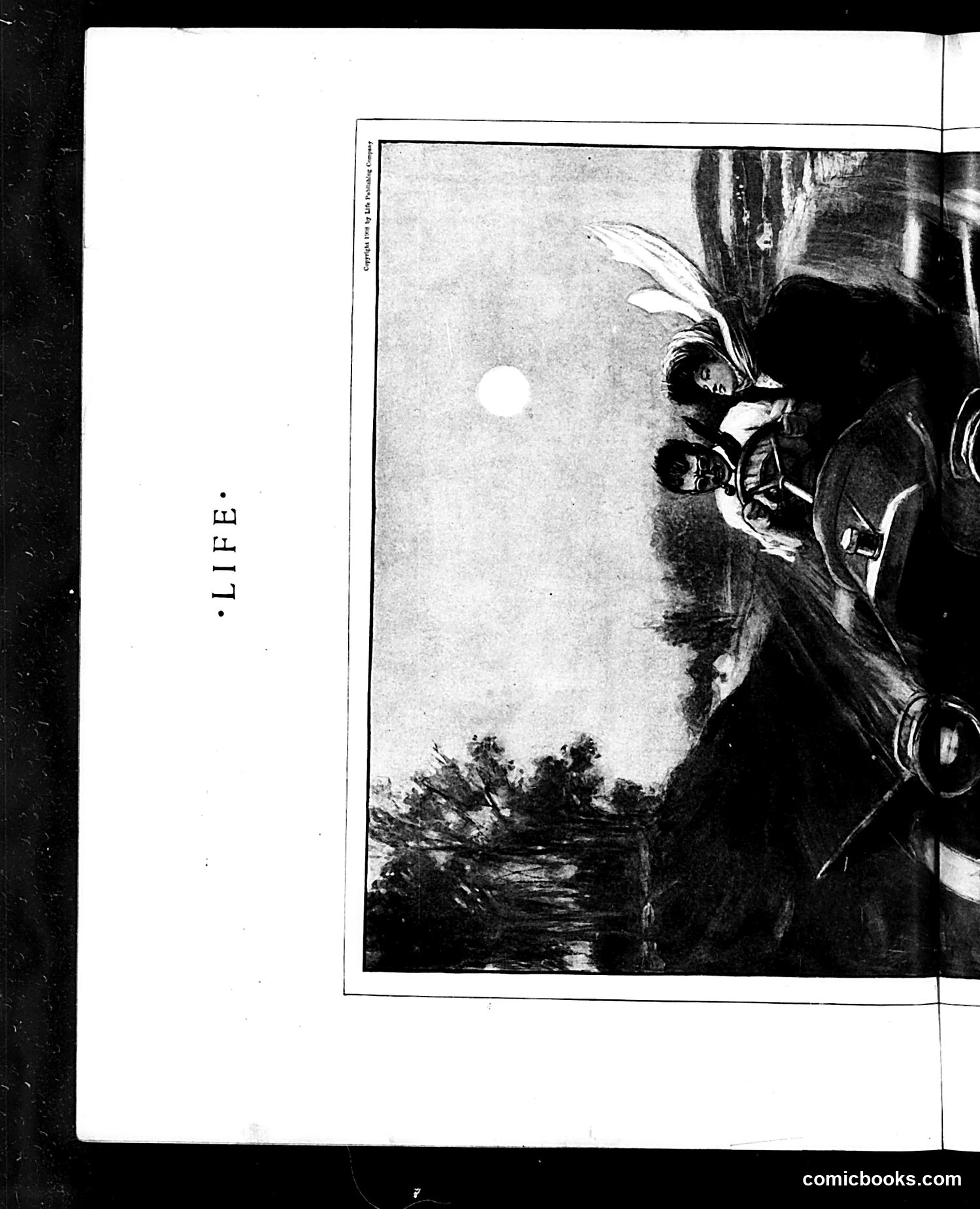
This page from *Life* magazine shows a title page with the word "LIFE" printed vertically on the left side. The right side contains a black and white illustration that appears rotated 90 degrees. The image depicts figures in what looks like a nighttime or darkened scene with a moon visible and some landscape elements at the bottom. The illustration's exact subject and satirical meaning are unclear from this angle and reproduction quality. Without additional context—such as the publication date, accompanying article text, or artist attribution—it's difficult to identify the specific political or social commentary intended. The page functions primarily as a title or section divider rather than a complete cartoon with obvious captioning or clear narrative elements.
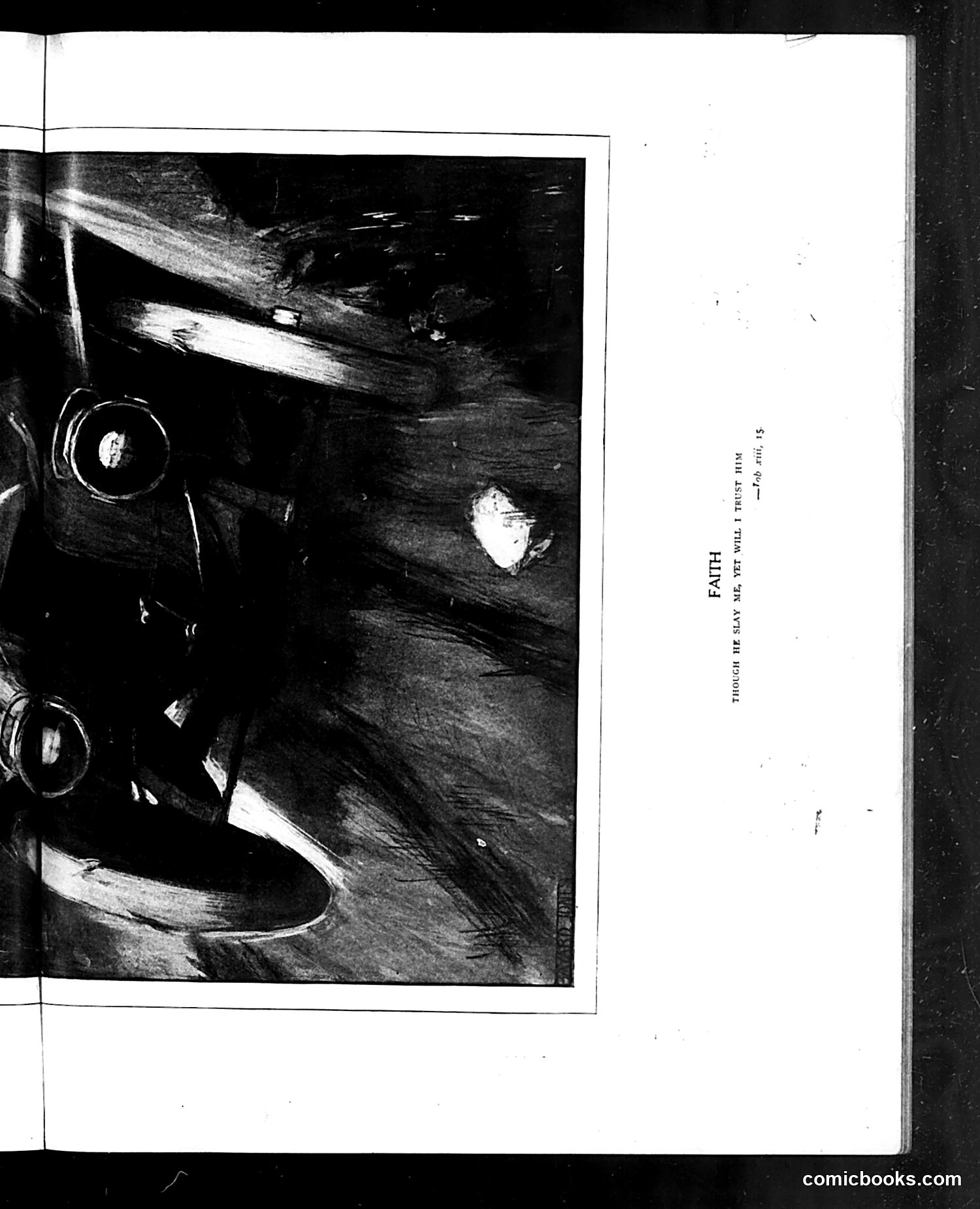
I can see this is a black and white photograph or illustration showing what appears to be mechanical or industrial machinery with circular elements and curved forms. The image is quite dark and grainy, making specific details difficult to discern clearly. However, the OCR text is severely corrupted and largely illegible—it appears to be garbled beyond meaningful interpretation. Without being able to read the actual caption or article text reliably, I cannot identify what specific political figures, events, or social commentary this page was meant to convey. To properly explain this cartoon's meaning to a modern reader, I would need either a clearer reproduction of the text or additional context about which issue of Life this appeared in. I cannot responsibly guess at the satire's target or point without reliable textual support.
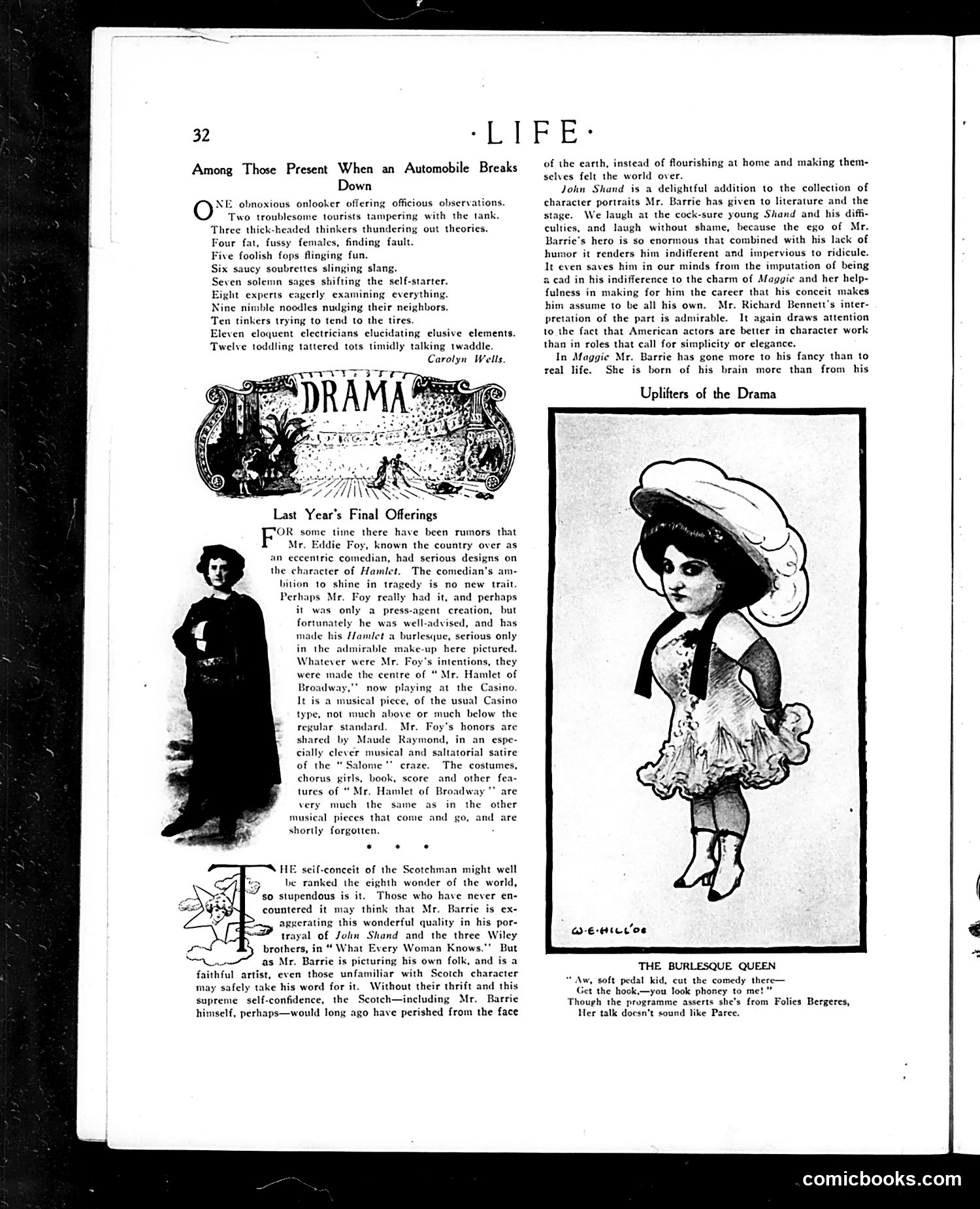
This page from *Life* magazine contains satirical commentary on early 20th-century theater and society. **Top section** presents Carolyn Wells's humorous poem about the chaos when an automobile breaks down—listing twelve stereotypical character types (the nosy onlooker, the bossy females, the incompetent tinkerers, etc.) who gather to unhelpfully comment or interfere. It's gentle social satire about human nature and public spectacle. **"Last Year's Final Offerings"** reviews theatrical productions. Eddie Foy's "Mr. Hamlet of Broadway" is mocked as a burlesque—a comedic travesty of Shakespeare rather than serious drama. J.M. Barrie's "What Every Woman Knows" receives more serious treatment, praising his character John Shand as a authentic portrait of Scottish self-confidence and shrewdness, while criticizing American actors' limitations in subtle versus showy roles. **"The Burlesque Queen"** illustration satirizes a performer claiming French ("Folies Bergères") origins but whose obvious American accent and demeanor expose her as a fraud—mocking both theatrical pretension and immigrant performance culture.
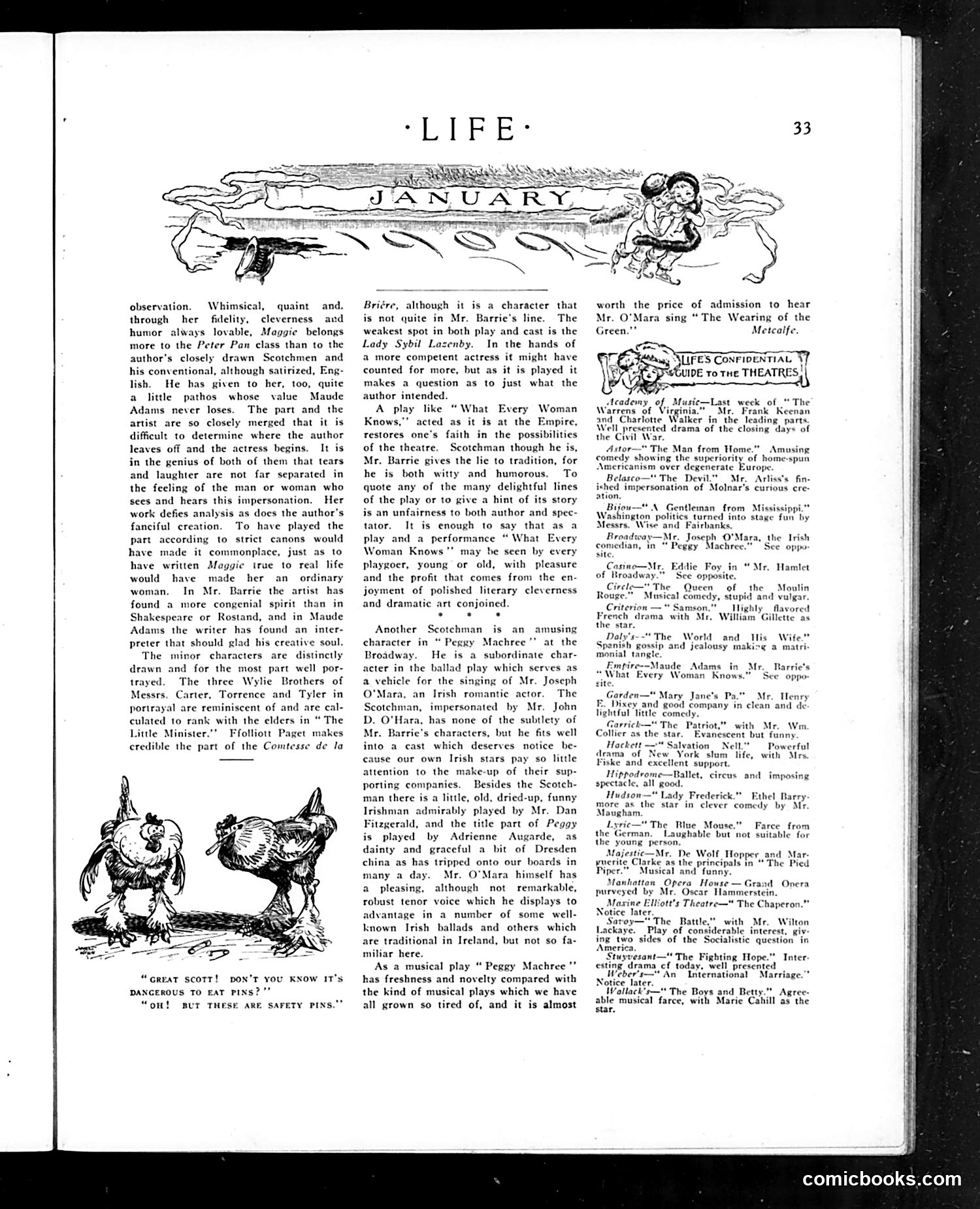
This page reviews contemporary theatrical productions, primarily focusing on J.M. Barrie's "What Every Woman Knows" starring actress Maude Adams. The text praises both the play's literary wit and Adams's performance, suggesting her interpretation transcends strict dramatic analysis. **The cartoon** (bottom left) shows a figure exclaiming "Great Scott! Don't you know it's dangerous to eat pins?" to another who responds "Oh! But these are safety pins." This is a visual pun playing on the literal and figurative meanings of "safety pins"—the joke relies on absurdist logic where someone treats actual pins as food, then assumes "safety" pins make them edible. It's gentle, whimsical humor typical of Life magazine's style. The page also reviews "Peggy Machree," a musical vehicle for Irish tenor Joseph O'Mara, and discusses supporting cast members. The overall tone celebrates polished theatrical craftsmanship and literary merit.
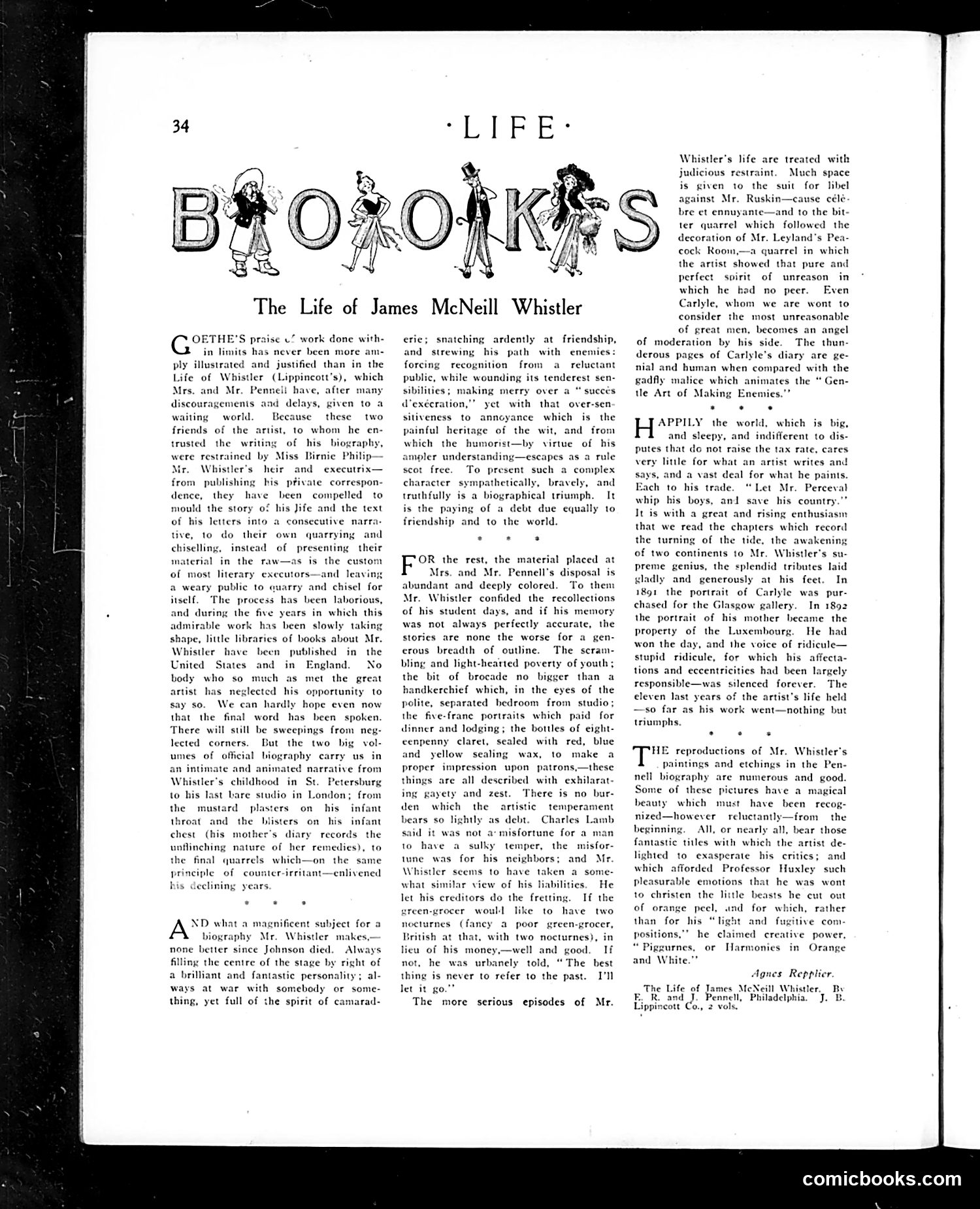
This is a literary review of a new biography of the famous American artist James McNeill Whistler, written by the Pennells. The decorative header featuring illustrated figures in period dress represents Whistler and his circle. The review praises the biography as a masterwork, comparing Whistler favorably to Samuel Johnson as a biographical subject. The satire focuses on Whistler's famously difficult personality: he was perpetually quarrelsome, hypersensitive to criticism despite his wit, and notoriously in debt while remaining unconcerned about it. The reviewer notes with amusement Whistler's bohemian poverty (five-franc portraits, cheap wine) and his casual attitude toward creditors. The joke is that Whistler exemplifies the "artistic temperament" at its most extreme—brilliant but troublesome, fighting with everyone yet charmingly so. The biography captures this contradiction: a genuinely great artist whose personal conduct was often unreasonable.
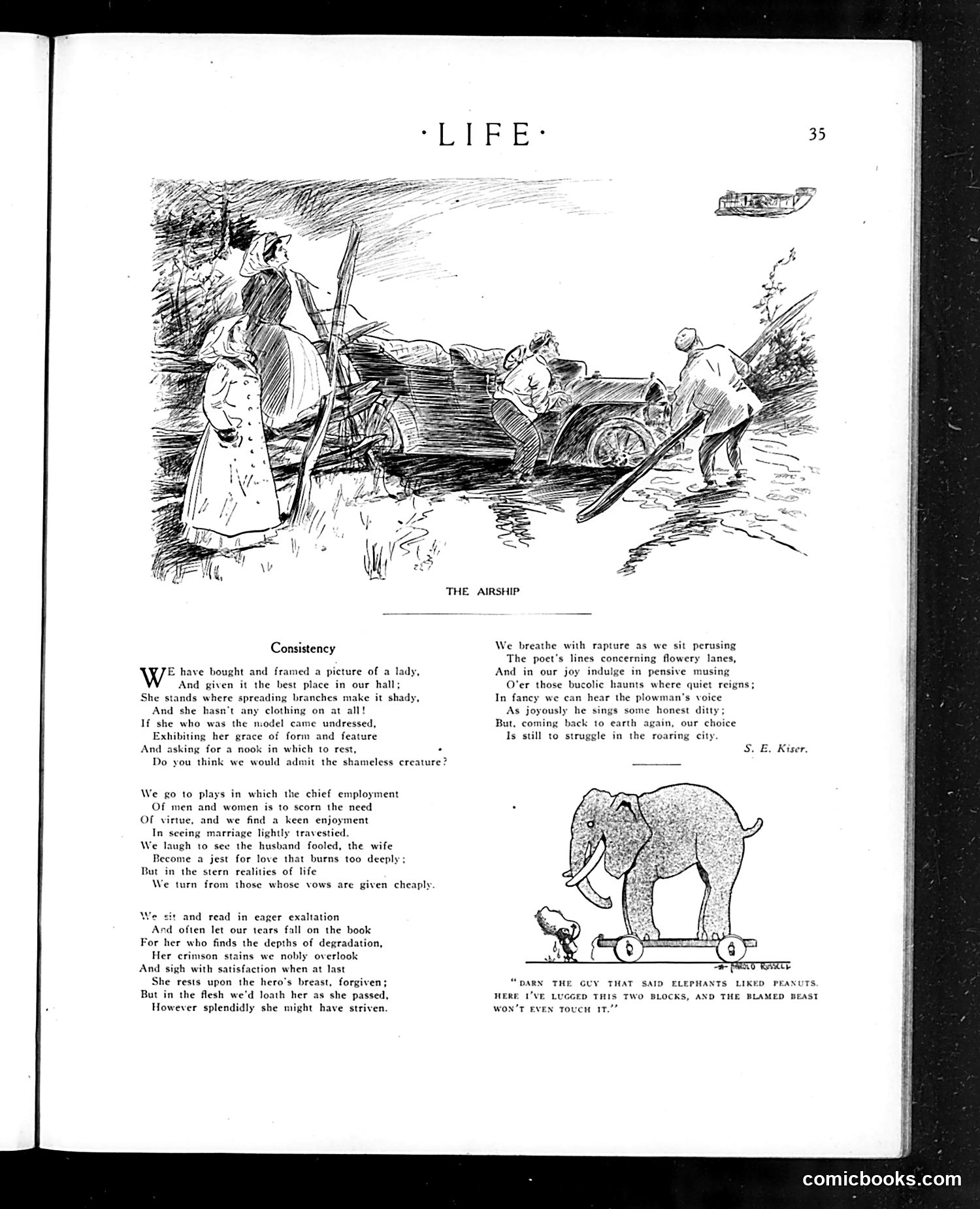
**"The Airship" (top cartoon):** depicts what appears to be an early automobile accident or breakdown scene, with several figures examining or working on a damaged vehicle. A boat is visible in the background. The title's meaning is unclear from the image alone. **Main Poem "Consistency":** This satirical verse critiques Victorian hypocrisy. The poem highlights the contradiction between what respectable people consume in art and entertainment versus how they judge actual people: - We display nude artwork in homes but would shun a naked woman seeking shelter - We enjoy plays mocking marriage and virtue, yet condemn immoral behavior in real life - We weep over fictional fallen women in literature while despising actual ones - We romanticize rural life in poetry while actually preferring city struggle **Lower cartoon:** A frustrated man carrying peanuts complains that the elephant won't eat them—mocking a false folk belief about elephants' preferences. Both pieces mock human inconsistency and blindness to their own contradictions.
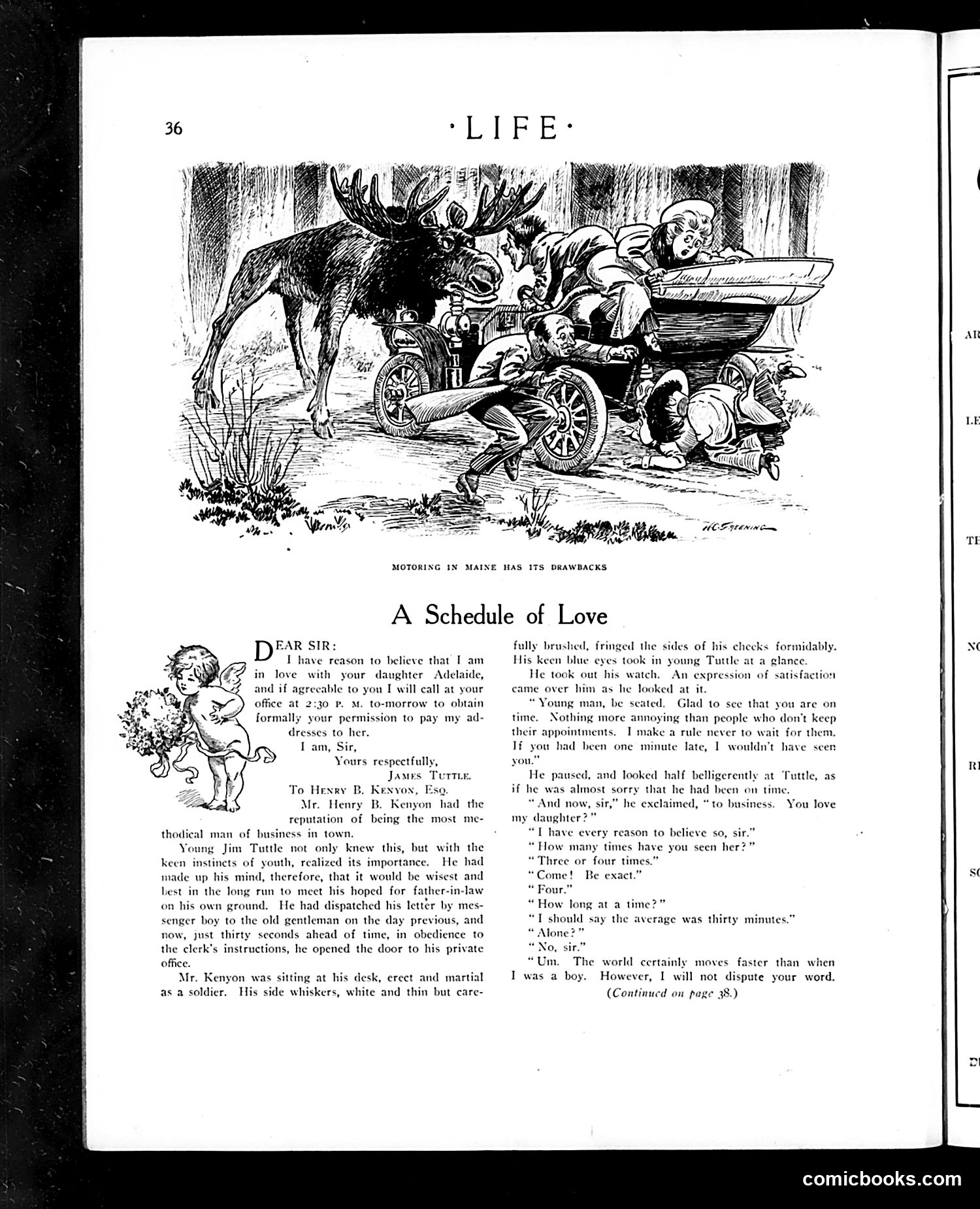
This satirical story mocks the rigidly methodical businessman Henry B. Kenyon through young suitor Jim Tuttle's courtship approach. The humor lies in Tuttle strategically adopting the father's own obsessive punctuality and business-like formality to win approval—arriving exactly on time and even writing a formal letter requesting a scheduled appointment. Kenyon's character embodies exaggerated Victorian-era business propriety: he's so devoted to schedule-keeping that he's almost disappointed Tuttle *didn't* arrive late, thus giving him grounds for rejection. His cross-examination of Tuttle about frequency and duration of visits with his daughter Adelaide applies cold business metrics to romance, treating courtship as a transaction requiring documented evidence. The satire targets how such rigid, humorless adherence to "proper procedure" becomes absurd when applied to human relationships. The top illustration—showing a moose disrupting motorists in Maine—reinforces the theme: nature (and love) are messy, unpredictable forces that resist orderly scheduling.
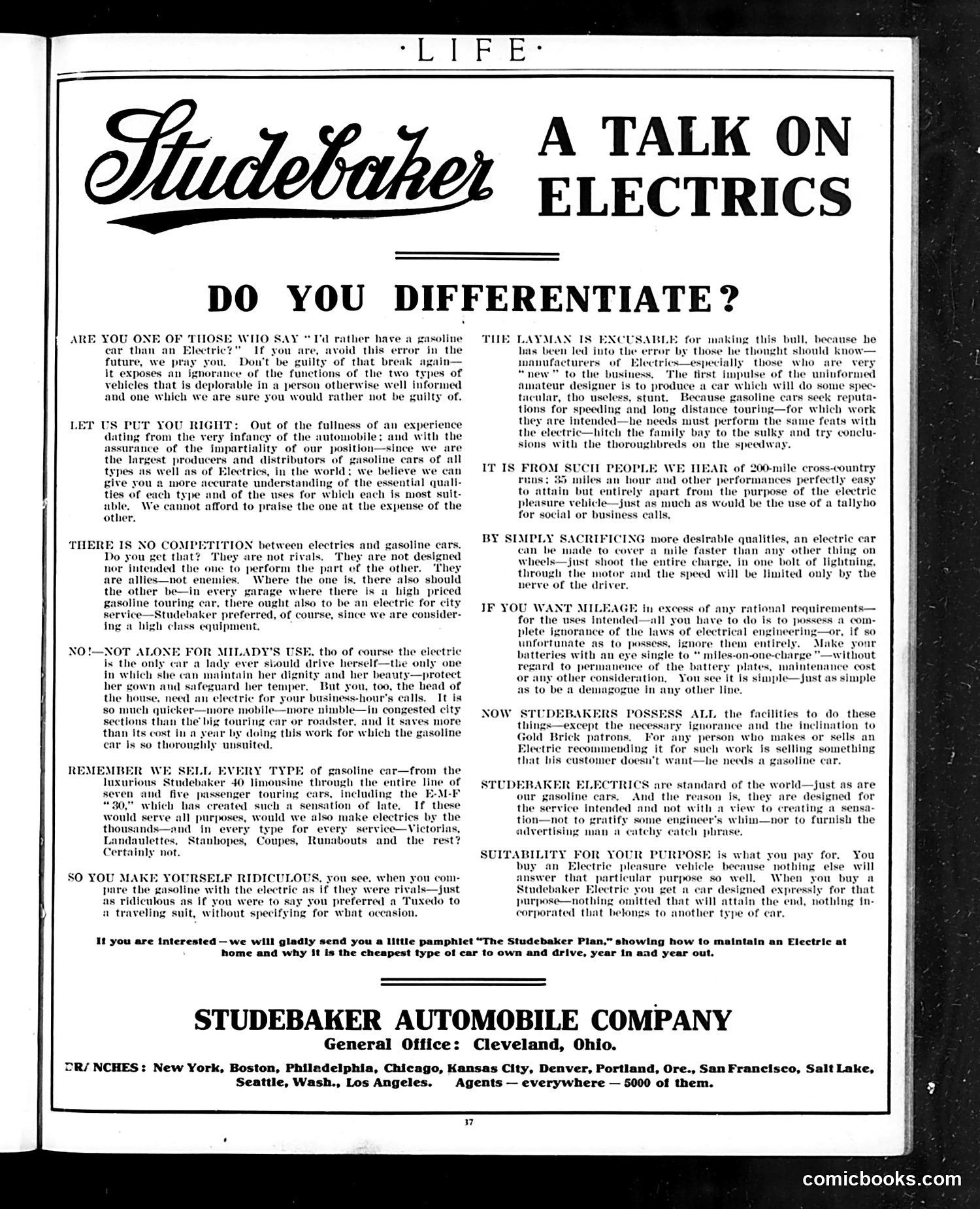
This is a **1910s Studebaker automobile advertisement**, not a political cartoon. It's a lengthy promotional "talk" defending electric cars against gasoline vehicle prejudice. **The Context:** Early 20th-century America debated whether electric or gasoline cars were superior. Electric vehicles were popular with wealthy urbanites (especially women, as the text suggests) for city driving—they were quiet, clean, and required no hand-cranking. Gasoline cars offered speed and long-distance capability. **Studebaker's Argument:** The company manufactured *both* vehicle types and argues they serve different purposes—not rivals but "allies." Electric cars excel at short city trips; gasoline cars handle long-distance travel. The ad ridicules comparing them directly, like preferring a Tuxedo to a traveling suit. **The Satire:** Studebaker gently mocks electric-car manufacturers making exaggerated speed claims to compete with gasoline vehicles, calling such stunts inappropriate to the vehicle's actual purpose. This advertisement reflects a now-forgotten technological moment when electric vehicles were genuinely competitive before gasoline engines dominated.
This is a comedic dialogue between Mr. Kenyon, a stern, methodical Victorian-era father, and young Tuttle, who seeks permission to court Kenyon's daughter Adelaide. The humor derives from Kenyon's obsessive systematization of romance. The satire targets rigid paternal authority and the formality of courtship customs of the era. Kenyon treats courtship like a business transaction, scheduling specific evenings, dictating conversation topics, and literally timing physical progression (hand-holding on the third visit). His repeated emphasis on "method" and "system" ridicules overly controlling fathers who micromanage their daughters' romantic lives. The young man's stammering embarrassment contrasts sharply with the father's clinical pragmatism, amplifying the absurdity. The piece mocks both restrictive social conventions governing courtship and the Victorian obsession with proper procedure in all matters, even love and intimacy.
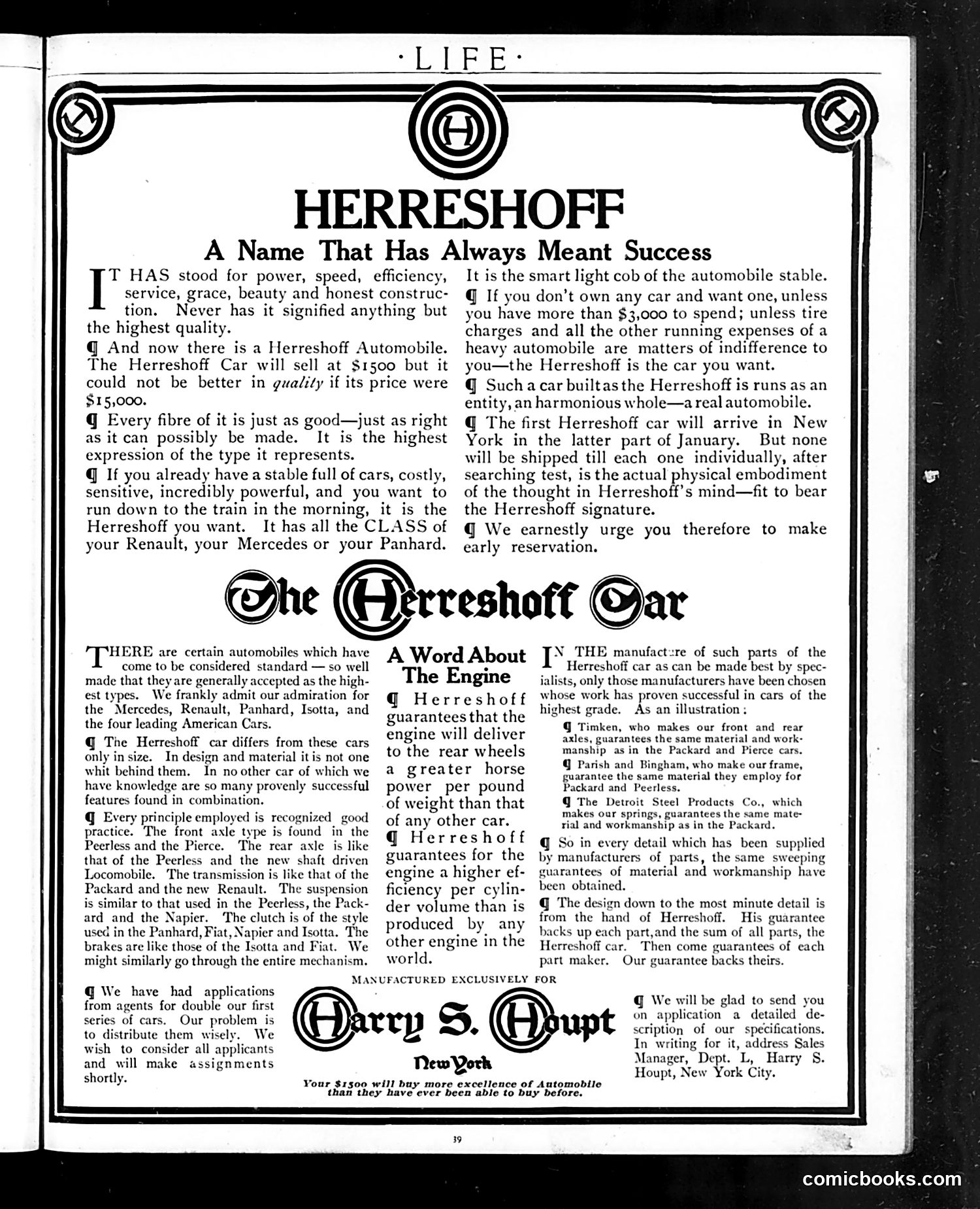
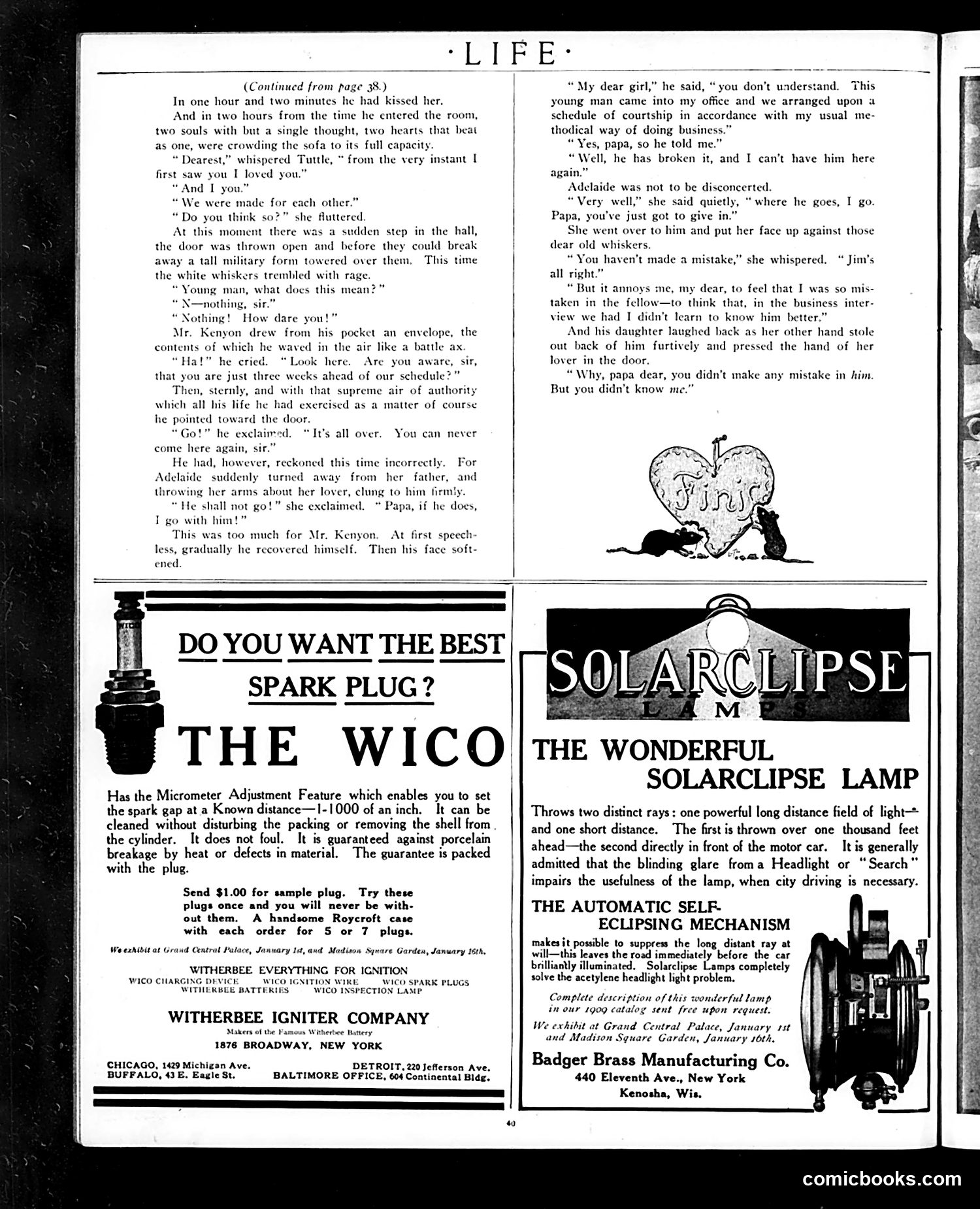
This page contains a romantic comedy story about courtship protocol. The narrative centers on a father, Mr. Kenyon, who has arranged a formal "schedule" for his daughter Adelaide's courtship with a young man named Tuttle. The joke is that Tuttle has proceeded too quickly—kissing and embracing Adelaide three weeks *ahead* of the predetermined schedule. When Mr. Kenyon discovers this breach, he furiously expels Tuttle. However, Adelaide refuses to accept this, declaring she'll leave with her lover if her father won't relent. The humor satirizes rigid Victorian-era business-like approaches to romance: Kenyon treats courtship with the same methodical scheduling he applies to his business affairs, treating love as a transaction to be managed rather than experienced. The satire mocks over-controlling fathers and the absurdity of trying to regulate human emotion through bureaucratic schedules. Adelaide's defiance represents youthful passion overcoming paternal rigidity. The page also contains period advertisements for spark plugs and automotive lamps.
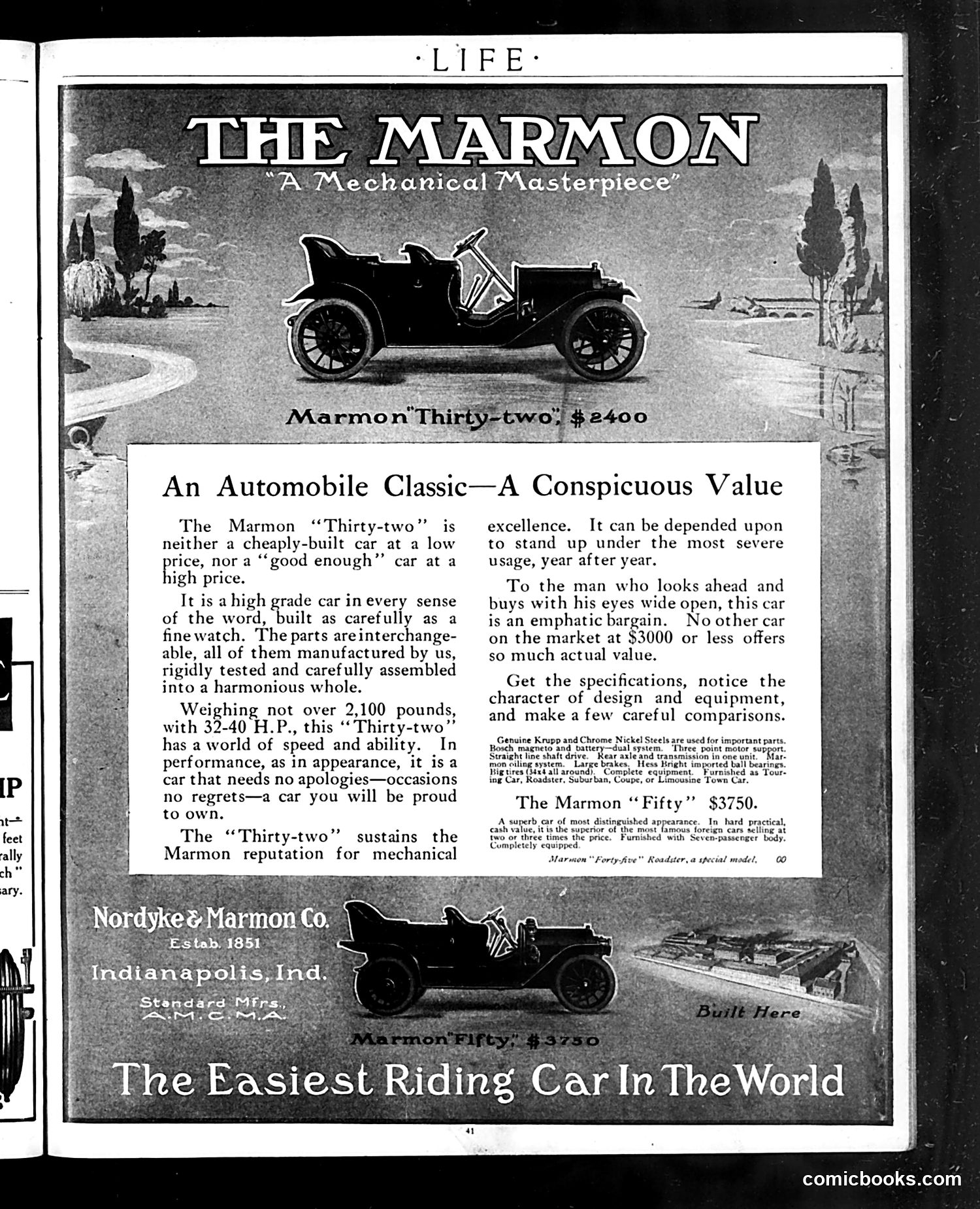
This page is **not a cartoon or satire**—it's a straightforward automobile advertisement from Life magazine's advertising section. The ad promotes the Marmon automobile, manufactured by Nordyke & Marmon Co. of Indianapolis. It presents two models: the "Thirty-two" ($2,400) and the "Fifty" ($3,750), emphasizing their quality construction, mechanical reliability, and value for the price point. The advertising copy uses common early-20th-century marketing language: comparing the car to a "fine watch," highlighting precision manufacturing, and targeting the "forward-looking" buyer. The tagline "The Easiest Riding Car In The World" was likely a competitive claim among automobiles of that era. For modern readers: this represents when automobiles were luxury goods requiring detailed specification comparisons, and when Life's revenue depended heavily on full-page advertisements from major manufacturers.
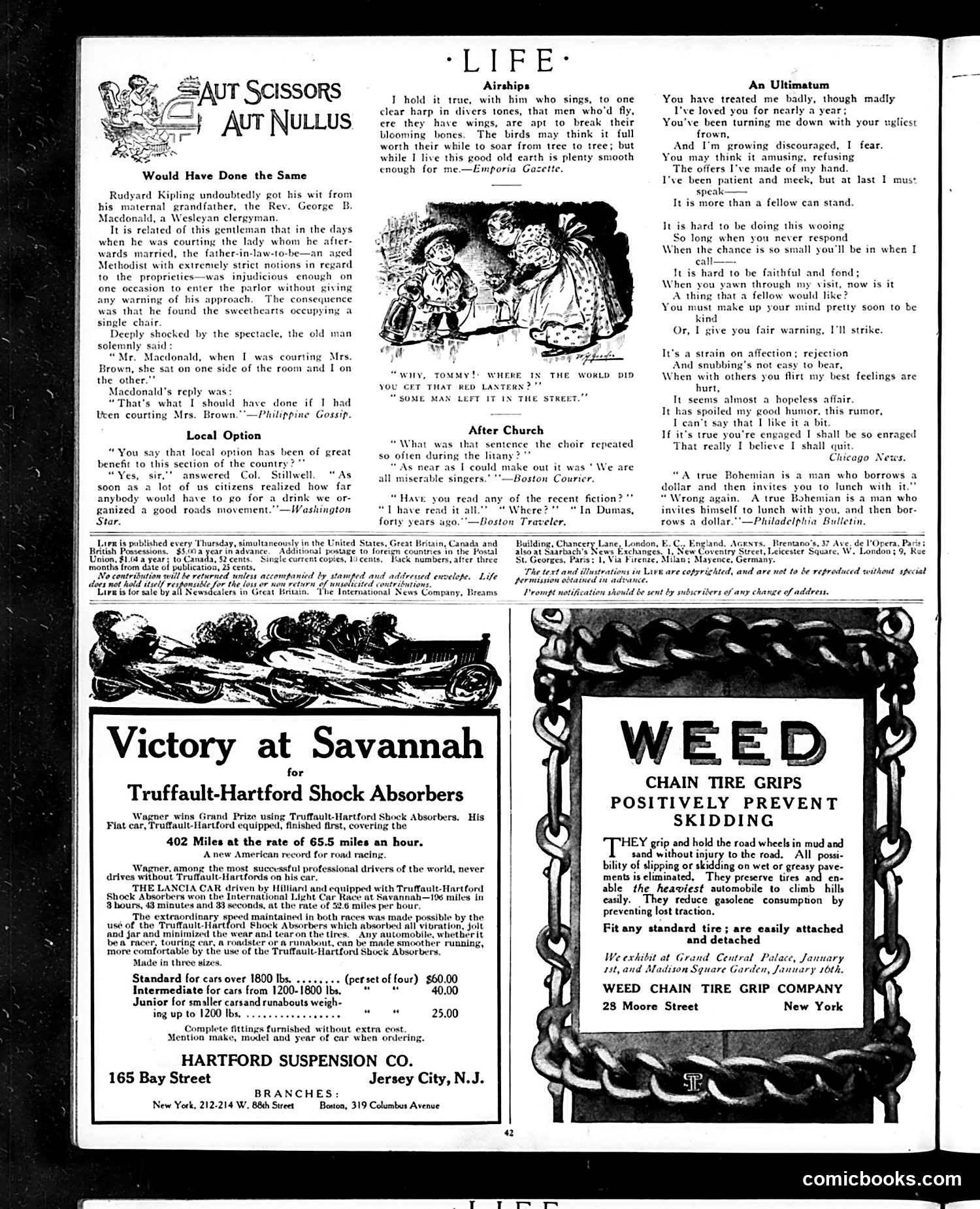
This page from *Life* magazine (appears to be early 1900s) contains several satirical pieces: **"Aut Scissors, Aut Nullus"** mocks early aviation enthusiasts, quoting the *Emporia Gazette* to suggest that flying machines will break aviators' bones—a skeptical commentary on the nascent airplane industry. **"Would Have Done the Same"** is an anecdote about Rudyard Kipling's grandfather courting his future wife, humorously contrasting Victorian propriety (sitting apart) with modern behavior (sharing one chair). **"An Ultimatum"** presents a spurned lover's dramatic threat to end pursuit unless the woman reciprocates—typical sentimental verse satirizing melodramatic courtship conventions. **"Local Option"** jokes that improved roads were built only after citizens realized how far they'd have to travel for alcohol—a reference to the temperance movement and Prohibition-era debates. The remaining short pieces mock choir singers, fiction readers, and Bohemian stereotypes with period humor about romance and social manners.
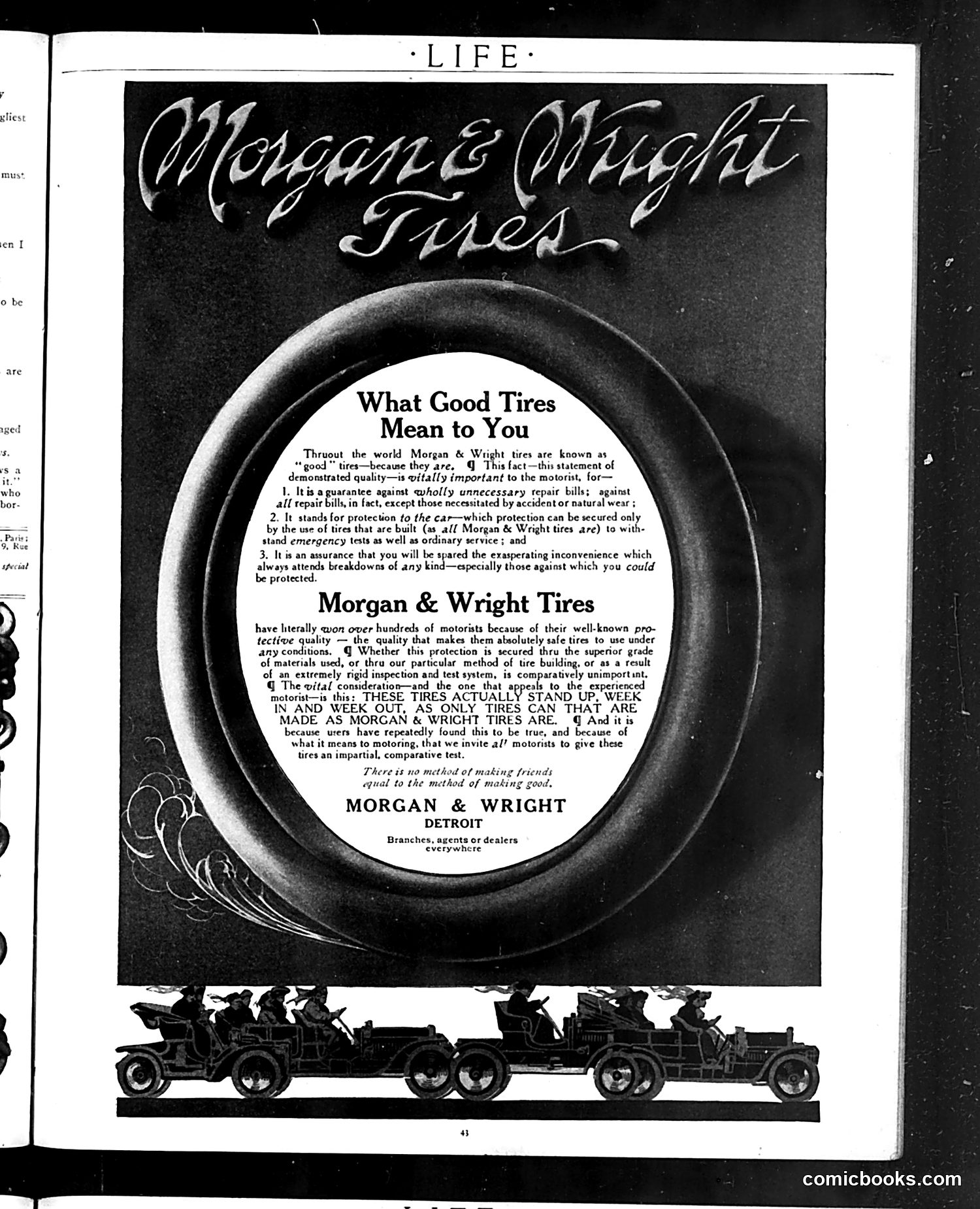
This is **not a cartoon or satire**—it's a straightforward advertisement for Morgan & Wright automobile tires, published in *Life* magazine (a humor/satire publication, though it carried advertisements). The ad uses a large photograph of an actual tire as its centerpiece, with marketing copy explaining why their tires are "good": they prevent unnecessary repair bills, protect the car, and reliably withstand both emergency and ordinary use. The ad emphasizes durability and quality through rigorous testing. At the bottom, decorative silhouettes show early automobiles in a procession, visually reinforcing the product's association with modern transportation. The phrase "There is no method of making friends equal to the method of making good" serves as the ad's philosophical tagline—essentially arguing that quality products build customer loyalty naturally. This represents early 20th-century automotive advertising, when tire quality was a genuine consumer concern and a selling point.
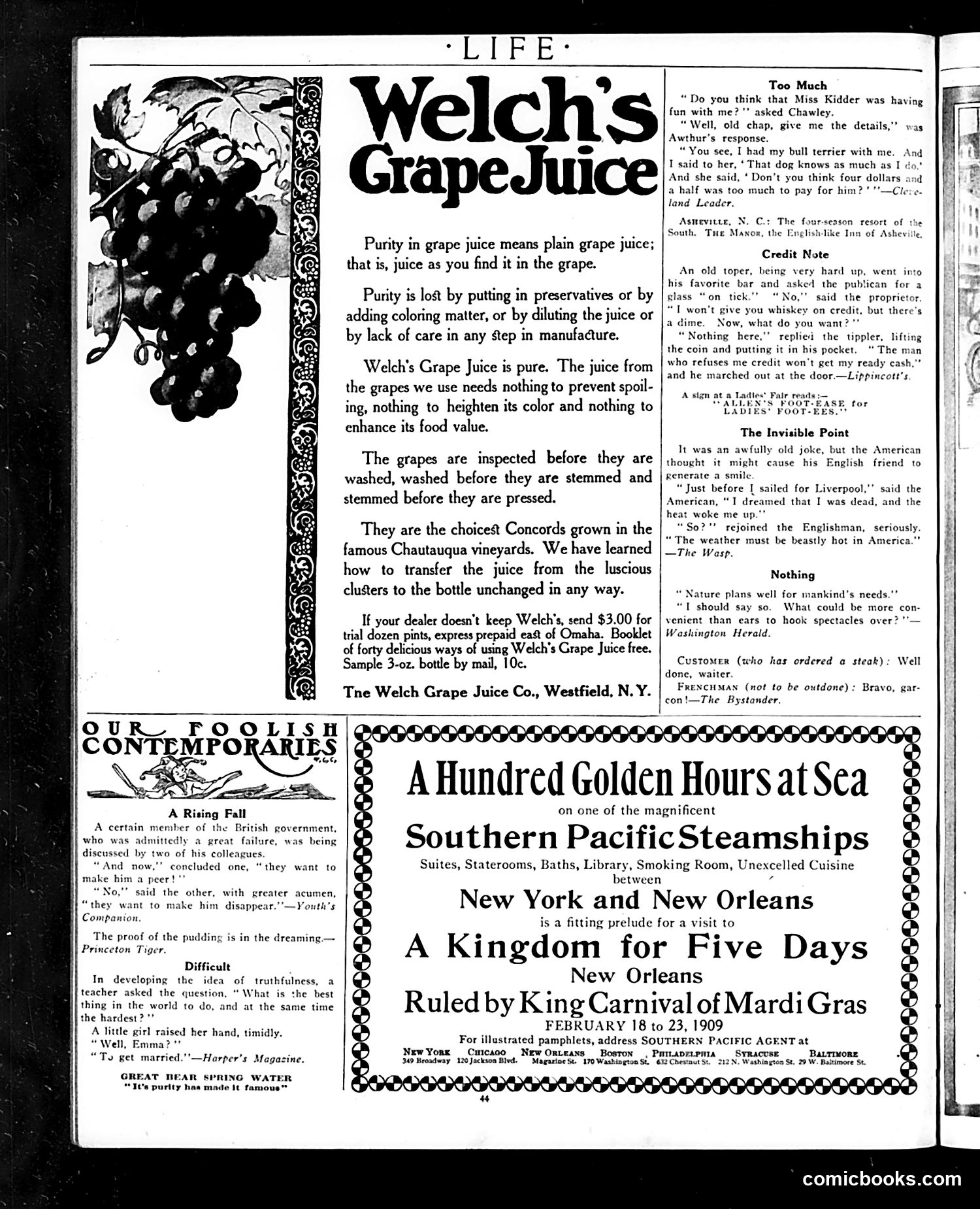
This page is primarily **advertising and humorous short pieces**. The dominant feature is a Welch's Grape Juice ad emphasizing purity—appealing to early 1900s consumer anxiety about adulteration and food safety. The accompanying illustration shows grapes, a straightforward visual. The humor pieces are brief, disconnected jokes: - **"Too Much"**: A man asks a woman about his dog's intelligence; she responds by charging him $4.50, implying the dog is worth money. The humor turns on the double meaning of "knowing as much." - **"Credit Note"**: A drunk asks for whiskey "on tick" (credit); refused, he takes the dime offered instead, then leaves—the joke being his petty revenge logic. - Other jokes about dreams, spectacles, and restaurant exchanges. These represent typical *Life* magazine filler humor—brief, pun-based, and reflecting class-conscious attitudes (tipsy characters, social embarrassments). No political cartoons appear here; the page mixes advertising with genteel comedy.
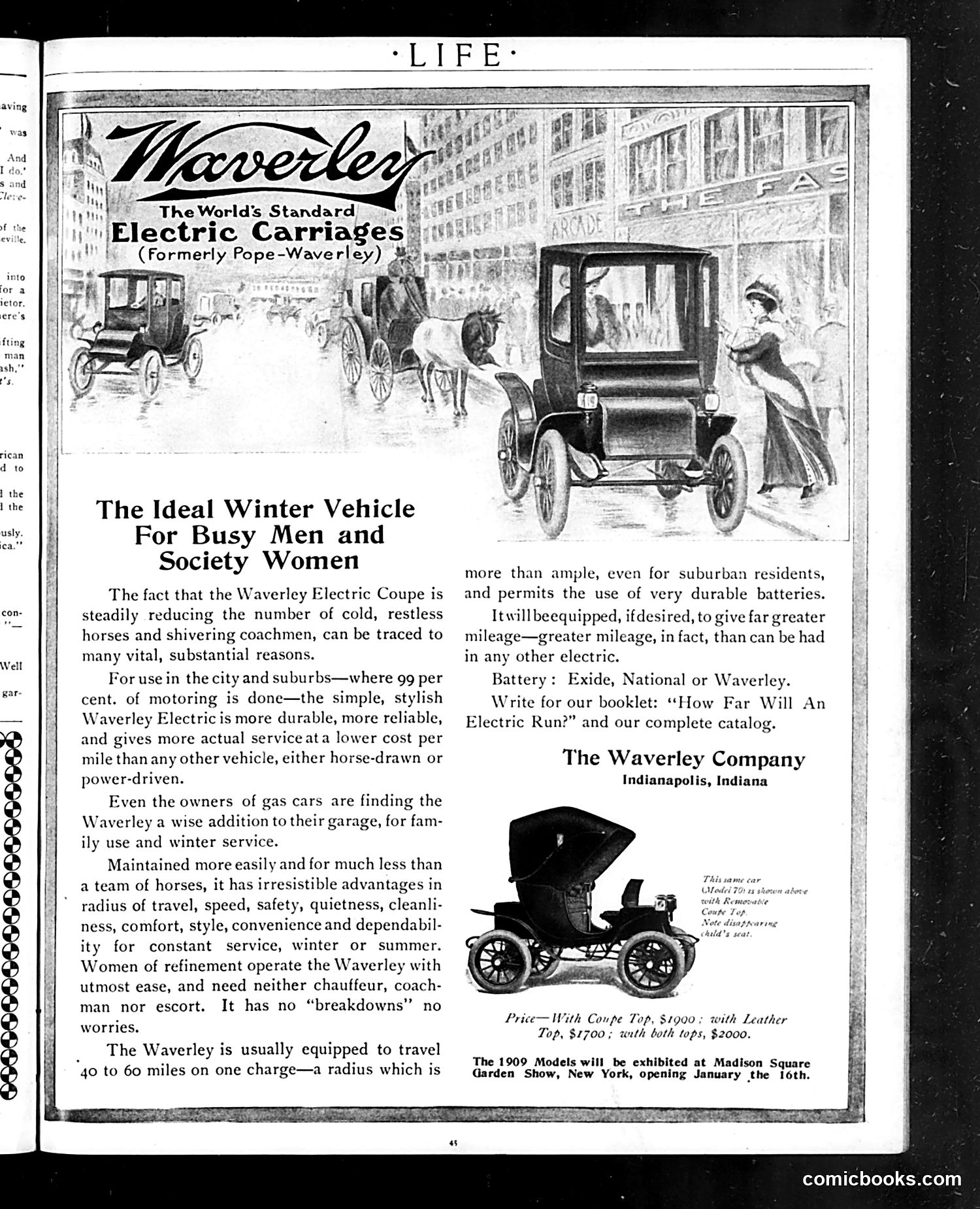
This is a straightforward advertisement, not satire. It promotes the Waverley Electric Coupe (formerly Pope-Waverley) as "the ideal winter vehicle" for affluent urban residents. The ad's key pitch targets **women of refinement** specifically—emphasizing that electric vehicles require no chauffeur, coachman, or escort, and operate with "utmost ease." This reflects early-1900s attitudes about women's emerging independence and vehicle accessibility. The ad contrasts electric cars favorably against both horse-drawn carriages (which need constant maintenance and live animals) and gasoline vehicles (which break down). The illustrations show the vehicle in an urban street scene and as a standalone image. Pricing ranges from $1,700–$2,000 (substantial for 1909), targeting wealthy society figures. The advertisement appears in Life magazine, which regularly featured luxury goods for its affluent readership, particularly appealing to the "busy men and society women" the headline addresses.
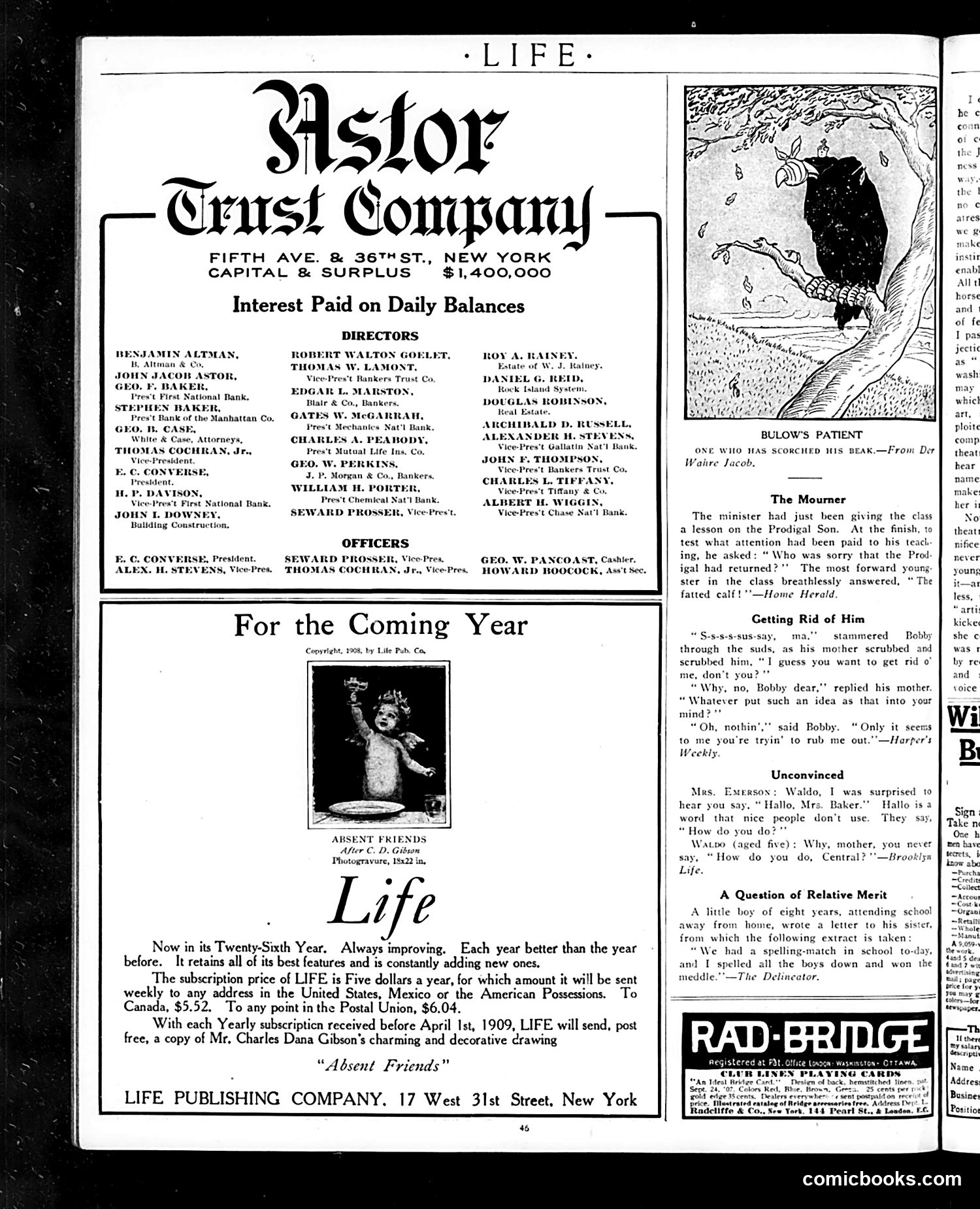
This page is primarily **advertising and promotional content** rather than editorial cartoons. The dominant features are: 1. **Astor Trust Company Advertisement** — A substantial bank advertisement listing directors and officers, emphasizing "Interest Paid on Daily Balances." This reflects the pre-1929 financial world. 2. **Life Magazine Self-Promotion** — A large advertisement for Life's upcoming twenty-sixth year of publication, offering subscriptions and a free Charles Dana Gibson drawing ("Absent Friends") to new subscribers. 3. **Small Humorous Anecdotes** — Several brief, mild jokes appear in the right column: - "Bulow's Patient" — references a German political figure (likely Chancellor Bernhard von Bülow) and a sarcastic caption about a scorched bear - "Getting Rid of Him," "Unconvinced," and "A Question of Relative Merit" — gentle domestic humor about children's innocent misstatements The page exemplifies early 1900s Life magazine: a mix of financial advertisements, self-promotion, and light social satire targeting middle-class readers.
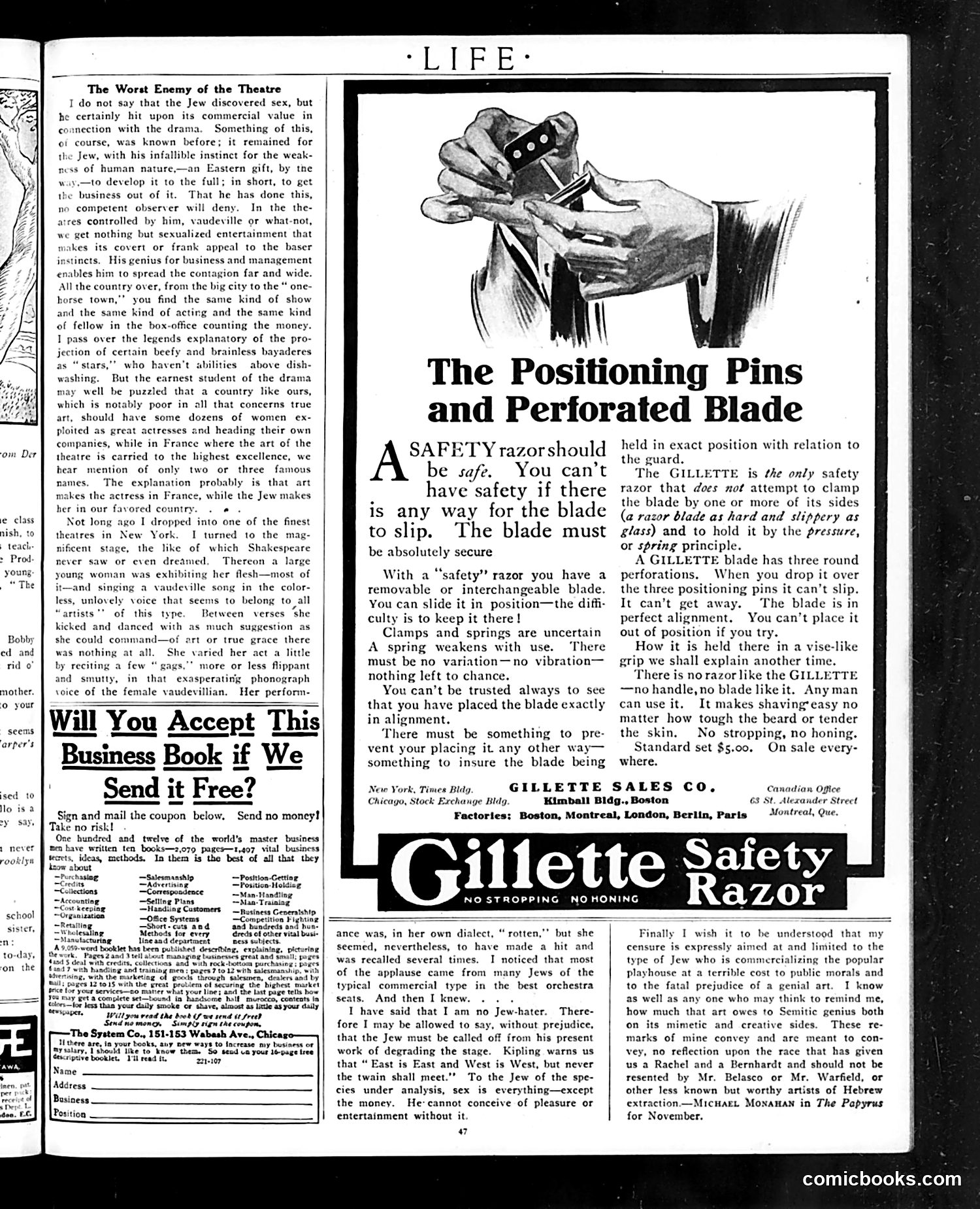
This page contains deeply antisemitic editorial content alongside advertisements, typical of early 20th-century American publications. **The Main Article ("The Worst Enemy of the Theatre"):** The text is an explicit antisemitic screed blaming Jewish theater producers for commercializing sex and "lowering" American theatrical standards. The author claims Jewish impresarios exploit "baser instincts" and contrasts their success unfavorably with French theater. This represents period prejudice depicting Jewish businesspeople as morally corrupting influences on entertainment. **The Advertisement:** The right side features a Gillette Safety Razor ad emphasizing secure blade positioning—unrelated to the editorial content. **Historical Context:** This reflects widespread early 1900s antisemitic attitudes in American media, where Jewish success in entertainment was framed as cultural contamination rather than achievement. Such rhetoric contributed to broader discriminatory practices of that era. Modern readers should recognize this as historical evidence of institutional antisemitism, not as valid social commentary.
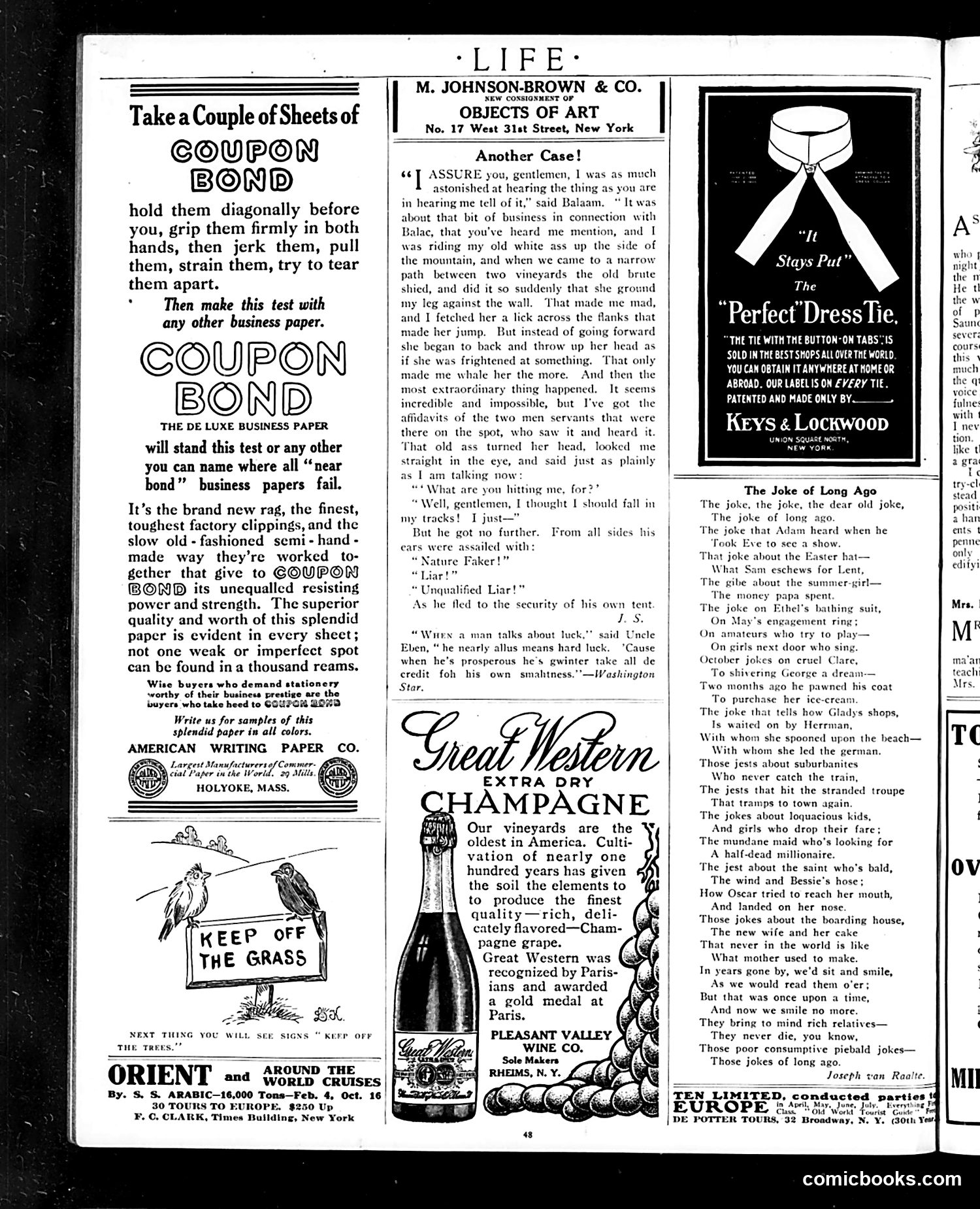
This page is primarily **advertising and fiction**, not political satire. The main content includes: **Advertisements:** Coupon Bond paper (emphasizing durability through a tear test), a dress tie product, Great Western Champagne, and travel cruises. **Fiction Story:** "Another Case!" depicts a Biblical reference—Balaam recounting the famous donkey incident from the Book of Numbers, where a talking donkey rebukes him. The joke is that when Balaam describes this miraculous event to others, they respond with accusations ("Faker!" "Liar!") and flee. The humor lies in the absurdity and unbelievability of his testimony, despite claiming eyewitnesses. **Poetry Section:** "The Joke of Long Ago" is a humorous poem about enduring old jokes throughout history—from Adam and Eve onward—suggesting certain tired jokes never die. The page represents typical early-20th-century *Life* magazine content: light humor, classical/Biblical references, and commercial advertising mixed with literary content. No specific political commentary appears present.
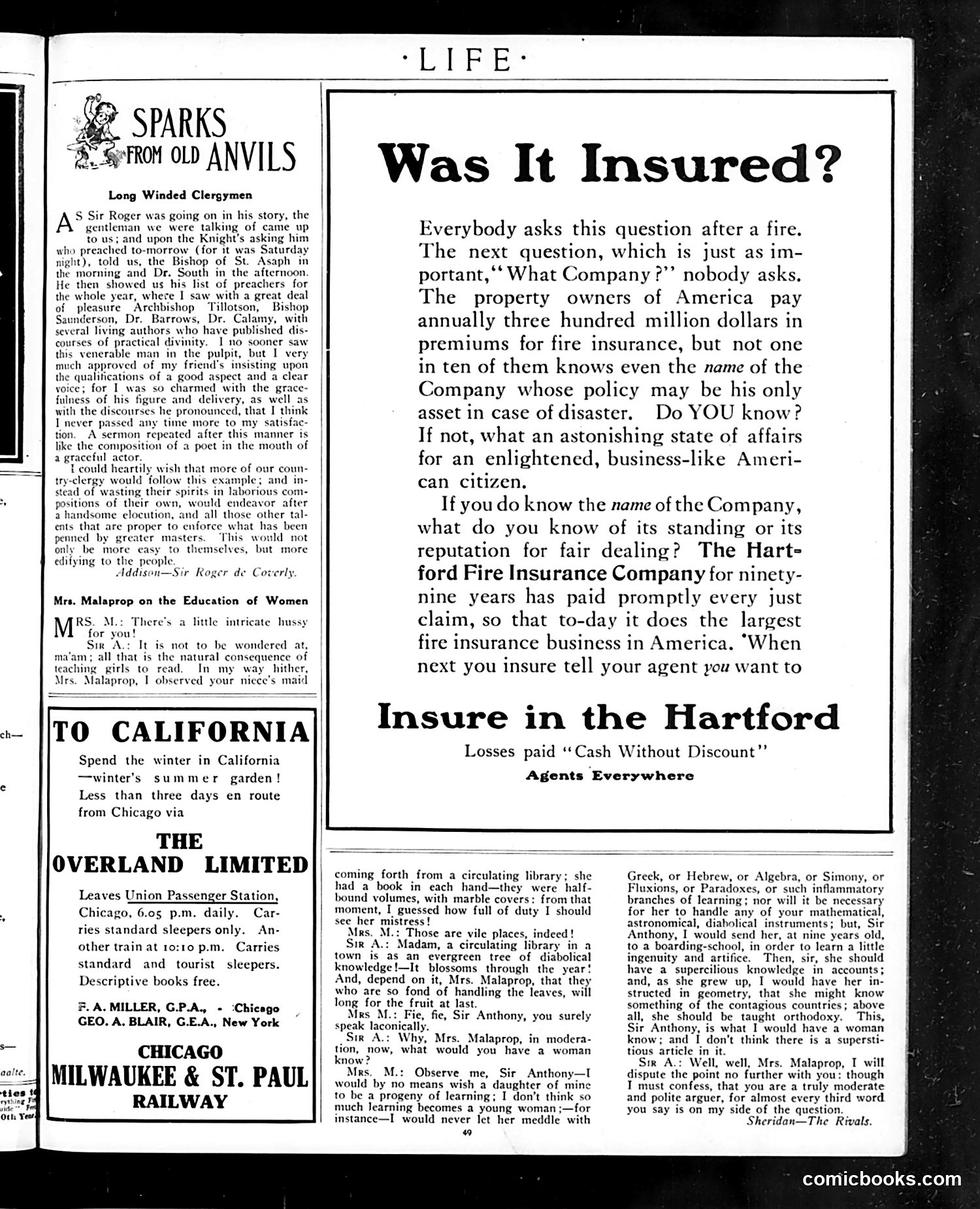
This page contains three distinct sections: two literary excerpts and one major advertisement. **Literary Content:** The "Sparks from Old Anvils" section reprints 18th-century passages—one from Addison's "Sir Roger de Coverly" essays satirizing long-winded clergymen who prioritize verbose composition over clear delivery, and another from Sheridan's "The Rivals" featuring Mrs. Malaprop, the famous character who opposes educating women, fearing books (especially lending libraries) will corrupt female virtue. These are presented as timeless social commentary. **Advertisement:** The dominant Hartford Fire Insurance Company ad addresses a practical concern: Americans pay substantial insurance premiums but often don't know their insurer's name or reputation. Hartford emphasizes its 99-year track record of prompt claims payment and largest market share, using this information gap as a sales pitch. **Supporting Ads:** Travel advertisements for California and Chicago-Milwaukee railroad service occupy the lower left.
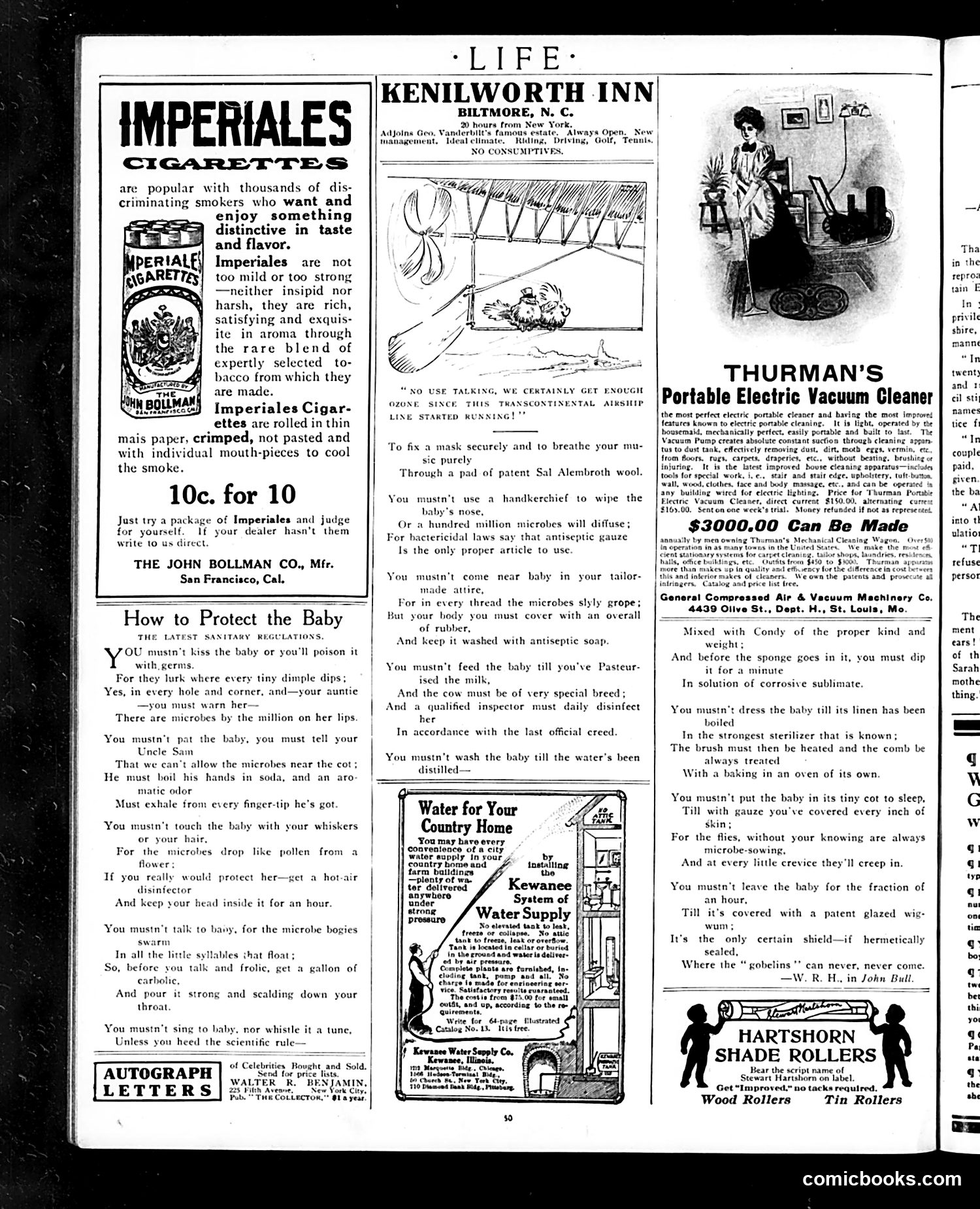
This page primarily contains **advertisements and humorous advice**, not political satire. The main content is "How to Protect the Baby"—a satirical poem mocking the era's obsession with germ theory and antiseptic safety. Written in the early 1900s (likely post-1900s when bacteriology became popular), it exaggerates the paranoid hygiene regulations doctors were beginning to impose on new parents. The joke: following all these rules would make normal human interaction with babies impossible. Lines like "you mustn't kiss the baby" and requiring a "hot-air disinfector" are absurd hyperboles of genuine (if overzealous) medical advice about preventing infant illness. The surrounding advertisements—cigarettes, vacuum cleaners, water systems, and shade rollers—are period products for affluent households. **The satire's point**: Life magazine was ridiculing both medical extremism and the anxiety it created among the middle and upper classes about child-rearing in an increasingly "scientific" age.
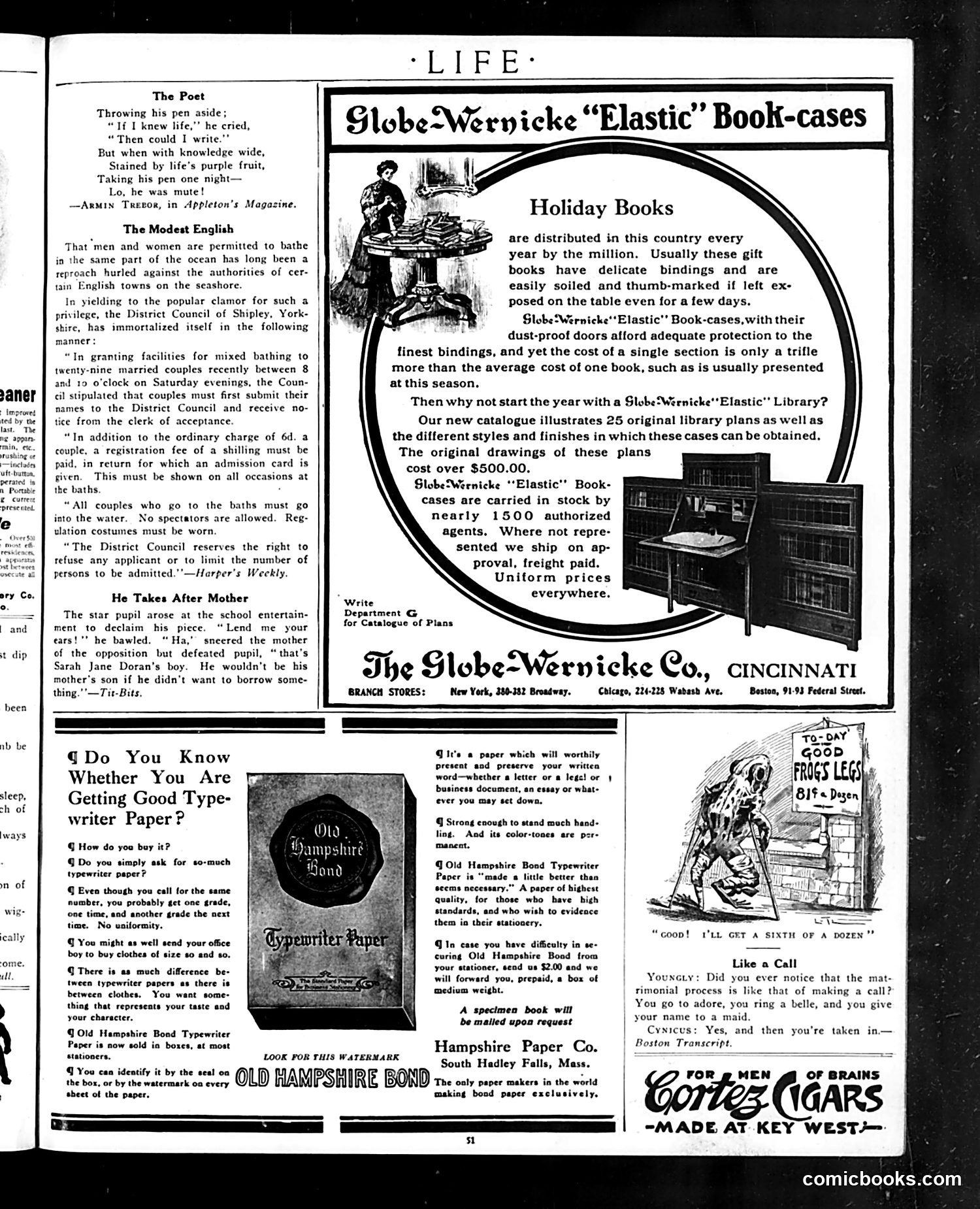
This page contains primarily **advertisements and light humor pieces** rather than political satire. **The humor sections** include: - "The Poet": A brief, philosophical joke about how knowledge paradoxically silences creative expression - "The Modest English": Satire of English prudishness—mocking a Yorkshire council's absurdly bureaucratic regulations for permitting married couples to bathe together (requiring registration, fees, admission cards, and "regulation costumes") - "He Takes After Mother": A schoolyard joke about a boy's theatrical delivery reminding someone of his mother's tendency to borrow things **The advertisements** dominate the page, promoting: - Globe-Wernicke "Elastic" bookcases for protecting holiday gift books - Old Hampshire Bond typewriter paper - Hampshire Paper Company products - Cortez cigars The "Modest English" piece is the most satirical content, gently ridiculing Victorian-era social conservatism and bureaucratic overreach in Britain.
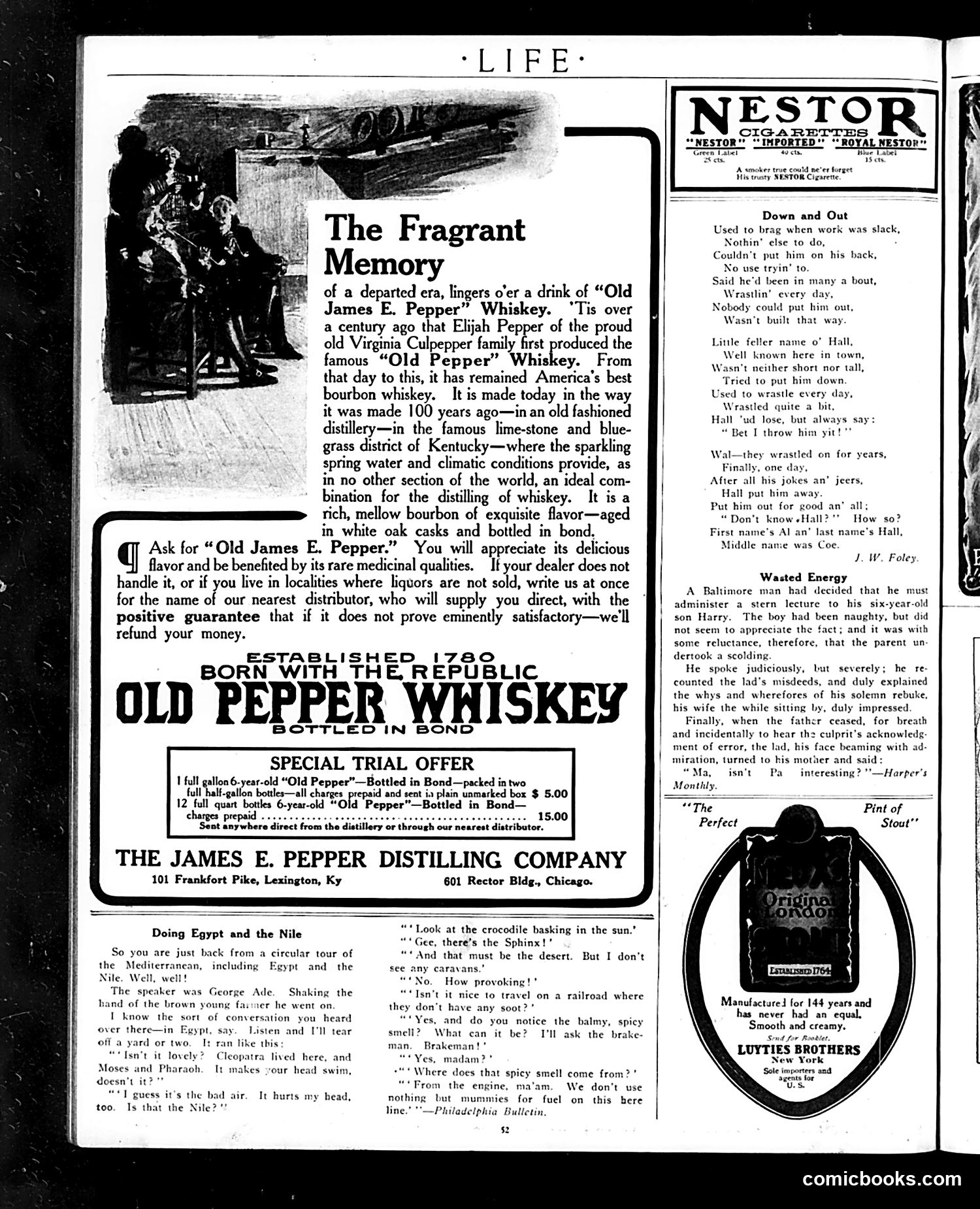
This page is primarily **advertising and light humor content**, not political satire. **Main Content:** The dominant feature is an advertisement for "Old James E. Pepper" bourbon whiskey, emphasizing its century-old heritage and medicinal qualities—a common pitch in pre-Prohibition or early Prohibition-era alcohol advertising. **Humor Pieces:** - "Doing Egypt and the Nile": A comedic dialogue by George Ade mocking tourists' predictable observations in Egypt. The joke culminates in a pun where a brakeman claims the locomotive runs on mummies as fuel—absurdist humor playing on Egypt's associations with ancient burial practices. - "Down and Out": A poem about a local wrestler named Hall who boasts he's unbeatable, then finally loses to someone named "Al...Hall"—a pun on the name. - "Wasted Energy": The beginning of a story about a father preparing to discipline his son. **Advertisements:** Nestor Cigarettes and Lutties Brothers stout appear in sidebar ads. The page reflects early-20th-century magazine humor: puns, travel clichés, and tall tales rather than political commentary.
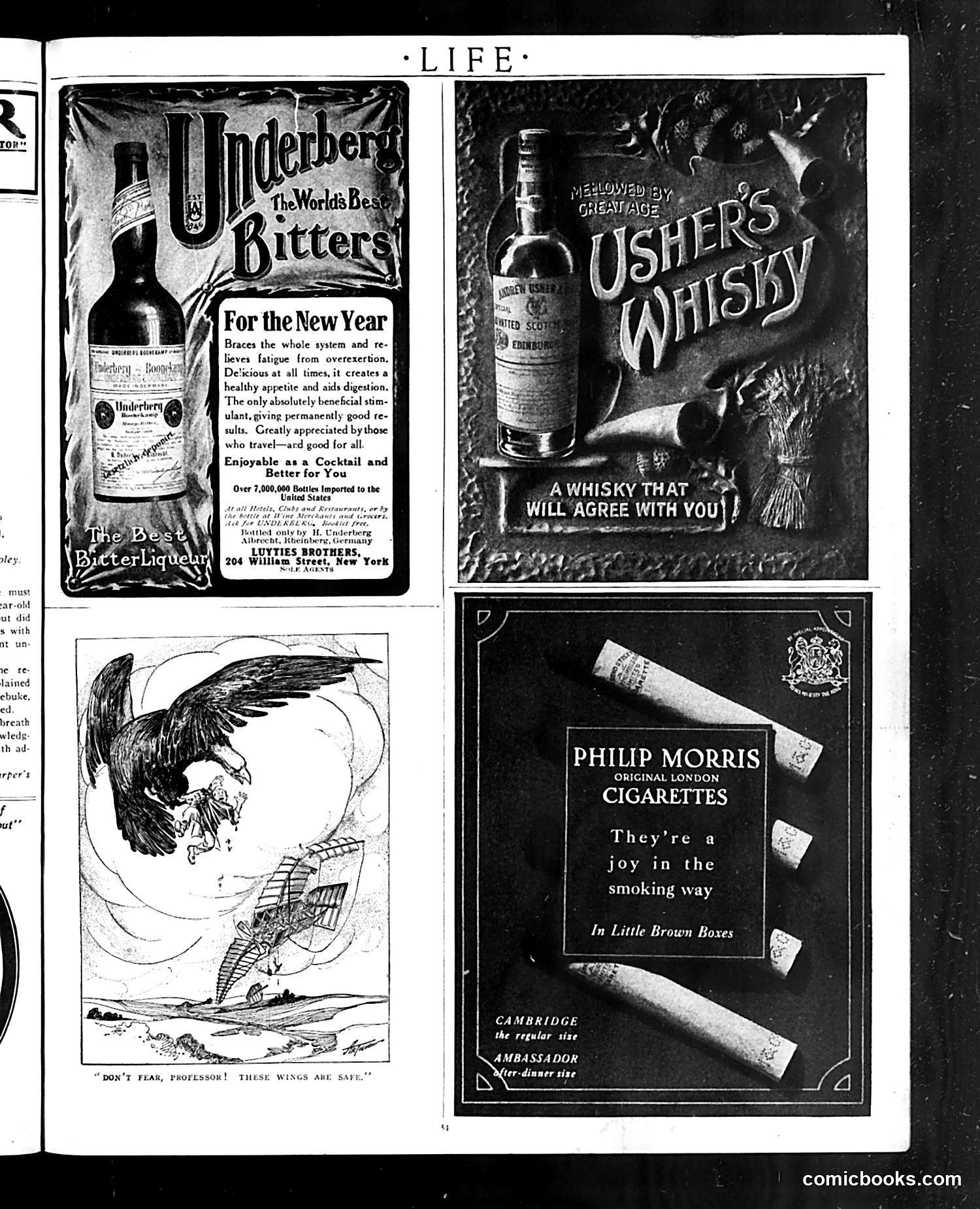
This page is primarily **advertising**, not editorial satire. It contains four ads for alcohol and tobacco products typical of the early 20th century. The only cartoon element is a small sketch showing a professor with a bird wearing mechanical wings, captioned "Don't Fear, Professor! These Wings Are Safe." This appears to be a humorous illustration promoting safety or reliability, likely accompanying one of the ads (unclear which). The three product advertisements are: - **Underberg Bitters** (liqueur) - marketed for New Year's health benefits - **Usher's Whisky** - described as agreeing with the consumer - **Philip Morris Cigarettes** - sold in "Little Brown Boxes" The ads reflect pre-Prohibition or early Prohibition-era marketing, when such products were openly advertised in mainstream publications. They use health and lifestyle appeals now recognized as misleading—bitters "bracing the system," whisky that "agrees with you," cigarettes as a "joy." The cartoon's specific meaning remains unclear without additional context about what it's advertising.
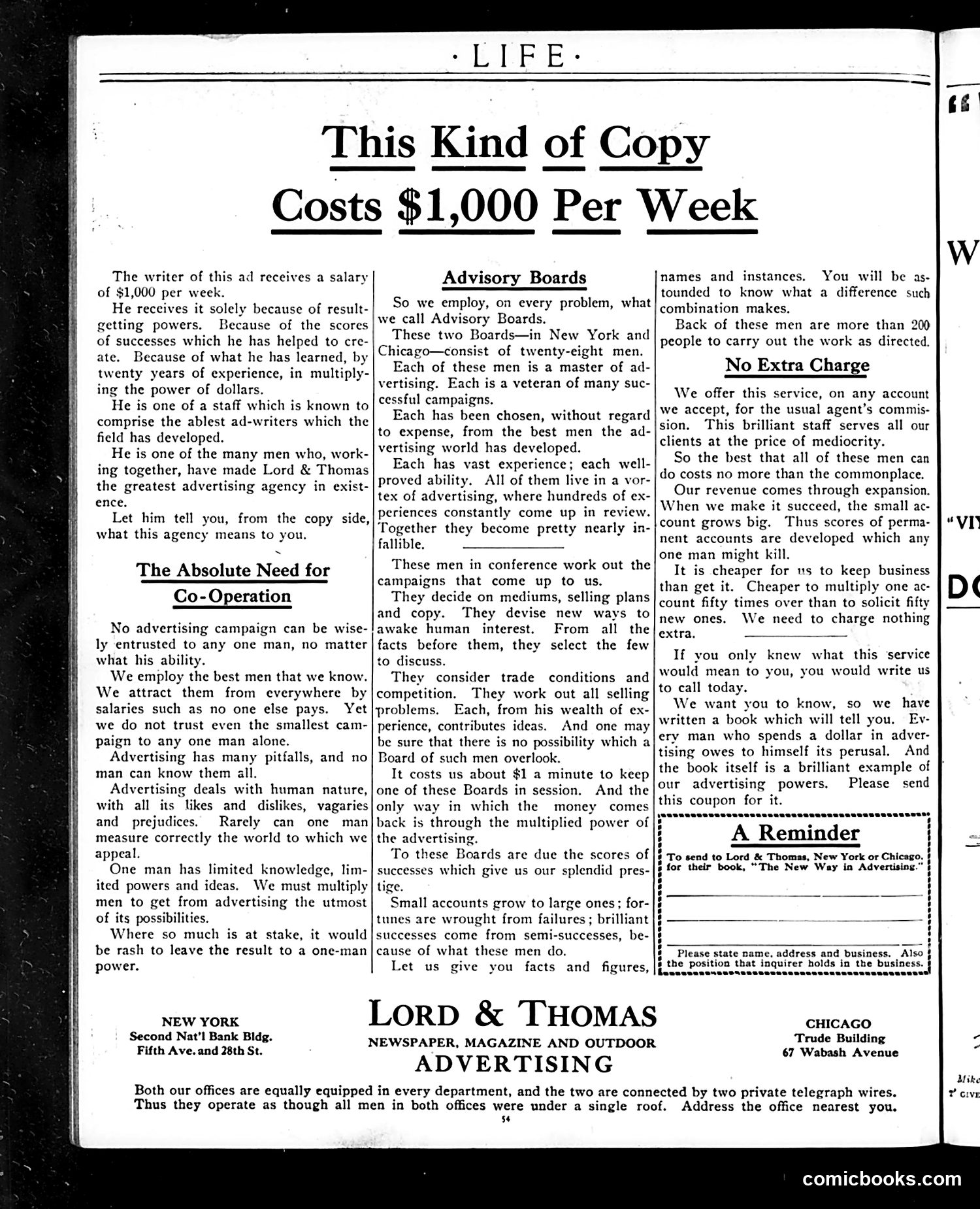
This is a **full-page advertisement** for Lord & Thomas, a major early-20th-century advertising agency, not a cartoon or satirical piece. The ad claims its copywriter earns $1,000 weekly—an enormous sum at the time—solely through proven results. The pitch emphasizes that Lord & Thomas employs "Advisory Boards" of twenty-eight veteran advertising experts in New York and Chicago who collaboratively develop campaigns rather than relying on single individuals. The central argument: quality advertising requires **multiple skilled perspectives**, not one-man decision-making. These boards cost "$1 a minute" to convene but supposedly generate massive returns through pooled expertise. The agency offers this premium service at standard commission rates, claiming expansion and client growth justify the investment. The tone is boastful corporate self-promotion typical of Progressive Era advertising—using pseudo-scientific teamwork rhetoric to justify high fees and position the agency as an elite professional firm rather than a simple vendor service.
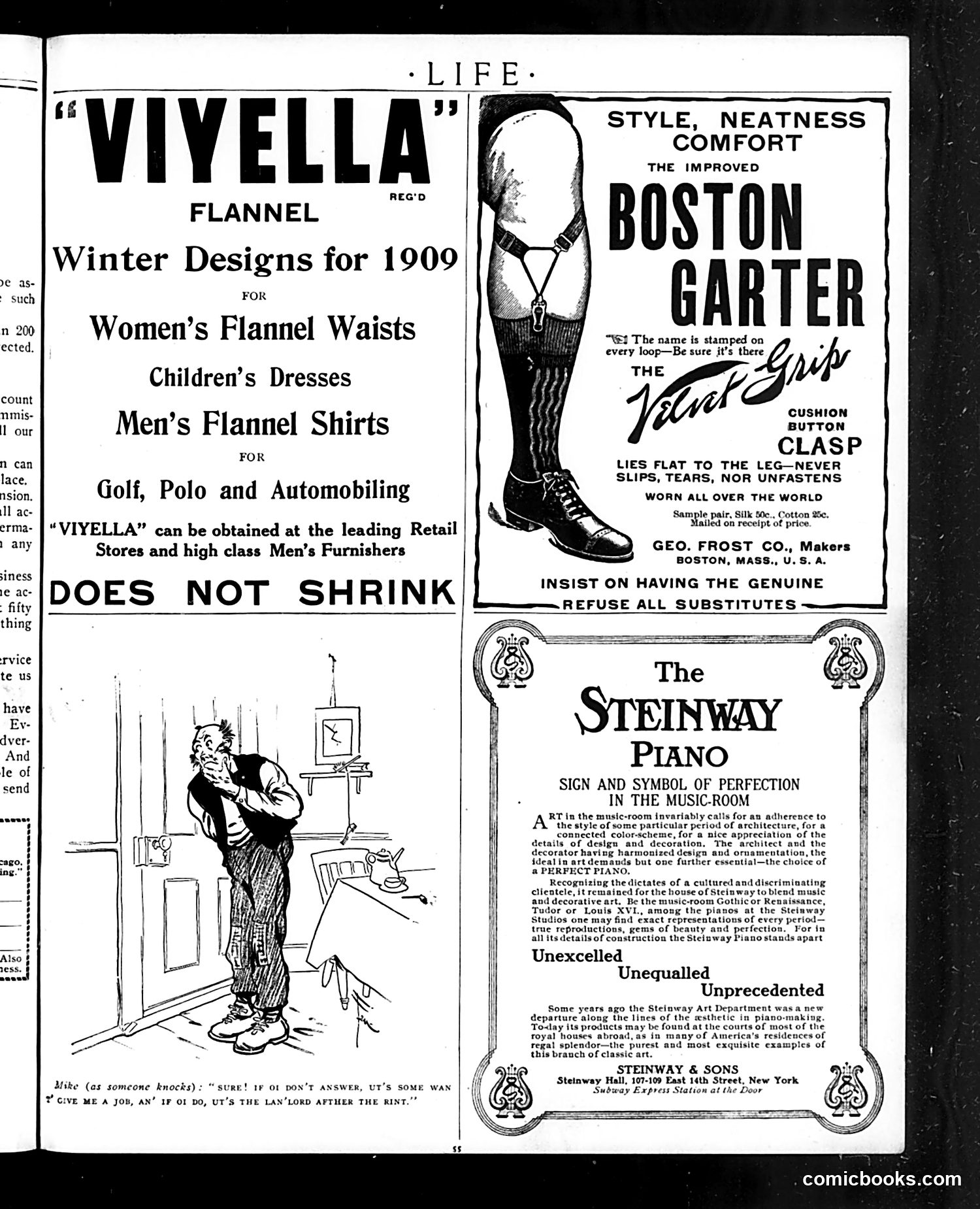
This page is primarily **advertising** rather than editorial content. The main elements are: **The Cartoon:** A small sketch depicts an Irish immigrant (identifiable by dialect and working-class appearance) at a tenement door, negotiating with a landlord about employment and rent. The caption uses heavy Irish brogue ("Sure! If ol don't answer...") to create humor from ethnic stereotyping common in 1909. The joke plays on the desperation of poor immigrants balancing job-seeking with avoiding eviction. **The Advertisements** promote: - **Vivella Flannel** (winter clothing) - **Boston Garter** (men's hosiery support) - **Steinway Piano** (luxury musical instrument) These ads reflect 1909 consumer goods and class aspirations. The Steinway ad emphasizes artistic sophistication and period-style design for wealthy homes, contrasting sharply with the working-class immigrant struggle depicted in the cartoon—a juxtaposition that encapsulates American class divisions of the era.
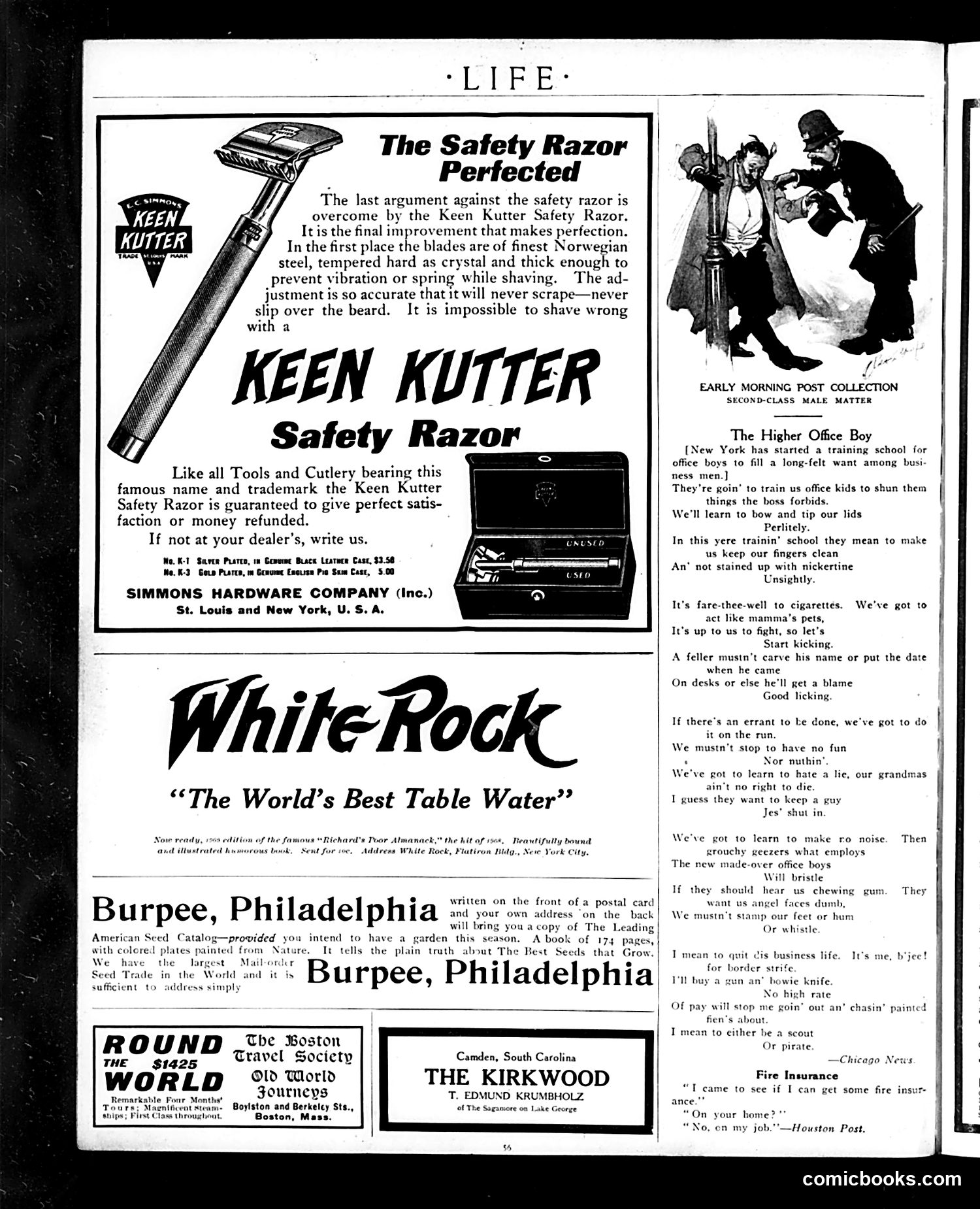
This page is primarily **advertising and humorous content**, not political satire. The main items are: **Advertisements:** Keen Kutter Safety Razors, White Rock water, Burpee seeds, and travel services dominate the layout. **Humor Content:** The substantive piece is "The Higher Office Boy," a satirical poem about New York's new training school for office boys. It mocks the school's attempt to instill propriety and discipline—requiring clean fingers, no cigarettes, respectful behavior, and honest work—by having a young office boy voice his resentment in dialect verse. He plans to abandon office work entirely for outlaw life ("border strife," becoming a "sco[undrel]" or pirate). The joke is generational: well-meaning reformers try to civilize working-class youth through rules, but the boy rebels against constraint itself. The closing "Fire Insurance" joke plays on this theme—he wants insurance against losing his job, not his house. This reflects early-1900s anxiety about **youth management and working-class respectability**.
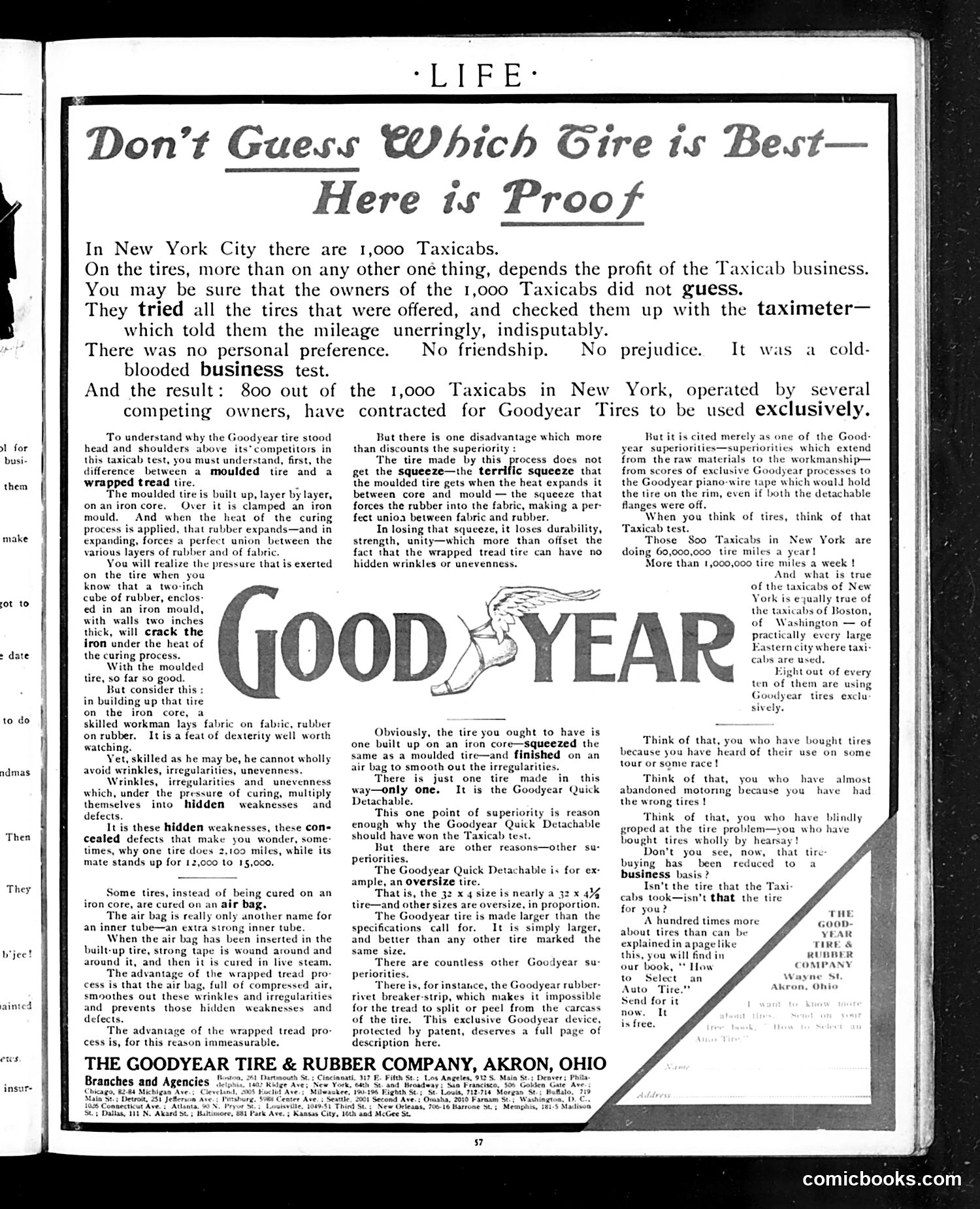
This is primarily **advertising disguised as journalism**—a common early 20th-century marketing tactic. The page reports that New York City taxicab owners tested various tire brands empirically (using taximeters to measure mileage) rather than guessing. The result: 800 of 1,000 cabs chose Goodyear exclusively. The bulk of the text explains **tire manufacturing differences**: Goodyear's "Quick Detachable" combines the best features of two methods—the durability of iron-mold curing with the smoothness of air-bag curing—while competitors' tires have hidden weaknesses. **The satire's point**: This isn't really satire but rather pseudo-scientific advertising. By framing tire selection as a rigorous business test (not "guessing"), Goodyear implies competitors rely on mere preference. The hand illustration emphasizing the Goodyear tire reinforces the sales message. This reflects an era when companies could present marketing claims as objective fact without regulatory scrutiny—exploiting readers' assumption that magazine content was editorial rather than paid promotion.
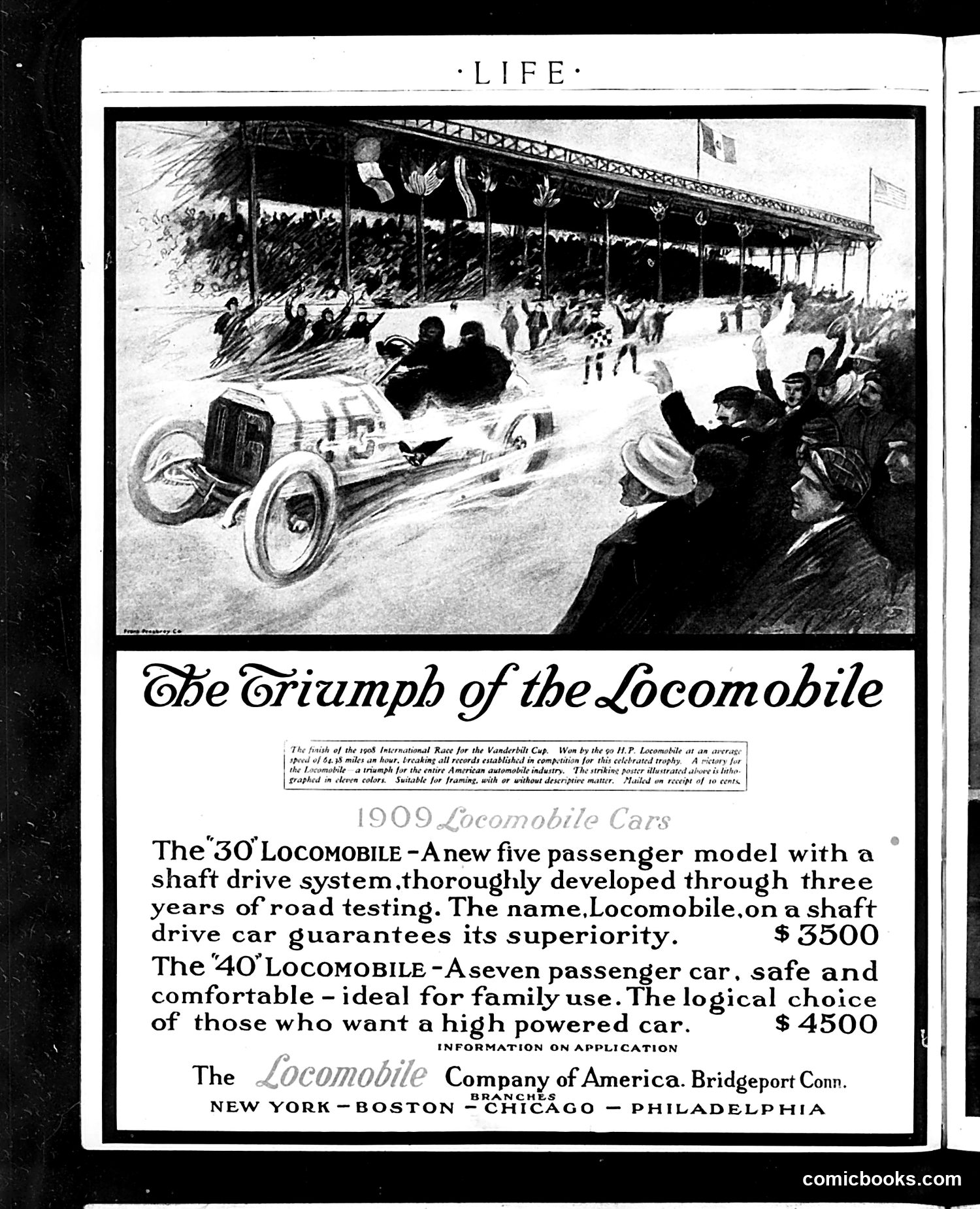
This is primarily a **Locomobile automobile advertisement**, not political satire. The top illustration depicts a racing scene at what appears to be a major motorsports venue, with a Locomobile racing car competing—likely referencing the 1908 Vanderbilt Cup race mentioned in the caption, which the text claims Locomobile won. The advertisement leverages this racing victory as proof of the brand's superiority and reliability. By 1909, automotive racing had become a marketing tool: victories demonstrated mechanical excellence to consumers considering expensive purchases ($3,500-$4,500—substantial sums at the time). The page advertises two models: a five-passenger "30" and a seven-passenger "40," targeting affluent American buyers. The Locomobile Company of America, based in Bridgeport, Connecticut, positioned itself as a premium manufacturer for those wanting "high powered" vehicles. There is no political cartoon or satire present—this is straightforward early automotive advertising using sporting achievement to build brand prestige.
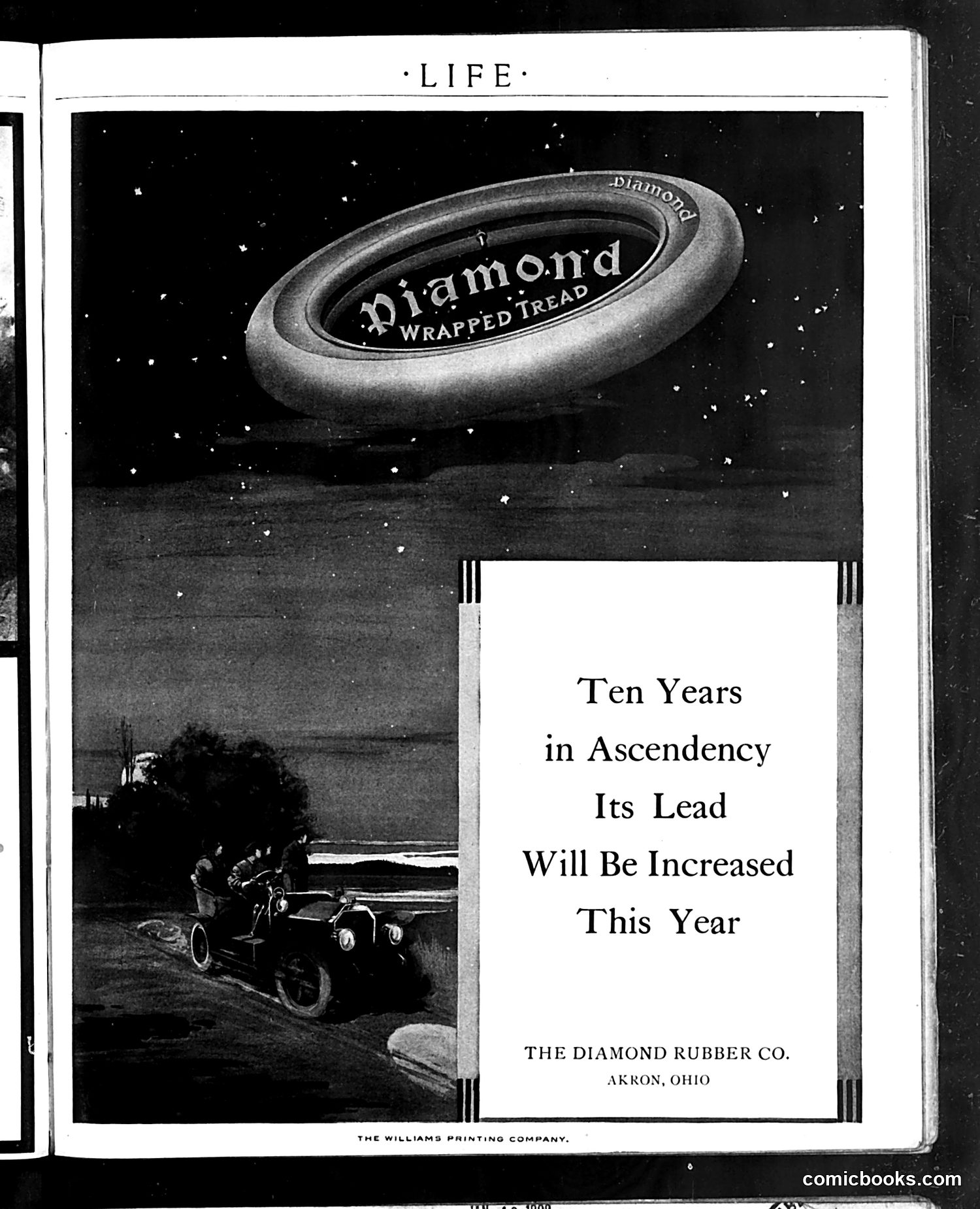
This is a **Diamond Rubber Company advertisement** from Life magazine, not political satire. It promotes Diamond brand wrapped bread (visible on the floating loaf at top) and rubber products, claiming the company has led its market for ten years with plans to increase that lead further. The imagery shows a surreal nighttime scene with a giant loaf of bread floating like a UFO above a car on a road—striking visual metaphor for the brand's dominance and ambitious trajectory. The company, based in Akron, Ohio (a major rubber manufacturing hub), uses the dramatic, forward-looking aesthetic typical of early 20th-century advertising to project growth and superiority. This is straightforward commercial messaging wrapped in eye-catching modernist design, not commentary or satire.
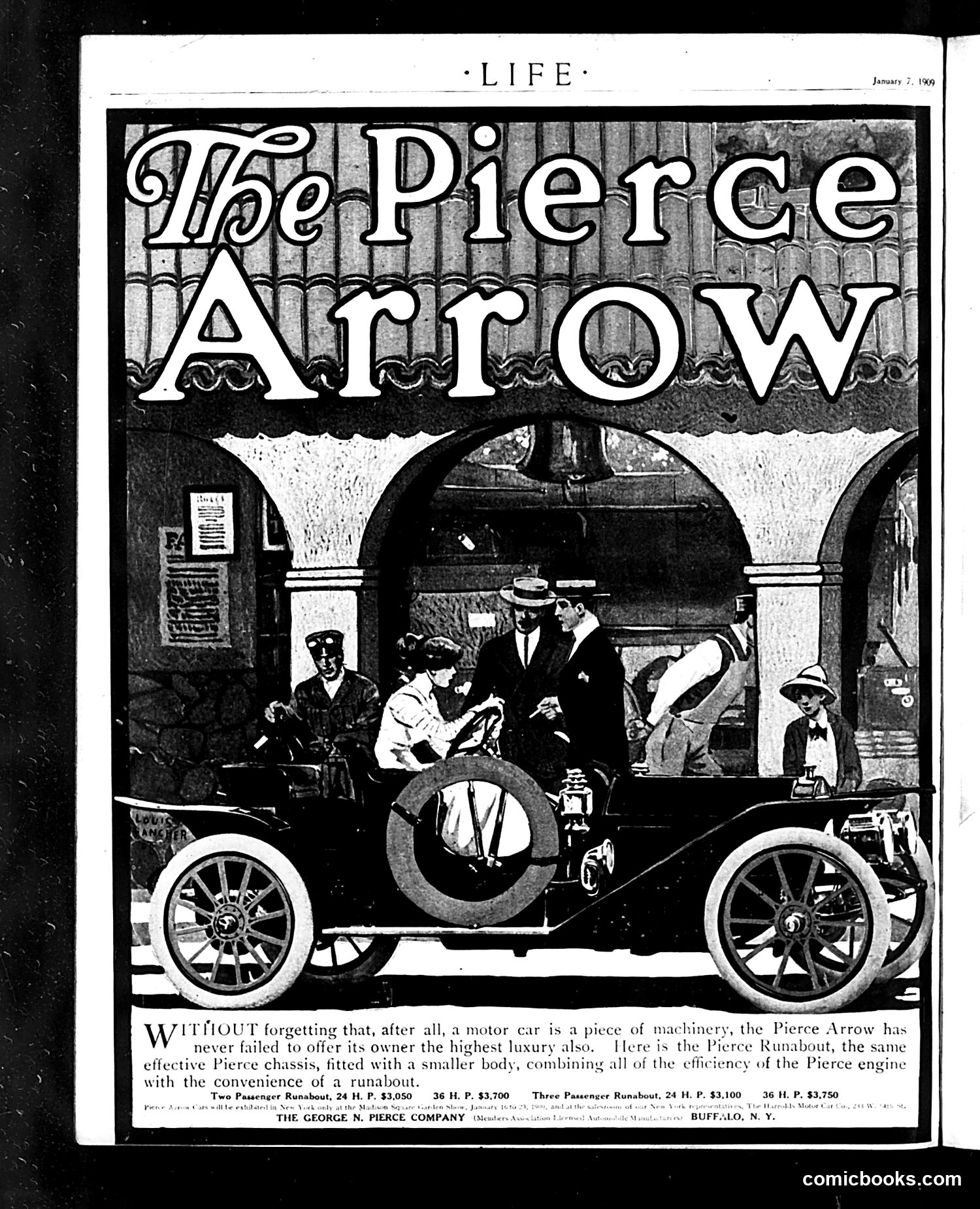
This is **not a political cartoon or satire**—it's a **automobile advertisement** from Life magazine (January 7, 1909). The page advertises the Pierce Arrow automobile, manufactured by the George N. Pierce Company in Buffalo, New York. The illustration shows well-dressed passengers in an early motorcar beneath an ornate archway (styled like "The Pierce Arrow"), emphasizing luxury and sophistication. The advertisement's text argues that Pierce Arrow vehicles combine mechanical excellence with comfort and convenience. It lists several Runabout models with their horsepower and prices ($3,050–$3,750). The "joke" or selling point is that despite being serious machinery, Pierce Arrows don't sacrifice luxury—an important pitch during this era when automobiles were expensive novelties for wealthy consumers. This represents early automotive marketing targeting affluent buyers.