
Life, 1909-01-07 · page 33 of 60
Life — January 7, 1909 — page 33: what you’re looking at
What you’re looking at
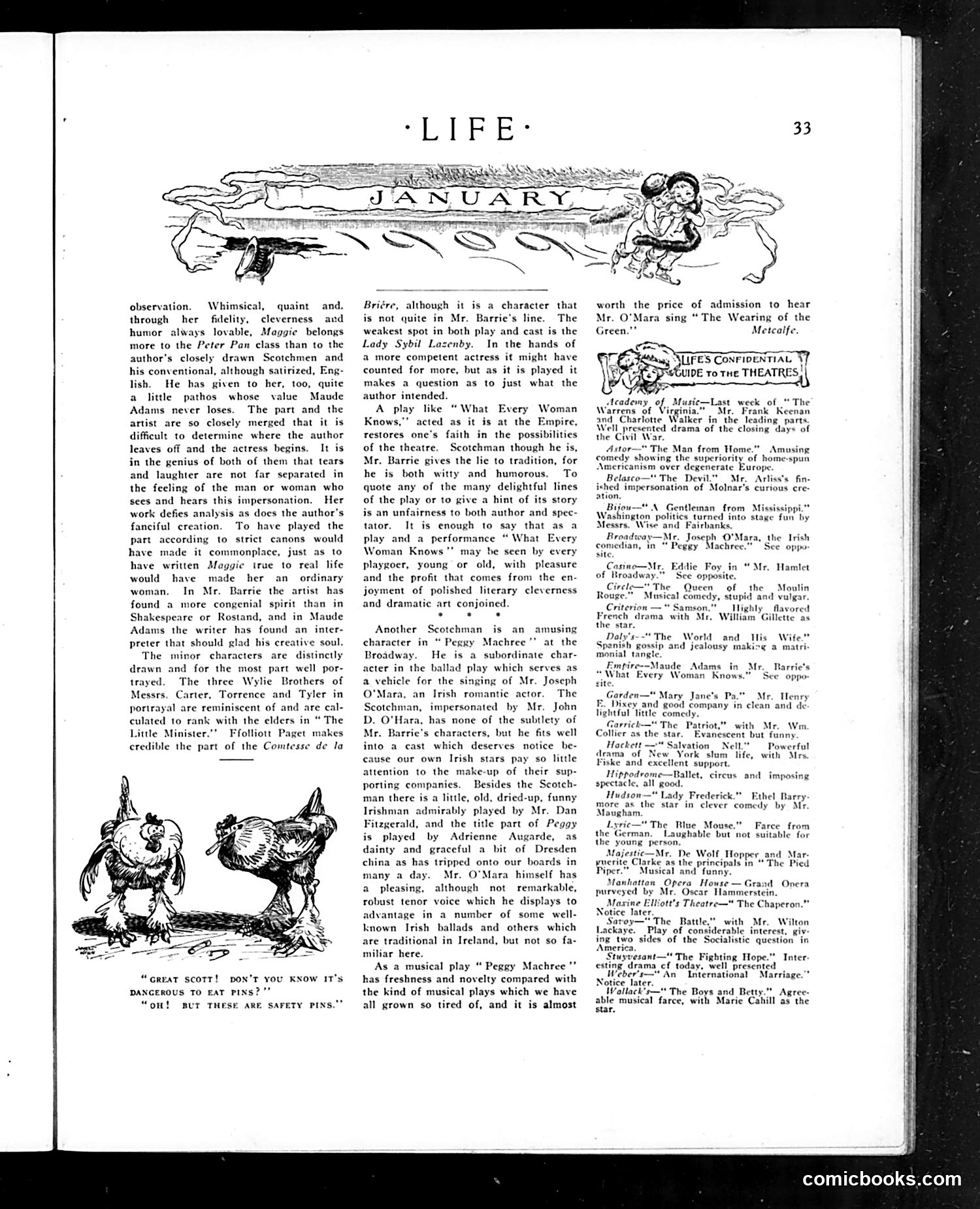
This page reviews contemporary theatrical productions, primarily focusing on J.M. Barrie's "What Every Woman Knows" starring actress Maude Adams. The text praises both the play's literary wit and Adams's performance, suggesting her interpretation transcends strict dramatic analysis. **The cartoon** (bottom left) shows a figure exclaiming "Great Scott! Don't you know it's dangerous to eat pins?" to another who responds "Oh! But these are safety pins." This is a visual pun playing on the literal and figurative meanings of "safety pins"—the joke relies on absurdist logic where someone treats actual pins as food, then assumes "safety" pins make them edible. It's gentle, whimsical humor typical of Life magazine's style. The page also reviews "Peggy Machree," a musical vehicle for Irish tenor Joseph O'Mara, and discusses supporting cast members. The overall tone celebrates polished theatrical craftsmanship and literary merit.
📄 Transcribed text from this page (OCR, searchable)
Machine-transcribed from the original scan — historical spelling and the odd misread are preserved.
*LIFE® observation. Whimsical, quaint and. through her fidelity, cleverness and humor always lovable, Maggie belongs more to the Peter Pan class than to the author's closely drawn Scotchmen and his conventional, although satirized, Eng- ish. He has given to her, too, quite a little pathos whose value Maude Adams never loses. The part and the artist are so closely merged that it is difficult to determine where the author leaves off and the actress begins. It is in the genius of both of them that tears and laughter are not far separated in the feeling of the man or woman who sees and hears this impersonation. Her work defies analysis as docs the author's fanciful creation. To have played the part according to strict canons would have made it commonplace, just as to have written Maggie true to real life would have made her an ordinary woman. In Mr. Barrie the artist has found a more congenial spirit than in Shakespeare or Rostand, and in Maude Adams the writer has found an inter- preter that should glad his creative soul. The minor characters are distinctly drawn and for the most part well por- trayed. The three Wylie Brothers of Messrs. Carter, Torrence and Tyler in portrayal are reminiscent of and are cal- culated to rank with the elders in “ The Little Minister.” Ffolliott Paget makes credible the part of the Comtesse de la DON'T You KNOW IT's oe “Great scott! DANGEROUS TO EAT Pi “on! BUT THESE ARE SAFETY PINS. though it is a character that is not quite in Mr. Barrie's line. The weakest spot in both play and cast is the Lady Sybil Lazenby. In the hands of A more competent actress it might have counted for more, but as it is played it makes a question as to just what the author intended. A play like “What Every Woman Knows,” acted as it is at the Empire, restores one’s faith in the possibilities of the theatre. Scotchman though he is, Mr. Barrie gives the lie to tradition, for he is both witty and humorous. To quote any of the many delightful lines of the play or to give a hint of its story is an unfairness to both author and spec- tator. It is enough to say that as a play and a performance “ What Every Woman Knows"? may be seen by every playgoer, young or old, with pleasure and the profit that comes from the en- joyment of polished literary cleverness and dramatic art conjoined. Another Scotchman is an amusing character in “Peggy Machree’? at the Broadway. He is a subordinate char- acter in the ballad play which serves as a vehicle for the singing of Mr. Joseph O'Mara, an Irish romantic actor. The Scotchman, impersonated by Mr. John D. O'Hara, has none of the subtlety of Mr. Barrie's characters, but he fits well into a cast which deserves notice be- cause our own Irish stars pay so little attention to the make-up of their sup- porting companies. Besides the Scotch- man there is a little, old, dried-up, funny Irishman admirably played by Mr. Dan Fitzgerald, and the title part of Peggy is played by Adrienne Augarde, as dainty and graceful a bit of Dresden china as has tripped onto our boards in many a day. Mr. O'Mara himself has a pleasing, although not remarkable, robust tenor voice which he displays to advantage in a number of some well- known Irish ballads and others which are traditional in Ireland, but not so fa- miliar here. As a musical play “ Peggy Machree has freshness and novelty compared with the kind of musical plays which we have all grown so tired of, and it is almost worth the price of admission to hear Mr. O'Mara sing “ The Wearing of the Green.”" Metcalfe. BS SLUFES ConriDENTIAL V7 NSGUIDE ro THe THEATRES, Academy of Music—Last week of “The Warrens of Virginia.” Mr. Frank Keenan and Charlotte Walker in the leading parts Well presented drama of the closing days of the Civil War. * The Man from Home.” Amusing howing the superiority of home-spun m over degenerate Europe ; "The Devil.” Mr. Arliss's fin: ished impersonation of Molnar’s curious cre: comedy "A Gentleman from Missi pi.” Washington’ politics turned into stage fur’ by Messrs, Wise and Fairbanks. Broadway—Mr. Joseph O'Mara, the Irish comedian, in “ Peggy Machree."” ' See oppo: site Casino—M of Broadway.” Cireleo—* The Fdilie Foy in “ Mr See opposite. Queen of the | Moulin Rouge.” Musical comedy, stupid and vulgar Criterion —" Samson." Highly flavored French drama with Mr. William Gillette as the star. = Daoly's--"* The World and Wis Wife.” Spenish gossip and jealousy making a matri- monial tan Empire--Maude Adams in Mr. Barrie's “What Every Woman Knows.” See oppo site Hamlet Pa” Mr. Henry ompany in clean and de Vightful little Comedy. Garrick—" The Pai Collier as the star, Evanescent but funny Hockett —* Salvation Nell.” Powerful drama of New York slum life, with Mrs. Fiske and excellent support Hippodrome—Ballet, circus and imposing spectacle, all good. Hudson—" Lady Frederi Ethel Barry more as the star in clever comedy by Mr. more ar in ¢ medy by M jot.” with Mr. Wm. “The Blue Mouse.” Farce from rman. Laughable but not suitable for young person. stic—Mr. De Wolf Hopper and xuerite Clarke as the principals in “ The Piper.” Musical and’ funny. , Manhattan Opera House — Grand purveyed by Mr. Oscar Hammerstein, . Marine Elliott's Theatre—* The Chaperon.” Notice later, Saroy—" The Battle,” with Mr. Wilt Lackaye. Play of considerable interest, §' ing two sides of the Socialistic question America. Stuyvesant— The Fighting Hope.” esting drama ef today, well presented _Weber’s—" An International Marriage.” Notice later. Wallack's—" The Boys and Betty." Agree- able musical farce, with Marie Cabill as the ir. Onera Inter. comicbooks.com