
Life, 1909-01-07 · page 28 of 60
Life — January 7, 1909 — page 28: what you’re looking at
What you’re looking at
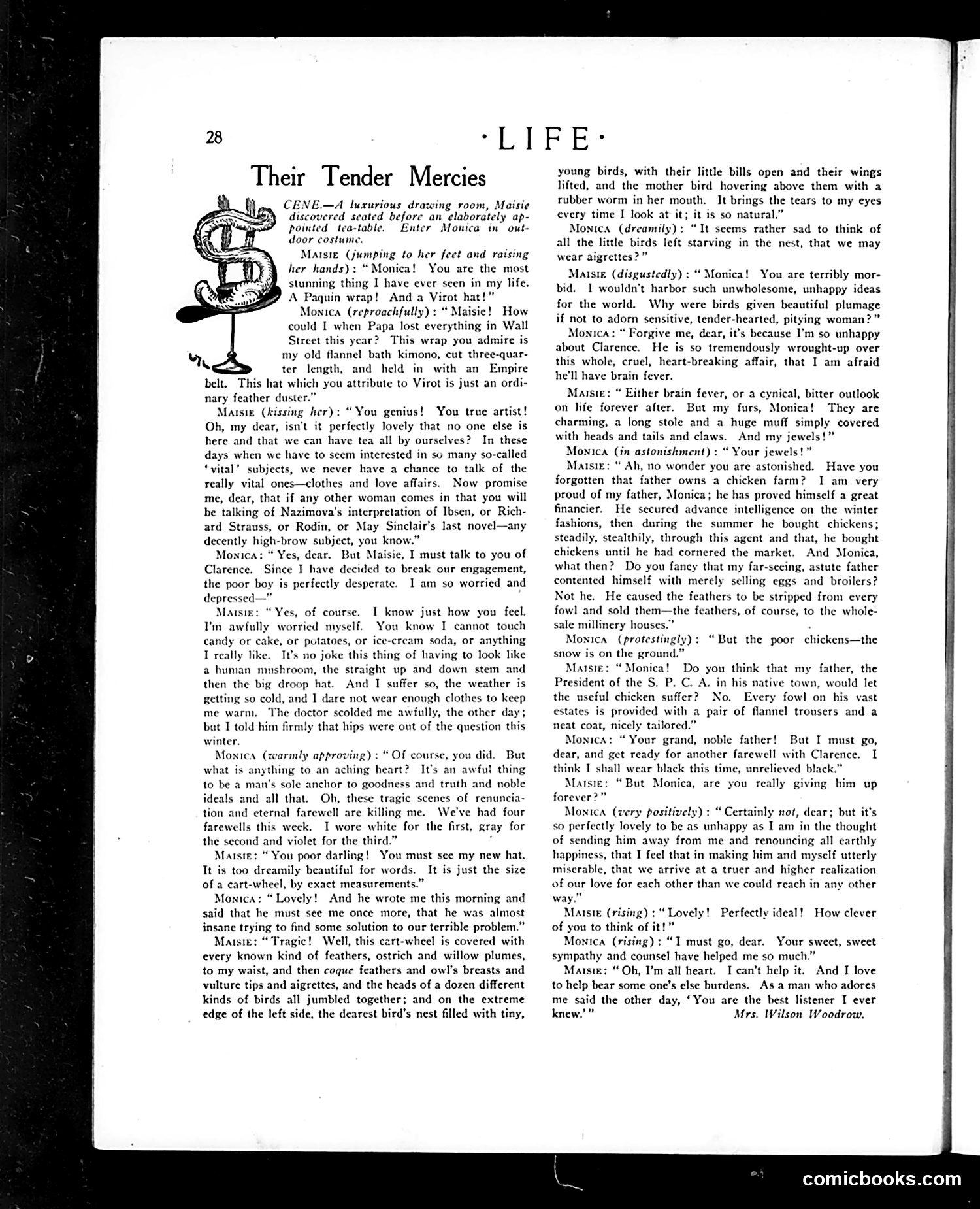
This sketch mocks the shallow priorities and moral contradictions of wealthy young women. Two society ladies, Maisie and Monica, discuss fashion and romance while pretending to intellectual sophistication. The satire targets several absurdities: **The Fashion Hypocrisy**: Monica's "ordinary feather duster" hat and "flannel bath kimono" are presented as haute couture (Paquin, Virot), satirizing how wealthy women obsess over status symbols. **The Fake Intellectualism**: Maisie explicitly states they avoid "vital subjects" like Ibsen and Rodin when alone, preferring gossip about "clothes and love affairs"—mocking their pretense of cultural refinement. **The Bird Plumage Irony**: The comic climax is Maisie's absurdly elaborate hat decorated with actual bird parts, complete with a live nest. Monica questions the ethics; Maisie dismisses her concern, arguing birds were "given beautiful plumage...to adorn...woman"—a ridiculous rationalization for animal exploitation. The piece satirizes Edwardian-era vanity, conspicuous consumption, and women's casual cruelty toward nature for fashion.
📄 Transcribed text from this page (OCR, searchable)
Machine-transcribed from the original scan — historical spelling and the odd misread are preserved.
LIFE Their Tender Mercies A luxurious drawing room, Maisie discovered scated before an elaborately ap- pointed tca-table. Enter Monica in’ out- door costume. Maisie (jumping to her feet and raising her hands): “ Monica! You are the most stunning thing I have ever seen in my life. A Paquin wrap! And a Virot hat!” Monica (reproachfully) : “* Maisie! How could I when Papa lost everything in Wall Street this year? This wrap you admire is my old flannel bath kimono, cut three-quar- ter length, and held in with an Empire belt. This hat which you attribute to Virot is just an ordi- nary feather duster.” Maisie (kissing her): “You genius! You true artist! Oh, my dear, isn’t it perfectly lovely that no one else is here and that we can have tea all by ourselves? In these days when we have to seem interested in so many so-called ‘vital’ subjects, we never have a chance to talk of the really vital ones—clothes and love affairs. Now promise me, dear, that if any other woman comes in that you will be talking of Nazimova’s interpretation of Ibsen, or Rich- ard Strauss, or Rodin, or May Sinclair's last novel—any decently high-brow subject, you know.” Monica: “ Yes, dear. But Maisie, I must talk to you of Clarence. Since I have decided to break our engagement, the poor boy is perfectly desperate. I am so worried and depressed—" Maisie: “Yes, of course. I know just how you feel. I'm awfully worried myself. You know I cannot touch candy or cake, or potatoes, or ice-cream soda, or anything I really like. It’s no joke this thing of having to look like a human mushroom, the straight up and down stem and then the big droop hat. And I suffer so, the weather is getting so cold, and I dare not wear enough clothes to me warm. The doctor scolded me awfully, the other d but I told him firmly that hips were out of the question this winter. Monica (warmly approving) : “ Of course, you did. But what is anything to an aching heart? It's an awful thing to be a man’s sole anchor to goodness and truth and noble ideals and all that. Oh, these tragic scenes of renuncia- tion and eternal farewell are killing me. We've had four farewells this weel I wore white for the first, gray for the second and violet for the third.” Maisie: “You poor darling! You must see my new hat. It is too dreamily beautiful for words. It is just the size of a cart-wheel, by exact measurements.” Monica: “Lovely! And he wrote me this morning and said that he must see me once more, that he was almost insane trying to find some solution to our terrible problem.” Maisie: “ Tragic! Well, this cart-wheel is covered with every known kind of feathers, ostrich and willow plumes, to my waist, and then coque feathers and owl’s breasts and vulture tips and aigrettes, and the heads of a dozen different kinds of birds all jumbled together; and on the extreme edge of the left side, the dearest bird’s nest filled with tiny, young birds, with their little bills open and their wings lifted, and the mother bird hovering above them w a rubber worm in her mouth. It brings the tears to my eyes every time I look at it; it is so natural.” Monica (dreamily): “It seems rather sad to think of all the little birds left starving in the nest, that we may wear aigrettes?” Maisig (disgustedly) : “ Monica! You are terribly mor- bid. I wouldn't harbor such unwholesome, unhappy ideas for the world. Why were birds given beautiful plumage if not to adorn sensitive, tender-hearted, pitying woman?” Monica: “ Forgive me, dear, it’s because I'm so unhappy about Clarence. He is so tremendously wrought-up over this whole, cruel, heart-breaking affair, that I am afraid he'll have brain fever. Maisie Zither brain fever, or a cynical, bitter outlook on life forever after. But my furs, Monica! They are charming, a long stole and a huge muff simply covered with heads and tails and clay And my jewels!” Monica (in astonishment) : “ Your jewels!” Marsie: “ Ah, no wonder you are astonished. Have you forgotten that father owns a chicken farm? I am very proud of my father, Monica; he has proved himself a great financier. He secured advance intelligence on the winter fashions, then during the summer he bought chickens steadily, stealthily, through this agent and that, he bought chickens until he had cornered the market. And Monica, what then? Do you fancy that my far-secing, astute father contented himself with merely selling eggs and broilers? Not he. He caused the feathers to be stripped from every fowl and sold them—the feathers, of course, to the whole- sale millinery houses.” Monica (protestingly) : snow is on the ground.” Maiste: “Monica! Do you think that my father, the President of the S. P. C. A. in his native town, would let the useful chicken suffer? No. Every fowl on his vast estates is provided with a pair of flannel trousers and a neat coat, nicely tailored.” Monica: “Your grand, noble father! But I must go, dear, and get ready for another farewell with Clarence. I think I shall wear black this time, unrelieved black.” Matsie: “But Monica, are you really giving him up forever?” Monica (very positively) : “Certainly not, dear; but it’s so perfectly lovely to be as unhappy as I am in the thought of sending him away from me and renouncing all earthly happiness, that I feel that in making him and myself utterly miserable, that we arrive at a truer and higher realization of our love for each other than we could reach in any other way.” Maiste (rising) : “Lovely! Perfectly ideal! How clever of you to think of it!” Monica (rising): “I must go, dear. sympathy and counsel have helped me so much.” Marste: “ Oh, I’m all heart. T can’t help it. And I love to help bear some one’s else burdens. As a man who adores me said the other day, ‘You are the best listener I ever knew.’” Mrs. Wilson Woodrow. “But the poor chickens—the Your sweet, sweet comicbooks.com