
Life, 1909-01-07 · page 20 of 60
Life — January 7, 1909 — page 20: what you’re looking at
What you’re looking at
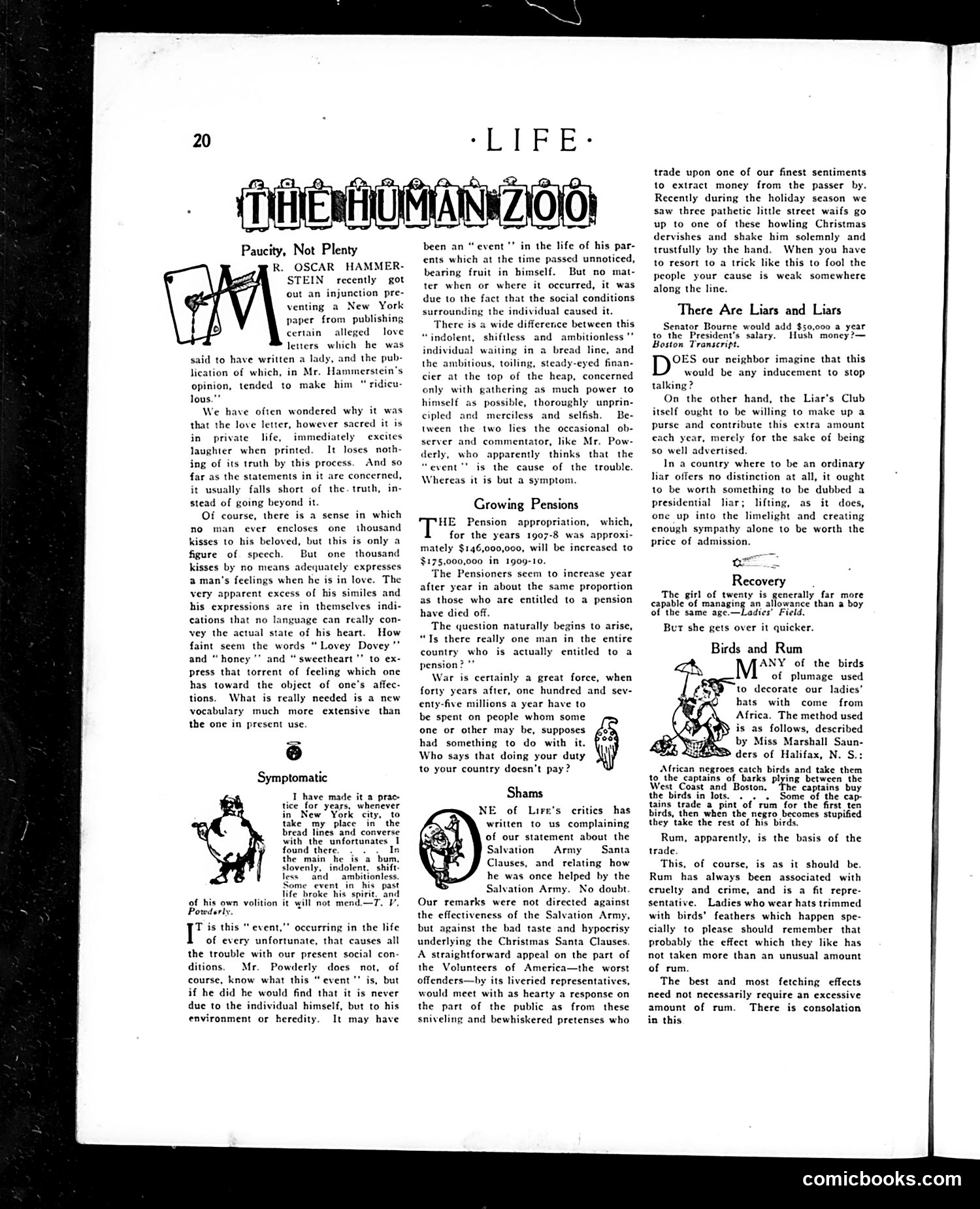
This page contains three satirical essays critiquing American society circa 1908-1909. **"Paucity, Not Plenty"** defends Oscar Hammerstein's attempt to suppress love letters, arguing that exaggerated romantic language (like "one thousand kisses") reflects genuine emotion, not ridiculousness. **"Symptomatic"** attacks labor leader T.V. Powderly's claim that unemployed "bums" lack ambition due to personal "events." Life argues instead that poverty stems from systemic social conditions and heredity—not individual moral failure—contrasting struggling breadline workers with ruthless wealthy financiers. **"Growing Pensions"** sarcastically mocks the escalating military pension budget ($146M to $175M), questioning whether anyone actually deserves pensions forty years after war. **"Shams"** begins defending the Salvation Army against unnamed critics who complained about Life's earlier criticism of their "Santa Clauses" charity campaign. The page employs Life's typical Progressive Era stance: blaming social structures rather than individual character for poverty and inequality.
📄 Transcribed text from this page (OCR, searchable)
Machine-transcribed from the original scan — historical spelling and the odd misread are preserved.
Paucity, Not Plenty R. OSCAR HAMMER- STEIN recently got out an injunction pre- venting a New York paper from publishing certain alleged love letters which he was said to have written a lady, and the pub- lication of which, in Mr. Hammerstein's opinion, tended to make him “ ridicu- lous.” We have often wondered why it was that the love letter, however sacred it is in private life, immediately excites laughter when printed. It loses noth- ing of its truth by this process. And so far as the statements in it are concerned, it usually falls short of the. truth, in- stead of going beyond it. Of course, there is a sense in which no man ever encloses one thousand kisses to his beloved, but this is only a figure of speech. But one thousand kisses by no means adequately expresses a man’s feelings when he is in love. The very apparent excess of his similes and his expressions are in themselves indi- cations that no language can feally con- vey the actual state of his heart. How faint seem the words “Lovey Dovey ’’ and “honey '’ and “sweetheart "’ to ex- press that torrent of feeling which one has toward the object of one’s affec- tions. What is really needed is a new vocabulary much more extensive than the one in pr Symptomatic T have made it a prac- tice for years, whenever in New York city, to take my place in the bread lines and converse with the unfortunates found there. : the main he is ‘a bum, slovenly, indolent. shift less and ambitionless. ‘ome event in his past fe broke his spirit. and of his own volition it yill not mend.—T. V. Powderly. T is this “event,” occurring in the life of every unfortunate, that causes all the trouble with our present social con- ditions. Mr. Powderly docs not, of course, know what this “event "” is, but if he did he would find that it is never due to the individual himself, but to his environment or heredity. It may have been an “ event’ in the life of his par- ents which at the time passed unnoticed, bearing fruit in himself. But no mat- ter when or where it occurred, it was due to the fact that the social conditions surrounding the individual caused it. There is a wide difference between this “indolent, shiftless and ambitionless "’ individual waiting in a bread line, and the ambitious, toiling, steady-eyed finan- cier at the top of the heap, concerned only with gathering as much power to s possible, thoroughly unprin- merciless and selfish. Be- tween the two lies the occasional ob- and commentator, like Mr. Pow- derly, apparently thinks that the “event” is the cause of the trouble. Whereas it is but a symptom himself cipled and server who Growing Pensions HE Pension appropriation, which, for the years 1907-8 was approxi- mately $146,000,000, will be increased to $17§,000,000 in 1909-10. The Pensioners seem to increase year after year in about the same proportion as those who are entitled to a pension have died off. ‘The question naturally begins to arise, “Ts there really one man in the entire country who is actually entitled to a pension?” War is certainly a great force, when forty years after, one hundred and sev- enty-five millions a year have to be spent on people whom some one or other may be, supposes had something to do with it. Who says that doing your duty to your country doesn’t pay? Shams NE of Live's critics has written to us complaining of our statement about the Salvation Army — Santa Clauses, and relating how he was once helped by the Salvation Army. No doubt. Our remarks were not directed against the effectiveness of the Salvation Army, but against the bad taste and hypocrisy underlying the Christmas Santa Clauses. A straightforward appeal on the part of the Volunteers of America—the worst offenders—hy its liveried representatives, would meet with as hearty a response on the part of the public as from these sniveling and bewhiskered pretenses who trade upon one of our finest sentiments to extract money from the passer by. Recently during the holiday season we saw three pathetic little street waifs go up to one of these howling Christmas dervishes and shake him solemnly and trustfully by the hand. When you have to resort to a trick like this to fool the people your cause is weak somewhere along the line. There Are Liars and Liars Senator Bourne would add $50,000 a year to the President's salary. Hush money?— Boston Transcript. OES our neighbor imagine that this would be any inducement to stop talking? On the other hand, the Liar’s Club itself ought to be willing to make up a purse and contribute this extra amount cach year, merely for the sake of being so well advertised. In a country where to be an ordinary liar offers no distinction at all, it ought to be worth something to be dubbed a presidential liar; lifting, as it does, one up into the limelight and creating enough sympathy alone to be worth the price of admission. os. Recovery The girl of twenty is generally far more capable of managing an allowance than a boy of the same age.—Ladies’ Field. But she gets over it quicker. Birds and Rum M* NY of the birds of plumage used to decorate our ladies’ hats with come from Africa. The method used is as follows, described by Miss Marshall Saun- ders of Halifax, N. S.: African negroes catch birds and take them to the captains of barks plying between the West Coast and Boston. The captains. buy the birds in lots... Some of the cap- tains trade a pint of rum for the first ten birds, then when the negro becomes stupified they take the rest of his birds. Rum, apparently, is the basis of the trade This, of course, is as it should be. Rum has always been associated with cruelty and crime, and is a fit repre- sentative. Ladies who wear hats trimmed with birds’ feathers which happen spe- cially to please should remember that probably the effect which they like has not taken more than an unusual amount of rum. The best and most fetching effects need not necessarily require an excessive amount of rum. There is consolation in this comicbooks.com