
Life, 1909-01-07 · page 23 of 60
Life — January 7, 1909 — page 23: what you’re looking at
What you’re looking at
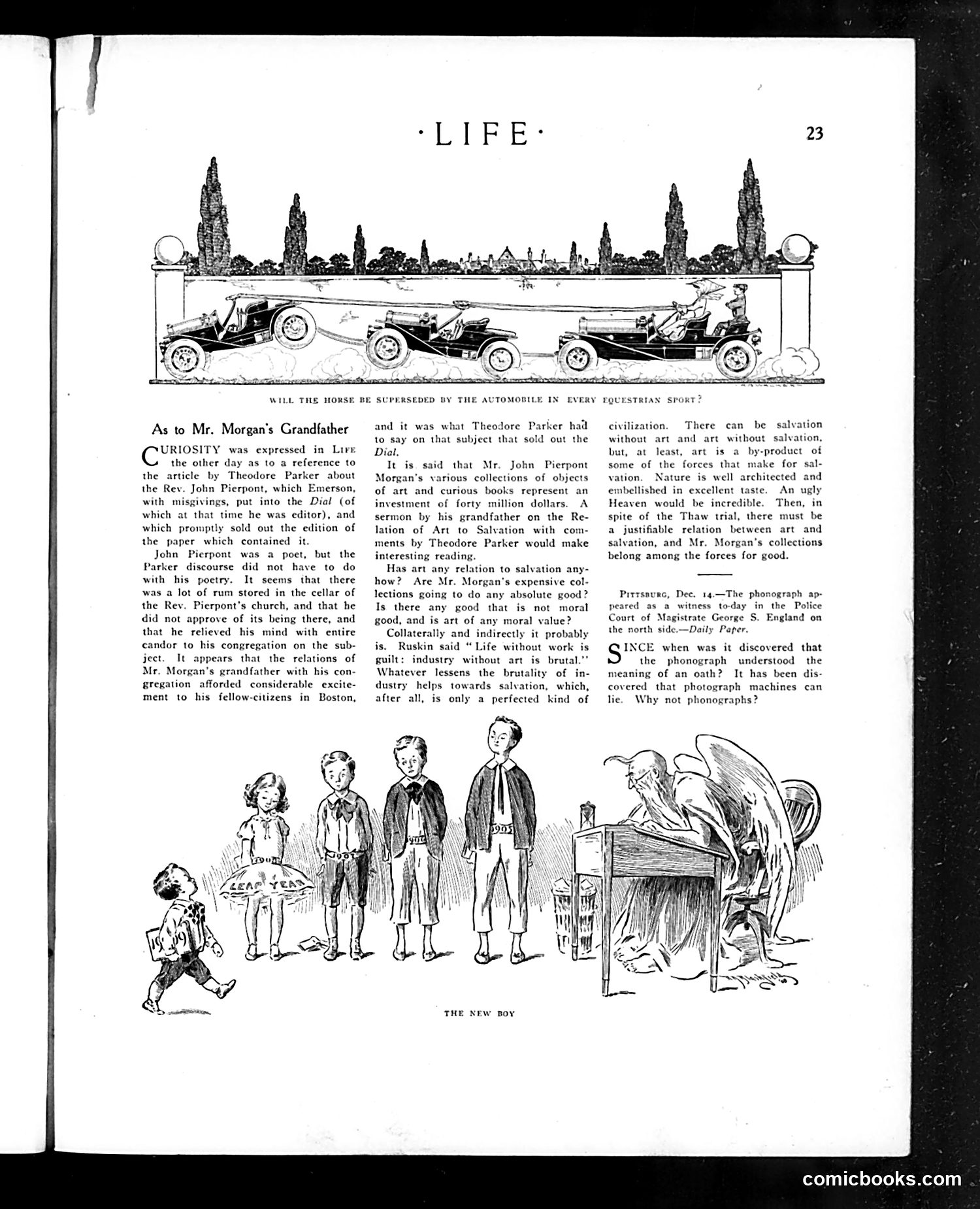
This *Life* magazine page contains two satirical pieces: **Top cartoon:** Questions whether automobiles will replace horses in sports. The illustration shows a progression of early vehicles alongside traditional carriages, posing a contemporary technological debate (automobiles were still novelties). **Main article:** Discusses J.P. Morgan's art collections (worth $40 million) through the lens of his grandfather, Reverend John Pierpont. The satire hinges on historical irony: Pierpont famously condemned alcohol stored in his church cellar, yet Morgan accumulated massive art collections. The article humorously ponders whether expensive art has moral value or aids "salvation," invoking Ruskin's philosophy. The implicit joke: Morgan's grandfather opposed worldly vices in his congregation, while his descendant accumulated worldly treasures. **Bottom item:** A brief satirical note questioning phonograph testimony in court—if machines can malfunction ("lie"), why trust their sworn evidence? This reflects early skepticism about mechanical recording devices as legal evidence. The page satirizes wealth, morality, and emerging technology circa early 1900s.
📄 Transcribed text from this page (OCR, searchable)
Machine-transcribed from the original scan — historical spelling and the odd misread are preserved.
WILL THE HORSE BE SUPERSEDED BY THE AUTOMOBILE IN EVERY EQUESTRIAN SPORT? As to Mr. Morgan's Grandfather URIOSITY was expressed in Lire the other day as to a reference to the article by Theodore Parker about the Rev. John Pierpont, which Emerson, with misgivings, put into the Dial (of which at that time he was editor), and which promptly sold out the edition of the paper which contained it. John Pierpont was a poet, but the Parker discourse did not have to do with his poetry. It seems that there was a lot of rum stored in the cellar of the Rev. Pierpont’s church, and that he did not approve of its being there, and that he relieved his mind with entire candor to his congregation on the sub- ject. It appears that the relations of Mr. Morgan's grandfather with his con- gregation afforded considerable excite- ment to his fellow-citizens in Boston, and it was w Pheodore Parker had to say on that subject that sold out the said that Mr. John Pierpont collections of objects of art and curious books represent an investment of forty million dollars. A sermon by his grandfather on the Re- lation of Art to Salvation with com- ments by Theodore Parker would make interesting reading. Has art any relation to salvation any- how? Are Mr. Morgan's expensive col- lections going to do any absolute good ? Is there any good that is not moral good, and is art of any moral value? Collaterally and indirectly it probably is. Ruskin said “Life without work is guilt: industry without art is brutal.’” Whatever lessens the brutality of in- dustry helps towards salvation, which, after all, is only a perfected kind of THE NEW poy civilization. There can be salvation without art art without salvation, but, at least, is a by-product of some of the forces that make for sal- vation. Nature is well architected and embellished in excellent taste. An ugly Heaven would be incredible. Then, in spite of the Thaw trial, there must be a justifiable relation between art and salvation, and Mr. Morgan’s collections belong among the forces for good. Prrrsnvrc, Dee. 14.—The phonograph ap P ed as a witness to-day in the Police Court of Magistrate George S. England on the north side.—Daily Paper. Sisce when was it discovered that the phonograph understood the meaning of an oath? It has been dis- covered that photograph machines can lie. Why not phonographs? comicbooks.com