
Life, 1909-01-07 · page 16 of 60
Life — January 7, 1909 — page 16: what you’re looking at
What you’re looking at
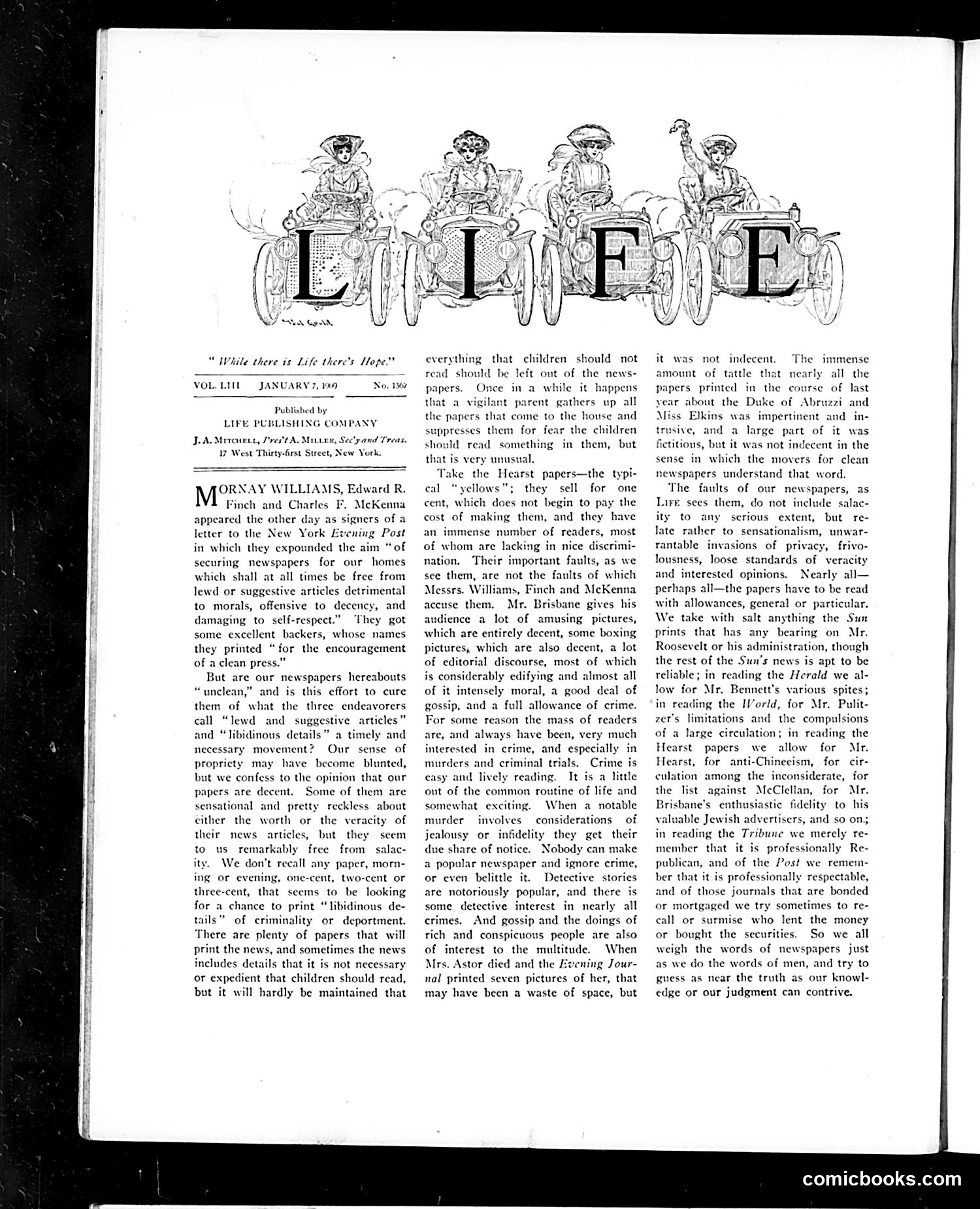
This is an editorial defending American newspapers against a "clean press" campaign launched by Mornay Williams, Edward Finch, and Charles McKenna. These three had written to the *New York Evening Post* criticizing papers for carrying "lewd" and "libidinous" content harmful to children. Life magazine's editor argues newspapers are actually quite decent. He acknowledges they're sensational and sometimes reckless with facts, but denies they print genuinely obscene material. He defends crime coverage and gossip about wealthy figures (like the Astor and Abruzzi coverage) as legitimate news interests, not moral failures. The cartoon header shows well-dressed figures in automobiles spelling "LIFE"—visual shorthand for modernity and progress. The satire's point: the reformers are exaggerating the problem. Papers may be flawed, but not in the prurient way claimed. The real issue is sensationalism and truthfulness, not hidden lewdness.
📄 Transcribed text from this page (OCR, searchable)
Machine-transcribed from the original scan — historical spelling and the odd misread are preserved.
FX GOD, “ While there is Life there's Hope.” VOL.LIIL | JANUARY 7,190 Published by LIFE PUBLISHING COMPANY No. 1367 J.A. Mrtourte, Pres't A. Minter, Sec’y and Treas. 17 West Thirty-first Street, New York. ORNAY WILLIAMS, Edward R. Finch and Charles F. McKenna appeared the other day as signers of a letter to the New York Evening Post in which they expounded the aim “of securing newspapers for our homes which shall at all times be free from lewd or suggestive articles detrimental to morals, offensive to decency, and damaging to self-respect.” They got some excellent backers, whose names they printed “for the encouragement of aclean press.” But are our newspapers hereabouts “unclean,” and is this effort to cure them of what the three endeavorers call “lewd and suggestive articles” and “libidinous details” a timely and necessary movement? Our sense of propriety may have become blunted, but we confess to the opinion t our papers are decent. Some of them are sensational and pretty reckless about cither the worth or the veracity of their news articles, but they seem to us remarkably free from. salac- ity. We don't recall any paper, morn- ing or evening, one-cent, two-cent of three-cent, that seems to be looking for a chance to print “libidinous de- tails” of criminality or deportment. There are plenty of papers that will print the news, and sometimes the news includes details that it is not neces: or expedient that children should read, but it will hardly be maintained that everything that children should not read should be left ont of the news- papers. Once in a while it happens that a vigilant parent gathers up all the papers that come to the house and suppresses them for fear the children should read something in them, but that is very unusual. Take the Hearst papers—the typi- cal “yellows”; they sell for one cent, which does not begin to pay the cost of making them, and they have an immense number of readers, most of whom are lacking in nice discrimi- nation, Their important faults, as we see them, are not the faults of which Messrs. Williams, Finch and McKenna accuse them, Mr. Brisbane gives his audience a lot of amusing pictures, which are entirely decent, some boxing pictures, which are also decent, a lot of editorial discourse, most of which is considerably edifying and almost all of it intensely moral, a good deal of gossip, and a full allowance of crime. For some reason the mass of readers are, and always have been, very much interested in crime, and especially in murders and criminal trials. Crime is easy and lively reading. It is a little out of the common routine of life and somewhat exciting. When a notable murder involves considerations of jealousy or infidelity they get their due share of notice. Nobody can make a popular newspaper and ignore crime, or even belittle it. Detective stories are notoriously popular, and there is some detective interest in nearly all crimes. And gossip and the doings of rich and conspicuous people are also of interest to the multitude. When Mrs. Astor died and the Evening Jour- nal printed seven pictures of her, that may have been a waste of space, but it was not indecent. The immense amount of tattle that nearly all. the papers printed in the course of last year about the Duke of Abruzzi and sins was impertinent and in- trusive, and a large part of it was fictitious, but it was not indecent in the sense in which the movers for clean newspapers understand that word. The faults of our newspapers, as Lire sees them, do not include salac- ity to serious extent, but re- late rather to sensationalism, unwar- rantable invasions of privacy, frivo- lousness, loose standards of veracity and interested opinions. Nearly all— perhaps all—the papers have to be read with allowances, general or particular. We take with salt anything the Sur prints that has any bearing on Mr. Roosevelt or his administration, though the rest of the Sun's news is apt to be reliable; in reading the Herald we al- low for Mr. Bennett's various spites; in reading the World, for Mr. Puli zer's limitations and the compulsions of a large circulation; in reading Hearst papers we allow for Hearst, for anti-Chineeism, for culation among the inconsiderate, the list against McClellan, for Brisbane's enthusiastic fidelity to valuable Jewish advertisers, and so in reading the Tribune we merely re- member that it is professionally Re- publican, and of the Post we remem- ber that it is professionally respectable, and of those journals that are bonded or mortgaged we try sometimes to re- call or surmise who lent the money or bought the securities. So we all weigh the words of newspapers just as we do the words of men, and try to guess as near the truth as our knowl- edge or our judgment can contrive. any comicbooks.com