
Life, 1909-01-07 · page 34 of 60
Life — January 7, 1909 — page 34: what you’re looking at
What you’re looking at
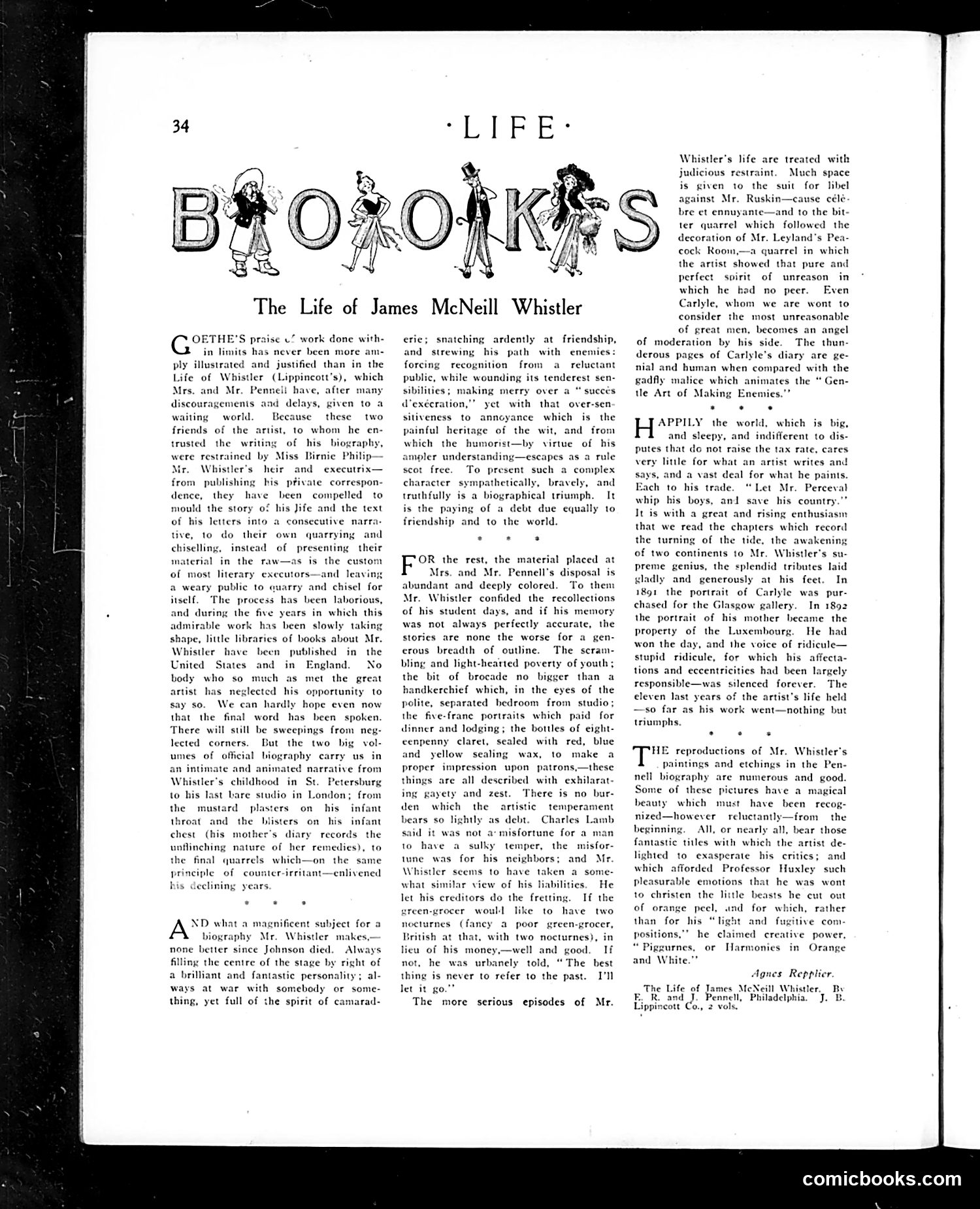
This is a literary review of a new biography of the famous American artist James McNeill Whistler, written by the Pennells. The decorative header featuring illustrated figures in period dress represents Whistler and his circle. The review praises the biography as a masterwork, comparing Whistler favorably to Samuel Johnson as a biographical subject. The satire focuses on Whistler's famously difficult personality: he was perpetually quarrelsome, hypersensitive to criticism despite his wit, and notoriously in debt while remaining unconcerned about it. The reviewer notes with amusement Whistler's bohemian poverty (five-franc portraits, cheap wine) and his casual attitude toward creditors. The joke is that Whistler exemplifies the "artistic temperament" at its most extreme—brilliant but troublesome, fighting with everyone yet charmingly so. The biography captures this contradiction: a genuinely great artist whose personal conduct was often unreasonable.
📄 Transcribed text from this page (OCR, searchable)
Machine-transcribed from the original scan — historical spelling and the odd misread are preserved.
The Life of James McNeill Whistler OETHE’S praise o? work done with- in limits has never been more am- ply illustrated and justified than in the Life of Whistler (Lippincott’s), which Mrs. and Mr. Pennell have, after many discouragements and delays, given to a waiting world. Because these two friends of the artist, to whom he en- trusted the writing of his biography, by Miss Birnie Philip heir and were restraine: Mr. Whistler's from publishing his pfivate correspon- executrin dence, they have been compelled to mould the story of his Jife and the text of his letters into a consecutive narra- tive, to do own quarrying and chiselling, instead of presenting their material in the raw—as is the custom and leaving their of most literary executors weary public to quarry and chisel for ‘The process has been laborious, and during the five years in whieh this admirable work has been slowly taking shape, little libraries of books about Mr. Whistler have been published in th United States and in England. No body who so much as met the great artist. has neglected his opportunity to say so. We can hardly hope even now that the final word has been spoken. There will still be sweepings from neg- lected corners. But the two big vol umes of official biography carry us in an intimate and animated narrative from Whistler's childhood in St to his last bare studio in London the mustard throat and the chest (his mother’s diary itself. Petersburg from plasters on his infant listers on his infant records the her remedies), to which—on the sam unflinching nature © final quarrels principle of cou his declining years cr-irritant—enlivened ND what a magnificent subject for a biography Mr. Whistler makes, none better since Johnson died. Always filling the centre of the stage by right of a brilliant and fantastic personality ; al- ways at war with somebody or some- thing, yet full of the spirit of camarad- friendship, enemies: reluctant erie; snatching ardently at path with from a and strewing his forcing recognition public, while wounding its tenderest sen- sibilities; making merry over a “ succes. d'exécration,”” yet with that over-sen sitiveness to annoyance which is the painful heritage of the wit, and fro which the humorist—by virtue of his + understanding—escapes as a rule scot free. To present such a complex character sympathetically, bravely, and truthfully is a biographical triumph. It is the paying of a debt due equally to friendship and to the world. OR the rest, the mater Mrs. and Mr. Pennell’s disposal is abundant and deeply colored. To them Mr. Whistler confided the recollections of his student days, and if his memory was not always perfectly accurate, the stories are none the worse for a gen- crous breadth of outline. The scram- bling and light-hearted poverty of youth ; the bit of brocade no bigger than a handkerchief which, in the eyes of the polite, separated bedroom from studio; the five-frane portraits which paid for dinner and lodging; the bottles of eight- cenpenny claret, sealed with red, blue and yellow sealing wax, to make a proper impression upon patrons,—these things are all described with exhilarat- There is no bur- 1 placed at ing ety and zest. den which the artistic temperament bears so lightly as debt. Charles Lamb isfortune for a man said it was not arm temper, the misfor- to have a_ sulky tune was for his neighbors; and Mr. Whistler seems to have taken a some- what similar view of his liabilities. He let his creditors do the fretting. If the xreen-grocer would like to have two nocturnes (fan green-grocer, Eritish at that, with two nocturnes), in a poor lieu of his money,—well and good. If “The best he past. I'll not, he was urbanely t thing is never to refer to let it go." The more serious episodes of Mr. tler’s life are treated with Much space libel cause célé judicious restraint is given to the suit for against Mr. Ruskin bre et ennuyante—and to the bit- ter quarrel which followed the decoration of Mr. Leyland’s Pea- cock Room,—a quarrel in which the artist showed that pure and perfect. spirit, of unreason in which he had no peer. Even Carlyle, whom we are wont to consider the most unreasonable of great men, becomes an angel of moderation by his side. The thun- derous pages of Carlyle’s diary are ge- nial and human when compared with the gadfly malice which animates the “ Gen- tle Art of Making Enemies.” H APPILY the world, which is big, and sleepy, and indifferent to dis- putes that do not raise the tax rate, ¢ very little for what an artist writes and says, and a vast deal for what he paints. ch to his trade. “Let Mr. Perceval whip his boys, and save his country.” Jt is with a great and rising enthusiasm that we read the chapters which record the turning of the tide, the awakening of two continents to Mr. Whistler's su- preme genius, the splendid tributes laid gladly and generously at his feet. In 1891 the portrait of Carlyle was pur- chased for the Glasgow gallery. In 1892 the portrait of his mother became the property of the Luxembourg. He had won the day, and the voice of ridicule— stupid ridicule, for which his affecta- tions and eccentricities had been largely The eleven last years of the artist’s life held as his work went—nothing but triumphs. ares responsible—was silenced forever. HE reproductions of Mr. Whistler's paintings and etchings in the Pen- nell biography are numerous and good. Some of these pictures have a magical beauty have recog- nized—however reluctantly—from the beginning. All, or near! famastic titles with which the artist de- lighted 10 exasperate his critics; and which Professor Huxley pleasurable emotions that he was wont which n been all, bear those forded such to christen the little beasts he cut out of orange peel, and for which, rather than for his “light and fugitive co: positions," he claimed creative power, “ Piggurnes, or Harmonies in Orange and White. Agnes Repplier. The Life of James MeNeill Whistler, By F, Ri and J. Pennell, Philadelphia. J. B Lippincott Co., 2 vols, comicbooks.com