
Life, 1909-01-07 · page 38 of 60
Life — January 7, 1909 — page 38: what you’re looking at
What you’re looking at
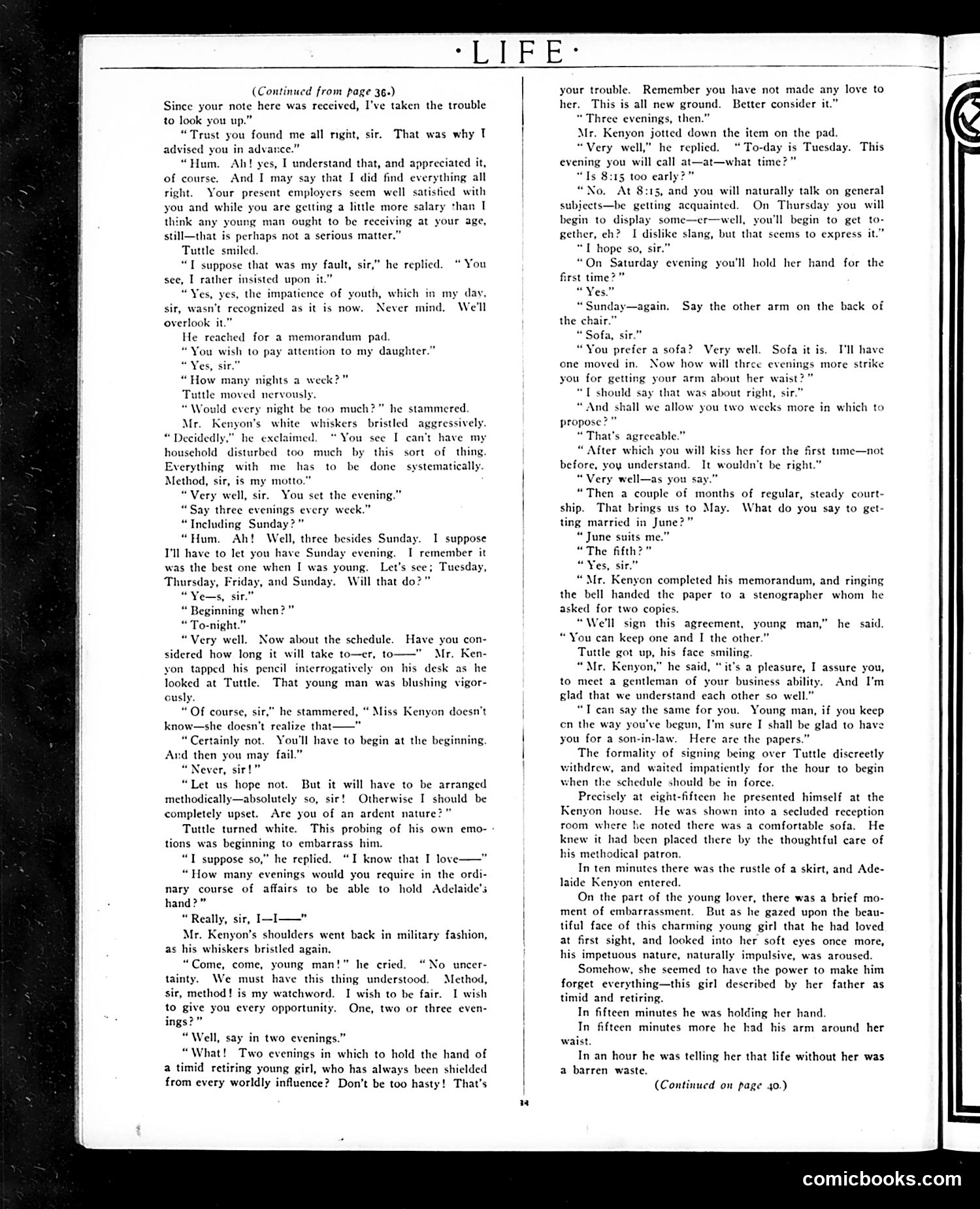
This is a comedic dialogue between Mr. Kenyon, a stern, methodical Victorian-era father, and young Tuttle, who seeks permission to court Kenyon's daughter Adelaide. The humor derives from Kenyon's obsessive systematization of romance. The satire targets rigid paternal authority and the formality of courtship customs of the era. Kenyon treats courtship like a business transaction, scheduling specific evenings, dictating conversation topics, and literally timing physical progression (hand-holding on the third visit). His repeated emphasis on "method" and "system" ridicules overly controlling fathers who micromanage their daughters' romantic lives. The young man's stammering embarrassment contrasts sharply with the father's clinical pragmatism, amplifying the absurdity. The piece mocks both restrictive social conventions governing courtship and the Victorian obsession with proper procedure in all matters, even love and intimacy.
📄 Transcribed text from this page (OCR, searchable)
Machine-transcribed from the original scan — historical spelling and the odd misread are preserved.
2 el Woe (Continued from page 36.) Since your note here was received, I've taken the trouble to look you up.” “Trust you found me all mght, sir. That was why T advised you in advance.” “Hum. Ah! yes, I understand that, and appreciated it, of course. And I may say that I did find everything all right. Your present employers seem well satisfied with you and while you are getting a little more salary than I think any young man ought to be receiving at your age, still—that is perhaps not a serious matter.” Tuttle smiled. “T suppose that was my fault, sir,” he replied. “ You see, I rather insisted upon it.” “Yes, yes, the impatience of youth, which in my day, sir, wasn’t recognized as it is now. Never mind, We'll overlook it.” He reached for a memorandum pad. “You wish to pay attention to my daughter.” “How many nights a week?” Tuttle moved nervously. “Would every night be too much?” he stammered. Mr. Kenyon’s white whiskers bristled aggressively. “Decidedly,” he exclaimed. “You see I can’t have my household disturbed too much by this sort of thing. Everything with me has to be done systematically. Method, sir, is my motto. “Very well, sir. You set the evening.” “Say three evenings every week.” “Including Sunday?” “Hum. Ah! Well, three besides Sunday. I suppose Tl have to let you have Sunday evening. I remember it was the best one when I was young. Let’s see; Tuesday, Thursday, Friday, and Sunday. Will that do?” “Ye—s, sir. “ Beginning when?" “ To-night.” “Very well. Now about the schedule. Have you con- sidered how long it will take to—er, to——" Mr. Ken- yon tapped his pencil interrogatively on his desk as he looked at Tuttle. That young man was blushing vigor- ously. Of course, sir,” he stammered, “ Miss Kenyon doesn’t know—she doesn't realize that——" “Certainly not. You'll have to begin at the beginning. And then you may fail.” Never, sir!” “Let us hope not. But it will have to be arranged methodically—absolutely so, sir! Otherwise I should be completely upset. Are you of an ardent nature?” Tuttle turned white. This probing of his own emo- + tions was beginning to embarrass him. “T suppose so,” he replied. “I know that I love—" “How many evenings would you require in the ordi- nary course of affairs to be able to hold Adelaide's hand?” “Really, sir, I—I—' Mr. Kenyon’s shoulders went back in military fashion, as his whiskers bristled again. “Come, come, young man!” he cried. “No uncer- tainty. We must have this thing understood. Method, sir, method! is my watchword. I wish to be fair. I wish to give you every opportunity. One, two or three ev ings?” “Well, say in two evenings.” “What! Two evenings in which to hold the hand of a timid retiring young girl, who has always been shielded from every worldly influence? Don’t be too hasty! That's | | your trouble. Remember you have not made any love to her. This is all new ground. Better consider it.” “ Three evenings, then.” Mr. Kenyon jotted down the item on the pad. “Very well,” he replied. “To-day is Tuesday. This evening you will call at—at—what time?” Is 8:15 too early? “No. At 8:15, and you will naturally talk on general subjects—be getting acquainted. On Thursday you will begin to display some—er—well, you'll begin to get to- gether, eh? I dislike slang, but that seems to express it. “IT hope so, sir.” “On Saturday evening you'll hold her hand for the first time? “Sunday—again. Say the other arm on the back of the chair.” “ Sofa, sir.” “You prefer a sofa? Very well. Sofa it is. I'll have one moved in. Now how will three evenings more strike you for getting your arm about her waist?” “T should say that was about right, sir.” “And shall we allow you two weeks more in which to propose?" “That's agreeable.” “After which you will kiss her for the first trme—not before, you understand. It wouldn't be right.” “Very well—as you say.” “Then a couple of months of regular, steady court- ship. That brings us to May. What do you say to get- ting married in June?” “ June suits me.” “The fifth? “Yes, sir. “Mr. Kenyon completed his memorandum, and ringing the bell handed the paper to a stenographer whom he asked for two copies. “We'll sign this agreement, young man,” he said. You can keep one and I the other.” Tuttle got up, his face smiling. “Mr. Kenyon,” he said, “it’s a pleasure, I assure you, to meet a gentleman of your business ability, And I’m glad that we understand each other so well. “Tcan say the same for you. Young man, if you keep en the way you've begun, I’m sure I shall be glad to have you for a son-in-law. Here are the papers.” The formality of signing being over Tuttle discreetly withdrew, and waited impatiently for the hour to begin when the schedule should be in force. Precisely at eight-fifteen he presented himself at the Kenyon hou: He was shown into a secluded reception room where he noted there was a comfortable sofa. He knew it had been placed there by the thoughtful care of his methodical patron. In ten minutes there was the rustle of a skirt, and Ade- laide Kenyon entered. On the part of the young lover, there was a brief mo- ment of embarrassment. But as he gazed upon the beau- tiful face of this charming young girl that he had loved at first sight, and looked into her soft eyes once more, his impetuous nature, naturally impulsive, was aroused. Somehow, she seemed to have the power to make him forget everything—this girl described by her father as timid and retiring. In fifteen minutes he was holding her hand. In fifteen minutes more he had his arm around her waist. In an hour he was telling her that life without her was a barren waste. (Continued on page 40.) comicbooks.com