
A complete issue · 56 pages · 1906
Life — November 1, 1906
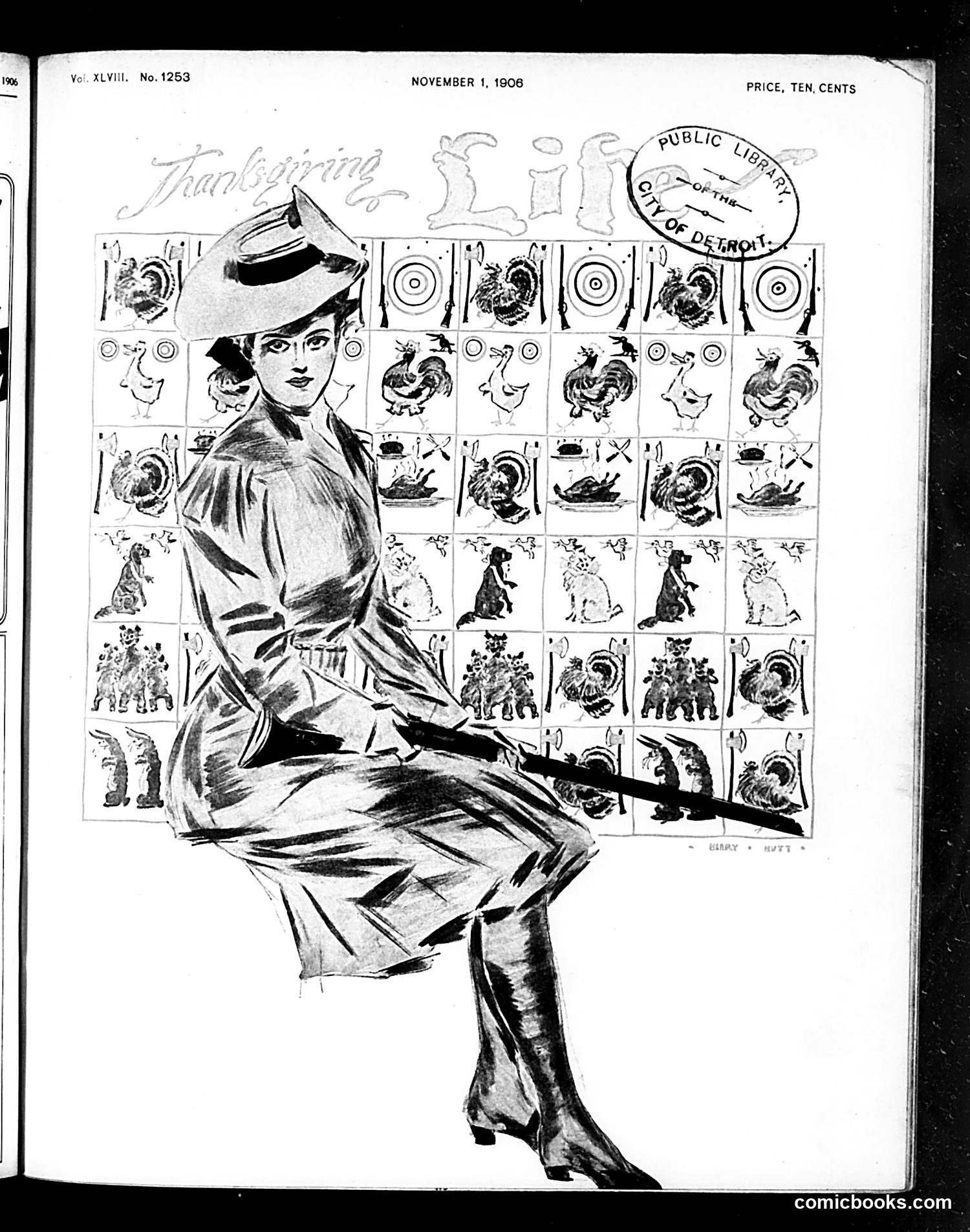
This *Life* magazine cover from November 1, 1908, presents a humorous fortune-telling theme for Thanksgiving. A fashionably dressed woman in an elegant hat and coat consults what appears to be a grid of tarot or fortune cards arranged behind her. The cards display various images: turkeys, chickens, dogs, and other figures—likely representing different fortune-telling outcomes. The satire seems to mock both the Thanksgiving holiday's traditions (the poultry imagery) and contemporary fascination with fortune-telling and spiritualism, which were popular among the upper classes. The woman's fashionable appearance suggests the joke targets wealthy society women's gullibility toward such practices. The artist's signature appears to be "Cesare Dutti" (or similar).
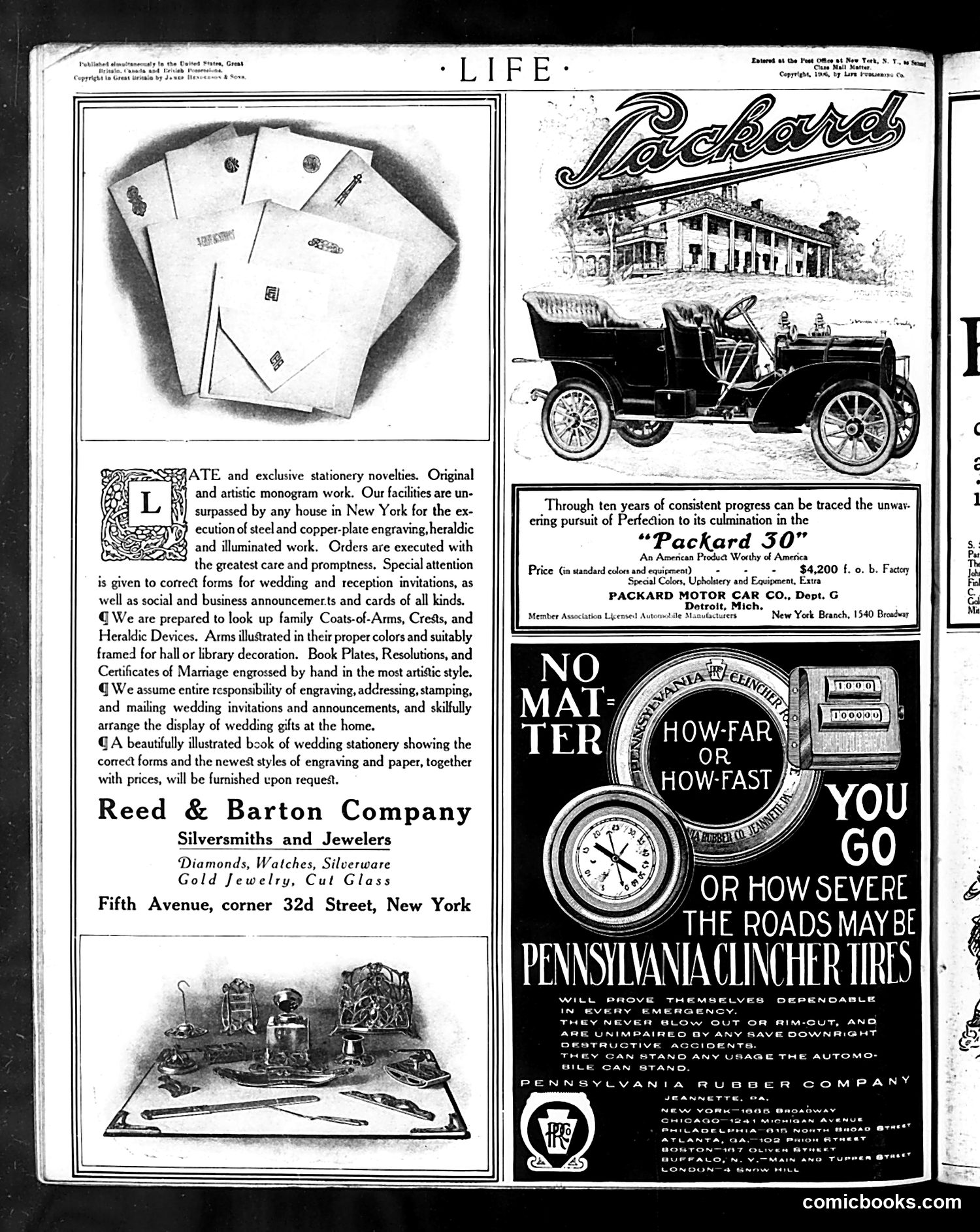
This page consists primarily of **advertisements rather than satire or political cartoons**. The left side features a **Reed & Barton Company ad** for high-end stationery, engraving services, and jewelry—highlighting their capabilities for wedding invitations, monogram work, and formal announcements. An illustration shows various decorated envelopes and ornamental silverware/jewelry pieces. The right side contains advertisements for **Packard automobiles** (featuring the "Packard 30" model with an illustration of the car and a mansion) and **Pennsylvania Clincher Tires**, emphasizing reliability and safety features for various road conditions. This appears to be a standard magazine page from the early 20th century mixing luxury goods advertisements, with no apparent political or satirical content.
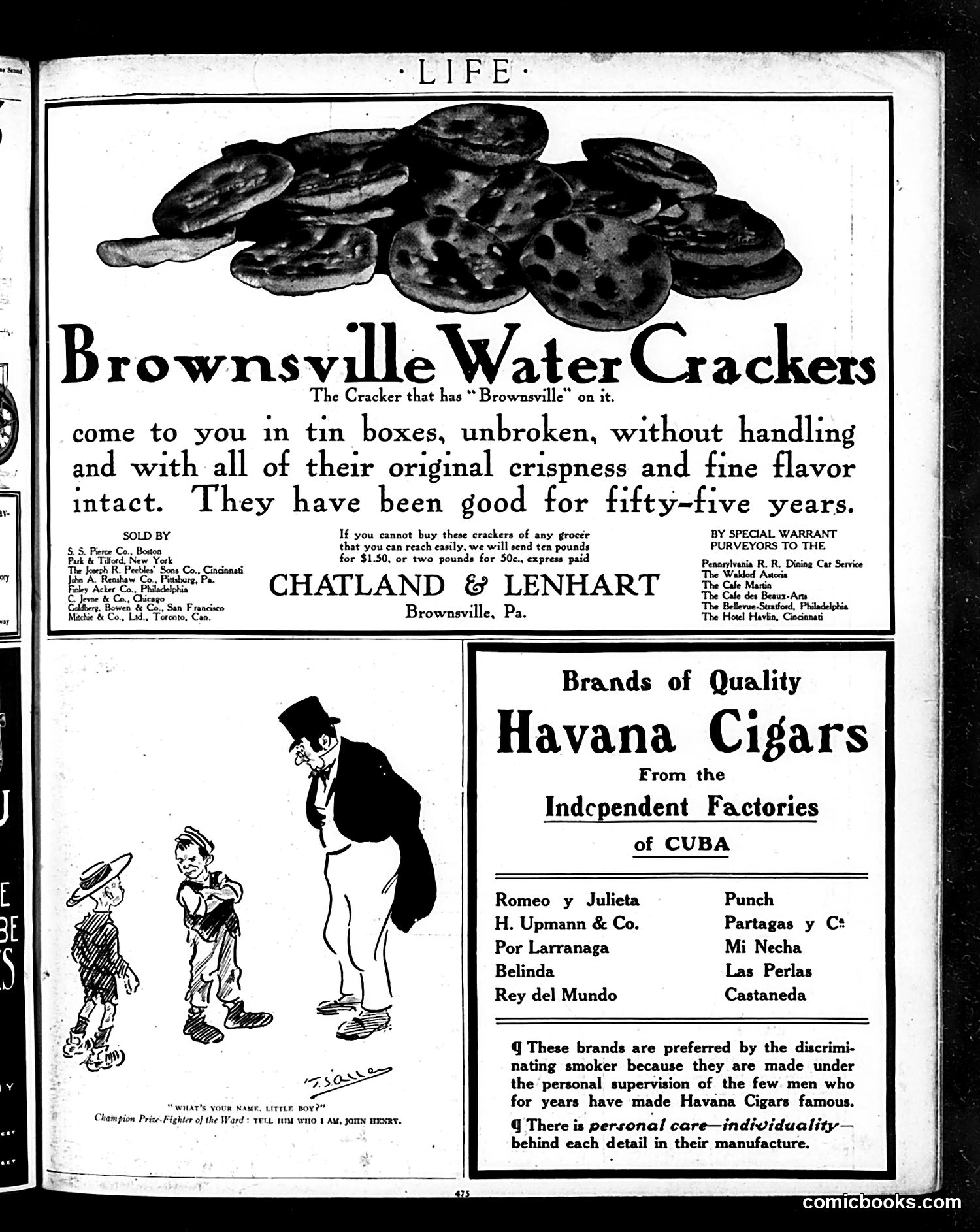
This page contains primarily **advertisements rather than political satire**. The top ad promotes **Brownsville Water Crackers** from Pennsylvania, emphasizing their 55-year history and quality. Distribution details list various grocery suppliers across American cities. The lower section advertises **Havana Cigars** from Cuban independent factories, listing brands like Romeo y Julieta and H. Upmann. The accompanying cartoon, credited to artist Tad (T. Dorgan), shows a tall thin man with two children and is captioned "What's Your Name, Little Boy?" — appearing to be a humorous domestic scene rather than political commentary. The cigar ad emphasizes "personal care" and "individuality" in manufacturing, targeting discriminating smokers. The page reflects early 20th-century advertising conventions in *Life* magazine.
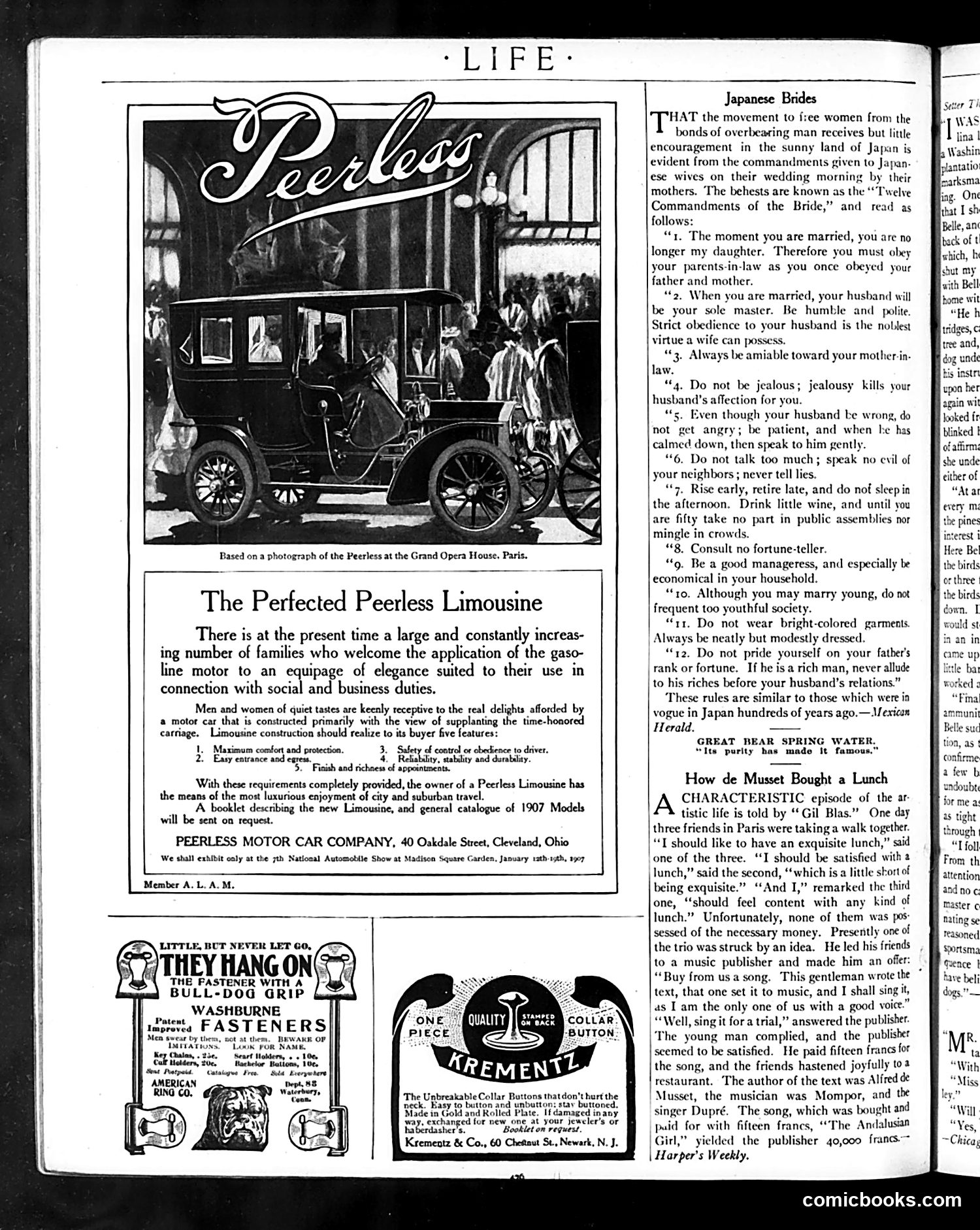
This page is primarily **advertising and feature content**, not political satire. The main illustration depicts a Peerless automobile at the Grand Opera House in Paris, advertising the "Perfected Peerless Limousine" for wealthy families seeking elegance and comfort. The right column features "Japanese Brides," discussing a movement encouraging Japanese women to escape restrictive marriages. It includes the "Ten Commandments of the Bride"—prescriptive rules for obedience to husbands and in-laws, presented as traditional Japanese marital expectations. Below are advertisements: Washburn fasteners, Krementz collar buttons, and an anecdote titled "How de Musset Bought a Lunch" about a composer negotiating with a music publisher. The page reflects early 1900s consumer culture, gender politics, and Orientalist attitudes toward Japanese society.
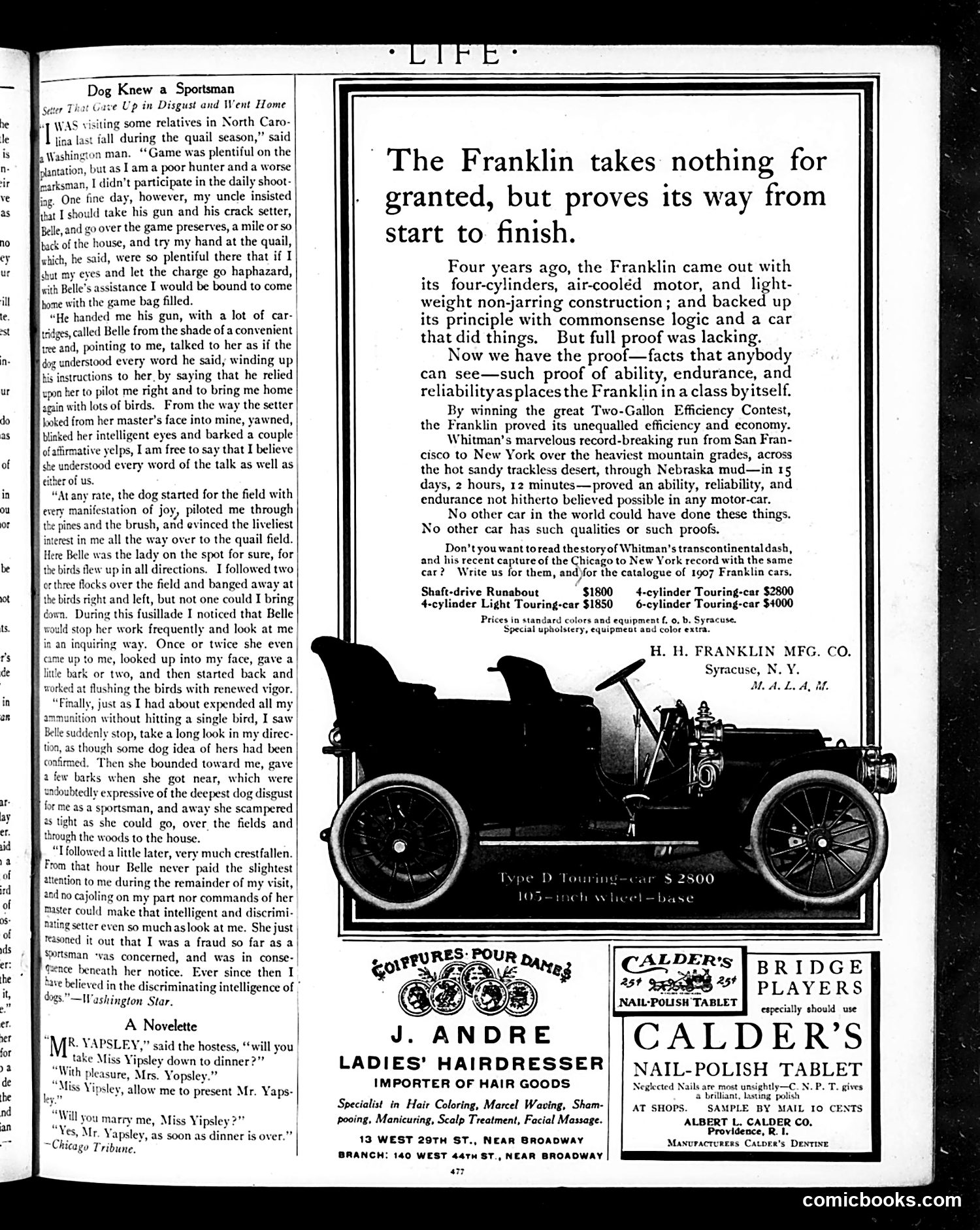
This page contains **no political cartoon or satire**. Instead, it features: 1. **"Dog Knew a Sportsman"** — A humorous anecdote about a hunting dog's intelligence and loyalty, emphasizing the animal's understanding of its master's commands and preferences. 2. **Franklin automobile advertisement** — A large ad promoting the Franklin car's proven reliability, highlighting its four-cylinder, air-cooled motor and recent transcontinental speed records. The ad emphasizes durability over flashiness. 3. **"A Novelette"** — A brief romantic fiction snippet about a dinner invitation. 4. **Bottom advertisements** — Including J. Andre (hairdresser), Calder's nail polish, and Bridge Players products. The page is primarily **advertising-focused** with light entertainment content typical of early 20th-century *Life* magazine.
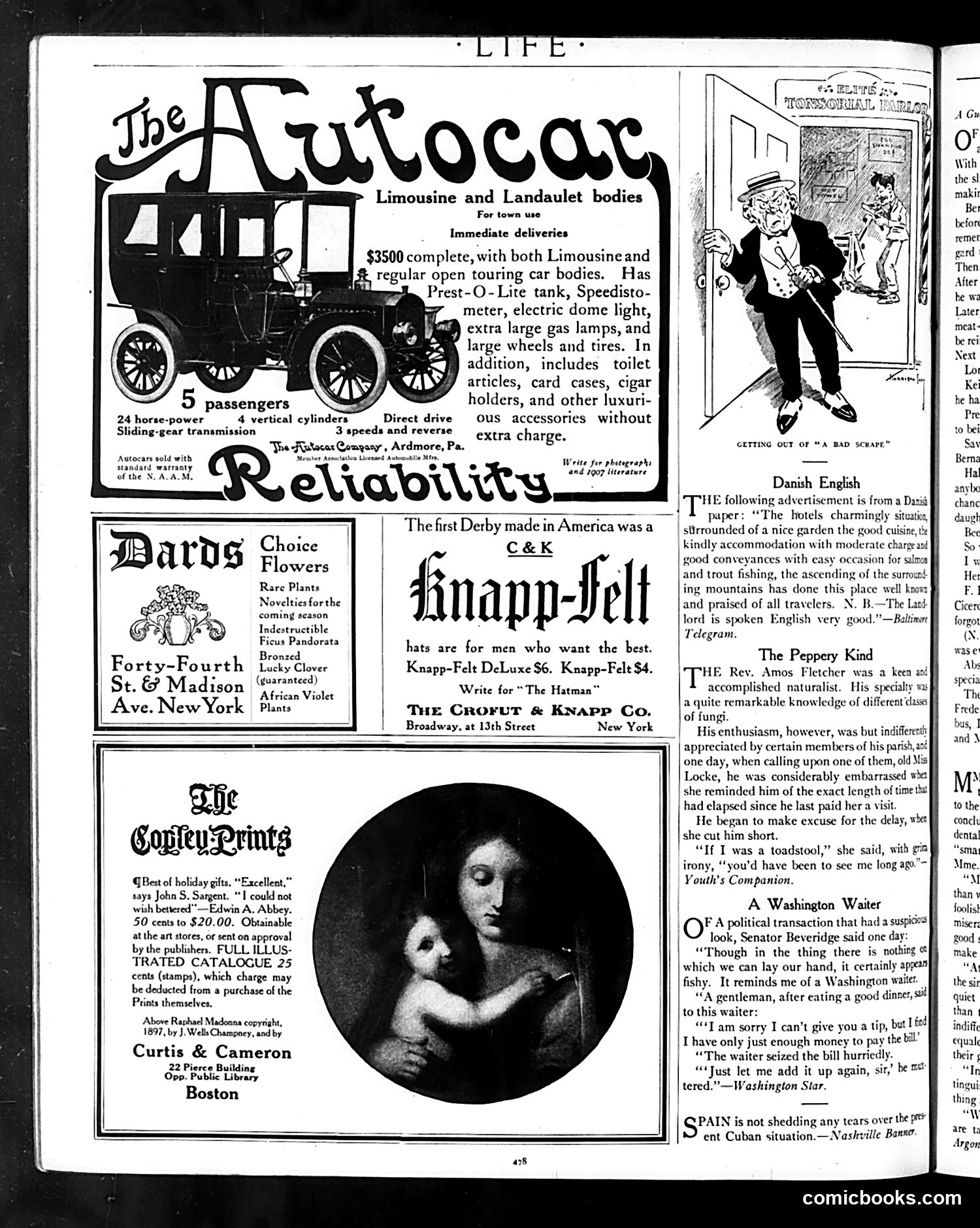
This page is primarily **advertising** with minimal editorial content. The dominant ad features the Autocar automobile, emphasizing reliability and luxury features ($3,500 complete). Other ads promote Dard's flowers, Knapp-Felt hats, and Curtis & Cameron's Copley Prints. The small editorial cartoon titled "Getting Out of 'A Bad Scare'" shows a man entering through a doorway, appearing relieved or startled. The accompanying text references a Danish hotel advertisement. Below are brief humor pieces: "The Peppery Kind" mocks Rev. Amos Fletcher's embarrassment when a parishioner reminds him of unpaid debts, and "A Washington Waiter" satirizes a stingy senator who cannot afford to tip. The content reflects early 20th-century concerns: automobiles as status symbols, propriety, and political/clerical hypocrisy.
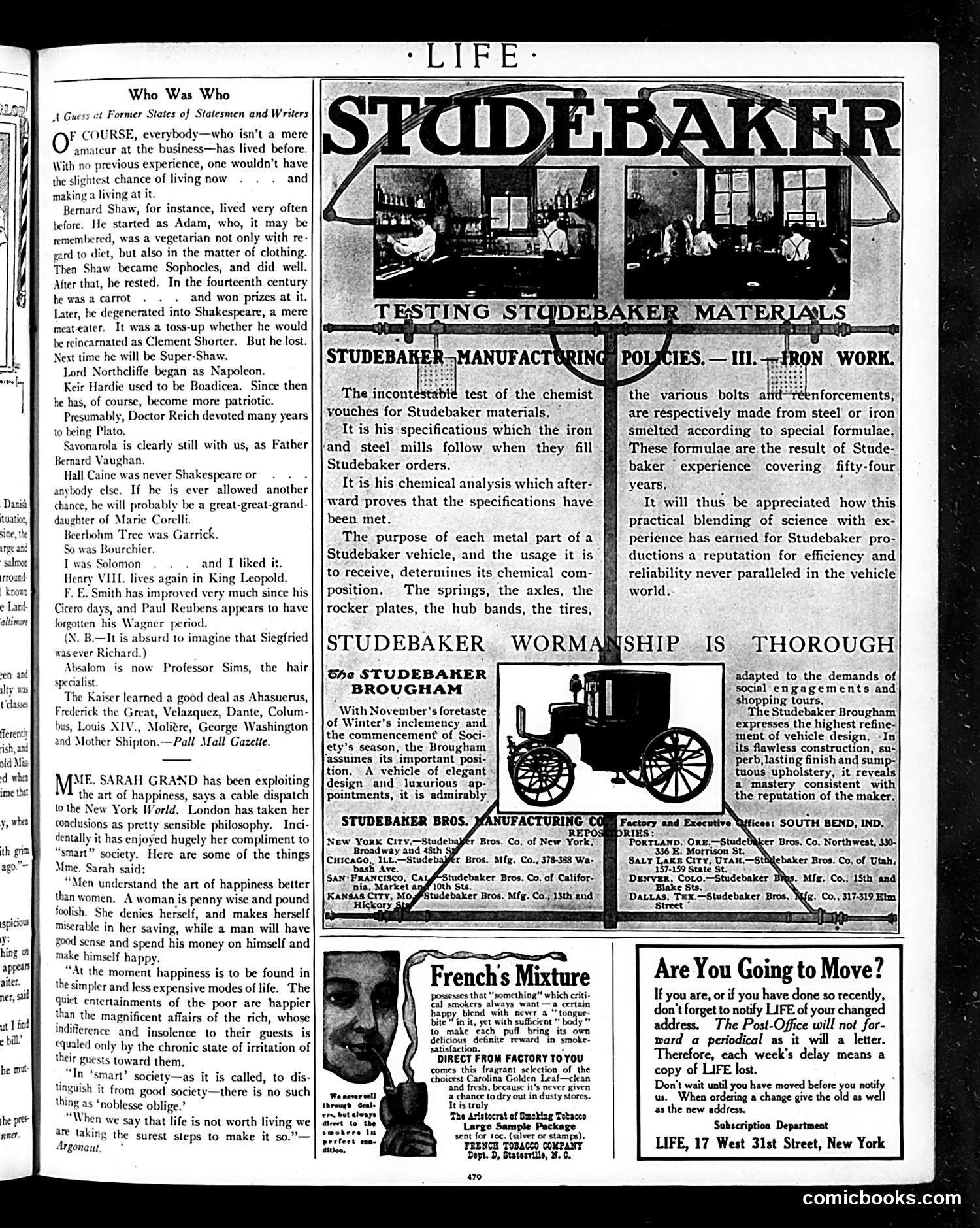
This page is primarily **advertising and corporate content** for Studebaker automobiles, not political satire. The main feature showcases Studebaker's manufacturing processes and quality control testing, with photographs of factory operations and their testing materials laboratory. The left column contains a gossipy "Who Was Who" section discussing various historical figures and society personalities—apparently a regular humor feature examining lineage and social standing. One brief anecdote mentions "Lord Northcliffe began as Napoleon," likely a joking comparison about ambition. There's also an advertisement for "French's Mixture" tobacco and a notice for address changes to Life magazine subscriptions. No political cartoons or satire appear on this page. It's essentially a corporate advertisement dressed up within the magazine's editorial format.
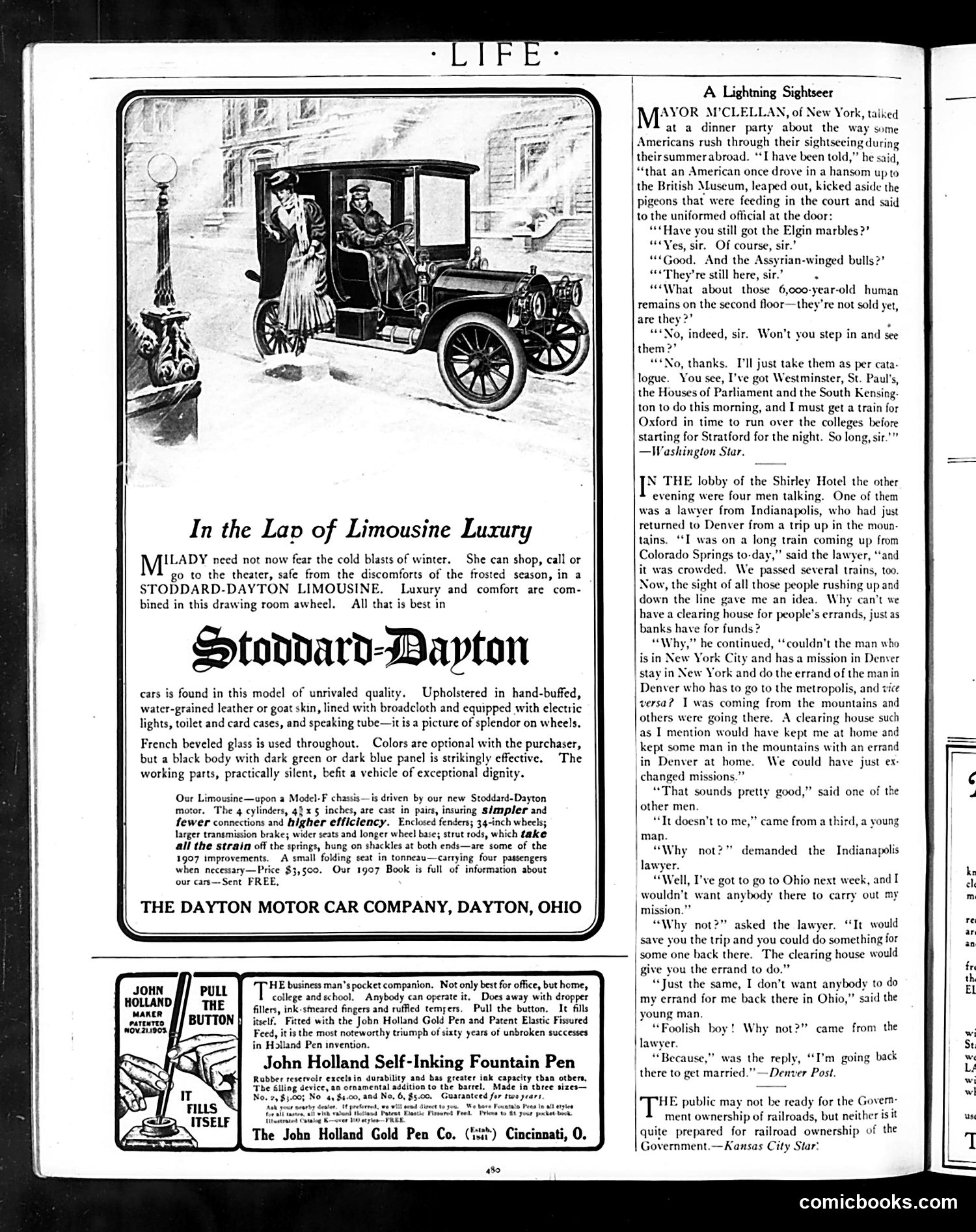
This page contains primarily **advertisements** (Stoddard-Dayton automobiles and John Holland fountain pens) rather than political satire or comics. The only editorial content is "A Lightning Sightseer," a humorous anecdote about Mayor McClellan of New York. The joke targets American tourists abroad who rush through famous sites without appreciating them. McClellan describes encountering a tourist who checked off major London attractions (British Museum, Westminster Abbey, Parliament) in a single morning to catch a train to Oxford—treating cultural tourism as a mere checklist rather than meaningful experience. The satire mocks the superficiality of hasty sightseeing and impatient American travelers, a common theme in early 20th-century social commentary about American tourists in Europe.
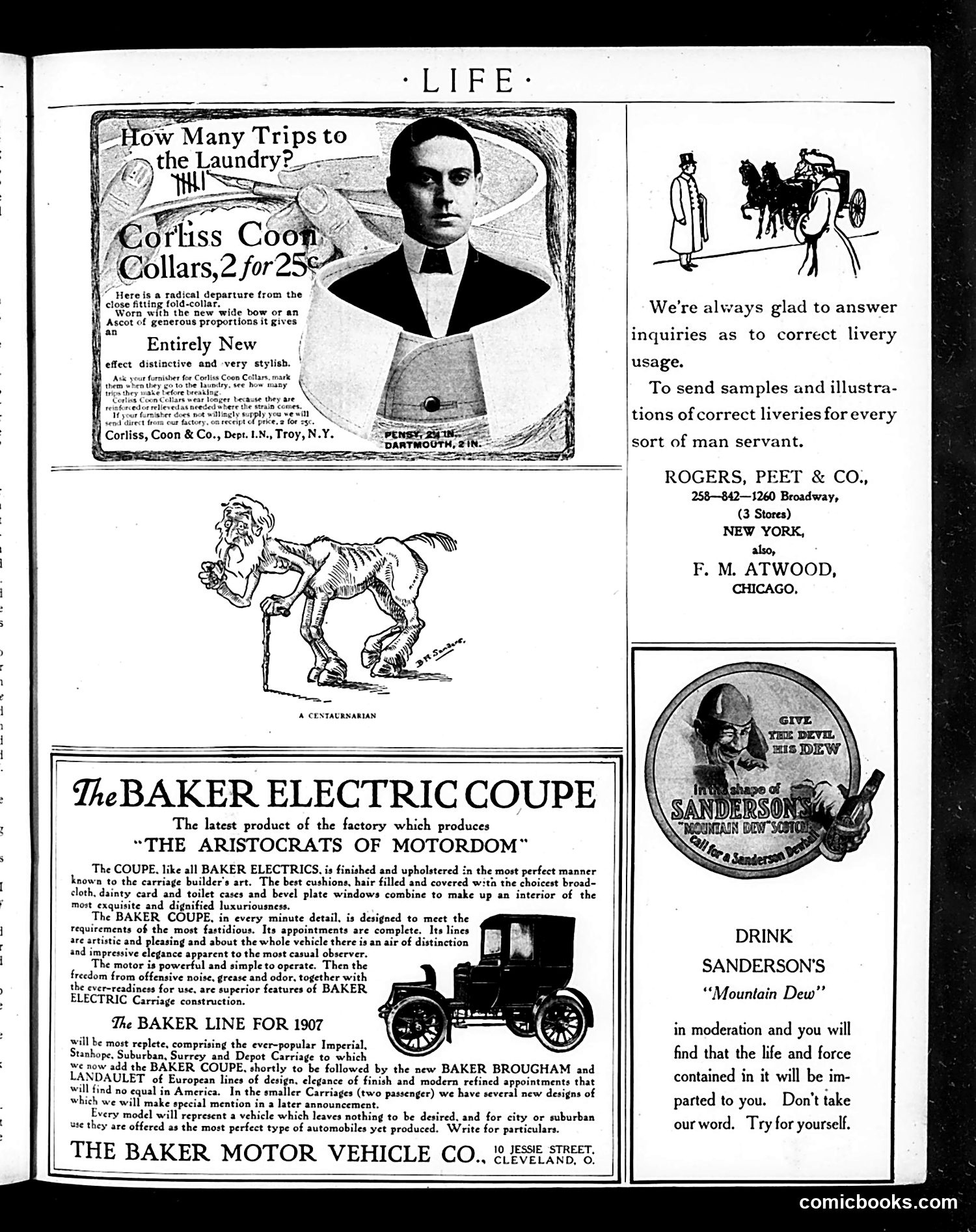
This page is primarily **advertising**, not political satire. The main content includes: 1. **Corliss Coon Collars ad** (top left): Promotes detachable shirt collars at 2 for 25¢, marketed as a "radical departure" with a new wide, low cut style. 2. **Livery service ad** (right): Rogers, Peet & Co. offers samples of correct livery uniforms for servants. 3. **Baker Electric Coupe ad** (large, bottom): Promotes an electric automobile as luxurious and refined—"aristocrats of motordom"—with powerful, simple operation. 4. **Sanderson's Mountain Dew ad** (bottom right): A beverage advertisement claiming health benefits. The small cartoon of "A Centaur" (mythological half-man, half-horse) appears decorative rather than satirical. This is a commercial magazine page typical of early 1900s American publishing.
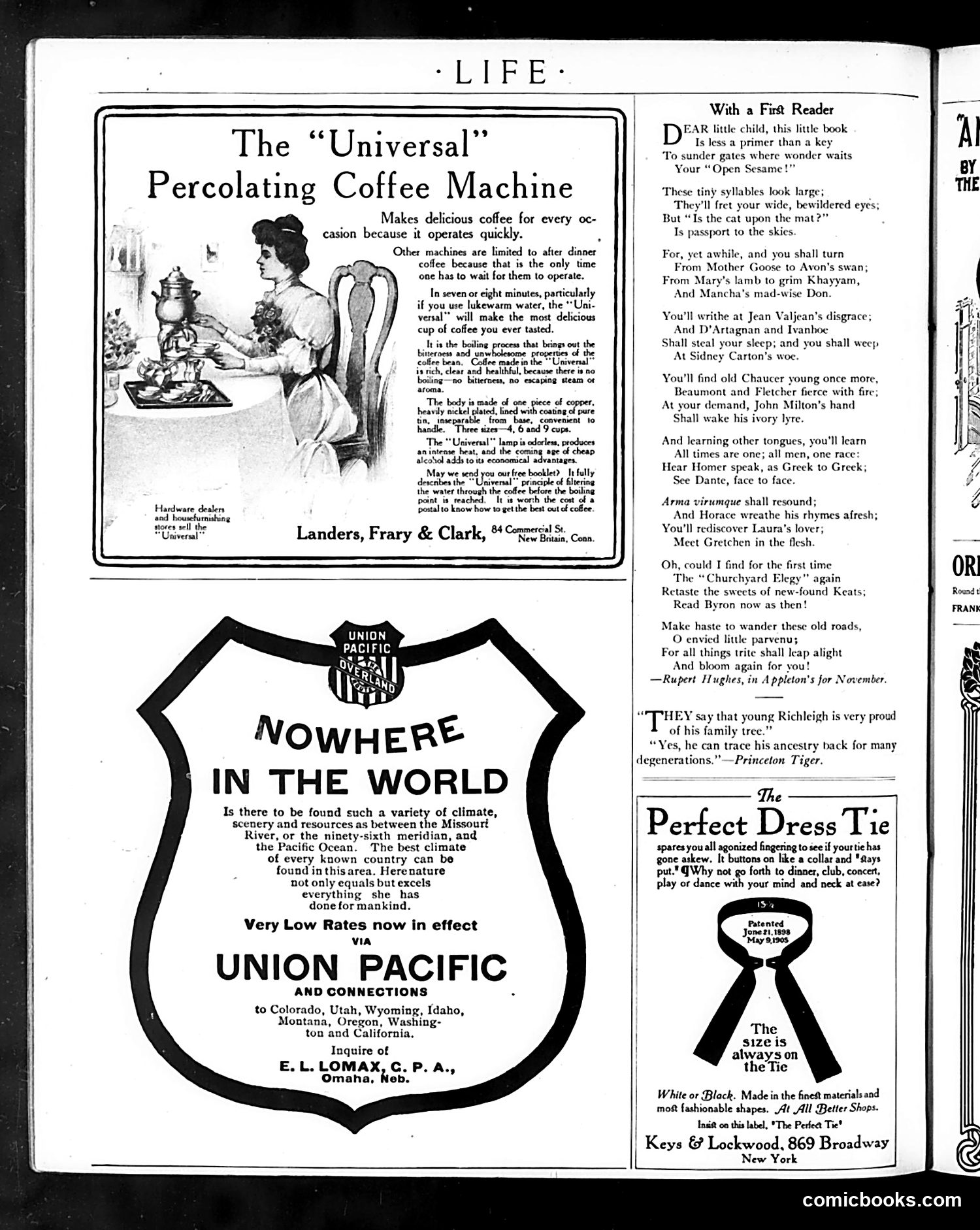
This page is primarily **advertising and literary content** rather than political satire. The main elements are: 1. **"Universal" Percolating Coffee Machine advertisement** - promoting a coffee maker that brews quickly and efficiently, targeting housewives as the primary consumer. 2. **Union Pacific Railroad advertisement** - promoting low fares to western destinations (Colorado, Utah, Wyoming, etc.), emphasizing the region's varied climate and natural resources. 3. **Poetry by Rupert Hughes** - a literary piece about reading classics and exploring literature. 4. **"Perfect Dress Tie" advertisement** - promoting a men's necktie with an organized fastening system. The page reflects early 20th-century consumer culture, targeting both domestic (women) and travel (men) markets. There is no significant political cartoon or satire present—it's a standard magazine page mixing ads with literary content.
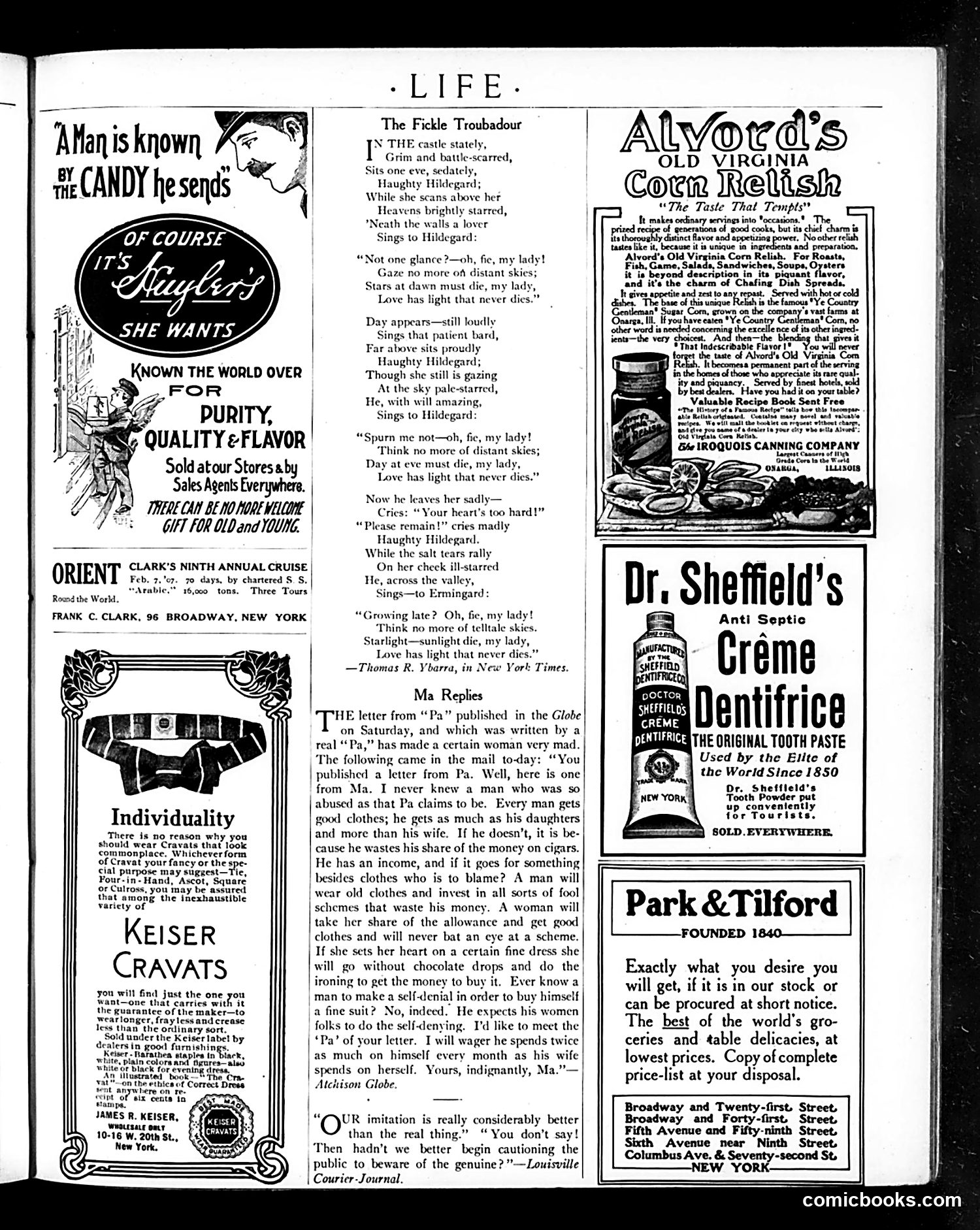
This page is primarily **advertisements and light content** rather than political satire. The left side features ads for **Suyler's candy**, **Keiser cravats** (neckties), and an **Orient cruise**—typical early 20th-century luxury goods. The center contains "The Fickle Troubadour," a **romantic poem** about courtship and fickle love, likely satirizing sentimental poetry conventions. The right side advertises **Alvord's corn relish** (food product) and **Dr. Sheffield's tooth paste**, claiming it's "the original" used since 1850. The page's humor is light and commercial rather than politically pointed. The "Ma Realties" section mocks pretentious letter-writers through a satirical published letter about marital finances—gentle domestic satire rather than serious commentary. This appears to be a **general-interest magazine mixing entertainment, poetry, and advertising** rather than hard political commentary.
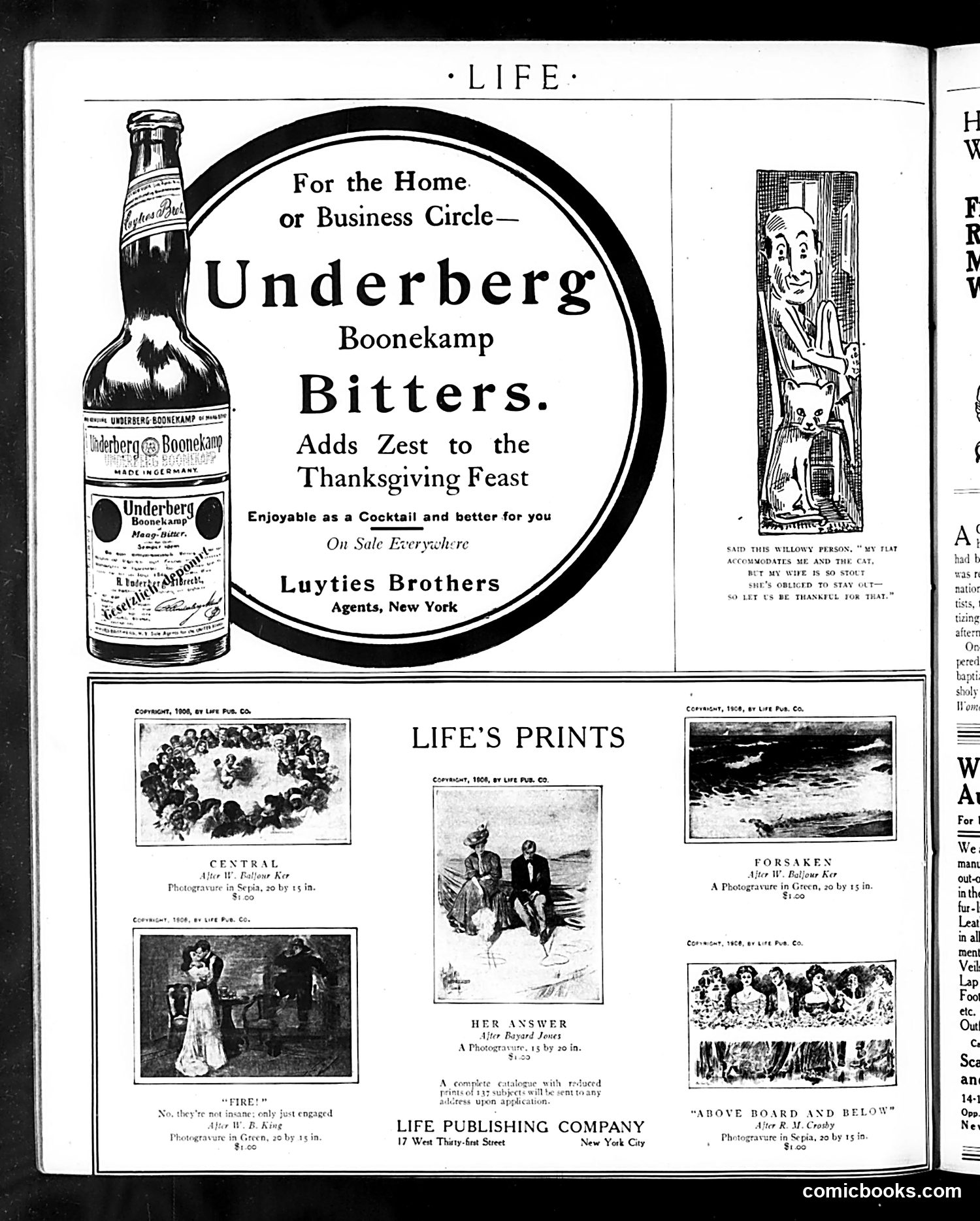
This page is primarily **advertising and product promotion** rather than political satire. The top half features a large advertisement for Underberg Boonekamp Bitters, a digestive liqueur, marketed by Luyties Brothers of Agents, New York as suitable for "the Home or Business Circle" and promising to "Add Zest to the Thanksgiving Feast." The bottom half displays **"Life's Prints"** — photographic reproductions available for purchase from Life Publishing Company. These include works by photographers like Alice B. Fallows Kip and others, with titles such as "Central," "Fire!," "Her Answer," and "Above Boarded and Below." This section functioned as a mail-order catalog for art prints, a common revenue stream for magazines of this era.
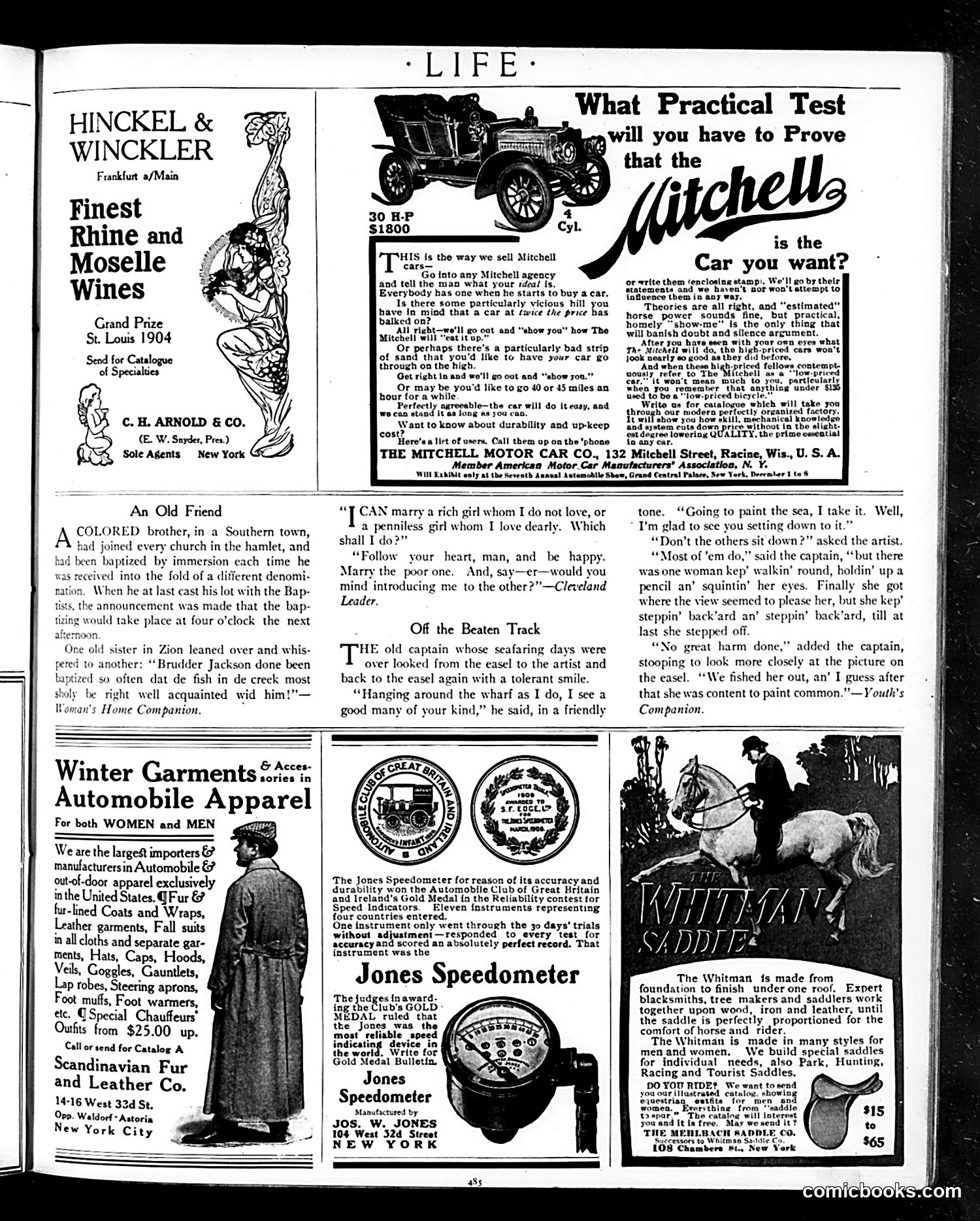
This page is primarily **advertising**, not political satire. It contains commercial promotions for: - **Hinckel & Winckler**: Rhine and Moselle wines - **Mitchell Motor Car Company**: automobile advertisement emphasizing durability and practicality - **Scandinavian Fur and Leather Co.**: winter clothing - **Jones Speedometer**: automotive instruments The small narrative pieces ("An Old Friend," "Off the Beaten Track") are light humor anecdotes rather than political commentary. They focus on everyday social situations—a brother introducing sisters, an artist and captain discussing their work. The single illustrated feature shows **"The Whitman Saddle"** with an image of someone on horseback, promoting specialized saddles for different riding purposes. This appears to be a standard commercial magazine page from the early 20th century, blending modest editorial content with advertising revenue.
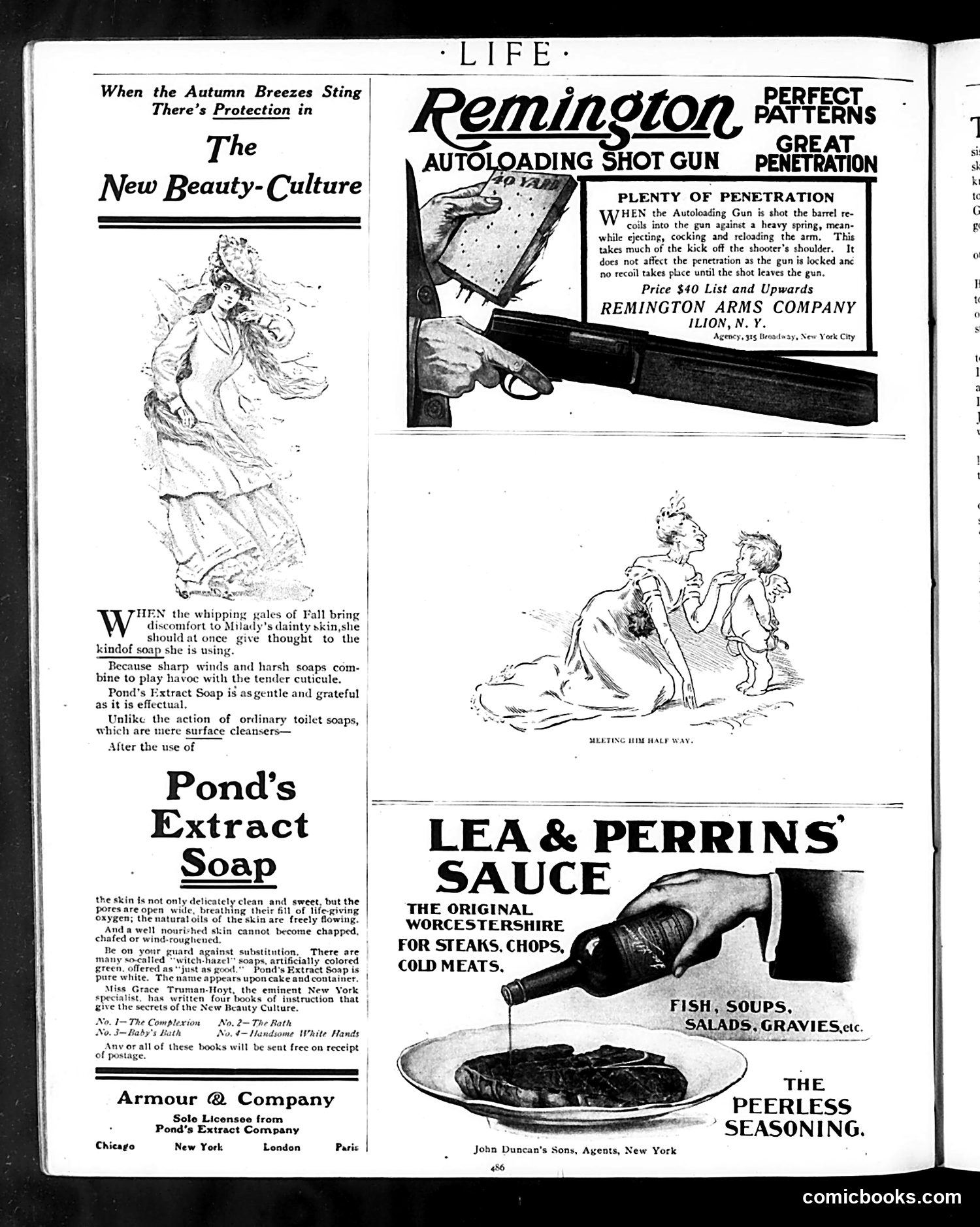
This page is primarily **advertising**, not political satire. It contains four commercial advertisements typical of early 20th-century magazines: 1. **Remington Autoloading Shotgun** — promotes a hunting rifle with technical specifications about recoil reduction and penetration, priced at $40+ 2. **Pond's Extract Soap** — "Beauty-Culture" ad emphasizing gentle skincare for women facing autumn wind damage. References a beauty specialist named Grace Truman-Hoyt and promotes four instructional books on complexion and hands. 3. **Lea & Perrins Sauce** — advertises the "original Worcestershire" condiment for various dishes 4. **Lea & Perrins Seasoning** — companion product advertisement The only illustration with narrative content shows a cherub or cupid figure with children, captioned "MEETING HIM HALF WAY" — likely a whimsical accompaniment to the beauty/romance-adjacent soap advertisement. **This is a straightforward commercial page with no detectable political or social satire.**
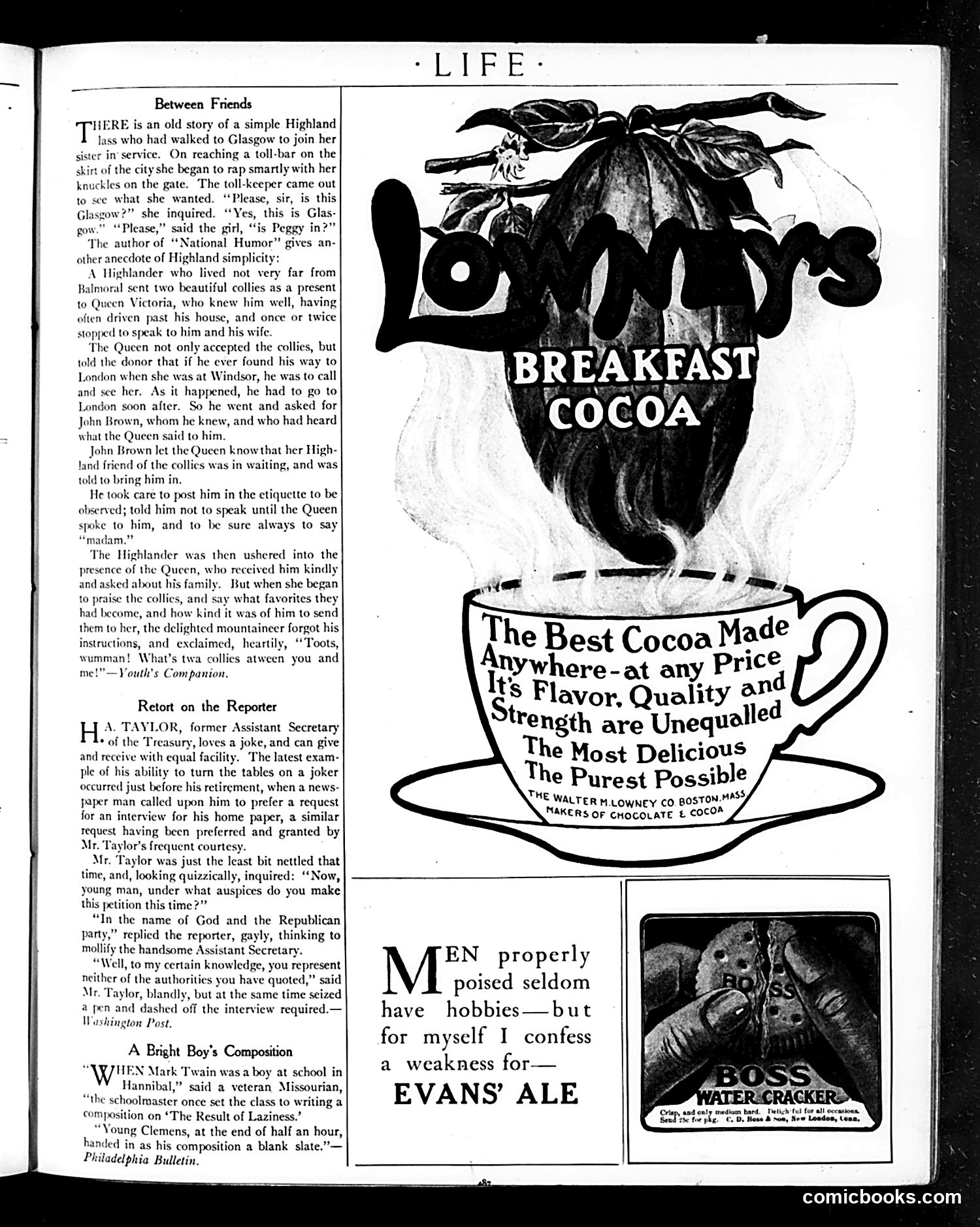
This page contains several humorous anecdotes rather than political cartoons. The three short stories showcase "Highland simplicity" and wit: 1. **"Between Friends"** presents two Scottish folk tales: a Highland girl naively asking a toll-keeper if she's reached Glasgow, and a Highlander who receives a royal summons from Queen Victoria but forgets courtly etiquette, exclaiming informally to the Queen about her gift dogs. 2. **"Retort on the Reporter"** recounts Assistant Secretary A. Taylor's witty comeback to a journalist invoking "God and the Republican party" as his authority—Taylor dryly observes the reporter represents neither. 3. **"A Bright Boy's Composition"** claims young Mark Twain, assigned to write about laziness, submitted a blank slate as his answer. The page is primarily advertising (breakfast cocoa, ale, water crackers) with humorous filler content typical of *Life* magazine's satirical format.
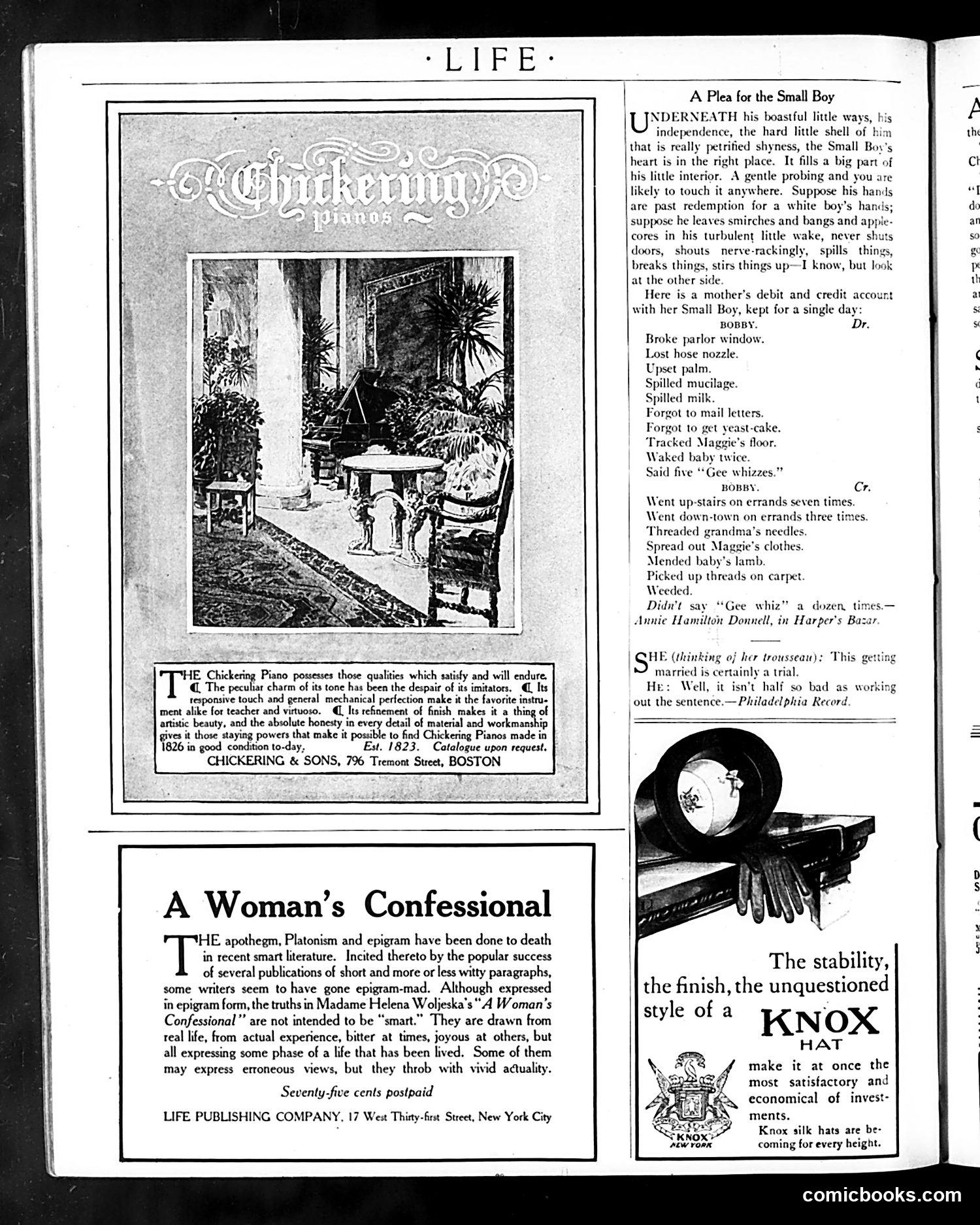
This page contains three distinct pieces of content: **"A Plea for the Small Boy"** is a humorous essay with an accompanying illustration. It presents a sympathetic defense of mischievous boys, arguing that despite their destructive behavior (breaking windows, spilling things, making noise), they perform genuinely helpful tasks. The "debit and credit" accounting format creates comedy by showing that a boy's good deeds—running errands, helping family members—balance against his chaos. The piece appeals to parental patience and affection. **"A Woman's Confessional"** advertises a book by Helena Woljeska, promoting it as witty yet sincere observations drawn from actual female experience—a counterpoint to trend-chasing epigram literature. **The remaining content** consists of period advertisements: a Chickering piano endorsement, a Knox hat ad, and a Philadelphia Record joke about marriage. The page is typical early-20th-century *Life* magazine: a mix of light satire, social commentary, and commercial advertising aimed at middle-class readers.
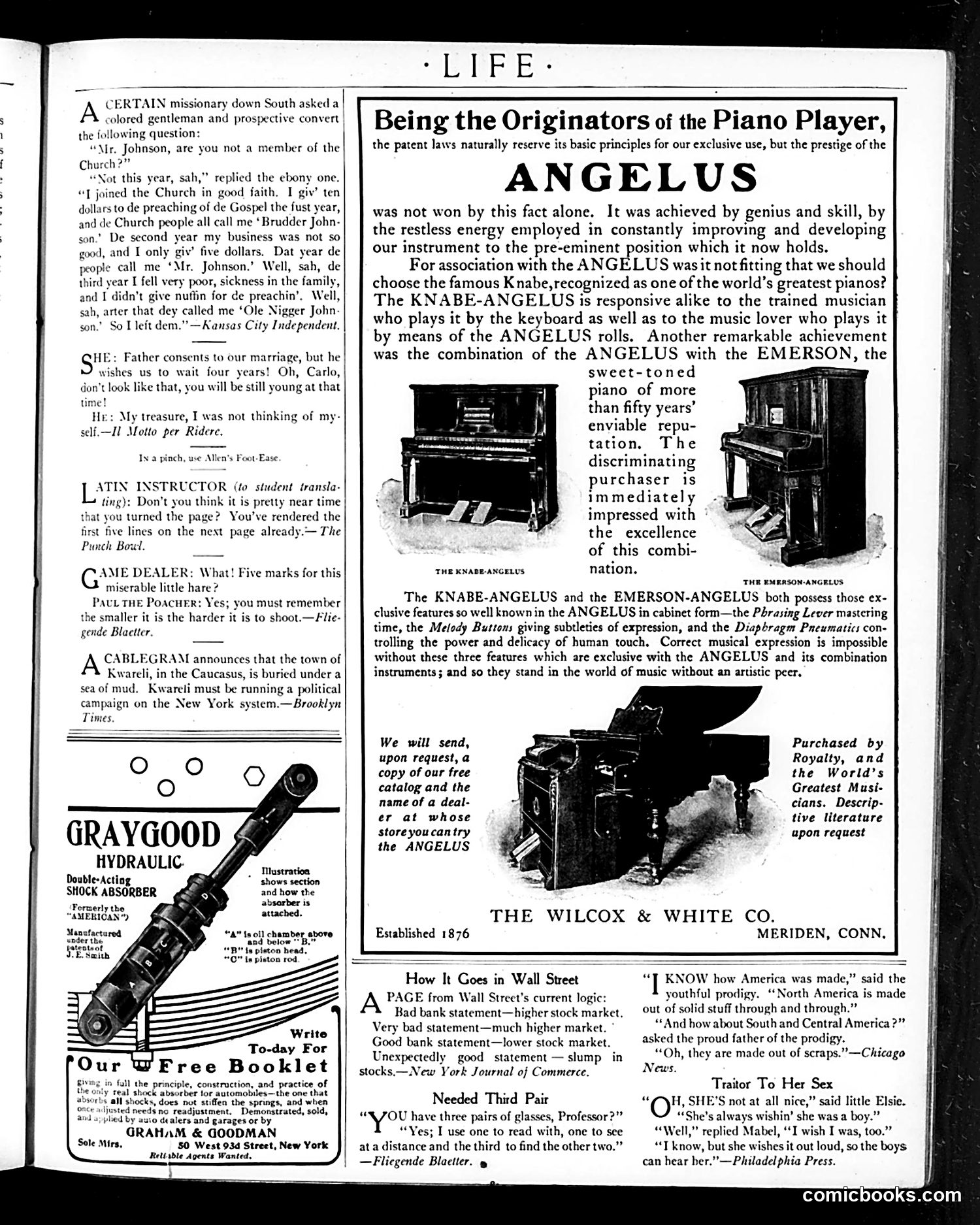
This page contains several brief satirical jokes and advertisements typical of early 20th-century Life magazine. **The main cartoon/joke** depicts racial discrimination through dialect humor. A Black church member explains why he's no longer called "Mr. Johnson" but "Ole Nigger Johnson"—his social standing in the congregation directly correlated with his financial donations. The satire targets the hypocrisy of church charity and racial prejudice masquerading as Christian fellowship. **Other brief jokes** include: - A Latin instructor's complaint about a slow student - A poacher defending inflated prices for small game (harder to shoot) - A political commentary comparing mud in the Caucasus to New York political corruption **The dominant content** is advertising: a full-page ad for the Angelus piano player, promoting combined pianos (Knabe-Angelus, Emerson-Angelus), and a separate ad for Graygood hydraulic shock absorbers. The page reflects Life's formula of mixing satirical commentary on contemporary social issues with commercial advertising.
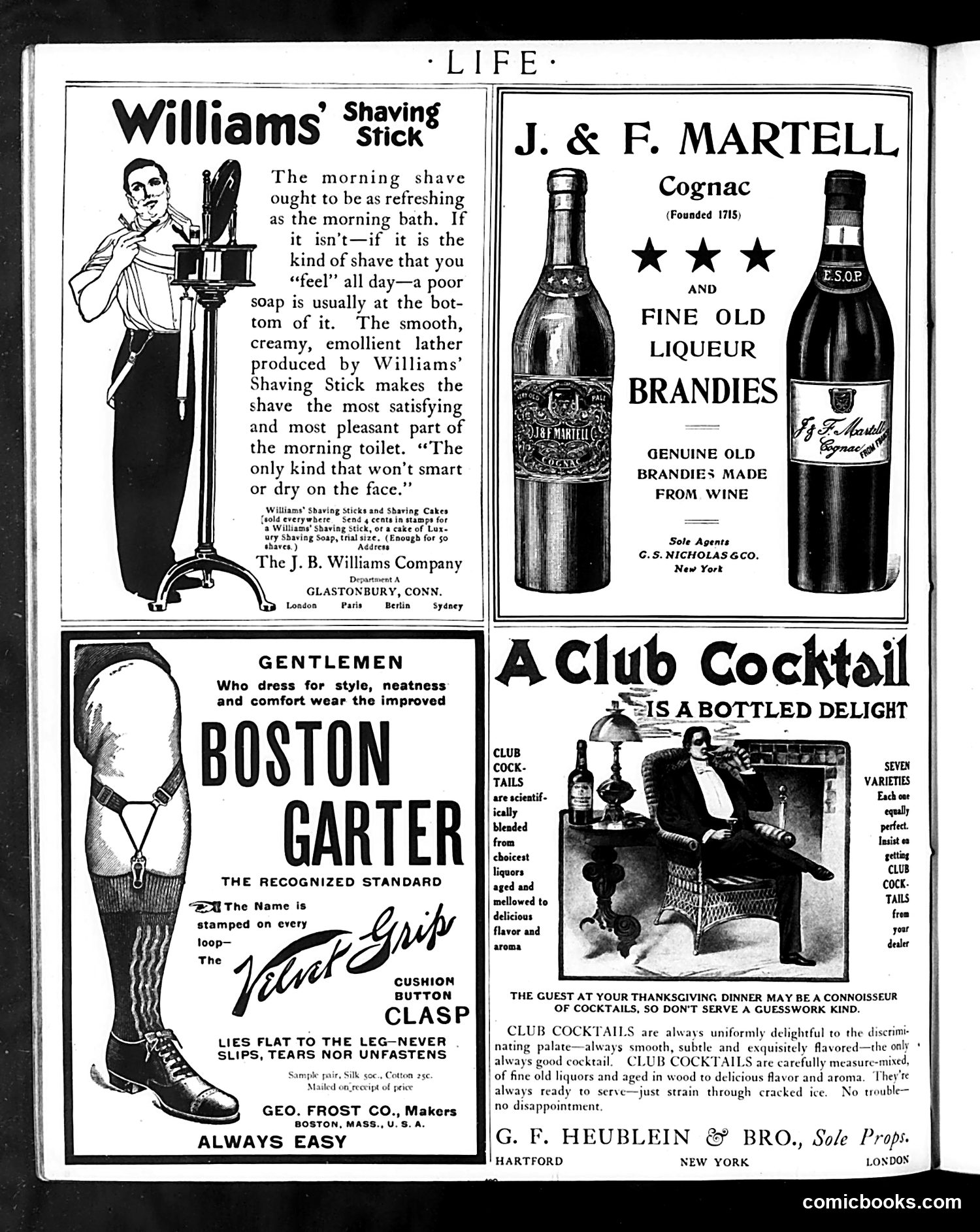
This is primarily an **advertising page**, not satirical content. It features four period product advertisements from the early 20th century: 1. **Williams' Shaving Stick** — promises a smooth, non-irritating shave that won't feel uncomfortable all day 2. **J. & F. Martell Cognac** — luxury brandy from France, established 1715 3. **Boston Garter** — men's garters with cushioned clasps designed not to slip or tear 4. **Club Cocktails** — pre-mixed cocktails with a Thanksgiving dinner pitch, noting guests may expect quality drinks The page reflects **early 1900s consumer culture** targeting gentlemen with grooming, fashion, and luxury goods. The Thanksgiving cocktail ad humorously acknowledges that cocktail connoisseurship was becoming a social expectation. These ads normalize branded products and marketing language emphasizing reliability, comfort, and refined taste—typical of Life magazine's commercial revenue model during this era.
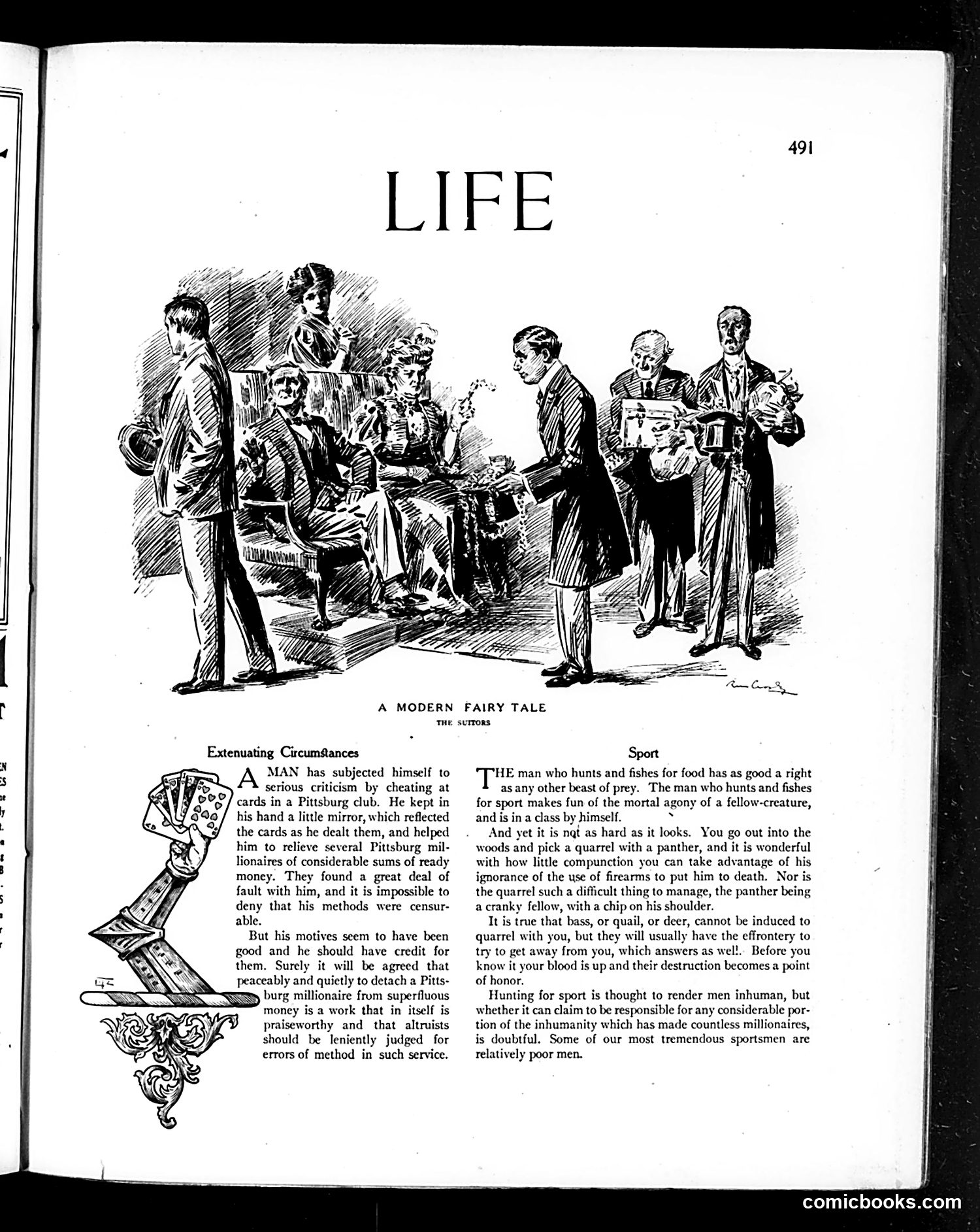
This page presents satirical commentary on wealthy American society through two paired essays titled "A Modern Fairy Tale." **"Extenuating Circumstances"** mocks the hypocrisy of Pittsburgh millionaires. A man cheated them at cards using a hidden mirror—clearly dishonest. Yet the author argues he deserves leniency because his goal (removing "superfluous money" from the wealthy) was morally praiseworthy. The satire suggests that stealing from the rich is actually virtuous work, and we should forgive bad methods for good intentions. **"Sport"** similarly mocks the wealthy's moral inconsistency. Hunting for food is defensible; hunting for sport is cruel entertainment that brutalizes character. Yet the author ironically notes that sportsmen aren't necessarily more inhumane than millionaires generally—implying the wealthy are already brutal, making hunting a minor moral concern. Together, these essays satirize Pittsburgh's gilded-age industrialists: wealthy, morally compromised, yet self-righteous. The accompanying illustration shows well-dressed suitors or business associates, suggesting the social circles being lampooned.
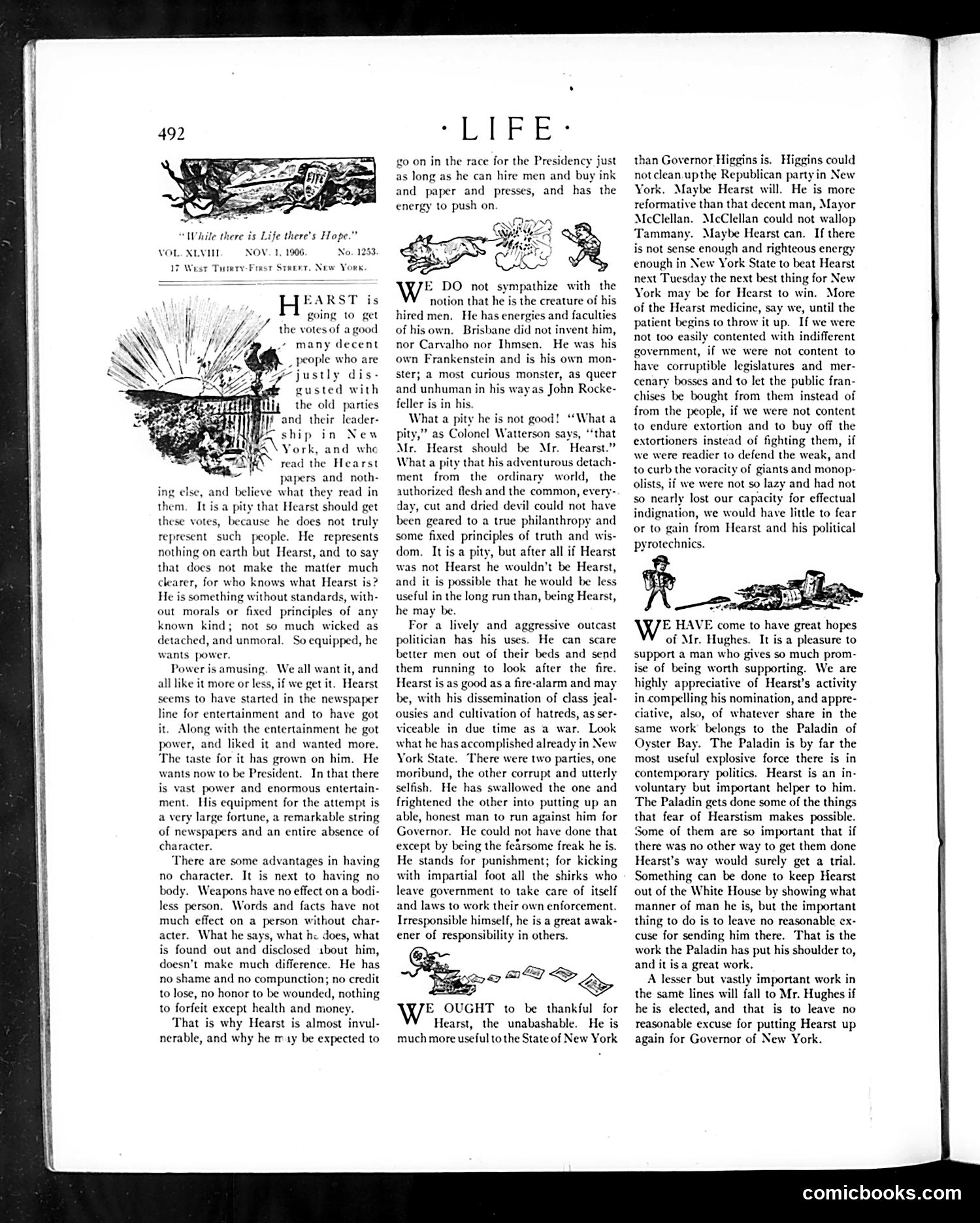
This is a scathing editorial attacking newspaper magnate **William Randolph Hearst**, who was running for New York Governor in 1906. The author argues Hearst is a man of no character or fixed principles—merely seeking power for entertainment—yet paradoxically useful as a political force. The piece acknowledges Hearst's "vast fortune" and "string of newspapers" but dismisses him as "detached, and unmoral" rather than genuinely wicked. It credits him with no real beliefs, only ambition. However, the author concedes Hearst serves a purpose: his demagogic attacks on corruption and class division ("fire-alarm") frighten entrenched politicians into nominating better candidates. The editorial references **Arthur Brisbane** and others as Hearst's employees, and compares him unfavorably to John D. Rockefeller as an "unhuman" figure. The overall tone is contemptuous yet grudgingly acknowledges Hearst's disruptive political utility despite his fundamental unsuitability for high office.
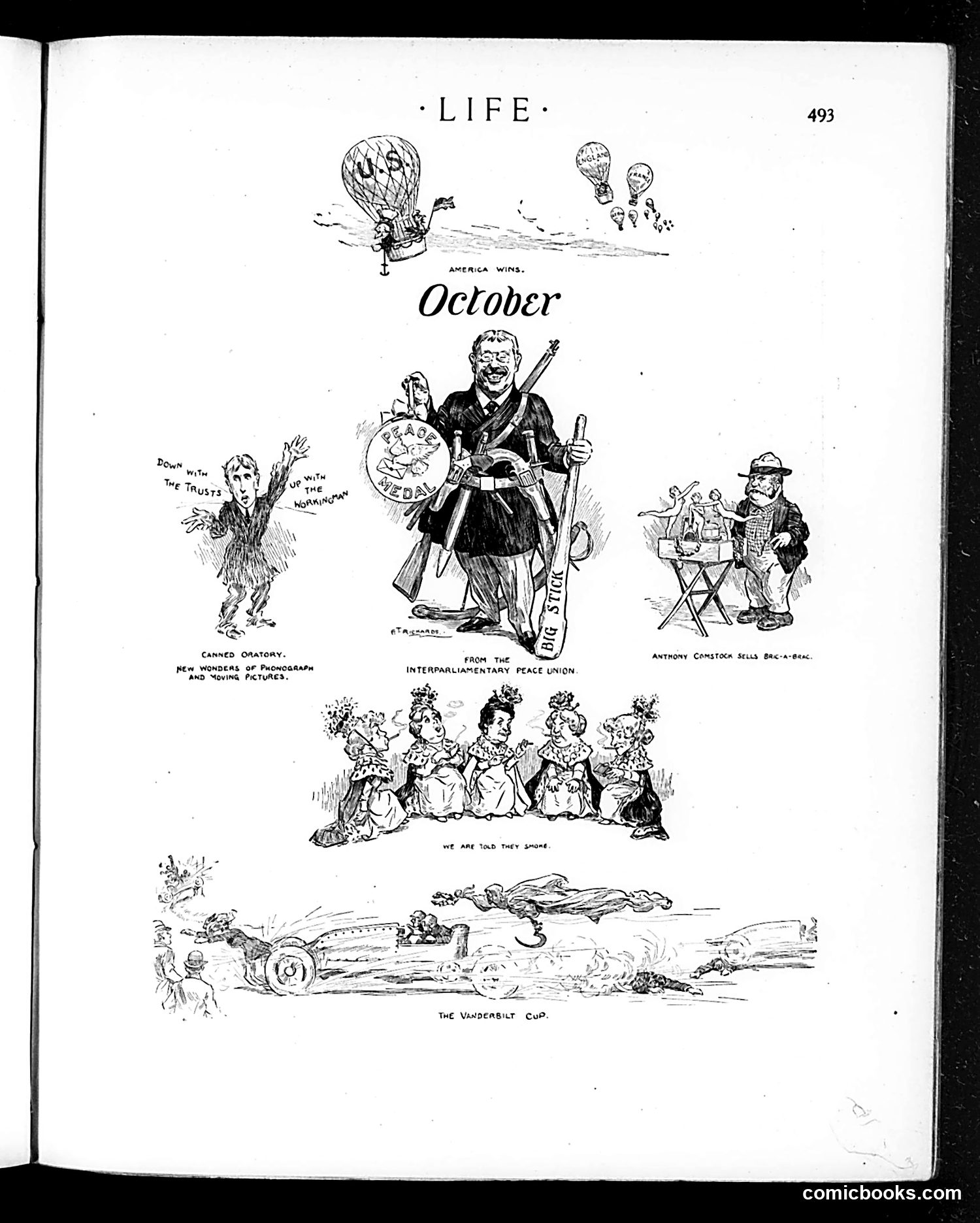
This October 1917 Life magazine page contains several political cartoons satirizing American wartime topics: **Top cartoon**: "America Wins" depicts hot air balloons, likely mocking political rhetoric about American military superiority during WWI. **Center cartoon**: A military figure with a drum labeled "Wilson" represents "Canned Oratory"—satirizing President Wilson's repetitive speeches about the war effort and new propaganda technologies (phonographs, moving pictures) used to promote the war. **Right cartoon**: "Anthony Comstock Sells Bric-a-Brac" appears to mock the famous moral crusader. **Bottom**: "We are told they spoke" shows women gossiping, while "The Vanderbilt Cup" depicts a reckless racing accident—likely satirizing wealthy industrialists' frivolous behavior during wartime. The page collectively ridicules political propaganda, military posturing, and the contrast between wartime sacrifice and elite indulgence.
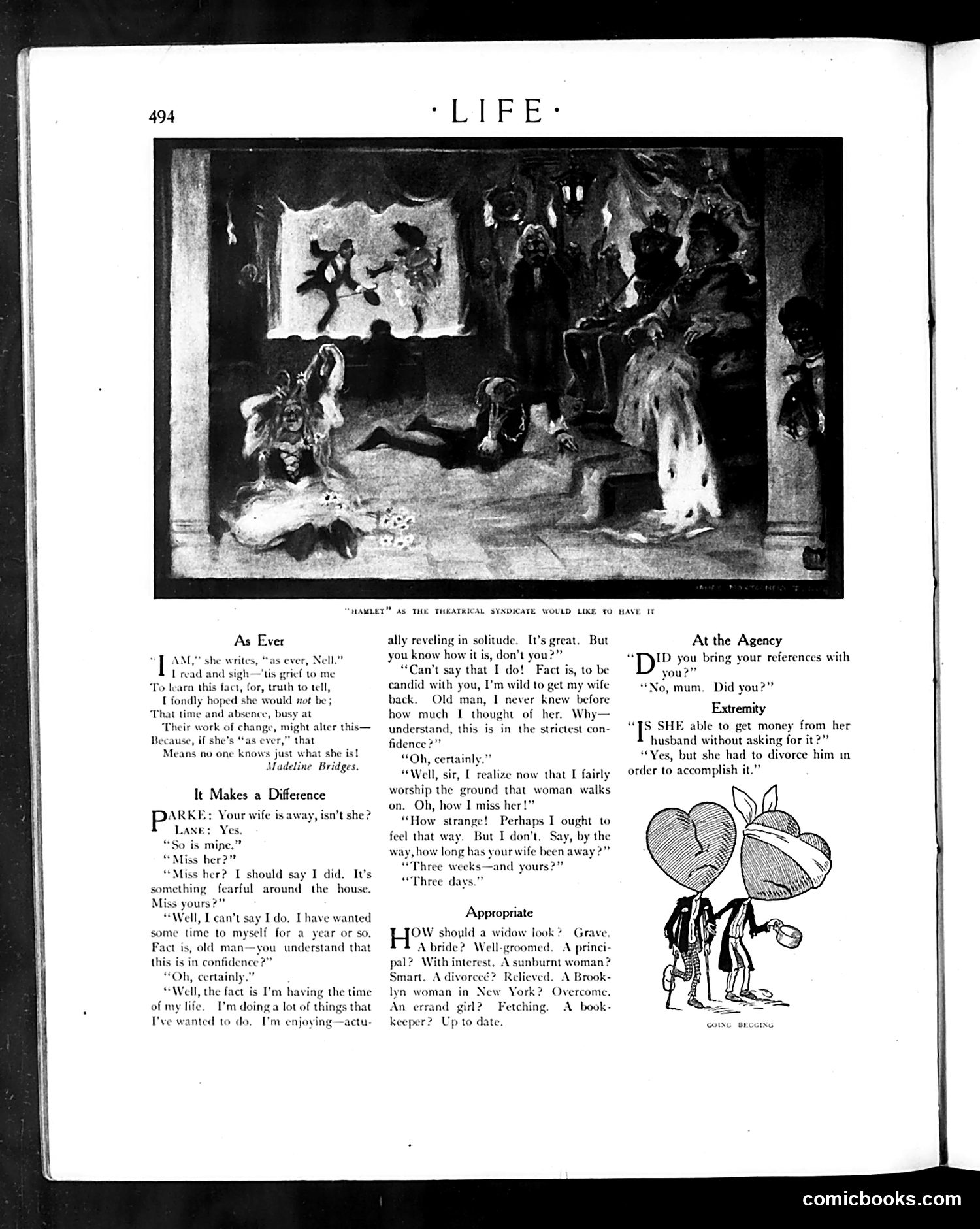
This page contains several brief humorous sketches typical of Life magazine's satirical format. **"Hamlet" at top**: A theatrical scene parodying how commercial theater syndicates would stage Shakespeare—apparently emphasizing spectacle and entertainment over substance (the image shows an elaborate stage production). **Main sketches**: Short dialogues satirizing gender relations and marriage. "It Makes a Difference" contrasts two men whose wives are away: one misses his desperately, the other relishes his solitude—the joke being the second man's wife has only been gone three days versus three weeks, suggesting his enthusiasm will fade. "At the Agency" jokes about employment references with a gender twist. "Extremity" presents a dark punch line about a woman divorcing her husband to access his money—satirizing both marital power dynamics and women's limited financial independence under the law. The overall tone reflects early 20th-century attitudes toward marriage, work, and gender roles, presented as light comedy for Life's educated, urban readership.
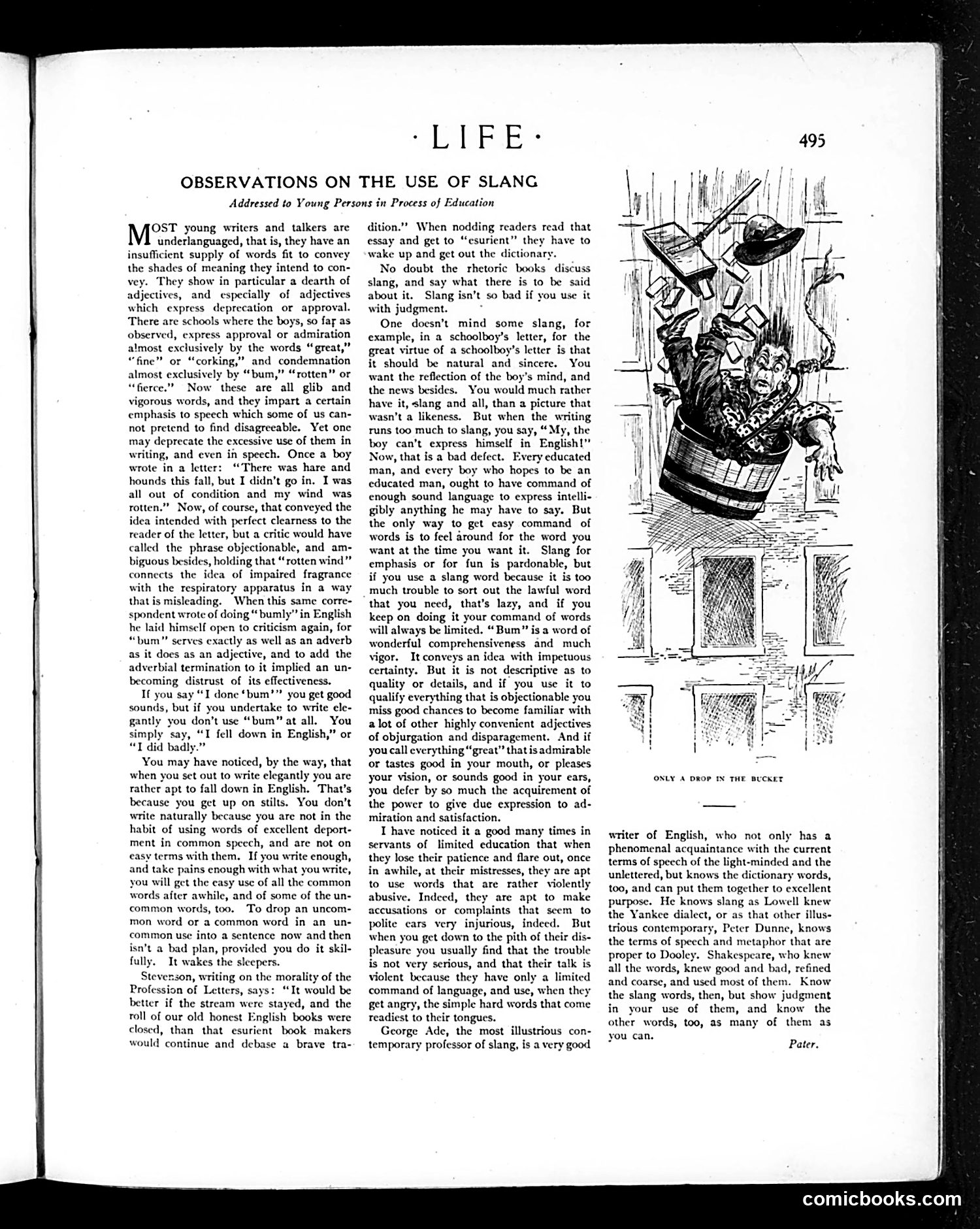
This page presents an essay addressed to young people about proper language use. The accompanying cartoon depicts a boy struggling up a staircase labeled "ONLY A DROP IN THE BUCKET"—a visual metaphor for the difficulty of self-improvement through education. The text critiques young writers and speakers for overrelying on slang terms like "great," "rotten," and "bum" due to insufficient vocabulary. The author argues that while slang may convey meaning clearly, educated people should command standard English to express themselves properly. The piece emphasizes that natural writing develops through practice using common words in speech, not by adopting "stilted" formal language. The satirical point: young people's lazy linguistic habits both reflect and perpetuate their limited education—a "drop in the bucket" toward genuine cultivation.
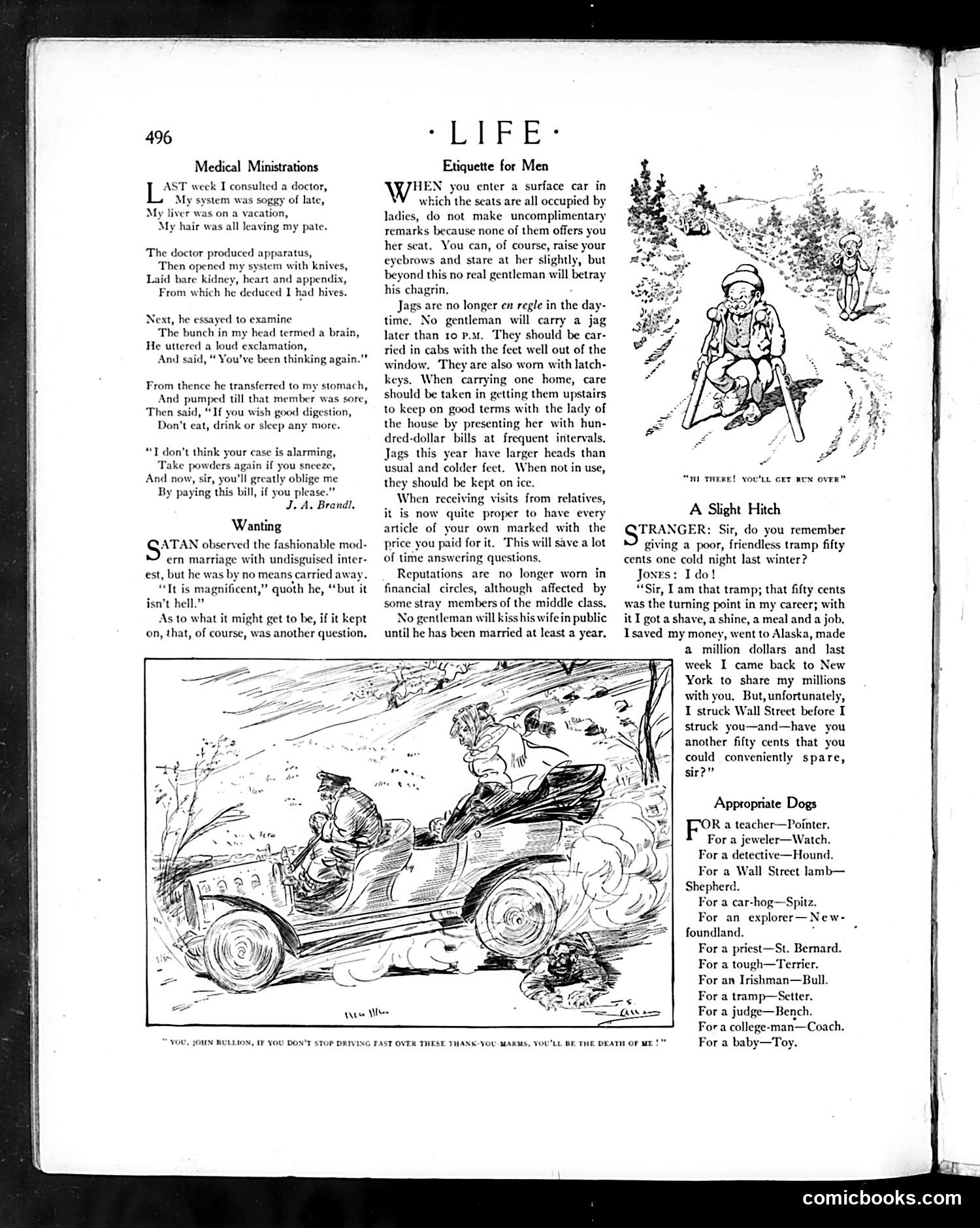
This page from *Life* magazine contains several satirical pieces mocking early 20th-century American society: **"Medical Ministrations"** (poem): Satirizes incompetent doctors who perform elaborate examinations yet reach absurd conclusions—diagnosing "hives" after opening the patient up, and blaming thinking itself for stomach problems. The humor derives from medical charlantanism. **"Wanting"** section: A brief joke about modern marriage being "magnificent" but not "hell"—implying fashionable marriages are superficial and potentially headed toward disaster. **"Etiquette for Men"**: Mock advice satirizing wealthy, drunken behavior among the upper class. References "jags" (getting drunk), suggests carrying intoxication in cabs with feet out windows, and mocks materialism by recommending displaying price tags on possessions. **"A Slight Hitch"**: A con-artist joke where a beggar returns claiming the fifty-cent donation transformed his life, then asks for another fifty cents after losing his fortune on Wall Street—satirizing both naive charity and Wall Street's destructive power. **"Appropriate Dogs"**: Clever wordplay matching dog breeds to professions through puns (Pointer for teacher, Watch for jeweler, etc.).
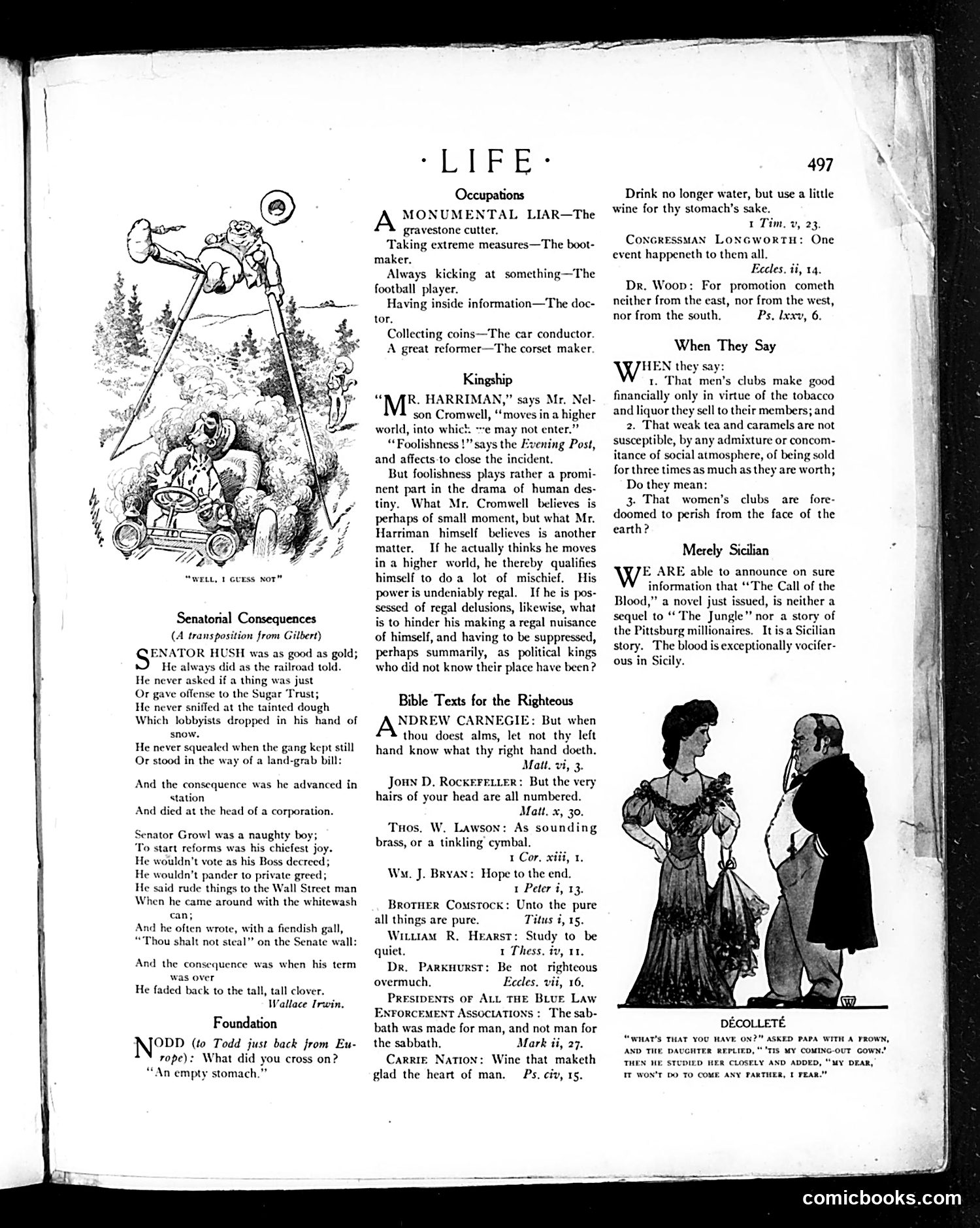
This page satirizes American political corruption and hypocrisy circa early 1900s. **The main cartoon** adapts Gilbert & Sullivan, contrasting two senators: one ("Senator Hush") obeys railroads and trusts, accepts bribes ("tainted dough"), and dies wealthy leading a corporation; the other ("Senator Growl") advocates reform and loses power. The satire: honest politicians are punished while corrupt ones prosper. **"Bible Texts for the Righteous"** mockingly pairs biblical verses with wealthy industrialists (Carnegie, Rockefeller) and reformers (Carrie Nation, Anthony Comstock), exposing the hypocrisy of the wealthy invoking scripture while engaging in exploitation, and reformers' selective morality. **The railroad/trust references** target the era's dominant corporate powers controlling senators through lobbying and financial pressure—a major Progressive Era complaint. The page attacks both corrupt politicians and wealthy elites' moral inconsistency during America's Gilded Age.
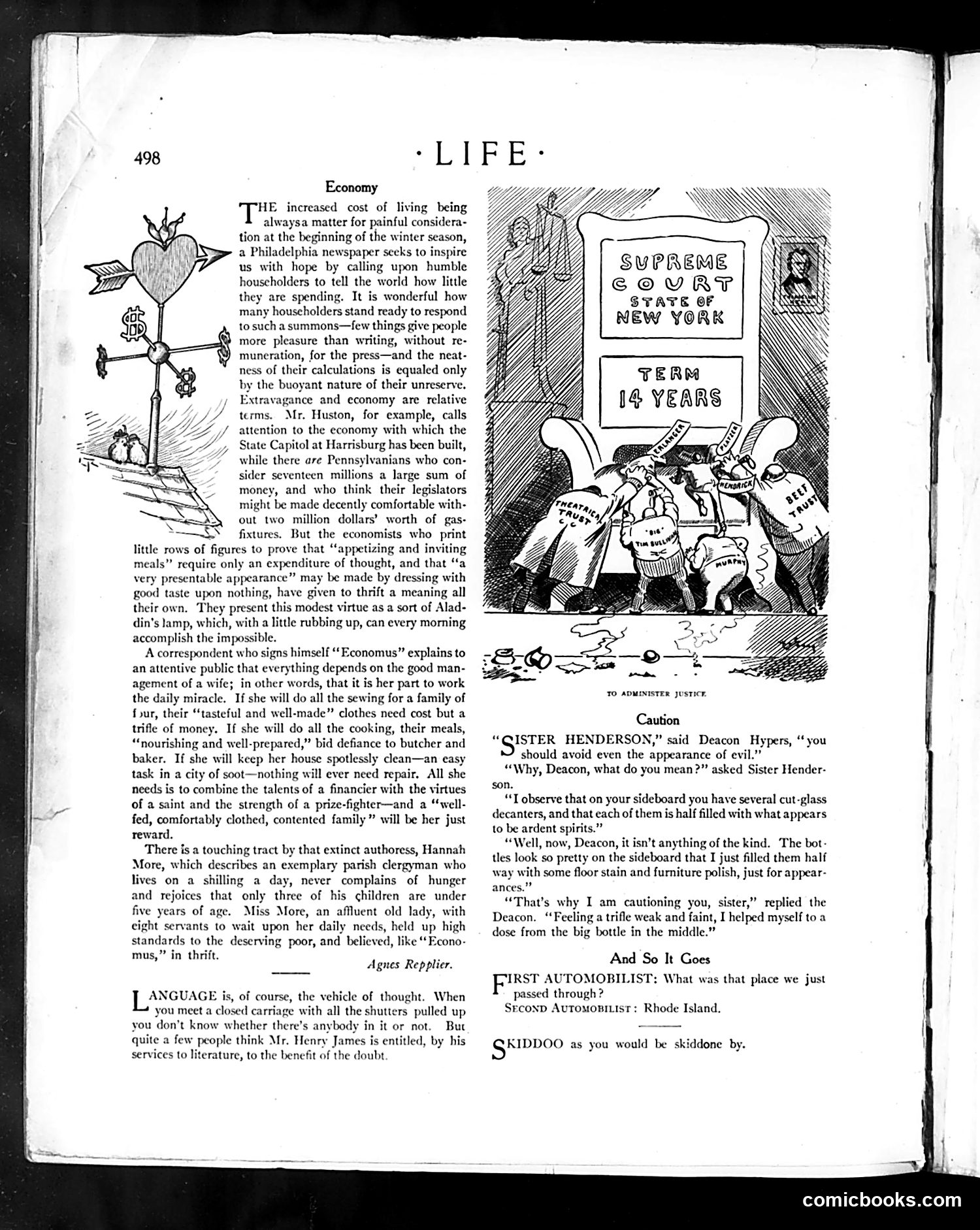
This page satirizes the era's hypocrisy about "economy" during rising living costs. The main article by Agnes Repplier mocks a Philadelphia newspaper campaign asking humble householders to publicly boast about their frugal spending. Repplier exposes the absurdity: these "economists" demand wives perform miraculous feats—sewing, cooking, cleaning—while possessing saint-like virtue and prizefighter strength, all to create the illusion of comfort on nothing. The cartoon depicts the "Supreme Court State of New York" as a grotesque judicial figure drowning in administrative burden, satirizing government inefficiency and bloated expenditure—contrasting sharply with the text's critique of unrealistic expectations placed on ordinary families. The brief anecdotes below (including a Henry James reference and a story about deceptive decanters) continue the theme of appearance versus reality and public hypocrisy.
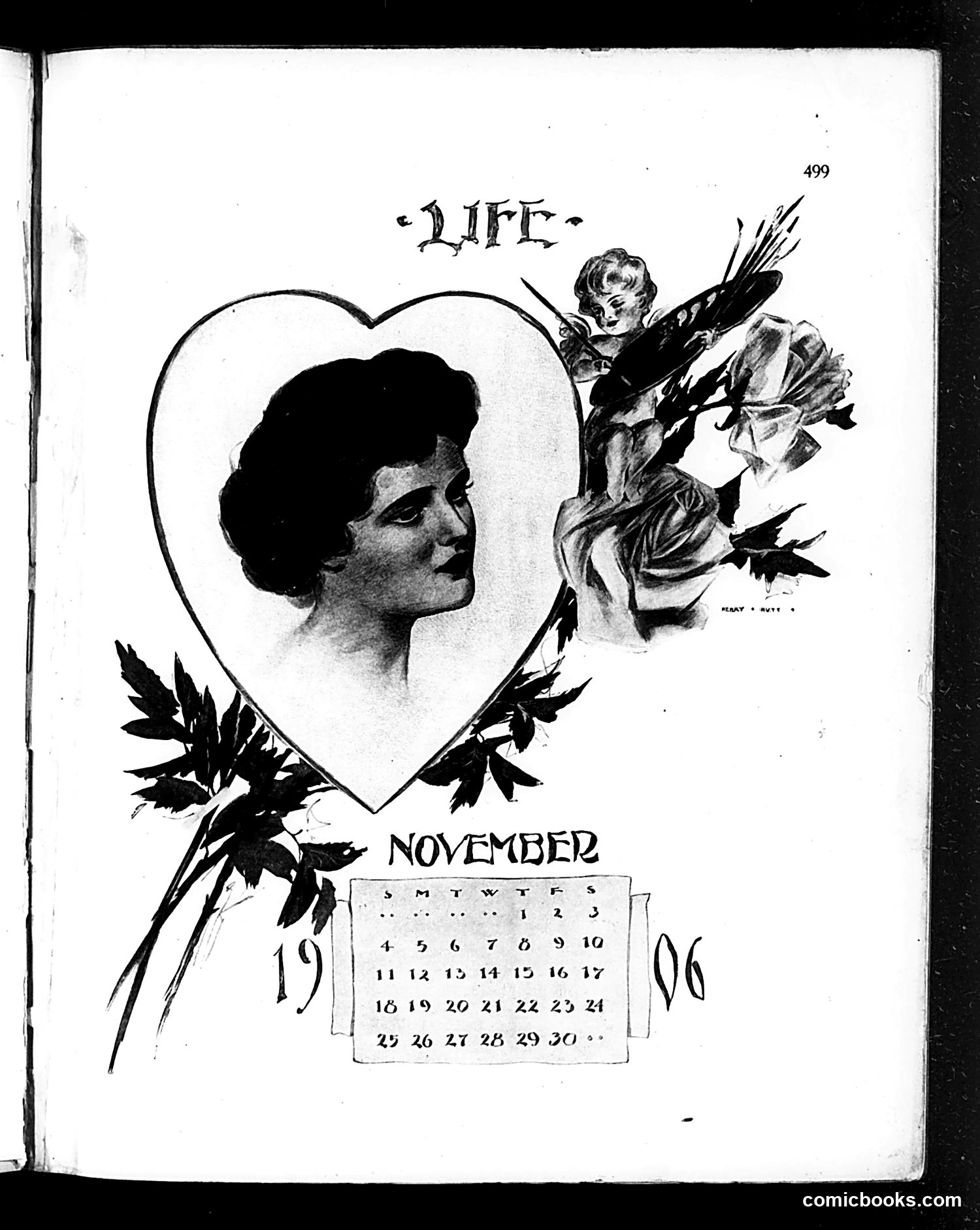
This is a calendar page for November 1906 from Life magazine's "Life" section (page 499). The decorative illustration features a woman's profile in a heart-shaped frame, surrounded by autumn foliage and cherubs or putti with arrows and flowers—classical symbols of love and romance. The design is purely decorative rather than satirical, typical of Life's ornamental calendar pages. The styling reflects early 1900s aesthetic sensibilities, with its Art Nouveau influences and romanticized imagery. There's no apparent political commentary or satire here—it's a straightforward calendar illustration meant to be visually pleasing and thematically appropriate for the month.
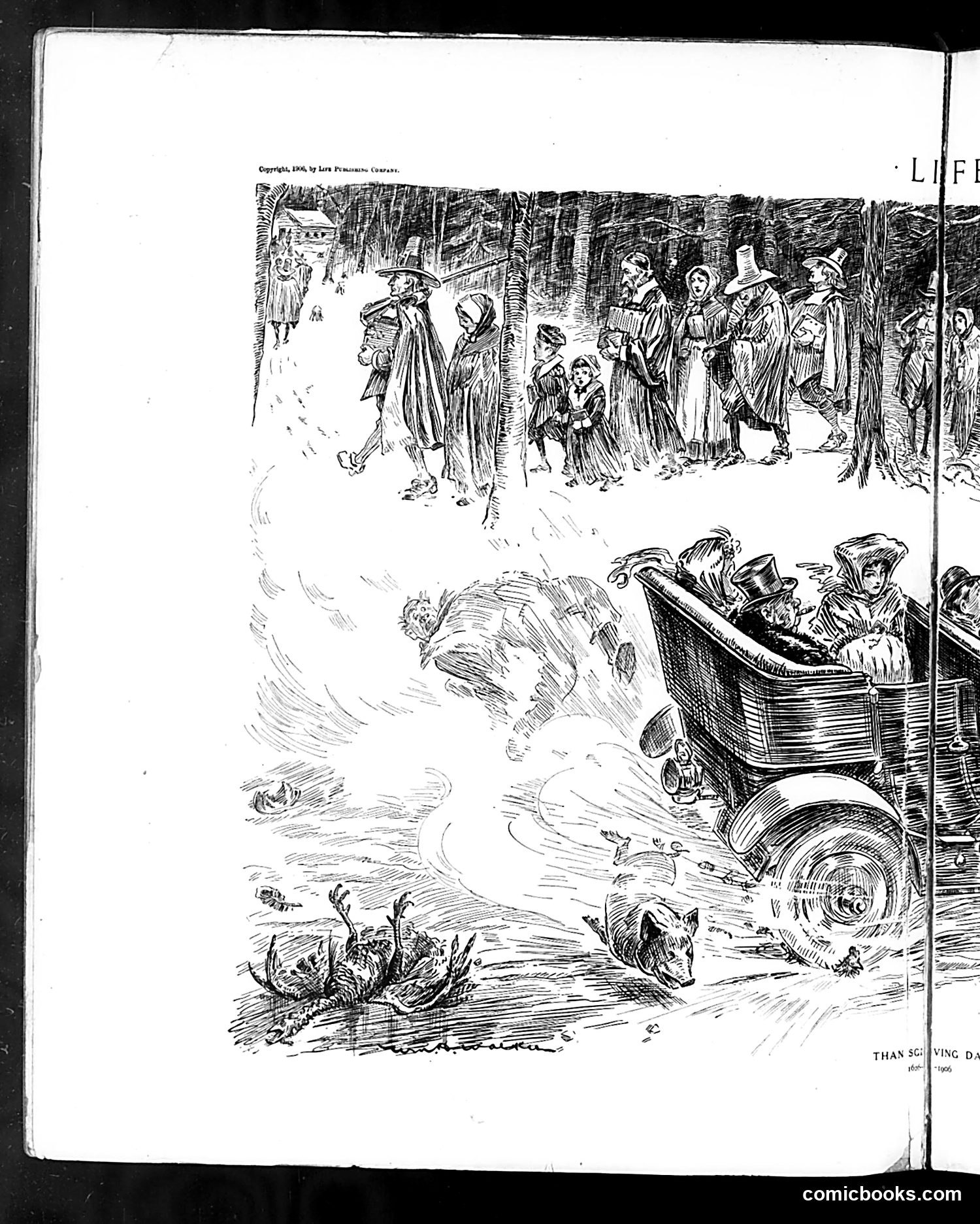
This appears to be a satirical illustration from *Life* magazine depicting a chaotic street scene. The image shows elegantly dressed pedestrians (upper portion) observing an accident or incident below involving a motorcar that has struck what appear to be ducks or geese in muddy water. The vehicle's passengers look alarmed while the birds scatter dramatically. The satire likely mocks early automobile culture—specifically the danger and chaos these new vehicles introduced to streets, and society's indifference to collateral damage. The contrast between refined pedestrians calmly observing and the violent disruption below suggests commentary on how the wealthy embraced automobiles despite their disruptive impact on urban life and nature. The OCR text is too corrupted to provide additional context.
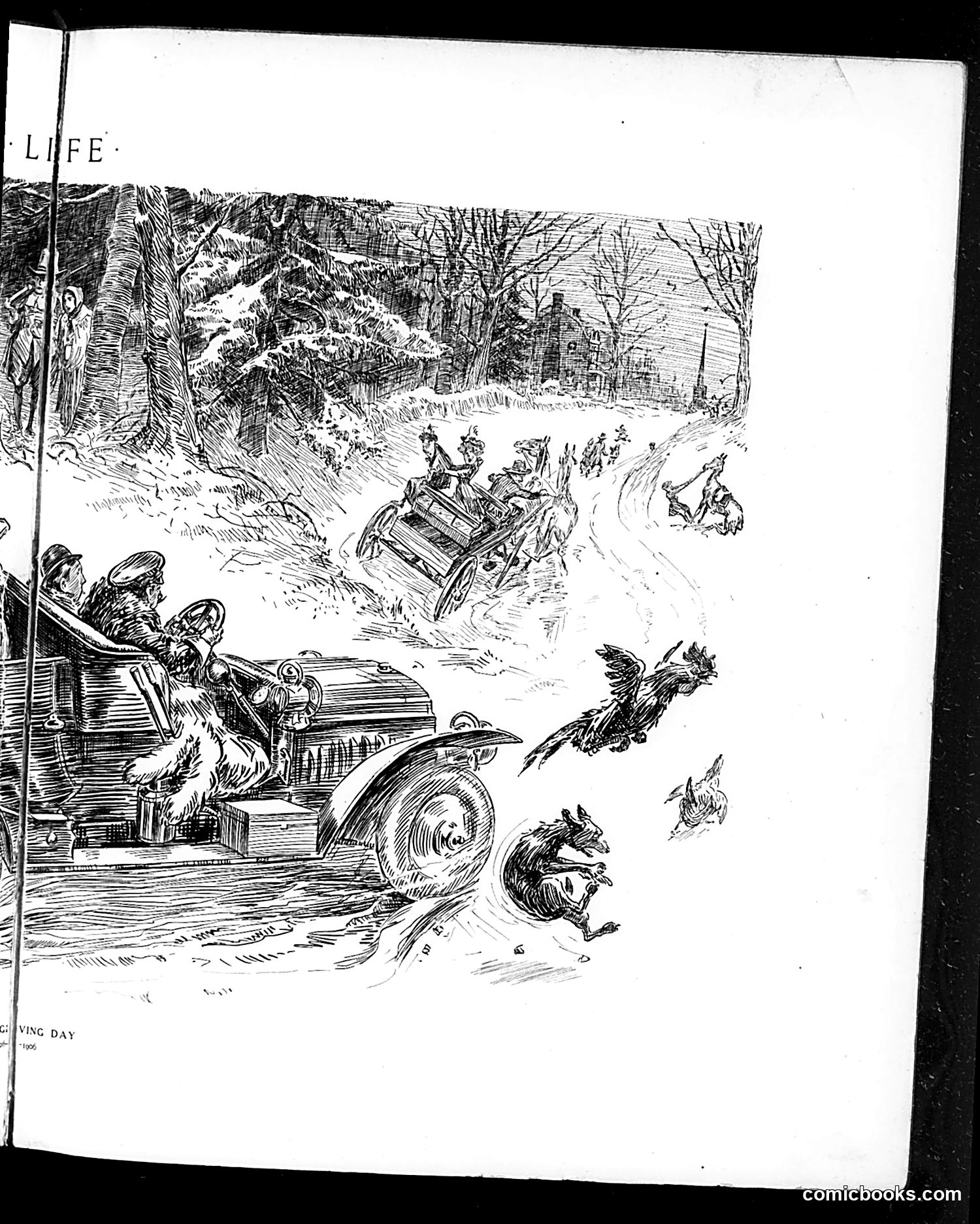
This page features a single illustration titled "LIFE" depicting a winter countryside scene with a horse-drawn sleigh in the foreground and additional sleighs in the background. The composition shows anthropomorphized animals—what appear to be dogs or similar creatures—operating the vehicles and enjoying winter recreation. The illustration's style is characteristic of early-to-mid 20th century satirical line art. The title "LIFE" suggests commentary on leisure activities and rural pastimes. The anthropomorphization of animals driving vehicles appears to be social satire, though without additional context or visible byline, the specific satirical target remains unclear. The winter setting and recreational focus suggest commentary on class, leisure, or lifestyle themes common to Life magazine's social commentary.
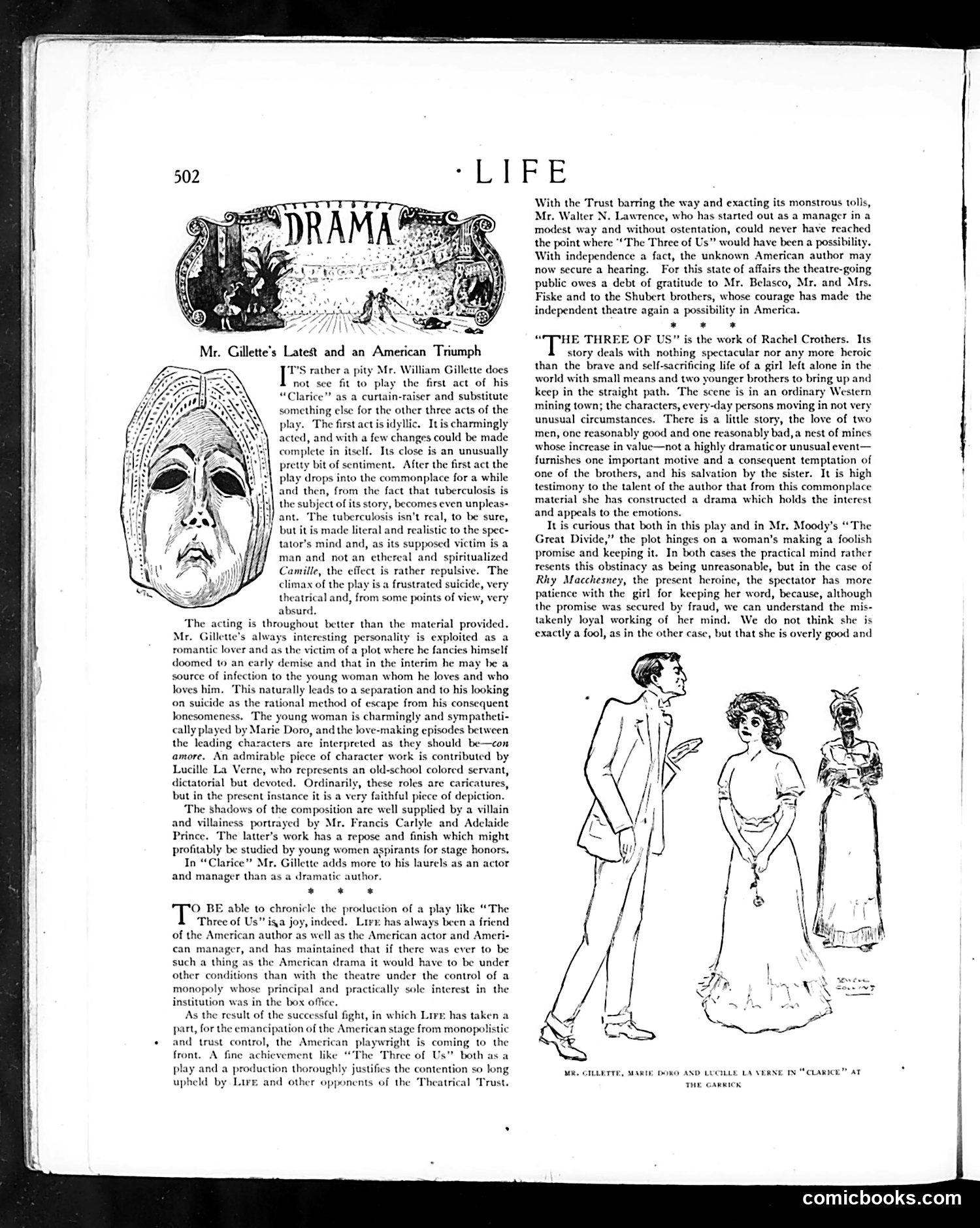
This page reviews two theatrical productions. The main critique addresses William Gillette's play "Clarice," which the reviewer finds dramatically weak despite strong acting. The play concerns a tuberculosis-stricken man contemplating suicide—a melodramatic subject the critic finds depressing and artificial compared to the charming first act. The second review praises "The Three of Us," celebrating it as evidence of American theatrical independence. The text emphasizes that this play's existence proves the recent breaking of the "Theatrical Trust"—a monopoly controlling American theater that previously blocked independent productions. The reviewer credits figures like Belasco, the Fiskes, and the Shubert brothers for fighting this monopoly, allowing unknown American authors and independent managers like Walter N. Lawrence to finally produce work. The underlying point: American drama can only flourish without monopolistic control restricting theatrical access.
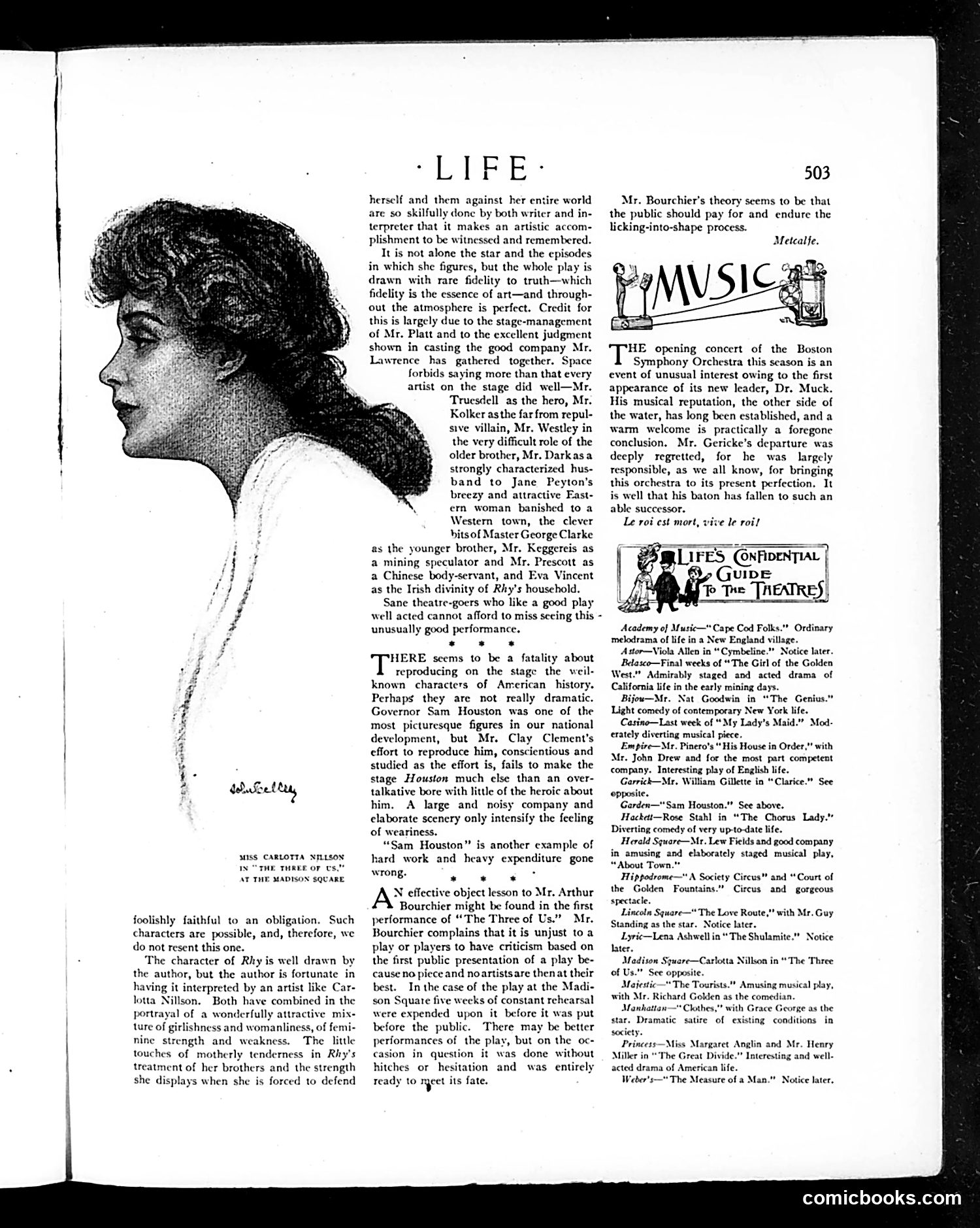
This page contains theater criticism and a music review, not political cartoons. The prominent illustration is a profile portrait of **Miss Carlotta Neilson**, an actress performing in the play "The Three of Us" at Madison Square Theatre. The reviews discuss stage productions: "The Three of Us" receives high praise for its faithful portrayal of American characters and Neilson's nuanced performance. By contrast, "Sam Houston" is criticized as a well-intentioned but tedious failure—despite elaborate scenery and a large cast, the historical figure emerges as an "over-talkative bore." The page also notes a comment by theater director **Arthur Bourchier**, who complains that first-night reviews are unfair. The critic responds that "The Three of Us" had five weeks of rehearsal before opening, so criticism of its opening performance is justified—Bourchier shouldn't expect audiences to pay for plays still being "licked into shape." The final section briefly announces Dr. Muck's debut conducting the Boston Symphony Orchestra.
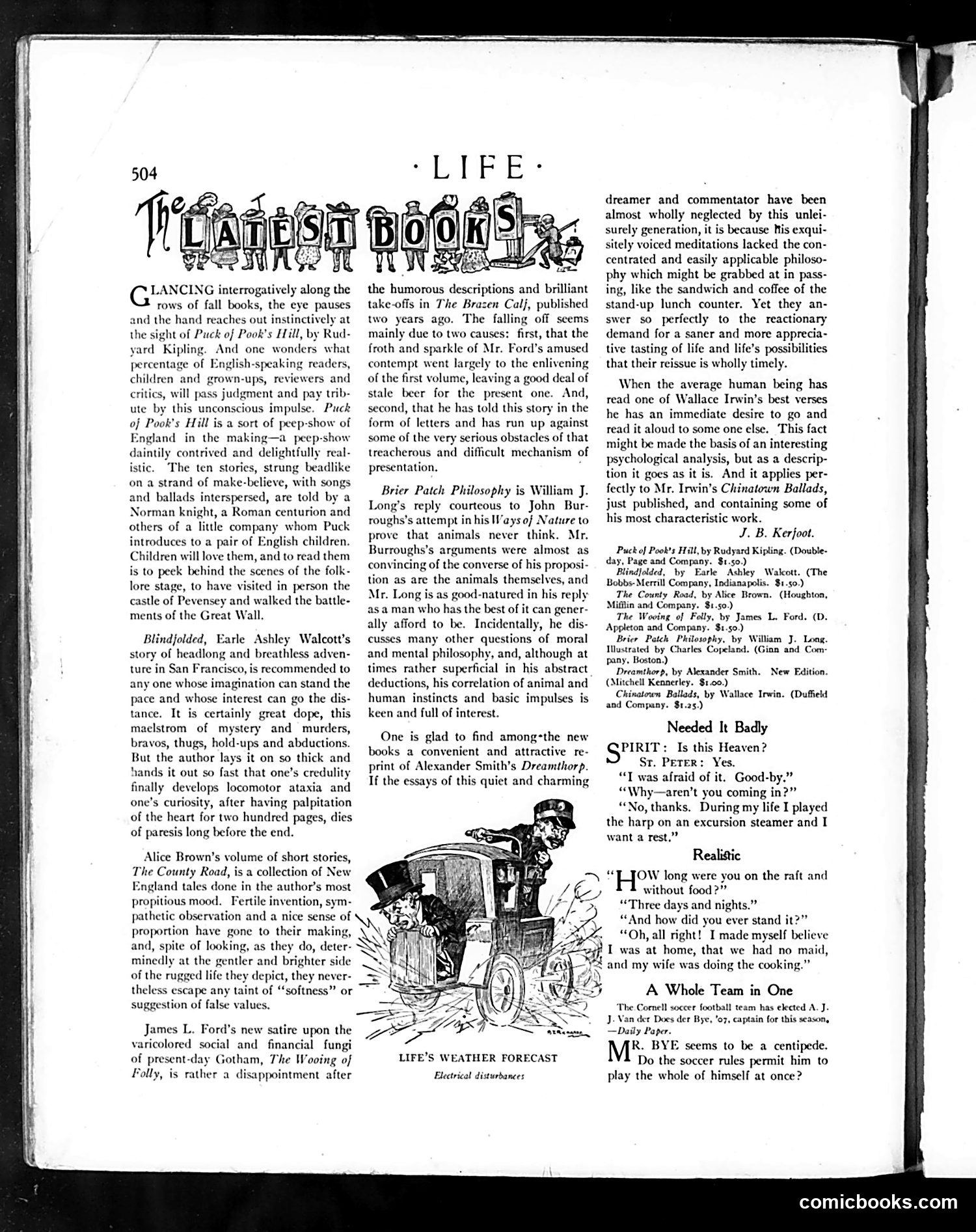
This is a book review section from Life magazine featuring literary criticism of contemporary works. The main cartoon, captioned "LIFE'S WEATHER FORECAST: Electrical Disturbances," depicts a man in a vehicle being struck by lightning or electrical discharge—a visual metaphor for the chaotic, turbulent nature of modern urban life. The reviews discuss Rudyard Kipling's *Puck of Pook's Hill*, a children's fantasy; adventure fiction set in San Francisco; New England short stories; and James L. Ford's social satire about New York ("Gotham"). The critic notes Ford's satirical takeoffs are witty but argues the work declines in quality compared to his earlier *Brazen Calf*. The cartoon's "electrical disturbances" likely satirizes the frenetic pace and instability of contemporary American life—a common Life magazine theme. The vehicle suggests modern technology as both enabler and source of chaos.
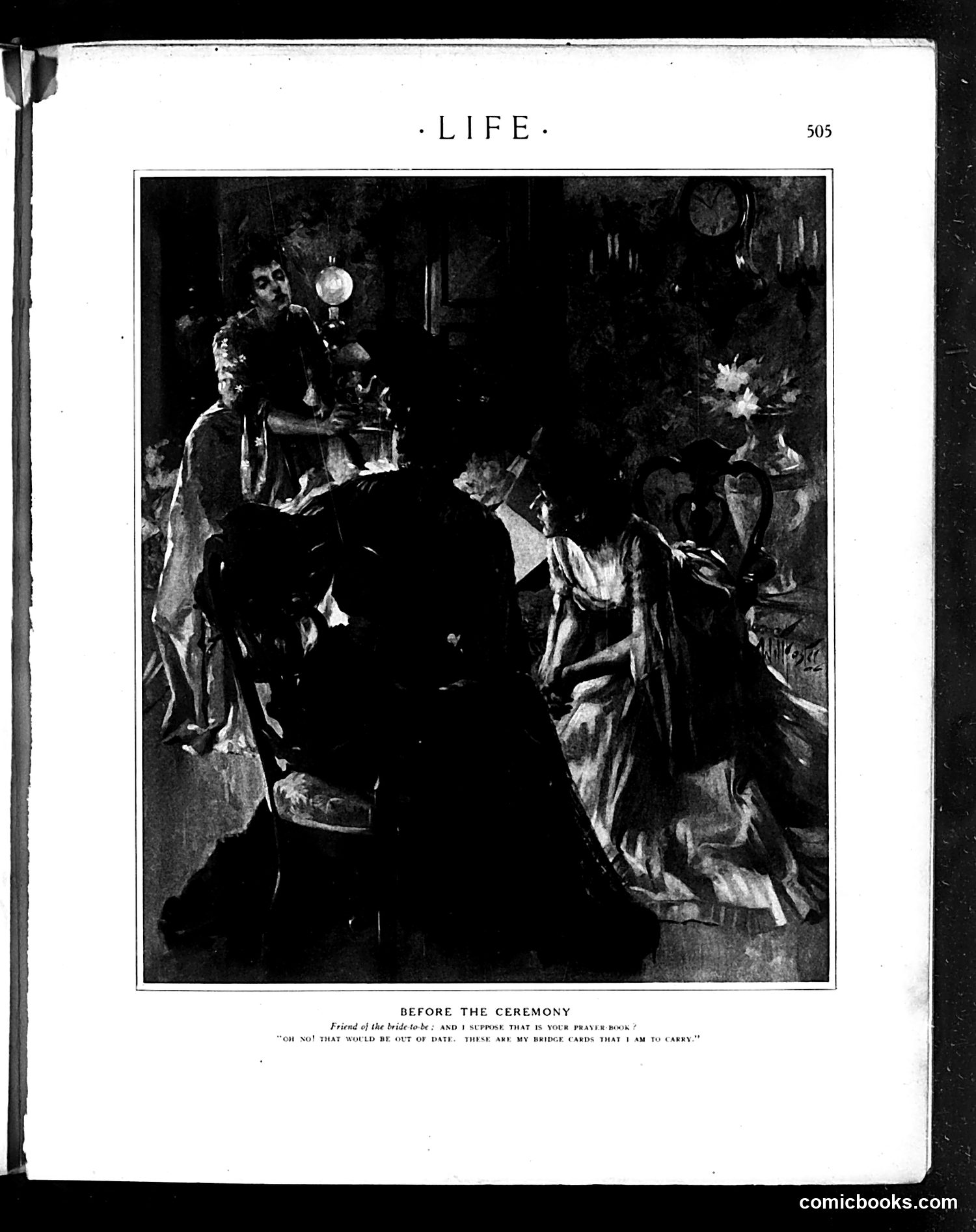
This appears to be a satirical illustration from *Life* magazine depicting a social scene before a wedding ceremony. The caption identifies a character as "Friend of the bride" speaking to someone, discussing prayer books and bridge cards. The humor centers on social pretension and misplaced priorities: the character is concerned about bridge cards (a fashionable card game among the wealthy) at what should be a solemn religious occasion. The joke mocks how affluent guests treat weddings as social events rather than spiritual ceremonies—they're more worried about their recreational activities than the religious significance of the moment. The dark, crowded composition with multiple figures in formal dress emphasizes the chaotic social atmosphere of upper-class wedding culture.
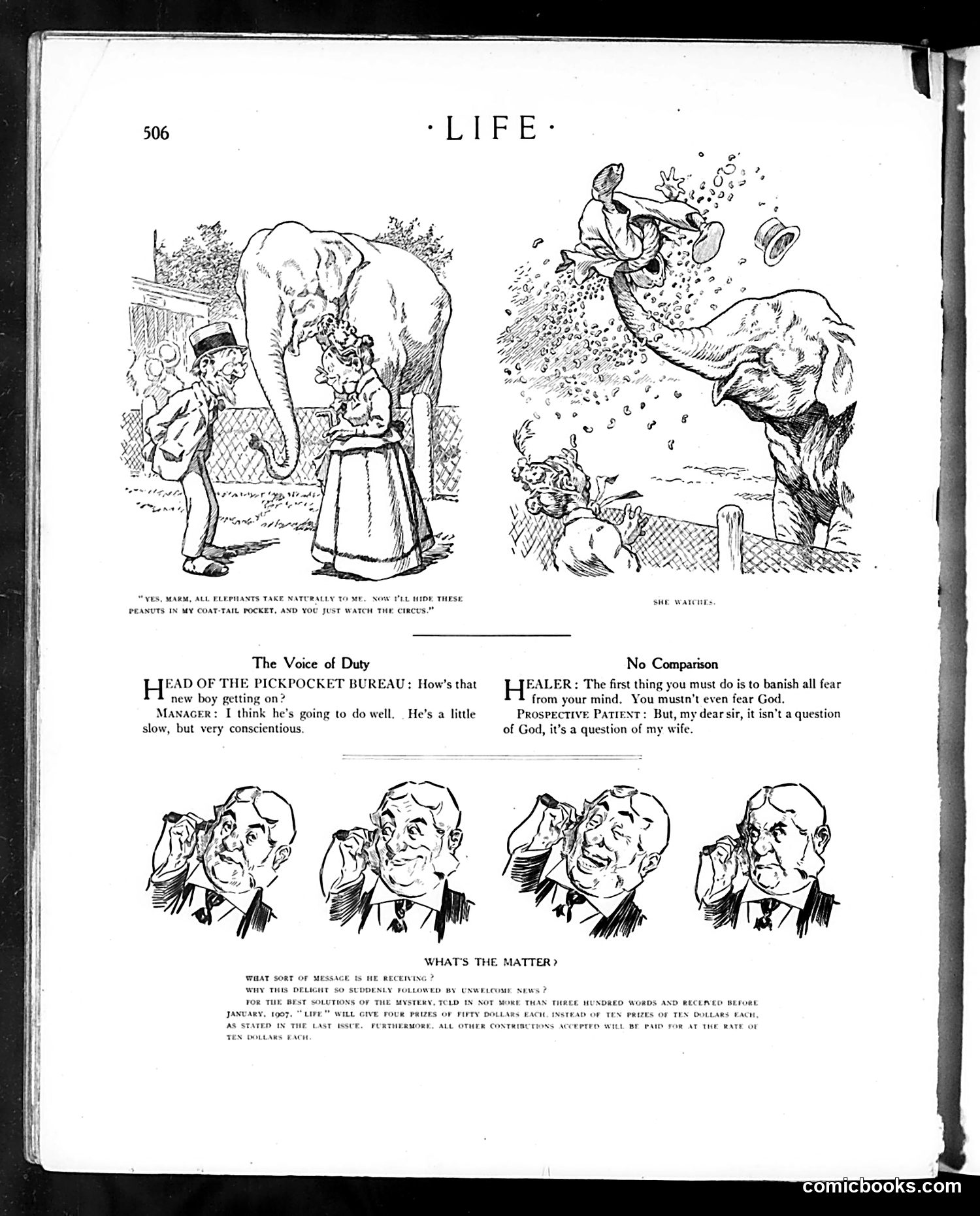
This page from *Life* magazine contains three satirical items: **Top cartoons**: Two circus scenes. Left shows a pickpocket instructing someone to hide peanuts in a coat tail while watching the circus—a joke about theft disguised as entertainment. Right depicts an elephant throwing a woman and child, captioned "She Watches"—dark humor about circus danger. **Middle section**: Two brief satirical dialogues. "The Voice of Duty" mocks a pickpocket bureau chief praising a new thief for being "conscientious" about stealing. "No Comparison" presents a healer telling a patient not to fear God, only his wife—satirizing both faith healers and marital relationships. **Bottom**: A puzzle competition offering fifty-dollar prizes for solving "What's the Matter?"—showing the magazine's reader-engagement contests. The overall tone ridicules contemporary institutions: circus fraud, petty crime professionalization, quack medicine, and domestic anxiety. The humor relies on inverted morality and understated absurdity typical of early 1900s *Life* satire.
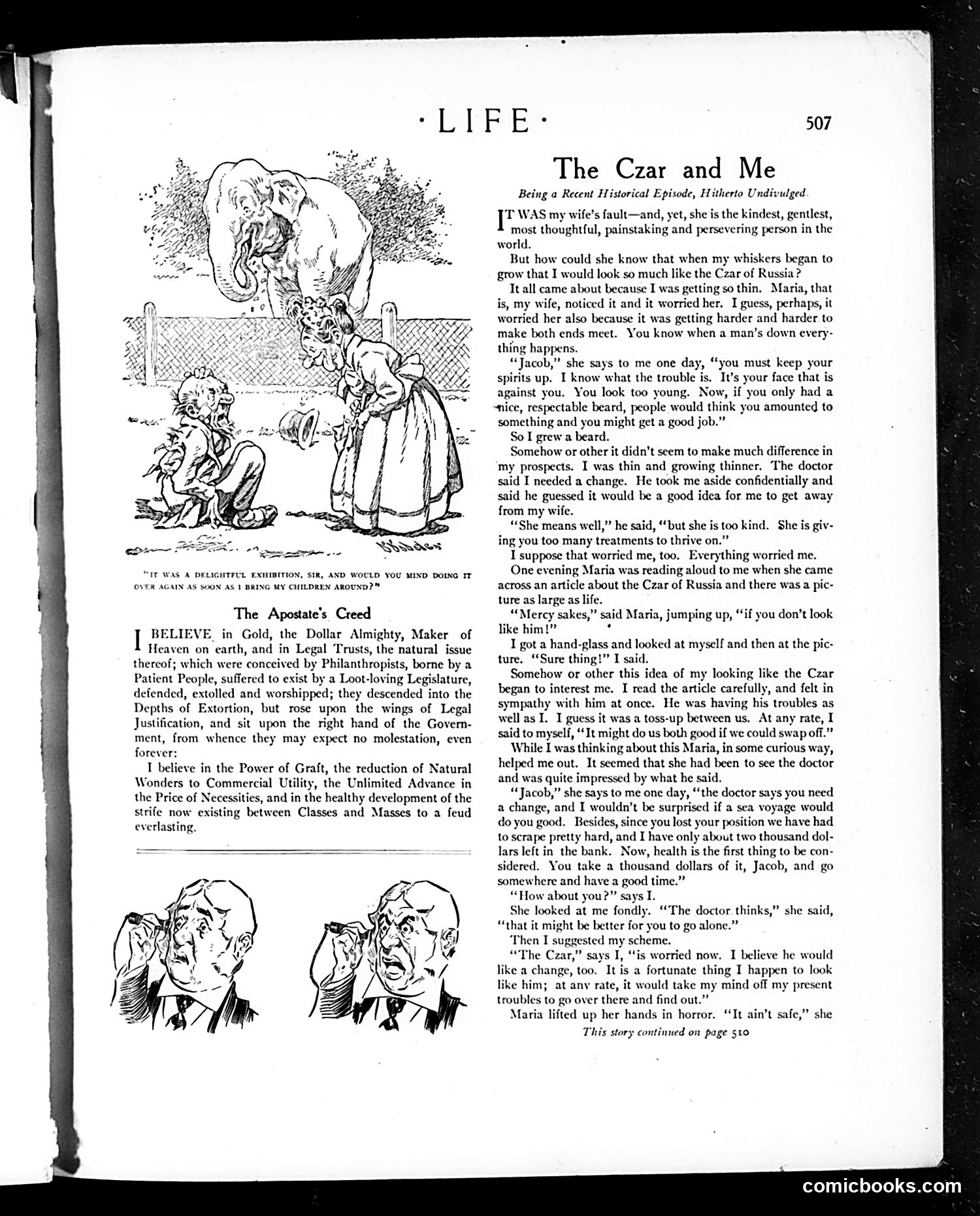
This page contains two distinct pieces of satirical content: **"The Apostate's Creed"** (left) is a mock-religious manifesto mocking American capitalism and corruption. It parodies the Christian Creed, replacing faith in God with faith in "Gold, the Dollar Almighty" and "Legal Trusts." It attacks graft, monopolies, and the widening class divide—typical Progressive Era critique of robber barons and corrupt business practices. **"The Czar and Me"** (right) is a humorous story about a poor Jewish immigrant (Jacob) who, growing a beard, begins resembling Russia's Czar. His wife Maria suggests he travel for health reasons. Jacob facetiously proposes swapping places with the Czar—a joke about the contrast between their lives and an implicit jab at Russian autocracy and Jewish persecution under the Czar. The story continues on page 510. Both pieces reflect early 20th-century American concerns: economic inequality, immigrant experiences, and skepticism toward foreign despotism.
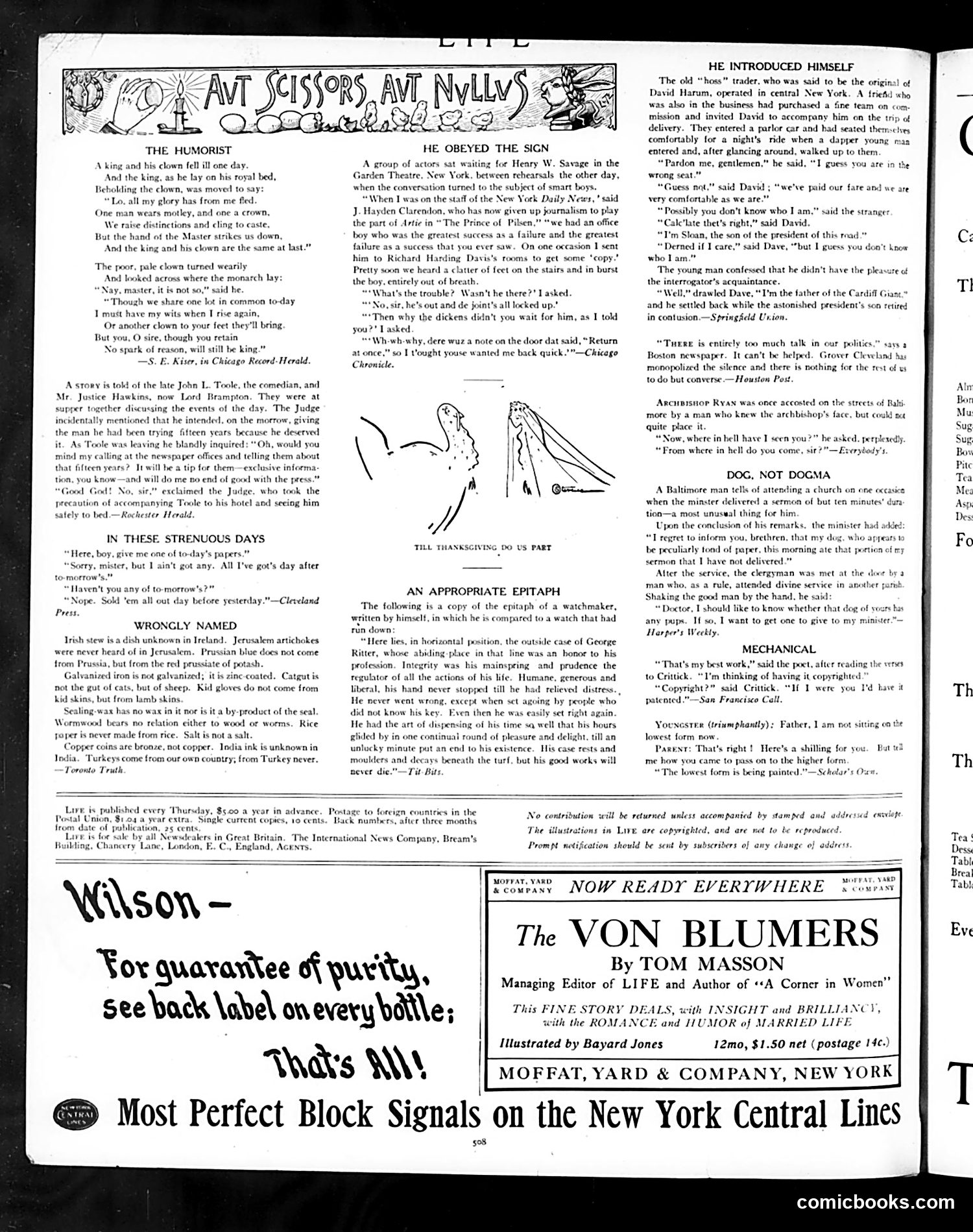
This page contains several short humorous pieces typical of *Life* magazine's satirical content: **"The Humorist and His Clown"** — A poem contrasting a dying king and jester. The king muses that death makes them equals, but the clown retorts he needs his wits to survive; the king won't. The satire mocks both aristocratic pretension and the notion that mortality erases class distinctions in practical life. **"He Obeyed the Sign"** — An anecdote about an office boy who sees a "Return at once" note on Richard Harding Davis's door and literally obeys it, returning immediately rather than waiting. The joke satirizes literalism and blind obedience to authority. **Other brief pieces** include jokes about newsboys selling tomorrow's papers and a humorous list of misnomers (Irish stew, Jerusalem artichokes, etc.). The page also advertises *The Von Blumers* by Tom Masson and Wilson's products. The overall tone is gentle, verbal humor typical of early-20th-century American satirical magazines.
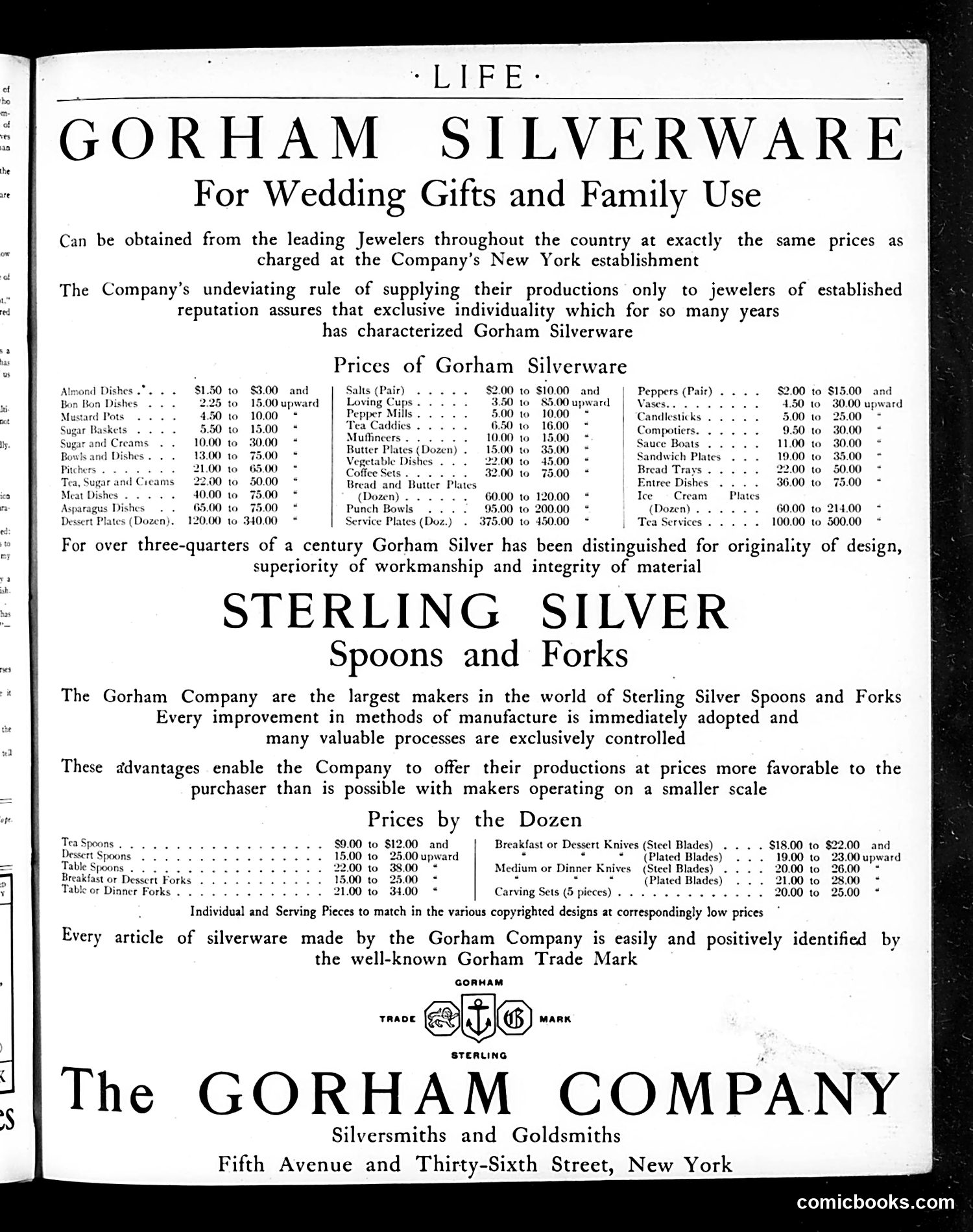
This is **not a cartoon or satirical content** — it is a full-page advertisement for the Gorham Company's silverware products, appearing in *Life* magazine. The page promotes Gorham silverware for weddings and household use, emphasizing the company's reputation, exclusive distribution through established jewelers, and manufacturing superiority. It lists extensive pricing for various silver items (dishes, bowls, spoons, forks, service plates) and claims Gorham as "the largest makers in the world of Sterling Silver Spoons and Forks." The only visual element is the **Gorham Trade Mark** — a company logo featuring an anchor and decorative elements. This represents early 20th-century luxury goods advertising targeting affluent consumers. There is no political satire, caricature, or social commentary present. The page simply showcases commercial product offerings and brand positioning.
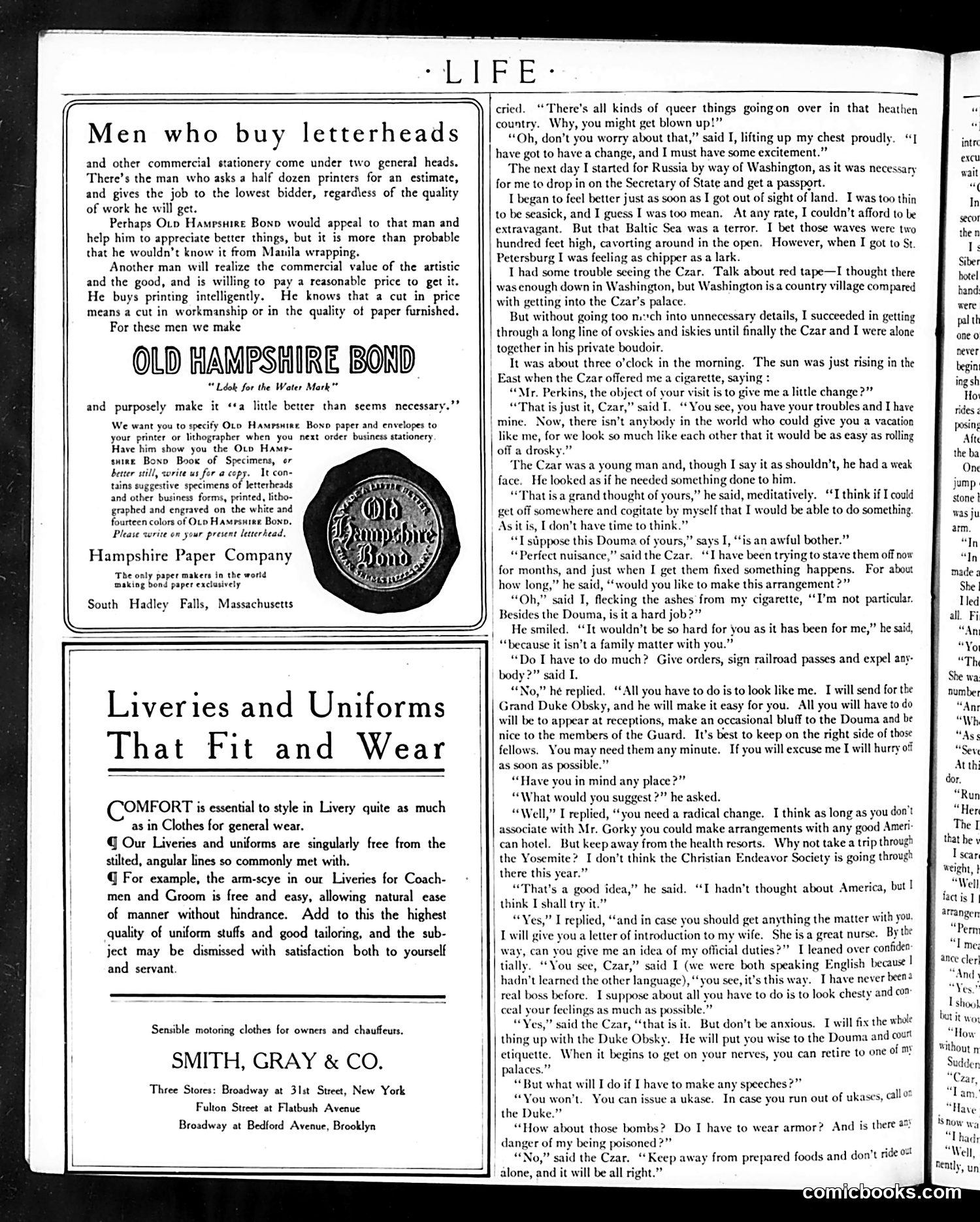
This page contains two distinct elements: a commercial advertisement and satirical fiction. **The Advertisement** (left side) for Old Hampshire Bond stationery presents a class-based argument: there are two types of business men—those who buy cheap, and intelligent men willing to pay for quality. The ad appeals to business vanity and professionalism. **The Story** (right side) is satirical fiction about an American named Perkins who, seeking excitement, travels to Russia and convinces Tsar Nicholas II to swap places. The satire mocks: - American tourism and restlessness ("I must have some excitement") - Russian bureaucracy ("Talk about red tape") - The Tsar's weakness and need for guidance - The Tsar's complaints about the Duma (Russia's parliament, established 1906), framing it as a "perfect nuisance" The humor hinges on an American casually offering to impersonate the Russian autocrat—suggesting both the Tsar's inadequacy and American audacity. This appears to reference early 1900s Russia during constitutional tension.
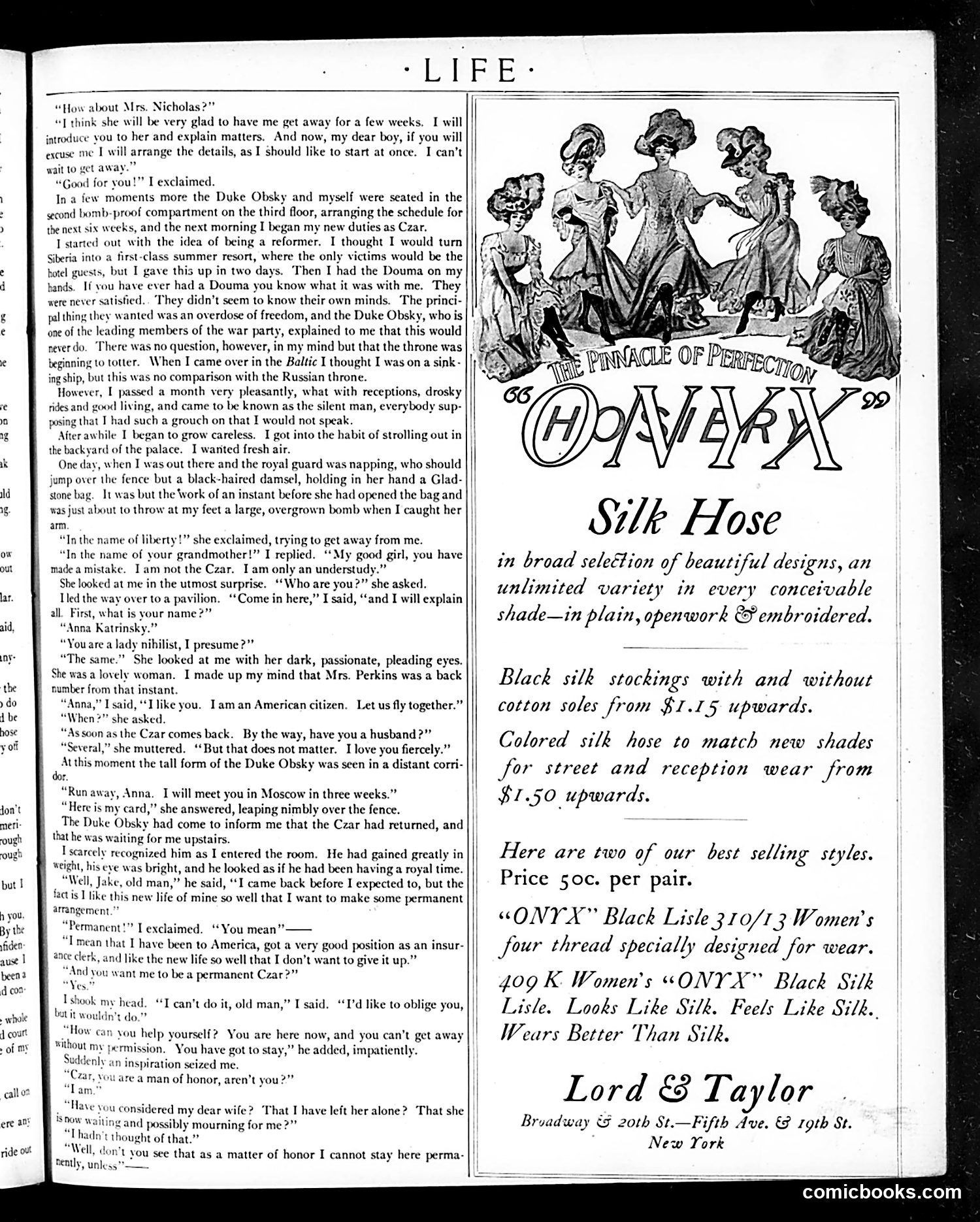
This page presents a serialized satirical story about an American who impersonates the Russian Czar. The narrative mocks early 20th-century Russian political instability: the Douma (parliament) is portrayed as perpetually dissatisfied, demanding "overdose of freedom," while the throne itself is "beginning to totter." The satire targets both Russian autocracy and American naïveté. The protagonist encounters "Anna Katrinsky," a nihilist bomb-thrower—referencing the real anarchist/revolutionary movements threatening the Russian Empire. Their romantic entanglement satirizes both revolutionary fervor and American romantic idealism. The joke's point: Americans stumbling into foreign intrigue, combined with Russia's institutional chaos where even an understudy can temporarily rule. The Czar's eventual return and desire to remain in America (having discovered better opportunities) offers satirical commentary on Russia's dysfunction versus American opportunity. The right page is primarily a Lord & Taylor advertisement for silk hosiery—typical Life magazine mixed content.
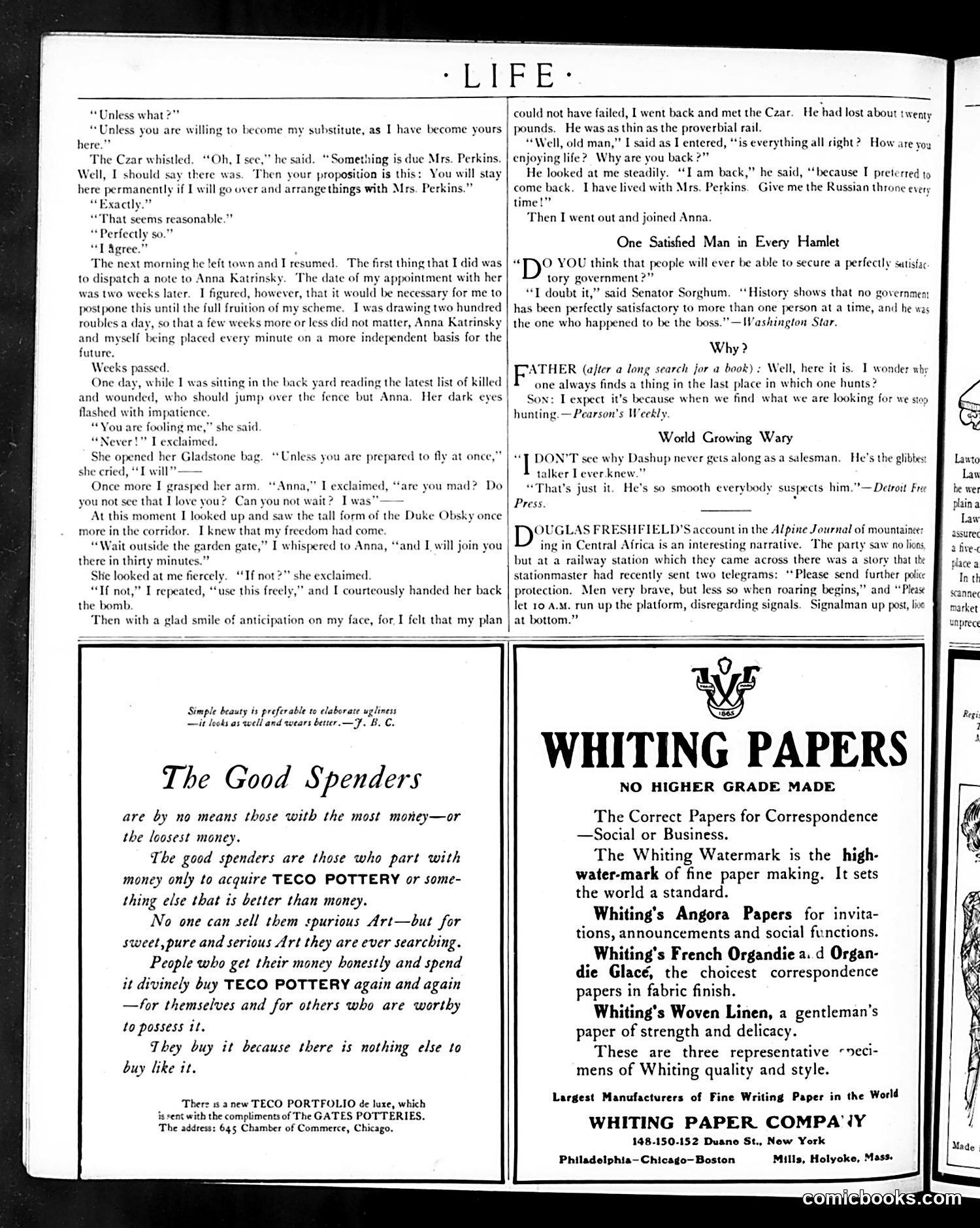
This page contains **narrative fiction and humor pieces**, not political cartoons. The main content is a serialized story about a man who impersonates a Russian Czar and arranges a wife-swap with him—a absurdist comedy playing on themes of identity and romantic entanglement. The humor sections below include: - **"One Satisfied Man in Every Hamlet"**: Senator Sorghum jokes that no government satisfies everyone except whoever holds power—political satire on the impossibility of universal contentment. - **"Why?"**: A mild observational joke about finding lost items. - **"World Growing Wary"**: Quips about salesmanship and suspicious behavior, plus a anecdote about African railway workers and a lion threat. The page is primarily **entertaining fiction and light social commentary** rather than hard political satire. The advertisements for Whiting Papers and Teco Pottery occupy significant space, indicating this is mid-20th century consumer-focused content aimed at educated, middle-class readers.
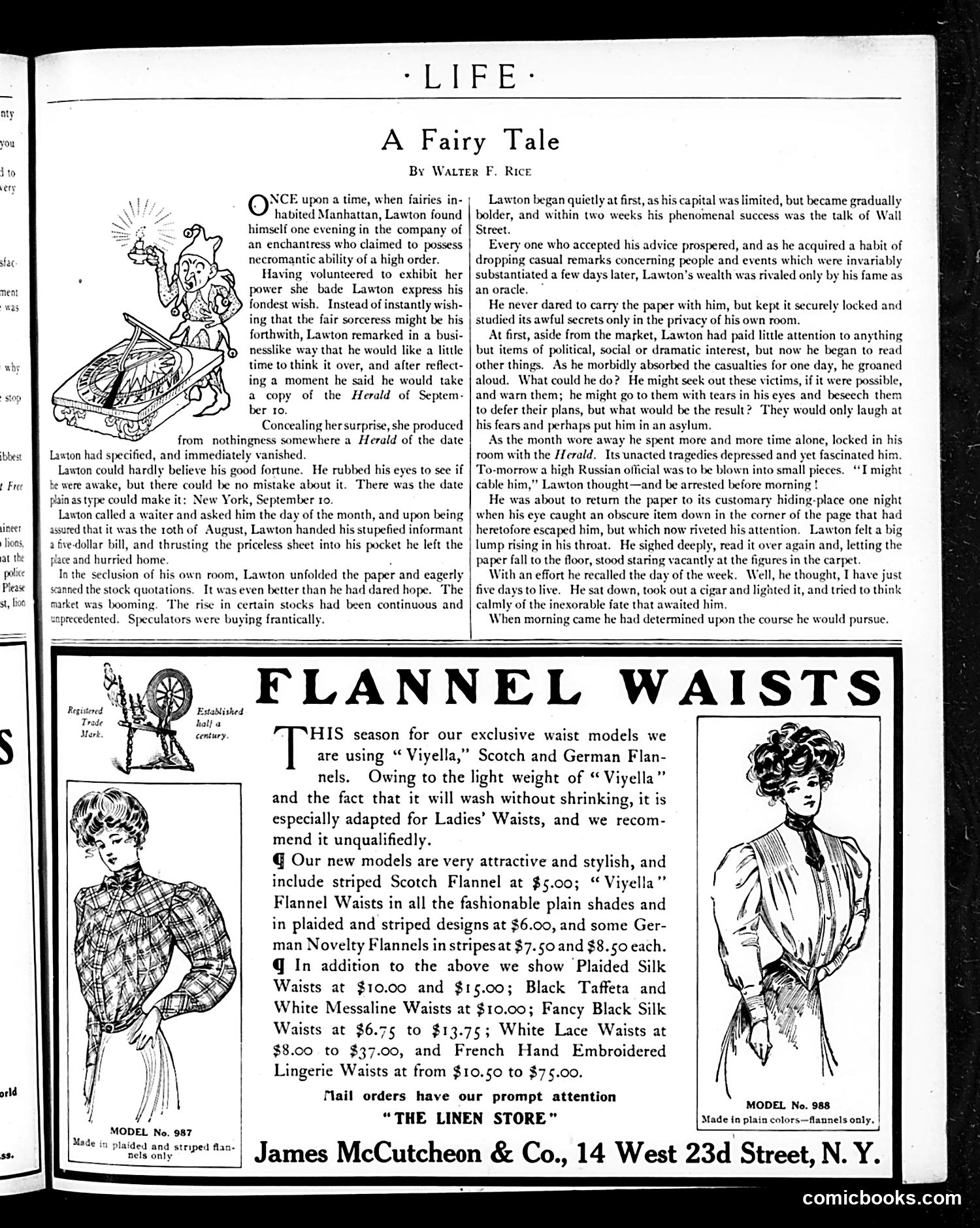
This page contains a short story titled "A Fairy Tale" by Walter F. Rice, satirizing stock market speculation and the get-rich-quick mentality of the era. **The Satire:** A man named Lawton obtains a newspaper from the future (September 10) through magical means while it's still August. He uses the stock quotations to make a fortune on Wall Street, becoming fabulously wealthy and famous. However, the story's darker implication emerges when he notices a personal item in the paper predicting his own death—giving him only five days to live. **The Point:** This is social satire about the obsessive nature of financial speculation and the moral bankruptcy of using inside information for profit. The magical premise highlights how absurdly privileged such advantage would be, while the ending suggests grim consequences for those consumed by market mania. The page also contains an advertisement for "Flannel Waists" from James McCutcheon & Co.—typical of Life's mixed editorial and advertising content.
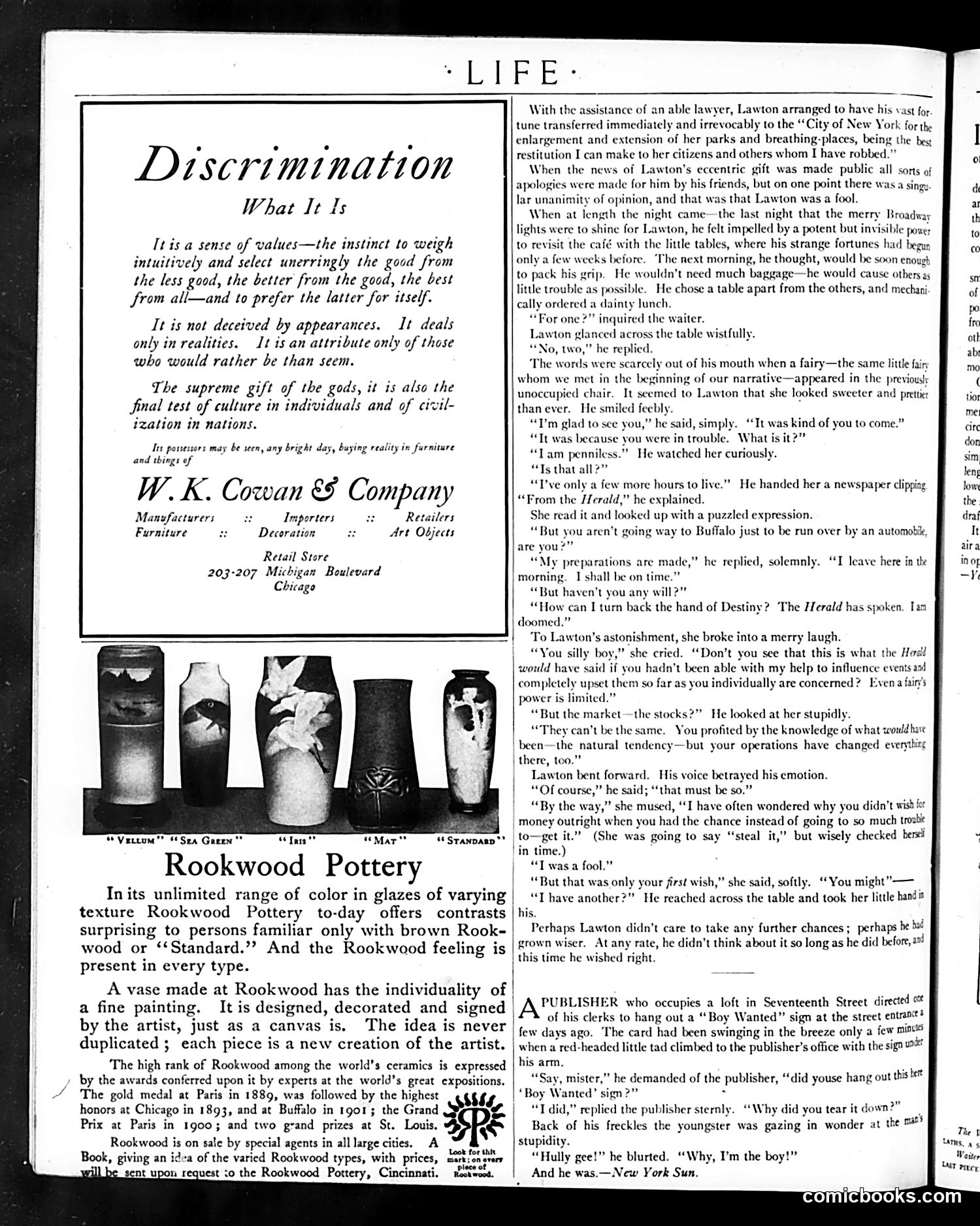
This page contains **primarily advertising and serialized fiction**, not political satire. The left side features ads for **W.K. Cowan & Company** (furniture/decorative arts) and **Rookwood Pottery** (a Cincinnati ceramics manufacturer known for artistic glazes). The pottery ad emphasizes craftsmanship and individuality—each piece uniquely created. The right side continues a serialized story about a character named **Lawton**, apparently a wealthy man who has donated his fortune to New York City parks and now faces financial ruin. A "fairy" character appears to console him, mocking his despair over predicted stock market losses and an ominous newspaper prediction of his death. The fairy argues he can change his fate through agency and wisdom. The story's theme—**discrimination** (defined in the sidebar as discerning true value from appearance)—connects thematically to the luxury goods advertised: both emphasize substance over superficiality, authentic quality over mere show. This was typical Life magazine content: literature, advertising, and humor blended together.
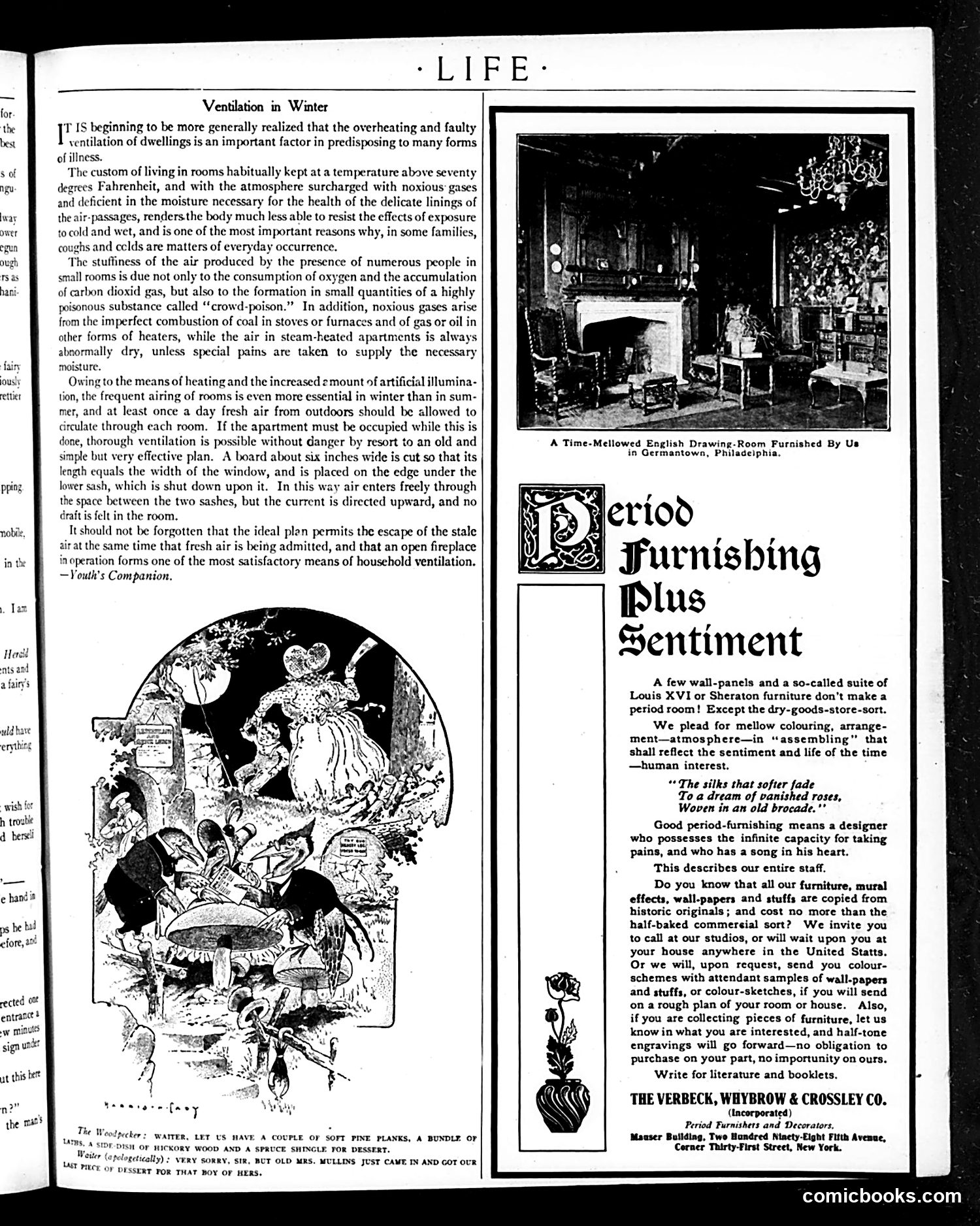
This page contains two distinct elements: an informational article on winter ventilation and period furnishings advertisements. **Left side:** A serious health article warns that overheated, poorly ventilated homes—common in that era—spread illness. It explains how sealed rooms accumulate "crowd-poison" (carbon dioxide and other noxious gases) and advocates opening windows daily. A humorous illustration shows a waiter apologizing because an elderly woman ("Mrs. Mullins") ate all the dessert meant for a boy—likely satirizing the complaint that in stuffy rooms, people lose appetite or behave oddly. **Right side:** An advertisement for The Verbeck, Whybrow & Crossley Company promotes "period furnishing" (historically accurate interior design). It contrasts authentic, carefully designed period rooms with cheap commercial imitations, appealing to affluent customers who valued tasteful, historically researched home decoration. The photograph shows an actual English drawing room they furnished. Both pieces reflect early 20th-century concerns: public health awareness and the emerging middle-class aspiration toward refined, historically-informed domestic environments.
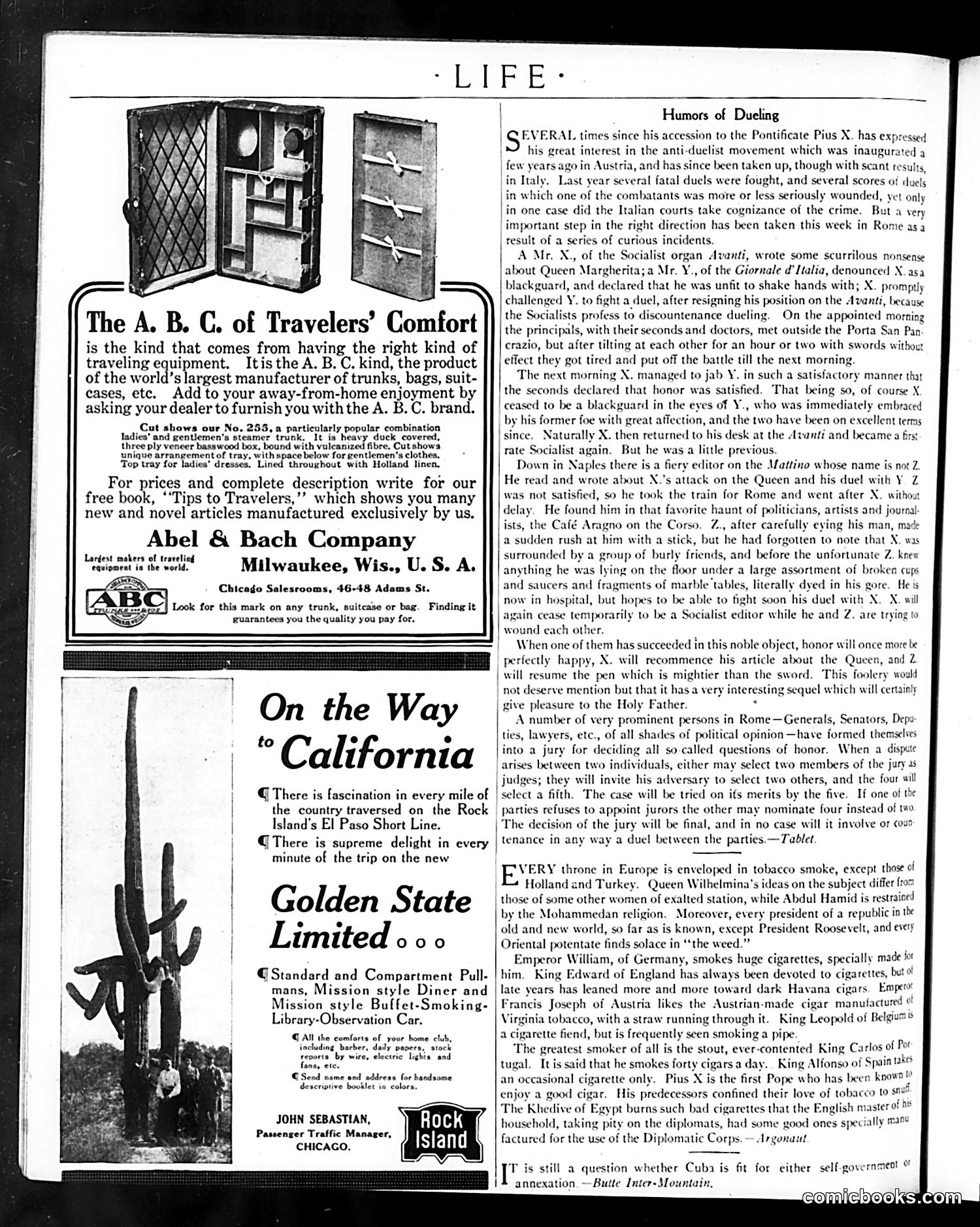
This page contains **advertisements and a satirical article about dueling in Italy**, not political cartoons. The main content is "Humors of Dueling," which mocks the Italian anti-dueling movement by recounting absurd recent incidents in Rome. The piece describes how a Socialist newspaper editor (Mr. X) insulted Queen Margherita, was challenged by a rival editor (Mr. Y) from a competing paper, fought an inconclusive duel, then—following the duel's conclusion—became friendly with his opponent. The satire lies in exposing how dueling culture persists despite official opposition: men fight over honor, declare satisfaction with minor wounds, then reconcile as if nothing happened. The article critiques both the **futility of anti-dueling efforts** and the **absurdity of honor-based violence**, suggesting Italy's dueling tradition remains deeply embedded despite papal and legal discouragement. The remainder of the page shows typical period advertisements for travel trunks (Abel & Bach Company) and railroad service (Rock Island Line to California).
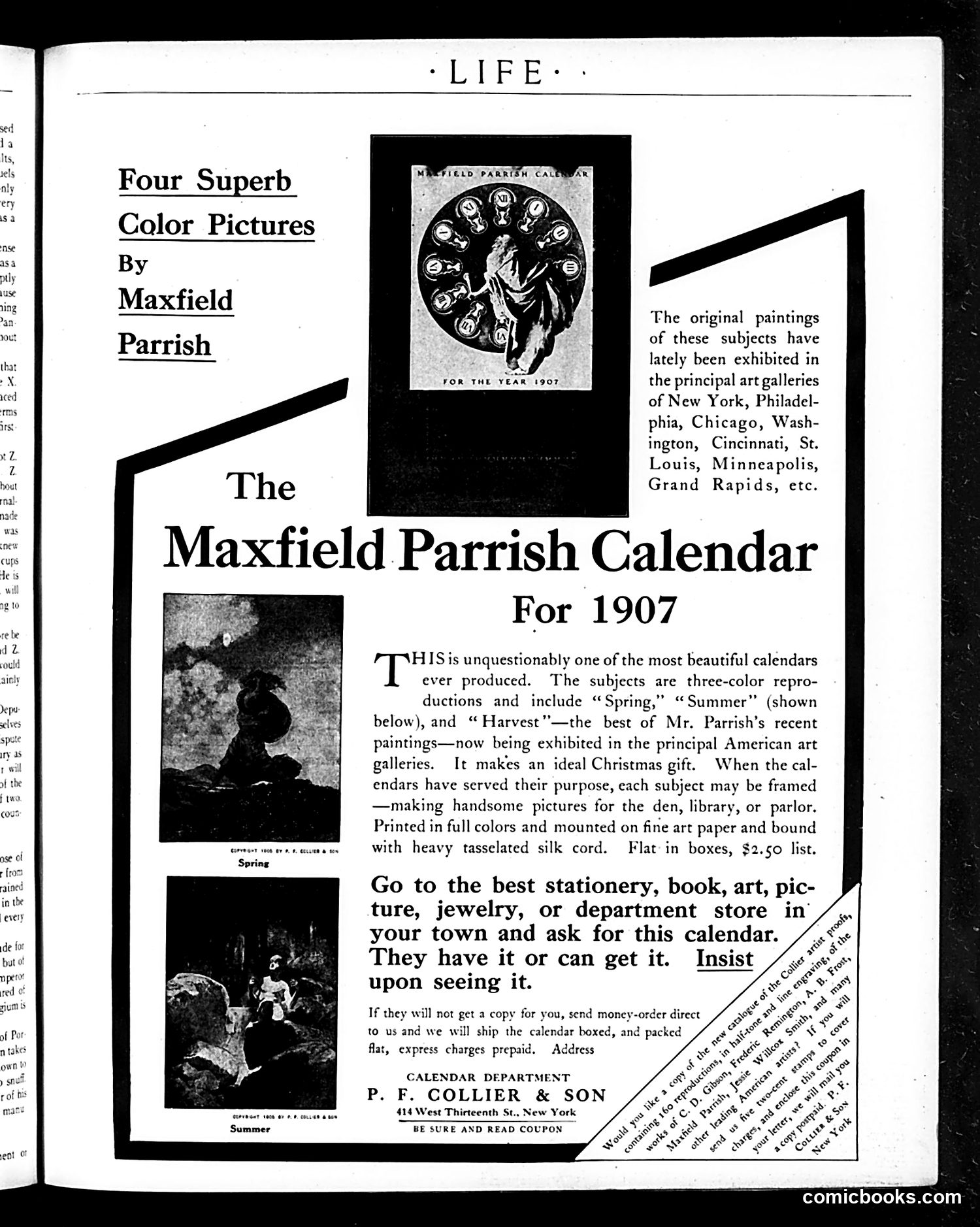
This page is primarily **advertising**, not satire or political commentary. It promotes *The Maxfield Parrish Calendar for 1907*, featuring three-color reproductions of paintings by the renowned American artist Maxfield Parrish. The advertisement emphasizes that Parrish's original paintings have been exhibited in major American art galleries (New York, Philadelphia, Chicago, etc.), lending prestige to the calendar. It markets the product as an ideal Christmas gift that, after serving its calendar purpose, can be framed as decorative art for home interiors. The visible images show examples from the calendar: "Spring" and "Summer" paintings depicting figures in Parrish's characteristic romantic, allegorical style. The calendar cost $2.50 and was distributed by P.F. Collier & Son publishers in New York. This represents early 20th-century marketing strategy: positioning mass-produced art reproductions as affordable luxury goods for middle-class homes.
This page is primarily **advertising**, with several short satirical anecdotes in the "Our Foolish Contemporaries" section. The main cartoon/satirical content critiques **police corruption and graft**. The "Typical Raid" anecdote mocks how police conduct raids on gambling dens—the lieutenant reports being "ready" with "flashlight camera men" and having notified the proprietor in advance. The satire is obvious: the police are staging a theatrical performance rather than conducting a genuine raid, essentially tipping off the criminals beforehand. This reflects Progressive Era concerns about urban corruption and the collusion between law enforcement and illegal operations. The remaining anecdotes are brief jokes about various social situations (a patient paying a doctor with musical performances, clerical hypocrisy about charity, election fraud, etc.)—typical humorous filler for the magazine. The rest of the page consists of period advertisements for whiskey, champagne, cigarettes, and hotels, which were standard revenue sources for publications like *Life*.
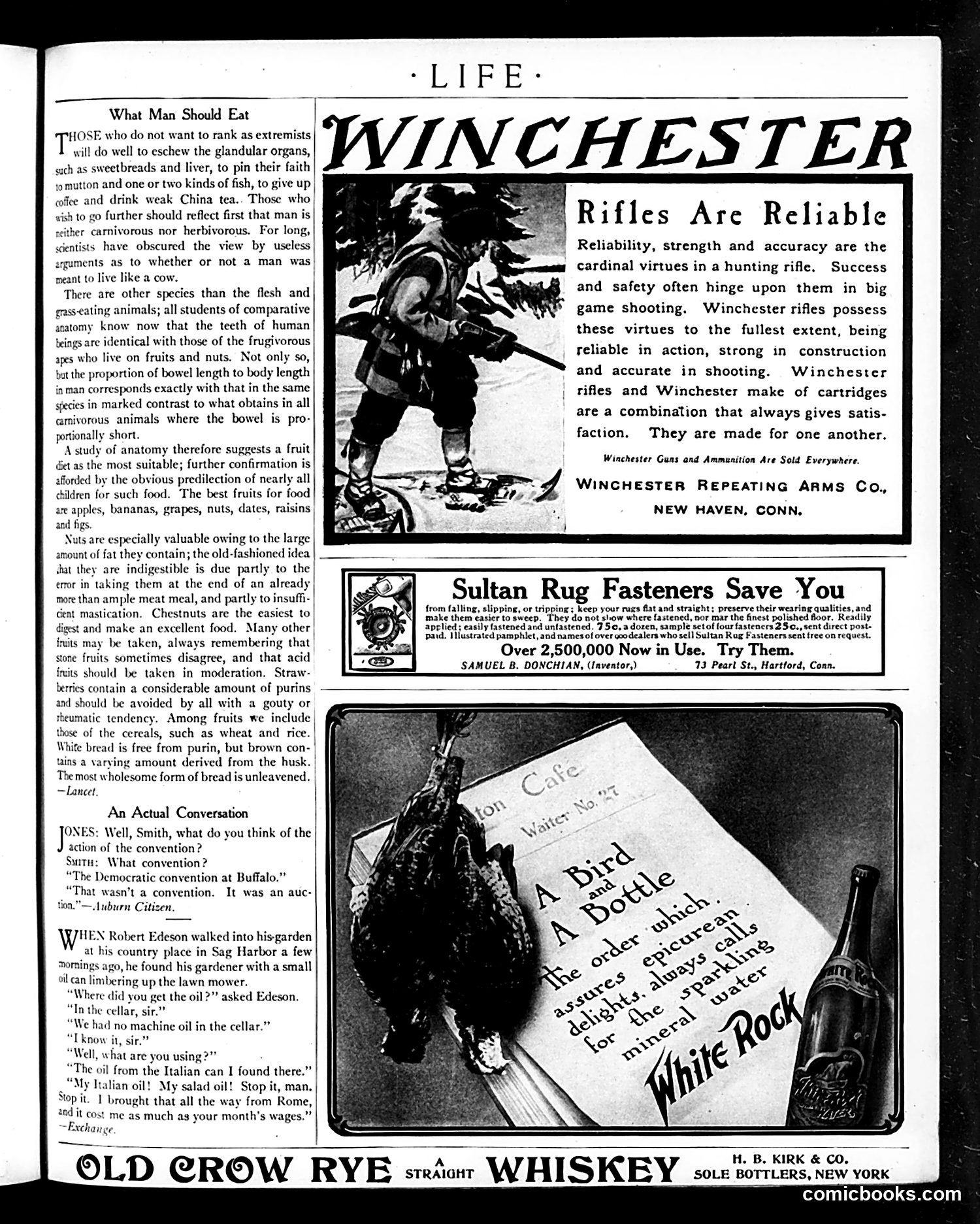
This page is primarily **advertising** interspersed with humor columns, not political satire. The content includes: **"What Man Should Eat"** – A serious dietary essay arguing humans are naturally frugivorous (fruit-eating), based on comparative anatomy of teeth and bowel length, advocating fruits, nuts, and unleavened bread over meat. **"An Actual Conversation"** – Two brief jokes. The first puns on the 1912 Democratic convention at Buffalo, calling it an "auction" (likely referencing corruption or money's influence). The second involves an actor whose gardener uses expensive imported Italian salad oil to lubricate a lawn mower—a joke about waste and class confusion. **Advertisements** dominate: Winchester rifles, Sultan rug fasteners, and Old Crow whiskey. The page reflects early 20th-century concerns with health, diet reform, and political cynicism about conventions, but is not primarily satirical commentary.
This page is primarily **advertisements and filler content** rather than political cartoons. The main satirical piece is the poem "Taft" by the Baltimore Sun, a commentary on President Theodore Roosevelt's interventionist foreign policy. ## The "Taft" Poem The verse mocks the solution to every American problem—domestic or international—as simply sending "Bill" (William Howard Taft, Roosevelt's Secretary of War and chosen successor). Whether it's leaky pipes, labor disputes, Congress asserting itself, or colonial unrest in Panama and the Philippines, the refrain is "Send Bill!" The satire criticizes Roosevelt's aggressive military interventionism and reliance on Taft to handle crises worldwide. It suggests this approach had become reflexive and absurdly oversimplified. ## Other Content The page includes period advertisements (moccasins, estate services, light bulbs) and anecdotes about historical spelling and the painter Rossetti—typical Life magazine filler from this era (likely early 1900s, based on Roosevelt/Taft references).
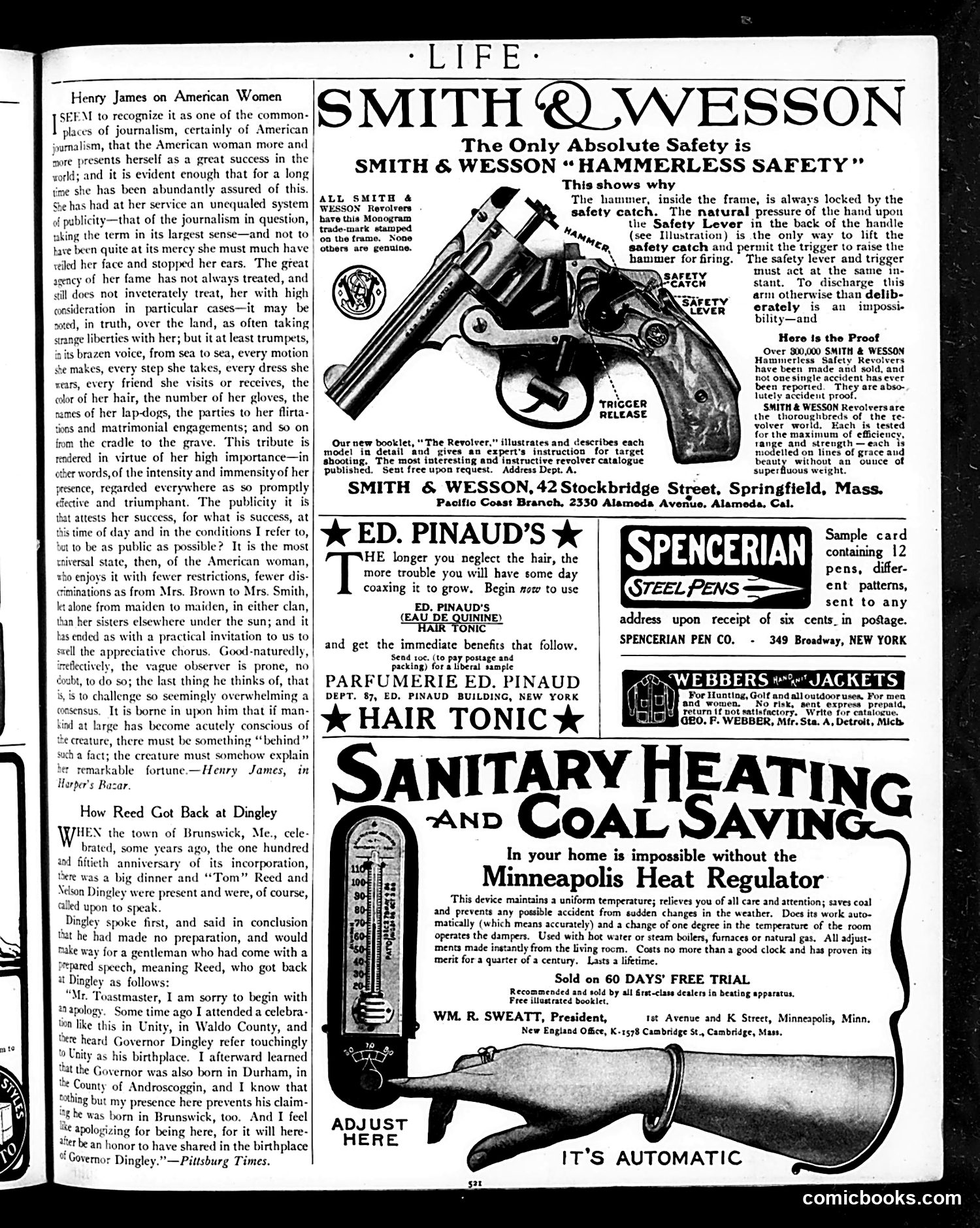
This page is primarily **advertisements and literary excerpts**, not political cartoons. The Henry James excerpt discusses American women's ubiquitous presence in journalism and publicity—how the press obsessively covers every detail of their lives (hair, gloves, social engagements). James critiques how this constant coverage presents American women as inherently successful, yet notes the press often treats them irreverently. The "How Reed Got Back at Dingley" anecdote is a humorous political story about Congressman Tom Reed's witty retort to Nelson Dingley (likely a Maine politician) at an 1850s Brunswick, Maine celebration. When Dingley claims birthplace connections, Reed jokes that Dingley was born in multiple places, so Reed himself shouldn't apologize for attending—a clever mock-apology that deflates Dingley's self-importance. The remainder consists of product advertisements: Smith & Wesson revolvers, Ed. Pinaud hair tonic, Spencerian pens, and heating regulators. These reflect early 1900s consumer culture.
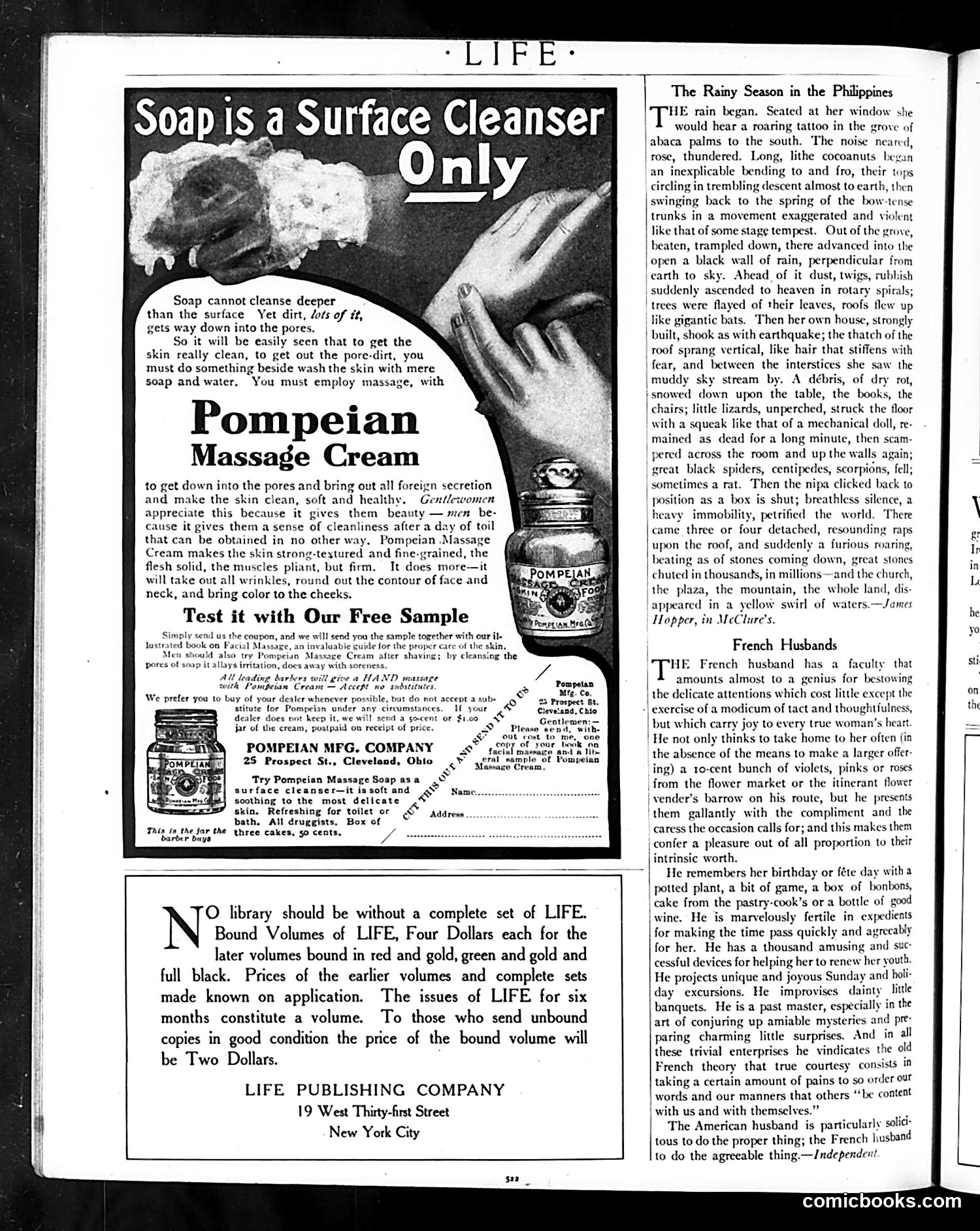
This page is primarily **advertising**, not political satire. The dominant content is a Pompeian Massage Cream advertisement claiming that soap alone cannot clean pores—only massage cream can reach deep into skin and remove dirt. The ad targets both women (promising beauty and wrinkle reduction) and men (promoting post-shave use by barbers). A coupon offers a free sample. Below is an unrelated **Life Publishing Company advertisement** selling bound volumes of the magazine itself. The right column contains a **short story excerpt**, "The Rainy Season in the Philippines," describing vivid meteorological drama—a violent tropical downpour affecting a colonial-era house and its occupant. This appears to be literary content rather than satire or commentary. There is **no political cartoon or social satire** on this page—it's a commercial publication page from an era when Life magazine mixed editorial content with advertising.
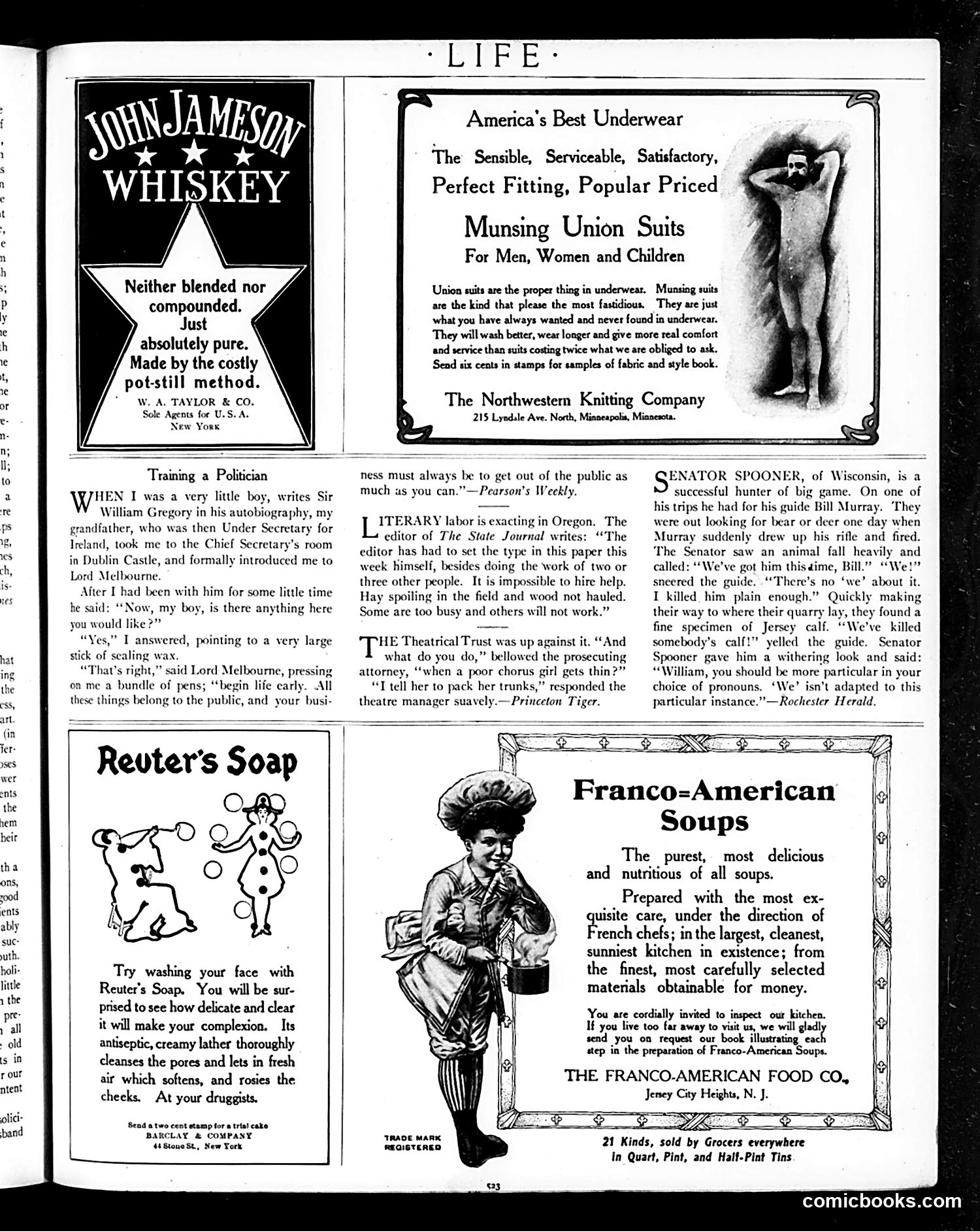
This page is primarily **advertisements and humorous anecdotes**, not political cartoons. The main content includes: **Advertisements:** John Jameson Whiskey, Munsing Union Suits (underwear), Reuter's Soap, and Franco-American Soups dominate the layout with period product claims typical of early 20th-century marketing. **Humorous Sketches:** Three brief, unrelated anecdotes appear under "Training a Politician": 1. A story about young William Gregory being encouraged by Lord Melbourne to steal public pens—satirizing political corruption and the normalization of self-dealing in office. 2. A note about Oregon newspaper labor shortages during hay season—commenting on rural labor difficulties. 3. A joke about Senator Spooner of Wisconsin, his guide Bill Murray, and mistakenly shooting a calf instead of game—a straightforward hunting mishap joke playing on Murray's pedantic insistence on proper pronoun usage ("I" vs. "we"). The page reflects Life's model of mixing light satirical commentary with commercial advertising rather than featuring sustained political cartooning.
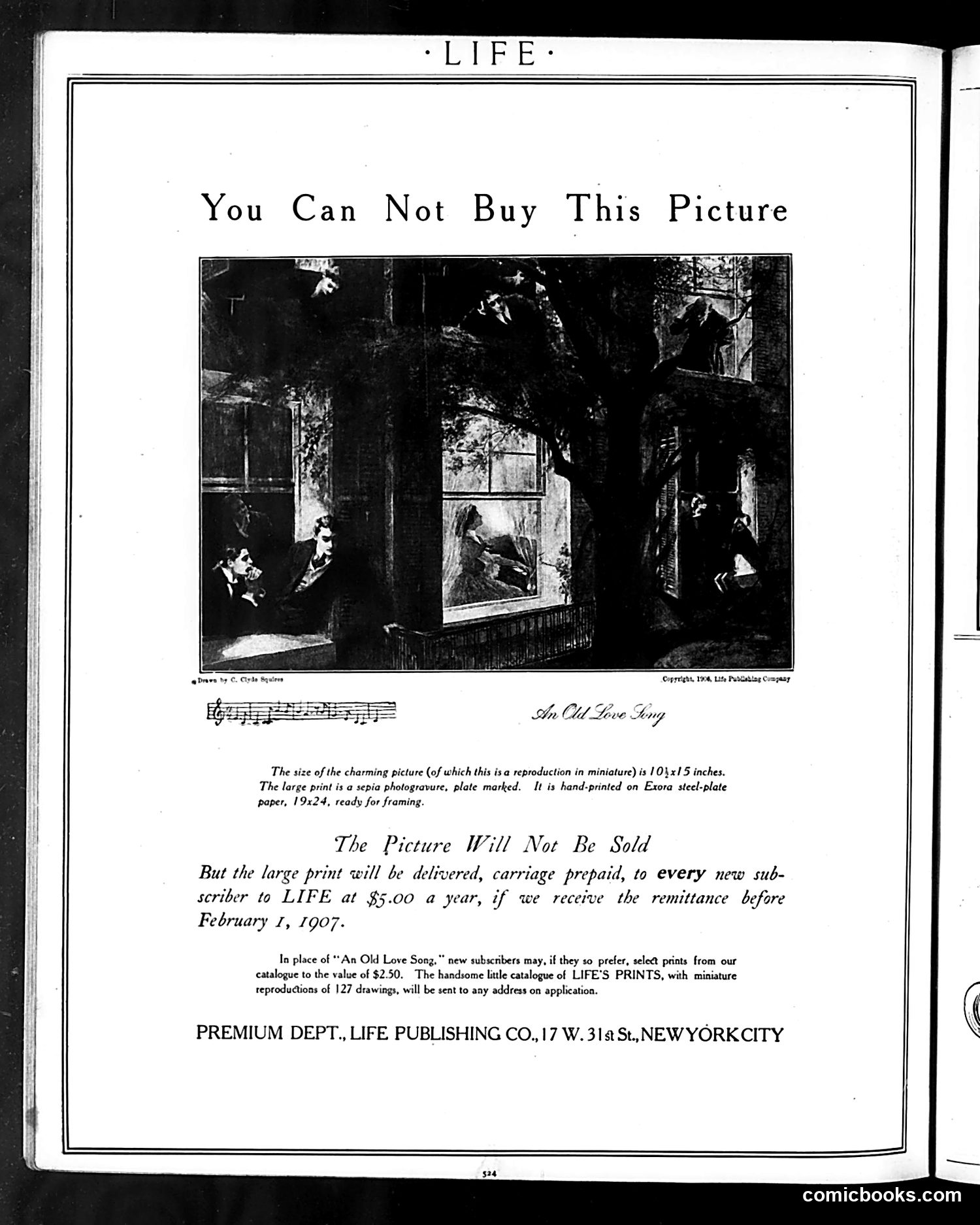
This is primarily a **subscription promotion**, not political satire. Life magazine is advertising a premium offer to new subscribers. The image shows a romantic scene titled "An Old Love Song"—a sepia photogravure by C. Clyde Squires depicting figures in an intimate moment by a window. The scene appears sentimental and nostalgic, typical of early 1900s popular illustration. **The Hook:** Life promises subscribers who pay $5.00 annually (by February 1, 1907) will receive a large hand-printed version of this image (19x24 inches) suitable for framing—at no additional cost. The title "You Can Not Buy This Picture" is a marketing gimmick: the picture itself won't be sold separately, only given as a subscriber incentive. Subscribers could alternatively choose prints from a 127-drawing catalog worth $2.50. This reflects early 20th-century magazine business strategy: using attractive premium offerings to build subscription bases.
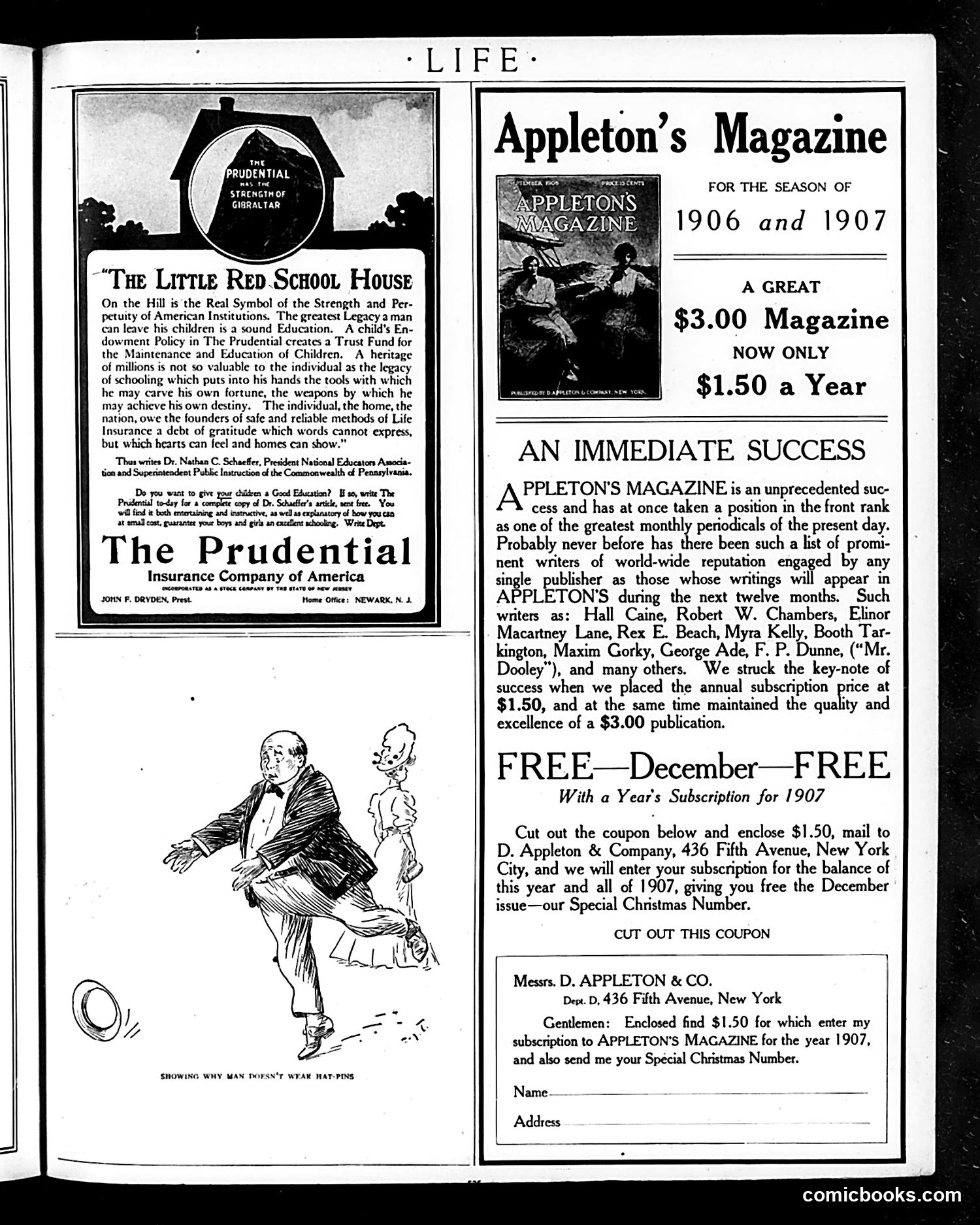
This page combines insurance advertising with magazine promotion and a social satire cartoon. **Left side:** A Prudential Insurance advertisement quotes Pennsylvania's education superintendent endorsing life insurance as funding children's education—a "legacy" argument positioning insurance as patriotic duty. Below is a cartoon captioned "Showing Why Man Doesn't Wear Hat-Pins," depicting a man being stabbed/pricked by a woman's hat pin, a contemporary fashion hazard. Hat pins were long, sharp accessories women wore to secure elaborate hats; they frequently caused injury in crowded spaces, making them a recurring topic of social complaint and satire in early 1900s publications. **Right side:** Appleton's Magazine advertises a subscription price reduction from $3.00 to $1.50 yearly, promoting an "unprecedented success" featuring famous contemporary writers (Hall Caine, Maxim Gorky, etc.). The coupon offers a free December issue with 1907 subscriptions. The page reflects Edwardian advertising practices and social concerns of the era.
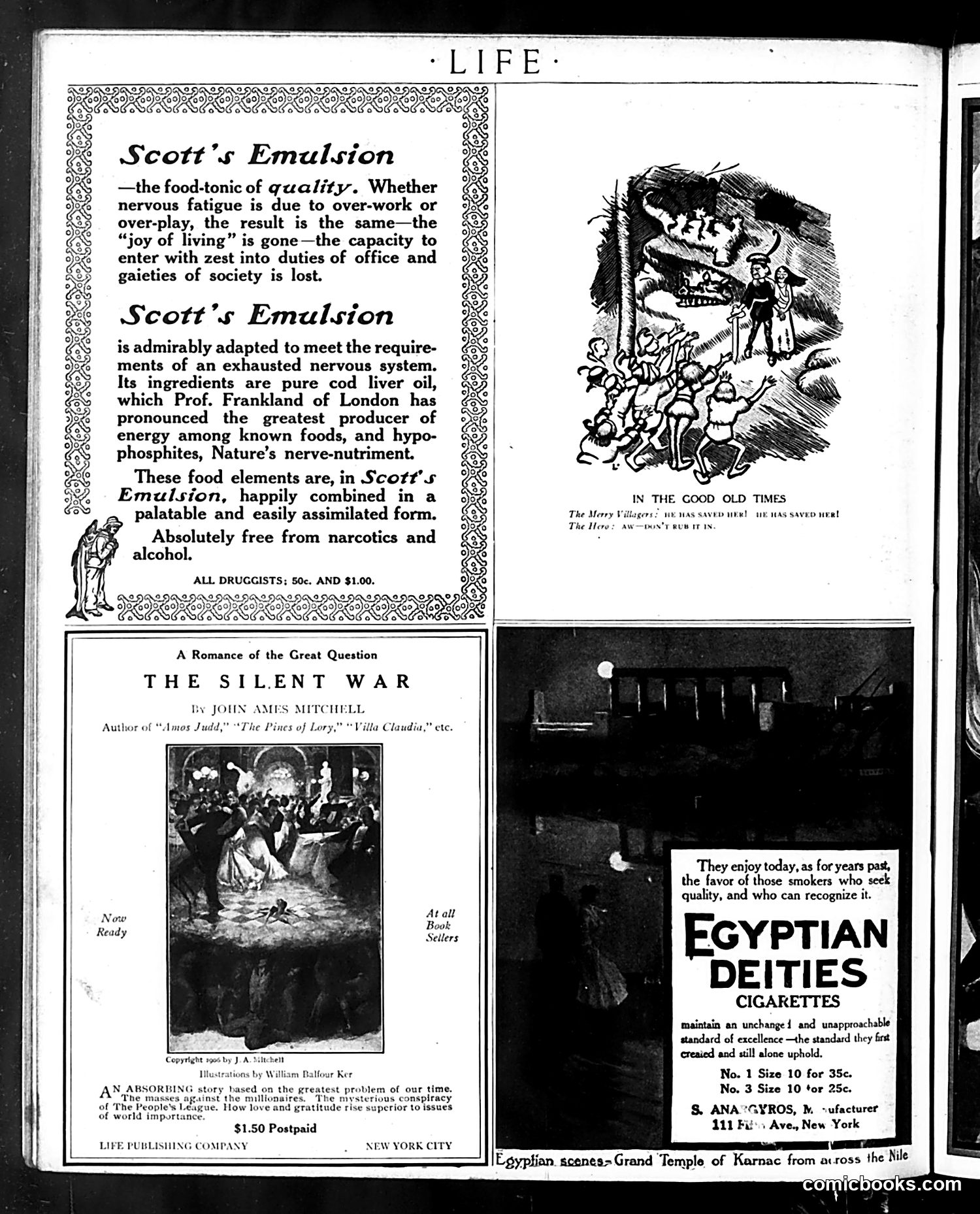
This page is primarily **advertising and promotional content** rather than political satire. It contains: 1. **Scott's Emulsion advertisement**: Markets a cod liver oil tonic as a cure for "nervous fatigue" caused by overwork or social excess—reflecting early 1900s concern that modern life exhausted people. The product claims to restore "joy of living." 2. **"The Silent War" book announcement**: John Ames Mitchell's romance novel, described as addressing "the greatest problem of our time"—likely referring to class conflict or labor disputes, though specifics aren't detailed. 3. **Egyptian Deities cigarettes advertisement**: Markets cigarettes as maintaining consistent quality standards, with pricing information. 4. **Small cartoon**: Shows villagers in "the good old times," with dialogue suggesting nostalgia for simpler, pre-modern life—contrasting with the nervous exhaustion theme above. The page reflects turn-of-the-century anxieties about industrialization and modern stress, marketed through products promising restoration of lost vitality.
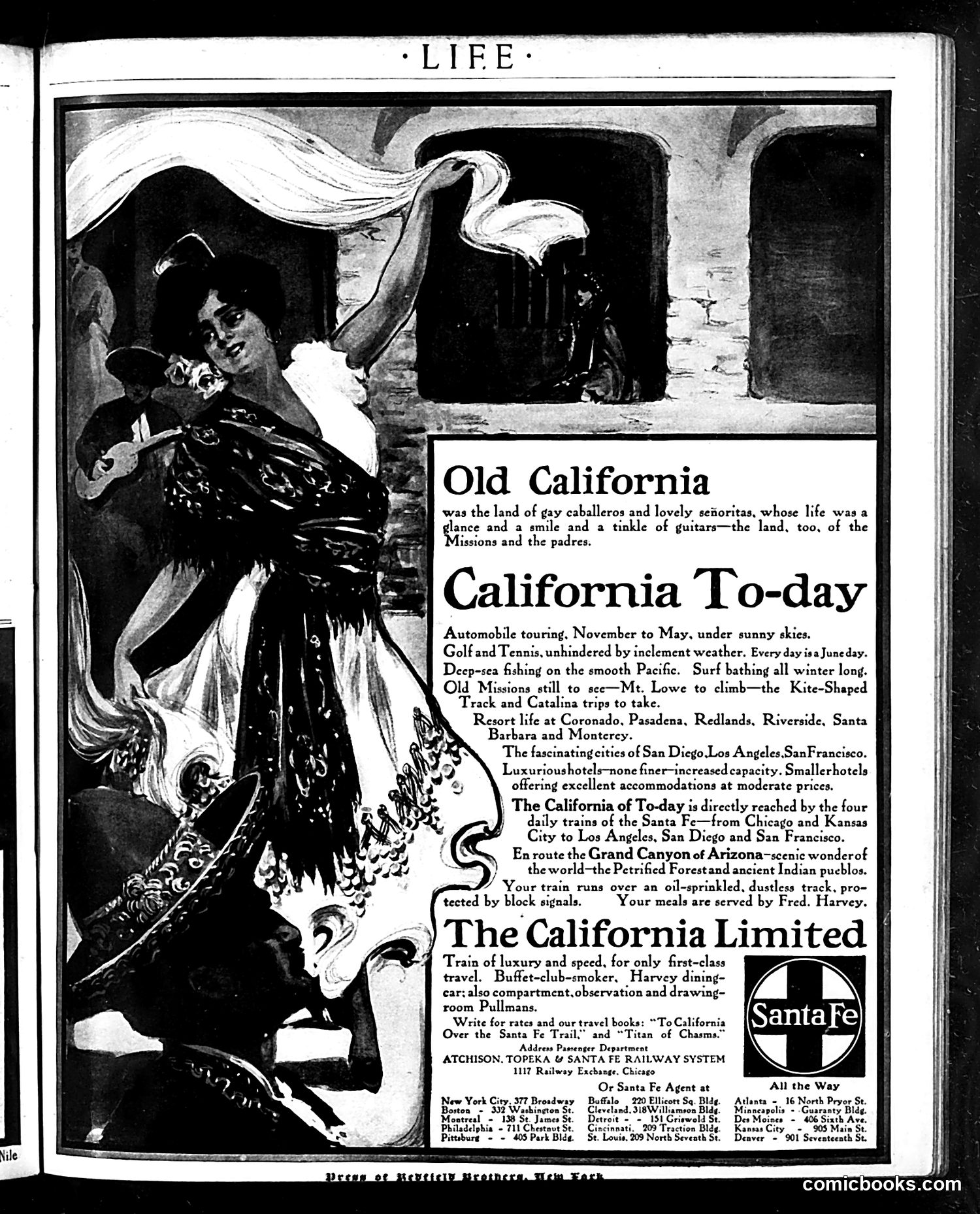
This is primarily a **Santa Fe Railway advertisement** promoting train travel to California, not a political cartoon. The illustration depicts a romanticized "Old California"—a woman in elaborate Spanish colonial dress with a flowing shawl, representing the region's historical senorita and caballero culture. This nostalgic imagery contrasts with the text's main pitch: "California To-day" offers modern leisure (golf, tennis, automobile touring, luxury hotels) accessible via Santa Fe trains running from Chicago and Kansas City. The advertisement exploits early-20th-century tourism marketing that blended romantic historical imagery with contemporary amenities. The reference to the Grand Canyon and Petrified Forest as "en route" attractions emphasizes the journey's appeal beyond the destination. The "Harvey" mention refers to Fred Harvey's famous railroad dining service, a selling point for affluent travelers. The page is essentially commerce—selling California as an aspirational winter destination.
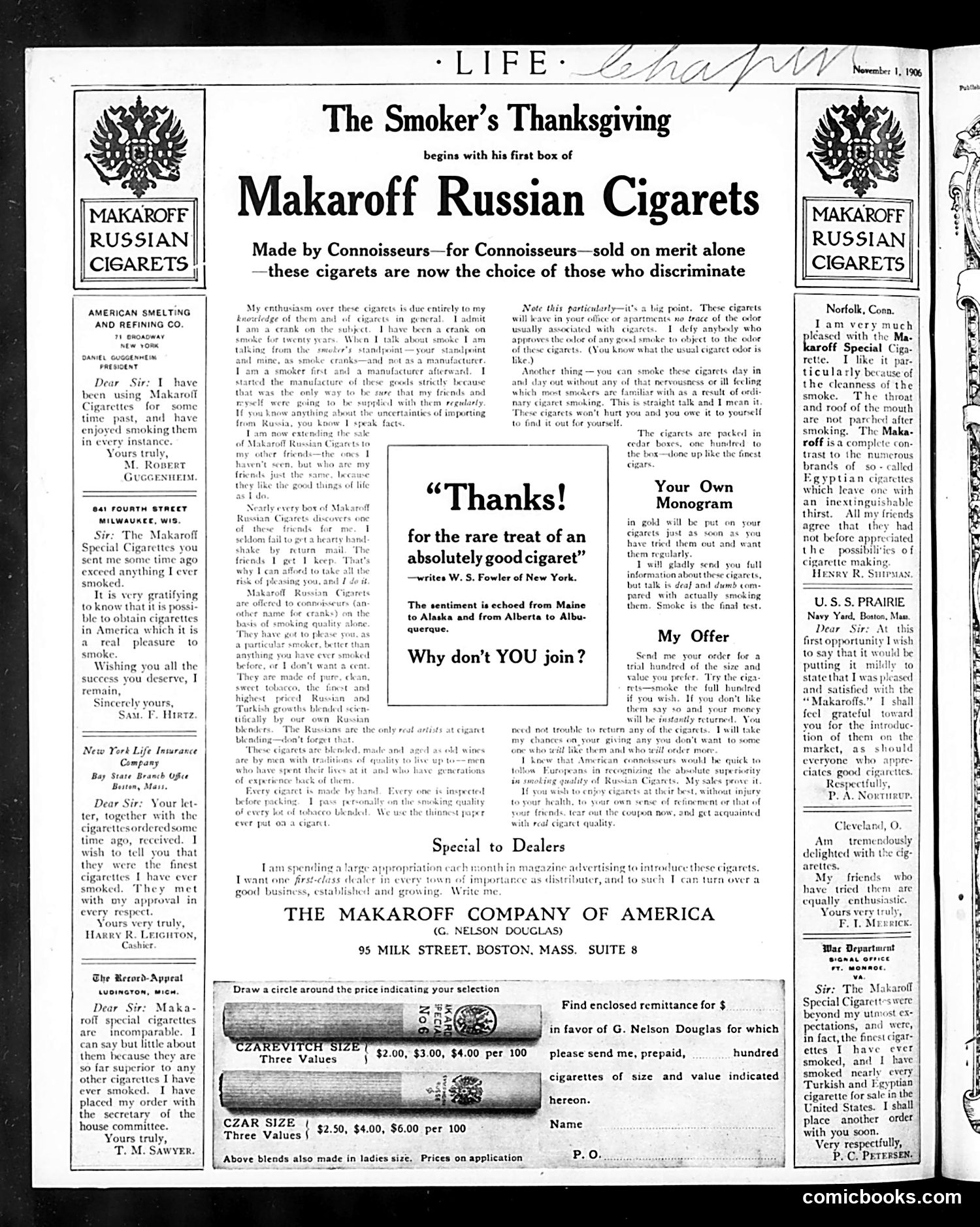
This is primarily a **cigarette advertisement** for Makaroff Russian Cigarets, disguised as editorial content in Life magazine (November 1, 1906). The page features testimonial letters from satisfied customers—presented as genuine correspondence but actually marketing copy. These praise the cigarets' superior quality and lack of odor compared to competitors. The customers include businessmen, insurance company officials, and government workers, lending false credibility. The "Thanksgiving" framing suggests these Russian cigarets represent a refined choice for discriminating smokers—positioning them as luxury goods for the elite. An offer for personalized monogramming adds exclusivity. This represents **early 20th-century advertising deception**: blending paid promotion into editorial space without clear disclosure, using fake testimonials, and appealing to class aspirations. Modern readers would recognize this as misleading advertising that would now violate FTC regulations.