
Life, 1906-11-01 · page 30 of 56
Life — November 1, 1906 — page 30: what you’re looking at
What you’re looking at
This page reviews two theatrical productions. The main critique addresses William Gillette's play "Clarice," which the reviewer finds dramatically weak despite strong acting. The play concerns a tuberculosis-stricken man contemplating suicide—a melodramatic subject the critic finds depressing and artificial compared to the charming first act. The second review praises "The Three of Us," celebrating it as evidence of American theatrical independence. The text emphasizes that this play's existence proves the recent breaking of the "Theatrical Trust"—a monopoly controlling American theater that previously blocked independent productions. The reviewer credits figures like Belasco, the Fiskes, and the Shubert brothers for fighting this monopoly, allowing unknown American authors and independent managers like Walter N. Lawrence to finally produce work. The underlying point: American drama can only flourish without monopolistic control restricting theatrical access.
📄 Transcribed text from this page (OCR, searchable)
Machine-transcribed from the original scan — historical spelling and the odd misread are preserved.
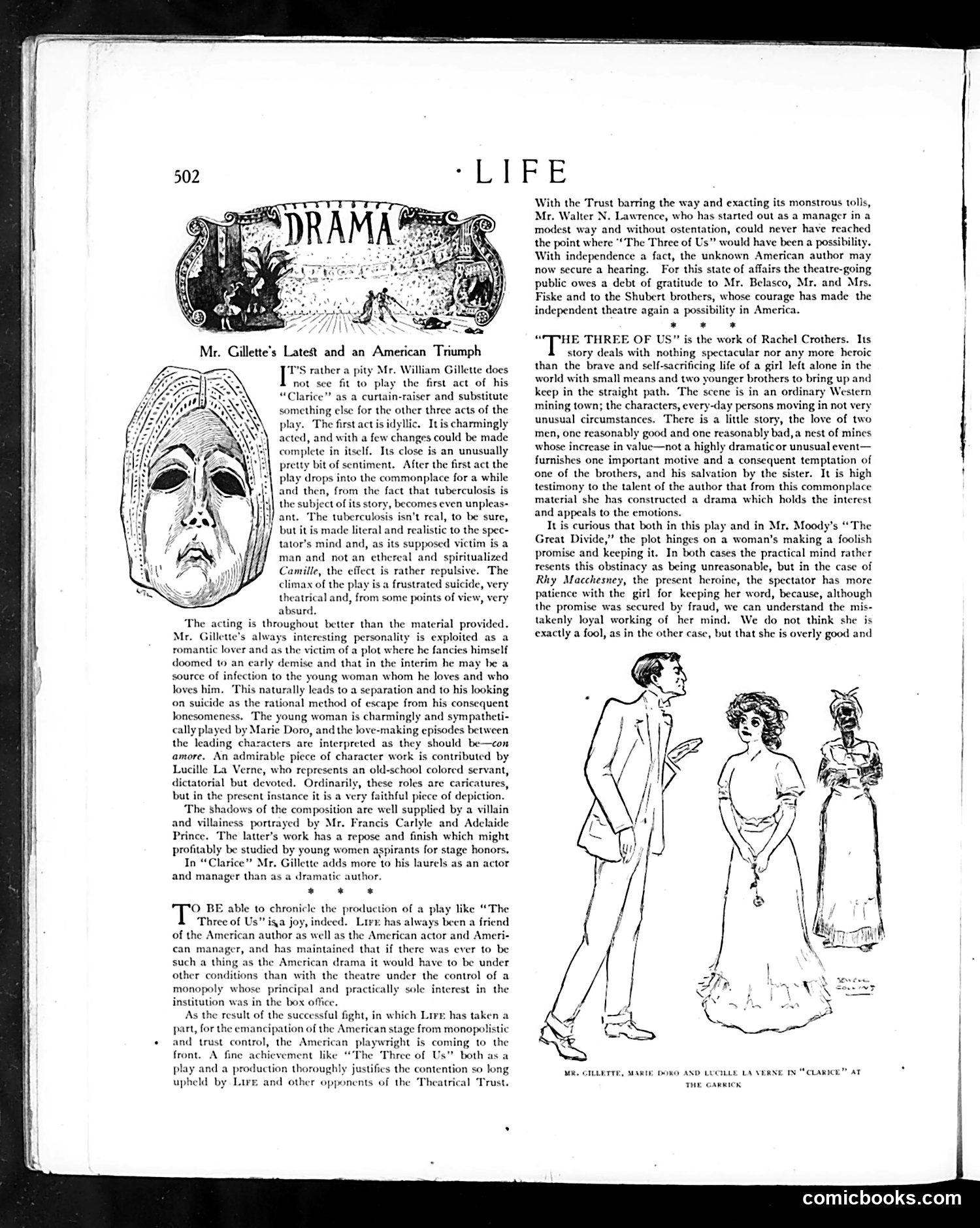
T’S rather a pity Mr. William Gillette does not see fit to play the first act of his “Clarice” as a curtain-raiser and substitute something else for the other three acts of the play. The first act is idyllic. It is charmingly acted, and with a few changes could be made complete in itself. Its close is an unusually pretty bit of sentiment. After the first act the play drops into the commonplace for a while and then, from the fact that tuberculosis is the subject of its story, becomes even unple: ant. The tuberculosis isn't real, to be sure, but it is made literal and realistic to the spec- tator’s mind and, as its supposed victim is a man and not an ethereal and spiritualized Camille, the effect is rather repulsi The ax of the play is a frustrated suicide, very theatrical and, from some points of view, very absurd, The acting is throughout better than the material provided. Mr. Gillette's always interesting personality is exploited as a romantic lover and as the victim of a plot where he fancies himself doomed to an early demise and that in the interim he may be a source of infection to the young woman whom he loves and who loves him. This naturally leads to a separation and to his looking ‘on suicide as the rational method of escape from his consequent lonesomeness. The young woman is charmingly and sympatheti- cally played by Marie Doro, and the love-making episodes between the leading characters are interpreted as they should be—con amore. An admirable piece of character work is contributed by Lucille La Verne, who represents an old-school colored servant, dictatorial but devoted. Ordinarily, these roles are caricatures, but in the present instance it is a very faithful piece of depiction. ‘The shadows of the composition are well supplied by a villain and villainess portrayed by Mr. Francis Carlyle and Adelaide Prince. The latter’s work has a repose and finish which might profitably be studied by young women aspirants for stage honors, In “Clarice” Mr. Gillette adds more to his laurels as an actor and manager than as a dramatic author. e * ¢& ‘© BE able to chronicle the production of a play like The Three of Us” iga joy, indeed. Liar: has always been a friend of the American author as well as the American actor and Ameri- can manager, and has maintained that if there was ever to be such a thing as the American drama it would have to be under other conditions than with the theatre under the control of a monopoly whose principal and practically sole interest in the institution was in the box off As the result of the successful fight, in which Lire has ti part, for the emancipation of the American stage from monopolistic and trust control, the American ght is coming to the front. A fine achievement like © Three of Us" both as a play and a production thoroughly justifies the contention so long upheld by Lire and other opponents of the Theatrical Trust. na With the Trust barring the way and exacting its monstrous tolls, Mr. Walter N. Lawrence, who has started out as a manager in a modest way and without ostentation, could never have reached the point where ‘The Three of Us” would have been a possibility. With independence a fact, the unknown American author may now secure a hearing. For this state of affairs the theatre-going public owes a debt of gratitude to Mr. Belasco, Mr, and Mrs. Fiske and to the Shubert brothers, whose courage has made the independent theatre again a possibility in America. * *# * “THE THREE OF US" is the work of Rachel Crothers. Its story deals with nothing spectacular nor any more heroic than the brave and self-sacrificing life of a girl left alone in the world with small means and two younger brothers to bring up and keep in the straight path. The scene is in an ordinary Western mining town; the characters, every-day persons moving in not very unusual circumstances. There is a little story, the love of two men, one reasonably good and one reasonably bad,a nest of mines whose increase in value—not a highly dramaticor unusual event— furnishes one important motive and a consequent temptation of one of the brothers, and his salvation by the sister. It is high testimony to the talent of the author that from this commonplace material she has constructed a drama which holds the interest and appeals to the emotions. It is curious that both in this play and in Mr. Moody’s “The Great Divide,” the plot hinges on a woman’s making a foolish promise and keeping it. In both cases the practical mind rather resents this obstinacy as being unreasonable, but in the case of Rhy Macchesney, the present heroine, the spectator has more patience with the girl for keeping her word, because, although the promise was secured by fraud, we can understand the mis- takenly loyal working of her mind. We do not think she is exactly a fool, as in the other case, but that she is overly good and MR. GILLETTE, MARIE DOKO AND LUCILLE LA VERNE IN “CLARICE” AT THE GARRICK comicbooks.com