
Life, 1906-11-01 · page 23 of 56
Life — November 1, 1906 — page 23: what you’re looking at
What you’re looking at
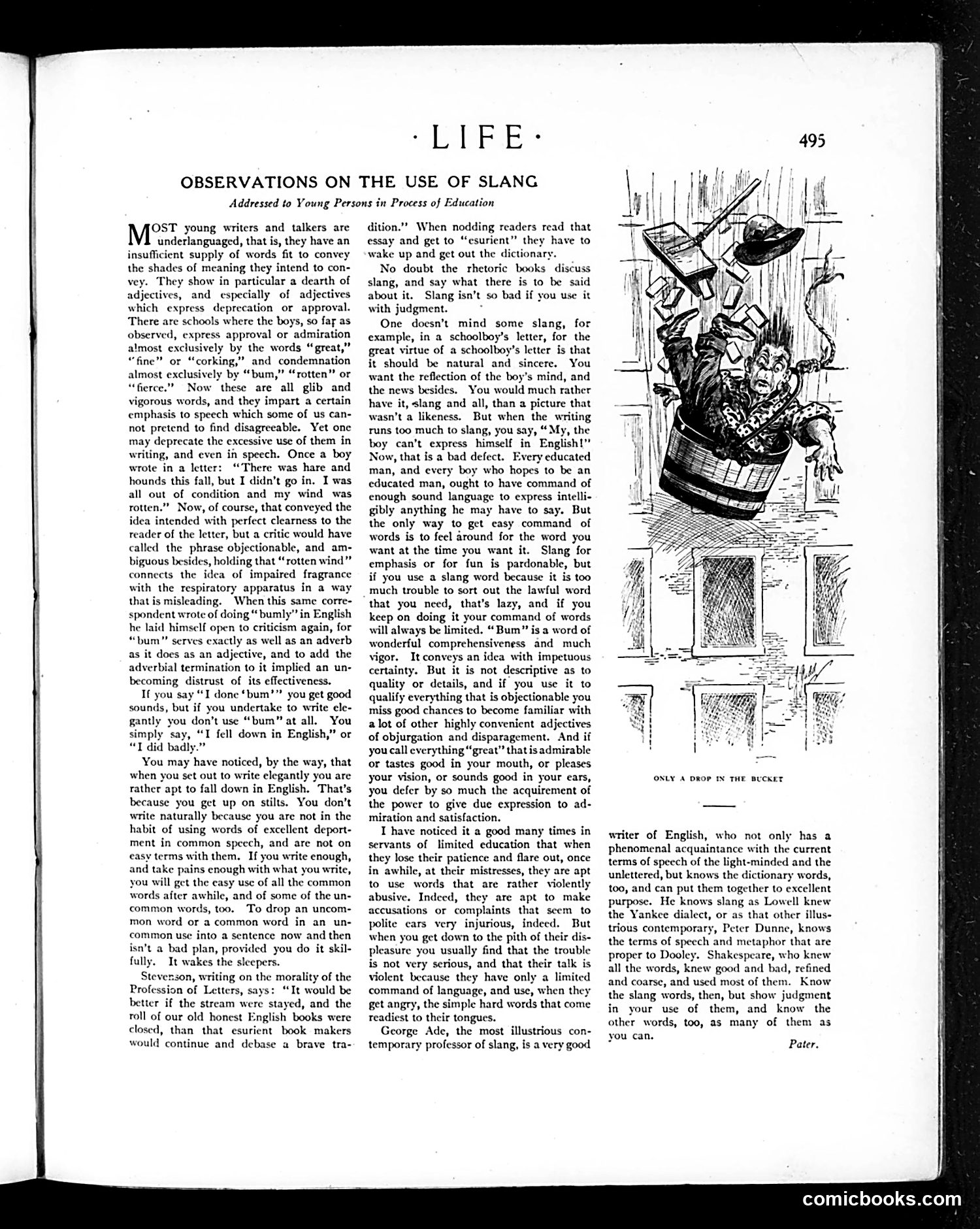
This page presents an essay addressed to young people about proper language use. The accompanying cartoon depicts a boy struggling up a staircase labeled "ONLY A DROP IN THE BUCKET"—a visual metaphor for the difficulty of self-improvement through education. The text critiques young writers and speakers for overrelying on slang terms like "great," "rotten," and "bum" due to insufficient vocabulary. The author argues that while slang may convey meaning clearly, educated people should command standard English to express themselves properly. The piece emphasizes that natural writing develops through practice using common words in speech, not by adopting "stilted" formal language. The satirical point: young people's lazy linguistic habits both reflect and perpetuate their limited education—a "drop in the bucket" toward genuine cultivation.
📄 Transcribed text from this page (OCR, searchable)
Machine-transcribed from the original scan — historical spelling and the odd misread are preserved.
Uc OBSERVATIONS ON THE USE OF SLANG Addressed to Young Persons in Process of Education OST young writers and talkers are underlanguaged, that is, they have an insufficient supply of words fit to convey the shades of meaning they intend to con- vey. They show in particular a dearth of adjectives, and especially of adjectives which express deprecation or approval. There are schools where the boys, so fay as observed, express approval or admiration almost exclusively by the words “great,” “fine” or “corking,” and condemnation almost exclusively by “bum,” “rotten”? or “fierce.” Now these are all glib and vigorous words, and they impart a certain emphasis to speech which some of us can- not pretend to find disagreeable. Yet one may deprecate the excessive use of them in writing, and even in speech. Once a boy wrote in a letter: “There was hare and hounds this fall, but I didn’t go in. I was all out of condition and my wind was rotten.” Now, of course, that conveyed the idea intended with perfect clearness to the reader of the letter, but a critic would have called the phrase objectionable, and am- biguous besides, holding that rotten wind” connects the idea of impaired fragrance with the respiratory apparatus in a way that is misleading. When this same corre- spondent wrote of doing “ bumly” in English he laid himself open to criticism again, for “bum?” serves exactly as well as an adverb as it does as an adjective, and to add the adverbial termination to it implied an un- becoming distrust of its effectiveness. If you say “I done bum?” you get good but if you undertake to write ele- ou don’t use “bum” at all. You “T fell down in English,” or when you set out to write elegantly you are rather apt to fall down in English. That’s because you get up on stilts. You don’t write naturally because you are not in the habit of using words of excellent deport- ment in common speech, and are not on easy terms with them. If you write enough, and take pains enough with what you write, you will get the easy use of all the common words after awhile, and of some of the un- common words, too. To drop an uncom- mon word or a common word in an un- common use into a sentence now and then isn’t a bad plan, provided you do it skil- It wakes the sleepers son, writing on the morality of the Profession of Letters, says: “It would be better if the stream were stayed, and the roll of our old honest English books were closed, than that esurient book makers would continue and debase a brave tra- dition.” When nodding readers read that essay and get to “esurient” they have to wake up and get out the dictionary No doubt the rhetoric books discuss slang, and say what there is to be said about it. Slang isn’t so bad if you use it with judgment. : One doesn't mind some slang, for example, in a schoolboy’s letter, for the great virtue of a schoolboy’s letter is that it should be natural and sincere. You want the reflection of the boy’s mind, and the news besides. You would much rather have it, slang and all, than a picture that wasn’t a likeness. But when the writing runs too much to slang, you say, “My, the boy can’t express himself in English!” Now, that is a bad defect. Every educated man, and every boy who hopes to be an educated man, ought to have command of enough sound language to express intelli- gibly anything he may have to say. But the only way to get easy command of words is to feel around for the word you want at the time you want it. Slang for emphasis or for fun is pardonable, but if you use a slang word because it is too much trouble to sort out the lawful word that you need, that’s lazy, and if you keep on doing it your command of words will always be limited. “Bum” is a word of wonderful comprehensiveness and much vigor. It conveys an idea with impetuous certainty. But it is not descriptive as to quality or details, and if you use it to qualify everything that is objectionable you miss good chances to become familiar with alot of other highly convenient adjectives of objurgation and disparagement. And if youcall " or tastes good in your mouth, or pleases your vision, or sounds good in your ears, you defer by so much the acquirement of the power to give due expression to ad- miration and satisfaction. I have noticed it a good many times in servants of limited education that when they lose their patience and flare out, once in awhile, at their mistresses, they are apt to use words that are rather violently abusive. Indeed, they are apt to make accusations or complaints that scem to polite cars very injurious, indeed. But when you get down to the pith of their dis- pleasure you usually find that the trouble is not very serious, and that their talk is violent because they have only a limited command of language, and use, when they get angry, the simple hard words that come Teadiest to their tongues. George Ade, the most illustrious con- temporary professor of slang, is a very good ONLY A DROP IN THE BUCKET writer of English, who not only has a phenomenal acquaintance with the current terms of speech of the light-minded and the unlettered, but knows the dictionary words, too, and can put them together to excellent purpose. He knows slang as Lowell knew the Yankce dialect, or as that other illus- trious contemporary, Peter Dunne, knows the terms of speech and metaphor that are proper to Dooley. Shakespeare, who knew all the words, knew good and bad, refined and coarse, and used most of them. Know the slang words, then, but show judgment in your use of them, and know the other words, too, as many of them as you can, . Pater, comicbooks.com