
Life, 1906-11-01 · page 42 of 56
Life — November 1, 1906 — page 42: what you’re looking at
What you’re looking at
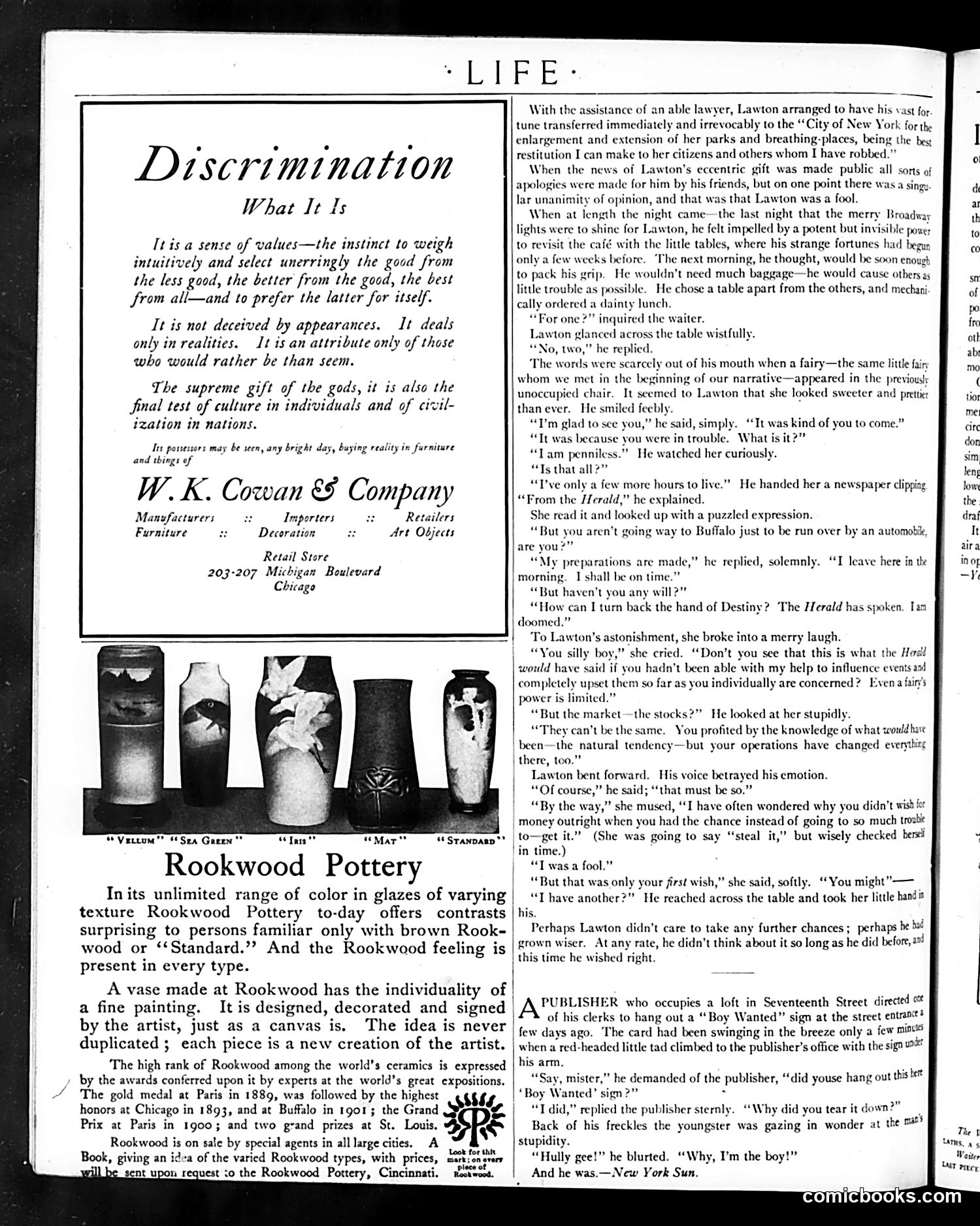
This page contains **primarily advertising and serialized fiction**, not political satire. The left side features ads for **W.K. Cowan & Company** (furniture/decorative arts) and **Rookwood Pottery** (a Cincinnati ceramics manufacturer known for artistic glazes). The pottery ad emphasizes craftsmanship and individuality—each piece uniquely created. The right side continues a serialized story about a character named **Lawton**, apparently a wealthy man who has donated his fortune to New York City parks and now faces financial ruin. A "fairy" character appears to console him, mocking his despair over predicted stock market losses and an ominous newspaper prediction of his death. The fairy argues he can change his fate through agency and wisdom. The story's theme—**discrimination** (defined in the sidebar as discerning true value from appearance)—connects thematically to the luxury goods advertised: both emphasize substance over superficiality, authentic quality over mere show. This was typical Life magazine content: literature, advertising, and humor blended together.
📄 Transcribed text from this page (OCR, searchable)
Machine-transcribed from the original scan — historical spelling and the odd misread are preserved.
Discrimination What It Is Tt is a sense of values—the instinct to weigh intuitively and select unerringly the good from the less good, the better from the good, the best from all—and to prefer the latter for itself. It is not deceived by appearances. It deals only in realities. It is an attribute only of those who would rather be than seem. The supreme gift of the gods, it is also the Jinal test of culture in individuals and of civil- ization in nations. Is possessor: may be seen, any bright day, buying reality in furniture and things of WK. Cowan &§ Company Retailers Manufacturers Art Objects Furniture & Importers Decoration Retail Store 203-207 Michigan Boulevard Chicago With the assistance of an able lawyer, Lawton arranged to have his vast for. tune transferred immediately and irrevocably to the “City of New York for the enlargement and extension of her parks and breathing-places, being the bes restitution I can make to her citizens and others whom I have robbed.” When the news of Lawton’s eccentric gift was made public all sons of apologies were made for him by his friends, but on one point there was a sing lar unanimity of opinion, and that was that Lawton was a fool. When at length the night came—the last night that the merry Broadway lights were to shine for Lawton, he felt impelled by a potent but invisible poser with the little tables, where his strange fortunes had begun only a few weeks before. ‘The next morning, he thought, would be soon enough to pack his grip. He wouldn’t need much baggage—he would cause others 2s little trouble as possible. He chose a table apart from the others, and mechani to revisit the ca = y ordered a dainty lunch. “or one?” inquired the waiter. Lawton glanced across the table wistfully. 1 “No, two,” he repl The words were scarcely out of his mouth when a fairy—the same little fairy whom we met in the beginning of our narrative—appeared in the previously unoccupied chair. It seemed to Lawton that she looked sweeter and prettier than ever. He smiled feebly “I'm glad to see you,” he said, simply. “It ind of you to come.” “Tt was because you were in trouble. What is it?” “Tam penniless.” He watched her curiously. “Ts that all?” “D’ve only a few more hours to live.” He handed her a newspaper clipping “From the Herald,” he explained. She read it and looked up with a puzzled expression. “But you aren’t going way to Buffalo just to be run over by an automobik, are you?” “My preparations are made,” he replied, solemnly. “T leave here in the | morning. I shall be on time.” “But haven't you any will?” | “How can I turn back the hand of Destiny? ‘The Herald has spoken. [a | doomed.” | To Lawton’s astonishment, she broke into a merry laugh. “You silly boy,” she cried. “Don’t you sce that this is wh would have said if you hadn't been able with my help to influence upset them so far as you individually are concerned? Even a fairs he H. vents and comple’ power is limite: “But the market —the stocks?” He looked at her stupidly. pa *Vartom’? Sea Geren '* “Tess "* “Mar” “*StanpagD Rookwood Pottery Inits unlimited range of color in glazes of varying | texture Rookwood Pottery to-day offers contrasts surprising to persons familiar only with brown Rook- | wood or ‘‘Standard.”? And the Rookwood feeling is present in every type. A vase made at Rookwood has the individuality of | a fine painting. by the artist, just as a canvas is. duplicated ; each piece is a new creation of the artist. ‘The high rank of Rookwood among the world’s ceramics is expressed by the awards conferred upon it by experts at the world’s great expositions. The gold medal at Paris in 1889, was followed by the highest honors at Chicago in 1893, and at Buffalo in 1901; the Grand Prix at Paris in 19003; and two grand prizes at St. Louis. Rookwood is on sale by special agents in all large cities. A Book, giving an idva of the varied Rookwood types, with prices, sert:on avert nt upon request zo the Rookwood Pottery, Cincinnati, slctesta. It is designed, decorated and signed | The idea is never | “They can’t be the same. You profited by the knowledge of what would have been—the natural tendency—but your operations have changed everythitg there, too.” Lawton bent forward. | “Ofcourse,” he said; ‘that must be s “By the way,” she mused, “I have often wondered why you didn't w money outright when you had the chance instead of going to so much trosbe to—get it.” (She was going to say “steal it,” but wisely checked bert lin time.) “Twas a fool.” “But that was only your first wish,” she said, softly. ‘You might”— “T have another?” He reached across the table and took her little band # his. Perhaps Lawton didn’t care to take any further chances ; perhaps he but grown wiser. At any rate, he didn’t think about it so long as he did before, 324 | this time he wished ‘right. His voice betrayed his emotion. sgh fer | A PUBLISHER who occupies a loft in Seventeenth Street directed of his clerks to hang out a “ Boy Wanted” sign at the street entrant? few days ago. ‘The card had been swinging in the breeze only a few minvis | when a red-headed little tad climbed to the publisher's office with the sign v9" his arm. “Say, mister,” he demanded of the publisher, “did youse hang out this bet ‘Boy Wanted’ sign?” “T did,” replied the publisher sternly. Back of his freckles the youngster was gazing in wonder at ¢ stupidity. “Hully gee!” he blurted. “Why, I’m the boy!” And he was.—New York Sun. “Why did you tear it down?” he sat The 1 Lams, 4 « Weiter Ut Piece icbooks.com