
Life, 1906-11-01 · page 26 of 56
Life — November 1, 1906 — page 26: what you’re looking at
What you’re looking at
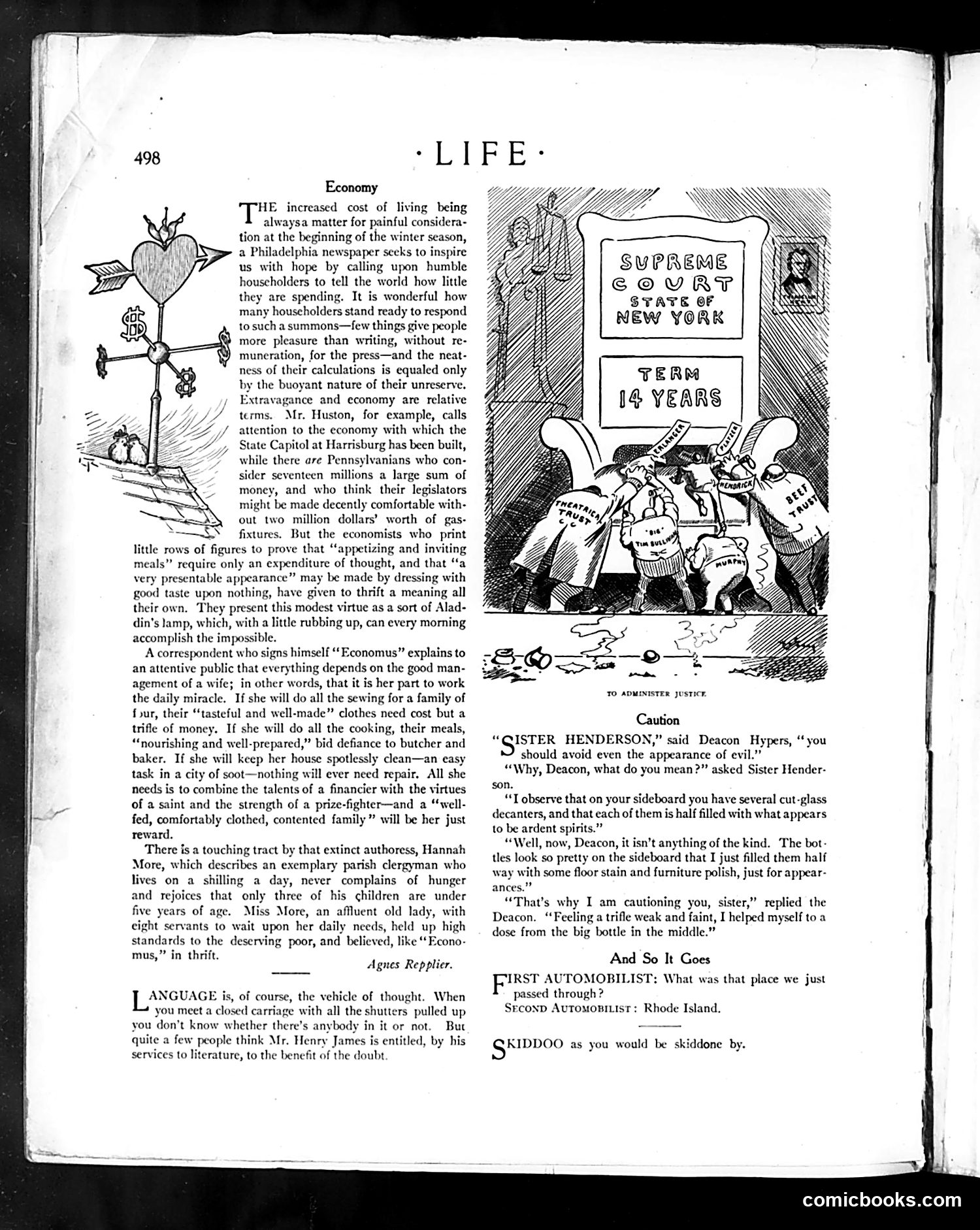
This page satirizes the era's hypocrisy about "economy" during rising living costs. The main article by Agnes Repplier mocks a Philadelphia newspaper campaign asking humble householders to publicly boast about their frugal spending. Repplier exposes the absurdity: these "economists" demand wives perform miraculous feats—sewing, cooking, cleaning—while possessing saint-like virtue and prizefighter strength, all to create the illusion of comfort on nothing. The cartoon depicts the "Supreme Court State of New York" as a grotesque judicial figure drowning in administrative burden, satirizing government inefficiency and bloated expenditure—contrasting sharply with the text's critique of unrealistic expectations placed on ordinary families. The brief anecdotes below (including a Henry James reference and a story about deceptive decanters) continue the theme of appearance versus reality and public hypocrisy.
📄 Transcribed text from this page (OCR, searchable)
Machine-transcribed from the original scan — historical spelling and the odd misread are preserved.
TE increased cost of living being alwaysa matter for painful considera- tion at the beginning of the winter season, a Philadelphia newspaper seeks to inspire us with hope by calling upon humble householders to tell the world how little they are spending. It is wonderful how many householders stand ready to respond to such a summons—few things give people more pleasure than writing, without re- muneration, for the press—and the neat- ness of their calculations is equaled only by the buoyant nature of their unreserve. ravagance and economy are relative terms. Mr. Huston, for example, calls attention to the economy with which the State Capitol at Harrisburg has been built, while there are Pennsylvanians who con- sider seventeen millions a large sum of money, and who think their legislators might be made decently comfortable with- out two million dollars’ worth of gas- : fixtures. But the economists who print little rows of figures to prove that ‘appetizing and inviting meals” require only an expenditure of thought, and that “a very presentable appearance” may be made by dressing with good taste upon nothing, have given to thrift a meaning all their own. They present this modest virtue as a sort of Alad- din's lamp, which, with a little rubbing up, can every morning accomplish the impossible. A correspondent who signs himself “Economus” explains to an attentive public that everything depends on the good man- agement of a wife; in other words, that it is her part to work the daily miracle. If she will do all the sewing for a family of four, their “tasteful and well-made” clothes need cost but a trifle of money. If she will do all the cooking, their meals, “nourishing and well-prepared,” bid defiance to butcher and baker. If she will keep her house spotlessly clean—an easy task in a city of soot—nothing will ever need repair. All she needs is to combine the talents of a financier with the virtues of a saint and the strength of a prize-fighter—and a “well- fed, comfortably clothed, contented family” will be her just reward. There is a touching tract by that extinct authoress, Hannah More, which describes an exemplary parish clergyman who lives on a shilling a day, never complains of hunger and rejoices that only three of his children are under five years of age. Miss More, an affluent old lady, with eight servants to wait upon her daily ds, held up high standards to the deserving poor, and believed, like ‘Econo- mus,” in thrift. ” Agnes Repplier. LANGUAGE is, of course, the vehicle of thought. When you meet a closed carriage with all the shutters pulled up you don’t know whether there’s anybody in it or not. But quite a few people think Mr. Henry James is entitled, by his services to literature, to the benefit of the doubt \ S SS \ MAX: NS STATE OF NEW YORK Ss \ Yj AN TO ADMINISTER JUSTICK, Caution “QISTER HENDERSON,” said Deacon Hypers, ‘you should avoid even the appearance of evil.” “Why, Deacon, what do you mean?” asked Sister Hender- son. “T observe that on your sideboard you have several cut-glass decanters, and that each of them is half filled with what appears to be ardent spirits.” “Well, now, Deacon, it isn’t anything of the kind. The bot- tles look so pretty on the sideboard that I just filled them half way with some floor stain and furniture polish, just for appear- ances.” “That’s why I am cautioning you, sister,” replied the Deacon. “Feeling a trifle weak and faint, I helped myself to a dose from the big bottle in the middle.” And So It Goes Fisst AUTOMOBILIST: What was that place we just passed through ? SEconp AvTomopiuist: Rhode Island. GEIDDOO as you would be skiddone by. comicbooks.com